Monthly Archives: June 2012

The Uncomfortable Truth about the Rise in Military Suicides

The truth can be uncomfortable and truthfully most people don’t like to deal with uncomfortable things.  Suicide is one of those things that tend to make us uncomfortable.  Occasionally someone will demand the truth and when they finally get, the truth becomes a very uncomfortable thing and frankly many people cannot handle the truth. It reminds me of the exchange in the movie A Few Good Men where Colonel Jessup played by Jack Nicholson tells Lieutenant Dan Caffey played by the Tom Cruise: “You want the truth, you can’t handle the truth!”

The United States Military has been struggling with an upsurge of suicides and suicide attempts among its personnel since 2005.  Before that point military suicide rates were comparable or lower than comparable civilian populations. That is no longer the case, the military suicide rate is now higher than the civilian rate by a statistically significant percent.

The Associated Press reported a Defense Department report noting that in the first 155 days of 2012 that 154 active duty service members had killed themselves. That number is going up, I know of at least two at my base that have occurred since this report was released including a murder suicide committed by a Staff Sergeant who had recently returned from Afghanistan.

The military has tried to stem the tide. It has bolstered its mental health services and suicide prevention programs but the numbers despite leveling out in 2010 and 2011 have been rising. These numbers are reaching staggering proportions in the active duty, reserve and discharged veteran ranks.

A Veteran’s Administration Crisis line reported that in in 2011 it had received over 164,000 calls last year. It reported 6760 rescues and noted that 2300 self reported Active Duty personnel had called their hotline as well as over 12000 calls from family members or friends of veterans regarding their loved ones.

The rise in suicides particularly as the mission in Iraq has ended and Afghanistan is beginning to draw down has surprised many both inside and outside the military. While many of the men and women who committed or   attempted suicide even more have done so who have not deployed. People are speculating about the reasons for this and we know a lot of the answers and underlying causes.

First and foremost is the stress put on the force by 10 years of non-stop deployments to combat zones and fighting two major insurgencies at the same time and the resultant effects: Soldiers, Sailors, Marines and Airmen killed and wounded, combat stress injuries, PTSD, TBI, moral injury, family issues, divorce, infidelity, financial problems, domestic violence, sexual assault, alcoholism and drug abuse. As a Chaplain I know many young men and women who grew up in Christian homes and had what they described as a deep faith who after war have lost their faith. I see an increasing number of these young men and women.

An additional factor is the fact that we are entering a period of time where Soldiers and Marines and to a lesser degree Sailors and Airmen are being threatened with a massive drawdown in numbers.  This will force many to leave the military in the midst of a long term economic downturn that could get worse based on the precarious economy of the Eurozone which threatens the US economy.

There is the perception on the part of many in the military that they fight the war alone. There is a real lack of understanding in the civilian population as a whole about what is involved in going to war. Since only about one half of one percent of the American population is in the military at any given time this should not be a surprise. Finally there is a widely held belief among those that fight the war, no matter what sacrifices they make in Afghanistan that it will not matter in the end, that the war cannot be won. No one wants to admit this but the fact of the matter is that it is true because neither political reads history.

However as important as all of those factors are they are now joined by another factor that was not a factor in the early part of the war. The bond of unit cohesion which was a positive factor is eroding. Prior to the war and during the first few years of it unit cohesion was strengthened by seasoned and mature Staff NCOs, Petty Officers. These men and women had risen through the ranks and were seasoned by years of training, well rounded careers, combat experience and deployments. Many had some amount of college education. They dealt with their own stress well and were excellent leaders and mentors to junior personnel and the young officers that they helped to train.

I was at a training conference in March attended by a couple of hundred Chaplains and Mental Health Professionals. One of the seminars dealt with a program to train the young NCOs and Petty Officers to be first responders who could care for their Marines and Sailors. During the question and answer portion I decided to bring this up. I said that “the program would be great if we had the same force that we started the war with and that the men and women that we were depending on to do this job were themselves among the injured.” I said that the force was “hardened but brittle.” A number of people including the Subject Matter Expert agreed with me, others, mostly those who were relatively new to the military looked at me like I had gone off the reservation. I brought this up at another conference this month with a similar response.

That seasoned core is gone. In their place are younger, combat hardened veterans. Unfortunately many of these young men and women, charged with leading and training the new Soldiers, Marines, Sailors and Airmen are damaged goods themselves. They have been back and forth to war so many times that they bear unspeakable burdens. Many suffer from unreported PTSD, struggle with alcoholism and have pressing personal or family problems. Some of them take out these issues on the new troops, something that I think is directly related to the suicide epidemic and other problems. The attitudes of some have become poisonous to good order and discipline and actually compromise the trust of of service members to the chain of command. That trust was essential and helped get the military through the first part of this war but I see it being eroded on a daily basis.

A glaring example of this comes not from a NCO but a Army General, the Commander of the 1st Armored Division at Fort Bliss Texas, Major General Dana Pittard at Fort Bliss Texas. General Pittard wrote on his blog: “I am personally fed up with soldiers who are choosing to take their own lives so that others can clean up their mess. Be an adult, act like an adult, and deal with your real-life problems like the rest of us.”  His attitude serves as a reminder that for many that some leaders see those suffering from PTSD, TBI or other psychological conditions as ‘broken.” Ask any Marine, Soldier, Sailor or Airmen what what it is to be labeled as “broken.” There is still a stigma attached to mental illness, depression, PTSD, suicide and being “broken” that is not helped by statements of leaders like General Pittard.

As a result the resiliency of the force is at stake. Anyone who served in the years following the Vietnam War and the beginning of the all volunteer military can see similarities then and now.  We have not reached the point where the force is broken but the situation will not show much improvement until some point of stability is reached.

I cannot state with certainty the actual proportions of this factor, just my own observations that come from counseling and listening to Marines and Sailors every day. I’m sure that the same is true in the Army where judging by what I read it seems to be worse. The Army suicide rates are the highest in the military.

What has to be done is bigger than the military itself can do. There has to be a national commitment to both finding a way to lessen the stress on the force and to do more than offer platitudes about “supporting the troops.” The truth is that as a nation we refused to pay the cost of these wars and tried to fight them on the cheap. Political leaders after September 11th 2001 told people to “go back to normal” or “go shopping” and did not call the nation to war. The nation was untouched, no one paid a dime in extra taxes and no one was forced to join the military. The burden was placed squarely on those who volunteered. That burden has not been removed and unless the American people and Congress do more than telling the military to “do more with less” while lining the pockets of defense contractors who cannot seem to produce weapons systems without major production problems, cost overruns that are never produced in the promised numbers as well as the war profiteers of the military industrial complex, the lobbyists and Wall Street.

Of course that is just my opinion. It is an opinion formed by serving over 30 years in the military and having gone to war myself. It is an opinion of someone that has been involved with suicide prevention in the military for close to 20 years. It is an opinion based on conversations that I have every day with the young Marines and Sailors that I encounter. It is quietly shared by many leaders.

I have seen what has happened first hand and if anyone actually wants to do something to change the suicide epidemic they need to look at the whole problem. It is a national problem that needs a national solution. As a nation we have burdened a comparatively small part of or population with fighting our wars without a true national commitment to either winning the wars or supporting them.

Military Medicine, Mental Health Services and Chaplains are performing heroic work to care for our troops. Many leaders “get it” and are trying to build a culture where those suffering can get help without suffering the stigma and pain of alienation that comes from being “broken.” Yet despite increases in funding, numbers and emphasis the problem continues to escalate. That is the truth and it will not significantly change until the causes that I have listed are addressed, not simply by the military but the nation.

God help us.

Peace

Padre Steve+
2 Comments

Filed under History, iraq,afghanistan, Military, national security, News and current events, Pastoral Care

Comings and Goings on a Sunday Night

It has been a few days since I have published and for those that are regular readers I do apologize. It has been a busy week which included a not to be repeated for more 10 years medical exam that comes with being over 50. I will let the reader defer to their imagination but it was a real pain in the ass. That aside, no pun  intended…the week has included a change of command at the Naval Hospital that I serve at o Friday and a celebration of the 114th anniversary of the Navy Hospital Corps rating last night as well as the normal load of pastoral counseling cases and inpatient groups.

I have also when not otherwise occupied I have been catching up on reading as well as reading for a purpose.  The purpose of the purposeful reading will be a review of the book “Leak: Why Mark Felt Became Deep Throat” by Max Holland for the folks at TLC Book Tours that I will publish here on Tuesday.

Since I have either been too tired or not feeling well after the aforementioned procedure or busy I have been outlining a number of articles that I will post this week. Subjects will include the epidemic of suicide in the military which has exploded in 2012; an article on the Hospital Corps of the US Navy; thoughts on the state of the Church and despicable actions of some of those that claim to be “Christian leaders” in the past few weeks and months; some thoughts about how hateful language and the deliberate dehumanization of certain people based on their race, religion or sexual preference frequently leads to actual violence and even genocide.  I expect also to write one or more articles on specific topics dealing with the Holocaust and the subject of Crimes against Humanity over the next few weeks. Regarding baseball I expect to be doing an article about Washington Nationals rookie sensation Bryce Harper and why he should be in the All-Star Game at the behest of a reader. I may also play around a bit and do a short story in the historical-fiction genre.  I have some ideas for the short story but haven’t decided on a specific topic, but it will deal with something interesting with a current application.

I did enjoy writing about D-Day and Midway last week. Those are subjects that I have studied or read about since childhood and which I always find something interesting enough to write about. I’ll probably do some more articles on Navy ships in the near future. I haven’t completed my series on the Super-Battleships of World War II so maybe I will do some work on those. Fore the readers unfamiliar with the series I have done a lot of articles on specific classes of the Washington Treaty Battleships of the US, Britain, France, Italy and Germany which are available under the “Warship and Naval Battles” tab at the top of the site.

I have had a good number of people suggest writing a book or possibly doing a compilation of essays from this site and turn them into a book. I expect that I will actually begin spending more of my writing time doing this and hope that I can shop around and find a publisher and literary agent. I wouldn’t mind doing a book tour of my own someday.

As for today it has been a day of celebrating a home Eucharist, doing laundry, reading and hanging out with my little dog Molly.  We went through a Hardee’s drive through this afternoon following a drive around the local area. When I ordered she had to start barking, like she’s not going to get anything. She is an entitled little dog. But then why should she not be?

Peace

Padre Steve+

Leave a comment

Filed under Loose thoughts and musings

The Battleships of D-Day

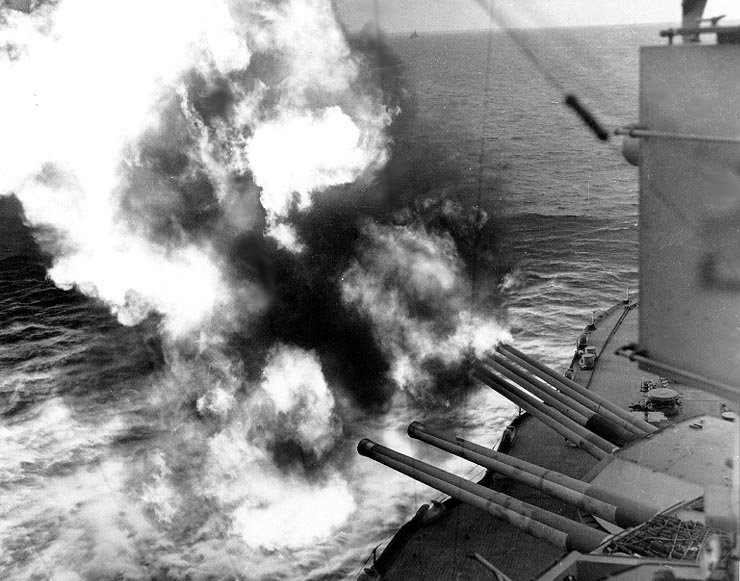
The 14″ Guns of USS Nevada in action at Normandy

On June 6th 1944 Allied Forces landed on the beaches of Normandy. Six American, British and Canadian Infantry Divisions, three Airborne Divisions and numerous supporting units came ashore in landing craft or were airdropped into Normandy. Backing them was an immense Naval Task Force which provided naval gunfire support, screened the force from German U-Boat or surface naval forces and transported the massive ground force.  It was an amazing armada.

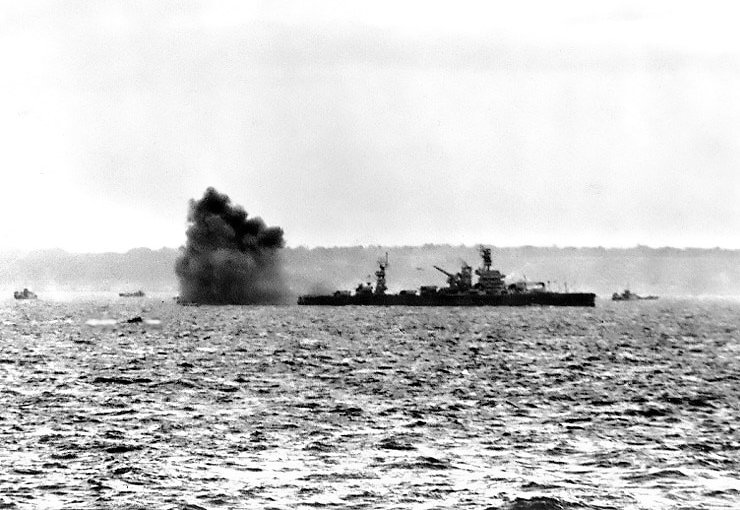
HMS Rodney bombarding German positions off Caen

It was an armada that also is forgotten by many who read about Normandy or whose only exposure to the landings are films such as Saving Private Ryan. Today I think it is fitting to remember Battleships that served at Normandy, USS Arkansas, USS Texas, USS Nevada, HMS Warspite, HMS Ramillies and HMS Rodney.

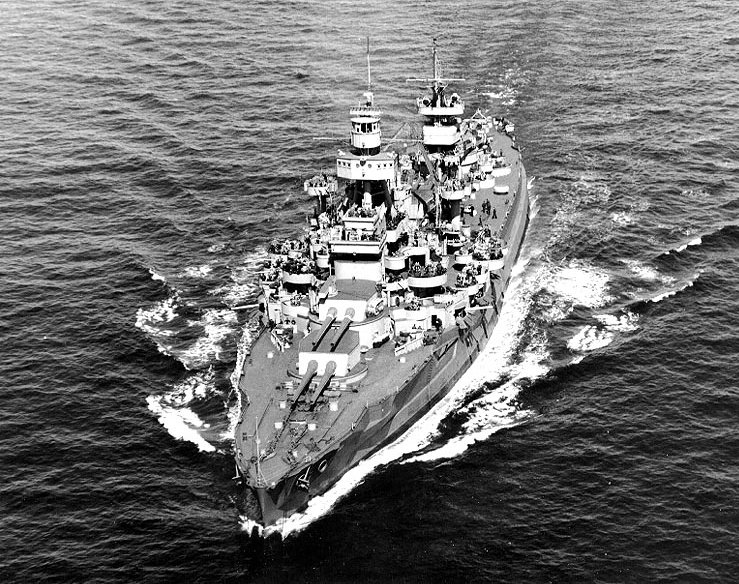
USS Arkansas off Omaha Beach

The naval gunfire support force included Battleships, Cruisers and Destroyers as well as specialized gunfire support ships.  The largest and most powerful ships were the six American and British Battleships.  These ships were important in providing the heavy firepower needed to destroy the strongest fortifications and shore batteries and to fire at targets far beyond the shoreline that were vital for German reinforcements.

However the ships involved were not the modern behemoths which were built in the 1930s and since the beginning of the war but rather among the oldest ships still active in either the United States or the British Royal Navy. At one time they had all been the hearts for their navies but now old, slow and with less than modern armament and fire control systems they were regulated to supporting amphibious forces or escorting convoys.

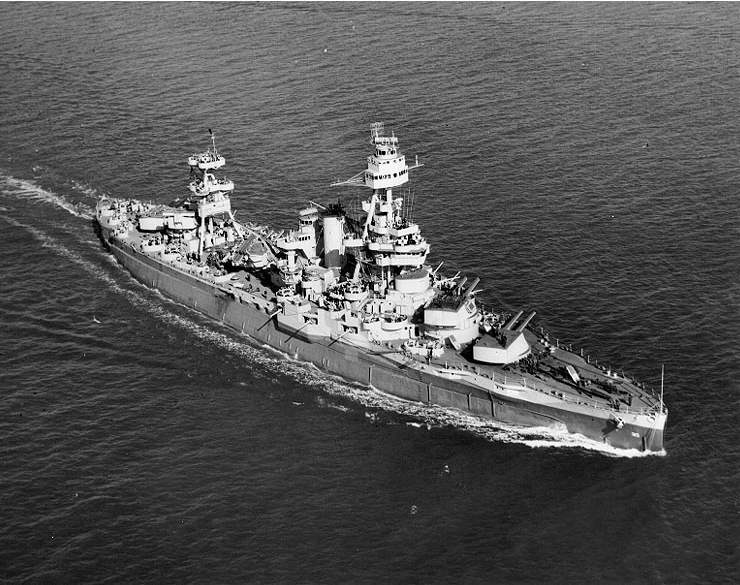
USS Arkansas BB-33

The oldest of these venerable ships was the USS Arkansas BB-33 which was commissioned in 1912. A Wyoming Class Battleship she mounted twelve 12” guns in six twin turrets, two forward, two aft and two midships. She displaced just over 27,000 tons. She had spent most of the war escorting convoys in the Atlantic before being assigned to the Normandy landings. She stood off Omaha Beach dueling with German shore batteries and pounding the German troops who were making Omaha a living hell for the men of the US 1st and 29th Infantry Divisions.  She would continue her valuable service off of Normandy and would do the same in to support the landings in Southern France before steaming to the Pacific where she would do the same at Iwo Jima and Okinawa.

USS Texas BB-35

The USS Texas, BB-35 of the New York class had been in commission since 1914. She mounted ten 14” guns in 5 twin turrets, two forward, two aft and one midships and was slightly larger than the Arkansas.  More modern she was more extensively modernized between the wars than was Arkansas and was one of the first US ships to carry experimental radar sets.  She also conducted convoy operations but was used to bombard Vichy French troops and positions during Operation Torch, the Allied invasion  of North Africa.  At D-day she was in the western sector of Omaha and bombarded Point Du Hoc and cruised to within 3000 yards of the beach to clear the western exits of the beach near Vierville.  She remained in the area a number of days and would subsequently support the attack on Cherbourg, the invasion of South France and then serve in the Pacific at Iwo Jima and Okinawa.

USS Nevada BB-36

The USS Nevada BB-36 was the first of a new class of battleships which set the basic pattern of US Battleship design through the ratification of the Washington Naval Treaty. Her main battery of ten 14” guns was mounted in four turrets, mounted fore and aft two triple and 2 twin turrets.  She was he powered by oil fired boilers as opposed to coal and   was designed with a longer cruising radius to meet the demands of War Plan Orange.  Nevada received major upgrades between the wars and on December 7th 1941 was moored on Battleship Row when Peal Harbor was attacked by the Japanese. The only Battleship to get underway during the attack Nevada was set upon by Japanese aircraft as she steamed toward the harbor entrance. Heavily damaged she was grounded off Hospital Point. She was re-floated and sailed to the United States where she was heavily modernized with a modern AA battery of twin 5” 38 caliber guns, and fire direction radars. She was modernized to the point that she no longer resembled the ship sunk at Pearl Harbor. After her repair and modernization she participated in the invasion of Attu Island and did convoy escort duty before reporting for the invasion of Normandy. Nevada supported the US 4th Infantry Division at Utah Beach and subsequently served with Texas and Arkansas in South France before going to the Pacific to support the invasions of Iwo Jima and Okinawa. Had the war continued she would have been involved in the invasion of the Japanese Mainland.

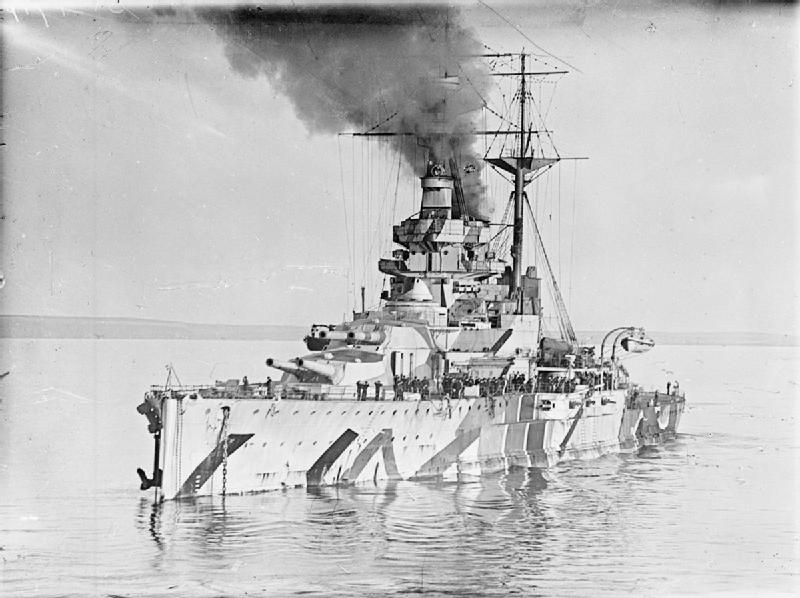
HMS Warspite

The Royal Navy Battleships of D-Day were also elderly veterans. The eldest was the heroic HMS Warsipte commissioned in 1915 and a veteran of the Battle of Jutland and numerous actions during the Second World War including the slaughter of the German Destroyers at Narvik, the Battle of Cape Matapan and the invasion of Sicily and Italy.  The Queen Elizabeth Class Battleship mounted eight 15” guns in twin turrets and was extensively modernized between the wars. At Salerno Warspite was hit by three of the earliest guided missiles, the Fritz-X type launched by Luftwaffe Aircraft. She was heavily damaged and required major repairs before returning to service at Normandy. She supported British troops at Sword Beach and later Gold Beach. She again was heavily damaged by a magnetic mine and received temporary repairs to allow her to continue bombardment duties against German positions France and Belgium before being placed in reserve in January 1945.

HMS Ramillies

The HMS Ramillies was a Revenge Class Battleship commissioned in 1917. These ships were a compromise design that was smaller, slower and cheaper than the Queen Elizabeth Class but had the same main battery of eight 15” guns.  The compromises prevented them from receiving significant upgrades between the wars and limited their employment. Ramillies operated as a convoy escort and was also involved in action in  the Mediterranean and Indian Ocean. She participated in the hunt for the German Pocket Battleship Graf Spee and shielded Convoy HX-106 from the Scharnhorst and Gneisenau and later took part in the hunt for the Bismarck. However she but was not engaged against any of the German ships but her presence prevented Admiral Lutjens from risking Scharnhorst and Gneisenau to attack the convoy. She took part in the initial battle between the Royal Navy and the Italians at the Battle of Cape Spartivento getting off several salvos before her slow speed forced her out of the action. She was heavily damaged by a torpedo from a Japanese mini-submarine in Diego Suarez harbor during the invasion of Madagascar in May 1942. Following repairs and the addition of extra deck armor and modern anti-aircraft guns she returned to action at Normandy were she supported British troops ashore and drove off an attack by German Destroyers. She stayed in action firing over 1000 shells at Normandy before supporting the invasion of Southern France. Too slow to be of use in the Pacific she was placed in Reserve in January 1945.

HMS Rodney

The youngest of the Battlewagons at Normandy on June 6th was the HMS Rodney which was commissioned in 1927. She and her sister ship HMS Nelson were to be the first of the post WWI super battleships and was designed as a larger and more powerful ship. With the limitations of the Washington Naval Treaty the ships were “cut down” and reduced in size and speed. Her armament made her one of the most powerful battleships of period but her engineering plant was not always reliable. Since she was relatively modern she did not receive any major refits before the war and apart from a repairs to her engines in Boston in 1941 (before the US entry into the war) and a brief refit in 1942 she received no further refits during the war. With the HMS King George V she helped sink the Bismarck and would escort convoys and participate in the Allied invasions of North Africa, Sicily and Salerno before being assigned to the Normandy invasion force attacking targets near Caen.  Her sister HMS Nelson was held in reserve and joined the battle on June 10th but she was not present on D-Day.

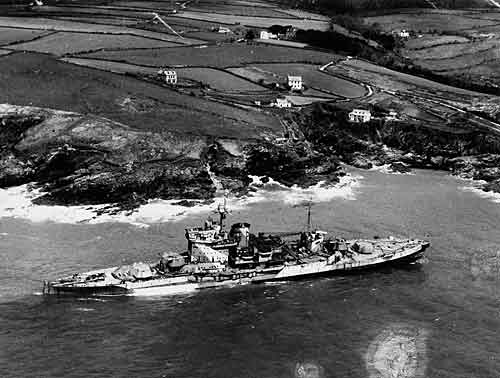
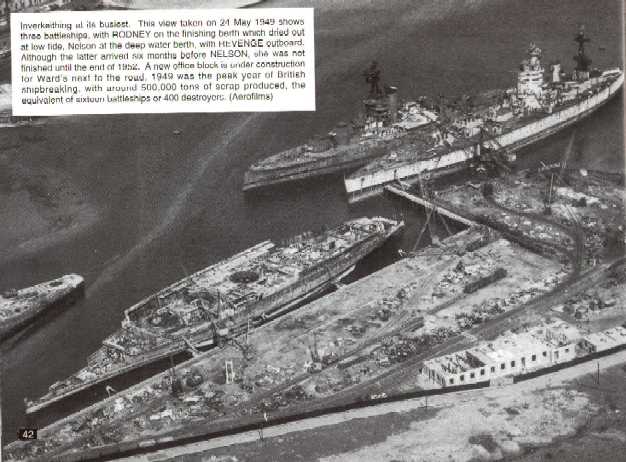
Warspite aground and Rodney being scrapped (below)

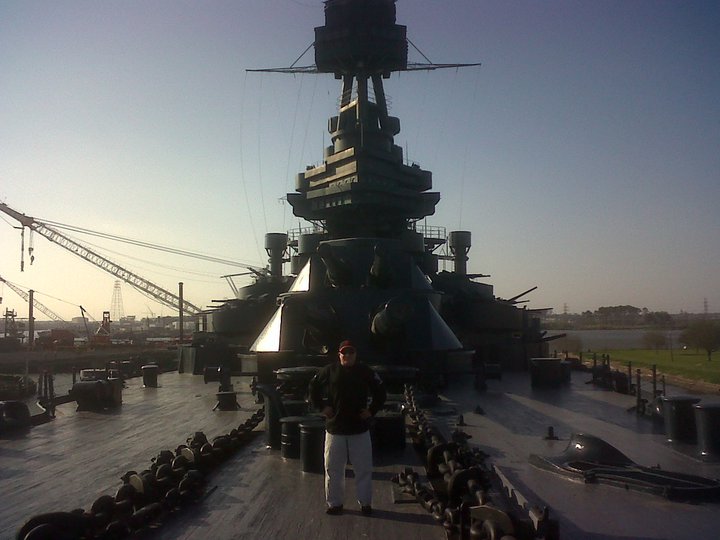
Despite their age and limitations all of these ships and their performed heroically during the war. The post war period was not as kind to the ships. Arkansas and Nevada were used in the Atomic Bomb tests at Bikini Atoll. Nevada survived and was expended as a target in 1948. All of the British ships were scrapped following the war due to their age, wear and damage incurred during the war. Warspite was being towed to the breakers when she broke a tow line and went aground. She ended up being partially scrapped in place.  Mementos of all these ships remain including a gun from Ramillies at the Imperial War Museum. The lone survivor was the USS Texas which became a museum ship and memorial at the San Jacinto battlefield in 1948. She is the last of the Dreadnought ships remaining. Other more modern US Battleships have been preserved but only Texas remains from those ships that at one time ruled the waves and pounded the Germans at Normandy.

The author aboard USS Texas in March 2011

The fire support provided by these proud ships and their consorts ensured the success of the Normandy landings. Without them it is very possible that the landings would not have succeeded and many more Allied soldiers would have died and the war extended.

To these great ships and all their heroic crews…

Peace

Padre Steve+

28 Comments

Filed under History, Military, Navy Ships, US Navy, world war two in europe

Compounding Disaster: The Loss of the Mikuma at Midway

Mikuma as Built

Admiral Isoroku Yamamoto was still attempting to digest the calamity that had befallen Admiral Nagumo’s carrier task force. In the shocked atmosphere of the mighty Super Battleship Yamato’s command center the Staff of the Combined Fleet was hastily attempting to arrive at a solution which might reverse the disaster and bring victory.  Admiral Ugaki, Yamamoto’s Chief of Staff despite his personal doubts ordered Vice Admiral Nobutake Kondo to prepare for a night surface engagement with the US Fleet and to dispatch a strong surface force to bombard Midway in order to prevent the Americans from reinforcing it and to prevent its further use against his forces should the invasion move forward.  Kondo organized his fleet to attempt to find the American carriers and bring them to battle before dawn.

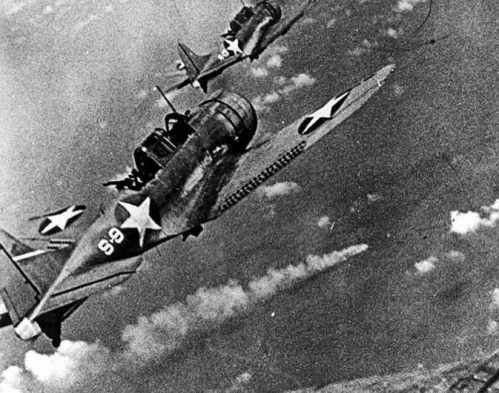
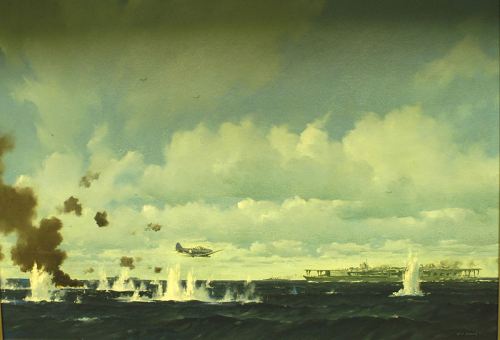
SBD Dauntless Dive Bombers from Hornet attacking Mogami and Mikuma 

Kondo detached Vice Admiral Takeo Kurita’s Close Support Group composed of Cruiser Seven, the fastest and most modern cruisers in the Imperial Navy proceed at full speed to attack Midway.  Kurita’s cruisers, the Kumano, Suzuya, Mikuma and Mogami were each armed with 10 8” guns and were escorted by the two destroyers.

Kurita’s force was 80 miles from Midway when Yamamoto realizing that his plan was unrealistic ordered Kondo’s forces to retreat and rendezvous with his main force shortly after midnight. The order was met with a measure of relief by most officers in the force and the force turned northwest and steamed at 28 knots to meet the Main Body.  At 0215 lookouts on Kumano sighted a submarine on the surface which turned out to be the USS Tambor which had been shadowing the group, and made a signal for the force to make a emergency 45 degree turn to port.

During the process Mogami’s Navigator took over from the watch to oversee the tricky maneuver. In doing so he thought that there was too much distance between him and the ship ahead, the Mikuma. So he adjusted his course to starboard and then realized his mistake. The ship he thought was Mikuma was actually Suzuya and Mikuma was directly ahead. As soon as he recognized his mistake Mogami’s Navigator ordered a hard turn to port and reversed the engines but it was too late. Mogami’s bow crashed into Mikuma’s port quarter. The impact caused minimal damage to Mikuma but Mogami was heavily damaged. She lost 40 feet of her bow and everything else was bent back to port at right angles to her number one turret.

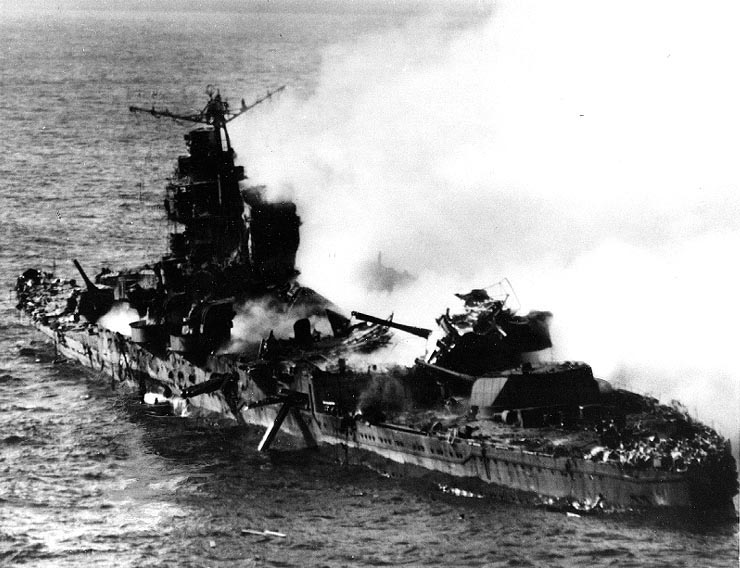
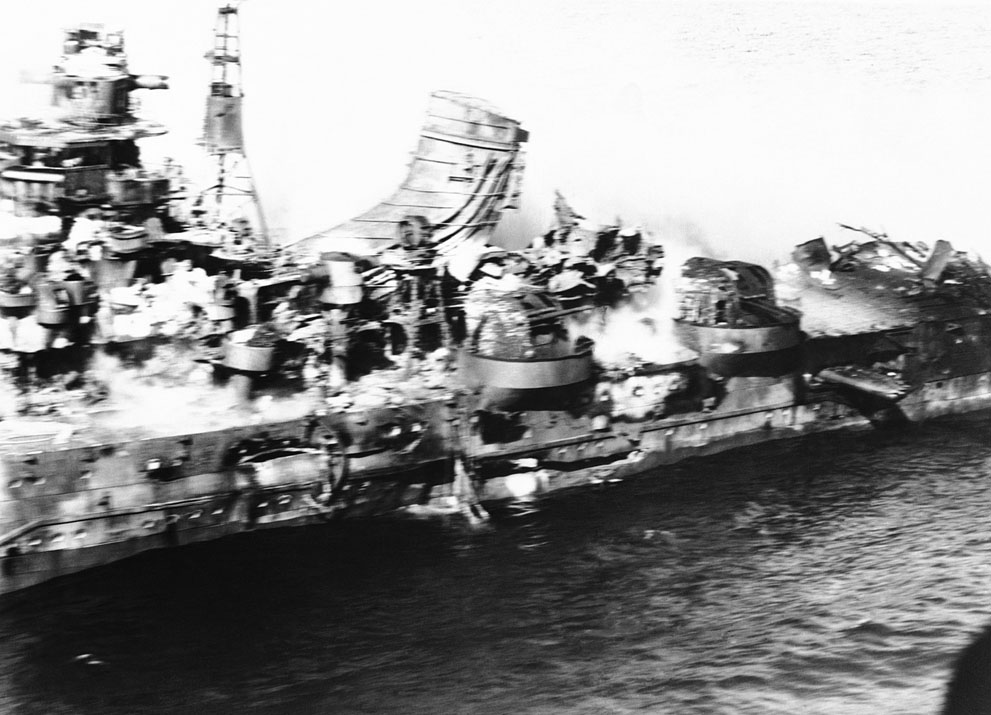
Ariel Photo of Mikuma damaged

Mogami’s damage control teams isolated the damage and worked the ship up to 12 knots. This was not fast enough for Kurita to make his rendezvous so he left Mikuma and the destroyers to escort Mogami while he steamed ahead with Kumano and Suzuya.

Mikuma adrift and sinking. The wreckage of Captain Fleming’s Vindicator can be seen on X- Turret 

Tambor’s skipper LCDR John W Murphy sent a contact report at 0300 reporting “many unidentified ships.” He followed this with more detailed information and the Americans on Midway began to launch its remaining serviceable aircraft to attack the threat. A flight of B-17 Bombers launched at 0430 could not find the Japanese ships but at 0630 a PBY Catalina found the Japanese and radioed Midway “two Japanese battleships streaming oil.”  The remaining 12 aircraft of VSMB-241 under command of Captain Marshall Tyler a mix of SBD Dauntless and SB2U Vindicators took off at 0700. His force attacked at 0808 scoring no hits but Captain Richard Fleming, his Vindicator on fire dropped his bomb and then crashed his aircraft into Mikuma’s after turret. The fire was sucked down air intakes into the starboard engine room with disastrous results. The engineers were suffocated by the smoke and fumes and Mikuma was greatly reduced in speed.

Close up shot of Mikuma with survivors visible 

The two ships limped northwest at 12 knots escorted by the destroyers and were unmolested through much of the day with the exception of an ineffective attack by the B-17s at 0830. The following morning the Dive Bombers of Enterprise and Hornet were at work and found the crippled Japanese ships. Waves over US Dive Bombers attacked the cruisers throughout the morning and into the afternoon. Mikuma was hit at least 5 times and secondary explosions of ammunition and torpedoes doomed the ship. Mogami was also heavily damaged but remained afloat while both destroyers received bomb damage.  At sunset the tough cruiser rolled over to port and sank into the Pacific. Mogami whose damage control teams had performed miracles to keep their ship afloat helped the destroyers rescue survivors from Mikuma.  Only 240 were rescued with 650 officers and sailors going down with the ship.

The action against the cruisers ended the combat operations at Midway. The Japanese ships were doomed by Yamamoto’s decision to try to salvage victory from defeat and the error of Mogami’s Navigator during the emergency turn when Kumano sighted Tambor. The only thing that kept the result from being total was the efficacy of Mogami’s damage control teams.  Mogami was out of the war for 10 months following repairs and conversion to an Aircraft Cruiser in which her aft turrets were removed to increase the number of float plane scouts that the ship could carry. She rejoined the fleet in April 1943 and was sunk following the Battle of the Surigao Strait on 25 October 1944.

The Mogami and Mikuma proved to be tough ships to sink. Unprotected by friendly aircraft they fought hard against the unopposed American Dive Bombers. They suffered massive damage from 500 and 1000 pound bombs, both direct hits and near misses. Mogami was saved by the skill of her damage control teams and the foresight of her Damage Control Officer to jettison her torpedoes so that they did not explode and compound the damage wrought by the American bombs.

For the Americans it was a fitting end to the Battle of Midway and revenge for the Battle of the Sunda Strait where Mikuma and Mogami sank the USS Houston.

Peace

Padre Steve+
3 Comments

Filed under History, Military, Navy Ships, US Navy, world war two in the pacific

70 Years: Celebrating the Miracle at Midway

It is hard to imagine now but in June of 1942 it seemed a good possibility that the Americans and British could be on the losing side of the Second World War.

In June 1942 the Japanese onslaught in the Pacific appeared nearly unstoppable. The Imperial Navy stormed across the Pacific and Indian Oceans in the months after Pearl Harbor decimating Allied Naval forces that stood in their way.  The British Battleships HMS Prince of Wales and HMS Repulse were sunk by land based aircraft off of Singapore. A force of Royal Navy cruisers and the Aircraft Carrier HMS Hermes were sunk by the same carriers that struck Pearl Harbor in the Indian Ocean.  Darwin Australia was struck with a devastating blow on February 19th and on February 27th the Japanese annihilated the bulk of the American, British, Dutch and Australian naval forces opposing them at the Battle of the Java Sea. American forces in the Philippines surrendered on May 8th while the British in Singapore surrendered on February 15th.

In only one place had a Japanese Naval task force been prevented from its goal and that was at the Battle of the Coral Sea.  Between 4-8 May the US Navy’s Task Force 11 and Task Force 17 centered on the Carriers USS Lexington and USS Yorktown prevented a Japanese invasion force from taking Port Moresby. Their aircraft sank the light carrier Shoho, damaged the modern carrier Shokaku and decimated the air groups of the Japanese task force. But it was the unexpected raid by US Army Air Corps B-25 Bombers launched from the USS Hornet under command of Colonel Jimmy Doolittle on April 18th 1942 which embarrassed Yamamoto so badly that he ordered the attack to take Midway and destroy the remaining US Naval power in the Pacific.

In May US Navy code breakers discovered the next move of the Imperial Navy an attack on Midway Island and the Aleutian islands.   Since the occupation of Midway by Japanese forces would give them an operational base less than 1000 miles from Pearl Harbor Admiral Chester Nimitz committed the bulk of his naval power, the carriers USS Enterprise CV-6, USS Yorktown CV-5 and USS Hornet CV-8 and their 8 escorting cruisers and 15 destroyers.  His force of 26 ships with 233 aircraft embarked to defend Midway while a force of 5 cruisers and 4 destroyers was dispatched to cover the Aleutians.  Midway itself had a mixed Marine, Navy and Army air group of 115 aircraft which included many obsolete aircraft, 32 PBY Catalina Flying Boats and 83 fighters, dive bombers, torpedo planes and Army Air Force bombers piloted by a host of inexperienced but resolute airmen.

The Japanese Fleet was led by Admiral Isoroku Yamamato and was built around the elite First Carrier Striking Group composed of the Pearl Harbor attackers Akagi, Kaga, Soryu and Hiryu. Led by Vice Admiral Chuichi Nagumo its highly trained and combat experienced air groups composed of 273 aircraft. This force was escorted by 2 Battleships, 3 Cruisers 12 Destroyers. Yamamoto commanded a force of  2 light carriers, 5 Battleships, 11 cruisers and 27 destroyers.  Meanwhile a  force of 4 battleships, 12 destroyers assigned screen to the Aleutian invasion force which was accompanied by 2 carriers 6 cruisers and 10 destroyers. The other carriers embarked a further 114 aircraft.  The Japanese plan was ambitious but it was so ambitious that the Japanese Task forces were scattered over thousands of square miles of the Northern Pacific Ocean from which they could not rapidly come to the support of each other.

With the foreknowledge provided by the code breakers the US forces hurried to an intercept position northeast of Midway. They eluded the Japanese submarine scout line which the Japanese Commander Admiral Yamamoto presumed would find them when they sailed to respond to the Japanese attack on Midway.  Task Force 16 with the Enterprise and Hornet sailed first under the command of Rear Admiral Raymond A Spruance in place of the ailing William “Bull” Halsey. Task Force 17 under Rear Admiral Frank “Jack” Fletcher was built around the Yorktown which had been miraculously brought into fighting condition after suffering heavy damage at Coral Sea. Fletcher assumed overall command by virtue of seniority and Admiral Nimitz instructed his commanders to apply the principle of “calculated risk” when engaging the Japanese as the loss of the US carriers would place the entire Pacific at the mercy of the Japanese Navy.

On June 3rd a PBY Catalina from Midway discovered the Japanese invasion force and US long range bombers launched attacks against but inflicted no damage. On the morning of the 4th the Americans adjusted their search patterns in and the Japanese came into range of Midway and commenced their first strike against the island.  In response land based aircraft from Midway attacked the Japanese carrier force taking heavy casualties and failing to damage the Japanese task force.

The American Carrier task forces launched their strike groups at the Japanese fleet leaving enough aircraft behind of the Combat Air Patrol and Anti-submarine patrol.  As the Americans winged toward the Japanese fleet the Japanese were in confused.  A scouting report by an aircraft that had been delayed at launch discovered US ships but did not identify a carrier until later into the patrol.  This was the Yorktown and TF 17. The Japanese attempted to recover their strike aircraft and prepare for a second strike on the island and then on discovery of the carrier embarked on the task of unloading ground attack ordnance in favor of aerial torpedoes and armor piercing bombs.  The hard working Japanese aircrew did not have time to stow the ordnance removed from the aircraft but by 1020 they had the Japanese strike group ready to launch against the US carriers.

As the Japanese crews worked the Japanese carriers were engaged in fending off attacks by the US torpedo bomber squadrons, VT-6 from Enterprise, VT-8 from Hornet and VT-3 from Yorktown.  The Japanese Combat Air Patrol ripped into the slow, cumbersome and under armed TBD Devastators as they came in low to launch their torpedoes.  Torpedo Eight from Hornet under the command of LCDR John C Waldron pressed the attack hard but all 15 of the Devastators were shot down.  Only Ensign George Gay’s aircraft was able to launch its torpedo before being shot down and Gay would be the sole survivor of the squadron.

Torpedo 6 under the command of LCDR Eugene Lindsey suffered heavy casualties losing 10 of 14 aircraft with Lindsey being one of the casualties.  The last group of Devastators to attack was Torpedo 3 under the command of LCDR Lem Massey from the Yorktown.  These aircraft were also decimated and Massey killed but they had drawn the Japanese Combat Air Patrol down to the deck leaving the task force exposed to the Dive Bombers of the Enterprise and Yorktown.

There had been confusion among the Americans as to the exact location of the Japanese Carriers, the Bombing 8 and Scouting 8 of Hornet did not find the carriers and had to return for lack of fuel with a number of bombers and their fighter escort having to ditch inn the ocean and wait for rescue.  The Enterprise group under LCDR Wade McClusky was perilously low on fuel when the wake of a Japanese destroyer was spotted.  McClusky followed it to the Japanese Task Force.  The Yorktown’s group under LCDR Max Leslie arrived about the same time.  The found the skies empty of Japanese aircraft. Aboard the Japanese ships there was a sense of exhilaration as each succeeding group of attackers was brought down and with their own aircraft ready to launch and deal a fatal blow to the American carrier wondered how big their victory would be.

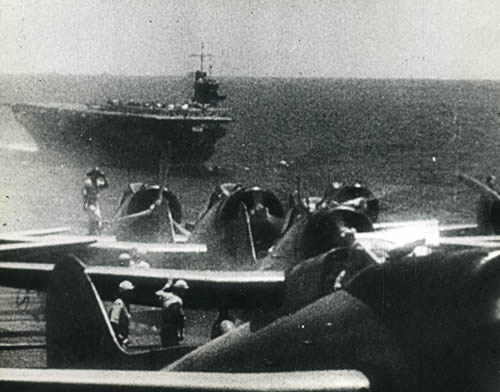
At 1020 the first Zero of the Japanese attack group began rolling down the flight deck of the flagship Akagi, aboard Kaga aircraft were warming up as they were on the Soryu.  The unsuspecting Japanese were finally alerted when lookouts screamed “helldivers.” Wade McClusky’s aircraft lined up over the Akagi and Kaga pushing into their dives at 1022. There was a bit of confusion when the bulk of Scouting 6 joined the attack of Bombing 6 on the Kaga.  The unprepared carrier was struck by four 1000 pound bombs which exploded on her flight deck and hangar deck igniting the fully fueled and armed aircraft of her strike group and the ordnance littered about the hangar deck.  Massive fires and explosions wracked the ship and in minutes the proud ship was reduced to an infernal hell with fires burning uncontrollably. She was abandoned and would sink at 1925 taking 800 of her crew with her.

LT Dick Best of Scouting 6 peeled off from the attack on Kaga and shifted to the Japanese flagship Akagi. On board Akagi were two of Japans legendary pilots CDR Mitsuo Fuchida leader of and CDR Minoru Genda the architect of the Pearl Harbor attack and subsequent string of Japanese victories.  Both officers were on the sick list and had come up from sick bay to watch as the fleet was attacked.  Seeing Kaga burst into flames they stood mesmerized until Akagi’s lookouts screamed out the warning “helldivers” at 1026.  Best’s aircraft hit with deadly precision landing tow of their bombs on Akagi’s flight deck creating havoc among the loaded aircraft and starting fires and igniting secondary explosions which turned the ship into a witch’s cauldron.  By 1046 Admiral Nagumo and his staff were forced to transfer the flag to the cruiser Nagara as Akagi’s crew tried to bring the flames under control. They would do so into the night until nothing more could be done and abandoned ship at 2000.  Admiral Yamamoto ordered her scuttled and at 0500 on June 5th the pride of the Japanese carrier force was scuttled.

VB-3 under LCDR Max Leslie from the Yorktown stuck the Soryu with 17 aircraft, only 13 of which had bombs due to an electronic arming device malfunction on 4 of the aircraft including the squadron leader Leslie.  Despite this they dove on the Soryu at 1025 hitting that ship with 3 and maybe as many as 5 bombs. Soryu like her companions burst into flames as the ready aircraft and ordnance exploded about her deck. She was ordered abandoned at 1055 and would sink at 1915 taking 718 of her crew with her.

The remaining Japanese flattop the Hiryu attained the same fate later in the day after engaging in an epic duel with the Yorktown which her aircraft heavily damaged. Yorktown was abandoned after a second strike but when she did not sink her her returned to attempt to save her. However despite their efforts she and the destroyer USS Hamman DD-412 were torpedoed by the Japanese Submarine I-168. Hamman sank almost immediately with heavy loss of life while Yorktown sank on the morning of the 7th.

It was quite miraculous what happened at Midway in those five pivotal minutes.  Authors have entitled books about Midway Incredible Victory and Miracle at Midway and the titles reflect the essence of the battle.  A distinctly smaller force defeated a vastly superior fleet in terms of experience, training and equipment and when it appeared that the Japanese Fleet would advance to victory in a span of less than 5 minutes turn what looked like certain defeat into one of the most incredible and even miraculous victories in the history of Naval warfare.  In those 5 minutes history was changed in a breathtaking way.  While the war would drag on and the Japanese still inflict painful losses and defeats on the US Navy in the waters around Guadalcanal the tide had turned and the Japanese lost the initiative in the Pacific never to regain it.   The Japanese government hid the defeat from the Japanese people instead proclaiming a great victory while the American government could not fully publicize the information that led to the ability of the US Navy to be at the right place at the right time and defeat the Imperial Navy.

When one looks at implications of the victory it did a number of things. First it changed the course of the war in the Pacific probably shortening it by a great deal.  Secondly it established the aircraft carrier and the fast carrier task force as the dominant force in naval warfare which some would argue it still remains.  Finally those five minutes ushered in an era of US Navy dominance of the high seas which at least as of yet has not ended as the successors to the Enterprise, Hornet and Yorktown ply the oceans of the world and the descendants of those valiant carrier air groups ensure air superiority over battlefields around the world.

Peace

Padre Steve+

4 Comments

Filed under History, Military, Navy Ships, US Navy, world war two in the pacific

The Diamond Jubilee: All Glory is Fleeting

Whenever I see anything about Queen Elizabeth II, especially the grand celebrations that reverberate around the nations that at one time or another were the exploited subjects of the British Empire I am less than excited. Nothing against the Queen or her predecessors I am less than impressed by the tabloid  media spectacle that currently surrounds the House of Windsor. At one time the British monarchy meant something, it was the titular symbol of an empire that spanned the globe. It was the symbol of the world’s mightiest navy, and largest and most powerful economic system.  It was the symbol of a nation that had stood alone against Napoleon and Hitler, it was the symbol of stability in times of tumult that Britons of all political leanings could rally around. But it was a symbol, a symbol of a nation that pioneered the rule of law and rule by a government of the parliamentary majority in the House of Commons. While the monarch was and is the “Head of State” their influence since the 1701 Act of Settlement  has been mostly symbolic and the practical function of the monarch is limited to non-partisan activities such as granting honors and titles.

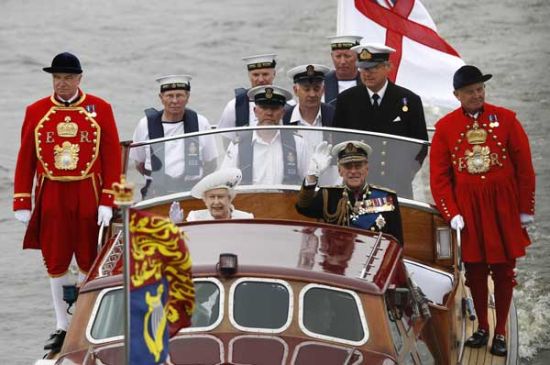
Today Queen Elizabeth reigns over a struggling nation and empire in name only. For much of her reign the Royal family has symbolized the decline of the empire with various members becoming the laughingstock of the world. While the Monarchy has recovered from the worst of its dips in popularity following the death of Princess Diana the the Royal family still surrounded by opulence and the splendor of history has with few exceptions seemed out of touch, indolent and irrelevant.  Some commentators have said that today’s “naval review” was important to give people a “sense of national pride at a time when the economy is in recession and people face deep austerity measures.”

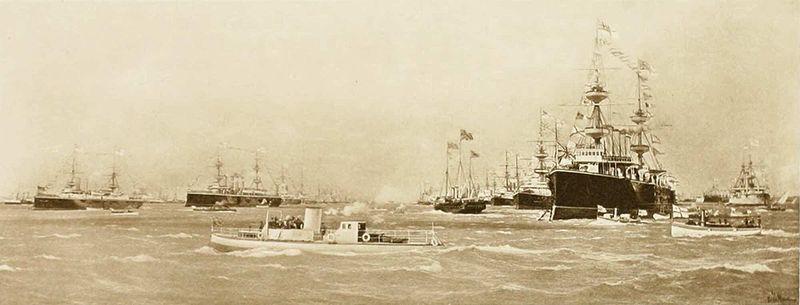
The Fleet Review at Elizabeth’s Coronation (above) and Queen Victoria’s Diamond Jubilee (below)

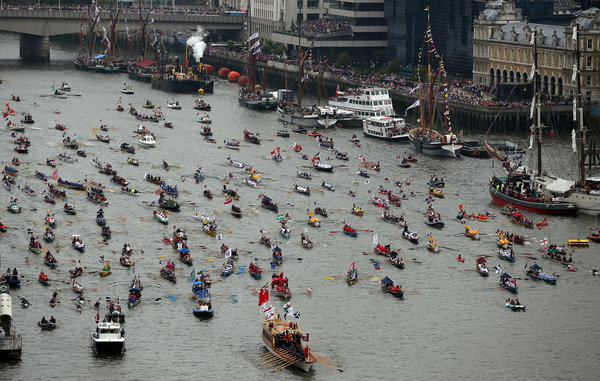
When I saw the news coverage of today’s “review” in the Thames I was happy for the Queen and how much it seemed to mean to a lot of the people present.  Yet at the same time I was saddened about the condition Britain. When King George VI, Queen Elizabeth’s father was crowned a real naval review showcasing over 200 warships from Britain and around the world were on display to pay honor to the new King. When Queen Victoria celebrated her Diamond Jubilee in 1897 165 ships of the Royal Navy were present. In the sense of history I found the motley collection of some 1000 small craft that paraded down the Thames to be less than impressive, a testament of sentimentality over substance, a triumph of merchandising rather than might. The presence of several dozen antique survivors of the Miracle of Dunkirk in 1940 in the parade was interesting and meaningful but it was a reminder of how a nation rallied to save its Army from certain annihilation in 1940 that said more about the British people than the current monarchy.

The British monarchy is in decline and even the question of succession provokes questions as to what shape and influence it will have in the future. The sad fact is that today’s parade on the Thames in honor of Elizabeth’s Diamond Jubilee is a celebration of past glory that provides momentary comfort to a nation is crisis. It is a reminder that indeed “all glory is fleeting.”

Peace

Padre Steve+

5 Comments

Filed under History, News and current events

8020 Games and Finally….a Miracle for the Mets: Johan Santana Pitches First No-No in Mets History

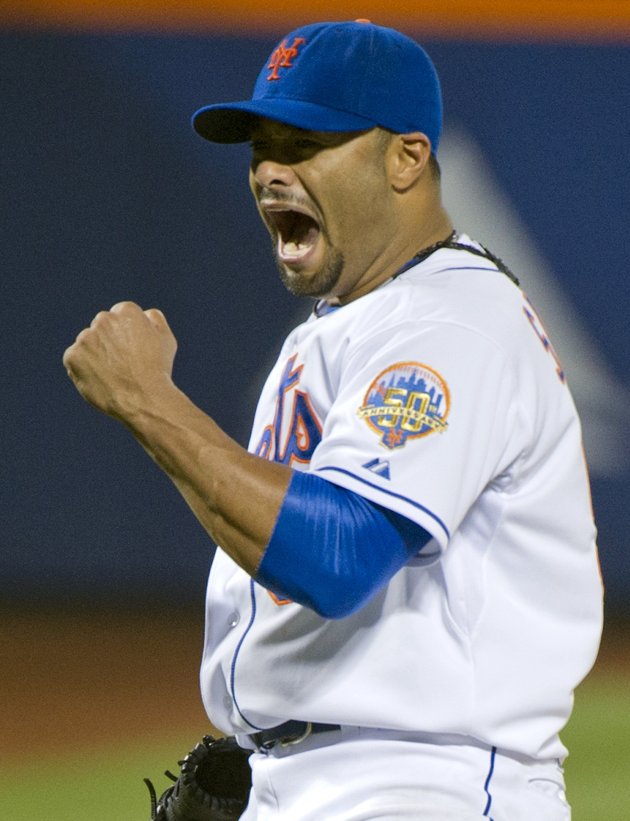
Johan Santana celebrates after striking out David Freese (Photo Ray Stubblebine/Reuters)

“A pitcher’s got to be good and he’s got to be lucky to get a no hit game.” Cy Young 

The New York Mets ended a 50 year drought as Johan Santana no-hit the St. Louis Cardinals tonight in New York. It was the longest that a team had gone in MLB history without a no-hitter and leaves the San Diego Padres as the only team in the Majors with 43 years without a no-hitter.

Santana threw 134 pitches as the Mets shut-out the Cardinals by a score of 8-0. After going down 3 balls and no strikes to David Freese Santana came back to strike out the Cardinal’s slugger to cinch to no-hitter.  Santana joined Phillip Humber of the White Sox and Jared Weaver of the Angels to pitch the 3rd no-hitter of this still young season. For Santana and the Mets it was a cause for celebration.  The Mets are not strangers to having good pitchers on their staff but despite this and having won two World Series titles but had never had one of their own pitchers whose ranks include David Cone, Greg Maddux and Tom Seaver ever pitch a no-hitter as a Met.

Santana a three time All-Star and two time AL Cy Young Award Winner has 136 career wins since entering the Majors with the Minnesota Twins in 2000.  Santana had missed the entire 2011 season after having surgery to repair a tear of the anterior capsule in his pitching shoulder. No pitcher had ever returned from that type of surgery and Santana entered the season just hoping to return to his pre-surgery form. After the game Santana said “Coming into this season, I was just hoping to come back and stay healthy and help this team….” Manager Terry Collins had planned on limiting Santana to 110 pitches but in the 8th inning Santana let his manager know that he “felt good.” Collins left his starter who had thrown a shut-out in his last outing against the Padres in the game. Santana recounted the conversation:

“He came right next to me and he just told me that I was his hero. At that point, I told him, ‘Listen, I’m just going to try to go out there and do my job and try to go as deep as I could in the game.’ And tonight, he was not going to take me out of the game — no chance.”

As in any no-hitter it seemed that the God of Baseball was with the pitcher. Sandy Koufax once said “You’ve got to be lucky, but if you have good stuff, it’s easier to be lucky” and such was the case with Santana this first day of June.  In the 7th inning Santana’s effort was saved when Mike Baxter made a dramatic catch of a Yadier Molina fly ball on the warning track in which he was injured and had to leave the game. He was also aided by a foul call of a ball hit by Carlos Beltran down the 3rd Base line which 3rd Base Umpire Adrian Johnson ruled foul but which the replay appeared to show as a fair ball when it crossed over the bag.

The no-hitter equals the number pitched in 2011.  It is possible that there could be a record number of no-hitters as pitching has again become dominant in the Major Leagues.  We will have to see how that works out but as a fan of great pitching and baseball drama I wouldn’t mind seeing a couple of more this season.

Peace

Padre Steve+

1 Comment

Filed under Baseball