Yearly Archives: 2013

One Square Mile of Hell: The Invasion of Tarawa

Friends of Padre Steve’s World
November is one of those weird months where I spend a lot of time reflecting on history, especially military history. Part of that I am sure is the number of important events and battles that occurred in November as well as the annual observation of Veteran’s Day (Armistice Day or Remembrance Day) and President Lincoln’s oratory of the Gettysburg Address. It certainly is not because I am a fan of war. I have been to war. I have seen its devastation and the long term damage that it does to those that fight as well as the nations and peoples involved. General Robert E. Lee said “It is well that war is so terrible, otherwise we should grow too fond of it.” Thus when I write an new article about a battle or re-publish an older article it is with this in mind. This week marks the 70th anniversary of the Battle of Tarawa. Next week the Marine Corps will mark that day at the Camp LeJeuene Headquarters of the 2nd Marine Division as well as other locations. Some of the ever dwindling number of survivors of the battle will attend these somber observances. It was a brutal affair and quite costly in terms of lives lost for the conquest of a tiny atoll of only one square mile. However it was a location that had to be taken and not just bypassed. The sacrifices of the Marines and Sailors who fought on the island and the sacrifice of their Japanese opponents who fought almost to the last man cannot be minimized. The Marines lost over 1000 dead and 2100 wounded while the Navy lost the Escort Carrier Liscombe Bay with the loss of nearly 700 sailors. The Japanese lost over 4600 troops. As you read it remember that sacrifice and pray that we will never again have to fight such a battle.
Peace
Padre Steve+

padresteve's avatarThe Inglorius Padre Steve's World

On November 20th 2009 the Marine Corps and especially the 2nd Marine Division will mark the 66th anniversary of the amphibious assault on the Tarawa Atoll and the island of Betio.  It was fought at a great cost but would yield lessons that would be invaluable in future amphibious operations. The veterans of the landing are fewer every day. Please take time to remember their sacrifice that they made and Marines continue to make in Afghanistan and Iraq. I have served with the 1st and 3rd Battalions, 8th Marine Regiment the 2nd Combat Engineer Battalion and HQ Battalion 2nd Marine Division.  I have had the honor to meet some of the surviving Tarawa Veterans so this is not only history for me, but a way to pay tribute to the Marines who served at Tarawa and all Marines since. Especially those Marines that I served with at…

View original post 6,747 more words

Leave a comment

Filed under Loose thoughts and musings

The Navy is the Future of National Security

Friends of Padre Steve’s World,
After 10 weeks I am about to complete the Joint Combined Wafighting School at the Joint Forces Staff College. Next week I will start my faculty orientation and beginning preparing for my first course which begins in January. The JCWS school is for planners on Joint Staffs, most of the students will go to assignments working on the staffs of the various Joint Commands as well as other positions on the Joint Staff. It is the second level of Joint Professional Military Education. All of the officers present have already completed either the Naval War College, Air War College, Command and General Staff College or Marine Corps Command and Staff College and are Majors, Lieutenant Colonels, Colonels, of Navy/Coast Guard Lieutenant Commanders, Commanders or Captains. Almost all of us have at least one graduate degree. As my class graduates we will be involved in the decision making process of how our forces will function in light of the end of the Afghanistan and Iraq Wars, the looming threat of Sequestration, reductions in force and how to successfully do what we are supposed to do in a resource constrained environment. It will be a challenge. In light of the fact that cuts will have to be made strategic decisions need to be made as to how the Department of Defense spends the money provided to defend the nation. In light of that I am re-publishing an article that I wrote a bit over two years ago. I think that it is even more appropriate today. Have a great night and peace.

Padre Steve+

padresteve's avatarThe Inglorius Padre Steve's World

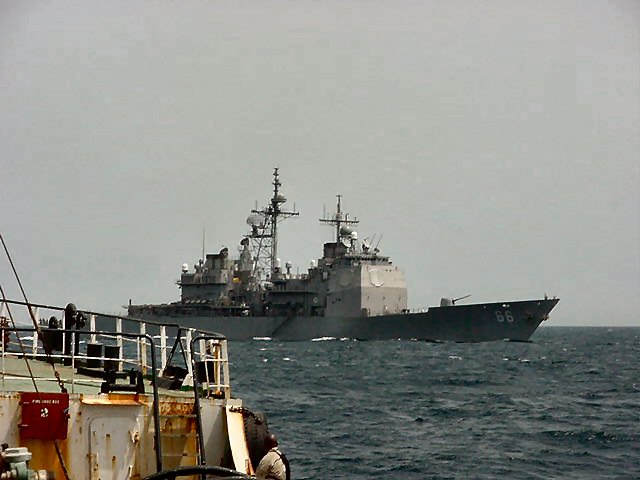
USS HUE CITY CG 66 in the Arabian Gulf 2002.  “I wish to have no Connection with any Ship that does not Sail fast for I intend to go in harm’s way.” John Paul Jones 

“Without a decisive naval force we can do nothing definitive, and with it, everything honorable and glorious.”  President George Washington

“A good Navy is not a provocation to war. It is the surest guaranty of peace.” President Theodore Roosevelt

“A powerful Navy we have always regarded as our proper and natural means of defense; and it has always been of defense that we have thought, never of aggression or of conquest. But who shall tell us now what sort of Navy to build? We shall take leave to be strong upon the seas, in the future as in the past; and there will be no thought of offense or provocation in that. Our ships…

View original post 2,203 more words

Leave a comment

Filed under Loose thoughts and musings

103 Years of Naval Aviation: Celebrating Eugene Ely and the First Flight on and Off a Ship

First_airplane_takeoff_from_a_warship

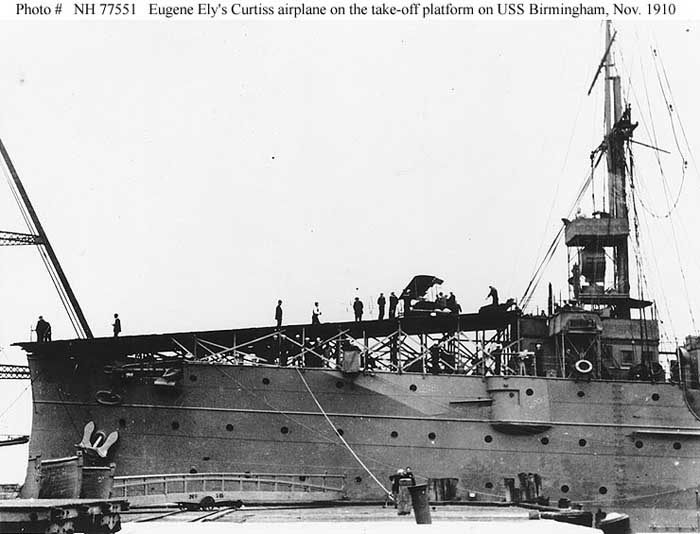
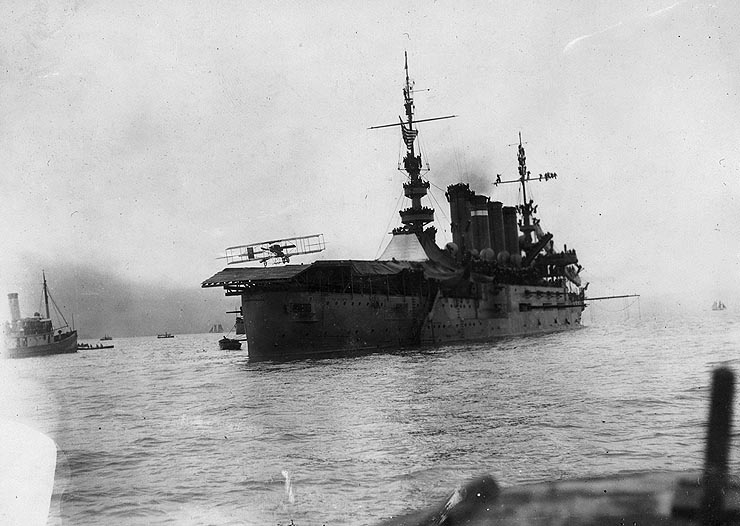
On a blustery November 14th in the year 1910 a young civilian pilot hailing from Williamsport Iowa became the first man to fly an aircraft off the deck of a ship.  At the age of 24 and having taught himself to fly barely 7 months before Eugene Ely readied himself and his Curtis biplane aboard the Cruiser USS Birmingham anchored just south of Fort Monroe in Hampton Roads.

458px-Eugene_Ely

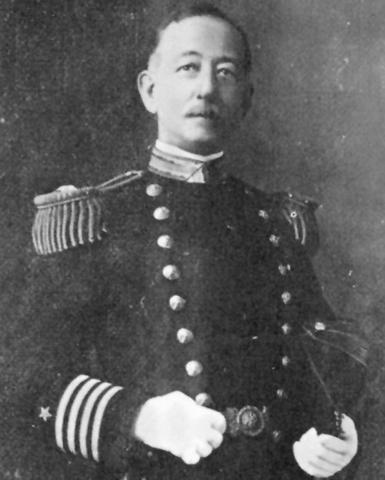
Eugene Ely (above) Captain Washington Irving Chambers (below)

Washington_Irving_Chambers

Ely was there because he was discovered by Navy Captain Washington Irving Chambers.  Chambers had been tasked with exploring how aircraft might become part of Naval Operations. Chambers had no budget or authority for his seemingly thankless task nor any trained Navy aviators. But when he heard that a German steamship might launch and aircraft from a ship Chambers hustled to find a way to stake a claim for the U.S. Navy to be the first in flight.

77551

Weather was bad that day as is so typical for Hampton Roads in November. Between rain squalls Ely decided to launch even though Birmingham did not have steam up to get underway to assist the launch.  Ely gunned the engine and his biplane rumbled down the 57 foot ramp and as he left the deck the aircraft nosed down and actually make contact with the water splintering the propeller. The damage to his aircraft forced Ely to cut the flight short and land on Willoughby Spit about 2 ½ miles away. This is not far from the southern entrance to the modern Hampton Roads Bridge Tunnel.

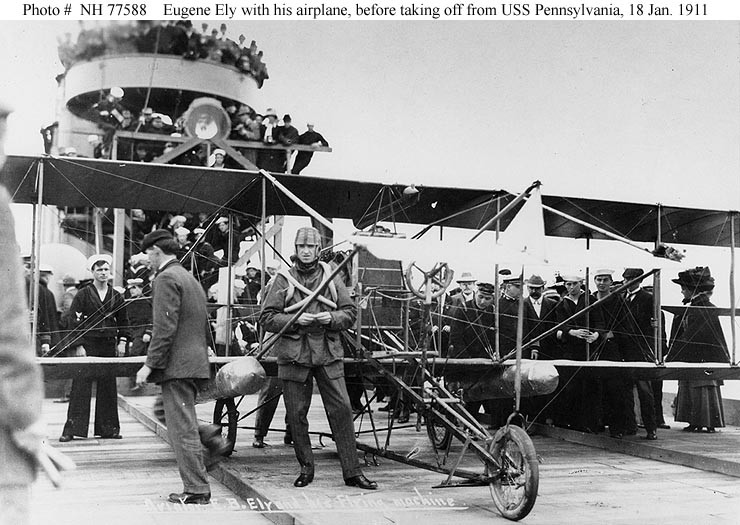
ELY-Eugene-B.-before-taking-off-from-USS-Pannsylvania-18-January-1911

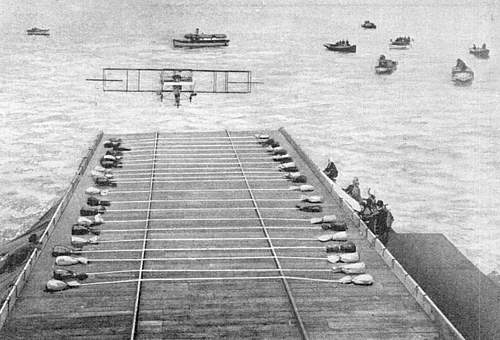
Chambers would talk Ely into making the first landing on a Navy ship the Armored Cruiser USS Pennsylvania in San Francisco Bay on January 18th 1911. In this flight his aircraft was modified and equipped with an arrestor hook, a standard feature on carrier aircraft since the early days of US Navy aviation.

USS_Pennsylvania_-_First_airplane_landing

ElyEugene-ShipLandingPM2-500px

Ely landing on USS Pennsylvania (note the “arrestor cables” on the deck)

Ely desired employment in the Navy but the Navy Air Arm had not yet been established so he continued his exhibition flying around the country. Ely died in a crash while performing at the Georgia State Fairgrounds on October 11th 1911 less than a year after his historic flight off the deck of the Birmingham.

Ely would not be forgotten. Though he was a civilian he was posthumously awarded the Distinguished Flying Cross by Congress in 1933. The citation read in part: “for extraordinary achievement as a pioneer civilian aviator and for his significant contribution to the development of aviation in the United States Navy.”

images-62

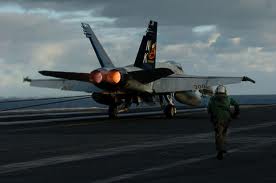
It is hard to believe that Naval Aviation traces its heritage back to this humble beginning. However the next time you see whether in person or on television aircraft taking off and landing from a modern super carrier remember the brave soul named Eugene Ely who 103 years ago gunned his frail aircraft down that short ramp aboard the Birmingham. To Ely and all the men and women who would follow him as Naval Aviators.

Peace

Padre Steve+

1 Comment

Filed under aircraft, History, Military, Navy Ships, US Navy

The Sinking of the USS Juneau and the Loss of the Sullivan Brothers

USS_Juneau_(CL-52)_0405201

Seldom in military history are five brothers killed in action on the same ship or same unit in the same action on the same day. Many families have lost multiple children in military conflicts but they usually are spread out over time. In fact in all of my study I only know if one family that lost five sons in the same action on the same day. That family was the Sullivan family of Waterloo Iowa who lost their sons George, Francis “Frank”, Joseph, Madison “Matt” and Albert aboard the USS Juneau CLAA-52 when that ship was torpedoed and sunk on the morning of November 13th 1942 after being badly damaged at the Naval Battle of Guadalcanal.

The fact that all were lost aboard Juneau was in large part because the brothers refused to serve unless they served together, The two oldest brothers George and Frank had served in the Navy before the war and both had been discharged in May of 1941. When war broke out the older brothers with their three younger siblings Joe, Matt and Al volunteered to serve in the Navy but only if they could serve together. Though the Navy had a policy of separating siblings it was not always followed and the five brothers enlisted to serve together and were assigned to the new Anti-Aircraft Light Cruiser USS Juneau. 

Juneau was an Atlanta Class Light Cruiser, actually designed as an anti-aircraft escort of the fast carrier task forces. Armed with 16 5” 38 caliber dual purpose guns and a large number of smaller anti-aircraft guns as well as 8 21” torpedo tubes as well as depth charge racks and projectors the class was an excellent escort ship, but woefully equipped to fight heavy fleet units in close surface actions.

Juneau and her sister Atlanta were part of Rear Admiral Daniel Callaghan’s Task Force 67.4 when it encountered a Japanese bombardment force comprised of the battleships Hiei and Kirishima Light Cruiser Nagara and 14 destroyers. Callahan’s Task Group was composed of the heavy cruisers USS San Francisco and USS Portland the light cruiser USS Helena the two Atlanta Class ships and 8 destroyers. In a confused and merciless night action the Japanese lost Hiei and two destroyers while the US Navy lost Atlanta and four destroyers. All the surviving US ships except the destroyer USS Fletcher incurred moderate to heavy damage. Among the ships suffering heavy damage was Juneau which suffered a torpedo hit which crippled her. The following day while returning to base Juneau suffered a torpedo hit from the Japanese submarine. I-26 which struck her her in the same spot as the hit from the night engagement. The Juneau exploded and sank in 20 seconds taking with her 600 of her crew of 700 men. Among those killed in the explosion were Frank, Matt and Joe Sullivan.

About 100 men survived the explosion including Al and George Sullivan. Unfortunately because the senior surviving US commander believed there to be no survivors and that his remaining ships could also be sunk by submarines these men were left at the surviving ships steamed away. Reports of possible survivors from a B-17 Bomber crew went unheeded for several days and it was not until 8 days after Juneau was sunk that 10 survivors were rescued by a PBY Catalina flying boat. By then the two remaining brothers had perished.

Sullivanbrothers

It was not until January 12th 1943 that the Sullivan family was notified of the loss of all of their sons. The Fletcher Class destroyer The Sullivans DD-537 was named after the brothers, she is now a museum ship in Buffalo New York.

USS_The_Sullivans_(DD-537)_off_Ponape_1944

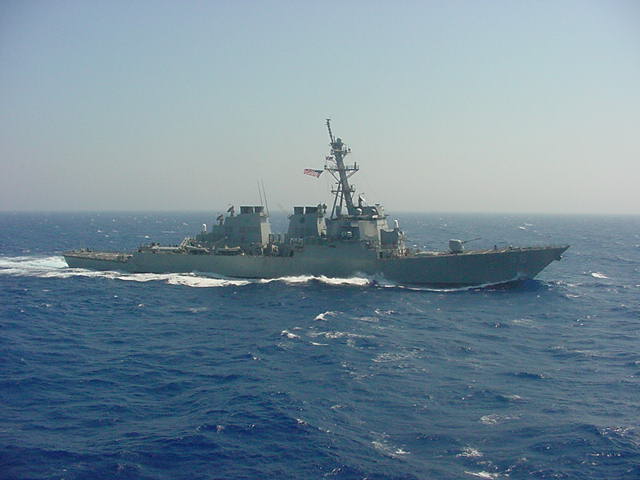
USS The Sullivans DD-537 (above) and DDG-68 (below)

05016808

Her successor USS The Sullivans DDG-68 is a Arliegh Burke Class Aegis guided missile destroyer based out of Mayport Naval Station Florida. For many years they were the only ships named after more than one person in the US Navy, something that they now share with the USS Roosevelt DDG-80 named after President Franklin Roosevelt and Brigadier General Theodore Roosevelt Jr, a Medal of Honor winner on D-Day and son of President Theodore Roosevelt.

The loss of the five brothers prompted the War Department to end the assignment of siblings in the same unit and adopt the Sole Survivor Policy which became law in 1948.

Juneau was a good ship with a fine crew but unsuited for the type of battle that out of military necessity she was thrown into. Heavily damaged she had the unfortunate luck to be part of a battered task force which had no ships capable of anti-submarine protection because of damage incurred the previous night. Her sinking at the hands of the I-26 and the subsequent loss of her survivors through was a tragedy of the highest order.

Tonight I remember Juneau her gallant crew and the Sullivan brothers.

May they all rest in peace.

Padre Steve+

5 Comments

Filed under History, Military, Navy Ships, world war two in the pacific

The Brotherhood: Veterans Day 2013

A post that I modified for this year. I wa writing something this afternoon when I remembered that I had written a similar piece back then. Since laziness is the better part of virtue at times I decided just to update the older post. To all of the Veterans, past and and present know that you are my brothers and sisters.

Peace, Padre Steve+

padresteve's avatarThe Inglorius Padre Steve's World

I am always a bit on the melancholy side on Veterans Day.  This year is no different but is a bit different because for the United States the war in Iraq is over, at least for now while the war in Afghanistan grinds on as we prepare to transition.

For me our wars are more about the incredibly small number of Americans who for the past 12 years have borne the burden of these wars.  They are my brothers and sisters, the 0.45% of Americans that serve in the military.  While this is a terribly low number it is only marginally lower than most of our previous wars.

In fact for most of our history it has always been a small minority of Americans that have fought our wars.  Kind of funny when you think about how much our culture worships militarism. World War II was an anomaly as just…

View original post 2,340 more words

Leave a comment

Filed under Loose thoughts and musings

The End of an Empire: The Abdication of Kaiser Wilhelm II

NYTimes-Page1-11-11-1918

Imperial Germany in 1918 was a nation in a state of collapse. Four years of war had cost it the flower of its manhood had bled the nation dry. Over 2 million men had died and another 5.6 million wounded and nearly a million more take prisoner. “One German soldier had died nearly every minute, 55 every hour, and 1331 every day of the war.” (1)

Revolution was in the air. The effects of the war and shortages of nearly every commodity including basic foodstuffs caused by the Allied blockade of German ports had taken their toll. Communists and members of the radical Independent Socialist Party agitated for revolution in key industries and in the military. Units of the Army and the High Seas Fleet whose ranks had been filled with conscripts who were “undisciplined youths, already indoctrinated with the defeatist propaganda of the extreme Leftist parties, to which they adhered more from the fear of combat than from political conviction.” (2)

Even in the spring of 1918 when German troops were winning spectacular victories on the Western Front revolts were occurring at home. 

As Germany’s allies collapsed around her, the Ottoman Empire, Bulgaria and finally the Astro-Hungarian Empire it was apparent to the High Command that an Armistice with the Allies was imperative. On October 29th the Kaiser left Berlin for the last time and arrived at the headquarters of the Army High Command in Spa, Belgium. In the next few days plans devoid of reality were suggested that the Kaiser should either lead the Army back to Germany to crush the revolts or die at the head of a regiment in battle. 

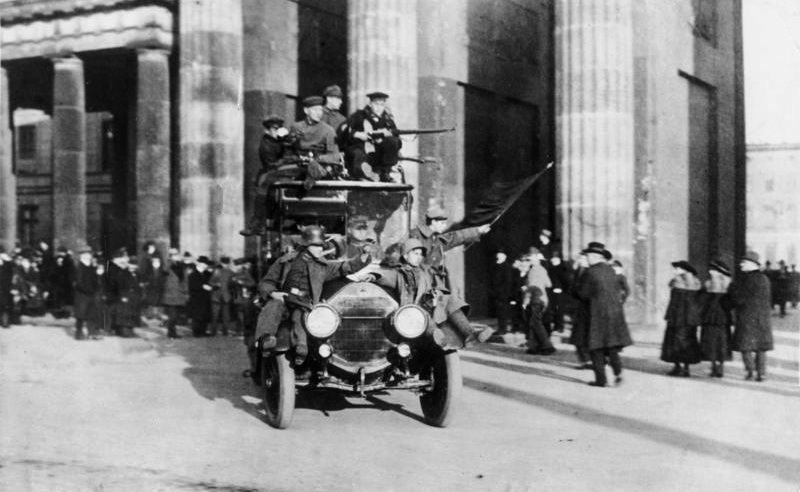
Bundesarchiv_Bild_183-B0527-0001-810,_Berlin,_Brandenburger_Tor,_Novemberrevolution

Revolting Troops in Berlin

Then in early November the red flags of revolution were raised aboard the battleships of the High Seas Fleet in its bases of Kiel and Wilhemshaven. Soon workers, sailors and soldiers councils were “springing up everywhere to take over power.” (3) The authority of Naval Officers on their ships was gone, many were prisoners of their crews. “From the ports the torch of revolution was carried to western and southern Germany.” (4) Soon the royal dynasties that made up Imperial Germany were toppled one by one. In spite of this Wilhelm who had lived in a dream world throughout most of the war, shielded from the truth by advisors, military and civilian believed that the German people would rally to his cause. 

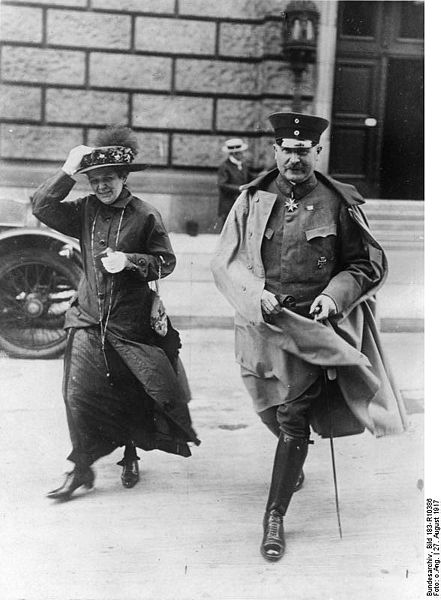
441px-bundesarchiv_bild_183-r10386_wilhelm_groener_mit_frau

Groener

General Wilhelm Groener who had replaced General Erich Luddendorff as the First Quartermaster of the Army was now showing himself to be the “most clear headed and determined of the army’s leaders.” (5)  After a brief visit to Berlin in the first week of November Groener became convinced that the Kaiser must abdicate if there was any hope of preserving the monarchy and transitioning to a constitutional monarchy an idea supported by the Majority Socialists and their leader Friedrich Ebert. 

Facing the unrealistic ideas of the Kaiser Groener called an emergency meeting of 50 senior commanders of which 39 arrived in time to take part in the council. In answer to Groener’s questions as to whether the Army would stand beside the Kaiser only one commander “guaranteed that the soldiers stood squarely behind the Kaiser.” (6)

That morning Admiral von Hintze an emissary of Prince Max of Baden, the Chancellor and the Army headquarters in Berlin brought new messages warning “that unless the Emperor abdicated at once, a revolution would sweep him and the monarchy away.” (7)

With that news and the results of his poll of the army leadership at Spa Groener took action. Hintze and Groener convinced Field Marshal Paul von Hindenburg that the Kaiser must be informed. Hindenburg wanted to offer his his resignation and remained silent in the background as Groener told Wilhelm “The Army will march home in peace and under orders from its leaders and commanding generals, but not under the command of Your Majesty for it no longer stands behind Your Majesty!” (8)

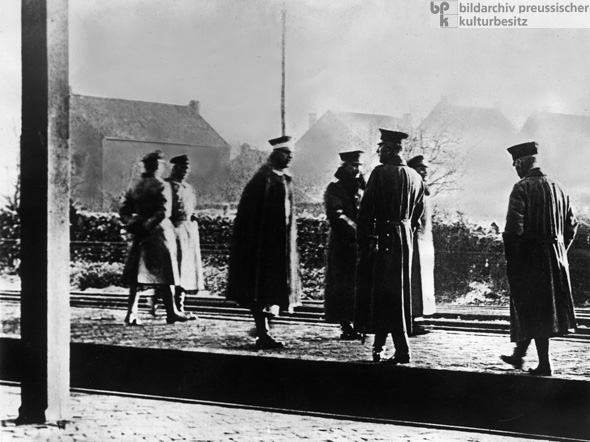
Wilhelm II. (4.v.l.) geht am Tag der Unterzeichnung seiner Abdankung über die Grenze in das holländische Exil

Wilhelm II Arriving in Holland

The Kaiser was stunned and by the morning of the 10th he departed by his royal train to Holland where he went into exile. Several years later in recounting the day the former monarch still lived in a dream world writing in his memoirs:

“The decision as to my going or staying, as to my renunciation of the Imperial Crown and retention of the Royal Crown of Prussia, was summarily snatched from me. The army was shaken to the core by the erroneous belief that its King had abandoned it at the most critical moment of all.”  (9)

Of course he was wrong. He had helped lead his nation and the world into a war that swept his monarchy and other great monarchies away. It was a war that ultimately led to another war of even greater destruction. It changed the world order which had existed from the time of Metternich and the Congress of Vienna. 

Groener was instrumental in preserving the unity of Germany and helped establish the Weimar Republic working with the leaders of the Majority Socialists. Unfortunately their efforts to establish a working republic were frustrated by the actions of the vengeful Allied powers, the terrible political polarization of the country and the effects of several economic crisis which doomed the Republic. 

The abdication of Kaiser Wilhelm II was to many in Germany, especially the Officer class and nobility “the end of the world.” That being said had more leaders had the foresight and leadership of Groener and Ebert the republic might have survived. Had Ebert not died unexpectedly it is possible that the center might have held. But it was not to be. 

Peace 

Padre Steve+

1 Herwig, Holger The First World War, Arnold a Member of the Hodder Headline Group, London 1997 p.446

2 Gordon, Harold J, The Reichswehr and the German Republic 1919-1926, Princeton University Press, Princeton New Jersey 1956 p. 4

3 Ibid. Gordon. p.6 

4 Carsten, F. L. The Reichswehr and Politics 1918-1933, Oxford University Press, London 1966 p.7

5 Craig, Gordon A. The Politics of the Prussian Army, Oxford University Press, London 1955 p.345

6 Ibid, Herwig p. 445

7 Dorpallen, Andreas, Hindenburg and the Weimar Republic Princeton University Press, Princeton NJ 1964 p.17

8 Ibid. Herwig p.445

9 Wilhelm II, The Kaiser’s Memoirs Translated by Thomas R. Ybarra, Harper and Brothers Publishers, New York and London 1922, pp.287-288


Leave a comment

Filed under History, Military

Happy 238th Birthday Marines! The Proud Tradition of the United States Marine Corps Continues

Happy 238th Birthday Marines!

padresteve's avatarThe Inglorius Padre Steve's World

Resolved, that two Battalions of Marines be raised consisting of one Colonel, two Lieutenant Colonels, two Majors & Officers as usual in other regiments, that they consist of an equal number of privates with other battalions; that particular care be taken that no persons be appointed to office or enlisted into said Battalions, but such as are good seamen, or so acquainted with maritime affairs as to be able to serve to advantage by sea, when required. That they be enlisted and commissioned for and during the present war with Great Britain and the colonies, unless dismissed by Congress. That they be distinguished by the names of the first & second battalions of American Marines, and that they be considered a part of the number, which the continental Army before Boston is ordered to consist of.
—Resolution of the Continental Congress on 10 November 1775

Today is the 238th

View original post 1,472 more words

Leave a comment

Filed under Loose thoughts and musings

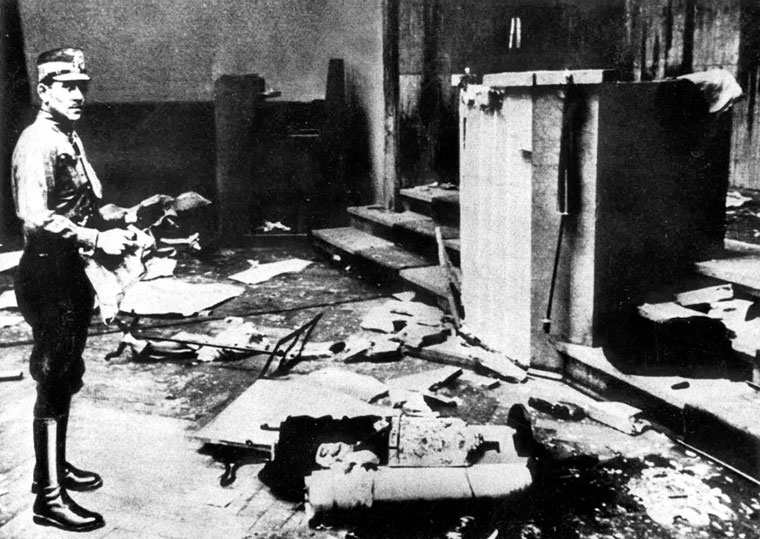
Kristallnacht 75 Years Later

1938_progrome_synag_696724gNW

“One of the men grabbed my father by the shoulder and spit in his face. They tore his World War I medals from his shirt and stomped them into the ground. They started beating my father. Furniture started flying through the windows. My mother was screaming: ‘Let’s get out of here. They are killing us.’ We slipped out a back street, hoping the men would be finished soon and we could go back home.” Alex Liebenstein Kristallnacht survivor. (Jewish Weekly.com 12 November 2004) 
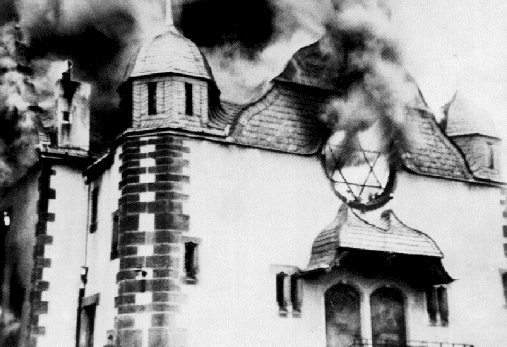
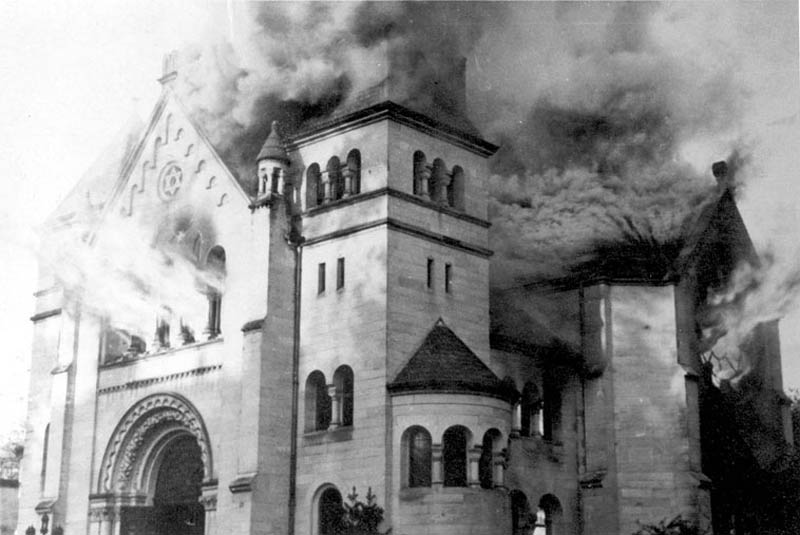
Burning_Synagoge_Kristallnacht_1938

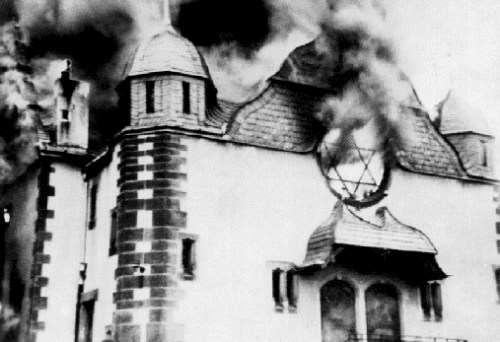
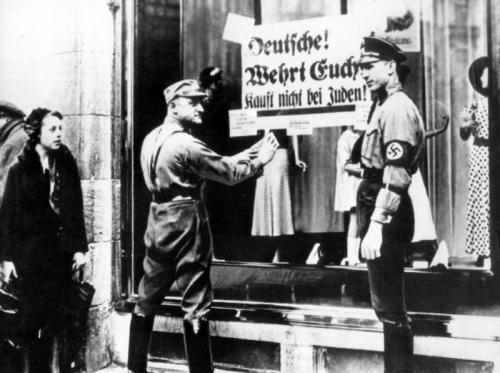
It is still hard for me to believe that a civilized people can be incited into mob violence against a minority, even one that is already being persecuted. Unfortunately has happened all too often. The atrocities committed by the Nazi regime 75 years ago on the 9th and 10th of November 1938 reverberate to today as we see a resurgence of a anti-Semitism around the world.
LzcZh7MM

The catalyst for the event was the assassination of a German diplomat in Paris by the teenage son of a Polish Jewish immigrant who had recently been expelled from his home. However the death of the diplomat was a mere pretext for actions that the more radical National Socialists desired and had been building up to the previous five years.

ART_goebbels_110405

Josef Goebbels 

Preparations for the action were already underway when death of the diplomat Ernst was delivered at a meeting commemorating the Beer Hall Putsch. Ironically Von Rath was an anti-Nazi under suspicion and being watched by the Gestapo.

After the message was delivered, Goebbels who was in disgrace with Hitler after the discovery of an affair between him and an actress took the opportunity to regain favor with Hitler. He stirred up the assembled Nazis and reported that there were reports of anti-Jewish demonstrations and the burning of synagogues and that Hitler `has decided that such demonstrations are not to be prepared or organized by the party, but so far as they originate spontaneously, they are not to be discouraged either.’ Taking his exhortation as an order many Gauleiters ran to phones to begin the action in their districts.

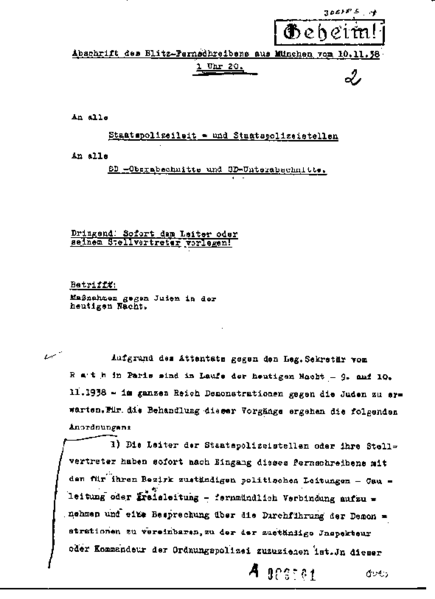
But the fact was the pogrom was already planned. SS Gruppenfuhrer Reinhard Heydrich sent the following order out the day before.

Reinhard Heydrich

Reinhard Heydrich

TO ALL REGIONAL AND SUB-REGIONAL GESTAPO OFFICES 1:20AM, November 8, 1938

SUBJECT: MEASURES AGAINST THE JEWS THIS NIGHT
That only such measures were to be taken that would not endanger German lives or property  Businesses and residences of Jews may be damaged but not looted. Particular care is to be paid in business sections and surrounding streets. Non-Jewish businesses are to be protected from damage under all circumstances. Police are to seize all archives from synagogues and offices of community organizations, this refers to material of historical significance. Archives are to be handed over to the SS. As soon as possible, officials are to arrest as many Jews especially wealthy ones – in all districts as can be accommodated in existing cells. For the time being, only healthy male Jews of not too advanced age are to be arrested.
Reinhard Heydrich, SS Gruppenführer

435px-Kristallnacht_rh_telegram_pg1

Heydrich’s Order

By two to three in the morning mobs were roaming the streets of German and Austrian cities. British Journalist Hugh Carlton Greene of the Daily Telegraph wrote:

“Mob law ruled in Berlin throughout the afternoon and evening and hordes of hooligans indulged in an orgy of destruction. I have seen several anti-Jewish outbreaks in Germany during the last five years, but never anything as nauseating as this. Racial hatred and hysteria seemed to have taken complete hold of otherwise decent people. I saw fashionably dressed women clapping their hands and screaming with glee, while respectable middle-class mothers held up their babies to see the “fun”.” 

Magdeburg, zerstörtes jüdisches Geschäft

The banned Social Democratic Party reported:

“When the Jewish Synagogue was burning…a large number of women could be heard saying, That’s the right way to do it—it’s a pity there aren’t any more Jews inside, that would be the best way to smoke out the whole lousy lot of them. No one dared to take a stand against these sentiments….”

photo02

Though horrified by the reports coming out of Germany the world did nothing to help the Jews. No country stepped up to allow increased immigration including the United States where anti-semitism was at its historic peak. Public condemnations of the Nazis by world leaders were at best muted. Likewise the passivity of many Germans to Kristallnacht encouraged the most radical parts of the party to enact even more restrictive and punishing laws and regulations on the Jews.

Goebbels was ecstatic and wrote in his diary: 10 November 1938 I reported to the Fuehrer and he decides: the demonstrations should be allowed to continue. The police should retreat. Let the Jews get a taste of popular anger. He is right. I immediately instructed the party and police accordingly. Then I gave a short speech along these lines to the Party leadership. Loud applause. Everybody goes to the telephones. Now the people is going to act…. I wish to return to my hotel, and see a glow as red as blood. The synagogue is burning.… We only put out the fires when they endanger adjacent buildings. If not, they should be burned to the ground.… Reports come from all over the Reich. 50 synagogues, then 70 are on fire. The Fuehrer ordered 20-30 thousand Jews to be arrested.… Public anger is running wild.… They have to be given the possibility to vent their rage.… Driving to the hotel, windows are being smashed. Bravo, bravo. The synagogues burn like big old huts. There is no danger to German property. For the time being there is nothing more to be done.… (Der Spiegel 1992)

Magdeburg, zerstörtes jüdisches Geschäft

Heydrich’s preliminary report stated:

The extent of the destruction of Jewish shops and houses cannot yet be verified by figures … 815 shops destroyed, 171 dwelling houses set on fire or destroyed only indicate a fraction of the actual damage so far as arson is concerned … 119 synagogues were set on fire, and another 76 completely destroyed … 20,000 Jews were arrested. 36 deaths were reported and those seriously injured were also numbered at 36. Those killed and injured are Jews.”

The Nazis even found a way to make money off of their persecution of the Jews. Hermann Goering convened a meeting of leaders on the 12th and discussed the economic implications of the action. The minutes of the meeting recorded his thoughts.

article-2389725-01CB755F0000044D-690_306x403

Hermann Goering

“Since the problem is mainly an economic one, it is from the economic angle it shall have to be tackled. Because, gentlemen, I have had enough of these demonstrations! They don’t harm the Jew but me, who is the final authority for coordinating the German economy. `If today a Jewish shop is destroyed, if goods are thrown into the street, the insurance companies will pay for the damages; and, furthermore, consumer goods belonging to the people are destroyed. If in the future, demonstrations which are necessary occur, then, I pray, that they be directed so as not to hurt us.” 

Accordingly those at the meeting decided that the Jews were to blame for the action and determined that the Jews be fined 1 Billion Reichsmarks for the slaying of Von Rath and 6 million for the damage to property. The money was taken from the insurance payments that Jewish business and property owners would have received.  The banality of Goering was typical of many Nazi leaders. He stated “We must agree on a clear action that shall be profitable to the Reich. … Anyway, the Jew must be evicted pretty fast from the German economy.”

kristallnacht-night-of-broken-glass1

Goebbels made the announcement of the official party line that the riots and destruction were “a spontaneous wave of righteous indignation throughout Germany as a result of the cowardly Jewish murder of Third Secretary vom Rath.” Goebbels lied to foreign reporters saying “Not a Jew has had a hair disturbed.” 

But the truth was different. 91 Jews died as a direct result of the action while it is estimated several hundred more committed suicide during or just after Kristallnacht. Another two to three thousand of those arrested and sent to concentration camps died in those camps before the majority were released on the promise that they would leave Germany.

Roll_Call_Buchenwald_after_Kristallnacht

Jewish Prisoners after Kristallnacht

The events of Kristallnacht and the decisions afterwards marked a distinct watershed in the annals of the Holocaust. They had already been stripped of citizenship and most rights but from this point they became the target of any petty bureaucrat or party official. Kristallnacht foreshadowed the future for the Jews of Germany and Nazi occupied Europe.

In the next year over 100,000 Jews would immigrate from Germany mainly to other European countries where many would again face the horrors of Nazi persecution as the Nazis implemented the Final Solution.

In hope of peace,

Padre Steve+


1 Comment

Filed under History, nazi germany

Remembering Armistice Day: A Day of Conscience

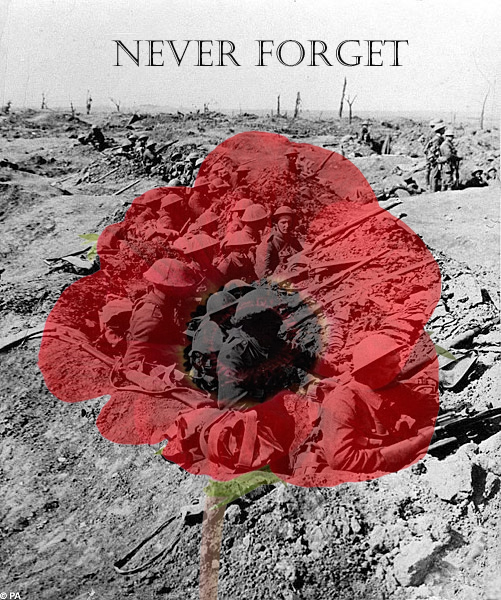
remembrance_day___poppy_day_by_daliscar-1

“Tomorrow is our day of conscience. For although it is a monument to victory, it is also a symbol of failure. Just as it honors the dead, so must it humble the living. Armistice Day is a constant reminder that we won a war and lost a peace…” General Omar Bradley November 10th 1948, Boston Massachusetts. 

It was the “War to End All War” or so thought President Woodrow Wilson and other American idealists. However that war to end all wars birthed a series of wars which made the losses of the First World War fade into insignificance as wars of ideology replaced wars for the preservation of the state.

In the First World War there were over 22 million casualties including over 5 million dead of which over 116,000 were Americans. President Woodrow Wilson established what we know now as Veteran’s Day as Armistice Day in November 1919, a year after the guns went silent.

Wilson wrote: “To us in America, the reflections of Armistice Day will be filled with solemn pride in the heroism of those who died in the country’s service and with gratitude for the victory, both because of the thing from which it has freed us and because of the opportunity it has given America to show her sympathy with peace and justice in the councils of the nations…

That initial proclamation was followed nearly 40 years later by one of President Dwight D. Eisenhower. Eisenhower signed into law what we now know as Veteran’s Day in 1954. In a sense I wish we had two holidays, one for Veterans from all wars in general and this one which we should never forget. It seems that in combining them we have lost some of the sacredness of the original. As Kurt Vonnegut wrote: “I don’t want to throw away any sacred things.” I will remember all who served this weekend but I will not forget why we do so.

All that being said for many in the United States and Western Europe the experience of  or even the thoughts of such a bloodletting is unimaginable. Yet to those of us who have gone to war and studied past wars the end result is not so distant. It is a part of our lives even today.

This weekend marks the 95th anniversary of the end in World War One.  For the United States the cost in the short time that its forces went into action and the armistice it was costly, though not nearly as costly as it was for the nations of Europe. From the time United States forces went into action in 1917 116,516 Americans were killed, 204,002 wounded, and 4,500 missing; 7.1% of the force of 4,355,000 the nation mobilized for war. (PBS the Great War UNC TV http://www.pbs.org/greatwar/resources/casdeath_pop.html)

However our costs pale in comparison with the European nations who had for over four years bled themselves dry.  If one wonders why Europeans seem to have so little desire for involvement in war one only needs to see how the concentrated killing of the First World War decimated the best and brightest of that generation. Out of nearly 8.5 million Frenchmen mobilized lost 1,357,000 killed, 4,266,000 wounded and 537,000 missing, 6,160,000 casualties or 73.3% of its forces. Other nations has similar casualty figures.

The human costs were horrifying. In all over over 65 million men served under arms in the war. Over 8.5 million were killed, over 21 million wounded, 7.75 million missing or prisoners or almost 37.5 million casualties. That total would be roughly equivalent to every citizen of the 30 largest American cities being killed, wounded or missing.

Much of Europe was devastated, mass numbers of refugees the dissolution of previously stable empires, civil wars, border conflicts between new states with deep seated ethnic hatreds, economic disasters and the rise of totalitarian regimes which spawned another even more costly world war and a 40 year cold war. The bitter results of the First World War are still felt today as conflicts in the Middle East in part fueled by the decisions of Britain and France at the end of the war rage on.

The epic war poem In Flanders Fields written by Canadian Lieutenant Colonel John McCrea symbolizes the cost of that war and the feelings of the warriors who endured its hell.

In Flanders fields the poppies blow
Between the crosses, row on row,
That mark our place; and in the sky
The larks, still bravely singing, fly
Scarce heard amid the guns below.

We are the Dead. Short days ago
We lived, felt dawn, saw sunset glow,
Loved and were loved, and now we lie
In Flanders fields.

Take up our quarrel with the foe:
To you from failing hands we throw
The torch; be yours to hold it high.
If ye break faith with us who die
We shall not sleep, though poppies grow
In Flanders fields.

Yes there are always consequences to actions. This weekend as we remember what we now call Veteran’s Day, or Remembrance Day in Britain let us not forget that the genus of these holidays was the blood shed by so many in places like Verdun, Gallipoli, Caporetto, Passchendaele, the Marne, the Argonne, Tannenberg, Galicia and on Flanders Fields.

flanders field

President John F Kennedy said: “As we express our gratitude, we must never forget that the highest appreciation is not to utter words, but to live by them.”

In the hope of peace and an end to war.

Peace,

Padre Steve+

Leave a comment

Filed under History, Military

The War to End All Wars….and a Peace to end all Peace

Friends of Padre Steve’s World….On November 11th 1918 the Great War ended, but a peace was imposed which gave birth to a hundred years of new wars, not just in Europe but in the Middle East, Africa and Asia. These conflicts redound to our generation today. May one day all of us live in peace. Padre Steve+

padresteve's avatarThe Inglorius Padre Steve's World

It was the War to end all war

On the 11th hour of the 11th day of the 11th month the guns fell silent across Western Europe and the war which had killed 16 million soldiers, sailors and civilians and wounded another 21 million more came to an end. It had begun as a conflict in the Balkans which rapidly drew in all of Europe’s major powers.  The central focus of the war was the Western Front where the armies of Germany battled those of Britain, France, Belgium and later the United States.  Battles with names such as the Marne, Passchendaele, the Somme, Verdun, Ypres, Chateau Thierry, Belleau Wood, Vimy Ridge, Cambrai, the Aisne, represented the pinnacle of killing as soldiers battled in the mud of massive trench systems and Generals sacrificing thousands of men in a day for the gain of a few hundred yards of…

View original post 930 more words

Leave a comment

Filed under Loose thoughts and musings