Author Archives: padresteve

padresteve's avatar

About padresteve

I'm a Navy Chaplain and Old Catholic Priest

A Difference of Degree: Thoughts on Discimination and Xenophobia

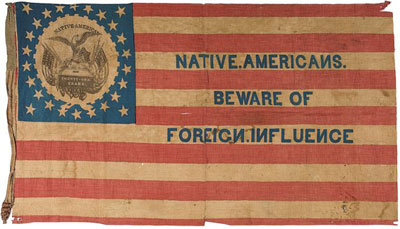
know-nothing_flag

Flag of the Know Nothing Party

“The segregation laws in your country and the anti-Semitic laws in mine, are they not just a difference of degree? Herman Goering (Brian Cox) to Captain Gustave Gilbert (Matt Craven) in the Miniseries “Nuremberg

Today a rather short post as I had a rough night sleeping and in the midst of a nightmare screamed and threw a body block into the bookcase that serves as my nightstand. You will be happy to know that though I woke up my wife, my trusty dog slept comfortably through the episode. But I digress….

Tonight I am taking a break from writing about the rise of the Islamic State and our war against it. Instead I am going back to a favorite subject of mine; that of civil rights and liberties. I find it strange that there are a host of people, mostly on the political right that are doing their best in their local communities, state legislatures and even Congress to roll back civil liberties for various groups of people. This includes the outright disenfranchisement being legislated in several states to roll back voting days and hours that disproportionally affect African Americans, students and the poor.

Likewise there are numerous attempts to roll back the rights of women, especially working women; the use of the legislature by religious conservatives to place limits on the reproductive rights of women, holding them to the standard of a religion that they do not practice. There are numerous attempts to curb any civil rights, including the right to marriage or civil unions of the LGBT community. There is also a certain amount of xenophobia in regard to immigrants of all types, especially those with darker skin white Americans, but some of the worst is reserved for Arabs and other Middle-Easterners, even Arab Christians who are presumed as all Middle Easterners are to be Moslem terrorists, even those who have been here decades and hold respectable places in their communities.

See what bothers me about all this is not that it is new, but rather these are a new twist on old formerly acceptable means of discrimination. The proponents just clothe them in new terminology and play on fear to rile up support for their policies. Their words and actions are actually very similar to the virulently anti-emigrant (especially toward the Irish), anti-Catholic and anti-Black groups known collectively as the Know Nothings. While I would not call them a new incarnation of the Know Nothings, I have to notice the similarities in their message and the way that they push their agenda. The late Spencer Perkins who worked to reconcile whites and blacks in Mississippi noted: “They saw no contradictions in how they treated me and Christianity.”

Abraham Lincoln wrote to Joshua Speed about the Know Nothing Party:

“I am not a Know-Nothing. That is certain. How could I be? How can any one who abhors the oppression of negroes, be in favor or degrading classes of white people? Our progress in degeneracy appears to me to be pretty rapid. As a nation, we began by declaring that “all men are created equal.” We now practically read it “all men are created equal, except negroes” When the Know-Nothings get control, it will read “all men are created equal, except negroes, and foreigners, and Catholics.” When it comes to this I should prefer emigrating to some country where they make no pretence of loving liberty — to Russia, for instance, where despotism can be taken pure, and without the base alloy of hypocracy [sic].”

photo-jugement-a-nuremberg-judgment-at-nuremberg-1961-1

Likewise it is a very similar spirit that existed in many European countries in the years leading up to the First World War which was magnified, especially in Germany, Austria and Eastern Europe following that war, a spirit which animated the National Socialist movement in Germany, a movement which carried such intolerance toward those deemed racially inferior to an extent unimagined by a supposedly civilized “Christian” country. There is a great scene at the end of the movie Judgment at Nuremberg where Burt Lancaster plays a jurist who served the Nazi regime, a jurist who before the Nazis was considered to be one of the best legal minds not only in Germany but in Europe. In the film the character played by Lancaster, Ernst Janning discussed who he and others like him ended up doing what they did. It is a penetrating look at how people justified their actions.

“There was a fever over the land. A fever of disgrace, of indignity, of hunger. We had a democracy, yes, but it was torn by elements within. Above all, there was fear. Fear of today, fear of tomorrow, fear of our neighbors, and fear of ourselves. Only when you understand that – can you understand what Hitler meant to us. Because he said to us: ‘Lift your heads! Be proud to be German! There are devils among us. Communists, Liberals, Jews, Gypsies! Once these devils will be destroyed, your misery will be destroyed.’. It was the old, old story of the sacrificial lamb. What about those of us who knew better? We who knew the words were lies and worse than lies? Why did we sit silent? Why did we take part? Because we loved our country! What difference does it make if a few political extremists lose their rights? What difference does it make if a few racial minorities lose their rights? It is only a passing phase. It is only a stage we are going through. It will be discarded sooner or later. Hitler himself will be discarded… sooner or later. The country is in danger. We will march out of the shadows. We will go forward. Forward is the great password. And history tells how well we succeeded, your honor. We succeeded beyond our wildest dreams. The very elements of hate and power about Hitler that mesmerized Germany, mesmerized the world! We found ourselves with sudden powerful allies. Things that had been denied to us as a democracy were open to us now…”

Likewise, those with a more religious view who attempt to enact laws specifically designed to give their religion more protections, and allow discrimination based on religious preference are startlingly similar to the Taliban and other extremist groups that use religion to limit the rights of people that do not agree with their interpretation of Islam, including other Moslems.

There is a remarkable scene in the 2001 movie Nuremberg which is about the major war crimes trials following the Second World War. There is a scene where the American Army psychologist assigned to the confined war criminals goes to Herman Goering after he hears the testimony of and then questions the commandant of the Auschwitz concentration camp. The climax of that scene involves Goering dressing down the psychologist in words that make one think, and I have included a link to that scene below.
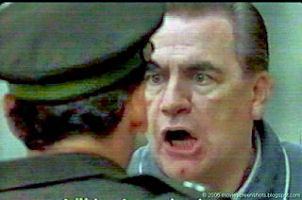
goering3

http://www.youtube.com/watch?v=WjbsD-TYi3s

Unfortunately this is what happens when people or groups, be they political or religious are more committed to their ideology than they are to their fellow citizens. It matters not if they are Christians, Moslems, Jews, Hindus, secularists, or others that hold the purity of their political, social, ideological, racial or economic theories as more important than people. It occurs when old prejudices are used under the banner of patriotism and nativism to confront real or imagined danger.

My comparison to the Taliban and the Know Nothings while I am sure that it is offensive to some is fitting. Because the spirit of such beliefs is the same, even if they differ in the degree in which people will go to enforce them. Like Hermann Goering’s comments at Nuremberg to Gustav Gilbert the difference between the ideology and actions of the Taliban, or the Know Nothings or the authors of the Jim Crow Laws as opposed to militant Christians and others, who attempt to use the power of the State to suppress, control and persecute those that they find offensive is only a matter of degree.

That may not seem important to some. But it is the difference between a divided society that can agree to disagree respecting the differences within it, and one for which factions attempt to use the police power of the State and the law of the land to persecute those that are different.

Goering in his critique of America in the 1930s and 1940s was correct; what we as a society enshrined in law and in our culture to discriminate against others differed little from what the Nazis did, only in the matter of degree. The sad thing is there are those today that work tirelessly to bring about a return to such practices.

It is something for us all to think about.

Peace

Padre Steve+
1 Comment

Filed under civil rights, film, laws and legislation, Political Commentary

Prepare for a Long and Brutal Ideological War Against the Islamic State

“This war differs from other wars, in this particular: We are not fighting armies but a hostile people, and must make old and young, rich and poor, feel the hard hand of war.” William Tecumseh Sherman

Note: Please know, I have been to war, I have seen its devastation and heartache and I came back changed from the experience. I hate it. That being said, despite being a progressive who hates war, I am also a realist. I am not one that finds any romance or glory in war, but I know that sometimes it becomes unavoidable. In the past few articles I have written about the nature of war, the kind of war we are now engaged in with ISIL and some of the ethical and moral compromises that could easily be made in such a war. Thus what I write here is a continuation of those thoughts and I encourage you to look at those articles. 

President Obama came into office as a President determined to end the wars that the United States was engaged in and usher in an era of peace. That did not happen. The genie of war and chaos that was unleashed when President Bush stopped pursuing Al Qaeda and attacked Saddam Hussein’s Iraq refused to go back into its bottle. The new and more violent terrorist groups spawned from the loins of Al Qaeda in Iraq are now the dogs of war that have been unleashed on the region, threatening all of the peoples there.

This menace to the people of the region as well as to the West, known as the Islamic State of Iraq and the Levant is different than Al Qaeda.  It is a terrorist group to be sure, but it is also an embryonic state which is conquering territory, subduing people, butchering its enemies and murdering innocents in cold blood. They boast in their atrocities and believe what they are doing is blessed by their God. They have grown up and been nurtured by a culture of victimhood which they believe that past or present oppression justifies their actions. Eric Hoffer wrote something that is quite poignant if we are to understand the mindset of ISIL:

“It is doubtful if the oppressed ever fight for freedom. They fight for pride and power — power to oppress others. The oppressed want above all to imitate their oppressors; they want to retaliate.”

The leaders and fighters of ISIL are people of the 12th Century living in the 21st Century. Prisoners of their doctrine they are incapable of negotiation, seeing it as only weakness and a way to impose their will on those unable to, or unwilling to resist them. Hoffer described their mindset well in his book  The True Believer:

“A doctrine insulates the devout not only against the realities around them but also against their own selves. The fanatical believer is not conscious of his envy, malice, pettiness and dishonesty. There is a wall of words between his consciousness and his real self.”

Thus this war will be something different, something that we in the West do not want to comprehend. We want any war to be neat, fast and comparatively bloodless, but this will not be the case in the war against ISIL. Such wars may be possible against traditional nation states with weak militaries. But to believe that it can be with ISIL is wrong headed and dangerous because it ignores the nature of that group. Carl Von Clausewitz noted that:

“Kind-hearted people might of course think there was some ingenious way to disarm or defeat the enemy without too much bloodshed, and might imagine this is the true goal of the art of war. Pleasant as it sounds, it is a fallacy that must be exposed: war is such a dangerous business that the mistakes which come from kindness are the very worst.”

Ultimately, despite the fact that I almost always counsel that war should be avoided and peaceful solutions found to resolve conflict, there are times that wars must be fought. If ISIL was a true nation-state with a conventional understanding of diplomacy and the relationship between nations it would be conceivable that the United Nations or perhaps the Arab League could help broker a deal. But ISIL is neither your father’s terrorist organization, nor a real nation-state. It is a hybrid which is not driven by realpolitik but rather a fanatical religious belief in their cause.  This allows them to dispense with diplomatic niceties and allows them no compromise with those they believe are the enemies of their God; including other Moslems.

Their war has been raging for some time in both Syria and Iraq. What they are doing is further destroying the mosaic of peoples who are part of the Arab heritage in both countries. The atrocities committed by ISIL against Shi’ite Moslems, secular Sunnis, Yidazi and Christians have been displayed around the world. Mass executions, beheadings and the destruction of historic sites which are important parts of the Christian, Moslem and Jewish heritage are only part of their crimes.

Some of those images inflamed people in the West, but it was the images of American and British hostages being beheaded amid dire threats to kill others and bring vengeance on the Western Infidels that finally got our attention.  The only condition for peace given by ISIL to those it considers the enemy is “convert or die.”  Whether we like it or not, war is now unavoidable. President Obama, the “peace President,” and some of his peers in Western Europe have reluctantly decided to fight ISIL and are now gaining international support for their efforts, even in the Arab world.

Some politicians and pundits seem to think that this will be easy, simply destroy ISIL where they stand. But that belief is illusory. ISIL and its sympathizers may seem to be concentrated in Iraq and Syria, which is enough of a problem for us, but their supporters, financial supporters and sympathizers are world wide. Interestingly Pope Francis noted that:“Even today, after the second failure of another world war, perhaps one can speak of a third war, one fought piecemeal, with crimes, massacres, destruction….”

That being said there is a warning that all must remember about this war. It is at its heart ideological, and it will be long and brutal and very importantly, the Islamic State believes that it can and will win it.

Winston Churchill said:

“Never, never, never believe any war will be smooth and easy, or that anyone who embarks on the strange voyage can measure the tides and hurricanes he will encounter. The statesman who yields to war fever must realize that once the signal is given, he is no longer the master of policy but the slave of unforeseeable and uncontrollable events…. Always remember, however sure you are that you could easily win, that there would not be a war if the other man did not think he also had a chance.”

Thus in this war we cannot waver, and we must believe in our ideals of freedom, justice, equality and the value of a single human life. We must do this even though our practice of them often makes a mockery of them. But they are still ideals that are worth fighting for, because without them we lose something of our already flawed humanity. Carl Clausewitz recognized this and wrote:

“If the mind is to emerge unscathed from this relentless struggle with the unforeseen, two qualities are indispensable: first, an intellect that, even in the darkest hour, retains some glimmerings of the inner light which leads to truth; and second, the courage to follow this faint light wherever it may lead.”

It was said by Barbara Tuchman that “War is the unfolding of miscalculations.” For over a century the leaders of the West as well as Arab leaders throughout the region have miscalculated far too many times, and what is going on now is the tragic and bloody result of all of those miscalculations. The suffering and the human cost will be great.

Pray my friends for peace, but remember reality, peace is not possible when the kind of religious extremism that motivates ISIL is the driving force. That kind of ideology cannot be negotiated with, it has to be defeated.

It has been a long time since we in the West have had to wage that kind of war and it will come at some cost to our psyche and it will take some getting used to, if you can ever get used to the evil, the carnage, the suffering and the devastation that is the essence of war. As William Tecumseh Sherman said “War is Hell.”

Peace

Padre Steve+

5 Comments

Filed under ethics, Foreign Policy, History, history, middle east, Military, Religion, War on Terrorism

Can you Live With It? The Moral Costs of the War Against the Islamic State

pale-moonlight

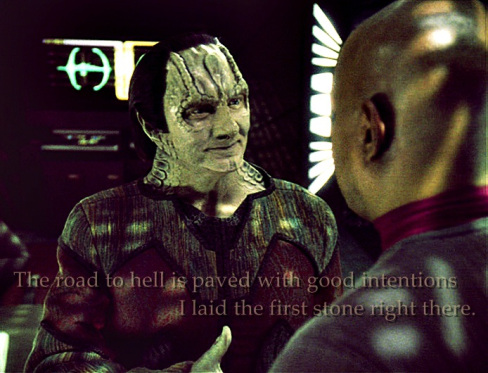
“My father used to say that the road to Hell is paved with good intentions. I laid the first stone right there. I’d committed myself. I’d pay any price, go to any lengths, because my cause was righteous. My… intentions were good. In the beginning, that seemed like enough.” Captain Benjamin Sisko (Avery Brooks) Star Trek Deep Space Nine, In the Pale Moonlight

I think that among the Star Trek series that my favorite is Star Trek Deep Space Nine. Of course all of the series deal with ethics, philosophy and morality to some extent, but Deep Space Nine is perhaps the most interesting to me. Don’t get me wrong I think that the Original Series and Start Trek the Next Generation were and are leap years ahead of most television series when it comes to addressing ethical, moral and existential issues, but somehow living in the post 9-11 “War on Terrorism” world I find Deep Space Nine to be the most compelling. I think that is that the fact that the moral issues get blurred which attracts me to the series, and to this episode in particular.

One of my favorite episodes is from season six and is entitled “In the Pale Moonlight.” The episode deals with the unsavory matter of contriving a reason to get the Romulan Empire to join with the Federation and the Klingons to fight the Dominion-Cardassian alliance that is threatening those entities as well as potentially the entire Alpha Quadrant. I have included a link to the conclusion of that episode here:

http://www.youtube.com/watch?v=dTgGtJ-PisA

The ethics of this episode seem very timely as I look at the new phase of the conflict that the United States has been engaged for the past thirteen years. The fact is that in spite of our appeal to higher ideals we are having to make alliances with powers that are only slightly less unsavory than ISIS, powers whose polices have help ISIS grow. In a sense it is the classic scenario of making a deal with the devil to defeat one’s enemy. Of course this is not new, individuals and nations have made such deals, sometimes with mortal enemies throughout history.

Unfortunately we usually judge such decisions based on their results, rather than wrestle with the ethical issues involved and how we might behave in similar situations. For me the philosophical and ethical issues involved in such alliances have a special interest and as such I tend to notice or recall instances where I saw, read or heard something that makes a connection to an ethical or moral dilemma faced by policy makers and planners today.

Some of the issues involved for policy makers are related to the traditional Just War Theory, and what is called the “Supreme Emergency” exemption. This exemption basically posits that when faced with a supreme and existential emergency a person or state may engage in behaviors that ordinarily would be considered unethical if the situation were not of a supreme emergency.

Of course such decisions in the real world are difficult. Those who have a system of beliefs that help them define right and wrong behaviors, even if they are not codified in law may struggle with with such decisions, while those who act according to what they deem necessary or expedient, unbridled by religious, philosophical or other similar codes may not, instead making their decisions based on what appears to be necessary at the time.

This Deep Space Nine episode is remarkable because we get to see an actor playing a military commander dealing with the morality of the course of action that he is taking. In one of the early scenes Captain Sisko expresses his doubts relating to the morality of a decision that he is making in a war that has already consumed the lives of tens of millions of people.

siskogarak


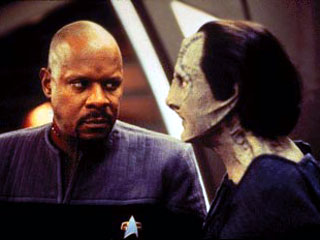
After an incident where a Federation starship was destroyed, Sisko went to Elim Garak (Andrew Robinson), an exiled Cardassian intelligence officer to uncover any evidence about Dominion-Cardassian collusion to attack the Romulans. When none was uncovered and Garak’s sources on Cardassia were compromised he agreed to allow Garak to manufacture evidence in order to get the Romulans into the war on the side of the Federation and Klingons. Sisko compounded the situation by having the Kilingons release a master forger who was on death row to help Garak. Sisko knew it was wrong and confided in his log:

“Why I didn’t listen to the voice in the back of my mind telling me not to believe a word he said, I’ll never know… But it didn’t take long for me to come face to face with the fact that I’d made a mistake.”

When the former prisoner gets drunk and attacks the owner of a tavern on the space station Sisko was in a bind. He wanted no evidence that the man had been on his station and in order to keep Quark, the bar owner quite had to bribe him. Sisko again expressed his doubts in his personal log:

“Maybe I should have put a stop to it right there. Maybe I should have said, “Thank you very much for your input, Mister Garak, I will take your suggestion under advisement,” and then gone back to my office and forgotten the whole thing. But I didn’t. Because in my heart, I knew what he was saying made sense.”

Even so Sisko still had doubts:

“That was my first moment of real doubt, when I started to wonder if the whole thing was a mistake. So I went back to my office. And there was a new casualty list waiting for me. People are dying out there every day! Entire worlds are struggling for their freedom! And here I am still worrying about the finer points of morality! No, I had to keep my eye on the ball! Winning the war, stopping the bloodshed, those were the priorities! So I pushed on. And every time another doubt appeared before me, I just found another way to shove it aside.”

When nations feel they are engaged in a life and death struggle, those who serve as policy makers, planners and military commanders often make uncomfortable compromises with their own religious, ethical or philosophical codes. Sisko continued down the path despite his doubts but justified his actions by the fact that Starfleet had approved them:

“Maybe… I was under more pressure than I realized. Maybe it really was starting to get to me, but I was off the hook. Starfleet Command had given the plan their blessing and I thought that would make things easier. But I was the one who had to make it happen. I was the one who had to look Senator Vreenak in the eye and convince him that a lie… was the truth.”

The forgery was completed and the Romulan Senator secretly arrived on the station to examine the evidence and as he did so all Sisko could do was wait, confiding in his log:

“So all I could do was wait… and see how masterful Tolar’s forgery really was. So I waited… tried to catch up on my paperwork, but I find it very difficult to focus on criminal activity reports, cargo manifests… So I went back to pacing, staring out of the window. I’m not an impatient man, I’m not one to agonize over decisions once they’re made. I got that from my father. He always says, “Worry and doubt are the greatest enemies of a great chef. The soufflé will either rise or it won’t – there’s not a damn thing you can do about it, so you might as well just sit back and wait and see what happens.” But this time the cost of failure was so high, I found it difficult to take his advice. If Vreenak discovered that the data rod was a forgery, if he realized that we were trying to trick them into the war it could push the Romulans even farther into the enemy camp. They could start to openly help the Dominion. If worst came to worst they could actually join the war against us. I had the distinct feeling that victory or defeat would be decided in the next few minutes.”

In-The-Pale-Moonlight

It did not work, Vreenak discovered that the data rod was a forgery and threatened to expose Sisko’s deception and possibly bring the Romulans into alliance with the Dominion. When Sisko’s actions blew up in his face and his deceit was revealed he was not happy and resigned himself to face the consequences:

“So it all blew up in my face. All the lies and the compromises, the inner doubts and the rationalizations – all for nothing. Vreenak was furious. I can’t say I blamed him; I’d have reacted the same way. After telling me in no uncertain terms that he intended to expose this “vile deception” to the entire Alpha Quadrant, he got back in his shuttle and headed home. There didn’t seem to be anything more to do… so I went back to work. Two days later we got the news.”

Sisko learned in a Starfleet communication that Vreenak’s shuttle had blown up and that is was suspected to be the work of the Dominion. When Sisko found that Vreenak was dead he went to Garak and forcefully confronted him, striking him in the process. He accused Garak of sabotaging the senator’s ship and killing him as well as the forger, Tolar. Instead of backing down Garak confronted the results and the ethical issue. The heated exchange between the two men is fascinating:

Garak: If you can allow your anger to subside for a moment, you’ll see that they did not die in vain! The Romulans will enter the war!

Captain Sisko: There’s no guarantee of that!

Garak: Oh, but I think that there is. You see, when the Tal Shiar finishes examining the wreckage of Vreenak’s shuttle, they’ll find the burnt remnants of a Cardassian optolythic data rod which somehow miraculously survived the explosion. After painstaking forensic examination, they’ll discover that the rod contains a recording of a high-level Dominion meeting, at which the invasion of Romulus was being planned.

Captain Sisko: And then they’ll discover that it is a fraud!

Garak: Oh, I don’t think they will! Because any imperfections in the forgery will appear to be a result of the explosion. So – with a seemingly legitimate rod in one hand, and a dead senator in the other, I ask you, Captain – what conclusion would you draw?

As Sisko’s anger subsided Garak continued:

“That’s why you came to me, isn’t it, Captain? Because you knew I could do those things that you weren’t capable of doing? Well, it worked. And you’ll get what you want: a war between the Romulans and the Dominion. And if your conscience is bothering you, you should soothe it with the knowledge that you may have just saved the entire Alpha Quadrant. And all it cost was the life of one Romulan senator, one criminal, and the self-respect of one Starfleet officer. I don’t know about you, but I’d call that a bargain.”

Shortly thereafter Sisko found out that the out that the deception was successful as Garak had said it would be. The Romulans who recovered the damaged data rod believed that it was genuine and declared war on the Dominion-Cardassian alliance and had entered the war on the side of the Federation. He completed his personal log:

“At oh-eight-hundred hours, station time… the Romulan Empire formally declared war against the Dominion. They’ve already struck fifteen bases along the Cardassian border. So, this is a huge victory for the good guys! This may even be the turning point of the entire war! There’s even a “Welcome to the Fight” party tonight in the wardroom!… So… I lied. I cheated. I bribed men to cover up the crimes of other men. I am an accessory to murder. But most damning of all… I think I can live with it… And if I had to do it all over again… I would. Garak was right about one thing – a guilty conscience is a small price to pay for the safety of the Alpha Quadrant. So I will learn to live with it…Because I can live with it…I can live with it. Computer – erase that entire personal log.”

DS9SiskoToast

My guess is that before this war is over, there will be men and women serving in positions of responsibility in our or allied militaries, policy makers and government officials who will make similar deals, violating their own moral codes and even laws in order to defeat the Islamic State and prevent acts of terror against their citizens. Most, like Sisko will not be happy but will live with their decisions. The fact is that long asymmetrical wars in which nation states have to fight non-state terrorist entities get really ugly and the longer and more bloody that they become the more decent and honorable people will make decisions like Sisko and resort to actions that in normal times they would never countenance.

This is nothing new. Those who have fought in such wars throughout history have found ways to “live” with actions that they would not approve of had things been different. Wars such as the one that we are fighting and continue to fight in the years ahead have a corrosive affect on the human spirit. They corrupt and destroy even when they are “successful.”

The question is: Can we live with it? Sadly, as much as I hate to admit it, in a similar situation I think like Sisko, that I could condone or be complicit in something like this. I too could probably convince myself that the end justified the means and that I could live with it.

Peace

Padre Steve+

4 Comments

Filed under ethics, leadership, News and current events, philosophy, Political Commentary, star trek, War on Terrorism

War is Cruelty, and You Cannot Refine it… The War Against ISIL

Iraq-unrest

The war that we are in, and please let’s call it that, which we have been in for over thirteen years now; and which has been extended indefinitely by the actions of the Islamic State and the announced intentions of President Obama to fight it will become much worse than people want to believe regardless of whether it is a long or a short war.

Americans have grown up for the past twenty years with hi-tech wars that with a few exceptions of terrorism inflicted on American civilians have been waged by a comparatively small professional military; a military that at any given time over the last 20 years has comprised less than one percent of the American population. As such war is a spectator sport for most Americans, we watch it on television, or on You Tube videos on the internet, but it is a distant thing, happening to others that doesn’t touch us too deeply because most of us think that we have no skin in the game. In fact people that bet on baseball have more skin in the game than most Americans do in the current war, but that will probably change.

Since I have written much about that military at its sacrifices in the war that began on September 11th 2001 I am not going to belabor that today. Instead I am going to go back to the nature of war, even wars that may be fought in self-defense and with just cause. It was General William Tecumseh Sherman who wrote:

“You cannot qualify war in harsher terms than I will. War is cruelty, and you cannot refine it; and those who brought war into our country deserve all the curses and maledictions a people can pour out…

Chris Hedges wrote: “Violence is a disease, a disease that corrupts all who use it regardless of the cause,” and as Clausewitz noted of war’s nature, that it is: “a paradoxical trinity-composed of primordial violence, hatred and enmity…”

We try to use language to soften war; to make it more palatable, but to do so is an Orwellian charade that is deceptive and destructive to the soul. Dave Grossman, the army infantry officer who has spent his post military life writing about the psychology of war and killing wrote:

“Even the language of men at war is the full denial of the enormity of what they have done. Most solders do not “kill,” instead the enemy was knocked over, wasted, greased, taken out, and mopped up. The enemy is hosed, zapped, probed, and fired on. The enemy’s humanity is denied, and he becomes a strange beast called a Jap, Reb, Yank, dink, slant, or slope. Even the weapons of war receive benign names- Puff the Magic Dragon, Walleye, TOW, Fat Boy, Thin Man- and the killing weapon of the individual soldier becomes a piece or a hog, and a bullet becomes a round.”

Likewise Thucydides wrote:

“Words had to change their ordinary meaning and to take that which was now given them. Reckless audacity came to be considered the courage of a loyal supporter; prudent hesitation, specious cowardice; moderation was held to be a cloak for unmanliness; ability to see all sides of a question incapacity to act on any….”

Such language gives those who have never been to war but cannot live without it to bring it on, but as Sherman noted: “It is only those who have neither fired a shot nor heard the shrieks and groans of the wounded who cry aloud for blood, more vengeance, more desolation. War is hell.”

President Obama in his address to the nation, and the world on the eve of September 11th talked of a war against the Islamic State, using far more diplomatic, restrained and less warlike language than did Vice President Biden who said:

“As a nation we are united and when people harm Americans we don’t retreat, we don’t forget. We take care of those who are grieving and when that’s finished, they should know we will follow them to the gates of hell until they are brought to justice because hell is where they will reside. Hell is where they will reside.”

I commend the President for his humanity and desire to fight the Islamic State with a matter of restraint. That restraint will last so long as the Islamic State is unable or unwilling to strike at American civilians in the American homeland, or in a country that is not in the war zone, or an American ship or military installation at home or abroad. But once that happens, and it will the pretense of restraint will drop and what the Vice President said will become our goal, even if we do not officially say it. But once those restraints are passed, the war will get really messy. Michael Walzer wrote in his book Just and Unjust Wars:

“We don’t call war hell because it is fought without restraint. It is more nearly right to say that, when certain restraints are passed, the hellishness of war drives us to break with every remaining restraint in order to win. Here is the ultimate tyranny: those who resist aggression are forced to imitate, and perhaps even to exceed, the brutality of the aggressor.”

The problem with this war is that it has lasted so long already, and such long wars are detrimental to the nations and peoples that fight them, as Sun Tzu wrote: “There is no instance of a nation benefitting from prolonged warfare,” as such the longer we drag this war against the Islamic State and other similar groups out, the longer the war continues, the crueler it will become and the more damage it will do to our civil liberties, our economy and even more importantly to the spirit of our nation. One can only look at the Patriot Act and related measures undertaken in the name of national security after 9-11-2001 and recall the words of President John F Kennedy who said in respect to the epidemic of loyalty oaths and restrictions on civil liberties enacted in the 1950s:

“We have also seen a sharpening and refinement of abusive power. The legislative investigation, designed and often exercised for the achievement of high ends, has too frequently been used by the Nation and the States as a means for effecting the disgrace and degradation of private persons. Unscrupulous demagogues have used the power to investigate as tyrants of an earlier day used the bill of attainder.

The architects of fear have converted a wholesome law against conspiracy into an instrument for making association a crime. Pretending to fear government they have asked government to outlaw private protest. They glorify “togetherness” when it is theirs, and call it conspiracy when it is that of others.”

Thus the place that we now find ourselves is not good. On one hand by using restraint the war goes on and on, war without end, and if we embrace Sherman’s realism and admit that “War is cruelty. There’s no use trying to reform it. The crueler it is, the sooner it will be over” is that we will imitate or exceed the brutality of the Islamic State. Either way, we lose something of ourselves. But as Abraham Lincoln said “There’s no honorable way to kill, no gentle way to destroy. There is nothing good in war. Except its ending.”

My hope is that somehow, when this is war is done, maybe in our time or in another generation or two, that we will be able to establish peace by making our enemies our friends.

Peace

Padre Steve+
3 Comments

Filed under History, iraq,afghanistan, middle east, Military, national security, News and current events, Political Commentary, War on Terrorism

9-11-2014 War Without End…

9-11 jumpers

“We have not reached the limit of our military commitments…” T.E. Lawrence (Mesopotamia 22 August 1920 in the Sunday Times)

Thirteen years after the Al Qaeda attacks on the World Trade Center and Pentagon in which nearly 3000 Americans were killed and the American response against Al Qaeda and its Taliban hosts in Afghanistan a month later we enter a new phase of war against old and familiar as well as new and frighteningly brutal enemies.

Of course the war was extended to Iraq by the Bush Administration, pursuing the goal of toppling Saddam Hussein and his non-existent weapons of mass destruction. That extension of the war, which so reminds me of what T.E. Lawrence wrote about the British adventure in Mesopotamia in 1920 has led to the creation of a much more ruthless and capable enemy than Al Qaeda ever was and strengthened our old adversary Iran in ways that it could not have done itself. Lawrence wrote of the British effort:

“The people of England have been led in Mesopotamia into a trap from which it will be hard to escape with dignity and honour. They have been tricked into it by a steady withholding of information. The Bagdad communiqués are belated, insincere, incomplete. Things have been far worse than we have been told, our administration more bloody and inefficient than the public knows. It is a disgrace to our imperial record, and may soon be too inflamed for any ordinary cure. We are to-day not far from a disaster.”

Like the Bush administration the British reasons for going into Mesopotamia were cloaked in the words of liberation and protection, only from the Turks, not Saddam. Lawrence noted in words that are hauntingly familiar to those that paid attention to the American war in Iraq:

“Yet our published policy has not changed, and does not need changing. It is that there has been a deplorable contrast between our profession and our practice. We said we went to Mesopotamia to defeat Turkey. We said we stayed to deliver the Arabs from the oppression of the Turkish Government, and to make available for the world its resources of corn and oil. We spent nearly a million men and nearly a thousand million of money to these ends. This year we are spending ninety-two thousand men and fifty millions of money on the same objects.”

Perhaps the most poignant and relevant note on the ill thought out Bush decision to invade Iraq in 2003 was by Thucydides who wrote:

“Think, too, of the great part that is played by the unpredictable in war: think of it now, before you are actually committed to war. The longer a war lasts, the more things tend to depend on accidents. Neither you nor we can see into them: we have to abide their outcome in the dark. And when people are entering upon a war they do things the wrong way round. Action comes first, and it is only when they have already suffered that they begin to think.”

Last night President Obama announced his intention to fight the brutal and extreme fighters of the Islamic State, or ISIL by building a broad coalition spearheaded by American airpower and intelligence agencies. Of course the President’s announcement was met with cries of not being enough by some on the political right, and with equal vehemence by opponents on the political left who feel that he has displayed cowardice in the face of “9/11 fear mongering” and the implementation of a policy of “perpetual war.” Of course the answer is more complex than anyone wants to admit, the critics on both sides are right in some things and wrong in some things, and the fact is there are no good answers.

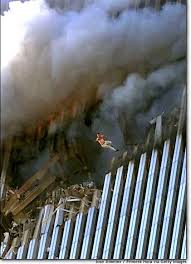
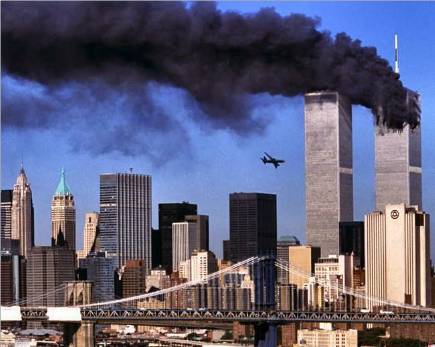
Sadly because of what we and the British and others have done in Iraq and Syria the President is left with few options, mainly those that are bad, and those that are worse. So now, as the President, with a fair amount of judiciousness and caution commits the country to continue and maybe even expand the war that began thirteen years ago, it is time to remember those burning towers, the flailing bodies of our fellow Americans and others falling to their deaths to escape the surety of death in those flames and those who have perished in Iraq and Afghanistan; not just Americans, but coalition partners and the people of those lands who had no say in what Osama Bin Laden and Al Qaeda did or what Saddam did or didn’t do; and who went from the oppression of Saddam or the Taliban, to unending civil, tribal and religious wars, in which they were caught in the middle, the Iraqis in a war that was devised by President Bush and his advisors.

There are always results and today we are dealing with the results of at least a century of incredibly short sighted decisions of Western as well as Arab leaders which have blighted the Middle East and caused immense suffering to the peoples of the region. Now because of those decisions there exists a terrorist organization which is rapidly becoming a state in the areas of Iraq and Syria that it occupies. Islamic scholar Reza Aslan described the Islamic State on CNN Monday:

“Number one, you do have to respond militarily to ISIS soldiers and fighters. These guys are fighting a war of the imagination, a war that they think is happening between the forces of good and evil. There is no negotiation. There’s no diplomacy. There’s nothing to talk about with these guys. They have to be destroyed.”

Sadly, Aslan is right in his analysis of the Islamic State. Because of that fact, on this thirteenth anniversary of the 9-11-2001 attacks we and the already suffering people of the region will see war continue without end. One wonders how many generations it will last and what the cost on lives and treasure will be.

481801_10151367001287059_1003164983_n

Peace

Padre Steve+
1 Comment

Filed under History, iraq,afghanistan, middle east, national security, News and current events

The Eve of 9-11-2001 +13

flight_175_photo


On the night of September 10th 2001 my mind was as far from war and terror as it could be. I was much more interested in the MLB Pennant Race than I was anything going on in the world, after all the only issues we faced were occasional, if deadly terrorist attacks on foreign installations and deployed ships like the USS Cole.  But as to the security of the Continental United States, or as it has been referred to since 9-11 as “the Homeland” I wasn’t concerned. Somehow, despite my knowledge, understanding and study of terrorist groups I just never thought anyone could pull off an attack of this magnitude.  The next morning I discovered just how wrong I was as the first reports came in while I was on my way to a late PT session at Camp LeJeune North Carolina where I was serving with the Second Marine Division.

That day changed all of our lives and ushered in what is now 13 years of war which has cost the United States military almost 60,000 casualties including nearly 7,000 dead or died of wounds. Of course that does not count non-DOD agency casualties, or those of the contractors who have been a big part of the war effort.

Today I was in Washington DC participating in the Military Officers Association of America “Warrior-Family” Symposium, which was an effort to bring together DOD, VA and the private sector to pool ideas, share best practices and attempt to make the connections that we need to serve and care for our military personnel and their families. It was a very good day and I will report out on it in detail in the coming days. That being said I was nervous my entire time in DC because of the approaching anniversary of the 9-11-2001 attacks as my hotel, and the facility where the symposium were conducted were both just three blocks from the White House. Needless to say with the anniversary occurring tomorrow I am glad to be home.

This evening I watched as President Obama addressed the nation regarding the military and diplomatic actions that he is taking against the Islamic State, also known and ISIS or ISIL. Whether we wanted it to or not the war which began on 9-11, which was so stupidly expanded into Iraq by the Bush Administration, opening the door to Al Qaeda Iraq and now the Islamic State, and which greatly strengthened Iran by eliminating their worst enemy, Saddam Hussein have made our task most difficult.

Thirteen years after 9-11-2001 we are not only still at war, but it is becoming a war without end.

Thirteen years ago, I figured that after a few months Al Qaeda would be no more, and the war that they had unleashed upon us would be over. however I was wrong .

Have a good night, until tomorrow,

Peace

Padresteve.wordpress.com

2 Comments

Filed under Foreign Policy, History, history, iraq,afghanistan, Military, philosophy

Iraq and the Middle East 2013: Lessons from T. E. Lawrence

Friends of Padre Steve’s World,
Today has been a day of travel to Washington DC where tomorrow I will be delivering the invocation at and participating in a panel discussion at the Military Officer’s Association of America “Warrior Family Symposium.” Since so much of why I am here is due to my time in Iraq and its after effects, and since we are faced with another difficult choice of what to do in that country, as well as Syria, to deal with the very real threat of the Islamic State, or ISIS, I thought a short reminder of how we got to this point would be in order, and no it is not all Obama’s fault.
I have a lot of personal investment in Iraq and the Middle East, as well as investment in the lives of those who served there.
Unlike your typical pundit, preacher or politician, this actually matters to me.
This is a post from January 2013, but it is still relevant.
So have a great night,
Peace
Padre Steve+

padresteve's avatarThe Inglorius Padre Steve's World

295_26912097058_4309_n

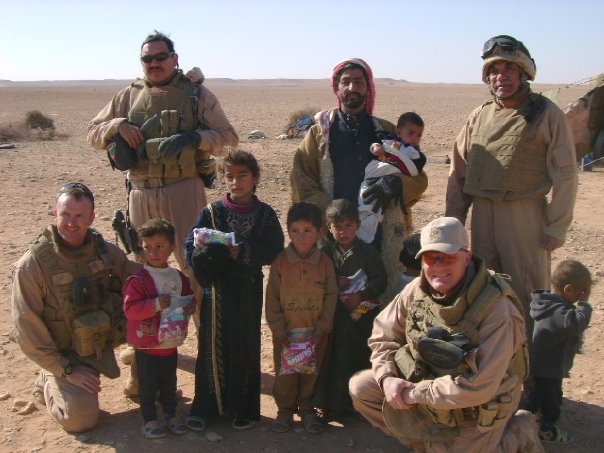
The Author with Advisors and Bedouin on the Iraqi Syrian Border

I left Iraq just under five years ago and in the process left part of me in that long suffering country.  I have written much about my experience there and how even today I have a deep regard for the Iraqi people and their hopes for a better future.

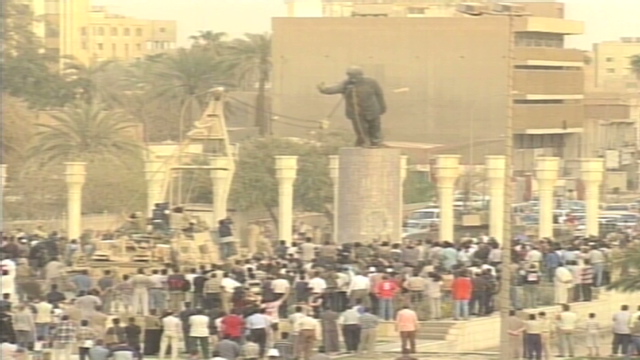
In 2003 the United States invaded Iraq and made short work of that country’s military. Many, if not most Iraqis of all creeds looked upon the US and coalition forces as liberators but within a few months the illusion was over. The US military personnel and leaders who were working with Iraqi officials, both military and civilian to get the country back on its feet were replaced by the Bush administration.

vault.von.saddam.statue.fall.itn.640x360

False Hopes in 2003, believing that US Forces were Liberators 

In their place a new entity, the Coalition Provisional…

View original post 1,058 more words

1 Comment

Filed under Loose thoughts and musings

The Opportunity to Act Upon a Dream

400236_10151328400862059_541742014_n

“All men dream: but not equally. Those who dream by night in the dusty recesses of their minds wake up in the day to find it was vanity, but the dreamers of the day are dangerous men, for they may act their dreams with open eyes, to make it possible.” T E Lawrence

This week I will be part of a panel discussion entitled “Paths for Achieving Readiness Tomorrow” at the Military Officer’s Association of America “Warrior Family Symposium” in Washington DC. The opportunity came about through the Department of Defense’s Real Warriors campaign which I have been working with since 2011 when they did a video feature on my struggle with PTSD. The panel will be moderated by WUSA Channel 9’s news anchor Derek McGinty and will include a number of mental health care providers or program directors; I will be the only chaplain speaking at the symposium. The panel will discuss available and developing programs designed to provide insight, skills and assistance for veterans, service members, their children and families – to aid them through handling reintegration, combat/operational stress, and mental health concerns; and provide them and the community, the understanding of the art of being present.

I am a bit nervous about presenting despite having been very open and transparent about my struggles with PTSD since beginning this website back in 2009. That is not so much because I don’t know my material, or what to say, but rather because I am an introvert and find writing to be less stressful than talking about my experiences in front of a big group of people. Part of this is also related by my need for safety as I am often very anxious in big groups of people that I don’t know, and because I have so much emotional investment in the subject of getting those who deal with the trauma of war and their families the help that they need.

After some of my experiences in attempting to get help myself in the military mental health care system, some of which have been more damaging than helpful, especially recently I know how scary attempting to get help can be. Likewise, I fully understand the profound stigma that many military members, especially those of more senior ranks who have invested their lives in military service, feel when they admit to dealing with these issues.

While the military has attempted to get rid of the stigma of seeking mental health treatment, even for PTSD the fact of the matter is that the stigma still exists. A very senior enlisted leader in an elite community told me following the suicide of a true naval hero who suffered from untreated PTSD and probably TBI as well who we both served with: “it’s hard when they say if you have issues and they are known that you can still have a successful career, but you will never be promoted or selected to a critical position, again.” The ironic thing was that the leader that committed suicide asked me when he took command of the unit I was in “where does a chaplain go to get help?” He obviously knew the reality of the stigma, even for chaplains. Sadly, I have to confess that as a Chaplain, Priest and clergyman there is a huge stigma to being a broken or flawed clergyperson, especially in the institutions of the church and chaplaincy. We clergy tend to take better care of our other parishioners than we do of each other and most clergy, be they in parish work, denominational structures or institutional ministry report a sense of isolation and lack of care from men and women who should be their colleagues.

I did not expect this invitation and I do hope and pray that what I say will be of help to the attendees and to those that struggle with PTSD, TBI, Moral Injury and other combat trauma or stress related issues. I dream that when I retire from the Navy, whenever that happens to be that I will be able to be an advocate and spokesman for those who suffer from these injuries. Maybe this opportunity will provide me a network of sorts to prepare for that dream.

As T.E. Lawrence said that dreamers that dream with their eyes open are dangerous, because they may act with open eyes to make those dreams possible, and I am one who does that. I have ideas and experiences that I think can be of help to others walking this path and their families. Likewise, I have a passion for trying to get people the help they need and even more importantly provide a safe place where they know that they can be honest. Admiral James Stavridis said: “overall, I think that’s an obligation to share your ideas.”

My experience is a bit more diverse than your average clergyman, mental health provider or military member. I combine my theological, philosophical, ethical and pastoral care insights, with being a caregiver to those that suffer, while struggling with the effects of PTSD, sometimes more effectively than other times. All of this is tempered by the realism that comes from 33 year military career and my academic training as a historian; both of which enable me to place these things in a broader context.

So anyway I will follow up with something tomorrow night and hopefully report out on my experience at the symposium on Thursday, as I expect to be on the road late Wednesday night returning from D.C.

I do appreciate your thoughts and prayers.

Peace

Padre Steve+
4 Comments

Filed under mental health, Military, PTSD

The Fallacy of Reductionist Fundamentalism: You Cannot be Competent in God

galaxy_universe-normal1

Today is a day for something a bit more theological in nature. A couple of days ago I wrote about the dangers of reductionist fundamentalism. One of the issues that fundamentalists of all stripes wrestle with is the issue of certitude. For them life has to be bounded by certainty. For them, whether in the matter of origins, or how life came about, in the matter of faith and morals, how life is lived in the present; or how the world ends, life must be certain. In fact, fundamentalism in all its forms inculcates believers that there is only one way of thinking, one way of knowing, one way of understanding things that are unknowable. 

Because of this need for certitude, Christians, Moslems, Jews and others of various persuasions have attempted to define the beginning and the end, as well as to dictate what is acceptable to believe, or acceptable behavior. However, this actually says more about their insecurity than reflects the strength of their beliefs. I can speak to this need for certitude from a Christian point of view, and from my study of other faiths make what I think is informed commentary.

But for people who supposedly believe in God, the reality is that in presuming certitude in what we think that we know  is actually a denial of faith. Dietrich Bonhoeffer wrote that “a God who would let us prove his existence is an idol.” Bonhoeffer was right, not only do those that presume to know exactly how creation came about, how the universe will end or say with unrequited certitude what constitutes proper belief or behavior in the eyes of God make an idol of their God, they also, whether they intend to or not, put themselves in the place of God.

According to the writer of the Book of Hebrews, “faith is the essence of things hoped for, the evidence of things unseen.” That writer, who I think is Priscilla (see Acts Priscilla and Aquila) understood that faith was not the same as empirical knowledge, otherwise it would not be faith. To understand faith in a modern sense it means that faith is something that we admittedly cannot prove. That is why it is faith.

I am admittedly a skeptic. I am. Christian, I do believe, but I doubt as much as I believe. In fact for nearly two years I lived as an agnostic, a priest praying that God still existed, thus is believe but even now doubt. That being said I have seen things that cannot be explained by science or anything rational, and there are physicians that I have worked with that can attest to those things. That being said I think there are a lot of events claimed by some as “miraculous” that are explainable and are not miraculous at all.

The fact is, whether it it about creation and the questions of origins, an exact definition by which to judge absolute truth for living or belief, or the manner of how creation will end; every single statement of such absolutes is contradicted by the fact that we live as Bonhoeffer wrote, and I like to call “the uncomfortable middle. Bonhoeffer wrote in his book Creation, Fall and Temptation that:

“Man no longer lives in the beginning–he has lost the beginning. Now he finds he is in the middle, knowing neither the end nor the beginning, and yet knowing that he is in the middle, coming from the beginning and going towards the end. He sees that his life is determined by these two facets, of which he knows only that he does not know them.”  

The reality for Christians is that we have to admit is that our belief is rooted in our faith, faith which is given to us through the witness of very imperfect people influenced by their own culture, history, traditions as well as limitations in terms of scientific knowledge. Even scripture does not make the claim to be inerrant, though some Christian Fundamentalist make that claim. Because of that, the Bible cannot be understood like the Koran or other texts which make the claim to be the infallible compendium of faith delivered by an angel or dictated by God himself. The Bible, of we actually believe it, is a Divine-human collaboration so symbolic of the relationship that God has with his people, often confusing and contradictory yet inspiring. As Hans Kung so rightly wrote:

“Christians are confident that there is a living God and that in the future of this God will also maintain their believing community in life and in truth. Their confidence is based on the promise given with Jesus of Nazareth: he himself is the promise in which God’s fidelity to his people can be read.” 

Does that mean that we fully comprehend the nature of Christ, or the doctrinal formulation of the Hypostatic Union which defines Christ as being fully human and fully God? Or does it mean that we fully comprehend or understand the doctrine of the Trinity encapsulated in either the Nicene or Athanasian Creed? Certainly not, none of those doctrines are provable by science, or for that manner even history, for there were and are people who consider themselves Christians who do not believe and who reject those doctrinal formulations. Thus for Christians to attempt to argue such matters as fact to those who do not believe is not productive at all. We must understand that faith in the living Christ is not in a doctrine but  a promise that we believe, by faith, is given given by God through Jesus of Nazareth.

The real fact of the matter is that fixed doctrines are much more comfortable than living with difficult questions or honestly examining the contradictions that exist within Scripture, history and tradition. The fact is this makes many people uncomfortable and thus the retreat into the fortress of fixed and immutable doctrine found in the various incarnations of Fundamentalism.

The fact is the world is not a safe place, and our best knowledge is always being challenged by new discoveries many of which make people nervous and uncomfortable, especially people who need the safety of certitude. So in reaction “true believers” become even more strident and sometimes even violent when confronted with issues that question immutable doctrine.

I wish it were otherwise but Christianity cannot get away unscathed by such criticism. At various points in our history we have had individuals, churches and Church controlled governments persecute and kill those that have challenged their particular orthodoxy. Since Christian fundamentalists are human they like others have the capacity for violence if they feel threatened, or the cause is “holy” enough. Our history is full of sordid tales of the ignorance of some Christians masquerading as absolute truth and crushing any opposition. Doctrinal certitude is comforting. It is as Eric Hoffer wrote:

“A doctrine insulates the devout not only against the realities around them but also against their own selves. The fanatical believer is not conscious of his envy, malice, pettiness and dishonesty. There is a wall of words between his consciousness and his real self.”

This is the magnetic attraction of fundamentalism in all of its forms, not just Christian fundamentalism.  Yet for me there is a comfort in knowing that no matter how hard and fast we want to be certain of our doctrines, that God has the last say in the matter in the beginning and the end.

But there some Christians who now faced with the eloquence of men like Neil DeGrasse Tyson and Bill Nye who make legitimate challenges respond in the most uncouth and ignorant manners. The sad thing is that their response reveals more about them and their uncertainty and insecurity than it does the faith that they boldly proclaim.

themiddle1

Our doctrines, the way we interpret Scripture and the way we understand God are limited by our humanity and the fact that no matter how clever we think we are that our doctrines are at best expressions of faith. We were not there in the beginning  and we will not be present at the end, at least in this mortal state. We do live in the uncomfortable middle. Our faith is not science, nor is it proof. That is why it is called faith, even in our scriptures where as Paul the Apostle says “If Christ is not raised your faith is worthless”  and we “are to be pitied among men.” (1 Cor. 15:17-18)

We are to always seek clarity and understanding. However it is possible that such understanding and the seeking of truth, be it spiritual, historical, scientific or ethical could well upset our doctrines about God and that is not heresy, it is an admission that God will not allow us to put hi m in our theological box. As Henri Nouwen wrote: “Theological formation is the gradual and often painful discovery of God’s incomprehensibility. You can be competent in many things, but you cannot be competent in God.”

With that I will close for tonight.

Peace

Padre Steve+

Leave a comment

Filed under christian life, faith, philosophy, Religion

The Sinking of the Aboukir, Cressy and Hogue and the Advent of Submarine Warfare

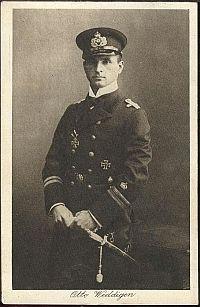
livebait_pc_weddigen1

“There was a fountain of water, a burst of smoke, a flash of fire, and part of the cruiser rose in the air. Then I heard a roar and felt reverberations sent through the water by the detonation.”

Otto Weddigen describing the sinking of HMS Aboukir 

Ninety years ago this month an event took place that changed naval warfare and introduced the world to how deadly a single submarine could be. In September 1914 most naval experts held the submarine was not much of a threat. The submarines of the day were limited in range, diving depth, speed, armament and endurance.

U9Submarine1


U-9

The U-9 was powered by kerosene engines on the surface which charged batteries which were used when the boats were submerged. Later submarines would be powered by diesel engines. U-9 was small, displacing only 543 tons on surface and 674 submerged. She was 188 feet long and just 19.7 feet in beam. The living conditions for her crew of 4 officers and 25 enlisted men were less than spartan. She was armed with four 17.7 inch torpedo tubes, two forward and two aft and carried six torpedoes, four in the tubes and two reloads for the forward torpedo tubes. The boat had been commissioned in April 1910 and on the outbreak of the First World War she was commanded by Kapitänleutnant Otto Weddigen.

kapitaenleutnant_-_otto_eduard_weddigen_-_03_01_1918


Otto Weddigen 

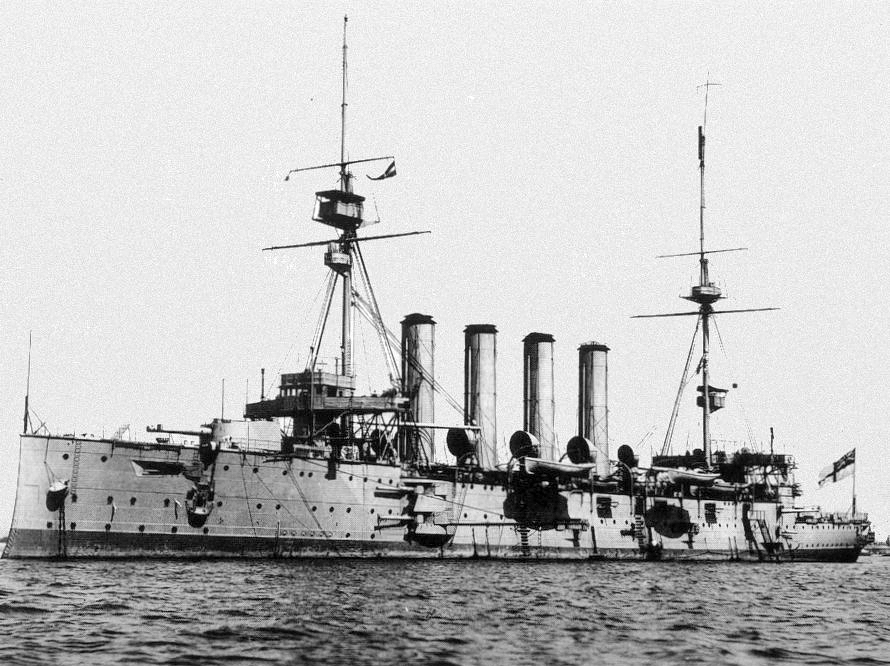
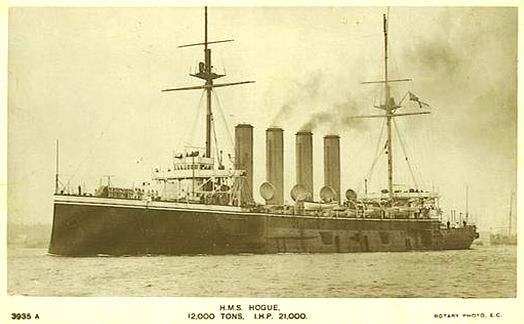
On September 22nd 1914 with enormous battles raging on the Western Front and the High Seas Fleet in port the soon to be famous submarine was patrolling in the North Sea. The U-9 was about 18 miles off the Dutch Coast near the Hook of Holland when she encountered three ships of the Royal Navy’s 7th Cruiser Squadron, or Cruiser Force C. The squadron was composed of three obsolete Cressy Class Armored Cruisers, the HMS Cressy, HMS, Aboukir and HMS Hogue displacing 12,000 tons and mounting two 9.2” and 12 6” guns each.

HMS_Aboukir


HMS Aboukir at Malta before the War, HMS Cressy (below)

HMS_Cressy

wjb_hogue_2

HMS Hogue shortly after being commissioned

The three ships were manned primarily by recently called up reservists and were derisively known throughout the fleet as the “Live Bait Squadron.” On that September morning they would be just that. The squadron was reduced in number as the squadron flagship was not present and the HMS Euryalus had to drop out due to lack of coal and weather damage to her wireless. The weather was bad, so the admiral in command was had to remain with the ship, unable to transfer. As such he delegated command to the captain of the Aboukir. The same bad weather also kept the destroyers that would of accompanied the patrol in port.


The ships were steaming in a line ahead formation when Weddigen on the U-9 spotted them about 0600 on the morning of September 22nd. They were not zig-zagging to lessen the chance of submarine attack and thought they had posted lookouts had no idea that U-9 was stalking them.

Weddigen on worked the boat into what he felt was a better firing position and launched his first torpedo at the center cruiser, the Aboukir at 0620 from a distance of just 550 yards. The torpedo struck her midships and broke her back. She began to sink and within 25 minutes capsize taking 527 of her crew of 760 down with her. Weddigen wrote in his post battle report:

“Her crew were brave, and even with death staring them in the face kept to their posts, ready to handle their useless guns….”

livebait_aboukir_sinking1

Aboukir Sinking

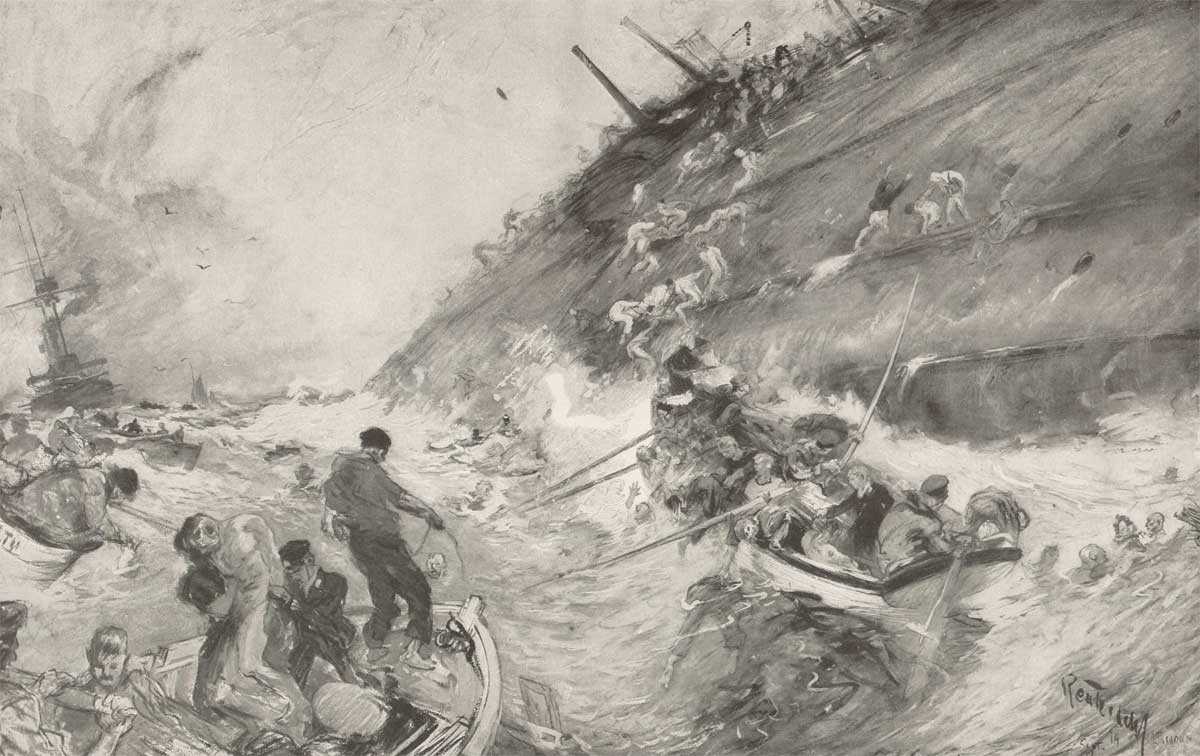
Thinking that Aboukir had struck a mine the Captains of the Cressy and Hogue moved their ships close to rescue survivors. Weddigen had surfaced to observe the British and then fired two torpedoes into Hogue from a range of just 300 yards and then dived with Hogue opening fire as she did so. Hogue capsized and sank in 15 minutes.

The British now knew that a submarine was responsible for the attack and the last ship and after reloading his forward tubes attacked Cressy at 0720 firing two torpedoes from her stern tubes. Weddigen then surfaced to bring his bow tubes into action and fired another shot, as he dis so the British cruiser opened fire and attempted to ram. Cressy was struck by two torpedoes during the attack, the doomed ship capsized and then sank at 0755.

Reuterdahl_-_HMS_Cressy_Sinking


Cressy Sinking 

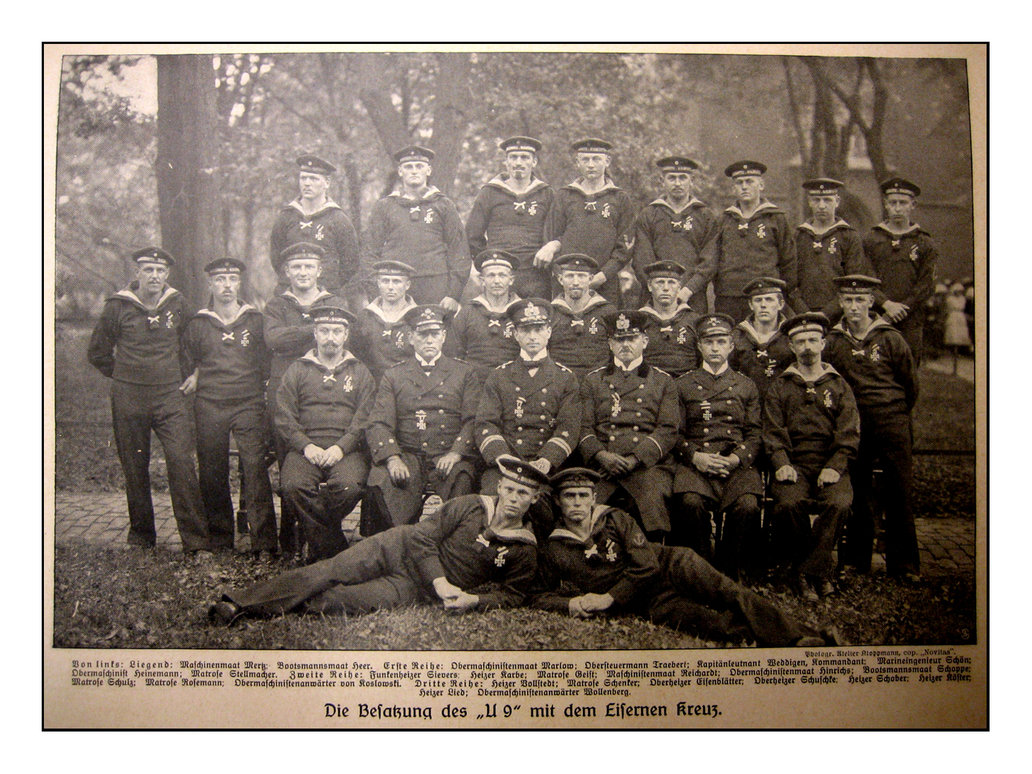
In a little over an hour the U-9 had sunk three British cruisers. A total of 1459 British sailors died in the attacks and only 837 crew members from all three ships survived. Weddigen withdrew from the area as he knew that the British would be looking for the U-9. When the boat returned to port, Weddigen, and his crew were hailed as heroes. Weddigen was awarded the Iron Cross First Class and later the Pour le Merite which he received personally from Kaiser Wilhelm II. The U-9 was one of only two ships of the Imperial Navy awarded the Iron Cross. The other was the Light Cruiser Emden, nicknamed the “Swan of the East” which tied down a large number of British, French and Russian ships in the Pacific and Indian Ocean during her short but productive deployment as a commerce raider.

U9_Heimkehr

The Return of the U-9 to Wilhelmshaven

The plucky U-9 would survive the war, sinking another cruiser, the HMS Hawke in 1915 and 13 other merchant ships or fishing boats. She was withdrawn from front line service in 1916 and assigned to training duties.

German_marines___U9_submarine_by_G497


The Crew of U-9

Weddigen was less fortunate, the aggressive young officer was killed on March 18th 1915 when his new command the U-29 was rammed and sunk by the HMS Dreadnought.

Future First Sea Lord Dudley Pound then serving on the Battleship HMS St. Vincent wrote:

“Much as one regrets the loss of life one cannot help thinking that it is a useful warning to us — we had almost begun to consider the German submarines as no good and our awakening which had to come sooner or later and it might have been accompanied by the loss of some of our Battle Fleet.”

Submarines would go on to be one of the most feared and effective weapons ever developed for naval warfare. German U-Boats nearly brought Britain to its knees in both World Wars and the submarines of the US Navy’s Pacific Fleet decimated the Japanese merchant fleet and inflicted great losses on the Imperial Japanese Navy in the Second World War. After Pearl Harbor and the many defeats of early 1942 it was the submarine force that according to Admiral Chester Nimitz “held the lines against the enemy.”

Today the most deadly submarines ever built prowl underneath the surface of the world’s oceans. Nuclear powered and advanced diesel electric boats armed with torpedoes and cruise missiles, and giant nuclear powered ballistic missile submarines armed with long range nuclear ballistic missiles provide an invisible and nearly undetectable deterrent.

Unlike 1914 today all navies take the submarine threat seriously. Should any significant naval war be fought in the Persian Gulf or the Pacific submarines will certainly have an impact not only at sea but in strategic strikes on enemy installations and land based units. In 1914 no one would have thought that the success of the tiny U-9 would eventually lead to such a dominating weapon.

Peace

Padre Steve+
Leave a comment

Filed under History, history, Military, Navy Ships, world war one