Author Archives: padresteve

padresteve's avatar

About padresteve

I'm a Navy Chaplain and Old Catholic Priest

What Happened? An analysis of the Norfolk Tides in 2009

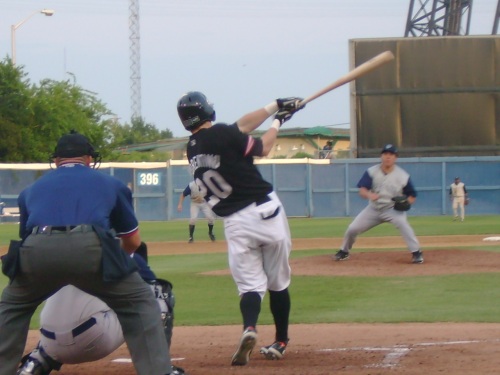
Pirates Orioles BaseballOscar Salazar

I have posted a couple of other articles analyzing the performance of the Norfolk Tides in 2009.  Now that the season is over with the Tides winning their final game by a score of 4-3 at Durham in 10 innings to finish at .500 for the season I am really going to get into the weeds.  First I am going to look at the team’s record each month of the season and note losses of key players during those months.

The Tides began well in April they were 11 and 8 with a  .578  winning percentage.  On April 21st Pitcher Brad Bergeson (1-1 2.45 ERA) was promoted to the Orioles.

In May the Tides were almost untouchable winning 23 and losing only 7 driving their record to 34-15 with a .693 winning percentage.  On May 13th Nolan Reimold (.394  9 HRs 27 RBI) was recalled to the Orioles.  May 14th Scott Moore (.252, 7 HRs, 21 RBIs) was injured, on May 29th Catcher Matt Wieters (.305 5 HRs 30 RBI’s) was called to the Orioles.  Pitcher Lance Berken (2-0  1.05 ERA) was promoted on May 26th.

three run homer by fiorentinoJeff Fiorentino 3 Run Home Run

The Tides crashed back to earth in June winning just 9 while losing 19.  They still were in first place and had a overall record of  43 wins and 34 losses with a .558 winning percentage.   Oscar Salazar (.372, 10 HRs and 43 RBIs) was called up by the Orioles on June 7th.  On June 28th pitcher David Hernandez (3-2 3.30 ERA) was promoted to Baltimore.  It is important to note that after June 7th the Tides were 8 and 15 with a .347 winning percentage. This is the date that Oscar Salazar was called up and it marks a watershed.

085Gary Allenson

July started off better than August but between 14th and 31st they went 5 and 13 with a .384 winning percentage.  For the month they were 14 and 15 with an overall record of 57-49 and a .537 winning percentage and had fallen into 2nd place.  On July 17th Justin Christian (.270 3 HRs and 25 RBIs) was injured followed by Jolbert Cabrera on July 17th (.298, 7 HRs, 50 RBIs) was injured breaking his foot going into home when sent by Gary Allenson on a play that he had little chance of scoring on. On the 29th Chris Tillman (8-6  2.70 ERA)  and reliever Kam Mickolio (3-3 3.50 ERA) were called up by the Orioles.

In August the woes continued as the Tides won 10 and lost 18 giving them a 67-67 and .500 on the year.  Once again the Tides had a meltdown, between the 20th and the 31st they only won 2 and lost 9 a pathetic .181 winning percentage during that stretch.  Even more disheartening three of these games were blown with the Tides leading in the 9th inning. On August 29th Joey Gathright (.329 24 Stolen bases) was traded while Michael Aubrey who had come to the Tides from the Cleveland system was promoted to the Orioles on the 18th.

130Injuries: Jolbert Cabrera

The Tides finished the year going 2 and 2 in September and maintain their .500 record to finish the year at 71 and 71.  September call ups included Jeff Fiorentino who hit .312 with 12 HRs and  67 RBIs.

The Tides finished 2009 with the 7th best record in the International League.  They had the 2nd highest team batting average of .272 behind Columbus.  Yet they were last in home runs with 79.  If one remember that 31 of these were produced by Salazar, Reimold,  Moore and Wieters before June 7thth in runs scored with 603 of which 239 (39.6%) were produced by the sextet of Salazar, Reimold, Wieters, Moore, Cabrera and Fiorentino.  The Tides were 5th in total hits with 1283,  6th in On Base Percentage at.330 and 10th in Slugging percentage at .389.
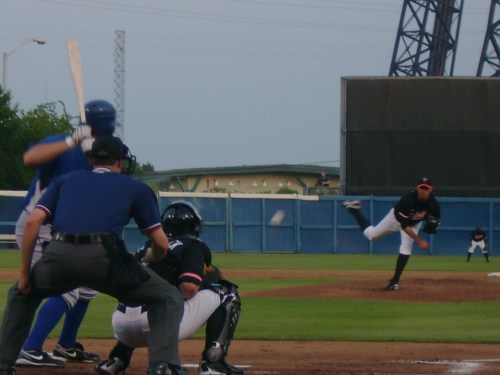
007Jeff George was a late season addition to the pitching staff

The Tides had the 7th best team pitching in the league with a team  3.87 ERA.  The ranked  7th in runs surrendered to opponents with 607 of which  527 were earned runs (80 unearned runs. Tides pitchers  gave up the 2nd most home runs (113) led the league in hit batsmen (77). They were  9th in walks with 409, 4th in strikeouts with 998.  Only one complete game was recorded by a Tides pitcher that by David Pauley in a game that he lost as the hitting never came through.  They had 9 shutouts on the year.
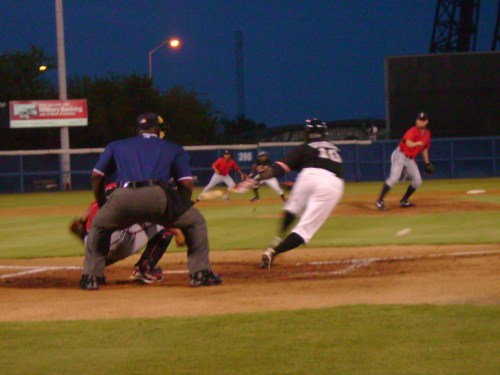
gathriright buntingJoey Gathright bunting for a hit

Hitting seems to be the key, after the Tides lost Reimold, Wieters, Salazar and Moore they were 36-56 for a .391 winning percentage.  Between those 4 players they hit 31 home runs before they left the team.  Salazar 10 in 50 games with 43 RBIs.  Reimold with 9 in 31 games with 27 RBIs, Moore, 7 in 32 games with 21 RBIs and Wieters with 5 in 39 games with 30 RBIs.  Prior to this they were 35-19 with a .648 winning percentage.  However the big drop occurred after Salazar was called up.  After Salazar left on June 7th the Tides had a   36 and 56 record for a .391 winning percentage during that time.
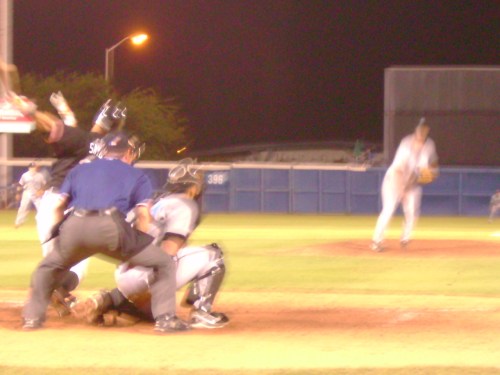
088Brandon Snyder Goes Down Swinging

In the field the Tides had 130 errors.  If one looks at fielding percentage by position played one can see my instincts about various players were correct.  Justin Turner had a .963 fielding percentage at 2nd base in 80 games committing 13 errors.  In only 14 games at short he had 4 errors and a .930 fielding percentage, while at 3rd he had 4 errors in 15 games and a .893 fielding percentage.  The farther Turner got from 2nd the less effective he was.  Other fielders had similar dynamics causing me to wonder about constantly moving infielders around in order to produce utility players when in fact it may be better to focus players on the positions that they play the best and only occasionally move them to other positions for additional experience.  I do understand the need for utility players, however you do not produce utility players at AAA.  If the player and the team has not yet figured out where the player plays the best and fits the best in the organization then it has probably missed the boat.  At AAA it is my opinion that unless a player has been recently converted to a new position, that strengths should be built upon with the goal of having potential starters, All-Stars and Golden Glove players at as many positions as possible.  This goes against the utility player mindset that the Tides-Orioles seem to have adopted where the only logical thing they appear to be doing is producing a glut of utility infielders most of who will have little chance of making the majors and little utility outside the minor league system.  Winning teams are built on excellence and not utility.  Utility players are important to plug holes and give starters a break.  You do not win pennants with teams loaded with utility players.  The Orioles know what they need at various positions.  Melvin Mora is getting old and Brian Roberts has been repeatedly mentioned in trade possibilities.  Ty Wigginton is not the best Third Baseman and there is the potential that Luke Scott may not return at first base.  Potentially they will have to replace one or more players in their infield next year.  Justin Christian could go to second and Brandon Snyder to 1st.  Brandon Pinckney is the only infielder who could be considered a true and reliable utility infielder being pretty solid in every position that he has played including a one inning relief pitcher outing and being a dependable hitter with a .291 batting average.

045July 3rd a Win Before the Bottom dropped out

Looking at trends for the Tides:

2009: 71-71  .500  3rd place

2008: 64-78  .451 2nd place

2007: 69-74 .483 3rd place

Last 3 Year  204-223    .478

The Tides last winning season with the O’s is 2005 when they were the Ottawa Lynx skippered by Dave Trembley.   Allenson managed the Ottawa in 2003 to a 79-65 record and .549 winning percentage.

Looking at the numbers the Tides early success was based on the incredible hitting and run production on about 6 players, only one that played most of the season with the team, Jeff Fiorentino.  The key date to mark is June 7th when Oscar Salazar was called up by the Orioles.  This was not simply do to the numbers, but to “X” factor that he was on the team.  Observing the team close up from section 102, row B, seat 2 I saw the impact that he had on the bench and on deck.  He provided a a sense of relaxed determination and confidence that had an impact on the players around him.  He Salazar not been called up, which I am glad that he was because he deserved to be, I doubt the Tides would have suffered the meltdown that they experienced.  When adversity struck it seemed that Gary Allenson checked out emotionally, he exuded little energy and that obviously carried over to the team.  Watching the Tides through most of August was painful as the team seemed lifeless as if they had already given up.  Scuttlebutt heard around the park indicated that quite a few players were unhappy with the organization.  A hint of this was provided by Jim Miller who when finally brought back as a closer indicated how being moved around hurt his game.
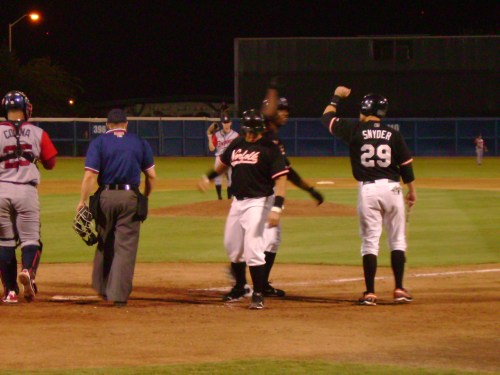
090Last Home Win Against Gwinnett September 3rd

With Allenson seemingly ineffective during this second half meltdown the organization needs to look at the previous years as well.  They need to look at who manages the Tides in relationship to the Orioles and in relation to whoever is manages at Baltimore as there is widespread speculation that Dave Trembley will not be back.  The Baltimore organization has no lack of talent at all levels as far as players are concerned, the key now is the field management team at Baltimore and Norfolk.  I would think that Baltimore would be wise to get in the hunt for Bobby Valentine who has proven that he can work with and motivate young players and who has signaled that he is ready to return from the land of the Rising Sun.  Since the Mets have elected to continue down the path of self-immolation by keeping their losing management team of Minaya and Manuel.  The Mets would have been the natural place for Valentine to go so with them out of the picture it would be wise for the Orioles to try to get him.

That is all for tonight.

Peace, Steve+
Leave a comment

Filed under Baseball, leadership, philosophy

Going to War: Interlude in Fallujah Reunions, Redirection and a Stay at the Ramadan Inn

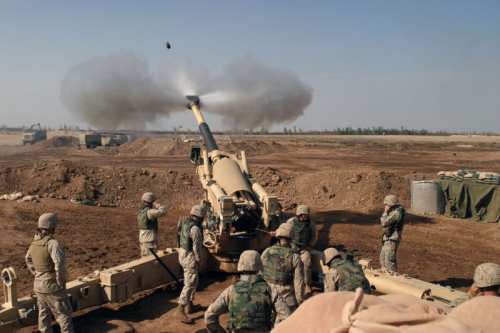
marine 155s in fallujahUSMC 155mm Howitzer firing on Insurgents at Fallujah in 2007

Note: This is the latest installment of my “Going to War” Series.  Other postings in this series are located in the Subjects section under “Tour In Iraq.” The series chronicles the tour of Religious Support Team-2 of the Iraq Assistance Group in MNF-West from July 2007-February 2008. We were the first Navy Chaplain and Assistant to work supporting advisers since the Vietnam War.

We woke up to the sound of more outgoing artillery fire.  The sun was shining outside as I look out my window at the sky above the California Barrier that protected our “suite” in the south wing of the Ramadan Inn.  Climbing out of the decrepit Iraqi bed with the fresh sheets I stumbled over my two tons of gear to look at the time while Nelson slept like a baby in his equally decrepit Iraqi bed.   My ever trusty alarm clock showed that it was about 0830, which meant we had gotten maybe 5 hours sleep and missed breakfast. Thankfully I had stockpiled a few pop-tarts and granola bars from the Camp Victory chow-hall the day before.   Opening the door and peering out into the hallway I saw it empty and walked across the hall to the head, shower and laundry room to do my morning business.   Despite being a Baath Party playground the suites at the Ramadan Inn were not furnished with their own toilet or shower, just a small sink and mirror.

ramadan innRamadan Inn

Though the Ramadan Inn had seen better days it was certainly, despite being the playground of Uday and Qusay Hussein it was not exactly a palace like those of their father Saddam.  It was somewhat reminiscent of an old and run down motel along Route 666.  The floor was a marble type tile and the sand painted concrete building with a flat roof.  I strolled over to the head in my PT-sleep clothes and was relieved to be able to relieve myself in a facility that had actual porcelain shitters which flushed using real water.  If you have been to Iraq or Afghanistan you know that this is not always the case.  The showers were passable being a more European design and the water was hot.  I guess even the cold water was hot in Fallujah with temps in the 120s.  Once I had gotten up I awakened Nelson, the sleeping beauty. He then went through his morning ritual to make himself presentable to the world.  Those who know nelson know that if he can he will take care of his personal hygiene.  I ate one of my Strawberry Filled frosted Pop Tarts washed done with water and when Nelson was ready we walked over to the Chaplain office.  It was like a maze to get there. We walked across the way a bit, took a right, made a left and went through the normal transient quarters area, took a right went up a block or two, took a left, made another left, wound our way past a decorative lake, took a right, went past a number of buildings before passing a final bank of green porta-johns finding the MEF- Forward Chaplain Office to our right.  The sun shone brightly and though not a long walk was relatively warm and by the time we got to the Chaplain Office I was sweating.

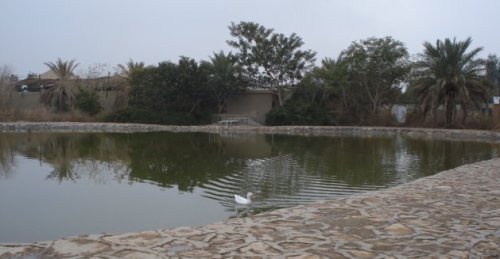
fallujah pondPond at Fallujah

The Chaplain office was like every other facility and was protected by California Barriers or Hesco’s. We were met by RP1 Roland and the Deputy MEF-FWD Chaplain CDR J.P. Hedges.  They were most hospitable and offered us water as well as coffee, which my caffeine deprived brain needed badly.  After introductions Nelson got together with RP1 Roland and I met with Chaplain Hedges doing the usual butt-sniffing that military professionals engage in when meeting someone for the first time.  This ritual usually consists of learning who our mutual friends are, where and with whom we had served in the Navy, where we went to school, something about our families and for Chaplains our faith tradition or denominational affiliation.  This is a customary act for chaplains as it is for other communities and specialties in the Navy.  On the positive side it is a way of making connection with each other and building relationships.  It is also a way or self preservation within the system as sometime there are people that do not have your best interests at heart. However for J.P. and I the meeting was very friendly. We d a lot of shared experiences in the types of duties we had done and we had mutual friends.  While we enjoyed conversation he began to introduce me to some of the things that had been going on in country the last few months.  After about 30 minutes Chaplain Mike Langston came in.  It was Mike who had worked with Peter Dissmore and the Corps Chaplain to bring us out to the west to cover the Marine and Army advisors in Al Anbar Province.

Mike had a couple of orders of business to take care of before he brought Nelson and I into his office and had our reunion. Nelson and I had both worked with Chaplain Langston.  It was good to see him again.  Nelson had worked for him in Afghanistan and I had been with him at 2nd Marine Division in 2000-2001.  He and Chaplain John Kaul arranged for me to take over Headquarters Battalion upon my return to work in a quasi-regimental billet with oversight of the independent battalions Religious Ministry Teams, though not the actual supervision of them. In addition to my regular duties counseling Marines, doing suicide interventions, conducting classes and supporting field exercises they used me, because of my experience to assist and evaluate chaplains who had been fired or relieved of their duties.  I got each one for 30-60 days to see if they could be recovered for further service or not.  In a sense this transformed me from a relief pitcher to a pitching coach.  Chaplain Langston was at a school when 9-11 occurred and during this time I was used as the Deputy Division Chaplain looking at readiness, training and potential deployment of our religious ministry teams with their units.  Both Nelson and I had experienced Chaplain Langston as a tough but fair chaplain.  What he did expect was that we would be out doing our job and keeping him or his office in the loop on our operations and issues facing us.  He did not attempt to micro-manage us.

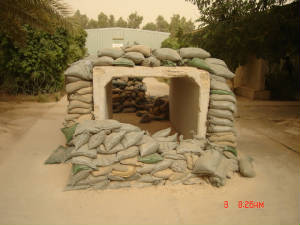
bunkers_everywhere.jpg.w300h225Bunkers to Protect Against Indirect Fire at Camp Fallujah

Mike Langston is a prior Marine Corps Infantry Officer who had been a been a Company Commander and battalion staff officer as well as instructor at “The Basic Course” which is the leveling field for all Marine Corps officers regardless of their commissioning source.  He played football in college and still has the physique of a defensive lineman.  He left active duty and went to seminary and when he was ordained and graduated from seminary entered the Navy Chaplain Corps. He had since risen to the pinnacle of a career for most chaplains having been promoted to Captain, the same as a Colonel for the other services and assigned as the 2nd Marine Division Chaplain.  He is a no-nonsense kind of guy and kind with a high level of energy and emotion.  He explained the current situation in the Province was, the locations of the various Marine Regimental Combat Teams (RCT-2 and RCT-6) as well as the one Army Brigade Combat Team, 3rd Brigade, 4th Infantry Division as well as the 1st Light Armor Reconnaissance Battalion and the MEF Aviation and logistics assets were located.  He then got down to the specifics of our mission which were pretty simple and suited to our personality as a ministry team. Basically he expected us to manage our own operations in the MEF area of operations. He expected that we coordinate our operations with the teams that we would support and keep his office informed of where we were going and what our general plan of operation was.  Since he had worked with both of us and we were both known and trusted quantities he gave us a tremendous amount of operational freedom to do our job.  His expectation was that we would be active and get out to the remotest places that we had training and assistance teams of advisors.  He told us about an Army team that had been based in Ramadi to do the job with the advisors.  He confirmed what Peter Dissmore had told us about this team.   They had never left the base in 4 months and basically hung out at the Ramadi main chapel. They managed to get their orders curtailed and left theater never once having contacted or visited any advisory teams.

ega fallujahMonument in the Traffic Circle at Camp Fallujah

We were also told of a change to our projected base of operations.  Our original plan of operations had us working out of the former British and Iraqi base at Habbinyah the location of the headquarters of the 1st Iraqi Division and the Advisors assigned to it.  Instead the Colonel in charge of those teams made the call that he could not support the operations of a Chaplain from his location. He held firm on this and the plan was changed so that we would operate from Ta’Qaddum a large air and logistic  hub about equidistant between Fallujah and Ramadi.  Ta’Qaddum is adjacent to Habbinyah on the south side of the Euphrates. It sits atop an escarpment overlooking the town to the north and Lake Habbinyah in the South.  In 1941 it was the site of a siege when the Iraqi military launched a revolt against the British who occupied the country despite it being given independence at the end of World War One.  The British we besieged in Habbinyah and the Iraq forces had the high ground atop the escarpment.  Unfortunately for the Iraqis and fortunately for the British the British forces had support from the Royal Air Force and the Iraqis had no logistics ability to support their units atop the escarpment.  The Iraqi forces were pounded and eventually a relief force arrived from Jordon to break the siege.  At TQ as it is known by most Americans we would be housed and taken care of by the 2nd Marine Logistics Group Chaplain, Commander Pat McLaughlin and his team.  We were instructed to make coordination to plan work with the teams supporting the 7th Iraqi Division, the 2nd Border Brigade, Iraqi Highway Patrol and the Provincial Police forces while working to build a bridge to the teams of the 1st Iraqi Division. The change was momentarily upsetting but ultimately it opened the door to the entire province where if we had been co-located with the 1st Division we may not have gotten out of its operational area.

Following the briefing, he, J.P, RP1 Roland, Nelson and I went to lunch at one of the two major chow halls on the camp where I met up with an old friend.  The friend was Captain Luke Fabiunke with whom I had served for 2 years at Marine Security Forces Battalion.  Luke was our S-6 and the Communications officer at Security Forces.  He was always fun to hang out with and was very supportive of my work as a chaplain there.  Luke was in the G-3 Operations shop t the MEF and specifically was working with the section that dealt with the training and advisory teams in the province.  It was good to see him and he immediately upon learning our mission asked how he could help.  This hook up was one that paid off in spades in the next 6 months.  It is a lesson that Chaplains need to build relationships with other staff officers in order to be successful, not just in their current assignment but in many cases later in their careers when they need assistance the most.  For me it helped meet my mission of finding and making contact with advisory teams of all types as soon as we hit the ground rather than operating blindly trying to figure our way around the labyrinth that was the operational setting for these teams.  I think that I owe Luke a beer or two for his assistance.

Following lunch we got to work.  Helped by Chaplain Hedges and RP1 Roland we were issued flight suits and Nelson a couple of sets of Marine Pattern Camouflage uniforms and I was issued two elderly Panasonic Tough Book laptops. One was set up for regular unclassified traffic and the other for classified work dealing with intelligence reports, weather and planning and submitting air movement requests.  Despite being a highly technological military when one gets into a combat zone technology assets for oddball teams like ours are sometimes scarce.  In fact I understood from Peter back at IAG that most of the Army teams had to share assets with others just to communicate.  Chaplain Langston and his staff ensured that we had freedom to be able to do our job without having to inconvenience others to do it.  They laptops may have been elderly but they worked.  Chaplain Hedges taught me the ins and outs of planning and coordinating the air support from Marine, Army and Air Force aviation assets and helped get us set up to do this.  Once again we got what we needed to do our mission.

We spent another three days in Fallujah preparing for the mission and making coordination with staff sections and others that we might have to call upon.  We also had a number of reunions with others that both of us had served with. I met Major Andy Niebel and Lieutenant Colonel Dave Ottignon who I had served with a Second Combat Engineer Battalion. They were good friends then and are men for whom I have a tremendous amount of respect.  I also met a number of Chaplain with whom I had previously served or knew from other duty stations. One of these was LT Joe Buenviaje, who had been my RP at 1st Battalion 8th Marines when I had done my relief pitching job there.  Joe had cross-rated from being a Boiler Technician to the RP rating not long before I had met him.  We had qualified for the old FMF qualification together and I was able to help him begin his journey to be a Navy Chaplain.  I was also blessed and honored to baptize his children at Camp LeJuene.  Joe has a heart of gold and did well in Iraq.  He got out with his Marines a lot, once almost getting blown up by an explosive device which blew up a highway overpass where they had just been conducting services. With them was a Catholic priest who had likewise just celebrated Mass.  They were leaving the site when the explosion hit and following the attack helped to take care of the wounded.

Having a cross on your uniform in a chow hall can lead to interesting situations as well as ministry.  Some people will automatically avoid you when they see the cross as if faith and religion was some sort of communicable disease.  I admit that there are some religious people and groups across the faith continuum that I think are toxic so I understand this.  Likewise there are people have been used, abused or burned by religious leaders or groups and thus want nothing to do with organized or even disorganized religion.   There are other people who are afraid that if they say something wrong that the chaplain might come down on them.  There are still others who when they see that you are a chaplain ensure that they get together with you and some will even pray for you. Regardless of the situation I always try to be friendly to those around me in a chow hall despite my preference for my introversion.  In fact I will attempt to start up conversations with anyone around me if nothing else to let them know that I know that they are there and that they can talk with me.

Some of the people that we supped or dined with were Religious Programs specialists like Nelson….well actually not so much like Nelson.  Nelson is one of those one of a kind animals that the Deity Herself cracked the mold when he was out of the oven.  These young men and women had been in country various lengths of time and were having as happens in almost every case good or bad experiences working with their chaplain.  There are unfortunately a few bad apples that mistreat their RPs and give the rest of us a bad name. Likewise there are bad RPs in the force.  Some actually set new lows for military conduct and discipline and give a bad name to the good sailors in the rating.  I had one that stole from the offering in Okinawa, forged offering forms, leave papers and burned up a new pickup truck to try to get the insurance money. I had another who tested positive for cocaine upon arriving to my ship and yet another who pretty much stayed one step ahead of the law.  I guess it is human nature that we get such folks and unfortunately because there are people like this who serve as Chaplains and RPs there is kind of a guilt by association.  As such RPs question the RPs that they know  as to how their chaplains treat them and are often wary of a chaplain that they do not know.  Nelson assured them that I was “cool” and we had a couple of interesting meals together.

There were a number of times in Fallujah where young sailors or Marines approached me about spiritual issues, family problems or prayer requests. There were even some young men and women who were interesting in becoming chaplains.  It was neat to be able to be there in those moments where our lives intersected, maybe for the one and only time.

We spent our last day in Fallujah getting ready for our flight, another really late flight.  During the day we heard that an Army CH-47 Chinook had crashed at TQ killing the crew and that the cause was undetermined as to whether it was due to hostile fire or a mechanical problem.  Such incidents raise your pucker factor especially when you will be flying into the same place that they crashed.  With this in mind we picked up our laundry had some chow, made some final coordination, called and e-mailed our families, did some PT and settled in for the evening waiting for RP1 Roland to pick us up. While outgoing artillery boomed in the distance we sat back in our room at the Ramadan Inn and discussed our plans, as well as wondered out loud what was in store for us.

3 Comments

Filed under History, iraq,afghanistan, Military, Pastoral Care, Tour in Iraq

Managing the “AAA” Franchise: A View from 102

“Baseball is a simple game. If you have good players and if you keep them in the right frame of mind then the manager is a success.” Sparky Anderson

“I believe managing is like holding a dove in your hand. If you hold it too tightly you kill it, but if you hold it too loosely, you lose it.”  Tommy Lasorda

This has been an interesting year for the Norfolk Tides.  For me the year has been the first where I have had the opportunity to observe the game on nearly a daily basis from field level behind the plate. The proximity of where I sit to the playing field in Section 102, Row B Seat 2 at the Church of Baseball, Harbor Park Parish has given me the chance to sharpen my eye for the nuances of the game.  Part of this has been lessons on life, leadership, strategy, player development and the psychology of winning and organizations that win.  In fact if you are a regular reader of this website you will likely note that baseball is pervasive in my writings.  Likewise the subject of baseball is usually entwined with my local team the Norfolk Tides who inhabit the parish church with me.  Thus my closest observations of the game come from watching the Tides.  Over the course of the season I have become familiar with the players met a decent number of the starting pitchers on more than one occasion each as well as talked with scouts and former players.  Additionally one of the best baseball men round who really needs to be hired as a color man for the Tides radio show is Elliott the Usher. Elliott and I have had numerous discussions regarding strategy, player development and baseball philosophy throughout the season, not always agreeing, but each hearing what the other had to say.  Elliott knows the game, knows the players and despite being a Red Sox fan, not that there’s anything wrong with that is a great human being.  Thank the Deity Herself that he is not a Dodgers fan, yeech!

So anyway, here are a couple of Padre Steve’s observations about the Tides this year that I think hurt player development and kept them out of the playoffs.   Now I don’t think being in the playoff as a minor league team is the end all of life, but it does not hurt the organization.  My thesis is that although the Tides suffered an end of July and August collapse that need not have happened and may have hurt a number of player’s chances of making the majors.   The collapse was like the old “June Swoon” days of the San Francisco Giants only worse.  Yet despite the swoon the Tides continued to maintain one of the highest batting averages in the league and their pitching, though not as reliable as earlier in the season was constantly around the middle of the league.  I think that there is a reason for what happened to the reliability of the pitching and it is not because the pitchers suddenly went bad. I’ll explain this further on in this article.

Fielding, in regard to the number of errors committed by the infield was not that much different than their International League South rivals.  However it seemed that the errors committed by Tides players tended to come at the worst possible time and often scuttled solid performances by pitchers.  My thesis is that this was not a case of the talent available to the team despite mid-season call ups and injuries. Nor is it just because the players did not play as well as they could thus I would take issue with those who would who want to simply blame the collapse on these factors.  Did they play a part? Yes, were they the over-riding factor? I don’t think so.

The most important person on a Triple “A” team is the Manager.  The manager sets the tone for the team and is the face of the team.  The manager is not simply a teacher, but someone who has to have a feel, almost a 6th sense for how players are doing at given points in the game or season, what their strengths and weaknesses are and what makes them tick…in other words the way that a manager deals with his players is as important to their development and success as is the talent and ability that the players bring to the team when they show up.  A minor league manager cannot allow himself to just be a cog in the big league club’s system.  The manager needs to be able to make the hard calls of telling the big club what he thinks of where players can fit and when and where they should play. A manager should never be a slave to arbitrary pitch counts, especially if he sees a pitcher is really doing badly early, or if he sees a pitcher doing well enough to complete a game.   Psychology is as important as numbers.  There are times players need to be handled with great care and other times that they might need a dressing down or boot up their ass, but this must be well thought out and not an arbitrary process.  Likewise, there is the emotional tone that a player sets in the clubhouse.  There is no right or wrong as to style, but the manager needs to be able to make his style work. If he cannot the cohesion of the club will suffer as will the hardiness of the players, individually and as a team to weather difficult times during the season.   All this said it is my belief that Tides manager Gary Allenson was not effective in this, especially during July and August.  This is certainly not to be interpreted as a sour grapes kind of accusation.  As someone who has had the responsibility for over a hundred personnel, and a couple of million dollars worth of equipment and property as well as regularly dealing with people in life and death circumstances I am sensitive to the weight on a manager’s shoulders and I have taken my share of criticism.  The job is not easy and Allenson has had a lot of success during his managing career.  So I am not saying that he is a bad manager, but that this year his management of the team was a causal factor in the collapse.

To go into specifics the biggest places that this was apparent was with the pitching staff.  When a starter of reliever got in trouble it seemed that Allenson was often disengaged.  Maybe he was trying to reach a pitch count with them or maybe trying to teach them how to pitch through difficult situations. Patently these are important in grooming pitchers but cannot be seen as the goal itself.  They are rather measurement tool to assess the pitcher’s development and readiness to play at the current level or move up in the organization.  However, the tools cannot be allowed to dictate the manager’s decision making process.  Observing this close hand watching the pitchers at various points during the game and season and watching Allenson’s body language in the dugout as well as how long it would take to have  a reliever ready makes me believe that these were overriding factors in the decision making process.

I do not know if Allenson’s intent was to let pitchers try to work through rough outings without relief every time that they pitch, or if it is something that the Orioles have instructed him to do.  Regardless of what it is that plan did not work.  The pitching staff became demoralized it was evident in their body language and by what was heard around the park.  It is fine to occasionally let a pitcher work through a difficult patch and even get roughed up a bit.  That builds character and perseverance, in fact not to do it promotes a false sense of confidence that hurts the pitcher later on.  However it is not a good policy to do this in every game as it becomes counterproductive as the pitcher loses confidence because they are not winning.  This appeared to be what was happening with Tides pitchers.  The psychology of pitchers depends a lot on winning. To take a pitcher out before he gets in trouble while he is ahead is not a bad thing. Winning helps promote a winning attitude that carries over from game to game.  Pulling a pitcher before he gets in trouble can be used to the benefit of the pitcher and the team.  This is the way of great major league managers including Earl Weaver.  Allowing pitchers to be roughed up and have no relief waiting in the bullpen on a regular basis is detrimental to their development and serves no purpose.  Thus if a pitcher is beaten and the manager knows it leaving him in the game serves no purpose unless it is simply to preserve the bullpen.  If a manager senses that a pitcher is in trouble he should be more like Earl Weaver and get the guy out of the game for his good as well as that of the team.  Losing is contagious.  Lose a lot, especially when the losses could have been avoided and a team loses its fire and often its heart.  Take a look at perennial winning and losing teams and you will find that it is not just the talent that makes a team, it is the management and manner in which they work with the talent available that make them the organizations that they are.  Winning organizations promote winning at all levels.

Another aspect of the management of Tides pitchers has been the lack of consistency in developing relief pitchers.  It is important to work to individual pitcher’s strengths in how they are employed.  If a reliever finds his particular niche then it is incumbent on management to build on this.  Relievers are a quirky breed and by the time that they are in Triple “A” ball the management should have a relatively good idea of where they fit in the organization and start preparing them for that role on the big league club.  Thus at Triple “A” it is not the best policy to give players shots at all the different relief situations, especially if it takes someone who has the potential to be a great closer out of his game.  Case in point for the Tides was the use of Jim Miller.  Miller became the Tides closer early in the season and by the All-Star break had 15 saves.  When Miller went in during the first half of the season it was almost automatic that he would close the game successfully.  After the All-Star break Miller was bounced to middle relief and occasional set up roles as the Orioles according to Gary Allenson “wanted to turn him into a two-inning pitcher, because he’s probably not going to close games in the big leagues.”  Miller said recently that he would rather finish games. “That’s what I’ve done my whole career. They wanted to stretch me out, have me throwing 30-35 pitches. If that’s what they want, of course, that’s what I’ll do. But I like closing games.” It was noticeable how uncomfortable Miller was and how his effectiveness went down when moved out of the closer role.  I’m a firm believer that if someone does something better than others that you play to strength and build on it. Guys who can close a game and have a closers mindset are rare; those guys need to be coached to be even better and not bounced around.  Miller has come into the game in the 9th in close situations since the 31st and has been his old self, even games where he had no chance at a save he shut the opponent down.  It may be the case that the Orioles do not need Miller as a closer, however he could be the 8th inning set up man, not the 5th to 7th inning middle reliever and still keep a closer mindset.

Winning organizations know when a player is in his element and from thereon work hard to make him the best at that position and to put complementary players around him. To win an organization needs no only to produce a lot of middle of the road jack of all trades utility players but guys who can become All-Stars.  Utility players do not end up on the All-Star team and while important to an organization are not the building blocks of it.  I have heard it said that giving infielders experience at a lot of different positions helps them get to the majors.  While I believe this has some validity,  I think if an infielder is gifted at a certain position, say 2nd, 3rd or shortstop and has the potential to be a starter in that position on the major league club then it imperative that the organization focus on making him the best possible player at that position.  Can the player be used at other positions occasionally?  Of course, they need to be somewhat versatile but to use a military expression, I think it is best to “train as you fight.”  In other words of the player is being groomed for a certain position don’t waste too much time trying him at other positions, or moving him to allow someone who is a utility player to play in his spot.  A Triple “A” team might have one of these players on their team at any given time; they should be the linchpin around which utility players are utilized.   I think that 2nd Baseman Justin Turner was this player on the 2009 Tides and should be used in this manner in 2010 as the Orioles prepare to bring him up. Can he play other positions? Certainly, but watching him the further he was moved from 2nd base the less effective and sure of himself he became.

Next year should be interesting.  Several of the late season call ups from Bowie should be good additions to the club, notably outfielders Jonathan Tucker and Dave Krynzel.  Guillermo Rodriguez should remain at catcher as he has the potential to develop pitchers and be available on short notice to play in Baltimore as a backup for Matt Wieters.  Injured Scott Moore, Donnie Murphy and Justin Christian should be back as should Rhyne Hughes, Brandon Snyder and Brandon Pinckney.  Pitchers Chris Waters if not taken up to Baltimore or traded should be back, as should Jake Arrieta, Chris Lambert and Chris George.  Andy Mitchell would be an ideal middle to long reliever to follow hard throwing starters with his submarine style delivery. Jim Miller needs to be kept if not brought up to the Orioles or traded, as should Josh Perrault and Troy Patton.  Other pitchers on the current staff could still be of use; Bob McCrory seemed to be doing well at the end of the season and as did Ross Wolf.  I believe that starter David Pauley is a free agent after this season so I do not know if he will be back.  Of the other position players I think it unlikely that 37 year old Jolbert Cabrera comes back and wonder if Melvin Dorta and Blake Davis need to be at Norfolk as both had significant numbers of errors.

If I was the Orioles organization I would re-look to see if Gary Allenson is the man to continue to lead the team.  The last half of the season the team has not performed to the level that it could have. Some of this maybe a lot has to do with management.  It is possible that Allenson’s superiors in Baltimore are calling the shots at Norfolk and that he wants to manage differently.  However my assumption has to be that Allenson was unable to get the team to gel after the loss of players to mid-year injuries and call-ups and did not adjust well to losing so much hitting at that time.  Again my take is not that of a disgruntled fan, but an observer trying to make sense of what happened from the end of July until the end of August.  My assessment is that it is largely a managerial problem, likely at the field level, though possibly higher in the Orioles organization as well.

It is too easy to criticize a manager and I have tried to be as fair as possible, however a team’s success is always to a great degree dictated by the manager and at the end of the year every organization has to ask itself if it has the right man for the manager’s job.  It is incumbent to the organization to do so.

Peace, Steve+

1 Comment

Filed under Baseball, leadership, philosophy

September Comes to Harbor Park: A New Month and a New Team

batter upBatter Up: September Comes to Harbor Park

Fans of Triple “A” Baseball teams in the International League and Pacific Coast League understand that the on the 1st of September the Major League Team will expand their roster.  With the roster expansion at the Major League level there is a ripple effect and sometimes even a “sucking sound” as the Triple “A” affiliates have some of their most promising players taken up to the big leagues.

On some teams this process may be a season long process, especially if the Major League team is lacking depth, talent or is suffering from injuries to key players.  However it is the roster expansion in September that changes the Triple “A” team significantly and all at once.  A couple of things happen during this time.  First and the most obvious is that key players are taken up to the Major League franchise.  For some players this may be a repeat trip having been called up for a brief amount of time earlier in the season.  For others it is their introduction to the big leagues and intended to give them Major League experience before going back down to the minors to continue working on their game the following year. For all it will be the opportunity for the Major League club to see them on the field, in the clubhouse and evaluate them to see where or if they have a place on the big club.  The move up does not always mean that the organization will even keep the player; some might be traded or given their outright release.

chris georgeChris George in His Win

Simultaneous to the Major League call up the Triple “A” roster is reinforced by players from Double “A” and occasionally even single “A” farm teams.  Again this is a similar process where players are given the chance to play at a higher level and be evaluated by the staff.  The same dynamics apply as with the Major League team, except that for some players this is their last hurrah, they are being called up to fill a roster position and will be off the team or out of baseball the following year.   In lower levels of Minor League ball the end of the season frequently sees those of marginal ability weeded out to make room for draft picks, college players and other prospects to have a place in the organization.

From my view from Section 102, Row B, Seat 2 at the Church of Baseball Harbor Park Parish the September 1st call-up is the culmination of a season of call-ups and trades which began early and continued right up to the end of August.   The Norfolk Tides inhabit the Parish Church with me and my friends, Elliott the Usher, Barry the Scorekeeper, Chip the Usher, Terri the Usher, Marty the Card Dealer, Kenny the Pretzel Guy aka “Crabmeat,” as well as Ray and Charlie and their crew from the Vietnam Veterans of Virginia who man the Beer stand on the concourse behind home plate and several thousand others depending on which night the services are held.  The Tides are the Triple “A” affiliate of the Baltimore Orioles.

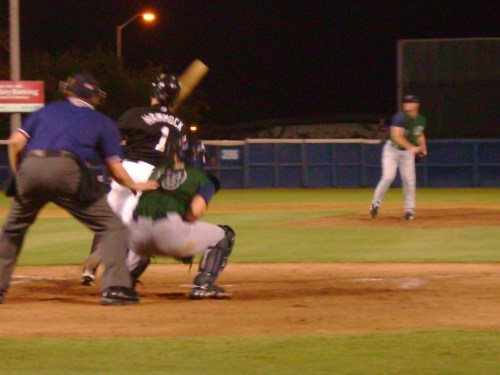
034Robby Hammock Doubles against Charlotte

The past few years the Orioles have been engaged in a rebuilding process which for many has been long and painful and is not yet complete.  They began in the lower “A” level and progressively worked their way up so that their minor league organization is one of the best in baseball at least as far as talent and prospects are concerned.  Some of that talent had filtered up to Baltimore by the beginning of the year but the Orioles were still a very weak team as they entered the season.  By May the team was calling up members of the Tides, Outfielder Nolan Reimold and Catcher Matt Wieters were among the first to go along with pitchers Brad Bergeson, Lance Berken.  Others would follow throughout the year so that even before the call up at least a dozen former members of this year’s Tides team including pitchers David Hernandez, Chris Tillman and Kam Mickalio were up with Baltimore, or who like Oscar Salazar made the Orioles and were traded and are still in the big leagues.  There were others who were traded at the very end of August including Joey Gathright who went to the Red Sox and Freddy Guzman who went to the Yankees.  There were a number of players who had season ending injuries that might have been called up including Justin Christian, Scott Moore and Jolbert Cabrera.  Cabrera’s injury may be a career ender as he turns 37 in December.

scoreSafe!

The players called up on September 1st were pitchers Dennis Safrate, Matt Albers and Alberto Castillo. Outfielder Jeff Fiorentino who is arguably the MVP for the Tides this year was also called up. Unfortunately for Fiorentino the Orioles have a stocked outfield of Nick Markakis, Adam Jones and Nolan Reimold so it unlikely that he will stay up beyond the regular season.  It is expected that the O’s will call up several more players on September 8th following the end of the International League season. There is talk of a couple of pitchers, perhaps Chris Waters and Jim Miller as well a catcher and Second Baseman Justin Turner.

For us in the Church of baseball it meant that we had a season that was very good and really bad. The Tides were probably the best team in Triple “A” at the beginning of the season. By early June they had a large division lead and had close to .700 winning percentage.  With hitting which included power and speed the Tides have had one of the top batting averages in the league all year, even at the end of the season.  Currently they are batting .274 as a team only .001 behind Columbus which is at .275.  The pitching staff was solid but after call ups and injuries mid-season became less effective about the same time the Tides lost most of their power hitters.  This resulted in a All-Star break the team began slump in which the Tides ended up dropping back to 3rd place and a winning percentage of just above .500.

The Tides have 5 games to finish out the season.  The new players are beginning to show some life and the Orioles and Tides management will beginning planning for the 2010 campaign.  Of particular interest to me are catcher Guillermo Rodriguez an excellent defensive catcher with a better bat than we have seen at that position sin a long time with the exception of Matt Wieters and outfielder Jonathan Tucker just up from AA Bowie where he was on the Eastern League All-Star team this year.  He is much like Joey Gathright, a speedy contact hitter with excellent range in the outfield and I expect that Jonathan will be patrolling the outfield for the Tides in 2010.  Recently acquired Rhyne Hughes has added punch to the lineup at First Base hitting home runs in his last two games and I would not be surprised to see the Orioles keep him around.

moon over harbor parkMoon over Harbor Park

September has started better for the Tides and for the first time since August 6th. The win streak has improved the Tides record to 70-68 moving them back to a .507 winning percentage, currently in 3rd place in the IL South. In the three games the Tides have outscored their opponents 21-3 defeating Charlotte 10-0, Gwinnett 8-1 and 3-2.  Andy Mitchell, Chris George and Chris Lambert got the wins in strong performances.  Tides relievers were excellent allowing no runs.  Jim Miller rang up his 17th save tonight having reclaimed his rightful place as the Tides closer.  The two wins over Gwinnett have dropped that former rival from Richmond to 2 games back of Durham for the I South Title with 4 games left to play.

Friday night the Tides will play their last home game of the season at the Church of Baseball, Harbor Park parish at 7:15 against these same Braves hoping to put another nail in the Braves Title hopes.

Peace,

Steve+

Leave a comment

Filed under Baseball

The Guadalcanal Campaign and the Beginning of Joint Operations

The Guadalcanal campaign was the first experiment by the United States of conducting a “joint” campaign in modern warfare involving Naval and Naval Air, Ground combat units, Army air assets and amphibious operations. The campaign involved numerous land, sea and air battles. It was under the command of Admiral Nimitz as CINCPACFLTand included commanders for ground, air and sea forces engaged.  For brevity and simplicity sake I will discuss the campaign and sea even though they are interconnected with the sea and air campaigns directly affecting the outcome of the land campaign.

Designated OPERATION WATCHTOWER and aptly called OPERATION SHOESTRING the campaign was launched on short notice, approved on 2 July the commanders of the operation first learned of it on 7 July. Utilizing the 1st Marine Division, which would later be reinforced by the Americal Division, landed on Guadalcanal and the neighboring island of Tulagi on 7 August.  The Marines took Tulagi after a brief but bloody fight and the few Japanese troops on Guadalcanal fled inland allowing the Marines to seize the airfield.  Unfortunately, the commander of the supporting US carrier task force, Admiral Frank Fletcher fearing danger to his carriers and withdrew following the landings. The forces in direct support were surprised by a Japanese cruiser force under Admiral Mikawa losing 3 American and 1 Australian heavy cruiser in one of the worst American naval defeats in history at the Battle of Savo Island. The next morning the transports, many still full of supplies left the Marines.  Admiral Fletcher’s action, which left the Marines without air cover and carrier support gave the Marines a new term, still in use today, for being left high and dry: “to be Fletchered.”

The Land Battles: The Japanese quickly responded sending in Naval Landing forces which went in light without all their troops or equipment. The Ichiki detachment was wiped out in the battle of the Tenaru (Ilu) river on 20 August.  The Kawaguchi detachment of 3,500 men landed in two groups, again short of men, material and equipment landed in the closing days of August and attempted to seize the now operational “Henderson” field on September 13 to 14th after one of its supporting units had been destroyed by the 1st Raider Battalion in a small amphibious assault.  Kawaguchi’s attack was disjointed and his units dispersed.  He was defeated in detail by the Marines in the Battle of “Edson’s ridge” or “Bloody Ridge.”  The Marines attacked and destroyed another Japanese force at the Mataniko river on 9 October.  The Marines were further reinforced by the 7th Marine Regiment while Kawaguchi was reinforced by the HQ of 17th Army under General Hyakutake who brought the 2nd Division onto the Island under the command of General Maruyama.  Kawaguchi would then be relieved and sent home following disagreements with Maruyama and his chief of staff prior to the next major Japanese attack which took place 23-25 October along the same ridgeline that Kawaguchi had assaulted. Though the Japanese now had 15,000 troops with good artillery support, the attacks were fierce but uncoordinated. Defended by 7th Marines under Chesty Puller as well as troops from the recently arrived Americal, the Marines again effectively destroyed the attacking Japanese force.  Despite additional reinforcements of the 38th Division, the Japanese, due to severe food, supply and ammunition shortages would not make any more major attempts to take the airfield.  The Americans would shift to the offensive with the Army XIV Corps composed of the 25th Division, Americal Division and Second Marine Division under Major General Lawton J “Lightening Joe” Collins commanding in December.

The Sea Battles: The sea campaign in the waters surrounding Guadalcanal would be marked by some of the bloodiest sea battles in the history of the US Navy.  So many ships from both navies would be sunk offshore that the waters would become known as “Ironbottom Sound.” Following the previously mentioned “Battle of Savo Island” the Americans lost the carrier Saratoga to torpedo damage and the Wasp was sunk while escorting a convoy. In the Battle of Eastern Solomon’s of 24 August the Americans have the Enterprise knocked out of action for 2 months and while sinking a Japanese light carrier and inflicting heavy aircraft losses on the Japanese.The Americans surprised a Japanese force on 11 October off Cape Esperance sinking a heavy cruiser and destroyer and heavily damaging a second heavy cruiser. The Japanese effort, now directed by Yamamoto brought battleships to support operations around Guadalcanal, including bombardments of the airfield on 13-14October in support of Maruyama. The attacks damaged but did not close Henderson field which was able to continue air support to the Marines and soldiers.  On 26 October a carrier engagement would be fought, the Battle of Santa Cruz Islands would be a tactical Japanese victory sinking the Hornet and damaging Enterprise, while losing no ships. Two Japanese carriers were damaged but they lost a large number of pilots and aircrews who could not be readily replaced. They also not succeed in their amphibious efforts to retake the island or Henderson field, gaining the Americans badly needed time.  On 13 November the Japanese attempted to repeat the bombardment of Henderson field but would be stopped from doing so by a task force under Admiral Daniel Callaghan.  The First Naval Battle of Guadalcanal cost the Japanese the battleship Hiei and two destroyers, additionally many of the transports bringing Japanese reinforcements would be sunk by aircraft from Henderson field and Enterprise.  The Americans lost 2 cruisers and 4 destroyers sunk and every other ship save the destroyer Fletcher damaged. Admiral Callaghan and Admiral Scott, the victor of Cape Esperance were both killed.  The following night the Japanese would lose the battleship Kirishima to the USS Washington task group under the command of Admiral Willis Lee.  Further Japanese naval activity would be limited to attempts to reinforce the island with destroyers; during one of these operations on 29 November they would clash with a force of American cruisers and destroyers at Cape Tassafaronga, sinking 1 cruiser and badly damaging three more at the cost of one destroyer, but was unable to complete his supply run.  Though the Americans lost more total warships, the Japanese could not replace what they lost.

Air Operations: The air operations would be decisive to the effort, land based aircraft of the Japanese played a key role in destroying some US shipping and sinking warships in waters off Guadalcanal however they could not maintain air superiority over the island which was maintained and increased by the Americans as Henderson field’s capacity grew and additional Army, navy and Marine aircraft were stationed there.  Naval air was extremely important in the sea battles around the island.

Japanese Reaction: The Japanese reaction was one of dismay; they could not fulfill their promise to the emperor to retake the island.  They had lost many ships and aircraft as well as ground troops. From this time on the Japanese would go over to a strategic defensive in the Pacific.  Japanese losses were devastating as they could not be made up.

Importance for the Americans: This was important in a number of ways. For the navy it showed that they could defeat Japanese surface ships in night engagements and gave the navy great experience as it moved forward in the South and Central Pacific. American carrier air crews had become experienced and gained superiority over the Japanese.  On the ground the myth of the Japanese “superman” was destroyed, yet American commanders also began to appreciate the skill, endurance and tenacity of the Japanese soldier in future operations.

Importance for Joint Operations: The campaign also was a triumph for the Americans in the fact that they were able to overcome inter-service rivalries undertake a difficult operation against a stronger opponent far from major fleet logistics and support basis.  To be sure this was Joint Operations in its infancy and until the arrival of significant Army forces on the island to relieve the Marines was for the most part a Navy, Marine Corps and Army Air Corps operation.  When Major General Lawton “Lightning Joe” Collins assumed command of the island from Marine Major General Alexander Vandergrift it became a true-inter service operation and the beginning of Joint Operations.

Leave a comment

Filed under Loose thoughts and musings

The Treaty Cruisers: A Warship Review

Note: Since childhood I have loved naval history and the study of various types of warship design throughout history. My favorite period is really from the Spanish-American War through the mid 1970’s.  I find the leaps in Naval design and architecture, weapons and fire control systems and the diversity of the types of ships built absolutely fascinating.  Not only initial designs but the various modifications and modernizations of various ships or classes of ships went through during their service careers. The cruisers of the inter-war period were some of the most ascetically pleasing warships to ever grace the high seas. They were well proportioned, and graceful while still looking every part the warship.  This is something that many ships in our modern era lack, despite the fact that their armament despite limited gun power is formidable. With VLS launchers and Harpoon Missile tubes they pack a punch, but unlike the old cruisers, their offensive teeth are hidden. I had the privilege of serving aboard the USS HUE CITY CG-66 which is about the same size and displacement of the Chester Class

I think I actually began reading Naval history back in 2nd or 3rd grade, and it was not uncommon for me to spend hours at the public library going through reference stacks to read old issues of “Jane’s Fighting Ships” and the main collection to check out every book on Naval Warfare and warships that I could find. One of the most interesting types of ship to me was the Heavy Cruisers built under the restrictions of the Washington Naval Treaty. The treaty had several major provisions but today I only deal with the restrictions on Heavy Cruisers, the response of treaty nations to the limitations and the combat summary of each class.  This is all pretty much out of the deep recesses of my sometimes dark mind and tonight I didn’t have to crack a book to write this.  It’s thanks to having one of those phonographic memories that just keeps going around and around. This is another one of the things that I am passionate about.  Anchor’s Away! Peace, Steve+

atago

IJN Atago

The Washington Naval Conference of 1921-1922 set a number of limits on warship construction and fleet composition.  One of the ship types limited by the treaties was cruisers, notably heavy cruisers.  These ships, descended from the Armored Cruisers developed by the navies of the great powers prior to the First World War were considered a major part of each of the navies of the signatory nations.  The armored cruisers had 8-10 inch guns and a relatively substantial armored belt.  The type was not particularly successful as with few exceptions they were used in fleet actions where they were under-gunned and under-armored.  They were most successfully used in overseas service against raiders or commerce.  The most famous of the type were the German Scharnhorst and Gneisenau of the German Far East Squadron.  Smaller and faster than a battleship, the type had developed by the 1920s into a ship that could be used for fleet screening and scouting as well as showing the flag in foreign waters where many were found.  The Washington treaty did not limit numbers of these ships as it did Battleships and Aircraft Carriers, but it did place maximums on the gun size and displacement of individual ships.   A heavy cruiser could be armed with 8 inch guns and were limited to 10,000 tons displacement.  Of course this led to compromises in the designs of the ships which frequently gave up protection for speed.

uss pensacolaUSS Pensacola

The Americans were the leaders in the development of the treaty cruisers.  The Japanese only built one class of cruiser, the Kako class which complied with the terms of the treaty.  They mounted 6- 8” guns and displaced about 8,600 tons.  They were fast but because of their light displacement were top-heavy.  Subsequent classes, the Nachi and Atago classes violated the tonnage limits by as much as 4,000 tons while the Japanese reported them as 10,000 tons. They were armed with 10-8”guns in five turrets, had good protection and also mounted 12 24” “Long Lance” torpedo tubes.  Two subsequent cruisers of the Kumano and Tone classes were built in the 1930s. The Kumano class of about 13,000 tons were initially classed as “light cruisers” mounting 15- 6” guns prior to being re-armed with 10-8” guns.  The Tone’s mounted 8- 8”guns in 4 turrets all mounted forward leaving the entire aft section for use as a seaplane launching area; the Tone class carried 8 float planes for fleet scouting.

hms exeterHMS Exeter

The British treaty cruisers abided by the limits included the York and Exeter, of the same displacement and armament as the Kako class except they were slower, a common feature of British ships which were generally slower than their American and Japanese counterparts.  The later County class ships were armed with 8- 8” guns and were distinctive looking having three funnels. The County class included such famous ships as the Norfolk, Suffolk and Dorsetshire which played critical roles in the chase and sinking of the German Battleship Bismarck. Australia had two Counties, the Australia and Canberra which did most of their service in the Pacific. The Counties were armed with 8- 8” guns and were distinctive with their three funnels.  They were slower than their Japanese or American counterparts.

uss houstonUSS Houston with President Roosevelt Aboard

The first American treaty cruisers the Pensacola and Salt Lake City of about 9,500 tons with an unusual arrangement of 10- 8” guns mounted in 4 turrets.  However it was the Chester class which was the quintessential U.S. Treaty Cruiser design.  These ships, and the later Astoria class, also displaced 9,500-10,000 tons and mounted 9- 8” guns in three turrets.  A further “treaty” cruiser was Wichita, converted from a St. Louis class light cruiser. All were fast but were lacking in armored protection and none mounted the torpedoes found in Japanese or British ships.  Some of the more notable ships in the U.S. treaty classes included the Houston which served as the Flagship of the Asiatic Fleet which was sunk at the Battle of the Java Sea. The Augusta which took Franklin D Roosevelt to Argentia for the signing of the Atlantic Charter in 1941; The San Francisco which helped stop the Japanese fleet in a point blank encounter in the Naval Battle of Guadalcanal and Indianapolis which with just weeks left in the war having completed the secret mission to deliver the Atomic bomb was sunk by a Japanese submarine.

PrinzEugen-2Prinz Eugen

The Germans did not build true “heavy cruisers” until the late 1930’s and their ships, the Hipper, Blucher and Prinz Eugen mounted 8- 8” guns and displaced about 19,000 tons.  The German “Pocket Battleships” Deutschland, Graf Spee and Admiral Scheer, mounted 6-11” guns on a hull of about 11,000 tons (officially 10,000) in compliance with the Treaty of Versailles restrictions on German battleships.  They were designed to outgun and be more heavily armored than the heavy cruisers and be faster than battleships, much more in the Armored Cruiser tradition.  During the war the German Navy reclassified them as Heavy Cruisers. None of these ships were built under the treaty limits for cruisers.

hms suffolkHMS Suffolk

These ships saw distinguished service throughout the war.  The British ships remained their only heavy cruiser design throughout the war. The ships took part in the sinking of the Graf Spee and Bismarck. They also suffered heavily; York was sunk at Crete and Exeter in the Java Sea. Cumberland and Dorsetshire were sunk by Admiral Nagumo’s carriers which had attacked Pearl Harbor, in the Indian Ocean. Canberra was sunk at the Battle of Savo Island off Guadalcanal.  Some of the British Ships remained in service until the 1950s and all eventually we paid off and sent to the breakers.

The Japanese ships were involved in almost every major action of the Pacific war.  Fast, heavily armed and manned by well trained crews they dominated almost every surface action of the early war in the Pacific.  The were key at the Battle of Java Sea and Savo Island where they annihilated Allied or American cruiser and destroyer squadrons. In action so often they were destroyed leaving only two marginally operational at the end of the war. Three of the four Kako class were lost in the Solomon’s.  They were all involved at Savo Island, and the last survivor, Aoba was lost at in harbor to U.S. air strikes at Yokosuka at the close of the war.  The Nachi class saw considerable service and were the workhorses of the Japanese cruiser force. They were the principle executioners of the ABDA fleet in the Java Sea battles and continued their service until late 1944 and the end of the war. Nachi and Ashigara were sunk in the aftermath of Leyte Gulf while Haguro fought the last surface action of a major Japanese combatant in a surface action of the war against a British force in 1945 and was sunk. and Myoko survived the war in a damaged condition being surrendered in Singapore.  The Chokai class also served throughout the war and three of the four were lost at Leyte Gulf. The Atago and Maya were lost to the U.S. Submarines Darter and Dace, Chokai in the action at Samar to combined U.S. destroyer and air attacks from TAFFY-3. Takao survived the war in a damaged condition having been torpedoed at Leyte Gulf but making port.  Of the later cruisers Mikuma was sunk at Midway and Mogami survived almost unimaginable damage in that battle.  Mogami was sunk by the resurrected Pearl Harbor Battleships at the Battle of Surigo Strait while Kumano and Suzaya were lost off Samar.  Chikuma and Tone also served in many battles, it was Tone’s float plane which was delayed in launching and discovered the U.S. carriers at Midway too late. Chikuma too was lost at Samar; Tone was sunk at anchor at Yokosuka in 1945.  Leyte Gulf in a sense could be described as the “Death Ride” of the Japanese Cruiser force.

The U.S. cruisers fought valiantly in nearly every engagement of the Pacific war and a few in the Atlantic.  Houston was immortalized by her actions with ABDA in the Java Sea against hopeless odds.  Astoria, Vincennes and Quincy were sunk in the Savo Island debacle.  Northampton and Chicago lost also in later actions in the Solomon’s.  San Francisco and Portland fought toe to toe with the Japanese Battleships Hiei and Kirishima in the epic Naval Battle of Guadalcanal, inflicting so much damage on Hiei that she was later sunk by American Aircraft the following day.  Indianapolis met an unlikely fate at the close of the war being sunk by a Japanese submarine after returning from a secret mission delivering the Atomic bomb.  A series of unfortunate events led to her loss not being noted with the result that most of the survivors of the sinking being lost to the elements and shark attacks while waiting days for rescue.   Others survived horrific damage from “Long Lance” torpedoes and Kamikaze attacks.  Following the war the Pensacola’s were expended as targets and the remaining ships placed in “mothballs” until the late 1950s when all were scrapped.  Some artifacts of San Francisco including her mast are at “Land’s End” park in that city.

uss san franciscoUSS San Fransisco Returning After the  Naval Battle of Guadalcanal

Of all the navies involved only the United States Navy and German Kriegsmarine built or attempted to build new classes of heavy cruisers during the war.  The US Navy brought out the Baltimore Class which was highly successful and built upon lessons learned from the Treaty Cruisers and the follow on Oregon City class which incorporated design improvements based on experience with the Baltimore Class.  Some of these ships would be converted into the first US Guided Missile Cruisers. The later Des Moines Class the largest class of all gun cruisers ever built with fully automated 8″ gun systems.  Of these ships only Salem survives in Quincy MA as a museum ship, sadly the Des Moines which had been slated to become a Museum ship in Milwaukee was scrapped in 2007 .

No treaty cruiser survives today.  Their service, heroic, unceasing and tireless service is remembered only by their surviving crews and a few naval historians and buffs.  The epic damage control actions of the San Francisco are still taught at the Naval Surface Warfare School.  They have passed into history, of those sunk some have been rediscovered, the Ballard expedition discovered and photographed the wrecks of Astoria and Quincy and their Australian consort Canberra in the waters of “Iron Bottom Sound” off Guadalcanal.  The German “Prinz Eugen” though not a treaty cruiser survived the war and was expended as a target in the Atomic bomb tests.  Her wreck lies capsized and submerged at Bikini Atoll.  An attempt to salvage her by a German group was abandoned and one of her screws was brought back and placed on display near Kiel, Germany.

Though all had design drawbacks due to the treaties, the American and British ships performed magnificently and without their service, especially in the early days of the war history today might be different.  Here’s to gallant ships and steadfast crews. May they never be forgotten.

Peace,

Steve+

13 Comments

Filed under Loose thoughts and musings

Star Trek the Next Generation: Captain Jean-Luc Picard Deals with PTSD

Counselor Deanna Troi: Interesting.
Captain Jean-Luc Picard: Counselor…
Counselor Deanna Troi: I just find it interesting. Captain Jean-Luc Picard, the man who couldn’t be pried out of his seat for a vacation for three years!
Captain Jean-Luc Picard: It’s Earth. It’s home. Do I need another reason?
Counselor Deanna Troi: I don’t know, what do you think?
Captain Jean-Luc Picard: Your help has been invaluable during my recovery, but…look, I’m, uh…I’m better! The injuries are healing.
Counselor Deanna Troi: Those you can see in the mirror.
Captain Jean-Luc Picard: The nightmares have ended. All I need now is a little time to myself.
Counselor Deanna Troi: I agree. In fact, I’m delighted you’re going. It’s just that…the choice of where you’re going could stand some scrutiny.
Captain Jean-Luc Picard: If you wish to believe my going home is a direct result of being held captive by the Borg, be my guest.
Counselor Deanna Troi: Is that what you believe?
Captain Jean-Luc Picard: I hate it when you do that.
Counselor Deanna Troi: Captain, you do need time. You cannot achieve complete recovery so quickly. And it’s perfectly normal after what you’ve been through, to spend a great deal of time trying to find yourself again.
Captain Jean-Luc Picard: And what better place to find oneself than on the streets of one’s home village.
Counselor Deanna Troi: Interesting.

I have always found the Star Trek TNG episode Family quite compelling.  The episode (Season 4 Episode 2) deals with Captain Jean Luc Picard’s return home following his capture and assimilation by the race known as the Borg during The Best of Both World’s Part 1 and II (Season 3 Episode 26 and Season 4 episode 1.)

The story is interesting because it deals with some of the issues that people traumatized in combat deal with as they try to find themselves again.  In the story Captain Picard, in a very typical manner of someone traumatized by combat believes that his injuries are healing.  His counselor, Deanna Troi who serves as the Ship’s “Counselor” challenges him on his belief that he has recovered and his choice of where he wants to go to find himself again.

I saw the episode when I was in Seminary not long after completing the Chaplain Officer Basic Course and then saw it again when I was going through my Clinical Pastoral Education Residency.  It was during that process, one in which I was trying to find and define what “home” was, that it really caught me.  I was Captain Picard, the brother who left home to explore and travel while serving in the military.   My brother Jeff was Picard’s brother Robert.  He is the one who stayed home and minded family business.  The parallels then got me and even more so now.  My Residency Supervisor used this to good effect during that time in dealing with the issues of home, but the post combat and PTSD part was yet to come.

Back in the days of my residency I struggled with another of issues related to being a military brat and having begun a career in the Army.  In a sense I was a nomad.  I had lived a lot of places but none were really home, even where I had spent all of junior and senior high school.  Like Picard my eyes were set on far horizons of exploration and adventure of military life.  My brother Jeff on the other hand like Picard’s brother was content at staying at home, being near our parents, getting established in the school district and taking care of his family.   We both chose our own paths and both were right for us.  I still long for adventure and exploration but have begun to settle down.

When it came to the placement of the PTSD in this picture it was after Iraq that I had a crisis in a number of areas in my life and every time I thought that I was doing better and maybe even “getting well” that there was always something that could trigger the memories, bring back the dreams and keep me from sleep.  I can say that a year and a half after my return from Iraq I am doing better in a lot of ways but still having struggles with anxiety insomnia and hyper-vigilance.  I did find out that there is one thing that does not evoke a startle reflex is a foul ball that comes back against the screen in from of me in Section 102 at the Church of Baseball Harbor Park Parish.  Last night while taking pictures right up against the screen I had several balls that hit within a couple of feet of me, one of which hit my camera and knocked it out of my hand.  Anywhere else loud noise, unexpected crashes, things flying past me sends me into a hyper-alert status.

picard familyPicard Meets His Family after Many Years and Wounds Away

When Picard goes home it is not the confident Starship Captain who returns, but a man unsure of himself and where he fits in life.  His encounter with the Borg has changed him and he contrary to assurances to Counselor Troi is still wounded.  When I returned from Iraq I wondered where I fit, I felt like I had abandoned my advisers in Al Anbar when I returned because my relief had to be sent elsewhere do to circumstances beyond my control.  I did not feel a part of my own unit as nothing was the same when I came back.  I felt weak, useless and at the end of my rope after having completed incredible tour in combat of my then 26 years in the military.  Physically I was falling apart; I had several nagging injuries from Iraq that caused chronic pain.  I was flashing back with every moment, fires burning in the Great Dismal Swamp had turned our air the color of an Iraq sand storm while the smell was like that of the ever present burn pits, both military and Iraqi.  Walking out the door one morning with my neighborhood shrouded in smoke I began to melt down.  That day we had a seminar done by a nationally known speaker dealing with trauma and combat with the associated feelings and emotions.  At the end of the day I was a wreck.  My Unit Doctor, Chris Rogan looked at me and said “Chaplain you don’t look good, are you okay?”  I said “no I’m not, I’m losing it and I’m scared.”  That was the place where I finally began to get help.  It has been about 14 months since I started and it is still a process.  We made a trip home that summer and I did not do well.  It was painful and I had great difficulty both in the travel as well as the visit.  When I hear fellow vets talking about the surreal and often painful times that they experience I can understand.  The fact is that you can be with a hundred friends and family members and be totally alone when you return home because it is something that you cannot really share and that they usually don’t understand.  Once again I have been fortunate.  My little brother actually listens to me and lets me vent when I need to.  Of course dealing with our family’s stuff this is a two way street.

not a happy camperVisiting Home and not Doing Well

In the story Picard is offered a chance to leave Starfleet and go to work on a project under the ocean on Earth.  He is sorely tempted to take it but before he can he has an encounter with his brother who challenges his decision.  They exchange words and Captain Picard feeling picked on starts a fight.  During the fight he breaks down about his experiences sobbing in his brother’s arms.  “His brother then said: So – my brother is a human being after all. This is going to be with you a long time, Jean-Luc. A long time. You’ll have to learn to live with it. You have a simple choice now. Live with it below the sea with Louis, or above the clouds with the Enterprise.”

In a sense that is something that all of us who serve after having been traumatized by the experience of wart have to deal with, the physical as well as the psychological and spiritual wounds.  For me it was the realization that I was human after all and the slow realization that this will be with me a long time.  The choice is how I choose to live my life and where I do so.

In the series and subsequent Star Trek: The Next Generation films Picard is forced to deal with his psychological wounds from the encounter with the Borg culminating in the second of those films Star Trek: First Contact. In it Starfleet Command leave Picard and the Enterprise out of the battle leading to this exchange between Picard and his First Officer which deals with the stigma associated with such an injury.

Cmdr. William Riker: Captain, why we are we out here chasing comets?
Captain Jean-Luc Picard: Let’s just say Starfleet has every confidence in the Enterprise and her crew – they’re just not sure about her Captain. They believe that a man who was once captured and assimilated by the Borg should not be put in a situation where he would face them again. To do so would introduce “an unstable element to a critical situation.”
Cmdr. William Riker: That’s ridiculous. Your experience with the Borg makes you the perfect man to lead this fight.
Captain Jean-Luc Picard: Admiral Hayes disagrees.

The stigma associated with psychological injuries is far greater than that of physical injuries.  The unseen injuries are not as well understood and those who suffer them often are broken down by the system as they try to get help and many simply go underground and self medicate.  Last year two Army Generals opened up about their struggles with PTSD. I was fortunate to have people come alongside of me when I went down hard.  People who did not give up on me and kept faith by caring about me when I was and still get down.

See the article at: http://edition.cnn.com/2009/HEALTH/03/06/generals.ptsd/

Despite this and the efforts of many in the Military to help those with PTSD and other “unseen” injuries, to include medical conditions brought on by exposure to toxins in the combat zone, there is still the stigma.  As the young officer suffering from a rare and eventually fatal pulmonary condition acquired in Iraq as well as yet untreated PTSD “I squarely wish I had lost my legs then than the lung function that I have lost!”

Captain Picard’s story of course is fictional, but it demonstrates to some degree what those who experience the psychological and spiritual wounds of war face when they “come home.”  This stuff doesn’t go away.  Here are some of the comments that I have had from readers who deal with their own or a family members PTSD.

Australian Vietnam Veteran who wrote me said:  “As an Australian Vietnam Veteran with PTSD, I find these articles fascinating. I long wondered why the world had to be such a hostile mongrel place. Then 30 years later I was diagnosed with PTSD and I can now relate to why I have the condition but the world has not changed and medication is of limited use. There are many of us who are still very isolated and have to limit our social contacts. I recently started a Vietnam Veterans group, for members of our small unit, on the web and I found men who were relieved to be part of something and someone they could relate to as they had all but withdrawn from society. Sadly a few of them refuse to take any medication for their medical conditions as they see that as prolonging their miserable existence.”

A family member of a WWII veteran said: “thank you. It’s really needed for women to read articles/memoirs like that. It’s easy to say someone has PTSD, but another to live with and love who has it. I come from a family with rich military history and this is an everyday issue. Never goes away, even after 40 – 60 years.”

A USMC Vietnam Vet that I know wrote: “It’s a bitch at times, and the sleep, or lack of will eventually come, although it will never be a fully restful sleep. The Hyper vigilance seems never to go away. Yes it could be good, but eventually it can be bad…. well do I know both.”

An Army Chaplain from Iraq noted: “I too am a chaplain who felt that he and his assistant were the best equipped to handle the horrors of war – just to find out after being home for about a year just how much I had changed. I was sitting with my daughter in my lap one weekend afternoon when she asked, “Daddy, why don’t you play and laugh with us like you use to before you went to Iraq?” It was the key event that brought everything to a point where I could get help. In the months since there have been good days and definitely bad days – however, my faith remains strong….”

I run into people like this every day in the course at work who deal with this and sometimes it spills over into my stuff.  However I am glad to know that I am not alone.  To those who have helped me since I have be back, Chris, Two Feathers, Limey, Greg, Jesse, Jeff, Elmer, my longsuffering wife the Abbess of the Abbey Normal Judy and my brother Jeff, Colonel P and Janet, the folks I work with, the people at Harbor Park, especially Ray, Charlie and the Vietnam Veterans of America who man the beer stand on the concourse behind home plate and all the others who have come alongside I am grateful.  It is my sincere wish and prayer that all veterans will have such fine people there for them when they hit the wall.

Peace, Steve+

Leave a comment

Filed under iraq,afghanistan, PTSD, star trek

Cowboys Stadium meets Seinfeld: A Scoreboard and a Nose that You Can’t Miss

cowboys scoreboardJerry Jones’  Über-Jumbotron

The New Cowboys Stadium opened officially last week as Jerry’s Kids played the team formerly known as the Houston Oilers the Tennessee Titans, or as I will now call them the Toilers. Most people have been focusing on the controversy over the height of the scoreboard from the field, and if it is really in the way of a punter.  Okay, so what? There are other domed stadiums throughout the league where punters have hit the rafters or roof.  I actually could care less if a punt hits the damned thing that is why the NFL has a rule that says something like this: “If a punt hits the ceiling, roof, scoreboard, the Goodyear Blimp, low flying aircraft or a Space Shuttle returning to earth the punt shall be done over” or words to that effect.  So really the whole controversy over Jerry’s Gigantic Über-Jumbotron being too low is a red herring.  Jeff Fisher doesn’t like Jerry and figures that he will make Jerry’s life complicated, especially since Jerry spent something like 43 million dollars on the scoreboard, or the price of three large pizzas and three beers at one of the stadium’s concession stands.

The thing that got me was not that the Toilers punter hit the scoreboard and if it was intentionally done as Jerry’s Kids claim, or if it was unintentional as Fisher and his Punter claim.  It is how the scoreboard appears when you see it on TV and I can only believe that the effect has to be even more pronounced in person.  It is overwhelming; it is all that you see, it is like a really nice looking girl with a nose that is so big that it overwhelms every other facial feature and draws your attention to it so you can see nothing else.    A colleague of mine at work has had season tickets for the Cowboy’s for years.  Every home game she and her husband fly from the East Coast to Mecca to see the Cowboys play.  She has her tickets for the new stadium and she is pretty sure that her seats will be low enough not to have her view of the other side of the field impeded by the Über-Jumbotron.

So back to my point; when I first heard about the scoreboard I thought, big deal it’s only a big scoreboard.   A lot of stadiums, auditoriums and churches have large screen scoreboard.  I think there is a church in Texas that has one that shows the preacher, has his preaching stats on one column as well as that Sunday’s hymn numbers, Scripture readings and the offering count for the previous month noting the biggest givers’ contributions, but I digress as we are talking about the Jerry’s Über-Jumbotron.

This thing is so big that when I briefly flipped past the game I was transfixed by the sheer size of it.  It was all that I could see. It dwarfed everything.  When people say that everything is bigger in Texas, this proves it.  Although one wonders like the old question dealing with the size of a man’s you know what; if size really matters.  Since girls are not as discreet in talking about such things in public I have occasionally overheard conversations in bars, restaurants and malls where women are discussing this rather delicate and sometimes controversial subject.  Once again I digress.

So anyway when I saw Jerry’s Über-Jumbtron I thought to myself “I have seen this before but where?’  Then it came to me…Seinfeld.  The episode where George dates a girl who has a massive nose which the writers focused in on as if it was George looking at her and all that he could see was nose…nothing but nose.  Once again Seinfeld meets life, only rather than a nose it is Jerry’s Über-Jumbotron.  I was astounded at just how large that it is and I was almost mesmerized by it.  I shook my head to break eye contact with the monster before I could be sucked through my TV screen and into the Stadium.

seinfeld noseThe Nose

Like I said, I could care less about the rules and how the scoreboard affects play.  I personally find football only mildly interesting now and a diversion to fill occasional time slots when Baseball season ends.  The only question that I have is about the ascetics of the scoreboard.  I wonder if it will become a distraction from the game itself.  I wonder of people who actually care about football wonder the same thing.  Has Jerry Jones created a monster in putting in such a large and overwhelming edifice in his high tech Temple of Cowboy’s Football?  Or is it like the scene out of the movie ruthless people where Judge Reinhold is talking to a rich couple

buying a stereo:

Ken Kessler: Over here, we have a great speaker, Sentry EV- . Consumer Stereo has just rated this a best buy.  I have a pair myself.

Male Customer in a leather Ferrari jacket: Yeah, uh, what do you think of this one?

Ken Kessler:  The Dominator X- ? The Dominator’s a good marketing idea, but it’s really not a good speaker.  We give it a 100 % markup, so we sell it at 50 % off, give the customer the illusion he’s getting a deal and we still make a bundle.

Female Customer: But it’s so big and impressive!

Ken Kessler: Size means very little. Bigger is not necessarily better. I sound like Dr. Ruth.

Female Customer: You mean the Dominator’s like a, uh–

Ken Kessler: Well, the Dominators are very popular with men who like to have bigger… uh—

Female Customer: Equipment?

Ken Kessler: Exactly!

Have a great football season Cowboy fans!

Peace, Steve+

2 Comments

Filed under purely humorous

Leave no Soldier Behind? I think not…A letter from an IOF Vet and Reader

Note: This is the sanitized version of an e-mail that I received last night from a OIF 05 and OIF 07 Veteran Army Officer who has been awarded two Bronze Star Medals for his service in Iraq and was Medivac’d out of Iraq during his second tour when he was diagnosed with an exceptionally rare incurable and eventually  fatal lung disorder that he contracted in Iraq with two separate Brigade Combat Teams.  Since then he has developed other medical conditions brought on by his lack of pulmonary function.   He is in process of being medically boarded out of the Army and is despairing to the point of having suicidal thoughts and ideations, wondering if it would be better for him to die on active duty so his wife and child would have a better financial support than if he waited to die a few years from now as a medical retiree.  I was able to contact this officer to listen to him at length this morning and afternoon. He has agreed to get help for these thoughts and I have given him the means to contact me any time and he has contracted with me to get help, I suggested a trip to his local medical facility Emergency Room.  He has given me permission to share this as he no longer feels protected enough by the Army to say it on his blog.  Please pray for this man and take care of the Combat Veterans, active duty, disabled or retired that you know.   His letter follows.

Peace,

Steve+

Dear Padre Steve,

This is why I am not posting on line…(I would say things like the following…)

I really do not know how much more I can take! I am beaten down, first by my own body and the diseases that are exacting a high price; second by the fight waged to receive some kind of medical care; third by the callus medical care provided; fourth by the institution of the Army attitude and treatment of “broken” people; by how the institution seeks to downplay and disregard the sacrifices of those who have sacrificed so much–by trivializing the toll of the disease–especially when not clearly visible.

Without a thirteen round prize fight the Army will throw me off the back of metaphoric  5-ton and act like they are doing me a favor by slowing down to 55 mph! “Look, you worthless scum-bag, we are doing you a favor by slowing down. Don’t, worry, you should be OK…we will try and get you off to the side so the tank does not role over you…”

The system, and the people within it, constantly questions your “worthiness” of any consideration. Then if you insist  on getting help for things that you know are wrong with you they double and triple question as if there is no way you could be telling the truth.

It is easy to say that I am at my wits end with all of what is going on in my life lately. The constant fight to receive what is necessary right is darning. I have been dealing with this callused indifference since being Medivac’d in the middle of my second Iraq tour. The system seems to be designed to wear you down so that rather than continuing to fight for the care that you need, just take what little the Army is willing to give.  I found out this week that after I am med-boarded out of the service that I will have to fight the Army all over again to be able to keep my Army benefits when I apply to the VA.  This is happening despite the fact that the Congress recently allowed for this compensation for veterans.

Will justice EVER be given? At what price?

Does the “Army” GIVE A DAMN!? The short answer is NO! There may be some individuals who do. What is experienced is the Teflon affect. Not many, if any, are willing to get dirty and fight for or on behalf on another. People end up getting treated as paper and numbers–not the individual they are, or for the sacrifices they have made. The individual is trivialized through the bureaucratic process that most involved in processing hide behind to separate them from the reality and often pain experienced by those suffering in the system.

I have recently started trying to get help from my PTSD.  A board certified Army physician that I wrote a consult for me to see someone.  I was contacted and told that the people who run the program here no longer take appointments or consults and that I would have to be “triaged” by a medical or psych tech to get an appointment that might be 3 months from now?  I might be dead by then. I don’t feel safe.

People may listen, but they usual will not, cannot, or do not know what to do. So trying to get help is like trying to find a particular molecule of water in the ocean.

This process SUCKS. It is worse than my first, very trauma filled, combat tour in Iraq (OIF 05-07). It is demoralizing. I squarely wish I had lost my legs them the lung function that I have lost!

I am an officer with TWO BRONZE STARS for my Iraq service.  I gave all that I had and my honesty, integrity and faith in the Army that I joined is being called into question.  If it is happening to me, what is happening to junior personnel? Who is their advocate? Is it any wonder that soldiers are committing suicide and unheard of rates?  Shit I have even counted up the money and figured that my family would be better off if I died on active duty than after my medical retirement.  What the hell is up with that? Why should I have to die for the Army to take care of my family?

What do I have to do to be heard? Does God even care? I’m just asking. Thanks for listening.

Sincerely,

Joe Smith (a pseudonym)

1 Comment

Filed under healthcare, iraq,afghanistan, leadership, Military

Analyzing the End of Season Collapse of a Baseball Team

Note: I cover baseball and the Norfolk Tides with a Blog on the Virginia Pilot Online entitled Padre Steve’s View from 102. The link to that site and those blogs is here:  http://hamptonroads.com/blogs/padre-steve039s-view-102 Those articles are not re-posted here.

out at homeGathright Out at Home

Baseball is replete with end of season collapses of teams that had started hot and were in first place. The collapses often take place due to injuries to key players, trades gone bad or slumps that never end.  These collapses are even more troubling when there are not injuries or other circumstances that readily explain them.  The 1964 Phillies and the 2007 Mets had meltdowns of epic proportions in the last month of a major league season.  At the Minor League level there are other factors to consider especially with the added dimension of call ups by the Major League team and trades made by the Major League affiliate which impact the Minor League club’s roster.

strike outThe Melt Down Continues Strike Out

This year the Baltimore Orioles AAA International League Norfolk Tides who were playing nearly .700 ball through June experienced a collapse like I have not seen up close and personal.  Early in the season they were nearly unbeatable. Consistent and clutch hitting combines with excellent pitching allowed them to dominate the league taking series after series and recording a number of series sweeps against good teams. The for a variety of reasons the wheels came off.  At first is was merely inconsistent play and basically playing .500 ball. Then came the collapse and the Tides are only mathematically in the post season chase.

Fiorentino HR against ColonBright Spot: Jeff Fiorentino Should be Tides 2009 MVP

As the season draws to a close with the Tides obviously out of the playoff race even with the mathematical possibility of coming back it will be time for some ruthless evaluation of how the club has been managed since the All-Star break.  It is hard to believe that with as much talent as the Tides still have that they are losing this consistently and this badly.  The Orioles can be blamed for pulling players up and depriving the Tides of talent, however they needed to draw upon the Tides because of the weaknesses at Baltimore.  Certainly the call up of players like Nolan Reimold, Matt Wieters and Oscar Salazar has had an effect on the Tides. Likewise  the number of significant injuries to productive position players such as Justin Christian, Jolbert Cabrera, Scott Moore and Donnie Murphy had a large impact.  The loss of these 7 players deprieved the Tides of most of thier offensive power as did the recent call up of Michael Aubrey.

gathriright buntingAnother Bright Spot: Joey Gathright Bunting for a Hit

But even with all of these losses the Tides are tied for the best team batting average in the International League at .274.  So we cannot simply blame the crash on the loss of these position players and loss of power hitters.  We then come to pitching, Despite the collapse the pitching staff ERA is still only 3.94 and not at the bottom of the league, however the relief pithcers including guys who had been almost automatic in being able to close out innings and games has become very incosistent and in the past 10 games have blown 3 9th inning leads.  Convert those to wins and the Tides are still in the hunt.  Rececnt pitching additions from other clubs with the exception of Jeff George have not panned out. So we can say that pitching is a factor.   Fielding and defense is another matter.  Unfortunately Tides infielders have committed 71 errors.  Three players, Melvin Dorta, Justin Turner and Blake Davis have committed 51 of these and former Tides infielder Carlos Rojas another 9. Though the statistic is not found on the MiLB or Tides Websites, Tides pitchers have committed their share of errors at critical points in games.   On the other hand Tides outfielders Joey Gathright and Jeff Fiorentino have only two errors eachand lead the Tides in batting average, on base percentage and are near the top in slugging percentage among the current roster.

046Is it the Manager?

The Orioles organization will certainly address these on the field concerns.  This is something that thye have been working on and I expect that next years team will be more solid in these areas and  hopefully the Orioles with the addition of so many Tides who now have Major League expereince will not need to dip down so often and give the Tides, Baysox and Keys time to develop tallent.  However the Orioles management may need to take a look at the dynamics of what is happening in the dugout with the field staff including Manager Gary Allenson.  We really have to see if the problem is bigger than just a Lemony Snickets Series of Unfortunate Events or an organizational problem.  There are many regulars who question Allenson’s choices as a 3rd base coach as well as his inability to pull a pitcher before they get the team in deep trouble.  Yes giving pitchers the experience of trying to pitch out of jams is important, but it should not be done all the time.  Frequently it seems that Allenson has left pitchers in for one out or one inning too long, often with no-one warming up in the bullpen.  The final thing to ask is how Allenson rotates his infielders to different positions on an almost daily basis. I have to wonder if the constant changes in where the infielders are being played is effecting the number of errors being committed by the club especially in light of the fact that the three biggest error producers are the middle infielders. While the Organization may be at fault for some player personnel issues ultimately it is the Manager who makes the day to day calls on the field that determine whether a team wins or loses.

135Injuries: Jolbert Cabrera Being Carried Off teh Field after Breaking Bones in his Foot

The Tides are 10 and 25 since July 20th oin what has been a collapse nearing epic proportions and since the 18th of August have been outscored 65-40.  When one looks at talent, save the inability of the infield to play error free ball;  one has to begin asking questions and getting answers.

The Tides face the Charlotte Knights tonight, with Jake Arrieta facing Jake Peavy.  I will be there in Section 102, Row B Seat 2.

Though the players are here to develop and learn, there is little substitute for winning when building a young team. As Charlie Brown said “Winning isn’t everything, but losing isn’t anything.”

Peace, Steve+

Leave a comment

Filed under Baseball