Author Archives: padresteve

padresteve's avatar

About padresteve

I'm a Navy Chaplain and Old Catholic Priest

The Death Ride Of the Scharnhorst at North Cape

Friends of Padre Steve’s World,

Today was the Second Day of Christmas or as it is also known, the Feast of St. Stephen.

Christmastide is a joyous time for many, but in the course of history there have been times that military men have fought and died in hopeless battles far from their families. Thus it is often a time of sorrow, especially for those that die alone. Among those who died alone in the Arctic darkness of December 26th 1943 were the officers and crew of the German battlecruiser Scharnhorst.

Schlachtschiff

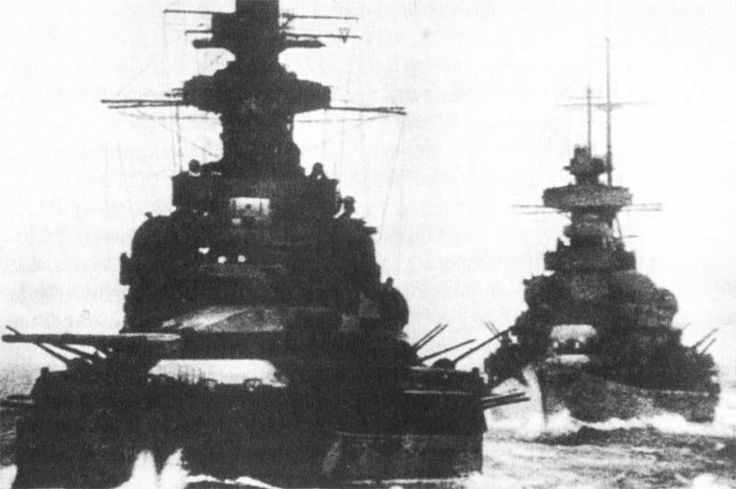
The Scharnhorst along with her sister ship Gneisenau were the product of the naval architects of Germany who in the early 1930s designed some of the most beautiful as well as deadly warships of the Second World War.  Following Germany’s rejection of the provisions of the Treaty of Versailles the Kreigsmarine enacted a building program to enlarge and modernize the German Navy which then was composed of obsolete pre-Dreadnaught battleships and a few modern light cruisers and destroyers.   The first major units constructed were actually begun by the predecessor to the Kreigsmarine, the Reichsmarine Of the Weimar Republic.  These were the Deutschland class Armored Ships, sometimes called “Pocket Battleships” and later reclassified as Heavy Cruisers. These ships were designed to replace the old pre-Dreadnaught battleships and incorporated electric welds to reduce displacement, diesel engines for extended cruise range to enable them to serve as commerce raiders and a battery of six 11” guns.  While an advance over anything in the German inventory they were outclassed by the British battle cruisers Hood, Renown and Repulse.

However, the first true capital ships built by the Kriegsmarine were the Scharnhorst and Gneisenau They were classed as battleships by the Germans, but in reality they were battle cruisers because of their light main battery of 11” guns as opposed to the 14”, 15” or 16” batteries of other nations battleships.  In fact, their main battery was Despite this in displacement and armor protection of the ships was comparable to other battleships of the era and their designed speed of 31.5 knots was superior to almost all other battleships of the era including the British King George V Class and the US Navy’s  North Carolina class.  Only the massive battlecruiser HMS Hood was their superior in speed and firepower.

As built Scharnhorst and Gneisenau displaced 31,000 toms, however at full combat load they both weighed in at nearly 38,000 tons and were 772 feet long.  They had an armor belt that was nearly 14 inches thick.  Armed with a main battery of nine 11” guns and a secondary armament of twelve 5.9 inch guns they also mounted a powerful for the time anti- aircraft battery of fourteen 4.1 inch guns, 16 37mm and 16 20mm anti-aircraft cannons.  Additionally they mounted six 21” torpedo tubes and carried three Arado 196 A3 scout planes.  The main battery was eventually to be replaced by six 15” guns but this never occurred; Gneisenau was taken in hand to mount the new weapons but the conversion was never completed due to Hitler’s anger after the failure of a German task force during the Battle of the Barents Sea in December 1942.

scharnhorst2

Scharnhorst firing at HMS Glorious 

Laid down on 15 June 1935 and launched 3 October 1936 Scharnhorst was commissioned 7 January 1939.  Her sister Gneisenau was laid down 6 May 1935, launched 8 December 1936 and commissioned 21 May 1938.  Upon the commencement of the Second World War the two sisters began a reign of destruction on British shipping. In November they sank the Armed Merchant Cruiser HMS Rawalpindi During Operation Weserübung the pair surprised sank the aircraft carrier HMS Glorious and her two escorting destroyers, the only time a Fleet carrier was caught and sunk by battleships during the war.   From January to March 1941 they conducted Operation Berlin against British merchant shipping in the North Atlantic sinking 22 ships before returning to base.
eeb893a0b92de4ae595de56fe0fd90ca

Scharnhorst and Gneisenau during Operation Cerebus

While in the port of Brest Gneisenau was bombed and torpedoed requiring extensive repairs.  Due to the exposed location of the port the German high command decided to return the ships to Germany along with the Heavy Cruiser Prinz Eugen.  The operation was called Operation Cerberus and it took place from 11-13 February 1942. The ships made a dash up the English Channel which was unsuccessfully contested by the British Royal Air Force and Royal Navy. However, both Scharnhorst and Gneisenau were damaged by mines and needed subsequent repairs.  While undergoing repairs in Kiel Gneisenau was further damaged by the Royal Air Force requiring repairs in or to steam to the port of Gotenhafen for repair and conversion.  Although some work was completed she was decommissioned and sunk as a blockship on 23 March 1945.  Following the war she was raised by the Poles and scrapped.

Scharnhorst was repaired following Operation Cerberes and in March 1943 was transferred to Norway where along with Tirpitz, Admiral Scheer, Lutzow (the former Deutschland), Admiral Hipper and Prinz Eugen she became part of a “fleet in being” poised to strike the Allied convoys bound for Russia.
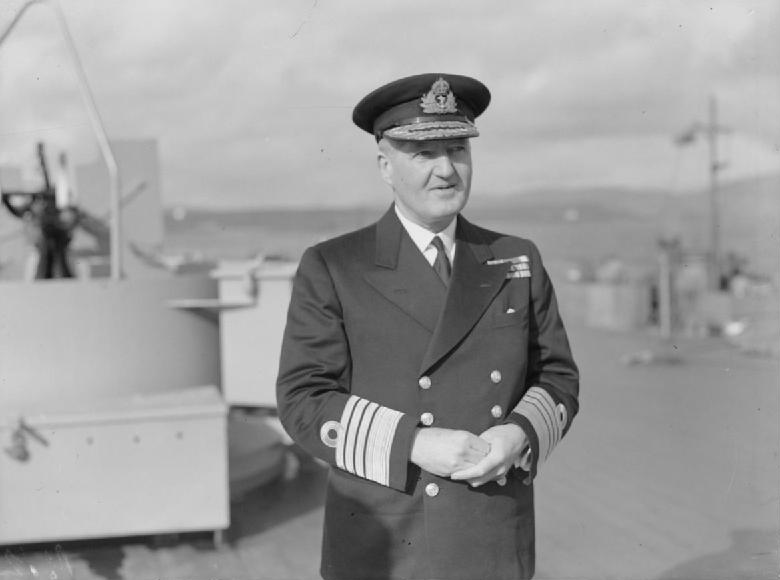
 

Admiral_Bruce_Fraser_1943_IWM_A_16489

Admiral Bruce Fraser

The German surface ships were a potent force that if the circumstances allowed could devastate the Russia bound convoys and the Commander of the British Home Fleet, Admiral Bruce Fraser was determined to entrap and destroy any of these ships that threatened any convoy. As such in December 1943 Fraser formed a task group built around the HMS Duke of York to be ready to pounce on any German raider that threatened the convoys. His intent was to catch any of these ships, especially Scharnhorst and trap them between the convoys and their base, in conduction with a second task group centered around the cruisers HMS Belfast, HMS Norfolk, and HMS Sheffield, Known as Force One, and destroy the German battleship.

The key to British the British operation was Enigma the German code machine and cipher system which they had acquired from captured U-Boats, and which British code-breakers had mastered. The Germans decided to send Scharnhorst and five destroyers to locate and destroy convoy JW-55B which had been spotted by Luftwaffe reconnaissance aircraft. Because of Enigma, Fraser knew that Scharnhorst would attempt to intercept the convoy and put his plan to set the trap in motion.
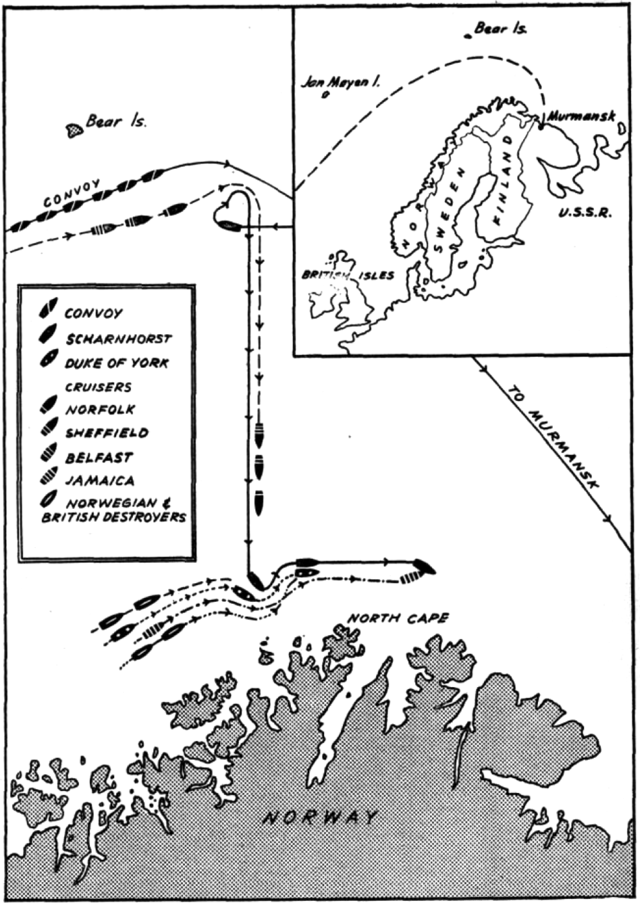
Battle_of_North_Cape_26_December_1943_map

Scharnhorst and her escorts set sail on Christmas Day 1943 under the command of Rear Admiral Erich Bey to conduct Operation Ostfront. But Bey was new to command, he had been promoted to Konteradmiral on the day the force sailed, having taken the place of Admiral Oskar Kummetz who had left for Germany to take a long convalescent leave. Bey was an experienced commander, but all of his experience was on destroyers. He was a torpedo expert, but had never served aboard a battleship, or even a cruiser, and he was a a novice when it came to the large caliber guns aboard the Scharnhorst. His position was made worse by the fact that the task force staff had been thinned out by the Navy for few expected it to be sent in combat.

However, Grand Admiral Karl Dönitz, had decided that given the right conditions, specifically that an exposed convey without heavy support which could be engaged with a high degree of success could be attacked. This convoy was JW-55B, which had been spotted by a German weather observation aircraft on the 22nd Of December. However, the weather was so foul that no further spotting of it or any other British ships was made. There was no question that further air reconnaissance was possible, Berlin was satisfied that the convoy had no support, as German Historian Wolfgang Zank wrote that Berlin followed its motto: “Was nicht gemeldet wird, ist auch nicht da” or “What isn’t reported, isn’t there.” 

Bey wasn’t convinced while still transiting Alta Fjord, he radioed Berlin to inform the high command of how the weather would interfere with the operations of his five destroyers, after all he was a destroyerman and had commanded destroyers in such weather. He was attempting to get the mission called off, but Berlin insisted on the attack. Dönitz replied “I believe in your attacking spirit. Sieg Heil!” With no recourse, Bey put to sea.

However, his destroyers could not keep pace with Scharnhorst so Bey detached them and sailed alone to fight the enemy.

Since Fraser knew that the Germans were coming he had the convoy to temporarily reverse course. This action caused Bey to find nothing where he expected the convoy to be, but he did encounter and engage at long range Fraser’s cruisers including HMS Norfolk, HMS Sheffield both veterans of the the hunt for and sinking of the Bismarck and the HMS Belfast. Scharnhorst’s guns damaged the heavy cruiser Norfolk, but the radar directed fire of the British cruisers landed a hit which knocked out her search radar leaving the German ship virtually blind as the weather worsened and darkness set in.

Bey, thinking he had shaken his pursuers, set course for Alta Fjord at full speed, however, Belfast had maintained contact and Fraser with Duke of York closed the distance and at 1617 her radar picked up the German at a range of 45,500 yards. By 1632 she was 29,700 yards away. Scharnhorst was oblivious to the danger, and at 1648 Belfast illuminated the German ship and Duke of York opened fire at just under 12,000 yards scoring hits which disabled Scharnhorst’s forward turrets and destroyed her airplane hanger. Bey changed course and increased speed, briefly opening the range and momentarily giving the Germans hope, but that was not to be.

At 1820 Duke of York struck a devastating blow on the German ship. A 14” shell pierced the armored belt and exploded in Scharnhorst’s number one boiler room reducing her speed to just 10 knots. Quick repairs were made enabling the ship to steam at 22 knots, but now she was vulnerable to torpedo attacks by the British destroyers.

When he did not find the convoy in the expected location Bey detached his destroyers to expand the search area, leaving Scharnhorst alone to face the enemy.

Rear Admiral Erich Bey

At about 0900 on December 26th 1943 the cruisers of Force One discovered Scharnhorst and the  Battle of North Cape was on. Though little damage was suffered in the first engagement, the radar of Scharnhorst was knocked out, leaving her not only without air support or escort, but blind.
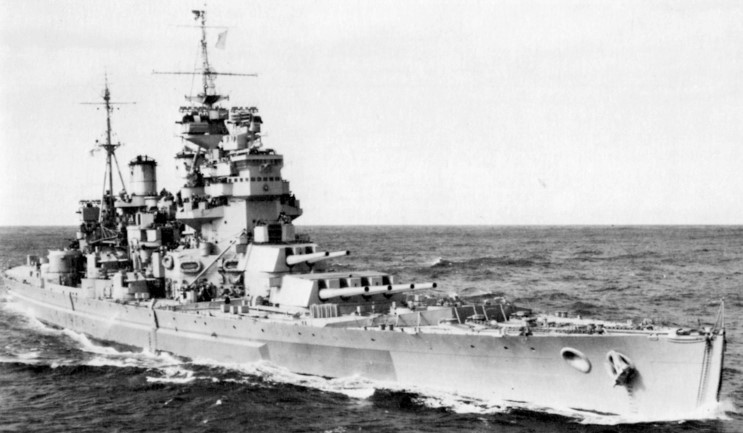
HMS Duke of York firing her main battery

Scharnhorst attempted to flee, but Fraser’s Duke of York  and her four escorting destroyers destroyers intercepted her. Without radar in the blinding snow squalls Scharnhorst was surprise by their appearance. Duke of York’s first radar direct salvos knocked out her forward main battery but the German ship appeared to be making a getaway when a shell from Duke of York hit her number one boiler room and reduced her speed to barely ten knots. Although the German engineers and damage control teams made some repairs and were able to bring her speed back up to 22 knots, the British ships rapidly made up the distance enabling the British destroyers to launch torpedo attacks.

Knowing the ship was doomed Admiral Bey dispatched a message to the high command of the Kriegsmarine: “We will fight on until the last shell is fired.” 

While Scharnhorst attempted to fight off her attackers and escape she was struck by torpedoes from several destroyers as being punished at distance of under 10,000 yards by Duke of York’s 14″ shells, as well as the 6″ shells of HMS Belfast and HMS Jamaica. Savaged by at least 13 hits by Duke of York’s 14” shells and numerous torpedo hits, incapable of further resistance, the German ship capsized and sank, her massive screws still turning at 1945 hours with the loss of all but 36 of her 1968 man crew. Admiral Bey was not among the survivors, though he was spotted in the water

As she sank bow first survivors attempted to abaneon ship. Günter Sträter, who survived amd was rescued noted:

“In the water now the sailors were looking to get the rafts”,… those  who found a place on the rafts sang both verses of the song: ‘On a sailor’s grave, there are no roses blooming.’ I did not hear cries for help. It all happened exactly and without panic. “

Survivors were rescued by the British destroyers HMS wreck was discovered on October 3rd 2000 some 70 miles north of North Cape Norway. Of the ships engaged, only HMS Belfast survives, as a museum ship in the Thames River in London.
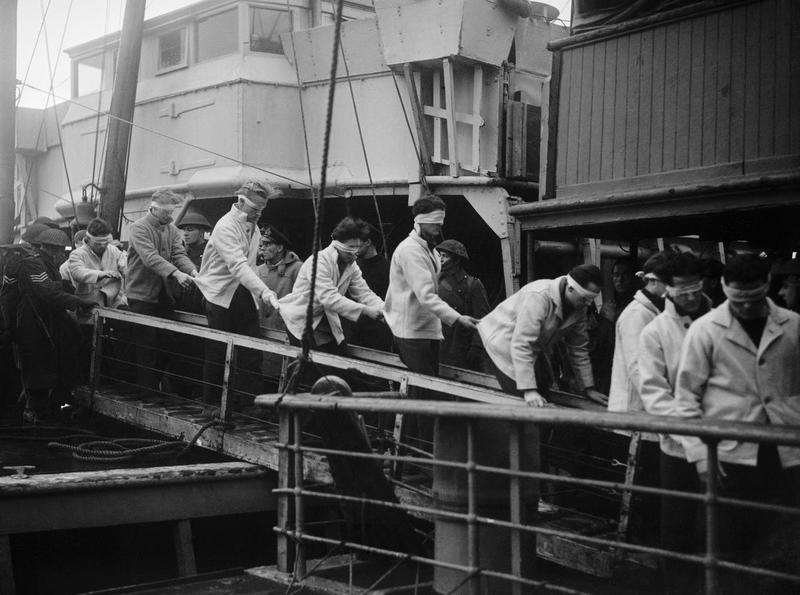
Scharnhorst_survivors_A_021202

Survivors of Scharnhorst 

Admiral Fraser praised the gallantry of the German ship to his officers later that night saying: “Gentlemen, the battle against Scharnhorst has ended in victory for us. I hope that if any of you are ever called upon to lead a ship into action against an opponent many times superior, you will command your ship as gallantly as Scharnhorst was commanded today”

After the battle Grand Admiral Erich Raeder who had authorized the sortie was relieved as commander in chief of the navy and was replaced by Grand Admiral Karl Donitz who commanded the U-Boat forces. Hitler was furious and ended most surface naval operations.
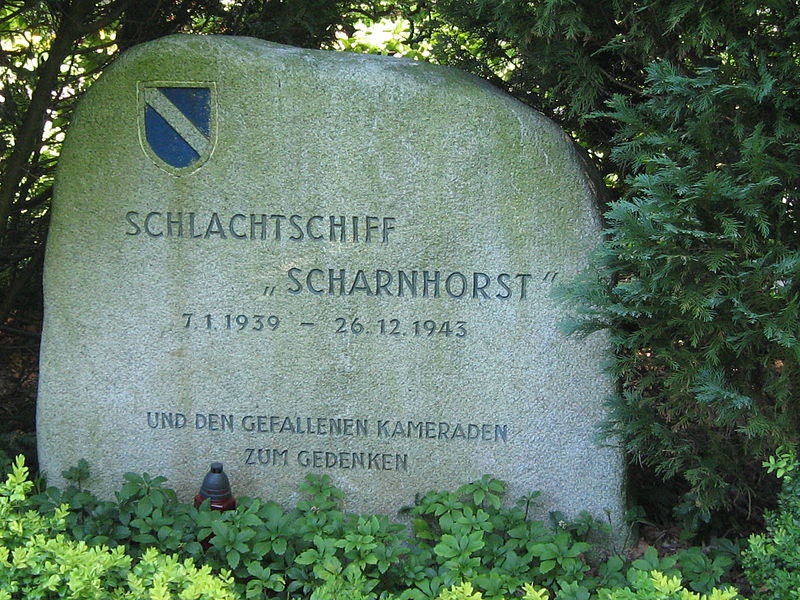
800px-Scharnhorst-WHV-April-2011

Memorial to Scharnhorst and her crew at Kiel and the HMS Belfast

I have written many times about the tragedy of war, on land and at sea. Having served in combat zones on land and having been shot at by the enemy, as well as having served at sea on a cruiser I have a sense of what these men must have gone through on that final day of their lives. Though I am a realist and know that such tragedies will likely occur again, in fact I expect them and predict that the United States Navy will see its share of nautical disasters when it faces well equipped and trained opponents.

All that being said, I really do pray for the day that war will be no more and that those who serve in harm’s way will never have to do so again.

Peace

Padre Steve+

10 Comments

Filed under History, Military, Navy Ships, nazi germany, World War II at Sea

Christmas NUTS! Anthony McAuliffe and the 101st Airborne at Bastogne

anthony_mcauliffe1

Brigadier General Anthony McAuliffe

Friends of Padre Steve’s World,

On December 16th 1944 the German Army launched an assault in the Ardennes Forrest completely surprising the thinly spread American VIII Corps.  The German 6th Panzer Army, 5th Panzer Army and 7th Army attacked and forced the surrender of 2 regiments of 106th Infantry Division, mauled the 28th Division in the center of the American line while battering other U.S. forces.  To the north the 2nd and 99th Infantry Divisions were tenaciously defending Elsenborn Ridge while to the south the thinly spread 4th Infantry and 9th Armored Divisions resisted the 7th Army advance. As elements of the two German Panzer armies advanced west Eisenhower dispatched his only reserves the 82nd and 101st Airborne Divisions to meet the threat. The 82nd moved to the town of St Vith to aid the 7th Armored Division while the 101st was dispatched to hold the key road center of Bastogne.

By the 22nd of December the besieged American defenders of Bastogne were causing Hasso Von Manteuffel’s 5th Panzer Army headaches. Manteuffel’s leading Panzer units of the 2nd Panzer Division and Panzer Lehr had been thwarted from taking Bastogne by a Combat Command of 10th Armored Division and lead elements of the 101st Airborne Division. After failing to take the town the Germans invested it with the 26thVolksgrenadier Division, and a regiment of Panzer Lehr while the  2ndPanzer and the bulk of Panzer Lehr continued their westward advance.

Cut off from any other American forces the 101st and a collection of stray units including CCB 10th Armored Division and remnants of CCR 9th Armored Division, three 155mm artillery battalions including the African American 969th Field Artillery Battalion held out. By the 21st of December they were completely surrounded by strong German Forces with no relief in sight.

The Commander of the American garrison was Brigadier General Anthony McAuliffe. McAuliffe was the acting commander of the 101st and normally was the commander of the Division Artillery. Major General Matthew Ridgeway and many key commanders and staff were away from the division when it was hastily deployed to the Bulge to combat the German offensive.  McAuliffe now commanded a division which was surrounded, and that was short of ammunition, food, and cold weather gear.

luettwitz

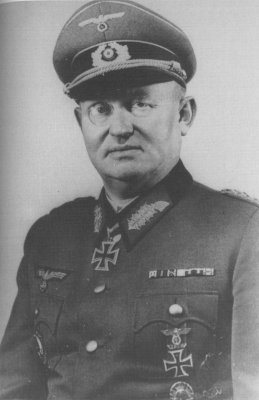
General Der Panzertrüppen Heinrich Freiherr von Lüttwitz

The German forces surrounding the city were commanded by the veteran General Der Panzertrüppen Heinrich Freiherr von Lüttwitz, commander of XLVII Panzer Corps.  Lüttwitz believed that resistance to his forces was futile sent the following message under a flag of truce to McAuliffe

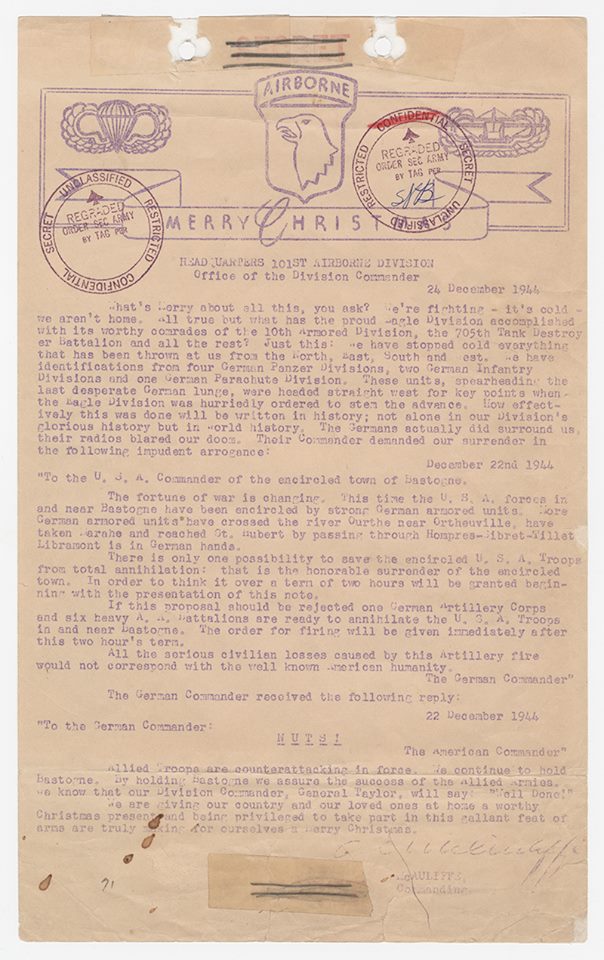
To the U.S.A. Commander of the encircled town of Bastogne.

The fortune of war is changing. This time the U.S.A. forces in and near Bastogne have been encircled by strong German armored units. More German armored units have crossed the river Our near Ortheuville, have taken Marche and reached St. Hubert by passing through Hompre-Sibret-Tillet. Libramont is in German hands.

There is only one possibility to save the encircled U.S.A. troops from total annihilation: that is the honorable surrender of the encircled town. In order to think it over a term of two hours will be granted beginning with the presentation of this note.

If this proposal should be rejected one German Artillery Corps and six heavy A. A. Battalions are ready to annihilate the U.S.A. troops in and near Bastogne. The order for firing will be given immediately after this two hours term.

All the serious civilian losses caused by this artillery fire would not correspond with the well-known American humanity.

The German Commander

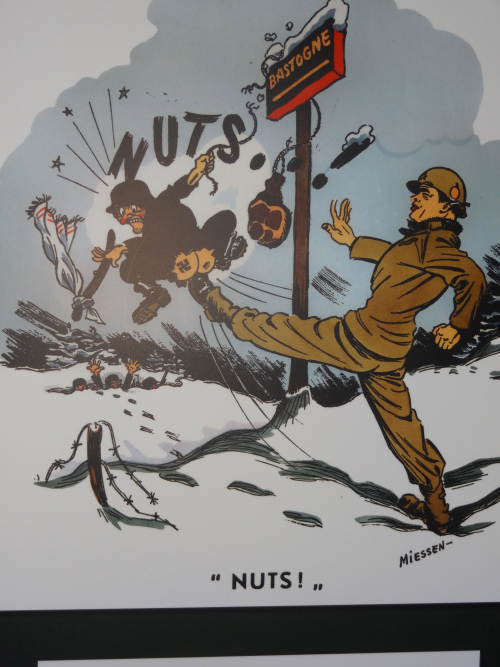
McAuliffe’s response has become one of the immortal responses to a surrender demand in military history. According to staff members present when he received Lüttwitz’s note he simple said “nuts.” One of his staff officers suggested that he use “nuts” as his official reply to Lüttwitz and the following reply was typed:

To the German Commander

NUTS!

The American Commander

The reply was delivered by the commander of the 327th Glider Infantry Regiment Lieutenant Colonel Joseph Harper and his S-3 Major Alvin Jones. When Harper delivered the message he told the German delegation that in “plain English” it meant “Go to hell.” The scene has been immortalized on film in the movie The Battle of the Bulge

Likewise it is also depicted in the mini-series Band of Brothers. 

And in the 1949 film Battleground 

dsc00072a

The garrison held out until it was relieved on December 26th by the 4th Armored Division of General George Patton’s 3rd Army.  Despite that the situation remained tenuous and the town was the scene of much hard fighting over the next two weeks.

1901879_10153009725477994_814138470181390794_n

McAuliffe’s Christmas Message to his Soldiers

McAuliffe went on to command the 103rd Infantry Division by the end of the war.  He returned to Europe as Commander of 7th Army in 1953 and U.S. Army Europe in 1955. He retired in 1956 with the rank of General.  He died in 1975 at the age of 77. His adversary Von Lüttwitz died at the age of 72 in 1969.

As we remain engaged in the current war it is always worth our time to remember the heroism, courage and faith of those that served before us.

Peace

Padre Steve+

Post Script: To read more about the Battle of the Bulge on this site go to Wacht am Rhein: The Battle of the Bulge

5 Comments

Filed under film, History, leadership, Military, nazi germany, us army, world war two in europe

“Christmas Day Will Always be, Just as long as We have We” Everything I Know Really About Christmas comes from Peanuts and the Grinch

Friends of Padre Steve’s World,

I am a Priest, and I am actually a pretty learned theologian as well as a historian. I am probably a better historian than theologian, in fact on of my Deans at the Joint Forces Staff College said that I was “a historian masquerading as a chaplain, not that there is anything wrong with that.” But the fact is that as learned as I am of the theology of the Incarnation and how important that is to real Christian theology. The Incarnation not about creating some kind of Christian theocracy in order to usher in the Kingdom of God, instead it is about a God that chooses to become fully human, to be born of a woman, and to endure the death of a criminal, despised and rejected by the types of people that theocracy minded “Christian leaders” emulate in thought, word, and deed.

With that being said I will not bore you with an essay citing historical references, Scripture, or quotations of theologians, pastors, and historians much more learned, and for that matter probably better Christians than me. So, please, if you feel the need to criticize my theology, feel free, but please, have the decency to arrange to do that over a beer or your favorite tasty beverage later, don’t ruin your Christmas or mine to do that, there are plenty of other days to do just that take a deep breath whether you are a Christian Fundamentalist, a Traditionalist Catholic, a militant Atheist, or whatever.

But here’s the deal. The truth is when all is said and done I learned ever that I need to know about Christmas from Merry Christmas Charlie Brown by Charles Schulz, and How the Grinch Stole Christmas by Dr. Seuss.

To me it is fascinating because Schulz, who brought us Charlie Brown, Snoopy, and the whole Peanuts Gang for half a century was a Christian who battled depression and faith, yet his classic animated cartoon of Christmas which was released in 1965 has probably reached more people with the Christmas message than any great preacher of the past century or more.

The decision to include the speech by Linus was controversial, because of the expressly religious implications, by Schulz insisted that it be reatained.

I saw it for the first time when it was released in 1965, and now 53 years later it retains its freshness and innocence.

 Charlie Brown: Isn’t there anyone, who knows what Christmas is all about?!

Linus: Sure Charlie Brown, I can tell you what Christmas is all about. Lights please?

And there were in the same country shepherds, abiding in the field, keeping watch over their flock by night. And, lo, the angel of the Lord came upon them, and the glory of the Lord shone round about them! And they were sore afraid. And the angel said unto them, “Fear not! For, behold, I bring you tidings o great joy, which shall be to all my people. For unto you is born this day in the city of David a Saviour, which is Christ, the Lord. And this shall be a sign unto you: Ye shall find the babe wrapped in swaddling clothes, lying in a manger.” And suddenly, there was with the angel a multitude of the Heavenly Host praising God, and saying, “Glory to God in the Highest, and on Earth peace, and good will toward men.

That’s what Christmas is all about, Charlie Brown.

Likewise, I think that Dr. Seuss, who was Jewish, may very well have done the same in his story about the Grinch.

I think of the last part of the Grinch and think about these words:

Welcome, Christmas, bring your cheer. Cheer to all Whos far and near. Christmas Day is in our grasp, so long as we have hands to clasp. Christmas Day will always be just as long as we have we. Welcome Christmas while we stand, heart to heart, and hand in hand.

I know, kind of simplistic and ecumenical. But I have learned so much about Christmas and the Incarnation from others, of course many are Christians, but I have also learned from Jews, Muslims, and others. So for all of my friends and readers I simply repeat the words of Dr Seuss. Welcome Christmas, bring your cheer… Christmas Day will always be just as long as we have we…

Peace,

Padre Steve+

4 Comments

Filed under christian life, faith, film, life, Religion

A Thought for Christmas Eve: It’s Not too Late…


Friends of Padre Steve’s World

Just a quick thought from one of my favorite Christmas movies for Christmas Eve.

Those of you who know me personally, or follow my writings here know how much I struggle with faith, as well as how much Christmas means to me. It is the one time of year that I tend to believe again.

The thought is from the classic comedy Scrooged starring Bill Murray. I think that in the midst of all the turmoil and hate that it somehow may be the best that we might be able to do.

“It’s Christmas Eve! It’s… it’s the one night of the year when we all act a little nicer, we… we… we smile a little easier, we… w-w-we… we… we cheer a little more. For a couple of hours out of the whole year, we are the people that we always hoped we would be!”

Have the best Christmas or whatever holiday you celebrate as you can.

Peace,

Padre Steve

Leave a comment

Filed under faith, film, movies

Joyeux Noël, Christmas Eve 2018: History and Memory, the Stubborn Humanity Within Us

joyeux_noel3

Friends of Padre Steve’s World,

Last night I rewatched the film Joyeux Noel (Merry Christmas) which is one of my Christmas traditions. When I watch it I cannot stop. I don’t look at my social media, I don’t tweet. Although it recounts an incident that occurred over a century ago, I am drawn to it out of a feeling of camaraderie, and a hope that people of good will can, and maybe will someday put and end to the scourge of war. I guess one reason I have to put down everything else is that I cry through most of the film.

I do not think that  end of war will happen anytime soon, for as Henry Wordsworth Longfellow wrote some fifty years before this incident, “for hate is strong, and mocks the song, of peace on earth, goodwill to men.” 

But I dare not, even in the age of a madman in the White House and warmongering dictators and despots wreaking havoc on the world, give up the hope of peace. I tend to watch it before or after reading Stanley Weintraub’s book: Silent Night: the Story Of the World War One Christmas Truce. 

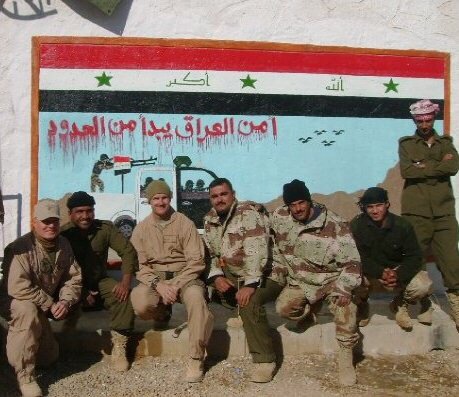
It was a book that I refused to read until after I returned from Iraq in 2008. Of course as a military historian I knew of the Christmas Truce, but it was something that I tried to keep a distance from after September 11th, 2001. After my experience of Christmas on the Iraq – Syrian Border In 2007 I could no longer ignore it.

Weintraub Wrote:

Christmas 1914 evokes the stubborn humanity within us, and suggests an unrealized potential to burst its seams and rewrite a century.

I say that my time in Iraq did that to me. I cannot forget the Masses that I celebrated on the border and my time with Americans, Iraqi Soldiers, and local Bedouin during those days.

In the film, one of the main characters is the Chaplain of the Scottish battalion played by Gary Lewis tells a Lieutenant:

“Tonight, these men were drawn to that altar like it was a fire in the middle of winter. Even those who aren’t devout came to warm themselves. Maybe just to be together, maybe just to forget the war.” 

12010440-mmmain

The war was supposed to be over by Christmas, or so the planners had said. Instead after a series of massive battles that produced unprecedented number of casualties the war settled into a stalemate. As the sides exhausted themselves in a series of meeting engagements throwing the flower of their idealistic youth into the great maw of the front to be torn apart by massed artillery and machine gun fire the planners sought new ways to find military victory.

In December 1914 with neither side having the ability to force the issue and casualties already running over a million dead and wounded the armies dug in. Massive trench networks were constructed in the mud of France and Belgium as the artillery continued its impersonal work of destroying men, machines and the homeland of millions of civilians.

From Clipboard

Despite the stalemate the high commands of the various nations continued to through their troops into meaningless attacks to gain a few yards of their opponent’s trench networks. The attackers always suffered the worst as they went “over the top” and were cut down by well sited machine guns and networks of defensive redoubts.

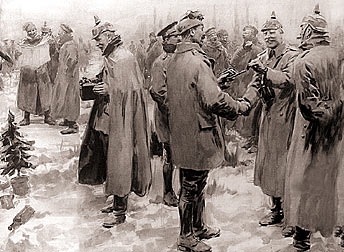
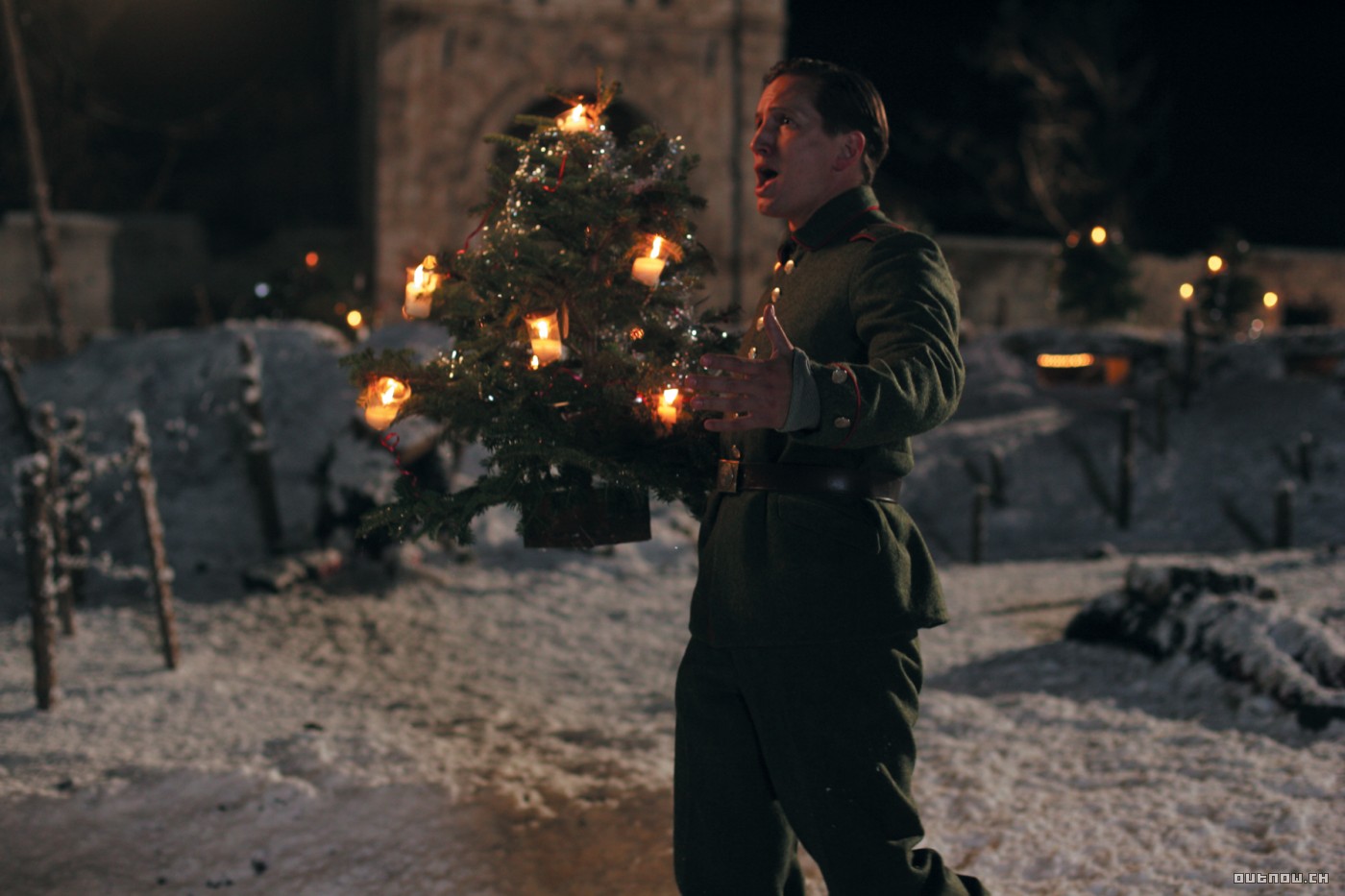
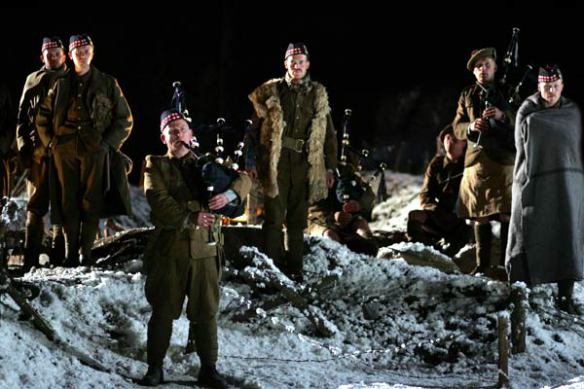
As Christmas neared individual parties of British and German troops began to fraternize exchanging gifts and attempting despite the wishes of their commanders to maintain an attitude of live and let live. On Christmas Eve German troops began to decorate their trenches with Christmas trees and lights, carols were sung and Christmas greetings exchanged as the local truces became widespread and soldiers met in no man’s land to talk and give each other gifts of cigarettes, alcohol, food and souvenirs.  In some places the sides helped each other collect and bury their dead and some Chaplains even led Christmas services in which men of both sides worshipped.

football-truce

The truce would not last as the high commands of each side issued strict orders against them and within days had moved the units that they believed most “infected” by the Christmas spirit to other locations and replaced them with units inculcated with the message of the inhumanity of their enemy. Such messages often included the religious understanding of this being a “holy war” against enemies of God and humanity. It is funny that though Muslims are frequently demonized for committing Jihad, that Christians have a terrible record when it comes to finding theological reasons to kill those that they believe, even other Christians to be the enemy.

Christmas Day December 1914 World War One

joyeux-noel-2


joyeux-noel-3

This really wasn’t surprising, after all for in the years leading up to the war many school children, especially in France and Germany had been propagandized. Churches and ministers cooperated in the carnage.

In the movie Joyeux Noel the British Padre who had cooperated in the Christmas truce is relieved by his Bishop and sent home. The Bishop then preaches to the newly arrived soldiers, those replacing the men who had found peace for a moment. The sermon is not a work of fiction, it is actually part of a sermon that actually was given in Westminster Abbey in 1915. It was a sentiment that fit the mood of the high command who sought to minimize the danger of peace without victory. It was a sermon, the likes of which were preached by ministers, preachers, priests and bishops throughout that terrible war. It is a sermon that many preachers, Christian, Jewish, Islamic and Hindu even today mimic with terrible consequences.

“Christ our Lord said, “Think not that I come to bring peace on earth. I come not to bring peace, but a sword.” The Gospel according to St. Matthew. Well, my brethren, the sword of the Lord is in your hands. You are the very defenders of civilization itself. The forces of good against the forces of evil. For this war is indeed a crusade! A holy war to save the freedom of the world. In truth I tell you: the Germans do not act like us, neither do they think like us, for they are not, like us, children of God. Are those who shell cities populated only by civilians the children of God? Are those who advanced armed hiding behind women and children the children of God? With God’s help, you must kill the Germans, good or bad, young or old. Kill every one of them so that it won’t have to be done again.”

Unfortunately I have met and heard men preach the same message against those they hate, a message that twists the words of Jesus in a diabolical way to justify the worst acts of nations and peoples. In the year 2018 wars rage around the world. Some are conducted by well organized professional militaries but many by militias, paramilitary and terrorists groups. In some cases the brutality and inhumanity exhibited makes the industrialized carnage of the First World War seem sane. Even now preachers of various religions, including Christians, Moslems and Jews advocate the harshest treatment of the enemies of their peoples all in “the name of God.”

295_26912097058_4309_n

n671902058_1153798_5336

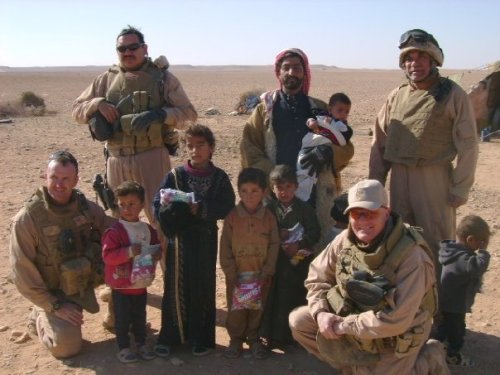
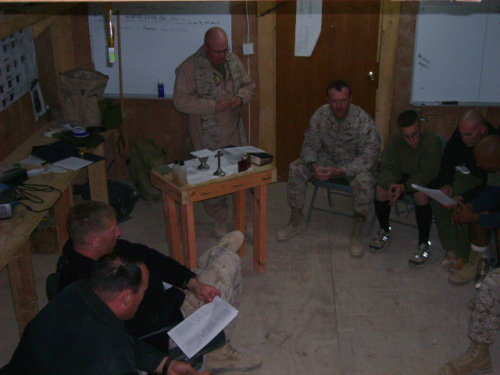
Eleven short years ago I was traveling up and down the western border of Iraq with Syria. I was visiting our Marines that were advising the Iraqi Army and Border Forces, conducting Christmas services for them and also visiting Iraqi soldiers as well as civilians. In a couple of instances Iraqi and Jordanian Christians working as interpreters came to the Eucharist services, for one it had been years since he had received the Body and Blood of Christ in the Holy Communion. While out and about visiting Iraqis we were hosted by Iraqi troops and well as Bedouin tribesmen and their families. The warmth and hospitality and faith of these wonderful people was amazing.

T.E. Lawrence wrote that the Bedouin could not look for God within him: he was too sure that he was within God.” 

n671902058_1153804_6925

I think that for me that Christmas week was the one that will remain with me more than any and despite being in a war zone, it for me was a time of peace on earth and good will toward men. Some people cannot imagine how a career military officer could feel that way. In the movie the French company commander is confronted by his father after the truce, and after the military postal censors had reported the many incidents of fraternization with the enemy to the various high commands in France, Germany, and Great Britain.

The Country? What does it know of what we suffer here? Of what we do without complaints? Let me tell you, I felt closer to the Germans than to those who cry “Kill the Krauts!” before their stuffed turkey…  no, you’re just not living the same war as me. Or as those on the other side.”  

Weintraub wrote:

“To many, the end of the war and the failure of the peace would validate the Christmas cease-fire as the only meaningful episode in the apocalypse. It belied the bellicose slogans and suggested that the men fighting and often dying were, as usual, proxies for governments and issues that had little to do with their everyday lives. A candle lit in the darkness of Flanders, the truce flickered briefly and survives only in memoirs, letters, song, drama and story.”

During World War One there were men who retained their conscience and tried to mitigate the effects of the war and suffering. Likewise there were those who could not let go of their hate. One such Soldier was Adolf Hitler, whose story is recounted in Weintraub’s book:

Although he was out of the line in reserve, discussion arose about crossing into Niemandsland to share Christmas with the British. He refused. “Such a thing should not happen in wartime,” Hitler argued. “Have you no German sense of honor left at all?” More than patriotic scruples were involved. Although a baptized Catholic, he rejected every vestige of religious observance while his unit marked the day in the cellar of the Messines monastery to which they had retired on the 23rd. “Adi” was distinctly odd. He received no mail or parcels, never spoke of family or friends, neither smoked nor drank, and often brooded alone in his dugout. In the ruins open to the sky, Corporal Frobenius, a Lutheran theology student also decorated with the Iron Cross, read the Christmas gospel to a joint congregation of Catholics and Protestants, but not to Corporal Hitler.

Hitler’s Nihilism, racist nationalism, and unrepentant rejection of his religious heritage while gaining the support of the most religious Christians in the Reich would be part  of his life until he took it in his Berlin Bunker In 1945, and it would be shared by all too many men since the First World War until the present.

I will not be one of them.

Maybe someday we will begin to understand, until then, like so many others in so many wars before, I am still dreaming of home.

Until tomorrow,

Peace

Padre Steve+

2 Comments

Filed under ethics, faith, film, History, Military, movies, Political Commentary, world war one

Hope In Hell: Dr. Kurt Reuber and the Madonna Of Stalingrad

Bundeswehr zeigt "Stalingrad"-Ausstellung

Friends of Padre Steve’s World,

It is almost Christmas and I am reflecting about the true meaning of Christmas in a world where hope seems to be dying before our eyes. In such an environment I reflect on men who lived in a human made hell, a hell made by hate filled ideologues who launched the world into its bloodiest war, and I wonder, could it happen again? A decade ago I would have said it never could again happen, but now I am not so sure. So, in the age of Donald Trump, I must try to find hope wherever I can find it.

I think most of my readers know that I am a career military officer and have served in peace and war as a chaplain. That service includes a tour in Iraq, a war, which by almost any standard would have been considered unjust and illegal, yet I served there, and came back a changed man. As such the stories of those who served in war, especially those who serve in hopeless battles, and even in evil causes during Christmas have a special place in my heart. One of those men was a German pastor and medical doctor named Kurt Reuber.

k_reuberl

As I said, Reuber was a theologian, pastor and medical doctor, likewise he was an accomplished artist and used that medium to convey his own faith, and doubts. He was a friend of Albert Schweitzer in 1939 he was conscripted to serve as a physician in the Germany Army. By November 1942 he was a seasoned military physician serving with the 16th Panzer Division, part of the German 6th Army, which had been fighting in the hell of Stalingrad. When his division along with most of 6th Army was surrounded by the Soviets, cut off from most supply and without real hope of relief, he like other physicians continued to serve the soldiers committed to his care.

pg-34-stalingrad-2-getty

However, unlike most physicians, the care Reuber offered care included spiritual matters, as he sought to help his soldiers deal with the hopelessness of their situation. As Reuber reflected on the desperation of the German soldiers in the Stalingrad pocket. He wrote to his family.

“I wondered for a long while what I should paint, and in the end I decided on a Madonna, or mother and child. I have turned my hole in the frozen mud into a studio. The space is too small for me to be able to see the picture properly, so I climb on to a stool and look down at it from above, to get the perspective right. Everything is repeatedly knocked over, and my pencils vanish into the mud. There is nothing to lean my big picture of the Madonna against, except a sloping, home-made table past which I can just manage to squeeze. There are no proper materials and I have used a Russian map for paper. But I wish I could tell you how absorbed I have been painting my Madonna, and how much it means to me.”

“The picture looks like this: the mother’s head and the child’s lean toward each other, and a large cloak enfolds them both. It is intended to symbolize ‘security’ and ‘mother love.’ I remembered the words of St. John: light, life, and love. What more can I add? I wanted to suggest these three things in the homely and common vision of a mother with her child and the security that they represent.”

The picture was drawn on the back of a captured Soviet map and when he finished it he displayed it in his bunker, which became something of a shrine. Reuber wrote:

“When according to ancient custom I opened the Christmas door, the slatted door of our bunker, and the comrades went in, they stood as if entranced, devout and too moved to speak in front of the picture on the clay wall…The entire celebration took place under the influence of the picture, and they thoughtfully read the words: light, life, love…Whether commander or simple soldier, the Madonna was always an object of outward and inward contemplation.”

drkrop

As the siege continued men came to the bunker for both medical care and spiritual solace.  On Christmas Eve Reuber found himself treating a number of men wounded by bombs outside the bunker. Another soldier lay dying, just minutes before the soldier had been in the bunker singing the Christmas hymn O Du Froehliche.  Reuber wrote:

“I spent Christmas evening with the other doctors and the sick. The Commanding Officer had presented the letter with his last bottle of Champagne. We raised our mugs and drank to those we love, but before we had had a chance to taste the wine we had to throw ourselves flat on the ground as a stick of bombs fell outside. I seized my doctor’s bag and ran to the scene of the explosions, where there were dead and wounded. My shelter with its lovely Christmas decorations became a dressing station. One of the dying men had been hit in the head and there was nothing more I could do for him. He had been with us at our celebration, and had only that moment left to go on duty, but before he went he had said: ‘I’ll finish the carol with first. O du Frohliche!” A few moments later he was dead. There was plenty of hard and sad work to do in our Christmas shelter. It is late now, but it is Christmas night still. And so much sadness everywhere.”

On January 9th 1943 with all hope of escape or reinforcement gone Reuber gave the picture to the battalion commander as the officer was too ill to carry on and was one of the last soldiers to be evacuated from the pocket. Reuber’s commander carried the Madonna out of the pocket and returned it delivered it to Reuber’s family, preserving it for all.

Reuber was taken prisoner and survived the harrowing winter march to the Yelabuga prison camp. In late 1943 Reuber wrote his Christmas Letter to a German Wife and Mother – Advent 1943. It was a spiritual reflection but also a reflection on the hope for life after the war, when the Nazi regime would be defeated, and Germany given a new birth.

Reuber wrote:

“The concatenation of guilt and fate has opened our eyes wide to the guilt. You know, perhaps we will be grateful at the end of our present difficult path yet once again that we will be granted true salvation and liberation of the individual and the nation by apparent disappointment of our “anticipation of Advent”, by all of the suffering of last year’s as well as this year’s Christmas. According to ancient tradition, the Advent season is simultaneously the season of self-reflection. So at the very end, facing ruin, in death’s grip – what a revaluation of values has taken place in us! We thus want to use this period of waiting as inner preparation for a meaningful new existence and enterprise in our family, in our vocation, in the nation. The Christmas light of joy is already shining in the midst of our Advent path of death as a celebration of the birth of a new age in which – as hard as it may also be – we want to prove ourselves worthy of the newly given life.”  (Erich Wiegand in Kurt Reuber, Pastor, Physician, Painter, Evangelischer Medienverb. Kassel 2004. )

prisoner's madonna

Reuber did not live to see that day. He died of Typhus on January 20th 1944, not long after writing this and just a few weeks after painting another portrait of the Madonna, this one entitled The Prisoner’s Madonna. He was not alone, of the approximately 95,000 German POWs taken at Stalingrad only about 6,000 returned home.

His paintings survived the war and his family gave The Madonna of Stalingrad to the Kaiser Wilhelm Memorial Church in Berlin after it was restored as a symbol of hope and reconciliation. Copies are also displayed in Coventry Cathedral and the Russian Orthodox Cathedral in Volgograd, the former Stalingrad. A copy of The Prisoner’s Madonna is now displayed at the Church of the Resurrection in Kassel.

I have a print of the Madonna of Stalingrad in my office. It has become one of the most meaningful pictures I have since I returned from Iraq in 2008. To me they are symbols of God’s presence when God seems entirely absent.

Praying for an end to war.

Peace

Padre Steve+

3 Comments

Filed under christian life, faith, History, Military, nazi germany, Political Commentary, world war two in europe

”For Hate is Strong and Mocks the Song Of Peace on Earth Goodwill to Men” Henry Wordsworth Longfellow and Christmas 2018


Friends of Padre Steve’s World,

I could be writing about the travails being inflicted on the country and the world by President Donald Trump, but I do enough of that. Christmas is coming and even when I don’t explicitly write about Teump, the message of the season stands against him and against all that he stands.

Looking at the news of the week; the resignation on principle by Secretary of Defense James Mattis, the abandonment of the Kurds in Syria to the Turks, Russia, as ISIS, the crashing stock markets, and the completely preventable partial government shutdown brought about President Trump and his most fanatical followers, it is easy to despair. Frankly, there are many times that I do, and Inhave to remember how people before us went through great trials and tribulations.

The great American poet Henry Wadsworth Longfellow penned these words of hope on Christmas Day, 1863:

“God is not dead, nor doth He sleep; The wrong shall fail, the right prevail With peace on earth, good will to men.”

Christmas is coming and I feel that Longfellow’s words are as pertinent today as when he first penned them. The thought of what is to come in the next few years, in the United States and in many other liberal democracies bodes ill for our future as authoritarian and often xenophobic leaders rise to power. The world that we grew up is is passing away, and what comes in its place, a dystopian world where hope will be a rare commodity beckons.

Longfellow’s words became the heart of the song I Heard the Bells on Christmas Day.  I have heard it a number of times in the past few days and each time it really touches me.

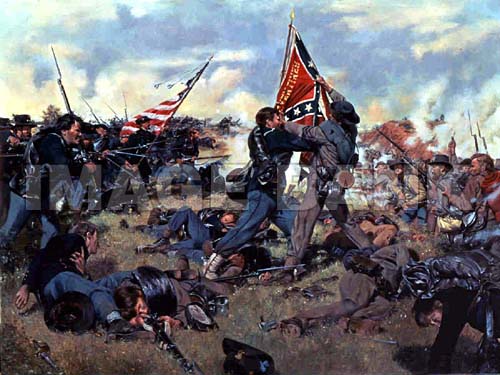
The song has been recorded in a number of versions by different artists over the years. However, the words of the song go back to the American Civil War. It began as a poem written by Henry Wadsworth Longfellow on Christmas Day 1863 following the serious wounding of his son Charles, a Lieutenant in the Union Army at the Battle of New Hope Church, and the death of his wife in a fire two years before. Longfellow had much to despair about, but he maintained a faith in God, as well as the founding principles of the United States.

His words are haunting. Probably because they demonstrate the profound tension that lies at the heart of the Incarnation, which is the heart of Christmas and the Christian faith. the tension, played out so well in the song is the existence of a message of peace and reconciliation in a world where war and hatred of many kinds rip human beings apart coupled with the tragic inability of Christendom, especially American Conservative Evangelicalism to even come close to the message of Christmas.

I heard the bells on Christmas day

Their old familiar carols play,

And wild and sweet the words repeat

Of peace on earth, good will to men.

I thought how, as the day had come,

The belfries of all Christendom

Had rolled along th’ unbroken song

Of peace on earth, good will to men.

gburg dead2

The reality of this is seen in the third verse. It is a verse that echoes throughout history and seems to be true even today, in fact it seems to be the most real as we deal with war, hatred, terrorism, killing in the name of God, and political fratricide.

And in despair I bowed my head

“There is no peace on earth,” I said,

“For hate is strong and mocks the song

Of peace on earth, good will to men.”

syria-war-holocaust-unicef-678x381

The interesting part about the songs as opposed to the poem is that they omit three of Longfellow’s verses that admittedly in a reunited country would not help record sales. Those verses speak to the heart of the Civil War.

Till ringing, singing on its way,
The world revolved from night to day,

A voice, a chime,

A chant sublime

Of peace on earth, good-will to men!

Then from each black, accursed mouth
The cannon thundered in the South,

And with the sound

The carols drowned

Of peace on earth, good-will to men!

It was as if an earthquake rent
The hearth-stones of a continent,

And made forlorn

The households born

Of peace on earth, good-will to men!

But Longfellow hears in the bells something more powerful. It is the message of Christmas and the incarnation. The message that justice and peace will finally embrace.

Then pealed the bells more loud and deep:

“God is not dead, nor doth He sleep;

The wrong shall fail, the right prevail

With peace on earth, good will to men.”

Till ringing, singing on its way

The world revolved from night to day,

A voice, a chime, a chant sublime

Of peace on earth, good will to men.

The song has been recorded many times by many artists. I like the version sung by Frank Sinatra, which the music was composed by Johnny Marks, composer of Rudolph the Red Nosed Reindeer. Another earlier version composed by John Baptiste Calkin has been recorded by Elvis Presley and Johnny Cash among others.


As wars rage in the Middle East, tensions rise in Asia, Africa and even Eastern Europe while the Unholy Trinity of Politicians, Pundits and Preachers, led by the American President rage as we go into another, and even more perilous year with the possibility of nuclear war more probably than not, people still look for hope.

Longfellow, who lost so much in a short time in the midst of a terrible Civil War, reminds us that in such times, “God is not dead, nor doth He sleep; The wrong shall fail, the right prevail With peace on earth, good will to men.”

In a time like this when the world led by the American President seems to be hurtling into the abyss, it is important to remember Longfellow’s words and the message of Christ and the Incarnation. The child born as an outcast in a manger would die as a criminal, crucified by an occupying power with the full support of the leaders of the occupied country. As the German theologian Jurgen Moltmann wrote:

“He humbles himself and takes upon himself the eternal death of the godless and the godforsaken, so that all the godless and the godforsaken can experience communion with him.” 

Yes, the wrong shall fail, and the right prevail, but it in the age of Trump it will certainly involve much travail. As for the travail, it is just beginning.

Until tomorrow,

Peace

Padre Steve+

3 Comments

Filed under christian life, civil war, faith, Foreign Policy, History, middle east, music, Political Commentary

Silent Night at 200: A Song Of Hope

Friends of Padre Steve’s World,

It will soon be Christmas and instead of the government shutdown or the depraved and irresponsible actions of President Trump, I am going to focus on Christmas, particularly musical expressions, as well as meditations about my own faith journey as well as the experience of soldiers during the holidays.

In the midst of everything happening in Washington D.C. and the potential crises that could plunge the world into war in the coming months it still is important to focus on the holidays. Since I am a Christian I share about Christmas without any shame, even as I respect and honor other people’s traditions and expressions of faith.

So here is a post about the song Silent Night. 

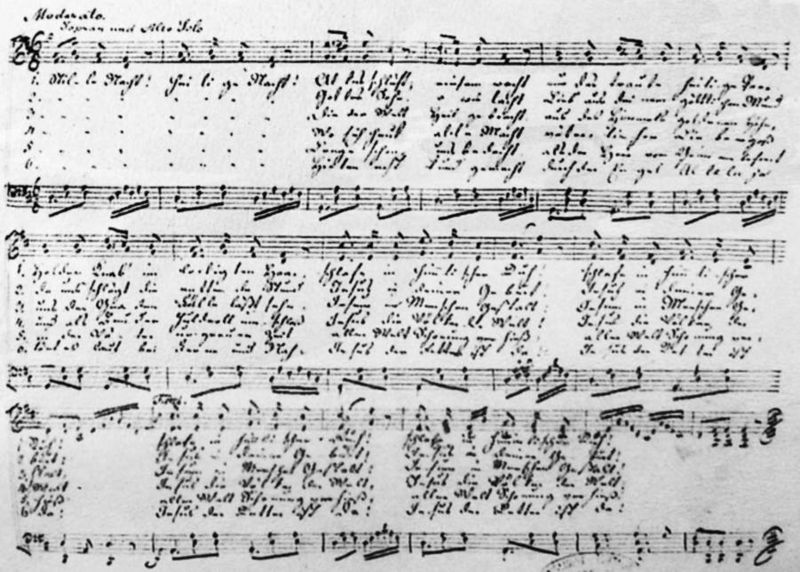
800px-Stille_nacht

Stille Nacht Autograph in the Hand of Joseph Mohr

In 1816 a young Austrian Catholic Priest in a small parish near Salzburg penned the lyrics to a hymn that even in the midst of war can bind people together. Father Joseph Mohr after moving to another parish in Oberndorf took those lyrics to Franz Gruber a nearby schoolmaster and organist. Mohr asked Gruber to put the words to music, specifically with a guitar accompaniment. Together the performed the song at Oberndorf’s parish church’s Vigil Mass on December 24th 1818.

malamkudus_11

There are a number of fanciful apocryphal stories about why the song was written and performed on the guitar, including one about the bellows of the church organ having been eaten by mice, but these are akin to sensationalist tabloid journalism. The simple truth is that Mohr sought out Gruber to arrange the song for guitar to be sung by two people accompanied by a choir for that Christmas Vigil Mass.

Stille Nacht, Heilige Nacht 

Stille Nacht, heilige Nacht,
Alles schläft; einsam wacht
Nur das traute hochheilige Paar.
Holder Knabe im lockigen Haar,
Schlaf in himmlischer Ruh!

Stille Nacht, heilige Nacht,
Hirten erst kundgemacht
Durch der Engel Halleluja,
Tönt es laut von fern und nah:
Christ, der Retter ist da!

Stille Nacht, heilige Nacht,
Gottes Sohn, o wie lacht
Lieb’ aus deinem göttlichen Mund
, Da uns schlägt die rettende Stund’.
Christ, in deiner Geburt!

 The song rapidly grew in popularity and spread quickly in Europe. A traveling Austrian singing group, the Rainer family performed it in front of Austrian Emperor Franz I and Tsar Alexander I.

7998

They also gave its first American performance in New York outside the famed Trinity Church in 1839. I continued to grow in popularity and was translated into many languages, now numbering about 140.

21760570

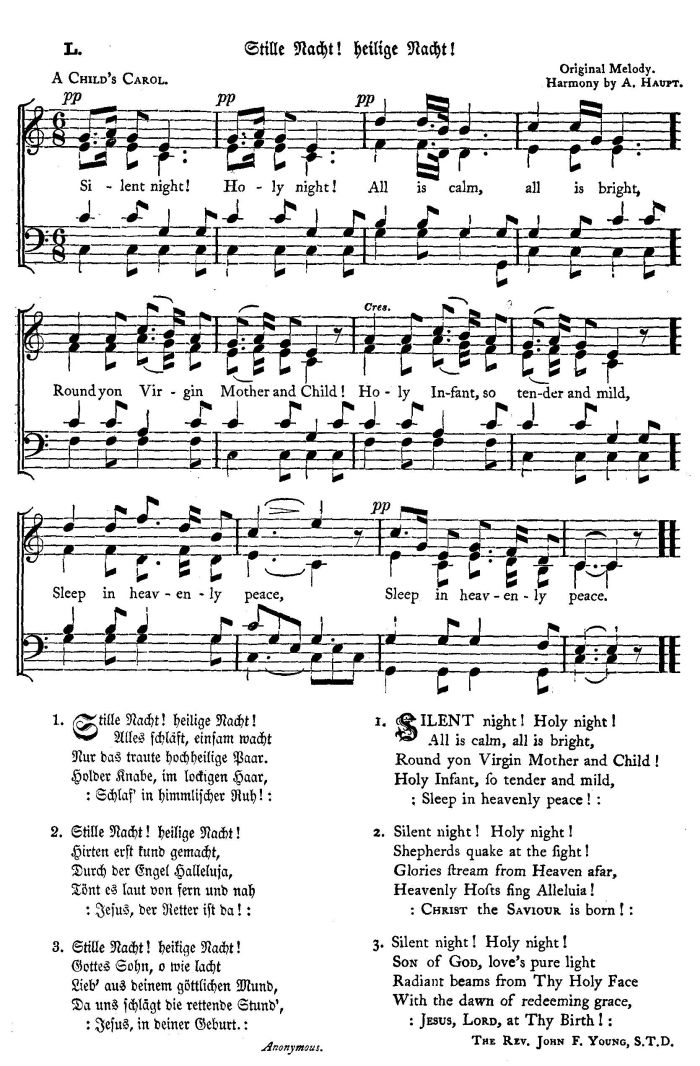
The American Episcopalian Bishop John Freeman Young translated it into English in 1863. It is his version that is most used today in English speaking lands today. A website called the Silent Night Web http://silentnight.web.za has 227 versions of the song in 142 languages on its site.

50-Silent_Night

Silent night, Holy night

 All is calm, all is bright

‘Round yon virgin , mother and child

Holy infant so, tender and mild
Sleep in heavenly peace,
Sleep in heavenly peace.

Silent night, Holy night
Shepherds quake, at the sight
Glories stream from heaven afar
Heavenly, hosts sing Hallelujah.
Christ the Savior is born,
Christ the Savior is born.

Silent night, Holy night
Son of God, love’s pure light
Radiant beams from thy holy face
With the dawn of redeeming grace,
Jesus, Lord at thy birth,
Jesus, Lord at thy birth.

The song is one that always takes me back to a very simple faith and an event that by all accounts is not explainable by logic. Karl Barth, perhaps the most influential theologians in the history Of the Christian faith wrote:

”The nativity mystery “conceived from the Holy Spirit and born from the Virgin Mary”, means, that God became human, truly human out of his own grace. The miracle of the existence of Jesus , his “climbing down of God” is: Holy Spirit and Virgin Mary! Here is a human being, the Virgin Mary, and as he comes from God, Jesus comes also from this human being. Born of the Virgin Mary means a human origin for God. Jesus Christ is not only truly God, he is human like every one of us. He is human without limitation. He is not only similar to us, he is like us.”

Silent Night is the most simple and profound hymn of the incarnation and because of its simplicity it has become a song that points to an end of war, an end of suffering, and the beginning of new life.

Until tomorrow,

Peace,

Padre Steve+

← Back

Thank you for your response. ✨

, Holy night
Shepherds quake, at the sight
Glories stream from heaven afar
Heavenly, hosts sing Hallelujah.
Christ the Savior is born,
Christ the Savior is born.

Silent night, Holy night
Son of God, love’s pure light
Radiant beams from thy holy face
With the dawn of redeeming grace,
Jesus, Lord at thy birth,
Jesus, Lord at thy birth.

Father Mohr refused to profit from his song and donated his proceeds to care for the elderly and educate children in the parishes and towns he served. He died in 1848.

889

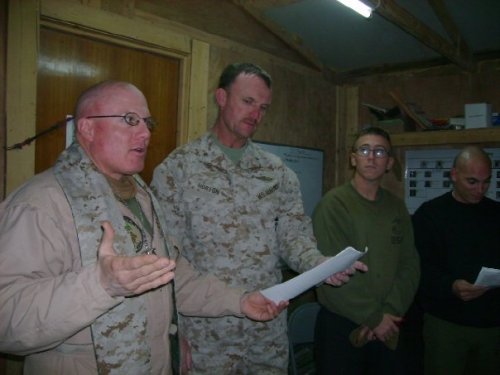
I find that the song will bring me to tears fast than almost any song. It is one that I have sung in English, German and French. In my travels as a military Chaplain have used on every Christmas Eucharist celebration that I have done, including at two lonely COPS in Iraq, COP South and COP North on the Syrian Border in Al Anbar Province. Likewise I have celebrated joint ecumenical Christmas services with German military chaplains and civilian clergy. Last Friday I did that again for the members of the German NATO contingent at my chapel.

It is a simple and humble song. It is performed the world over by the great and small, the famous and the unknown. It is a song that in two world wars has stopped the violence as opposing soldiers paused to sing it together each in their own language. This happened during the Christmas Truce truce of 1914 as well as in 1944 along the Western Front during the Battle of the Bulge.

13-1

http://www.youtube.com/watch?v=EbGZ7T5EHpQ

joyeux-noel-4

On Tuesday as people gather for Christmas Eve Sunday and when they gather for Christmas Day services the song will be sung around the world. In lands where war rages the song will be sung. It is my hope that someday that war will be no more and the tiny child spoken of in this humble hymn will understand the incredible grace of the message spoken by the Angels as recorded in Luke’s Gospel:  “Glory to God in the highest, And on earth peace among men in whom he is well pleased.” (American Standard Version)

Peace

Padre Steve+
1 Comment

Filed under christian life, culture, faith, History, music, Religion

A Watershed Moment, and a Time to Be Afraid: Jim Mattis Resigns in Protest

Friends of Padre Steve’s World,

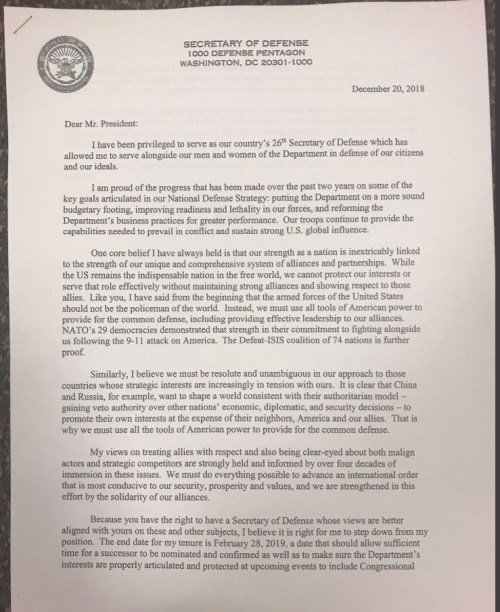
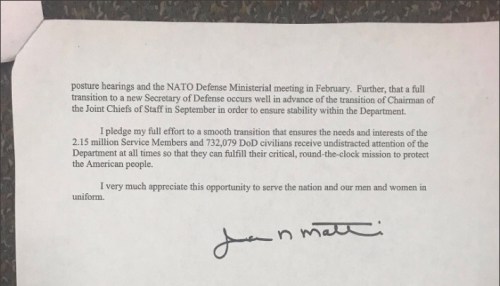
Secretary of Defense James Mattis resigned his position in protest at the manner in which President Trump is endangering the security of the United States. His resignation letter speaks for itself but it echoes many things that I have written regarding the Trump military and foreign policy since his election campaign. The final straw for Mattis was Trump’s unilateral decision against the advice of Mattis, the Department Of Defense, the State Department, and the National Security Council to withdraw all U.S. Troops from Syria falsely claiming that ISIS had been defeated.

Secretary Mattis’s letter is show below.

It was a watershed moment in American History. Honestly, I never expected Mattis to survive this long in the Trump Swamp. Everything about him stands in complete opposition to everything that Donald Trump embodies. The disgraced convicted felon Michael Flynn much more represents for which Trump stands.

Mattis was and remains a Marine who exemplified the Marine motto Semper Fidelis, and of living the creed of Duty, Honor, Country. Many times during his time in office he resisted the worst impulses and decisions made by the President. He knew that his duty and oath were to the Constitution of the United States and not the President. I think that he has become a tragic figure, he accepted the position thinking that he could serve the country better by taking it rather than not.

In the end Mattis could not abide the constant attacks on what he believed were the foundations of American national security and he resigned in protest. In a way he reminds me of Colonel General Ludwig Beck, Chief of Staff of the German Army, who resigned in protest over Hitler’s planned invasion of Czechoslovakia in 1938. Beck, who died in the attempt to kill Hitler on July 20th, 1944 said:

It is a lack of character and insight, when a soldier in high command sees his duty and mission only in the context of his military orders without realizing that the highest responsibility is to the people of his country.”

Working with former Secretary of State Rex Tillerson, and former National Security Advisor H.R. McMaster he had allies within the administration who could help check the President’s worst instincts. But Tillerson and McMaster were forced out and replaced by men who Trump believes that are more personally loyal to him, leaving Mattis isolated in the administration. Mattis was not able to get his recommendation for the next Chairman of the Joint Chiefs of Staff, Air Force Chief of Staff General David Goldfein approved by Trump. Mattis took this as a personal affront because the Secretary of Defense usually gets his recommendation for the position approved by the President. I wonder if Trump rejected Goldfein because in addition to being a decorated combat veteran who was actually shot down over Serbia in 1999, is also Jewish. Honestly, I don’t think that Trump could stomach having a Jewish war hero as his Chief military advisor. Maybe someone should ask that question, but I digress…

Mattis’s resignation, combined with Trump’s declaration of victory over ISIS and withdraw announcement sent a chill throughout Washington and around the world. Even influential Republican leaders who have carried Trump’s water are seeing the approaching danger of Trump unrestrained. The only question is if they will have the courage to choose principle over personal profit and power. Sadly, to this point they have not backed their words with action. Perhaps with the wheels coming off this presidency they will, but I think they are more afraid of his cult like followers than they are of him, so we will have to see.

Trump promises that he will nominate a replacement for Mattis soon. Make no mistake, whoever Trump chooses will be pliant and nothing more than his lackey. The replacement will be someone in the tradition of Field Marshal Wilhelm Keitel, who was absolutely committed to Adolf Hitler and who not only went along with, but signed criminal orders that obliged the German military to commit war crimes, at home and abroad. Supreme Court Justice Robert Jackson who served as the Chief American Prosecutor at Nuremberg said about Keitel:

“Keitel, the weak and willing tool, delivered the armed forces, the instrument of aggression, over to the party and directed them in executing its felonious designs.”

I am not sure who would want the job, but I am sure that he will be an modern embodiment of Keitel, and I will be glad that I will be retired within a few months of his confirmation. A year ago I thought that Senator Tom Cotton would gladly take it, but since he was one of the leading critics of the Syria withdraw, that he saw as a surrender to Russia I am not so sure. I don’t think that he’s that stupid. Instead, I think that Trump may pick a retired General or Admiral from his partisans for the job, there are plenty of them out there who would take it, I could be wrong, but we’ll have to see.

Regardless of who takes over for Mattis is the fact that with Mattis out of the way, Trump’s worst instincts will win policy debates and he may even lose John Bolton. Today the danger to our country and to to world has increased exponentially. To quote General Colin Powell’s words in his waning days as Secretary of State, “I sleep like a baby … every two hours I wake up screaming.”

I think that may be the case for many of us in the coming days, weeks, and months. Since I already do that due to my PTSD and combat based nightmares and night terrors this will be nothing new. If that hasn’t been the case for you, welcome to my world.

Peace,

Padre Steve+

6 Comments

Filed under ethics, Foreign Policy, History, leadership, Military, national security, nazi germany, News and current events, Political Commentary

I Won’t Shut Up Until It’s Fixed: Military and Veteran Mental Health Treatment

Friends of Padre Steve’s World,

Last night I came across the story which threw me back in to the abyss of PTSD. I still suffer terribly from it. I have terrible nightmares and night terrors and often physically act out my dreams. Since 2014 this has resulted in two Emergency Room visits due to the injuries incurred in those dreams, including a broken nose. In the deepest depths of anxiety, fear, depression and at times paranoia I contemplated suicide many times. The only thing that kept me from it was what the effect would be on Judy and how my dog Molly would understand that daddy wasn’t ever coming back.

Anyway, I read about the story of Colonel Jim Turner who committed suicide in the parking lot of the Bay Pines Florida, Department Of Veternas Affairs Medical Center. He had dressed in his Dress Blues with Medals, got out of his car, sat on his service records, and killed himself with a rifle. The story struck so close to home because in July of 2014 I was at the same point following an encounter with a a provider and what was a very inhuman and machinelike system of treatment at Naval Medical Center, Portsmouth, Virginia.

I had been getting treatment and therapy since the summer of 2008 when I crashed following my return from Iraq. In 2013 I thought that I was doing well enough to discontinue therapy. But in early January 2014, my former Commodore at EOD Group Two, Captain Tom Sitsch committed suicide outside a hospital in New Hampshire. He had been retired about five years and his life was falling apart, but when I met in the spring of 2008 he was the only man who seemed to care about me, and how I was coping as I was crashing. His death hit me really hard and I realized that I needed to get back into therapy at least to have someone to talk to every couple of weeks to make sure that I was  okay.

I wrote about these encounters on this blog a number of times from the day until it happened until the situation was resolved by the intervention of my former Commanding Officer at Naval Hospital Camp LeJeune, NC who had since been promoted to Admiral and put me in direct contact with Rear Admiral Jeff Moulton who commanded the Medical Center and Naval Region East.

After my encounter with the provider, a young Psychiatric Resident physician, I was considering suicide in a very similar way to how Colonel Turner killed himself. I was goi g to purchase a chrome plated M1911A1 .45 pistol, my favorite or all weapons I used in the military, clothe myself in my choker whites with full medals and put a round in my heart. I was ready to do it, and then I thought of the effect on my wife Judy, my dogs, and the people who would witness what I did.

If Admiral Lane had not reached out to Admiral Moulton I might well have died by my own hand. But those men took the time to listen to me and ensure that I got help. They saved my life. I am still in therapy. I still suffer crazy nightmares and act out my dreams, even last week when I scared the shit out of my Papillon dog Izzy and Judy when I tried to defend myself from a enemy combatant who had a pistol pointed at me, but I don’t want to die.

But an interesting thing happened. While reviewing my medical records in preparation for going into the VA system I found that the young Psychiatry Resident had put in a very perjorative diagnois Of a personality disorder based on a brief visit and a phone call, in fact the diagnosis was put in weeks after I had talked with her and after I had talked with Admiral. I guess she never thought that I would know about it. I talked with my current therapist who could access her notes about it today. When we talked he gave the dates on her notes, he told me what she wrote, and so this evening I went to my blog archives because I knew I had written about it when it happened. The result blew me away.

If I was a civilian I could sue her for malpractice, but since I am on active duty I cannot due to to provisions of the Feres Decsion. Now at this point in my life I don’t want revenge, I just want to have the perjorative diagnosis removed from my records. Until today I didn’t realize that I had the evidence at my fingertips, my scrambled brain had me think that the encounter was in 2015, but my blog and the Medical records show that it happened in July and August of 2014.

Pray for me, and if you have any legal advice please let me know. I plan to go forward as the psychiatrist is still on active duty at another base heading a clinic that treats patients with PTSD. I wonder if she is using her position to slander young sailors and marines who disagree with her or do not want to use her as a therapist, and who don’t know that a provider can so easily use a medical record to prejudice other providers against them.

As I said back in 2014, I will not shut up until the system is fixed. The late Colonel David Hackworth who Inhad the honor of corresponding with before he died noted: “If a policy is wrongheaded feckless and corrupt I take it personally and consider it a moral obligation to sound off and not shut up until it’s fixed.”

That is now part of my mission, not just for me, but for men like Colonel Turner, Captain Sitsch, and the countless men and women who have been callously treated by military and Veterans Administration mental health providers. For the approximately 20 military personnel and veterans who take their lives every day. All of us deserve better,

By my calculations the psychiatrist who did this to me wasn’t even born whenI enlisted in the Army or had even entered medical school when I deployed to Iraq. At the time that she saw me she had never deployed, been in combat, or commanded troops, in fact I would dare say that when I saw her I had much more experience dealing with death and troops suffering from PTSD than she did. I’m pretty sure that when I told her I didn’t want to do therapy with her I told her that, perhaps she was offended that a non-physician would tell her that, but I tend to tell the truth, and call things the way that I see them.

So anyway, until tomorrow, or maybe since it’s after midnight, later today I wish you peace, and pray for me a sinner.

Peace,

Padre Steve+


6 Comments

Filed under ethics, leadership, mental health, Military, News and current events, PTSD, suicide, Tour in Iraq, us army, US Marine Corps, US Navy