Category Archives: christian life

Advent 2010: Looking Back, Looking Forward

Christmas Eve 2007 with Border Team and Bedouin family on Syrian Border

The Season of Advent and the celebration of the Incarnation of Jesus on Christmas and during the Christmas Octave is my favorite season of the Church year. I have always even as a child been mesmerized by the aspect of hope that is intrinsic to the celebration, the twofold emphasis on the time leading to the Incarnation of Jesus Christ, born of the Virgin Mary in the manger of Bethlehem and the personalities involved to the promise of the Second Coming which was considered the “Blessed Hope” by the early Church which believed that the event would occur during their time as has the Church in times ever since.

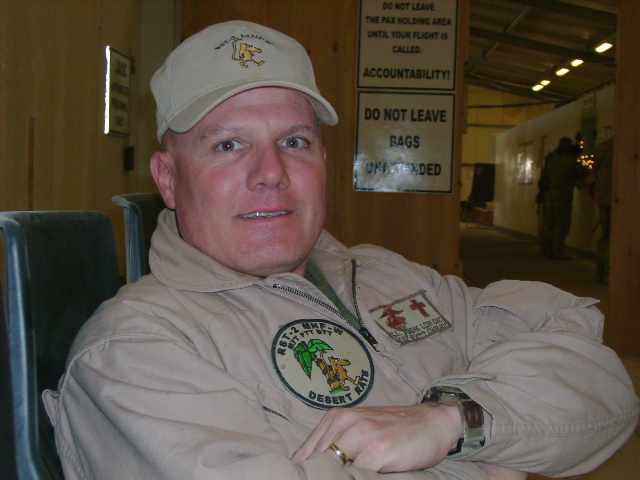
I think the most meaningful season of Advent and Christmas that I have known was my time in Iraq in 2007.  At the time I was travelling about the remote western regions of Al Anbar province with my trusty assistant RP2 Nelson Lebron.  We had been doing this kind of work at a steady pace travelling thousands of miles by air and ground to be with the Military Training Teams that were assigned to the 1st and 7th Iraqi Divisions and those of the Border Training Teams assigned to the 2nd Border Brigade as well as Army advisors assigned to the Iraqi Police and Marines working with the Iraqi Highway Patrol.  By the time we made our far west Christmas expedition which lasted almost two weeks.  The immediate days around Christmas were spent on the Syrian Border with the teams assigned to the 1st and 3rd Battalions, 3rd Brigade 7th Division and Border forces at COP South and COP North.

As we traveled the area with our teams, especially Captain Josh Chartier’s Military Training Team and Major Stan Horton’s Border team out of COP South I was taken in by the Bedouin camps that dotted the desert because in so many ways they lived a life so similar to the shepherds that received the angelic visitation recorded in the Gospel according to Saint Luke.  The Bedouin are nomads and travel where they can tend flocks or fields according to the season.  On December 23rd we traveled with Major Horton’s team visiting both the Bedouin in the area and the Iraqi Border Forces in a number of border forts along the Syrian border which at the time was a major conduit for money and arms being smuggled to Al Qaeda Iraq and indigenous Iraqi insurgents.  The Iraqi troops were most hospitable as were the Bedouin who hosted us in their tents or homes.  We delivered toys, candy and school supplies to the Bedouin kids and were treated to food and Ch’ai tea. Had it not been late and we had not had more sites to visit we would have taken the invitation of the head of one Bedouin family to have dinner with him.

That night we celebrated a Christmas Eve Eucharist a day early for the teams at COP South.  Since we were the only Religious Ministry team that spent any real time with the isolated teams like these it was a special occasion for all, one man in particular, one of the Iraqi interpreters, a Christian who had not been able to attend a Mass of any kind for over two years.  The next day we would travel 50 miles of often very rough roads and trails to the even more isolated COP North where we did the same for the members of those teams and had a wonderful Christmas day and eve with these Marines.

That was the most meaningful Advent and Christmas season I had ever seen. It was a season without all the bells and whistles, without all the commercialism and distractions to take away from the simplicity of the message that “when the fullness of time had come, God sent his Son, born of a woman, born under the law, in order to redeem those who were under the law, so that we might receive adoption as children” (Galatians 4:4-5) the simple message of redemption and the grace and mercy of God that has been shown to all people and is the heart of the season.

After my return from Iraq I experienced a major spiritual and emotional collapse related to PTSD which changed me in fairly significant ways.  For nearly two years I struggled desperately to recover faith that was lost after I returned home.  I was overwhelmed with the turbulence of the country, a disastrous series of splits in my old church, feeling abandoned by the Navy and dealing with the long, slow and painful demise of my father due to the ravages of Alzheimer’s disease. I am told that I am not alone in what I went through.  I begin this Advent having made the transition from my old church to the Apostolic Catholic Orthodox Church which is a North American expression of the Old Catholic faith and I am quite at peace with that move.

After nearly two years faith returned during Advent due to an event in the Medical Center that I worked in where I provided the last rights to an Anglican patient as he drew his last breathe in our ER. I call it my “Christmas miracle.”   https://padresteve.wordpress.com/2009/12/24/padre-steve%E2%80%99s-christmas-miracle/

It was ironic and fitting that my spiritual rebirth came in the midst administering the Sacrament of the Anointing of the sick.  Faith has returned and unlike last year when in the midst of my personal gloom and despair I rediscovered faith and the wonder of the season I look forward to the fullness of the season.

I don’t know how much I will write about the season this year, certainly some articles but I do look forward to the continued rediscovery of faith in the Incarnate God.

Peace

Padre Steve+


1 Comment

Filed under christian life, faith, PTSD, Religion, Tour in Iraq

So God gets the Blame for Dropped Passes….the Prosperity Gospel strikes again

Padre Steve’s Disclaimer: This post deals in a humorous manner with the Tweet of Buffalo Bills Wide Receiver Steve Johnson.  His tweet is a foil for a bigger point about the “prosperity Gospel” and the distorted view of God of those that teach it and their unfortunate victims.  I am sure that he is a sincere young man who was very emotional after dropping a pass. I wish him well and he will let up on himself and God. Peace, Padre Steve+

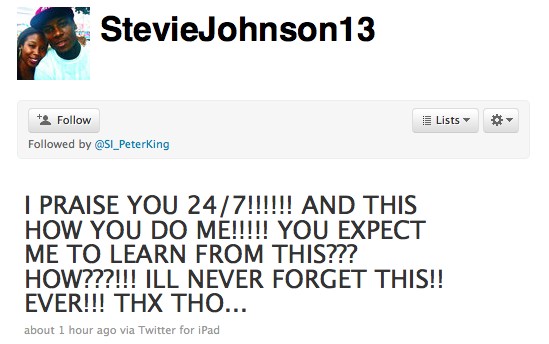
Well, well isn’t this special. Buffalo Bills receiver Steve Johnson dropped an easy pass that would have won the game for the Bills and stunned the Pittsburgh Steelers. After the game at the Bills press conference the young man was up in front of the reporters taking responsibility like a man all but offering to commit Hari-Kari to atone for his sin against his team which cost them the game.  I saw the interview on ESPN and heard it on the radio and I thought that while I liked the fact that he owned up to blowing the play that it sounded a bit overdone and even a bit histrionic if you asked me.  Lucky for Johnson and quickly recovered his composure and realized that God had thrown him under the bus. I mean he had obviously done all the right things to make God happy except to play for the Cowboys who in addition to claiming to be America’s team have also conjured up the image of being the Deity’s team but I digress.  You have to look at what the young man said in the context of his Twitter account:

The “I PRAISE YOU 24/7!!!!!! AND THIS IS HOW YOU DO ME!!!!!” is a little strong if you ask me. How anyone finds time to praise God 24/7 is beyond me and I would assume that he means “a lot” and not a literal 24/7 Praise-a-Thon.  I’m sure that since he used so many exclamation points that he lost the chance to remind God about his tithes, vows and other offerings in the tweet, alas the limitations of Twitter.

You see it is obvious to me that God had to let him down. He’s playing for a bad team getting whacked around by opposing defenses and all the while praising God and giving until it hurts. Let’s face it anyone knows if you take the time to watch or listen to much of what passes of “Christian teaching” on almost any “Christian” television network you know that the young man speaks the truth. He praised, prayed and gave and what did he get for his trouble? I’ll tell you what he got, he got the shaft and he should sue.  He should go for God’s big pockets.

Look at this, I mean if you listened to some of the guys that really are tight with God you would do the same thing as Johnson, and if you do listen to God’s anointed you would probably do the same thing in Johnson’s situation.  I mean these guys are called anointed, apostles, prophets and even “God’s Generals” so they can be trusted right?

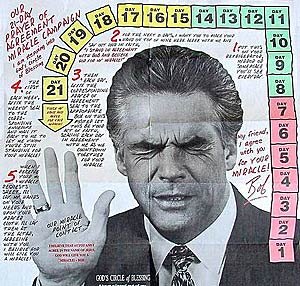
Prosperity Doctrine Poster Child: Robert Tilton

I mean I have seen some of them actually getting messages from God on camera with the whole constipated look while they are struggling to hear exactly what God is saying because the Old Testament talks about the severe penalties for getting God wrong.  With that kind of accuracy and authority it is no wonder that people fall all over themselves to give to these ministers and their ministries.  Seriously the basic message of the “health, wealth and success” prosperity preacher in its crudest form is that if you give you get.  If you do things like praise God, something that certainly a good thing for us to do and give of your time talent and treasure, especially the treasure part that God is obligated to give back to you. The Prosperity preachers love to quote Scripture but only in regard to people giving to them and their ministries, they just love Luke 6:38 “Give, and you will receive. Your gift will return to you in full–pressed down, shaken together to make room for more, running over, and poured into your lap. The amount you give will determine the amount you get back.” Can I get an Amen? No of course if you look at all the troublesome verses around this gem the context is not how it is presented by the prosperity crowd.  The passage is Jesus giving a lecture about the Christian life to include humility, forgiveness, judgment and even hypocrisy and the giving is just one part of it and certainly if you look a the broader context of Scripture regarding material prosperity generally talks about it as an encumbrance that often leads to sin, excess and even presumption on God denying the very way of the Cross.

So you get my drift, what Steve Johnson did is no different than the person that gets upset at God when they didn’t get a promotion, or get something that they really wanted and even prayed for, and all of us including yours truly have had meltdowns where we have words with God.  However the problems arise when we presume that because we do something good that God is obligated to return the favor like God is some sort of cosmic ATM. With the proliferation of the prosperity teaching on television, in mega-churches and on the internet we have seen a cultural shift in how the Christian faith is presented in often very narcissistic ways.

So my best to Steve Johnson and I do hope and pray that a more mature Christian in his circle of trust will pull him aside and help him. These things happen and once you “tweet” or hit the send button on your e-mail or text you can’t take it back.  Live and learn, it’s hard to be a rookie on Twitter, maybe the NFL should keep rookies off of Twitter until they can learn not to look stupid using it.

Have fun and God bless,

Peace

Padre Steve+


Leave a comment

Filed under christian life, faith, football, Just for fun, purely humorous, Religion

Reforming the Church Today Part One: By their Budgets Ye Shall know Them

John Tetzel shook down Germans for Indulgences….Have we learned anything from history?

This is the first in a series of essays on reforming the Church today that will appear on this website

It seems that Christians and especially ministers of all traditions forget the lessons of history.  The church in the United States is at a critical point in history and is fast losing its credibility due to the arrogance and excess of many churches as well as individual clergy in matters related to personal behavior, financial accountability as well as accountability before the law concerning clergy that who have committed grievous crimes against children and others.  Likewise there is the nearly incestuous relationship between many ministers and those holding political and or economic power in which quite often one cannot tell where the “gospel” ends and the politics begin.  This exists in many churches large and small and spans the denominational spectrum not being the sole property of any particular body.  There is also the matter of accountability in which it seems that many churches, ministries and ministers practice a “do as I say, not as I do” lifestyle holding their subordinate clergy as well as parishioners to a higher standard than they practice themselves.

The United States has always had a strong Christian heritage that has impacted its faith as well as its national life.  This is not of itself a bad thing as one looks at how churches and Christian leaders have made an impact that goes beyond them and is beneficial to the nation as a whole.  Some of these achievements include the pressure put on James Madison by Virginia Baptists to ensure a guarantee of religious freedom in the Bill of Rights, the abolition of slavery the ending of child labor, the Civil Rights movement as well as numerous charitable and public interest oriented ministries to care for society’s most disadvantaged citizens as well as the aliens that have lived among us.  At the same time there were many Christians, churches and ministers that supported slavery, an established state religion, segregation and many other issues.  That being said churches and individual ministers have made a huge contribution to American life and community that cannot be easily dismissed despite the many problems, controversies, and scandals that have surrounded churches of almost all denominations since the founding of the United States.  Religious liberty as well as Christian churches and religion in general has traditionally been seen as a positive rather than a negative aspect of the United States going back to Alexis de Tocqueville in his comments on American democracy.

Clergy have enjoyed a special status in American life that exists in large part due the Bill of Rights and the Jeffersonian understanding of an “eternal wall of separation” between church and state.   This is because clergy were seen as fair arbiters because they were not an appendage of the state as were the clergy of most European states that had established state religion.  Thus the “clericalism” of Europe which was seen as a danger by our Founding Fathers was not a major issue. Yes some of the founders recognized a potential danger but that did not stop Congress from treating clergy and churches favorably in the early years of the republic and worked to ensure that no church became a “State church.”  Over the years since the founding of the United States clergy of many denominations have made many positive contributions to our Nation in both their pastoral and prophetic roles.  At the same time over the years some clergy have attempted to use their status and privileges as an entry into the elite parts of society, especially in the political, government policy and financial realms.

The point to be short is that many clergy in the United States, especially those in influential pulpits and ministries have forgotten the dangers of “clericalism” and the abuses of clerics who use their office as clergy to gain political, financial and personal power.  Jesus told his disciples that they had to be servants and not seek wealth, status or position something that was echoed by the New Testament writers as well as many of the Ante-Nicene Fathers.

By their budgets ye shall know them….I saw the report of the Reverend Robert Schuler of the “Crystal Cathedral” megachurch which declared bankruptcy last week being $43 Million dollars in debt and embroiled in struggles about Schuler’s successor call for his parishioners to give more money.  He asked “tithers to double tithe” and those that do not tithe to “start tithing.” He talked about what the church has given to them and earned their support. I found this to be a rather pompous plea from a man who has had the ear of Presidents and leaders in the political and business world.  The fact is that Southern California has been terribly hard hit by the economic downturn and recession and that obviously includes many of his parishioners both those that worship at the Cathedral as well as those who what Schuler’s “Hour of Power” show.  The Chrystal Cathedral now has to live “month to month on $2 Million dollars a month” and has cut back staff, curtailed programs and sold property to try to make ends meet. I’m sorry but when you live off of other people’s money you should never build a ministry requiring millions of dollars on the presumption that if you get it wrong that the faithful givers should have to bail you out.  I saw this at a local level a few years back and it all but destroyed the local church and the denomination that church belonged.  I wonder how many more megachurches built on piles of debt are facing what is happening at the Chrystal Cathedral.

By their budgets ye shall know them….Other churches at denominational and local levels have often become embroiled in banking scandals that tarnished the reputation of those churches, their leaders and disillusioned their membership often causing mass defections to other churches or leave the organized church all together.  The Roman Catholic Church had to deal with a major scandal involving the Vatican Bank in the 1970s and 1980s and have recently had other allegations of another potential banking scandal involving the Vatican have surfaced.

By their budgets ye shall know them….I worked for a fairly reputable Television ministry while I was a seminary student. The common plea of these types of ministries is that they “are on a mission from God” well, maybe that is a Blues Brother’s paraphrase but you get my drift. Most are not part of any denominational structure and have little oversight and presume that since someone might watch them that they are entitled to financial support. They do not ask their audience for actual input into their “mission” strategy, they just ask for their audience’s money to do with as they “and as the Lord would have them to do” with it. This of course is not the sole property of television ministries but it occurs in many churches as well.  If someone questions the church and its financial accountability they are accused of “being unfaithful,” “not hearing God,” or being “disobedient to God’s will or to the church.”  Since many churches and ministries suffer a terrible lack of accountability and oversight these abuses are more widespread than we would want to believe. Sometimes it takes personal experience to see this but when one sees it up close and in person the blinders can be removed. In regard to television ministries in particular the amount of money required to keep their programs on the air is beyond exorbitant. It comes often from those that are barely surviving financially even in “good times” and the most desperate of people “believing in God for a miracle” in response to obediently shelling out of their meager incomes to ministries in response to persuasive pleas by ministers that should know better. The motivation, love and obedience of these often wonderful people is exploited in order to support air programs that have little impact on the world despite the boastings of these ministers that they are “fulfilling the great commission.” One has to ask if this is the case why there is so little to be seen in our society as a result of all the money poured into these pricy ministries.

By their budgets ye shall know them….If money was the only thing it would be a manageable problem…. Oh but wait money and power is the root of the problem as the problem extends to lifestyles of ministers and other church leaders which are hardly supported by the demands of the Gospel. It is not uncommon at all to see clergy living off of the offerings of their parishioners live opulent lifestyles and when times get tough demand more money from their flocks rather than amending their own behaviors.  Instead of accountability, repentance and a change in behavior there is a demand for obedience from their flock and if the flock objects they are the ones that are vilified.  This again cuts across denominational lines and includes Protestants and Catholics, those in parish as well as those in parachurch, television and radio ministries. In my old church those clergy who could not meet their tithe for whatever reason were told that they were being “disobedient to their vows” which instead of vows to the Church in regard to orthodoxy as well as orthopraxy were narrowed down to if you were paying your tithe on time. I remember one Bishop who left the church to go elsewhere told the assembled priests in his diocese that the tithe was the “essential test of obedience, and what bound us together.” Families and parishioners of parishes were described by another Bishop as “tithing units” not people and when I was in the reserves contemplating a mission parish start up was told that in order to be “successful” the church needed at least “x-number of tithing units.” Doctrine or even other forms of public witness were secondary to paying the tithe.  That church had many major financial scandals that are well documented elsewhere so I won’t go into detail about them.

By their budgets ye shall know them…. If churches spend more money on the salaries of their pastors than they do on outreach to the poor or missions something is severely out of order, one cannot imagine the Apostles of those Ante-Nicene Fathers who suffered poverty and persecution advocating for what amounts to be an “Imperial” church even those that advocated a firm hierarchy in regard to faith and belief.  When leaders of a church, especially a small church get together and dine in luxury on the monies donated by their often impoverished flocks it shows a tacit denial of the Gospel and lack of respect or care for the people of God.

By their budgets ye shall know them….When church building programs and plant maintenance are extravagant and require massive amounts of money to sustain without demanding more from their parishioners than something is out of kilter.  When chandeliers cost more than a mission budget for the poor something is wrong.  My Church History professor from who I appropriated the “by their budgets ye shall know them” line used to say that “God is going to get us for our stained glass windows when we neglect the poor.”  I love good church architecture including stained glass windows but it is presumptive on God the people of God for churches, ministries and ministers to demand monies when they have failed to play and manage effective especially when in spite of economic indicators they spend like drunken sailors and expect others to pick up the tab while crying crocodile tears about how “God’s plans will be thwarted” if their ministry fails.

By their budgets ye shall know them….Back prior to the Protestant Reformation in Europe there was a large amount of discontent which focused on the arrogance, opulence and financial demands of the Catholic Church.  In fact much of Dr. Martin Luther’s protest in the 95 Thesis dealt with the manner in which the Church used a practice called indulgences and the selling of “relics” to fund the construction of St Peters Basilica in Rome.  In people gave because they believed men like John Tetzel who preached in regard to indulgences “a penny into the coffer rings a soul from purgatory springs.”  Of course there was the manner that the Church also used its power to reward or punish rulers which was also part of the problem but the complaint of many reformers was often directly related to the Churches’ financial as well as political abuses of its members and nations to buttress its position in Europe.  Unfortunately I do not think that we have learned this lesson and that Churches and ministries in the United States are losing membership and the trend is that people are opting for individual expressions of faith rather than become a part of institutions that they feel are out of touch with real people.  I believe that if things do not change there will be a mass exodus from many churches and religious institutions because of the odious nature of the financial dealings and pressure put on people to support questionable programs and lavish lifestyles.

By their budgets ye shall know them….There are honest and hard working ministers and churches that emphasize ministry and care for people as part of the Gospel message.  Many are foreign missionaries that eke out support while working full time in “tentmaker” professions in order to fund their missions without unduly burdening those that support them.  I know many people like this and for them whether they be working in foreign missions or caring for the poor at home live the Gospel in word and deed and nothing in this essay should be construed to be against such people or their missions.  I may disagree with someone’s theology but when I see them demonstrate humility and the love of God in all that they do I can only commend them.

You see my friends and readers my experience leads me to believe that people are still searching for authentic faith and spirituality and have not necessarily given up on orthodox Christian beliefs.  The problem is they are finding little of substance in many churches and other religious institutions. Novelist and write Anne Rice recently did this, leaving “Christianity” but not Christ and I fully understand her reasoning for doing so.

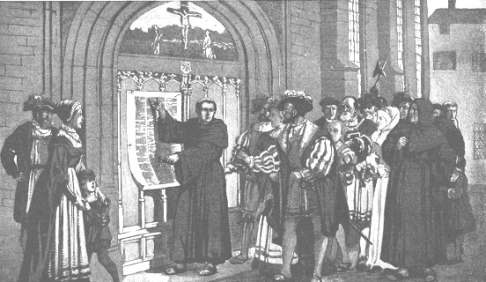
Martin Luther and the 95 Thesis: What if the Church had listened to him rather than branding him as a heretic and criminal?

Some will say that by writing this that I am “causing division in the Church” or the more pious “causing division in the body of Christ.”  However that is a red herring argument that attempts to divert attention from the real problem. If the Church and I mean across denominations not any particular body fails to reform itself it will fall on its own and fall hard and in the process harm the faith of many people. Churches which have to defend the indefensible to “retain unity” are those that are in schism from Christ, not those that raise issues that the society at large recognizes but church and religious leaders seem incapable of admitting. The Church must reform and a big part of that in the United States involves how we deal with wealth. By their budgets ye shall know them.

This essay will be continued as I move to the next segment which will be about the incestuous relationship between many ministers and those of the political and financial elites.  I’m sure that I will come up with a catch title for that essay but need to ruminate some more.

Peace

Padre Steve+


3 Comments

Filed under christian life, faith, History, Pastoral Care, philosophy, Religion

To the Edge of Oddness and Beyond: Let’s Stuff Bliss Between Peoples Ears Until the Cows Come Home

I don’t think like a lot of people finding humor in events that others see in a more serious light and irony in so many places, so many that I have to remember that I don’t iron anything anymore. Back when I was in college Judy and I had a friend named Eric. Eric to be kind was slightly on the eccentric side of life and he had a phrase that I appropriated for when people told him that he was “weird.” He would say “weird takes work, not crazy like most people.”  Yes weird does take work and as most of the people that know me well attest most never know what I will find funny or say next. Of course there people who are humor deprived that do not see anything that I say or do to be funny or witty.  But that is okay with me because I find their humorlessness humorous. I think our little Red Dachshund named Greta who took life so seriously that it was funny to us helped me in this. I see so many people so consumed with the cares of live that they live in a perpetual state of unhappiness, anxiety, depression with anger seething below the surface ready to implode or explode depending on what day it is.

Even in my darkest moments coming back from Iraq I found humor even in some of the nuttiness that was part and parcel of my PTSD like the time that I got rudely cut off in a grocery store parking lot and I called the other driver an Oedipal Mother you-know-whater.  There were so many other things that even when depressed, anxious and struggling to believe that I found funny, ironic and just plain amusing even things about me that when I got over whatever I wasn’t over that I found ludicrous and had to laugh at myself. I think that humor help sustain me through the most difficult times when I could have easily sunk into a morose bitterness that would have been the end of me as you know me and I think that that would have been a fate worse than a fate worse than death.

This has been especially helpful during the prevailing national nastiness that we Americans seem to be reveling in as we find more ways to hate one another.  That my friends is not for me, I just want to get along and care about people that come my way no matter who they are, what they believe or any other defining characteristic that others label them as.  Why do I want this? Because it is so wacky that it makes absolute sense. I think that if we start learning to love each other despite our differences that we can make this world a better place.

Although some would say that “ignorance is bliss” and I certainly am not ignorant I like bliss.  Bliss should be good even if not grounded in ignorance.  I wish bliss on unhappy and overly serious people because it has to be good for them.  Now we can’t make people blissful even if we stuff bliss between their ears until the cows come home but it would be worth a shot.  Some might find that odd but I think that it might be the will of God.  Kind of like when the Ghostbusters II when they Ghostbusters blasted the toxic slime out of existance with “put a little love in your heart.”

http://www.youtube.com/watch?v=T3XXWTV0cV0

Peace,

Padre Steve+

Leave a comment

Filed under christian life, philosophy, PTSD, purely humorous

The Church Maintained in Love: Maintaining Integrity and Preserving Relationships When Asked to Leave a Church

“There comes a time when one must take a position that is neither safe, nor politic, nor popular, but he must take it because his conscience tells him it is right….” Martin Luther

The past three years have been filled with change and transition for me as anyone who is a regular reader of this site understands.  This week another transition took place as I was asked to leave the Charismatic Episcopal Church over my perceived “liberal” writings and spiritual journey.  This has been a long time in coming and while I was surprised at the timing I was not surprised that it eventually came to this.  While my Bishop states that he did not ask me to leave the tenor of his call, which was pastoral and friendly yet used terms such as “you do not appear to be happy in the CEC,” “I would think that you might be happier in another church” and “liberal beliefs” indicated to me that I was being asked to leave and that was how I interpreted it.  He did not at all threaten my status in the military as I made my transition but left me with the impression that the sooner I found a new home the better.

Before I go into the process of how this happened I have to say that I depart the CEC without rancor or personal animosity and that unlike many who have departed the CEC will not engage in criticism or attacks on that Church or its leadership.  While I have theological, philosophical and pastoral disagreements with where I see the CEC going it is not for me to sit as the judge upon the CEC.  I have too many friends in the church and dare not risk relationships over issues that are mine to deal with.  At the same time I will in this post note those differences.  But again I say that all churches have the right and responsibility to do what they think is correct regarding their beliefs and how to deal with their clergy and laity that have differing views.  It is my view that unless a person is willing to stay within their church and abide by its discipline that they should leave peacefully.  I also believe that if a person feels that they are bound by the faith and by Scripture to remain in a church as a voice of loyal opposition that they should but have the grace not to make their opposition a personal crusade to get their way or to force change in their church before it is time.  I believe that a person who practices principled opposition can never use his opposition as an excuse to seek further division in the church. Likewise a person cannot allow his or herself to become so attached to his cause that he sees his opponents as enemies and allows hate to dominate his actions.

I believe that the Church is a community centered on Jesus and bound together by our baptism, One Lord, One Faith, One Baptism, One God and Father of All.  I believe in this community that there are many expressions of that faith.  We maintain the faith that comes passed to us in the Gospel “that God was in Christ, reconciling the world to himself, no longer counting people’s sins against them. And he gave us this wonderful message of reconciliation.” (2 Cor. 5:19 NLT)

Within this context lies my journey. As a priest in the CEC I was bound by my vows to be obedient to the discipline of the church.  When I entered the CEC in 1996 I felt very comfortable with those vows. Over the course of the years I began to have misgivings about those vows as the church went through a number of very bitter splits over what amounted to be the issue of power and authority.  Money was at the root of much of this but also the personal misconduct of a number of Bishops as well as clergy aggravated the situation. In the United States during the period of 2004-2007 a total of 8 bishops left the church to form their own denominations or join other groups, many taking the majority of their clergy and parishes with them. Two of these bishops would return to the CEC in later years. One Archbishop resigned and became a Roman Catholic layman. One Archbishop was removed from his episcopate and left the church to form his own church and eventually the world-wide Patriarch was forced to step down after being complicit in the cover-up of an affair of his archdeacon and the wife of a layman in the church whose father was a priest in the military. All of those Bishops did more to damage the faith and witness of the CEC than any article that I could ever write so I am not ashamed as I have behaved with honor and maintained my vows.

During my time in the CEC I had a number of negative experiences with Bishops and clergy that are no longer in the CEC. The Archbishop that laicized and became Roman Catholic had forbidden me from writing after publishing two articles in a conservative Catholic journal.  The accusation was that I was “too Catholic and misrepresenting the church.” Of course my writings were following the lead of this bishop and a number of others that were trying on their own accord to push the CEC into communion with Rome. He did not inform the Archbishop for the Military of this.  I later had conflict with this bishop when I corrected a priest in his diocese who was not following what the bishop said to do. For my trouble I was forbidden to have relationships with civilian clergy in that diocese. When this bishop laicized this diocese imploded, only a few missions with very few members remain in the CEC. The others found homes in communions that the other departing bishops formed after failing to remove the Patriarch in 2006.  I had many friends leave the CEC at that time.  Thus from 2004 I had no local support of fellowship with anyone in the CEC. The bishop that inherited the scattered remnants of this diocese never contacted me in that time, apart from my fellow chaplains I felt completely cut off from the church.  Thus when all the major scandals and schisms occurred I only had the support and fellowship of a number of the priests of our military archdiocese. Despite this I felt bound to my vows as none of the Bishops that remained had wronged me in any way and I valued my relationship with my military bishop and fellow chaplains.

The CEC continued its implosion while I was in Iraq with the resignation of the Patriarch. I wondered if the CEC would survive in any form and began to explore options contacting a number of communions while in Iraq. When I returned home suffering from PTSD flashbacks, insomnia and anxiety as well as the lingering effects of wear and tear injuries to my shoulders and knees and a badly sprained ankle which refused to heal I was in pretty ragged shape. I told Judy that I felt that I needed to leave the CEC and recognizing the danger of a hasty move she persuaded me to stay and at least wait a year to make any decisions.

In fact in light of the journey that I have been on, especially since returning from Iraq in February 2008 I had began the process of seeking to find a home. This was done in large part because when I am done with my military service we plan on retiring in the Hampton Roads area.  One thing that I discovered after Iraq was that I needed local relationships and a church home.  This was something that even if I had remained in sync with the CEC that they could not have provided and I did find a local church home at St. James Episcopal Church in Portsmouth.

During that year I experienced a major crisis of faith that left me for nearly two years as a practical agnostic wondering where God was. Christmas of 2008 was so bleak that I left the Christmas Eve Mass at Judy’s parish before it started walking into the cold of the night asking God if he even existed.  Faith was a struggle for the next year, but I did find a local church home at St. James Episcopal Church in Portsmouth whose priest, Father John Agbaje became my pastor and friend. Though I was still struggling I found comfort in the liturgy and tradition of this historic church. It was a place of solace, something that I had not had in the CEC for many years.

By the summer I realized that if we were to remain in the Hampton Roads area that I would have to leave the CEC if nothing else for the local relationships that we were building at St. James. While this was occurring my faith journey continued. I saw many things going on in much of the church world, to sometimes include the CEC that concerned me as a Christian. These were pastoral, societal and political issues and not creedal issues even though for many conservative Christians including most of the CEC they are “hot button” issues.  While I consider myself a moderate many people on the far right consider that to be “liberal.” Due to the poisonous political and social climate that we live in here in the United States most people are no longer open to debate or dialogue on those issues. Since I have written about this in my recent article “Faith Journey’s: Why I am Still a Christian” ( https://padresteve.wordpress.com/2010/09/22/faith-journey%E2%80%99s-why-i-am-still-a-christian/) I will not go into them here.

In fact it was the Monday following that article that I received a call from my military archbishop telling me that I would have to find a new denominational home due to my “liberal” beliefs.  He is a friend and I sure that the call pained him to make, we go back almost 15 years.  I do not know what led to the call but presume it was pressure from other bishops to do something about me although he stated that this was not the case. I hold no ill will toward Bishop Doug or anyone else in the CEC leadership for asking me to leave. In a way it was a relief as I realized that my writings, even as circumspect as I tried to make them could cause problems for me in the CEC.

At no time did I attack the leadership of the CEC or its stand on any of these issues but evidently some considered my statements as a challenge to the church and its authority.  I am of the belief that to remain viable that there should be differing opinions on matters that are pastoral and societal and not out of keeping with the Christian tradition.  For me it does not matter if a church is conservative or liberal, if it silences dissent by people who are committed to that church for dissent on non-creedal issues then it does itself a disservice in the long run. But again I have to say that the CEC like any Church has the right and responsibility to maintain its church discipline and uphold what it believes to be true and that asking me to leave was within the bounds of its canons

Another endorsing agent helped me find the the Apostolic Catholic Orthodox Church (http://www.apostoliccatholic.org/default1.htm) an Old Catholic Communion whose ethos is very similar to mine.  I have had meaningful talks with the Presiding Bishop, Diana Dale and a number of priests who have served or are serving as military chaplains.  I really look forward to serving in the ACOC for many years to come.

My original desire was to leave the CEC quietly but my writings have placed me at odds with the CEC as a whole and as a consequence I have been asked to leave.  I can do so in good conscience knowing that for 14 years I served the church well and presented a positive view of the church even when the church was going through its most difficult times.  I can maintain my integrity and be more open in my beliefs by leaving than remaining.

Over the past three years Bishop Doug has been most supportive and even had not chided me on other articles that voiced similar sentiments as the Faith Journey’s article and I shall maintain a friendship even if we disagree on some issues. Relationships matter and I refuse to make enemies on my way out of the CEC. I will miss my friends at Church of the Messiah in Jacksonville where we worshipped in 2002-2003 and St. Michael’s in San Clemente who hosted the best of our military diocese convocations, as well as my friends and brothers in the Archdiocese for the Armed Forces. I will remain in contact with many through Facebook and other means.  Friends are friends and I and I will not leave with the bitterness and animosity of so many that left the CEC earlier in the decade, people who have not been able to move past their hurt and embrace their new church homes.

I hope this article in some ways explains my journey. Bishop Doug has already let my fellow military priests know that I am leaving the CEC so at least some people know what has happened. I will contact those that I am closest to personally and provide this article to others.  This is a painful time of transition but it is the right decision for both the CEC and me.

My official change over to the ACOC will take place sometime next week.  I thank all of my friends in the CEC for your support and prayers over the years.  I will keep the CEC and you my friends in my prayers as I continue my journey.

Peace and blessings,

Padre Steve+

Non nobis, non nobis, Domine
Sed nomini tuo da gloriam

Postscript: I had a conversation with Bishop Doug this morning. In that conversation he stated that he did not ask me to leave the CEC in our conversation two weeks ago, just that I appeared to be “unhappy” in the CEC and might want to look elsewhere because of “liberal views” suggesting the Episcopal Church as a possibility.  This is true, he did not directly ask me to leave, but I interpreted the call in that manner he used the term “liberal views.” It was that term that led me to believe that perhaps he had been talked to about me as the term is loaded in the current climate of American religious and political debate. I did not mention other instances regarding past encounters with some in the current CEC leadership that also influenced my interpretation of Bishop Doug’s words. That serves no purpose and I will not mention names or even incidents because I do not want those encounters to be used against the CEC or anyone in it.

I implore anyone that reads this post NOT to disparage Bishop Doug in any way. He is a gentleman and a Christian and I know that he bears me no malice whatsoever. He has been attacked personally on the blogs of many that left the CEC and I cannot countenance that or lend my voice to those criticisms. SLD+

13 Comments

Filed under christian life, faith, Pastoral Care, philosophy, remembering friends

Padre Steve’s Flashback to Early Contemporary Christian Music

Me, top row 3rd from right with Continental Singers Tour G 1979 at Mount Rushmore

I became an active Christian a few years after what is now called ContemporaryChristian Music came on the scene.  Back then it was simple called “Jesus Music.”  Over the last 35 years or so I have seen this genre of Christian music morph from a small segment of the music scene to a rather large and profitable industry. I really don’t listen to too much of the new stuff in fact unless the artist was around in the late 1970s or early 1980s I probably wouldn’t know anything about them or their music.

In those days it was still possible to hang out with groups when they came into town. In 1979 the group The Sweet Comfort Band came to my hometown, Stockton California for a series of concerts in local high schools (God forbid this happen today) culminating with a Friday night concert at one of the larger churches in town.  The guys were down to earth and real and talked about real life, even movies not just church.  That was eye opening because it kind of blew away my idea that “Christian” artist were somehow a step above the rest of us.  These guys showed me that Christians could be down to earth and able to relate to people.  I was able to meet others at the 1979 Continental Singers rehearsal camp as I prepared to go as a Spotlight Technician with the Continental Singers Tour G.

When this genre of music first came out the record labels that carried the new contemporary artists were either labels that had previously carried gospel singers such as Word and Light and start ups such as Maranatha! Music, Sparrow/Birdwing Music and Larry Norman’ Solid Rock Records.  When larger secular labels discovered that there was money to be made they acquired most of these labels giving them more visibility but I think less independence than they had previously.

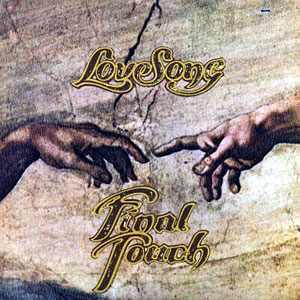
The music was as diverse and the artists performing the songs, everything from rock and country rock, to jazz and middle of the road music.  Some artists had been successful secular recording artists before becoming Christians or rediscovering the faith that they had grown up with.  The music varied in quality, some groups were very good and even pushed the edges of artistic license allowed in Evangelical Christianity while others were not that good and were pushed into the limelight because they had long hair and played guitars.  Some of the bands such as Love Song would achieve a certain status in Contemporary Christian music that long outlived the length of time that they were in existence.  Some bands were one album wonders while some like Daniel Amos remained together for many years.

As the genre grew a sub-genre of contemporary praise and worship music grew out of Calvary Chapel beginning with an album called The Praise Album. These were simple worship songs that small groups especially youth groups and college age groups could easily sing with just a guitar. They fit what John Wesley said about hymns was that they must be easily sung and not complicated.  As such they grew in popularity and many other churches and recording labels got in on the game in opinion saturating the market with music that is only remarkable in its poor quality and insipid theology.  The theology in most of the early songs was simple, based around Jesus and God’s love and not written to advance quasi politic agendas. There was not the warlike quality of many of today’s so called “worship music.”  I know that some will rake me over the coals for this but I have a hard time calling something worship when it is nothing more than a rally or fight song.  Some of these early songs are here: Freely, Freely http://www.youtube.com/watch?v=bCLconoyX9I As the Deer http://www.youtube.com/watch?v=mvQwvDfY5dk&p=90917541439498D0&playnext=1&index=82 In His Time http://www.youtube.com/watch?v=Pjab00qQG3k&feature=related, Karen Lafferty’s Seek Ye First http://www.youtube.com/watch?v=9LMQfOp9w8k&feature=related The Servant King http://www.youtube.com/watch?v=DwIukabdw3E and the Spirit Song http://www.youtube.com/watch?v=KqkvIhs7Ijg

But in this essay I’m going to go back in time and look at some of the early artists and their music beginning in the early 1970s and ending in the mid-1980s.  This is kind of an arbitrary line because in 1984 I left the United States for a three year tour with the Army in Germany where I lost track of most of what was going on in Christian music and when I returned did not find the newer artists as much to my liking.  For me it was simply a matter of musical preference.  It is hard to find much of this music now. Many songs were only on LPs and produced in limited quantities. Since many were obscure and this was before the digital age very few video recordings exist for many groups.  As such some people have taken audios and mixed them with slide shows or videos or the videos are from “reunion” type concerts 20-30 years after the songs were first introduced.

The revolution in Christian music began in Costa Mesa California at a little country church called Calvary Chapel. The church made the effort to reach the “hippies” that hung around the beach towns including many musicians. The group Love Song was perhaps the first group to reach any form of national prominence and their songs such as Little Country Church http://www.youtube.com/watch?v=yZkWrn9SXwo&feature=related, and Two Hands http://www.youtube.com/watch?v=fW12P7upc6o&feature=related became early examples of how the music could be popular and contemporary.  The lead singer of the group Chuck Girard went solo and made a number of albums but Rock and Roll Preacher was one of his signature songs. http://www.youtube.com/watch?v=A_I3R3tC6Rk&feature=related

Other Calvary Chapel Groups that recorded on the new Maranatha! Music lable included the Children of the Day who released For those Tears I Died http://www.youtube.com/watch?v=Np8GJGZ3Vv8 Mustard Seed Faith who released Sail on Sailor http://www.youtube.com/watch?v=BPDAC4-ZkEc&feature=related the country rock band Bethlehem and Desert Song http://www.youtube.com/watch?v=OMkpLzomcxM&feature=related as well as Bill Sprouse and The Road Home who had one song that made the group before Sprouse died, the song  Psalm 5 http://www.youtube.com/watch?v=4gJ2XPDf_jE and The Way who produced two albums under Marantha one of their songs being Song of Joy http://www.youtube.com/watch?v=77Le6G63eZY .

Two other groups Daniel Amos and the Sweet Comfort Band also hailed from the early days of Maranatha Music.  Both groups endured and although they had different music styles they could both have fun with their music as well as make provocative statements about the church and how Christians related to society.  Daniel Amos initially was a country rock band with a sound somewhat similar to the Eagles.  They would retain some of this but moved on to some of the more cutting edge New Wave Rock styles of the 1980s.  Their signature album was Shotgun Angel a country rock album with a side two that was a mini concert about the Second Coming of Christ from a Pre-Tribulation Dispensational theology understanding, an understanding that was quite common in the groups of that day. That album included Black Gold Fever,  http://www.youtube.com/watch?v=yZkWrn9SXwo&feature=related, Shotgun Angel http://www.youtube.com/watch?v=zFD8_-v4bhw&feature=related, Posse in the Sky http://www.youtube.com/watch?v=hwa5gep9CBc&feature=related and Fall in Your Father’s Arms http://www.youtube.com/watch?v=kOTar60srFg&feature=related.  Their First Album include one of my favorite songs of the ear I Ain’t Gonna Fight it http://www.youtube.com/watch?v=intea3oCcDk Later releases include the albums Horrendous Disc and Alarma! The song I Believe in You http://www.youtube.com/watch?v=OMkpLzomcxM&feature=related from Horrendous Disc and Walls of Doubt http://www.youtube.com/watch?v=sbFTcGAAQkk&feature=related from Alarma! Interestingly enough Daniel Amos is considered by some to be one of the best bands from a creativity standpoint in the 1980s Christian or secular.  The group stayed together and after they broke up Terry Taylor the leader of the group formed other bands including The Swirling Eddies and the Lost Dogs. One of the more interesting songs of the Swirling Eddies is Hide the Beer the Pastor’s Herehttp://www.youtube.com/watch?v=b74VWclpH6c which deals with some of the hypocrisy of some Christians who will condemn someone for drinking yet excuse all sorts of other unseemly behaviors.

A second group from the Maranatha label was the Sweet Comfort Band. This band led by Bryan Duncan and Randy Thomas had a light jazz and rock style that featured Randy Thomas Jazz Guitar and brothers Kevin Thompson’s Alembic 5 string bass guitar and Rick Thompson’s drums.  The group produced a number of albums before they broke up in the late 1980s with Bryan Duncan going solo. They have on occasion gotten together in reunion concerts though Kevin Thomas died in May of this year.  Their first album Sweet Comfort which came out on the Maranatha label included Childish Things http://www.youtube.com/watch?v=6R8wY0DCI3A&feature=related When I was Alone http://www.youtube.com/watch?v=sbFTcGAAQkk&feature=related It’s so Fine http://www.youtube.com/watch?v=igp9WJ7QLUE&feature=related and Get Ready http://www.youtube.com/watch?v=-EhcPuwBvZg where Kevin had a great bass solo.  They left Maranatha and signed with Light Music where they made a number of albums including Breakin’ the Ice which featured Breakin’ the Ice http://www.youtube.com/watch?v=RJ4cddT0Eh0&p=20C05334BBE82D2F&playnext=1&index=1, Good Felling http://www.youtube.com/watch?v=lJWwcRYT1p4 and Got to Believe http://www.youtube.com/watch?v=M3x7Myegr24 Other later albums featured songs like Ride the Tide http://www.youtube.com/watch?v=c8oSc7jY288&feature=related

The interesting thing was that many Christians had a hard time with both Daniel Amos and the Sweet Comfort Band.  The members of SBC were frequently berated for their jazz, rock, funk style by Christians who felt that the style was “of the Devil” and both groups frequently played for free on places like the Sunset Strip because they felt it was more important to play for non-believers than believers. Wow, imagine that? When one looks at much of what is called “Contemporary Christian Music” now these groups stand in stark contrast. They were not playing for the approval and entertainment of Christians.

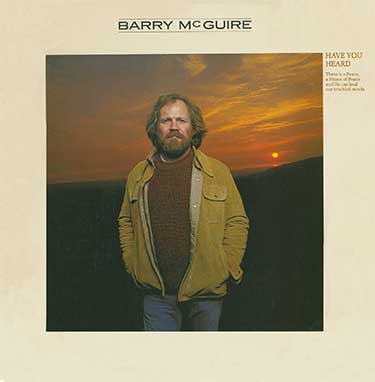
Other artists emerged outside of Calvary Chapel, some who had been successful in their own right prior to becoming Christians such as Barry McGuire who had been with Credence Clearwater Revival, had been in the musical Hair and had his own hit Eve of Destruction for which he is best known.  McGuire’s music is harder to find online and much of what is now available comes from a series of concerts with Peter York, Phil Keaggy, Terry Talbot and others on the music of the 1960s.  However Eve of Destruction http://www.youtube.com/watch?v=ntLsElbW9Xo and his post conversion song Calling me Home http://www.youtube.com/watch?v=hxoRzqZnP98&feature=related make for interesting listening. Barry still tours and is still entertaining. I remember seeing him a number of times in Sacramento in the late 1970s at a church called The Warehouse.


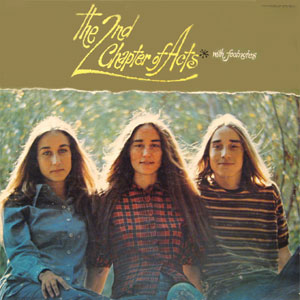
McGuire recorded on the Sparrow label founded by Buck Herring.  The label also featured the long lived Second Chapter of Acts who performed such memorable songs as Mansion Builder http://www.youtube.com/watch?v=EmxcotW-O0w and the Easter Song. http://www.youtube.com/watch?v=5gggPpVtEKQ&feature=related,

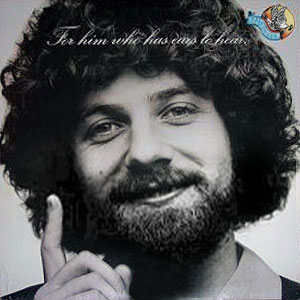
and Keith Green the Jewish convert to Christianity who wrote Make my Life a Prayer to You http://vodpod.com/watch/2188390-keith-green-make-my-life-a-prayer-to-you-subtitles He’ll take Care of the Rest http://www.youtube.com/watch?v=gAe0q21YgTQ&feature=related, The Victor http://www.youtube.com/watch?v=Wil0PBylyW0&feature=related and When I Hear the Praises Start http://www.youtube.com/watch?v=fIgVU_5FsqA&feature=related. Green would produce many songs that have endured among his fans and those that wound never see him in person.  Green had a hard edge to his message and died in a private plane crash with two of his children in the summer of 1982.  His wife Melody carries on his musical legacy.

Another artist on the label was John Michale Talbot who along with his brother Terry had been founding members of the group Mason Proffit before becoming Christians.  John Michael produced two albums on the label before his conversion to Roman Catholicism where he became a lay Franciscan.  He remained on the label for years producing albums which helped introduce a generation of contemporary Christian listeners to the liturgy and Catholic spirituality.  His album The Lord’s Supper was a breakthrough as he adapted music from the Mass into a beautiful album.  His adaptation of the Apostle’s Creed http://www.youtube.com/watch?v=NxACNt-QRAo was amazing in its musical style and difficulty and his Holy is His Name http://www.youtube.com/watch?v=9aYecuDlDYM is an enduring classic.  Talbot’s brother Terry also recorded on Sparrow one song which is entitled No Longer Alone. http://www.youtube.com/watch?v=xR0KBRO-e7g

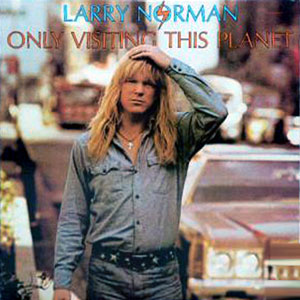
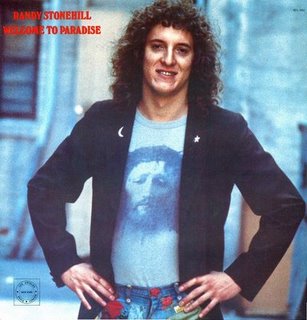
Other artists included Larry Norman who might be considered the first Christian rocker and Randy Stonehill who recorded on Norman’s Solid Rock label. Norman is best known for his songs The Rock that Doesn’t Roll http://www.youtube.com/watch?v=OzB638GRfJ0&feature=PlayList&p=44A2023098B233CF&index=0&playnext=1 I’d Wish we’d All Been Ready http://www.youtube.com/watch?v=X1FcTKNXlO0 and Why Should the Devil Have all the Good Music? http://www.youtube.com/watch?v=kWh8-FPelHU&feature=related

His friend Randy Stonehill wrote songs like King of Hearts http://www.youtube.com/watch?v=n1Q0RO3yi8Y&feature=related, First Prayer http://www.youtube.com/watch?v=QmhsY7NeFhM&feature=related Keep me Running http://www.youtube.com/watch?v=zP2dB208ISI&feature=related and Song for Sarah. http://www.youtube.com/watch?v=crDIHKaMwyA&feature=related Norman died in 2008 after a long illness and Stonehill has continued to produce often touching on topics that other Christian artists fear to tackle.

Guitarist Phil Keaggy has had a long and illustrious career in both Christian and secular music with his song Your Love Broke Through being among my favorites. http://www.youtube.com/watch?v=Wil0PBylyW0&feature=related

Paul Clark and Liberation Suite brought an English twist to the genre, this song Make a Joyful Noise was taped during their 1976 European tour http://www.youtube.com/watch?v=vYfa4iQg8e4 while the Pat Terry Group produced You’d be There http://www.youtube.com/watch?v=YWMBV0WoTeI&feature=related and Don Francisco recorded the classic He’s Alive! http://www.youtube.com/watch?v=o2slLdaK5Wg&feature=related Amy Grant produced many albums beginning in the late 1970s and still remains popular. Song’s like My Father’s Eyes http://www.youtube.com/watch?v=YmOEJXNtF0E and El Shaddai http://www.youtube.com/watch?v=KYcEHguYwtc&feature=related remain hits to this day.  Likewise Evie Tourquist (Karlsson) was incredibly popular, especially with young Christian guys in the mid to late 1970s and the song Pass it On http://www.youtube.com/watch?v=jHQLRm_O9mU was a staple of many high school groups.

Other groups have passed into obscurity with their albums nearly impossible to find.  The early “Jesus Music” often produced in primitive studios was certainly sincere it varied in quality as well as theological content. At the same time the early artists pioneered new ways of expressing their faith in music which has influenced the music of churches that in the 1970s considered such music to still be “the Devil’s music.”  I could go on to write about other artists but most of those came later and really don’t fall into the early years that I am trying to limit this musical essay to, but the fact is that these artists as well as others changed Christian music.  The impact has been mixed while there is much positive in the music many Christians and churches threw out their musical and theological heritage in the rush to become more relevant. Likewise the absorption of Christian music labels into secular labels which were later acquired by multinational entertainment groups is not necessarily a good thing because those corporations are totally profit driven and undoubtedly influenced the content, theology and style of the music produced by current artists causing some of the older artists to become independents.

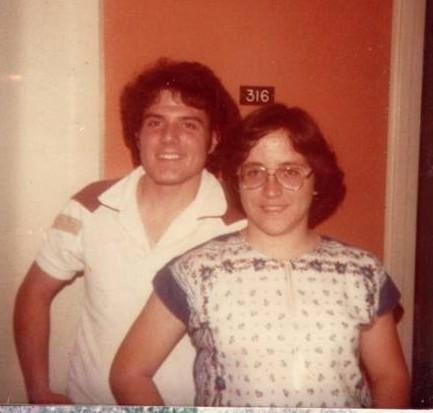
Padre Steve and Judy back in the Day

I guess in the long run we will see the fruit of this movement, the good and the bad and hopefully the good will outweigh the bad and maybe, just maybe the music will again be the music of the church and not merely of publishing houses that sell a product to churches.

Peace

Padre Steve+

5 Comments

Filed under christian life, faith, music

A Sea of Contradictions: My Life and Faith since returning from Iraq

Dinner with my Friend, Major General Sabah in Ramadi

“Many people are looking for an ear that will listen. They do not find it among Christians, because these Christians are talking where they should be listening.But he who can no longer listen to his brother will soon be no longer listening to God, either; he will be doing nothing but prattle in the presence of God, too. This is the beginning of the death of the spiritual life, and in the end there will be nothing left but spiritual chatter and clerical condescension arrayed in pious words… never really speaking to others.” Dietrich Bonhoeffer

Since I returned from Iraq I have grown weary of Christians that have all the answers and are more interested in promoting their agenda than actually listening or caring for those wounded in spirit from various forms of trauma including war. Since I returned from Iraq and going through what amounted to a crisis in faith, belief and experience of what I felt to be abandonment by God and many Christians.  I have elected to travel down a path that has been of great benefit but has been filled with difficulty and pain as I both walked through the psychological, spiritual and physical effects of my time in Iraq and, the moral injuries that I incurred and the practical ways that these crisis’ have had on my life and relationships.

On Monday at work we had some of our pastoral care residents presented their research projects which they had worked on during their residency year.  All were well done but one struck me because of its subject and home much I could relate to it.  The subject was “Writing our Way Home” and dealt with how the use of poetry and narrative could help some combat veterans make sense of their world and deal with the trauma that they have experienced.  After Iraq I began to write, initially because it was therapeutic and helped me to begin to start sorting out what was going on with me. It also helped me, especially when I went public on this site about my experience to get outside of my normally severely introverted self. As I began to write regularly it became a part of my life as I struggled to deal with PTSD as well as  spiritual and emotional crises following my tour in Iraq, alienation on my return as well as various family crisis’s.

The understanding that resonated with me was that our stories, the good and the bad, what we believe to be true and what really is true about ourselves and our experiences is all part of who we are. This is something that I experienced in my own pastoral care residency at Parkland Memorial Hospital in the 1990s when my supervisor challenged be to stop living in the past and begin to imagine a future that was not a prisoner of my past disappointments and failures.  That was a watershed experience for me and as I began to sort through all of the crap that I was dealing with in CPE and family of origins issues I began to realize that I did not need to live my life in a constant repetition of the past.  Now that realization did not always find a place in my life but in a gradual process I began to escape that past and begin to live in the moment with an eye to the future.

Of course Iraq changed that to some degree, in fact to a large degree. What I experienced there and upon my return to the States shook many of my beliefs about the world, faith and life. The images of American Marines wounded by IED attacks, wounded children and destruction of vast areas of cities, towns and villages coupled with having HUMMVs and Helicopters that I traveled on shot at and having rockets fly over my head changed me, especially when I saw how the war was being covered by both the liberal and conservative media which bore little resemblance to my first hand observations. Even worse was the feeling of being isolated and abandoned when I returned home.  I experienced a crisis in faith that left me a practical agnostic even as I desperately prayed for God to show up.  In fact it was psychotherapist that was the first person to even address my spiritual life after I returned.

When Elmer Maggard asked me: “How are you and the big guy?” I could only say “I don’t know I don’t even know if he exists.”  For a priest and chaplain that was a harrowing admission.  I had entered a world of darkness that I did not believe was possible. I would struggle for another year and a half until during Advent of 2009 things began to change and I began to sense the presence of a loving God again.  My faith began to return but I have to say it is not the same as before I went to Iraq.  I still struggle though most of the time I cannot say that I am a practical agnostic as I do have faith and faith which can be considered orthodox but perhaps more negotiable.

You may ask what I mean by this so I will briefly explain.  First I admit that I do not have the answers that I used to think that I had. Likewise I am a lot more apt to say “I don’t know” or “I struggle with that too” when people tell me of their experiences when struggling with faith or even the existence of God.  I refuse to pass judgment on someone’s faith journey or even if they question God’s existence because I have been there and it is not a comfortable place to live.  I am far more willing to walk with someone thorough that valley of doubt or unbelief because I lived in that valley for over a year. As far as who I frame my world, I am far less likely to pin something as “God’s will” or “an attack of the Devil” than I am to recognize that as human beings that we live in a fallen state and that sometimes things just happen. To quote a popular say “Shit Happens.”  In the middle of this I think the real miracle is that God can give us the grace to go through the most difficult times even when we have no faith at all.  I don’t think that is at all heretical because the experience of Jesus on Good Friday and the scriptural accounts as well as the testimony of 2000 years of Christians tells me that this is true. The miracle in my mind is not being “delivered” from crisis or unbelief but through the grace of God making it though the crisis and return to faith, even if that faith takes a different form.

For me the act of writing both about my experience as well as through fiction or history has been therapeutic and forced me out of my comfort zone.  When I began this site and began to tell my story my friend Elmer the Shrink he asked me if I was really sure that I wanted to open up and become vulnerable as I shared the truth as I believed it to be.  I said that I needed to as I thought people needed to know the reality of what many Iraq and Afghanistan veterans were going through.  He told me that what I was doing was risky but let me make the call. 600 posts later, not all of course dealing with what I and other veterans have gone through I can say that it was the right decision.

Our presenter on Monday gave us a few minutes to write something and for me this came quite easily as I was struck by a section of her presentation about how contradictory our life experiences can be. I began to write about those contradictions and will share a bit of that here.

I am a man of faith, a Christian and Priest. I believe but I also doubt and question, in fact there are some times that I feel somewhat agnostic even after the events of last December when faith began to return.  I am much more prone to give the benefit of the doubt to people especially those who struggle with life, faith and even the existence of God. I figure that God is big enough to handle doubt and unbelief while still loving and caring for the person experiencing doubt or unbelief or whose beliefs that may not fit the definition of Christian orthodoxy.

I am a passionate person who is an introvert in an extroverted world both in ministry and the military. I am an intuitive “out of the box” thinker and sometimes rebel.  Yet in spite of this I willingly volunteer to serve the church and the military.  It is interesting because both institutions prize loyalty to the institution, obedience and staying within the lines of prescribed beliefs and traditions.  I believe yet question, I find cause to not agree with what all of my political party or the other political party espouse to the chagrin of the faithful in both parties.

I have learned that there is a healthy tension in this type of life. I do not for the most part follow those that insist that to be a Christian that I must do this and that even though I fully subscribe to the Creeds, the first 7 Ecumenical Councils an Anglican understanding of the Christian faith. Nor do I think that to be to be a “American patriot” that I should vote a certain way, belong to a particular party or follow the agenda of any political party as if it others believe the agenda to be brought down from the mountain by Moses himself.  I have had people on occasion to criticize me for this.  However I cannot allow any political ideology to hold my faith captive, nor can I cast aside the essence of the Christian faith even when I doubt.

One of the things that I find concerning is how it seems to me that many supposedly “conservative” Christians have almost made what I think is a deal with the devil in terms of their political involvement. I think that they are sacrificing a long term witness to short term expedient political alliances with people, particularly “conservative” political talk show host and pundit Glenn Beck that have an antithetical and antagonistic views of historic Christianity.   My concern is more about the faith and witness of the Church than an alliance with someone that appeals to our more base nationalistic ideas than the faith itself.

I have discovered that for the most part I can comfortably live in this tension, in fact I do not think that I was to fall completely to one side or the other be it in faith, social responsibility or politics that my life would be as full as it is, or as some might be thinking now as “full of it as I am.” Whatever… The fact is that I think that as a Christian and as an American that it is okay to live life in balance and with a health appreciation of creative tension.

I have begun to emerge from the darkness of my post Iraq experience and I know that I am still wounded. I know that I still struggle but I now am beginning to see this as a gift.  My faith is not the same as it was, I am not satisfied with simplistic answers or the party lines of people that only care about their agenda especially when they decide that their agenda is God’s will, even if it has nothing to do with the Gospel. I know that sounds kind of snarky to some but I really want to be an authentic Christian not some caricature that is more a picture of the American perversion of the faith than anything found in Scripture or the 2000 year history of the Church.

I believe but I struggle. I will listen to other points of view, including those of people that are not Christian. In fact I found that my Iraqi Muslim friends were much easier to dialogue with and have deep and respectful theological discussions with than many American Evangelicals.  For me that was a watershed moment.

But anyway, this post was not meant to be a treatise on anything but is for me more of a reflection of a dialogue that has been going on in me since my return.  The thing is I know other Chaplains that have returned from Iraq or Afghanistan who have experienced the same feelings that I have been working through but do not have a safe place in their churches to heal, and are afforded little time to do self care.  I am concerned for our caregivers that care of veterans like me.  I wonder how many can be real in their faith community without having people run away from them as if they were radioactive, a feeling that many veterans and other trauma victims experience when they attempt to tell their story.

I just hope that I will be able to be there for others who are wounded and suffering as a result of what they experienced in war.

That is all for tonight.  Blessings and peace my friends,

Padre Steve+

5 Comments

Filed under christian life, iraq,afghanistan, Loose thoughts and musings, Pastoral Care, philosophy, Religion

Rehab Assignments

There are times in life that many of us experience some kind of injury; physical, emotional or spiritual that puts us in the position that we cannot function at the level that we are accustomed to doing. For some people this might be the result of some kind of traumatic event, perhaps a serious illness or physical injury or even something that causes us to lose faith in God or in whatever higher power that we ascribe meaning in our life.

As any regular reader of this site will recognize I interpret or frame much of my life experience through baseball and baseball analogies. In my case I frequently frame that through pitchers or older ball players that have encountered injury or rough spots in their careers.  I think about pitchers a lot because the craft of pitching involves such a degree of connection between the physical and mental dimensions of the game.  There are many times when a pitcher suffers a physical injury that requires changes in his delivery or the kinds of pitches that he throws.  When this happens it also affects his mind as he may lose confidence or over think what he is doing as he tries to make adjustments, also while experiencing residual physical pain.  Some pitchers are able to make the adjustment, for others the adjustment is more difficult and they are not as effective as they were previously. Still others either cannot recover from the physical injury or never make the adjustments and end up out of the game.

Those that experience injury as they recover are sent back to the minor leagues, or if they are in the high minor leagues to a lower level league in order to get back to the level that they were before the injury.  Even when they get back to the majors or to triple-A the pitching coach and manager may still go easy on them in order to ensure they are 100% and do not re-injure themselves.  This is called a rehab assignment and it is part of the game.

In the military we seldom get that chance unless the injuries are so significant that we need to put on some kind of limited duty and a placed in a non-deployable status until they are considered fully fit for duty. I returned from Iraq in February 2008 with several nagging chronic physical injuries to my ankles, knees and shoulders and an elbow which coalesced to sideline me from much physical activity. Even worse I was dealing with PTSD which was not recognized or diagnosed until late June of 2008 when I was falling apart having flashbacks, night terrors, chronic anxiety, insomnia and moods that alternated from anger to despondency.  When I left EOD Group Two I for my assignment to Portsmouth Naval Medical Center I was still in denial of sorts, though I knew that I was in ragged shape I went into the assignment trying to act as if and perform as if I was uninjured.  I threw myself into the job pouring working on the average 65-75 hours a week for almost a year mostly on the ICU and PICU before my boss finally stopped me and put me on more administrative duties with minimal clinical duties and plenty of time to get back in physical, emotional and spiritual shape.  Not many senior officers would give a subordinate that kind of grace nor would they rate an officer under them with an eye on their potential versus what they were doing for them at the moment.  Mine did, I will be forever grateful to Chaplain Jessie Tate for giving me that grace.

Eventually his patience as well as my hard work and a lot of God’s grace were rewarded. Things started to turn around in December of 2009 in what I call my “Christmas miracle.”   Slowly my physical injuries healed and I can now say that I am in as good or better shape than when I went to Iraq. I had to make some adjustments to my physical training regimen as well as confidence to believe that I was not going to re-injure myself.  My mindset in my physical training went from timid to confident as I gained in strength, speed, dexterity and endurance.  This was coupled with the loss of 16 pounds and a body fat percentage that went from 32% (when I ballooned from 167 to 194 pounds between April and November of 2009) down to 22% as of last week.  Spiritually I began to believe again. Most of the time after Iraq I struggled with faith sometimes even doubting the existence of God or at best feeling alienated and rejected by him and many of his people.  My spirituality has changed as has the way I approach my faith being much less doctrinaire to relational focusing on the grace, love and mercy of God and to trying to show that to others as St Francis said “preach the Gospel at all times, use words when necessary.”  Psychologically I was able to come to grips with my PTSD and make the adjustments that I needed so that I might be able to function.  I am much more in touch with feelings and what is going on in me than I was before and my observation of other people has improved, I guess once a person has had everything fall apart that they become more sensitive even to the unspoken things when they are around others.

In a sense this assignment became a rehab assignment for me. I was able to come back and become not only functional but able to be in the game again.  When I was selected for promotion my boss had no hesitancy in nominating me for the supervisory Chaplain at Naval Hospital Camp LeJuene. I can see the future again and it is good.  My plan was for Portsmouth to be an “All-Star” game for me where my clinical and academic skills would enable me to be a water walker but it was different, it was a fight to remain in the game a fight to regain confidence, overcome injury and return to relatively normal life.  My rehab assignment is over and I am back in the game performing at a level that I expect.

For those that are in similar circumstances I hope that you have a boss with the grace to help you through the difficult times and not abandon you as “broken” or of little use to the organization. I know that happens in the military and outside of the military, even in churches.

Peace and blessings,

Padre Steve+

2 Comments

Filed under Baseball, christian life, faith, Pastoral Care, philosophy, PTSD, Tour in Iraq

Anne Rice and the Exodus

Anne Rice

There is an exodus occurring in American Christianity.  This is not new. George Barna has reported a lot about disturbing trends in American Christianity, particularly Evangelical Christianity.  These trends span denominational lines and having watched them and seen a lot of anecdotal evidence myself over the past 20 or so years I believe that they are now having a cascade effect with visible effects.  Before the effects were covered over as mega-churches, seeker-friendly churches, the so-called “church growth movement” carved out rather large chunks out of denominational churches of all types.  The common charge leveled against “traditional” denominational churches by the new non-denominational start-ups was that they were out of touch with people, hypocritical, immersed in promoting “boring” doctrine and not keeping up with the times in their worship style, preaching or service format.  The new churches more often than not minimized the major doctrines of Christian orthodoxy, for all practical purposes reduced the Bible to a pop-psychology manual that Christians were to use to get all they wanted from God, particularly health and wealth but also self-esteem and just plain old feeling good.  Those that taught anything that deviated back toward orthodoxy usually focus on things like eschatology or on moral issues, the “culture war” and align themselves closely with political movements and parties, sometimes becoming more focused on winning the political war  than actually proclaiming the Gospel.

As a result much of the Christian landscape is dominated by churches that understand little of the Christian faith, no longer see value in practicing things like Baptism or Holy Communion and while they preach about “Biblical absolutes” in regard to abortion, an admittedly abhorrent practice and homosexuality they seem to gloss over other many moral issues including divorce, sex outside of marriage, materialism, greed and avarice, so long as those practicing them are on “our side.” Likewise they are prone to give people who actually oppose the Christian faith a pass if they fall on the same side of the political aisle.  We are simple selective literalists.

As Barna’s studies have shown Evangelical Christians have worse rates of divorce, teenage sex outside of marriage and other moral problems than those that do not claim to be Christians.  Likewise the lifestyles of many of the leaders of the Evangelical movement are prone to gross material excess and every year we see some Evangelical leader or leaders involved in some kind of sexual, financial or sometimes criminal activity.  To me it seems that American Christianity is doctrinally impoverished, politically intolerant and morally bankrupt.

So Anne Rice announces that she is leaving Christianity but not Jesus and catalogued a list of things that she found that she could not live with inside the church.  Since she announced this she has been the talk of the town. To those cynical to organized religion, though why we call any religion in America organized is beyond me, this is a boon.  For those defending the faith it is also a boon as they have an identifiable “traitor to the faith” to go after rather than some amorphous concept or idea.  Real heretics are so much more fun to go after.  I have been amazed but not surprised at the number of articles condemning Rice.  Most even if they don’t say it in the article they basically articulate the same thing that many of the early Church Fathers stated in regard to heretics and schismatics that left the church for the various heresies of the day almost all of which denied the nature of Christ, either his deity or humanity.

Rice has not done that. She has not denied the deity or humanity of Christ, his message of salvation or anything. She has protested and repudiated the outward actions of Christians and the institutional Church.  Now whether one agrees with her assessment is another matter but she has not necessarily denied Christ.  Her story is not yet completed, she may reconcile again with the Catholic Church or another Church.  To condemn her at this point would be similar to condemn Francis of Assisi when he walked out of the church.

In fact to condemn Ms Rice at this point is to miss the point of her protest.  Her protest is that the Church does not live the Gospel.  Her critics almost universally attack her for her support of homosexuals.  However a large part of that support is because her son is homosexual and to condemn her as a mother to that has lost one child at the age of 6 and is widowed for protesting the treatment that her son and other homosexuals have received from Christians is unfair to her and to them regardless of what one believes about homosexuality.  It seems to me that homosexuality is about the only unpardonable sin to many American Christians and that is the biggest criticism that I see in what her critics have written. They may talk about her separating herself from the Church and thus Christ but it really seems more to be about why she did so.   We Christians will tolerate about every sort of perversion and unfaithful action of people in the church to include leaders so long as it is not homosexuality. Divorce, no problem; gluttony, not an issue; murder, as long as it is state sanctioned; materialistic greed as long as we can link it to our own and the church’s prosperity; discrimination against people based on gender, race or religion, no problem so long as it is the name of national security or in the interest of our political party or church organization.  The argument against her is a red herring to divert people from the real issue which is the dismal state of the church, in belief and practice in the United States.

You see the argument used against Ms. Rice that by separating herself from the Church that she has separated herself from Christ and is “in schism” itself is disingenuous.  Every church body in this country can be accused of being in schism from someone and that includes the Roman Catholics and the Orthodox who to this day believe the other to be in schism.  Likewise for Protestants, especially those in independent churches to call her into question is hypocritical, many of those churches were born in schism and have few discernible beliefs or practices that link them to historic Christianity except that they “believe in Jesus.”  Protestantism itself is a “protest” against the Church and its practices, the Catholic Church to be sure but nonetheless at its heart a protest that is little different from that of Ms. Rice.

You see that is the problem with American Christianity. We want to selectively apply scripture and the teachings of the early Church to other Christians that we don’t agree with and that is something that we all do to one degree or another and it does not matter if we are conservatives or liberals, Catholics or Protestants, seeker friendly or traditionalist. No matter who we are or what our theological stance we all somehow ensure that we exclude someone else or some group from the Kingdom of God and to make it more fun we can all find something in Scripture or tradition to buttress our position.  As much as we want it to be the issue is not belief or doctrine, but practice and just who we allow the grace of God to extend to.

I don’t think that it is right to single Ms. Rice out after all let’s be truthful if a person has left a church for any issue including doctrine they are in schism.  If a person has been part of a church split at the local or the denominational level where they have left their “mother church” they too are in schism.  If someone leaves their church for a season or forever they have done the same thing that Ms Rice has done and I don’t see anyone out there making this point or going after all of us that are in schism from someone.

Let’s face it there are in the United States alone anywhere from 25,000-40,000 distinct denominational groups depending on your source. David Barrett lists 34,000 separate faith groups in the world that consider themselves to be Christian (David B. Barrett, et al., “World Christian Encyclopedia : A Comparative Survey of Churches and Religions in the Modern World,” Oxford University Press, (2001)) In fact, many consider themselves alone to be the only “true” Christian church. Now if you ask me that sounds like a whole lot of schism going on and just looking at the numbers there are a lot of people outside the walls of someone else’s church and therefore outside of the grace of God.

So with all of this in place I have to go back to some of my original statements of how we got to where we are and why Ms. Rice’s “defection” is symptomatic of a far bigger problem for American Christianity. We have over the past 40 years or so since the societal revolt of the 1960s been collectively as Christians been laying turds in our own punchbowl. We have renounced any semblance of coherent doctrine because “doctrine is boring.” Thus when we look at the most popular preachers in the country we see that one, T.D. Jakes holds a position on the Godhead (Jesus only modalism) which has been condemned by the church for like 1700 years or so. The there is Joel Osteen who seems like a nice guy but seems to have no recognizable Christian doctrine in his preaching, except that God loves us. I have no problem with that but that isn’t all that there is. Of course there is Rick Warren and before him Bill Hybels both of whom have taken the non-denominational identification to new heights.  I won’t even go into morality as I mentioned that in a recent post about the marital problems of another big time preacher, Benny Hinn who has promulgated more heresy than I can list.  On the Catholic side we have a church that despite official statements seems to still be protecting criminals and sexual predators and silencing those in the Church who raise their voices in protest to include the Cardinal Archbishop of Vienna, Christoph Schoenborn the driving force behind the current Catechism of the Catholic Church.

For better or worse the church in the United States has become the “Church of What’s Happening Now.”  We have tossed out the riches of 2000 years of faith, replaced them with religious mumbo jumbo that most closely aligns with our special interest and when people go from church to church or drop the faith completely we wonder why?

As a military Chaplain I have had a unique perspective on the state of Christianity in this country. My experience of how people classify themselves religiously nearly mirrors what is seen in the work of the Barna Research Group and the American Religious Identification Surveys of 2001 and 2008, by The Graduate Center of the City University of New York. What I have seen in almost 20 years of being a chaplain is both a decline in those that identify themselves as Christians and those that while they identify themselves as Christians have no consistent practice or identification with any particular denomination or group. The numbers claiming “No Religious Preference” and “Christian No Denomination” seem to go up every year.  Likewise the numbers identifying themselves as Wiccan or any number of other more earth based or eastern religions is increasing.  Many of these young men and women were raised as Christians or had some kind of “Christian” experience before going off to what they are now.

Barna notes that “There does not seem to be revival taking place in America. Whether that is measured by church attendance, born again status, or theological purity, the statistics simply do not reflect a surge of any noticeable proportions.” (“Annual study reveals America is spiritually stagnant,” Barna Research Group, Ltd., at: http://www.barna.org/) and that “evangelicals remain just 7% of the adult population. That number has not changed since the Barna Group began measuring the size of the evangelical public in 1994….less than one out of five born again adults (18%) meet the evangelical criteria.” (“Annual Barna Group Survey Describes Changes in America’s Religious Beliefs and Practices,” The Barna Group, 2005-APR-11, at:http://www.barna.org/ )

The American Religious Identification Survey 2008 notes other troubling facts for American Christianity.  Among them:

The percentage of American adults that identify themselves with a specific religion dropped from 89.5% to 79.9%:

Americans who identify themselves as Christian dropped from 86.2 to 76.0 — a loss of 10.2 percentage points in 18 years — about 0.6 percentage points per year.

Americans identifying themselves as Protestant dropped from 60.0 to 50.9%.

Catholics declined from 26.2% to 25.1%

The Catholic population in the Northeast fell: From 1900 to 2008, it went from 50% in New England to 36%, and from 44% to 37% in New York state. Apparently to immigration, it rose during the same interval from 29% to 37% in California, and 23% to 32% in Texas.

Religious Jews declined from1.8% to 1.2%

The fastest growing religion (in terms of percentage) is Wicca. According to Religion Link “Specifically, the number of Wiccans more than doubled from 2001 to 2008, from 134,000 to 342,000, and the same held true for neo-pagans, who went from 140,000 in 2001 to 340,000 in 2008.”

Finally 15.0% (14.1%) do not follow any organized religion. There are more Americans who say they are not affiliated with any organized religion than there are Episcopalians, Methodists, and Lutherans combined. (Cathy Grossman, “Charting the unchurched in America,” USA Today, 2002-MAR-7, at: http://www.usatoday.com/life/dcovthu.htm)

The ARIS survey noted the following about those that left or switched churches:

About 16% of adults have changed their identification.

For the largest group, the change was abandoning all religion.

Baptists picked up the largest number of any religion: 4.4 million. But they also lost 4.6 million.

Roman Catholics lost the greatest number, 9.5 million. However, they also picked up 4.3 million.

Those are just the numbers. To look within we have to look at behaviors and we find that American Christians on the whole are very similar to those with no religion whatsoever. Rates of divorce, teenage pregnancy and other social indicators often show that American Christians differ little from and sometimes are in worse shape than their non-Christian neighbors.

If we look at reasons for people leaving the faith Barna has the answer. To put it in Padre Steve terminology “we don’t treat people well.”  Barna notes: “Based on past studies of those who avoid Christian churches, one of the driving forces behind such behavior is the painful experiences endured within the local church context. In fact, one Barna study among unchurched adults shows that nearly four out of every ten non-churchgoing Americans (37%) said they avoid churches because of negative past experiences in churches or with church people.” (http://www.barna.org/faith-spirituality/362-millions-of-unchurched-adults-are-christians-hurt-by-churches-but-can-be-healed-of-the-pain)

Instead of condemning Anne Rice maybe we as Christians, Churches and Church leaders need to get over defending ourselves and get ourselves and our churches right with God, one another and our neighbors. Maybe Anne Rice is a prophet and we should thank her even if we don’t agree with all that she says. Maybe we should stop referring to her as a traitor to her faith.

Maybe Dietrich Bonhoeffer had it right when he wrote from prison:

Religious man] must therefore live in the godless world, without attempting to gloss over or explain its ungodliness in some religious way or other. He must live a “secular” life, and thereby share in God’s sufferings. He may live a “secular” life (as one who has been freed from false religious obligations and inhibitions). To be a Christian does not mean to be religious in a particular way, to make something of oneself (a sinner, a penitent, or a saint) on the basis of some method or other, but to be a man–not a type of man, but the man that Christ creates in us. It is not the religious act that makes the Christian, but participation in the sufferings of God in the secular life.”

Peace

Padre Steve+

11 Comments

Filed under christian life, faith, Religion

Flickering Flames: Clergy Burnout in America in 2010

Father Mulcahy: What an ordeal. 72 hours straight. I’m prayed out – absolutely prayed out.
Hawkeye: Don’t forget, Father, God was on six days straight.
Father Mulcahy: He was a lot younger then
.

It doesn’t matter whether you feel useful or not when you’re moving from one disaster to another. The trick, I guess, is to just keep moving. Father Mulcahy, William Christopher M*A*S*H

A few days ago I read an article in the New York Times ( the link is here: http://www.nytimes.com/2010/08/02/nyregion/02burnout.html?_r=1&hp&adxnnl=1&adxnnlx=1280746899-Fj4AG+SysGvlJ/xdTT+ZZg ) about the large number of civilian clergy experiencing burnout, discouragement, disillusionment to the point that they end up developing chronic physical illnesses, psychological or psychiatric conditions, experience marriage or family difficulties or are so beaten down that they leave the ministry entirely.   Many clergy now suffer from high rates of obesity, hypertension and depression more so than most Americans. In the last decade, the use of antidepressants by clergy has risen and their life expectancy has fallen. Job satisfaction is down and many clergy would leave the ministry if they felt that they could. The issue cuts across denominational and even religious lines and is not bound by the depth of faith or the fervency of the minister in his or her pursuit of “doing good ministry” in whatever venue they are in.  It also impacts those of all sides of the theological spectrum from fundamentalists to progressives or in old time parlance “liberals” and everything in between.

Actually I am not surprised by the studies or the conclusions of the article. When I was in seminary back in the late 1980s and early 1990s the school that I attended was filled with pastors either those in ministry or those recovering from nasty church splits, or being fired for often trivial reasons. These were by and large good men, I say men because the Southern Baptist Convention then and now has few women in parish ministry.  Many of the men that I knew were broken; they had come back to school as a way to see if there was some way to find a safe place of ministry.  In the last years of seminary and the year prior to entering my clinical pastoral education residency I worked for a nationwide ministry and was assigned the task of assisting clergy that came to us for help or counsel.  One of the interesting things to note was that during this time the average longevity of a Southern Baptist pastor in his church was a dismal 18 months. Later I had a friend in another Baptist denomination accept a call to a church that had been through 33 pastors in 30 years.  He thought that he would be the exception, less than 8 months later a time that he and his new wife were harassed, abused and hounded by the congregation he quit. He ended up in my denomination as he was moving in a more liturgical and sacramental way of life and is now in the process of becoming a married Roman Catholic priest.

When I left the active duty Army to go to seminary I was under the impression that most clergy were relatively satisfied with life but the men that I met in seminary and those that I dealt with later showed me that all was not well for many good men and women doing their best to serve Christ and the people of God committed to their charge.  I never will forget men saying to me that they struggled with depression, alcoholism, sexual addiction, were being divorced by their wives or considering either leaving the ministry or changing the type of ministry that they served or even their denominational home.  Nearly all reported the stress that they experienced in their ministry, the unmanageable tasks of trying to compete for numbers, and in many churches it is all about numbers, see Chuck Colson’s book “The Body” cater to the nearly insatiable “needs” of parishioners who demanded more time, and investment in programs to keep them in the church, pressures resulting from the financial costs of trying to manage building programs, special ministries and programs and an every growing desire for more excitement and “thrills” in the church program.  Add to this the unrealistic expectation of parishioners, local and denominational leaders and the constant upbraiding to be more like Reverend so and so on television or the guy that wrote the latest book on church growth, spiritual warfare or whatever as the list goes on ad infinitum. Add to this the intrusiveness brought about by cell phones, texting, the internet which place clergy in a place where they have no place to go when they need a rest because there is always one more need to satisfy many of  which cannot be satisfied. One minister of a wel-known Mega-Church when confronted by Colson about not preaching on more controversial moral topics told Colson that “they pay me to get them in the door and keep them coming.”

The pastor of our age must become a teacher, preacher, counselor, evangelist, financer, program director, personnel manager, marketing executive and most of all be able to reinvent himself at a whim in order to remain relevant and in tune with the current “move of God.”  Those that don’t keep pace with whatever the latest “move of God” (read marketing ploy) is finds that they are out of a job faster than a Mob hit-man with ad aim. It is a recipe for disaster, not only for clergy and their families but for congregations which when their pastors burn out, divorce or become compromised do to sex, alcohol or money suffer the consequences of their own making  often losing members and sometimes even collapsing.

The pressures are immense and not just for married or single Protestant pastors but for Catholic Priests, Jewish Rabbis and even Moslem Imam’s all under some kind of unreasonable pressure.  It does not matter of it is trying to balance the competing theological factions present in their faith tradition from fundamentalists to progressives and everything in between, trying to meet unattainable goals set by congregational or denominational leaders or just to attempt to be all things to all people just to survive it is amazing that that any survive at all.  This is not the life of clergy even a generation ago, a generation that reported high job satisfaction, good health and congregations that would if possible strive to serve their pastor as much as he served them.

The world has changed and clergy are not doing well.  When a big name pastor, evangelist or leader of a church or denomination screws up perfectly the good men and women serving in ministry that don’t do those things are lumped in with those that commit various crimes or ethically challenged behavior.

In my chosen vocation within the vocation of being a priest and minister, that of a military Chaplain the pressures of service often exceed those that our civilian counterparts face. In a time where we have been at war almost 10 years with many chaplains making multiple deployments to the various combat zones the pressures are immense. The pressures on chaplains, their families as well as the men and women that they serve are unparalleled in civilian ministry, which as I describe above is no picnic, unless perchance you serve the fabulously well to do.

While I do not know statistics on Chaplains and burnout I can assure you that it is a concern of mine based on some that I have met.

In my service, the Navy we have battled shortages of Chaplains and the increasing demands necessitated by the war.  Likewise Chaplains in the Navy and Air Force face personnel cuts or elimination of billets due to cuts in their services personnel and more cuts are coming, at least to the billets that at one time offered chaplains the chance to recover from deployments and still serve God’s people. Most of the billet cuts are in shore commands, the places that at one time were the places that one could serve and recuperate after having done multiple operational tours.  As the force gets smaller and mission requirements increase these chaplains are deployed more often to combat zones and stress and family separation take their toll of chaplains.  Chaplains serving at bases and hospitals now serve large numbers of men and women traumatized by war and their families but have seen their own numbers shrink.  I work in a major medical center like all of the chaplains that serve in similar billets are caring for our wounded (in body, mind or spirit) warriors, their families those deploying or returning from deployment, are subject to deployment during our shore tours as Individual Augments to the operating forces all while dealing with life and death on a daily basis. In fact yesterday I came home from work at 5:30 PM after going to work at 6 AM Tuesday nearly 36 hours on duty in which time I was involved in multiple crisis situations, baptized a baby that was to removed from life support and care of patients their families and our staff.  This is not uncommon. What I described for me is typical of many Chaplains of all our military services serving in health care institutions.  It requires a tremendous sense of discipline to manage all of these competing demands and maintain ones physical, emotional and spiritual balance.

In fact when I came to my assignment I was suffering from PTSD and in an emotional and spiritual nosedive and in trying to meet the demands of the job did not take care of me and I fell apart physically, spiritually and emotionally.  It took a year and a half to start the recovery and I am now moving forward on all counts but some others don’t recover. I was fortunate, my boss knew well enough to shield me and let me recover and get the help that I needed to do so. Nonetheless it was not and is not easy to recover.

Add to this the pressure to perform and get promoted to stay in the military chaplain ministry.  Chaplains like all officers have to get promoted to stay in the military.  The promotion rate from the Captain/Navy Lieutenant rank to Major / Lieutenant Commander has been consistently in the 50-60% range for those being looked at the first time.  This basically means that 40-50% will not be retained on active duty long enough to qualify for retirement unless they had prior active service before becoming a Chaplain. Even if they have this the stigma of not being selected is something that is incredibly hard on chaplains just as it is for other officers.  Non-selection is considered failure even for those that have great ministries and are awesome ministers. Sometimes failure to select has nothing to do with how well you care for God’s people but simply comes down to numbers. When a military service contracts as all of our Armed Services did following Vietnam, the Cold War and today as personnel numbers are cut the respective Chaplain Corps or Services take their share of the cuts and this often means that men and women worthy of promotion are not selected and are eventually let go.  I have been fortunate during the cutbacks following the Cold War I was selected for Major in the Army Reserve and though I reduced in rank in 1999 to enter the Navy was promoted to Lieutenant Commander and recently selected for Commander and I am very grateful for the opportunity of both increased responsibility as well as the chance to care for God’s people in the Navy and Marine Corps.  Not everyone gets that chance.

Being a minister is no easy way of life if you are seeking to love and serve God and God’s people. Burnout, discouragement and depression are not uncommon.  Health problems for many are increasing and at younger ages. Many no longer have safe places that they can go for counsel and care because doing so might hurt their ministry.  I have seen much of this, good men and women doing their best to serve God and God’s people broken, depressed and sometimes addicted to behaviors that ultimately are destructive to their lives, families, congregations and ministries.

It is my opinion that while those that take on military ministry sort of ask for this because we know going in that we may be deployed to combat zones or separated from family for extended periods of time when we sign up. However many on the civilian side have no idea of the pressures that they will face and the tasks that will become theirs when they begin to work at a parish.  It is a tough life and I am not surprised to see so many broken, discouraged and disillusioned ministers just trying to survive instead of thriving in the field that God called them to serve.  I am blessed. Despite the hard work, separations from my wife and family and even the PTSD that I came back from Iraq with I am doing well. I get to serve people in a community that I love and in which I was born into.  I get to do what I believed that I am called to do in a venue that I am very comfortable in serving.  No everyone is so lucky or blessed. As Lou Gehrig said “I am the luckiest man alive.”

Please pray for your ministers and support them. Give them grace to serve knowing that they will not always make the right decisions, preach the best sermons or compete with the minister with the “hot hand” and latest “word from God” down the street or on television.  Ministers are certainly not perfect, some of us are pretty earthy. Don’t impose the culture of corporate America into the local church.  The vast majority of clergy really do care about the people that they serve even when they make mistakes and screw up. Give them the grace that you wish that your boss would give to you.  Of course there are exceptions, men and women with few people skills, with their own agendas and even with their own dark-side which shows up in how they abuse God’s people. However these people are the exception.  Don’t let the foibles or crimes of such people lead you to turn you back on good men and women that make mistakes common with the rest of humanity.

Peace

Padre Steve+

3 Comments

Filed under christian life, faith, Pastoral Care, philosophy, PTSD, Religion