Category Archives: History

The Terrible Costs of Not Learning the Lessons of War: Vietnam, Iraq Afghanistan

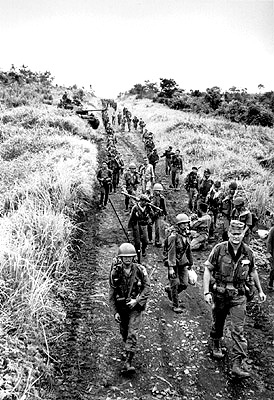
481801_10151367001287059_1003164983_nIn 1986 a Army Major working at the Office of the Secretary of Defense wrote a book that was a history of the US Army in the Vietnam War, and as it turns out to be a work of military prophecy. The young officer, Andrew Krepinevich wrote his book, The Army in Vietnam: 

“In the absence of a national security structural framework that address the interdepartmental obligations associated with FID operations, and considering the lack of incentives for organizational change within the Army, it is presumptuous for the political leadership to believe that the Army (or the military) alone will develop the capability to successfully execute U.S. security policy in Third World countries threatened by insurgency. This being the case, America’s Vietnam experience takes on a new and tragic light. For in spite of its anguish in Vietnam, the Army has learned little of value. Yet the nation’s policy makers have endorsed the service’s misconceptions derived from the war while contemplating an increased role in Third World low-intensity conflicts. This represents a very dangerous mixture that in the end may see the Army again attempting to fight a conventional war against a very unconventional enemy.” (The Army in Vietnam, Andrew F Krepinevich Jr., The Johns Hopkins University Press, Baltimore and London, 1986. p.275)

Krepinevich retired from the Army in the 1990s as a Lieutenant Colonel and has been busy in the world of think tanks and national security policy. Unlike his book, which is probably one of the best accounts of the Vietnam War and as I said before a book that is somewhat prophetic his later work has not been as well received. He has his critics. But despite that criticism once cannot deny the accuracy of his predictions concerning the Army’s subsequent operations in low intensity, or counter-insurgency campaigns beginning in Somalia and encompassing the wars in Iraq and Afghanistan.

If Krepinevich had been alone in his criticism, or his book not been widely read one might excuse policy makers of the 1990s and 2000s who sent the Army and the military into counterinsurgency campaigns involving massive numbers of troops and the commitment of blood and treasure that had practically no value to the national security of the United States. Instead thousands of American and Allied lives were sacrificed, tens of thousands wounded and one nation, Iraq that had nothing to do with the attacks of 9-11-2001 left devastated and crippled empowering Iran the sworn enemy of the United States no regional rival.

n671902058_1153793_4043

One cannot say that the Iraq war was worth the lives and treasure spent to cover the lies and hubris of the Bush Administration. Nor can one say that the effort to change the tribal structure of the fiercely independent Afghan peoples after driving Al Qaeda from that “Graveyard of Empires” been worth the expenditure of so many American lives and treasure. In fact the wars in Iraq and Afghanistan damaged the United States in more ways than their proponents could every admit. The military, now drained by years of war is hamstrung and will be hard pressed to meet legitimate threats to our national security around the world because of the vast amounts of blood and treasure expended in these wars.

In 1920 T.E. Lawrence wrote about the follies of the British government in Mesopotamia, what is now Iraq. His words could have been written about the Bush Administrations 2003 war in Iraq. Lawrence wrote in a letter to the Sunday Times:

The people of England have been led in Mesopotamia into a trap from which it will be hard to escape with dignity and honour. They have been tricked into it by a steady withholding of information. The Bagdad communiqués are belated, insincere, incomplete. Things have been far worse than we have been told, our administration more bloody and inefficient than the public knows. It is a disgrace to our imperial record, and may soon be too inflamed for any ordinary cure. We are to-day not far from a disaster.”

Krepinevech, like Lawrence before him was right, but he was not the only one. in 1993 Ronald H Spector in his book wrote:

“Americans dislike problems without solutions. Almost from the beginning of the U.S. involvement in Vietnam they have attempted to find “lessons” in the war. The controversy about the appropriate lessons to be learned continues with the same vigor and lack of coherence as the debates about the war itself.

Lessons are controversial and fleeting but lessons long. The memories of 1968 have remained and served to influence attitudes and expectations well into the 1990s. The ghosts of Vietnam haunted all sides of the recent deliberations about the Gulf War. In the wake of that war, President Bush hastened to announce that “we have kicked the Vietnam syndrome.” 

Doubtless many Americans would like to agree. It is easier to think of the Vietnam War as a strange aberration, a departure from the “normal” kind of war, like World War II and the recent war in the Gulf, where the course of military operations were purposeful and understandable and the results relatively clear cut. Yet the Vietnam War may be less of an aberration than an example of a more common and older type of warfare, reaching back before the Thirty Years’ War and including World War I. A type of warfare in which a decision is long delayed, the purposes of the fighting become unclear, the casualties mount, and the conflict acquires a momentum of its own. In a world which had recently been made safe for conventional, regional and ethnic wars, Vietnam rather than World War II may be the pattern of the future.” (After Tet: The Bloodiest Year in Vietnam, Ronald H Spector Vintage Books, a division of Random House, New York 1993 pp. 315-316

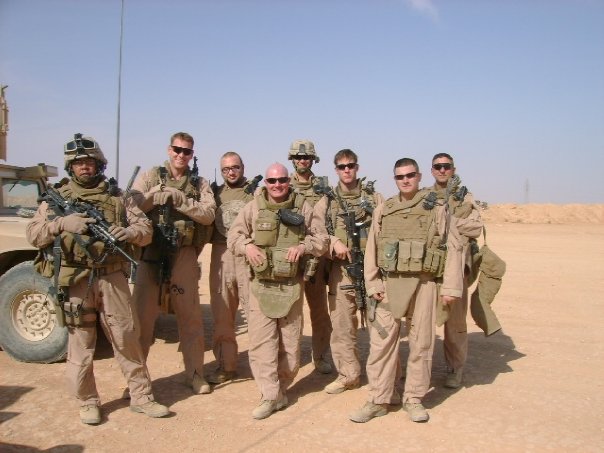
After serving in Iraq with the advisors to the Iraqi 7th and 1st Divisions and 2nd Border Brigade in 2007-2008 and seeing the results of the great misadventure brought upon our nation and Iraq by the Bush administration I cannot help but recognize how disastrous the wars unleashed after 9-11-2001 have been. I have lost friends and comrades in them, I see the human costs in our Navy hospitals every day. I have told too many If they had actually accomplished something it would be another matter. But the human, economic, strategic and even more importantly the moral costs have been so disastrous to our nation to make the loss of the Twin Towers and the victims of 9-11-2001 pale in significance.

sch0-017

The sad thing is that these wars have gone on so long that many of the young Marines and Soldiers fighting them have no understanding of why they deploy and deploy to Iraq and then Afghanistan, and they are far more knowledgeable than the population at large, many of whom are untouched by the personal costs of the war. We as Americans love to say “we support the troops” but most don’t even know one. For the most part big bases from where our troops train and deploy are far from where most Americans live and might as well be on a different planet. We are invisible to most of the country, except when they see a color guard at a sporting event or bump into one of us in uniform at an airport.

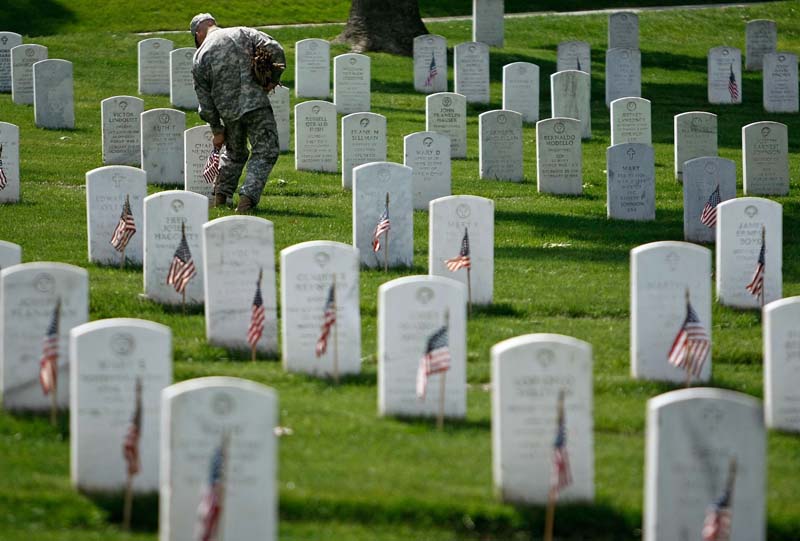
3rd Infantry Places American Flags At The Graves Of U.S. Soldiers

As a result the sacrifices that the under 1% of the population that serve in the military and fight these wars are really not understood, or fully appreciated. I don’t think that this is so much the fault of the people. but rather the product of the post Vietnam era and the “Peace Dividend” of the post Cold War era when the military was reduced, the draft ended and bases in major populations centers closed.

I have written about the effects of these kinds of wars before, not just Iraq or Afghanistan. You can see some of that writing the following articles on this site. They are not comprehensive but they do tell some of the tale of where we have been since 9-11-2001. 

The Anomaly of Operation Desert Storm and Its Consequences Today

Why History Matters: The Disastrous Effects of Long Insurgency Campaigns on the Nations that Wage them and the Armies that Fight Them 

Irrelevant Incidents and Un-winnable Wars: Thoughts on Returning from War 5 Years Later

 349: Active Duty Military Suicides Hit New High in 2012

The Fallacy of “Complete” Victory and the Seeds of Perpetual War and the Way to Peace

Thoughts on Choosing a President and the Results of Not Getting it Right: Lieutenant General Harold Moore at West Point

War is a Racket: Remembering Major General Smedley Butler USMC and Why He Matters

Armed Forces Day 2012: The Disconnection of the Military and Society and the Terrible Result

Failing to Learn from History: The Lesson of the First Anglo-Afghan War and Questions about the US-NATO Campaign

The War that Cannot Be Won: Afghanistan 2012

The 9-11 Generation: The Few

The “Comfortable” Experts and the Real Soldiers

Adjusting Strategy to Reality

No Illusions: The Cost of the Long War and its Potential impact on the United States

The sad thing is that we don’t learn from history. Krepinevech, Spector and Lawrence could have written what they wrote yesterday. Instead they all wrote many years before the 9-11 attacks and our military response to them. As a historian, a career officer and a chaplain I cannot help but think of the terrible costs of such wars and how they do not do anything to make us more secure. The fact is that we do not learn from history much to our detriment despite the great human, spiritual, moral and economic effects of such wars.

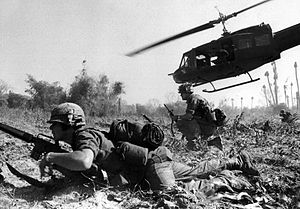
300px-Battle_of_Ia_Drang_Valley-1

What is the cost of war? what is the bill? Major General Smedley Butler wrote: “This bill renders a horrible accounting. Newly placed gravestones. Mangled bodies. Shattered minds. Broken hearts and homes. Economic instability. Depression and all of its attendant miseries. Back -breaking taxation for generations and generations. For a great many years as a soldier I had a suspicion that war was a racket; not only until I retired to civilian life did I fully realize it….”

Peace

Padre Steve+

Leave a comment

Filed under Foreign Policy, History, iraq,afghanistan, Military, national security, News and current events

The Doolittle Raid: 30 Seconds that Changed the Course of the Pacific War

20130417-235602.jpg

This week marks the 71st anniversary of the Doolittle Raid on Tokyo. 80 US Army Air Corps flyers manning 16 B-25 Mitchell bombers conducted a mission from the deck of the USS Hornet CV-8which though it caused little damage changed the course of World War Two in the Pacific.

The genus of the strike came from the desire of President Franklin Roosevelt to bomb Japan as soon as possible during a meeting just prior to Christmas 1941. Various aircraft types were considered and in the end the military chose the B-25 because it had the requisite range and had the best characteristics. Aircraft and their crews from the 17th Bomb Group which had the most experience with the aircraft were modified to meet the mission requirements. Lieutenant Colonel Jimmy Doolittle was selected to lead the mission.

Once the aircraft were ready they and their crews reported to Eglin Field for an intensive three week period of training. Supervised by a Navy pilot the crews practiced simulated carrier take offs, low level flying and bombing, night flying and over water navigation. When the training was complete the aircraft and crews and support personnel flew to McClellan Field for final modifications and then to NAS Alameda California where they were embarked on the Hornet Hornet’s air group had to be stowed on the ships hanger deck since the 16 B-25s had to remain of the flight deck. Each bomber was loaded with 4 specially modified 500 lb. bombs, three high explosive and one incendiary.

Departing Alameda on April 2nd the Hornet and her escorts, Hornet’s Task Force 18 rendezvoused with the Admiral William “Bull” Halsey’s Task Force 16 built around the USS EnterpriseCV-6. task Force 16 provided escort and air cover during the mission. The carriers, escorted by 4 cruisers, 8 destroyers and accompanied by two oilers hoped to get close enough to the Japanese home islands so that the raiders could reach bases in allied China.

The destroyers and slow oilers broke off on the evening of the 17th after refueling the carriers and cruisers. The two carriers and the cruisers then commenced a high speed run to get into range. However early in the morning of April 18th the ships were sited by a Japanese patrol boat, the #23 Nitto Maru which was sunk by the USS Nashvillebut not before it got off a radio message alerting the Japanese command. However the Japanese knowing that carrier aircraft had a relatively short range did not expect an attack. However, realizing the danger that the sighting brought, Captain Marc Mitscher elected to launch immediately, even though it meant that bombers would have to ditch their aircraft or attempt to land well short of the friendly Chinese airfields. The launch was 10 hours earlier and about 170 miles farther out from the Chinese bases than planned.

Flying in groups of two to four aircraft the raiders struck the Japanese cities of Tokyo, Yokohama, Yokosuka, Nagoya, Kobe and Osaka. Minimal damage was done and only one aircraft was damaged. However they needed to fly nearly 1500 more miles to get to areas of China unoccupied by Japanese forces. Miraculously most of the aircraft and crews managed to find refuge in China. 69 of the 80 pilots and crew members avoided death or capture. Two flyers drowned, one died when parachuting from his aircraft. Eight men were captured. Of those captured by the Japanese three, Lieutenants William Farrow, Dean Hallmark and Corporal Harold Spatz were tried and executed for “war crimes” on October 15th 1942.

Many of the surviving flyers continued to serve in China while others continued to serve in North Africa and Europe, another 11 died in action following the raid. Doolittle felt that with the loss of all aircraft and no appreciable damage that he would be tried by courts-martial. Instead since the raid had so bolstered American morale he was awarded the Congressional Medal of Honor, promoted to Brigadier General and would go on to command the 12th Air Force, the 15th Air Force and finally the 8th Air Force.

The raid shook the Japanese, especially the leadership of the Imperial Navy who had allowed American aircraft to strike the Japanese homeland. The attack helped convince Admiral Isoroku Yamamoto that an attack on Midway was needed in order to destroy the American Carriers and the threat to the home islands.

When asked by a reporter about where the attack was launched from, President Roosevelt quipped “Shangri-La” the fictional location of perpetual youth in the Himalayas’ made famous in the popular book and movie Lost Horizon.

The raid in terms of actual damage and losses to the attacking forces was a failure, but in terms of its impact a major victory of the United States. It gave the people of the United States a huge morale boost at a time when very little was going right. It forced the Japanese Navy to launch an attack on Midway that turned out to be a disaster, decimating the best of the Japanese Naval Air Forces and the loss of four aircraft carriers and enable the US Navy to take the offensive two month later at Guadalcanal.

In the years after the war the survivors would meet. Today four survivors of the raid remain alive. Three of them will meet in Fort Walton Beach Florida this week for their final public reunion. At some time the remaining men will meet privately and drink a bottle of 1896 Hennessy Cognac from silver goblets each inscribed with their names.

It will not be long before the final survivors will be gone and it is up to us to never forget their heroism, sacrifice and service in a mission the likes of which had never before been attempted, and which would in its own way help change the course of the Second World War.

Peace

Padre Steve+

3 Comments

Filed under History, Military, US Navy, world war two in the pacific

Remembering the Holocaust

20130408-231328.jpg

“For the dead and the living we must bear witness.” Ellie Wiesel

Berlin, July 31st 1941

To: Gruppenfuhrer Heydrich

Supplementing the task assigned to you by the decree of January 24th 1939, to solver the Jewish problem by means of evacuation and emigration in the best possible way by according to present conditions, I hereby charge you to carry out preparations as regards organizational, financial, and material matters for a total solution (Gesamtlosung) of the Jewish question in all the territories of Europe under German occupation.

Where the competency of other organizations touches on this matter, the organizations are to collaborate.

I charge you further to submit to me as soon as possible a general plan of the administrative material and financial measures necessary for the carrying out the desired final solution (Endlosung) of the Jewish question.”

Goering

20130408-232429.jpg

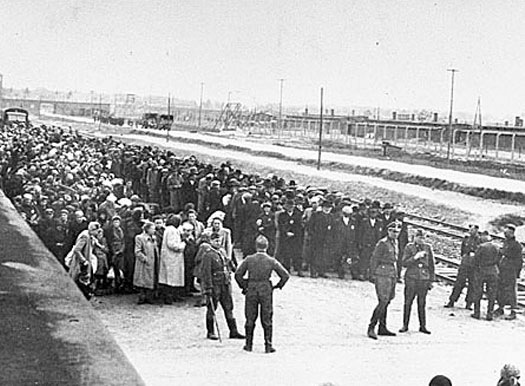
It is hard to believe that 70 years ago the gas chambers and crematoria of Auschwitz and many other extermination factories were in high gear. Specially formed units of the SS, Police and their Foreign auxiliaries, the Einsatzgruppen were exterminating Jews and others, people the Nazis termed Untermenchen (subhumans) across Europe.

When Herman Goering wrote Reinhard Heydrich, the head of the Reichssiecherhiethauptampt (RSHA) in July 1941 it seemed that Nazi victory in Europe was all but assured. Goering’s words were businesslike. Early measures to rid Germany and the annexed Austria ha been reasonably successful of their Jews through emigration and evacuation. However with the occupation of most of Europe following the Nazi military success and the looming occupation and subjugation of the Soviet Union the process of giving the Jews a chance to emigrate to lands outside Nazi control had come to an end. In fact the Nazis occupied the countries that may Jews had found refuge. The Nazi leadership decided that its race war against the Jews needed to forge ahead.

Within weeks SS commanders at various concentration camps were devising means to exterminate Jews more efficiently. It was a matter of pride and efficiency for them. As Rudolph Hoess the Commandant of Auschwitz said at Nuremberg “the camp commandant at Treblinka told me that he had liquidated 80,000 in the course of one half year. He was principally concerned with liquidating all the Jews from the Warsaw Ghetto. He used monoxide gas, and I did not think that his methods were very efficient. So when I set up the extermination building at Auschwitz, I used Zyclon B….” Hoess estimated that some 2.5 million people were exterminated at Auschwitz at rates as high as 10,000 a day.

In the Soviet Union four Einsatzgruppen followed each of the German Army Groups and systematically began to massacre the Jews of every city and village which German soldiers captured. Over a million and a half Soviet Jews were killed by the Einsatzgruppen, Ordungspolizei battalions, Army Security Divisions and locally recruited units.

20130408-232813.jpg

Less than six months after he received the directive from Goering, on January 20th 1942 Heydrich summoned representatives from various Reich agencies were called for what turned out to be a brief, two hour meeting which decided the fate of the Jews. The meeting was held at an estate located in the suburbs of Berlin, called Wansee. Organized by Heydrich’s deputy Adolph Eichmann, involved Heydrich, Eichmann and 13 mid level representatives from various economic, governmental, justice and police entities.

At the conference Heydrich established his authority through Goering’s directive to overcome the bureaucratic and personal attempts of various attendees to take control of the Final Solution process. Despite objections from some attendees who favored sterilization and the use of Jews in the war armaments industries, Heydrich made it clear that the Final Solution would be a campaign of extermination. He was quite clear:

“Approximately 11 million Jews will be involved…in large single sex labor columns, Jews fit to work will work their way eastward constructing roads. Doubtless the large majority will be eliminated through natural causes. Any final remnant that survives will doubtlessly consist of the most resistant elements. They will have to be dealt with appropriately, because otherwise by natural selection, they would form the germ cell of a new Jewish revival.”

20130408-233150.jpg

“I also want to mention a very difficult subject before you here, completely openly. It should be discussed among us, and yet, nevertheless, we will never speak about it in public…I am talking about the “Jewish evacuation” the extermination of the Jewish people.”

It is One of the things that is easily said. “The Jewish people is being exterminated,” every Party member will tell you, “perfectly clear, it’s part of our plans, we’re eliminating the Jews, exterminating them, ha!, a small matter.”

But then along they all come, all the decent upright Germans and each has his decent Jew. They all say: the others are all swine, but here is a first class Jew. And none of them has seen it, has endured it. Most of you will know what it means when 100 bodies lie together, or when there are 500 or 1000. And to have seen this through, and –with the exception of human weaknesses– to have remained decent, has made us hard and is a page of glory never mentioned and never to be mentioned….”

Whether the words are those of Goering, Heydrich, Hoess or Himmler, there is a certain businesslike banality to them. But these men, and many others like them orchestrated a campaign of genocide and race hatred unmatched in history. Yes, there have been other genocides, the Turks killing the Armenians during the First World War and the Hutu and Tutsi slaughter in Rwanda but neither they or the politically motivated campaigns of mass slaughter conducted by the Soviets, the Chinese Communists and the Khamer Rouge killing fields can match the systematized extermination campaign waged by the Nazis against the Jews.

The truly terrifying thing about the Nazi perpetrators of the Holocaust to me is that most of the men at Wansee, men that commanded the Concentration camps and the Einsatzgruppen were very ordinary men who simply believed that they were doing their jobs. Very few could be described as psychopathic killers by nature. They were lawyers, doctors, career police officials, businessmen, and bureaucrats who carried out an extermination campaign that killed by their own numbers between 5.5 and 6 million Jews, not to mention others deemed to be subhuman including the handicapped, the mentally ill, homosexuals, and other non-Jewish minorities like the Gypsies not to mention the wide variety of those considered political enemies. But it was the Jews that bore the most tragic fate.

20130408-233818.jpg

Primo Levi said it well:

“Monsters exist, but they are too few in numbers to be truly dangerous. More dangerous are…the functionaries ready to believe and act without asking questions.”

20130408-234402.jpg

Let us work to ensure that nothing like this happens again. We owe it to those who died in the Holocaust and to humanity now and in the future. Never forget.

Peace

Padre Steve+

Leave a comment

Filed under History, nazi germany, world war two in europe

I Have Been to the Mountain: The Assassination of Dr Martin Luther King Jr.

20130404-203529.jpg

“And then I got to Memphis. And some began to say the threats…or talk about the threats that were out… What would happen to me from some of our sick white brothers? Well I don’t know what will happen now. We’ve got some difficult days ahead. but it doesn’t matter with me now. Because I been to the mountaintop. And I don’t mind. Like anybody, I would like to live a long life. Longevity has its place. But I’m not concerned about that now. I just want to do God’s will. And He’s allowed me to go up to the mountain. And I’ve looked over.and I have seen the promised land. I may not get there with you. But I want you to know tonight, that we, as a people, will get to the promised land! And so I am happy, tonight. I’m not worried about anything. I am not fearing any man. Mine eyes have seen the glory of the coming of The Lord.”

It was April 4th 1968. The United States was divided by the Vietnam War and numerous social crises. In many places despite the integration of the Armed Forces, Baseball, the repeal of many Jim Crow laws and the passage of the 1964 Voter’s Rights Act African Americans still felt the sting of individual and institutional racial prejudice.

Dr. Martin Luther King Jr, the most prominent civil Rights leader of his time was in Memphis to lend support to the African American Sanitation Workers who were denied the same rights, wages and protections of white sanitation workers in the city.

On the evening of April 3rd 1968 Reverend King delivered what would be his final speech at the Mason Temple, the international headquarters of the Church of God in Christ, the largest historically Black denomination in the United States. That speech is now known as the “I have been to the mountaintop” speech. He had flown into Memphis earlier in the day, on a flight delayed by a bomb threat. King like many Civil Rights leaders of his day lived under the constant threat of physical violence, intimidation and assassination. Life was precious to him, but he like many others understood that it could be cut short at any moment for simply speaking the truth about racial discrimination, prejudice and violence. King himself had been accosted at different times and spent time in jail for “breaking” laws that enforced and enabled institutions and individuals to discriminate against Blacks with no consequences whatsoever. He was called a radical, a Communist and anti-American by those that opposed any changes to the status quo. He knew that his life was always in danger.

Thus his speech at the Mason Temple is almost prophetic in its message. The 39 year old Baptist Preacher from Atlanta’s words echoed through the sanctuary of the church to the applause of those present even as a heavy spring thunderstorm rocked the city.

The following evening, King with a number of other Civil Rights leaders including Ralph Abernathy and Andrew Young were at the Lorraine Motel, where King often stayed when in the city. King was standing on the balcony outside of his room, Room 306 when at 6:01 PM he was cut down and mortally wounded by a single shot fired from a Remington 760 rifle. The bullet struck him in the right cheek, traveled down his spine and severed his jugular vein and several major arteries before it came to rest in his shoulder. He still had a heartbeat when the ambulance arrived and on his arrival at St Joseph’s Hospital. Efforts to revive him by opening his chest and attempting cardiac massage were unsuccessful and at 7:05 PM Dr King was pronounced dead.

20130404-221100.jpg

20130404-221225.jpg

Witnesses reported a man named James Earl Ray fleeing the area after the shooting. The Remington rifle and a pair of binoculars with Ray’s fingerprints were found at the scene. Ray was apprehended at London’s Heathrow Airport two months later. Ray was tried and convicted of Dr King’s murder. He was sentenced to 99 years in prison and died in 1998. During the trial Ray recanted his confession, implicated an unknown man named “Raul” who he had supposedly met in Montreal as being involved and said that “he personally did not kill” Dr King hinting at a conspiracy. Ray plead guilty to avoid the death penalty.

Other theories were postulated about the murder and Lloyd Jowers who owned a restaurant across from the Lorraine Motel claimed in a 1993 interview that the US Government and the Mafia were complicit in the killing, that Ray was a scapegoat and that Memphis Police Lieutenant Earl Clark was the shooter.

Jowers’ story is disputed however it was believed by King’s widow Coretta Scott King believed Jowers and filed a wrongful death lawsuit in which a jury found that Jowers and others including government agencies were guilty of the plot to kill Dr King on December 8th 1998. Though Jowers story was contradicted by much of his own testimony during the trial the results have caused a divide in who experts believe killed Dr King. As for the King family they reconciled with Ray before his death.

20130404-221809.jpg

Regardless of who killed Dr King the result was a shock to much of the nation and in many places riots broke out despite the pleadings of most Civil Rights leaders to continue in Dr King’s path of non-violence.

20130404-230118.jpg

Senator Robert F Kennedy, running for the Democratic Party nomination for President learned of Dr King’s shooting just before flying to Indianapolis for a camapaign rally. On his arrival he learned of Dr King’s death. Warned by police that he could be in danger he made an impromptu speech from the back of a flat bed truck. The speech was short, under 5 minutes but its message is applicable even today.

“Ladies and Gentlemen,

I’m only going to talk to you just for a minute or so this evening, because I have some — some very sad news for all of you — Could you lower those signs, please? — I have some very sad news for all of you, and, I think, sad news for all of our fellow citizens, and people who love peace all over the world; and that is that Martin Luther King was shot and was killed tonight in Memphis, Tennessee.

Martin Luther King dedicated his life to love and to justice between fellow human beings. He died in the cause of that effort. In this difficult day, in this difficult time for the United States, it’s perhaps well to ask what kind of a nation we are and what direction we want to move in. For those of you who are black — considering the evidence evidently is that there were white people who were responsible — you can be filled with bitterness, and with hatred, and a desire for revenge.

We can move in that direction as a country, in greater polarization — black people amongst blacks, and white amongst whites, filled with hatred toward one another. Or we can make an effort, as Martin Luther King did, to understand, and to comprehend, and replace that violence, that stain of bloodshed that has spread across our land, with an effort to understand, compassion, and love.

For those of you who are black and are tempted to fill with — be filled with hatred and mistrust of the injustice of such an act, against all white people, I would only say that I can also feel in my own heart the same kind of feeling. I had a member of my family killed, but he was killed by a white man.

But we have to make an effort in the United States. We have to make an effort to understand, to get beyond, or go beyond these rather difficult times.

My favorite poem, my — my favorite poet was Aeschylus. And he once wrote:

Even in our sleep, pain which cannot forget falls drop by drop upon the heart, until, in our own despair, against our will, comes wisdom through the awful grace of God.

What we need in the United States is not division; what we need in the United States is not hatred; what we need in the United States is not violence and lawlessness, but is love, and wisdom, and compassion toward one another, and a feeling of justice toward those who still suffer within our country, whether they be white or whether they be black.

So I ask you tonight to return home, to say a prayer for the family of Martin Luther King — yeah, it’s true — but more importantly to say a prayer for our own country, which all of us love — a prayer for understanding and that compassion of which I spoke.

We can do well in this country. We will have difficult times. We’ve had difficult times in the past, but we — and we will have difficult times in the future. It is not the end of violence; it is not the end of lawlessness; and it’s not the end of disorder.

But the vast majority of white people and the vast majority of black people in this country want to live together, want to improve the quality of our life, and want justice for all human beings that abide in our land.

And let’s dedicate ourselves to what the Greeks wrote so many years ago: to tame the savageness of man and make gentle the life of this world. Let us dedicate ourselves to that, and say a prayer for our country and for our people.

Thank you very much.”

Two months later Kennedy was shot and mortally wounded by Sirhan Sirhan after winning the California Primary.

The loss of Dr King and later Senator Kennedy was profound. So tonight take the time to remember and pray that we all will be able to go to the mountain and see the promised land where in a more perfect Union we will heal the wounds that so divide our country.

20130405-004046.jpg

Peace

Padre Stave+

1 Comment

Filed under History, News and current events

New Troubles: A Missing Body an Empty Tomb and Sleeping Soldiers The Story of Longinus the Centurion

PictJesusResBelll

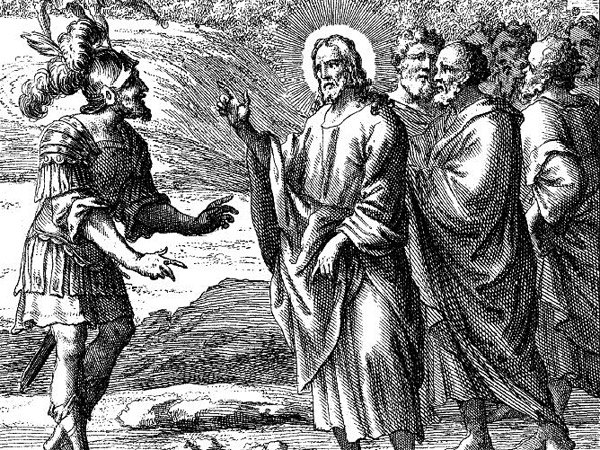
This is the third chapter of the redone second part of a trilogy that I have been writing about the Roman Centurion known as Longinus who was at the cross when Jesus was crucified. I have tried to weave other characters from the Gospel narratives, including the Centurion whose “beloved servant” was healed by Jesus an account mentioned in both Matthew and Luke, where the Greek word for servant “pais” is only found in these accounts and is different from the word commonly used in the New Testament “doulos.” The difference leads to some interesting and potentially powerful understandings about the people that Jesus interacted during his earthly ministry.

The links the to preceding chapters are shown below. I will be doing a final section to the trilogy dealing with what I imagine happened later to the men in the narrative. The reason I am doing this is because I believe that many Christians cannot imagine what it must have felt like to be the Roman occupiers of Judea in a time where they were hated and deep divisions, religious, cultural and political complicated the lives of Roman officers like the Centurion known as Longinus.”

Part One: A Centurion in Jerusalem 

A Centurion’s Sunday in Jerusalem: The Story of Longinus

The Story of Longinus the Centurion: A Meeting of Friends

The Story of Longinus the Centurion: A Visit to Death Row

Duplicity in Jerusalem: An Official Visit and 30 Pieces of Silver

Part Two: An Unenviable Mission

The Long Good Friday of Longinus the Centurion

The Morning After a Most Unsettling Crucifixion: The Story of Longinus the Centurion

I do hope that you enjoy the series and that it and the Gospel narratives challenge you whether you are a Christian or not. I know from my time in Iraq serving with our advisors to the Iraqi forces that what the Roman officers dealt with was more difficult than any of us could imagine, unless you have been a soldier or officer of an occupying power.

Peace and Happy Easter…He is Risen!

Padre Steve+

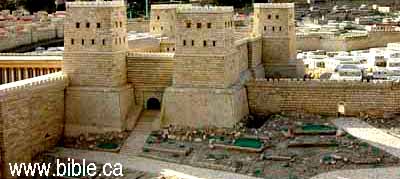
The pounding on his door awakened Longinus before he expected on this day after the Jewish Passover. He was hoping perhaps beyond hope that the worst was over and that in a few days he could take his soldiers back to the confines of Caesarea and away from the troubled city of Jerusalem. He was tired of this duty and longed for service with a real Legion with real Roman soldiers. He wiped the sleep from his eyes and went to the door of his quarters in Fortress Antonia. He opened the door to find his Optimo, or second in command Decius, with a look of near panic on his face.

He asked the young officer to come into his quarters and take a seat at his table. They like the other officers had seen events that they could barely explain. some of those events had troubled Longinus in a manner in which he was not accustomed.

Longinus took a wineskin and poured the contents into two cups. He asked Decius what was so urgent and frightening that he had to be at his quarters well before the duty day began. The young man took off his helmet to reveal a crop of blondish brown hair common to the Tyrol in the northern part of Italy and told an almost unbelievable story. He explained that there was trouble at the tomb of the itinerant preacher named Jesus.

The two guards from their unit who had relieved the previous watch at the tomb had evidently fallen asleep and there had been a break in. They claimed that they had been overcome when some kind of angelic being who had descended in front of them and some of the women who had been at the execution site previously. The story seemed preposterous but Longinus could not believe that they had fallen asleep on duty either as such could be punished by a death sentence. Adding to the confusion was a report that two of the preacher’s “disciples” had reportedly entered the tomb and claimed that the body was gone as had some of the women that had been there at the crucifixion. It was unbelievable but yet in light of the strangeness of the man and his execution. Longinus had Decius bring the two soldiers to him along with the Sergeant of the Guard to explain what had happened.

RubensResurrection

The two soldiers, one a Samaritan and the other a Greek had good reputations in the unit. Neither had given him cause for concern and the terrified expression on their faces as they explained what happened gave Longinus reason to believe them. Yes it was possible that they were lying but Longinus believed their story. He threatened them and promised a light punishment if they only told the truth, but despite this they stuck with this outrageous story.

Longinus was not much of a believer in miracles angels or any sort of magic hocus pocus purveyed by seers, magicians or fortune tellers. that being the case here he was believing this outlandish story because to disbelieve would mean that there was a serious breakdown of discipline by two outstanding soldiers. He had some soldiers that he wouldn’t believe for an Athenian minute if they told him such a tale but he believed these men. The terror on their face as they told the story led Longinus to believe that they had to be telling the truth as improbable as it was.

Longinus again thought of his words as the darkness enfolded the city and the earth quaked preacher hung dying on the cross on that evil hill two day before.

Longinus went to Pilate’s headquarters when he and the other Centurions, including his friend Flavius were participants in a meeting with the High Priest and his representatives and two of Herod’s people.

The meeting reminded him of a meeting of criminals. The High Priest and his representatives were livid and Herod’s henchmen voiced their displeasure regarding the lapse of the Roman soldiers that allowed this to happen. Longinus spoke for his men and said that as improbable as it was that he believed their story. That only made the non-Romans angrier; he almost thought that they were engaging Pilate in some histrionic episode in order to force Pilate to do their bidding. They insisted that Longinus’ soldiers had to have fallen asleep and or that they had conspired with the preacher’s followers to remove the body from the tomb. This angered Longinus to the point that he interrupted their ranting to defend his men’s honor. Pilate finally ordered Longinus and the High Priest to be silent. He asked the non-Romans to step outside while he conferred with Longinus and the other Centurions.

Pilate explained his dilemma. He was afraid that if he sent the High Priest away by supporting his soldiers that there would be a revolt in the streets. He had seen the tumult on the streets by the supporters of the High Priest when he tried to release the “King of the Jews” and felt that this would be worse for security. He advised the Centurions that while he had no reason to doubt them or their men that he had to placate the High Priest and Herod in order to avoid chaos, chaos that could lose him his job if he wasn’t careful. Likewise he did not feel that he had the manpower in the city to handle a full-fledged revolt and that he would have to call for reinforcements from the Legions based in Syria, something that he was loathe to do as this would get back to the Emperor.

Longinus thought back to the day of the execution. Pilate had agreed to place a guard at the tomb at the urging of the High Council. Longinus had argued against placing any soldiers at the tomb as he felt that since the “King of the Jews” them man that he had called the “son of God” was dead that Rome’s obligation was over. The whole thing reeked of politics.

Longinus was overruled by Pilate who explained that Roman soldiers needed to guard the tomb because the High Priest who Longinus detested as much as Pilate insisted that Jesus’ followers would attempt to steal the body and claim that he had been raised from the dead to lead a revolt against the Council and eventually Rome itself.

Added to the Judean witches’ cauldron was the presence of Herod Antipas, the corpulent and corrupt “King” of Judea. If Longinus detested Pilate and Caiaphas he hated Herod and all that he stood for, it made him wonder why Roman lives and treasure were spent to solve the problems of this God-forsaken land which he believed would still be trouble two millennia from now if the world lasted that long. Longinus believed that as long as Rome allowed the High Council and Herod to rule the region by proxy that the troubles would never end. He believed that it was only a matter of time before these people, led by the Zealots would revolt as they had against the Seleucids nearly 200 years before. He knew if that happened that Rome would crush the revolt and not leave as much as a house standing. He hated this occupation and all that it stood for, especially when he saw a good man, an innocent man killed for no good reason other than the politics of it all. It sickened him.

When he was done explaining his decision to Longinus and the other Centurions Pilate now called the quite irate non-Romans back into the proceedings. He told the High Priest and Herod’s men that he would disciple the soldiers involved and he would assist them in finding just what parties removed the body from the tomb. In the mean time he would suppress any stories coming from the soldiers about this supposed “resurrection.”

The High Priest and Herod’s men agreed that this would suffice and thanked Pilate for his time and effort. Longinus and the other Centurions quietly seethed as this took place. When the non-Roman parties had left Pilate ensured the officers that no action would be taken against the men and that he would not actively assist the Jews in trying to find the perpetrators of the event. He then let the officer know that they would remain in Jerusalem for another week to allow the multitude of pilgrims to leave the city and then they would return to Caesarea. Longinus thought and for a brief moment admired Pilate’s duplicity. Pilate the consummate politician had again found a way to defuse the situation. As much as he despised the deal it was better than trying to deal with a full fledged rebellion with so few troops available in Jerusalem.

Longinus left with the others and met Decius and Flavius and stepped into the court of the fortress. He was very unhappy with the deal that Pilate made with the High Priest and Herod. He felt that he had dishonored his soldiers and the unit for the sake of political expediency. He felt ashamed of the Empire for what Pilate had done in cooperating with these people from beginning to end during this affair. He would not forget.

Empty-Tomb-Picture-07

That night he felt compelled to walk to the empty tomb with Flavius. In the darkness they looked into the sepulcher aided by a lantern. They saw the grave cloths where they remained; the large stone was rolled away and the seal that had been placed on it was broken. They looked for any evidence to suggest that the soldiers had fallen asleep but could not find any. Nor did either see how anyone could have stolen the body and gotten very far without being seen by anyone. Convinced by what they saw they set down in the tomb.

They sat silently and wondered. Finally Longinus asked Flavius. “You believe in this Jewish God, what do you think?”

Flavius sat for a moment staring silently ahead at the stone wall of the tomb. Finally he spoke “My friend, I believed something was different about the Galilean when he healed my servant, even though I’m sure that he knew that my servant was more than a servant to me.”

Longinus thought for a moment. “Friday morning I would have told you that the man was a simple but probably misunderstood Jew. Tonight I do not know.” He paused. “Perhaps he is the son of God, or whatever I said on that hill.”

“I believe that he is some kind of God my friend, one who may change all of our lives.” Replied Flavius.

“My friend, I really do not know what to believe anymore. Let’s get out of here and get back to Antonia, at least we can drink there.”

Longinus looked at ground where the body had been placed. In the dim light he noticed what appeared to be some thorns. He reached down and picked up the crown of thorns that had been on the Galilean’s head.

Flavius looked at him and said “the crown, how fitting that it was left here.”

“Somehow fitting. Maybe we should take it? Who knows maybe it will be worth something someday?” Responded Longinus.

“Maybe so my friend, maybe so. But maybe you should keep it to remind you of him.”

“No you take it. I have the Galilean’s blood on my spear. That is enough a reminder for me.” Longinus handed the crown of thorns to Flavius and they walked into the night out of the tomb, their path lit by their lamp.

They walked back to the fortress when both men went to the tavern in Officer’s Mess and had the barkeep pour them each an ale. He drank quite a few before the evening was out, Flavius leaving before him. he remained alone for hours and then went to his quarters where he lay down exhausted and perplexed by the events of the past few days.

1 Comment

Filed under christian life, faith, History, Political Commentary, Religion

The Morning After a Most Unsettling Crucifixion: The Story of Longinus the Centurion

IMG_0643-726257 14_2009_da_02_int

The horrible day was passed and a new morning greeted Longinus as he arose. The sun rising over the escarpment in the east that overlooked the Jordan River cast a warm red and yellow glow as its rays infiltrated the window overlooking the courtyard of Fortress Antonia.

He, Flavius and Decius had spent much of the evening in the tavern following the executions, none talked much though Flavius had briefly discussed the meaning of Longinus’s comments as the Galilean preacher died upon the cross. Longinus pondered the words again. “Surely this man is the son of God” or something to that effect. He didn’t remember his exact words, but then the day was long and the events struck a nerve. He had seen or taken part in many executions as well as difficult battles. Until now he had managed to keep his soul protected from such feelings by the wall that he had built around his heart.

Longinus looked out the window and then at his desk. He would need to call his officers together soon. He was sure that even though it was the sabbath that those that plotted against Roman rule, as well as the various factions at work in Jerusalem were still plotting, scheming and at work. He wondered how in such a climate anyone could call the day “holy.”

He did not like what had happened the previous day and the way that Pilate gave in to the Jewish leaders in regard to killing the Galilean still bothered him. The man was innocent. Pilate knew it, they all knew it and still all of them aided and abetted those that wanted the man named Jesus dead. Longinus felt a shame that in all of his years of soldiering he had never before felt. Pilate was able to wash his hands of responsibility, but the blood of the innocent man still stained the tip of the lance that Longinus had plunged into his side. He shook his head in disgust.

tomb-roman-soldiers-guard-james-tissot-1

Just then Decius knocked and entered with the news that Pilate had ordered a guard set at the tomb of Jesus. Supposedly the Jesus fellow had said that he would rise from the dead and the Jews wanted to make sure that no one tried to make off with the body of Jesus.

Longinus was not surprised, somehow as strange as the week had been it make perfect sense. Set a guard over the tomb of a man who was betrayed by one one his own, denied by others and abandoned by all but one. He thought rather cynically that it was a waste of his men’s time and effort. If the Jews were so concerned why didn’t they send their Temple Police to guard the tomb. But then he realized that such duties were beneath the Temple establishment. Get the infidel Romans to do the dirty work, that way if something went wrong they could take the blame. It figured.

He ordered Decius to set the guard and also received the report that two of his Samaritan soldiers had been brought in by a patrol dead drunk late in the evening. He would have to discipline them later, that was the lot of a commanding officer. How he wished that he was commanding a unit of Italians in a home province rather than these Samaritan and Syrian cast offs in this God forsaken backwater of the Empire. At least he had a number of good officers, perhaps if he remained he could organize a transfer of his men to the Italian Cohort stationed in Caesarea where his friend commanded one of the units. Though he was based in Caesarea it was much better to be assigned to that Italian unit rather than the locally recruited units.

Flavius joined them as they set down to eat breakfast. Outside Quentin and other sergeants mustered the men, and proceeded to carry out the order of the day. Patrols were dispatched to remind any Zealots or sicarii that even if they had gotten Pilate to do their bidding regarding the Galilean that Rome was still in charge of their capital.

The officers discussed details of the planned movement that would take them back to Caesarea in the next couple of days, whenever Pilate decided that the situation in Jerusalem was calm enough to leave. That would be a day or two as the multitudes who had come to observe Passover from the diaspora returned to their homes about the Empire and beyond.

The sun now shown brightly through the window. Pilate looked at the still menacing hill known as Golgotha, now devoid of crosses. He thought about that final scene yesterday amid the gloom as the tree men including the Galilean hung suspended between the heavens and earth. It was a sight that he would not soon forget.

Flavius and Longinus hoped for an uneventful couple of days in order to prepare for the always dangerous trip through Judea. The Zealots, sicarii and other insurgents lying in wait to kill a Roman. Tonight, the Gods willing they would meet over a cup of ale in the tavern.

holy-saturday

1 Comment

Filed under faith, History, Loose thoughts and musings, Religion

The Long Good Friday of Longinus the Centurion

600px-Gustave_Doré_-_Crucifixion_of_Jesus

This is a re-do of my original “Long Good Friday of Longinus the Centurion., Since I first wrote that piece two years ago I have written a prequel, and like George Lucas feel the need to change and improve the original. Unlike Lucas who simply tweeked Star Wars I have chosen to spend my time completely re-writing the original in light of the prequel series dealing with the events leading up to Good Friday that I did this week. I don’t know about you but I like to imagine events as they might have actually happened. As an Iraq veteran who served with our advisors to the Iraqis I do understand the plight of soldiers from an occupying power serving far away from home where their presence is barely tolerated, much less welcomed. Since I have always felt a special affinity for the soldiers that have interactions with Jesus, who are treated very sympathetically by the writers of the Gospels as well as Luke in the Book of Acts.

The links to the first four chapters of this story are linked in below. I have not linked the three original articles in order to provide a better continuity and personal narrative for the characters in light of the Gospel accounts, non-Biblical accounts, church tradition and my own imagination.

Peace

Padre Steve+

A Centurion’s Sunday in Jerusalem: The Story of Longinus

The Story of Longinus the Centurion: A Meeting of Friends

The Story of Longinus the Centurion: A Visit to Death Row

Duplicity in Jerusalem: An Official Visit and 30 Pieces of Silver


Longinus had finally decided to try to get a bit of rest. After his rather morose meeting with Flavius and Decius he and Decius went back to check on the preparations for the executions scheduled for the next day. Quentin his Tesserarius had been working with the squad chosen to to conduct the actual crucifixions of the prisoners, Bar-Abbas the insurgent as well as the common criminals and murderers Dismas and Gestas who he had met in the hell hole of a jail in the dungeon of Fortress Antonia after Pilate had assigned him the task of conducting the executions.

Longinus was certain of his unit’s ability to carry out the mission, though he would have rather had a unit from Italy than his unit of Syrian and Samaritan troops. There was one positive aspect, his Samaritans and Syrians had no love for the Jews and would have no qualms whatsoever in disposing of the criminals.

He thought for a moment about the prisoners. That Bar-Abbas fellow, he would be glad that he or any other Roman would have to deal with him again once the crucifixion was over. As for the common criminals he felt that everyone would be better off with Gestus dead although he hoped that Pilate might take pity on the repentant thief named Dismas. However, despite his feelings he also knew that the law was the law and repentant or not that Dismas was guilty of the crimes and the sentence was just. As he had realized earlier in the day while talking with Flavius it was important not to become emotionally involved with the locals, especially prisoners. Maintaining an emotional distance ensured that he would not flinch in times when ice rather than blood needed to flow through one’s veins. He was proud that he could do this but envied the humanity that his comrade and friend Flavius still maintained in spite of everything.

He was just about to prepare for bed when a messenger from Pilate knocked on his door. It was late, too late and Longinus wondered just what was going on.

“Come.” He said, the weariness in his voice obvious in the way he answered.

The messenger, a relatively young Italian soldier assigned to Pilate’s bodyguard entered, came to attention and saluted.

Longinus looked at the young man, like him far from home and asked “what am I needed for now?”

“Centurion, the Governor has requested your presence” the soldier replied.

“May I ask what for?” A now increasingly irritated Longinus asked.

“Sir, I do not have the details but it is a pressing matter regarding the Jews and that Galilean preacher.” The young man was obviously uncomfortable in having to request a career officer like Longinus, a veteran of real battles and campaigns appear before Pilate for what was not much more than a religious dispute among an occupied people.

“Pressing matter?” Asked Longinus.

“Yes Centurion. I was told that it was urgent that you come to Governor Pilate now and alert your unit as at least some of your men may be needed if things get out of hand.”

“Can you please tell me just what is going on?” Longinus asked as he pulled his armored breastplate over his shoulders.

“I’m sorry Centurion, I have no more information. You are to report to the Governor within the half hour. The Governor wants your unit ready within the hour.” When he finished he came to attention, saluted and exited the room.

Longinus hated how leaders sent young men to be their messengers and would not give them all of the relevant information.

Longinus sat back down in his chair where he had been sitting and discussing the situation with Flavius and Decius. He wondered to himself what could be so pressing that Pilate needed him now.

After briefing Decius and Quentin, instructing them to wake the men and be ready for action Longinus took a squad and went to Pilate’s headquarters. When he arrived Pilate greeted him.

“Centurion, I hate to have bothered you at this hour in light of how busy you and your men will be in the morning but a situation has arisen.” Longinus looked around the room and then heard some commotion on the area called “the Pavement.”

“What is happening my Lord?”

“Longinus, these Jews have brought that Jesus fellow here and are accusing him of fomenting a rebellion against the Emperor.”

“A rebellion sir?”

“That is what they say Centurion. They claim that one of his closest associates had turned him in and after a trial of their own that they found him guilty of claiming to be a king and God that will overthrow the Emperor.” Pilate could not hide his discomfort.

carrycross

“Do you actually believe them sir? After all we had heard this morning that this Judas Iscariot fellow had betrayed him for 30 pieces of silver.”

“I know Centurion, I know.” Pilate looked at Longinus then back out at the crowd gathered outside in the dark. He was afraid and Longinus could sense that fear, fear that if he made the wrong move that a real rebellion could break out and that Pilate as the Governor would take the blame and bear the punishment and wrath of Caesar.

“Centurion, I tried to placate these people be questioning this Jesus fellow myself.” Pilate paused. “I must say that he is a rather unusual man and truthfully I could not find anything that under Roman law that I could find him guilty of doing. Not a thing Centurion, nothing but their leaders kept pressing me.” Pilate’s gaze seemed to be almost pleading with Longinus to help him escape this decision. Longinus knew at that moment that his day was about to get worse. Pilate continued “It seems to be a religious squabble of some kind so in order to deal with it and to try to keep us out of it I sent Jesus to Herod since Herod is the ruler of Galilee.”

“So Herod will certainly deal with the situation, will he not Governor?”

“Centurion, I thought that that corpulent bastard Herod would deal with it but I just got word that Herod too could find no crime. The Jewish leaders and of their Temple Police are supposedly bringing him back to me to render judgement. They are leaving it to me.”

“Judgement for what?”

“Sedition, treason, blasphemy, proclaiming himself a king.” Pilate paused, his face flushed. “My God I’m surprised that they haven’t accused the man of fathering the High Priest’s daughter.” The sarcasm and bitterness was evident in his voice.

“So what do you intend to do.”

“I intend to try to get us out of this with as little trouble or guilt as possible. When they return him to me I will ask a few more questions and set him free as is my prerogative, certainly they wouldn’t want to release a real murderer like Bar-Abbas back into society, I do give them more credit than to stoop that low.”

“I do hope that you are right governor, but from what I understand it seems that they are intent on ridding themselves of the fellow once and for all. I think that their leaders see the Galilean as more of a threat than a man like Bar-Abbas.”

Pilate said nothing and during the silence Longinus’s troops under the direction of Decius entered the perimeter of the court adding an additional security cordon as the crowd grew and got more boisterous. As they took up position the Temple Police and members of the High Priest’s entourage approached the court with the Galilean in custody. Quentin with four soldiers met them and took custody of the obviously tired and already abused man. They delivered Jesus to Pilate and stood back. Longinus watched as it happened. As he did so Flavius entered the room with his servant. The servant appeared unsteady and full of emotion when he saw the man who had healed him two years before. Flavius stood by his face not betraying any feelings except deep seated rage that was boiling as he saw this travesty of justice take place.

Pilate attempted every trick in the book to garner a way to save the life of the man standing before him. He asked him questions and Jesus clothed in a purple robe that Herod had mockingly placed upon him said nothing. Finally in desperation Pilate asked Jesus if he was a king. The answer both fascinated and terrified Pilate and caused him to wish that he had never come to the city. As he deliberated earlier and debated the members of the Sanhedrin his wife again urged him to “have nothing to do with that innocent man.”

But the answer of Jesus to the question of his kingship troubled Pilate. Had he thought the man insane he would have scourged him, declared him mad and been done with the affair. “My kingdom is not of this world, if it were my followers would be fighting to ensue that you did not hand me over to the Jewish leaders.” Jesus looked into Pilate’s eyes, the look sent a chill through Pilate’s soul and Pilate restated the question “so you are a king?”

Jesus replied solemnly “You say I am a king. I was born for this and it is why I came to this world, to testify to the truth. Everyone who belongs to the truth listens to me.”

Pilate appeared stunned and both Longinus and Flavius knew that he was beaten. They listened as Pilate asked “what is truth?” The question was one of a man who had long ago sold his soul to gain the world, it was the question of a deeply cynical man who had long determined that truth was only in the eye of the beholder and to be used as needed to acquire power. At the same time they could see a touch of genuineness in the question as Pilate, desperate for an answer that would enable him to please everyone and spare the life of the man before him wrestled with the question of truth for the first time in years.

They watched as Pilate attempted to bargain for the life of Jesus only to be shouted down by the increasingly riotous crowd who demanded that Bar-Abbas be released. Again attempting to assuage the mob he had Jesus scourged with a barbed whip. The soldier who did that brutal work was a Syrian, big and burley without a trace of feeling in his eyes or face. The servant of Flavius begged him to intervene but Flavius now knew that the things happening to Jesus could no longer be influenced by sentimentality and stories of the goodness of Jesus. He had seen this type of Justice before, and though he despised it, he earnestly hoped that it would be enough to deliver Jesus.

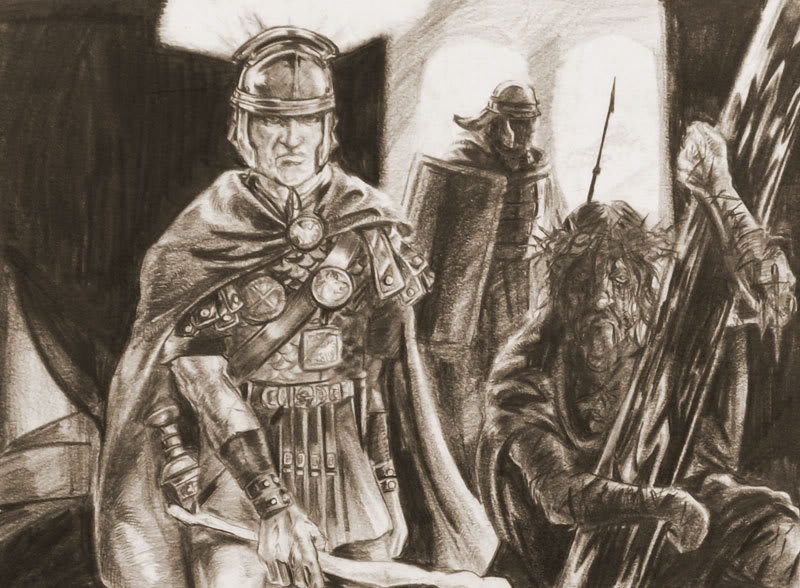
After the scourging, soldiers assigned to Longinus jammed a crown of thorns down on the blood covered Jesus and placed the purple cloak over him. Jesus’s body trembled. Pilate again approached the mob and tried to decline the odious responsibility thrust into his hands. The mob led by the Chief Priests and joined by man of their rivals, the Pharisees cried out for Jesus to be crucified.

They heard Pilate plead with Jesus, again noting that he had power over the life and death of Jesus to which Jesus replied that Pilate “had no power over him that had not been given by God.” Finally he pleaded with the Jews one more time to take Bar-Abbas for execution and to spare the Galilean. The leaders shouted him down again and cried out that Pilate would be a traitor to Caesar if he let a man who claimed to be a king live.

Defeated By the mob and by his own weakness of character Pilate asked for a ceremonial washing basin full of water. When it came in the hands of a court member he placed his hands in it and proclaimed “I am innocent of this man’s blood.” He then ordered the soldiers to take Jesus to be crucified even as the prisoners Dismas and Gestus were led from the dungeon for execution and a profoundly perplexed Bar-Abbas was released by the jailer.

Longinus looked at Flavius and whispered to him “wash my hands of his blood? My God, he knows that he is as guilty at them.” Flavius looked on and simply said “I know my friend, we all are.”

The detail of soldiers assigned to the crucifixion detail was commanded by Quentin, a man who had fought many battles and like Longinus and Flavius felt that these executions of helpless prisoners were unworthy of soldiers like himself. The soldiers of Flavius’s unit had responsibility for helping to clear a way down the narrow street called by the Romans Via Delarosa. The street of suffering. It was the street that all the condemned travelled to the hill of execution so fittingly called the place of the Skull. Longinus had seen others walk this path but in the past he had been able to shield his person from their suffering, but today was different.

Longinus’s own execution squad led by Quentin led Jesus and the others along, forcing them to carry their crosses. About halfway down the street Jesus collapsed under the weight if his cross and grabbed a bystander, a man from Cyrene to carry the cross while the soldiers prodded the bloody body of Jesus down the street and out of the city to the place of execution. People jeered at the condemned as they did at very execution as for most this was no different than any other crucifixion and most of those present knew little about any of the condemned men and even those that were familiar with Jesus probably did not recognize the bloody man stumbling down the street. Of course there were others present who did know Jesus and watched in horror as their friend, teacher and for one woman her son struggled to the execution site. Longinus wondered about his own elderly mother and thought of her as he saw the mother of Jesus. He quickly tried to chase her image from his mind, he needed to be strong and hard if he was to keep his objectivity and conduct the mission as distasteful as he found it.

When the macabre parade arrived at the hill, the prisoners were stripped, placed on the crosses and nailed to them. Their screams as Quentin hammered the large iron nails home through their already abused flesh echoed for all to hear. Thankfully Quentin knew what he was doing and this part of the execution process happened quickly. Then the crosses were raised, but just before this a messenger from Pilate arrived with the placards that denoted the charges. He handed them to Longinus who noted what was written on the one for Jesus. It said “The King of the Jews.”

The placards were placed and with a thud the crosses were placed in the holes on the hill. The suffering of the prisoners was great, the crowds jeered and mocked them while those that loved them stood at a distance. Soldiers stood guard to ensure that no one interfered with them in any way. There was a bit of banter between the real criminals one of whom, the unpleasant one named Gestus joined in the mocking of Jesus only to be put in his place by the other one named Dismas.

Longinus, Flavius, Decius and a few other officers watched as their soldiers from the crucifixion detail divided the paltry worldly possession of the men between themselves. The men argued over a one piece tunic worn by Jesus, Not wanting to destroy it they cast lots for it. A trooper from Tyre won the tunic. Longinus and Flavius looked at each other and realized how little most of their men earned and neither begrudged the men the few items that they gathered from the men being executed.

The skies which had began the day with bright sunshine now became dark and foreboding. Lightening appeared in the distance and occasionally Jesus would address his mother or one man, Flavius believed him to be a disciple who stood by the cross. Jesus even promised the Dismas character that “he would be with him in paradise” and told others, Longinus thought the soldiers but he wasn’t sure “forgive them they know not what they do.” As it approached the ninth hour Jesus cried out in Aramaic “my God, my God, why have you forsaken me!”

A cold rain began to fall.

Quentin approached him with a sponge on a pole which was soaked in a sour wine. It touched Jesus’s lips and Jesus said “Father into your hands I commit my spirit” and then “it is finished.”

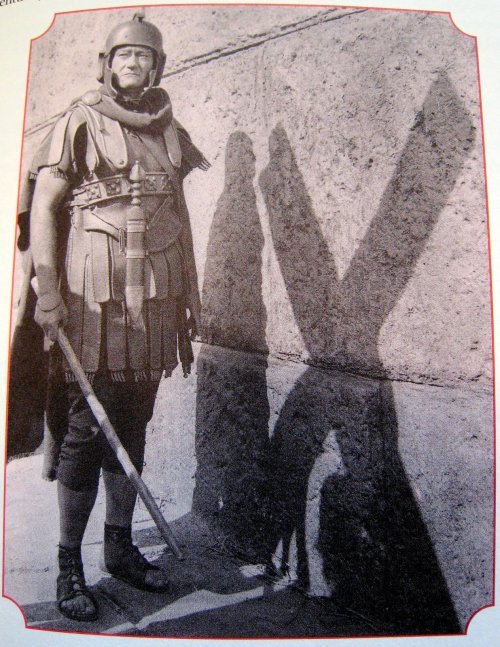
With that last dying remark the head of Jesus fell to his chest and his body, bloody and mangled hung limp. As the men looked on the ground began to tremble and as the ground shook and the officers looked about amid the gloom and confusion as the onlookers took flight Longinus exclaimed “surely this man was the son of God.” Flavius looked at his fellow Centurion in astonishment. Longinus, the man who had closed his heart in a fortress was echoing what he had believed since Jesus had healed his servant, the young man who was more than a servant to him.

As the crowds dispersed Longinus received the message that the executions had to be concluded before the Jews began their Passover. With that he sent Quentin to break the legs of the prisoners to hasten their deaths. When Quentin reached Jesus he called for Longinus.
IMG_0643-726257

“Centurion, I believe that this man is already dead. Do you still want me to break his legs?”

Longinus looked at his subordinate and said “no I must do this myself.” He had a soldier bring him his lance, a ceremonial lance that denoted his seniority as the senior Centurion in the Legion. He looked at the lance and plunged it into the side of Jesus into his heart. Jesus did not move but from the wound blood mixed with what looked like water poured out of the wound and down his side.

“Quentin, he is dead, you may take him down.” Other soldiers pulled down the dead bodies of the thieves. As they did this a man approached Longinus and Flavius.

“Gentlemen. I am Joseph, I am a member of the Sanhedrin. I have come to take responsibility for the body of Jesus of Nazareth.”

Longinus replied in a businesslike manner “by whose authority?” He had a hard time believing that a member of the Sanhedrin would claim this body.

With that Joseph produced a letter from Pilate. Longinus looked the letter over and handed it back to Joseph without comment. Joseph then motioned to several men with him to take the body as Longinus, Flavius and the others looked on. Longinus thought to himself that it was good that a man of some means and influence would at least take the time to give this innocent man a decent burial.

As Quentin took charge of the clean up Longinus instructed Decius to prepare the troops to return to Fortress Antonia. Flavius instructed his optimo to do the same. The last thing that any of them wanted to be was on the streets when the Jews began their Passover, as always they decided that it was unwise to stir up any more animosity than was needed. Today w a near run thing with e demonstration outside Pilate’s headquarters and none of them wanted any more excitement this evening.

When the clean up was completed and the bodies removed Longinus and Flavius ordered their soldiers back to Fortress Antonia. When they arrived the Centurions went to Pilate to inform him that the mission was complete. Pilate was glad the ordeal was over but was obviously still disturbed by the events of the day. Longinus, now exhausted was glad to leave Pilate’s presence. He still loathed politicians and wondered if had Pilate been a soldier if he would have had the courage to tell the leaders of the Sanhedrin to “pound sand” and keep Jesus alive. But then he knew that had Pilate done something that only a diplomat could do, he kept the peace. Had he been in charge the man named Jesus might have lived but hundreds maybe even thousands of others might have died.

After he dismissed his soldiers he went to his room, doffed his gear and went to the tavern in the fortress. Flavius joined him about 15 minutes later. They sat at the table as the barkeeper brought them each an ale. They looked at each other and Flavius asked “What did you mean by surely this man was the son of God?”

Longinus shook his head. “My friend I do not really know.” He paused and took a drink from his cup. “Until today I simply figured that he was a good man, but after today, after what I witnessed I just don’t know.”

“If you ask me my friend I think that he must be a God, if not somehow connected to the greatest of Gods, the God of the Jews.”

“Perhaps Flavius you are right. All I know is that I can no longer see the world, the Empire or my life in the same light as I did just a week ago.”

Flavius nodded his understanding as Decius entered the tavern. The younger officer reported to his seniors. They acknowledged his entrance and Longinus asked the younger officer to sit with them.

“What do you know Decius?”

The younger officer spoke. “Sir, I do not know if you heard the latest about the man that betrayed Jesus.”

Longinus said sarcastically “did they elect him High Priest?”

The younger man caught the sarcasm and replied “if only that we’re the case. He was found dead, hanging from a tree in the Potter’s Field.”

Flavius answered “so the traitor couldn’t handle his own act of duplicity?”

Longinus replied, “evidently not.” He took a drink from his cup and motioned for the barkeep to get Decius an ale. The three men continued to drink silently and wondered what else could happen…

1 Comment

Filed under faith, History, Religion

Duplicity in Jerusalem: An Official Visit and 30 Pieces of Silver

images-35

This is the final section of the prequel to my historical fiction series on Longinus the Centurion. The other chapters of the series can be found at the following links. Have a blessed Easter Triduum.

A Centurion’s Sunday in Jerusalem: The Story of Longinus

The Story of Longinus the Centurion: A Meeting of Friends

The Story of Longinus the Centurion: A Visit to Death Row 

Good Friday Special: The Long Good Friday of Longinus the Centurion

Holy Saturday Special: A Centurion Reflects on a Days Work

Easter Special: Trouble in River City the Centurion’s Easter: An Empty Tomb, Duplicitous Politicians and a Lingering Question

Peace,

Padre Steve+

Longinus continued to think about the various intrigues that he saw in Jerusalem but he could not imagine what he was soon to learn about. The morning had started normally until the corpulent and corrupt Herod Antipas, the appointed “Jewish” ruler of Galilee and son of Herod the Great arrived in Jerusalem with his entourage.

Longinus knew that there was no love lost between Pilate and Herod, nor between the Pharisees and Herod. Herod chafed knowing that he only ruled a portion of the land his father had ruled especially that he did not rule in Jerusalem. His father had rebuilt and restored the Temple after it was desecrated by the Seleucids, something that the Pharisees and the Priestly class in the city seemed to not give his father enough credit for doing. The fact that Herod was coming to observe the Passover in the city could only add to the tensions that were simmering.

Pilate called Longinus and the other senior officers, including the Centurion Flavius to his headquarters to be part of his official greeting party. Pilate may have despised Herod, but he was the representative of the Empire and Herod, like any proxy ruler needed Pilate’s support.

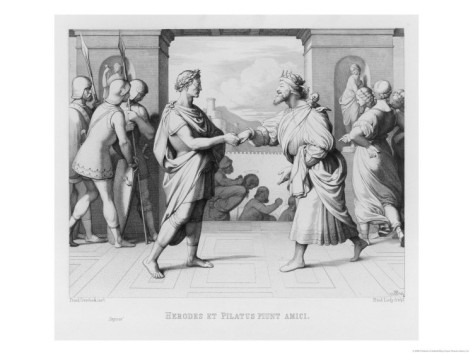
friedrich-overbeck-pilate-and-herod-resolve-their-differences-and-pilate-hands-jesus-over-to-herod-s-jurisdiction

The meeting at the court referred to as “the Pavement” was filled with ceremonial pleasantries as Pilate, Herod and their staff members and court followers conducted the business of the day. Nothing of much importance was discussed, Pilate decided not to bring up anything about the Galilean preacher despite the uproar of Sunday that accompanied his arrival. Pilate thought it amusing that a poor preach from Herod’s own province would be greeted as a king while the population hardly acknowledged Herod, apart from the rathe sullen looks that greeted his arrival.

After Herod departed Longinus, Flavius and the other officers were dismissed, yet another morning that they would never get back. But again that was part of life as an officer in a Godforsaken backwater like Judea. Such meetings of course were a necessary evil for them to attend and sometimes one could find out information that could be useful. Though nothing important was shared in the meeting Longinus noted that no Jewish religious leaders were in attendance. He thought that odd until he arrived back in his quarters where he was doffing his more ceremonial dress uniform items for the more practical daily kit.

After Herod departed Longinus, Flavius and the other officers were dismissed, yet another morning that they would never get back. But again that was part of life as an officer in a Godforsaken backwater like Judea. Such meetings of course were a necessary evil for them to attend and sometimes one could find out information that could be useful. Though nothing important was shared in the meeting Longinus noted that no Jewish religious leaders were in attendance. He thought that odd until he arrived back in his quarters where he was doffing his more ceremonial dress uniform items for the more practical daily kit.

As he changed his second in command, Decius knocked on the door.

“Come.” Longinus said and his subordinate entered. Decius came to attention and saluted.

“Be at ease my friend, what news do you bring?”

“Centurion. I have some rather interesting news from our Jewish spy regarding this Jesus fellow.”

“Is that so?” Longinus inquired.

“Yes sir. He said that one of Jesus’s own men, one of his 12 closest followers went to the ruling elders this morning and offered to betray him.” The words coming from his subordinate were stunning.

“Tell me more.” Longinus said, his voice now full of curiosity.

“Sir, our man said that a man named Judas Iscariot, who is trusted by Jesus enough that he carries the money bag and pays whatever expenses that Jesus and his men incur.” Decius paused while Longinus pondered this unexpected turn of events.

After a few moments of silence Longinus asked his Tesserarius, Quentin to fetch Flavius and asked Decius to sit at his desk. Flavius arrived within a couple of minutes and joined Longinus and Decius at the desk.”

Longinus began the discussion.

Judas' 30 pieces of silver

“Flavius, we have news about your friend the Galilean preacher, it seems that one of his merry band is a traitor.”

If Longinus’s reaction to the news was surprise and maybe even amusement with the duplicity of these Jews the reaction of Flavius was one of stunned disbelief and horror.

“You can’t be serious?” He stammered.

“Well that is what Decius says my Jewish insider at the Sanhedrin has reported just a little while ago.” He looked at Flavius as Flavius asked “do you know which one of his men has done this.”

“A certain Judas Iscariot. That is the correct name isn’t it Decius.”

“Yes Centurion, Judas Iscariot.”

Flavius looked at Decius and Longinus and said “Iscariot.”

“You know of him.” Inquired Longinus.

“Yes I do know of him. Before he joined with Jesus he was reported to be linked to a group of assassins called the sicarii.”

“The sicarii?” Longinus asked , hardly believing what Flavius said. The sicarii were a particularly violent group, known to kill Romans and people that they suspected of being collaborators. They armed themselves with a particularly nasty dagger that they carried beneath their tunics. If this was true it could be a particularly disturbing turn of events.

“Yes my friend. You see many people followed this Jesus not because of his goodness or any thought of benevolence, but because they believed that he would overthrow the Jewish regime and drive us out of this land.”

“I had no idea. I thought they were all a bunch of do gooders. In fact until Jesus took a whip to all the merchants in the Temple the other day I didn’t think that he had a violent bone in his body.”

He looked at Decius and asked “What does our spy say about this Judas fellows motive?”

The younger officer replied “our man said that He overheard Judas talking before he went into the chambers of the Sanhedrin with some Priests sympathetic with the Zealot party of the Jews.”

“Continue.”

“What he said is that evidently Judas told these men that he was disappointed by the fact that Jesus did not appear to be seeking to overthrow us.”

“That would not be surprising for a member of the sicarii.” Added Flavius, his expression changing from disbelief to anger and after a moment’s reflection he slammed his fist down on the table and added “I could kill that miserable bugger myself…the man Jesus has done nothing wrong.” As Flavius spoke his voice rose in intensity. Longinus knew his friend was upset.

“Flavius, I can understand, this seems a vile thing but there are even larger issues than your friendship with this man and what he did for your servant.” Longinus hoped that his outward calm and acknowledgment of his friend’s feelings would help calm the anger.

“Longinus my friend, I know how you feel about these people and I hoped for better, I wanted to believe that they were a cut above us with their One God, but I see that even a people as devout as the Jews are as capable of evil as the worst Greek, Egyptian, Cretin or Arab.” He paused. “Do you have wine? I could use a drink about now.”

“Of course, my friend. Decius pour us each a cup of wine.”

As the younger officer got the wine Longinus looked at his angry and downcast friend. He felt a certain amount of sympathy for Flavius, but he had long ago learned not to let the sufferings of occupied people touch him deeply. He had built a fortress at impregnable as Fortress Antonia around his own heart years ago. It was the only way to survive. The being said he recognized a certain amount of humanity in his friend that was absent from so many of his comrades. In a way he envied Flavius. As he thought these things he realized that he needed to move the subject from Flavius’s emotional response to this situation to the practical consequences of this development. About that time Decius brought the wine and placing three cups on the table poured the wine.

“Thank you my friend.” Flavius said as he lifted the cup to his lips.

Both men raised their cups and took a drink. As he set his cup down Longinus continued. “I know that you hoped for better from these people, but you know I have found that some of the most religious people are also the most violent and intolerant.”

Flavius looked at his friend who continued “it seems to me that when someone, you know true believers, know that they have any deity at their disposal they are inclined to be less tolerant of others.” He paused and took a sip of wine. “I think that it is a testament to the Empire that we have so many religions and that in the name of law and order that violent ones are suppressed. That is why throughout most of the Empire we have peace.”

Flavius interrupted his friend. “But we enforce the religion of Caesar, a man, who we claim as God on our citizens.”

“True, but none of us really believe he is a real God anyway, it is a way to keep order. The state makes a religion of itself, it keeps the really dangerous types at bay. So long as people put Caesar first, even if it means burning a bit of incense to a man that they do not believe is God it serves a purpose doesn’t it?”

Flavius looked at his friend and quietly replied “I guess until I met this Jesus fellow I would have agreed completely, but now I don’t know.”

Longinus listened to his friend and could see the sincerity in his face. He continued saying softly  “I really believe my friend that the second that any religion that proclaims something different arises and gains control of the Empire you can be assured that the peace that we know will be gone.”

“But that is no substitute for belief in a real God.” Answered Flavius.

“That may be so my friend but it helps keep the peace and is why we don’t have problems throughout the Empire like those that beset us here.”

A curious silence descended in the room as the two friends pondered the situation. Finally Flavius broke the silence. “I just hope that what this man has done stays a Jewish problem for their leaders. I would hate for us Romans to have to become involved in it.”

“As do I my friend, I can drink to that.”

The three men sat silently continuing to drink their wine as they pondered the position that they found themselves…. It was nearly sunset.

2 Comments

Filed under faith, History, Religion

The Story of Longinus the Centurion: A Visit to Death Row

MLPPT_CenturionCross_1

This is the third chapter of a prequel to my series on Longinus the Centurion, who according to tradition was the Centurion in charge of the execution of Jesus. The Previous chapters as well as the original series can be found at the links supplied below. 

A Centurion’s Sunday in Jerusalem: The Story of Longinus

The Story of Longinus the Centurion: A Meeting of Friends

Good Friday Special: The Long Good Friday of Longinus the Centurion

Holy Saturday Special: A Centurion Reflects on a Days Work

Easter Special: Trouble in River City the Centurion’s Easter: An Empty Tomb, Duplicitous Politicians and a Lingering Question

The next morning a messenger knocked on the door to Longinus’s quarters in Fortress Antonia. He told Longinus that Pilate wanted to speak to him and to report as soon as possible to Pilate’s headquarters in the fortress.

bible-archeology-jerusalem-temple-mount-antonia-fortress

Longinus, who had been discussing the day with Decius in order to ensure his soldiers were ready for any contingency but also conduct some training was bothered by the request. He had discussed the situation in the city and about Jesus in particular the previous afternoon with Pilate and figured that unless there was some sort of incident that he would meet again later in the day to discuss the latest events.

Instead Longinus, was being ordered to report to Pilate again and it was interfering with his conduct of military business. Longinus hated dealing with politicians and diplomats and though he respected Pilate who he felt to be as decent of man as any politically appointed diplomat as any Pilate was still not a military man. He did not always understand military matters.

Longinus looked at the messenger and asked: “Tell me. what would the Governor need of me at this hour?”

“Centurion,” the messenger replied. I was only told to have you report as soon as possible.”

Bothered by the lack of detail Longinus told the messenger to go and tell Pilate that he would be there shortly. He then looked at Decius, and shook his head. “My friend, I am afraid that I will be delayed. Take care to conduct today’s training and be ready in case any trouble arises.” With that he put on his armored breastplate and cape and left the room.

When he arrived at Pilate’s headquarters the Governor greeted him cheerfully. “Centurion, it is good to see you.”

“Likewise sir…” Pilate stopped him before he could continue.

“I don’t suppose that you know why I called you here do you?” Pilate asked, irritating Longinus who feeling even more irritated by Pilate’s levity kept his feelings to his self and simple replied: “No my Lord, your messenger only told me to report here, he did not give me a reason.”

Pilate smiled. “It was with good reason, had he done so I am sure that you, like any other Centurion in the province would have found some “pressing military duty,” isn’t that what you call it? to avoid coming here.”  He paused for just a moment and before Longinus could respond continued: “Of course I know the answer, you need not say anything and I suppose if I was in your position that I would feel the same way.”

Longinus knew this was the case and had no answer to Pilate who continued.

“Centurion, this week will unfortunately be a week where we must conduct some rather unpleasant business, less than soldierly business but necessary.” Pilate paused again and motioned for Longinus to take a seat at his desk and Longinus did so, looking about the room and noticing Pilate’s civilian staff and several soldiers assigned as his personal bodyguard.

Longinus, decided to hasten the length of the visit and asked: “My Lord, may I ask why I am here? After all I do have pressing military business to attend to.”

Pilate immediately caught the sarcasm in Longinus’s words and smiled. “Centurion, you amuse me, because I know how you military types think. You see I may not have served with a Legion, but I have served with enough officers to know that you would rather be fighting the enemies of the Empire than doing police work, but we are in Palestine, not the Teutonic Forrest.”

Longinus stared back at Pilate and said nothing.

“Centurion, this week we will dispense justice to three Jewish prisoners. Men of your unit will conduct the crucifixions this Friday.”

“Yes my Lord.” Longinus’s muted response spoke more than any protest could.

Pilate continued. “Centurion, I want you to see the prisoners and in doing so know in your heart why this must be done. These men are violent criminals, and one of them is the infamous Bar-Abbas.”  Longinus looked at Pilate, and asked “the insurgent who has attacked and killed our soldiers and officials?”

Pilate nodded and replied “so you know why this is important, in an environment as volatile as Judea we cannot let a man like this remain unpunished, it would only encourage more men to rise up like him.” Pilate smiled and continued. “We cannot forget how the Jews rose up and overthrew the Seleucid rulers underestimated these Jews when that Judas Maccabee fellow led that bloody revolt.”

Longinus replied “No we could not let that happen on our watch.”

Pilate nodded in agreement and continued. “So you understand Centurion, it is an unpleasant duty, but mind you history will thank us for it, as will any God that you believe in.” Pilate finished by telling Longinus to visit the prison for himself and begin to choose his soldiers for the crucifixion detail with care.

Longinus rose and saluted Pilate, turned and left the room without another word. He was not happy but proceeded to the dungeon where he met the Jailer of the Fortress, a rather obese and dirty looking man named Alexander, a Roman citizen of Greek origin hailing from Antioch.

When Longinus reached the dungeon he immediately noticed the stench and again realized why he was a Legionnaire and not a policeman. The prison was dark, and by Palestinian standards dank and moist smelling of human excrement and body odor.

“Well Centurion, welcome to my kingdom” said Alexander, a smile pressing through his grimy face.

“Thank you Alexander, where are the condemned?” asked Longinus icily.

They are in the cells to your left. Bar-Abbas is in the first and the other two, neither as notorious as he are in the next cell.”

“What are their names?”

“Dismas and Gestas, they are violent criminals of their own accord, but they were only out for personal gain. I think that one feels some remorse, but the other seems to be a rather hardened and unrepentant man.” The words came effortlessly to the unkempt jailer

“Thank you warden, I will see them now” said Longinus as he turned to look over these men as quickly as possible so he could return to his unit.

He walked past Bar-Abbas without making eye contact and went to the second cell. The two prisoners could not appear more different. One, seemed to accept his fate while the other looked at Longinus without remorse. After about a minute Longinus asked their names. The remorseful looking one answered, “I am Dismas, I stand condemned for robbery and murder. I accept my fate Centurion.” The other prisoner glared at his mate and with hatred in his voice and eyes said to Longinus “I am Gestas, and I am not sorry for anything that I did you Roman swine.”

Longinus stared back saying nothing, his continued lack of respect for such people seemed vindicated. He turned to the other cell and looked at the burley prisoner in it. “So you are Bar-Abbas?”

barabbas

The prisoner snarled “So what is it to you Roman?”

Longinus began to feel better about his mission. “Well, Bar-Abbas, it seems that you have killed one too many of my comrades and it is I who will get to exact justice on you.”

Bar-Abbas smiled an evil smile and said, “The Roman that can kill me has not been born.” He laughed at Longinus who stood silently for a moment. Then, quietly Longinus replied, “We’ll see about that.” With that Longinus motioned to Alexander the Jailer to let him out. The jailer unlocked the door and Longinus walked up the steps and into the courtyard of the fortress where his unit was practicing battle drills.

Calling Decius to his side, he said. “We have a second mission this week, the mission of executing some dangerous prisoners, including Bar-Abbas the insurgent.”

“Bar-Abbas sir?” replied the junior officer.

“The same, but we have to wait until Friday. It seems that our governor wants to make a show if his generosity to the people here. If it was up to me I would have killed them in the dungeon and been done with it, we could have said that they died of the plague.” Longinus looked at his assistant and then continued “Of course that is not how we Romans do things, they will be executed in public to show these Jews that they cannot engage in such conduct, but it will only build more resentment.”

“Sir, are you saying that our methods are wrong?” asked Decius.

“Young man, look around you. You know the history of these people. They will continue to rise up until they regain their independence or we kill them all.” He paused. “That is their history and they can do no other. After all, if they were occupying our homes, establishing their God in cities and forcing our people to serve them how would we respond?”

Decius nodded his understanding and looked at the Legionnaires practicing close combat tactics that might be necessary in a pitched battle if the city was to erupt in revolt.

Longinus continued “Decius, choose a squad of men as the execution team and another as the escort. The rest of the Century is to be trained to maintain a secure perimeter and ensure that no Jews attempt to interfere with our mission.

“Sir, where is the execution to take place?” asked Decius.

images-36

Longinus motioned to a hill visible just outside the city walls. “Over there, that barren hill. The locals call it Golgotha.” He paused. “Fitting name, the place of the Skull. I perfect place to kill people that don’t want us here wouldn’t you say?” He chuckled and continued, “don’t answer, it is a rhetorical question.”

His assistant nodded and Longinus gave the order “Carry on with training, let me know which men you think should be on the execution team later tonight.”

Longinus turned and walked away wondering what else might happen, after all, the best laid plans of men sometimes don’t work out. He silently cursed under his breath the day that he was assigned to this place, which despite its history and splendor seemed forsaken by the Gods

4 Comments

Filed under faith, History, Military, Religion

The Story of Longinus the Centurion: A Meeting of Friends

14_2009_da_02_int

This is another in the historical fiction series that I am writing with the Centurion Longinus, who according to tradition was the Centurion at the Cross who put his lance in the side of Jesus and who would exclaim “Surely this was the Son of God” as Jesus breathed his last.

That series began with a prequel that I published last night as well as three that I published over the last couple of years. Those chapters can be found at the links below:

This chapter takes up where after the Triumphant Entry of Jesus into Jerusalem.

A Centurion’s Sunday in Jerusalem: The Story of Longinus

Good Friday Special: The Long Good Friday of Longinus the Centurion

Holy Saturday Special: A Centurion Reflects on a Days Work

Easter Special: Trouble in River City the Centurion’s Easter: An Empty Tomb, Duplicitous Politicians and a Lingering Question

The day after the entry of this Jesus character into Jerusalem was uneventful for Longinus and his fellow Roman officers. Jesus had returned to Bethany after driving out the money changers and other assorted riff-raff out of the Temple but had returned without the tumult of the preceding day, Instead, Jesus with a number of his disciples went to the Temple where he engaged the people and some of the Pharisees in a time of teaching culminating in a series of what Longinus’ Jewish spy said were comments that could be interpreted as threats against the Temple establishment and veiled allusions to Jesus being the Messiah of the Jews.

Jesus left the Temple at the end of the day without incident but Longinus’ spy indicated that the Priests and other religious authorities were discussing ways by which they might rid themselves of this Galilean would be Messiah. Now Longinus and his fellow officers couldn’t care a whit about Jewish religious disputes so long as it did not make their job keeping the peace any more difficult than it already was.

p-063-1

When his spy reported back Longinus briefed Pilate of the simmering tensions. Pilate was with his wife Bernice when he received the report. Pilate did not like what was going on but had no contact with any of the religious leaders from any faction since his arrival and was troubled. His wife warned him in the presence of Longinus “not to have anything to do with that man” and he told Longinus to continue monitoring the situation, He also dispatched a messenger to the commander of the Legion in Caesarea to send reinforcements to Jerusalem just in case things got out of hand. Until then, Longinus, the Primus Pilus, or senior Centurion of the Legion was to help him maintain a close watch on the situation and hopefully keep the situation from boiling over.

After his meeting with Pilate and Bernice, Longinus sat around the tavern in Fortress Antonia with several others of his officers and Centurions from the Legion currently in Jerusalem. His Optio, or second in command Decius, a Roman from his former unit who had accompanied him to Palestine was there, as were two Decurio officers from the cavalry detachment and his Tesserarius, Quentin, a man who held a position much like a First Sergeant. Late in the evening another Centurion came to the tavern. This Centurion, was accompanied by his young servant was in charge of the Century based in Capernaum in Galilee.

The Centurion, Flavius by name ordered an ale from the barkeeper and walked over to the table where Longinus and the other officers sat. After the exchange of formalities Flavius sat with them. His young servant remained at the bar sitting alone.

Longinus had known Flavius for several years and known him to be an honorable man, though he did not necessarily approve of the very “Greek” arrangement that he had with his Pais,* which was common in the Roman and Greek military units, he respected Flavius’s soldiering abilities, leadership and integrity. Flavius and his Century had arrived in Jerusalem the previous night after Jesus had made his entry into the city. Longinus was glad to see Flavius because he felt that an officer stationed in Galilee might be able to shed more light on this man of mystery who had Jerusalem up in arms and so troubled Pilate.

Flavius asked what Longinus knew about Jesus, and Longinus told him what he had seen the day before as well as the information that he had obtained from his own Jewish spy.

Flavius, nodded and then began to tell Longinus and the other officers of his encounter with Jesus a couple of years before in Capernaum of Galilee.

Flavius began: “Longinus my friend, I met this Jesus in Capernaum and he is no ordinary man.” He paused to take a drink and continued as Longinus nodded for him to continue.

“It was a difficult time my friend. My Pais was very ill, sick to the point of death, He lay in our quarters and I heard that the miracle working Rabbi named Jesus was in town. Now, you know my friends that I care not a thing about what these Jews believe but I was desperate and from what I had heard and seen I believed that the Gods had to be with this man.”

Longinus continued to listen and then asked “Why didn’t you go to our Temple and have our Gods intercede for your Pais?”

“My friend I had already done that but my Pais’ condition had worsened. So I found this Jesus fellow as he was entering the city and sent some Jews that I had befriended to him.” He paused. “Those Jews convinced Jesus that I was a friend of the Jews and had done many good things for their community, and this my friend is true.”

“So the Jews helped you contact this Jesus fellow?” asked Decius. Longinus looked at his subordinate disapprovingly and asked Flavius to continue.

“I tell you my friends, this man is like no one that I have ever met, the Gods are certainly with him, whether our Gods or the Jewish God I know not which but he is not a normal Rabbi.”

The officers looked around the table as Flavius continued.

centurion1

“Gentlemen, when this Jesus came to me I felt something that I have never felt in my life. Jesus asked what he could do for me and I told him of the sickness of my Pais and he asked if he could come to my quarters. I replied that I didn’t need him to come, because I was not worthy for him to come under my roof but to only say the word and my Pais would be healed.”

Longinus looked at his fellow Centurion in disbelief. Flavius sensing this continued. “My friend, I could not believe that I uttered those words but Jesus peered into my eyes and I knew that he knew all about me. Then he replied that “your servant is healed” and then exclaimed to all of the Jews around us that he “had not seen such faith in all of Israel.” Then, he put his hand on my shoulder, blessed me with some Hebrew blessing and walked away with his friends. When I returned to my quarters, my Pais, the young man over at the bar was well.”

Longinus saw the deep emotion that Flavius was expressing and raised his mug. “A toast to this Jesus!, whatever and whoever he he is.”

“Here here” replied those at table as Flavius looked on and several laughed. He had not expected such a reaction and said softly.

“My friends I don’t think you understand.” He paused a second and looked Longinus in the eyes. “I do hope that whatever happens in the next few days that no harm will come to this man. I would hate that my spear could bring harm to him.”

Longinus responded. “I hope that nothing happens to cause any of us any problems. The city is boiling with emotion and unlike your friend Jesus, most of them hate us and would rather see us dead, and some of their leaders from what I understand wouldn’t mind seeing him dead either.” Longinus paused and emptied his mug, drinking the ale to the last and then continued “My friend, I appreciate what you have to say, but we have to do our duty for the Empire regardless of our personal feelings. We are outnumbered here and this Jesus, as much as we may find him fascinating is the source of much of the current discord.” He looked at Flavius. “You do understand this?”

Flavius looked down at his drink and looked back up at Longinus and then at the officers around the table.

“I do understand my duty my friend, but you have to know what he did for me.”

“We do understand my friend” replied Longinus, “but our honor is loyalty to Caesar, not any other man.”

“I know Longinus, I do know, more than you think, but what if he is more than just a man?”

Longinus and the other officers sat silently pondering Flavius’s words. The silence was deafening and slowly the junior officers individually asked to be excused, begging pressing duties to attend to leaving Flavius and Longinus at the table. The bartender brought each man another ale and they continued to drink silently.

The Greek word Pais is the word used in many Greek texts to to describe a homosexual relationship. The use by Matthew in his account of the healing of the servant of the Centurion used the word Pais to describe the servant, not the typical Doulos which is used for slave or bond servant as is most common throughout the New Testament. In fact this is the only use of the word in the New Testament. Many Biblical scholars and linguists, though not completely certain do entertain that possibility that the Centurion that I call “Flavius” and his servant were a Gay couple.

4 Comments

Filed under faith, History, Loose thoughts and musings, Religion