Category Archives: History

Damned if you do and Damned if you Don’t: The Allied Intervention in Libya

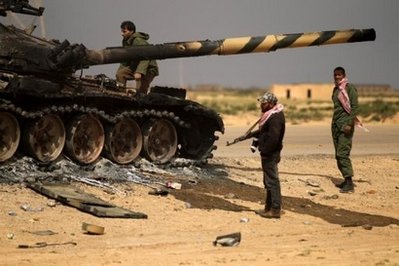
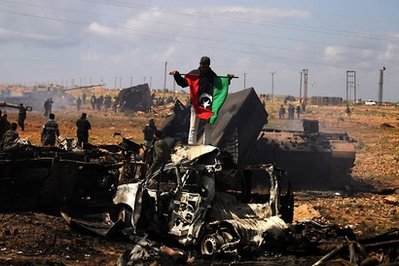
Libyan Rebels gather around a destroyed T-72 outside Benghazi

War is the unfolding of miscalculations.
Barbara Tuchman

Back on the 9th of March I wrote this closing line to an article entitled The Guns of March where I discussed the developing situation in Libya and the really terrible options that world and regional leaders had in response to Muammar Gaddafi’s criminal actions against his own people. I concluded that article with this statement.

There are many possibilities for the situation in Libya to get worse and potentially engulf the region in a war that no one wants or really is prepared for.

We can only see what develops but there are no good options only options of bad or worse. Will the region like Europe in 1914 be engulfed in war where there are no winners or will somehow the situation be resolved before it can get that far?”

It is obvious to all that the region stands a very good chance of becoming engulfed in a regional war unless the rebels drive Gaddafi from power, Gaddafi steps down on his own or he is killed or captured. Gaddafi has promised a “long war” against the “colonial and crusader” enemy.
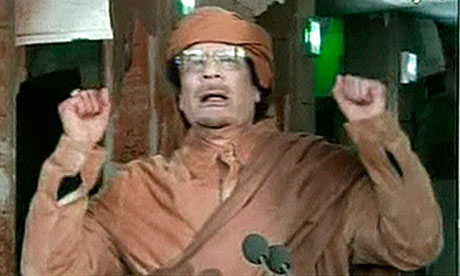
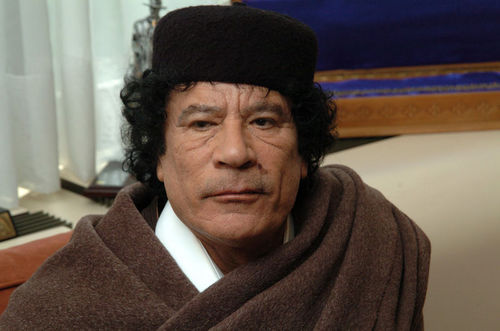
Gaddafi Defiant

In the days since I wrote the referenced article the Arab League spoke up in support of establishing a no-fly zone and the United Nations Security Council voted for member nations to enforce a no-fly zone and take “all necessary measures” in order to stop Gaddafi’s forces attacks on other Libyans. By the time the Security Council acted Gaddafi’s forces had retaken many rebel held cities inflicting great slaughter on civilians and were on the outskirts of the rebel capital Benghazi with Gaddafi threatening to send his forces “house to house” to kill the opposition and promising to show no mercy.  Within a day French and British aircraft were flying missions and striking the spearhead of Gaddafi’s forces outside of Benghazi and United States Navy ships were launching Tomahawk Cruise Missiles at the Libyan air defense system. They were joined by aircraft from the U.S. Navy, Marine Corps and Air Force as well as Canada, Spain, Italy, Belgium, Norway, Denmark and Qatar.  Gaddafi’s forces were decimated outside of Benghazi and forced to retreat and a renewed rebel force, this time acting more like a military organization began a pursuit which has reached Ajdabiya.  In the west Gaddafi’s forces continue to attack the towns of Misrata and Zintan and according to observers and medical personnel inflicting heavy casualties on civilians.
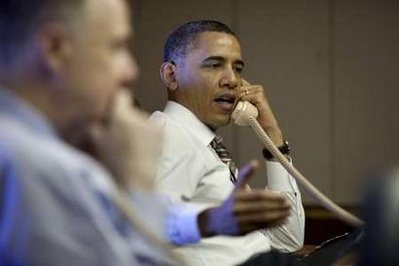
President Obama in a briefing

Around the world there is much criticism of the operation as well as support. In the United States representatives as diverse as Ron Paul and Dennis Kucinich are raising concerns on the Constitutional issues of the intervention in that President Obama did not secure the approval of Congress prior to sending American forces into battle. Kucinich even calls it an impeachable offense.  Likewise a diverse assembly of politicians, former military and executive branch officials including those with experience at the State Department, the United Nations, NATO and the Middle East are voicing their concerns about the fact that the end state of the operation is not defined and about the possibility of mission creep. The administration has not helped matters in sending a number of messages over the past few days of a desired end state. It is obvious that President Obama did not want this fight nor did he want it to appear that we were again leading an attack on an Arab nation.  His hesitancy has led to some conservatives attacking his lack of decisiveness even as other conservatives criticize his decision to join the military operations. Secretary of Defense Robert Gates has been outspoken in his opposition to becoming involved in another war and seems to want U.S. involvement to decrease sooner rather than later.
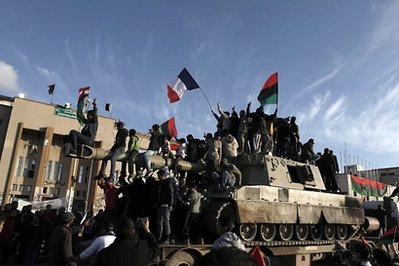
Rebels with damaged 152mm Self Propelled Howitzer

The situation is still evolving by the hour and one thing is clear. The outcome is very unclear and the repercussions across the region are also uncertain. One problem is the apparent discontinuity in U.S. and Western policy to various despotic Arab regimes, supporting the overthrow of Hosni Mubarak in Egypt, a military operation against Gaddafi in Libya and very muted and lukewarm support to popular political movements in Bahrain and Yemen. The Bahraini demonstrations have been put down with the help of Saudi forces but in Yemen numerous influential military officers have taken their units to support the Yemeni protestors. Of course the situation in all of these nations is different with the exception of the fact that all are ruled by long term undemocratic and repressive regimes of varying degree. Likewise actors in each country are different as are the geo-political interests of the United States.

A friend of mine pointed out to me that we are not viewed as “the good guys” in much of the Arab World as much as we see ourselves as such. I think that is true to a large extent because of foreign policy choices of the past century in regard to the Arab World as well as the past decade of war in Iraq and Afghanistan where even today photos taken by a rogue Army unit of soldiers posing with the mutilated and dead bodies enemies of the enemy further degrade opinion in the region against us.  But we are also the hope of many of those in Tunisia, Egypt, Libya and other nations and in those places and others popular uprisings have called out to us for political support and in the case of the Libyans military protection.

Parallels of 1989 in the fall of the Soviet Empire in Eastern Europe are drawn by the optimistic observers of what has been called the “Arab Spring.” However as much as I would like to believe that this is the case I think the miscalculations of 1914 are more readily apparent. There is nothing simple about what is going on and it seems to me that the region is sinking into a war with very unpredictable and grave consequences. Those consequences will probably with us for a generation was were the unanticipated outcomes of the First World War. Of course one of those outcomes was the breakup of the Ottoman Empire and the arbitrary redrawing of boundaries and selection of leaders in the newly created Arab nations and emirates by the victorious Allies. That is something that we are dealing with even as I finish this article.

As I wrote in another article I believe that acting to prevent the slaughter of Libyans by Gaddafi was the right thing to do.  Unfortunately as most observers know the people of Libya will not be safe unless Gaddafi leaves power. I think by backing Gaddafi into a corner early, even before he began his offensive against what were peaceful protestors and not giving him a face saving way out that we may have brought about a war that no one wanted and has few possible good endings. We are damned if we do and damned if we don’t.

Peace

Padre Steve+
3 Comments

Filed under Foreign Policy, History, middle east, Military, national security

Strike on Libya: The Unknown outcome of Operation Odyssey Dawn

Libyan Rebels among tanks and vehicles destroyed by coalition air strikes outside Benghazi (AFP photo)

“No plan survives contact with the enemy.” Field Marshal Helmuth Von Molkte the Elder

“War is the province of chance. In no other sphere of human activity must such a margin be left for this intruder. It increases the uncertainty of every circumstance and deranges the course of events.”
– Karl von Clausewitz

Under the authority of a United Nations Security Council resolution the military forces of a number of NATO nations began air and missile strikes against Libyan air defenses command a control facilities and ground forces.  While the United States and British Royal Navies lobbed salvoes of Tomahawk cruise missiles aircraft from France, Britain, the United States launched the initial air strikes. They have been joined by or soon will be joined by aircraft from Italy, Spain, Denmark, Norway, Canada and Qatar, the first Arab nation to participate. A number of other Arab countries may join the force as operations move from air strikes to the enforcement of the no-fly zone itself. The French Navy has deployed the nuclear aircraft carrier Charles de Gaulle from Toulon and it will join the naval forces in conducting air strikes and enforce the no-fly zone.

Air strikes have significantly degraded Libya’s air defenses and blasted Libyan forces arrayed against the rebel stronghold of Benghazi. The attacks on the ground forces stopped the Libyan attack in its tracks and the rebels have returned to the advance after appearing to be on the verge of a last stand against Gaddafi’s forces. In the past few days Gaddafi and his son Saif Al Islam Gaddafi have said that they would destroy the revolt and show “no mercy” in doing so. It is my belief that Libyan military officers and forces which have been “on the fence” will join the revolt in short order as the rebel forces renew their advance to the west as their loyalty to the regime is tenuous at best.

The strikes though extensive seem to have avoided doing to the Libyan people what was done to the Iraqi people and not targeted power plants or other infrastructure needed by the Libyan people. In other words NATO is trying to make sure that the Libyan people do not suffer for Gaddafi’s crimes. Gaddafi is trying to play up the attack as an attack against Libya by the “Crusader or Colonial enemy.”

Gaddafi has said that he will wage a “long war” and that he would arm a “million civilians” as loyalists gathered in his compound to act as a human shield to protect Gaddafi.  Gaddafi is known for his propaganda and his ruthlessness so we have to believe that he will at least attempt to resist but arming a million civilians is likely beyond his logistical capabilities while under heavy bombardment. The United States and NATO have said that they have not targeted Gaddafi but of course as everyone knows no one would object if Gaddafi happened to be in the neighborhood of a military target.

As the operation is in its early stages it is unknown how it will turn out. Morally and under the United Nations charter it is the right thing to do as Gaddafi was killing civilians and on the verge of killing many more and making the humanitarian crisis even worse. Unfortunately when any military operation is undertaken the consequences are and outcomes are never pre-determined. One hopes that the strikes will keep Gaddafi from killing more of his own people and causing greater chaos in the region. One also hopes that it will encourage the pro-democracy and secular movements that began in Iran but was crushed but which has taken root in Tunisia and Egypt to continue to spread across the Middle East. One hopes that other Arab nations will help Libya recover from Gaddafi and do what is right for the Libyans and for their own people. One also hopes that the strikes will level the playing field enough for the rebels to overthrow Gaddafi and bring him to justice.  So analysts in the Middle East believe that this will be the case. Al Jazeera reports that “Faysal Itani, deputy head of Middle East and North Africa forecasting at Exclusive Analysis tells Reuters that Gaddafi’s use of heavy weaponry against civilians has narrows his options considerably. He says: The doors are really shut for negotiation …  We think Gaddafi will be killed, or commit suicide or simply run away. It’s over.”

Of course one never knows. Gaddafi has stated that he has issued a cease fire but witnesses in Misrata which has been under heavy attack for the past week state that Gaddafi’s forces are still waging a campaign against civilians in that city. Likewise as Nicholas Burns a former United States Undersecretary of State notes that “one of the gambles that Britain, France and the United States, and indeed the Arab League, have taken is not having an agreement on what the mission is. Is the coalition trying to protect civilians in harm’s way, or in essence trying to overthrow Gaddafi? The coalition has intervened in a civil war on behalf of one of the protagonists. They have got to straighten out exactly what they are trying to accomplish.”

That is a big question mark. The real danger in this kind of unscripted intervention is the unforeseen consequences of each action taken. Even an action undertaken with the noblest of reasons can run afoul of unforeseen and undesirable outcomes. Thus only time will tell and we can only hope that freedom comes to Libya and that the bloodshed will end, hopefully with the Gaddafi regime thrown upon the ash heap of history by the Libyan people.

The die has been cast….

Peace

Padre Steve+


2 Comments

Filed under Foreign Policy, History, middle east, Military

In Memoriam: Professor Helmut Haeussler the Most influential Teacher in my Life

I received an e-mail from the History Department of California State University at Northridge this week that a memorial service is to be held for Professor Helmut Haeussler. Dr. Haeussler was my primary professor in the department during my undergraduate years at the school as well as one year of graduate work before I was commissioned as an Army Second Lieutenant and reported for active duty in 1983.

I studied under Dr. Haeussler for three years taking courses such as German History, World War II and the Holocaust followed by an extensive number of independent study courses where I concentrated on Germany from the end of the First World War until the fall of the Third Reich. In this my primary focus was the Weimar Republic and the relationship of the German Army to the Government and the various political parties.

Dr. Haeussler was unique. He was born in Germany in 1922 during the turmoil of the early Weimar Republic and his family immigrated to the United States in the early 1930s. He was attending the University of Wisconsin when the Second World War broke out and served as an intelligence analyst and interpreter with the 82nd Airborne Division and as an interrogator at the Nuremburg trials. After leaving the Army he continued his education eventually graduating with a Ph.D. from in History from the University of Wisconsin.  He joined the faculty at Northridge in 1963 and he retired in 2005, having taught many courses in German History, Modern European History, World War II, the Holocaust, Anti-Semitism, and Military History.  He also taught at California Lutheran College on occasion. He was a tremendous teacher and for our class on the Holocaust he had a survivor of Auschwitz named Mel Mermelstein who challenged Holocuast deniers in court and won. Mermelstein’s fight was dramatized in the television movie called Never Forget in which he was played by Leonard Nimoy.  Dr. Haeussler, a Lutheran from Germany and veteran of the United States Army was a man who did not want the crimes of the Nazis to be forgotten and the dangers of a divided society which has lost its sense of identity.

He wrote a book on the life of General Wilhelm Groener who was a key figure in the formation and preservation of the Weimar Republic from forces on the Left and Right in its fragile early years. Along with the Majority Socialist President Friedrich Ebert and Defense Minister Gustav Noske he forged an alliance between the very conservative Army Officer Corps and the Socialist Government which endured until Ebert’s untimely death in 1925.

Dr. Haeussler spent many hours with me recommending research resources and writers, looking over my work and challenging my conclusions at many points. I still have all of the books from his classes as well as books that he recommended. When I went on to a second Masters Degree, this one in Military History and the work that I did under him paid dividends in those studies. I appreciate what Dr. Haeussler taught me and how he pushed me to constantly pursue learning. Readers of this site can find much of his influence in my writings on Weimar and the Nazi era and application for the present day, especially as our society becomes increasingly divided and the government as ineffective and the Weimar Government after the death of Ebert.

Dr. Haeussler’s passing is also a watershed. He was the last faculty member at Northridge who had served in the Second World War. This is yet another reminder to us of the members of that generation who are passing away at an ever increasing rate.

The information on the memorial is below. I am simply pasting it from the e-mail that I received.

The History Department will hold a reception on Sunday, March 27, at 2 P.M. in the Whitsett Room, Sierra Hall 451.  Emeritus Professor Michael Meyer, a long-time friend and colleague, will bring his violin and play German songs that Helmut would have liked. Faculty, friends, and former students of Professor Haeussler are cordially invited to attend and share their memories. Refreshments will be served.  Please call the History Department, 818-677-3566, so that we may plan accordingly. Parking will be available in the lots west of Sierra Hall.  Visitors must stop at the parking kiosk on Prairie Street, just east of Darby, to obtain a permit.

I wish that I could attend the memorial and spend time with those that worked alongside him and fellow students. I was privileged to have a professor who has continued to influence my learning almost 30 years after my last class with him. I wish that every student would have such a teacher at some point in their life.

Peace

Padre Steve+


7 Comments

Filed under History, remembering friends, world war two in europe

Cataclysm in the Land of the Rising Sun

The Tsunami Hits

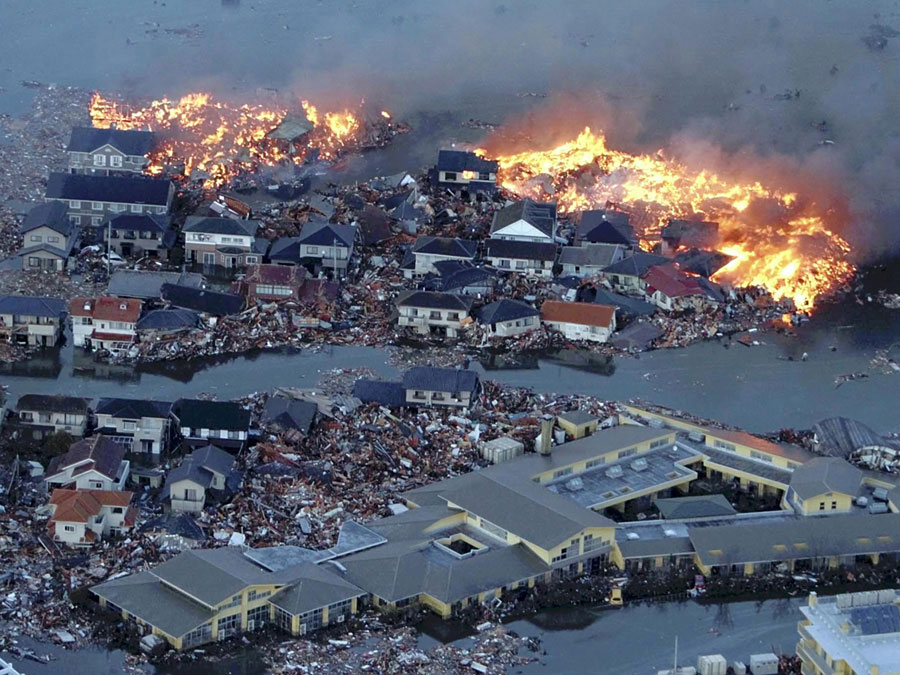
At 2:46 PM Tokyo time on Friday March 11th 2011 one of the largest earthquakes ever recorded struck off the Northeast coast of Japan. The quake which is now measured at 9.1 on the Richter scale caused damage to many structures from Tokyo north to the city of Sendai which bore the brunt of the damage. Had the damage been limited to that caused by the quake itself few would have given it a second thought as Japan has learned to build in such ways that damage from large quakes is minimal; a 7.3 temblor struck the same area on Wednesday with causing no damage. The damage from the quake would have been significant for Japan would have been exponentially greater in almost any other country including the United States. One only has to look at damage from much smaller quakes in the United States, Europe and around the world to verify this fact. The quake was so massive that it moved the coastline of Japan 8 feet.

Fire and Flood after the Quake and Tsunami

Large quakes are not uncommon in Japan but this one was different. It was much stronger than any felt in Japan’s recorded history including the massive 8.1 quake that struck Tokyo on September 1st 1923 the Great Kanto earthquake (Kantō daishinsai) which devastated Tokyo and the surrounding prefects killing between 100,000 and 142,000 people and spawned tsunami some of which were recorded as being 30 meters high.  The bulk of the casualties in that quake were caused in the great firestorms which engulfed the region.

The devastated town of Minamisanriku

The quake which was centered 80 miles offshore at a depth of 6 miles where the North American plate and the Pacific plate meet with the Pacific plate pushing westward and driving under the North American Plate. The North American plate broke under the pressure generated by the Pacific plate and was violently lifted upward creating a massive displacement of water from the Japan Trench creating tsunami. The tsunami struck the coast of Japan quickly but the Japanese tsunami warning system gave residents about a 15 minute notice. The tsunami struck with apocalyptic force sweeping away everything in its path, devastating the city of Sendai burying its airport runway and tarmac while sweeping some towns off the face of the earth with the chaos reaching as far as six miles inland. The official death toll continues to climb to over 1500 but 9,500 people are unaccounted for in the town of Minamisanriku in Miyagi Prefecture alone.

Ships washed ashore at Myagi

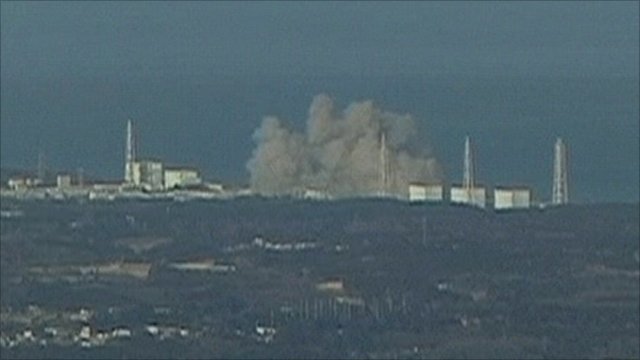
Yet further threats remain. Large aftershocks some nearing 7.0 on the Richter scale, strong enough to create more tsunami continue to rock the region. The new morning has revealed the extent of the devastation and revealed a potential new catastrophe as the Fukushima Daiichi nuclear plant is in danger of losing its remaining battery power to cool down the reactors.  The resultant temperature increase in the containment dome is worrying provoking fears very real fears of a meltdown similar to the one at Three Mile Island caused engineers to vent radioactive steam to lower the pressure in the containment dome. There was a massive explosion in the Fukushima Daiichi nuclear plant’s building which contains the number one unit. Japanese engineers are attempting to flood the containment chamber with sea water but this appears to be a measure of desperation. With the past several hours the highly radioactive element cesium has been detected which indicates that at least some of the fuel rods have melted at the Daiichi number one unit.

The Fukushima Daiichi nuclear plant explodes

The nearby Daini plant has also reported a loss in its ability to control its reactor pressure and Japanese engineers are considering releasing radioactive steam to relieve pressure in these facilities. A state of emergency has been declared at the Daiichi unit, the first in the history of Japan’s nuclear program and residents within twelve miles of the unit have been ordered to evacuate. Three more reactor units at the affected plants are under states of emergency and Japanese engineers are franticly attempting to get power to generators which power the pumps which cool the reactor cores.

Japan has the best civil defense and disaster preparedness system in the world is under tremendous strain. It has mobilized its military in order bolster the rescue and relief operations and asked for international assistance. At the present time 5.1 million homes are without power and over a quarter million people are in emergency shelters, a number which could go up depending on the extent of evacuations near the damaged nuclear plants. The United States has sent warships to provide humanitarian relief efforts including the USS Ronald Reagan, the Command Ship USNS Blue Ridge and several cruisers and destroyers. The USS Essex which had just arrived in Malaysia is getting ready to return to Japan to rendezvous with the USS Harpers Ferry and USS Germantown off Tokyo to prepare for any humanitarian assistance/disaster relief duties.  The 7th Fleet is working to get relief supplies and equipment into position to assist the Japanese. Likewise elements of the III Marine Expeditionary Force to provide helicopters, heavy equipment, medical support and other humanitarian support to affected areas.

Aftermath of the 1923 Great Kanto Quake

The situation is still developing and the danger from aftershocks, additional tsunami and disease related to the flooding as well the nuclear situation will complicate an already cataclysmic event. One cannot discount the possibility that the quake could cause other major seismic events. This is not unprecedented in Japan as the 8.6 Hōei quake of 1707 triggered a major eruption of Mount Fuji (Hōei dai funka) a month later.

Of course I always recommend that people pray for the victims of such disasters but everyone can do a little bit to contribute to relief efforts. CNN has published a list of organizations on its website as well as other pertinent information at http://news.blogs.cnn.com/2011/03/11/tsunami-aid-and-relief-how-you-can-help/ .  Both the Red Cross and Salvation Army have ways to donate $10 via text message with the money being applied to your cellular bill. To donate to the Red Cross text “redcross” to 90999 and for the Salvation Army text either “japan” or “quake” to 80888.

Peace

Padre Steve+

5 Comments

Filed under History, natural disasters

The Guns of March

“War is the unfolding of miscalculations” Barbara Tuchman

Libya Revolt (Al Jazeera)

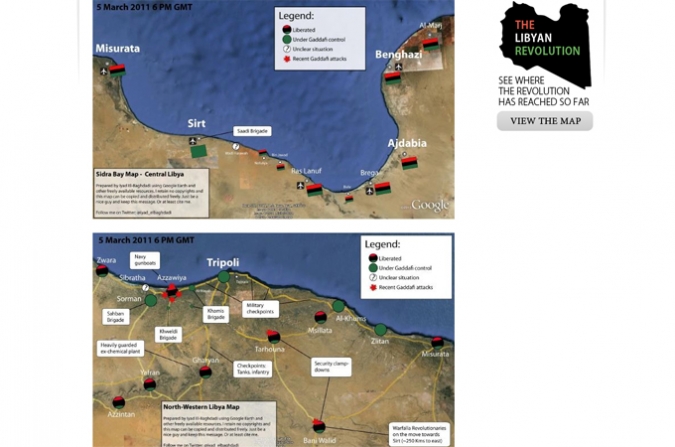
In 1914 an assassination in Bosnia-Herzegovina led to the First World War. In 2011 a civil war in Libya may lead to the destabilization of an entire region and to a regional conflict. A few weeks ago many thought that Libya would take the same course as Egypt and Tunisia. That was before Muammar Gaddafi began to launch an organized campaign of slaughter against his own people using members of his clan as well as African, Arab and Eastern European mercenaries.  Now we wonder what will happen as many actors try to discern courses of action praying that their calculations are correct.

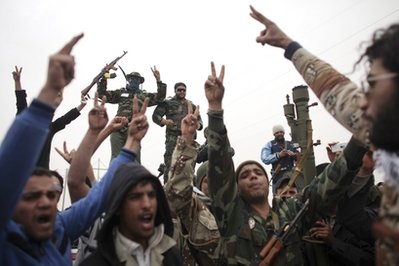
Defecting Libyan Soldiers with protesters (AFP Photo)

If we look at the players we see the Gaddafi clan and its allies who include mercenaries from Africa, other Middle Eastern nations and Eastern Europe battling in a life or death struggle with a disparate and not yet very organized revolutionary movement which has taken many key cities in Libya. Gaddafi’s forces have become quite brutal in their response even as Gaddafi denies attacking his own people and appear in some places to be gaining the upper hand. The rebels have a limited amount of arms and ammunition and few heavy weapons but have given a good account of themselves against Gaddafi’s forces.

The USS Enterprise CVN-65

The United States is really too heavily committed to do much and even if NATO and or the UN agree to establish a no-fly zone over Libya it is doubtful if it will do much to much good on the ground against Gaddafi’s mercenary army and party thugs.  President Obama has asked Saudi Arabia to help arm the rebels and the Saudis and the Gulf Cooperation Council states have asked the United States and NATO to establish a no fly zone to at least protect the rebels from Gaddafi’s helicopter gunships and attack aircraft. Gaddafi has stated that such a no-fly zone would be an act of war.

The words of Western leaders to include President Obama, British Prime Minister David Cameron and France’s Nicholas Sarkozy announcing that Gaddafi has to step down has hardened Gaddafi’s resolve and have whether we want it or not signaled that we are about to engage in another war. Military forces from NATO including the USS Enterprise Carrier Battle Group are being moved to positions that they can either enforce a no-fly zone or assist in humanitarian operations.

While the West debates what to do the fighting continues and Gaddafi’s military unhindered by anyone continues its attacks others in the region seek to gain from the Chaos. Syria has been supporting the Gaddafi regime and it is likely that Iran is seeking to gain more influence in Arab countries that have been hostile to it.  The presence of the two Iranian warships in the Eastern Mediterranean added to the tensions but those ships have now returned to the Red Sea after passing through the Suez Canal after exercises with the Syrians.

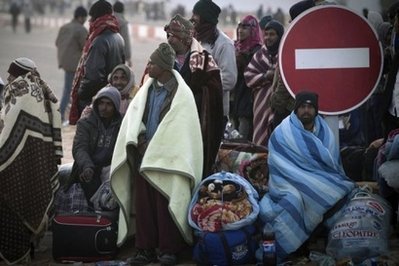
Refugee Crisis (AP Photo)

The fact is that this is a chaotic and ever changing situation. NATO will meet on Thursday to discuss possible courses of action.  Adding to the crisis is the specter of NATO’s abysmally slow response to the Bosnia crisis as well as the United Nation’s, American and European response to the Rwandan genocide. Since the ongoing battle in Libya to include Gaddafi’s slaughter of his own people and the massive refugee crisis on Libya’s borders is televised like the previous crises is in Bosnia and Rwanda Western Leaders are caught in a bind. They can turn a blind eye and chose to let the rebels die on the vine attempting to overthrow Gaddafi and be accused of ignoring crimes against humanity as were their predecessors during the Bosnian and Rwandan events.

There are many possibilities for the situation in Libya to get worse and potentially engulf the region in a war that no one wants or really is prepared for.

We can only see what develops but there are no good options only options of bad or worse. Will the region like Europe in 1914 be engulfed in war where there are no winners or will somehow the situation be resolved before it can get that far? Those are very real questions.

Peace

Padre Steve+


5 Comments

Filed under Foreign Policy, History, middle east, Military, national security

No Illusions: The Cost of the Long War and its Potential impact on the United States

Libya: One of Many unanticipated Crises

There has never been a protracted war from which a country has benefited. Sun Tzu

Don’t fight a battle if you don’t gain anything by winning. Erwin Rommel

The United States and its Allies have been at war for over 10 years and that war has worn us down. Even as we battle for minimal gains in Afghanistan while attempting to finish withdrawing from Iraq the costs of this war are now becoming evident to the most casual observer.

Over 5900 U.S. Military personnel have died in the Iraq and Afghanistan campaigns and over 40,000 wounded. Add to this over 2000 contractors, mostly foreign killed or died or wounds or illness and over 16,000 wounded while employed by firms contracted by the U.S. Government. This does not count Allied military personnel. Thousands more suffer from Traumatic Brain Injury or PTSD or moral injuries that impact their lives and those of their families’ years after serving and the necessary billions of dollars to pay for the medical and psychological wounds of war. Despite increases in funding and personnel the Veterans Administration has been overwhelmed by the numbers of discharged veterans requiring medical or psychological care.

The financial cost of the current wars is astronomical. The official cost is a trillion dollars since 2001 in excess of regular defense spending with Afghanistan costing over 190 million dollars a day. Military equipment including high end equipment such as aircraft are reaching the end of their service lives sooner that planned due to the high operations tempo and sustained combat operations in inhospitable climates. An ossified defense bureaucracy which Defense Secretary Robert Gates says had an “overwhelming tendency of our defense bureaucracy to focus on preparing for future high-end conflicts – priorities often based, ironically, on what transpired in the last century – as opposed to the messy fights in Iraq and Afghanistan,” and a military procurement system laden with pet projects pushed by legislators influenced by lobbyists from defense industries pushing the most expensive and often problem laden systems imaginable. Even those which eventually turn out to be great weapons come in way over budget and take far too long to go from the drawing board to the battlefield. Others turn out to be money pits which sometimes never enter production after years and sometimes decades of development.

Because of the national economic and financial crisis and huge national debts the military is being cut back even as the wars continue and more crises arise in critical regions.  Because of the commitments in Iraq and Afghanistan the United States is now lacking strategic and operational depth to react to new situations. We are fortunate that the ferry sent to rescue American citizens in Libya was not attacked while trapped in Tripoli harbor. The Marine Expeditionary Unit which would normally be at sea for contingency or humanitarian operations is engaged in Afghanistan and the Amphibious Group that supports it is operating east of the Suez.  Two Carrier Battle Groups are now required in the 5th Fleet Area of Operations putting additional strain on our ability to respond to other situations.

Defense Secretary Robert Gates

Very bluntly the long ground wars in Iraq and Afghanistan are taking away from our ability to respond if need be to situations in areas that are actually more important to us and the world in a strategic and economic way.  Secretary Gates knows how much these wars have weakened the military and the nation and in a speech to cadets at the United States Military warned his successors “Any future defense secretary who advises the president to again send a big American land army into Asia or into the Middle East or Africa should ‘have his head examined,’ as General [Douglas] MacArthur so delicately put it.”

The fact is that we are hamstrung by the ongoing wars which limit our ability to respond to rapidly changing situations. We are in a similar situation to the Germans in 1942 and 1943 overcommitted, overstretched and lacking true strategic depth to respond to unanticipated situations as are now occurring across the Middle East. In 1942 and 1943 the Germans were always just just short of the forces that would have turned the tide.

Gates said of our situation:

“We can’t know with absolute certainty what the future of warfare will hold, but we do know it will be exceedingly complex, unpredictable, and – as they say in the staff colleges – ‘unstructured’. Just think about the range of security challenges we face right now beyond Iraq and Afghanistan: terrorism and terrorists in search of weapons of mass destruction, Iran, North Korea, military modernization programs in Russia and China, failed and failing states, revolution in the Middle East, cyber, piracy, proliferation, natural and man-made disasters, and more.”

In September 1944 with the Western Front in ruins Field Marshal Gerd Von Rundstedt was appointed to command German forces in the West. After receiving a briefing from his staff about the situation a senior staff officer asked what they should do. Von Rundstedt reportedly said “Make peace, you fools.” I have placed a link to that incident from the film A Bridge too Far here.

http://www.youtube.com/watch?v=ch56NAL1C-I

I’m not arguing for a precipitous withdraw that would leave an even more chaotic situation in Afghanistan but we have to decide what the end game is there and how we will adjust our strategy to meet reality.

The long war in Afghanistan and the war which we are leaving in Iraq have hurt us in the long run in many ways.  We have to ask hard questions about the war as to whether the continued sacrifices of the Marines, Soldiers, Sailors and Airmen that fight it and the impact on our ability to respond to other crises are something that we think are in our best interests as a nation. At least Secretary Gates is asking the hard questions.

It was Britain’s involvement on the European Continent during the First World War which impoverished her and doomed the Empire. Britain was traditionally a naval power that tried not to become involved on the Continent whenever possible. It is entirely possible that our long war in Afghanistan and Iraq will reduce us as an economic and military power and leave our interests around the world vulnerable just as the World Wars did to Britain.

Peace

Padre Steve+


2 Comments

Filed under Foreign Policy, History, iraq,afghanistan, middle east, Military

The Predictable Unpredictability of Revolution and the Christian Call to Reconciliation

Revolutions often end with one Tyranny replacing another

“In a revolution, as in a novel, the most difficult part to invent is the end.” Alexis de Tocqueville

“All great movements are popular movements. They are the volcanic eruptions of human passions and emotions, stirred into activity by the ruthless Goddess of Distress or by the torch of the spoken word cast into the midst of the people.” Adolf Hitler

We are living in revolutionary times. When we look around the world and down the street we cannot help but notice the flames of revolution burning. While we are focused on the amazing revolutions going on in the Arab World there is revolution brewing in the United States. Revolution that has been stoked on the airwaves and in cyberspace against ineffective government and political parties concerned more about their power and financial institutions that have devastated our economy for years as is hitting our state capitals as the country lurches deeper into economic and social crisis.

“Every successful revolution puts on in time the robes of the tyrant it has deposed.” Barbara  Tuchmann

Many good and honorable people are part of a new revolutionary movement in the United States but such movements sometime morph into the very thing that they protest when unscrupulous people take them over. (Reuters photo)

Whether actual revolutions that have been relatively peaceful in Tunisia and Egypt to ones where those in power have resorted to deadly force such as Libya and Iran as well as those in their incipient stages they are forerunners of many more to come. Just count the countries in the Middle East, Asia, Europe and the Americas where for a variety of reasons protests, dramatic political change and revolts erupt threatening the old order. Be it the overthrow of despots in the Middle East, calls for a Jasmine revolution in China, economic collapse in various European Union countries that cause massive electoral shifts that threaten the breakup of that union, narco-anarchy in Mexico or chaos in U.S. State Capitals all signs tell us that we have entered a new age of revolution. Likewise the talk of revolution is everywhere even in the United States where some in the Tea Party movement call for a revolution against the status quo in Washington D.C. and against the growth and power of the Federal Government.

“The scrupulous and the just, the noble, humane, and devoted natures; the unselfish and the intelligent may begin a movement – but it passes away from them. They are not the leaders of a revolution. They are its victims.” Joseph Conrad

The one constant about revolutions is that they unpredictable even those that begin with the most altruistic of motives. Likewise in many cases those who begin the revolutions often become the victims of those that come after them. That is a fact from history and it is often true that as Barbara Tuchmann said “Every successful revolution puts on in time the robes of the tyrant it has deposed.” That is the danger that is faced as we enter this revolutionary era.

It is always cool to see tyrants fall and for people to have a chance to be free, but unfortunately evil always lurks in the hearts of those who seek to exploit the revolution for their own power’s sake. No movement is immune from this threat and those who are convinced of their own righteousness and rightness of their cause are very likely to take up the mantle of tyranny that they helped overthrow.

Larry Klayman who writes for World Net Daily made this comment in a recent opinion piece on that site:

“What establishment governmental institution will hold our judges, legislators and even the president accountable to the “rule of law”? The answer is none! It’s all one happy club of “establishment felons,” who, whether Democrat or Republican, play the game, scratch each others’ backs and feed at the huge trough of government money and favors.

It’s the establishment, stupid – whether it’s in the good ol’ USA, Cairo or Tripoli – that has ruled the school. And “we the peons,” are given the crumbs that are left after the establishment pillages, rapes, perverts and destroys the at one time noble institutions of government that were created by and for the people.

Thousands of years ago, a revolutionary in the Holy Land confronted a similar total breakdown of values, ethics and the rule of law. He confronted corruption in the highest places of government – before his fellow clergy, the Jewish high priests and the Roman Forum – and did so fearlessly. He paid with his life, and his name was Jesus Christ.

Our rotting and diseased institutions need to be attacked legally and, I am sorry to say, torn down – and then built back up again into the “faithful city of Jerusalem.” While I do not advocate violence – indeed, Jesus never resorted to this – we must urgently find other ways such as civil disobedience to wage a new revolution. We cannot be afraid, and we must act immediately. Because our nation and the planet stand on the precipice of complete chaos and extinction. And, unless we rid it of the vermin who inhabit and have seized our establishment institutions as their own, and reform these corrupt institutions, we will soon perish. The American people did their first house cleaning in our first Revolution.

Now it’s time to bring on the second! If even the Arabs, who have no history of democracy and freedom, can do it, then why can’t we?” Larry Klayman: If Arabs can Revolt why can’t We? 27 February 2011 retrieved from World Net Daily http://www.wnd.com/index.php?fa=PAGE.view&pageId=268289

While the  Revolution in Egypt was mostly peaceful no one is sure exactly how it will end

Klayman voices the anger of many, maybe not a majority but a significant minority of the American electorate, many of which are conservative Christians, a minority that is becoming more organized daily and is threatening to supplant the establishment Republican Party as the voice of conservatism. Now I have little respect for the two corrupt political parties that have gotten us into this mess but when writers, especially Christians refer to people, even corrupt rulers as vermin is scary. I do think that elected and non-elected officials need to be held accountable but never believe that dehumanizing them by referring to them as “vermin” is wise. Such calls usually mean that when the new order, whatever it is comes to power those in the old order are not just swept away but many times exterminated. One only has to look at history to see that this is the case.

Likewise for them to reduce Jesus Christ to a mere revolutionary who “confronted corruption in the highest places” as Klayman does actually does violence to the message of the Gospel of the Kingdom and the message of Jesus which was never about his followers changing governments or overthrowing kingdoms by means other than the love of God and the call to be reconciled to God as Paul the Apostle writes “in Christ God was reconciling the world to himself, not counting their trespasses against them, and entrusting the message of reconciliation to us.” (2 Cor 5:19 NRSV)

Revolutionary times often bring out the worst aspects of the human condition be it from the oppressors or the revolutionaries themselves. The unbridled passions that underlie revolutions are very difficult to contain. Anger, hatred, envy, distrust, cynicism, disrespect and the dehumanization of opponents only add fire to the legitimately unjust and evil conditions which feed calls for revolution and calls for change and often lead to violence and repression from those that harness the revolutionary spirit for their own ends. Revolution often begets tyranny.  Hitler understood this when he said “if today I stand here as a revolutionary, it is as a revolutionary against the Revolution.”

This is the danger zone into which some Christians plunge with wild abandon a zone where some radically depart from the message of reconciliation to the legitimization of violence through their interpretation of Scripture to buttress a political and revolutionary end. Doug Giles who is a commentator at Townhall.com and has his own radio program writes:

“The believer, however, has an insanely powerful arsenal of divinely-inspired dynamite to utilize against unrighteousness and those who propagate it. Yep, Dinky, it’s a prayer against both sin and sinner—the problem and its perpetrator. Theologians call these the imprecatory prayers, or maledictions. I call them Dirty Harry prayers, prayers to pull out and pray when things get bad. Real bad. Prayers you use when a nation’s getting mucked up by degenerate priests or politicos.” Note to Church: Pray Dirty Harry Prayers for Our Nation. Posted July 25, 2009 by nhiemstra in Doug Giles, Townhall.com retrieved 27 February 2011.

Giles uses Scripture to drive home his point but he uses Scripture against Jesus. If I recall correctly Jesus was not about this. He may have pronounced woes upon the religious elite of his time but when they arrested him and abused him he did not protest. He acted in accordance with his instructions to his disciples:

“But I say to you that listen, Love your enemies, do good to those who hate you, bless those who curse you, pray for those who abuse you. If anyone strikes you on the cheek, offer the other also…But love your enemies, do good, and lend, expecting nothing in return. Your reward will be great, and you will be children of the Most High; for he is kind to the ungrateful and the wicked. Be merciful, just as your Father is merciful.” (Luke 6:27-29a and 25-36 NRSV)

In revolutionary times we are not called to become one with the revolution nor the status quo brought about by corrupt rules, institutions or oppressors. The call of the Church and Christians is to be salt and light and ambassadors of Christ’s call for humanity to be reconciled to God and to one another. It certainly is not a popular position now days as extremists of all types, including Christians throw gasoline on already raging fires.

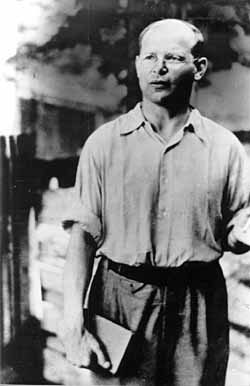
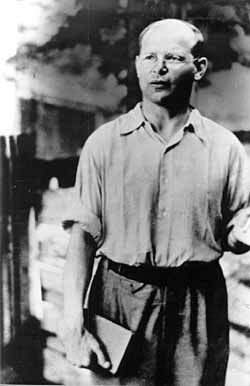
Dietrich Bonhoeffer

Dietrich Bonhoeffer so stranger to the evils of revolutionary times and the tyrants that they often beget wrote in “The Cost of Discipleship”

“The followers of Christ have been called to peace. . . . And they must not only have peace but also make it. And to that end they renounce all violence and tumult. In the cause of Christ nothing is to be gained by such methods. . . . His disciples keep the peace by choosing to endure suffering themselves rather than inflict it on others. They maintain fellowship where others would break it off. They renounce hatred and wrong. In so doing they over-come evil with good, and establish the peace of God in the midst of a world of war and hate.”

C. S. Lewis

That call is radically different than almost anything that we hear from politically active “revolutionary” Christians.  One of my regular readers posted a response to an article that I wrote a few days ago. In that response he quoted C. S. Lewis from his book The Screwtape Letters.” The quote which I include here is so appropriate to the spirit of our times and Lewis in one of his typically poignant observations has the demon Screwtape write his nephew Wormwood of how to use Christianity as a means to bring down mankind.

Uncle Screwtape pens his advice

“Whichever he adopts, your main task will be the same. Let him begin by treating the Patriotism or the Pacifism as a part of his religion. Then let him, under the influence of partisan spirit, come to regard it as the most important part. Then quietly and gradually nurse him on to the stage at which the religion becomes merely part of the “cause”, in which Christianity is valued chiefly because of the excellent arguments it can produce in favour of the British war-effort or of Pacifism. The attitude which you want to guard against is that in which temporal affairs are treated primarily as material for obedience. Once you have made the World an end, and faith a means, you have almost won your man, and it makes very little difference what kind of worldly end he is pursuing. Provided that meetings, pamphlets, policies, movements, causes, and crusades, matter more to him than prayers and sacraments and charity, he is ours—and the more “religious” (on those terms) the more securely ours. I could show you a pretty cageful down here.”

Screwtape’s advice seems to have been heeded by many Christians in the United States. Our causes have usurped the faith. Scripture is nothing but a tool to advance the causes that we choose and the politics that we follow.

We do live in interesting times don’t we? Pray for me a sinner.

Peace

Padre Steve+


1 Comment

Filed under christian life, faith, History, middle east, Political Commentary, Religion

The Intangible Force of Morale: A Leadership Lesson from Field Marshal William Slim

Field Marshal William Slim

Field Marshal William Slim was one of the most brilliant commanders of the Second World War. He gets little press and there are not a lot of books written about him. Slim was one of those unique officers who served on the periphery of the British Empire as an office in the British Indian Army. He was a clerk in a factory who attended the University of Birmingham and commissioned as a reserve officer through its reserve officer training course; he did not attend Sandhurst, the British equivalent of the U.S. Military Academy.  He was commissioned in 1914 and assigned to the Indian Army. He served at Gallipoli and Mesopotamia in the First World War and at Gallipoli saw the immense waste of human life which led him in his future commands never to sacrifice his men in senseless operations. Between the wars he served in India with the Gurkhas and also spent a significant time as a student and an instructor. He did was not promoted to Lieutenant Colonel and given command of a battalion at the age of 46.  However during the war he rose from Battalion to Brigade and then Division command and achieved his Generalship through wartime promotions remaining a Colonel on the regular list while serving in the British campaign against the Italians in the Sudan and the invasion of Iraq. When the war was at its lowest point and British forces were collapsing against the relentless Japanese advance in Burma he was assigned to command Burma Corps which eventually became the British 14th Army, sometimes better known as the “Forgotten Army.” He took command and had to conduct a 900 mile withdraw under desperate conditions. His Army was emaciated, poorly equipped and beaten, but his leadership during that retreat saved his army and kept their spirit alive.  However it was his leadership that turned the Army around restored it and then conducted an amazing campaign to drive the Japanese out of Burma.

Slim has some of the most brilliant insights into leadership and I am just going to throw out one here.

Morale is a state of mind. It is that intangible force which will move a whole group of men to give their last ounce to achieve something, without counting the cost to themselves; that makes them feel they are part of something greater than themselves. If they are to feel that, their morale must, if it is to endure–and the essence of morale is that it should endure–have certain foundations. These foundations are spiritual, intellectual, and material, and that is the order of their importance. Spiritual first, because only spiritual foundations can stand real strain. Next intellectual, because men are swayed by reason as well as feeling. Material last–important, but last–because the very highest kinds of morale are often met when material conditions are lowest.

This is something that is really important and something that I think that we have lost all sense of in the West and why we struggle against insurgents who are inferior to us in every military aspect. We focus on the material first, technology has become our God, and it is our answer to everything.  Next we do emphasize the intellectual but often what we emphasize is formulas, templates or the learning of abstract principles that that are hard to apply in the real world. We often study things that don’t necessarily apply to the war that we are currently engaged and try to make the reality fit our templates rather than taking the time to really learn. With all our technology we have also lost much of the sense of personal leadership where leaders actually know their soldiers.

Slim understood these principles and they were not abstract, they were real because he took the time to know his soldiers and they knew that in spite of the incredible hardships of the war in Burma that Slim understood them and would not sacrifice them needlessly. He trained his men hard in the tactics that would be needed to drive the Japanese from Burma and his leadership would pay off. His ability to hold leaders accountable for the welfare of their soldiers and his ability to relate to all kinds of soldiers made him one of the most unique and successful commanders of the war. After the war he retired but was called out of retirement to replace Field Marshal Bernard Montgomery as the Chief of the Imperial General Staff indeed a rare feat for a man who began his career as a clerk in a factory.

I am going to come back to Slim in later writings. This is just a taste of Slim’s thought and my interpretation of it.

Peace

Padre Steve+
1 Comment

Filed under History, leadership, Military, world war two in the pacific

Christian Radicalism?

“God loves human beings. God loves the world. Not an ideal human, but human beings as they are; not an ideal world, but the real world. What we find repulsive in their opposition to God, what we shrink back from with pain and hostility, namely, real human beings, the real world, this is for God the ground of unfathomable love.” — Dietrich Bonhoeffer

Dietrich Bonhoeffer grew up in an era of world war, the collapse of Empires and social order, economic collapse, revolutions and the rise of the greatest evils that the world has ever seen. Bonhoeffer recognized evil in the world and the dangers of radicalism. He was a child when the First World War ended and the Kaiser abdicated and Germany went through a violent civil war, the humiliation of the Treaty of Versailles, economic calamity, Communist and Fascist coup attempts which finally led to the Nazi takeover by legal means. When the Nazis came to power Bonhoeffer was a young pastor.  He was one of the first to recognize the evil of the Nazi state and Nazism as well as its hold over Christians from all denominations.

We live in somewhat similar times. These are unsettled and great evil exists, evil which seeks to destroy the world in order to make it in its own image.  Some of these are godless, materialist and secular while others are rooted in the Great Religions as well as others in mysticism and individualistic spirituality all of which see the world and for that matter humanity, especially those that are not like them as the enemy. We are well acquainted with the extremism associated with Islamic terrorism as well as that of others with more politically based ideologies which have committed murder on a massive scale and wherever they rule oppress their own people, however Christians are not immune to radicalism usually radicalism in what they see as a godly response to the evils of their time. Bonhoeffer saw the danger of Christians who become radicalized in relationship to how such radicalization stands in antithesis to the Gospel which in restoring fallen humanity to relationship with Christ commands that those that have been reconciled to him has now “given us the ministry of reconciliation; that is, in Christ God was reconciling the world to himself, not counting their trespasses against them, and entrusting the message of reconciliation to us. So we are ambassadors for Christ, since God is making his appeal through us; we entreat you on behalf of Christ, be reconciled to God. For our sake he made him to be sin who knew no sin, so that in him we might become the righteousness of God.”  2nd Corinthians 5:18b-21

Bonhoeffer penned this from inside a Nazi prison awaiting his execution.

“Radicalism always springs from a conscious or unconscious hatred of what is established. Christian radicalism, no matter whether it consists in withdrawing from the world or in improving the world, arises from the hatred of creation. The radical cannot forgive God his creation. He has fallen out with the created world, the Ivan Karamazov, who at the same time makes the figure of the radical Jesus in the image of the Grand Inquisitor. When evil becomes powerful in the world, it infects the Christian, too, with the poison of radicalism. It is Christ’s gift to the Christian that he should be reconciled with the world as it is, but now this reconciliation is accounted to be a betrayal and denial of Christ. It is replaced by bitterness, suspicion and contempt for men and the world. In place of the love that believes all and hopes all, in the place of the love which loves the world in its very wickedness with the love of God (John 3:16), there is now the pharisaical denial of love to evil, and the restriction of love to the closed circle of the devout. Instead of the open Church of Jesus Christ which serves the world till the end, there is now some allegedly primitive Christian ideal of a Church, which in its turn confuses the ideal of the living Jesus Christ with the realization of a Christian ideal. Thus a world which is evil succeeds in making the Christians become evil too. It is the same germ that disintegrates the world and that makes the Christians become radical. In both cases it is hatred towards the world, no matter whether the haters are the ungodly or the godly. On both sides it is a refusal of faith in the creation. But devils are not cast out through Beelzebub.” (Letters and Papers from Prison p.386)

This Christian radicalism has become a very real part of the American religious-political landscape and it has managed to poison a generation through the Dominionism. The man who can be called the founder of this movement which has become one of the loudest voices in American Evangelicalism, the Charismatic and Pentecostal movement and other Christian groups spanning the denominational spectrum is R.J. Rushdoonny.  Rushdoony’s version of the Christian faith is an Old Testament militancy based upon Israel’s conquest of the Land of Promise. Some examples of Rushdoony’s theological argument which is echoed by many American Christian conservatives are found here:

Israel was attacked by Amalek. According to Deuteronomy 25:17, Amalek “feared not God.” Amalek’s attack on Israel, according to the “Midrashic lore,” was an obscene defiance of God and a contempt for God. Where men attack God’s people, there we often have a covert or overt attack on God. Unable to strike directly at God, they strike at God’s people. There is thus continual warfare between Amalek and Israel, between God’s people and God’s enemies. The outcome must be the blotting out of God’s enemies…. the covenant people must wage war against the enemies of God, because this war is unto death. The deliberate, refined, and obscene violence of the anti-God forces permits no quarter… this warfare must continue until the Amalekites of the world are blotted out, until God’s law-order prevails and His justice reigns.” R.J. Rushdoony, The Institutes of Biblical Law (Nutley, NJ: Craig Press, 1973), p. 318.

Rushdoony’s son in law Gary North is now the primary ideological and theological spokesman for the Dominionist movement. He is very popular and influential in many conservative and political circles and with the Tea Party movement. North makes the following comment in relation to the Christian’s relationship and attitude when dealing with the world.

“It occurs to me: Was Moses arrogant and unbiblical when he instructed the Israelites to kill every Canaanite in the land (Deut. 7:2; 20:16-17)? Was he an “elitist” or (horror of horrors) a racist? No; he was a God-fearing man who sought to obey God, who commanded them to kill them all. It sounds like a “superior attitude” to me. Of course, Christians have been given no comparable military command in New Testament times, but I am trying to deal with the attitude of superiority–a superiority based on our possession of the law of God. That attitude is something Christians must have when dealing with all pagans. God has given us the tools of dominion.” Gary North, The Sinai Strategy: Economics and the Ten Commandments (Tyler, TX: Institute for Christian Economics, 1986), p. 214n

This militancy has gained popular support since the 2008 elections and is reflective of the bitter and angry undercurrent which pervades many Christian political activists many of whom are very comfortable with using violence against those that they believe are their enemies. A similar tenor is found in some of their opponents on the Left who speak of bloodshed.

However such words and actions often mirror those of their proclaimed enemies the radicals of which use similar words of violence and justification of brute force to achieve their goals. Those who do not agree with such theology or ideology be that from those in the Dominionist movement or the more radical leftists are as much of an enemy as anyone else. Neither side will stop until they conquer and destroy every bastion of the other. The war between the “godless and the godly” to quote Bonhoeffer is actual a war against the creation and humanity that God through Christ seeks to redeem.

Bonhoeffer made a very poignant observation:

“There is a truth which is of Satan. Its essence is that under the semblance of truth it denies everything that is real. It lives upon the hatred of the real and the world which is created and loved by God. It pretends to be executing the judgment of God upon the fall of the real. God’s truth judges created things out of love. And Satan’s truth judges them out of envy and hatred. God’s truth has become flesh in the world and is alive in the real, but Satan’s truth is the death of all reality.” Bonhoeffer Ethics p. 366

As I look around and see the great conflict in our country with two sides determined to win at any cost and demonize any contrary opinion and fear for what will overtake us as the Satanic truth proclaimed from all sides of the political and religious spectrum consumes the land. In the midst of such discourse which is trending toward physical violence as the extremes battle for power the Church and Christians are commanded to demonstrate the love of God to all people no matter how vile their outbursts or prejudice. As Paul wrote to the Corinthians “God has entrusted the ministry of reconciliation to us.” It is this reconciliation of the real Incarnate Jesus Christ that must be made present in the midst of the current darkness. Christian radicalism is as poisonous as godless radicalism and it has no answers. It is time to cast it aside.

Peace

Padre Steve+


4 Comments

Filed under christian life, film, History, philosophy, Political Commentary, Religion

Harbingers of the Future: The German Type XXI Electroboote U-Boats

Throughout history there have been ships that have changed the course of Naval strategy and made previous types of ships obsolete overnight, the USS Monitor, the HMS Dreadnought and USS Nautilus are three, but add to the list the German Type XXI U-Boats which forever changed the way that submarines were built around the world.

The Type XXI was designed in 1943 in order to regain the initiative and thereby reassert German naval power in the Atlantic in order to turn the tide against the Allies.  By 1943 the Allies had turned the tide against the Germans as the Type VII and Type IX U-Boats took heavy losses against naval units and convoys which now had air support at every stage of their trek across the North Atlantic. These boats had to surface for prolonged periods in order to recharge their batteries and had limited range, speed and endurance when submerged. The advent of the Escort Carrier, long range patrol bombers and hunter killer groups of Destroyers and the new Destroyer Escorts took a great toll on the U-Boat Force.

U-3008 in U.S. Navy Service

In order to meet the challenge the Germans opted for new technology based on the high speed hydrogen powered Walter turbines for underwater operations.  Since these turbines which could produce a high underwater speed had a short endurance the designers modified the design to use conventional diesels but equip the boats with batteries that had three times the capacity of previous boats. The boats were a radical change from all previous submarine designs which were basically surface ships with the ability to operate underwater for limited periods of time. The Type XXIs were really the first true submarines. They could operate at underwater speeds that were faster than many of their opponents, had a streamlined design which facilitated higher submerged speed of 18 knots and silent running making them very difficult to track.  They could remain underwater for 11 days while only needing 5 hours to recharge their batteries when using the schnorkel device.

The Wilhelm Bauer the former U-2540 in 1960

The Type XXI had a full streamlined hull and conning tower and even equipment which were externally mounted such as the radio antennae, hydrophones, DF Ring and forward planes were fully retractable. They had no deck guns and their twin 20mm flak guns mounted in a streamlined housing on the conning tower. The German designers eliminated the traditional open bridge in favor of three small openings for the watch officer and 2 lookouts. They had a superior silent running ability and at 15 knots were quieter than the US Navy Balao Class doing 8 knots.  They had a 1 inch thick steel aluminum alloy pressure hull with a designed crush depth of 280 meters (919 feet), a greater designed crush depth than any previous submarine.

They incorporated other innovations which would be incorporated into the post-war submarines of the victorious Allied powers. Among these innovations were semi-automatic hydraulic torpedo reload system which allowed three 6 torpedo salvos to be fired in less than 20 minutes where prior U-Boats had manual reloads and took over 10 minutes to reload a single torpedo. To make the fullest use of this capability the German equipped the boats with an advanced passive and active sonar system called the called Gruppenhorchgerät and Unterwasser-Ortungsgerät NIBELUNG mounted in the bow. The improved passive system enabled the boats to close to where they could emit short active sonar bursts to fix the target location. They could fire from a depth of 160 feet. The torpedoes themselves were an advanced design called the LUT or Lageunabhängiger Torpedo. The LUT was a guided torpedo that could be fired from the U-Boat regardless of the target’s bearing as it was programmed to steer an interception course programmed by the torpedo computer.

Submarines influenced by the Type XXI

USS Gudgeon a Tang Class submarine

Polish Submarine ORP Orzel a WHISKEY Type Submarine

USS Nautilus on trials

The Type XXI boats were unique in production as they had no prototype and went directly in production. They were assembled from prefabricated sections built from factories around Germany and transported to the major shipbuilding yards. This was efficient but caused problems that slowed final assembly as many of the factories had no experience building U-Boats and quality suffered because the exacting specifications required by the Kriegsmarine.  Likewise Allied air strikes on German factories and rail networks hampered production. Yet even in spite of these difficulties 119 Boats were completed although only four were rated as combat ready and only two were fully operational at war’s end. Of these only one embarked on a war patrol.  Most were destroyed in air attacks while in port or scuttled by the Germans to prevent their capture.  Eight Type XXIs were taken over by Allied navies at the end of the war where they were used to evaluate technology for use in future submarines. The U.S. Navy Tang Class boats were heavily influenced by the Type XXI as were the GUPPY upgrades to Balao and Tench class boats.  The first nuclear submarines of the U.S. Navy, the Nautilus, Seawolf and the Skate Classes all incorporated design features of the Type XXIs. The Soviet Union developed its 613 and 614 project submarines which became the type known by NATO as the WHISKEY class from the Type XXIs that they received following Germany’s surrender. In 1957 the Federal Republic of Germany raised the scuttled U-2540 and commissioned her as the research submarine Wilhelm Bauer. That boat was operated by both the Bundesmarine and civilian crews until her decommissioning in 1982. She is now a museum ship open to the public in Bremerhaven.

The Type XXIs were the first true submarines and influenced every submarine constructed since. Though introduced too late in the war to make a difference they were truly a wonder-weapon.

Peace

Padre Steve+


1 Comment

Filed under History, Military, Navy Ships, world war two in europe