Category Archives: iraq,afghanistan

Iraq and the Middle East 2013: Lessons from T. E. Lawrence

295_26912097058_4309_n

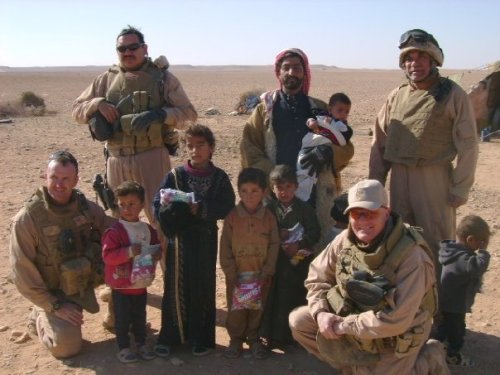
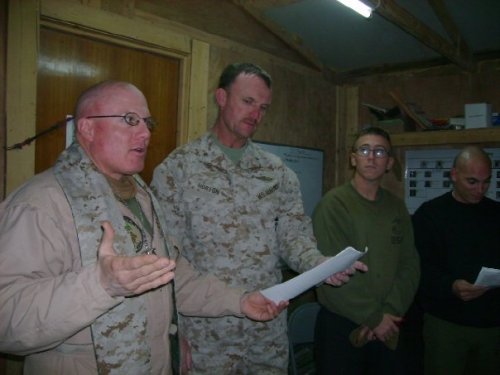
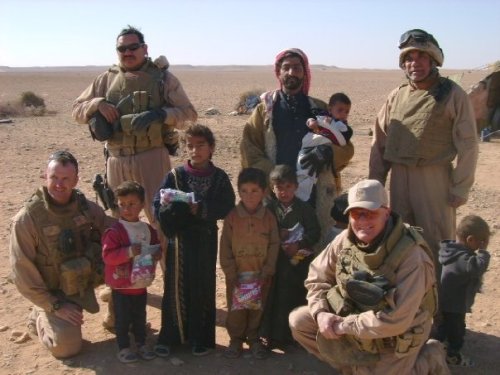
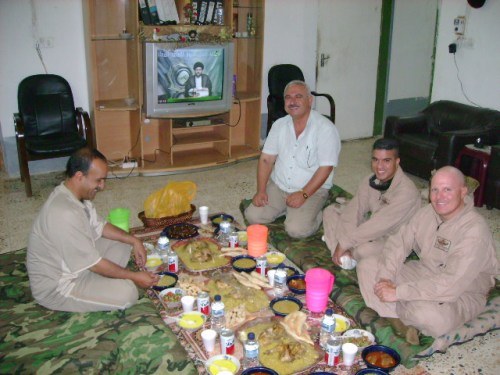
The Author with Advisors and Bedouin on the Iraqi Syrian Border

I left Iraq just under five years ago and in the process left part of me in that long suffering country.  I have written much about my experience there and how even today I have a deep regard for the Iraqi people and their hopes for a better future.

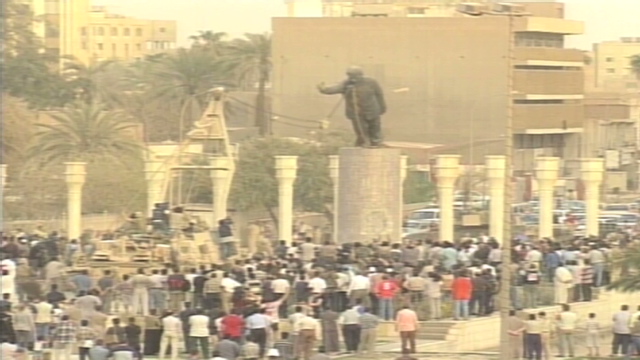
In 2003 the United States invaded Iraq and made short work of that country’s military. Many, if not most Iraqis of all creeds looked upon the US and coalition forces as liberators but within a few months the illusion was over. The US military personnel and leaders who were working with Iraqi officials, both military and civilian to get the country back on its feet were replaced by the Bush administration.
vault.von.saddam.statue.fall.itn.640x360

False Hopes in 2003, believing that US Forces were Liberators 

In their place a new entity, the Coalition Provisional Authority was created and staffed. The first administrator of the entity was retired Army Lieutenant General Jay Garner, who had much experience in Iraq but was replaced quickly for not conducting an immediate purge of members of the Ba’athist Party from key positions in the civil service or security forces.  Led by Ambassador L. Paul Bremer, a man who had no experience in the Arab world, much less in Iraq. Bremer and his staff, most of who had little experience or knowledge of the country created conditions that directly led the the Iraq insurgency, the sacrifice of thousands of American and allied lives and the friendship of the Iraqi people. They also gave a victory to Iraq’s traditional enemy and oppressor Iran to become a dominant regional power without having to worry about the Iraqi threat.

410w-1

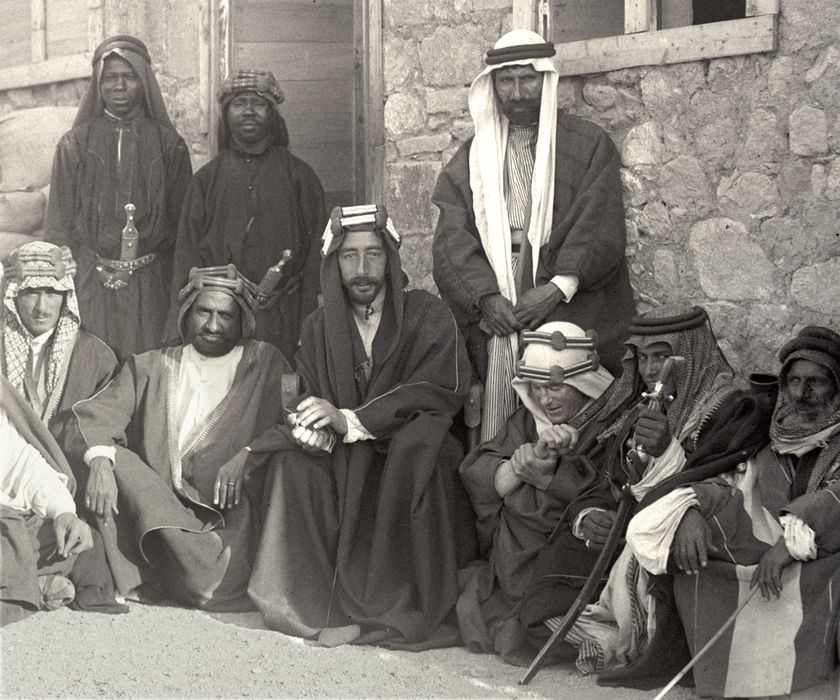
Lawrence

rumsfeld-bremerL Paul Bremer (r) with SECDEF Donald Rumsfeld

It was as if Bremer, the leaders of the Bush administration and their neo-conservative allies knew nothing of history. T.E. Lawrence wrote of the British incursion into Turkish Mesopotamia in 1915, managed by the British Indian Office:

“By brute force it marched then into Basra. The enemy troops in Irak were nearly all Arabs in the unenviable predicament of having to fight on behalf of their secular oppressors against a people long envisaged as liberators, but who obstinately refused to play the part.”

The actions of the CPA laid waste pragmatists in the Pentagon and State Department who hoped that existing civil service, police and military forces would be retained and individuals with significant ties to the regime of Saddam removed. Instead Bremer dissolved the Iraqi military, police and civil service within days of his arrival. Since the military invasion had been accomplished with minimal forces most Iraqi weapon sites, arsenals and bases were looted once their Iraqi guardians were banished and left their posts. The embryonic insurgency was in effect given a full arsenal of weapons to use against American forces, many of who were now mobilized Reservists and National Guardsmen that were neither trained or equipped to fight an insurgency or in urban areas.

The reaction of the Iraqi Arabs to US occupation should have been anticipated. Lawrence wrote in 1920 a letter that could have easily been written in 2004:

“It is not astonishing that their patience has broken down after two years. The Government we have set up is English in fashion, and is conducted in the English language. So it has 450 British executive officers running it, and not a single responsible Mesopotamian. In Turkish days 70 per cent of the executive civil service was local. Our 80,000 troops there are occupied in police duties, not in guarding the frontiers. They are holding down the people.”
295_26912047058_2328_n

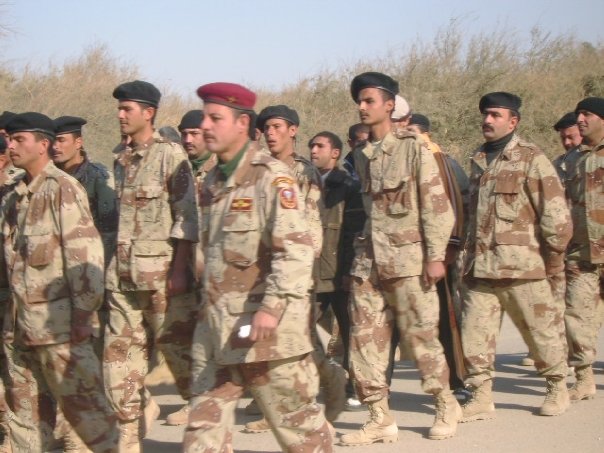
Rebuilding an Army

The actions of Bremer’s incompetent leadership team led to a tragic insurgency that need not have taken place. The now unnumbered US forces had to fight an insurgency while attempting to re-create an army, security forces and civil service from the wreckage created by Bremer’s mistakes and its own often heavy handed tactics in the months following the invasion. Nearly 4500 US troops would die and over 30,000 more wounded in the campaign. Hundreds of thousands of Iraqis were killed, wounded or died of disease during the war.  Lawrence wrote about the British administration of Iraq words that could well have been written about Bremer’s Coalition Provisional Authority: “Meanwhile, our unfortunate troops, Indian and British, under hard conditions of climate and supply, are policing an immense area, paying dearly every day in lives for the wilfully wrong policy of the civil administration in Bagdad.”

It took dramatic efforts in blood and treasure to rebuilt that was only beaten back after the US acted to conduct a surge in conjunction with the revolt of the Sunni of Anbar Province against foreign fighters who had become a dominant force in the insurgency. The surge under the command of General David Petreus achieved the desired result. It gave the Iraqis a chance to stabilize their government and increase their own security forces. Unfortunately many of those that remained in power of the Shi’ite sect refused to  share power in meaningful ways with Iraq’s Sunni and Kurds leading to a political crisis. The US military mission ended in December 2011 and since then Iraq security forces and civil authorities, often divided by tribal or sectarian loyalties have struggled to maintain order. The result is that in 2013 that Iraq is again heading toward the abyss of civil war. Sunni protestors in Anbar and other provinces conduct frequent protests as sectarian violence spreads. Many Iraqis of all sects have mixed feelings about the American invasion and the bloody aftermath and fear the future.

In 1920 Lawrence wrote of the continuing British intervention and occupation of Iraq: “The people of England have been led in Mesopotamia into a trap from which it will be hard to escape with dignity and honour. They have been tricked into it by a steady withholding of information. The Bagdad communiqués are belated, insincere, incomplete. Things have been far worse than we have been told, our administration more bloody and inefficient than the public knows. It is a disgrace to our imperial record, and may soon be too inflamed for any ordinary cure. We are to-day not far from a disaster.”

His words have a sadly familiar tone. The US invasion of Iraq did have a different outcome than we imagined. The Arab Spring erupted and the consequences of it will be far reaching and effect much of the Middle East and the world. However, Lawrence’s words and wisdom concerning the Arabs who rebelled against the Turkish Ottoman Empire are something that we in the West need to heed today.
baghdad1917

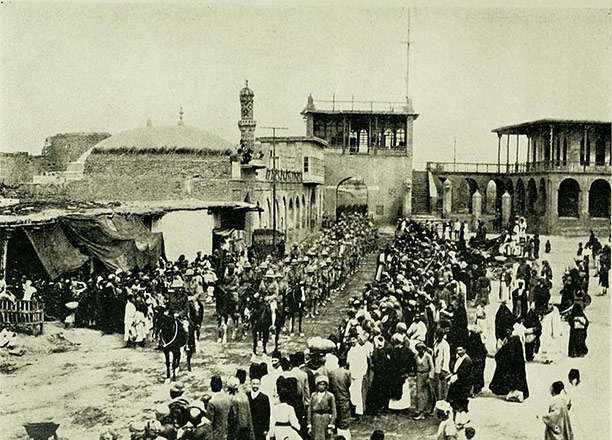
British Troops entering Baghdad

“The Arabs rebelled against the Turks during the war not because the Turk Government was notably bad, but because they wanted independence. They did not risk their lives in battle to change masters, to become British subjects or French citizens, but to win a show of their own.”
481801_10151367001287059_1003164983_n

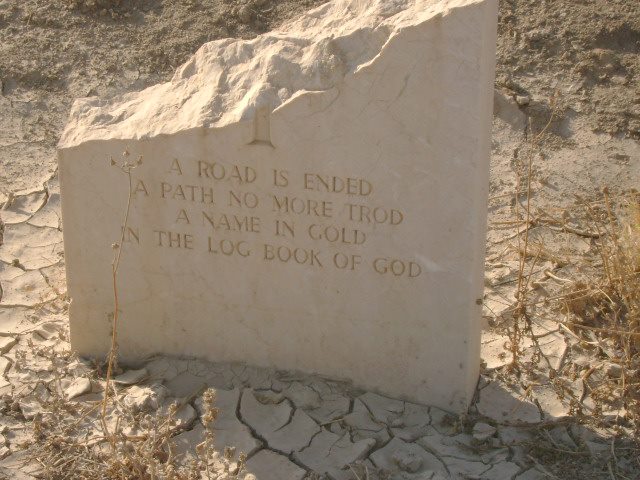
Grave of a British Soldier in Habbaniyah Iraq

That is the case in many Arab countries today. One can only hope that in those countries and in Afghanistan where our troops are embroiled in a war that cannot end well that we will do better.

Peace

Padre Steve+
2 Comments

Filed under Foreign Policy, History, iraq,afghanistan, middle east, national security

The Loss of an Icon: General Norman Schwarzkopf dies at 79

201212281047938734_20

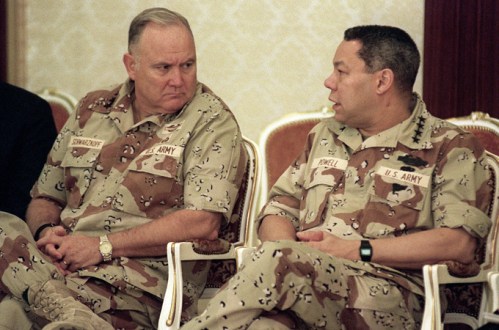
Schwarzkopf and Powell, the Eisenhower and Marshall of their Era

“Do what is right, not what you think the high headquarters wants or what you think will make you look good.” 

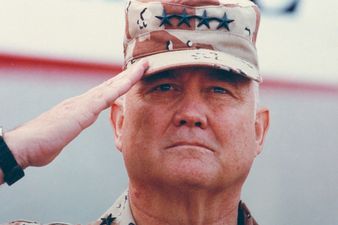
Americans lost a military hero and an icon yesterday. General Norman Schwarzkopf died in Tampa at the age of 79 due to complications of pneumonia.

Schwarzkopf was one of the most brilliant commanders of his era, a multi-dimensional character who was to many of us bigger than life.

Schwarzkopf was the quintessential Army Brat, growing up on military bases in the United States as well as in diplomatic posts overseas. The son of General he graduated from West Point, was commissioned as an infantry officer, became a paratrooper at Fort Campbell Kentucky before being assigned to the Berlin Brigade, a post he left just prior to the erection of the Berlin Wall by the Soviets and the East Germans. He completed a Masters degree in Mechanical Engineering from USC and was assigned as an instructor at West Point.

sch0-008a

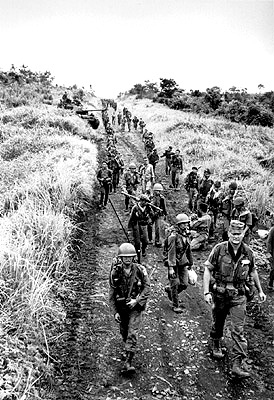
Schwarzkopf helping to carry a wounded South Vietnamese Paratrooper 

During that tour he volunteered to serve as an advisor with South Vietnamese paratroopers.  After that tour and the completion of his tour at West Point he was promote to Lieutenant Colonel and commanded the 1st Battalion 6th Infantry, 198th Brigade and was wounded while with his troops and who in the crisis kept his head and helped lead his troops, though seriously wounded out of the trap. He was known with affection by many soldiers as “the Bear,” a moniker that he appreciated much more than Desert Storm media nickname of “Stormin’ Norman.”

sch0-017

Schwarzkopf with ARVN Paratroops

It was during his time in Vietnam that Schwarzkopf came to a realization about men at war and his own personality. “I prided myself on being unflappable even in the most chaotic of circumstances,…That guise lasted until Vietnam, where I realized that I was dealing with human lives and if one were lost, it could never be replaced. I quickly learned that there was nothing wrong with being emotional.”

sch0-007a

Following his time in Vietnam he remained in the Army to help be a part of its rebuilding as an All Volunteer force. By the late 1970s he had served as a Brigade commander in the 9th Infantry Division and Assistant Division Commander in the 8th Infantry Division before taking command of the 24th Infantry Division in late 1982. He was appointed the Deputy Commander for the Joint Task Force that invaded Grenada in 1983 and in 1988 was appointed Commander for the US Central Command.

1general122812

It was in this capacity that he took command of US and coalition troops gathering to respond to Saddam Hussain’s invasion of Kuwait in August 1981. His leaders and planning cells helped engineer a military campaign in conjunction with the admirable skill of President George H.W. Bush and his diplomats the successful expulsion and destruction of Saddam’s forces. While some criticize the decision not to continue the war and go on to Baghdad Schwarzkopf made a comment that those that invaded Iraq in 2003 might well have better heeded: had “we taken all of Iraq, we would have been like a dinosaur in the tar pit — we would still be there, and we, not the United Nations, would be bearing the costs of that occupation.”

20436634_BG1

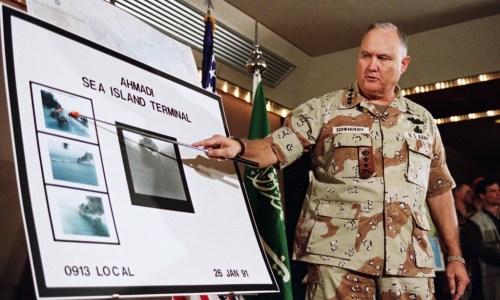
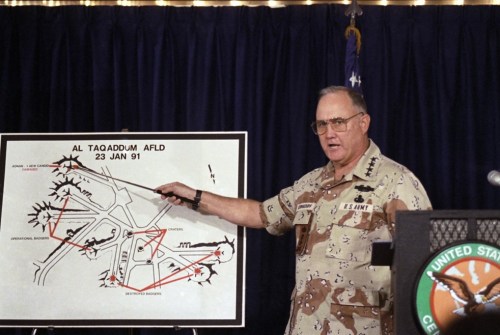
Schwarzkopf’s Briefings

After his retirement he was active in supporting cancer research programs, efforts to save the Grizzly Bear and was a military commentator and analyst for NBC. Although he supported the invasion of Iraq in 2003 he asked questions that few were asking. In early 2003 he told the Washington Post: “What is postwar Iraq going to look like, with the Kurds and the Sunnis and the Shiites? That’s a huge question, to my mind. It really should be part of the overall campaign plan.”  Following the invasion and the beginning of the insurgency he became a critic of the operation. He was particularly critical of Defense Secretary Donald Rumsfeld for not anticipating the consequences of the invasion and for Rumsfeld’s criticism of the Army and the deployment of reserve component troops into urban combat who did not have the correct training or equipment for the job. He also made another observation that few noted about Rumsfeld and much of the Pentagon staff and the Bush Administration appointees in Iraq, in that they “showed a total lack of understanding of the culture that we were dealing with.” 

Schwarzkopf was an original and though he was loathe to admit it a hero. He also knew that life was bigger than the military and that one has to be more than the sum of their career. He once told the Associated Press: “I may have made my reputation as a general in the Army and I’m very proud of that… “But I’ve always felt that I was more than one-dimensional. I’d like to think I’m a caring human being. … It’s nice to feel that you have a purpose.”

ip8CXZqG.OL8

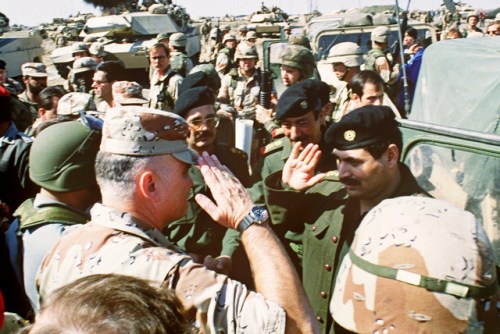
Schwarzkopf with Iraqi Generals at Cease Fire

Though I never served under his command while in the Army I knew many friends that did and my early career was shaped and molded by men life him.  He was not a perfect commander, analysis of his command in the Gulf show that he did make some mistakes, the greatest and most long lasting being the concession to allow the defeated Iraqi forces the use of helicopters which they used with great effect against the Shi’a tribes near Basra that sought independence.

However, in my mind it was Schwarzkopf’s public leadership that helped inspire his troops and encourage the nation which until that point had not recovered from all of the effects of the Vietnam War.  His briefings inspired confidence in America and with our Allies. He was as much of a diplomat in figuring out how to employ over 700,000 troops, military forces of 32 nation coalition, including numerous large Arab countries in a successful war.

Schwarzkopf also understood the full gravity of war and its effects on nations and people. He said: “I hate war. Absolutely, I hate war…Good generalship is a realization that … you’ve got to try and figure out how to accomplish your mission with a minimum loss of human life.”

He is remembered well. General Colin Powell who served as the Chairman of the Joint Chiefs during Desert Storm remarked after Schwarzkopf’s death “His leadership not only inspired his troops, but also inspired the nation. He was a good friend of mine, a close buddy. I will miss him.” From his hospital bed former President George H W Bush issued a statement saying that Schwarzkopf: “epitomized the ‘duty, service, country’ creed that has defended our freedom and seen this great nation through our most trying international crises….More than that, he was a good and decent man — and a dear friend.”  President Barak Obama praised him saying that “He was an American original” and “From his decorated service in Vietnam to the historic liberation of Kuwait and his leadership of United States Central Command, General Schwarzkopf stood tall for the country and Army he loved…”

Norman+Schwarzkopf+

Rest in Peace General, Rest in Peace,

Peace

Padre Steve+

2 Comments

Filed under History, iraq,afghanistan, leadership, middle east, Military, News and current events, vietnam

That War Would Cease: The Christmas Truce of 1914

joyeux_noel3

“Tonight, these men were drawn to that altar like it was a fire in the middle of winter. Even those who aren’t devout came to warm themselves.” Chaplain Palmer Joyeux Noël

12010440-mmmain

The war was supposed to be over by Christmas, or so the planners had said. Instead after a series of massive battles that produced unprecedented number of casualties the war settled into a stalemate. As the sides exhausted themselves in a series of meeting engagements throwing the flower of their idealistic youth into the great maw of the front to be torn apart by massed artillery and machine gun fire the planners sought new ways to find military victory.

In December 1914 with neither side having the ability to force the issue and casualties already running over a million dead and wounded the armies dug in. Massive trench networks were constructed in the mud of France and Belgium as the artillery continued its impersonal work of destroying men, machines and the homeland of millions of civilians.

From Clipboard

Despite the stalemate the high commands of the various nations continued to through their troops into meaningless attacks to gain a few yards of their opponent’s trench networks. The attackers always suffered the worst as they went “over the top” and were cut down by well sited machine guns and networks of defensive redoubts.

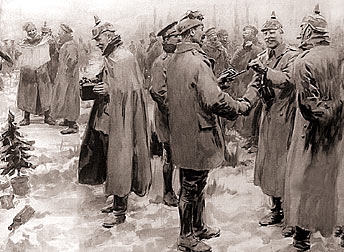
As Christmas neared individual parties of British and German troops began to fraternize exchanging gifts and attempting despite the wishes of their commanders to maintain an attitude of live and let live. On Christmas Eve German troops began to decorate their trenches with Christmas trees and lights, carols were sung and Christmas greetings exchanged as the local truces became widespread and soldiers met in no man’s land to talk and give each other gifts of cigarettes, alcohol, food and souvenirs.  In some places the sides helped each other collect and bury their dead and some Chaplains even led Christmas services in which men of both sides worshipped.

football-truce

The truce would not last as the high commands of each side issued strict orders against them and within days had moved the units that they believed most “infected” by the Christmas spirit to other locations and replaced them with units inculcated with the message of the inhumanity of their enemy. Such messages often included the religious understanding of this being a “holy war” against enemies of God and humanity. It is funny that though Moslems are frequently demonized for committing Jihad that Christians have a terrible record when it comes to finding theological reasons to kill those that they believe, even other Christians to be the enemy.

Christmas Day December 1914 World War One

joyeux-noel-2

http://www.youtube.com/watch?v=7-MGfNsgB3A

joyeux-noel-3

This really wasn’t surprising, after all for in the years leading up to the war many school children, especially in France and Germany had been propagandized. Churches and ministers cooperated in the carnage. In the movie Joyeux Noel the British Padre who had cooperated in the Christmas truce is relieved by his Bishop and sent home. The Bishop then preaches to the newly arrived soldiers, those replacing the men who had found peace for a moment. The sermon is not a work of fiction, it is actually part of a sermon that actually was given in Westminster Abbey in 1915. It was a sentiment that fit the mood of the high command who sought to minimize the danger of peace without victory. It was a sermon, the likes of which were preached by ministers, preachers, priests and bishops throughout that terrible war. It is a sermon that many preachers, Christian, Jewish, Islamic and Hindu even today mimic with terrible consequences.

http://www.youtube.com/watch?v=fMPxjUE40iw

“Christ our Lord said, “Think not that I come to bring peace on earth. I come not to bring peace, but a sword.” The Gospel according to St. Matthew. Well, my brethren, the sword of the Lord is in your hands. You are the very defenders of civilization itself. The forces of good against the forces of evil. For this war is indeed a crusade! A holy war to save the freedom of the world. In truth I tell you: the Germans do not act like us, neither do they think like us, for they are not, like us, children of God. Are those who shell cities populated only by civilians the children of God? Are those who advanced armed hiding behind women and children the children of God? With God’s help, you must kill the Germans, good or bad, young or old. Kill every one of them so that it won’t have to be done again.”

Unfortunately I have met and heard men preach the same message against those they hate, a message that twists the words of Jesus in a diabolical way to justify the worst acts of nations and peoples. In the year 2013 wars rage around the world. Some are conducted by well organized professional militaries but many by militias, paramilitary and terrorists groups. In some cases the brutality and inhumanity exhibited makes the industrialized carnage of the First World War seem sane. Even now preachers of various religions, including Christians, Moslems and Jews advocate the harshest treatment of the enemies of their peoples all in “the name of God.”

295_26912097058_4309_n

n671902058_1153798_5336

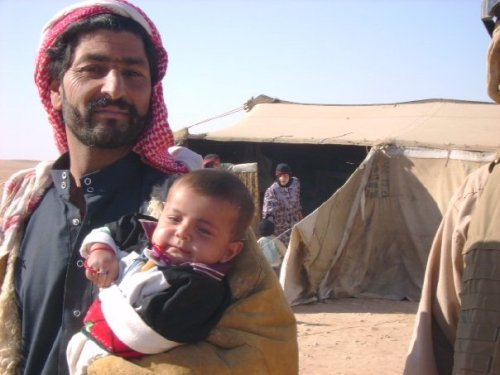
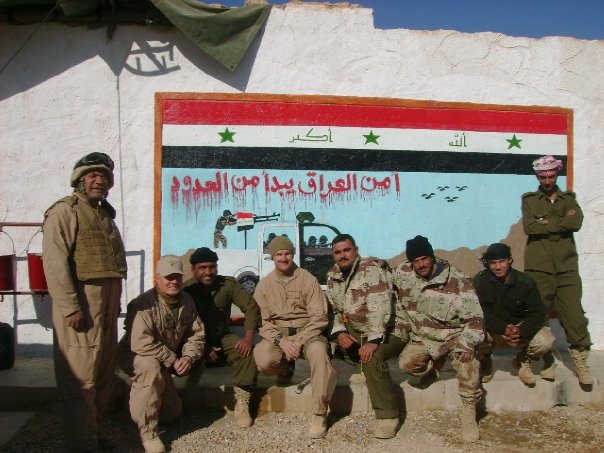
Six years ago I was traveling up and down the western border of Iraq with Syria. I was visiting our Marines that were advising the Iraqi Army and Border Forces, conducting Christmas services for them and also visiting Iraqi soldiers as well as civilians. In a couple of instances Iraqi and Jordanian Christians working as interpreters came to the Eucharist services, for one it had been years since he had received the Body and Blood of Christ in the Holy Communion. While out and about visiting Iraqis we were hosted by Iraqi troops and well as Bedouin tribesmen and their families. The warmth and hospitality and faith of these wonderful people was amazing.  T.E. Lawrence wrote that the Bedouin could not look for God within him: he was too sure that he was within God.” 

n671902058_1153804_6925

I think that for me that Christmas week was the one that will remain with me more than any and despite being in a war zone, it for me was a time of peace on earth and good will toward men.

Maybe someday we will begin to understand.

Peace

Padre Steve+

6 Comments

Filed under christian life, faith, film, History, iraq,afghanistan, Religion, Tour in Iraq

A Place of Peace: Where My Iraq Meets the Atlantic

35923_10151361668782059_785733223_n

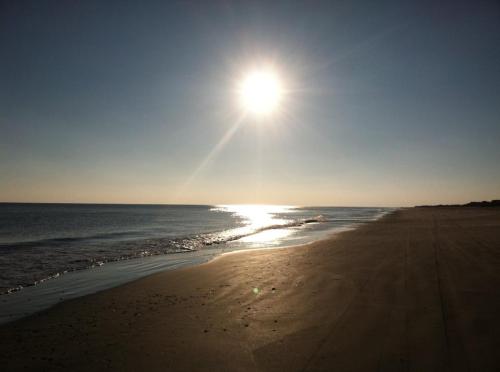
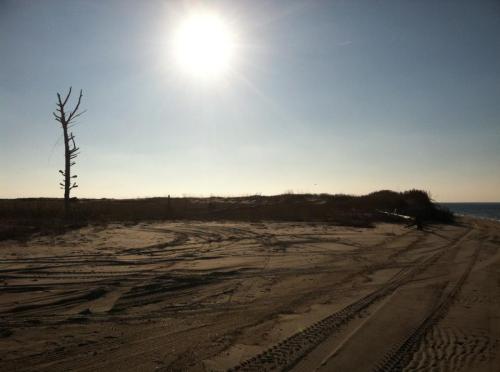
Where Iraq Meets the Atlantic

I have talked about things bring me peace amidst the struggles of life in recent days and in one post I briefly mentioned that while running on the beach in Emerald Isle it was the place where in that moment “Iraq met the Atlantic.”

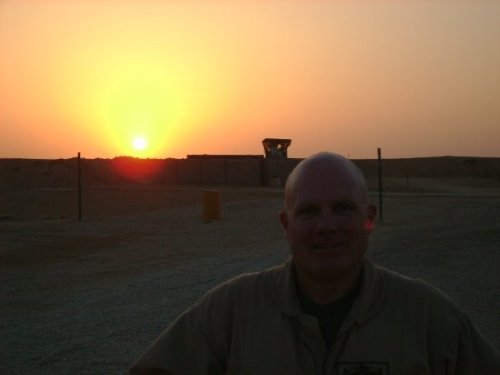
It has been nearly 5 years since I left Iraq in February of 2008 but there are times that it feels like I have never left and times when I would like to be back there. I have always loved the ocean and the desert. For some reason the vast expanses of barren desert and the untamed ocean draw me to them like nothing else.

262_29132267058_9181_n

I have struggled with a lot over the past 5 years. However as I mentioned recently it seems that things are coming together in ways that I have never could have fathomed even a few months ago. On Wednesday I needed to take a day off to reflect and gather my thoughts after a particularly cathartic sequence of events. One of the things that I did that day was to rest, but then to run along the beach where I live.

198177_10151361204842059_1890411795_n

I mentioned to a couple of people that it was like Iraq met the Atlantic and they didn’t understand, until I showed the pictures. I guess though that the juxtaposition of the Western Desert of Iraq, sometimes known as the Syrian Desert and the Atlantic Ocean would seem strange to most people, unless they have experienced both in their stark beauty.

270107_10151361199622059_1286921284_n

I ran about seven and a half miles Wednesday along the beach and it was breathtaking. The deep blue skies and seas met with the desert tan of the sands of the beach. There were few people out that day so the beach was nearly deserted and I was alone with nature and God. It has been many years since I felt that depth of peace in my soul that I felt on Wednesday.

262_29132262058_8844_n

I really can’t explain it and most people will probably never understand and I have learned that such a lack of understanding is okay. There is a big part of me that is still in the Iraqi desert and will always be there. There in the land of Abraham, amid the barren deserts, the rich valley of the Euphrates river valley, the battered cities and town of war torn Al Anbar Province many of my hopes and dreams still live. When I ran along the beach that day it was like I had returned, but instead of being traumatic it was peaceful.

262_29132227058_6903_n

I pray for the people of Iraq, especially those in Al Anbar Province and the Iraqi military. I pray that they will know peace and that their country, so long victimized by tyrants, devastated by war and torn by terrorism and civil-religious strife will be a place of blessing.

295_26912097058_4309_n

As T.E. Lawrence wrote about 85 years ago: “We were fond together because of the sweep of open places, the taste of wide winds, the sunlight, and the hopes in which we worked. The morning freshness of the world-to-be intoxicated us. We were wrought up with ideas inexpressible and vaporous, but to be fought for. We lived many lives in those whirling campaigns, never sparing ourselves: yet when we achieved and the new world dawned, the old men came out again and took our victory to remake in the likeness of the former world they knew. Youth could win, but had not learned to keep, and was pitiably weak against age. We stammered that we had worked for a new heaven and a new earth, and they thanked us kindly and made their peace.” 

262_29132307058_1522_n

Peace

Padre Steve+


3 Comments

Filed under History, iraq,afghanistan, Tour in Iraq

Epiphanies: PTSD, Life, Leadership, Lawrence of Arabia and the Gospel

I have been going through a process lately in preparation for some treatment of my chronic insomnia, nightmares and other PTSD symptoms which has caused me to have to be very deliberate and reflective in examining the various parts of the often tattered tapestry of my life.

Part of this has involved my experiences in military, religious and civilian institutional settings and how those experiences have helped shaped me as a Priest as well as a Naval Officer. Today was one of those days where a convergence of thoughts came together in a number of encounters juxtaposed with some reading of B.H. Liddell Hart’s book about T.E. Lawrence, Lawrence of Arabia.

While I was waiting for my doctor late this afternoon I was reading the book on my Kindle and as he came into the waiting room I had just finished marking this passage.

“The rare man who attains wisdom is, by the very clearness of his sight, a better guide in solving practical problems than those, more commonly the leaders of men, whose eyes are misted and minds warped by ambition for success….”

Somehow this little passage in a book that I am about halfway through reading and which I have already made numerous other annotations really struck me as profound. It encapsulated close to 20 years of experience as a military chaplain and over 30 years in the military as well as civilian professional work, and it struck me especially in regard to my experiences both in Iraq and after my return. Before, during and after my time in Iraq I had come to see Lawrence as a kindred spirit, someone that thought outside the box and went to places that no one else wanted to go. My job in Iraq to me to those places that few Americans and almost no other chaplains went or had the chance to experience with Iraqi Arabs and the Bedouin.

Those that read my posts regularly know that the impetus for my writing came about during my time in Iraq around Christmas of 2007 in the western Iraqi Al Anbar Province while on the Syrian border. At that time I wrote a short article for my former denomination’s website and a little more than a year after my return to the United States  I began this site I modified that article and published it here under the title of God in the Empty Places. It was a catharsis for me because I going though a tremendously ark period of my life where I had for all practical purposes become an Agnostic struggling to believe in God again. It was published a couple of months after I walked out of a church on Christmas Eve 2008 and walked an hour home in the dark and cold of that night.

During the interregnum of returning from Iraq and now I experienced a number of additional traumatic life events, both personal and professional. Following my assignment to my current post where I supervise a number of chaplains, pastoral counselors and support personnel I made it my goal in life not to let things that happened to me at the hands of some senior chaplains happen to others, especially those struggling with life, health, spiritual or emotional issues.

I have been asked by a number of people in the past couple of weeks, how in light of things that could leave me embittered and cynical could I embody grace to others. I admit that I still hurt and have issues of anger and some bitterness towards some people who I thought used me and betrayed me both in my old denomination as well as some senior chaplains. That is a given, though I try to live in a state of forgiveness toward them there are times that I do get upset the things that happened during that time. It is something that I deal with and I don’t always do well. I have my bad moments in which that grace doesn’t come out well,  but my path to healing has involved a conscious effort to see the good in people and to embody something different than I experienced.

A couple of people made the comment as we discussed these experiences as well as their own that “you do the Gospel it by living it.” I think that is what Jesus did, he taught yes and he did miracles, but the biggest miracles were those that he did when he rocked the religious-political establishment of his day by hanging out and caring for the people it despised. In fact Jesus surmised the entire law in two commandments, love God with all your heart and love your neighbor as yourself. The prophet Malachi noted what God required “to do justice, and to love kindness, and to walk humbly with your God.”

Those two passages have been tremendously important as faith returned after what I refer to as Padre Steve’s Christmas Miracle faith began to return in a way that I never expected.

So the past few weeks have served as an epiphany to me about wisdom can evade leaders whose “eyes are misted and minds warped by ambition for success…” My eyes are opening in more ways to the bigness of God, the grace of God, the love of God and the mercy of God. My ambition is simply to care for the people that God allows me to care for and show that grace, love and mercy to those who some would attempt to destroy because they themselves have become prisoners of the institutions and their offices and ambitions.  I have resolved in daily life to do all I can to avoid becoming a prisoner of my office or ambitions and simply to be real. One of the senior leaders of the hospital that I work noted that he saw me as not just as the senior chaplain but a “real person.” I can live with that.

Well that is enough for tonight.

Peace

Padre Steve+

1 Comment

Filed under faith, History, iraq,afghanistan, Tour in Iraq

The Fallacy of “Complete” Victory and the Seeds of Perpetual War and the Way to Peace

“We learn from history that complete victory has never been completed by the result that the victors always anticipate—a good and lasting peace. For victory has always sown the seeds of a fresh war, because victory breeds among the vanquished a desire for vindication and vengeance and because victory raises fresh rivals.” B H Liddell Hart

The current conflict between Israel and Hamas in Gaza has brought into light the fallacy of the belief that military victories alone can bring peace. One would think that leaders would know this and understand the basic truth of this key aspect of the human condition but it seems that we are doomed in every generation for leaders to ignore this basic fact of human life and civilization.

While one can easily criticize the Israelis and Palestinian Arabs for their unremitting hostility and desire for revenge they are not unique. Europe bears the scars of over 1500 years of Christendom’s own tribal and religious hatreds, many which still simmer underneath the surface of “free and democratic society.” Asia is rife with ethnic hatred and desire for revenge for actions committed by people long dead. Africa, the same except for the most part those in the “First World” be they Americans, Europeans or Asians only care about Africa for its natural resources, otherwise we would have acted to stop the various genocides on that rich, beautiful and diverse but seemingly cursed continent. The inter-Islamic and other Middle Eastern and Central Asian Moslems likewise have their hatreds, try as they might Arabs and Persians despite a common allegiance to Islam are mortal enemies with animosities that pre-date their conversion to Islam. Even we Americans are not immune to such hostility in our own country and against those that we label as our enemies overseas.

Despite this there are those that first and always resort to military force or terrorist violence to attempt to fight the “war to end all wars.”

The current episode of violence in Gaza is simple another chapter in what has been an unending series of wars since the establishment of the State of Israel. The time since has been marked by major wars in 1948, 1956, 1967, 1973 and 1981 the Palestinian Infatada as well as border conflicts between Israel, Fatah, Hamas and Hezbollah that have occurred since. These wars forced exodus of Palestinian Arabs from their ancestral homes, as well as the practical end of substantial Jewish and Christian communities in Moslem dominated nations.

The Israelis have in many cases lived under threat of invasion and destruction by neighboring Arab states for much of their history even while maintaining control of territories that they occupy by brutal force in the name of their own security. In some sense the Israeli position is understandable. They occupy but a small portion of land and threats of extermination, real and propagandistic by Arab and nations and the Iranians cause them to see these threats as existential threats.

The Arabs on the other hand deal with centuries of humiliation at the hand of foreigners, many Christian and European, but also that of the Turk and Persian. The constant drumbeat of military defeats endured by them at the hands of the Israelis and the support of Israel by western nations, some of whom ran the brutal colonial administrations which divided their lands, appointed despots as surrogates and exploited their natural resources has ingrained in them a deep seated need for revenge and respect.

I know from my time in Iraq and other Middle Eastern countries that the key to friendship and mutual respect is the simple act of taking time to know and appreciate the culture, history, faith and traditions of other people. I frequently in my dealings with Iraqi officers in Al Anbar Province opened doors by taking the time to learn their history, which goes back several millennia as the cradle of civilization and to be both polite and respectful in dealing with them. Iraqi officers were surprised that I knew the positive contributions of Iraqi military officers to Iraq, including the abolition of child labor, public education, the expansion of universities, universal suffrage and public works that benefited all Iraqis before the takeover of the country by Saddam Hussein and his Ba’ath Party. Likewise the fact that I could name the victories of Iraq forces against the British at Al Kut in the First World War, the largest surrender of British forces during the war as well as other victories gained me their respect and friendship as the “American” or “Christian Imam.”

However most Americans have not learned this despite over a decade of war in Afghanistan and Iraq. I was listening to a friend today who was upset that the government of Iraq was urging that Arabs use oil as a weapon against the United States to force the United States to change its policy in regard to the Palestinians. The argument presented on Fox News and echoed around much of the country is that the statement of the Iraqis is an act of ingratitude by a country that we “liberated.”

But that is our fiction that we create to absolve ourselves from the fact that over a period of 20 years American and other Western nations destroyed Iraq and humiliated its people. Yes we overthrew Saddam Hussein, a brutal dictator, a man that we supported for years as an ally until he crossed a line that we determined that he should not cross when he invaded Kuwait in 1990. To Shi’te Iraqis the overthrow of Saddam in 2003 was liberation, but it was “liberation” that followed the betrayal of them in 1991 where after encouraging them to revolt against Saddam we allowed them to be slaughtered by his Republican Guard.

To the Sunni of Anbar Province who after realizing that the radicals of Al Qaeda who were bringing more destruction to them than the Americans and allied themselves with the United States military in 2007, the Anbar Awakening the withdraw of American forces was an abandonment. They made our exit from Iraq possible and helped break the back of Al Qaeda, and for their trouble they believe that they have been abandoned to a corrupt Shi’te led government in Baghdad.

In light of all of this who can blame the Iraqis for making those statements. How would be we feel if that were to happen to us in the United States, or in Western Europe? Actually we know from history how we would feel. The answer is obvious in our history as well as our current actions and attitudes. We would not rest until those that brought destruction on our country and betrayed our people were defeated.

It is no wonder that Sun Tzu said that “To win one hundred victories in one hundred battles is not the acme of skill. To subdue the enemy without fighting is the acme of skill.”

Likewise Abraham Lincoln asked a question that those consumed by the need to destroy their enemies by military force should ask before ever mobilizing an army for war: “Am I not destroying my enemies when I make friends of them?”

Peace

Padre Steve+

2 Comments

Filed under History, iraq,afghanistan, middle east, Military, Tour in Iraq

Veterans Day 2012: Remembering those Who Served and Those that Helped Me

I always become a bit more thoughtful around Veterans Day and Memorial Day.  I’ve been in the military for over 30 years now.  I enlisted in the National Guard while in college and entered Army ROTC back on August 25th 1981.  Since then it has been to quote Jerry Garcia “a long strange trip.”  During that trip I learned a lot from the veterans who I am blessed to have encountered on the way.

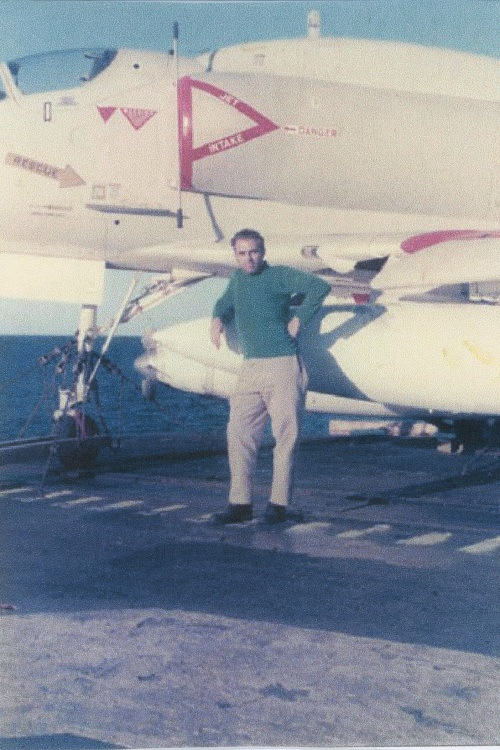
My Dad: Chief Petty Officer Carl Dundas aboard the USS Hancock CVA 19 circa 1971-72

I come from a Navy family. My dad served twenty years in the Navy.  Growing up in a Navy family in the 1960s and 1970s was an adventure for me and that Navy family that surrounded us then remained part of my family’s life long after.  My mom and dad remained in contact with friends that they served with or were stationed with, and now many of them are elderly and a good number have passed away.  Even so my mom, now a widow stays in regular contact with a number of her Navy wife “sisters.”

My dad retired in 1974 as a Chief Petty Officer and did time surrounded in the South Vietnamese city of An Loc when it was surrounded by the North Vietnamese for 80 days in 1972.  He didn’t talk about it much when he came back; in fact he came back different from the war.  He probably suffered from PTSD.  All the markers were there but we had no idea about it back then, after all he was in the Navy not the Army.  I had friends whose dad’s did not return fromVietnamand saw howVietnamveterans were treated by the country as a whole including some members of the Greatest Generation.  They were not welcomed home and were treated with scorn.  Instead of being depicted a Americans doing their best in a war that few supported they were demonized in the media and in the entertainment industry for many years afterwards.

My dad never made a big deal out of his service but he inspired me to pursue a career in the military by being a man of honor and integrity.

It was the early Navy family experience that shaped much of how I see the world and is why I place such great value on the contributions of veterans to our country and to me.  That was also my introduction to war; the numbers shown in the nightly news “body count” segment were flesh and blood human beings.

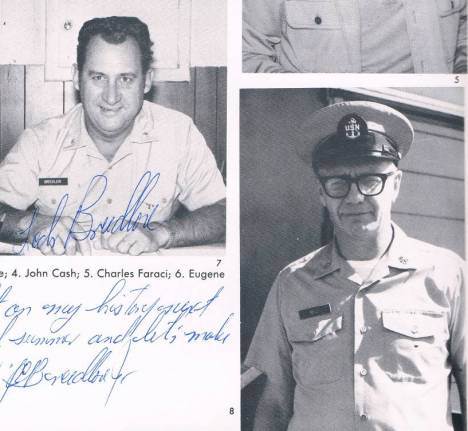
My second view of war came from the Veterans of Vietnam that I served with in the National Guard and the Army.  Some of these men served as teachers and mentors.  LCDR Jim Breedlove and Senior Chief John Ness at the Edison High School Naval Junior ROTC program were the first who helped me along.  Both have passed away but I will never forget them.  Commander Breedlove was someone that I would see every time that I went home as an adult. His sudden death the week before I returned from Iraqshook me.  I have a post dedicated to them at this link.  (In Memorium: Chief John Ness and LCDR Jim Breedlove USN )

Colonel Edgar Morrison was my first battalion commander.  He was the most highly decorated member of the California National Guard at that time and had served multiple tours inVietnam.  He encouraged me as a young specialist and officer cadet and showed a tremendous amount of care for his soldiers.  Staff Sergeant’s Buff Rambo and Mickey Yarro taught me the ropes as a forward observer and shared many of their Vietnam experiences. Buff had been a Marine dog handler on the DMZ and Mickey a Forward Observer.

The Senior NCOs that trained me while in the Army ROTC program at UCLA and Fort Lewis had a big impact. All were combat veterans that had served inVietnam.  Sergeant First Class Harry Zilkan was my training NCO at the UCLA Army ROTC program.  He was a Special Forces Medic with 7th Group inVietnam.  He still had part of a VC bayonet embedded in his foot.  He received my first salute as a newly commissioned Second Lieutenant as well as a Silver Dollar.  I understand that after the Army he became a fire fighter.  He had a massive heart attack on the scene of a fire and died a few years later from it.  Sergeant Major John Butler was our senior enlisted advisor at UCLA.  An infantryman he served with the 173rd Airborne inVietnam.  Sergeant First Class Harry Ball was my drill sergeant at the ROTC pre-commissioning camp at Fort Lewis Washington in 1982.  He was a veteran of the Special Forces and Rangers and served multiple tours inVietnam.  Though he only had me for a summer he was quite influential in my life, tearing me apart and then building me back up.  He was my version of Drill Sergeant Foley in An Officer and a Gentleman. Like Zack Mayo played by Richard Gere in the movie I can only say: Drill Sergeant “I will never forget you.”

As I progressed through my Army career I encountered others of this generation who also impacted my life. First among them was First Sergeant Jim Koenig who had been a Ranger in the Mekong Delta.  I was the First Sergeant that I would measure all others by.  Once during an ARTEP we were aggressed and all of a sudden he was back in the Delta. This man cared so much for his young soldiers in the 557th Medical Company.   He did so much for them and I’m sure that those who served with him can attest to this as well as me. Jim had a brick on his desk so that when he got pissed he could chew on it.   He was great.  He played guitar for the troops and had a song called “Jane Fonda, Jane Fonda You Communist Slut.” It was a classic.  He retired after he was selected to be a Command Sergeant Major because he valued his wife and family more than the promotion.  It hurt him to do this, but he put them first. Colonel Donald Johnson was the commander of the 68th Medical Group when I got to Germany in January 1984.  Colonel “J” as well all called him was one of the best leaders I have seen in 28 years in the military.  He knew everything about everything and his knowledge forced us all to learn and be better officers and NCOs.  On an inspection visit you could always find him dressed in coveralls and underneath a truck verifying the maintenance done on it.  He served a number ofVietnamtours.  He died of Multiple Myeloma and is buried at Arlington.  Chaplain (LTC) Rich Whaley who had served as a company commander in Vietnam on more than one occasion saved my young ass at the Army Chaplain School.  He remains a friend and is the Endorsing Agent for the Church of Jesus Christ of Latter Day Saints. As a Mormon he was one of the most “Christian” men that I have ever met.  I know some Christians who might have a hard time with that, but Rich demonstrated every trait of a Christian who loved God and his neighbor.

Me with Col Tom Almon and MG Frank Smoker USAF Ret

When I was the Installation Chaplain at Fort Indiantown Gap PA I was blessed to have some great veterans in my Chapel Parish.  Major General Frank Smoker flew 25 missions as a B-17 pilot over Germany during the height of the air war in Europe. He brought his wonderful wife Kate back from England with him and long after his active service was over he remained a vital part of the military community until his death in 2010.  Sergeant Henry Boyd was one of the 101st Airborne soldiers epitomized in Band of Brothers. He had a piece of shrapnel lodged next to his heart from the Battle of the Bulge until the day he died and was honored to conduct his funeral while stationed at Indiantown Gap. Colonel Walt Swank also served in Normandy.  Major Scotty Jenkes was an Air Force pilot in Vietnam flying close air support while Colonel Ray Hawthorne served several tours both in artillery units and as an adviser in 1972 and was with General Smoker a wonderful help to me as I applied to enter the Navy while CWO4 Charlie Kosko flew helicopters in Vietnam.  All these men made a deep impact on me and several contributed to my career in very tangible ways.

My life more recently has been impacted by others. Since coming into the Navy I have been blessed to serve with the Marines and Sailors of the 2nd Combat Engineer Battalion and Lieutenant Colonel T D Anderson, 1st Battalion 8thMarines and Lieutenant Colonel Desroches, 3rd Battalion 8th Marines and Colonel Lou Rachal and Headquarters Battalion 2nd Marine Division and Colonel, now Major General Richard Lake.   My friends of the veterans of the Battle of Hue City including General Peter Pace, Barney Barnes, Tony “Limey” Cartilage, Sergeant Major Thomas and so many others have become close over the years, especially after I did my time inIraq. They and all theVietnam vets, including the guys from the Vietnam Veterans of America like Ray and John who manned the beer stand behind the plate at HarborPark all mean a lot to me.  My friends at Marine Security Forces Colonel Mike Paulovich and Sergeant Major Kim Davis mean more than almost any people in the world.  We traveled the globe together visiting our Marines.  Both of these men are heroes to me as well as friends, Colonel Paulovich was able to administer the oath of office to me when I was promoted to Commander.

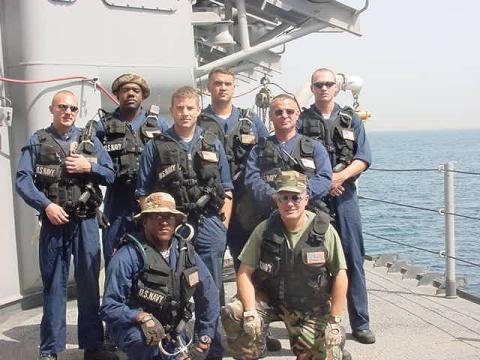
Finally there are my friends and brothers that I have served with at sea on USS HUE CITY during Operation Enduring Freedom and the advisers on the ground in Al Anbar mean more than anything to me. Perhaps the most important is my RP, RP2 Nelson Lebron who helped keep me safe and accompanied me all over the battlefield.  Nelson who has doneIraq three times,Afghanistan,Lebanon and the Balkans is a hero.  The men and women of Navy EOD who I served with from 2006-2008 have paid dearly in combating IEDs and other explosive devices used against us in Iraq and Afghanistan are heroes too.  There is no routine mission for EOD technicians.  Then there are the friends that I serve with in Navy Medicine, medical professionals who care for our Sailors, Marines, Soldiers and Airmen, family members and veterans at home and in the thick of the fighting in Afghanistan.

I give thanks for all them men that I mention in this post, especially my dad. For the countless others that are not mentioned by name please know that I thank God for all of you too.

I do hope that people will remember the Veterans that impacted their lives this and every day.  Some may have been the men and women that we served with, perhaps a parent, sibling or other relative, maybe a childhood friend, a teacher, coach or neighbor. As we pause for a moment this Friday let us honor those who gave their lives in the defense of liberty in all of the wars of our nation. They have earned it.

Peace

Padre Steve+


1 Comment

Filed under faith, History, iraq,afghanistan, Military, News and current events

I Left My Heart in Al Anbar…Visions of Iraq 5 Years Later

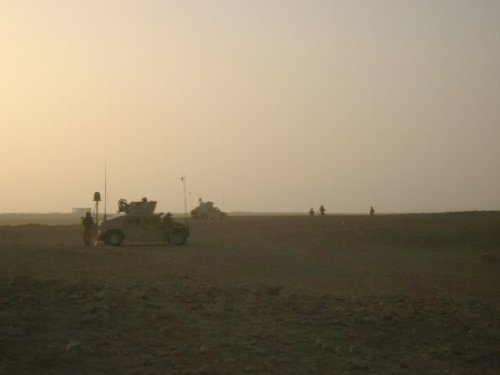
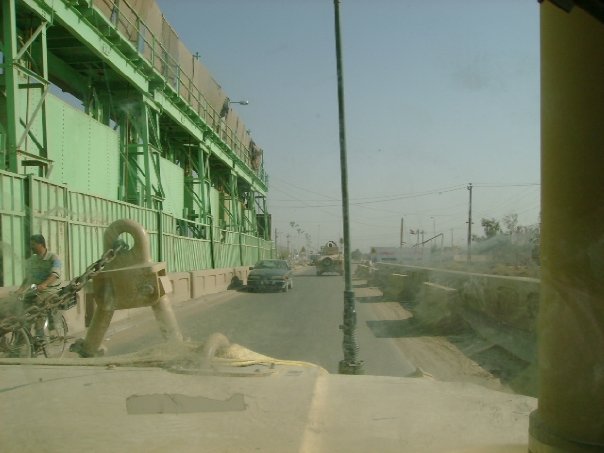
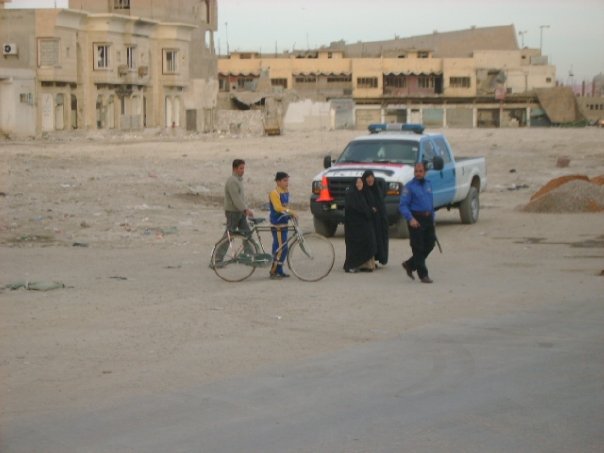
I left Iraq in early 2008. My experience of Iraq was with various teams of advisors in Al Anbar Province. I travelled thousands of miles hot cramped HUMMVs and in tightly packed aircraft to get to these far flung teams of 12-30 Americans in places from the Syrian border at Al Waleed, Al Qaim and various COPs on the border, back to Fallujah and almost everywhere in between, occasionally taking fire and most of the time isolated, and sometimes alone and unarmed except for the presence of my Religious Programs Specialist and Bodyguard, RP1 Nelson Lebron.

For those unaware of geography Anbar Province is about the same size in area as the State of North Carolina. The Euphrates River runs through it, a shimmering blue swath bordered by a narrow green valley that cuts through an endless sea of yellow brown sand speckled with small towns and a few larger sized cities. The Provincial Capital, Ar Ramadi is in the east central part of the province about 65 miles west of Baghdad. It is a city of about 440,000 people at the time of the US invasion.

In 2007 Ramadi and Al Anbar Province was the turning point for the United States in the Iraq War. The Sunni tribes of the province decided that their interests were better served by cooperating with the United States Forces rather than continue to endure the terrorism of foreign Al Qaida members.

It was to Al Anbar Province that I deployed in 2007. I was assigned to the Iraq Assistance Group with duties to serve the advisor teams assigned to the Iraqi Army, Border Forces, Police, Highway Patrol and Port of Entry Police. While there I also served members of Provincial Reconstruction Teams.

I have been thinking a lot about Iraq lately as I have been having to recount my experiences as I get ready for EMDR and Biofeedback therapy to treat my PTSD. I have been surprised by how strong the memories are of my time there.

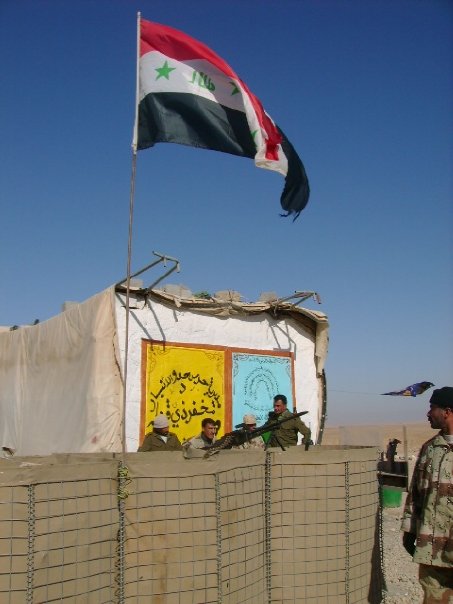
Today I was talking with my therapist and the discussion came to one of my experiences at a base on the banks of the Euphrates in Ramadi. At least part of it was known as COP Snake Pit. It is a base included a Joint Security Operations Center run by the US Army, a Police training facility an Iraqi Military and Police forces, an Advisor of Marines woking with the Iraqi Army 7th Division and an Iraqi Detention Facility. Surrounded by Hesco Barriers and walls not far from a number of high speed avenues of approach an easy target for any attacker. In fact since the United States left Iraq the detention facility and Operations center have been attacked by Al Qaida linked insurgents.

When we visited there Iraqi forces were in charge of the perimeter security while a small number of Americans worked at three isolated areas within the base. For me the memories of walking through the prison as well as getting to address the first class of female Iraqi Police cadets in Anbar.

The memories of that visit are still etched deep in my mind. When I close my eyes I can see the inside of that prison as well as the faces of those brave Iraqi women who risked their lives and those of their families to become Police officers in war torn Ramadi. As I talked with my therapist those memories were so strong. I talked about things today that I have not shared with anyone and which are still hard to write about. Eventually I will, but not tonight, it will be hard enough to sleep as it is.

For most people the Iraq war is not even a memory. Most Americans are untouched by war and cannot imagine what either our troops or the Iraqi people went through and it is hard to explain.

Since I am all verklempt right now I think I will stop for the night. But as I told my therapist today to paraphrase Tony Bennett’s immortal song I Left my Heart in San Francisco I left my at least part of my heart in Al Anbar.

Peace

Padre Steve+

1 Comment

Filed under iraq,afghanistan, middle east, Military, PTSD, Tour in Iraq

The Murder of Field Marshal Erwin Rommel

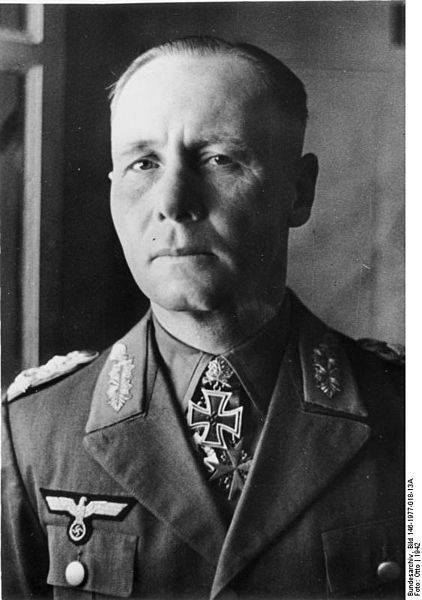
It was 68 years ago in Ulm Germany that a car pulled up to the residence of Field Marshal Erwin Rommel. In the car was the driver and two Generals dispatched by Hitler.  Rommel was recuperating following being severely wounded in an air attack in Normandy on July 17th 1944.

Rommel was never a Nazi but like many Germans he believed Hitler’s promises and propaganda. As a division commander in France and as the commander of the troops sent to bail out Mussolini’s failed African adventure Rommel gained fame, earned rapid promotion and was a poster-child for Goebels’ propaganda machine. His fame also earned the resentment of many fellow officers who since he was not an officer of the General Staff regarded him with jealous envy and distain.

That was until he discovered the reality of Hitler’s promises as the troops of the Afrika Corps found themselves subjected to constant privation from lack of supply, air support and reinforcements. As commander of the Afrika Corps and the Panzer Armee Arfika he and his troops achieved amazing success against an enemy that was always better supplied and equipped and which had air and sea superiority. Battling the British as well as the political machinations of Mussolini and Germany’s Italian Allies as well as opponents in the German government such as Hermann Goering, Rommel saw his troops crushed under the press of the British as well as the Americans who landed in French North Africa. Eventually, sick and worn out he was sent back to Germany.

His honest assessments of the chances of the Germans winning the war which he spoke candidly to Hitler and the High Command made him persona non grata in Berlin and Berchtesgaden. In the time before he was posted to France in late 1943 he became a part of the plot to end the war and overthrow Hitler. Rommel’s Chief of Staff at OB West General Hans Speidel was a key man in the conspiracy and Rommel had contacts with a number of key conspirators. He believed that the war was lost unless his forces could repel the coming Allied invasion on the beaches. His recommendations for the deployment of Panzer Divisions where they could immediately counterattack were not taken. He was given command but not control of many important units which Hitler alone could release.

When the invasion came Rommel was away and sped back to Normandy. He fought a desperate battle against an Allied force. His outnumbered forces under constant assault from the land, sea and air received paltry reinforcements compared to the Allies. German troops inflicted many local defeats and exacted a heavy price in allied blood in Normandy. Many American infantry regiments suffered 100% casualties but remained in action because of a continuous stream of replacements. Rommel urged a withdraw before the allies broke through his front and found that he was now considered a defeatist.

He was wounded just days before the attempt on Hitler’s life which Hitler survived and exacted a terrible revenge on anyone connected with the plot. Show trials and public hangings of officers who had served valiantly at the front were common.Thousands were killed and thousands more imprisoned.

Eventually Rommel was identified with the plotters. He was recommended by the “Court of Military Honor” to be expelled from the military and tried by the “People’s Court” of Judge Roland Freisler. Because of his fame and popularity in Germany Hitler was decided to offer Rommel the choice of being tried by the People’s Court that was busily executing anyone suspected of disloyalty or committing suicide and ensuring his family’s safety. German military heroes were hauled before this court and humiliated by Freisler before they were sent to their deaths.

Rommel suspected that he would be identified and killed and told that to his friends and family leading up to the day that the staff car carrying Generals Wilhelm Burgorf and Ernst Maisel from OKW with the ultimatum. They met with Rommel for a short time before giving him the opportunity to say goodbye to his family. Rommel told them of his choice and left his home for the last time. 15 minutes later the Generals called his wife to say that he had died of a heart attack. Rommel was given a state funeral and the German people were lied to about his cause of his death.

Rommel was 52 when he died, the same age that I am now. I find in the story of Rommel some commonality in my own life. Before Rommel went to Africa he believed that Germany would win the war, during his command there he discovered that what he believed was lies and that Hitler had little regard for him or his troops. Before I went to Iraq in 2007 I believed much of the political propaganda about that war. I have written on this site numerous articles critical of that war and our current war in Afghanistan. Like Rommel I feel that our troops have been and are being sacrificed in a war that we have no chance of winning. We are saddled with an Afghan ally who we put in office, President Karzai who makes Mussolini look like a winner and does nothing to help our war effort, condemning our troops at every opportunity even as his own police and soldiers kill ours. Our troops do valiant and often heroic work and in spite of the terrible situation that could get worse of more war breaks out in Iran or Syria.

Peace

Padre Steve+

4 Comments

Filed under History, iraq,afghanistan, Military, Tour in Iraq, world war two in europe

Padre Steve Remembers 9-11 and the Forgotten War

It has been nearly eleven years since that fateful Tuesday when the world changed.

I can still remember it like it was yesterday despite the intervening years.

I was in my office at Camp LeJeune where I was serving as Chaplain for Headquarters Battalion 2nd Marine Division. I had just finished an early morning counseling case and had delayed my early morning PT in order to handle the case and after I checked e-mail I was about to close my internet browser when I saw a small headline on the Yahoo News headline section.

The headline simply read “Plane crashes into World Trade Center Building.” My immediate thought was “some dumb ass flew his Cessna into the building.” I simply thought that some inexperienced pilot had gotten lost and crashed his plane into a tower. Thinking nothing more I closed out the page and left the office. It was 0900.

I got in my car and the radio was tuned in to a local right-wing talk radio station, yes I used to listen to it all the time. The talk show host was former Congressman Bob Dornan. He was talking with someone about what kind of aircraft had struck the building when he shouted “oh my God another plane has crashed into the other tower!”

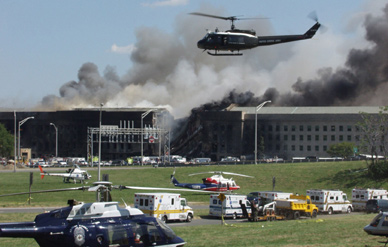
I was stunned. I knew that it had to be terrorism. I drove to the gym since they had multiple televisions and I figured that I could find out more there. I walked in and saw Marines, Sailors and civilians gathered around the sets. Every TV was tuned in to different news programs, CNN, Fox News, MSNBC as well as shows such as the Today Show and Good Morning America. Some whispered to each other but the silence of most was deafening. I remained a few minutes, transfixed by the images on the set. I then left the gym, got in my car and went back to the office where I showered, got into uniform, made a check of the news which was now reporting a strike on the Pentagon and the collapse of the South Tower of the WTC.

I drove to our battalion command post where I met with our Commanding Officer, Colonel Lake and Executive Officer Major Foster. We all knew that this was the beginning of a war and all of us had been through countless instances where we had been notified to get ready to deploy, most recently during the Kosovo action where Marines were to take a lead roll had the Serbians not backed down. While we talked the North Tower of the WTC collapsed. The emotions on everyone’s face showed, it was hard to believe that so much had happened and the great towers were smoldering heaps of rubble with possibly tens of thousands of victims crushed or incinerated in the ruins. I was instructed to get my gear and be back for a staff meeting as Colonel Lake was heading to division to meet with the Staff of 2nd Marine Division.

I made a quick run to my town home, hugged the dogs since Judy was out and grabbed my gear and some extra uniforms and underwear and headed back into the base through the back gate. I deposited my gear in my office and went around the building so see our Marines and Sailors assigned to our Truck Company, MP Company, Medical Company and Headquarters Company and all were waiting for more word, most gathered around televisions and watching breaking news. Some came to me and asked what it meant and expressed concern for families and friends in the affected locations. Then I went back to our headquarters where we heard from Colonel Lake what was known and what our actions would be. We were placed on high alert, patrols by full combat ready Marines were to patrol vulnerable areas of the base while roadblocks and checkpoints were established near every major headquarters aboard the base. The base was also locked down and only Marines, Sailors or Civilian workers returning to work were allowed aboard.

Later in the day I met with the chaplains who served our independent battalions, 2nd Combat Engineer Battalion, 2nd Light Armored Reconnaissance Battalion, 2nd Recon Battalion and 2nd Tank Battalion. I explained what I knew from my meetings with the Division Chaplain and Battalion Commander. We concluded our meeting with prayer for the victims of the attacks, the responders and for our Marines and Sailors.

It was both grim and surreal as the day passed and night fell. We remained in that condition four days. Meals were served at the Chow Hall, MRE’s issued and we went everywhere in full combat gear. I visited Marines at their guard posts during the night and worked counseling those who were concerned about family members or friends. They did so for good reason as nearly 3000 people were killed in the WTC, Pentagon and aboard the four hijacked aircraft.

Within a month U.S. Forces were engaged in combat in Afghanistan, driving the Taliban from power and sending Osama Bin Laden and Al Qaeda into hiding. Various units of the division were deployed to Afghanistan and the Horn of Africa over the coming weeks and months and even as we did so rumors circulated about Iraq.

I knew that the war would not be the short war that everyone hoped for and within 6 months I would be deployed with the USS Hue City and the USS John F Kennedy Carrier Strike Group to the Arabian Gulf, Horn of Africa and Gulf of Oman.  We would take part in maritime interception operations off the Horn of Africa and in the Arabian Gulf where we took part in the UN Oil Embargo on Iraqi smugglers.

I would travel to the Middle East frequently over the coming years supporting Marines from the Marine Security Force Battalion and later deploy to Iraq from EOD Group Two. I have lost friends and see the effects of the war every day at Camp LeJeune.

Osama Bin Laden is now dead, and it has been 11 long years of war. However it has been a war that for the most part has not been a national effort. After 9-11 the nation was not called to sacrifice, it was told by political leaders to “go shopping.” The brave men and women of our military and their families have made incredible sacrifices over the past 11 years. 2024 have died in Afghanistan while 4486 died in Iraq before the withdraw of US forces in December 2011. Another 32,223 were wounded in Iraq while 15,332 have been wounded in Afghanistan. These numbers do not count American contractors, State Department, CIA, FBI or other law enforcement agencies.

They also do not count the thousands afflicted by PTSD or other illnesses contracted in the combat zone, nor does it count the large number of Iraq and Afghanistan veterans who have taken their lives on active duty or following their discharge or retirement. Then there are the lives of over 1500 coalition soldiers, mostly British, Canadians and Australians who have given their lives in these wars. Finally there are the hundreds of thousands of Iraqis and Afghan civilians who have died or suffered injury or have been dislocated or exiled as a result of the wars.

Then there is the economic cost which amounts to trillions of dollars for both wars which have been funded by borrowing against our economic future.

Despite this for most Americans the war in Afghanistan is unpopular, little understood and distant, far from daily life. This is backed by polling data and by words of some politicians of both major political parties, in every major poll over 60% of Americans say that the war in Afghanistan is not worth the cost and needs to end.

One of the most glaring examples of how political leaders think about Afghanistan, but certainly not the only one is Republican Presidential nominee Mitt Romney. Romney did not mention either Iraq or Afghanistan in his acceptance speech at the Republican National Convention, although he did mention “strengthening the military.” He explained it later in an interview by saying to Fox News anchor Brett Baier “When you give a speech you don’t go through a laundry list, you talk about the things that you think are important….”

The sad fact is that no matter why Romney left out any mention of an ongoing war out of his speech that his words “you talk about the things that you think are important” are indicative not only of him but the majority of Americans. The reality is that Romney and most Americans have no personal connection with the war or the military. The war has been fought by a relatively small professional military that represents less than one percent of the population. Marine Lieutenant General John Kelly who lost his son, a Marine Lieutenant in Afghanistan noted at the 2012 American Legion national convention:

“America as a whole today is certainly not at war, not as a country, not as a people… Only a tiny fraction of American families fear all day and every day a knock at the door that will shatter their lives….” 

This Tuesday we will reflect on something called Patriot’s Day and pause to remember the events of that bloody Tuesday of September 11th 2001. I hope, probably in vain that the American people and their leaders will do more than mouth a few words, talk about how terrible the day was and go back to business as usual. I hope, probably again in vain that Americans will wake up to the fact that tens of thousands of Americans are in harm’s way and that even more and probably more terrible wars loom just over the horizon.

I have no idea what it will take to actually engage the vast bulk of the American population that what happens in Afghanistan is still important. Nor do I think that most people have any idea that a war with Iran could be disastrous for US and coalition forces fighting in Afghanistan.

It is odd to think that we can think about 9-11 and then ignore the subsequent wars the way that we have done. I really don’t.

Peace

Padre Steve+
 

4 Comments

Filed under Foreign Policy, History, iraq,afghanistan, News and current events