Category Archives: Loose thoughts and musings

The Day I Came to Love Iran: Reflections on the World Cup, Sports, and our Common Humanity

Friends of Padre Steve’s World,

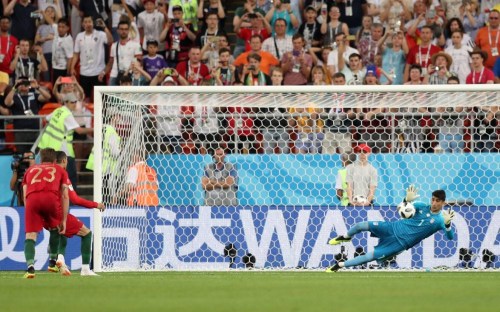
I have a confession to make. After I watched Iran play its first match in the World Cup against Morocco I was hooked, and I hoped that they would advance at least into the round of 16. The plucky Iranian team defeated Morocco, lost to Spain by a score of just 1-0 and tied Portugal today with a score of 1-1. Their fans cheered their team with the enthusiasm that any American would do for our teams in any sport, and many of their fans took the time to protest policies of the Iranian government and Revolutionary Guard. Honestly, eight or twelve years ago I wouldn’t have gotten past the blood sport of international politics and hatred of what I considered to be an enemy. But sports can help build bridges between people that might otherwise be unbridgeable.

I remember my first meeting with an Iranian, it was back when Iran was an ally of the United States and I was a Navy Junior ROTC cadet undergoing training at NTC San Diego. He was an Iranian Navy Lieutenant, since I recognized him as an officer I saluted and he replied. When the Iranian Revolution came I was stunned because I figured that the Shah must have been a good guy, but that was before I learned of how he had come to power and the CIA had overthrown a democratically elected government to put him in power and how he and his secret police did horrific things to the Iranian people.

Let me say as well that I never was a fan of the Ayatollahs or their stormtrooper like Republican Guard and their abuse of human rights or sponsorship or terrorism. That being said there was a moment in time that occurred after the attacks of September 11th 2001 when the Iranians offered their sympathy to us and support for us against Al Qaida. Instead the Bush Administration turned them down and then labeled them as part of the Iraqi and North Korean “Axis of Evil.” Of course that was an incredibly stupid act of hubris since none of the three actually had any connection to Bin Laden and Al Qaida and even more stupidly many Americans including me believed the lies.

But it wasn’t long after that when deployed to the Arabian Gulf about the cruiser USS HUE CITY that I saw Iranian regular Navy ships as well as Coast Guard vessels steer Iraqi smugglers out of their territorial waters and into our hands. The Revolutionary Guard Naval Forces were a different matter, some of their boats harassed our task force flagship, the HMAS Manora and we almost went to war before they withdrew. Of course we ended up invading Iraq which likewise was an enemy of Al Qaida throwing it into chaos and basically handing Iran’s hard liners a victory. But all of that is history.

I have known other Iranians and people of Iranian dissent. Every single one of them has been a wonderful human being. I may oppose the Ayatollahs and the Revolutionary Guards including their actions in Iraq, Syria, and supporting Hezbollah, but I do really believe that if the United States behaved with any kind of moderation towards Iran that the majority of people born after the Revolution and yearning for freedom would overthrow them. I think that the Iranian fans at the World Cup demonstrated more of what Iran is much more than the Ayatollahs or Revolutionary Guard. In fact even during this game there were large demonstrations against the regime in Iran.

I watched Iran’s games against Morocco, Spain, and Portugal and they earned my respect. They didn’t advance to the knockout round but they showed such poise and determination that I could not hope but to hope that they would make it to the next stage. I guess that partly because I have seen the United States do in the World Cup when we have made it into the Cup. I like underdogs unless they are playing against Germany, which I think I have mentioned that I have a rather strong attachment to, but again I digress.

I guess that what I mean to say is that I really do care for the people of Iran. Likewise I hope that the Trump administration will not blunder us into a war with them or push the Iranian people to support a government that most of them despise simply because they feel that they need to defend their country.

Maybe that doesn’t make sense to people who simply hate the Iranians and Muslims based on their nationality, religion, and race. But then I have really stopped caring what such people think about me because in spite of everything I look forward to the day that we can live in peace because having been to war I am tired of it.

Until tomorrow,

Peace

Padre Steve+

Leave a comment

Filed under life, Loose thoughts and musings, middle east, News and current events, sports and life

Celebrating 35 Years of Marriage to the Kindest, Sweetest, Prettiest Person I’ve Ever Met In My Life…

Friends of Padre Steve’s World,

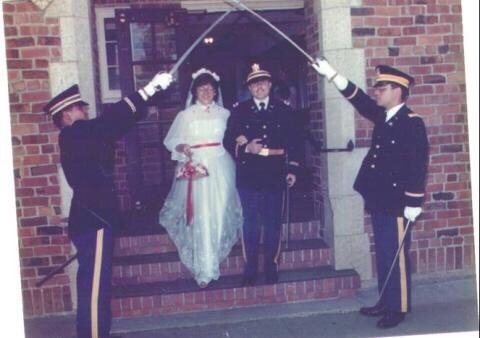
Thirty-five years ago today I married the love of my life and despite many stupid and thoughtless actions we are still married and probably happier than we have ever been. We have been spending the weekend with dear friends and the combined 12 Papillon dogs we have. It has been very nice, relaxing and fun.

It has also been a time for me to recharge my batteries because when we return home tomorrow I will have much to do at work as well as at home as we start to repair and renovate our home after the flooding event we experienced. By then we should hopefully have the insurance settlement to allow us to do what we need after the initial contractor provided by the insurance company wanted thousands of dollars more than the estimate they provided to do what we asked. Today we will go to dinner and celebrate at a restaurant that I like in D.C., but I digress…

We got married just six days after I was commissioned as a Second Lieutenant in the U.S. Army. Three of the men I was commissioned with were in the wedding and I am still in contact with a number of others. We had met almost five years before at San Joaquin Delta College in Stockton, California. I fell in love with her that night.

Our marriage has been a long strange trip, not that there is anything wrong with that. Military life, separations due to deployments and war have been part of our life. Judy has had to endure more than I can imagine to stay with me all these years. She is simply the best. She is creative, talented, kind, resourceful, considerate, and amazingly patient. I have seen her go out of her way to be kind and giving to people just because that’s who she is.

Honestly I fell in love with her the day that we met. When I first asked her on a date a few months later I was so nervous that she thought I was going to ask her to marry me. I loved her and wanted to marry her but I could barely stammer out “would you like to go to a movie?” Thankfully she said yes, otherwise I would have never gotten to the whole marriage thing.

When I think of her I think of what Bill Murray’s character in Groundhog Day, said to Andie McDowell in that movie:

I think you’re the kindest, sweetest, prettiest person I’ve ever met in my life. I’ve never seen anyone that’s nicer to people than you are. The first time I saw you… something happened to me. I never told you but… I knew that I wanted to hold you as hard as I could. I don’t deserve someone like you. But if I ever could, I swear I would love you for the rest of my life.

I still do. So to the most amazing and talented woman in the world, I love you, even more than I did that night we first met.

So to all,of our friends, and to all thank you for being a part of our lives.

Peace,

Padre Steve+

5 Comments

Filed under life, Loose thoughts and musings, marriage and relationships

Friends, Papillons, World Cup, and the Padre’s Pizza

Friends of Padre Steve’s World,

It has been a nice day with our friends in the DC area and our Papillon dogs. It was very relaxing, I got to sleep late, enjoy a nice home cooked breakfast with our friends. After that I retreated to the basement where I watched two World Cup games, Mexico vs. South Korea, and Germany vs. Sweden with Pierre and Izzy beside me on the couch.

Since I have been a fan of the German Mannschaft since mid-1980s when I first took an interest in the soccer with Bayern Munich and the National Team I have become a more and more serious follower of international soccer. I have to say that I really get into well played games especially when my teams are playing and when games are close and my team is on the verge of either advancing to another round or being eliminated things can become very tense, not that the world will end or anything like that, but sometimes it feels like it.

It was like that today when Germany, the reigning champions had to come back to avoid being eliminated in the group stage for the first time since before WWII. In fact they have reached the semifinals the past four World Cups. Tony Kroos the German National who plays for Real Madrid scores the winning goal in the 95th minute, which not only kept Germany alive but set them up well to advance if they defeat South Korea and Mexico with wins or ties against Sweden. Needless to say I will be cheering for Mexico as hard as will be Germany on Wednesday morning.

After the game I went back upstairs, relaxed and socialized and then made The Padre’s Pizza.

What most people don’t know about me is that I worked some of my way through college and seminary working in pizza parlors. While I was on my first active duty tour in the Army I began to experiment with my own pizza dough and sauce recipes and over the years I have become quite well known to my close friends for it. It’s a lot of work because I take the time to craft each pizza, and despite the work I find it very relaxing and good for stress relief. I should do it more often at home.

I love doing it. I love making the dough to perfection, seeing it rise, and turning it into a pizza dough. I love cutting the vegetables so that they not only look good but cook perfectly. I love crafting the sauce with my own blend of spices. Then I love building the pizza so that when it cooks that it looks as spectacular as it tastes. There really is an art to it you don’t see every day.

Tonight I made large two 16″ New York style pizzas topped with mozzarella, provolone, Romano, and Parmesan cheeses, pepperoni, Italian sausage, fresh mushrooms, Roma tomatoes, and garlic, peperocini peppers, and Kalamata olives. I also whipped up a pizza crust which became garlic bread.

Sometimes people ask me why I don’t try to start a pizza parlor, but truthfully I do is truly artisan and trying to mass produce it would take away the fun and turn a stress relief activity into a chore. Likewise I will not answer the question of “when does a pizza become a pizza?” (An obscure Seinfeld reference.)

Now like last night everyone has gone to bed but me and Piere. I’m finishing this up so it will Post after midnight and I will go back to reading the book Seduced By Hitler: the Choices of a Nation and the Ethics of Survival. It was published in 2000 and while I have had it in my library for at least 10 years I never read it until this week. I’m about 40% through it and I will give a synopsis when done.

So anyway, until tomorrow.

Peace,

Padre Steve+

Leave a comment

Filed under life, Loose thoughts and musings, sports and life

Happy Cinco de Mayo: a Sad Day for Emperor Max

Batalla_de_Puebla

The Battle of Puebla

Friends of Padre Steve’s World,

I just wanted to wish all my readers a happy Cinco de Mayo. This holiday, which is not a Federal holiday in Mexico, and which many people assume is has something to do with the Mexican Independence Day, or the sinking of shipment of mayonnaise bound for Mexico by a German U-Boat during the First World War actually celebrates something entirely different. It celebrates the defeat of a French Army by Mexican forces at the Battle of Puebla on May 5th 1862.

Mexico had already been independent for nearly forty years when this took place. The French had led an intervention in Mexico, and members of the conservative Mexican aristocracy asked Archduke Maximilian of Austria to be the emperor of a new Imperial Mexico, and he agreed, but I digress…

Before Maximilian took over, the French first had to conquer the Mexican Republic, something that most Mexicans rather liked. At Puebla the French commander underestimated the Mexican will to resist and ordered an attack on the city which was repulsed with heavy casualties. Since people around the world expected the French to have an easy time of it the victory was stunning, and it inspired the Mexican people to fight on. Now the war went on for some time. Eventually the French succeeded in capturing Mexico City on May 17th 1863 and installed Maximilian as Emperor of Mexico arriving in Veracruz on May 21st1864.

Although they had succeeded the war was not over, President Benito Juarez continued to resist and in 1865, aided by weapons, arms and money from the United States which now that its Civil War was over, was able to supply, issued a series of defeats on French Forces. Emperor Napoleon III of France, who had conjured up this mess now decided that the price of supporting Emperor Maximilian was too high and chose better relations with the United States over the hapless Maximilian and his Mexican forces.

The French withdrew, but Emperor Max chose to fight on and was captured by Republican forces and was tried, and sentenced to death. At his execution he paid the firing squad in gold not to shoot him in the head so his mother could see his face. The remnants of his government surrendered in Mexico City on June 20th 1867, the day after his execution.

Despite Cinco de Mayo not being an official Mexican holiday, we Americans and people in a number of other countries do celebrate it, ostensibly as a day to remember Mexican heritage, but more often as an excuse to party, eat Mexican food, and drink lots of beer, margaritas, and tequila shots.

Since I will be drinking beer and Judy will be drinking margaritas today with friends I wish you well.

Have a great day.

Peace

Padre Steve+

2 Comments

Filed under History, Loose thoughts and musings

The Satanic Truth Of Paul Ryan, Ron Johnson & Ayn Rand

Friends of Padre Steve’s World,

When I see political leaders who clothe their politics in a veneer of the Christian faith and claim to be pro-life while in life doing everything that they can to oppose the basic teachings of the Church regarding the worth of people and their rights I get very angry.

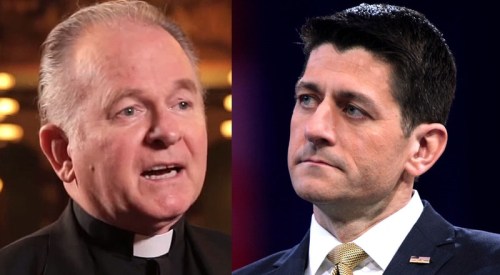
Yesterday I read the words of Senator Ron Johnson of Wisconsin who told a group of high school student that food, medical care, and housing were not basic human rights. His reasoning was based on Ayn Rand. Then I read that Atlas Shrugged toting Paul Ryan fired the Catholic Chaplain of the Speaker of the House for praying during a session dealing with the Trump Tax plan:

“As legislation on taxes continues to be debated this week and next, may all members be mindful that the institutions and structures of our great Nation guarantee the opportunities that have allowed some to achieve great success, while others continue to struggle,” the chaplain said. “May their efforts these days guarantee that there are not winners and losers under new tax laws, but benefits balanced and shared by all Americans.”

A week later Father Conroy heard from Speaker Ryan’s office:

“A staffer came down and said, We are upset with this prayer; you are getting too political,” he said. “It suggests to me that there are members who have talked to him about being upset with that prayer.” Shortly after, when he saw Mr. Ryan himself, Father Conroy said that the speaker told him, “Padre, you just got to stay out of politics.”

This wasn’t the supposedly faithful Catholic speaker’s conflict with the Church on its moral teachings. In 2012 the Jesuits at Georgetown handed a chunk of his skinny ass noting that the House Budget proposal went against Catholic moral teaching:

“As the U.S. Conference of Catholic Bishops has wisely noted in several letters to Congress, “A just framework for future budgets cannot rely on disproportionate cuts in essential services to poor persons.” Catholic bishops recently wrote that “the House-passed budget resolution fails to meet these moral criteria.” In short, your budget appears to reflect the values of your favorite philosopher, Ayn Rand, rather than the Gospel of Jesus Christ. Her call to selfishness and her antagonism toward religion are antithetical to the Gospel values of compassion and love.”

But that’s Paul Ryan whose core values reflect those of Ayn Rand who denigrates the key parts of the Christian faith in regards the sacrifice of Christ which she called “monstrous” and any responsibility to others. Regarding Christ she stated to Playboy:

“According to the Christian mythology, [Christ] died on the cross not for his own sins but for the sins of the non-ideal people. In other words, a man of perfect virtue was sacrificed for men who are vicious and who are expected or supposed to accept that sacrifice. If I were a Christian, nothing could make me more indignant than that: the notion of sacrificing the ideal to the non-ideal, or virtue to vice. And it is in the name of that symbol that men are asked to sacrifice themselves for their inferiors. That is precisely how the symbolism is used. That is torture. ”

In regard to the latter the following exchange between Rand and Mike Wallace on 60 Minutes is telling because it cuts to the very heart of Ryan’s Fred with the Church:

Rand: “You love only those who deserve it.”

Wallace: “And then if a man is weak or a woman is weak he is or she is beyond love?”

Rand: “He certainly does not deserve it. He certainly is beyond it . . . he cannot expect the unearned, neither in love or in money, in matter or in spirit.”

Wallace: “There are very few of us in this world, by your standards, who are worthy of love.”

Rand: “Unfortunately yes, very few.”

Ryan, a true Randian Apostle and evangelist told members of The Atlas Club, a group of Rand devotees: “I grew up reading Ayn Rand and it taught me quite a bit about who I am and what my value systems are and what my beliefs are. It’s inspired me so much that it’s required reading in my office for all my interns and my staff.”

Such philosophical schizophrenia is endemic in people like Ryan who on one hand claim to be followers of Christ and faithful Christians while exalting in their lives and social beliefs the atheistic creed of Rand.

The words of Father Conroy were in keeping with not only the Catholic tradition, but a tradition of human and civil rights that has been a hallmark of the American political and religious tradition since the earliest protests of abolitionists against the institution of slavery. But those are not the traditions that Senator Johnson or Speaker Ryan adhere. Instead they are devoted to the perverse ideology of Ayn Rand, which is nothing more than Social Darwinism and the exploitation of the weak for the benefit of the strong. Sadly, that ideology permeates the supposedly “Christian Right” to the point that it has completely overwhelmed anything that could be considered “pro-life” in their theology. Just because you are against abortion doesn’t mean that you are pro-life, especially if you despise those who are already born and condemn them to death.

Dietrich Bonhoeffer who was martyred by the Nazis wrote:

“Christianity stands or falls with its revolutionary protest against violence, arbitrariness and pride of power and with its plea for the weak. Christians are doing too little to make these points clear rather than too much. Christendom adjusts itself far too easily to the worship of power. Christians should give more offense, shock the world far more, than they are doing now. Christian should take a stronger stand in favor of the weak rather than considering first the possible right of the strong.”

The amorality of the current GOP position on life is absurd. According to it you can kill babies overseas when targeting terrorists with drone strikes, you can execute men and women when there is evidence that they might have been innocent; you can use economic sanctions to so cripple poor country’s to kill hundreds of thousands of children because they do not have food, water, or medical care; you can funnel tax revenues to the richest of the rich and deny food, housing, jobs, education, medical care, post natal care, ad infinitum to people but just don’t abort babies and you are the most commendable of men.

That my friends is Paul Ryan and Ron Johnson. They make President Trump for all of his faults loom like a saint when compared to them. Trump makes no apology for what he is. Trump doesn’t hide behind the image of being a Christian. Yes, he will take the prayers and adulation of Christians, and he will definitely take their votes and money, but he doesn’t pretend to be something that he is not. I respect him more than I do them. As terrible as he is there is the possibility that he could actually a conversion experience, but they won’t because they have perverted the faith for a Satanic ideology.

Bonhoeffer noted:

“It is worse for a liar to tell the truth than for a lover of truth to lie…. There is a truth which is of Satan. Its essence is that under the semblance of truth it denies everything that is real. It lives upon hatred of the real world which is created and loved by God.”

What Ryan, Johnson, and their fellow travelers proclaim in thought, word, and deed Satanic truth, and incompatible with the Gospel. What Ryan did with Father Conroy was truly despicable and politically motivated. I expect now that the deed is done that the Right Wing propagandists, maybe even with Russia help begin to attack the life and character of Father Conroy.

Think about that.

Until tomorrow,

Peace

Padre Steve+

Leave a comment

Filed under christian life, ethics, faith, History, holocaust, leadership, Loose thoughts and musings, News and current events, Political Commentary

“If Only…” Thinking about the Tapestry of Life

img_3416

Friends of Padre Steve’s World

It is interesting to think about life, what has transpired, and what might have been if only…

Like anyone I wonder about all of the “what ifs” and “might have been” parts of my life. Of course there are many, going back to things that I could not control, such as the choices that my parents made regarding their lives, career, family, and home. Then there are my own choices, choices that I made, some for better, and some maybe for worse. Then there were the choices of men and women in my life and career that impacted my life and the decisions that I made, again for better or worse.

Some of my dreams, and nightmares too, involve those decisions, particularly the ones that I could not control; but then there were those decisions, particularly regarding my military career choices, that come back to haunt my dreams. Those can be troubling; the things that I volunteered to do and the costs of those to Judy as a result of those decisions. Many of those decisions, particularly my decisions to volunteer for certain deployments and operations have come at a great cost to both of us, the struggle with the effects of PTSD even ten years after my return from Iraq is still very real.

But then I am reminded that none of us have a crystal ball that allows us to see what the result of our decisions will be; none of us are God, or some other omniscient being. We make our decisions based on what we know, and what we think might be the outcome of our decisions.

I love the television series Star Trek the Next Generation. One of my favorite episodes is called Tapestry. In the episode Captain Picard is killed. He is then met by the being known as Q, played by John De Lancie for a do-over, a second chance to reverse a choice that he made as a young officer.

On Q’s promise that his choice will not alter history Picard takes the chance and he ends up regretting it. In his second chance to avoid the incident that allowed him to be killed he alienates himself from his friends, and turns him in to a different person, unwilling to take chances and doomed to insignificance. When he returns to his new present he finds himself alive but a different person. Instead of a starship captain is a nondescript lieutenant junior grade doing a job that he hates as an assistant astrophysics officer.

tapestry2

Distraught Picard complains to Q:

Picard: You having a good laugh now, Q? Does it amuse you to think of me living out the rest of my life as a dreary man in a tedious job?

Q: I gave you something most mortals never experience: a second chance at life. And now all you can do is complain?

Picard: I can’t live out my days as that person. That man is bereft of passion… and imagination! That is not who I am!

Q: Au contraire. He’s the person you wanted to be: one who was less arrogant and undisciplined in his youth, one who was less like me… The Jean-Luc Picard you wanted to be, the one who did not fight the Nausicaan, had quite a different career from the one you remember. That Picard never had a brush with death, never came face to face with his own mortality, never realized how fragile life is or how important each moment must be. So his life never came into focus. He drifted through much of his career, with no plan or agenda, going from one assignment to the next, never seizing the opportunities that presented themselves. He never led the away team on Milika III to save the Ambassador; or take charge of the Stargazer’s bridge when its captain was killed. And no one ever offered him a command. He learned to play it safe – and he never, ever, got noticed by anyone.

It is a fascinating exchange and one that when I wonder about the choices that I have made that I think about; because when all is said and done, my life, like all of ours is a tapestry. On reflection Picard tells Counselor Troi, “There are many parts of my youth that I’m not proud of. There were… loose threads – untidy parts of me that I would like to remove. But when I… pulled on one of those threads – it’d unravel the tapestry of my life.”

I think that I can agree with that. All the things in my life, the good things and the bad, as well as the paths not taken have all been a part of the tapestry of my life. I would not be who I am without them; and that I cannot comprehend. I would rather be the flawed me that is me, than the perfect me that never existed. Thus, all of those threads of my tapestry are in a sense, precious and even holy.

I’ll keep all of them.

Peace

Padre Steve+

Leave a comment

Filed under faith, life, Loose thoughts and musings, philosophy, PTSD, star trek

Soldiers, Politics, and Empty Tombs: The Strange Experience of Longinus the Centurion

roman-soldiers-guard-james-tissot-1

Friends of Padre Steve’s World,

Those who follow my writings know that I struggle with faith. Since my return from Iraq in 2008 I have found a certain kinship with soldiers who have been assigned the unthankful and trying tasks of dealing with occupation duties or fighting insurgencies. 

In the case of the story of Easter it is all too common that writers, theologians and others focus on the story of Jesus and his disciples, or conversely, if they explore anyone else, they focus on the Jewish religious leaders of the time. 

After Iraq I had a harder time relating to Jesus and his followers, or the religious leaders of Jerusalem. That being said, coming home from Iraq, struggling to believe, I find a tremendous affinity with the officers of the Roman Legions serving in Judea and Samaria in the 1st Century A.D. 

This is the final chapter of a series that I wrote several years ago about the Roman Centurion known as Longinus, who according to tradition, was at the cross when Jesus was crucified. I have tried to weave other characters from the Gospel narratives, including the Centurion whose “beloved servant” was healed by Jesus an account mentioned in both Matthew and Luke, where the Greek word for servant “Pais” is only found in these accounts and is different from the word commonly used in the New Testament “Doulos.” The difference leads to some interesting and potentially powerful understandings about the people that Jesus interacted during his earthly ministry.

The reason I am doing this is because I believe that many Christians cannot imagine what it must have felt like to be the Roman occupiers of Judea in a time where they were hated and deep divisions, religious, cultural and political complicated the lives of Roman officers like the Centurion known as Longinus.

I do hope that you enjoyed the series and that it and the Gospel narratives challenged you whether you are a Christian or not. I know from my time in Iraq serving with our advisors to the Iraqi forces that what the Roman officers dealt with was more difficult than any of us could imagine, unless you have been a soldier or officer of an occupying power, which I have been.

By the way, at the point this article posts I will be preaching at the Easter Sunrise Service at my base proclaiming the triumph of life over death and the universal love of God for all people. As the German Lutheran theologian Jurgen Moltmann wrote:

“Believing in the resurrection does not just mean assenting to a dogma and noting a historical fact. It means participating in this creative act of God’s … Resurrection is not a consoling opium, soothing us with the promise of a better world in the hereafter. It is the energy for a rebirth of this life. The hope doesn’t point to another world. It is focused on the redemption of this one.”

Peace and Happy Easter…

Padre Steve+

The pounding on his door awakened Longinus before he expected on this day after the Jewish Passover. He was hoping perhaps beyond hope that the worst was over and that in a few days he could take his soldiers back to the confines of Caesarea and away from the troubled city of Jerusalem. He was tired of this duty and longed for service with a real Legion with real Roman soldiers.

The pounding continued and the weary centurion wiped the sleep from his eyes, rolled out of his bed and went to the door of his quarters in Fortress Antonia. He opened the door to find his Optimo, or second in command Decius standing there, his fist ready to continue pounding, with a look of near panic on his face.

Startled, Longinus asked the young officer to come into his quarters and take a seat at his table. They like the other officers had seen events that they could barely explain over the past week, and some of those events had troubled Longinus in a manner in which he was not accustomed to, or prepared for.

Longinus took a wineskin and poured the contents into two cups. He asked Decius what was so urgent and frightening that he had to be at his quarters well before the duty day began. The young man took off his helmet to reveal a crop of blondish brown hair common to the Tyrol in the northern part of Italy.

The young officer took the cup of wine and downed it in one motion. Longinus, pureed and another as the young Tyrolean told an almost unbelievable story. Wiping his brow and taking a drink from the cup he explained that there was trouble at the tomb of the itinerant preacher named Jesus.

Longinus listened to his report:

The two guards from Longinus’s unit who had relieved the previous watch at the tomb had evidently fallen asleep. While they were asleep there had been a break in. The soldiers claimed that they had been overcome when some kind of “angelic being” descended in front of them. They reported that some of the women who had been at the execution site previously had been near the tomb. They said that when they awakened the body of this Jesus was no longer in the tomb.

The story seemed preposterous, but Longinus could not believe that his soldiers had fallen asleep on duty, as such an act could be punished by a death sentence. Adding to the confusion was a report that two of the preacher’s “disciples” had reportedly entered the tomb and claimed that the body was gone as had some of the women that had been there at the crucifixion.

Longinus took a drink from his cup of wine and thought for a moment. He had to admit that the story was unbelievable, but yet in light of the strangeness of the man and the events surrounding his execution Longinus, was no longer surprised at anything. Longinus looked at his young executive officer and said:

“Optimo, there has to be a logical explanation for what happened, and we need to find the truth. I do not like to think that our soldiers were asleep on duty, and I don’t think that the High Priest would not attempt to use this against us. Please have the soldiers and the Sergeant of the Guard report to me.”

Longinus had Decius bring the two soldiers to him along with the Sergeant of the Guard to explain what had happened.

The two soldiers, one a Samaritan and the other a Greek had good reputations in the unit. Neither had given him cause for concern and the terrified expression on their faces as they explained what happened at the tomb gave Longinus reason to believe them. Yes, it was possible that they were lying but Longinus believed their story because in spite of his threats they stuck to it. He threatened them with death if they had fallen asleep and were lying. When that did not produce results he promised a light punishment if they only told the truth, but despite his efforts to get them to testify to something rational they stuck with this outrageous story.

Longinus was not much of a believer in miracles angels or any sort of magic hocus-pocus purveyed by seers, magicians or fortunetellers. He did not believe in the state “gods” of Rome and likewise had little respect for the Jewish God, not so much because he understood the theology of the Jews, or even might believe in some sort of all-powerful being, but because he was disgusted by their use of their god for their political purposes.

All that being said, Longinus was inclined to believe his solders. When his friend Flavius had told him about his servant being healed by the Jesus fellow he found it hard to accept. That being the case here he was now beginning to believe this outlandish story. It was preposterous, but he could not accept the alternative. To disbelieve his men would mean that there was a serious breakdown of discipline by two outstanding soldiers. Longinus had some soldiers that he wouldn’t believe for an Athenian minute if they told him such a tale, but he believed these men. The terror on their face as they told the story led Longinus to believe that they had to be telling the truth as improbable as it was.

Longinus again thought of his words as the darkness enfolded the city and the earth quaked preacher hung dying on the cross on that evil hill just two days before. He dismissed the soldiers and as they left he prepared himself to tell the scheming governor they latest “good news.” If only Rome had let these people stew in their own mess. Longinus shook his head as he wondered about the wisdom of attempting to police such fouled up lands.

After he washed and put on his uniform, Longinus went to Pilate’s headquarters where he and the other Centurions, including his friend Flavius participated in a meeting with Pilate and his staff, the Jewish High Priest and his representatives and two of Herod’s people.

The meeting reminded Longinus  of a meeting of criminals. The High Priest and his representatives were livid at the report he delivered and demanded that Pilate take immediate action to solve their problem. Herod’s henchmen voiced their displeasure regarding the lapse of the Roman soldiers that allowed this to happen.

Longinus spoke up for his men and said that as improbable as the story was, that he believed his men. That only made the non-Romans angrier and they began not only calling for punishing the soldiers, but Longinus as well. Longinus thought that they were engaging Pilate in yet another histrionic episode in order to force Pilate to do their bidding, if not today, in the future.

The High Priest and Herod’s men insisted that Longinus’ soldiers had to have fallen asleep and or that they had conspired with the preacher’s followers to remove the body from the tomb. This angered Longinus to the point that he interrupted their ranting to defend his men’s honor. Pilate finally ordered Longinus and the High Priest to be silent. He asked the non-Romans to step outside while he conferred with Longinus and the other Centurions. The High Priest objected, but decided not to press the point and left the room.

Pilate explained his dilemma. He was afraid that if he sent the High Priest away by supporting his soldiers that there would be a revolt in the streets. He had seen the tumult on the streets by the supporters of the High Priest when he tried to release the “King of the Jews” and felt that this would be worse for security. He advised the Centurions that while he had no reason to doubt them or their men that he had to placate the High Priest and Herod in order to avoid chaos, chaos that could lose him his job if he wasn’t careful. Likewise he did not feel that he had the military manpower in the city to handle a full-fledged revolt and that he would have to call for reinforcements from the Legions based in Syria. Pilate was loath to do as this as it would get back to the Emperor, and the Emperor did not take kindly to governors who could not manage their provinces.

Longinus thought back to the day of the execution. Pilate had agreed to place a guard at the tomb at the urging of the High Council. Longinus had argued against placing any soldiers at the tomb as he felt that since the “King of the Jews” was the problem of the Jews and since man that he had called the so called  “son of God” was dead that Rome’s obligation was over. Let the Jews handle their own problems.

The whole thing reeked of politics and Longinus did not like it, but on Friday Pilate had overruled him. Then Pilate explained that Roman soldiers needed to guard the tomb because the High Priest insisted that Jesus’ followers would attempt to steal the body and then claim that he this Jesus had been raised from the dead. That insisted the High Priest would lead a revolt against the Jewish council and eventually Rome itself.

Another actor who added to the Judean witches’ cauldron was the Herod Antipas, the corpulent and corrupt “King” of Judea. If Longinus detested Pilate and the Jewish High Priest he hated Herod and all that he stood for even more. The presence of Herod made Longinus wonder why Roman lives and treasure were spent to solve the problems of this God-forsaken land; a land that Longinus believed would still be trouble two millennia from now if the world lasted that long.

Longinus believed that as long as Rome allowed the High Council and Herod to rule the region by proxy that the troubles would never end. He believed that it was only a matter of time before these people, mobilized by the passion of the Zealots would revolt as they had against the Seleucids nearly 200 years before. He knew if that happened that Rome would mobilize more the  enough legions to crush the revolt, and when they were done would not leave as much as a house standing. Longinus hated this occupation and all that it stood for, especially when he saw a good and innocent man like this Jesus fellow killed for no good reason other than the politics of it all. It sickened him.

When Pilate was done explaining his decision to Longinus and the other Centurions Pilate called the quite irate non-Romans back into the proceedings. He told the High Priest and Herod’s men that he would discipline the soldiers involved. He also explained that he would assist them in finding just what parties removed the body from the tomb. In the mean time he would suppress any stories coming from the soldiers about this supposed “resurrection” of this Jesus character from the dead.

The High Priest and Herod’s men agreed that this would suffice and thanked Pilate for his time and effort. Longinus and the other Centurions quietly seethed as this took place. When the non-Roman parties had left Pilate, knowing how his officers hated his decision called them to him. He told the officers that no action would be taken against the men and that he would not actively assist the Jews in trying to find the perpetrators of the event. He had in fact deceived the High Priest and Herod’s men.

Pilate then let the officers know that they and their units would remain in Jerusalem for another week to allow the multitude of pilgrims to leave the city. Once the Jewish festivities were over and the people had departed, they would return to Caesarea. Longinus thought about it and for a brief moment he admired Pilate’s duplicity. Pilate the consummate politician had again found a way to defuse the situation, deceive the local leaders and protect his soldiers, and as much as Longinus and the other Centurions despised the deal it was better than trying to deal with a full fledged rebellion with so few troops available in Jerusalem.

Longinus left with the others and met Decius and Flavius when he stepped into the court of the fortress. He was very unhappy with the deal that Pilate made with the High Priest and Herod even though he understood the reality of the politics behind it. Longinus felt that he had dishonored his soldiers and the unit for the sake of political expediency. He felt ashamed of the Empire for what Pilate had done in cooperating with these people from beginning to end during this affair. He would not forget.

MLPPT_CenturionCross_1

When Longinus returned to his quarters he again looked at his blood stained lance and thought about the man who was put to such an ignominious death for such putrid reasons. Surely something had to be different about him and there had to be some purpose to this injustice. Longinus again mused quietly, “truly this was the Son of God…”

Whatever that meant…

1 Comment

Filed under christian life, ethics, faith, History, Loose thoughts and musings, middle east, Military, Religion

A Centurion’s Saturday after a Crucifixion

Friends of Padre Steve’s World

Today is what Christians call “Holy Saturday.” It is a day of reflection between the death of Jesus on Good Friday and his Resurrection. So unless something really unusual and earth shattering occurs I am going to take the Easter weekend to do some reflection, including on some spiritual topics. In light of that I am simply going to post three of my older fictional accounts of that weekend, yesterday, today, and Easter Sunday.

As a genre this series falls in the realm of historical fiction, which means that while they may be set in a historical event, that they are fiction. Likewise, I admit that they and the main character are more a reflection of me, and my journey, and my over-active imagination, than my cursory study of Roman and New Testament History.

That being said, have a nice weekend, and if you do it, have a nice Easter.

Peace,

Padre Steve+
holy-saturday

The horrible day was passed and a new morning greeted Longinus as he arose. The sun rising over the escarpment in the east that overlooked the Jordan River cast a warm red and yellow glow as its rays infiltrated the window overlooking the courtyard of Fortress Antonia. It seemed an eternity since he watched the sun rise as Pilate debated what to do with that Jesus fellow.

Longinus and his fellow officers Flavius and Decius had spent much of the previous evening in the tavern following the executions. It was not a typical night for them. There was little frivolity, few jokes and none talked much about the events of the day, which had begun for Longinus not long after midnight. Flavius, whose servant had been healed by Jesus in Capernaum had briefly discussed the meaning of Longinus’s comments as the Galilean preacher died upon the cross. Longinus pondered the words again. “Surely this man is the son of God” or something to that effect. He didn’t remember his exact words and he couldn’t even remember why he had said them, but then the day was long and the events struck a nerve. He had seen or taken part in many executions as well as difficult battles. He disliked executions in general but until now he had managed to keep his soul protected from from what he felt on Golgotha by the wall that he had built around his heart.

Longinus looked out the window and then at his desk. He would need to call his officers together soon. He was sure that even though it was the sabbath that those that plotted against Roman rule, as well as the various factions at work in Jerusalem were still plotting, scheming and at work. He wondered how in such a climate anyone could call the day “holy.”

He did not like what had happened the previous day. When Pilate gave in to the Jewish leaders in regard to killing the Galilean he very uneasy. Pilate should have damned the whole politics of the situation and let the man go. The events still bothered him. The man was innocent. Pilate knew it, Longinus knew, hell they all knew and yet all of them had aided and abetted those that wanted the man named Jesus dead. Longinus felt a shame that in all of his years of soldiering he had never before felt. Pilate was able to wash his hands of responsibility. Longinus wished he could do so for himself, but the blood of the innocent man, which still stained the tip of the lance that Longinus had plunged into him, would not let him. Longinus shook his head in disgust.

Just then Decius knocked and entered with the news that Pilate had ordered a guard set at the tomb of Jesus. Supposedly the Jesus fellow had said that he would rise from the dead and the Jews wanted to make sure that no one tried to make off with the body of Jesus.

Longinus was not surprised, somehow as strange as the week had been it made perfect sense. Set a guard over the tomb of a man who was betrayed by one his own, denied by others and abandoned by all but one? It was ridiculous; people don’t rise from the dead. Dead is dead. Longinus thought rather cynically that it was a waste of his troops time and effort. If the Jews were so concerned why didn’t they send their Temple Police to guard the tomb? But then he realized that such duties were beneath the Temple establishment. The dead were unclean, so get the infidel Romans to do the dirty work, that way if something went wrong they could take the blame. It figured.

14_2009_da_02_int

He ordered Decius to set the guard. As he did this he received a report that two of his Samaritan soldiers had been brought in by a patrol dead drunk late in the evening. He would have to discipline them later, that was the lot of a commanding officer. How he wished that he was commanding a unit of Italians in a home province or on a campaign rather than these Samaritan and Syrian cast offs in this God forsaken backwater of the Empire. At least he had a number of good officers under his command, perhaps if he remained in Palestine he could organize a transfer of he and his officers to the Italian Cohort stationed in Caesarea where his friend commanded one of the units. Though he too was based in Caesarea it was much better to be assigned to that Italian unit rather than the locally recruited units.

Flavius joined them as they set down to eat breakfast. Outside Quentin and other sergeants mustered the men, and proceeded to carry out the order of the day. Patrols were dispatched to remind any Zealots or sicarii that even if they had gotten Pilate to do their bidding regarding the Galilean that Rome was still in charge of their capital.

The officers discussed details of the planned movement that would take them back to Caesarea in the next couple of days, whenever Pilate decided that the situation in Jerusalem was calm enough to leave. That would be a day or two at least as the multitudes that had come to observe Passover from the diaspora returned to their homes about the Empire and beyond.

The sun now shown brightly through the window and Pilate looked at the still menacing hill known as Golgotha, now devoid of crosses. He thought about that final scene yesterday amid the gloom as the tree men including the Galilean hung suspended between the heavens and earth. It was a sight that he would not soon forget.

Flavius and Longinus hoped for an uneventful couple of days in order to prepare for the always-dangerous trip through Judea. The Zealots, the Sicarii and other insurgents always hoped to kill Roman soldiers. But tonight, the Gods willing Longinus and his comrades would meet over a cup of ale in the tavern and maybe things would begin to return normal, whatever that meant in this place.

To be continued…

1 Comment

Filed under christian life, faith, History, Loose thoughts and musings

The Long Good Friday of Longinus the Centurion

Friends of Padre Steve’s World

Today is Good Friday and so unless something really unusual and earth shattering occurs I am going to take the Easter weekend to do some reflection, including on some spiritual topics. In light of that I am simply going to post three of my older fictional accounts of that weekend today, tomorrow and Sunday.

There are a number of other articles in the series that cover all of Holy Week. If you want to read them those stories are on the site,

As a genre this series falls in the realm of historical fiction, which means that while they may be set in a historical event, that they are fiction. Likewise, I admit that they and the main character are more a reflection of me, and my journey, and my over-active imagination, than my cursory study of Roman and New Testament History.

That being said, have a nice weekend, and if you do it, have a nice Easter.

Peace,

Padre Steve+

 img_0643-726257

Longinus had finally decided to try to get a bit of rest. After his rather morose meeting with Flavius and Decius he and Decius went back to check on the preparations for the executions scheduled for the next day. Quentin his Tesserarius had been working with the squad chosen to to conduct the actual crucifixions of the prisoners, Bar-Abbas the insurgent as well as the common criminals and murderers Dismas and Gestas who he had met in the hell hole of a jail in the dungeon of Fortress Antonia after Pilate had assigned him the task of conducting the executions.

Longinus was certain of his unit’s ability to carry out the mission, though he would have rather had a unit from Italy than his unit of Syrian and Samaritan troops. There was one positive aspect, his Samaritans and Syrians had no love for the Jews and would have no qualms whatsoever in disposing of the criminals.

He thought for a moment about the prisoners. That Bar-Abbas fellow, he would be glad that he or any other Roman would have to deal with him again once the crucifixion was over. As for the common criminals he felt that everyone would be better off with Gestus dead although he hoped that Pilate might take pity on the repentant thief named Dismas. However, despite his feelings he also knew that the law was the law and repentant or not that Dismas was guilty of the crimes and the sentence was just. As he had realized earlier in the day while talking with Flavius it was important not to become emotionally involved with the locals, especially prisoners. Maintaining an emotional distance ensured that he would not flinch in times when ice rather than blood needed to flow through one’s veins. He was proud that he could do this but envied the humanity that his comrade and friend Flavius still maintained in spite of everything.

He was just about to prepare for bed when a messenger from Pilate knocked on his door. It was late, too late and Longinus wondered just what was going on.

“Come.” He said, the weariness in his voice obvious in the way he answered.

The messenger, a relatively young Italian soldier assigned to Pilate’s bodyguard entered, came to attention and saluted.

Longinus looked at the young man, like him far from home and asked “what am I needed for now?”

“Centurion, the Governor has requested your presence” the soldier replied.

“May I ask what for?” A now increasingly irritated Longinus asked.

“Sir, I do not have the details but it is a pressing matter regarding the Jews and that Galilean preacher.” The young man was obviously uncomfortable in having to request a career officer like Longinus, a veteran of real battles and campaigns appear before Pilate for what was not much more than a religious dispute among an occupied people.

“Pressing matter?” Asked Longinus.

“Yes Centurion. I was told that it was urgent that you come to Governor Pilate now and alert your unit as at least some of your men may be needed if things get out of hand.”

“Can you please tell me just what is going on?” Longinus asked as he pulled his armored breastplate over his shoulders.

“I’m sorry Centurion, I have no more information. You are to report to the Governor within the half hour. The Governor wants your unit ready within the hour.” When he finished he came to attention, saluted and exited the room.

Longinus hated how leaders sent young men to be their messengers and would not give them all of the relevant information.

He then sat back down in his chair where he had been sitting and discussing the situation with Flavius and Decius. He wondered to himself what could be so pressing that Pilate needed him now.

After briefing Decius and Quentin, instructing them to wake the men and be ready for action Longinus took a squad and went to Pilate’s headquarters. When he arrived Pilate greeted him.

“Centurion, I hate to have bothered you at this hour in light of how busy you and your men will be in the morning but a situation has arisen.” Longinus looked around the room and then heard some commotion on the area called “the Pavement.”

“What is happening my Lord?”

“Longinus, these Jews have brought that Jesus fellow here and are accusing him of fomenting a rebellion against the Emperor.”

“A rebellion sir?”

“That is what they say Centurion. They claim that one of his closest associates had turned him in and after a trial of their own that they found him guilty of claiming to be a king and God that will overthrow the Emperor.” Pilate could not hide his discomfort.

“Do you actually believe them sir? After all we had heard this morning that this Judas Iscariot fellow had betrayed him for 30 pieces of silver.”

“I know Centurion, I know.” Pilate looked at Longinus then back out at the crowd gathered outside in the dark. He was afraid and Longinus could sense that fear, fear that if he made the wrong move that a real rebellion could break out and that Pilate as the Governor would take the blame and bear the punishment and wrath of Caesar.

“Centurion, I tried to placate these people be questioning this Jesus fellow myself.” Pilate paused. “I must say that he is a rather unusual man and truthfully I could not find anything that under Roman law that I could find him guilty of doing. Not a thing Centurion, nothing but their leaders kept pressing me.” Pilate’s gaze seemed to be almost pleading with Longinus to help him escape this decision. Longinus knew at that moment that his day was about to get worse. Pilate continued “It seems to be a religious squabble of some kind so in order to deal with it and to try to keep us out of it I sent Jesus to Herod since Herod is the ruler of Galilee.”

“So Herod will certainly deal with the situation, will he not Governor?”

“Centurion, I thought that that corpulent bastard Herod would deal with it but I just got word that Herod too could find no crime. The Jewish leaders and of their Temple Police are supposedly bringing him back to me to render judgment. They are leaving it to me.”

“Judgment for what?”

“Sedition, treason, blasphemy, proclaiming himself a king.” Pilate paused, his face flushed. “My God I’m surprised that they haven’t accused the man of fathering the High Priest’s daughter.” The sarcasm and bitterness was evident in his voice.

“So what do you intend to do.”

“I intend to try to get us out of this with as little trouble or guilt as possible. When they return him to me I will ask a few more questions and set him free as is my prerogative, certainly they wouldn’t want to release a real murderer like Bar-Abbas back into society, I do give them more credit than to stoop that low.”

“I do hope that you are right governor, but from what I understand it seems that they are intent on ridding themselves of the fellow once and for all. I think that their leaders see the Galilean as more of a threat than a man like Bar-Abbas.”

Pilate said nothing and during the silence Longinus’s troops under the direction of Decius entered the perimeter of the court adding an additional security cordon as the crowd grew and got more boisterous. As they took up position the Temple Police and members of the High Priest’s entourage approached the court with the Galilean in custody. Quentin with four soldiers met them and took custody of the obviously tired and already abused man. They delivered Jesus to Pilate and stood back. Longinus watched as it happened. As he did so Flavius entered the room with his servant. The servant appeared unsteady and full of emotion when he saw the man who had healed him two years before. Flavius stood by his face not betraying any feelings except deep-seated rage that was boiling as he saw this travesty of justice take place.

Pilate attempted every trick in the book to garner a way to save the life of the man standing before him. He asked him questions and Jesus clothed in a purple robe that Herod had mockingly placed upon him said nothing. Finally in desperation Pilate asked Jesus if he was a king. The answer both fascinated and terrified Pilate and caused him to wish that he had never come to the city. As he deliberated earlier and debated the members of the Sanhedrin his wife again urged him to “have nothing to do with that innocent man.”

But the answer of Jesus to the question of his kingship troubled Pilate. Had he thought the man insane he would have scourged him, declared him mad and been done with the affair.

“My kingdom is not of this world, if it were my followers would be fighting to ensue that you did not hand me over to the Jewish leaders.” Jesus looked into Pilate’s eyes, the look sent a chill through Pilate’s soul and so he restated the question “so you are a king?”

Jesus replied solemnly “You say I am a king. I was born for this and it is why I came to this world, to testify to the truth. Everyone who belongs to the truth listens to me.”

Pilate appeared stunned and both Longinus and Flavius knew that he was beaten. They listened as Pilate asked “what is truth?” The question was one of a man who had long ago sold his soul to gain the world, it was the question of a deeply cynical man who had long determined that truth was only in the eye of the beholder and to be used as needed to acquire power. At the same time they could see a touch of genuineness in the question as Pilate, desperate for an answer that would enable him to please everyone and spare the life of the man before him wrestled with the question of truth for the first time in years.

They watched as Pilate attempted to bargain for the life of Jesus only to be shouted down by the increasingly riotous crowd who demanded that Bar-Abbas be released. Again attempting to assuage the mob he had Jesus scourged with a barbed whip. The soldier who did that brutal work was a Syrian, big and burley without a trace of feeling in his eyes or face. The servant of Flavius begged him to intervene but Flavius now knew that the things happening to Jesus could no longer be influenced by sentimentality and stories of the goodness of Jesus. He had seen this type of Justice before, and though he despised it, he earnestly hoped that it would be enough to deliver Jesus.

After the scourging, soldiers assigned to Longinus jammed a crown of thorns down on the blood covered Jesus and placed the purple cloak over him. Jesus’s body trembled. Pilate again approached the mob and tried to decline the odious responsibility thrust into his hands. The mob led by the Chief Priests and joined by man of their rivals, the Pharisees cried out for Jesus to be crucified.

They heard Pilate plead with Jesus, again noting that he had power over the life and death of Jesus to which Jesus replied that Pilate “had no power over him that had not been given by God.” Finally he pleaded with the Jews one more time to take Bar-Abbas for execution and to spare the Galilean. The leaders shouted him down again and cried out that Pilate would be “a traitor to Caesar” if he let a man who claimed to be a king live.

Defeated By the mob and by his own weakness of character Pilate asked for a ceremonial washing basin full of water. When it came in the hands of a court member he placed his hands in it and proclaimed “I am innocent of this man’s blood.” He then ordered the soldiers to take Jesus to be crucified even as the prisoners Dismas and Gestus were led from the dungeon for execution and a profoundly perplexed Bar-Abbas was released by the jailer.

Longinus looked at Flavius and whispered to him “wash my hands of his blood? My God, he knows that he is as guilty at them.” Flavius looked on and simply said, “I know my friend, we all are.”

The small cohort of soldiers assigned to the crucifixion detail were commanded by Quentin, a man who had fought many battles, and like Longinus and Flavius felt that these executions of helpless prisoners were unworthy of soldiers like himself. The soldiers of Flavius’s unit had responsibility for helping to clear a way down the narrow street called by the Romans Via Delarosa, or The street of suffering. It was the street that all the condemned travelled to the hill of execution so fittingly called the place of the Skull. Longinus had seen others walk this path but in the past he had been able to shield his person from their suffering, but today was different.

Longinus’s own execution squad led by Quentin led Jesus and the others along, forcing them to carry their crosses. About halfway down the street Jesus collapsed under the weight if his cross and grabbed a bystander, a man from Cyrene to carry the cross while the soldiers prodded the bloody body of Jesus down the street and out of the city to the place of execution. People jeered at the condemned as they did at very execution as for most this was no different than any other crucifixion and most of those present knew little about any of the condemned men and even those that were familiar with Jesus probably did not recognize the bloody man stumbling down the street. Of course there were others present who did know Jesus and watched in horror as their friend, teacher and for one woman her son struggled to the execution site. Longinus wondered about his own elderly mother and thought of her as he saw the mother of Jesus. He quickly tried to chase her image from his mind, he needed to be strong and hard if he was to keep his objectivity and conduct the mission as distasteful as he found it.

When the macabre parade arrived at the hill, the prisoners were stripped, placed on the crosses and nailed to them. Their screams as Quentin hammered the large iron nails home through their already abused flesh echoed for all to hear. Thankfully Quentin knew what he was doing and this part of the execution process happened quickly. Then the crosses were raised, but just before this a messenger from Pilate arrived with the placards that denoted the charges. He handed them to Longinus who noted what was written on the one for Jesus. It said “The King of the Jews.”

The placards were placed and with a thud the crosses were placed in the holes on the hill. The suffering of the prisoners was great, the crowds jeered and mocked them while those that loved them stood at a distance. Soldiers stood guard to ensure that no one interfered with them in any way. There was a bit of banter between the real criminals one of whom, the unpleasant one named Gestus joined in the mocking of Jesus only to be put in his place by the other one named Dismas.

Longinus, Flavius, Decius and a few other officers watched as their soldiers from the crucifixion detail divided the paltry worldly possession of the men between themselves. The men argued over a one piece tunic worn by Jesus, Not wanting to destroy it they cast lots for it. A trooper from Tyre won the tunic. Longinus and Flavius looked at each other and realized how little most of their men earned and neither begrudged the men the few items that they gathered from the men being executed.

The skies which had began the day with bright sunshine now became dark and foreboding. Lightening appeared in the distance and occasionally Jesus would address his mother or one man, Flavius believed him to be a disciple who stood by the cross. Jesus even promised the Dismas character that “he would be with him in paradise” and told others, Longinus thought the soldiers but he wasn’t sure “forgive them they know not what they do.” As it approached the ninth hour Jesus cried out in Aramaic “my God, my God, why have you forsaken me!”

A cold rain began to fall.

Quentin approached him with a sponge on a pole which was soaked in a sour wine. It touched Jesus’s lips and Jesus said “Father into your hands I commit my spirit” and then “it is finished.”

With that last dying remark the head of Jesus fell to his chest and his body, bloody and mangled hung limp. As the men looked on the ground began to tremble and as the ground shook and the officers looked about amid the gloom and confusion as the onlookers took flight Longinus exclaimed “surely this man was the son of God.” Flavius looked at his fellow Centurion in astonishment. Longinus, the man who had closed his heart in a fortress was echoing what he had believed since Jesus had healed his servant, the young man who was more than a servant to him.

As the crowds dispersed Longinus received the message that the executions had to be concluded before the Jews began their Passover. With that he sent Quentin to break the legs of the prisoners to hasten their deaths. When Quentin reached Jesus he called for Longinus.

“Centurion, I believe that this man is already dead. Do you still want me to break his legs?”

Longinus looked up at the bloody corpse and then at his subordinate and said “no I must do this myself.” He had a soldier bring him his lance, a ceremonial lance that denoted his seniority as the senior Centurion in the Legion. He looked at the lance and plunged it into the side of Jesus into his heart. Jesus did not move but from the wound blood mixed with what looked like water poured out of the wound and down his side.

“Quentin, he is dead, you may take him down.” Other soldiers pulled down the dead bodies of the thieves. As they did this a man approached Longinus and Flavius.

“Gentlemen. I am Joseph, I am a member of the Sanhedrin. I have come to take responsibility for the body of Jesus of Nazareth.”

Longinus replied in a businesslike manner “by whose authority?” He had a hard time believing that a member of the Sanhedrin would claim this body.

With that Joseph produced a letter from Pilate. Longinus looked the letter over and handed it back to Joseph without comment. Joseph then motioned to several men with him to take the body as Longinus, Flavius and the others looked on. Longinus thought to himself that it was good that a man of some means and influence would at least take the time to give this innocent man a decent burial.

As Quentin took charge of the cleanup Longinus instructed Decius to prepare the troops to return to Fortress Antonia. Flavius instructed his optimo to do the same. The last thing that any of them wanted to be was on the streets when the Jews began their Passover, as always they decided that it was unwise to stir up any more animosity than was needed. Today was a near run thing with e demonstration outside Pilate’s headquarters and none of them wanted any more excitement this evening.

When the clean up was completed and the bodies removed Longinus and Flavius ordered their soldiers back to Fortress Antonia. When they arrived the Centurions went to Pilate to inform him that the mission was complete. Pilate was glad the ordeal was over but was obviously still disturbed by the events of the day. Longinus, now exhausted was glad to leave Pilate’s presence. He still loathed politicians and wondered if had Pilate been a soldier if he would have had the courage to tell the leaders of the Sanhedrin to “pound sand” and keep Jesus alive. But then he knew that had Pilate done something that only a diplomat could do, he kept the peace. Had he been in charge the man named Jesus might have lived but hundreds maybe even thousands of others might have died.

After he dismissed his soldiers he went to his room, doffed his gear and went to the tavern in the fortress. Flavius joined him about 15 minutes later. They sat at the table as the barkeeper brought them each an ale. They looked at each other and Flavius asked “What did you mean by surely this man was the son of God?”

Longinus shook his head. “My friend I do not really know.” He paused and took a drink from his cup. “Until today I simply figured that he was a good man, but after today, after what I witnessed I just don’t know.”

“If you ask me my friend I think that he must be a God, if not somehow connected to the greatest of Gods, the God of the Jews.”

“Perhaps Flavius you are right. All I know is that I can no longer see the world, the Empire or my life in the same light as I did just a week ago.”

Flavius nodded his understanding as Decius entered the tavern. The younger officer reported to his seniors. They acknowledged his entrance and Longinus asked the younger officer to sit with them.

“What do you know Decius?”

The younger officer spoke. “Sir, I do not know if you heard the latest about the man that betrayed Jesus.”

Longinus asked sarcastically “did they elect him High Priest?”

The younger man caught the sarcasm and replied “if only that we’re the case. He was found dead, hanging from a tree in the Potter’s Field.”

Flavius answered: “So the traitor couldn’t handle the consequences of his own act of duplicity?”

Longinus replied, “Evidently not, it serves the bastard right.” He took a drink from his cup and motioned for the barkeep to get Decius a cup of ale too. The three men continued to drink silently and wondered what else could happen…

Peace

Padre Steve+

1 Comment

Filed under christian life, faith, History, Loose thoughts and musings

Hoping for a Good Friday…

img_0535

Friends of Padre Steve’s World,

The German Lutheran theologian Jurgen Moltmann wrote:

“Christian hope does not promise successful days to the rich and the strong, but resurrection and life to those who must exist in the shadows of death. Success is no name of God. Righteousness is.”

The past couple of weeks have been very trying, emotionally exhausting, yet spiritually have been good for me. It has been a difficult Holy Week, a week when I lived under the shadows of death. For 18 of the 19 years I had spent in the Navy as a Chaplain I had successfully been able to avoid assignment as a base chaplain of any kind. The last time I had such a duty was back in 1996-1998 in Germany and Fort Indiantown Gap Pennsylvania when I was still in the Army. The assignment I have now as a base chaplain places me in a situation when I confront situations every day where death lurks, and not in the same way as when I was deployed and under enemy fire.

It is Holy Week and in addition to all of the normal observances of the Christian faith I have had to deal with a number of chapel issues involving people, contracts, and other day to day issues, as well as a funeral, and the unexpected death of our Army Deputy Commander who I also consider a friend. It has been exhausting.

Tomorrow I will conduct a Good Friday Liturgy, engage in some planning for the memorial service that will take place for my friend, and prepare myself for the Easter Sunrise service even as I do my regular duties, get in what I hope will be a long run, and get some long needed medical tests. Thankfully I have a new provider who has ordered them and noted that he was in disbelief that my previous providers had never ordered them over the past 6 years.

So I am hoping that despite all that I will have to do that Good Friday will be good from a different point of view, that being not too crazy or tragic. Thankfully, unlike past years, despite everything I am in much better shape emotionally and spiritually to deal with what comes and I do believe that in addition to being Good Friday that it will be a good Friday.

So until tomorrow,

Peace

Padre Steve+


1 Comment

Filed under Loose thoughts and musings, Military, ministry