Category Archives: Military

The Ships of Pearl Harbor: A Comprehensive List with Short Histories of Each Ship

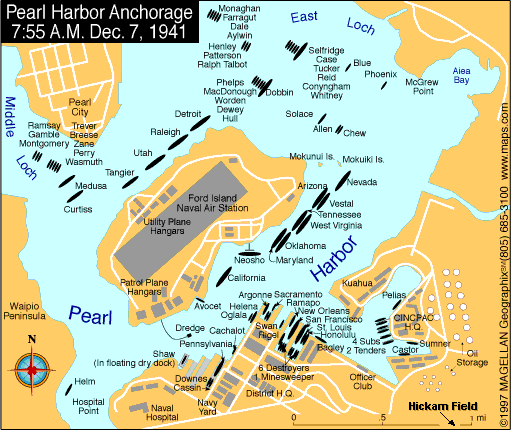
Last year I wrote a piece called The Battleships of Pearl Harbor. I followed that with an article this year entitled “Forgotten on the Far Side of Ford Island: The USS Utah, USS Raleigh, USS Detroit and USS Tangier. Of course most anyone that has see either Tora! Tora! Tora! Or Pearl Harbor is acquainted with the attack on “Battleship Row” and the airfields on Oahu.  What are often overlooked in many accounts are the stories of some of the lesser known ships that played key roles or were damaged in the attack.  Since none of the articles that I have seen have discussed all of the U.S. Navy ships at Pearl Harbor on that fateful morning I have taken the time to list all the ships with the exception of yard and patrol craft present at Pearl Harbor on December 7th 1941.  I have also excluded Coast Guard cutters. A brief account of each ship’s war service and final disposition is included.  I believe that this is the only site that has this information in a single article.

During the attack 18 ships were sunk or damaged but only three, Arizona, Oklahoma and Utah never returned to service.  During the war a further 18 ships were sunk or written off as losses during the war. All ships lost in the war are marked with an asterisk. One ship, the USS Castor remained in active service until 1968 serving in the Korean and Vietnam Wars. One ship, the Light Cruiser Phoenix was sunk in the Falklands War while serving as the Argentine ship General Belgrano. No U.S. Navy ships apart from the Yard Tug Hoga (not included in this article) remain today.  It is unfortunate that the Navy or any organization had the foresight to save one of these ships. It would have been fitting for one of the battleships that survived the war to be preserved as a memorial ship near the Arizona Memorial. While the USS Missouri serves this purpose symbolic of the end of the war it is a pity that no ship at Pearl Harbor was preserved so that people could see for themselves what these gallant ships was like.

Battleships


Nevada (BB-36) Nevada was the only Battleship to get underway during the attack.  As she attempted to escape the harbor she was heavily damaged and to prevent her sinking in the main channel she was beached off Hospital Point.  She would be raised and returned to service by the May 1943 assault on Attu.  She would then return to the Atlantic where she would take part in the Normandy landings off Utah Beach and the invasion of southern France in July 1944.  She then returned to the Pacific and took part in the operations against Iwo Jima and Okinawa where she again provided naval gunfire support.  Following the war she would be assigned as a target at the Bikini atoll atomic bomb tests, surviving these she would be sunk as a target on 31 July 1948. She received 7 battle stars for her WWII service.

*Oklahoma (BB-37) During the Pearl Harbor attack Oklahoma was struck by 5 aerial torpedoes capsized and sank at her mooring with the loss of 415 officers and crew. Her hulk would be raised but she would never again see service and sank on the way to the breakers in 1946.  She was awarded one battle star for her service during the attack.

Pennsylvania (BB-38) Pennsylvania was the Pacific Fleet Flagship on December 7th 1941 and was in dry dock undergoing maintenance at the time of the attack. Struck by two bombs she received minor damage and would be in action in early 1942. She underwent minor refits and took part in many amphibious landings in the Pacific and was present at the Battle of Surigo Strait.  Heavily damaged by an aerial torpedo at Okinawa Pennsylvania would be repaired and following the war used as a target for the atomic bomb tests. She was sunk as a gunnery target in 1948.  She received 8 battle stars for her WWII service.

*Arizona (BB-39) Arizona was destroyed during the attack.  Hit by 8 armor piercing bombs one of which penetrated her forward black powder magazine she was consumed in a cataclysmic explosion which killed 1103 of her 1400 member crew.  She was decommissioned as a war loss but her colors are raised and lowered every day over the Memorial which sits astride her broken hull.  She received one battle star for her service at Pearl Harbor.

Tennessee (BB-43) Tennessee was damaged by two bombs and was shield from torpedo hits by West Virginia. After repairs she conducted operations in the Pacific until she reported to Puget Sound Naval Shipyard in August 1942 for a complete rebuild and modernized with the latest in radar, fire control equipment and anti-aircraft armaments. She returned to active service in May 1943. She provided Naval Gunfire support in numerous amphibious operations and was a key ship during the Battle of Surigo Strait firing in six-gun salvos to make careful use of her limited supply of armor-piercing projectiles, Tennessee got off 69 of her big 14-inch bullets before checking fire.  Her gunfire helped sink the Japanese Battleships Fuso and Yamishiro and other ships of Admiral Nishimura’s Southern Force.  She was damaged by a Kamikaze off Okinawa on 18 April 1945 which killed 22 and wounded 107 of her crew but did not put her out of action.  Her final assignment of the war was to cover the landing of occupation troops at Wakayama, Japan.  She was decommissioned in 1947 and remained in reserve until 1959 when she was sold for scrap. Tennessee earned a Navy Unit Commendation and 10 battles stars for World War II service.

California (BB-44) California was hit by two torpedoes but had the bad luck to have all of her major watertight hatches unhinged in preparation for an inspection. Hit by two torpedoes and two bombs she sank at her moorings suffering the loss of 98 killed and 61 wounded. She was refloated and received temporary repairs at Pearl Harbor before sailing to Puget Sound Naval Shipyard to be completely rebuilt and modernized with the latest in radar, fire control equipment and anti-aircraft armaments. She returned to service in January 1944. She saw her first action in the Marianas and was in continuous action to the end of the war. She played an important part in the Battle of Surigo Strait and in the amphibious landings at Guam and Tinian, Leyte, Iwo Jima and Okinawa.  She was decommissioned in 1947 and placed in reserve finally being sold for scrap in 1959. She received 7 battle stars for her WWII service.

Maryland (BB-45) At Pearl Harbor Maryland was moored inboard of Oklahoma and was hit by 2 bombs.  She would be quickly repaired and returned to action and receive minimal modernization during the war. She would participate in operations throughout the entirety of the Pacific Campaign providing naval gunfire support to the landings at Tarawa, Kwajalein, Saipan, where she was damaged by an aerial torpedo, Palau, Leyte where she was damaged by a Kamikaze, Okinawa and the battleship action at Surigo Strait.  Decommissioned in 1947 she was placed in reserve and sold for scrap in 1959. On 2 June 1961 the Honorable J. Millard Tawes, Governor of Maryland, dedicated a lasting monument to the memory of the venerable battleship and her fighting men. Built of granite and bronze and incorporating the bell of “Fighting Mary,” this monument honors a ship and her 258 men who gave their lives while serving aboard her in WWII.  This monument is located on the grounds of the State House, Annapolis, Md. Maryland received seven battle stars for World War II service.

West Virginia (BB-48) West Virginia suffered some of the worst damage in the attack. Hit by at least 5 torpedoes and two bombs she was saved from Oklahoma’s fate by the quick action of her damage control officer to counter flood so she would sink on an even keel.  She would be raised, refloated and taken back to the West Coast for an extensive modernization on the order of the Tennessee and California. The last Pearl Harbor battleship to re-enter service she made up for lost time as she lead the battle line at Surigo Strait firing 16 full salvos at the Japanese squadron helping sink the Japanese Battleship Yamashiro in the last battleship versus battleship action in historyWest Virginia was decommissioned in 1947, placed in reserve and sold for scrap in 1959.

Heavy Cruisers

New Orleans (CA-32) Minor shrapnel damage from near miss. Fought throughout the war in the Pacific; bow blown off by Japanese torpedo at Battle of Trassafaronga in November 1942, repaired. 17 battle stars for WWII service, decommissioned 1947 and sold for scrap in 1957

San Francisco (CA-38 Undamaged at Pearl Harbor, fought through Pacific war, most noted for actions at the Naval Battle of Guadalcanal fighting Japanese Battleship Hiei. Decommissioned 1946 and sold for scrap in 1959. San Francisco earned 17 battle stars during World War II. For her participation in the Naval Battle of Guadalcanal, she was awarded the Presidential Unit Citation. For the same action, three members of her crew were awarded the Medal of Honor: Lieutenant Commander Herbert E. Schonland, Lieutenant Commander Bruce McCandless , and Boatswain’s Mate 1st Class Reinhardt J. Keppler (posthumous). Admiral Daniel Callaghan was also awarded the Medal of Honor (posthumous).  During the November 1942 repair at Mare Island, it was necessary to extensively rebuild the bridge. The bridge wings were removed as part of that repair, and are now mounted on a promontory in Lands End, San Francisco at Golden Gate National Recreation Area overlooking the Pacific Ocean. They are set on the great circle course from San Francisco  to Guadalcanal.  The old ship’s bell is housed at the Marines Memorial Club in San Francisco.

Light Cruisers

Raleigh (CL-7) Heavily damaged by torpedo, repaired served throughout war mainly in North Pacific . Decommissioned 1945 and scrapped 1946

Detroit (CL-8) Undamaged and got underway during attack. Mainly served in North Pacific and on convoy duty earning 6 battle stars for WWII service, decommissioned and sold for scrap 1946

Phoenix (CL-46) Undamaged at Pearl Harbor and served throughout war and at the Battle of Surigo Strait she helped sink the Japanese Battleship Fuso.  She earned 9 battle stars for WWII service. Decommissioned 1946 and transferred to Argentina 1951. Served as General Belgrano and sunk by submarine HMS Conqueror on 2 May 1982 during the Falklands War.

Honolulu (CL-48) Suffered minor hull damage from near miss. Served in Pacific and fought several engagements against Japanese surface forces in the Solomons. At the Battle of Kolombangara on the night of 12-13 July 1943 she was damaged by a torpedo but sank the Japanese Light Cruiser Jintsu. Earned 9 battle stars for WWII service, decommissioned 1947 and sold for scrap 1949

St. Louis (CL-49) St. Louis got underway at 0930 nearly torpedoed by Japanese midget sub. She served throughout war in numerous operations and was damaged at the Battle of Kolombangara. She earned 11 battle stars for WWII service. She decommissioned 1946 and transferred to Brazil where she was renamed Tamandare stricken in 1976 sold for scrap in 1980 but sank while under tow to Taiwan.

*Helena (CL-50) Damaged and repaired. Engaged in many battles around Solomon Islands where at the Battle of Cape Esperance at Guadalcanal she sank the Japanese Heavy Cruiser Furutaka and destroyer Fubiki. She was engaged during the Naval Battle of Guadalcanal and was sunk at Battle of Kula Gulf 6 July 1943.  She was the first ship to be awarded the Naval Unit Commendation and was awarded 7 battle stars for her WWII service.

Destroyers

Allen (DD-66) Undamaged during attack spent war in local operations in Oahu area. Decommissioned 1945 and scrapped 1946

Schley (DD-103) Being overhauled on December 7th was undamaged in attack. Converted into High Speed Transport (APD) in 1942, earned 11 battle stars for WWII service and decommissioned in 1945 and scrapped in 1946

Chew (DD-106) Undamaged during attack and conducted local operations in Oahu operations for remainder or war, decommissioned 1945 and scrapped 1946

*Ward (DD-139) Ward was underway patrolling Channel entrance to Pearl Harbor on December 7th, sank Japanese midget submarine. Converted to APD in 1943 and served in numerous operations prior to being heavily damaged by Japanese bombers at Ormoc Bay off Leyte in December 1944 starting fires that could not be controlled. She was sunk by USS O’Brien (DD-725) after survivors were rescued. By a strange twist of fate the C.O. of O’Brien LCDR Outerbridge who had commanded Ward when she sank the Japanese submarine at Pearl Harbor. Ward earned 10 battle stars for WWII service.

Dewey (DD-349) Being overhauled on December 7th Dewey served throughout the war earning 13 battle stars escorting carriers, convoys and supporting amphibious operations. Decommissioned October 1945 and sold for scrap 1946

Farragut (DD-348) Got underway during attack suffered minor damage from strafing. During the war she operated from the Aleutians to the South Pacific and Central Pacific escorting carriers and supporting amphibious operations. She earned 14 battle stars for WWII service. Decommissioned 1945 and sold for scrap 1947

*Hull (DD-350) Undamaged at Pearl Harbor she operated from the Aleutians to the South Pacific and Central Pacific escorting carriers and supporting amphibious operations. She earned 10 battle stars before sinking in “Halsey’s Typhoon” on 18 December 1944.

MacDonough (DD-351) MacDonough got underway during attack and was undamaged, during war served in North and Central Pacific escorting carriers and supporting amphibious operations. She earned 13 battle stars for her WWII service. Decommissioned October 1945 and sold for scrap 1946

*Worden (DD-352) Worden got underway during attack and went to sea with ships searching for Japanese strike force. Served at Midway and the South Pacific before being transferred to the Aleutians where she grounded on a pinnacle due to winds and currents at Constantine Harbor Amchitka Island on 12 January 193, she broke up in the surf and was written off as a total loss. Worden was awarded 4 battle stars for her WWII service.

Dale (DD-353) Dale got underway immediately under the command of her Command Duty Officer, an Ensign and joined ships searching for Japanese strike force. During war served in North and Central Pacific and took part in the Battle of the Komandorski Islands on 26 March 1943.  Earned 12 battle stars for WWII service, decommissioned October 1945 sold for scrap December 1946.

*Monaghan (DD-354)  Monaghan was the Ready destroyer on December 7th and ordered underway when Ward sank the midget submarine. On way out of harbor rammed, depth charged and sank a Japanese midget submarine that had gotten into Pearl Harbor. She participated in Coral Sea, Midway, Aleutians, the Battle of the Komandorski Islands and Central Pacific operations before sinking with the loss of all but 6 crewmen during the great Typhoon of November 1944 sinking on 17 November. She received 12 battle stars for her WWII service.

Aylwin (DD-355) Got underway within an hour of the beginning of the attack with 50% of her crew and four officers, all Ensigns manning her leaving her Commanding Officer and others behind in a launch as she was under direction not to stop for anything. This was captured in the movie In Harm’s Way. During the war Aylwin saw action at Coral Sea, Midway, Guadalcanal, the Aleutians, and the Central Pacific up to the Okinawa and due to the action of her crew survived the great typhoon of November 1944. She earned 13 battle stars for her WWII service and was decommissioned in October 1945. She was sold for scrap in December 1946.

Selfridge (DD-357) Manned by a crew from 7 different ships Selfridge got underway at 1300 and was undamaged in the attack. Throughout war she served primarily as an escort to carriers and transports. Torpedoed by Japanese destroyer and lost her bow at Battle of Vella Lavella on 6 October 1942. Repaired and finished war. Earned 4 battle stars for WWII service and was decommissioned in October 1945 and sold for scrap in December 1946.

Phelps (DD-360) Undamaged at Pearl Harbor Phelps was credited with shooting down one enemy aircraft. She was in action at Coral Sea, Midway, Guadalcanal, the Aleutians and the Central Pacific picking up 12 battle stars for her WWII service. Decommissioned in October 1945 and scrapped 1947.

Cummings (DD-365) Sustained minor damage from bomb fragments but got underway quickly. During war served on convoy escort, with fast carrier task forces and provided Naval Gunfire Support from the Aleutians to the Indian Ocean where she operated with the Royal Navy. On 12 August 1944, President Roosevelt broadcast a nationwide address from the forecastle of Cummings after a trip the Alaska. Cummings was decommissioned in December 1945 and sold for scrap in 1947.

*Reid (DD-369) Undamaged at Pearl Harbor Reid escorted convoys and amphibious operations throughout the Pacific until she was sunk by Kamikazes at Ormoc Bay in the Philippines on 11 December 1944. On 31 August 1942 she sank by gunfire the Japanese submarine RO-1 off Adak Alaska. She received 7 battle stars for her WWII service.

Case (DD-370) Undamaged at Pearl Harbor Case escorted the fast carrier task forces throughout much of the war as well as conducted Anti-Submarine Warfare operations and Naval Gunfire Support. She sank a Midget submarine outside the fleet anchorage at Ulithi on 20 November 1944 and a Japanese transport off of Iwo Jima on 24 December 1944. She earned 7 battle stars for her WWII service and was decommissioned in December 1945 and sold for scrap in December 1947.

Conyngham (DD-371) Undamaged during attack she was underway that afternoon. Spent most of war on convoy escort, escorting carrier task forces and conducting Naval Gunfire Support missions she was damaged twice by strafing Japanese aircraft she earned 14 battle stars for her WWII service. Used in 1946 Atomic Bomb tests and destroyed by sinking in 1948.

Cassin (DD-372) Destroyed in drydock but salvaged returned to service 1944 escorting convoys and TG 38.1 the Battle Force of the fleet at Leyte Gulf as well as supporting amphibious operations. She earned 6 battle stars for her WWII service.  Decommissioned December 1945 and sold for scrap 1947

Shaw (DD-373) Sustained massive damage due to magazine explosion, salvaged and repaired served throughout war and awarded 11 battle stars. Damaged by Japanese dive bombers off Cape Gloucester on 25 December 1943 with loss of 3 killed and 33 wounded. Decommissioned October 1945 and scrapped 1947

*Tucker (DD-374) Undamaged at Pearl Harbor Tucker conducted convoy escort operations and was sunk when she struck a mine escorting a transport to Espiritu Santo on 1 August 1942 sinking on 4 August. She received one battle star for her WWII service.

Downes (DD-375) Destroyed in drydock and salvaged. Decommissioned June 1942, rebuilt and recommissioned 1943. After she was recommissioned and used to escort convoys and conduct Naval Gunfire Support to amphibious operations. She earned 4 battle stars for her WWII service. Decommissioned 1947 and sold for scrap.

Bagley (DD-386) Undamaged at Pearl Harbor Bagley conducted convoy escort operations and supported amphibious landings throughout the Pacific earning 1 battle stars ended the war on occupation duty at the Sasebo-Nagasaki area until returning to the United States. She earned 12 battle stars for her WWII service and was decommissioned in June 1946 and sold for scrap in October 1947.

*Blue (DD-387) Blue was undamaged and got underway during the attack under the direction of 4 Ensigns.  Served on convoy escort duties, present at Battle of Savo Island on 9 August 192 and was torpedoed off Guadalcanal by Japanese destroyer Kawakaze on 21 August and was scuttled 22 August. She earned five battle stars for her WWII service.

Helm (DD-388) Helm was underway, nearing West Loch at the time of the attack. Helm served in the Solomons and the South Pacific until February 19. She joined the fast carrier task forces of 5th Fleet in May 1944. On 28 October at Leyte Gulf 28 October 1944 Helm and companion destroyer Gridley made sank the Japanese submarine I-46. She was used for a target during Operation Crossroads and scrapped in 1946. She received 11 battle stars for her WWII service.

Mugford (DD-389) Mugford was on standby status and had steam up which allowed her to get to sea during the attack in which she shot down Japanese aircraft. She spent much of 1942 on convoy duty between the U.S. and Australia. She took part in the Guadalcanal invasion and was struck by a bomb which killed 8 men, wounded 17 and left 10 missing in action. She would go on to serve in the Central and South Pacific being damaged by a near miss from a bomb on 25 December off Cape Gloucester and was stuck by a Kamikaze on 5 December 1944 in Surigo Strait. She escorted the fast carriers of TF 8 and 58 and later served on anti-submarine and radar picket duty. She decommissioned 1946 and was used in the Atomic Bomb tests and after use as a test ship for radioactive decontamination was sunk on 22 March 1948 at Kwajalein. She received 7 battle stars for her WWII service.

Ralph Talbot (DD-390) Ralph Talbot got underway by 0900 on the morning of the attack and joined other ships at sea attempting to find the Japanese strike force. She spent much of 1942 engaged in escort duties and took part in the Battle of Savo Island where she engaged the Japanese as part of the Northern Group and was damaged by Japanese shellfire. She spent the war in the South and Central Pacific escorting convoys and supporting amphibious operations and was damaged by a Kamikaze off Okinawa. She remained in service until 1946 when she was assigned to JTF-1 and the Operations Crossroads Atomic Bomb test. She survived the blast and was sunk in 198. She earned 12 battle stars for her WWII service.

*Henley (DD-391) Undamaged at Pearl Harbor Henley was already at General Quarters when the attack began because a new sailor sounded the General Quarters alarm instead of Quarters for Muster. As a result her weapons were manned. She got underway during the attack under the command of a junior Lieutenant and joined other ships patrolling outside of Pearl Harbor. Henley carried out convoy and anti-submarine patrols mainly around Australian continuing those duties through the Guadalcanal campaign. She was torpedoed and sunk by Japanese bombers on 3 October 1943 while conducting a sweep in support of troops ashore near Finshafen New Guinea. Henley earned 4 battle stars for her WWII service.

Patterson (DD-392) Patterson was undamaged during the attack and proceeded to sea conducting anti-submarine warfare patrols. She would spend the bulk of the war as an escort for fast carrier task forces. She was with the Southern Group during the Battle of Savo Island and suffered a hit on her #4 gun mount that killed 10 sailors.  She was awarded 13 battle stars for her WWII service. Decommissioned in November 1945 she was stricken from the Naval Vessel Register in 1947 and sold for scrap.

*Jarvis (DD-393) Jarvis survived Pearl Harbor undamaged and got underway to join other ships in patrols around Oahu.  She served as an escort for carriers and convoys and the invasion of Guadalcanal. She was heavily damaged by an aircraft launched torpedo during the landings but her crew made temporary repairs and restored power. She was ordered to Efate New Hebrides but evidently unaware of the order her Commanding Officer set sail for Sidney Australian and repairs from the Destroyer Tender USS Dobbin. She passed south of Savo Island as the Japanese cruiser force approached and refused assistance for the USS Blue.  She was last seen on the morning of 9 August 1942 by a scout plane from Saratoga. Already heavily damaged and having little speed, no radio communications and few operable guns was attacked by a force of 31 Japanese bombers sinking with all hands at 1300 on 9 August. Jarvis was awarded 3 battle stars for her WWII service.

Submarines

Narwhal (SS-167) Narwhal was one of a class of three large cruiser submarines that was built in the mid 1920s. Narwhal was 14 years old at the time of the attack. She was undamaged at Pearl Harbor and was used primarily to support special missions and special operations forces in raids against Japanese shore installations. Narwhal earned 15 battle stars for her service in the Pacific and was decommissioned in February 1945 and sold for scrap in May. Her 6” guns are enshrined at the Naval Submarine Base Groton.

Dolphin (SS-169) Undamaged in the Pearl Harbor attack Dolphin made 3 war patrols in late 1941 and early 1942 before being withdrawn from combat service and used for training due to her age. She was decommissioned in October 1945 and sold for scrap in 1946. She received 2 battle stars for her service in WWII.

Cachalot (SS-170) Undamaged at Pearl Harbor Cachalot conducted three war patrols damaging an enemy tanker before being withdrawn from combat service in the fall of 1942 being judged too old for arduous combat service. She served as a training ship until June 1945 and was decommissioned in October 1945 and sold for scrap in January 1947. She was awarded 3 battle stars for her WWII service.

Tautog (SS-199) Tautog was undamaged at Pearl Harbor and made the Japanese pay for not sinking her. She helped avenge the Pearl Harbor attack sinking 26 enemy ships of 71,900 tons including the submarines RO-30 and I-28 and destroyers Isoname and Shirakumo in 13 war patrols. She was withdrawn from combat service in April 1945 and served and operated in conjunction with the University of California’s Department of War Research in experimenting with new equipment which it had developed to improve submarine safety. She was decommissioned in December 1945. Spared from the Atomic Bomb tests she served as an immobile reserve training ship in the Great Lakes until 1957 and was scrapped in 1960.  Tautog was awarded 14 battle stars and a Naval Unit Commendation for her service in WWII.

Minelayer

Oglala (CM-4) Sank due to concussion from torpedo hit on Helena. Raised and repaired, converted to internal combustion repair ship. Decommissioned 1946 transferred to Maritime Commission custody and scrapped 1965

Minesweepers

Turkey (AM-13) Undamaged at Pearl Harbor she was redesignated as a Fleet Tug in 1942. She was decommissioned in November 1945 and sold for scrap in 1946. She received one battle star for her service at Pearl Harbor.

Bobolink (AM-20) Undamaged at Pearl Harbor and redesignated as an Ocean Going Tug in 1942. She decommissioned in 1946 and sold through the Maritime Administration. She received one battle star for her service at Pearl Harbor.

Rail (AM-26) Undamaged at Pearl Harbor Rail was redesignated as a Ocean Going Tug in June 1942. She supported operations throughout the Pacific earning 6 battle stars for her WWII service. She was decommissioned in 1946 and transferred to the Maritime Administration for disposal in 1947.

Tern (AM-31) Undamaged in the attack Tern was redesignated as an Ocean Going Tug in June 1942 and supported the fleet for the remainder of the war. She was decommissioned and struck from the Navy List in December 1945. She earned one battle star for her service at Pearl Harbor.

*Grebe (AM-43) Undamaged at Pearl Harbor Grebe was redesignated as an Ocean Going Tug in June 1942.  On 6 December 1942 Grebe grounded while attempting to float SS Thomas A. Edison at Vuanta Vatoa, Fiji Islands. Salvage operations were broken up by a hurricane that destroyed both ships 1-2 January 1943.

Vireo (AM-52) Undamaged at Pearl Harbor Vireo was designated an Ocean Going Tug in May 1942. At the Battle of Midway she was assisting USS Yorktown CV-5 when that ship was torpedoed by a Japanese submarine and sunk.  She was damaged in a Japanese air strike off Guadalcanal on October 15th 1942 abandoned but recovered by U.S. Forces and repaired supporting damaged fleet units. She was decommissioned in 1946 and disposed of by the Maritime Administration in 1947. Her final disposition is unknown. She was awarded 7 battle stars for her WWII service.

Coastal Minesweepers

Cockatoo (AMC-8) Undamaged at Pearl Harbor Cockatoo operated in the 14th Naval District from Pearl Harbor throughout the war. She was transferred to the Maritime Commission 23 September 1946.

Crossbill (AMC-9) Undamaged in the attack she operated in an in-service status attached to the 14th Naval District from 1941 to 1947.

Condor (AMC-14) Undamaged in the attack she operated in the Hawaiian Islands throughout World War II. Placed out of service 17 January 1946, she was transferred to the Maritime Commission for disposal 24 July 1946.

Reedbird (AMC-30) Undamaged during the attack she operated in Hawaiian waters throughout World War II. Then ordered inactivated, Reedbird returned to San Diego where she was stripped and placed out of service 14 January 1946. Her name was struck from the Navy list 7 February 1946 and on 8 November 1946 she was delivered to the Maritime Commission for disposal.

Light Minelayers (Note: All of these ships were WWI era “four piper” destroyers converted to Mine Warfare ships in the 1920s and 1930s)

*Gamble (DM-15) Gamble was undamaged at Pearl Harbor and served throughout the Pacific. On 29 August 1942 she sank Japanese submarine I-123 near Guadalcanal. On 6 May 1943 she mined the Blackett Strait with her sisters USS Preble and USS Breese. On the night of 7-8 May a Japanese destroyer force entered the minefield one of which Kurashio, went down and two others Oyashio and Kagero were sunk by Allied aircraft the next day. The sinking of Kagero provided a measure of revenge as that ship was part of the Japanese Carrier Strike Group that attacked Pearl Harbor. On 18 February 1945 Gamble was damaged by two bombs while operating off of Iwo Jima. Badly damaged she was towed to Saipan but salvage was impossible and she was decommissioned sunk off of Apra Harbor Guam on 16 July 1945. She was awarded 7 battle stars for her WWII service.

Ramsay (DM-16) Ramsey got underway during the attack and dropped depth charges in the vicinity of what was believed to be a midget submarine. She served in the Solomons and Aleutians and was redesignated as a Miscellaneous Auxiliary (AG-98) in 1944 operating around Pearl Harbor. She was decommissioned in October 1945 and scrapped in 1946. She received 3 battle stars for her WWII service.

*Montgomery (DM-17) Undamaged in the attack Montgomery conducted ASW operations in the wake of the attack. She operated throughout the Pacific until she was damaged by a mine while anchored off Ngulu on 17 October 1944. She was decommissioned on 23 April 1945 and sold for scrap in 1946. She was awarded 4 battle stars for her WWII service.

Breese (DM-18) Breese got underway during the attack and assisted in sinking a midget submarine. She was engaged throughout the war in the Pacific and operated with Gamble and Preble to mine the Blackett Strait in May 1943, an operation that resulted in the sinking of 3 Japanese destroyers. She was decommissioned and sold for scrap in 1946. She was awarded 10 battle stars for her WWII service.

Tracy (DM-19) Tracy was being overhauled during the attack and all machinery and armament was dismounted.  After the overhaul she operated around the Pacific and in February 1943 she Tracy, as task group leader, led Montgomery (DM-17) and Preble (DM-20) in laying a field of 300 mines between Doma Reef and Cape Esperance. That night, Japanese destroyer Makigumo struck one of these mines and was damaged so badly that she was scuttled. Tracy was decommissioned and scrapped in 1946. She received 7 battle stars for her WWII service.

Preble (DM-20) Preble was being overhauled on December 7th and took no part in the action. During the war she operated throughout the Pacific and in company with Gamble and Breese laid a minefield on 6 May 1943 which resulted in sinking 3 Japanese destroyers. She was redesignated as a Miscellaneous Auxiliary (AG-99) and she was regulated to convoy escort duties until the end of the war. She was decommissioned in December 1945 and sold for scrap in 1946. She was awarded 8 battle stars for WWII service.

Sicard (DM-21) Sicard was under overhaul at the Naval Shipyard during the attack. During the war she primarily served on convoy escort duty with and in some mine laying operations. She was reclassified a miscellaneous auxiliary, AG-100, effective 5 June 1945, decommissioned in December 1945 and sold for scrap in 1946. She was awarded 2 battle stars for her WWII service.

Pruitt (DM-22) Pruitt was being overhauled during the attack and served throughout the Pacific during the war. She was reclassified a miscellaneous auxiliary, AG-101, effective 5 June 1945, decommissioned November and stricken from the Navy List in December 1945 being scrapped at Philadelphia Naval Shipyard. She was awarded 3 battle stars for her WWII service.

High Speed Minesweepers (Note: All of these ships were WWI era “four piper” destroyers converted to Mine Warfare ships in the 1920s and 1930s)

Zane (DMS-14) Undamaged at Pearl Harbor Zane saw much service in the South and Central Pacific in WWII. She conducted minesweeping, convoy escort and ASW operations from Pearl Harbor to the Marianas campaign. She was damaged in a firefight with Japanese destroyers at Guadalcanal in 1942.  After the invasion of Guam she was reassigned to target towing duties. Reclassified from high-speed minesweeper to a miscellaneous auxiliary, AG-109, on 5 June 1945 she decommissioned in December 1945 and sold for scrap in 1946. She was awarded 6 battle stars and a Naval Unit Commendation for her service in WWII.

*Wasmuth  (DMS-15) Wasmuth was undamaged during the attack and spent 1942  conducting patrol and convoy escort duties in the Aleutians and the West Coast. On 27 December 1942 while escorting a convoy in heavy seas two of her depth charges were ripped off their racks and exploded under her fantail blowing off her stern.  Despite repair attempts her crew was evacuated and she sank on 29 December 1942. She was awarded one battle star for her service at Pearl Harbor.

Trever (DMS-16) Trever got underway during the attack without her Commanding Officer. During the war she saw extensive service. In 1945 she was regulated to training and local operations around Pearl Harbor. On 4 June 1945, she was reclassified as a miscellaneous auxiliary and designated as AG-110 and decommissioned in December 1945 and sold for scrapping in 1946. She received 5 battle stars for her WWII service.

*Perry (DMS-17) Perry got underway during the attack and was undamaged. During the war she engaged in numerous minesweeping and escort duties. She struck a mine during the Peleliu invasion off Florida Island and sank on 6 September 1944. She was awarded 6 battle stars for her WWII service.

Gunboat

Sacramento (PG-19) The elderly Sacramento was undamaged during the attack and participated in rescue and salvage operations after the attack. During the war she served as a tender for PT Boats and an air sea rescue vessel.  Sacramento was decommissioned on 6 February 1946 at Suisun Bay, Calif., and simultaneously transferred to the War Shipping Administration for disposal. She was sold on 23 August 1947 for mercantile service, initially operating under Italian registry as Fermina. She received one battle star for her service at Pearl Harbor.

Destroyer Tenders

Dobbin (AD-3) Dobbin received minor damage from a bomb burst alongside which killed 2 crewmembers.  During the war she would serve in the South Pacific supporting Pacific Fleet Destroyer Squadrons. She was decommissioned and transferred to the Maritime Administration in 1946. She was awarded one battle star for her service at Pearl Harbor.

Whitney (AD-4) Whitney was moored with a nest of destroyers during the attack and helped them prepare for sea during the attack issuing supplies and ammunition to help them get underway. Her sailors helped in repair and salvage operations on several ships during and after the attack.  She would provide vital support to destroyer squadrons during the war and serve until 1946 when she was decommissioned and transferred to the Maritime Administration and scrapped in 1948. She received one battle star for her service at Pearl Harbor.

Seaplane Tenders

Curtiss (AV-4) Damaged by bomb and repaired. She served throughout the war and was damaged by a  Kamikaze in 1945 while operating off Okinawa. Repaired she finished the war and served on active duty until 1956 when she was decommissioned and placed in reserve. She was scrapped 1972. Curtiss received 7 battle stars for her WWII service.

Tangier (AV-8) Moored just past the USS Utah Tangier was undamaged in the attack and contributed her guns to the air defense as well as shooting at a Japanese midget submarine that had penetrated the harbor. She maintained a very active operational carrier in the Pacific. Decommissioned in 1946 Tangier was sold for scrap in 1961. She earned 3 battle stars for her WWII service.

Seaplane Tenders (Small)

Avocet (AVP-4) Undamaged at Pearl Harbor Avocet Avocet served in the Alaskan and Aleutian theatres of operations as a unit of Patrol Wing 4. During the years, she tended patrol squadrons, transported personnel and cargo, and participated in patrol, survey, and salvage duties. She was decommissioned in December 1945 and sold in 1946. She received one battle star for her service at Pearl Harbor.

Swan (AVP-7) Swan was on the Marine Railway drydock during the attack and was undamaged. During the war she was primarily used on target towing duties. She was decommissioned in December 1945 and disposed of by the Maritime Commission in 1946. She received one battle star for her service at Pearl Harbor.

Seaplane Tenders (Destroyer) (Note: All of these ships were WWI era “four piper” destroyers converted to Seaplane Tenders in the 1920s and 1930s)

Hulbert (AVD-6) Hulbert was undamaged during the attack and spent 1942-1943 conducting support missions for flying boats. Reclassified DD-342 she was used as an escort and plane guard for new Escort Carriers at San Diego until the end of the war. She was decommissioned in November 1945 and sold for scrap in 1946. She received 2 battle stars for her WWII service.

*Thornton (AVD-11) Thornton contributed her guns to the defense of Pearl Harbor and served in varying locales in the Pacific supporting the operations of flying boats. She was lost during the Okinawa invasion when collided with Ashtabula (AO-51) and Escalante (AO-70). Her starboard side was severely damaged. She was towed to Kerama Retto. On 29 May 1945 a board of inspection and survey recommended that Thornton be decommissioned, beached stripped of all useful materiel as needed, and then abandoned. She was beached and decommissioned on 2 May 1945. Her name was struck from the Navy list on 13 August 1945. In July 1957, Thornton’s abandoned hulk was donated to the government of the Ryukyu Islands. She received 3 battle stars for her WWII service.

Ammunition Ship

Pyro (AE-1) Pyro was undamaged in the attack and served the war transporting ammunition to naval bases around the Pacific. She was decommissioned in 1946 and scrapped in 1950. She was awarded one battle star for her service at Pearl Harbor.

Oilers

Ramapo (AO-12) Ramapo was not damaged at Pearl Harbor and due to her slow speed was regulated to fuel transport operations between the Aleutians and the Puget Sound. She was decommissioned in 1946 and transferred to the Maritime Administration.

*Neosho (AO-23) Undamaged during the attack her Captain alertly moved her from her berth near Battleship Row to a less exposed part of the harbor.  She operated with the carrier task forces and was heavily damaged at the Battle of Coral Sea by Japanese aircraft. Her crew kept her afloat for 4 days until she was discovered and her crew rescued before she was sunk by gunfire from USS Henley on 11 May 1942. Neosho was awarded 2 battle stars for her WWII service.

Repair Ships

Medusa (AR-1) Medusa was undamaged at Pearl Harbor and spent the war throughout the South Pacific repairing numerous vessels damaged in combat. After the war she served to prepare ships for inactivation before being decommissioned in 1947 and turned over to the Maritime Administration. She was scrapped in 1950. She received one battle star for her service at Pearl Harbor.

Vestal (AR-4) Vestal was damaged while moored adjacent to USS Arizona. Repaired following the attack Vestal served throughout war in the Pacific and was vital during the critical days of 1942 when she and her crew performed valiant service on major fleet units damaged during the Guadalcanal campaign and actions around the Solomon Islands. Carriers Enterprise and Saratoga, battleships South Dakota and North Carolina, cruisers San Francisco, New Orleans, Pensacola and St. Louis were among the 5,603 jobs on 279 ships and 24 shore activities that she completed in a 12 month tour at Espiratu Santo. She would continue to perform this level of service the remainder of the war. During a stint at Ulithi she completed 2,195 jobs for 149 ships including 14 battleships, 9 carriers, 5 cruisers and 5 destroyers.  She continued her vital work even after the war into 1946 when she was finally decommissioned.  She was sold for scrap in 1950. She received 1 battle star for her service at Pearl Harbor.

Rigel (AR-11) Rigel was at Pearl Harbor completing her transformation from Destroyer Tender to Repari Ship. She incurred minor damage and she served throughout the war conducting vital repairs to numerous ships. She was decommissioned and transferred to the Maritime Administration in 1946.  Her ultimate fate is unknown. She was awarded 4 battle stars for her WWII service.

Submarine Tender

Pelias (AS-14) Undamaged during the attack Pelias supported submarine squadrons based in the Pacific throughout the war. She was placed in commission in reserve 6 September 1946, and in service in reserve 1 February 1947. On 21 March 1950 she was placed out of service in reserve but later performed berthing ship duty at Mare Island until she decommissioned 14 June 1970. She was scrapped in 1973.

Submarine Rescue Ship

Widgeon (ASR-1) Widgeon conducted salvage, rescue and fire fighting operations on the sunk and damaged battleships on battleship row. During the war she served as the duty submarine rescue ship at Pearl Harbor and San Diego.  After the war she supported the Operation Crossroads. She was decommissioned and sold for scrap in 1947. She received on battle star for her service at Pearl Harbor.

Hospital Ship

Solace (AH-5) Solace was undamaged in the attack and provided medical care to many of the wounded after the attack. She served throughout the war caring for the wounded and dying in the Gilberts, the Marshalls, Guam, Saipan, Palau, Peleliu, Iwo Jima and Okinawa.  Solace was decommissioned at Norfolk on 27 March, struck from the Navy list on 21 May, and returned to the War Shipping Administration on 18 July 1946. She was sold to the Turkish Maritime Lines on 16 April 1948 and renamed SS Ankara, rebuilt as a passenger liner. SS Ankara was laid up in 1977 and scrapped at Aliaga, Turkey, in 1981. Solace received seven battle stars for World War II service.

Cargo Ship

Vega (AK-17) Vega was at Honolulu offloading ammunition when the attack occurred. She served in the Aleutians and in the Central Pacific during the war. Decommissioned and scrapped in 1946. She received 4 battle stars for her WWII service.

General-Stores-Issue Ships

Castor (AKS-1) Castor was strafed by Japanese aircraft during the attack but suffered little damage. She would go on to an illustrious career in WWII, Korea and Vietnam before being decommissioned 1968 and scrapped in Japan in 1969. She was awarded three battle stars for World War II service, two for Korean War service and six campaign stars for Vietnam War service.

Antares (AKS-3) Antares was at the Pearl Harbor entrance and spotted a midget submarine. She reported the contact to the USS Ward which sank the sub.  During the war Antares made many supply runs in the Pacific and was at Okinawa. Sailing from Saipan to Pearl Harbor she was attacked by the Japanese submarines I-36, whose torpedoes missed their target and the kaiten-carrying I-165. She opened fire on one of the subs forcing it to dive. She was decommissioned in 1946 and sold for scrap in 1947. She was awarded 2 battle stars for her WWII service.

Ocean-going Tugs

Ontario (AT-13) Undamaged at Pearl Harbor Ontario would support operations in the Pacific throughout the war. She was decommissioned in 1946 and sold in 1947. She received one battle star for her service at Pearl Harbor.

Sunnadin (AT-28) Undamaged in the attack she operated at Pearl Harbor for the duration of the war. She was decommissioned in 1946 and transferred to the Maritime Administration. Her final disposition is unknown. She was awarded one battle star for her service during the Pearl Harbor attack.

Keosanqua (AT-38) Keosanqua was at the Pearl Harbor entrance preparing to transfer a tow from the USS Antares. She took the tow to Honolulu during the attack. She operated at Pearl Harbor and in the Central Pacific conducting towing operations. She was decommissioned in 1946   ransferred to the Maritime Commission 11 July for disposal, she was sold the same day to Puget Sound Tug & Barge Co., Seattle, Wash. Resold to a Canadian shipping firm in 1948, she was renamed Edward J. Coyle. In 1960 she was renamed Commodore Straits.

*Navajo (AT-64) Navaho was 12 miles outside Pearl Harbor entrance when the attack occurred. She operated in the South Pacific until 12 December 1942 when she was torpedoed and sunk by the Japanese submarine I-39 while towing gasoline barge YOG-42 150 miles east of Espiritu Santo, 12 December 1943 with the loss of all but 17 of her crew of 80.  She earned 2 battle stars for her WWII service.

Miscellaneous Auxiliaries

*Utah (AG-16 ex-BB-31) Sunk at her moorings and righted 1944 but not raised, wreck is now a memorial at Ford Island.

Argonne (AG-31) Argonne was undamaged during the attack and served in a variety of capacities during the war supporting operations in the Pacific. For a time she was Admiral Halsey’s flagship as Commander Southwest Pacific in 1942 during the Guadalcanal Campaign.  On 10 November 1944, Argonne lay moored to a buoy in berth 14, Seeadler Harbor, when the ammunition ship Mount Hood (AE-11) blew up, 1,100 yards away causing damage to her and other ships which she assisted after the explosion. She was decommissioned in 1946 and transferred to the Maritime Administration. She was scrapped in 1950. Argonne was awarded one battle star for her service at Pearl Harbor.

Sumner (AG-32) Sumner was undamaged during the attack and was redesignated as a Survey Ship AGS-5. She was damaged by a Japanese shell off Iwo Jima on 8 March 1945. She was decommissioned in 1946 and transferred to the Maritime Administration. She was awarded 3 battle stars for her WWII service.

15 Comments

Filed under History, Military, Navy Ships, world war two in the pacific

Forgotten on the Far Side of Ford Island: USS Utah, USS Detroit, USS Raleigh and USS Tangier

USS Utah BB-31 in 1920s

When you visit Pearl Harbor most eyes are drawn to the USS Missouri and the USS Arizona Memorial on Battleship Row.  On the mooring quays the names of the Battleships California, Oklahoma, Maryland, West Virginia, Tennessee and Arizona mark the places where the proud Battle Force of the U.S. Pacific fleet was moored on the fateful morning of December 7th 1941.  Movies such as Tora! Tora! Tora!, In Harm’s Way and Pearl Harbor have recorded the attack in varying degrees of accuracy for audiences worldwide in the 1960s, 1970s and 2000s. All record the attack on Battleship row and the attacks on the Army Air Corps at Hickam Field but all overlook the former battleship moored on the west side of Ford Island, the two elderly light cruisers and the Seaplane Tender moored nearby.

USS Utah AG-16 in 1935

Of course these ships hold little interest to most people, they were elderly, Utah had been converted to a gunnery training ship years before and the Omaha Class light cruisers Raleigh and Detroit were obsolescent and after Pearl Harbor would serve in the backwaters of the Pacific war.  The Tangier a new Seaplane Tender occupied the berth aft of Utah.


The USS Utah AG-16, ex-BB-31 was one of the early U.S. Navy Dreadnought battleships of the Florida Class. Utah was 521 feet long, displaced 21,825 tons and mounted 10 12” guns making her comparable to British Dreadnoughts of the Neptune and Colossus class and slightly inferior to the German Helgoland class.  Utah was commissioned on 31 August 1911 and served at the Vera Cruz incident where a Naval “battalion” of 17 officers and 371 her prevented the delivery of arms from Germany to Mexican dictator Victoriano Huerta.  The in the clash with Huerta’s forces the sailors distinguished themselves earning 7 Congressional Medals of Honor.

Utah served as part of the U.S. Battle Squadron sent to operate with the Royal Navy operating out of Ireland conducting convoy protection missions and preparing to engage the German High Seas Fleet if called upon.  Utah served from 1919-1931 as a battleship conducting training and goodwill missions to Europe and South America before being converted to a gunnery training and target ship (AG16) in 1931 per the stipulations of the Washington Naval Conference. In 1941 she was modernized and equipped with weapons being installed on modern destroyers before resuming training duties with the fleet at Pearl Harbor.

On the morning of December 7th Utah was moored on the West side of Ford Island and at colors the ship was struck by a torpedo forward and began to heal to port. With the flooding causing the list to increase the senior officer on the ship, LCDR Isquith the Chief Engineer ordered Utah abandoned and while most of the crew was able to escape some were trapped below including Chief Water Tender Peter Tomich who remained below to ensure that the boilers were secured and his sailors safely out of the boiler rooms.  Tomich was awarded the Congressional Medal of Honor for his sacrifice.  By 0812 the mooring cables had snapped and Utah lay on her beam sinking into the harbor her war over.  6 Officers and 58 crewmen died the majority trapped in the ship.  The ship would be partially righted to clear an adjacent berth in 1944.

The Raleigh and Detroit were Omaha Class Light Cruisers 555 feet long, displacing 7050 tons and mounting 12 6” guns and 10 21” torpedo tubes and were capable of 3 knots. This made them more heavily armed than the contemporary Japanese Nagara Class or the British C, D  or E Class light cruisers and larger than all but the two ship E Class. However by the beginning of the war they were inferior to all newly constructed ships.

USS Raleigh CL-7 fighting to stay afloat

The cruiser Raleigh took a torpedo that caused her to list so sharply that it was feared she would capsize, however the heroic efforts of her crew and service force craft and sailors kept her afloat and allowed her to fight another day. Most of her war would be fought in the Aleutians and following the war she would be decommissioned and scrapped.

USS Detroit CL-8 1945, final configuration

Detroit was able to get underway during the attack and avoid damage to join other ships which had escaped to form an ad hoc task group to find the Japanese strike force.  She would also serve in the Aleutians through 1944 when she became flagship of the Replenishment Group servicing the U.S. Carrier Task Forces of the 3rd and the 5th Fleets. She would be present in Tokyo Bay for the signing of the peace treaty ending the war. She too would be decommissioned and scrapped shortly after the war.

Tangier would serve in many parts of the Pacific as a mobile base for PBY Catalina’s which conducted reconnaissance, anti-submarine and search and rescue operations in support of the fleet for the duration of the war. She was decommissioned in 1947 and sold for scrap in 1961.

USS Utah Memorial (Google Earth)

Today a monument is located on Ford Island near the rusting hulk of the Utah. It replaced a bronze plaque which had been placed on the wreck in the late 1940s. The Memorial was officially dedicated on Memorial Day 1972.  The monument is not listed on most tourist brochures and the memorial attracts few visitors. I was able to visit the memorial in 1978 while on a Navy Junior ROTC Cadet Cruise to Pearl Harbor and back.  The official USS Utah association website is linked here: http://ussutah.org/ and the Historical Naval Ships Association webpage on Utah is here: http://hnsa.org/ships/utah.htm and the Naval History and Heritage Webpage is here: http://www.history.navy.mil/photos/sh-usn/usnsh-u/bb31-y.htm

The Raleigh, Detroit and Tangier have no memorials.  Despite the anonymity of these ships and the men who served on them they all played a role in the war and they should not be forgotten.

Peace

Padre Steve+


33 Comments

Filed under History, Military, Navy Ships, world war two in the pacific

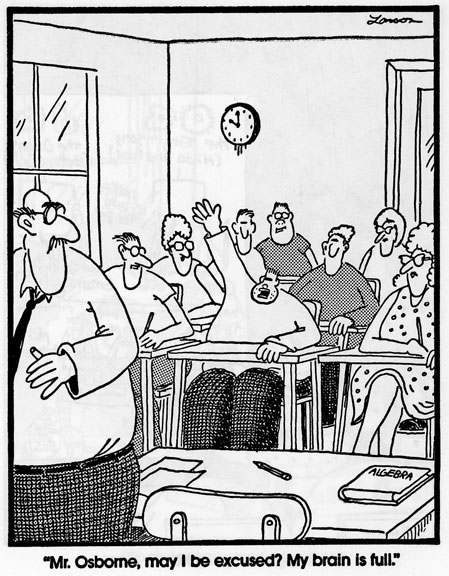
Borientation: The Perils of Corporate, Government and Military Orientation

If you have worked in corporate America, the Federal Government and State Governments or the Military in the past 20 to 30 years you probably have gone through a program of orientation or indoctrination upon being hired or transferred by a corporation or government agency. Now if you are completely new to an organization such classes are important in understanding the corporate or agency mission, culture and priorities. These programs also stress things that the organization has determined to be essential in a new employee’s understanding of how the entity does business and standards of practice, personal conduct and other items that may be required by accrediting commissions or by law.

Such programs tend to last 2 days to a week and can be incredibly detailed or filled with myriads of small topics that tend to blend together before a day is over. This is what I refer to as “Borientation.” I have worked in the military and in other state or local government agencies for nearly 30 years.  Each time I have being hired by a new organization or transferred within the military I have gone through some form of Borientation process.  These types of classes have been around for years but with every passing day some new law, regulation or discovery that something that we have been doing for years is too unsafe, unethical or enjoyable to be allowed in the workplace or anywhere else the organization can sink its paws into. This aside Borientation is deemed essential and almost everyone requires it.

If you are new to an organization, like in never had a job in your life kind of new or been locked away in a cave for the past 20 years you will certainly receive a fire hose blast of information that will make your head spin like Linda Blair in the Exorcist. However after a while in a business, government or military culture the Borientation process becomes rather mind numbing.   It’s not that there is anything wrong with the information and many times nothing wrong with the presentation but it is rather that after 10 or more years in an organization Borientation becomes a painful experience because with the exception of a tweak here and there most subjects are pretty much the same. It’s like watching reruns of the most boring PBS and BBC shows or really bad sitcoms for the 100th time except they are presented in marathon format and presented in classrooms where the employees sit in uncomfortable chairs in glaring fluorescent light with poor acoustics.

Since I have over 30 years experience in such environments going back to my pre-military days I can pretty much summarize 80% of what is covered in these classes in about 5 minutes.  Heck if I was God I would let the old guys and gals that have been in the organization for years get the “Cliff Notes” version of orientation, just what has changed since the last time they did it or what was not part of previous orientations.

As for me I don’t do well in seminars or classes that go on hour after hours in the same place providing information that I have been provided in person and online for years and years and years, and dare I say…years.  I actually have a physical reaction in these classes because I do my best to stay awake and attentive in order to at least respect the good people doing the training.  Now I keep my laptop with me to take notes to help me stay awake and take note of things that have changed or are new that are important.  I also keep a couple of news sites and Facebook running in the background if even the note taking becomes too tedious.  But even doing this and fortified with major doses of caffeine I often feel my face and head going numb.  I am not kidding it is like one of those old Star Trek or other science fiction flicks where aliens attach themselves to people, on Star Trek TOS the guys in the red shirts on the away team. It is like the life is being sucked out of me. Now I don’t know about you but looking around the room and talking to other seasoned folks during breaks I am pretty sure that I am not alone.  Please know I am not against orientation but rather Borientation. I have had to teach my fair share of these courses and I try desperately to get just the right information out quickly and with some humor because I know that the people that I am victimizing probably have 20 other presenters who will not do this.

Thus I try to see the humor in everything during the classes and afterward sometimes finding perverse pleasure in the Dilbert comic strips.  At the same time I am forced to wonder with the continuous expansion of Borientation programs and re-boreintation programs due to more and more regulations from either the government or accreditation commissions that we have reached the culminating point where we actually begin to lose ground in trying to gain ground by overloading people with information without adequate time to digest it.

Part of what I fear about Borientation is hurting me if I flip my desk or chair if I fall asleep. This mind you is not an unfounded fear.  I remember back in seminary after lunch having my Philosophy of Religion professor do a lecture about philosophic and religious themes in artwork. To do this he showed us hundreds of slides on the old slide carousel, no Power Point back then.  Well lunch had settled in my belly and as the majority of my blood supply went to digest the hamburger that I had consumed I found myself struggling to maintain conciseness eventually losing the battle against the “Z Monster” flipping my desk in front of the professor who didn’t miss a beat and continued to the next slide and I hastily recovered, righted my desk and got back into it as my classmates, many awakened from their naps by the loud crashing noise laughed their assess off.

So until the next time,

Peace,

Padre Steve+


3 Comments

Filed under Just for fun, Military, philosophy, purely humorous, state government agencies

The Most Perilous of Assignments: Six Members of U.S. Border Training Team Killed By Afghan Border Policeman

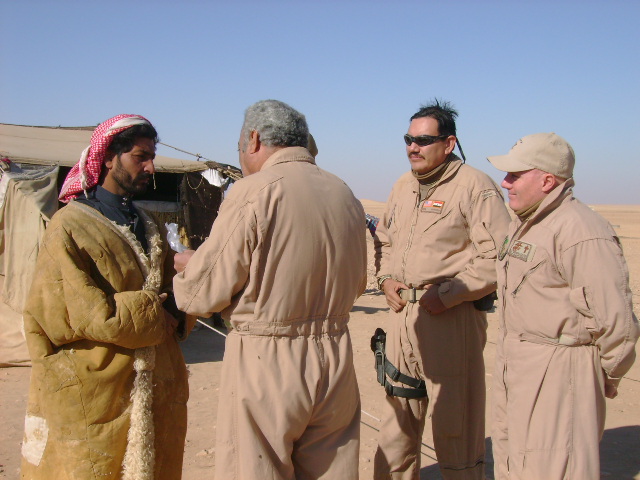
Me on Right with Border Team Members talking with a Bedouin on the Iraqi-Syrian Border

The big battalions get the press but in counter-insurgency operations in a very unstable environment such as Afghanistan the most perilous duty is often done by advisors.  Having served with our Marine and Army in Iraq in 2007 and 2008 I can say without equivocation that the advisors that serve with the Border and Port of Entry Police, as well as Police Training Team personnel serve in some of the most perilous and exposed locations imaginable usually far from quick support of combat units.

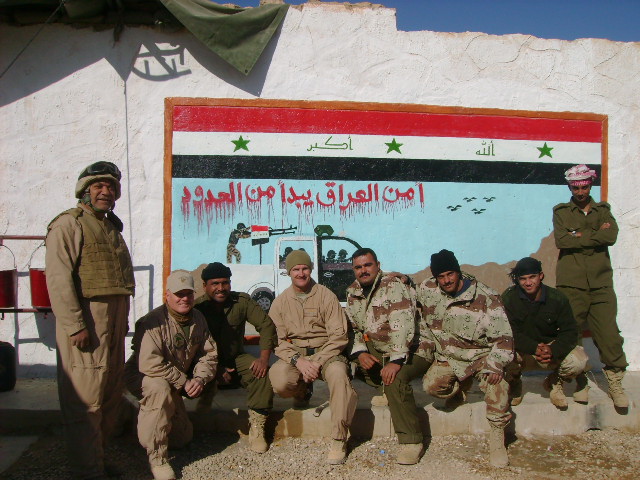
With an Iraqi Border Team

The Border teams typically cover large sectors and are composed of 15-20 personnel with a Captain or Major in command of the team and a number of junior officers or Staff Non-Commissioned Officers and junior enlisted personnel sometimes augmented by U.S. Border Patrol and Customs agents or contractors retired from those organizations.  They are not heavily armed and usually are based with the indigenous security forces.  Travelling in HUMMVS they visit and work with the indigenous Border Police and Port of Entry Police along long borders constantly exposed to possible ambush by insurgents or being attacked by the very personnel that they train and support.  This happens more frequently than we would want to see.

A Port of Entry Team after finishing an assistance visit at the Al Waleed Port of Entry. That evening the team went out and intercepted arms, drugs and money bound for Iraqi insurgents

The most recent case of this happened Monday the 29th when an Afghani Border Patrol Officer opened fire during a training mission Monday in the Pachir Wagam district of Nangarhar province near the border with Pakistan. The gunman was also killed during the incident according to NATO and Zemeri Bashary, a spokesman for the Afghan Interior Ministry, said the gunman was indeed a border police officer, and not an insurgent wearing a uniform. The Taliban claimed that the man was a Taliban member who had joined the Border Police to “kill foreign soldiers.” This has been a recurrent theme in the world of Afghanistan’s security forces, more so Police and Border forces than Army but a danger that grows as Afghanistan and NATO seek to quickly bolster the numbers of troops in the Afghan security forces.

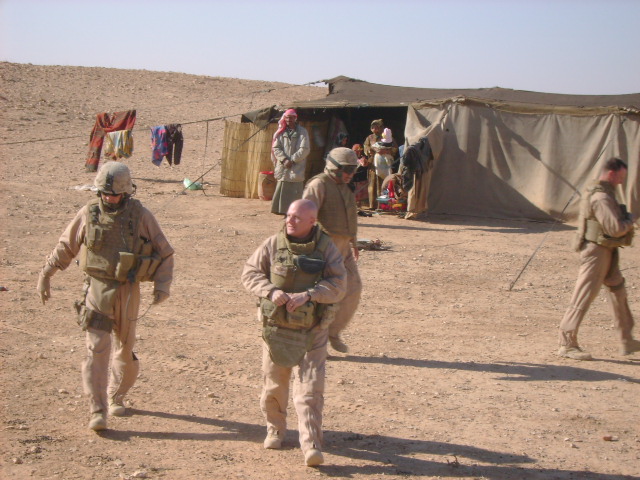
Leaving a Bedouin Camp

The attack was the latest in a series against advisors by their Afghani charges. In July, a rogue Afghan soldier fired a rocket-propelled grenade on NATO troops, killing three British soldiers and wounding four others.  In November 2009, an Afghan policeman killed five British soldiers at a checkpoint in Helmand. A month earlier, an Afghan policeman on patrol with U.S. soldiers fired on the Americans, killing two.

These Marines and Soldiers do not deploy for the most part with their own units, they deploy with their team and much of the time return to another assignment after their deployments separate from their comrades with whom they served in harm’s way.

I have been there in Iraq and involved with some very tense situations at Waleed as well as the border. The men that serve on these teams in Afghanistan are always on my mind and in my prayers.

On Monday the United States lost six brave soldiers on Afghanistan’s eastern border.  Please pray for the surviving members of this team which has been decimated by the attack as well as the families of the fallen.

Peace

Padre Steve+

Leave a comment

Filed under iraq,afghanistan, Military, national security

High Stakes Game of Chicken on the Korean Peninsula

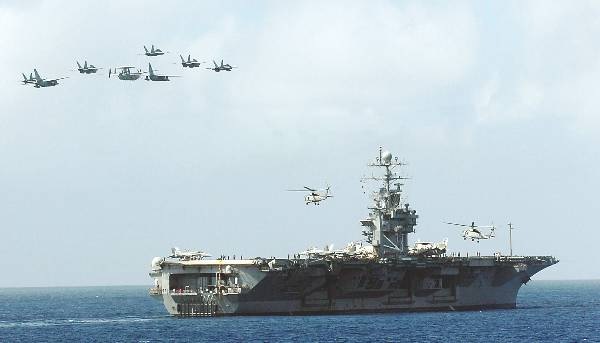
The USS George Washington and her Battle Group arrived in the Yellow Sea

The game is on.  The U.S. Navy and South Korean Navy task forces are moving into position, the South Korean Military is on its highest peacetime alert and the North Korean military is moving fresh batteries of Surface to Air and Ground to Sea missiles into place.  While diplomats from the United States, China and Japan seek to avert a war the North Koreans continue to stoke the fire with fresh artillery fire near Yeonpyeong Island which it brutally attacked earlier in the week.  In the South popular protests are rising against any soft treatment of the North and the commanding General of the South Korean Marine Corps Maj. Gen. You Nak-jun attended the funeral for the two Korean Marines killed in the attack said “Our marine corps … will carry out a hundred- or thousand-fold,” retaliation against North Korea for launching Tuesday’s attack, You said, without elaborating as to what he meant by the comment. The Defense Minister Kim Tae-young resigned after the attack on Yeonpyeong Island, and veterans of the South Korean military protested Saturday in Seoul, stating they were angry that the South Korean government had not done enough to respond to the North’s shelling.

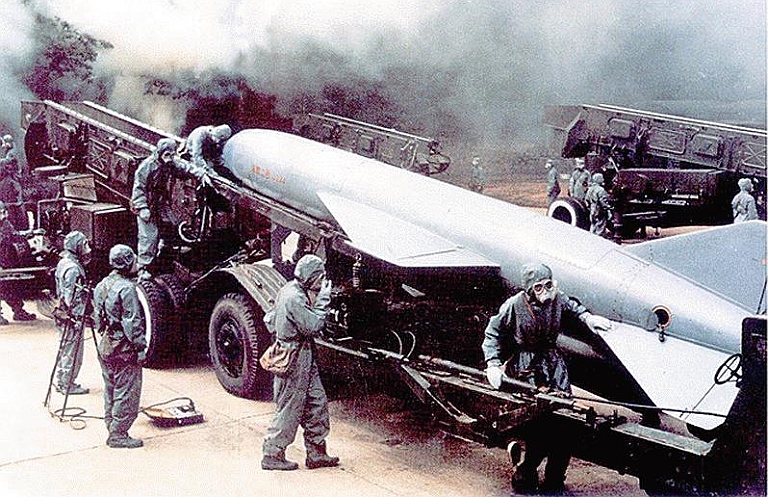
Silkworm Missile being fueled

North Korean rhetoric continues to rise in its belligerence and a North Korean State Committee for the Peaceful Reunification of Korea, the state agency in charge of relations with the South said in a statement carried by the North Korean Central News Agency (KCNA):  “Gone are the days when verbal warnings are served only, escalated confrontation would lead to a war,” and that the North Korean military was “getting fully ready to give a shower of dreadful fire and blow up the bulwark of the enemies if they dare to encroach again upon the North’s territory.”  The KCNA also said “If the U.S. brings its carrier to the West Sea of Korea at last, no one can predict the ensuing consequences.”

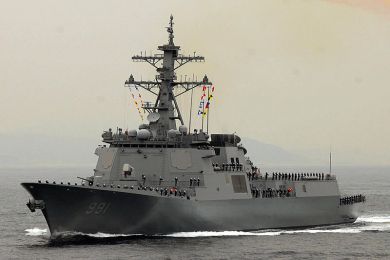
South Korean Aegis DDG

The defense drills begun today by United States and South Korean forces in the Yellow Sea involve the carrier USS George Washington as well as the Aegis Cruisers USS Cowpens and USS Shiloh and the Guided Missile Destroyer USS Stethem. South Korea has deployed one of its Aegis destroyers and two destroyers as well as frigates and anti-submarine aircraft.

North Korean forces have brought in SA-2 SAM batteries which an anonymous South Korea government source says “appear to be targeting our fighter jets that fly near the Northern Limit Line.” The source also reported that the South Korean “military is preparing for the possibility of further provocations as the North Korean military has deployed firepower near the NLL and is preparing to fire.”

Additionally the North is mounting C-201 Silkworm Ground to Sea anti-ship missiles on launchers along the coast in the disputed area which also hosts bases for submarines like the one that is believed to have sunk the South Korean Corvette Cheonan in March as well as fast attack craft mounting Styx anti-ship missiles.  If they were to attack the task force the North would likely attempt a saturation attack using ground and sea based SSMs against the Allied ships, however the task force includes at least 4 Aegis equipped guided missile cruisers and destroyers is well equipped to meet that threat.

The situation is tense and no one really knows exactly how it will develop is yet unseen but it will not take much to provoke a conflict that could engulf the region.

Peace,

Padre Steve+


3 Comments

Filed under Korean Conflicts, Military, national security, Navy Ships, US Navy

The South Korean Order of Battle

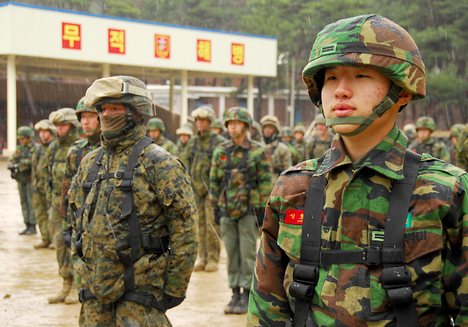
South Korean Marines

This is the second of a two part series on military forces on the Korean Peninsula and supplemental articles on the crisis on the Korean Peninsula. The First, the North Korean Order of Battle https://padresteve.wordpress.com/2010/05/27/the-north-korean-order-of-battle/ compliments this article.  Peace, Padre Steve+

The Republic of Korea has a robust military.  It is well trained and equipped but only about half the size of the military of its rival the Democratic People’s Republic of Korea (DPRK). It is composed of the Army, Navy, Air Force and Marines.  It is equipped with indigenously produced equipment as well as that purchased from the United States and other countries. It has deployed troops to Iraq, Afghanistan as well as Vietnam and the Gulf War.

The biggest component of the South Korean military is the Army which is composed of 522,000 soldiers organized into a Missile Command, Special Forces, aviation, logistics and training branches and a Capitol Defense Command.  The Army is composed of 30 Infantry and 5 Mechanized divisions, 4 Armored Brigades, 7 Special Operations Brigades (Airborne), 2 Special Assault Brigades and 6 Special Assault Regiments as well as a host of artillery, engineer, aviation, air defense, chemical, security and logistics commands of various sizes.

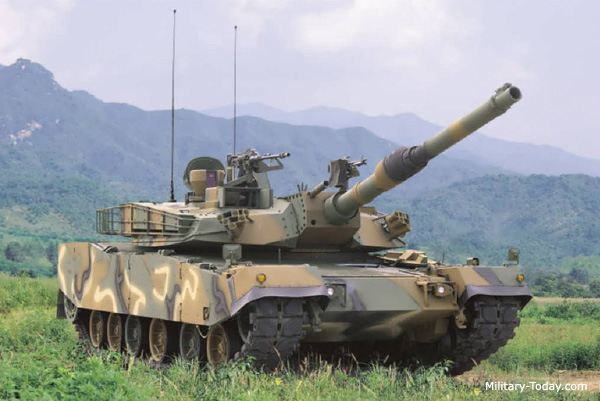
K1A1 Main Battle Tank

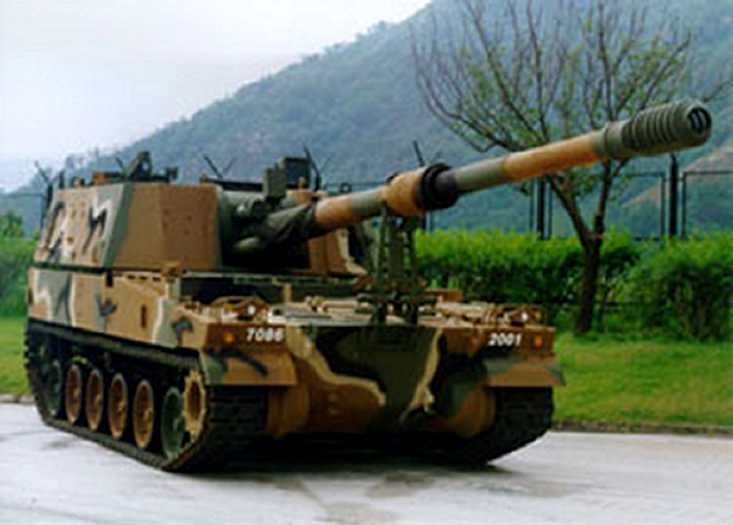
The Army has over 2500 tanks, 1500 of which are the K-1 and K-1A main battle tanks which were developed from the U.S. Army XM-1, M1, M1A1 and M1A2.  These are supplemented by 880 M-48 Patton Tanks. The Army also is well equipped with over 500 K-9 Self-Propelled 155mm Howitzer systems and about 1000 K55 155mm Self Propelled Howitzers based on the U.S. M109 series.  The Army uses about 2200 of the indigenously produced K200 Infantry Fighting Vehicles which are being supplemented with the first production batch of 466 K21 Infantry Fighting Vehicles. Its Aviation branch operates 600 helicopters.

K-9 155mm Howitzer

The ROK Marine Corps is a semi-autonomous branch of the Navy and is composed of 2 Marine Divisions and a Marine Brigade with strength of 27,000 Marines.  Like the U.S. Marine Corps the ROK Marine Corps has an amphibious mission and is similarly equipped with Amphibious Assault Vehicles, Tanks, and Artillery and Reconnaissance vehicles.  The 6th Marine Brigade garrisons the Islands in the West, or Yellow Sea and was involved in the most recent clash on Yeonpyeong Island.

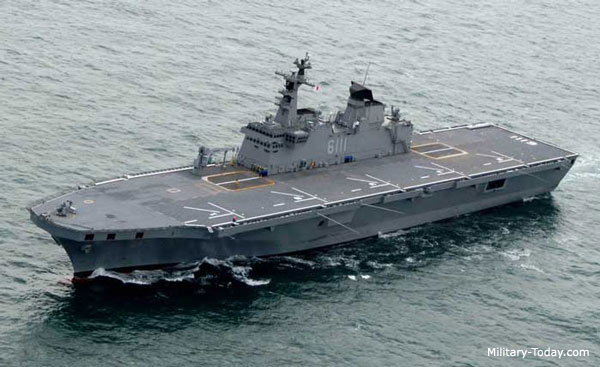
The ROK Navy has 9 very modern destroyers including 2 ships equipped with the Aegis Air Defense System and 9 Frigates of the Ulsan Class. It has 12 German designed S209 and S214 class Submarines with 12 more of the later building or planned.  The Navy operates about 130 other ships or craft including  23 Corvettes and 73 patrol craft. The Corvette Cheonan was sunk in March by a North Korean torpedo likely fired by a midget submarine.  It also has a robust amphibious capability recently fielding the LPH Dokdo a 14,000 ton helicopter assault ship.  It operates about 10 ASW Aircraft and 50 helicopters.

Dokdo LPH

As of 2008 the ROK Air force operated more than 180 KF-16, 174 F-5E/F, 130 F-4D/E, 39 F-15K fighter jets or fighter bombers. They are also pending the delivery of 21 additional F-15Ks between 2010 and 2012.  The bulk of the Air Force, 6 fighter wings is under command of the Northern Combat Command.

Supplementing the ROK forces at U.S. Forces Korea which include the ground forces of the 8th Army, now consisting of the 2nd Infantry Division (FWD) composed of 1st Heavy Combat Brigade Team, 201st Fires Brigade and 2nd Combat Aviation Brigade and supporting units.  Reinforcements can be drawn from I Corps at Ft Lewis Washington and units of the 2nd and 25th Infantry Divisions.

The 7th Air Force which has 2 Fighter Wings composed of F-16, F-15 fighters and A-10 ground attack aircraft as well as supporting ground units. .  In theater Air Force assets can be reinforced by wings and squadrons from U.S. Air Force Pacific which include the latest F-22 Raptors and other attack and bombing units.  Additionally units of the Strategic Air Command using B-52 and B-2 bombers can be employed.

The U.S. Navy 7th Fleet based in Japan contributes the USS George Washington (CVN 73) and the embarked Carrier Air Wing Five (CVW-5) Surface Combatant Force Seventh Fleet (or Task Force 75) comprised of Aegis Cruisers USS Shiloh (CG 67), USS Cowpens (CG 63) and the seven assigned ships of Destroyer Squadron Fifteen (CDS-15) complete the surface combatant forces.  Submarine Group 7 based in Guam composed of USS Buffalo (SSN 715), USS City of Corpus Christi (SSN 705) and USS Houston (SSN 713) supported by the Submarine Tender USS Frank Cable (AS 40) reinforced by USS Ohio (SSGN-726) and USS Michigan (SSGN-727) both Home-ported Bangor, Washington provide both ASW capability against DPRK Submarine Forces as well as attack and guided missile attack capabilities using Harpoon and Tomahawk Submarine Launched Guided Missiles. Amphibious forces include the Sasebo based USS Essex (LHD-2), USS Denver (LPD-9), USS Harpers Ferry (LSD-49) and USS Tortuga (LSD-46) which typically embark the 31st Marine Expeditionary Unit.  Mine Warfare forces include the USS Avenger (MCM-1), USS Defender (MCM-2), USS Guardian (MCM-5) and USS Patriot (MCM-7).  All can be reinforced by elements of the West Coast and Hawaii based 3td Fleet. Marine Forces of the III Marine Expeditionary Force based in Okinawa and Mainland Japan composed of 3rd Marine Division, 1st Marine Air Wing and 3rd Marine Logistics Group provide a potent expeditionary force in readiness to support any contingency on the Korea Peninsula.

While the ROK and US Forces undoubtedly would control the air and the sea North Korean ground forces mostly based on the border could launch a devastating artillery and missile attack on the South Korean Capital, Seoul and their large number of special operations forces could make ground operations more difficult despite the qualitative superiority of ROK and ground US Forces.  North Korea does have the capability to spread the war to Japan which could contribute its air, naval and potentially ground forces to any conflict. United Nations Forces could be added to the allied order of battle.

3 Comments

Filed under Foreign Policy, Military, national security

PT and Bumping into Old Friends at Camp Swampy and Getting Carded at Applebee’s

The Main Gate at Camp Swampy

One nickname that Camp LeJeune North Carolina bears is “Camp Swampy.” This is because of the marsh like conditions of some of the base, the normally abundant rainfall and the propensity of said rainfall to accumulate wherever it falls. It is somewhat like the Tidewater, a polite name for “swamp” is in Virginia, only with more rain and in the spring and summer the humidity, mosquitoes and other vermin that love the conditions.  However, because it is a Marine Corps base one can find people doing PT at any time of the day or night in a variety of forms.  Of course the Marines at Camp LeJeune PT in any weather and Chaplains assigned here, even those with the Navy are kind of expected to do the same. Of course each Chaplain does so within his or her physical constraints. Despite being 50 years old I am still in pretty good shape and have the psychological need to try to keep up with people 20 to 30 years my junior so when I do my PT I am serious about it.  In fact when I was stationed with Navy EOD I did so well on the physical readiness test that an EOD tech asked my assistant Nelson Lebron “what kind of ‘roids is the Chaplain on?”  I found this funny since I don’t do this but I can tell you at the age of 50 and being subject to all sorts of minor bumps, dings and nagging injuries I can understand why some professional athletes would use substances such as HGH, but like the rest of the Navy-Marine Corps team I survive on “Vitamin M” or as it is commonly known to laypersons as 800 mg Motrin.

My normal or abnormal regimen is to do what I call “distance interval training.” Interval training usually entails combining some kind of cardio with exercises that work various muscle groups interspersed throughout. I first did interval type training in high school football practice, back then we called them “grass drills” where we ran in place and whenever the coach blew his whistle we would drop for pushups, sit-ups, flutter kicks or any other exercise that could put us on the ground.  I saw a variation with the Marines early in my Navy career that entailed sprinting and then dropping for whatever kind of punishment the leader determined.  Back then I preferred to run long distances up to 20 miles in training for half-marathons and marathons.

However a series of nagging overuse injuries took me down to 5-8 miles a run before I went to Iraq. In Iraq I picked up a few more injuries and it took me a while to recover so after I was assigned to Naval Medical Center Portsmouth I built my runs back up to 3-5 miles but I didn’t find that this was working for me anymore. So I went back to something that I hadn’t done since high school, interval training but I didn’t want to give up running.  I devised a plan that works for me and what I need it to accomplish.  I am now adding the P90X fitness program to fit in on alternate days.

Now I run about 3 miles but every 100-200 yards I drop for a set of 15-25 pushups get up and then do one of 5 different sets of abdominal exercises, 15-30 regular crunches, 40 oblique’s, 15-20 crunches with legs up at a 90 degree angle, 60-100 bicycle crunches and 50-100 flutter kicks with sets of pushups between each of them.

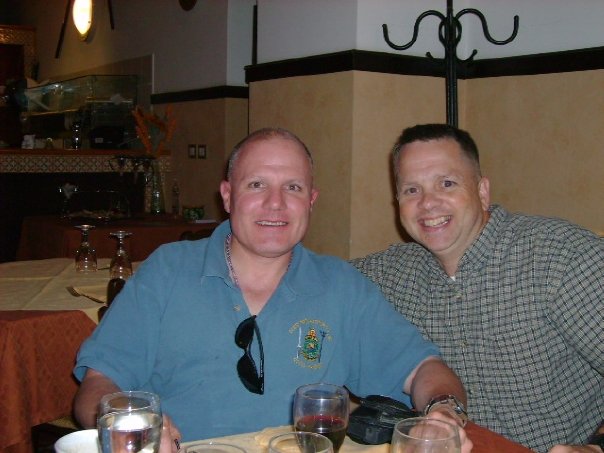
With Paul Rumery in Sicily, he has the hair

It has taken me a while to get settled at Camp LeJeune and begin to plan safe routes to run this and I am just getting back into the groove. Today I went out at lunch amid threatening rain. About a third of the way into the workout the rain came down and I continued to run, the rain was actually quite refreshing and by the two third point of the run I was soaked, my orange Baltimore Orioles t-shirt and gray running shorts must have weighed 5-6 pounds.  As I got up from a set of crunches I wiped off my sunglasses, no I didn’t need them I just like to look cool and as I wiped them off on my previously mentioned soaked Orioles t-shirt I started to run and a car pulled alongside where I was running, the window rolled down and I heard a familiar voice, LCDR Paul Rumery, the Chaplain who had relieved me on USS Hue City in 2003 and who had taken me to dinner the last time I was in Sicily with EOD called out “Hey Steve wild man I knew that it had to be you!” I pulled up and went over to the car, we had a brief talk. Paul had a brand new Chaplain with him who he told that I was a “wild man.” Paul let me know that he didn’t know that I was aboard Camp LeJeune and said that we needed to get together.  It was good to see him and I hope that we do get together soon. I picked up the run again and took it back in to the hospital where my now squishy running shoes and waterlogged clothing dripped of my mud stained body. A Marine Staff Sergeant came up to me and said that I had leaves on the back of my head. I laughed, said “I’m not surprised” and commented “if it ain’t raining we ain’t training.” The Staff Sergeant asked about my workout and was suitably impressed. I then ran into a Corpsman who had been assigned with me at 3rd Battalion 8th Marines back in 2000-2001.  He and I talked for a while. It’s funny what a small world it is when you are stationed in a place like Camp LeJeune.

After work I stopped by the local Applebee’s for a beer and a burger and I was carded by the server. I thanked the server who told me that they and to card anyone that looked under 30 and when he saw my ID and age he was surprised. I must say that since there are so many Marines and Sailors here it is not uncommon to be carded and since I don’t dress my age I can see why I get carded. I must say that it appeals to my vanity.  I guess part of this must be due to good genes as well. Whatever it is I will take it.

Tomorrow I will drive up to Virginia as I have a specialty appointment and assessment to figure out what might be causing my auditory processing disorder.  I haven’t understood speech well since returning from Iraq and the additional Tinnitus is at times deafening.  Hopefully they will figure it out and find something that will make it better.

So anyway, until tomorrow….

Peace

Padre Steve+


2 Comments

Filed under Military, sports and life

Wings of Gold: U. S. Navy Carrier Aircraft 1935-1941

Curtiss BF2C Goshawks (US Navy Photo)

As the United States Navy built up its Carrier Force in the mid to late 1930s it continued to develop aircraft specifically designed to operate from aircraft carriers.  It continued its development of fighter, dive bomber and torpedo bomber aircraft.  In 1935 the Navy was operating the Grumman FF-1 biplane fighter which it had began using in 1933 and the Curtiss F11C and BF2C Goshawk. The Curtiss aircraft were built in fighter and bomber variants and while initial aircraft had an open cockpit and fixed landing gear later aircraft had an enclosed cockpit and retractable landing gear. They had top speed of 157 miles an hour and due to limited success and were retired from service by 1939.  The Goshawk was operated against the Japanese by Nationalist China and also served in a number of air forces including Thailand where they were used against the French and Japanese.

Grumman FF-1 (US Navy Photo)

The Grumman FF-1 was a two-seater that had a enclosed cockpit with retractable landing gear and a top speed of 201 miles an hour.  The FF-1 was faster than any naval aircraft of its era, a follow-on variant designated the SF-1 followed and 120 aircraft were built. Most of the operational aircraft served aboard the USS Lexington CV-2 in a fighter and scouting role. The FF-1 and SF-1 were withdrawn from first line service and placed with the reserve as well as being used in aviation training commands. The aircraft was manufactured under license by the Canadian Car and Foundry Company and served in the Canadian Air Force until 1942 as the Goblin and 40 of the Canadian aircraft were used by the Spanish Republican forces in the Spanish Civil War.

Grumman F2F-1 (US Navy Photo)

The FF-1/SF-1 was followed by the Grumman F2F a single-seat model with improved speed and maneuverability over is predecessors.  54 F2F’s were ordered in 1934 with the production models being delivered between April and August 1935.  The aircraft were armed with 2 .30 machine guns mounted above the cowl and had a top speed of 231 miles an hour and maximum range of 985 miles.  The aircraft would remain in service until they were replaced in 1939 with the Grumman F3F. However they remained in service as utility and training aircraft until retired from service toward the end of 1940.

Grumman F3F (US Navy Photo)

The Grumman F3F followed the F2F with 157 production models. It was more aerodynamic and had a more powerful engine that the F2F which enabled it to achieve a top speed of 264 miles an hour.  It was operated by seven Navy and Marine Corps Squadrons and entered service in 1936 and would serve aboard carriers until replaced in late 1941. It continued with 117 aircraft being stationed at naval air stations and used for training until 1943.

F2A Brewster Buffalo (U.S. Navy Photo)

The first monoplane fighter developed and placed in service by the Navy was the F2A Brewster Buffalo. The Buffalo served with Navy and Marine Corps squadrons and was purchased by Great Britain for service in the Royal Australian and Royal New Zealand Air Forces which received 202 Buffalos. They would also serve with the Royal Navy. The Royal Netherlands Air Force received 144 most of which served in the East Indies. The final nation to receive the Buffalo was Finland which received 44 aircraft.  Buffalo was underpowered and the addition of armor and added fuel capacity further diminished the speed and performance of the aircraft.  The Navy placed its Buffalo’s in advanced training squadrons in early 1942 and one of the two Marine Corps squadrons (VMF-221) operated it at the Battle of Midway where they endured fearful losses at the hands of Japanese Zero fighters.

Brewster Buffalo 239s of the Finnish Air Force

Despite the lack of success in U. S. service the Buffalo performed in a heroic manner for the Finns destroying over 500 Soviet and German aircraft and producing 36 Buffalo Aces.  The highest scorer was Captain Hans W. Wind with 39 of 75 victories flying a Buffalo.  British Commonwealth and Dutch aircraft did not fare as well as the Finns as the tropical climate degraded the aircraft considerably.

Martin T4M over Lexington or Saratoga (US Navy Photo)

The Navy also developed aircraft for bombing missions as well as that could launch aerial torpedoes. The first aircraft built were dual purpose in that they could be used in level bombing and torpedo missions. In 1935 the primary aircraft of this type was the Martin T4M which had entered service in 1928 and replaced the Douglas DT and Martin T4M aircraft.  The T4M was a biplane with a crew of three that had a maximum speed of 114 miles an hour (I have driven much fast than this on the German Autobahn but I digress) and it could carry a torpedo or bombs.  155 were purchased by the Navy and the Marine Corps between 1928 and 1931.  They were operated from the Lexington and Saratoga until 1938 as no replacement aircraft offered enough improvements for the Navy to purchase and were instrumental in the development and demonstration of the capabilities of naval air power.  They were finally replaced by the Douglas TBD Devastator.

TBD Devastator (US Navy Photo)

The TBD which first flew in 1935 entered service in 1937 and at the time was possibly the most modern naval aircraft in the world and was a revolutionary aircraft. It was the first monoplane widely used on carriers and was first all-metal naval aircraft.  It was the first naval aircraft with a totally enclosed cockpit, the first with hydraulic powered folding wings.  The TBD had crew of three and had a maximum speed of 206 miles an hour and carried a torpedo or up to 1500 pounds of bombs (3 x 500) or a 1000 pound bomb.  129 were built and served in all pre-war torpedo bombing squadrons based aboard the Lexington, Saratoga, Ranger, Yorktown, Enterprise and Hornet with a limited number embarked aboard Wasp.  The Devastator saw extensive service prior to the war which pushed many airframes to the end of their useful service life and by 1940 only about 100 were operational.  They were still in service in 1942 as their replacement the TBF Avenger was not ready for service.  They performed adequately against minor opposition at Coral Sea and in strikes against the Marshalls but the squadrons embarked on Yorktown (VT3), Enterprise (VT-6) and Hornet (VT-8) were annihilated at Midway with only 6 of 41 surviving their uncoordinated attacks against the Japanese Carrier Strike Force.  They were too slow, had poor maneuverability, insufficient armor and defensive armament.  Only a few were able to launch their torpedoes as the Japanese Combat Air Patrol tore through them. Their sacrifice was not in vain as the Dive Bombers arrived facing no opposition and sank three of the four Japanese carriers getting the fourth later in the day. After Midway the remaining aircraft were withdrawn from active service in the Pacific. The Ranger’s VT-4 operated them until September 1942and Wasp’s VT-7 operated them in the Atlantic until she was transferred to the Pacific in July 1942.   By 1944 all remaining aircraft had been scrapped.
Vought SBU Corsair

In the mid 1930s the Navy began to develop Scout and Dive Bombers for use in carrier scouting (VS) and bombing (VT) squadrons.  The first of these aircraft types were biplanes.  The Grumman SF-1 was used in a scouting and bombing role and was joined by the Vought SBU Corsair in 1935 and by 1937 both were being replaced by the Curtiss SBC Helldiver, a biplane with a 234 mile an hour maximum speed, retractable landing gear, enclosed cockpit which could carry a 1000 bomb.

Curtis SBC Helldiver

However the era of the biplane was drawing to a close and the Helldiver would be relegated to training squadrons based in Florida.  Although they had a brief service career they were instrumental in develop dive bombing tactics at which the U.S. Navy excelled and which were copied by the German Luftwaffe with the Junkers JU-87 Stuka and the Japanese with the Aichi 99 Val naval dive bomber.  50 aircraft were transferred to the French and served aboard the carrier Bearn but due to the French surrender in June of 1940 saw no action and spent the war rotting in Martinique.

Vought SB2U Vindicator

The Helldiver’s were joined by the first monoplane dive bomber in U.S. service the Vought SBU2 Vindicator in 1937. The Vindicator was used by the Navy and the Marine Corps serving aboard the Lexington, Saratoga, Ranger and Wasp. They would remain in service until September 1942. The Marine aircraft equipped two squadrons VMSB 131 and VMSB-241, VMSB 241 suffered heavy casualties at Midway as the aircraft were underpowered and were limited to glide bombing missions.  After they were taken out of the operational squadrons the Vindicator served as a training aircraft until retired in 1945.   A French Naval Air Squadron was equipped with the Vindicator but they served ashore against the German invasion.  Most were lost to enemy action.  The Douglas SBD Dauntless was introduced in 1940 and 1941 but I will cover that aircraft in the World War II aircraft article that will follow this in a week or two.

These aircraft helped pave the way to aircraft that would be the mainstays of the Navy in the Second World War, aircraft with names such as Dauntless, Helldiver, Avenger, Hellcat and Corsair.  Naval aviation earned its “wings of gold” in these early years wings that continue to shine in the 21st Century.

Peace

Padre Steve+

9 Comments

Filed under aircraft, Military, US Navy, world war two in the pacific

The War to End All Wars….and a Peace to end all Peace

It was the War to end all war

On the 11th hour of the 11th day of the 11th month the guns fell silent across Western Europe and the war which had killed 16 million soldiers, sailors and civilians and wounded another 21 million more came to an end. It had begun as a conflict in the Balkans which rapidly drew in all of Europe’s major powers.  The central focus of the war was the Western Front where the armies of Germany battled those of Britain, France, Belgium and later the United States.  Battles with names such as the Marne, Passchendaele, the Somme, Verdun, Ypres, Chateau Thierry, Belleau Wood, Vimy Ridge, Cambrai, the Aisne, represented the pinnacle of killing as soldiers battled in the mud of massive trench systems and Generals sacrificing thousands of men in a day for the gain of a few hundred yards of territory throwing them against mountains of barbed wire, landmines, well emplaced machine gun nests and mortars. Massed batteries of artillery tore men to shreds leaving many men so pulverized that they would ever be identified.  Poison gas both choking agents and the long lasting mustard gas added to the hell that was the war in the West.

During the war the war Imperial Russia had fallen to a Communist revolt and surrendered, the Austro-Hungarian Empire fell in October of 1918 and even the Allies had faced near calamity on the home front. In 1917 the French Army mutinied after years of futility with only Marshal Petain the hero of Verdun able to quell it.

The men who drafted the Peace to end all Peace: Clemenceau, Wilson, Lloyd George

Kaiser Wilhelm II had abdicated his throne on November 9th amid a revolution at home which tore the country apart.  The new German Government accepted an armistice in the belief that the Allies would honor President Woodrow Wilson’s 14 Points.  Instead they were subjected to humiliation and starvation as the Allies refused to end their blockade of Germany until the Peace Treaty was signed. Hundreds of thousands more Germans died as a result of starvation and disease as their cities were wracked by violence as order collapsed.  It was the Socialist government which had inherited the country that had to fight the Communists in the streets allying themselves with the Army High Command to form Freikorps from units and individual soldiers under commanders willing to fight.

Soviet style revolution in Germany 1918-1919

In France at the Palace of Versailles the Allies led by the British and French brushed aside Wilson’s attempt at a just peace and placed draconian sanctions on the new German Republic which had no choice but to accept the surrender terms dictated by the Treaty of Versailles. The Army was to be reduced to 100,000 men with no heavy weapons, the Navy to a token force of obsolete ships, the air force disbanded.  Massive war reparations were imposed which were impossible for the Germans to fulfill and which were only paid off this year.  The final ignominy was the fact that the Germans were forced to bear the sole responsibility for the war. The German economy collapsed in the aftermath, France occupied key German industrial areas in the Saar and Ruhr and the nation fell into more disorder as the Deutschmark lost all of its value as hyperinflation made the money worthless.

Freikorps helped restore order when the Army dissolved

Eventually order returned to Germany with a brief period of relative prosperity which lasted until the world-wide Great Depression which through Germany back into chaos. Government after government was formed and dissolved and the last Chancellors of the Republic were forced to rule under the emergency conditions of Article 48 of the Weimar Constitution.  Eventually extremists on the left and the right brought further chaos as the eventually leading President Hindenburg to appoint the Leader of the National Socialist German Workers Party (Nationalsozialistische Deutsche Arbeiterpartei) or NSDAP as Chancellor.  We know the rest of the story. A World War that killed far more than the first 22-25 million military and 62-78 million civilians, a war of extermination on the Eastern Front, the Holocaust, and fearful weapons which ushered in the Atomic and Nuclear age.  Europe was shattered, Britain’s wealth drained and empire unsustainable, France divided and impoverished and other nations in political or economic crisis with the Soviets controlling Eastern Europe behind an Iron Curtain.

Cold War

In Europe and Asia a “Cold War” between the Soviet Communists and the West took the place of the previous war.  The United States would fight wars in Korea and Vietnam while the Soviets would rule with an iron fist in Eastern Europe and at the height of the Cold War invaded Afghanistan.  The wars in Vietnam and Afghanistan caused crisis in both the United States and the Soviet Union and Afghanistan helped mark the end of Soviet power and the end of the Soviet Union.

Around the world colonial empires fell through either revolts of colonized people or the abdication of empire by nations exhausted and economically broken by war. The many of the newly free “nations” were artificial and as a result experienced their own civil, tribal and religious conflicts the effects of which are still felt.  The end of the Cold war brought more change and for a time there was a period of American superiority but wars engulfed the Middle East as Iraq attacked its neighbors and was defeated in the Gulf War.  However the effects of that war were felt as Moslem extremists took power in Afghanistan and others including the Yemeni born Saudi Osama Bin Laden began a campaign of terror to drive the United States out of the Middle East that culminated in the attacks of September 11th 2001 and now the war that seems to have no end.

And it was the War to end all war and a peace that ended all hope of peace….God help us as it is unlikely that this war will end anytime soon for us or our allies even if we withdraw from Afghanistan.  Our enemies are too beholden to their ideology to stop their attacks until they win or are destroyed, the war will continue and God only knows how many soldiers and civilians will die in the coming years over 90 years after the War to end all War ended and the Peace to end all Peace began.

Peace

Padre Steve+


1 Comment

Filed under Foreign Policy, History, iraq,afghanistan, Military, national security, Political Commentary, world war two in europe

Veterans Day 2010: Counting the Cost of War

“It is well that war is so terrible, or we should get too fond of it.” General Robert E. Lee

Veterans Day had become a rather somber occasion for me over the past decade and since returning from Iraq in 2008 has taken on added personal significance.  I have noticed that I have become much more reflective about the sacrifices made by our military and the terrible coasts of war on our Soldiers, Marines, Sailors, Airmen and their families in this age of the all volunteer military.  The military which has about 2,225,000 members including the Reserves and National Guard is just 0.7% of the total population, the lowest percentage of military personnel compared to total population during any war in our history.  As a result this force has borne the brunt of a war that no politicians or bureaucrats figured would last half as long as it has.  As a result the “few” have been asked to do more for longer than and military that this nation has ever fielded during a war.

Thus for me Veterans Day has become a rather somber and reflective occasion as I ponder all the sacrifices made by our military and their families. In Afghanistan the U.S. Military has lost 1378 killed and our allies another 825.  In Iraq 4427 U.S. Military personnel have died along with 318 allied soldiers, not including the Iraqi military losses.  For each of the killed there are about 8 more wounded a total of over 38,000 wounded.  Of course the wounded numbers do not include 170,000+ cases of hearing damage; 130,000+ cases of mild traumatic brain injuries; and 200,000+ cases of serious mental health problems, over 30,000 serious disease cases, including a disfiguring, parasitic disease called Leishmaniasis, which results from bites of sand flies; thousands of cases of respiratory disease linked to exposure to toxic burn pit smoke and hundreds of suicides.  Then there are the injuries related to road and aviation accidents not in direct combat.  In my recent assignments in Iraq and Naval Medical facilities I have seen the human cost of the war.  I have friends who suffer as the result of Traumatic Brain Injury, PTSD and Pulmonary diseases as well as those that have been wounded as the result enemy action.  I have a dear friend with a rare and irreversible pulmonary condition from two tours in Iraq. He is 41 his lungs are those of a 70 year old man.  My best friend, a senior Naval Officer is still suffering from the effects of TBI and PTSD incurred while serving with the Marines in Al Anbar Province.

My Dad Aviation Storekeeper Chief Carl Dundas aboard USS Hancock CVA-19 off Vietnam circa 1971-72

A year ago on Veterans Day I was at with my parents in Stockton California to visit my mom and my dad who was then in a nursing facility due to the ravages of Alzheimer’s disease.  It was a terrible visit conflict with my mother due to witches’ brew of my PTSD and grief for my dad and my mother’s struggles with my dad’s condition and her own physical condition.  I visited my dad every day when in two and unfortunately he did not know who I was, Alzheimer’s had robbed him of everything that made him my dad.  He died on June 23rd of this year a day after I found out that I had been selected for promotion to Commander.  My dad was a retired Navy Chief Petty Officer who served in Vietnam on a beach detachment manning an emergency airfield in the besieged city of An Loc in 1972.  He never talked about that tour or what happened there except to tell me that he saw the Communists executing civilians in the city from his observation point.  He came home a changed man.  Thankfully he is now out of his suffering and our family is beginning to find its way back from the abyss of his illness.

I have served for over 29 years in the Army and the Navy and have witnessed many things and been blessed to have my life enriched by many veterans.  Unfortunately many of these brave men have since passed away, some having lived many years and others that have died far too young as a result of service connected injuries.

With advisors to the 3rd Bn, 3rd Brigade 7th Iraq Division COP South 2008

In my current work I see many young men that wear the Purple Heart for being wounded in combat. I see those that need assistance to walk, amputees, men with obvious scars from burns and others suffering blindness from their injuries. Our hospital’s Medical Board sees 40-60 Marines and Sailors a day, quite a few of whom that will be medically retired due to their injuries.  There are also those that have died by their own hand suffering from psychological and spiritual injuries too deep to fathom, we had one of our own Corpsman suicide last week.

The cost of war is terrible, as General William Tecumseh Sherman so eloquently put it: “War is Hell.”

Despite this our brave men and women that serve in all branches of the military as well as those that have gone before us in the 235 year history of our military have shouldered the load, for most of that history depending on volunteers who often served in obscurity often derided by their fellow Americans who believed that the military was a place to go if you could not be successful in the civilian world. The pay was low, the duty arduous and benefits few. In the Civil War, the World Wars and up until 1974 the professionals were augmented by draftees who outnumbered the professionals by a huge margin.  Since 1974 the force has been an all volunteer force.

Health and Comfort Board Team USS Hue City, Northern Arabian Gulf May 2002

Regardless of whether our Veterans were draftees or volunteers they have served this country well and on the whole to use the current Navy description are “A Global Force for Good.” The countries liberated from oppressors and helped in humanitarian operations by American Soldiers, Sailors, Marines and Airmen are many and varied.  They have represented the spectrum of our society and represent the best the country has to offer.  Unfortunately they have not always been honored by some of their our countrymen and women and sometimes the children and grandchildren of the peoples that they liberated from Nazi, Fascist or Communist oppressors who often use the wrongdoing of a few military personnel or the decisions or actions of American politicians or businessmen to label American military personnel as criminals.

Unfortunately since the military is such a small part of our population and concentrated in a few large bases it is invisible to most Americans as they live their daily lives. Often in isolated from the bulk of America such as Killeen Texas home of the U.S. III Corps and Jacksonville North Carolina the home of the 2nd Marine Expeditionary Force and Second Marine Division are quintessential military towns but neither are near major population centers and thus the sacrifice of these Soldiers, Marines and Sailors goes unnoticed by most of the nation.  In a sense the human cost of the war falls inordinately upon these military communities where there are few strangers.

In spite of this the current men and women of the American Military train, deploy, fight and return every day as they have since the 9-11-2001 attacks, many if not most have made multiple combat tours.  I have been pleased to see more support of the military in the media, especially sports media and leagues.  Many businesses are taking time to offer things of value to servicemen and women and those businesses should be commended and patronized.  I was touched by many stories that I saw about our veterans on ESPN over the past few days.  http://www.espnmediazone3.com/us/2010/11/espn%E2%80%99s-weeklong-salute-to-veterans-day/

Many of our Reserve component personnel give up civilian employment and chances for promotion to serve in the military, particularly when they are mobilized for service. When they return home most return to towns and cities that have little of the support afforded to active duty members when they return.  I pray that our political leaders in the future will exercise discernment and wisdom before committing us to another war. Otto Von Bismarck said: “Anyone who has ever looked into the glazed eyes of a soldier dying on the battlefield will think hard before starting a war.” Unfortunately the current members of the House, Senate and Executive branch have little connection to the military as very few have served and I wonder if any really comprehend this maxim.  In the 111th Congress 120 members had some form of military service.  The number of veterans in the 111th Congress reflects the trend of a steady decline in the number of Members who have served in the military. For example, there were 298 veterans (240 Representatives, 58 Senators) in the 96th Congress (1979-1981); and 398 veterans (329Representatives, 69 Senators) in the 91st Congress (1969-1971).  Those who have served a full military career are far fewer; the number of congressmen with military careers will remain relatively constant for the 112th Congress. In the Senate there will be one (as compared with two in 2006 and one in 2008) and in the House there will be eight (as compared with four in 2006 and six in 2008).  Some of these Congressional Veterans have been vilified by some broadcasters and pundits of the extreme right wing media most of whom who have never served in the military.  On the positive side nine members of the new Congress will have served in the current wars which hopefully will help promote the sacrifice of our current Veterans and help with programs that will help returning Veterans.
I have seen the cost of war up close and personal in Iraq and back here in the States. I suffer some the afflictions described as a result of my service and see the young men and women many of whom were not yet born when I enlisted in the Army, or when I was commissioned as an Army Officer, when I was a Company Commander or when I was a senior Captain in the Army. These young men and women are heroes.

Please take a moment to thank a Veteran.  If you have time volunteers are always welcome at organizations such as the USO and American Red Cross working with our troops, join or support organizations which promote the causes of Veterans including the Iraq Afghanistan Veteran’s Association www.iava.org the Veterans of Foreign Wars http://www.vfw.org/, American Legion http://www.legion.org/ , Marine Corps League http://www.mcleague.org/, the Fleet Reserve Association http://www.fra.org/, the Association of the U.S. Army http://www.ausa.org and the Disabled American Veterans http://www.dav.org/. There are also many charitable organizations that provide assistance to Veterans and their families’ one of the best being the Fisher House Foundation http://www.fisherhouse.org/ which provides comfortable and free lodging to the families of wounded, injured or sick military personnel on bases adjacent to military hospitals. I found these ten ways that you can help on Yahoo.com:

1. At 11 a.m., observe a moment of silence for those who’ve fought and died while in service to the country

2. Display an American flag

3. Attend a Veterans Day parade

4. Thank a vet for his/her service

5. Send a letter to troops through the U.S. Department of Defense Website

6. Work in a homeless shelter or soup kitchen

7. Visit a veteran’s grave or pick up trash at a veterans cemetery

8. Visit with the family of a veteran who’s serving overseas

9. Visit with a wounded vet at a local VA facility

10. Donate to the USO, the American Legion, Veterans of Foreign Wars USA or other organizations that honor and assist vets

Keep us all in your prayers and please when Veterans Day is past do not forget those of us that serve and our families, especially those men and women serving in harm’s way.  To my friends and comrades I echo the words of the German commander to his troops in captivity at the end of the Band of Brother’s mini-series:

“Men, it’s been a long war, it’s been a tough war. You’ve fought bravely, proudly for your country. You’re a special group. You’ve found in one another a bond that exists only in combat, among brothers. You’ve shared foxholes, held each other in dire moments. You’ve seen death and suffered together. I’m proud to have served with each and every one of you. You all deserve long and happy lives in peace.”

Peace

Padre Steve+

3 Comments

Filed under iraq,afghanistan, Military, PTSD, shipmates and veterans