Category Archives: Military

Political Folly and the Lust for Power

Friends of Padre Steve’s World,

Note: this was inadvertently posted in incomplete for late last night as I closed up my iPad thinking I would complete it today. This is the completed article.

I have been to war. I have been shot at and had rockets pass over my head. I have seen the wounded, and I have seen the devastation caused by war. Likewise I have also trained and prepared for worse worse than I served in. Back in the 1980s the unit that I commanded, the 557th Medical Company (Ambulance) had the mission of helping to support the 11th Armored Cavalry Regiment on the Fulda Gap. They and we were expected to take 75-90% casualties if the Soviets came over the border. I have to tell you that you haven’t really had to contemplate the reality of war if your neighborhood is not in the fallout pattern of nuclear weapons or the contamination zone of chemical or biological weapons. Mine was, thus ever since I was a young Army Lieutenant I have had a tremendous appreciation for what could happen if all hell broke loose and a worse case war scenario developed. For me it is not that hard to imagine worst case scenarios.

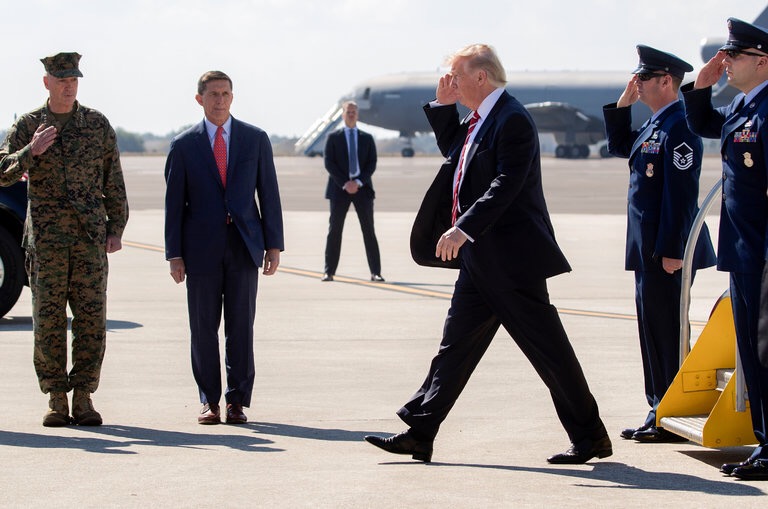
Sadly, that does not seem to be the case with President Trump. He seems hell bent at forcing the military to provide him with expressly demands faster military options for whatever he is planning; he mocks his Secretary of State’s efforts to use diplomacy to defuse the growing crisis on the Korean Peninsula, a crisis that he has made worse by taunting the North Korean leader; he is about to end an agreement with Iran which with the cooperation of our allies has been relatively successful in spite of Iran’s other provocative actions in the Arabian Gulf, in Syria, and in Yemen.

Despite the President’s rhetoric there has been no significant strengthening of the military since he took office. In fact the President’s policies are further stretching a force that spent the better part of a decade and a half wearing itself out in counterinsurgency campaigns that knew no end and cannot be won without the host nations being stable and secure enough to address the underlying causes of the insurgency. Now those forces are being tasked to go back and get ready for potential high intensity conflicts in Europe, Northeast Asia, and the Middle East.

The military is not the solution for every situation. This is something that those of us with significant military experience in peace and war, and who have studied the fundamentals of strategy and strategic thinking using history, economics, political science, geography, science and technology, diplomacy, and information know this. Sun Tzu wrote: “He who relies solely on warlike measures shall be exterminated; he who relies solely on peaceful measures shall perish.” It is in choosing which elements of national power to gain advantage without war where true success lies, as Sun Tzu noted “The greatest victory is that which requires no battle.”

There are a host of elements of national power, and for the President to be enamored with just one, the most costly and the destructive is foolish. Barbara Tuchman wrote:

“Chief among the forces affecting political folly is lust for power, named by Tacitus as “the most flagrant of all the passions.” Because it can only be satisfied by power over others, government is its favorite field of exercise. Business offers a kind of power, but only to the very successful at the top, and without the dominion and titles and red carpets and motorcycle escorts of public office.”

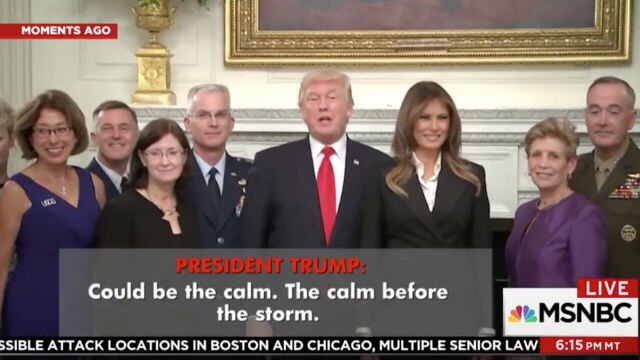
One can see how the lust for power infected President Trump and how business was not enough to satisfy that need, and how even the domestic power of being President is not enough. To me it appears that the President like so many before him sees glory in war conquest and does not consider the cost. When he told reporters that they “could be watching the calm before the storm” and when asked what he meant said “you’ll find out,” not just once but a number of times going into the next day it was unnecessary and unnerving.

Honestly it seems to me that the President through his words and actions is sowing the wind and that in time we will reap the whirlwind unless sane and wise counsel prevails. I do see that senior military leaders are stating their differences with the President on policy matters and one hopes that they if no one else will be able to restrain the President who cannot stomach criticism, attacks his opponents and seems to desire affirmation and not information.

So until tomorrow,

Peace

Padre Steve+

1 Comment

Filed under History, Military, News and current events, Political Commentary

Thoughts on the Sum Total of Life Amid Hurricanes and the Anniversary of 9-11-2001

Friends of Padre Steve’s World,

It is hard too believe that in just a couple of weeks that the United States has been impacted by two category four hurricanes, Harvey in southeast Texas and Irma in Florida and Georgia. Of course the remnants of both storms will also end up dumping a lot of rain on much of the American South and in some places causing flooding. The cost of both storms will be in the billions and it will take months to years for the towns, counties, cities, most affected by these killer storms, and most importantly, the people who call those places home to recover.

While these things have been going on it is hard to imagine that the Korean Peninsula sits on the razor’s edge of a potential war, possibly a nuclear, the likes that has not been seen since the Second World War, or imagined since the tense days of the Cold War. Likewise, the fact that today is the 16th anniversary of the terrorist attacks against the World Trade Center and the Pentagon. But I have been thinking about both even as we deal with Harvey and Irma.

I have served on the Korean DMZ, I was there just seven months before the attacks of September 11th 2001, but that was during the reign of Kim Jung Un’s father, Kim Jung Il. In retrospect the elder Kim, while a maniacal despot who starved millions of his own people, didn’t seem to have the same need to prove his manhood by testing missiles and nuclear devices as Chubby Son Number One does. In my view both are bad, but Kim Jung Un seems to be serious bent on provoking our own American wannabe despot into shooting first, but I digress…

But today I will be taking part at a remembrance at our base commemorating the attacks and resembling the victims of the 9-11 attacks. I remember the day well and I will never forget the nondescript memo on the Yahoo News homepage that morning as I logged off my computer to go to the gym at Camp Lejeune that stated “plane crashes into World Trade Center.” I saw that and thought that some dumb ass in a private plane had goofed up or had a medical emergency. Then I heard a radio talk show host screaming “oh my God, an airliner just crashed into the other tower.” I rushed to the gym to see what was on their televisions and saw Marines and Sailors standing and watching the burning towers. I went back to my office, showered, got my uniform on and went to my battalion headquarters. After twenty years in the military my war had begun, and it hasn’t ended yet. In fact I doubt that it will end before I retire, and I think that there is a strong chance that Korean, and maybe the Persian Gulf will blow up before my time of service ends.

Last night I watch Bridge on the River Kwai. In it, Sir Alec Guinness, playing Lieutenant Colonel Nicholson, the commander of a battalion surrendered at Singapore, in a reflective moment looking at the bridge that his soldiers built, tells his Japanese, captor, Colonel Saito, played by Sessue Hayakawa:

I’ve been thinking. Tomorrow it will be 28 years to the day that I’ve been in the service. 28 years in peace and war. I don’t suppose I’ve been at home more than 10 months in all that time. Still, it’s been a good life. I loved India. I wouldn’t have had it any other way. But there are times when suddenly you realize you’re nearer the end than the beginning. And you wonder, you ask yourself, what the sum total of your life represents. What difference your being there at any time made to anything. Hardly made any difference at all, really, particularly in comparison with other men’s careers. I don’t know whether that kind of thinking’s very healthy, but I must admit I’ve had some thoughts on those lines from time to time. But tonight… tonight!

Regardless of what happens over the remaining part of my now 36 year long military career, the fact is I am nearer to the end than the beginning of it, and I over the past few years I have asked myself the same questions that Nicholson poses to Saito.

So here I am, after 36 years my career is stalled and I believe that I am serving in my last billet before I retire. There are certainly others who have gone father than me, but I think I’ve had great career, and truthfully I am happy and regardless of what the last few years of my career bring, I hope that those who have served alongside of me in peace and war will be able to say that I made a difference. I don’t think that is for me to decide what the sum total of my life will represent, that is for others, their memory of me, and history.

But even so, as I finish this article and schedule it to post, my thoughts and prayers are with the people in Florida and elsewhere, especially my friends whose pieces are being disrupted by Irma, and those who are trying to recover their lives in Texas.

So until tomorrow,

Peace

Padre Steve+

1 Comment

Filed under Loose thoughts and musings, Military, News and current events, War on Terrorism

Retirement Honors

Friends of Padre Steve’s World,

William Shakespeare wrote in his play Henry V:

This story shall the good man teach his son;

And Crispin Crispian shall ne’er go by,

From this day to the ending of the world,

But we in it shall be remembered-

We few, we happy few, we band of brothers;

For he to-day that sheds his blood with me

Shall be my brother; be he ne’er so vile,

This day shall gentle his condition;

And gentlemen in England now-a-bed

Shall think themselves accurs’d they were not here,

And hold their manhoods cheap whiles any speaks

That fought with us upon Saint Crispin’s day.

Today I have the honor or participating in the retirement ceremony of my friend Vince Miller at Naval Station Norfolk. He is retiring from the Navy Chaplain Corps as a Commander after 24 years of service. He is a dear friend and a man of great integrity and one of the conscientious men that I know in the Chaplain Corps. He has served with the Marines, as well as at sea, and with the SEALS. He has served in Iraq, and has done much to better the lives of people at a number of shore installations as a base Chaplain and pastor.

I appreciate Vince’s friendship and I am pleased that I will have the honor or participating in his retirement ceremony. Lord willing in not too many years I will be retiring too, but with nearly two full careers between the Army and the Navy spanning nearly 40 years when I retire in 2020 or 2021.

But for those who have never served it is hard to fully appreciate what a man like Vince, and his family, have accomplished and endured in his 24 years of service. This is not a vocation for the faint of heart, or those who are enamored with uniforms and the possibility of having power over the lives of others. To be a chaplain and a naval officer one has to really desire to put others first and be a servant leader. I know that there are officers and including a good number of chaplains who are not that, but in fact are quite toxic, I have served under a number of them in my career, so when a good chaplain like Vince retires there is always a void left.

However, Vince is, and always has been a servant leader who has likewise endured much at the hands of toxic leaders. But that being said he has always remained humble and devoted to caring for the people of God in the military, regardless of their rank, position, race, creed, color, religion, gender, or sexual preference. He sees people as people, created in the image of God who are all worthy of being cared for, respected, and loved.

We lose a fine chaplain tomorrow. I know that Vince will continue to care for and serve people as a minister in his church regardless of what he does next in life, and that he will always be my friend and care about me.

I think Vince would agree with the words of Admiral William McRaven, a Navy SEAL and the former head of U.S. Special Forces Command:

“Remember… start each day with a task completed. Find someone to help you through life. Respect everyone. Know that life is not fair and that you will fail often. But if you take some risks, step up when times are toughest, face down the bullies, life up the downtrodden, and never, ever give up – if you do these things, then you can change your life for the better… and maybe the world!”

I am honored to have a part in his retirement ceremony today, for he is worthy of being honored for his service to God and country. It is an honor to have served with him, for he truly is my brother.

Peace

Padre Steve+

1 Comment

Filed under faith, Loose thoughts and musings, Military, shipmates and veterans, US Navy

They Silently Gather Around Me: Walking the Antietam Battlefield


Friends of Padre Steve’s World,

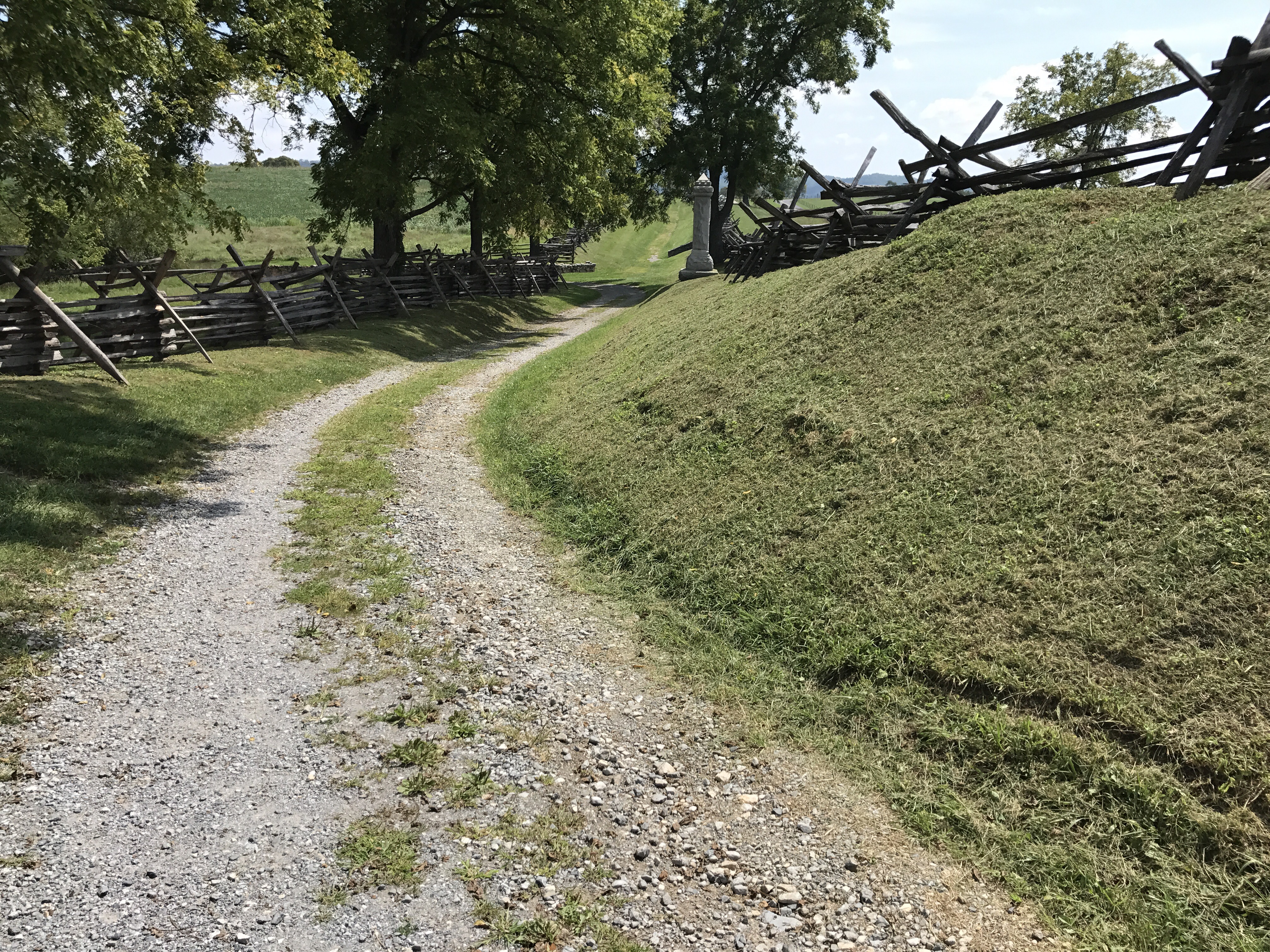
As you know from yesterday’s article I am taking an extended weekend in the D.C. area and yesterday I took a trip up to the Antietam Battlefield which surrounds much of Sharpsburg, Maryland. It was a time of quiet reflection on a battle, on the lives of soldiers, and on our country. The Battle of Antietam was the bloodiest day in American military history, more Americans were killed and wounded on that day than any other single day. While the battle was a draw from a military point of view it was singularly important in that it stopped Robert E. Lee’s invasion of the North and gave Abraham Lincoln enough of a victory to announce the preliminary Emancipation Proclamation. The announcement of that, and creative Union diplomacy helped turn the tide of the war by helping to keep England and France from recognizing the Confederacy.


It was my intention to walk as much of the battlefield as I could and I did. The weather was good but a bit warmer and sunnier than what the soldiers who fought there experienced on September 17th 1862. Even so it is my opinion that walking battlefields, be it on a staff ride, reenactment, or simply doing what I did yesterday helps one put the battle into a human context especially if one has a fair amount of historical knowledge and familiarity with a given battle. Being hot, sweaty, feeling ones legs, feet, and back hurt, dealing with waterlogged shoes, being assaulted by swarms of insects, and fighting your way through thrushes, reeds, and high grass along the banks of a creek or river, and drinking the bare minimum of water, and getting a little bit sunburned, is a good way to get a feel for what the soldiers experienced at Antietam or other Civil War battles. I am just glad that I was not wearing a wool uniform, carrying a heavy rifle, 60 rounds of ammunition and cartridges, and all my kit wearing what we would no call substandard shoes, if like the Union soldiers did we even had them. If you were a Confederate soldier at Antietam you might have been barefoot. Since I have been to war and lugged heavy amounts of gear around Iraq I can imagine that, even though I never had to walk as far there as I did today. That’s a good thing.


In his book The Forgotten Soldier, Guy Sajer wrote:

“Too many people learn about war with no inconvenience to themselves. They read about Verdun or Stalingrad without comprehension, sitting in a comfortable armchair, with their feet beside the fire, preparing to go about their business the next day, as usual…One should read about war standing up, late at night, when one is tired, as I am writing about it now, at dawn, while my asthma attack wears off. And even now, in my sleepless exhaustion, how gentle and easy peace seems!”

I am sure that many a Civil War soldier would agree with him. The fact is that reading the history of various wars is important, but whenever possible it is good to experience some of the discomfort of those who fought the battle. When I finished the last part of my battlefield experience my feet hurt and when I took off my shoes they looked pretty bad, but much of that was from the dirt, grass, and moisture that had found its way into my shoes. But unlike the soldiers at Antietam I could return to a safe and dry place and care for my feet, they couldn’t.


We are fortunate along much of the east and central parts of the United States to have many well preserved battlefields. I highly recommend those who have not gotten out to see them, walk them, and to remember those who were killed, wounded, or emotionally scarred for life. Walking the Antietam battlefield for the first time since 2001 I was able to sense the terrible reality that that battlefield was the bloodiest single day of fighting in American history. Depending on the estimate some 22,000 to 27,000 Union and Confederate soldiers were killed or wounded on that one day. As I walked through the Cornfield and the West Woods I tried to imagine how over 13,000 troops were killed or wounded in that part of the battlefield alone. I felt the same way along the Bloody Lane, near the Dunker Church, at the Burnside Bridge, and along the furthest point of the Union advance. Of course this is hallowed ground and the National Cemetery has in it the remains of over 5,000 Union soldiers.


The remains of nearly 3,000 Confederates were interred in a new cemetery on the outskirts of Hagerstown which was dedicated in 1877 as well as two other cemeteries. This is interesting to me because at Gettysburg the Confederate dead were exhumed and taken back to the south with many buried in Richmond’s Hollywood Cemetery.


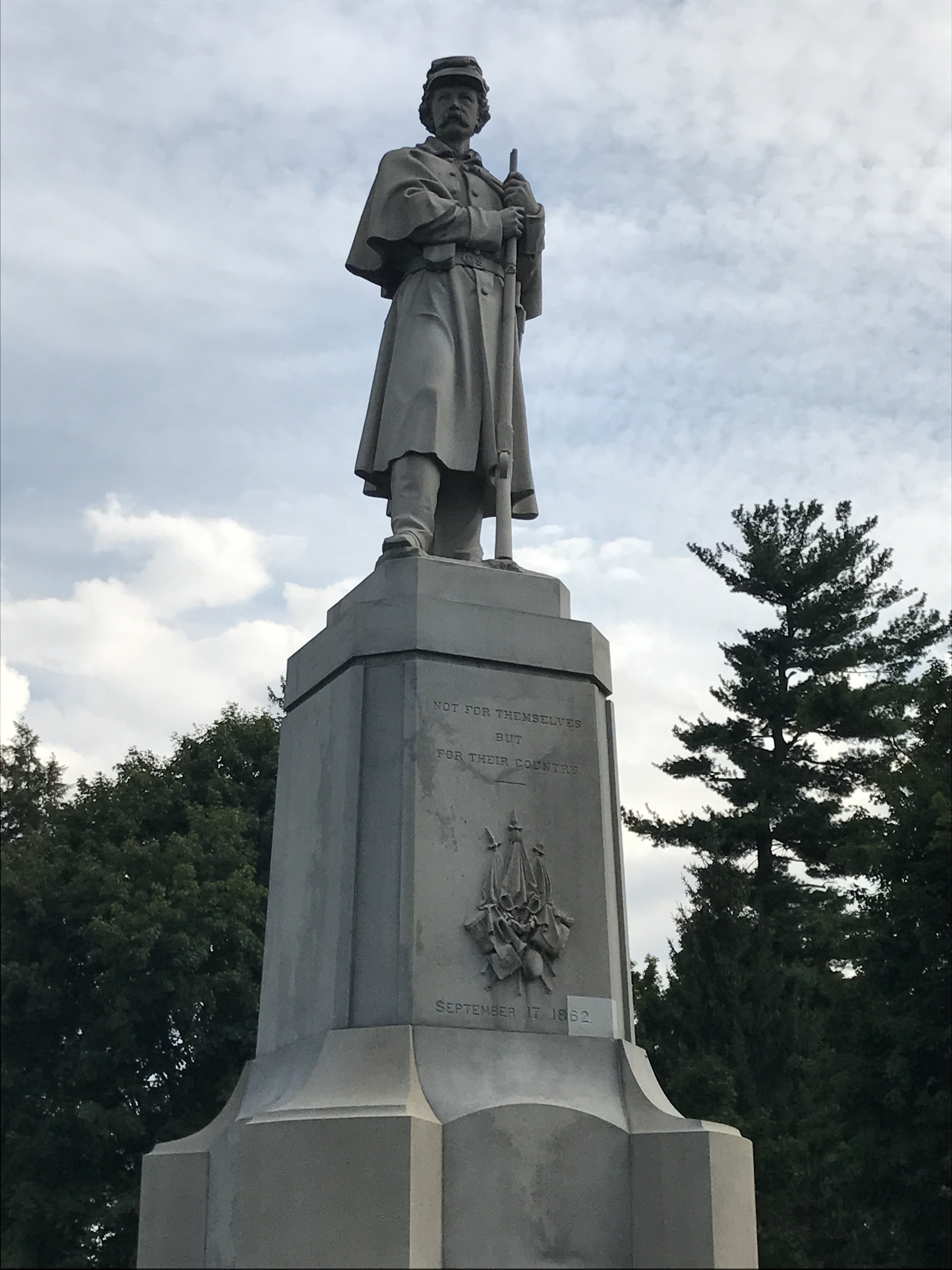
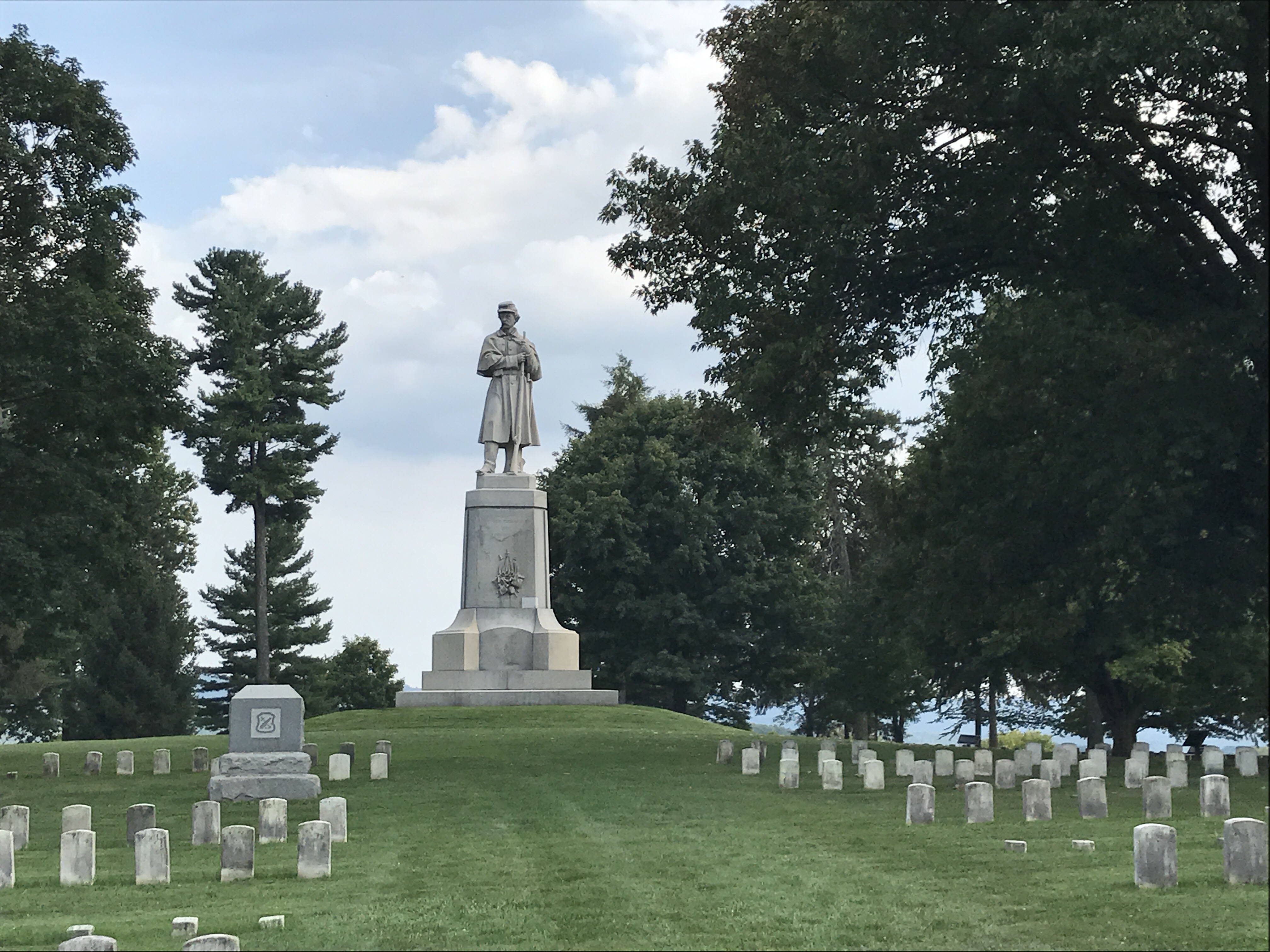
The National Cemetery is guarded by Old Simon a massive granite statue of a representative Union soldier. The monument is 44 feet tall, and Old Simon, designed and sculpted by James Batterson is 21 1/2 feet tall and weighs 30 tons. The inscription is appropriate. It simply reads: Not for themselves but for their country, September 17, 1862.


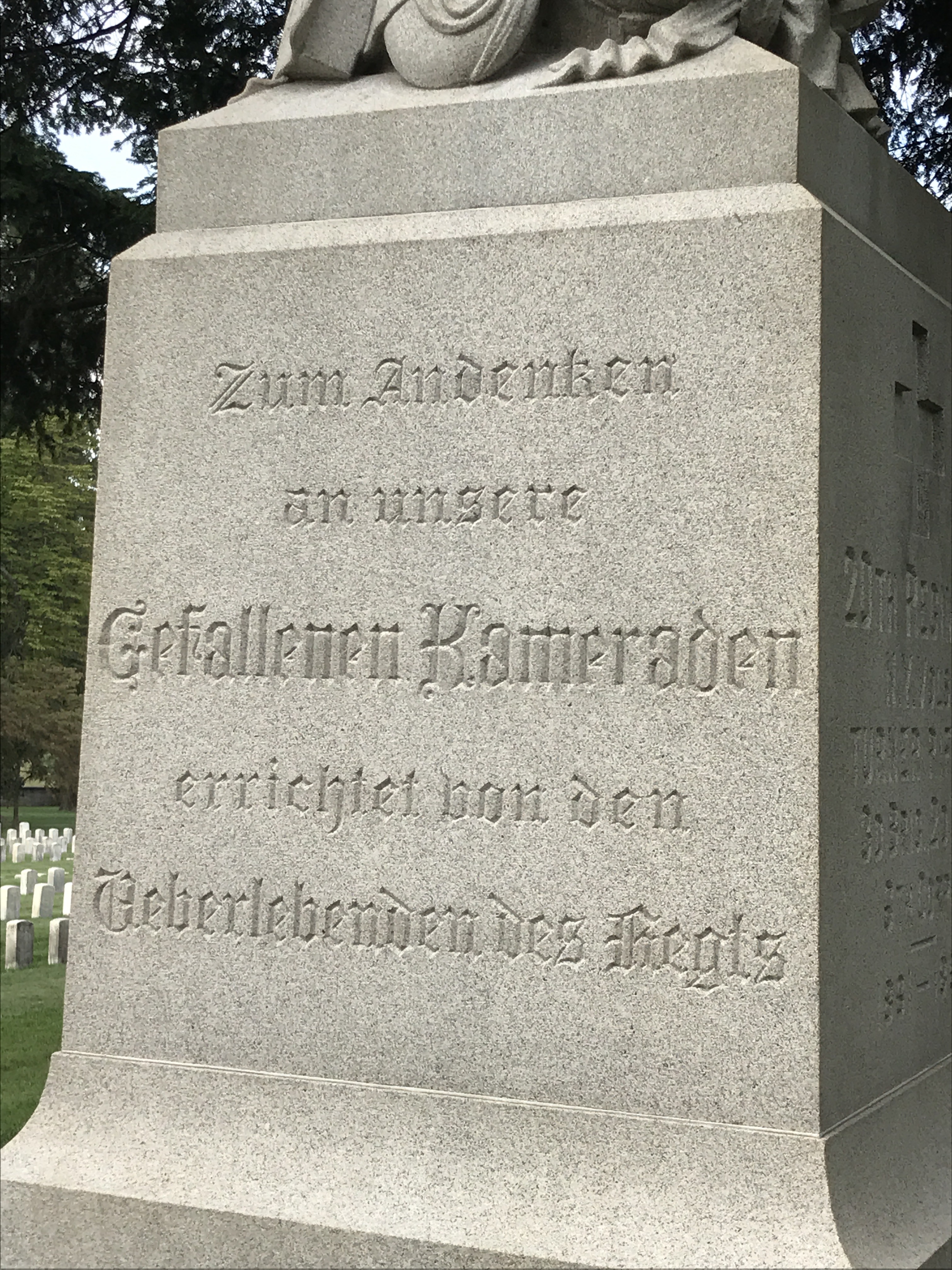
The graves of the soldiers are laid out around the statue grouped in the states from where they came. There are a few individual monuments and a monument erected by the survivors of the 20th New York, a unit primarily composed of German immigrants that also has a monument not far from the Dunker Church. The inscription on one side has in German the words Zum Andenken an unsere Gefallenen Kameraden, errichtet von dem Ueberlebenden des Regts. (Erected to our fallen comrades by the survivors of the regiment)


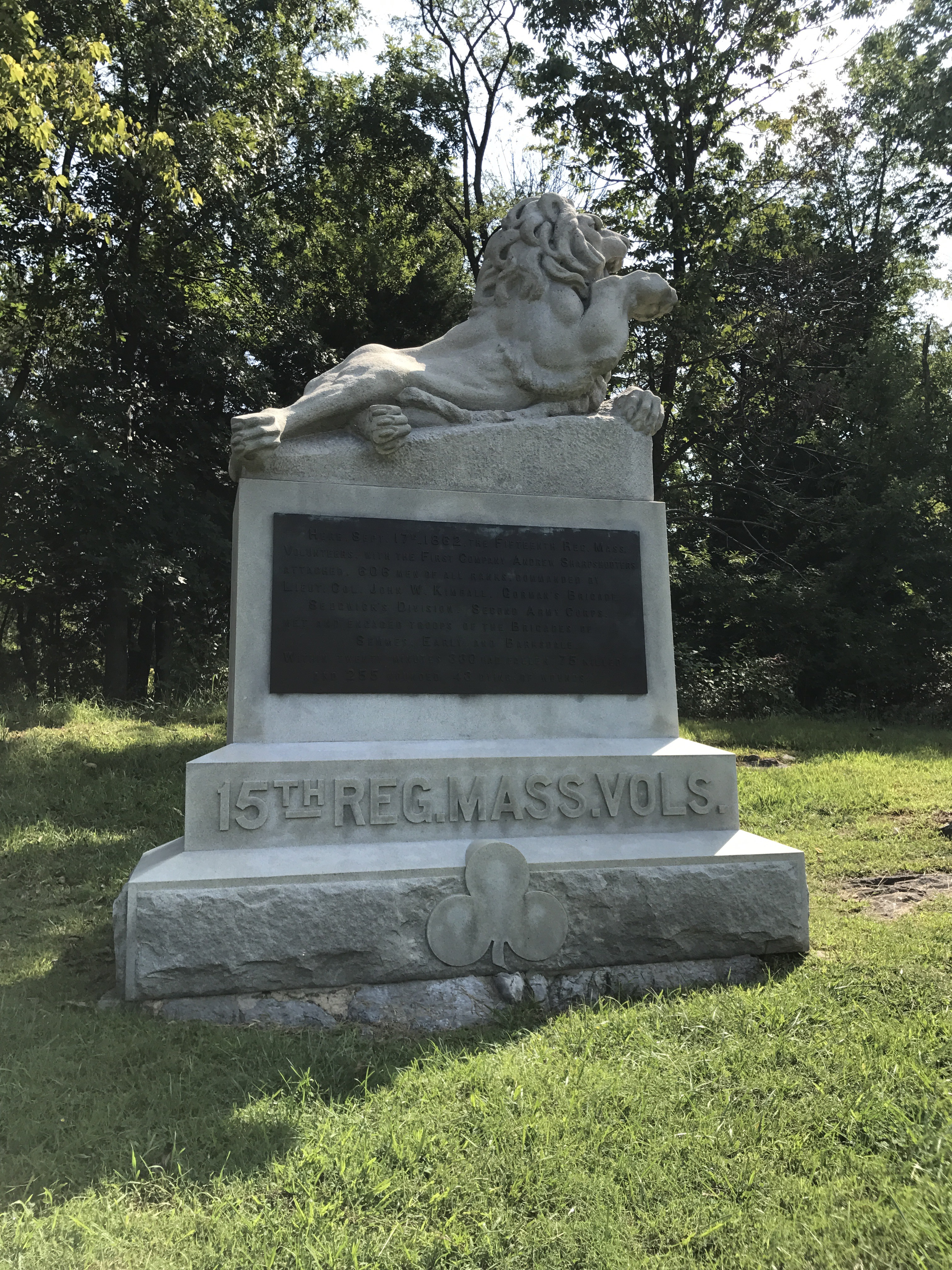
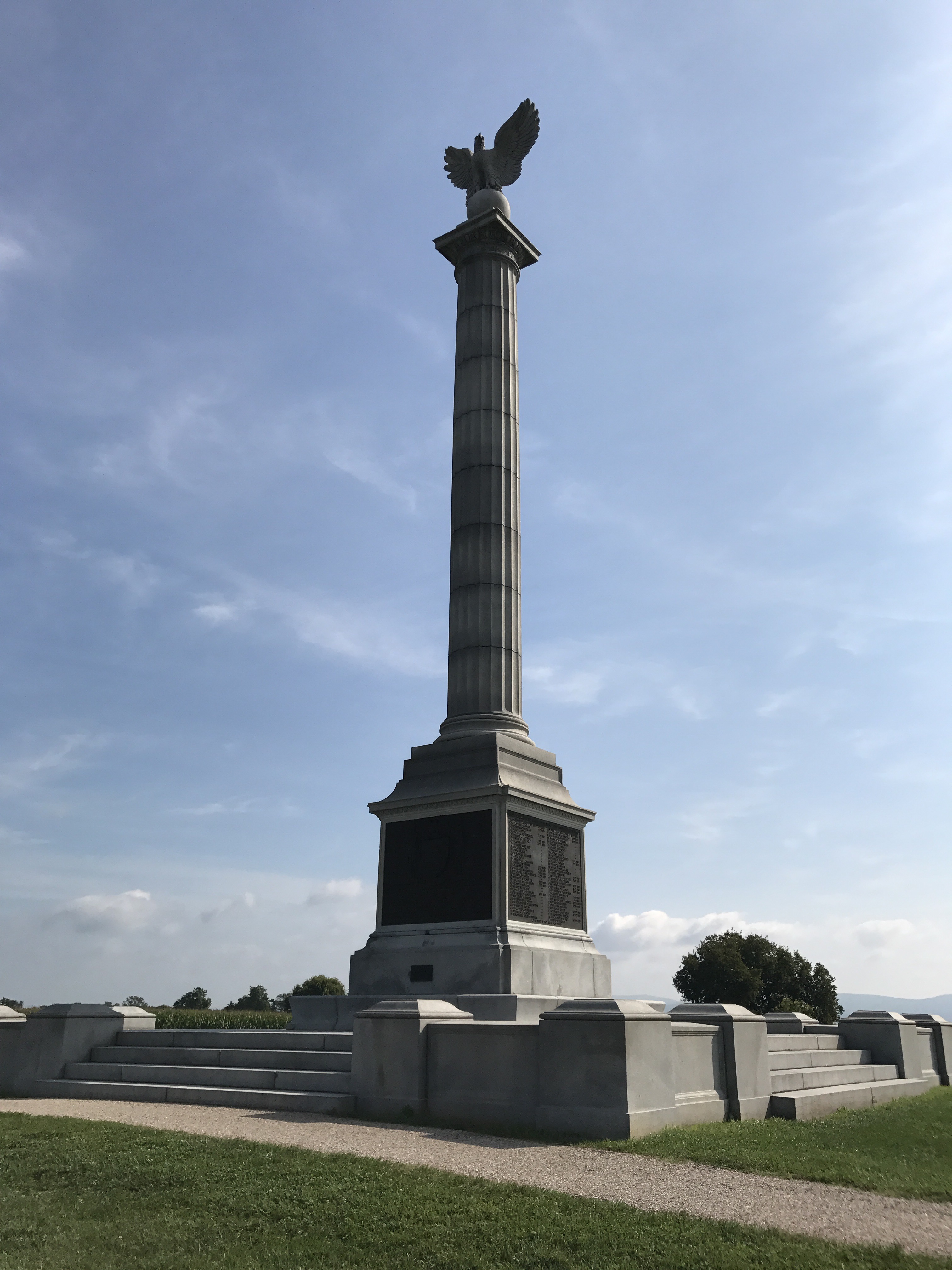
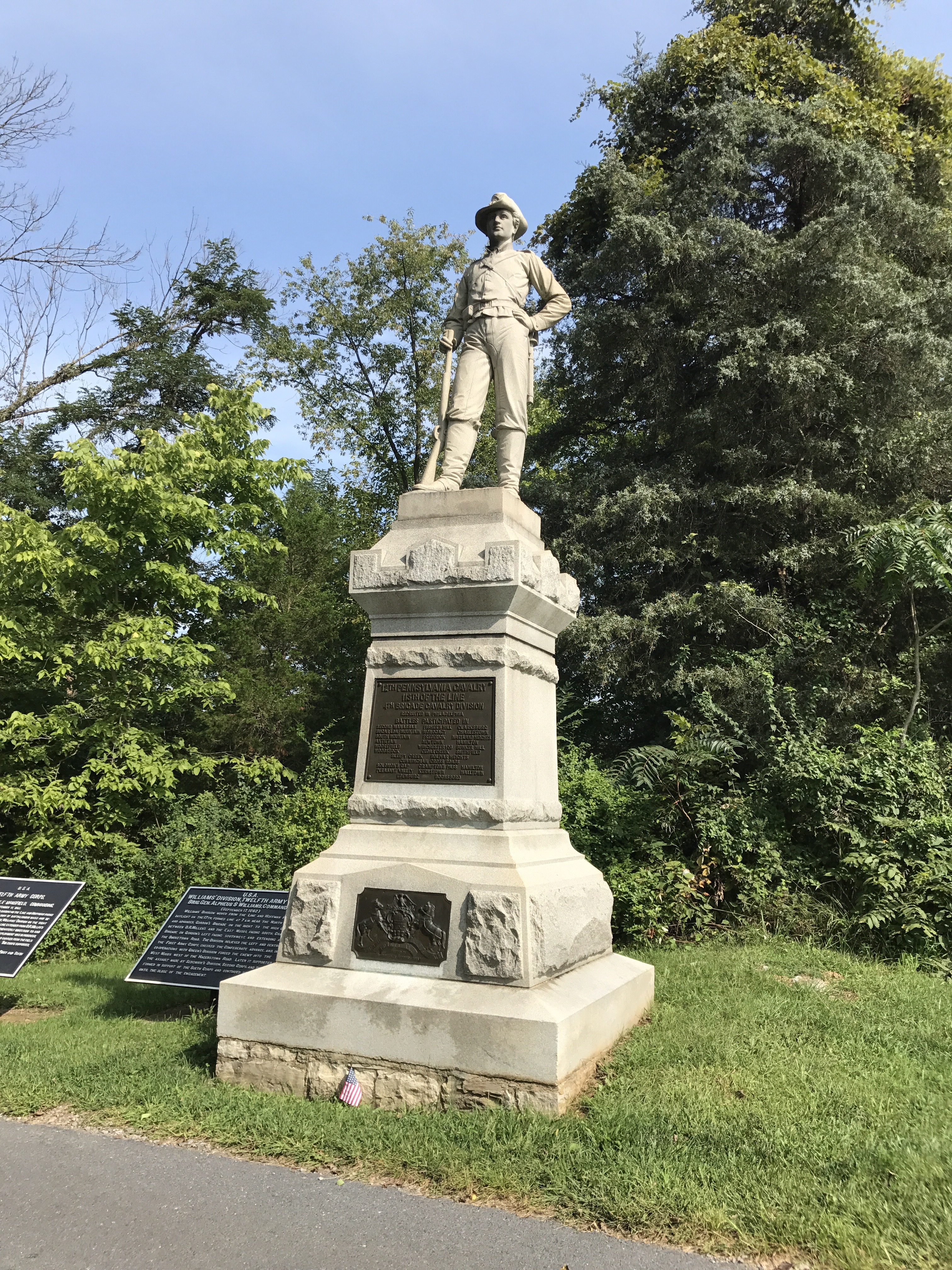
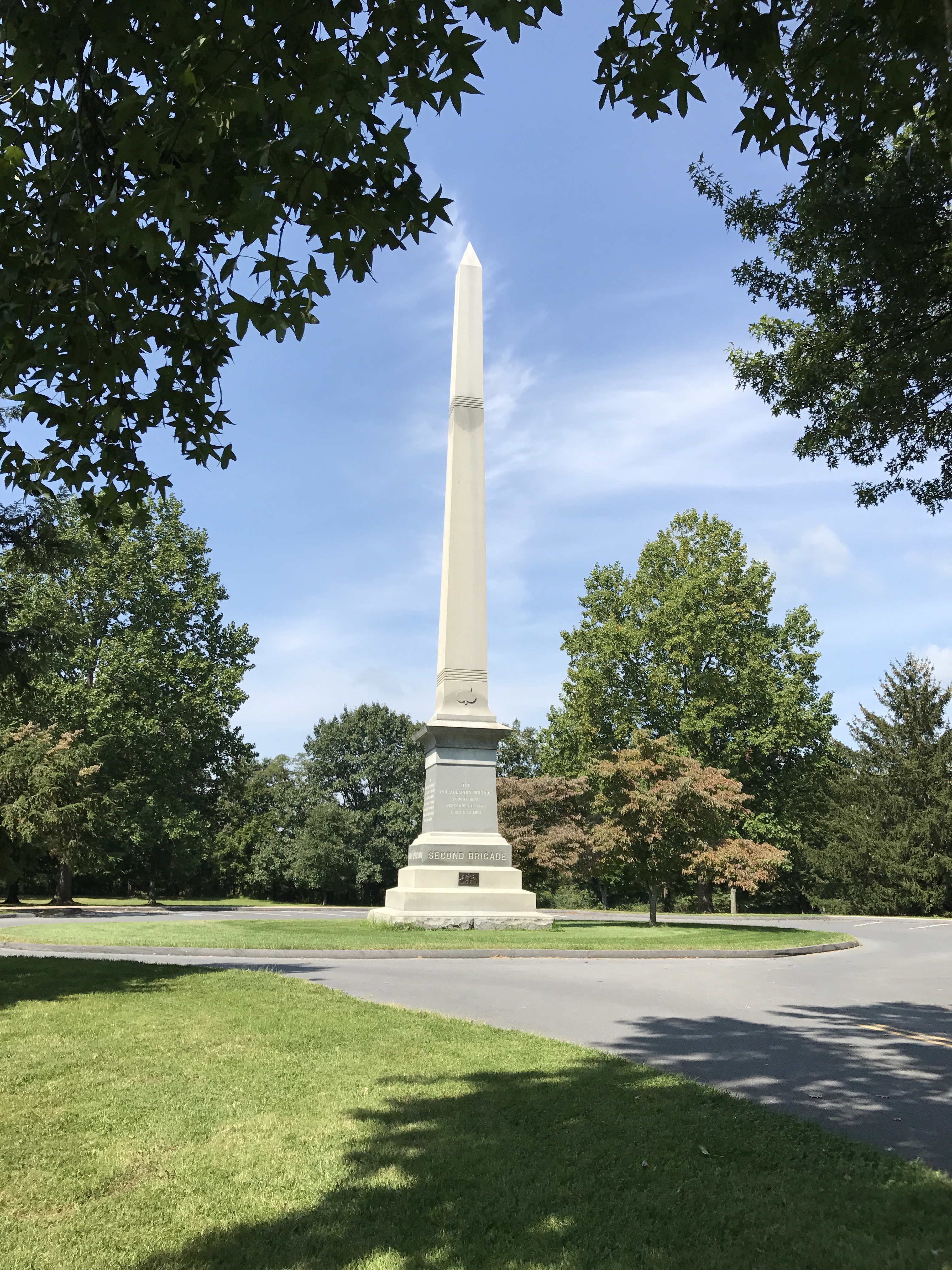
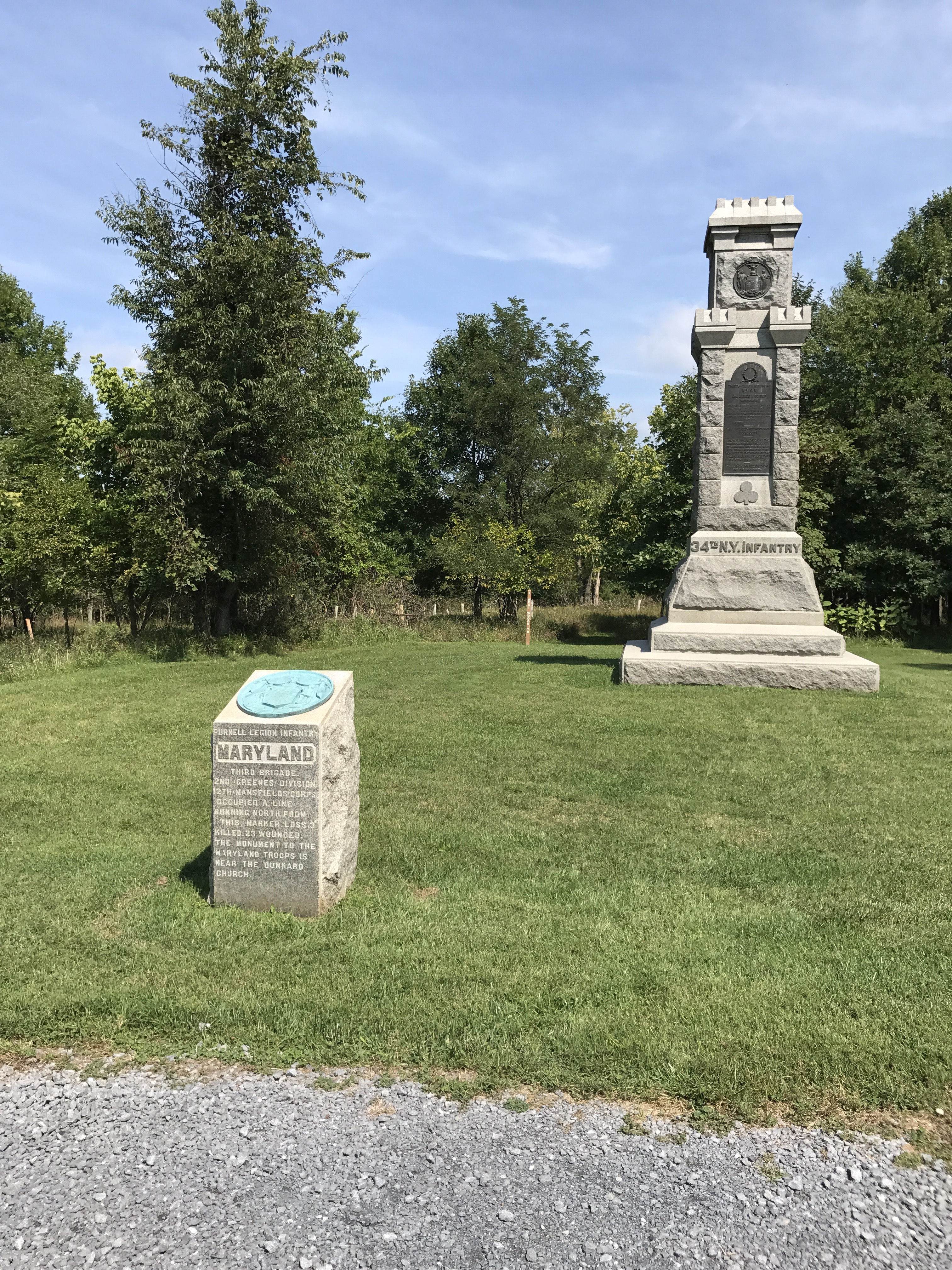
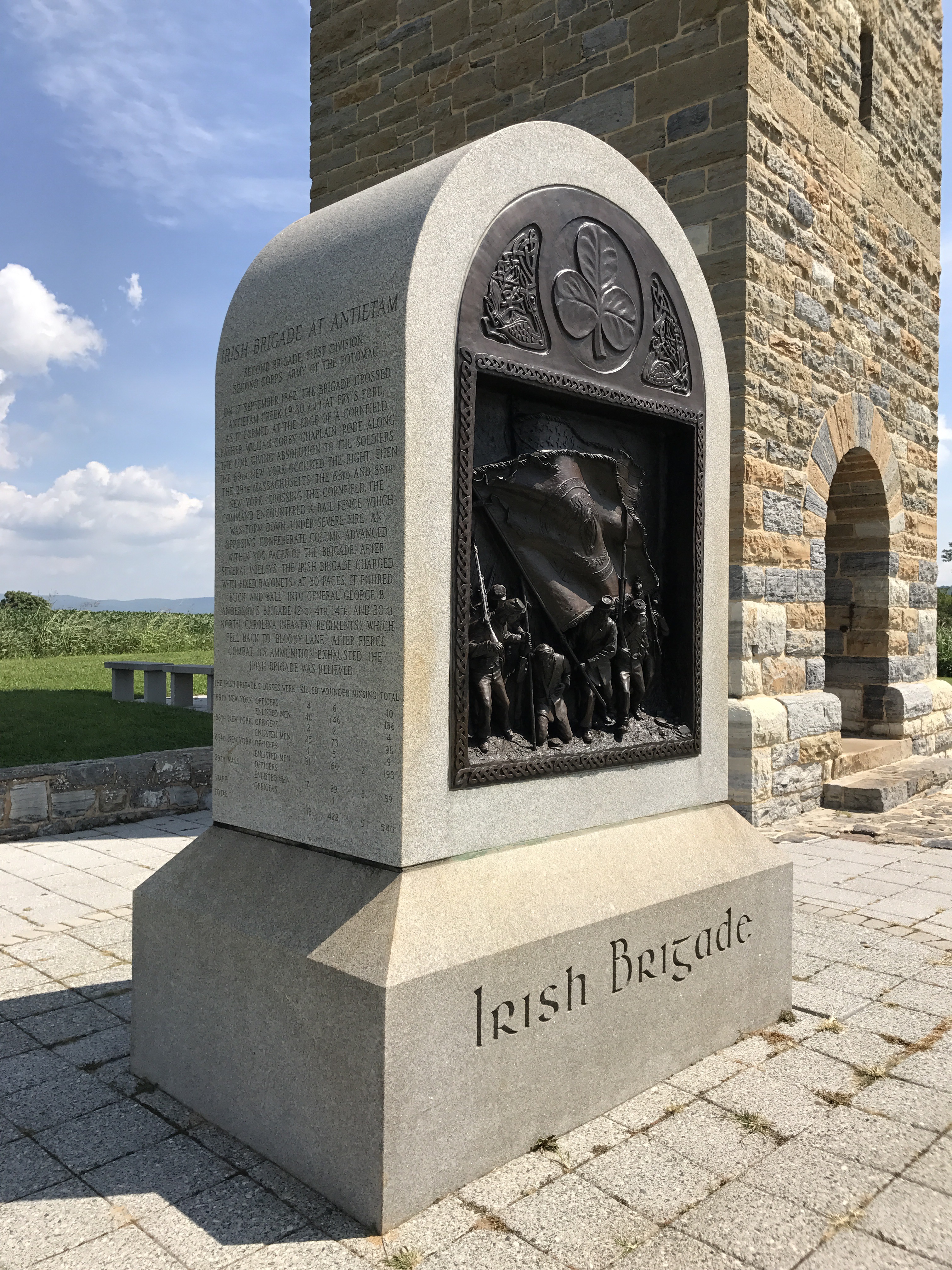
As far as battlefield monuments are concerned there are comparatively few, just 96 as compared to Gettysburg which has some 1,300 of all types. Almost all of the monuments at Antietam, with the exception of the ubiquitous bronze markers that show the positions of units and describe their actions, are dedicated to units of the Army of the Potomac. These were erected by states, communities that contributed troops and veteran associations. There are only six monuments specifically honoring Confederates with Maryland having a monument to its soldiers of both sides.


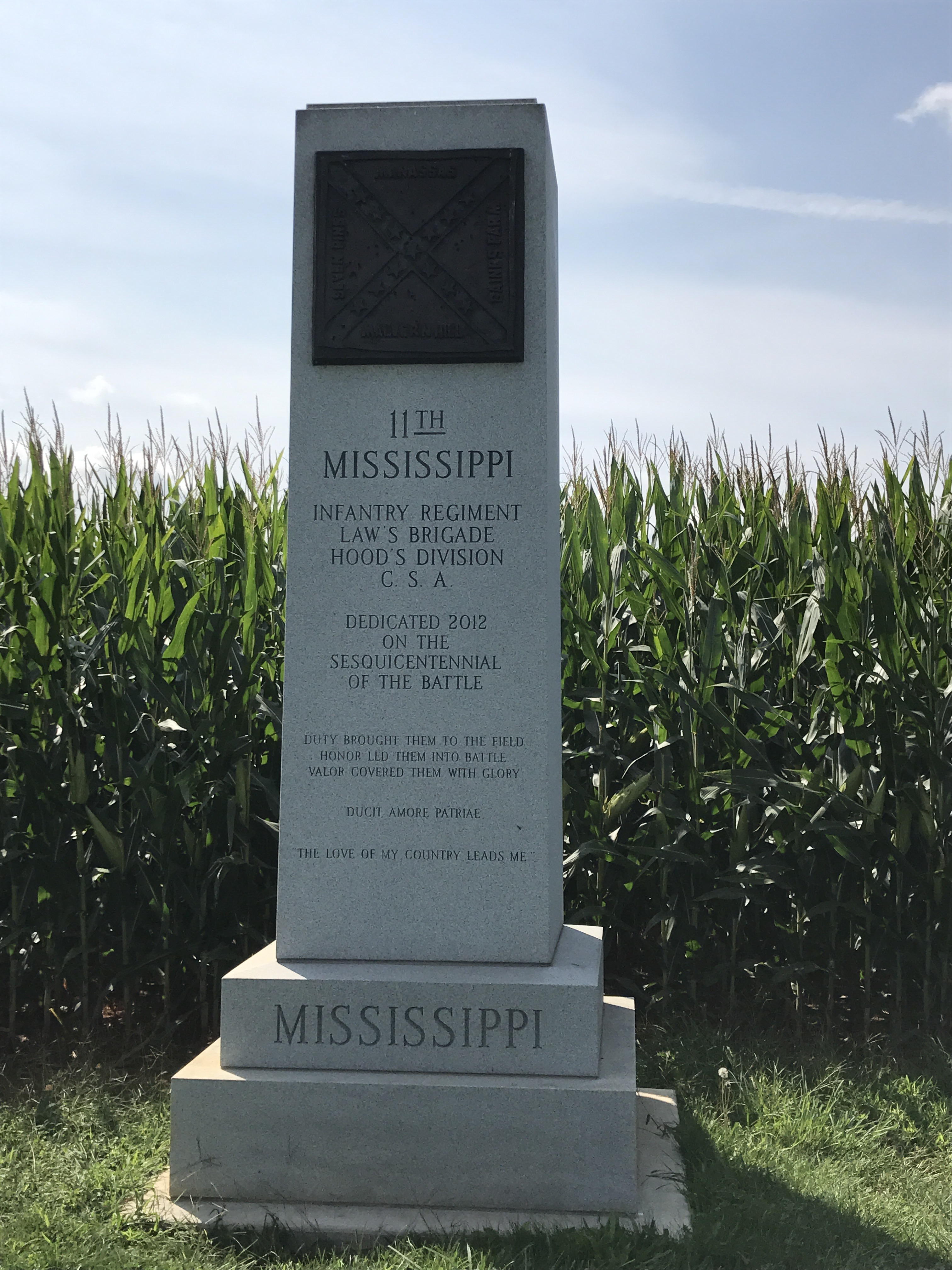
 Of the Confederate monuments most are of fairly recent import. Georgia and Texas have monuments to all of their soldiers, while Mississippi has one dedicated to the 11thMississippi Infantry. All three of these stand within a hundred yards of each other on the southern edge of the Cornfield.


There is a monument to Robert E. Lee near the new Burnside bridge off Maryland Highway 34 as you cross Antietam Creek. It too is a rather new addition, being funded by William F. Chaney and dedicated in June 2003. Chaney had noted that he just wanted “even things up a bit.” The inscription on it furthers the Lee myth promoted by the purveyors of the Lost Cause and the Noble South saying “Although hoping for a decisive victory Lee had to settle for a military draw, Robert E. Lee was personally against secession and slavery, but decided his duty was to fight for his home and the universal right of every people to self-determination.”


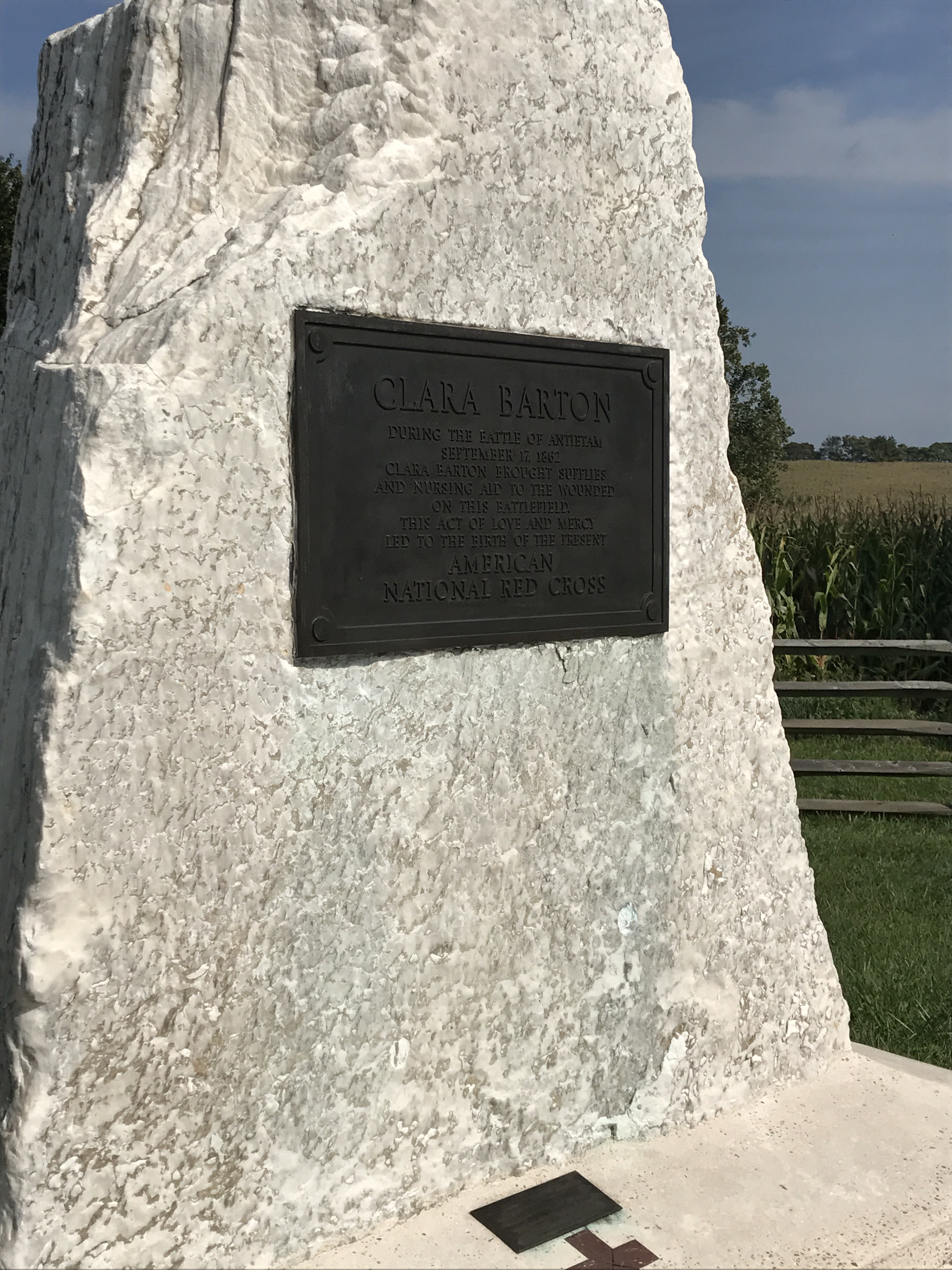
A monument on the northern edge of the Cornfield is dedicated to Clara Barton who along with other nurses helped to care for the wounded of the battle and one near the Burnside Bridge to President William McKinley who was a Sergeant in the 23rd Ohio Infantry. Six monuments each with a cannon placed upside down into a stone, these are mortuary markers noting where six Generals were killed or mortally wounded. They include Union Generals Joseph Mansfield, commander of XII Corps, and division commanders Israel Richardson and Isaac Rodman. Three Confederate brigade commanders, George Anderson, William Starke, and Lawrence O’Brien Branch are marked by identical monuments.


There was an eerie pristine feeling when I walked the battlefield yesterday. There were not many people on it, especially compared to Gettysburg. This led to a rather solitary experience amid the quite, only punctuated by the calls of birds, the chattering of squirrels, and the assorted buzzing, chirping, and humming of insects. As I walked the Cornfield, the West Woods, the Sunken Road and Bloody Lane, crossed the Burnside Bridge, made my way to the furthest point of the Union advance, and paused in the cemetery I was continually reminded of Walt Whitman’s poem, Ashes of Dead Soldiers:

“Ashes of soldiers South or North, As I muse retrospective murmuring a chant in thought, The war resumes, again to my sense your shapes, And again the advance of the armies. Noiseless as mists and vapors, From their graves in the trenches ascending, From cemeteries all through Virginia and Tennessee, From every point of the compass out of the countless graves, In wafted clouds, in myriads large, or squads of twos or threes or single ones they come, And silently gather round me…”


Until tomorrow,

Peace,

Padre Steve+

3 Comments

Filed under civil war, History, Loose thoughts and musings, Military, Travel

“It’s the People Stupid” The Need for Professional Mariners 


Friends of Padre Steve’s World,

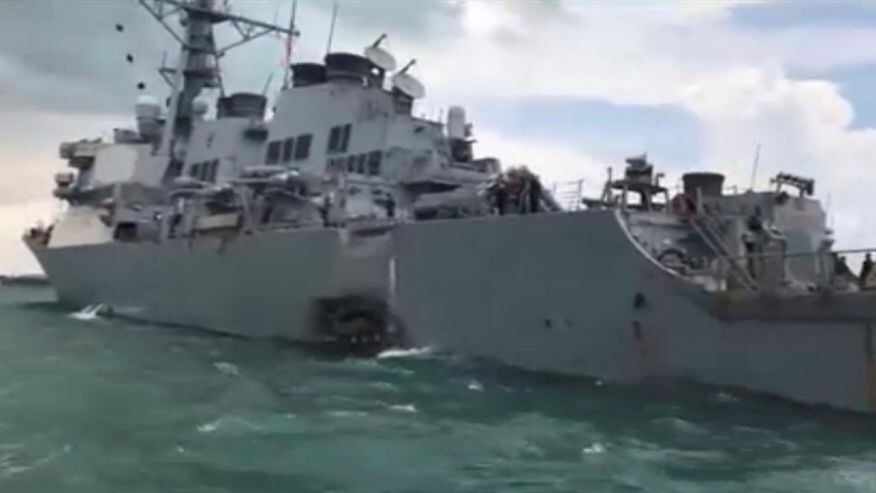
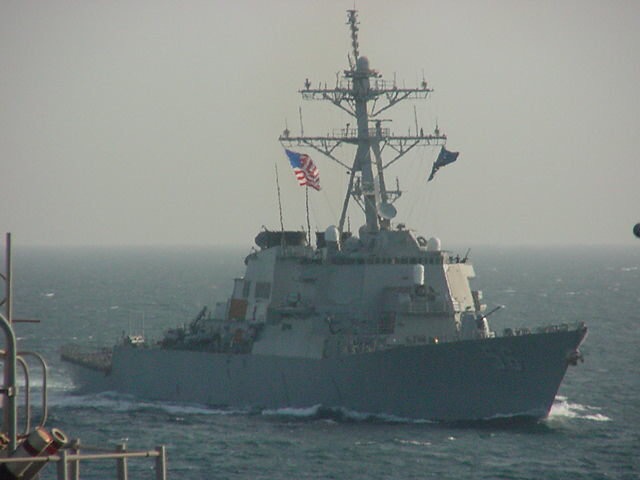
I’m holding off finishing the last part of my series Statues with Limitations until tomorrow. Of the past day I have been consumed with the collision of the USS John S. McCain with a tanker near Singapore that quite likely has claimed the lives of ten U.S. Navy sailors. It was the second fatal collision in less than three weeks involving some of the most technologically advanced warships in the world with merchant ships. The other was that of the USS Fitzgerald which was at fault in a collision with a container ship near Tokyo bay. 

Today I have been in contact with our regional casualty assistance coordinator and chaplains who are already or might be called to go to the home of a sailor’s next of kin to inform them that their sailor is dead. If you have never had to make such a notification you are lucky. They are not easy and they never get easier. Between the military and my time as hospital emergency and trauma department chaplain I have been involved in far too many of them, I lost count around the 350 point, I’ve probably been involved in close to 500 such notifications of all types. 

Frankly there are no words that can adequately convey how hard that news is on the loved ones of those who died, especially when their deaths were most likely preventable. Last week I read the preliminary report on what happened aboard Fitzgerald. It was damning and showed some systemic cultural issues that need to be fixed. I am sure that the Navy will fully investigate the incident involving McCain too, and the report will likely be just as damning. It is bad enough that the Commander of the Navy’s Seventh Fleet, to which Fitzgerald, McCain, and the cruiser Antietam which had a grounding incident near Yokosuka Japan, and the cruiser Lake Champlain which collided with a Korean fishing boat, was relieved of his command just before his scheduled retirement.

But the problem is bigger than simply relieving and replacing officers proved to be at fault in these incidents, the Navy is very good at that. The problem is that about 15 years ago the Navy shut down its Surface Warfare Officer School in Newport, Rhode Island as a cost cutting measure. Instead of going to a school after being commissioned from the Naval Academy, ROTC, or Officer Candidate School, to learn the basics of navigation, seamanship, damage control, engineering, and combats systems operations, these tasks were pushed onto the commanding officers of the ships the new officers were assigned. That began in 2002 and I remember discussing the detrimental effect this would have with fellow officers about the USS Hue City. Some 15 years later these are the officers who are becoming the commanding officers and executive officers of our ships. Most of them don’t spend enough time at sea to be truly professional mariners, and many of them spend years between sea assignments. As such they really don’t know their ships that well, the don’t know the sea that well, and as a result they have become addicted to technology at the expense of doing the basics like looking out the window and taking action to avoid collision. It comes down to in the words of my former Commanding Officer, Captain Rick Hoffman said about these incidents: 

“I am feeling a sense of increasing outrage. The more I write and get replies from so many great shipmates and long time friends, the more I feel a sense of urgency to see if we can’t take these tragedies to force a larger conversation about our SWO culture…or rather the demise of the culture. Help build a path forward that restores the professionalism and focus necessary to have a strong Surface Navy. Perhaps our ships are complex enough to look at the Royal Navy model. Professionals on the bridge, professionals manning the Combat Systems, professionals manning the engineering plant. Not this mongrel program that trains everyone up to the minimum level of competence just long enough to survive your tour and go ashore. Ten years later you go back to sea…in command. I guess I am just feeling frustrated.”

It is not a matter of technology being the answer, we have amazing technology, but as one former officer wrote “Technical solutions don’t solve cultural issues. We need to refocus on our capabilities as mariners.” Captain Hoffman noted: 

“I am pondering the value of sparking a larger discussion about our systemic challenges with basic maritime skills. We are ship drivers, we have technical skills but we are not mariners as a community. We don’t cherish the necessary focus on knowing and feeling the ship, the sea and the larger maritime environment. Just look out the window!!!! The CNO just called for industry to provide more solutions. THAT IS INSANE. It is the people, stupid. We have enough tools, we have forgotten how to use them. Eyeballs and brains. Engage the eyeballs and brains.”

The fact is that for more than a decade the men and women that officer our ships have been pulled many different directions, by various factors, many of our own doing. Quite a few were pulled off of ships at critical points in their career to serve in the sands of Iraq or the mountains of Afghanistan. Our Navy has stopped doing the basics of being professional mariners first so that they can get their ships safely from place to black and be ready to sail into harm’s way at a moment’s notice. 


As Captain Hoffman and so many other men who have commanded ships whose comments I have been reading have noted, the issue is cultural and it is a need to return to the basics. 

Until we do that we are going to keep getting sailors killed, and causing great damage to ships that cost billions of dollars in avoidable incidents. 

As for me, I hope that I don’t have to make another death notification, especially for a death that needn’t happen. 

Until tomorrow,

Peace

Padre Steve+ 

2 Comments

Filed under Military, national security, Navy Ships, News and current events, US Navy

“Time to Oblterate the Marks of Civil Strife and the Feelings of Oblivion the Feelings it Engendered”  


Friends of Padre Steve’s World,

Just a short post today because I have become weary of cyber-battles with neo-Confederates and Alt-Right Nazis. That is not to say that I won’t stop fighting them, but don’t have a lot of energy to put into this post because of those battles. I guess it could be worse, I could be tired because I had spent the day getting real bullets fired at me by these people’s Confederate and Nazi ancestors. I have been shot at in combat by Iraqi insurgents, and no it is not fun, especially when you are the only guy there without a weapon. That being said, my ancestors on both sides of my family fought for the Confederacy, and those on my paternal side were slave owners, Confederate officers, and unrepentant rebels who would not reconcile themselves to the defeat of the Confederacy. 

Unlike my ancestors, Confederate General James Longstreet was honest with himself and to the causes of the war. He wrote this in 1867:

“The surrender of the Confederate armies in 1865 involved: 1. The surrender of the claim to the right of secession. 2. The surrender of the former political relations of the negro. 3. The surrender of the Southern Confederacy. These issues expired on the fields last occupied by the Confederate armies. There they should have been buried. The soldier prefers to have the sod that receives him when he falls cover his remains. The political questions of the war should have been buried upon the fields that marked their end.” 

I am going to write about my rather nuanced view of statues dedicated to Confederate soldiers or leaders in the next few days. I had a really good, and lengthy discussion today with a fellow officer and friend about that subject. When I write it my words will probably not make anyone completely happy because I am not an absolutist in my views. While I reject what my ancestors fought for I also know that there were Confederate soldiers who were drafted against their will, Southerners like George Thomas and John Buford, who fought for the Union, and Northerners who fought political battles against Abraham Lincoln and wanted the South to win its independence because it would be good for business, and because they were as racist as the most rabid slave power secessionist. There were also Confederates who after their defeat, including James Longstreet, John Mosby, and Billy Malone who reconciled with the United States, recanted their secessionist views, and were demonized as if they were Judas Iscariot by the leaders of the Lost Cause cult because they did so. 

Robert E. Lee, who as so many statues in his honor including the one in Charlottesville that the Neo-Nazis supposedly went to defend, made this comment regarding such things, he was not in favor of them because he did not think it wise to keep open the wounds of war. He said:

“I think it wiser moreover not to keep open the sores of war, but to follow the examples of those nations who endeavored to obliterate the marks of civil strife and to commit to oblivion the feelings it engendered.” 

The neo-Confederates would be wise to heed to his words and those of James Longstreet. 

But I’ll leave that until I write that article. 

Peace

Padre Steve+ 

6 Comments

Filed under civil rights, civil war, ethics, History, Military, News and current events, Political Commentary

Great Illusions and the Threat of War 


Friends of Padre Steve’s World,

I have been reflecting on the words and actions of President Trump, Korean dictator Kim Jong Un and their sycophants over the past day and a half. I wrote some of my thoughts down yesterday before continuing to read and reflect. While I was doing so the words of William Shirer wrote in his forward to his book The Rise and Fall of the Third Reich, as well as some thought from Barbara Tuchman’s The Guns of August. While they deal with different eras, they also deal with the one constant in history, that of fallible human beings. I think that they are quite appropriate to reflect upon today. Shirer wrote: 

“In our new age of terrifying, lethal gadgets, which supplanted so swiftly the old one, the first great aggressive war, if it should come, will be launched by suicidal little madmen pressing an electronic button. Such a war will not last long and none will ever follow it. There will be no conquerors and no conquests, but only the charred bones of the dead on an uninhabited planet.”

There are some people who think that globalization and the interdependence of the economies of the world on international commerce and trade will ensure that nuclear war never occurs. They believe that realists will ensure that it never happens. That is a nice thought. During the Cold War the United States and the Soviet Union maintained a tenuous balance of terror that never resulted in a nuclear exchange, but they did come close, especially during the Cuban Missile Crisis. But we no longer live in that world where the leaders two heavily armed yet rational powers did not succumb to the temptation of using them. 

In 1914 the realists of the world believed that if a war broke out among the great powers of Europe that it would of necessity be short. Inspired by the writings of Norman Angell whose book The Great Ilusion drove home the message that war as no longer profitable and therefore capitalists would resist appeals to war and nationalist fervor, Barbara Tuchman wrote:

“By impressive examples and incontrovertible argument Angell showed that in the present financial and economic interdependence of nations, the victor would suffer equally with the vanquished; therefore war had become unprofitable; therefore no nation would be so foolish as to start one.” 

The book had a cult like following in Europe and when Europe went to war in August 1914 many people and governments believed that any war would have to be short, and as such none of them prepared for the long and catastrophic war that ensued. The Germans did not follow Angell, but Clausewitz who preached a dogma of short and decisive wars. Sadly, both authors were misunderstood by their most devoted disciples and as Tuchman wrote: “Clausewitz, a dead Prussian, and Norman Angell, a living if misunderstood professor, had combined to fasten the short-war concept upon the European mind. Quick, decisive victory was the German orthodoxy; the economic impossibility of a long war was everybody’s orthodoxy.” 

There are political, business, and military leaders around the world today who see the world much the same as the generation of leaders who took Europe to war in 1914. Now a chubby little madman in North Korea has his finger on the button and the American President seems to be goading him on and threatening preemptive war, and policy makers are scrambling. 

I don’t pretend to know what will happen in the coming days, weeks, or months, but I do know that this is a very dangerous time. 

Until tomorrow, 

Peace

Padre Steve+

4 Comments

Filed under History, leadership, Military, national security, News and current events, Political Commentary

“The Unfolding of Miscalculations” With Fire and Fury…


Friends of Padre Steve’s World

While I have been on leave I have been re-reading Barbara Tuchman’s classic work on the outbreak of the First World War, The Guns of August. I find a a fitting read for our time, not because there are exact parallels between that era and today, but because human beings are remarkably consistent in times of crisis. Tuchman wrote: “One constant among the elements of 1914—as of any era—was the disposition of everyone on all sides not to prepare for the harder alternative, not to act upon what they suspected to be true.”

Yesterday after I got back to our friends house after taking Izzy on a four mile walk through Huntington’s Ritter Park I learned that President Trump had warned North Korea, following an announcement that it had now produced nuclear weapons small enough to be mounted on a missile, that if it did not stop threatening the United States that it would be “met with fire and fury and frankly power, the likes of which this world has never seen before…” 

Not long afterward the North Koreans announced that they were examine a plan to attack the American territory of Guam and the bases, which house some of the long ranger bombers used by the United States to buttress its defense of the Pacific it with ballistic missiles. 

The rhetoric and preparations on both sides are continuing to mount and there is a real possibility that either Trump or his North Korean counterpart, Kim Jung Un could miscalculate the will of the other and provoke a regional, and maybe World War. Threats of preemptive strikes, which the North Koreans habitually make, and President Trump alluded to yesterday can easily cause on side or the other to want to strike first and precipitate a war that no-one can really win. As Kathy Gilsinin wrote in The Atlantic in April: “When two leaders each habitually bluster and exaggerate, there’s a higher likelihood of making a catastrophic mistake based on a bad guess.” 

Most Americans are clueless as to what that would mean and I don’t think that the understand how many millions of people would die, and how much the country would be devastated by such a war, especially if it involved nuclear weapons. Secretary of Defense James Mattis understands. He told CBS’s John Dickerson, “A conflict in North Korea would be probably the worst kind of fighting in most people’s lifetimes.” In June he told the House Appropriations Committee: “It will be a war more serious in terms of human suffering than anything we’ve seen since 1953… It would be a war that fundamentally we don’t want,” but “we would win at great cost.” 

Of course people from across the political, and even the religious spectrum are weighing in on the situation, especially the President’s words to meet future North Korean threats with “fire and fury like the world has never seen.” Of course some of his supporters like Trump’s de-facto Reichsbischof, Pastor Robert Jeffress are all in favor of war. Jeffrey’s said when asked about Trump’s remarks “God has given Trump authority to take out Kim Jong Un.” It is always comforting to know that prominent Christians like Jeffress and the other Court Evangelicals are the cheerleaders of any war party. 

Many others on both sides of the political divide including Senator John McCain, have pointed to the danger that the Presidents comments pose. McCain said:  “I don’t know what he’s saying and I’ve long ago given up trying to interpret what he says.” He added, “That kind of rhetoric, I’m not sure how it helps.” He observed, “I take exception to the president’s words because you got to be sure you can do what you say you’re going to do.”

In an interview the discredited Trump advisor, Sebastian Gorka, who has ties to Hungarian Fascist organizations, did what all good servants of totalitarian leaders do, paint the opposition as unpatriotic and disloyal to the country:

“It saddens me,” Gorka said. “We need to come together. And anybody, whether they’re a member of Congress, whether they’re a journalist, if you think that your party politics, your ideology, trumps the national security of America, that’s an indictment of you, and you need to look yourself in the mirror and ask yourself what’s more important: my political party or America. There’s only one correct answer.”

Of course the opponents of what the President said were not arguing against our national security but for it. The President’s words were dangerous, not because he drew a line in the sand, but because of the parameters of his threat. Instead of being specific and saying if the North Koreans conducted another nuclear test, tested another long range missile, or made a specific kind of military action, he threatened fire and fury if North Korea issued a threat to the United States, which they did a few hours later against the American forces on Guam, a threat that was not met with fire and fury. 


By threatening fire and fury the President continues to remind people that he is prone to speaking loudly and making great exaggerations, but doing little of substance. Throughout his business career and public life often makes bad “gut” decisions because he prefers to go with his gut rather than hard data or facts. His four corporate bankruptcies demonstrate that all too well. Likewise, his habitual tendencies to lie and exaggerate have already proven detrimental to U.S. foreign policy because world leaders do not believe that he can be trusted. 

Deterrence only works if people believe that a leader or country will do what it says. That was a hallmark of the Cold War, despite their threats both the leaders of the United States and the Soviet Union understood each other. That understanding was instrumental in defusing the threat of war during the Cuban Missile Crisis, and on a number of other occasions when computer or radar systems gave false alerts which could have resulted in missile launches and war had both sides not understood each other. 

The problem is that the Kim Jung Un and President Trump appear to be very similar in temperament. They bluster and exaggerate, they demand absolute loyalty, and they are paranoid and narcissistic. They are are not deep thinkers, their closest advisers tend to be sycophants who praise their greatness and refuse to give them bad news or present contrary views. History shows us that such tendencies does not bode well for peace. When I see them act out their drama I am reminded of Tuchman’s descriptions of Czar Nicholas II of Russia and Kaiser Wilhelm II of Germany in the years leading up to World War I. Of Nicholas Tuchman wrote:

“The regime was ruled from the top by a sovereign who had but one idea of government—to preserve intact the absolute monarchy bequeathed to him by his father—and who, lacking the intellect, energy, or training for his job, fell back on personal favorites, whim, simple mulishness, and other devices of the empty-headed autocrat.”

Of Wilhelm she noted how he told 300 visitors at a State banquet in Berlin, that his uncle, English King Edward VII was: “He is Satan. You cannot imagine what a Satan he is!” As Tuchman wrote: “The Kaiser, possessor of the least inhibited tongue in Europe, had worked himself into a frenzy ending in another of those comments that had periodically over the past twenty years of his reign shattered the nerves of diplomats.” 

Character and temperament matter more than anything when nations teeter on the brink of war. Neither Trump, nor Kim Jung Un possess an ounce of character and their mercurial temperaments only add to the danger of war. On the American side we have to hope that some of the President’s more level headed advisers can reign him in, as far as the North Koreans, one doesn’t know what to hope for or expect. Tuchman wrote in her biography of General Joseph Stillwell that “History is the unfolding of miscalculations.” 

I only wonder what miscalculation will be next. 

Until tomorrow. 

Peace,

Padre Steve+


1 Comment

Filed under Foreign Policy, Korean Conflicts, Military, national security, News and current events, Political Commentary

The Day the Ghost Got Out of the Bottle: Reflections on Hiroshima 


Friends of Padre Steve’s World,

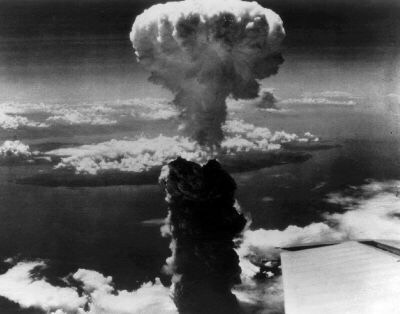
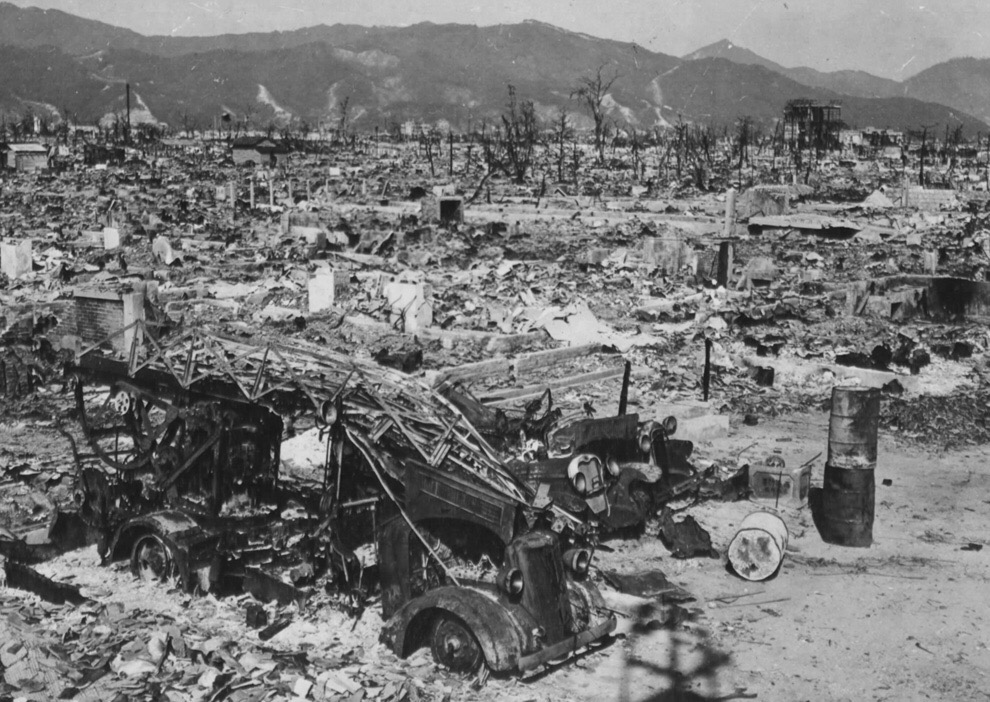
Seventy-two years ago the world changed. A remarkably destructive weapon was introduced in combat, a single bomb that annihilated the city of Hiroshima Japan. The effects were immediate, 70,000 to 80,000 people were killed, tens of thousands of others wounded, many of whom would suffer from the effects of radiation and radiation burns the rest of their lives. Within days a second bomb was dropped on Nagasaki with similar results, and Japan sued for peace. The Second World War was over and a new world was born, a world under the shadow of nuclear weapons.

The anniversary of that event yesterday is something that all of us should ponder with great trepidation as the world seems to lurch towards a day when such a weapon will be used again. The question should not be one of mere military or tactical expediency, but must consider the moral dimension of the use of these weapons as well as the whole concept of total war. 

In his book Hiroshima, John Hershey wrote: “The crux of the matter is whether total war in its present form is justifiable, even when it serves a just purpose. Does it not have material and spiritual evil as its consequences which far exceed whatever good might result? When will our moralists give us an answer to this question?” His question is worth considering. 

Up until April of this year I spend the last three and a half years teaching the ethics of war to senior military officers at a major U.S. Military Staff College. One of the things that we do in the class is to have the officers do presentations on different historical, or potential ethical problems faced by national policy makers, military commanders and planners. The goal is to have these men and women dig deep and examine the issues, and think about the implications of what they will do when they go back out to serve as commanders, staff officers, advisors to civilian leaders and planners.

In each class that I taught, at least one student dealt with the use of the Atomic bombs.  Most were Air Force or Navy officers who have served with nuclear forces. Unlike the depiction in the classic movie Dr. Strangelove or other depictions that show officers in these forces as madmen, the fact is that I was always impressed with the thoughtfulness and introspective nature of these men and women. They sincerely wrestle with the implications of the use of these weapons, and many are critical of the use of them at Hiroshima and Nagasaki. It is comforting to me to know that at least in the U.S. military that there are many who can reflect and do try to look at things not just from a purely military standpoint. Of course since I know humanity I figure that there are others in our ranks who are not so reflective or sensitive to the moral implications of the use of these weapons, among whom is our current President. The fact that the President acts on impulse and seems to have no moral compass, strategic sense, or anything apart than what benefits him causes me to shudder, especially when he has to actually confront North Korea on their ICBM and nuclear programs, not to mention the use of weapons of mass destruction by a terrorist group. As Barbara Tuchman wrote: “Strong prejudices and an ill-informed mind are hazardous to government, and when combined with a position of power even more so.”

I am no stranger to what these weapons, as well as chemical and biological weapons can do. Thirty years ago when I was a young Army Medical Service Corps lieutenant I was trained as a Nuclear, Chemical and Biological Defense Officer. I learned the physical effects of exposure to these weapons, how many Rads of radiation a person could receive before they became sick and died. I learned what radiation exposure does to people at each stage. We trained with maps to chart fallout patterns, and the maps had the cities and towns that we lived in, this was Cold War Germany and yes both NATO and the Warsaw Pact expected that tactical nuclear weapons and chemical weapons would be used and we had to be able to operate in contaminated environments. We operated under the idea of Mutual Assured Destruction or MAD as a deterrent to war. It was chilling and made me realize that the use of these weapons today would be suicidal. When Chernobyl melted down we were in the fallout zone and were given instructions on what we could and could not do in order to minimize any possible exposure to radiation poisoning.

So when it comes to the first use of the Atomic bomb I am quite reflective. As a historian, military officer, chaplain and priest who has been trained on what these weapons can do I have a fairly unique perspective. Honestly, as a historian I can understand the reasons that President Truman ordered its use, and I can understand the objections of some of the bomb’s designers on why it should not be used. I’ve done the math and the estimates of casualties had there been an invasion of the Japanese home islands is in the millions, most of which would have been Japanese civilians. 


My inner lawyer can argue either point well, that being said the manner in which it was used at Hiroshima and Nagasaki troubles me. Hiroshima did have military targets, but a big part of the choice was its location, surrounded by hills, which created a bowl that would focus the explosion and maximized its effect. Many of the larger military and industrial targets lay outside the kill zone. The designers and officers on the committee wanted to show the Japanese, as well as the world the destructive power of the weapon. Those who opposed its use hoped that it would convince the leaders of nations that war itself needed to be prevented. These men wrestled with the issue even as they prepared the first bombs for deployment against Japan. The recommendations of the committee can be found here:

http://www.atomicarchive.com/Docs/ManhattanProject/Interim.shtml
Of the 150 scientists who were part of the bomb’s design team only 15% recommended the military use without a demonstration to show the Japanese the destructive power of the bomb and a chance to end the war. The poll of the scientists can be found here:

http://www.atomicarchive.com/Docs/ManhattanProject/Poll.shtml
Leo Szilard wrote a letter to Edward Teller seeking his support in sending a petition to President Truman regarding his opposition to the use of the weapon based on purely moral considerations. Szilard wrote:

“However small the chance might be that our petition may influence the course of events, I personally feel that it would be a matter of importance if a large number of scientists who have worked in this field want clearly and unmistakably on record as to their opposition on moral grounds to the use of these bombs in the present phase of the war.

Many of us are inclined to say that individual Germans share the guilt for the acts which Germany committed during this war because they did not raise their voices in protest against those acts, Their defense that their protest would have been of no avail hardly seems acceptable even though these Germans could not have protested without running risks to life and liberty. We are in a position to raise our voices without incurring any such risks even though we might incur the displeasure of some of those who are at present in charge of controlling the work on “atomic power.”

The entire text of Szilard’s letter can be found here:

http://www.atomicarchive.com/Docs/ManhattanProject/SzilardTeller1.shtml
The two petitions of the scientists to the President are here, the second letter concludes with this recommendation:

“If after the war a situation is allowed to develop in the world which permits rival powers to be in uncontrolled possession of these new means of destruction, the cities of the United States as well as the cities of other nations will be continuous danger of sudden annihilation. All the resources of the United States, moral and material, may have to be mobilized to prevent the advent of such a world situation. Its prevention is at present the solemn responsibility of the United States–singled out by virtue of her lead in the field of atomic power.

The added material strength which this lead gives to the United States brings with it the obligation of restraint and if we were to violate this obligation our moral position would be weakened in the eyes of the world and in our own eyes. It would then be more difficult for us to live up to our responsibility of bringing the unloosened forces of destruction under control.

In view of the foregoing, we, the undersigned, respectfully petition: first, that you exercise your power as Commander-in-Chief to rule that the United States shall not resort to the use of atomic bombs in this war unless the terms which will be imposed upon Japan have been made public in detail and Japan knowing these terms has refused to surrender; second, that in such an event the question whether or not to use atomic bombs be decided by you in the light of the consideration presented in this petition as well as all the other moral responsibilities which are involved.”

http://www.atomicarchive.com/Docs/ManhattanProject/SzilardPetition.shtml

http://www.atomicarchive.com/Docs/ManhattanProject/Petition.shtml

Ralph Bard, Undersecretary of the Navy wrote to Secretary of War Stimson his opinion on July 17th 1945:

“Ever since I have been in touch with this program I have had a feeling that before the bomb is actually used against Japan that Japan should have some preliminary warning for say two or three days in advance of use. The position of the United States as a great humanitarian nation and the fair play attitude of our people generally is responsible in the main for this feeling.”

I think that those who debate the history of this need to look at the entire picture and read the letters, the documents and take into account everything. My hope is that leaders, policy makers, legislators and we the people continue to work to eliminate nuclear weapons. It is true that the nuclear stockpiles of the United States and Russia are significantly smaller than when the Cold War ended, but even so what remain are more than enough to extinguish human life on the planet. Add to these the Chinese, French, British, Indian, Pakistani and the hundreds of undeclared weapons of Israel the fact is that there remains the possibility that they could be used. Likewise there are nuclear programs in other nations, especially North Korea, which given enough time or believing them necessary could produce weapons. But the North Koreans are not alone, they could easily be joined by others including Iran and Saudi Arabia. Add to this the possibility of a terrorist group producing or acquiring a weapon the world is still a very dangerous place.

That is the world that we live in and the world in which policy makers, legislators and educated people who care about the world must attempt to make safe. If you asked me I would say outlaw them, but that will never happen. Edward Teller wrote Leon Szilard:

“First of all let me say that I have no hope of clearing my conscience. The things we are working on are so terrible that no amount of protesting or fiddling with politics will save our souls…. Our only hope is in getting the facts of our results before the people. This might help to convince everybody that the next war would be fatal. For this purpose actual combat use might even be the best thing…. But I feel that I should do the wrong thing if I tried to say how to tie the little toe of the ghost to the bottle from which we just helped it to escape…”

The ghost is out of the bottle, and nothing can ever get it back in. We can only hope and pray that reasonable people prevent any of these weapons from ever being used and that war itself would end.

Until tomorrow, 

Peace

Padre Steve+

2 Comments

Filed under ethics, Foreign Policy, History, Military, national security, Political Commentary, world war two in the pacific

“Everything Tends Toward Catastrophe and Collapse…” The Trumpian World Order


Friends of Padre Steve’s World,

On the night of July 28th 1914, as Europe slipped into the embrace of war, Winston Churchill, in one of his less statesmanlike moments wrote his wife: “Everything tends towards catastrophe, & collapse… I am interested, geared-up and happy.”

One hundred and three years ago the nations of Europe were careening towards war, a war that would destroy the old order, devastate the flower of European youth, energize revolutionary movements on the far left and far right, and impact the world up to today. The war which began with the Austrian-Hungarian Empire declaring war on Serbia two days prior would eventually claim 20 million dead and another 21 million wounded. It would be followed by the influenza pandemic of 1918-1919, and massive political, geographical, and economic crises which led to the Second World War Two decades after the Treaty of Versailles. 

The outbreak of the war was the result of a complex web of personalities, politics, prejudices, and per-conceived fixed notions, and wrong-headed assumptions by the leaders and the peoples of the nations involved. In his book The Sleepwalkers: How Europe Went to War in 1914 Christopher Clark wrote:

“Moreover, the complexity of the 1914 crisis arose not from the diffusion of powers and responsibilities across a single politico-financial framework, but from rapid-fire interactions among heavily armed autonomous power-centres confronting different and swiftly changing threats and operating under conditions of high risk and low trust and transparency.” 

As they moved ever closer to calamity many could not believe that disaster was hanging over them as surely as the Sword of Damocles. Barbara Tuchman noted: “One constant among the elements of 1914—as of any era—was the disposition of everyone on all sides not to prepare for the harder alternative, not to act upon what they suspected to be true.”

The world that we live in is much like that of August 1914, as Clark describes them. Unklike 1914, when the United States was an emerging power on the periphery of the conflict, the United States is the great power, with a Navy like Britian’s and Army like Imperial Germany’s, but with a leader who does not seem to be able to control himself from his worst instincts. 

I shudder as I watch the regime of President Trump descend into self-inflicted chaos driven by the whims of a narcissistic President who has no capacity for self-reflection, who relishes in humiliating those who are most loyal to him, and who lives in a cloud-cuckoo-land of fact-free paranoid fantasies run amok, at the very point the country’s most dangerous potential adversaries threaten at every corner of the globe and long-standing allies wonder what has happened to the United States. Tuchman described the President, who she never met, in his domestic and foreign policies, when she wrote: 

“Wooden-headedness, the source of self-deception, is a factor that plays a remarkably large role in government. It consists in assessing a situation in terms of preconceived fixed notions while ignoring or rejecting any contrary signs. It is acting according to wish while not allowing oneself to be deflected by the facts.” 

One hundred and three years ago far more able men than this President were making decisions based on their own self-deception and unwillingness to face the facts that we staring them in the face. Believing that victory would be quick and their cause vindicated governments mobilized their fleets and armies, and began to declare war. 

President Trump, who ironically avoid serving in the military believes in military power and surrounds himself in with Generals and military hardware. At the commissioning ceremony of the new aircraft carrier USS Gerald Ford he said “When it comes to battle, we don’t want a fair fight. We want just the opposite. We demand victory, and we will have total victory, believe me.” He reflected that belief this week when in tweeting about banning transgender persons from the military he said “Our military must be focused on decisive and overwhelming victory…” even as he weakens our alliances, praises dictators, and his Secretary of State continues to erode the country’s diplomatic power. It is as if he is determined to find a war in which he will be remembered as a great warlord, like Kaiser Wilhelm II envisioned himself. 

As I observe the actions of our President in relation to our enemies and allies alike and watch their response to him, I am reminded of Tuchman’s description of Sir Edward Grey on the eve of the First World War, “Watching with his failing eyes, the lamps being lit in St. James Park, Grey was heard to remark that “the lamps are going out all over Europe; we shall not see them again in our lifetime.” 

I don’t want to sound like a pessimist but every night I go to bed wondering if early the next morning the President will tweet us into a war. Likewise I wonder what the President will do if Kim Jong Un will fire the missile that brings Armageddon to an American city, or a terrorist group finally succeeds in detonating a weapon of mass destruction on American soil. The latter question is not just how he will respond militarily, but rather how far he will go in curtailing political dissent, free speech, and civil rights. I wonder if the President, to use the words of a less experienced and statesmanlike Churchill is geared up and happy as events tend toward catastrophe and collapse. 

Anyway, for now I’ll do my best to remain hopeful that disaster can be avoided but with every passing day I get more concerned about the future of the country and the world. 

Until tomorrow,

Peace

Padre Steve+

3 Comments

Filed under History, Military, national security, News and current events, Political Commentary