Category Archives: Military

The Dawn of the Future: The Type XXI U-Boats

U-2513_off_Key_West

Friends of Padre Steve’s World,

I am continuing to go back deep into the archives to re-publish articles about warships which helped change history. As I mentioned, the last few days have been very busy and I am doing some things to assist co-workers after a traumatic event at work, and to continue working on my Civil War texts. This article deals with the U-Boat Type XXI which was the harbinger of the modern submarines that ply the depths of the oceans today. I do hope that you enjoy.

Peace

Padre Steve+ 

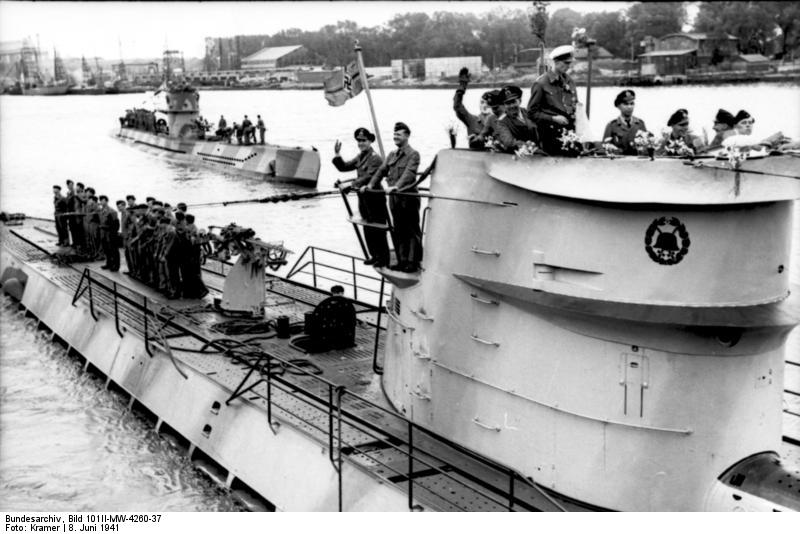
Throughout history there have been ships that have changed the course of Naval strategy and made previous types of ships obsolete overnight, the USS Monitor, the HMS Dreadnought and USS Nautilus are three, but add to the list the German Type XXI U-Boats which forever changed the way that submarines were built around the world.

type xxi u-boat SRH025-p40

The Type XXI was designed in 1943 in order to regain the initiative and thereby reassert German naval power in the Atlantic in order to turn the tide against the Allies. By 1943 the Allies had turned the tide against the Germans as the Type VII and Type IX U-Boats took heavy losses against naval units and convoys which now had air support at every stage of their trek across the North Atlantic. These boats had to surface for prolonged periods in order to recharge their batteries and had limited range, speed and endurance when submerged. The advent of the Escort Carrier, long range patrol bombers and hunter killer groups of Destroyers and the new Destroyer Escorts took a great toll on the U-Boat Force.

U3008

U-3008 in U.S. Navy Service

In order to meet the challenge the Germans opted for new technology based on the high speed hydrogen powered Walter turbines for underwater operations. Since these turbines which could produce a high underwater speed had a short endurance the designers modified the design to use conventional diesels but equip the boats with batteries that had three times the capacity of previous boats. The boats were a radical change from all previous submarine designs which were basically surface ships with the ability to operate underwater for limited periods of time. The Type XXIs were really the first true submarines. They could operate at underwater speeds that were faster than many of their opponents, had a streamlined design which facilitated higher submerged speed of 18 knots and silent running making them very difficult to track. They could remain underwater for 11 days while only needing 5 hours to recharge their batteries when using the schnorkel device.

Bundesarchiv_Bild_146-2008-0214,_Uboot_-Wilhelm_Bauer-_(ex_U_2540)

The Wilhelm Bauer the former U-2540 in 1960

The Type XXI had a full streamlined hull and conning tower and even equipment which were externally mounted such as the radio antennae, hydrophones, DF Ring and forward planes were fully retractable. They had no deck guns and their twin 20mm flak guns mounted in a streamlined housing on the conning tower. The German designers eliminated the traditional open bridge in favor of three small openings for the watch officer and 2 lookouts. They had a superior silent running ability and at 15 knots were quieter than the US Navy Balao Class doing 8 knots. They had a 1 inch thick steel aluminum alloy pressure hull with a designed crush depth of 280 meters (919 feet), a greater designed crush depth than any previous submarine.

They incorporated other innovations which would be incorporated into the post-war submarines of the victorious Allied powers. Among these innovations were semi-automatic hydraulic torpedo reload system which allowed three 6 torpedo salvos to be fired in less than 20 minutes where prior U-Boats had manual reloads and took over 10 minutes to reload a single torpedo. To make the fullest use of this capability the German equipped the boats with an advanced passive and active sonar system called the called Gruppenhorchgerät and Unterwasser-Ortungsgerät NIBELUNG mounted in the bow. The improved passive system enabled the boats to close to where they could emit short active sonar bursts to fix the target location. They could fire from a depth of 160 feet. The torpedoes themselves were an advanced design called the LUT or Lageunabhängiger Torpedo. The LUT was a guided torpedo that could be fired from the U-Boat regardless of the target’s bearing as it was programmed to steer an interception course programmed by the torpedo computer.

Submarines influenced by the Type XXI:

USS_Gudgeon_;0856710 tang class

USS Gudgeon a Tang Class submarine

ORP_Orzel2 wishkey class

Polish Submarine ORP Orzel a WHISKEY Type Submarine

SS-571-Nautilus-trials

USS Nautilus on trials

The Type XXI boats were unique in production as they had no prototype and went directly in production. They were assembled from prefabricated sections built from factories around Germany and transported to the major shipbuilding yards. This was efficient but caused problems that slowed final assembly as many of the factories had no experience building U-Boats and quality suffered because the exacting specifications required by the Kriegsmarine. Likewise Allied air strikes on German factories and rail networks hampered production. Yet even in spite of these difficulties 119 Boats were completed although only four were rated as combat ready and only two were fully operational at war’s end. Of these only one embarked on a war patrol. Most were destroyed in air attacks while in port or scuttled by the Germans to prevent their capture. Eight Type XXIs were taken over by Allied navies at the end of the war where they were used to evaluate technology for use in future submarines. The U.S. Navy Tang Class boats were heavily influenced by the Type XXI as were the GUPPY upgrades to Balao and Tench class boats. The first nuclear submarines of the U.S. Navy, the Nautilus, Seawolf and the Skate Classes all incorporated design features of the Type XXIs. The Soviet Union developed its 613 and 614 project submarines which became the type known by NATO as the WHISKEY class from the Type XXIs that they received following Germany’s surrender. In 1957 the Federal Republic of Germany raised the scuttled U-2540 and commissioned her as the research submarine Wilhelm Bauer. That boat was operated by both the Bundesmarine and civilian crews until her decommissioning in 1982. She is now a museum ship open to the public in Bremerhaven.

The Type XXIs were the first true submarines and influenced every submarine constructed since. Though introduced too late in the war to make a difference they were truly a wonder-weapon.

Peace

Padre Steve+

1 Comment

Filed under historic preservation, History, Military, Navy Ships, nazi germany, World War II at Sea

Predators of the High Seas: The U-Boat Type IX

Friends of Padre Steve’s World,

As I mentioned yesterday I am kind of taking some time away from politics and all the other stuff I could write about to go back to one of my passions, the great warships of history. I am busy at work and I am continuing to work on my Civil War texts but I’m not ready to post any of the new material from those just yet. Last night I wrote about the U-Boat Type VII, the most numerous, and one of the most successful type of submarines ever produced. Today, an older article dredged up from my archives about the U-Boat Type IX, which was one of the most successful types of submarines ever built. This is a tribute to them and their brave crews, who though fighting for an evil cause demonstrated bravery and courage even when the odds were stacked against them, most of who never saw home again. 

Have a great day,

Peace,

Padre Steve+

Lorient, U-Boote U-123 und U-201 auslaufend

U-123 returning from patrol

As the Kriegsmarine began its expansion in the mid-1930s the new U-Boat arm developed several types of submarines. The Type IX class was designed in 1935-36 as a long range attack boat and was larger had a greater range and were more heavily armed than the more numerous Type VII boats. The Kreigsmarine designers envisioned a submarine capable of operating far from German bases for extended periods of time. The design of these boats was derived from the two boat Type 1 class and incorporated lessons learned from that class. 283 boats of the type were constructed between 1937 and 1944 and the Kriegsmarine continuously sought to improve the type which resulted in five distinct models within the class.

type ix

Type IXA The first group referred to as the Type IXA or simply the Type IX was comprised of 8 boats built by AG Weser of Bremen. Ordered in 1936 the group was part of the Kriegsmarine’s Plan Z rearmament plan which began when the Nazi Government announced that it would no longer abide by the Treaty of Versailles. The initial 8 boats had a 1032 ton standard displacement were 251 feet long and were armed with six 21” torpedo tubes with 22 torpedoes. They had a 105mm deck gun with 110 rounds as well as a 37mm and 20mm anti-aircraft gun. They were the first German submarines equipped with a double hull which increased survivability and seaworthiness. They were powered on the surface by two MAN M9V40/46 supercharged 9-cylinder diesel engines that produced 4,400 shp as well as two SSW GU345/34 double-acting electric motors for underwater operations. As in all diesel-electric boats the diesels were used to recharge the batteries for the electric motors while the boat was operating on the surface. They had a maximum speed of 18.2 knots on the surface and a range of 22,354 miles at 10 knots. Underwater they had a maximum speed of 7.7 knots and range of 166 miles at 4 knots. The official maximum diving depth was 230 meters or 750 feet. Of the 8 boats of this type 6 were sunk during combat operations and two scuttled at the end of the war by their crews to prevent their capture by the Allies. The most successful of the Type IXA boats was the U-37 was the most successful boat of the type sinking 53 merchant ships for a total of 200,124 tons as well as two warships, the Sloop HMS Penzance and French Submarine Q-182.

U-107 in See, Bugraum

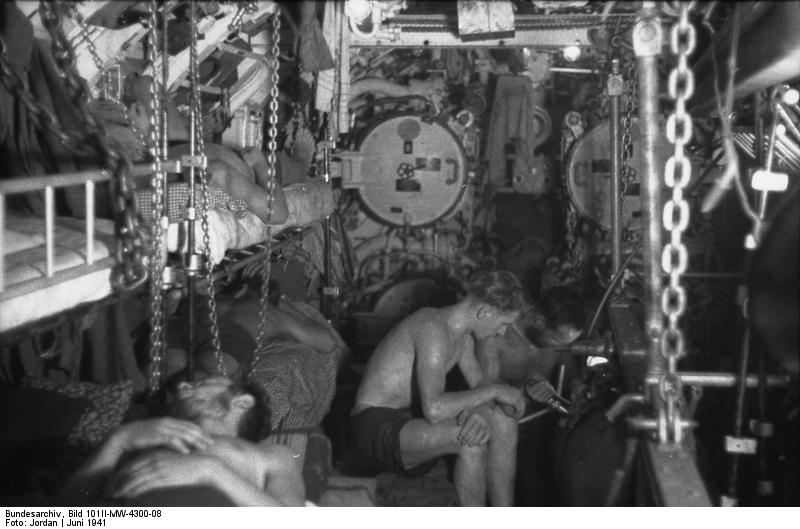
Crew members of U-107 in Torpedo Room

Type IXB The next group was the IXB of which 14 boats were built by AG Weser Bremen. This was the most successful class of U-boats, or for that matter any class of submarines based on tonnage sunk per boat during the Second World War. Each of these ships sank over 100,000 tons of Allied shipping. They were slightly larger than the IXA boats and had a significantly longer operational range of 24,600 miles on the surface at 10 knots. The U-107 of this class had the most successful war patrol of any U-Boat in the war sinking nearly 100,000 tons of Allied shipping off Freetown Sierra Leone while U-103 sank over 237,000 tons of Allied shipping during 11 war patrols over the course of 4 years. These boats were involved in Operation Drumbeat off the coast of the United States in early 1942.

U-Boot U-123 in See

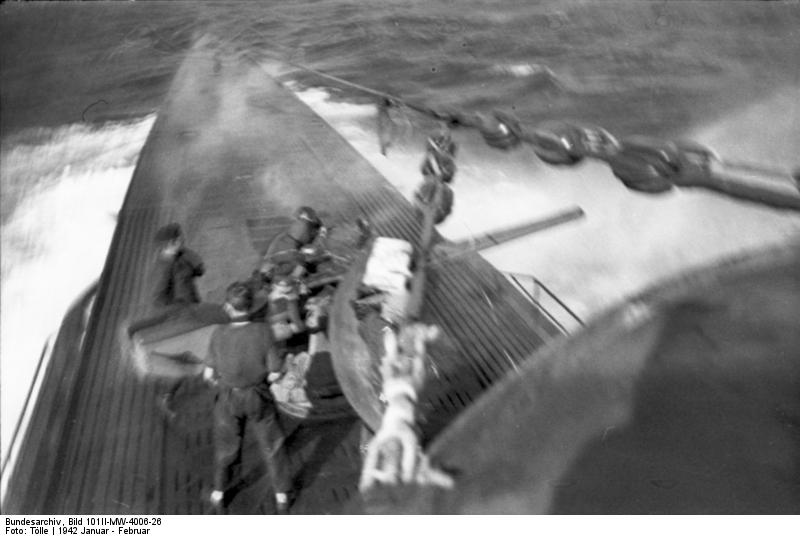
U-123 Gun Crew

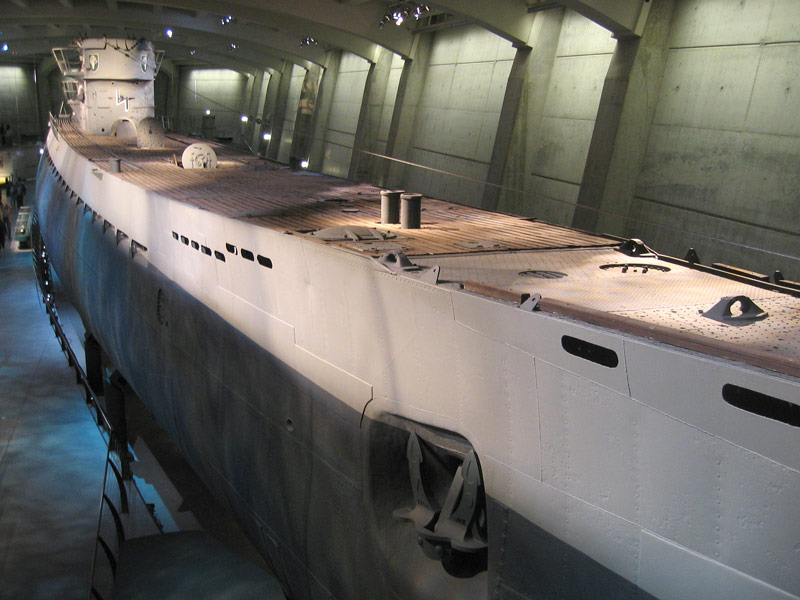
Type IXC The Type IXC was a further improvement of the type with additional fuel capacity and longer range. They displaced 1120 tons and 54 of the boats were commissioned of which 19 were equipped as minelayers with a capacity of 44 TMA or 66 TMB mines. The boats were built by AG Weser Bremen, Seebeckwerft Bremen and Deutsche Werft Hamburg. The U-505 of this type is the only surviving intact Type IX and was captured by a boarding team from the Escort Carrier USS Guadalcanal on June 4th 1944. Her capture was kept secret from the Germans and her crew kept as POWs in a separate POW Camp. The story of the crew and their encounter with the game of baseball is recorded in Gary Moore’s book, Playing with the Enemy: A Baseball Prodigy, a World at War, and a Field of Broken Dreams. The book is being turned into a movie entitled Playing with the Enemy which is scheduled to be released in 2011. She is preserved at the Museum of Science and Industry in Chicago.

U-848 Submarine_attack_(AWM_304949)

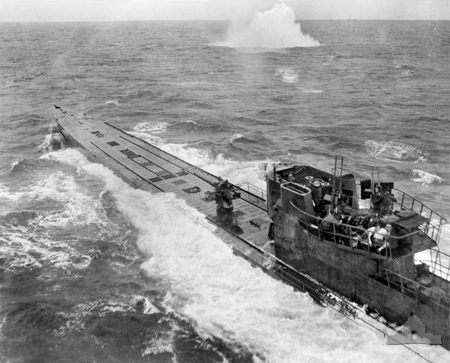
U-848 under attack by USN Aircraft

Type IXC/40 This was a further refinement of the IXC with slightly greater range and surface speed. It was the most numerous type of the class built with 87 being built by AG Weser Bremen, Seebeckwerft Bremen and Deutsche Werft Hamburg. The remains of the U-534 of the class are displayed at Woodside Ferry Terminal in Birkenhead England after being raised from the North Sea in 1986.

U-534_exhibit,_Birkenhead_(geograph_4545759)

U-534

Type IXD The final type in the Type IX Series was the Type IXD. This was a significantly larger boat than the others in the class 287 feet long with a standard displacement of 1610 tons. They were unique in that they had two sets of diesel engines, one for cruising and the other for high speed runs and battery recharge. There were three variants within the type, the IXD1 which were all converted to transport use due to problems with their engines, the most numerous variant the IXD2 and the IXD42 which had greater horsepower. Thirty Type IXs were commissioned with a further six Type IXD42s which were ordered with only one commissioned by the end of the war.

U-505chicago jerry atherton 2005

U-505 at the Museum of Science and Industry in 2005 (Jerry Atherton)

During the war surviving boats would receive increased anti-aircraft armament, the Schnorkel device which allowed them to operate on diesel power while submerged as well as better electronics and detection devices. Most of the boats which survived the war were scuttled by the Allies in Operation Deadlight. The U-511 was sold to Japan in 1943 and U-862 taken over by the Japanese after the German Surrender in May 1945. Both survived the war and were scuttled by the Allies. U-1231 was taken over by the Soviet Navy and served as the B-26 after the war.

The sailors of these U-Boats like all submarine sailors endured many hardships and during the war approximately 75% of the 40,000 U-Boat sailors never returned from patrol, forever interred in the deep with their proud boats.

Leave a comment

Filed under historic preservation, History, Military, Navy Ships, nazi germany, World War II at Sea, world war two in europe

The Type VIIC U-Boat: The Workhorse of the German Navy

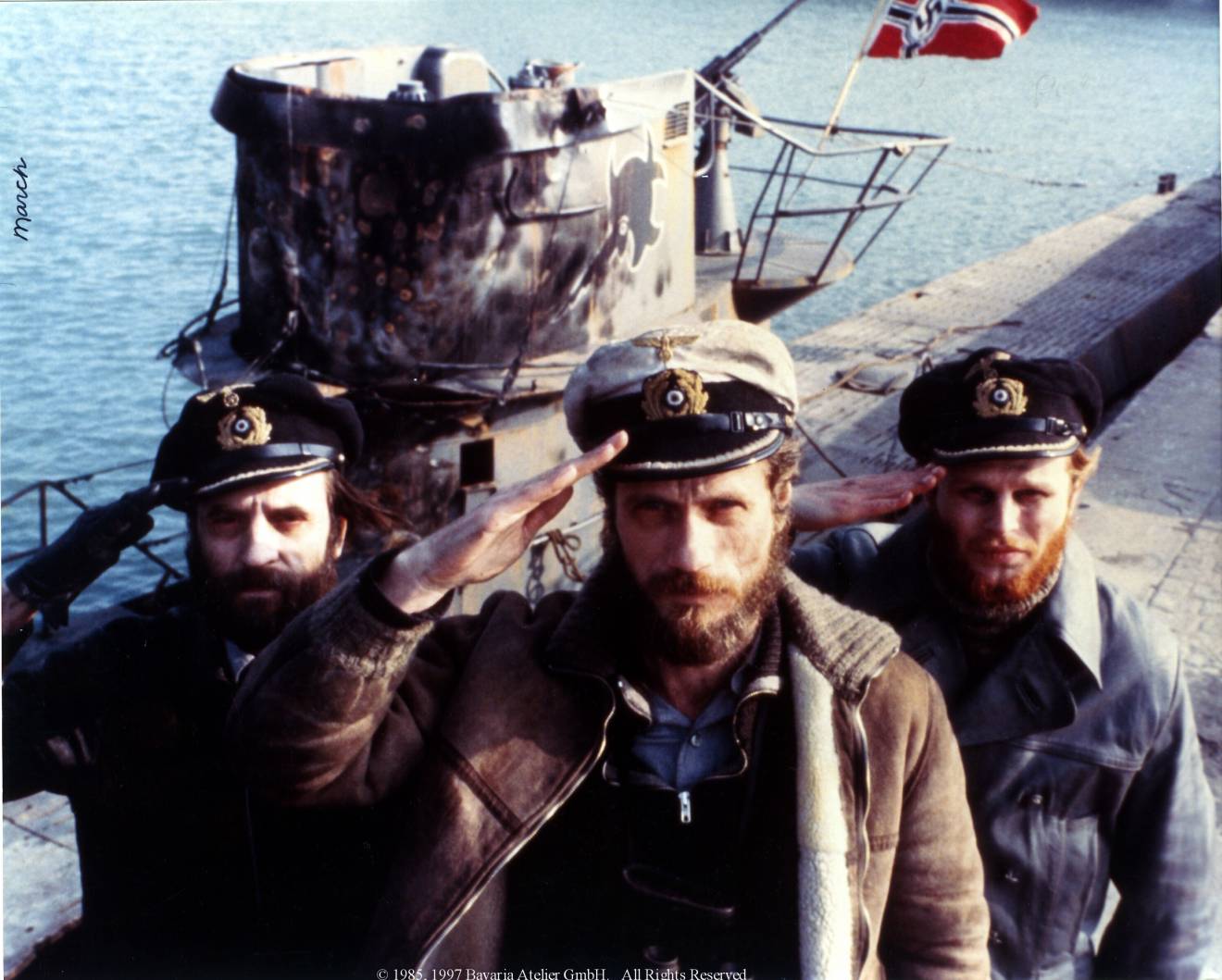
das_boot03

Das Boot 

Friends of Padre Steve’s World,

The beginning of this week has been really busy with something unexpected at work that took up much of my day caring for some of my co-workers. Nobody died or anything like that, but it was pretty traumatic and I am not the person to write about it, though I expect that Thomas Ricks may do so soon. That being said, as always there is much to write about but after today I am kind of taking it easy, besides, Donald Trump’s antics are getting pretty boring as he continues to implode as a serious candidate for President, as are the machinations of the GOP House members, the gang who could’t shoot strait, who are trying once again to torpedo Hillary Clinton. Sorry, but after five years they remind me of Wile E. Coyote trying to get the Road Runner, simply boring. 

So tonight something not very controversial but interesting. Those that know me and have been following my writings from the beginning know that I am fascinated with warships. Today, and the next few days I am going to republish some very old articles about three important types of German U-Boats in the Second World War. Tonight, an article on the Type VII U-Boat, the workhorse of the German Navy during the Battle of the Atlantic, and a tribute to the brave sailors who served aboard them, most of who never returned home.

Have a great night.

Peace

Padre Steve+

type viic

The signature warship of the German Kreigsmarine of the Second World War has to be the U-Boat Type VIIC, the most numerous type of submarine ever produced by any Navy. 568 of these U-Boats would be commissioned beutween 1940 and 1945 as well as 91 of the Type VIIC/41. The Type VIIC was developed from the prewar Type I and Type VIIA and VIIB classes.

Compared to contemporary American submarines of the Gato class they were smaller, mounted fewer torpedo tubes and had a shorter range. However the American boats were designed for the vast expanse of the Pacific while the German boats for the most part were operated in the smaller confines of the Atlantic and Mediterranean.

u1023

U-1023

The boats displaced a mere 769 tons on the surface and 871 tons submerged and were 67.1 meters (220.14 feet) long. The boats had a single pressure hull and the VIIC could dive to a maximum depth of 230 meters (754 feet) and had a crush depth of 250-295 meters (820-967 feet). The VIIC/41 could dive to 250 meters or 820 feet and a crush depth of 275-325 meters (902-1066 feet). This was deeper than any allied submarines of the period and a testament to their sound construction.

St. Nazaire, Uboot U 94, Karl Dönitz

Admiral Dönitz greeting U-94 in 1941

The Type VIICs were armed with a C35 88 mm/L45 gun with 220 rounds for surface actions and various types and numbers of anti-aircraft guns. The standard configuration for torpedo tubes was 4 bow mounted tubes and 1 stern mounted tube although a small number only carried 2 forward and none aft. They carried a maximum of 14 torpedoes and could carry 26 TMA Mines which would be laid at approaches to various ports.

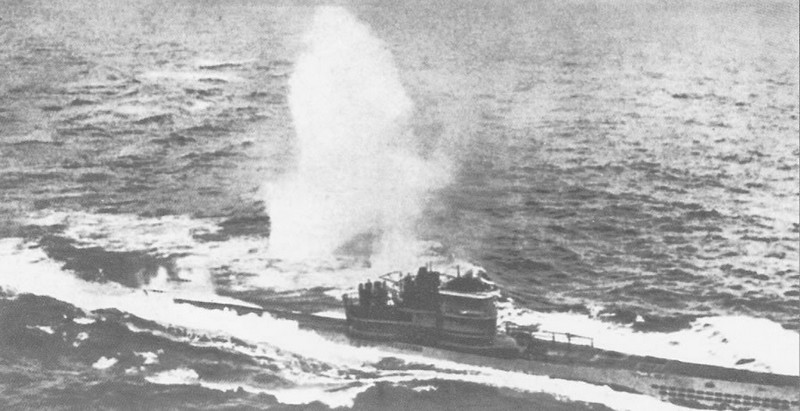
u966

U-966 under air attack

The Type VIIC was powered by two supercharged Germaniawerft, 6 cylinder, 4-stroke M6V 40/46 diesel engines on the surface producing between 2,800 to 3,200 horsepower which gave the boats a 17.7 knot maximum speed on surface. For submerged operations the boats were powered by one of a number of different electric motors whose batteries were charged by the diesels. The electric motors produced 750 horsepower (560 kW) and could drive the boats a maximum of 7.6 knots. In 1944 many of the surviving boats were equipped with the schnorkel apparatus which allowed them to use their diesel engines underwater at shallow depths. The had a range of 8190 miles at 10 knots surfaced which gave them a decent amount of operational flexibility for their Atlantic operations.

U995_2004_1

The last Type VII- U-995 (Type VIIC/41) German U-Boat Memorial Laboe Germany

During the war the German U-Boat force suffered grievous losses many of which were Type VIICs. The VIICs performed excellently in combat and many survived engagements that would have sunk less tough boats. The most famous of the Type VIICs of all variants is probably the U-96 which was featured in the epic submarine film Das Boot. A number had post war careers in several navies and the last active VIIC the U-573 which served in the Spanish Navy as the G-7 was decommissioned in 1970 and sold for scrap over the objections of those that wanted to purchase her as a memorial. The only surviving Type VIIC is the U-995 at Laboe Germany where she is a memorial to all the U-Boat Sailors of the Second World War. Two full sized mock ups one for exterior scenes and one for interior scenes were constructed for Das Boot and the exterior mock up was also used in Raiders of the Lost Ark.

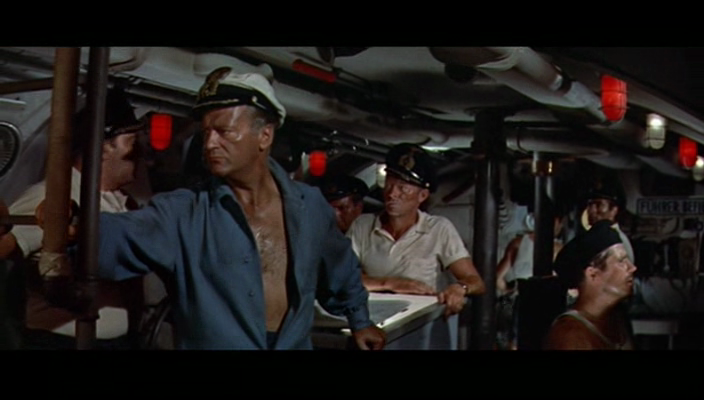
7865_6_screenshot

The Enemy Below


During the war U-Boats of all types sank nearly 3000 Allied ships including 175 warships among which were the carriers HMS Glorious, HMS Ark Royal and HMS Eagle and the Battleships HMS Barham and HMS Royal Oak. The Germans lost nearly 800 U-Boats of all types and over 28,000 U-Boat Sailors, about 75% of the force.

The films Das Boot and The Enemy Below are excellent reminders of the courage of the men that operated these submarines during the war. Though the Nazi Regime was evil the men of the U-Boat Service often displayed courage and ingenuity in the face of overwhelming odds and they nearly won the war for the Germans.


2 Comments

Filed under History, Military, Navy Ships, nazi germany, World War II at Sea, world war two in europe

Never Flatline Intellectually 


Friends of Padre Steve’s World,

Just a short note to end the week. Today was the 70th anniversary of the establishment of the Joint Forces Staff College where I teach. It was a very good, but long day with morning and evening ceremonies and activities. Our chief speaker was retired Marine Corps General Anthony Zinni, one of the most distinguished, honest, and outspoken military men of the past generation. Had the Bush administration listened to him we probably would have never ended up in the Iraq and Afghanistan quagmires. But I digress… 

One of General Zinni’s points was that no matter who you are that you must never stop learning. He lives this. At the age of 72 he holds three masters degrees and is working on a doctorate, lugging his books into doctoral seminars at Creighton University. He believes like I do, and history has shown, that when military budgets are cut the last thing that should be sacrificed is education. He noted that the most dangerous military officer is one whose intellectual curiosity has flatlined. General Zinni certainly does not subscribe to the principles that caused Barbara Tuchman to write “learning from experience is experience is a faculty almost never practiced,” and “nothing so comforts the military mind as the maxim of a great but dead general.” 

General Zinni is one of those remarkable people who can speak the truth without being an ideologue and who is a realist. I have always admired him and have had the pleasure of hearing him speak many times. His books “The Battle for Peace: A Frontline Vision of America’s Power and Purpose,” and “Before the First Shots are Fired: How America can Win or Lose off the Battlefield” should be required reading. 

His words reminded me of those spoken by the late Baltimore Orioles manager Earl Weaver, who said “it’s what you learn after you no it all that counts.” Those are words that I live by. I continually read, study and research, and when I finish my current writing projects I will probably begin to work on a doctorate, not because I need it, but because I never want to stop learning. I never want to flatline intellectually. I know too many people, smart and intelligent people who have flatlined, and far too many more whose intellectual quest stalled before they ever got out of the gate. All of them are dangerous because most devolve into mindless ideologues who readily sacrifice truth for a cause and cannot accept anything that challenges their uncritical worldview. 

So until tomorrow have a great night and better morning. 

1 Comment

Filed under History, Military, philosophy

The Guadalcanal Campaign: A Wave Top View of a Forgotten yet Epic Battle

Friends of Padre Steve’s World,

Today is another day where I am posting an article dealing with the Guadalcanal campaign. The campaign is often forgotten in our day. It was featured during the mini-series The Pacific and the 1998 film The Thin Red Line. The campaign was long and bloody, but it allowed the United States to gain the initiative in the Pacific, and it was the first time that American Marines and Soldiers defeated the Japanese on land, even as the U.S. Navy fought a series of naval engagements which cost the Imperial Japanese Navy large numbers of ships and combat seasoned sailors that they could not replace. It was also the first time that the United States military began to operate in a joint manner. Thus it is important, and sadly it is all too often forgotten, even by military history buffs. I was able to meet Mitchell Paige who was awarded the Medal of Honor on Guadalcanal about three years before he died when I was stationed at Camp Lejuene North Carolina. He was spry and active, and it was an honor to meet him after hearing him speak. 

This is a “wave top” look at the campaign. Maybe someday when I finish my Civil War books I will do something about this campaign. That being said I hope this article might inspire my readers to read any of the fine books that deal with this campaign. Have a great night.

Peace

Padre Steve+

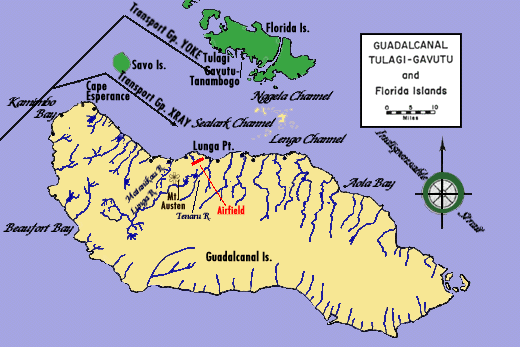
Guadalcanal map 2

The Decision to Invade

Guadalcanal came to American attention in early 1942 as a result of the Japanese South Pacific advance, which “threatened the Allied line of communications with Australia.”[1] Admiral King believed that “the Japanese must not be permitted to consolidate the formidable prizes” that they were then in the course of gathering.”[2] General MacArthur and Admiral Nimitz both wanted to “exploit the Midway victory by a speedy change-over from the defensive to the counter offensive.”[3] MacArthur wanted to strike Rabaul directly using Navy carriers. The Navy, not wanting to give up control of its carriers proposed a strategy of working up through the Solomon Islands, under Navy control.[4] The debate was at times acrimonious. Eventually King and General Marshall worked out a compromise that divided the campaign between the Navy and MacArthur,[5] the Navy in charge of taking Guadalcanal and Tulagi.[6] OPERATION WATCHTOWER was approved in a Joint Chief’s of Staff directive on July 2nd 1942.[7]

turner and vandagrift

Partners Rear Admiral Richmond K. Turner and Major General Alexander Vandegrift

The Japanese had not initially placed a high priority on the Solomons, “as they did not expect a counteroffensive in the Pacific for months.”[8] However, after Coral Sea and Midway, they authorized operation “SN” to “strengthen the outer perimeter of Japan’s advance by constructing airfields at key strategic points….”[9] The Japanese sent a contingent of troops, which arrived on June 8th[10] to build an airfield on Guadalcanal, in addition to the seaplane base on Tulagi, as part of a strategy to take the offensive in the South Pacific with an attack on Port Moresby in mid-August.[11]

coastwatchers

Coastwatchers

Japanese commanders were impatient for the airstrip to be completed, yet work began at a leisurely pace, with the Japanese unaware that every move was being “watched and reported to Allied headquarters in Australia,” by coast-watchers.[12] As the Japanese on Guadalcanal dithered the Americans rushed their preparations for the invasion[13] nicknamed “SHOESTRING” by American officers.

The Landings and Initial Actions through the Ilu (Tenaru) River

marines landing at guadalcanal

Marines coming ashore at Guadalcanal

Preparations, though rushed enabled the 1st Marine Division under General Vandegrift to embark on transports for Guadalcanal, despite not being combat loaded and having been assured that they “need not expect a combat mission before 1943.”[14] The invasion force under the overall command of Admiral Fletcher and Admiral Richmond “Kelly” Turner set sail on July 25th and cloaked by heavy rain and clouds[15] remained undetected by the Japanese until they arrived in the waters off Guadalcanal, achieving complete surprise.[16] The invasion force landed on both Tulagi and Guadalcanal. On Tulagi, 1st Raider Battalion under Colonel Edson and 2nd Battalion 5th Marines quickly drove off the 350 Japanese defenders of the 3rd Kure Special Naval Landing Force,[17] and in three days eliminated the Japanese garrison which resisted to the death, with only 23 prisoners.[18] On nearby Gavutu-Tanambogo 1st Parachute Battalion subdued the Japanese personnel operating the seaplane base, though not without difficulty, the naval bombardment was ineffective[19] and the Parachutists suffered heavy casualties[20] and forcing the commitment of the 1st and 3rd Battalions, 2nd Marines.[21] Across the sound the main force of 1st Marine Division went ashore near Lunga Point with 5 infantry battalions. The Marines rapidly ran into difficulty, not due to the Japanese garrison, which melted into the jungle,[22] but to a lack of maps, the thick jungle and kuni grass, their own “deplorable physical condition” from being shut up in the holds of the transports for two weeks and overburdened with full packs and extra ammunition.[23]

japanese aircraft guadalcanal

Japanese “Betty” Bombers attacking US Transports

While the Marines advanced inland, supplies built up on the landing beaches due to the limited number of cargo handlers. Additionally, the Japanese launched a number of heavy air raids which caused minimal damage to the destroyer Mugford on the 7th but were more successful on the 8th damaging a transport badly enough that it had to be abandoned.

GuadM3Tank

Marine M3 Stuart Light Tank and Crew at Guadalcanal

The Marines on Guadalcanal, comprised of the 1st and 5th Marine Regiments consolidated a bridgehead around the captured airfield on the 8th, but the next day found that their situation had changed dramatically. The Japanese Navy had attacked and mauled the covering force, sinking four cruisers and damaging one at the Battle of Savo Island.[24] The destruction of the covering force and Admiral Fletcher’s withdraw of the carriers forced the transports to depart on the 9th, still bearing much equipment, supplies and nearly 1800 men of the 2nd Marines.[25] Vandegrift was left with only 5 infantry and 3 artillery battalions, and the 3rd Defense battalion on the island as well as some tanks, engineers and Navy “Seabees.”[26] When the Navy left Vandegrift went over to the defensive and organized a line from the Ilu river on the east to Lunga point and the airfield to a point about 1000 yards past Kukum.[27] Defenses were prepared to defend against potential Japanese amphibious attacks. 1st Marines held the eastern perimeter and 5th Marines (-) the west. One battalion with tanks and half-tracks was reserve. The line was thin and not continuous, thus Vandegrift could only watch and wait for the Japanese strike and move “part of his mobile reserve to meet it when it came.”[28] On the 12th a prisoner reported that Japanese near Matanikau were willing to surrender and LtCol Goettge the G-2 led a 25 man patrol to investigate. The patrol was ambushed and decimated with only three survivors.[29] The Japanese landed the advance party of the 5th Special Naval Landing Force in broad daylight on the 16th, and Vandegrift decided to bring 2/5, and the Raider and Parachute battalions from Tulagi as soon as he had ships to do it.[30] On the 20th the airfield was opened and a squadron each of Marine Fighters and Dive Bombers landed on Guadalcanal.[31]

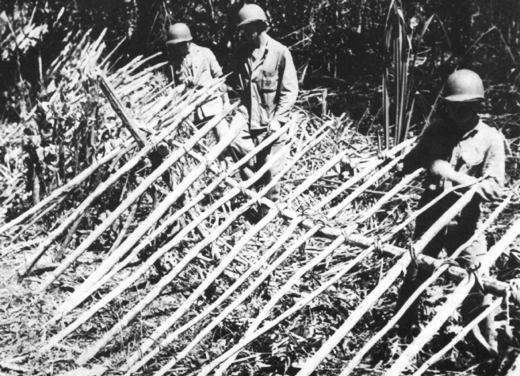
guadalcanal makeshift obstacle

Makeshift Obstacles: With no barbed wire the Marines used the ingenuity

General Hyakutake of the 17th Army was allotted 6,000 men of the Special Naval Landing Force, and the Kawaguchi and Ichiki detachments to re-take Guadalcanal. 17th Army also had the Sendai 2nd and the 38th Divisions, tank and artillery units, but they were scattered from Manchuria, to Borneo and Guam.[32] Hyakutake was ordered to use only the Ichiki detachment, a move which some at Imperial GHQ vigorously opposed.[33] Kawaguchi, recognized Guadalcanal’s importance and told a reporter that “the island would be a focal point in the struggle for the Pacific.”[34] On the 18th Colonel Ichiki landed with half of his unit, 915 men, 25 miles east of the Marines. Overconfident, he disobeyed orders to wait for the rest of his troops, left 125 men behind to guard his bridgehead and set off to attack.[35]
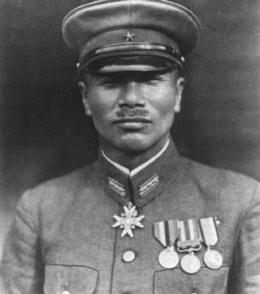
col ichiki

Colonel Ichiki whose elite 5th Special Naval Landing Force was annihilated at the Tenaru River

Ichiki’s force attacked shortly after 0100 on the 21st. He thought that he had achieved surprise[36], but, opposing him was 2nd Battalion 1st Marines under LtCol. Al Pollock. Warned by patrols that encountered the oncoming Japanese, and by Sergeant Major Vouza,[37] the Marines were on alert, well dug in, though lacking barbed wire, of which a single strand was emplaced across their front. The Japanese ran into the barbed wire and were mowed down as they attempted to cross the sandspit against G/2/1 and a weapons platoon. About 0300 artillery joined the action, catching the Japanese bunched together near the sandspit inflicting heavy casualties.[38] Around 0500 Ichiki made another attempt, sending a company through the surf, which was engulfed in machine gun and artillery fire.[39] At daylight the Marines counter attacked. Colonel Cates ordered Lt.Col. Cresswell’s 1st Battalion 1st Marines, to envelop the Japanese along the beach. Pollock’s Marines ranged mortars and small arms fire on Japanese survivors to their front, picking them off “like a record day at Quantico”

battle of tenaru river

Dead Japanese of the Ichiki Detachment at the Tenaru

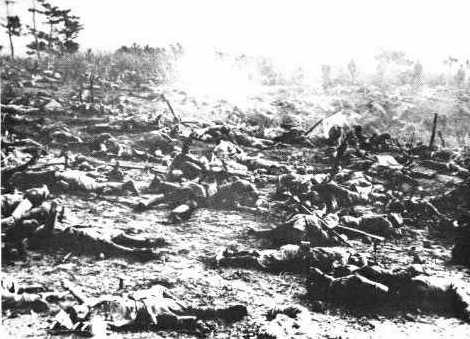
[40] Marine aircraft made their first appearance, strafing the Japanese survivors. A light tank platoon crossed the Ilu and began to mop up the Japanese with 1/1 at 1530. At 1630 Ichiki burned his regimental colors and committed suicide. The Battle of the Ilu was over, the Japanese suffering at least 777 dead,[41] 15, 13 of whom were wounded were captured, only a Lt. Sakakibara and one soldier escaped to join those at the landing site.[42] The Marines suffered 35 dead and 74 wounded.[43] Ichiki made critical mistakes; he failed to reconnoiter, made a frontal attack against a dug in enemy and repeated it, with disastrous results.[44] Hyakutake informed Tokyo: “The attack of the Ichiki detachment was not entirely successful.”[45] The Americans were shocked at the Japanese fight to the death, and Griffith would note: “from this morning until the last days on Okinawa, the fought a ‘no quarter’ war. They asked none for themselves. They gave none to the Japanese.”[46]

Bloody Ridge

mitchpaige

Artists depiction of Sgt Mitchell Paige assaulting attacking Japanese units at Bloody Ridge

A round of minor engagements was fought in late August and early September as each side sent reinforcements. Kawaguchi’s brigade landed between August 29th and September 4th, but many troops were lost due to air attacks on the destroyers, transports and barges. Kawaguchi received the remainder of Ichiki’s force, bringing his force to 6200 men. He refused Hyakutake’s offer of an additional infantry battalion, believing intelligence that only 2000 Marines remained on Guadalcanal.[47] In fact Vandegrift had already moved the Raiders, Parachutists from Tulagi to Guadalcanal. Most of Kawaguchi’s force was east of the Marines; elements of 4th Regiment under Colonel Oka were on the Matanikau.[48] Vandegrift used the Raiders to attack Kawaguchi’s rear areas, capturing Tasimboko and killing 27 Japanese, destroying many of his troop’s supplies and foodstuffs.[49] Kawaguchi was infuriated by the attack and 17th Army prepared to send troops from the Sendai 2nd Division to the island.
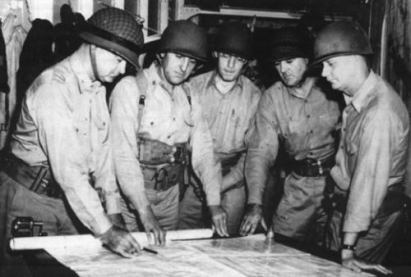
vandegrift and staff

Vandergrift and Key Marine Leaders

The Raiders and Parachutists took positions on a ridge south of Henderson field on their return from the raid against Kawaguchi’s rear. Vandegrift placed his “Amtrackers” to the west of the ridge with 1st Pioneer Battalion.[50] Colonel deValle’s artillery was emplaced to give close support and observers attached to Edson’s battalion. The artillery was registered on pre-plotted points.[51] Edson’s force had little time to prepared defenses and due to the ridge and jungle prevented him from having “anything like a continuous line.”[52] First Marines held the line from Edson’s left to the sea along the Ilu. Unlike Ichiki, Kawaguchi avoided an attack on the strong 1st Marines position, and headed across the jungle to attack the airfield from the south with the 124th Infantry Regiment. Due to the difficult approach his battalions had a hard time reaching their start positions, two of the three reached the assembly areas two and three hours after the start time. When they did attack they lost their way, became scattered and intermingled; and Kawaguchi his battalion commanders lost all control.[53] The attack on the 12th was frustrating to Kawaguchi who later wrote “In all my life I have never felt so helpless.”[54] The attack was so ineffective that Edson thought the Japanese were “testing” him.[55]

11th marines 155mm howitzer

Marine Artillery on Guadalcanal

Kawaguchi regrouped as did Edson, who pulled back his line 200 yards to a stronger point on the ridge, reorganizing the line and command and control.[56] This improved fields of fire for his automatic weapons.[57] 2nd Battalion 5th Marines, the only reserve was moved south of the airfield so it could relieve Edson on the 14th.[58] As darkness fell, the Japanese attacked. I/124 attacked the ridge and the area to the west. Marines withdrew up the ridge under heavy pressure supported by artillery, which dropped fires almost on top of the Raider positions.[59] During the withdraw the Parachutists became confused and continued to withdraw, and only stopped when Edson’s operations officer, Major Bailey stepped in and halted it.

bloody ridge

Artists depiction of the Battle of Bloody Ridge

Artillery pounded I/124 and halted its attack even as companies of the reserve, 2nd battalion 4th Regiment attacked forcing the Raiders back to a knoll, the last defensive position before Henderson Field.[60] Edson exhorted the Marines who threw the Japanese back, and parachutists under Captain Torgerson counterattacked. Two more attacks were repulsed with assistance from 2/5 which had moved up in support.[61] The third Japanese battalion did not get into action[62] and Colonel Oka in the west made a weak attack that was handily defeated. The Japanese lost over 1200 men in their attack on the ridge.[63] The demoralized Japanese retreated west to join Oka’s men, taking a week and costing even more casualties.[64] Short on food, Oka pushed the survivors west and so he could defend the river line.[65]On the 18th Vandegrift was reinforced with 4700 men of the 7th Marines along with trucks, heavy equipment and supplies.[66] Edson was promoted to command 5th Marines.[67]

Matanikau Battles and the Fight for Henderson Field
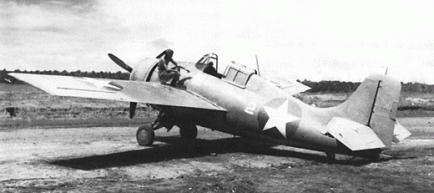
wildcat on henderson field

Marine F4F Wildcat on Henderson Field

The Japanese now decided to send the Sendai and 38th divisions and heavy artillery to the island. Hyakutake went to the island to direct the campaign. The decision resulted in the suspension of 17th Army’s offensive against Port Moresby.[68] Admiral Yamamoto committed the fleet to cover the operations[69] setting up a major air, land and sea confrontation with the Americans. However before these forces could reach the island Vandegrift launched a series of attacks against Oka’s force on the Matanikau using the Raiders, and elements of 5th and 7th Marines.[70] The first attacks took place 24-27 September. The Matanikau position was important to future Japanese operations as their artillerymen stressed that they could not effectively shell the airfield unless guns were emplaced across the river.[71] The Raiders attacked at the log bridge[72] supported by C/1/7 and were repulsed by Oka’s 12th Company with heavy casualties.[73] Puller’s attack by 2/5 and parts of 1/7 at the mouth of the river was rebuffed by 9th Company. An amphibious assault by three companies of 1/7 was ordered by Edson who mistakenly believed that his Marines had crossed the river.[74] The force isolated by Oka’s II/124 and 12th Company, its commander killed and the Marines had to be rescued by Navy units.[75]
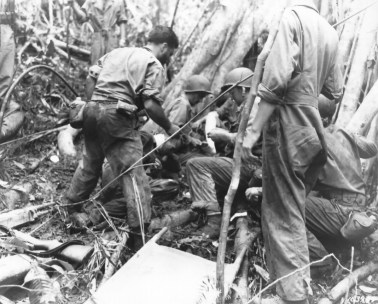
litter_bearers_on_guadalcanal

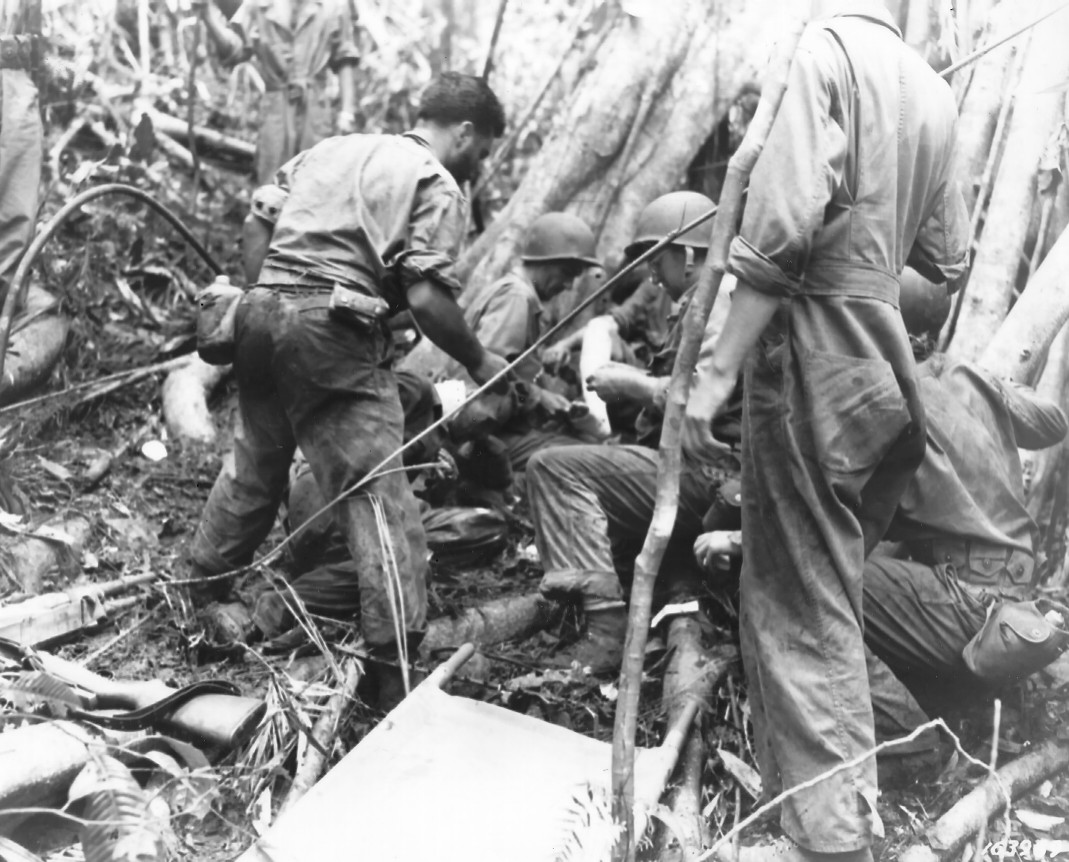
Navy Corpsmen preparing to evacuate a wounded Marines (above) and the 1st Marine Divsion Field Hospital
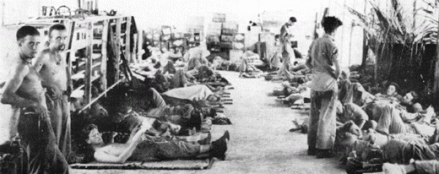
1st mardiv field medical

A second attack by the Marines on the Japanese, now reinforced by 4th Infantry Regiment on 6-9 October dealt them a crushing blow. An attack by 2/5 and 3/5 along the coast met heavy Japanese resistance and General Nasu decided to push across the river. While this was taking place, 7th Marines and the Whaling Group[76] outflanked the Japanese on the river and pushed to the coast. The Marines mauled the 4th Infantry, a Japanese report noting at least 690 casualties.[77] The action had decisive impacts on the next phase of Japanese operations.
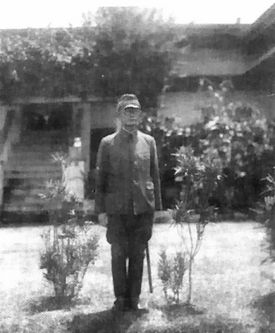
General Hyakutake

General Hyakutake Commander of the Japanese 17th Army defending Guadalcanal

7th Marines and the 164th Regiment of the Americal Division arrived allowing Vandegrift to mount a full perimeter defense while Admiral Halsey replaced Ghormley as COMSOPAC.[78] Arriving on 10 October with the Sendai Division and 17th Army Artillery, Hyakutake, was notified that “American artillery had ‘massacred” the Fourth Infantry Regiment”[79] and found Ichiki and Kawaguchi’s units in an emaciated condition, the total effectives of the 6 battalions numbering less than a full strength battalion.[80] He radioed Rabaul “SITUATION ON GUADALCANAL IS MUCH MORE SERIOUS THAN ESTIMATED, and asked for more reinforcements and supplies at once.”[81] The Navy turned back a Japanese bombardment group on the 12th, but battleships and cruisers blasted Henderson Field on the 13th, 14th and 15th, destroying many aircraft.[82]
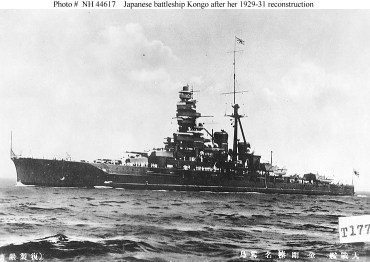
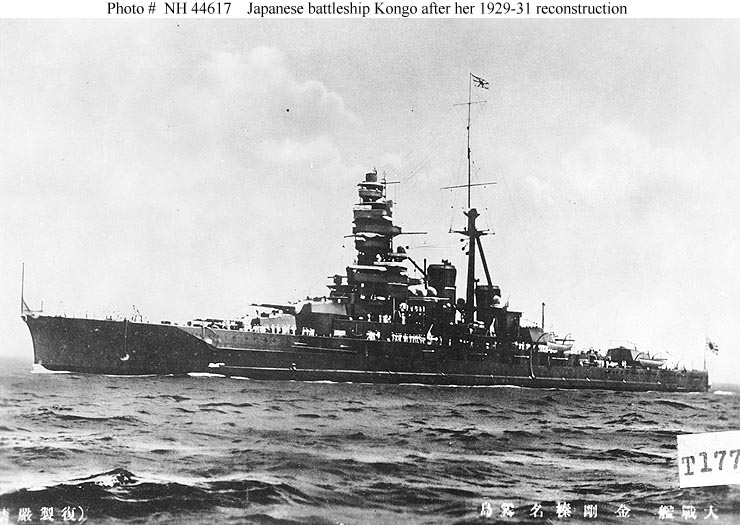
kongo

The 14″ guns of the Japanese Battleship Kongo and her sister Haruna pounded Henderson Field

Hyakutake received reinforcements including tanks and an infantry-artillery group and prepared to attack. General Sumiyoshi[83] was to make a diversionary attack along the coast with Army artillery and 5 infantry battalions. The Sendai Division under General Maruyama[84] with 9 infantry battalions moved inland along a route “the Maruyama road,”[85] to make the main effort to attack the airfield from the south. Sumiyoshi divided his artillery to support the bombardment of Henderson Field and support his infantry attacks, but was short ammunition.[86] The Marines had fortified the eastern side of the Matanikau and Sumiyoshi probed the Marines with infantry and tanks and artillery fire on the 20th and 21st, giving the Marines their first taste of concentrated artillery.[87] Sumiyoshi’s demonstration on the coast was effective, and Maruyama’s division remained undetected throughout its advance avoiding Marine and native patrols.[88]
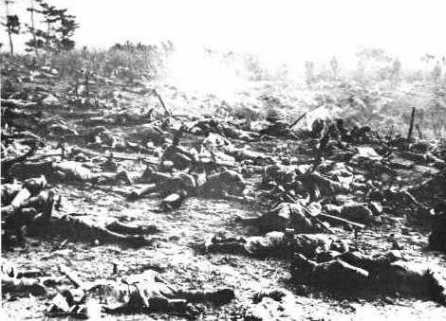
bloody ridge aftermath

Japanese dead after the failed attack on Henderson Field

The attack began on the 23rd with Sumiyoshi attacking on the Matanikau; but he did not get the word that the attack for that night had been postponed until the 24th since Kawaguchi’s units had not gotten to assembly areas on the right of Sendai division.[89] His tanks advanced at 1800 and all but one were destroyed by deValle’s artillery as soon as they moved across the sandspit. The supporting infantry withdrew, and most never went forward as they were hit hard in assembly areas by Marine artillery losing over 600 men.[90] The action succeeded in the Marines shifting 2/7 and 3/7 north leaving Puller’s 1/7 alone on “Bloody Ridge.”[91] Fortunately for the Marines these Japanese forces were detected by Scout-Sniper’s[92] and Puller dug in his battalion deeper and set out a platoon in an outpost 1500 meters south of his position.[93]

puller1

Chesty Puller

On the 24th Maruyama’s Sendai troops attacked the ridge. He divided his force into two wings each of three infantry battalions commanded by General Nasu on the left and Colonel Shoji[94] on the right, three battalions served as a reserve. He advanced at 1900 but a storm turned the jungle into a vast mud bog exhausting the Japanese. Shoji’s wing advanced tangential to the Marine line and only one battalion made contact with Puller’s battalion.[95] Nasu’s troops hit Puller’s who realized that he was facing a major attack; he fed platoons from 3rd Battalion 164th Infantry, a National Guard unit into his lines and requested reinforcements.[96] The Marines and Guardsmen beat back all but one attack, that of LtCol. Furimiya of III/29 who got into the Marine perimeter and held out 48 hours, colors flying, leading Hyakutake to believe that they had captured the airfield.[97] The Japanese were driven off 9th Company of the 29th Regiment was wiped out primarily by the efforts of Sgt. John Basilone’s machine gun section.[98]
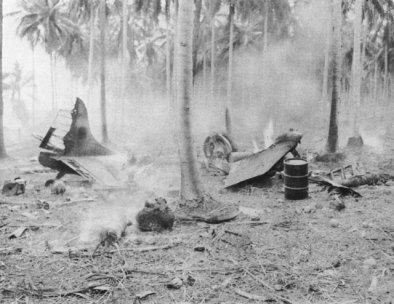
wrecked aircraft

Wrecked Aircraft on Henderson Field

The next day was known as “Dugout Sunday”[99] and that night the Japanese renewed the attack. This was better coordinated, but the Marines, reinforced by 3/164 and 3/2, and backed by artillery, devastated the Sendai division. Nasu and the commander of 16th Infantry were killed with at least 2000 of their soldiers.[100] Colonel Oka attacked 2/7 and was driven off with heavy casualties. Marine Sgt. Mitchell Paige won the Medal of Honor for single handedly manning his platoon’s machine guns after his troops became casualties, going gun to gun.[101] The attacks were crushed leaving more than 3000 dead or dying Japanese on the battlefield.[102]

On the Offensive
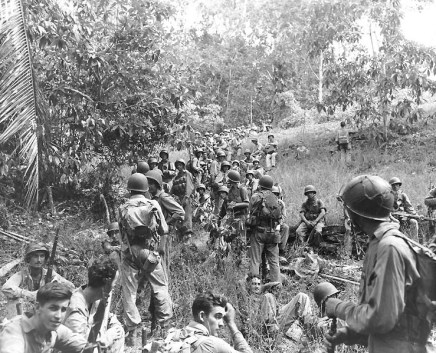
Guadalcanal

Marines pause during advance

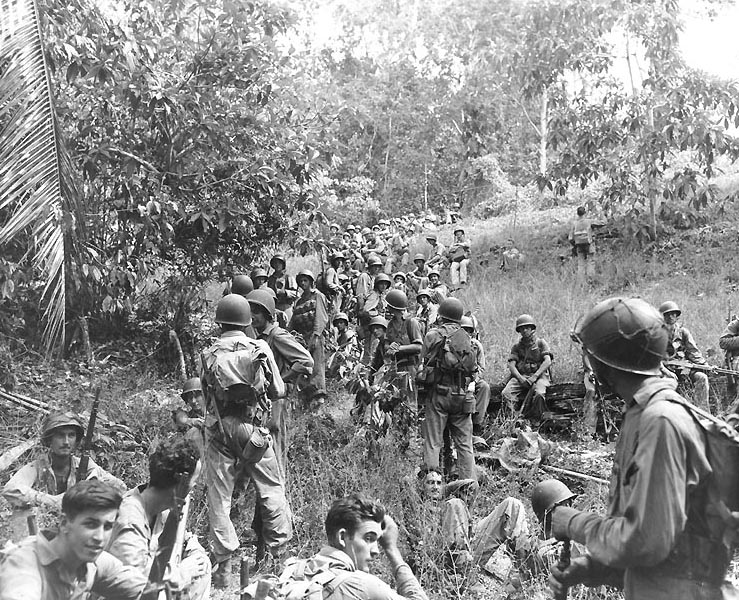
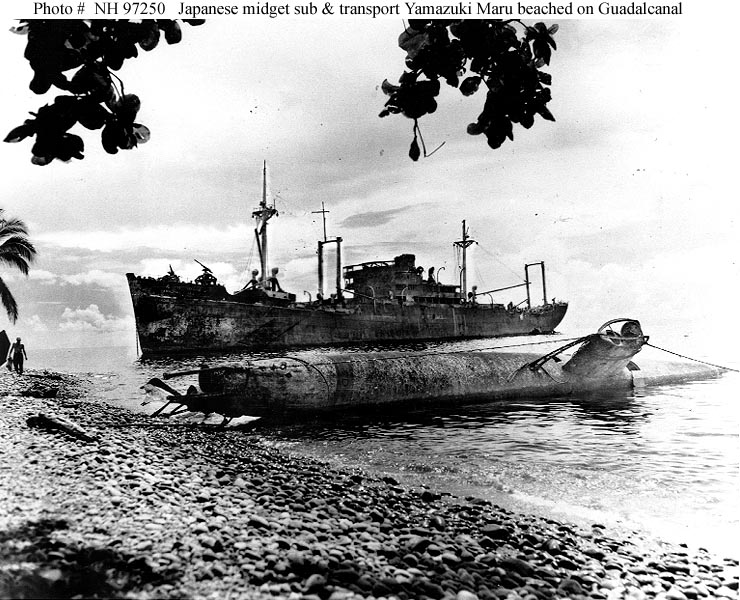
As the Japanese struggled out of jungle to the coast the Marines began preparations to attack as each side brought in reinforcements, the Americans receiving the 8th Marine Regiment and 2nd Raider Battalion of 2nd Marine Division, as well as the 2nd Marines who had been on Tulagi and more of the Americal Division.[103] On November 1st and 5th Marines attacked across the Matanikau and by the 4th had eliminated a Japanese pocket on Point Cruz.[104] To the east 1/7 and 2/7 along with 2/164 and 3/164 attacked Col. Shoji’s force and fresh troops sent to relieve him near Koli Point. The battle lasted until the 9th when Shoji broke through the American cordon with 3000 men pursued by 2nd Raider Battalion. Shoji eventually made it back to 17th Army with 700-800 soldiers, most unfit for combat after battling the Raiders and the jungle.[105] The Japanese attempted to reinforce the island during the Naval Battle of Guadalcanal from 13-15 November. Out of 11,000 troops of 38th Division on 11 transports only 2000 got ashore after 7 of the 11 were sunk enroute by Henderson Field aircraft and the surviving ships beached.[106]

jap transport and mini sub

Grounded Japanese Transport and Midget Submarine on Guadalcanal

The Americans received the rest of 2nd Marine and Americal Divisions and parts of 25th Division and Vandegrift decided to attack, his command now being a de-facto Corps.[107] Though they still numbered 30,000 the Japanese were incapable of offensive operations but still full of fight.[108]On 18 November the 8th Marines and the Army and elements of the 164th and 182nd regiments attacked on the Matanikau. They met heavy resistance from Col. Sakai’s 16th Infantry and in a 6 day battle and lost 134 dead with minimal gains.[109] The new arrivals allowed 1st Marine Division to be withdrawn[110] as it was no longer combat effective.[111] On 9 December Vandegrift[112] turned over command to General Alexander Patch of the Americal Division.

crossing a bridge

Advancing across a improvised pontoon bridge

Patch used early December to conduct aggressive patrolling[113] and decided to clear the Japanese from Mt Austen, which they had nicknamed “Gifu” and in a 22 day battle the 132nd Infantry eliminated the 38th Infantry Group.[114] With the 25th, Americal and 2nd Marine Division Patch now headed XIV Army Corps.[115] Although the Americans were unaware the Japanese had decided to withdraw from Guadalcanal on 31 December, after a heated debate.[116]

vandegrift edson paige and basilone

Major General Vandegrift, Colonel Edson, 2nd Lt Mitchell Paige and Sgt John Basilone all awardees of the Medal of Honor

The final offensive began on 10 January. Patch hoped to clear out the Japanese by April.[117] The 2nd Marine Division attacked along the coast while General Lawton Collins led his 25th Division in a flanking movement heavily supported by artillery and air. 6th Marine Regiment relieved 2nd Marines flanking the Japanese enveloped the majority of the 4th and 16th Regiments.[118] The Japanese began withdrawing on the 17th moving west shielded by the Yano battalion.[119] Collins troops finally reduced and eliminated the Japanese on the Gifu by the 23rd.[120] “The annihilation of Japanese detachments from regimental size down” characterized operations over the final phase of the command.[121] A characteristic of American operations now included the use of heavy massed artillery including time on target or “TOT” missions.[122] On the 22nd the Japanese began to extricate their troops via the Tokyo Express at Cape Esperance.[123] On 1 February Patch landed 2/132 at Verahue on the southwest tip of the island and the 25th and Americal Divisions continued their push to the west against the rearguards of 17th Army. On the 8th of February the last survivors were withdrawn[124] in a move described by the Chief of Staff 17th Army as a “minor miracle.”[125] The Japanese were shocked that the Americans “press them hard” and turn the withdraw “into a bloody rout.”[126] Still expecting a fight Patch’s troops found nothing on Cape Esperance but abandoned boats and supplies.[127]

JapanesePrisonersGuadalcanal

Japanese Prisoners

The Guadalcanal campaign had ended with the loss of nearly 30,000 Japanese. Japan lost the psychological advantage it had possessed from the beginning of the war.[128] It was an action that was an offensive won with defensive actions. The Americans seized a strategic point that the Japanese could not afford to lose and then fought a defensive battle of attrition to grind the Japanese down. The American Marines and Soldiers showed themselves to be the equals of the Japanese in one of the most demanding campaigns of the war. Kawaguchi would comment to a reporter in Manila; “We lost the battle. And Japan lost the war.”[129]

Appendix: Leaders On Guadalcanal

Major General Alexander A. Vandegrift: (1887-1973) Commander of 1st Marine Division on Guadalcanal. He served in the Corps 40 years and retired in 1949 as Commandant of the Marine Corps. After Guadalcanal he commanded 1st Marine Amphibious Corps at Empress Augusta Bay. He was a key player in the congressional debates regarding the Marine Corps in 1946 when President Truman supported by the Army pushed to eliminate the Marine Corps as a ground combat force. He was awarded the Medal of Honor for his service at Guadalcanal. USS Vandegrift FFG-48 was named after him. That ship made the first visit of a US warship to Vietnam since the Vietnam War in 2003.

Major General Alexander Patch: (1889-1945) Commander of XIV Army Corps at Guadalcanal. He assumed command of forces on island from Vandegrift on 9 December 1942. General Marshall ordered him to Europe in 1943 to take command of 7th Army from General Patton. He commanded 7th Army in the south France and the Rhone campaign of 1944, leading that army across the Rhine in 1945. He was to take command of 4th Army in the United States but died of Pneumonia. He was considered a very good commander in both the Pacific and Europe. Patch Barracks in Stuttgart Germany is named after him.

Major General Lawton Collins: (1896-1987) “Lightning Joe” Collins commanded 25th Infantry Division (Tropical Lightening) at Guadalcanal. He commanded VII Corps and distinguished himself in France and was instrumental in Operation COBRA and the breakout from Normandy. He was considered by many to be one of the outstanding Corps commanders in the Second World War. During Korea he was Army Chief of Staff and later served with NATO and as a special representative to Vietnam.

Lieutenant Colonel Lewis B. “Chesty” Puller: (1898-1971) “Chesty Puller commanded 1st Battalion 7th Marines at Guadalcanal and was instrumental in the fight for Henderson Field against the Sendai Division. His early career was marked by much time in Haiti and Nicaragua where he was awarded his first and second Navy Crosses. He served with the “China Marines” (the 4th Marines) He was wounded on Guadalcanal and later served as Executive Officer 1st Marine Regiment and commanded that Regiment at Peleliu. In Korea he again commanded 1st Marines at the epic Battle of the Chosin Reservoir. He was promoted to Brigadier General and served as Assistant Division Commander for that Division. He was promoted to Major General and Lieutenant General prior to his retirement in 1955. He is considered one of the most iconic and beloved Marines who have ever lived earning 5 Navy Crosses and numerous other awards for valor in combat include the Bronze and Silver Stars and Distinguished Service Medal and the Purple Heart. The USS Puller (FFG-23) a Perry Class Frigate was named after him. His uniforms and many of his medals and citations were displayed at the former Marine Corps Barracks, Naval Weapons Station Yorktown until 2006 when they were transferred to the custody of the Marine Corps Museum following the death of his wife Virginia who insisted that they be displayed in Yorktown.

General Harukichi Hyakutake: (1888-1947) Commanded 17th Army on New Guinea and Guadalcanal. He was an infantry officer who studied crypto analysis and served with the Kwantung Army in Manchuria before the war and following Guadalcanal he remained in command of Japanese Troops in the Solomons. He returned to Japan at the end of the war and died in 1947.

Major General Kiyotake Kawaguchi: (1892-1961) Commanded 35th Infantry Brigade on Guadalcanal and was senior officer until the arrival of General Hyakutake and the Sendai Division. Led the unsuccessful battle at “Bloody Ridge” and was relieved of his command just prior to the October attack on Henderson Field. Was one of the few Japanese officers who expressed an early understanding of the importance of Guadalcanal to the overall war effort. Following his evacuation from Guadalcanal and return to Japan he was transferred to the reserve. Convicted of war crimes in 1946 for actions committed in the Philippines in 1941-42 he was released in 1953 and died in 1961.

Notes

[1] Spector, Ronald H. Eagle Against the Sun: The American War With Japan, The Free Press, New York, NY p.185
[2] Morison, Samuel Elliott, The Two Ocean War: A Short History of the United States Navy in the Second World War, Little, Brown and Company, Boston and Toronto, 1963. p.164

[3] Liddle-Hart, B.H. History of the Second World War G.P. Putnam’s Son’s. New York, NY 1970. 356

[4] Ibid. Spector. p.185

[5] Ibid. Spector comments that “MacArthur declared that the navy’s obstinacy was part of a long time plot to bring about ‘the complete absorption of the national defense function to the Navy, the Army being regulated to merely base, training, garrisoning, and supply purposes.’” (p.185)

[6] Toland, John. The Rising Sun: The Decline and Fall of the Japanese Empire 1936-1945, Random House Publishers, New York, 1970. p.346

[7] Ibid. Morison. p.165

[8] Ibid. p.350

[9] Frank, Richard B. Guadalcanal: The Definitive Account of the Landmark Battle, Penguin Books, New York, NY 1990. p.30

[10] Ibid. p.31

[11] Ibid. Morison. p.166

[12] Griffith, Samuel B II. The Battle for Guadalcanal originally published by Lippincott, New York, 1963, University of Illinois Press, Champaign IL, 2000. p.19

[13] Costello, John. The Pacific War 1941-1945, Quill Publishers, New York, NY. 1981. p.320.

[14] Ibid. Spector. p.186

[15] Ibid. Frank. p.60

[16] Ibid. Spector. p.191

[17] Ibid. Frank. p.72

[18] Ibid. Costello. p.323

[19] Ibid. Griffith. p.49

[20] Ibid. Frank. p.72. 1st Raider Battalion took 22% casualties and 1st Parachute Battalion 50-60%.

[21] Ibid. Frank. p.74. Frank notes that of the 536 Japanese defenders that only about 50, a platoon from the 3rd Kure Naval Landing force were trained for ground combat.

[22] Ibid.

[23] Ibid. Griffith. p.45

[24] Savo Island was the worst defeat suffered by the US Navy. In a short engagement the heavy cruisers Astoria, Quincy and Vincennes and the RAN Canberra were sunk and the Chicago badly damaged, leaving the covering force but one heavy cruiser and some AA Cruisers and Destroyers to cover the transports. Over 1000 sailors lost their lives.

[25] Ibid. Frank. p.125

[26] Costello notes the presence of the Seabees, but neither Franks nor Griffith mentions them by name. The discrepancy appears to be the date of their arrival on the island. Morrison notes that 387 men of the 6th Seabee Battalion landed on September 1st with 2 bulldozers and other equipment and that they then took over the improvement of Henderson Field. Morison, Samuel Elliott. The Struggle for Guadalcanal: August 1942-February 1943, Volume V of History of United States Naval Operations in World War II, Copyright 1949, Samuel Elliott Morison, Castel, Books New York, NY 2001, published in arrangement with Little Brown and Company. p.76

[27] Ibid. Griffith. p.68

[28] McMillan, George. The Old Breed: A History of the First Marine Division in WWII, The Infantry Journal Incorporated, Washington DC. 1949. p.50

[29] Ibid. Frank. p130, Griffith. p.70. McMillan pp.52-56. This incident is still shrouded in mystery as no Japanese records survive to record the outcome of the incident. According to McMillan, when Goettge went out he believed he was also on a humanitarian mission and took the assistant division surgeon and a language officer. The Goettge Field House at Camp LeJeune NC is named in his honor.

[30] Ibid. Griffith. p.74

[31] Ibid. McMillan. pp.56-57

[32] Ibid.. p.59

[33] Ibid. Griffith. pp.79-80 some believed the commitment of small numbers inadequate to the task would repeat the defeats suffered at the hands of the Russians and in China. Ichiki himself was given poor intelligence stating that there were only about 2000 Americans on the Island and that they suffered from low morale and were trying to flee Guadalcanal to Tulagi. (p.81)

[34] Ibid. Toland. p.364

[35] Ibid. p.365

[36] Ibid. p.366

[37] Ibid. McMillan. p.61. Vouza, a native constable had actually been captured and interrogated by the Japanese, who bayoneted him and left him for dead.

[38] Ibid. pp.61-62

[39] Ibid. Griffith. p.84

[40] Ibid. p.86

[41] Ibid. Frank. p.156. Richard Tregaskis in Guadalcanal Diary reports that he heard there were 871 Japanese dead in the battle area. Tregaskis, Richard, Guadalcanal Diary, Originally published by Random House, 1943. Modern Library Paperback edition, Random House Publishers, NY 2000, with an introduction by Mark Bowden. p.130

[42] Ibid. Toland. p.367 Griffith reports that a Captain Tamioka survived. (p.87)

[43] Various accounts give slightly different figures for the Marine casualties. This number is taken from McMillan.

[44] Ibid. Griffith. pp.87-88. Griffith comments: “there was something more fundamental involved here than action taken on the basis of poor information, a reckless and stupid colonel, dedicated soldiers, and a disparity in weapons. This was ‘face.’ Once committed to the sword, Ichiki must conquer or die. This was the code of the Samurai, ‘The Way of the Warrior’: Bushido. (p.88)

[45] Ibid. McMillan. p.64

[46] Ibid. Griffith. p.88

[47] Ibid. Frank. p.218. Toland reports that he received intelligence that 5000 Marines were on the island but he believed that he could be victorious. (p.378)

[48] Ibid. Toland. p.376. Oka’s force was particularly hard hit by the air attacks during transit, losing 650 out of 1000 men, and his survivors had little food and ammunition and were not in good condition to attack.

[49] Ibid. Frank. pp.221-222. They also brought back documents, Kawaguchi’s dress uniforms and beer.

[50] Vandegrift rusted in the understanding that every Marine is a rifleman.

[51] Ibid. Griffith. p.115

[52] Ibid. Frank. p.229

[53] Ibid. p.231

[54] Ibid. p.232

[55] Ibid. Griffith. p.117

[56] Ibid. Frank. p.235 He still lacked the manpower to form a continuous line.

[57] Ibid. Griffith. p.117

[58] Ibid. Frank. p.235

[59] Ibid. Griffith. p.119

[60] Ibid. Frank. p.239

[61] Ibid. p.240

[62] This was III/124 under Colonel Wanatabe, suffering from old war wounds he failed to get his unit into the fight and Kawaguchi told him to commit Hari-Kari. (Griffith .121)

[63] Ibid. Griffith. p.121. The Marines lost 263 men of which 49 were killed and 10 missing. The Parachute battalion which began the campaign with 397 men had only 86 ambulatory after “Bloody Ridge” and were withdrawn. (Frank. p.241)

[64] Ibid. Costello. p.346 Frank also notes that another of Kawaguchi’s battalions, the Kuma battalion and his artillery fared even worse while trying to move to the west, becoming lost in the jungle for three weeks, losing all their weapons and becoming severely malnourished. (Frank. p.246)

[65] Ibid. Griffith. p.125

[66] Ibid. Toland. p.385 The Japanese began to call the island Starvation Island.

[67] Edson and Bailey both were awarded the Congressional Medal of Honor for their actions on the ridge. (McMillan p.81)

[68] Ibid. Griffith. pp.126-127

[69] Ibid. Spector. p.199 and Costello. p.348

[70] Ibid. Frank. p.269.

[71] Ibid.

[72] Ibid. Griffith. p.135. Griffith refers to this as the “Jap bridge.” I use Frank’s the name given by Frank.

[73] Ibid. Frank. p.272

[74] Ibid. Toland.p.390

[75] Ibid. Frank p.273-274. Frank analyzes: “In a retrospective assessment, the Marines found that the operation had an improvised purposeless flavor. It had been initiated without meaningful intelligence on the enemy situation or the terrain, and the attack was characterized by the commitment of battalions along unreconnoitered axes, beyond mutual support range, and without coordination of movements or of air and artillery support.” (p.274)Griffith comments: “Here Edson, as always supremely confident, had dispersed his force haphazardly to assault an enemy well armed, well concealed, and at each pointing superior strength. Second Matanikau hammered home to Vandegrift that a commander who allows himself or a subordinate, to drift aimlessly into any action will pay the price. (Griffith p.137)

[76] Ibid. Griffith. p.283. The Whaling Group consisted of 3rd Bn 6th Marines and the Scout Sniper detachment.

[77] Ibid. 289. The Division history of 1st Marine Division reported over 900 Japanese killed. (McMillan p.96)

[78] Ibid. McMillan. p.99

[79] Ibid. Griffith. p.148

[80] Ibid. p.338

[81] Ibid. Toland. p.392

[82] Ibid. Griffith. p.157. By the 15th the Marines only had 27 aircraft left, but by the evening a Navy fighter squadron had reinforced them.

[83] Artillery commander 17th Army.

[84] Ibid. Toland. p.393. Maruyama noted before the division departed from Japan that Guadalcanal was the “Decisive battle between Japan and the United States, a battle in which the fate of the Japanese Empire will be decided.”

[85] Ibid.p.340 Toland notes how this “road” had been hacked out of the jungle in the proceeding month. (Toland. p.393)

[86] Ibid. p.342. The 15 150mm guns targeted the airfield and the remaining 17, 75mm and 100mm guns and howitzers targeted the infantry.

[87] Ibid. Griffith. p.165-166

[88] Ibid. Frank. p.348

[89] Ibid. Griffith. pp.166-167. Sumiyoshi was not at fault as he had fallen into a coma brought on by Malaria. Kawaguchi was relieved by Hyatutake for this failure.

[90] Ibid. p.167

[91] Ibid. McMillan. p.105

[92] Ibid. Toland. p.401. Frank notes that even this discovery did not alert the Marine command to the Japanese presence south of the ridge and he credit’s Puller’s lack of complacency.

[93] Ibid. Frank. p.352

[94] Ibid. Frank. Shoji had relieved Kawaguchi.

[95] Ibid. Frank. pp.352-353

[96] Ibid.. p.355-356

[97] Ibid. p.356. Furimiya would eventually commit suicide when he had lost the rest of his troops. His diary, found by the Americans made a note that “we must not overlook firepower.” (p.366) Griffith notes the officer as Ishimiya and notes that only 9 men were with him. (p.169)

[98] Ibid. p.356. Basilone won the Congressional Medal of Honor.

[99] The day was marked by a fierce air-sea battle between American aircraft and a Japanese naval task force sent to shell Henderson Field and supporting fighters. A number of Japanese ships were damaged and the light cruiser Yura sunk. See Morison. History of Naval Operations in WWII vol V. pp.197-198

[100] Ibid. Frank. pp.364-365

[101] Ibid. pp.363-364. I met Paige in 2000 at Camp LeJeune. This icon of the Corps remained an outspoken Marine until the day that he died.

[102] Ibid. Toland. p.404

[103] Ibid. Liddle-Hart. p.361

[104] Ibid. Griffith. p.184

[105] Ibid. Frank. pp.421-424.

[106] Ibid. Morison. History of Naval Operations. p.182. Frank backs this number and Liddle-Hart gives 4000.

[107] Ibid. McMillan. p.135

[108] Ibid. Griffith. p.212-213

[109] Ibid. Frank. pp.495-497.

[110] The 1st Marine Division lost 621 KIA, 1,517 WIA and 5601 Malaria cases. Its Marines earned 5 Congressional Medals of Honor, 113 Navy Crosses and 4 Distinguished Service Medals. (McMillan pp.138-139)

[111] Ibid. Griffith. p.216

[112] Vandegrift would become Commandant of the Marine Corps in 1944.

[113] Johnston, Richard W. Follow Me! The Story of the Second Marine Division in World War II, Copyright 1948 by the 2nd Marine Division Historical Board and published by Random House, New York, NY. 1948. p.69

[114] Ibid. Frank. pp.528-534.

[115] Ibid. Johnston. p.72

[116] Ibid. Toland. pp. 421-426. Generals Sato and Tanaka engaged in a fist-fight ended by Tojo and the Emperor himself probed the High Command about the defeat and personal approved the Japanese withdraw.

[117] Ibid. Spector. p.213

[118] Ibid. Frank. p.557

[119] Ibid. p.560

[120] Ibid. p.566

[121] Ibid. p.567

[122] Bergerud, Eric. Touched With Fire: The Land War in the South Pacific, Penguin Books, New York, NY 1996. p.192

[123] Ibid. p.570

[124] Ibid. p.595 Depending on the source the Japanese withdrew anywhere from 10,000 to 13,000 troops from the island.

[125] Ibid. Griffith. p.244

[126] Ibid.

[127] Ibid. Morison. History of Naval Operations, p.371.

[128] Murray, Williamson and Millett, Allan R. For the Common Defense: Fighting the Second World War, The Belknap Press or Harvard University Press, Cambridge, MA 2000. p.215

[129] Ibid. Toland. p.431

Bibliography

Bergerud, Eric. Touched With Fire: The Land War in the South Pacific, Penguin Books, New York, NY 1996

Costello, John. The Pacific War 1941-1945, Quill Publishers, New York, NY. 1981

Frank, Richard B. Guadalcanal: The Definitive Account of the Landmark Battle, Penguin Books, New York, NY 1990

Griffith, Samuel B II. The Battle for Guadalcanal originally published by Lippincott, New York, 1963, University of Illinois Press, Champaign IL, 2000

Johnston, Richard W. Follow Me! The Story of the Second Marine Division in World War II, Copyright 1948 by the 2nd Marine Division Historical Board and published by Random House, New York, NY. 1948

Liddle-Hart, B.H. History of the Second World War G.P. Putnam’s Son’s. New York, NY 1970

McMillan, George. The Old Breed: A History of the First Marine Division in WWII, The Infantry Journal Incorporated, Washington DC. 1949

Morison, Samuel Elliott, The Two Ocean War: A Short History of the United States Navy in the Second World War, Little, Brown and Company, Boston and Toronto, 1963

Murray, Williamson and Millett, Allan R. For the Common Defense: Fighting the Second World War, The Belknap Press or Harvard University Press, Cambridge, MA 2000

Spector, Ronald H. Eagle Against the Sun: The American War With Japan, The Free Press, New York, NY

Toland, John. The Rising Sun: The Decline and Fall of the Japanese Empire 1936-1945, Random House Publishers, New York, 1970

Tregaskis, Richard, Guadalcanal Diary, Originally published by Random House, 1943. Modern Library Paperback edition, Random House Publishers, NY 2000, with an introduction by Mark Bowden

Leave a comment

Filed under History, Military, world war two in the pacific

The Guadalcanal Campaign: Bloody Savo

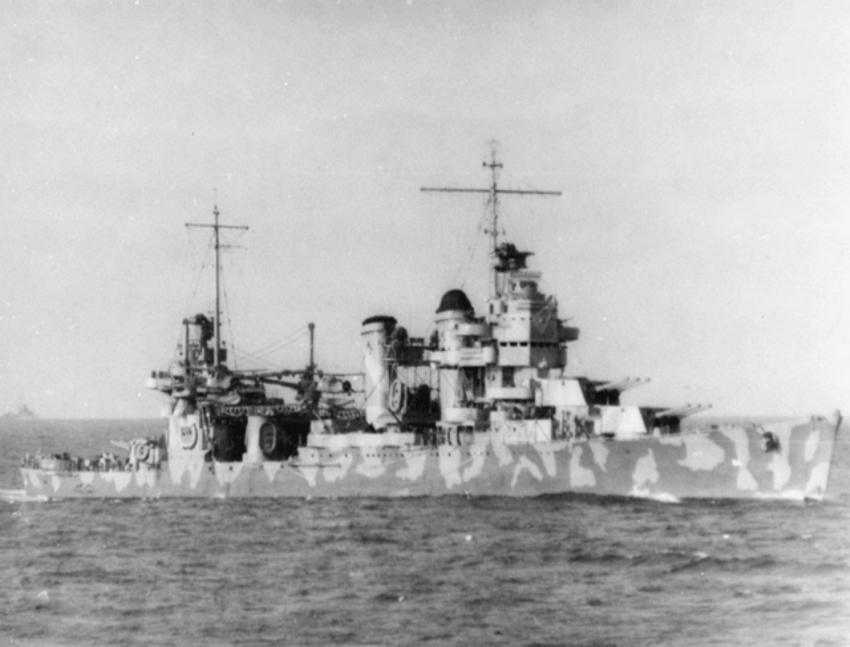
USS_Quincy_CA-39_savo

Friends of Padre Steve’s World,

For the next few days I will be posting some articles about the Guadalcanal campaign, a pivotal series of battles in the Second World War where the United States and its allies took the offensive against Imperial Japan. This article deals with the first naval engagement of that campaign which was the worst and most lopsided defeat ever suffered by the U.S. Navy in history.  I am posting these articles because they are forgotten by so many. Tomorrow I will begin posting articles on the Guadalcanal Campaign, but the story of “Bloody Savo” is here. Have a good night. 
Peace,

fletcPadre Steve+

On August 8th 1942 the U.S. Task Force supporting the invasion of Guadalcanal was tired. The crews of the ships had been in continuous combat operations conducting naval gunfire support missions, fending off numerous Japanese air attacks and guarding against submarine attacks for two days. The force commanded by Admiral Richmond K. Turner was still unloading materials, equipment and supplies needed by the men of the 1st Marine Division who they had put ashore on the morning of the seventh.

On the afternoon of the eighth Turner was informed by Admiral Frank “Jack” Fletcher that he was pulling his carrier task force out of action. Fletcher alleged that he did not have enough fighter aircraft (79 remaining of an original 98) and as low on fuel. The carriers had only been in action 36 hours and Fletcher’s reasons for withdraw were flimsy. Fletcher pulled out and left Turner and his subordinate commanders the responsibility of remaining in the area without air support with the transports still full of badly needed supplies and equipment.

Gunichi_Mikawa

Admiral Gunichi Mikawa

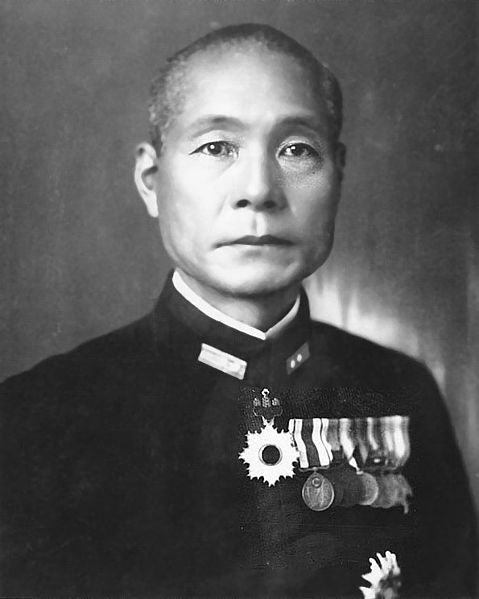
As the American drama played out, the Japanese moved forces into position to strike the Americans. Admiral Gunichi Mikawa commander of the 8th Fleet and Outer South Seas Force based at Rabaul New Britain quickly assembled a force of 6 heavy cruisers, the 14,000 ton Atago Class Chokai, and the four smaller ships of the Kako Class, the Aoba, Kako, Kinugasa and Furutaka, the light cruisers Yubari and Tenryu and the destroyer Yunagi. Mikawa raised his flag aboard Chokai and the force sped down “the slot” which ran the length of the of the Solomon’s chain mid day on the seventh.

The Americans had warning of their coming. The first sighting was by B-17s before the Japanese forces had reached Rabaul. The second was the elderly U.S. Navy submarine S-38 at 2000 on the 7th when they were 550 miles away not far from Rabaul. This report was discounted because it would not be unusual to find a number of fleet units steaming near a major naval base and fleet headquarters. The last which should have alerted the allies was a sighting by a Royal Australian Air Force patrol aircraft on the morning of the 8th. However the pilot did not report the sighting until he returned from his mission returned to his base and had his tea. The eight hour delay in reporting the information as well as errors in it which reported 2 submarine tenders as part of the force lulled the Allied forces into believing that the Japanese were setting up a seaplane base and posed no threat to the invasion forces. It was a fatal error of reporting and judgment by the pilot.

USS_Astoria_(CA-34)_off_Guadalcanal_1942

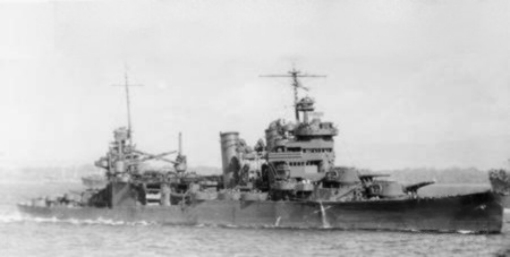
USS Astoria on August 8th off Guadalcanal and USS Chicago (below)

CA-29_Chicago

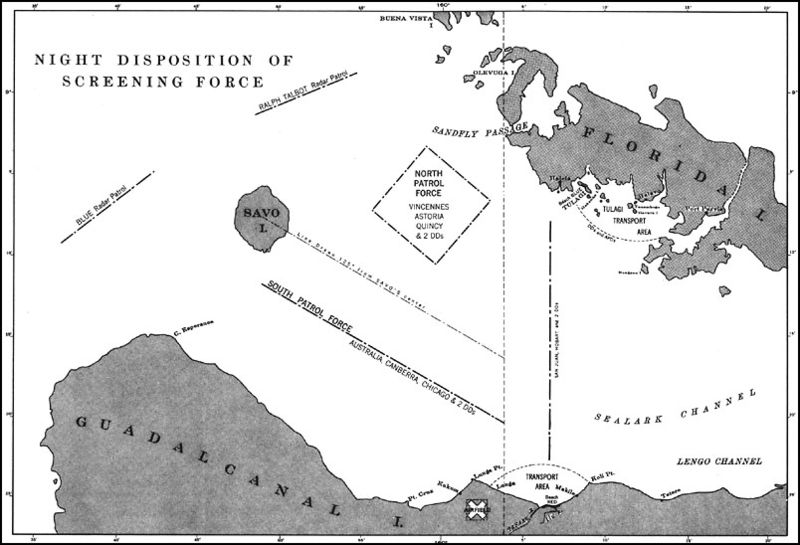
In the absence of good information Turner deployed his support ships to cover the three entrances into what soon would be known as Iron Bottom Sound. He placed the Anti Aircraft Cruiser USS San Juan and Australian Light Cruiser HMAS Hobart to the east with two destroyers under the command of Rear Admiral Norman Scott. To protect the south west entrance into the sound south of Savo Island Turner placed the Heavy Cruisers USS Chicago, HMAS Australia and HMAS Canberra and two destroyers under the command of Rear Admiral R.A.C. Crutchley RN who in theory commanded the screening force. To the north of Savo he deployed the Heavy Cruisers USS Vincennes, USS Astoria and USS Quincy and two destroyers under the tactical direction of Captain Frederick Riefkohl aboard Vincennes. To the west of Savo he placed two destroyers to act as picket ships. Unfortunately these ships radar sets were insufficient and would fail to pick up the approaching enemy.

800px-SavoIslandMap

Allied Dispositions

During the early evening Turner recalled Crutchley to his flagship for consultations of what to do regarding Fletcher’s retreat. Crutchley came over in his flagship the Australia denuding the southern force of its commander as well as one of its three heavy cruisers. He left the commanding officer of Chicago Captain Howard D. Bode in tactical command but Bode did not have his ship take the lead position in the patrol assuming Crutchley would return bymidnight.

USS_Vincennes_(CA-44)_in_the_Solomons_1942

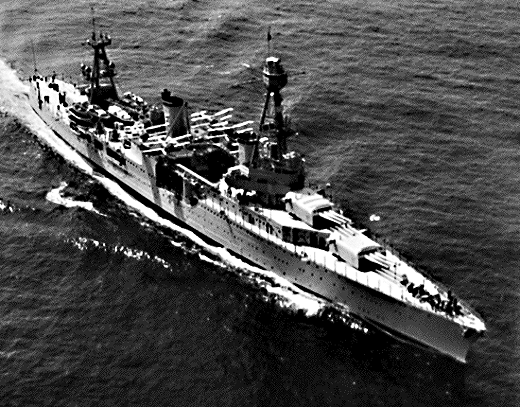
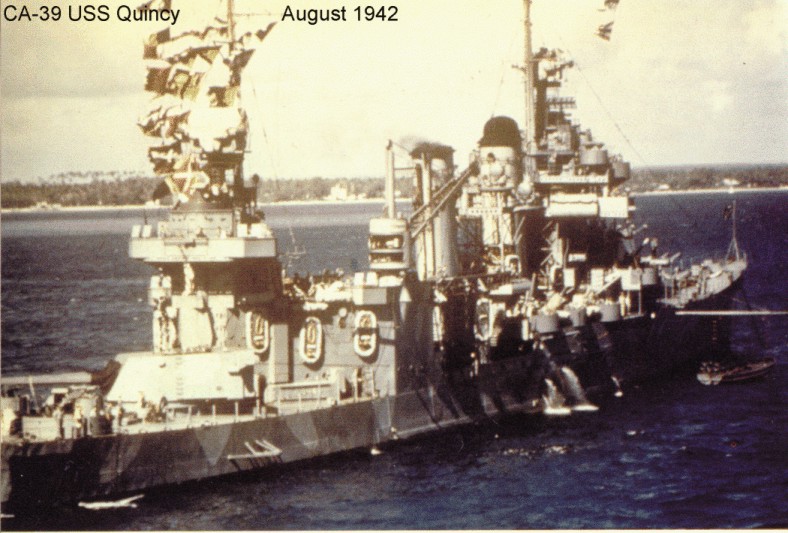
USS Vincennes (above) and USS Quincy (below)

ca__39_uss_quincy___1942.08.03___1a

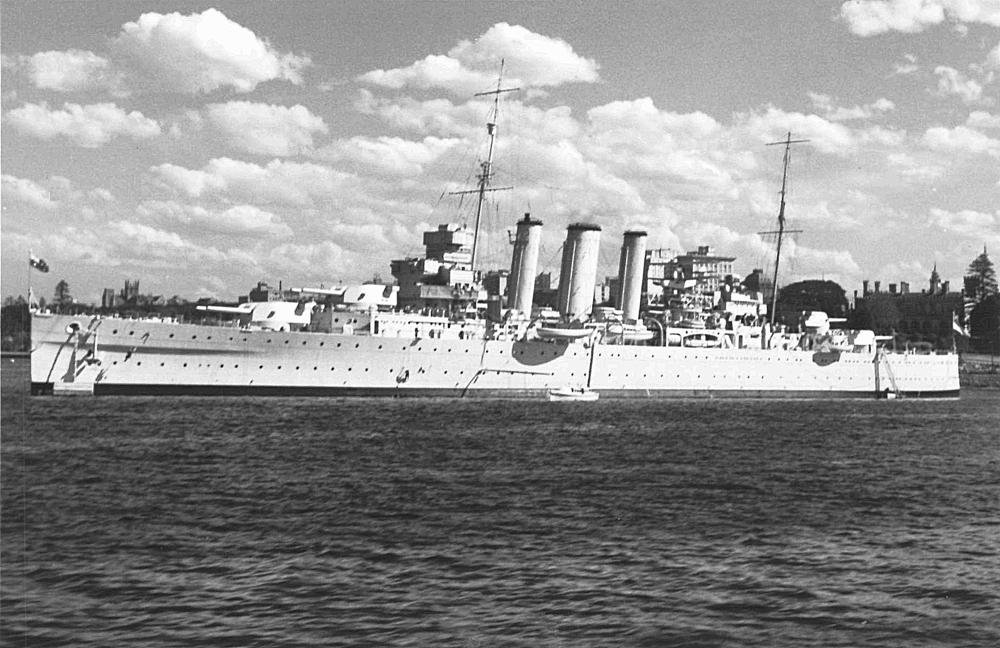
HMAS Canberra Sydney Harbour

HMAS Canberra 

Mikawa launched float planes to scout the locations of the American ships and to provide illumination once the battle began. Some of these aircraft were spotted but no alert measures were taken as many assumed the Japanese to be friendly aircraft. Many commanding officers were asleep or resting away from the bridge of their ships, lookouts were tired and not expecting the Japanese and Condition Two was set in order to provide some of the tired crews a chance to rest.

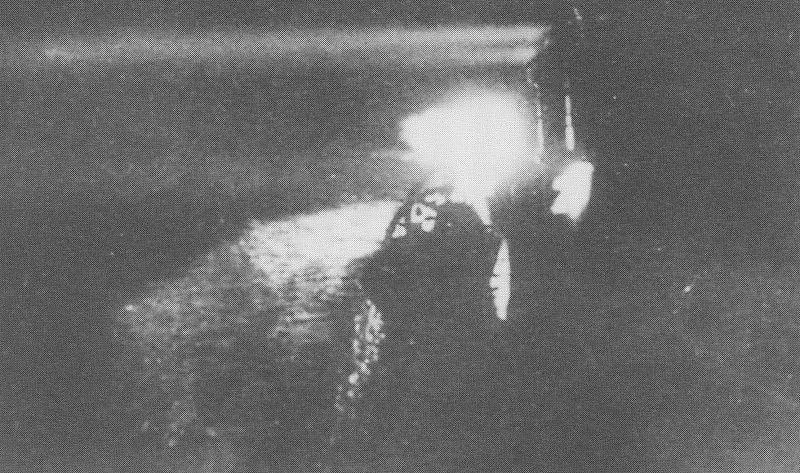
800px-SavoIslandYubariSearchlight

Light Cruiser Yubari illuminating American cruisers at Savo Island

Admiral Mikawa now new the Allied disposition and ordered his ships to battle stations at 0045. At 004 he sighted and passed astern of USS Blue the southern picket which also failed to detect the Japanese force. Mikawa assumed that the destroyer might have reported his presence, briefly turned north but turned back to his original course when a lookout allegedly spotted a destroyer to his northeast. He gave the order to attack at 0132 and promptly spotted the American destroyer USS Jarvis which had been heavily damaged and without radio communications was making her way toAustralia for repair and passed her after some ships fired torpedoes and raced toward the southern force at 26 knots. With the southern force just a few miles away Mikawa ordered his ships to commence firing at 0136 and at 0138 torpedoes had been launched.

480px-SavoIslandMap1

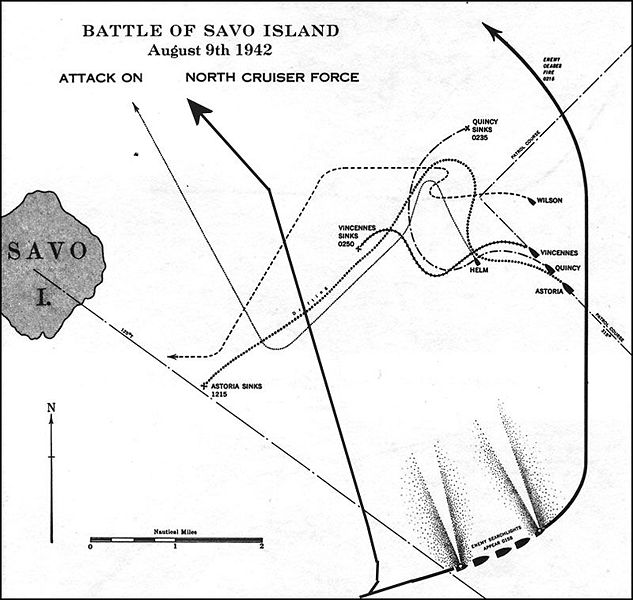
Mikawa’s lookouts spotted the northern group at 0144 and changed course. The maneuver was badly executed and left the Japanese in two columns as they swiftly closed on the Americans. Mikawa’s flagship Chokai launched torpedoes at 0148 and Astoria the cruiser closest to the Japanese set general quarters at 0145 and at 0150 the Japanese illuminated her with searchlights and opened fire. Astoria under the direction of her gunnery officer returned fire at 0152 ½ just before her Captain came to the bridge unaware of the situation. He ordered a cease fire until he could ascertain who he was firing at assuming the Japanese to be friendly ships. He delayed 2 minutes and ordered fires commenced at 0154 but the delay was fatal. Astoria had opened fire on the Chokai which then had time to get the range on the American cruiser and hit her with an 8” salvo which caused fires which provided the other Japanese ships an aiming point.

SavoJapaneseWarArt

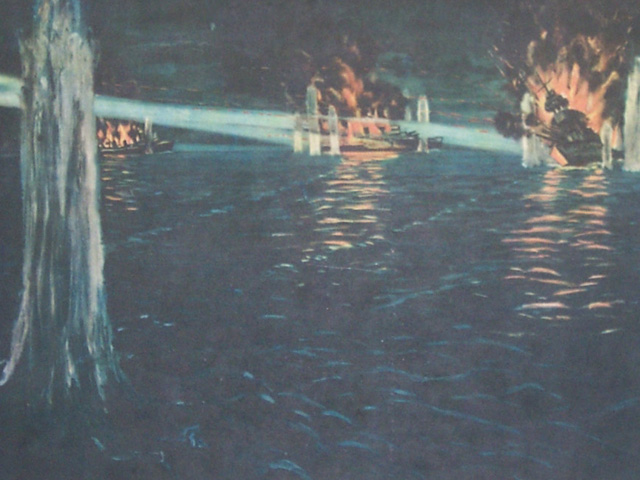
Japanese artist depiction of attack on US Navy Cruisers at Savo Island

Astoria was left burning and heavily damaged barely maintaining headway but attempted to fight on scoring a hit on Chokai’s forward turret even as the Japanese opened up on the next cruiser in line the USS Quincy. Quincy caught between the two Japanese columns. Aoba illuminated her with her searchlight and Japanese forces opened fire. The gunnery officer order Quincy to return fire getting two salvos off before her skipper Captain Samuel Moore came to the bridge, briefly ordered a cease fire assuming that he was firing on Americans and turned on his running lights. Quincy was ripped by salvo after salvo which killed Captain Moore and nearly everyone in the pilothouse just as a torpedo ripped into her engineering spaces turning them into a sealed death trap forcing the engineer to shut down the engines. Burning like a Roman candle Quincy was doomed she was ordered abandoned and capsized and sank at 0235. However Quincy did not die in vain, at 0205 two of her 8” shells hit Chokai causing enough damage the Admiral’s chart room that Mikawa would order a withdraw at 0220 which spared the now defenseless American transports.

633px-SavoIslandMap2A

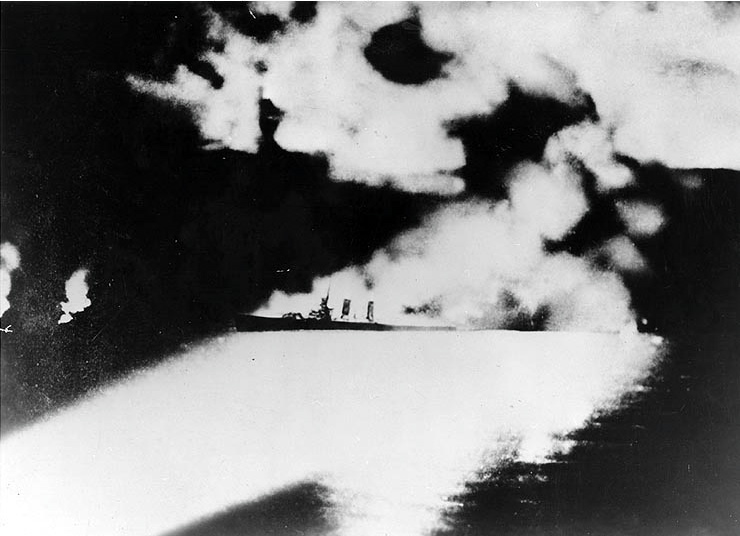
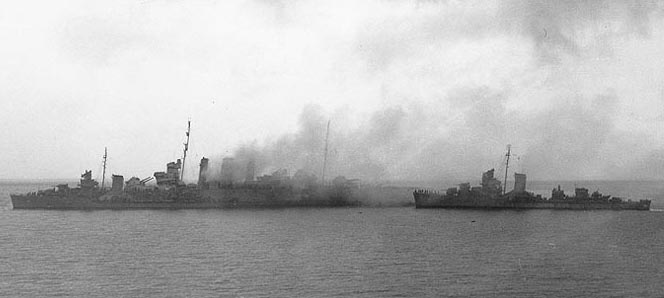
Vincennes, the lead ship and flagship was next in the line of death. Captain Reifkohl order General Quarters sounded not long after the Japanese illuminated the southern group. At 0150 Vincennes was lit up by the searchlights of three Japanese ships which opened fire on her. Vincennes returned fire at 0153 hitting Kinugasa before she was hit starting fires on her scout planes mounted on their catapults. The Japanese mauled Vincennes, three possibly four torpedoes ripped into her as shells put ever gun out of action. At 0215 she was left burning and sinking by the Japanese who soon withdrew from the action. Ordered abandoned she sank at 0250.

Savo_Island canberra

HMAS Canberra being evacuated by the Patterson and Blue

Canberra struggled against the odds but was abandoned and was sent to the bottom by an American torpedo at 0800. Astoria also struggled for life but the damage was too great and she was abandoned sinking at 1215. Mikawa withdrew up the sound but on his return the Heavy Cruiser Kako 70 miles from home was sunk by torpedoes from the American submarine S-44 sinking in 5 minutes.

The Americans and Australians lost 4 Heavy Cruisers sunk and one heavily damaged. Two destroyers were also damaged. Casualties were heavy; Quincy lost 389 men killed, Vincennes, 342, Astoria, 235, Canberra, 85, Ralph Talbot, 14, Patterson, 10, and Chicago, 2.

It was an unmitigated disaster, an allied force destroyed in less than 30 minutes time. Boards of inquiry were held and Captain Bode hearing that he shouldered much blame killed himself in 1943.

It was a rude awakening to a Navy which had believed that technical advances would give it victory and which  in the words of Admiral Ernest King  was not yet “sufficiently battle minded.” It was the first of many equally bloody battles in the waters around Guadalcanal which became known as Ironbottom Sound..

2 Comments

Filed under History, Military, Navy Ships, US Navy, world war two in the pacific

Hiroshima, Nukes, and Trump

Cloud-2

Hiroshima, August 6th 1945

Friends of Padre Steve’s World,

Today is the 71st anniversary of the first atomic bomb being used against the city of Hiroshima. In an instant ninety percent of the city was destroyed, 80,000 people killed, and tens of thousands more would die of radiation exposure in the weeks, months, and years following the bombing. Three days later another atomic bomb was dropped on Nagasaki. In the decades that followed, the United States, the Soviet Union, Britain, France, China, India, Pakistan, probably Israel, and maybe even North Korea have constructed thousands of nuclear weapons, most of them more powerful than the ones used by the United States against Japan.

In the decades since, none of the countries that have built these weapons have used them. There is a good reason for that. Once a nation crosses the nuclear threshold today there is no going back. It was something that President John F. Kennedy understood, and he led the nation through a potential nuclear Armageddon during the Cuban Missile Crisis, “We will not prematurely or unnecessarily risk the costs of worldwide nuclear war in which even the fruits of victory would be ashes in our mouth.”

I have always been concerned about the character and temperament of Donald Trump, especially when I think of the possibility of the use of nuclear weapons, Back in the 1980s during the Cold War I was a Nuclear, Biological, and Chemical Defense Officer. I had to learn all about the effects of nuclear weapons on people. I could tell you how many Rads, or the absorbed radiation dose that a soldier could be exposed to and still function. I could tell you how best to survive a nuclear strike, what kind of structure, or vehicle would provided you some amount of protection from radiation exposure. I could tell you how long you could remain in an area where a nuclear blast, or in the case of the Chernobyl meltdown occurred, and I could plot fallout patterns. The maps we used to plot those things in our training included the city that I lived in. I know more about this than I ever wanted to, and those when I hear politicians or for that matter anyone advocating for the use of nuclear weapons, especially as a first strike option, I get concerned.

This week, Joe Scarborough of the MSNBC morning show “The Morning Joe” reported that a senior national security policy adviser was asked by Donald Trump “why can’t we use nukes?” three times within less than an hour. When I heard Trump’s acceptance speech, he said that he would defeat the Islamic State “quickly,” even as he derided the U.S. Miltary as a “disaster.” To me that meant only one thing, that he would use nuclear weapons as a first strike option against an enemy that has no capacity to destroy us. The Islamic State is evil, but it is not an existential threat to the United States or any of its allies, thus from an ethical, moral, legal, and military standpoint the use of nuclear weapons would be criminal.

I believe that it spoke volumes as to why he is unfit to lead this country, and why so many military and national security experts are not supporting him. The fact is that Trump has no self-control. He acts on emotion and perceived slights to his person. His prejudices are now legend, and his ignorance of basic national security strategy policy, government, and even the Constitution itself are shown on a daily basis. Barbara Tuchman wrote something that I think is very applicable to Trump. “Strong prejudices and an ill-informed mind are hazardous to government, and when combined with a position of power even more so.” [1]

When I read Tuchman’s words I can only think about Donald Trump with his finger on the nuclear trigger.

Anyway, it is something to seriously ponder. Have a great weekend.

Peace

Padre Steve+

[1] Tuchman, Barbara The March of Folly: From Troy to Vietnam A Ballantine Book published by Random House, New York 1984 p.138

1 Comment

Filed under ethics, History, Military, News and current events, Political Commentary

Disgusting, Disgraceful, and Dishonorable: Trump’s Pathological Need to Belittle those Who Sacrifice for the Country 


Friends of Padre Steve’s World,

Three words: Disgusting, disgraceful, dishonorable, is how I have to characterize how Donald Trump and his campaign treats those who serve, those who have served, and the families of military personnel. 

Ever since the parents of Army Captain Humayun Khan so eloquently spoke, and criticized Donald Trump at the Democratic National Convention there has been a full court press by Trump, his aides, and his most strident supporters to demonize the Khans in the most cruel, senseless, and even evil ways. What they have done and continue to do is so offensive that it drew the official rebuke of many veterans groups, including the Veterans of Foreign Wars, and the Iraq Afghanistan Veterans Association. 

Trump is the ultimate bully and crybaby. He went to Twitter to complain of their “vicious attacks,” of course ignoring how has made a career of not only making vicious, and even libelous attacks on people of all walks of life. But then, like I said he is a bully and a crybaby. His assault on military personnel and veterans knows no bounds. He went out of his way to insult, attack, and demonize the Khans, and some of his aides and advisers have insinuated that they are connected to the Islamic Brotherhood, and demanded that they condemn Islamic militants, like losing their son in the battle against them doesn’t count. He mocked John McCain who spent years in a North Vietnamese POW camp, as well as others who have been POWs. He equates his high school years at an elite military prep school as being better than having actually served in the military. He says that he knows more than Generals about how to defeat ISIL. He stated in his acceptance speech that the military was “a disaster.” This list could go on, but even more despicable is the fact that while he claims to “have made sacrifices” he used five deferments to dodge the draft, something that he seems proud of doing. 

He claims to have made millions of dollars in donations to military charities but there are no records, he will not name the charities, and he will not reveal his tax returns. He biggest bragging point is his participation as a co-chairman of the New York Vietnam Veterans Memorial Commission, in which he claimed credit for its construction is also full of deceit. In 1984 he was exposed by fellow members for only showing up at two or three of the twenty meetings. When asked by the Washington post about this he played down the military service of the other commissioners saying “They’re very small thinkers. They’re stockbrokers that were in Vietnam and they don’t have it.” 

The farcical comments by one of the head of his political action committee, that his sacrifice included losing two marriages because he was so committed to his business, conveniently leaving out the part about his constant affairs that led to the break up of those marriages. Some sacrifice. 

Why Trump acts this way might be a mystery to some, but I have a theory. Trump actually feels inferior to the men and women he is insulting because he knows that his avoidance of serving in Vietnam was cowardly. So he has to tear down McCain, he has to say he knows more than the generals, he has to go after the parents of a fallen hero. He is pathological in his need to prove his superiority, but as much as he blusters, Trump knows that he cannot live his own dishonor down, and so he must actively continue to belittle the sacrifices of, and even attempt to destroy the lives and reputations of those who actually did serve. 

Truthfully, the man has no honor, and neither do his henchmen in the Christian Right who have been the loudest and most vicious critics of the Khans, simply because they are Muslim, and who have demeaned Captain Khan’s sacrifice to protect his troops from a terrorist car bomber. Some even said that he was not a hero. To see people who claim to be “Christians” act in such a manner defies the imagination and brings to mind the images of the burning of heretics, witch hunts, and more recently in American history the lynching of blacks by the supposed Christians of the Ku Klux Klan, the Red Shirts, and the White Leagues. 

But truthfully I am surprised at none of this. Many American Evangelical and Conservative Christians only care about the military and the men and women who serve in it so long as it fits their political and religious agenda, and they ruthlessly attack anyone who dares to criticize that agenda. I know this because it has happened to me on quite a few occasions. 

The whole affair has both sickened and angered me as a thirty five year veteran of the Army and Navy, as a combat veteran, and as a Christian. When I see the venomous nature of Trump, his campaign, and many of his supporters I fear for the country. A a Mike Pence speech the mother of a current Air Force member asked Pence about Trump’s attack on the Khans and was booed by the attendees, and he made no attempt to stop it. 

The campaign being waged by Trump reminds me of the 1932 campaign of Hitler against Paul Von Hindenburg. In that campaign war veterans of non-Nazi parties were attacked, derided, and sometimes murdered by Nazi Brownshirts. The violence of the Trump campaign language being used against the Khans and others who disagree with Trump could easily lead to physical violence against Trump’s enemies. Don’t say it can’t happen, violence was a central feature of Trump supporters during the primaries and as the election draws closer I would not be surprised to see an uptick in the number of acts of violence against those who oppose Trump. 

So anyway. That will be all. Have a great Tuesday. 

Until tomorrow,

Peace,

Padre Steve+

3 Comments

Filed under christian life, civil rights, faith, iraq, Military, News and current events, Political Commentary

Celebrating 20 Years as a Miscreant Priest 


Friends of Padre Steve’s World,

Yesterday was the 20th anniversary of my ordination to the Priesthood. July 7th 1996, it really is hard to believe that it has been that long, and this year it kind of snuck up on me. I had pretty much forgotten until I noticed an old friend from Camp LeJeune was wishing me well on it. If you are reading this Ray, thank you. 

Since Being ordained I have served in a lot of places as an Army and now Navy Chaplain, and I have served some of the most wonderful people ever, and in turn they have done more for me than I can ever imagine or repay. One of the things that a lot of people don’t understand is that the true joy in the priestly ministry is people, all kinds of people, regardless of who they are or what they believe. 

Over the years I have come to value that more than anything else. For me this is not about any kind of ecclesiastical power or desire for advancement. I do not desire to be a bishop, nor for that matter be in charge of anything. I prefer just to serve and care as I can, be with real people, and try as I might to show people God’s love by being real and caring for them. Now that doesn’t mean that I always do it well, I can be so stupid and insensitive sometimes, even when I am not trying to be. Judy tells me that it is because the male hormone causes brain damage. I won’t argue. 


Over the past twenty years I’ve have times of extreme faith, actually bordering on pious certitude bordering on arrogance. But I have also had doubts, very real doubts. In fact for almost two years after my tour in Iraq I can honestly say that at best I was an agnostic just praying that God existed. Eventually faith returned, and it has to be called faith, because it is not based on how much I think I know, but how little I do know. St. Anselm of Canterbury, the great Scholastic theologian described his task as “faith seeking understanding.” I used to think that way, but I don’t think that understanding the great mystery that is God is really possible, and that’s not a bad thing. I have faith in Jesus the Christ, I believe, and as one of the men Jesus encounters exclaimed, “I believe, help my unbelief.” 


I guess that is all part of the journey. When I look back at all of my time as a priest was my high point, it was my time in Iraq. In the midst of all chaos that I felt closest to God, even when I was struggling. As T.E. Lawrence wrote, “We were fond together because of the sweep of open places, the taste of the wide winds, the sunlight, and the hopes in which we worked. The morning freshness of the world-to-be intoxicated us. We were wrought up with ideas inexpressible and vaporous, but to be fought for…”  It was the richest time of my life, but also the most disappointing, personally and professionally. I found like Lawrence, that most people really don’t care about the Iraqis, and that most of my fellow clergy really didn’t care about me. No wonder Lawrence said, “the fringes of their deserts were strewn with broken faiths.” 

But all of that aside, despite everything, I have rediscovered faith, life, and joy in ministry. So at twenty years I am good, and hopefully I’ve got at last twenty more good years to serve God and the people of God, wherever they are and no matter what their faith or lack of faith is, and interestingly enough my idea of ministry has broadened. So I don’t think that the form of my future ministry will be in the traditional parish setting. That too is okay as I am still fond of the sweep of open places, and the ideas, often inexpressible and vaporous are still there to be fought for. 

So until tomorrow, have a great day, and as the wonderful and grace filled conclusion off the rite of penance says, “pray for me a sinner.” 

Peace

Padre Steve+

4 Comments

Filed under faith, iraq, middle east, Military, ministry

The Tragedy of Friends fighting Friends: Winfield Hancock and Lewis Armistead atCemetery Ridge

armistead

Friends of Padre Steve’s World,

I have been rating but continuing to work on my Civil War and Gettysburg texts this weekend, and because of that I am retiring to an older post about the relationships of close friends in war. In this case, friends who had served together for many years who ended up fighting each other at Gettysburg. The story is tragic, because none of them hated each other, or held any animosity towards each other, but instead had followed what they believed to be their duty, some in the continued service of the Union, and others to that of their home states. Even so the bonds of friendship were never severed. Of course, unless you have served with people in war and in the military it it hard to comprehend such a fate. Even now, I know men that I consider friends, men who now hold very different political and social beliefs than me, and if God forbid there was ever another civil war, we would be on opposite sides, but they would still be friends, and I would grieve the fact that we would be fighting. 

I do plan on reworking this section of my Gettysburg text again, adding to it and further exploring the dynamics of the relationships at play in this story. But for now, since I have been working on other things, this will have to do.

Have a great day,

Peace

Padre Steve+

The bonds of friendship forged by soldiers are some of deepest and long lasting that are formed anywhere.  For American military professionals those bonds are formed in the small rather closed society that is the regular United States military. They are formed in war and peace, and are marked by years of deployments, isolated duty and combat. They are part of a culture that is often quite different than that of civilian society. That is the case now as it was in 1860.

When the Southern States seceded from the Union men who had spent much of their adult lives serving together discovered had to say goodbye and prepare to fight each other. Most did so with a heavy heart even though many had strong convictions about the rightness of their region’s cause. Those who left the army to serve the Confederate states were often torn by doubt and questions of where their loyalty lay. Robert E. Lee was a good example of the conflict that many Southern officers faced. “The Southern professional officer in 1861 was confronted with a cruel choice symbolized by Lee’s anguished pacing at Arlington. On one hand, the Southern officer’s political allegiances drew him to the Confederacy; on the other his professional responsibility drew him to the Union.” [1] They wrestled with their oath of office and the costs of perhaps having to face their dearest friends on future battlefields. Lee’s letter to his sister Ann Marshall, who remained a supporter of the Union, after he resigned from the army he had served for 32 years reflects that anguish, torn between his loyalties Lee wrote “With all my devotion to the Union, and the dear feeling of loyalty and duty of an American citizen, I have not been able to make up my mind to raise my hand against my relatives, my children, my home.” [2] He added: “I know you will blame me…but you must think as kindly of me as you can, and believe that I have endeavored to do what I think right.” [3]

They were different from the mass levies of civilian volunteers who rallied to the flags of the Union and Confederacy in 1861. The volunteers, most of whom did not have the deep and abiding friendships of the professionals were often motivated by ideological, sectional or religious hatred of the other and went to war with great aplomb. However, the professionals for the most part went to war against former comrades with heavy heart, “old army colleagues found themselves wrenched from the normal course of their lives when their states joined the Confederacy.” [4]

The American Civil War has many such tales. Porter Alexander wrote of his final words with his superior James B. McPherson, who later went on to be a highly successful corps commander under Grant and Sherman before being killed outside Atlanta in 1864. McPherson desired that Alexander remain in California as an Engineering officer and warned him about the nature of the coming war and gave him his counsel as a friend:

“Now this is not going to be any 90 day or six months affair as some of the politicians are predicting. Both sides are in deadly earnest & it is long & desperate & fought to the bitter end. ..God only knows what may happen to you individually, but for your cause there can be but one possible result. It must be lost….” [5]

Alexander wrote: “Nothing could exceed the kindness & real affection with which McPherson urged these views on me…. His earnest talk impressed me deeply & made me realize that a crisis in my life was at hand. But I felt helpless to avert it or even to debate the question what I should do. I could not controvert one of McPhersons’ statements or arguments; I could only answer this: “Mac, My people are going to war, & and for their liberty. If I don’t come & bear my part they will believe me a coward…” [6]

One of the most remembered is that of Union General Winfield Scott Hancock and Confederate General Lewis Armistead. It was key story line in Michael Shaara’s Pulitzer Prize winning novel The Killer Angels was immortalized in the movie Gettysburg which is based on Shaara’s novel.

hancock

Major General Winfield Scott Hancock USA

Hancock was from Pennsylvania. He was a career soldier and Infantry officer, a graduate of West Point Class of 1844. He served in Mexico and held numerous positions. In 1861 he was stationed in California as a Quartermaster under the command of Colonel (Brevet Brigadier General) Albert Sidney Johnston with the Sixth Infantry Regiment. One of his fellow officers was Captain Lewis Armistead, a twice widowed Virginian who also served as a commander of the New San Diego Garrison under Johnston’s command, and Richard Garnett commanding a company at Fort Yuma. Hancock and his wife Almira became fast friends with the widowed Virginian.

Armistead was a nephew of the officer who defended Fort McHenry from the British in the War of 1812. Armistead had academic and personal difficulties at West Point and “was bounced out, not once but twice.” [7] His troubles included an altercation with Jubal Early in which he broke a plate over Early’s head.  Between his academic difficulties and the fight with Early he resigned from the Academy. However, his father helped him obtain a commission as an Infantry officer in 1839. Armistead’s career from that point on was similar to many other officers of his day. He served with distinction in Mexico, the Great Plains, Kansas, Utah and California.

As the war clouds built and various southern states seceded from the Union numerous officers from the South were torn between their oath, their friendships and their deep loyalty to their home states and families. In the end most Southern officers resigned their commissions, many with mixed feelings and quite often sadness. A large minority, some “40 to 50 per cent of Southern West Point graduates on active duty in 1860 held on to their posts and remained faithful to the Union.” [8] The most prominent of these men were General Winfield Scott and Major General George Thomas, the “Rock of Chickamauga.” Likewise Union Brigadier General John Buford’s family in Kentucky supported the Confederacy.

For those southern officers who remained loyal to the Union to was often at a great personal cost. Thomas’s action cost him his relationship with his immediate family who deemed him to be a traitor. He and others were pilloried and demonized in the basest ways by many in the South. Some Southerners who served the Union were executed when they were captured. George Pickett, who called for his fellow Virginian Thomas’ death ordered 22 North Carolinians who he captured fighting for the Union in Kinston North Carolina to be executed. Pickett was not alone in such sentiments.

armistead2

Brigadier General Lewis Armistead CSA

However, for most it was different. As talk of secession and war heated up officers stationed on the frontier debated the issues and asked each other what they would do if war came. In California Armistead and other officers asked Hancock, who was a Democrat and not openly hostile to the South, advice on what he would do if war came. Hancock’s reply was simple. I shall not fight upon the principle of state-rights, but for the Union, whole and undivided” [9]

The parting came in 1861. When it was apparent that many officers would be resigning and heading home to join their state’s forces the Hancock’s hosted a going away party for their friends. Almira Hancock wrote of the party that “Hearts were filled with sadness over the surrendering of life-long ties.” [10]

Colonel Albert Sidney Johnston’s wife Eliza went to a piano and sang sentimental songs such as Mary of Argyle and the popular Irish song Kathleen Mavourneen. [11] Almira Hancock wrote “Those songs…will ever be remembered by survivors of that mournful gathering.” [12]

“Mavourneen, Mavourneen, my sad tears are falling, 

to think that from Erin and thee I must part!

It may be for years, and it may be forever, 

Then why art thou silent, thou voice of my heart?

The parting was especially emotional for Armistead who had been a friend of the Hancock’s for 17 years. They had helped in following the death of both of his wives and children. He was tearful. He put his arm on his friend’s shoulder as he said: “Hancock, good-by; you can never know what this has cost me, and I hope God will strike me dead if I am ever induced to leave my native soil, should worse come to worse.” [13] As he departed Armistead gave a wrapped Bible and Prayer book to Almira Hancock, in case of his death, inscribed were the words “Trust in God and fear nothing.” [14]

Armistead led his brigade during the Peninsula campaign and battles around Richmond and his brigade was decimated in Lee’s failed assault on prepared Federal positions at Malvern Hill. Armistead did not endear himself to many of the volunteer officers who served in the Confederate ranks. One of his Colonels resigned over Armistead’s supposedly harsh treatment to which Armistead replied: “I have felt obliged to speak to him as one military man would to another and as I have passed nearly all my life in camps my manner may not be understood or appreciated by one who has been all his life a civilian.” [15] Armistead’s words can easily be understood by military professionals whose lives have been shaped in a different manner than their civilian counterparts.

At Gettysburg Armistead spoke his fears about the charge to his comrades. One was Brigadier General Dick Garnett, another of Armistead and Hancock’s comrades from the California days on the night of July 2nd. Garnett’s career had paralleled that Armistead, the same age Garnett struggled at West Point in his third year “he failed and withdrew. Taking the same courses again during the next term, he finished fourteenth among his new classmates, then graduated in 1841 standing 29th of fifty-two graduates.” [16]

Armistead and Garnett served together in the Sixth Infantry for most of their careers. They were promoted at similar times, a pattern of promotion that continued into their Confederate service. The next afternoon, the two friends who had served together so long and whose careers were so similar led their brigades of Pickett’s Division across the valley between Seminary Ridge and Cemetery Ridge against their friend and comrade Winfield Scott Hancock’s II Corps which was defending Cemetery Ridge.

Garnett had to lead his brigade on foot, having been injured during the army’s march to Gettysburg. During the engagement Garnett was killed just before reaching the Union lines and Hancock gravely wounded. Armistead, lead the remnants of his decimated brigade to the Stone Wall, near the Copse of Trees. He rallied his troops fearing that some were faltering calling out: “Come on boys, give them the cold steel! Who will follow me?” [17]

His troops breached the Union line and his black hat atop his sword led his troops forward. He reached the now unmanned artillery of Cushing’s battery and called to his remaining men “The day is ours men, come and turn this artillery on them.” [18] It was then that he met more Federal troops who unleashed a volley of musket fire that cut down many of the survivors. Armistead was wounded in the right arm and shoulder and fell near one of the Union artillery pieces, a point now known as “The High Water Mark” of the Confederacy.

img_0602-1

As Armistead lay wounded he was approached by Major Bingham of Hancock’s staff. Bingham, a Mason noticed that Armistead was making a Masonic sign of distress. When Bingham told Armistead of Hancock’s injury Armistead was grieved and told Bingham to “Say to General Hancock for me that I have done him, and you all, an injury, which I shall always regret.” [19]

The meaning of those words is debated, especially by Southerners who cherish the myth of the Lost Cause. However, based on Armistead’s conduct and behavior in the time before he left California, it is not unreasonable to assume that as he lay dying he truly regretted what he had done. Armistead died from infections caused by his wounds which were initially not thought to be life threatening. A Union surgeon described him as: “seriously wounded, completely exhausted, and seemingly broken-spirited.” [20]

Garnett’s body was never found and was probably buried in a mass grave with other Confederate soldiers and was likely taken after the war to his native Virginia “together with thousands of unidentified bodies from Gettysburg, for burial in Richmond’s Hollywood Cemetery.[21] Armistead was buried by a member of the 107th Ohio near the XI Corps field hospital. About a month later a physician from Philadelphia tracked down the soldier and “dug up the “Rough box” containing the body and embalmed poor Armistead’s remains for sale to grieving family members.” [22] Armistead’s family buried the remains in Old Saint Paul’s Cemetery in Baltimore.

Robert Krick wrote: “Death on adjacent bits of blood soaked ground in Adams County, Pennsylvania, yielded a final common thread, that of indignity: Lewis Armistead’s corpse wound up a hostage to petty human greed, while Dick Garnett’s entirely disappeared.” [23]

Hancock’s injuries were severe, but he recovered. He would go on to continued fame and be one of the most admired and respected leaders of the Army during and after the war. He was gracious as a victor and spoke out against reprisals committed against Southerners after the war.

In 1880 Hancock was the Democratic nominee for President. He lost a close election to James Garfield, losing the popular vote by fewer than 40,000 votes. It was an era of great political corruption and Hancock was one of the few major public figures viewed favorably for his integrity. Even his political opponents respected him for his integrity and honesty. Former President Rutherford B Hayes said:

“if when we make up our estimate of a public man, conspicuous both as a soldier and in civil life, we are to think first and chiefly of his manhood, his integrity, his purity, his singleness of purpose, and his unselfish devotion to duty, we can truthfully say of Hancock that he was through and through pure gold.” [24]

A few years after his death Republican General Francis A Walker, lamenting the great corruption of the time said:

“Although I did not vote for General Hancock, I am strongly disposed to believe that one of the best things the nation has lost in recent years has been the example and the influence of that chivalric, stately, and splendid gentleman in the White House. Perhaps much which both parties now recognize as having been unfortunate and mischievous during the past thirteen years would have been avoided had General Hancock been elected.” [25]

The story of Hancock, Armistead and Garnett is one that reminds us of the depth of friendships that many military professionals develop and cherish. It is also a story that reminds us of how hardened ideologues can divide a nation to the point of civil war. It is a story that should give pause to any political or spiritual leader that incites people to war against their neighbor and uses their ideology to slander, demean or even enslave and brutalize their political opponents.

The blood of the approximately 50,000 soldiers that were killed or wounded during the three days of the Battle of Gettysburg is ample reminder of the tragedy of war, especially war that forces the dearest of friends to fight and even kill one another.

Notes 

[1] Huntington, Samuel P. The Soldier and the State: The Theory and Politics of Civil-Military Relations, The Belknap Press of Harvard University Press, Cambridge MA and London 1957 p.212

[2] Thomas, Emory Robert E. Lee W.W. Norton and Company, New York and London 1995 p.188

[3] Korda, Michael. Clouds of Glory: The Life and Legend of Robert E. Lee Harper Collins Publishers, New York 2014 pp.230-231

[4] Jordan, David M. Winfield Scott Hancock: A Soldier’s Life Indiana University Press, Bloomington and Indianapolis 1988 p.33

[5] Alexander, Edward Porter. Fighting for the Confederacy: The Personal Recollections of General Edward Porter Alexander edited by Gary Gallagher University of North Carolina Press, Chapel Hill 1989 p.24

[6] Ibid. Alexander. Fighting for the Confederacy p.25

[7] Guelzo, Allen C. Gettysburg: The Last Invasion Vintage Books a Division of Random House, New York 2013 p.379

[8] Ibid. Huntington The Soldier and the State p.213

[9] Ibid. Jordan Winfield Scott Hancock p.33

[10] Ibid. Jordan Winfield Scott Hancock p.34

[11] Ibid. Jordan Winfield Scott Hancock p.34

[12] Ibid. Jordan Winfield Scott Hancock p.34

[13] Ibid. Jordan Winfield Scott Hancock p.34

[14] Krick, Robert K. The Parallel Lives of Two Virginia Soldiers Armistead and Garnett in The Third Day at Gettysburg and Beyond edited by Gary Gallagher, University of North Carolina Press, Chapel Hill and London 1994 p.112

[15] Tagg, Larry The Generals of Gettysburg: The Leaders of America’s Greatest Battle Da Capo Press Cambridge MA 1998 Amazon Kindle Edition p.244


[16] Ibid. Krick Armistead and Garnett p.101

[17] Stewart, George R. Pickett’s Charge: A Micro-History of the Final Attack at Gettysburg, July 3rd 1863 Houghton Mifflin Company Boston 1959 pp.216-217

[18] Hess, Earl J. Pickett’s Charge: The Last Attack at Gettysburg University of North Carolina Press, Chapel Hill and London 2001 p.262

[19] Ibid. Stewart Pickett’s Charge pp.254-255

[20] Ibid. Stewart Pickett’s Charge pp.254

[21] Ibid. Krick Armistead and Garnett p.123

[22] Ibid. Krick Armistead and Garnett p.123

[23] Ibid. Krick Armistead and Garnett p.123

[24] Ibid. Jordan Winfield Scott Hancock p.319

[25] Stone, Irving They Also Ran Doubleday, New York 1943 and 1981 pg. 188

2 Comments

Filed under civil war, Gettysburg, History, Military