Category Archives: ministry

Joyeux Noël: I Belong Here with those in Pain Who have Lost Their Faith


palmer

Friends of Padre Steve’s World

As a veteran who served in the badlands of Al Anbar Province during Christmas of 2007 I can relate to Father Palmer, the British priest and chaplain in the film Joyeux Noel (Merry Christmas) when he makes the comment “I belong with those who are in pain, and who have lost their faith, I belong here.”

I again watched that film last night. The film is the story of the amazing and exceptional Christmas Truce of 1914. It is a film that each time I see it that I discover something new, more powerful than the last time I viewed it. It reminds me of serving in Iraq, at Christmas from my perspective as a Chaplain, and thereby giving voice to those who serve now, as well as those who served God’s people in hellish places before me. It reminds me of how much I hate war, and how much I often hate the clergy who are all too often, bloodthirsty cheerleaders for war.


As a Chaplain I am drawn to the actions of the British Padre in the film, who during the truce conducts a Mass for all the soldiers, British, French and German in no-man’s land, who goes about caring for the soldiers both the living and the dead. His actions are contrasted with his Bishop who comes to relieve him of his duties and to urge on the replacement soldiers to better kill the Germans.

As the Chaplain begins to provide the last Rites to a dying soldier the Bishop walks in, in full purple cassock frock coat and hat and the chaplain looks up and kisses his ring.

As the chaplain looks at his clerical superior there is a silence and the Bishop looks sternly at the priest and addresses him:

“You’re being sent back to your parish in Scotland. I’ve brought you your marching orders.”

Stunned the Priest replies: “I belong with those who are in pain, and who have lost their faith, I belong here.”

The Bishop then sternly lectures the Priest: “I am very disappointed you know. When you requested permission to accompany the recruits from your parish I personally vouched for you. But then when I heard what happened I prayed for you.”

The Priest humbly and respectfully yet with conviction responds to his superior: “I sincerely believe that our Lord Jesus Christ guided me in what was the most important Mass of my life. I tried to be true to his trust and carry his message to all, whoever they may be.”

The Bishop seems a bit taken aback but then blames the Chaplain for what will next happen to the Soldiers that he has served with in the trenches: “Those men who listened to you on Christmas Eve will very soon bitterly regret it; because in a few days time their regiment is to be disbanded by the order of His Majesty the King. Where will those poor boys end up on the front line now? And what will their families think?”

They are interrupted when a soldier walks in to let the Bishop know that the new soldiers are ready for his sermon. After acknowledging the messenger the Bishop continues: “They’re waiting for me to preach a sermon to those who are replacing those who went astray with you.” He gets ready to depart and continues: “May our Lord Jesus Christ guide your steps back to the straight and narrow path.”

The Priest looks at him and asks: “Is that truly the path of our Lord?”

The Bishop looks at the Priest and asks what I think is the most troubling question: “You’re not asking the right question. Think on this: are you really suitable to remain with us in the house of Our Lord?”

With that the Bishop leaves and goes on to preach. The words of the sermon are from a 1915 sermon preached by an Anglican Bishop in Westminster Abbey. They reflect the poisonous aspects of many religious leaders on all sides of the Great War, but also many religious leaders of various faiths even today, sadly I have to say Christian leaders are among the worst when it comes to inciting violence against those that they perceive as enemies of the Church, their nation or in some cases their political faction within a country.


“Christ our Lord said, “Think not that I come to bring peace on earth. I come not to bring peace, but a sword.” The Gospel according to St. Matthew. Well, my brethren, the sword of the Lord is in your hands. You are the very defenders of civilization itself. The forces of good against the forces of evil. For this war is indeed a crusade! A holy war to save the freedom of the world. In truth I tell you: the Germans do not act like us, neither do they think like us, for they are not, like us, children of God. Are those who shell cities populated only by civilians the children of God? Are those who advanced armed hiding behind women and children the children of God? With God’s help, you must kill the Germans, good or bad, young or old. Kill every one of them so that it won’t have to be done again.”

The sermon is chilling and had it not been edited by the director would have contained the remark actually said by the real Bishop that the Germans “crucified babies on Christmas.” Of course that was typical of the propaganda of the time and similar to things that religious leaders of all faiths use to demonize their opponents and stir up violence in the name of their God.

When the Bishop leaves the Priest finishes his ministration to the wounded while listening to the words of the Bishop who is preaching not far away in the trenches. He meditates upon his simple cross, takes it off, kisses it hand hangs it upon a tripod where a container of water hangs.

The scene is chilling for a number of reasons. First is the obvious, the actions of a religious leader to denigrate the efforts of some to bring the Gospel of Peace into the abyss of Hell of earth and then to incite others to violence dehumanizing the enemy forces. The second and possibly even more troubling is to suggest that those who do not support dehumanizing and exterminating the enemy are not suitable to remain in the house of the Lord. Since I have had people, some in person and others on social media say similar things to what the Bishop asks Palmer the scene hits close to home.

When I left Iraq in February 2008 I felt that I was abandoning those committed to my spiritual care, but my time was up. Because of it I missed going with some of my advisors to Basra with the 1st Iraqi Division to retake that city from insurgents. It was only a bit over a month after I had celebrated what I consider to be my most important Masses of my life at COP South and COP North on December 23rd as well as Christmas Eve and Christmas Day. In fact they were really the last masses that I felt the mystery and awe of the love of God that I used to so much feel.

When I left the new incoming senior Chaplain refused to take my replacement leaving our advisers without dedicated support. He then slandered me behind my back because what I was doing was not how he would do things and because I and my relief were under someone else’s operational control. It is funny how word gets back to you when people talk behind your back. Thankfully he is now retired from the Navy and I feel for any ministers of his denomination under his “spiritual” care. So I cannot forget those days and every time I think about them, especially around Christmas I am somewhat melancholy and why I can relate so much to Father Palmer in the movie.

It has been eight years since those Christmas Masses and they still feel like yesterday. In the intervening years my life has been different. Just a year later I was walking home from church where my wife was to sing in the choir during the Christmas vigil mass. I couldn’t handle the crowds, the noise, and I felt so far away from God. That night I walked home in the dark looking up into the sky asking God if he still was there. If there had been a bar on the way home I would have stopped by and poured myself in.

Since Iraq I have dealt with severe and chronic PTSD, depression, anxiety and insomnia were coupled with a two year period where due to my struggles I lost faith, was for all practical purposes an agnostic. I felt abandoned by God, but even more so and maybe more importantly by my former church and most other Chaplains. It was like being radioactive, there was and is a stigma for Chaplains that admits to PTSD and go through a faith crisis, especially from other Chaplains and Clergy. It was just before Christmas in late 2009 that faith began to return in what I call my Christmas Miracle. But be sure, let no one tell you differently, no Soldier, Sailor, Marine or Airman who has suffered the trauma of war and admitted to PTSD does not feel the stigma that goes with it, and sadly, despite the best efforts of many there is a stigma.

Now that faith is different and I have become much more skeptical of the motivations of religious leaders, especially those that demonize and dehumanize those that do not believe like them or fully support their cause or agenda. Unfortunately there are far too many men and women who will use religion to do that, far too many.

As for me, I thought that I was in a better place a year ago. I had the floor kicked from out from under me in the summer of 2014 and it has been a hard fight and while I am beginning to get back to some sense of normal it is a day to day thing. I still suffer the effects of the PTSD, especially the insomnia, nightmares and the nightmares which came back with a vengeance last summer. I also still have the anxiety in crowded places and bad traffic, but working with my new therapist I am coming up with some effective coping mechanisms. As for faith, I do believe again, though at the same time I doubt. I would have to consider myself a Christian Agnostic who echoes the cry of the man who cried out to Jesus, “Lord I believe, help my unbelief!” I believe and yet, I don’t.

Like the Priest in Joyeux Noel I know that my place is with those who are “in pain, and who have lost their faith.” For me this may no longer be on the battlefield as I will retire from the Navy in a few years. However, that being said I will strive to be there for those that struggle with faith and believe, especially those who struggle because of what they saw and experienced during war and when they returned home.
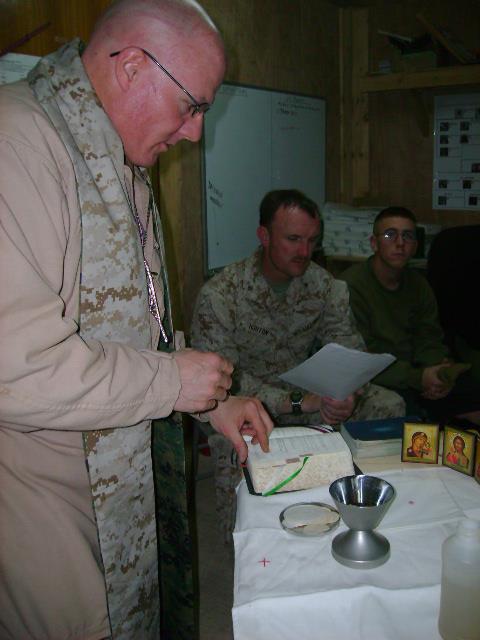
533506_10151366982457059_868388211_n


Likewise I expect that I will do my best to speak truth to those in power and those whose faithfulness is more a product of their comfort with the God that they create in their own mind rather than the Crucified God wise death on the Cross s a scandal. For many Christians the scandal of the cross is too easy to avoid by surrounding ourselves with pet theologies that appeal to our pride, prejudice and power. The kind of malevolent power represented by the bishop in Joyeux Noel. Thus I take a measure of comfort in the words of Simone Weil who said “He who has not God in himself cannot feel His absence.” 

Thus, like Paul Tillich I have come to believe that “Sometimes I think it is my mission to bring faith to the faithless, and doubt to the faithful.”  In other words to become a complete pain in the ass until the day that I die.

Praying for Peace this Christmas,

Padre Steve+
Leave a comment

Filed under faith, History, Military, ministry, movies, Tour in Iraq, world war one

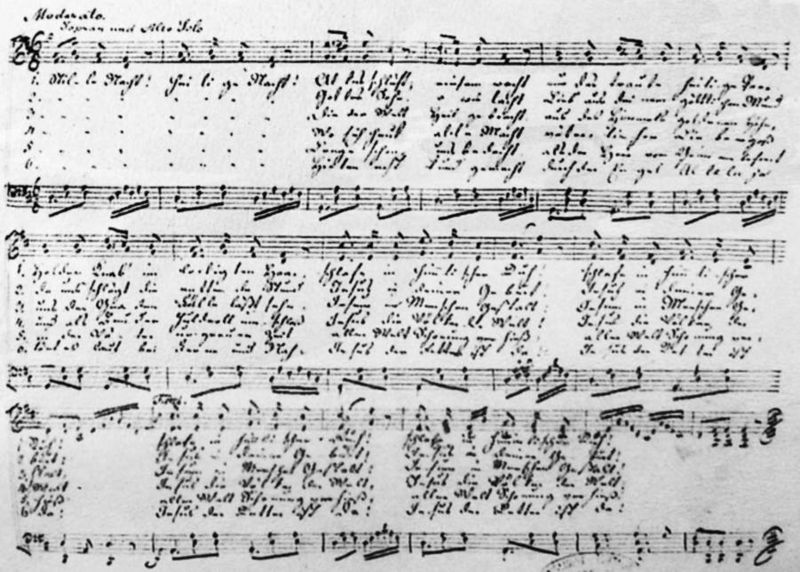
Stille Nacht

800px-Stille_nacht

Stille Nacht Autograph in the Hand of Joseph Mohr

In 1816 a young Austrian Catholic Priest in a small parish near Salzburg penned the lyrics to a hymn that even in the midst of war can bind people together. Father Joseph Mohr after moving to another parish in Oberndorf took those lyrics to Franz Gruber a nearby schoolmaster and organist. Mohr asked Gruber to put the words to music, specifically with a guitar accompaniment. Together the performed the song at Oberndorf’s parish church’s Vigil Mass on December 24th 1818.

There are a number of fanciful apocryphal stories about why the song was written and performed on the guitar, including one about the bellows of the church organ having been eaten by mice, but these are akin to sensationalist tabloid journalism. The simple truth is that Mohr sought out Gruber to arrange the song for guitar to be sung by two people accompanied by a choir for that Christmas Vigil Mass.

Stille Nacht, Heilige Nacht 

Stille Nacht, heilige Nacht,
Alles schläft; einsam wacht
Nur das traute hochheilige Paar.
Holder Knabe im lockigen Haar,
Schlaf in himmlischer Ruh!

Stille Nacht, heilige Nacht,
Hirten erst kundgemacht
Durch der Engel Halleluja,
Tönt es laut von fern und nah:
Christ, der Retter ist da!

Stille Nacht, heilige Nacht,
Gottes Sohn, o wie lacht
Lieb’ aus deinem göttlichen Mund
, Da uns schlägt die rettende Stund’.
Christ, in deiner Geburt!

 The song rapidly grew in popularity and spread quickly in Europe. A traveling Austrian singing group, the Rainer family performed it in front of Austrian Emperor Franz I and Tsar Alexander I.

They also gave its first American performance in New York outside the famed Trinity Church in 1839. I continued to grow in popularity and was translated into many languages, now numbering about 140.

The American Episcopalian Bishop John Freeman Young translated it into English in 1863. It is his version that is most used today in English speaking lands today. A website called the Silent Night Web http://silentnight.web.za has 227 versions of the song in 142 languages on its site.

Silent Night 

Silent night, Holy night

 All is calm, all is bright

‘Round yon virgin , mother and child

Holy infant so, tender and mild
Sleep in heavenly peace,
Sleep in heavenly peace.

Silent night, Holy night
Shepherds quake, at the sight
Glories stream from heaven afar
Heavenly, hosts sing Hallelujah.
Christ the Savior is born,
Christ the Savior is born.

Silent night, Holy night
Son of God, love’s pure light
Radiant beams from thy holy face
With the dawn of redeeming grace,
Jesus, Lord at thy birth,
Jesus, Lord at thy birth.

Father Mohr refused to profit from his song and donated his proceeds to care for the elderly and educate children in the parishes and towns he served. He died in 1848.

I find that the song will bring me to tears fast than almost any song. It is one that I have sung in English, German and French. In my travels as a military Chaplain have used on every Christmas Eucharist celebration that I have done, including at two lonely COPS in Iraq, COP South and COP North on the Syrian Border in Al Anbar Province. Likewise I have celebrated joint ecumenical Christmas services with German military chaplains and civilian clergy.

It is a simple and humble song. It is performed the world over by the great and small, the famous and the unknown. It is a song that in two world wars has stopped the violence as opposing soldiers paused to sing it together each in their own language. This happened during the Christmas Truce truce of 1914 as well as in 1944 along the Western Front during the Battle of the Bulge.

Tonight people gather for Christmas Eve services the song will be sung around the world. In lands where war rages the song will be sung. It is my hope that someday that war will be no more and the tiny child spoken of in this humble hymn will understand the incredible grace of the message spoken by the Angels as recorded in Luke’s Gospel:  “Glory to God in the highest, And on earth peace among men in whom he is well pleased.” (American Standard Version)

Peace and Merry Christmas

Padre Steve+

1 Comment

Filed under faith, ministry, music

Wounded Healers at Christmas

lastmass

Friends of Padre Steve’s World

The German theologian Jürgen Moltmann wrote, “God weeps with us so that we may one day laugh with him.”  Since coming home from Iraq in 2008 my faith has undergone a profound change. This is a part of my story that I share with you.

Christmas is a special time for me, it always has been but in spite of that there were times that I took the faith element for granted. I believed and my faith in God, for me the Christian God, Father, Son and Holy Spirit was unquestioned. I knew the Scriptures, the Creeds and the Councils and I felt that my faith in a sense was untouchable. I was sure of it, in fact almost cocksure or arrogant about it. That came out in published writings in a very conservative Catholic monthly, the New Oxford Review back in 2000-2001.

For me the elements of my faith were very much intellectual. I could see other points of view but if I disagreed with them enough I would engage them with the purpose of defeating them. Of course this usually went to theological methods, history and hermeneutics. As far as those that lost their faith it was something that I had difficulty comprehending. Not that I was unsympathetic or uncaring of them or their plight, but I didn’t see how it could happen to me.

But that was before Iraq. That was before PTSD, moral injury and my own crisis of faith when I returned from the Iraq War in 2008.  That changed me as war has changed so many others before. Guy Sager wrote of his return from war in his classic The Forgotten Soldier:

“In the train, rolling through the sunny French countryside, my head knocked against the wooden back of the seat. Other people, who seemed to belong to a different world, were laughing. I couldn’t laugh and couldn’t forget.” 

My return instigated a crisis of faith, I felt like I still belonged in Iraq and home seemed like a foreign land.  In the crisis I was for all practical purposes I was an agnostic trying to believe and feeling abandoned by God and many of his people, especially clergy.  Commodore Tom Sitsch at EOD Group Two, a veteran of much combat asked me “where does a Chaplain go for help?” I told him “not to other Chaplains or clergy.”

That crisis etched a permanent scar in my soul which led to some fairly major changes in my life.  It forced me to enter what Saint John of the Cross called the “Dark Night of the Soul.”

I will not tell of how my great spiritual disciplines and intellect helped me get through the crisis, as they did not. I found it hard to pray or believe in anything for nearly two years as I struggled with abandonment. I felt that God, the Church and the Navy had abandoned me.  The only thing that kept me going was my profound sense of vocation as a Priest and Chaplain and commitment to others who were suffering.

I was losing my battle with PTSD during that time, depressed, anxious and despairing I threw myself into my work among the critically ill ICU patients and those that cared for them.  Christmas Eve of 2008 was spent in despair as I wandered through the darkness on a cold night after leaving Mass because I could not get through it.

Though I found a community and camaraderie among those that I worked with and tried to provide spiritual care, my own condition grew worse.  I was so bad enough that my clinical duties had to be curtailed over my objections in September of 2009.

I still stood the overnight duty and filled in for others as needed, but for a number of months I had no clinical assignments.  That meant that others in our minimally staffed department had to fill in for me. I am sure that they resented that, especially because before this I often worked 80-90 hours a week mostly in our ICUs and the staff of the ICUs now expected that kind of intensive ministry and support.

But in my desperation I was greeted with a surprise. On one of the on call nights not long before Christmas I received a call to the ER to provide the last rites to an elderly retired Navy Medical Doctor.  The man was a saint, faithful to God, his Church and the community. For years he dedicated much of his practice to the poorest members of the community, delivering babies for women with no insurance and caring for prisoners in the Portsmouth City Jail.  He breathed his last as I prayed this prayed the prayer of commendation following the anointing and something strange happened. I felt the presence of God for the first time since Christmas of 2007 in Iraq. It is too this day hard to explain.

Something miraculous happened that night and by Christmas Eve I realized that something was happening to me. As I wrote in Padre Steve’s Christmas Miracle on Christmas Eve of 2009:

“Mid afternoon I was walking down the hall and I experienced a wave of emotion flood over me, and unlike the majority of emotions that I have felt in the past couple of years this was different.  It was a feeling of grace and I guess the presence of God.  I went up and talked with Elmer the shrink about what I was feeling and the experience was awesome, I was in tears as I shared, not the tears of sadness, but of grace.  I am beginning to re-experience the grace of God, something that has been so long absent that I did not expect it, at least right now.  I didn’t do anything differently; I certainly was not working extra hard to pray more, get more spiritual or pack my brain full of Bible verses.  I was too far gone to do those things.  It was all I could do many mornings just to get out of bed and come to work.”

Since that time I have continued to recover faith and belief. I cannot say that it is the same kind of faith that I had before Iraq. This was a different kind of faith.  It was faith born of the terrible emptiness and pain of abandonment and despair, a faith that is not content with easy answers and not afraid to ask questions.  It is a faith in Jesus Christ, the crucified one who’s image we see hanging from the crucifix and adorning icons of the Crucifixion. It is as Moltmann wrote in The Crucified God:

“The Symbol of the Crucifix in church points to the God who was crucified not between two candles on an altar, but between two thieves in the place of the skull, where the outcasts belong, outside the gates of the city. It is a symbol which therefore leads out of the church and out of religious longing in to the fellowship of the oppressed and abandoned. On the other hand, it is a symbol which calls the oppressed and godless into the church and through the church into the fellowship of the crucified God”

My Philosophy of Religion Professor, Dr. Yandall Woodfin at Southwestern Baptist Theological Seminary told us in class that until we had “dealt with the reality of suffering and death we were not doing Christian theology.” At the time the words were offensive to me, but by the time I had graduated and also done a year of Clinical Pastoral Education they became a part of my experience. However that did not prepare me for the darkness that I lived in from February of 2008 until that Christmas Eve of 2009.  I would say that in addition to Dr Woodfin’s understanding of grappling with suffering and death that one has to add the abandonment of the outcast to the equation.

The “I Believe in God” of the Creed is no longer for me simply a theological proposition to defend, but rather an experience of God born out of pain, despair, anxiety, doubt, unbelief and abandonment. During my crisis I found almost no Christians willing to walk through the darkness with me, including clergy. The only clergy willing to were those who were walking the same path of the outcast with me, suffering from PTSD, TBI and other unseen wounds of war. It was if I was radioactive. Many people had “answers” for me, but none sought to understood my questions until my first  therapist Dr. Elmer Maggard asked me “how I was with the big guy?”

When I finally collapsed in the summer of 2008 and met with Dr. Maggard I made a conscious decision that I would not hide what I was going through.  I felt that if someone didn’t speak out that others like me wouldn’t seek help. In the nearly six years since I returned from Iraq I have encountered many people, men and women, current and former military personnel and families of veterans who came to me either in person or through this website. It led to me being interviewed in a newspaper and being featured on the Real Warriors website http://www.realwarriors.net , a program run by the Department of Defense to help reduce the stigma of getting help for PTSD which features the stories of military personnel suffering from it. My story can be found here: 

http://www.realwarriors.net/multimedia/profiles/dundas.php

I have had a number of military chaplains come to me also experiencing a faith crisis. Most said that I was the first Chaplain or minister that they had met or who admitted that he struggled with faith and the existence of God.  For a minister to be open about such struggles is dangerous. When my faith returned and was different I was asked to leave my former denomination because I was now “too liberal.”

In each of those encounters with those suffering there was a glimmer of hope for me and I think for them.  It was as if for the first time we had people that we could be open with.  Co-workers and others said that I was “real.” I certainly do not boast of that because it was painful to be transparent with people while in the depths of doubt and despair while hoping that somehow God would touch them with some measure of grace when I found it hard to believe.  I guess it was the fact that I was willing to walk with them in their crisis and let them be honest even if it meant facing my own pain and doubt. I learned something about being what Henri Nouwen called a wounded healer.  Nouwen wrote:

“Nobody escapes being wounded. We all are wounded people, whether physically, emotionally, mentally, or spiritually. The main question is not “How can we hide our wounds?” so we don’t have to be embarrassed, but “How can we put our woundedness in the service of others?” When our wounds cease to be a source of shame, and become a source of healing, we have become wounded healers.”

I do still struggle with the continued effects of War and PTSD, but I am in a much better place. I also struggle with faith at times when I look at the actions of those who profess to believe but treat others with contempt. I can understand the quote from the Gospel “I believe, help my unbelief.”

So today this wounded healer will celebrate a special Christmas at home. My wife and I will celebrate a Mass, enjoy a Christmas dinner with our dogs, Molly and Minnie. Depending on how she feels we will either go out to a movie or watch one at home.

I want to thank all of my readers, especially those who like or comment on these posts. You are appreciated, some are lengthy and you choose to take your time to read them and often share them. If you are walking the path of the outcast feel free to drop me a line here or on my Facebook page. My wish for you and for all is a Christmas of peace, reconciliation and love.

Peace and blessings,

Padre Steve+

1 Comment

Filed under christian life, faith, ministry, Pastoral Care, PTSD, Tour in Iraq

The Long & Winding Road of a Radioactive Priest

IMG_1931

Friends of Padre Steve’s World

The late Henri Nouwen wrote, “Ministry means the ongoing attempt to put one’s own search for God, with all the moments of pain and joy, despair and hope, at the disposal of those who want to join this search but do not know how.”

Those who have followed my writings for some time know how much that means for me, and how in spite of all of my struggles with faith and doubt it matters as I continue my own walk, as well as try to be there for those who like me struggle at this time of year. Since I have a lot of new readers since I last shared this I figured I would attempt to share those thoughts again.

In February 2009, about eight months after psychological physical and spiritual collapse due to the effects of PTSD and in the midst of my struggle I began to write about my experiences on this site. My psychologist at the time had suggested that I go public with my struggles using my writing as a means to do so. It was something that I had contemplated for some time. I was a mess and struggling many days to even get to work. I was depressed much of the time, continually on edge, still suffered from nightmares, night terrors, flashbacks and sometimes an angry rage which swept over me when I felt threatened. I avoided big crowds, was afraid to even go to church and I had a hard time trusting anyone. In that time I would listen to the Beatle’s song “The Long and Winding Road” which in some ways became a prayer for me.

The long and winding road
That leads to your door
Will never disappear
I’ve seen that road before
It always leads me here
Lead me to your door

The wild and windy night
That the rain washed away
Has left a pool of tears
Crying for the day
Why leave me standing here?
Let me know the way

Many times I’ve been alone
And many times I’ve cried
Anyway you’ll never know

The many ways I’ve tried

And still they lead me back
To the long winding road
You left me standing here
A long long time ago
Don’t leave me waiting here
Lead me to your door

But still they lead me back
To the long winding road
You left me standing here
A long long time ago
Don’t keep me waiting here
Lead me to your door

The Long And Winding Road lyrics: Songwriters: Mccartney, Paul; Lennon, John. © SONY BEATLES LTD; SONY/ATV TUNES LLC

So I began to write and find some solace even as I struggled with even the existence of God. One thing that I found was that there were really very few people, especially ministers secure enough to enter into a healing relationship with me. I felt isolated among my peers especially those from my own church. Since I have detailed that journey to include a restoration of faith in God in December 2009 about two years after my struggle began I won’t go into great detail in this article. All I knew is that it seemed that most Priests and other ministers either didn’t know how to walk with me, were afraid to walk with me and were most certainly uncomfortable with a colleague, especially one with my experience dealing with the pain psychological and spiritual effects of PTSD including being from all practical purposes an agnostic. As one psychotherapist labeled it I was “radioactive.”

Eventually some in the leadership of my former denomination which I had served faithfully as a priest for 14 years asked me to leave the church because I had become “I had changed since coming back from Iraq” and “had become too liberal.”I had known this was coming for some time and had been making preparations for it but the timing of the notice from my former Bishop came as a surprise.

I had begun to voice opinions, especially on social and political issues that rankled some, maybe many in my former church. Since only a few friends from that church remain in contact with me I presume that I rankled more than I did not. There were times during the early part of 2010 that my wife would ask me after reading something that I had published if I was trying to get thrown out. I wasn’t trying to but I was at the point where I knew that I had to be honest and transparent about my struggle as well as how my beliefs had changed a result of war and of PTSD. I was diplomatic and tried to say what I had to say without getting too controversial. That began to change in the summer of 2010 and reached its head on September 23rd when I published Faith Journeys: Why I am Still a Christian. https://padresteve.wordpress.com/2010/09/22/faith-journey%E2%80%99s-why-i-am-still-a-christian/

I actually did not intend for the article to be too controversial, but looking back I can see how it was interpreted that way. It was for all practical purposes a declaration of independence and a severe criticism of the lack of care that I had felt from the church that I had served for most of my ministerial career. In a sense it was my “Here I stand, I can do no other moment.” 

My goal since faith began to return was to be available to those that feel cut off from God and the Church, to walk with people in the midst of struggle, pain and despair, especially fellow ministers and chaplains. I don’t have all the answers, in fact I know very few, except that I know that God can use the pain, alienation, struggle and despair that I went through then, as well as the struggles that I still have in the lives of others like me that are willing to walk that lonely path to reconciliation with God and humanity.

It has been a long, winding and often lonely road but I have found solace, community and faith as I have travelled it. Those that I have met along the way have become my brothers and sisters on the journey. And that my friends makes it all worth it.

Peace

Padre Steve+

1 Comment

Filed under christian life, faith, ministry

Success, Depression & Empathy

chicken of depression

Friends of Padre Steve’s World,

I just finished reading a biography of the late Iris Chang, who wrote the book The Rape of Nanking and A History of the Chinese in America. She was a brilliant, caring, and passionate women who had a major depressive crash and ended up committing suicide. She wrote her mother about her feelings when Charles Schulz, the creator of Peanuts died, the night before the final Sunday comic came out. She wrote her mom:

Dear Mom,

I think it was Charles Schulz’s pessimism – as well as his ability to understand human failure, insecurity, heartbreak – that made millions love Peanuts.

You’re absolutely right, Schulz had no reason whatsoever to be depressed, after achieving wealth and fame at such an early age. But depression is not rational. Perhaps he did have a mental problem, or some chemically induced condition. But whatever it was, it prevented him from losing touch with the underdogs of the world.

It’s strange, but I still feel a void in my heart after Schulz’s death – even though I never knew him and didn’t particularly like him after meeting him in person, It made me wonder, what is the secret to Schulz’s magical appeal?

The answer, I believe, is simple. Schulz understands the heart of a loser. He captures those moments in life when we fell utterly unloved, unwanted, and alone. And all of us – no matter how successful- have felt like losers at some point in life.

Love, Iris

(From The Woman Who Could Not Forget: Iris Chang Before and After The Rape of Nanking, a memoir by Ying-Ying Chang, Pegasus Books, New York, 2013)

The book intrigued me and I was drawn to Iris’s story, and was so impressed with her as a person, and having suffered major depression myself, felt a certain kinship with her as I read the book, especially the chapters dealing with her success, and her collapse.

Those of you who have followed me for a while know that I have struggled a lot with major depression, anxiety, and even have occasionally been suicidal since returning from Iraq in 2008 with one hell of a case of PTSD. Thankfully over the past couple of months I have been doing pretty well. While I still suffer chronic insomnia, really weird dreams, nightmares, and night terrors, as well as anxiety in crowed places and flashbacks; but I have not been chronically depressed. I have had a few down days, but nothing like the past number of years. So all in all I think that is a good thing, I am starting to get back in better physical shape, eating better, and losing weight, so all in all I count that in the win column.

That being said, since Iraq I have developed a tremendous amount of empathy for those that suffer from depression, because it is not a rational disease. It affects millions of people in our country, and I am not referring to people who once in a while get the blues or feel a bit down, but people who live their lives in a state of clinical depression. I have known a lot of people who suffer from depression. Most are tremendously talented, witty, charming, intelligent, and caring. I have known very successful people who suffer from such depression that they cannot appreciate their own achievements and feel like failures. I have known some who have committed suicide because they saw no hope for themselves and believed that the world would be better off without them. I have friends who walk this path today, people who are battling to stay alive.

Likewise, many of my heroes, my role models, have suffered from depression, even lifelong depression. These include Joshua Lawrence Chamberlain, the hero of Little Round Top at Gettysburg, Abraham Lincoln, and T.E. Lawrence, better known as Lawrence of Arabia.

Sadly, most people, especially religious people have little long term tolerance for depressed people. If the depressed person does not get better, they abandon them, sometimes in very cruel ways.

In a Peanuts strip Charlie Brown goes to Lucy and says, “I have deep feelings of depression… What can I do about this?” Lucy does what is so common in our culture and says “Snap out of it! Five cents, please.” The fact is that if you are chronically depressed or suffer from clinical depression, you don’t simply snap out of it and I think that depression and mental pain is harder to bear than physical pain. C.S. Lewis wrote in his book The Problem of Pain:

“Mental pain is less dramatic than physical pain, but it is more common and also more hard to bear. The frequent attempt to conceal mental pain increases the burden: it is easier to say “My tooth is aching” than to say “My heart is broken.”

The reality is that depression is not rational, nor is it logical, and thus it defies the attempts of well-meaning people to help those who suffer from it. You can tell a depressed person to get involved in activities, to stay busy, work harder, to read their Bible or pray more, but most of the time this only makes things worse. The depressed person tries them and does not get better which makes the depression and feeling of failure even worse. I know this because I lived it, I did all those things. I worked harder, prayed more, and the rest of that, and I only got worse. Then I began to lose hope. It was terribly frightening and very few people understood, and even fewer stood by me. Those who did were mainly my drinking buddies and friends from the Norfolk Tides and Kinston Indians ballparks, not clergy, or chaplains. 

This makes it terribly frustrating for all concerned. The depressed person ends up feeling alone, lost, isolated, and rejected when the friends, family, and caregivers give up.

I think to me the hardest thing is that for those of us who serve in caring professions, the clergy, mental health care, medicine, and nursing; is that when we struggle there is often no-one to go to. When I was absolutely falling apart after Iraq, my new commanding officer asked me “where does a chaplain go to get help?” and I said “I don’t know, but not to other chaplains.” I know that I said that in the abyss of total despair, and that there are a couple of chaplains that I can go to and pour out my heart without fear of rejection, but they are the minority. The fact is that many caregivers, especially clergy, have no empathy for those most like them. I know this because I have known and seen so many clergy, across the denominational and theological spectrum who have been broken by the cares of life, and been abandoned by their churches and their peers.

But like, Iris Chang, I do think that some, people like Charles Schulz, the depression they live enables them not to lose touch with those who suffer, that in a sense that their suffering engenders a great empathy for others that many lack. I have been told by some that I have that kind of empathy and if I do it is not because I am such a great person, but rather because I have suffered and still suffer from the pain, and despite my own accomplishments, and achievements, that I still occasionally feel like a loser or failure. But as far as my condition goes, I am oddly comforted by the words of Raymond “Red Reddington (James Spader) in The Blacklist:

“There is nothing that can take the pain away. But eventually, you will find a way to live with it. There will be nightmares. And everyday when you wake up, it will be the first thing you think about. Until one day, it’s the second.”

I know my ongoing battle will continue, but I have determined to try to be there for others that struggle with pain that does not want to go away, and nightmares that never seem to end. As the late Henri Nouwen wrote: “Ministry means the ongoing attempt to put one’s own search for God, with all the moments of pain and joy, despair and hope, at the disposal of those who want to join this search but do not know how.”

Until tomorrow,

Peace

Padre Steve+

2 Comments

Filed under faith, History, mental health, ministry

Faith, Doubt & Sacramental Encounters

IMG_0535

Friends of Padre Steve’s World

The late Father Andrew Greeley wrote in his mystery novel The Archbishop in Andalusia, “Every sacramental encounter is an evangelical occasion. A smile warm and happy is sufficient. If people return to the pews with a smile, it’s been a good day for them. If the priest smiles after the exchanges of grace, it may be the only good experience of the week.” 

I firmly believe that, and this week I had the opportunity to be present at one of thos sacramental encounters.

People who know me well, and people who have read what I have written on this site for the past six or so years know that I struggle with faith, belief, and doubt. I am a priest, and have been so for nearly twenty years, but faith for me is a constant struggle, and as such, I pray that in my seasons of doubt, and occasional unbelief that I won’t screw things up for others.

Over the past two years my academic duties have been more a part of my life than my priestly duties because of the nature of my assignment at the Staff College. I have a chapel, but attendance is always sparse and if I get more than five people in attendance it feels like a mega-church. I also do some counseling as well as care for students or those on our staff and faculty who need pastoral care, but the bulk of my duties are teaching and writing. This has been good as I spent the five previous years in hospital ministry and before that ten of twelve years doing operational duties and the other two in base chapels and congregations.

My current duties are refreshing, and despite my struggles with faith I attempt to be sensitive to what is going on around me, and the people who I come into contact with. This has been one of those kinds of weeks. We had a friend get ploughed over by an inattentive driver who cut across two lanes of traffic to strike my friend on his Harley. My friend was not at fault but is busted up pretty badly. His recovery will take six months to a year. Judy and I were visiting him on Thursday night and when we were going out on the elevator, it stopped and an older lady with two large bags asked if the elevator was going down. I said yes, held the door and had her come in. Since she was taking bags out I asked if she had family there and if she was going to be taking them home.

She looked up and told me that her husband was dying and had just days to live. I asked if I could carry her bags to her car and she told us what was going on. Her husband, a 30-year Navy veteran, who she had been married to for 46 years, was taken ill just a week prior after coming home from work. She took him to the hospital and after exploratory surgery they were informed that he had cancer throughout his body and just days to live, nothing could be done. It came as a shock as he had not missed a day of work for over ten years, and the illness was the first sign that he was sick.

We walked her to her car and I carried her bags and told her that I was a Navy chaplain. I have few words to describe what happened next. When I said that she was moved to tears, but they were not tears of sadness, she said that God must have meant for us to be on the same elevator. I wonder about such encounter, often, if not most of the time, I believe that what happens to us is not directed by God; but rather chance encounters that we are left to do the best we can in; but I was not going to argue. I realized that many military veterans and their families, especially older ones, are often more appreciative of chaplains than civilian clergy; so I offered to do anything that I could. I took a battered business card from my wallet, scribbled by cell phone number on the back and gave it to her, inviting her to call me any time. Judy and I left her as she went home to clean up and await the arrival of her children before she went back to the hospital.

That night she and her husband weighed on my mind and late last night she called me and asked if I could come by the hospital Saturday or Sunday. I told her that I would be there this morning. I again thought of her and her husband and what I would need, and tried to get some fitful hours of sleep. I got up, and went to the office to pick up my prayer book and hospital stole, made sure I had oil to anoint him and then drove the twenty-miles back across town from the base to the hospital, where I arrived at ten a.m. I knocked, and she greeted me, a social worker from the hospital palliative care was there, as was her son. She greeted me with a hug and introduced me and let me know that her husband had passed away not long before. He lay in the bed and she invited me to sit with her by him.

She then told me of his passing, how she saw the room filled with angels and a golden hue, she asked God to wait to allow her son and his brother to arrive. He hung on and shortly after they arrived she could see and feel the angels taking her husband to heaven. She then spoke of their life, and relationship and all the hopes, dreams and joys that they had experienced over the years, and how she had always been jealous that he had kept his youthful looks while she had obviously aged. She asked if I would pray and then I did so, commending his soul to God. I was reminded of Greeley’s words “We are born with two incurable diseases, life, from which we die, and hope, which says maybe death isn’t the end.” The encounter re-impressed those words on me. We all die, but we live in hope that death is not the end.

After a while longer I left and went to visit my friend who is being discharged today, though he will need several more surgeries over the coming weeks an months. We are going to do all that we can for him and his wife to help take up some of the burden, because they, like so many of our friends from the bar at Gordon Biersch are closer to us than any church people that we have known here; and they have been there for us when we needed them.

So now we are about ready to go to a birthday party for another friend. All part of the cycle of life, and perhaps the cycle of God’s grace, love, and presence, even in those times that we do not believe.

Peace

Padre Steve+

Leave a comment

Filed under christian life, faith, ministry

Not to Be Alone: Why Gay Marriage Matters

Friends of Padre Steve’s World

I have been thinking about the profound legal and moral implications of the Supreme Court ruling on marriage equity, the Obergfell v. Hodges case. One of those impacts in in a very simple and human concern, the ability of people to be with their loved ones during medical crisis or when they are dying. I saw the profound implications of not having this right when I was a young chaplain doing my hospital residency at Parkland Hospital in Dallas, Texas 1993 and 1994. This is the story of those two encounters and how they changed me.

Peace

Padre Steve+

marriage equality

For me it is still hard to comprehend, a young chaplain; two relatively young men dying of AIDS, two partners, two families and two radically different experiences of humanity, faith, religion and authentic loving relationships.

I was still a relatively inexperienced minister and chaplain back when I was doing my Pastoral Care residency at Parkland Memorial Hospital in Dallas Texas back in 1993 and 1994. Yes I had graduated from seminary. Yes I had a bit of chaplain experience as an Army National Guard chaplain and as a counselor at a major evangelical Christian ministry, and yes I had experience in dealing with AIDS as a Medical Service Corps officer in the Army.

Despite that, I was so ill prepared to deal with the massively different treatment of people dying from AIDS from their families. Families that in some cases shared the same Christian faith as me. I think that is one of the things that young ministers struggle with when they enter the nether world between life and death, mortality and immortality, faith and unbelief in the real world. When I was in seminary the senior pastor of the mega-church that I attended told a story about being approached by a family member of someone who was very sick and in hospital. The person wanted him to visit them while they were a patient. He had been their pastor for years. When they ask him if he would come, he refused. He recounted that the “parishioner asked just how sick he would have to be to get a hospital visit?” The pastor told us his response. He laughed and said “you don’t want to be that sick.” The congregation laughed and I was devastated.

The pastor was a leader in the New Apostolic Reformation, a friend of John Wimber, Rick Joyner and others who helped to pave the way to the heartless, unfeeling, political “Christianity” and “Dominion theology” that is in vogue with the Tea Party and Religious Right today. When I questioned him about his comments later he told me that thought that pastoral care of those in his congregation, especially in regard to hospital visits was “below his office as an apostle, that others had that responsibility.” The thing that disturbed me the most was that he had ordained me as an Evangelical minister in that church to be a chaplain barely two years before this. I had respected him and now I felt a tremendous sense of emptiness when I left his office.

So when I began my pastoral care residency at Parkland I found that I had a lot to learn about the real world of religious faith, religious hypocrisy and religious hatred and intolerance.

Early in my residency I dealt with a number of AIDS cases. I wrote about one of those cases last night, although that was not really early in my residency, it was closer to the end of it. There were two cases besides that one that made such deep impressions on me that I can never forget them. Both involved young, white, homosexual men dying of the complications from full blown AIDS. Both came from very “Evangelical Christian” families (both were Southern Baptist) and both were being grieved by what we called then, their “significant others” as well as their biological families. But that was where the similarities ended.

The first case was in the second month of my residency, when I was the chaplain for the Medical ICU, before the Pastoral Care Director wisely moved me to the Trauma and Surgery department. A patient came to us, a man, about my age, a successful architect with many friends who was experiencing pneumonia brought about by his immunodeficiency brought about by HIV.

When he arrived he was still able to communicate and he had many of his friends as well as his significant other visiting him. They loved him and he loved them. There was a sense of community and if I dare say real family as they visited. In those first few days I got to know him and these people, most of who were homosexual but not all. There were a number of women there, who I am sure had the patient, who was a remarkably handsome man, been a heterosexual, would have loved to have been his wife.

My encounter with him, before his condition worsened to the point that he had to go on a ventilator and was sedated was transforming. He grew up in the church, knew that he was homosexual, attempted to live with it and finally came out as gay, and was disowned by his family. Despite this he became a highly successful architect, had many friends, was active in charitable works, and still maintained his faith in Jesus. I came to appreciate him, the man who for was for all purposes his spouse and his friends.

However, when his condition deteriorated his estranged family, the people who had disowned him, rushed to his “rescue.” In good Christian form they brought their pastor who though their son was unconscious proceeded to preach at him regarding his need to “repent” and “to come back to Jesus.” The family also took advantage of the law. They were his biological family and next of kin. They banned the man’s partner and friends from his room as he lay dying.

The family’s pastor preached at the dying man and glared at the people closest to him while he was present.  I was appalled by his, and their behavior. While they isolated their son from those closest to him and allowed their pastor to condemn him as he died, I remained with his partner and friends. I prayed with them, I cried with them, I embraced them. When the family left I went with them to be with this young man’s mortal body. We prayed and after the nurses prepared his body and the doctors completed their final notes, I walked with them as we took his body on that long trip from the ninth floor to basement, where the morgue awaited. I still cry when I think of this encounter, of how supposedly Christian people would not only keep their son, who they had rejected and condemned from those who loved him the most as he lay dying.

A couple of months later I was in my element as the Trauma and Surgery Department Chaplain, but I still had on call duty where I was responsible for crisis situations anywhere in the house. One of those wild nights I got a call from the nursing staff of Nine South, the Medical Step Down unit where the lady that I wrote about last night had passed away, but that was still in the future.

This time there was another young white man, another partner, another family. This young man was not in the ICU fighting for his life, he was passing away in the quiet solitude of his room with his mother and father, his partner and his friends at his side. Like the other young man he was a man of faith. He loved Jesus, he loved his family and he loved his partner.

He was from the area west of Dallas, the area between Fort Worth and Abilene. His mom and dad were ranchers, dad was wearing his cowboy hat, a plaid shirt, classic western Levi’s jeans and cowboy boots. His mom was wearing a simple dress. Both were thing, tanned and their faces lined by the sun and weather and from being out on the range with their cattle. The young man who was with them, the dying man’s partner was casually dressed but though he was from the same area was not a rancher.

I spent time with all of them. The contrast between the “Christian” parents and pastor of the first young man could have not been more profound. Like the architect’s parents, they were Christians. In fact they were Southern Baptists who attended a small country church in the town that they lived. By any sense of the word they could be described as “Fundamentalist” Christians, but unlike so many fundamentalists they focused on loving God and loving people, even people that so many Christians reject out of hand.

I arrived as the patient was breathing his last. I remained with him, his parents, partner and friends as he passed away, and when his parents asked I offered a prayer commending his soul to God. As I did this his partner was in a state of near collapse, exclaiming “I have no one now, I am alone!” His grief was overwhelming, he had no legal status, in the eyes of the law he meant nothing, though the man that he loved had just died. My heart was rent, and I held on to him.

As I did, the patient’s father came alongside of us. The father said to the young man “You are not alone, you are our son now, we love you.” When this dear man said this we all were in tears, as I am right now. I stayed with all of these dear people as the nursing staff prepared the young man’s body to go to the morgue. At some point the parents escorted their son’s now widowed partner out of the hospital. Mom and dad walked on either side of him as they left the ward. If there was anyone couple on this either who were true Christians, it was this dear couple. As we parted I could not hold back the tears, and the father of the deceased gave me a hug and thanked me for being with them and honoring his son.

I remained with the nursing staff and the internal medicine resident as they complete their duties and took the young man’s body to the morgue. After that I went back to the emergency room where some of the nursing staff, including a RN who at one time had been an Assemblies of God pastor, but was now an avowed atheist who loved to torment chaplains, except me, comforted me in my grief. It is funny that an atheist would be comforting the chaplain after such an event, but then if I do believe in God, why can’t I believe that anyone cannot share in the grief of others and of comfort and care.

It was a story that I could only share with my pastoral care residency supervisor, in our residency group and with my wife Judy, as I knew if I shared my experience at church that at best I would only be humored, and most probably be ostracized. In fact I had to keep that story pretty much under wraps until 2010 when was told to leave the church which had ordained me a priest, for among other things speaking out for the rights of Gays, Lesbians and the LGBTQ community. By then I had met and served with far too many Gays who were far better Christians than most of the Christians who condemned them not to do so.

But, in a way it was a step to freedom because I realized that what I had been taught for so long was so horribly at odds with the message of Jesus.

Two deaths, two men, two partners, two families, two experiences of God’s grace, two experiences of a common humanity and the experience of one very flawed, but no longer confused chaplain…

Leave a comment

Filed under christian life, civil rights, ethics, faith, healthcare, laws and legislation, LGBT issues, ministry, Pastoral Care

Friends, Puppies & Laughter: the Cure for the Celtic Funk 


Friends of Padre Steve’s World

Last week really sucked and I do want to thank those of you who have been so kind to offer words of encouragement on the site or on other social media platforms. Last night was a contuation of the funk. I did not sleep well, had very strange dreams and nightmares and when I got up this morning I was in a deeper funk than I was anytime during the past week. So I just want to say thank you for the love, concern, support and prayers. 

For those that don’t know my family background, we are mostly Scotish, Irish and English with a little bit of French Hugenot and a smidgen of Scandnavian mixed in. Thus I am predominately of Celtic stock which can take a melancholy mood and make it worse, the only fixes for such a foul temper is some irreverent humor and beer. The humor I have enjoyed and I will enjoy the beer in not too long. 

Without reciting the litany of all the events that happened last week, including some that we will still have to face that could make last week look good, I have to say that I am in a far better state of mind that I was just a few hours ago. There are three things for this. First are the friends, many who have known me for years who have offered uncouragement and did not preach at me. Likewise there are my friends that I am getting to know who follow and comment on what I write here, as well as those on Twitter. It would take so much time to mention everyone who has been so kind and I fear that I would leave someone out. But you all know who you are and I have responded individually to all of you. God bless you and thank you. 


That being said last week I felt like my life was a bad country and western song and kind of reminded me of the opening scene of the movie “Stripes” starring Bill Murray. After losing his job, his car, his girlfriend and having dropped his pizza on the ground he simply said “and then depression set in.” I have been so depressed this past week, and I am sure that when I see her next that my shrink will note in my chart that I am officially suffering from clinical depression. But my friends I digress…

Today started out as crappy as any of the past week. I got in to work early, checked my e-mail and then went down to my empty chapel having locked my keys in my office. I had to get security to get the master key to let me in so I could open up the chapel for the throngs of people who do not show up. Then I had to get an external hard drive to take to the Apple Store as my old MacBook Pro went crazy and crapped out on me yesterday. I can either spend big bucks to have it repaired or pay a couple of hundred buck more for the new and improved model. 


I got to the mall where the Apple Store is located and found out that it did not open until eleven a.m. I mean that they don’t even unlock the doors until eleven. So I am standing in Barnes and Noble, which by the way is open wondering just why the hell I can’t walk the mall even if no stores are open. So in frustration I go to the Starbucks inside Barnes and Noble to get a cup of coffee. In front of me is a couple who looked far older than me though I am sure they were probably about my age. The difference is that they were dressed like grown ups, something that to Judy’s consternation I am incapable of doing. This couple were either on their way to or on their way from church and the wife was agonizing over what type of tea to purchase, maybe it was for a gift or for their own consumption by the woman was deeply serious about what would be a key decision in life. 

So the girl behind the counter, the barista, I think that is what we call them now asks me what I would like. 

I responded with my standard line, “plain black coffee.” When she asked if I wanted her to leave room for creame or sugar I responded “no I drink it dark and bitter like my life.” That was more true than usual this morning, usually I mean it as a joke, but today I was quite serious. When I said it the church lady looked up from her quest for the perfect tea and almost in shock said “you poor man.” Somehow that cheered me up a bit. I attempted to assuage her obviously genuine concern by giving her a big smile and a wink. gave her a big smile and wink. 

I sat down and had my dark and bitter coffee and as I did so my Facebook and Twtter friends were offering words of encouragement. Finally the mall open its doors and I was able to go to the Apple Store and drop off the external hard drive to get all my data from the old computer. 

When I got home I was treated by Minnie and Izzy. There is nothing like the greeting of sweet puppies to melt one’s heart and to cheer one up. That was nice. Of course Judy and I were able to talk about the week, reflect on Molly and our concerns about what she might face. We had some good laughs and then I saw a quote that made me laugh harder than I have all week. It is from Stephen King.

“When his life was ruined, his family killed, his farm destroyed, Job knelt down on the ground and yelled up to the heavens, ‘Why God? Why me?’ And the thundering voice of God answered ‘There’s just something about you that pisses me off.’

I about hurt myself laughing and now I feel so much better. I’m sure I will quote it the next time Job is in the lectionary readings for a Sunday. Perhaps a tiny bit of blasphemy is the best medicine after all. 


Have a great Sunday, and thank you for everything.

Peace

Padre Steve+ 


1 Comment

Filed under dogs, faith, ministry

Music, Liturgy & the Relief of the Soul

davids_harp__image_1_sjpg1312

Friends of Padre Steve’s Word

Something a little bit different. A while back I was asked to write and article for a periodical called “The Liturgical Singer” which is published by the That National Association of Pastoral Musicians. The article came out only in hard copy and at the request of a couple of friends I am posting it here. Have a great night.

Peace

Padre Steve+


“And whenever the evil spirit from God came upon Saul, David took the lyre and played it with his hand, and Saul would be relieved and feel better, and the evil spirit would depart from him.” 1 Samuel 16:23

When I was in seminary one of the most valuable courses I ever took was an introductory course in Church Music. The course opened my heart to music in the liturgical setting. Now I am not a musician, I play the radio and sing monotone. Like many pastors, priests and theologians I am a word person; written, spoken I am a word person. That being said I learned early on that music can be a balm for the wounded and suffering soul.

Sadly, I don’t think that many priests or pastors truly understand this. I am a Priest and Navy Chaplain. But, I am one of the wounded. I suffer from severe PTSD, anxiety, and more often than not I find going to church often makes things worse. As an Iraq Veteran I can somewhat relate to King Saul. Sometimes the effects of PTSD feel like an evil spirit, and when I came home from war I went through a spiritual crisis that was so bad that for nearly two years I was for all practical purposes an agnostic hoping that God still existed.

Hans Christian Anderson wrote that “Where words fail, music speaks.” All too often our worship, even in liturgical churches focuses more on words, than it does the healing property of music.

Those who suffer from trauma of any kind, including PTSD, or who suffer from anxiety, depression or other afflictions of the soul don’t usually come to church to see a show or to get yet another self-help lecture baptized with a few selected Bible verses. They don’t come to be entertained. They come for solace, they come to encounter God as do most regular churchgoers. But a recent Barna survey noted that less than 20% of regular churchgoers feel close to God on even a monthly basis. Martin Luther, who suffered from tremendous depression and despair for much of his life wrote “My heart, which is so full to overflowing, has often been solaced and refreshed by music when sick and weary.”

One has to ask why this is. I think one reason is that in many churches, even liturgical churches music has become entertainment. While this is pervasive in our American church culture it is not new. Erasmus of Rotterdam wrote:

“We have brought into our churches certain operatic and theatrical music; such a confused, disorderly chattering of some words as I hardly think was ever in any of the Grecian or Roman theatres. The church rings with the noise of trumpets, pipes, and dulcimers; and human voices strive to bear their part with them….”

As entertain it really is no longer part of liturgy, which is by definition the work of the people. I think the type or style of music is less important than the message that it conveys. I honestly believe different types of music touch our soul in different ways. That being said I think that the message of the music should lead people into the presence of God and to do that church music directors and liturgists need to back off of the culture of entertainment that has invaded the Church. I can say that there are songs, hymns and psalms of almost every musical style which reside in my heart. In the midst of my spiritual crisis I found that some of these songs stayed with me. One verse of Abide With Me was one of my prayers during that time:

Come not in terrors, as the King of kings, But kind and good, with healing in Thy wings, Tears for all woes, a heart for every plea— Come, Friend of sinners, and thus abide with me.

I have found that when a liturgist leads a people into the presence of God it is that the songs, hymns and songs they use actually allow the people to participate in the liturgy. The songs speak of God’s presence even in the midst of suffering, they allow those who suffer a measure of hope, even in the midst of what St. John of the Cross referred to as “the dark night of the soul.” When this happens the music becomes part of the participant’s experience of God, it takes up residence in the depth of the soul and there it remains reminding the person that they are not alone. Percy Bysshe Shelley wrote that “Music, when soft voices die, vibrates in the memory.”

Peace

Padre Steve+

Leave a comment

Filed under christian life, faith, ministry, music, PTSD

Post Easter Thoughts on Christian Right Paranoia

religious-beliefs-350

Easter was weird for me this year. While I rediscovered the joy of celebrating Eucharist thanks to three Lebanese Christian officers who were in our last class at the Staff College, I struggled. I mentioned last week that it wasn’t my post-Iraq agnosticism, but rather a reaction to the power hungry preachers, politicians and pundits of the Christian Right.

These are people who though they hold most of the levers of power in the Republican Party, have a stranglehold on over half of the state legislatures and state houses as well as have the majority in both the House of Representatives and Senate live in a paranoid dream world. It is a cloud-cookoo-land were they honestly continue to spread the lie that they are the only group that it is legal to discriminate against. It is a world where they pass laws to discriminate against groups of people that they hate and then say that they are being discriminated against.

The positively Orwellian attitude, words and actions of these people are responsible for the rapid decline of people who call themselves Christians and the rapid expansion of people who no longer believe. The reason is born out by the polls of the Barna Group, Pew Religion Research and many other polls. They all agree. It is not Jesus that people reject, it is his most ardent followers, who are now described as Hypocritical, anti-homosexual, insincere, sheltered and too political.

Another Barna poll recorded that young people were leaving the church because “Christians demonize everything outside of the church,” that “God seems missing from my experience of church,” that “Christians are too confident they know all the answers and that churches are out of step with the scientific world we live in,” that “churches are afraid of the beliefs of other faiths” and “church is like a country club, only for insiders,” and finally that young people are unable to ask their “most pressing life questions in church,” that they have “significant intellectual doubts about their faith,” and that the church “does not help with depression or other emotional problems.”

Despite these self-inflicted wounds the Christian Right and their allies blame everyone else for the demise of the Christian church in the United States. Instead of making a genuine attempt to witness of the grace, love and mercy of Jesus embodied in the message of reconciliation so wonderfully stated in Second Corinthians chapter five:

All this is from God, who reconciled us to himself through Christ and gave us the ministry of reconciliation:  that God was reconciling the world to himself in Christ, not counting people’s sins against them. And he has committed to us the message of reconciliation.” 

Note that in this there is no command to judge or take political control over the world, it is a message of reconciliation seldom practiced by Christians now or sadly throughout much of history, especially after the Church became the Imperial Church under Constantine.

The words of the Christian Right and their allies, especially regrading homosexuals have reached such a point of ridiculousness that it is hard to know whether to laugh or cry. Cries by Mike Huckabee that “It won’t stop until there are no more churches, until there are no more people who are spreading the Gospel, and I’m talking now about the unabridged, unapologetic Gospel that is really God’s truth.” 

Others repeatedly invoke the specter of Nazi Germany, persecution of Christians and even concentration camps and martyrdom, even though they are the ones passing the laws and using the government to legislate against homosexuals. But they say that they are the victims of homosexual hatred and liberal intolerance.

To me it is reminiscent of the scare tactics used by the Souther proponents of secession and slavery in the months leading to the Civil War. Henry Benning of Georgia told the Virginia Secession conference:

“I fear that the day is not distant when the Cotton States, as they are called, will be the only slave States. When that time comes, the time will have arrived when the North will have the power to amend the Constitution, and say that slavery shall be abolished, and if the master refuses to yield to this policy, he shall doubtless be hung for his disobedience…we will be overpowered and our men will be compelled to wander like vagabonds all over the earth; and as for our women, the horrors of their state we cannot contemplate in imagination. That is the fate which Abolition will bring upon the white race…But that is not all of the Abolition war. We will be completely exterminated, and the land will be left in the possession of the blacks…”

The message of the Christian Right and their allies is laden with similar statements, not about blacks, at least openly, but mostly in regard to Gays and the LGBT community.  None of these words or actions can be in the slightest construed with an authentic Christian message. Robert Henlein wrote:

“Almost any sect, cult, or religion will legislate its creed into law if it acquires the political power to do so.”

This is what Conservative American Christians of the Christian Right, especially the leaders who subscribe to Christian Dominionism are doing every day. That my friends is why the church in the United States is dying and why people are fleeing it in record numbers, and why non-believers want nothing to do with it. It is why I struggle. 

But there is an antidote to this, a message that wonderfully contradicts everything that the Christian Right and their allies stand for, and that is a message of love.

In his last Bishop Blackie Ryan novel, the late Father Andrew Greeley used the example of a fictional Spanish Cardinal to his people. It is the message that needs to be preached here and now in this country:

“So many of our lay people believe that ours is a Church of rules, that being Catholic consists of keeping rules. They do not find an institution which is like that very appealing. Nor should they.

In fact, we are a Church of love. Our message from the Lord himself even today is the message that God is Love and that we are those who are trying, however badly, to reflect that love in the world. I find that in my own city that notion astonishes many people. How we came to misrepresent that which we should be preaching above all else is perhaps the subject for many doctoral dissertations.

More important for us today, however, is the reaffirmation that we exist to preach a God of love, we try to be people of love, and we want our church to be, insofar as we poor humans can make it, a Church of radiant love.

Does such a Church have a future? How could it not?”

Greeley wrote more than fiction, he was a socialist and a historian. He noted something about a time when Christians were actually the subject of real persecution before Constantine:

“People came into the Church in the Roman Empire because the Church was so good — Catholics were so good to one another, and they were so good to pagans, too. High-pressure evangelization strikes me as an attempt to deprive people of their freedom of choice.”

But now the problem is more than high pressure evangelism, it is the high pressure political machine that the Christian Right is an integral part. That my friends is what is destroying the witness of the church, not gay rights or same-sex marriage. It isn’t the liberals, or the media, it is a woefully short-sighted belief that Christians must subdue those who they disagree with and disapprove of and that they must work to use the law of the state to establish their view as law, and enforce that law on others.  Eric Hoffer noted that:

“Hatred is the most accessible and comprehensive of all the unifying agents. Mass movements can rise and spread without belief in a god, but never without a belief in a devil.” 

The Christian Right has found multiple devils to demonize: gays, women, liberals and anyone else they want to make the enemy of their God. As Hoffer said: “religions give people identity by positing a basic distinction between believers and non-believers, between a superior in-group and a different and inferior out-group.”

I thought about this subject over the past week in the context of my own struggle and the series of articles that I wrote about the Roman Centurion during Holy Week. Despite my own struggle I realize it is better to struggle with faith than to subscribe to the absolute falsehood and heresy of the hatred and judgment used by the Christian Right and their allies.

Anyway, I am tired and need to take a break.

Peace

Padre Steve+

Leave a comment

Filed under christian life, ethics, faith, LGBT issues, ministry, Religion