Category Archives: Religion

Alleluia Christ is Risen!

After the sabbath, as the first day of the week was dawning, Mary Magdalene and the other Mary went to see the tomb. And suddenly there was a great earthquake; for an angel of the Lord, descending from heaven, came and rolled back the stone and sat on it. His appearance was like lightning, and his clothing white as snow. For fear of him the guards shook and became like dead men. But the angel said to the women, “Do not be afraid; I know that you are looking for Jesus who was crucified. He is not here; for he has been raised, as he said. Come, see the place where he lay. Then go quickly and tell his disciples, `He has been raised from the dead, and indeed he is going ahead of you to Galilee; there you will see him.’ This is my message for you.” So they left the tomb quickly with fear and great joy, and ran to tell his disciples. Suddenly Jesus met them and said, “Greetings!” And they came to him, took hold of his feet, and worshiped him. Then Jesus said to them, “Do not be afraid; go and tell my brothers to go to Galilee; there they will see me.” Matthew 28:1-10

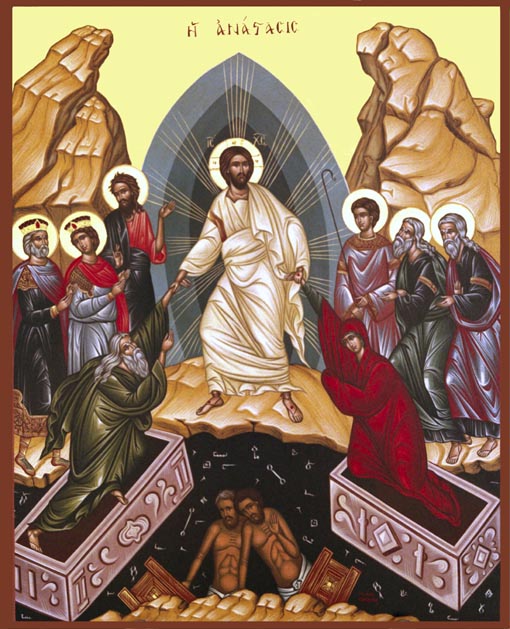
It is Easter at last and Christians around the world sing the triumphant message “alleluia Christ is risen, he is risen indeed!”  Just as the first disciples walked with Jesus we too have walked with Jesus through the penitential season of Lent beginning on Ash Wednesday where we remembered that “we are but dust and to dust we shall return.” With each thing that we abstained from or added to our spiritual discipline we in a small way were reminded that we are to “deny ourselves, take up our Cross and follow.”  In Holy week we experienced the nearly schizophrenic emotions of triumph and tragedy of Palm or Passion Sunday, the solemnity that comes on Holy or Maundy Thursday as we recall the institution of the Eucharist or the Lord’s Supper and the humility of Jesus as he takes on the mantle of a lowly servant and washes the feet of his disciples.  Leaving that we enter into the suffering of Jesus on Good Friday and see how even his friends betrayed or abandoned him with only a thief on an adjacent cross and the officer in charge of the crucifixion realizing just who was on that middle cross.  We wait overnight Friday and through Saturday in the uncomfortable middle between the crucifixion and resurrection that so often mirrors events in our own life where we sometimes experience what we feel to be forsaken by family, friends, church and sometimes even God.  Yet in the pre-dawn darkness of that first Easter morning we like the disciples awake to find that something has happened, that the stone is rolled away, the tomb is empty and Jesus is raised from the dead crushing sin death and hell.  We are greeted by Jesus who tells us not to be afraid but to go and tell others what has happened.  He greets us on the road to Emmaus and breaks bread with us even as we tell him about the tragedy of his death and then our eyes are opened.  Jesus is the victor and in his death burial and resurrection we have the forgiveness of sins.  The event is also eschatological in that it opens the door for him to return in glory and for him to be revealed in his people For the creation waits with eager longing for the revealing of the children of God;  “for the creation was subjected to futility, not of its own will but by the will of the one who subjected it, in hope that the creation itself will be set free from its bondage to decay and will obtain the freedom of the glory of the children of God.” Romans 8:20-21

Likewise it is in this series of inseparable events that Christ establishes our redemption by the forgiveness of sins “For while we were still weak, at the right time Christ died for the ungodly. Indeed, rarely will anyone die for a righteous person—though perhaps for a good person someone might actually dare to die. But God proves his love for us in that while we still were sinners Christ died for us.” Romans 5:6-8.

It is a universe changing event whereby Christ sets his people free and destroys the power of his enemies. Karl Barth wrote: “Look once again to Jesus Christ in his death upon the cross.  Look and try to understand that what he did and suffered he did and suffered for you, for me, for us all.  He carried our sin, our captivity and our suffering, and did not carry it in vain.  He carried it away.  He acted as the captain of us all.  He broke through the ranks of our enemies.  He has already won the battle, our battle.  All we have to do is to follow him, to be victorious with him.  Through him, in him we are saved.  Our sin no longer has any power over us.  Our prison door is open…when he, the Son of God, sets us free, we are truly free.” This is the redemption that the world awaits, not a redemption that is to be hoarded by believers but a redemption that extends beyond the present redemption for all people, especially those who believe and the people of God are to toil and struggle for this “For to this end we toil and struggle, because we have our hope set on the living God, who is the Savior of all people, especially of those who believe.” 1 Timothy 4:10

The Cross and Resurrection are to be a new and purifying wind in the world and the people of God are to be the vehicle for this wind empowered by the Holy Spirit of God.  It is not simply about mastering the art of dying as Socrates did but experiencing resurrection.  Christ did not merely die but he overcame the last enemy which is death itself. (1 Corinthians 15:26)  The power of this is not to be taken lightly in its possibilities for real change for as Dietrich Bonhoeffer wrote “If a few people really believed that and acted on it in their daily lives, a great deal would be changed. To live in the light of the Resurrection—that is what Easter means.”

While we live in the reality of the light of the Resurrection we simultaneously live under the shadow of the Cross of Christ as well as the cross that we are obliged by God to carry in our own lives. In the duality and unity of the Cross and Resurrection we have hope and in that hope we are not to be overwhelmed by events in the world that we cannot control.  Nor are we to be consumed by false “gospels” presented by various ideologues of the right and the left who may identify themselves as “Christian” but place their ideologies, social, political, national and economic over the Gospel itself.  Ideologues who quote scripture to buttress their arguments so that their ideology and the “Gospel” are one in the same much as Satan did during the temptation of Jesus to provide a veneer of Christianity to ideologies that are often opposed to the message of the Gospel. Such an idea is much like the message on German soldier’s belt buckles in the Second World War proclaimed “Gott Mit Uns” even as their nation made war on the world and executed an evil ideology of death upon the Jews and others unfortunate enough to be considered the enemies of the Nazi Party.

It is the ideologues who now endanger the Church and Gospel itself for many choose to remain inside the walls of the church and attempt to turn it into a tool of their ideology and in doing so these ideologues measure and evaluate “others only from the standpoint of whether they are supporters of this ideology, or whether they might become such, or whether they might at least be useful to it even without their consent, or whether they must be fought as its enemies. Its glory has already become for him the solution not only to the personal problem of his own life but to each and all of the problems of the world.” But the Cross and resurrection cry out “NO!” to such ideas even when they are drenched with so called “Biblical” support.

The Cross and the Resurrection bring us to life and promise that Christ who died and was raised will come again and in doing so will complete the redemption of the world for which he suffered and died. It is the real world for which God cares for enough to live suffer and die to save, as Dietrich Bonhoeffer so eloquently wrote “God loves human beings. God loves the world. Not an ideal human, but human beings as they are; not an ideal world, but the real world. What we find repulsive in their opposition to God, what we shrink back from with pain and hostility, namely, real human beings, the real world, this is for God the ground of unfathomable love.”

It is God’s unfathomable love that Easter proclaims as victorious and allows us will all people to cry out “Alleluia Christ is Risen! The Lord is Risen indeed!”

Peace and Happy Easter

Padre Steve+
1 Comment

Filed under christian life, faith, Religion

Holy Saturday….Living in the Uncomfortable Middle

“Man no longer lives in the beginning–he has lost the beginning. Now he finds he is in the middle, knowing neither the end nor the beginning, and yet knowing that he is in the middle, coming from the beginning and going towards the end. He sees that his life is determined by these two facets, of which he knows only that he does not know them” Dietrich Bonhoeffer

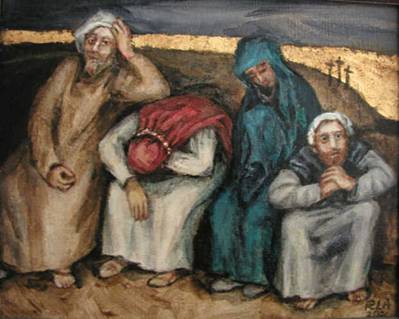
Holy Saturday reminds us of the fact that we live as Bonhoeffer so eloquently put it “in the middle, knowing neither the end nor the beginning. The Gospel accounts are silent as to what was happening during this interregnum between the crucifixion and the resurrection except that the women prepared the body of Jesus for burial and that the tomb was sealed and a Roman guard detachment detailed to ensure that the tomb remained secure.

One has to use their imagination as to what was occurring in the lives of the characters in this story. We know that on the day of the crucifixion that after Jesus’ death that Joseph of Arimathea provided a tomb where Jesus’ body was prepared and in which he was laid.  We know that the tomb was sealed and that Roman guards were at it as ordered by Pilate.  We know that the disciples with the exception of John had abandoned Jesus and that following the crucifixion that they had scattered and went underground with the exception of Judas who was last seen hanging around.  Most of Jerusalem was observing Passover between Friday evening and Saturday evening.  Life for many went on without a second thought as Jesus was now yesterday’s news.  The disciples wondered if they would be next, a mother mourned, members of the Sanhedrin likely were relaxing for the first time since Jesus entered Jerusalem as potential Messiah the previous Sunday while Roman soldiers far from home wondered just why they were guarding the tomb of a criminal.

We know from the reactions of the disciples the next day that they really believed that Jesus was not only dead but not coming back. There was a finality that they lived a grief that they bore. Their teacher the one that they had given up all to follow was dead executed as a criminal between common criminals and buried in a borrowed tomb.  One of their friends that they had shared the previous three years had betrayed Jesus.  Their world was upended; the one that they assumed to be the Messiah was mortal.  Their faith was crushed.

The life of faith that we live in the interregnum between life and death creation and consummation is often similar to that the disciples experienced.  We experience situations where faith is hard to come by and since we are in the uncomfortable middle nothing seems certain.  Much of this comes when like the disciples we expect something from God or expect God to do something only to find that our expectations were perhaps just a bit different from those of the Deity.  Disappointment with God I think one has called it and if we are honest it is a part of life because none of really know the will of God or even what will transpire tomorrow something that scripture is rather clear about.

We live in the middle every time we walk with Jesus and his followers through Holy Week just as we walk through life and Holy Saturday is in a sense a metaphor for life when we don’t understand it when we are in the middle wondering what transpired before and not knowing the future.  It is a time to again seek out our faith and with our friends who share this life to maintain hope that things will work out, that in fact resurrection will come.

Until tomorrow we leave the disciples in hiding, the city sleeping and the Roman soldiers cold and bored at a tomb which in reality they care less about.

Peace,

Padre Steve+

Leave a comment

Filed under christian life, faith, Religion

It is Finished

“28 After this, when Jesus knew that all was now finished, he said (in order to fulfill the scripture), “I am thirsty.” 29 A jar full of sour wine was standing there. So they put a sponge full of the wine on a branch of hyssop and held it to his mouth. 30 When Jesus had received the wine, he said, “It is finished.” Then he bowed his head and gave up his spirit.” John 19: 28-30 NRSV

 Good Friday, I wrote about it last night and published it very early this morning.  I just completed the Good Friday Liturgy at the hospital and am set to get an early start on the rest of the Easter Weekend.  I am not going to repeat last night’s article here, just something that struck me as I prepared for the service and read the Passion narrative from John’s Gospel.  The words It is finished” which come from the lips of Jesus as he dies convey a finality that sometimes we miss as we fast forward to Easter. Upon the Cross Jesus really did die and this can be very uncomfortable in fact a number of major religions reject the notion that God would condescend to become human and certain would never consent to death.  Such a stream of thought was even evidenced in Gnostic Christianity where God is “pure spirit” and the God of the Old Testament was corrupt being powerful enough o create humanity and wicked enough to do so as for the Gnostics the flesh was evil and the spirit good.  Likewise the Aryan Heresy invoked the notion of a Jesus who was not really God, more like a superman as God could not die.  The thought of the Aryans is still present in Islam as Mohammed the Prophet had exposure to Aryan Christianity and the image of Jesus in Islam is nearly identical to the Aryans.

 “It is finished.” They are haunting words and when one reads the words of Isaiah one gets the picture of something that if we passed by on the street that we would probably turn our heads away from to avoid the unpleasantness of the sight as “he had no form or majesty that we should look at him, nothing in his appearance that we should desire him. 3He was despised and rejected by others; a man of suffering and acquainted with infirmity; and as one from whom others hide their faces he was despised, and we held him of no account.”   

 The hymn When I Survey the Wondrous Cross is particularly vivid in painting the picture of the crucified Christ: “See, from his head, his hands, his feet, sorrow and love flow mingled down. Did e’er such love and sorrow meet, or thorns compose so rich a crown.”

 The fact that Jesus dies on the cross and dies rejected is a paramount truth of the Gospel and is necessary if we are to comprehend the Gospel, we do not get to the resurrection without the crucifixion and any attempt to do so especially by his people creates a false Gospel, a Gospel devoid of the forgiveness of sins and a Gospel where God knows not our sorrows.  It is the Gospel of Theism where God is not involved in the real world; untouched and unmoved by human suffering and even arbitrary and capricious in his dealings with humanity.   Dietrich Bonhoeffer wrote Jesus is a rejected Messiah. His rejection robs the passion of its halo of glory. It must be a passion without honor. Suffering and rejection sum up the whole cross of Jesus. To die on the cross means to die despised and rejected of men. Suffering and rejection are laid upon Jesus as a divine necessity, and every attempt to prevent it is the work of the devil, especially when it comes from his own disciples; for it is in fact an attempt to prevent Christ from being Christ.” 

 The fact that Jesus did not let the cup from him has implications for his disciples which again are not comfortable as they stand opposed to the “Gospel” of those who present the faith as one of respect, prosperity, earthy power and health.  It is not the “Gospel” of materialism where we remain in relationship with God only for the blessings but the Gospel of discipleship and suffering.  It is the cry My God, my God why have you forsaken me?” which Jesus utters as rejected by man and by God as Bonhoeffer said “It is not suffering per se but suffering-and-rejection, and not rejection for any cause of conviction of our own, but rejection for the sake of Christ. If our Christianity has ceased to be serious about discipleship, if we have watered down the gospel into emotional uplift which makes no costly demands and which fails to distinguish between natural and Christian existence, then we cannot help regarding the cross as an ordinary everyday calamity… We have then forgotten that the cross means rejection and shame as well as suffering.”

 Again, such a Gospel is not comfortable for the disciple the Gospel of the Cross whereby we come to know God is the Gospel which “bids a man to come and die.” This is not the kind of martyrdom sought by fanatics who seek to destroy their and presumably God’s enemies but a call that is unique to every disciple:

 “But each has a different share: some God deems worthy of the highest form of suffering, and given them the grace of martyrdom, while others He does not allow to be tempted above that they are able to bear…. The cross is laid on every Christian. The first Christ-suffering which every man must experience is the call to abandon the attachments of this world. … we surrender ourselves to Christ in union with His death—we give over our lives to death. … When Christ calls a man, He bids him come and die.…death in Jesus Christ, the death of the old man [or nature] at his call. Jesus’ summons to the rich young man was calling him to die, because only the man who is dead to his own will can follow Christ. In fact, every command of Jesus is a call to die, with all our affections and lusts. But we do not want to die…”

 There is a hymn that means much to me is “And Can it be” which personalizes the great mystery inherent in the Gospel.

And can it be that I should gain
an interest in the Savior’s blood!
Died he for me? who caused his pain!
For me? who him to death pursued?
Amazing love! How can it be
that thou, my God, shouldst die for me?
Amazing love! How can it be
that thou, my God, shouldst die for me?

’Tis mystery all: th’ Immortal dies!
Who can explore his strange design?
In vain the firstborn seraph tries
to sound the depths of love divine.
’Tis mercy all! Let earth adore;
let angel minds inquire no more.
’Tis mercy all! Let earth adore;
let angel minds inquire no more.

He left his Father’s throne above
(so free, so infinite his grace!),
emptied himself of all but love,
and bled for Adam’s helpless race.
’Tis mercy all, immense and free,
for O my God, it found out me!
’Tis mercy all, immense and free,
for O my God, it found out me!

 It is finished and with it we wait. Like the disciples we know not what tomorrow holds we live in a tension knowing Christ’s suffering and awaiting resurrection.  The Centurion Loginous at the Cross saw what no one else saw that day knew that “surely this was the Son of God” and like the disciples would lay down his duties to follow Christ.

 I pray that God will richly bless us this Good Friday with his peace which as he says passes all understanding.

 Peace

Padre Steve+

Leave a comment

Filed under christian life, faith, Religion

Good Friday…Ecce Homo! Behold the Man

“God is nowhere greater than in his humiliation. God is nowhere more glorious than in his impotence. God is nowhere more divine than when he becomes man” Jürgen Moltmann Trinity and Kingdom


“So they took Jesus; 17and carrying the cross by himself, he went out to what is called The Place of the Skull, which in Hebrew* is called Golgotha. 18There they crucified him, and with him two others, one on either side, with Jesus between them.” John 19: 16b-18

4Surely he has borne our infirmities
and carried our diseases;
yet we accounted him stricken,
struck down by God, and afflicted.
5But he was wounded for our transgressions,
crushed for our iniquities;
upon him was the punishment that made us whole,
and by his bruises we are healed.
6All we like sheep have gone astray;
we have all turned to our own way,
and the Lord has laid on him
the iniquity of us all. Isaiah 53:4-6

“My God my God why have you forsaken me?”

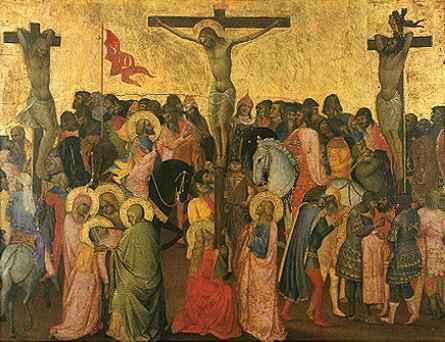
Today is Good Friday, the Altars are bare and we simply “Behold the Man.” The picture that we have today is paradoxical, it is the picture of a suffering man betrayed by a friend, abandoned by his closest followers and executed in a barbaric fashion under the orders of a man who washes his hands of his own responsibility.  It is a picture that is troubling because of its unpleasantness it is not the kind of picture of God that we want.  While we gladly acknowledge God’s grace and God forgiving our sins through Jesus we want to stay on this side of the resurrection. But like it or not we are confronted with questions about why do the innocent suffer and how could God do this to me or the one that I love.  Much of the problem is that we often buy in to a God untouched by human suffering a God who is arbitrary, unfeeling and cold no matter how much we try to convince ourselves that he cares.  A God incapable of suffering is a cold comfort when we or a loved one suffers. This is not the Christian God even if we try to baptize this “god” in our theology.  “In Christianity the cross is the test of everything that deserves to be called Christian” so writes Jürgen Moltmann in “The Crucified God.”

The Cross and the Passion of Christ is the center of how Christians come to understand God and if we attempt to regulate it to the background we do the message of the Gospel violence.  This is very apparent in the number of churches that do nothing to acknowledge the event on Good Friday even as they adorn their churches for the Easter celebration. It is as if the central event in God’s revelation to humanity and means by which he reconciles humanity to himself is a stepchild to the resurrection, but without the Cross there is no resurrection. It is also seen by some who find the symbol of the Crucifix offensive often derisively saying “Jesus isn’t on the Cross anymore, I worship the Risen Jesus.” While we worship the Risen Christ he also remains the Crucified God who in his human flesh bore the sins of the world. It is as Dietrich Bonhoeffer writes:

“The figure of the reconciler, of the God-man Jesus Christ, steps into the middle between God and the world, into the center of all that happens.  In this figure is disclosed the mystery of the world, just as the mystery of God is revealed in it.  No abyss of evil can remain hidden from him through whom the world is reconciled to God.  But the abyss of the love of God embraces even the most abysmal godlessness of the world.  In an incomprehensible reversal of all righteous and pious thought, God declares himself as guilty toward the world and thereby extinguishes the guilt of the world.  God treads the way of humble reconciliation and thereby sets the world free.  God wills to be guilty of our guilt; God takes on the punishment and suffering that guilt has brought on us.  God takes responsibility for godlessness, love for hate, the holy one for the sinner.  Now there is no more godlessness, hate, or sin that God has not taken upon himself, suffered, and atoned.  Now there is not longer any reality, any world, that is not reconciled with God and at peace.  God has done this in the beloved son, Jesus Christ.  Ecce homo!” –Dietrich Bonhoeffer, Ethics: Dietrich Bonhoeffer Works, Volume 6, edited by Clifford J. Green and translated by Reinhard Krauss, Charles C. West, and Douglas W. Scott (Minneapolis: Fortress, 2005), 83.

In addition to its salvific value the Cross of Christ is also relevant to all who suffer as “the deep meaning of the cross of Christ is that there is no suffering on earth that is not borne by God.” In the Cross God identifies himself with all of humanity especially those afflicted or persecuted.

Today we take the time to reflect and remember this event. Many people will have a day of fasting and accompany it with prayer or service.  My prayer is that in the midst of the various crises that we face in the country and the world that we will take the time as Christians to ponder the depth of God’s love and identification with his all people and the ramifications for how we treat others, even those that we view as our opponents or even enemies.  If God can condescend to love us while we were at enmity with him, just how can we fail to treat others with the same love? To again quote Bonhoeffer with whom I have walked this Lenten season:

“God loves human beings. God loves the world. Not an ideal human, but human beings as they are; not an ideal world, but the real world. What we find repulsive in their opposition to God, what we shrink back from with pain and hostility, namely, real human beings, the real world, this is for God the ground of unfathomable love.”

Ecce Homo! Behold the Man!

Peace

Padre Steve+

Leave a comment

Filed under christian life, faith, Religion

Holy or Maundy Thursday….Pausing to Reflect on Communion

Today is Holy or Maundy Thursday, a day where many Churches and Christians take the time within their theological traditions to reflect upon in their worship, the institution of the Eucharist or the Lord’s Supper.  Today for me is always special, though the past couple years I was not doing well do to PTSD and other stuff.  This year is different in the sense that I have began to recover that sense of mystery and awe that comes in this celebration.

I grew up in kind of an eclectic faith tradition as a Navy brat. My family was Methodist and I was baptized in my parents and grandparents home church, Southside Methodist Church in Huntington West Virginia.  However living on the West coast we went to Navy Chapels or local civilian churches of various denominations.  During my dad’s time in Vietnam it was a Roman Catholic Navy chaplain who showed us the love of God when many civilian churches made military families unwelcome.  I owe my vocation and faith to that man who took care of our Protestant family.  I remember attending the Holy Thursday Mass at the little Naval Communication station in 1971. There was a sense of mystery and holiness in that service that stayed with me.  When I was in high school I went to a Conservative Baptist church where communion was not observed in the same manner but the Pastor, Reverend Ron Lundy made it special. There was a sense of holiness and thankfulness that I have seldom seen in Evangelical churches since.

When I went to seminary I was attending a non-denominational evangelical/charismatic church.  It was a good church but little emphasis was placed on communion and apart from Easter Sunday no attention was paid to Holy Week. However as a seminary student at Southwestern Baptist Theological Seminary in 1988-1992 before the great purge of moderates I had a number of professors, but in particular my Church History professor Dr Doyle Young took the time to look at how the major traditions within the Christian faith viewed the Eucharist or Holy Communion.   I was acquainted with most in a fairly rudimentary manner Dr Young brought out the really important theological aspects of each in the context of how each view came about.  I always had a sort of Reformed or Presbyterian view of Holy Communion in that unlike most of my Baptist and Evangelical friends I really believed that there was a “spiritual” presence of Christ in communion as opposed to it being a symbolic memorial.  That changed as I was taught the Roman Catholic and Orthodox understandings of the Eucharist but was nailed down as we studied Martin Luther, his understanding of the Eucharist and the discussion between Luther and Ulrich Zwingli at the Marburg Colloquy.  It was Luther’s argument from Scripture “This is my Body, this is my Blood” with which he responded to every argument posed by Zwingli that convinced me of the reality of Jesus’ presence in the Eucharist in more than just a spiritual manner.  I could not ignore Scripture and that was the watershed in bringing me to an Anglican or Anglo-Catholic understanding of faith and the Eucharist.

My purpose here is not to argue for my theological view but rather to encourage Christians to take advantage of the communion that we have with Jesus and through him with the Father and the Spirit as well as the communion that we share with each other.  Though I may believe my understanding of the Eucharist fits best with Scripture and the earliest teaching of the Church I will not use this to attack those who have different viewpoints.  Instead regardless of the theological perspective I hope that my readers will be able to renew their faith tonight as we celebrate this holy evening where Jesus met with his disciples before he was betrayed a Luke the Evangelist wrote:

“When the hour came, he took his place at the table, and the apostles with him. 15He said to them, ‘I have eagerly desired to eat this Passover with you before I suffer; 16for I tell you, I will not eat it* until it is fulfilled in the kingdom of God.’ 17Then he took a cup, and after giving thanks he said, ‘Take this and divide it among yourselves; 18for I tell you that from now on I will not drink of the fruit of the vine until the kingdom of God comes.’ 19Then he took a loaf of bread, and when he had given thanks, he broke it and gave it to them, saying, ‘This is my body, which is given for you. Do this in remembrance of me.’ 20And he did the same with the cup after supper, saying, ‘This cup that is poured out for you is the new covenant in my blood.” Luke 22:14-20

And Paul to the Corinthians

“ For I received from the Lord what I also handed on to you, that the Lord Jesus on the night when he was betrayed took a loaf of bread, 24and when he had given thanks, he broke it and said, ‘This is my body that is for* you. Do this in remembrance of me.’ 25In the same way he took the cup also, after supper, saying, ‘This cup is the new covenant in my blood. Do this, as often as you drink it, in remembrance of me.’ 26For as often as you eat this bread and drink the cup, you proclaim the Lord’s death until he comes.” 1 Corinthians 11:23-26

And Saint John’s comments in the Gospel bearing his name:

“This is the bread that comes down from heaven, so that one may eat of it and not die. 51I am the living bread that came down from heaven. Whoever eats of this bread will live forever; and the bread that I will give for the life of the world is my flesh.” John 6:50-51

It is important that no matter whether we view this as a Sacrament or a symbolic memorial that we take this feast of God’s love for us seriously for he comes to us in Word, Sacrament in this moment where we take the time to spend with him and his people as we prepare to celebrate the “Mystery of Faith” “Christ has Died, Christ is Risen, Christ will come again.”

My prayer is that we all find God’s peace and life during this Easter Triduum of Holy Thursday, Good Friday and Easter Sunday as we walk with Jesus and his disciples through that tumultuous time.  Lent is ended, our seasonal penitence is done so let us take the time to pause remember and reflect of the remarkable depth of God’s love for us in that “while we were yet sinners Christ died for us.” As Martin Luther said “For here in the sacrament [Communion] you receive from Christ’s lips the forgiveness of sins, which contains and conveys God’s grace and Spirit with all his gifts, protection, defense, and power against death and the devil and all evils” (The Large Catechism — p. 98).

Another feature of Holy Thursday is the enactment by the clergy of Jesus washing his disciple’s feet. This is important in a world where power and fame is sought after over service to one another, even in churches.  The call of Christ is that we are to be servants of all.

In a world wracked by so much division including Christians who cannot agree on exactly what is going on when we come to the Altar or to the Communion table it is imperative that Christians even given their longstanding differences regarding this would be good to acknowledge their dependence upon God and one another.  If while acknowledging our differences we can at least share in the love and communion of God in Christ even if our individual churches will not share communion with one another. After all in the end it really is about the Lord and his relationship with his people and their relationship with each other and the world that he came to save.

Peace

Padre Steve+

1 Comment

Filed under christian life, faith, philosophy, Religion

Palm or Passion Sunday…the Paradox of the Triumphant Entry and the Cross

The Triumphant Entry

“Although we praise our common Lord for all kinds of reasons, we praise and glorify him above all for the cross. Paul passes over everything else that Christ did for our advantage and consolation and dwells incessantly on the cross. The proof of God’s love for us, he says, is that Christ died for us while we were yet sinners. Then in the following sentence he gives us the highest ground for hope: If, when we were alienated from God, we were reconciled to him by the death of his Son, how much more, now that we are reconciled, shall we be saved by his life!” John Chrysostom (AD 347-407)

God speaking to Luther: “Discipleship is not limited to what you can comprehend—it must transcend all comprehension. … Not to know where you are going is the true knowledge. My comprehension transcends yours. Thus Abraham went forth from His father… not knowing whither he went. … Behold, that is the way of the cross. You cannot find it yourself, so you must let me lead you as though you were a blind man. Wherefore it is not you, no man… but I myself, who instruct you by my Word and Spirit in the way you should go. Not the work which you choose, not the suffering you devise, but the road which is clean contrary to all you choose or contrive or desire—that is the road you must take. To that I call you and in that you must be my disciple.” Dietrich Bonhoeffer the Cost of Discipleship

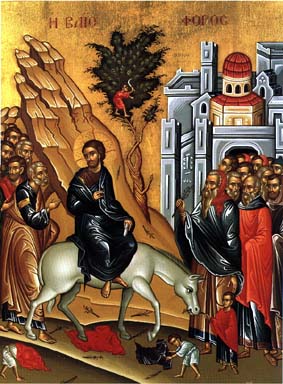
Palm or Passion Sunday always is a day that invokes mixed emotions in me. It is the last Sunday of the Lenten Season and in modern times has become a juxtaposition of two events, the Triumphant Entry of Jesus into Jerusalem where he according to all four Gospels was greeted by crowds of people who lined the street with palms as Jesus riding on a donkey processed from Bethany and Bethphage where he had been staying with Lazarus into Jerusalem and the narrative of the Passion.  As such it is a roller coaster ride in our experience of walking with Jesus in the most difficult times.

This particular occasion is the Sunday where the disciples of Jesus are confronted with the reality that our earthy expectations of him do not meet the reality of his condensation to walk among us fully Divine yet fully Human but one too well acquainted with suffering, rejection and shame.  He shatters our expectations that he will bless any particular political or social ideology that we allow to take pre-eminence over him, even those that invoke his name. Thus our liturgy brings us to this strange day where in a sense we are confronted with celebrating the entrance of the King and in the next breath cursing him and betraying him to those who torture and crucify him.

In the Roman Catholic and Anglican liturgy the observance is divided between the Liturgy of the Palms which takes place outside the Church Nave either outside the church building or in the Narthex in cold or inclement weather.  After an opening collect and reading of the Gospel passage from one of the synoptic Gospels, which one depends on which of the three year liturgical readings that the church is in. Following the reading of the Gospel the congregation led by choir, acolytes and clergy process into the church reciting the words of Psalm 118: 18-29 or singing a hymn such as “All Glory Laud and Honor.”  Once the congregation is in the church the Liturgy of the Word continues and when the Passion Gospel is read and specific roles may be assigned to members of the congregation, while the congregation remains seated through the first part of the Passion the congregation stands at the verse where “Golgotha” is mentioned and remains standing.

The liturgy takes the congregation on an emotional and spiritual roller coaster.  As the congregation begins outside the following is read:

When Jesus had come near Bethphage and Bethany, at the place called the Mount of Olives, he sent two of the disciples, saying, “Go into the village ahead of you, and as you enter it you will find tied there a colt that has never been ridden. Untie it and bring it here. If anyone asks you, ‘Why are you untying it?’ just say this, ‘The Lord needs it.'” So those who were sent departed and found it as he had told them. As they were untying the colt, its owners asked them, “Why are you untying the colt?” They said, “The Lord needs it.” Then they brought it to Jesus; and after throwing their cloaks on the colt, they set Jesus on it. As he rode along, people kept spreading their cloaks on the road. As he was now approaching the path down from the Mount of Olives, the whole multitude of the disciples began to praise God joyfully with a loud voice for all the deeds of power that they had seen, saying,

“Blessed is the king who comes in the name of the Lord!

Peace in heaven, and glory in the highest heaven!”

Some of the Pharisees in the crowd said to him, “Teacher, order your disciples to stop.” He answered, “I tell you, if these were silent, the stones would shout out.” Luke 19:29-40

It is hard when you read this passage and be caught in the reenactment of this procession not to feel the excitement that must have accompanied that procession.  It has the feeling of a victory parade but this road ends in a manner that those present, those seeking an earthly king and Messiah who would drive our the Roman oppressor and restore the kingdom to Israel would not expect with some of them perhaps playing a role in the drama that would take place later in the week.  I particularly like the hymn “All Glory Laud and Honor.”

All glory, laud and honor,
To Thee, Redeemer, King,
To Whom the lips of children
Made sweet hosannas ring.

Thou art the King of Israel,
Thou David’s royal Son,
Who in the Lord’s Name comest,
The King and Blessèd One.
Refrain

The company of angels
Are praising Thee on High,
And mortal men and all things
Created make reply.
Refrain

The people of the Hebrews
With palms before Thee went;
Our prayer and praise and anthems
Before Thee we present.
Refrain

To Thee, before Thy passion,
They sang their hymns of praise;
To Thee, now high exalted,
Our melody we raise.
Refrain

Thou didst accept their praises;
Accept the prayers we bring,
Who in all good delightest,
Thou good and gracious King.

During the Liturgy of the Word one of the following is read, either Isaiah 45:21-25 or Isaiah 52:13-53:12, the second being the Song of the Suffering Servant.  The Psalm is Psalm 22 where the Psalmist foretells Jesus’ anguished cry from the Cross; “My God, my God, why have you forsaken me? and are so far from my cry and from the words of my distress?”And then we have the New Testament reading Philippians 2: 5-11, the hymn to Christ is read:

“Let the same mind be in you that was in Christ Jesus, who, though he was in the form of God, did not regard equality with God as something to be exploited, but emptied himself, taking the form of a slave, being born in human likeness. And being found in human form, he humbled himself and became obedient to the point of death– even death on a cross. Therefore God also highly exalted him and gave him the name that is above every name, so that at the name of Jesus every knee should bend, in heaven and on earth and under the earth, and every tongue should confess that Jesus Christ is Lord, to the glory of God the Father.”

Peter Denies Christ

This year the Passion Narrative is that of Luke (22:39-71) 23:1-49 (50-56).  The three parts that stand out in this narrative for me are Peter’s denial of Jesus:

“Then they seized him and led him away, bringing him into the high priest’s house. But Peter was following at a distance. When they had kindled a fire in the middle of the courtyard and sat down together, Peter sat among them. Then a servant-girl, seeing him in the firelight, stared at him and said, “This man also was with him.” But he denied it, saying, “Woman, I do not know him.” A little later someone else, on seeing him, said, “You also are one of them.” But Peter said, “Man, I am not!” Then about an hour later still another kept insisting, “Surely this man also was with him; for he is a Galilean.” But Peter said, “Man, I do not know what you are talking about!” At that moment, while he was still speaking, the cock crowed. The Lord turned and looked at Peter. Then Peter remembered the word of the Lord, how he had said to him, “Before the cock crows today, you will deny me three times.” And he went out and wept bitterly.”

Peter’s denial is in large part because he has had his illusions about Jesus shattered and the fact that he had not understood the message up to that point.  As Bonhoeffer says “Jesus is a rejected Messiah. His rejection robs the passion of its halo of glory. It must be a passion without honor. Suffering and rejection sum up the whole cross of Jesus. To die on the cross means to die despised and rejected of men. Suffering and rejection are laid upon Jesus as a divine necessity, and every attempt to prevent it is the work of the devil, especially when it comes from his own disciples; for it is in fact an attempt to prevent Christ from being Christ.”

Likewise Jesus interaction with the condemned thieves that were crucified with him:

“One of the criminals who were hanged there kept deriding him and saying, “Are you not the Messiah? Save yourself and us!” But the other rebuked him, saying, “Do you not fear God, since you are under the same sentence of condemnation? And we indeed have been condemned justly, for we are getting what we deserve for our deeds, but this man has done nothing wrong.” Then he said, “Jesus, remember me when you come into your kingdom.” He replied, “Truly I tell you, today you will be with me in Paradise.”

The Crucifixion

The final passage from this narrative that strikes me is the moment of Jesus’ death on the Cross:

“It was now about noon, and darkness came over the whole land until three in the afternoon, while the sun’s light failed; and the curtain of the temple was torn in two. Then Jesus, crying with a loud voice, said, “Father, into your hands I commend my spirit.” Having said this, he breathed his last. When the centurion saw what had taken place, he praised God and said, “Certainly this man was innocent.” And when all the crowds who had gathered there for this spectacle saw what had taken place, they returned home, beating their breasts. But all his acquaintances, including the women who had followed him from Galilee, stood at a distance, watching these things.”

The darkness of this is event is perplexing to those who want to find God in some place where he is untouched by human suffering to them the Cross is folly for what kind of God would submit himself to such ignominy but as Martin Luther wrote “He who does not know Christ does not know God hidden in suffering. Therefore, he prefers works to suffering, glory to the cross, strength to weakness, wisdom to folly. For they hate the cross and suffering and love works and the glory of works. Thus they call the good of the cross, evil and the evil of a deed, good. God can only be found in suffering and the cross.” It is in the contradiction of this week that we come to know God, not a God who seeks not the righteous or the powerful, those who seek the power of an earthy kingdom backed by an ideology of power which tramples the weak, but rather those who will simply walk in the footsteps of Jesus the Christ who rules by serving the least, the lost and the lonely.

The liturgy of this day takes us to the heart of the Gospel as we led by the writers through the triumph of the entrance into Jerusalem, to the betrayal of Jesus by Judas, the abandonment of him by the disciples and the denial of Peter.  As the writers lead us through his trial, conviction, scourging and trek to Golgotha we see the gamut of human emotions and reactions to Jesus and we know that we can be there as well in any of the characters simply because we are human and capable of compassion or betrayal.  As Jesus is on the Cross it is not the religious or upstanding that remain with him.  He is left with his mother, the other Mary and John the beloved.  He is shown compassion by a thief and recognized as the Son of God by the Roman Centurion, a gentile serving an empire oppressing the people of Israel and whose governor had pronounced the sentence of death upon him.  In this liturgy we have been taken from the heights of exhilaration in the triumphant entry to the depths of despair felt by his disciples that Friday afternoon. It is in this time that we realize how right Dietrich Bonhoeffer is when he writes “God loves human beings. God loves the world. Not an ideal human, but human beings as they are; not an ideal world, but the real world. What we find repulsive in their opposition to God, what we shrink back from with pain and hostility, namely, real human beings, the real world, this is for God the ground of unfathomable love.”

St Longinus, Centurion at the Cross and Martyr

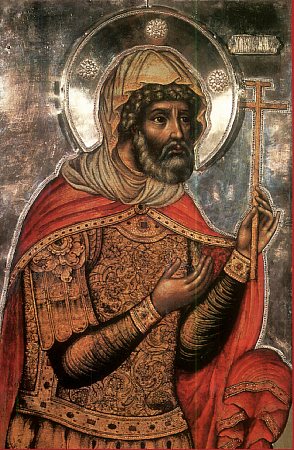
It is the Centurion for which I have the greatest affinity in this story. He is a soldier and in the words of so many soldiers who have obey orders carried out the sentence upon Christ by crucifying him and then as the life ebbs out of Christ’s crucified body exclaims “surely this was a good man” or in other accounts “surely this was the Son of God.” That is the cry of a man who knows that he has executed an unjust sentence, the reaction of a true penitent, the reaction of a man who comes to realize even before many of Jesus’ closest followers understood.  According to tradition the Centurion was named Longinus who left the service of the Imperial Legion, was baptized by the Apostles and was martyred under the orders of Pontius Pilate by soldiers of the unit that he had once commanded.

It is important for the Church not to lose this identification.  The Church is not to become enmeshed and co-opted by those who attempt to use the Gospel to promote ideologies foreign to it as is the temptation in times of crisis.  As Jürgen Moltmann notes:

“In Christianity the cross is the test of everything which deserves to be called Christian… The Christian life of theologians, churches and human beings is faced more than ever today with a double crisis: the crisis of relevance and the crisis of identity. These two crises are complementary. The more theology and the church attempt to become relevant to the problems of the present day, the more deeply they are drawn into the crisis of their own Christian identity….

Christian identity can be understood only as an act of identification with the crucified Christ, to the extent to which one has accepted that in him God has identified himself with the godless and those abandoned by God, to whom one belongs oneself.” The Crucified God [pgs. 7, 19]

Nor is our task is not to attempt to invent “crosses” for ourselves in acts of pseudo-martyrdom but simply to be faithful in loving Jesus and our neighbor as Bonhoeffer noted “Must the Christian go around looking for a cross to bear, seeking to suffer? Opportunities for bearing crosses will occur along life’s way and all that is required is the willingness to act when the time comes. The needs of the neighbor, especially those of the weak and downtrodden, the victimized and the persecuted, the ill and the lonely, will become abundantly evident.” The mark of the Christian is not to blindly give his life for a cause or be consumed by the false “messiah’s” promoted by politicians, pundits and even preachers captivated by the lust for power and glory.

As we walk through the mystery of Holy Week together let us renew our faith in the Crucified One and not be conformed to those things that seek to turn us from the way of discipleship and the way of the Cross.

Peace

Padre Steve+

2 Comments

Filed under christian life, faith, philosophy, Religion

Lenten Joy

“Joy is the simplest form of gratitude.”  Karl Barth

“Gratitude changes the pangs of memory into a tranquil joy.” Dietrich Bonhoeffer

“Lord deliver us from gloomy saints” Teresa of Avila


Today is the last Friday in Lent and one to reflect on something often forgotten as we get lost in the “necessity” to give up things or do more in our spiritual life.  As one who never enjoyed the Lenten season because I got lost in the legalism of it.  I would become more focused on setting up things to do or to abstain from that were unreasonable and bound to fail no matter how hard I worked to make them work.  Often these were practices that I gleaned from medieval spirituality which focused on the penitential and ascetic aspects of the Christian life which in retrospect only made me more miserable during Lent.  Since I already know that I am a screw up and not very good at many spiritual practices the added “disciplines” were a continual reminder of how screwed up I really am.  This got worse after Iraq dealing with PTSD and all kinds of other issues to the point that last year I did an “un-Lent Lent” avoiding those things but not being very successful in doing better spiritually.

This Lent has been about recovering Joy.  Yes Lent is a penitential season and yes I do examine my conscious and seek to ensure that I go to confession or penitential service.  In fact the acuity of my awareness has gotten better making this less painful than it used to be.  Knowing that I have been able, even when knocked on my ass by a nasty Kidney stone for almost a month have been able to gain something from my Lenten journey, something very spiritual which drew me closer to God and others without a lot of additional religious activity.  For the first time in my life I can say that I have enjoyed Lent.

Part of recovering joy in life is regaining the ability to laugh again and not just with cynical and sarcastic wit.  Instead I have been able to laugh about life, the good and the bad.  As Karl Barth said “laughter is the closest thing to the grace of God.”

Laughter and joy have again become central in my life and I wonder how I lived during the darkest parts of the last two years when I despaired of life itself and wondered if God even existed.  Even with all the turmoil in the country and world, which I do take seriously if you are a regular reader, I have been able to live life, do theology, provide pastoral care and write and study history while living in the moment appreciating the grace and forgiveness of God and looking to the future with hope.  I know for some this may sound a bit daft, but I know that things are not great but I also know that somehow God and humanity continue to move forward in relationship to each other.

When I survey some to the pastors, teachers, and “theologians” in print and on the internet I wonder if they have forgotten the essence of life with God.  As the first question in the Westminster Catechism asks “what is the chief end of man?” The proper answer to this question is “to glorify God and enjoy him forever.” Even the disciples of John “I don’t know how to have fun” Calvin got this one right.

Karl Barth hits the nail on the head in dealing with joyless theologians and pastors.  When I was in seminary and since I have ordained I am amazed at the number of joyless people in ministry.  I know that some people get treated like crap by their churches but to remain in ministry while hating it and loathing people strikes me as just sort of self destructive.   Likewise the “theologian” who loathes the work that he has been called to do and the people that he is called to serve.  Barth notes:

“The theologian who has no joy in his work is not a theologian at all. Sulky faces, morose thoughts and boring ways of speaking are intolerable in this science. May God deliver us from what the Catholic Church reckons one of the seven sins of the monk—taedium [loathing]—in respect of the great spiritual truths with which theology has to do. But we must know, of course, that it is only God who can keep us from it.” Karl Barth, Church Dogmatics, II/1, p. 656.

To have joy in life and rediscover it in a season where even some of the most devout Christians what become immersed in tasks that are meant to bring them closer to God in fact serve to drive them away or become legalistic and unhappy seemingly incapable of knowing joy.  In “giving things up” they also give away the joy and peace of the Lord and the fellowship of his people. Joy should actually serve to remind us of, call us to and awaken us to desire.  C.S. Lewis talked a lot about joy and even wrote a book about it.  He noted in a letter that “All joy…emphasizes our pilgrim status; always reminds, beckons, awakens desire. Our best havings are wantings.”

Lent should not be a season where we take the fact that there are no “alleluias” and that many of the symbols of faith in our churches are covered as being a season of sorrow.  If we allow it to become that we miss the point entirely.  The joy that should we experience in life with God and the people that he loves, even in the most mundane and supposedly “unspiritual” undertakings of life is something to be savored.  Joy is part and parcel part of the Christian hope, and merely the hope of the Christian but the hope of humanity in the midst of a world dominated by politicians, pundits, preachers and a media machine that do nothing to inspire but rather play on people’s fears and seek to drive wedges between people who depend upon one another. The Christian faith is about a future grounded in hope and lived in fullness bathed in joy because of what God has done in Christ, instead of dwelling on death it is fixated on life.   As Jürgen Moltmann said “the origin of hope is birth, not death. The birth of a new life is an occasion for hope. The rebirth of lived life is an occasion for even greater hope. And when the dead are raised, they enter into the fulfilled hope of life. The setting for learning hope in life, therefore, is the possibility of starting anew and a new beginning, the true freedom.”


I have entered into a period where I am again experiencing joy in the simplicity and complexity of life lived with people that I have come to love and with whom I hope to share a great future.  With real joy a part of my life I can look to a great future as I turn 50.

Peace,

Padre Steve+

Leave a comment

Filed under christian life, faith, Religion

The Last Week of Lent: Mediation on Life, Love and Public Witness

Lent is drawing to a close and Sunday begins Holy week where the Church remembers the last week in the early life of Jesus the Christ.  While I will write about the various aspects of Holy week to include Passion or Palm Sunday, Holy or Maundy Thursday, Good Friday and Easter but tonight a short meditation on the final week of this Lenten season.

I have discussed how this Lent has been different than previous observances of Lent.  In the past I was constantly trying to observe certain spiritual disciplines to include fasting, abstinence and prayer in a formal and legalistic manner.  Last year as I was “melting down” in my spiritual, psychological and physical life facing an existential crisis where after my tour in Iraq, experience of forsakenness, disillusionment concerning the Church, political institutions and the media and doubt about the existence of God I attempted to change the way that I observed Lent.  For the most part that attempt was an abysmal failure, however out of it came an association with the Pastor and people of Saint James Episcopal Church in Portsmouth which has been a place where at least part of me began to experience community and healing again.

This Lenten season has been one filled with an experience of God’s grace and love as well as a connection to others that I have missed for a long time.  It has been a time of continued healing, self discovery in the light of God’s grace and change in the way that I do life.  Admittedly this has been a gradual process that began back during Advent but has become more a part of my life.  The rediscovery of God’s grace in Jesus and a life in community with others has been a key factor in this experience.  I certainly have not figured everything out, far be it, I am re-learning my faith and it has been a time of refreshment.  Part of this is the experience of Christ in Scripture and sacred Tradition, but also in reason.  As such it has been a time where I have been able to enunciate how my Christian faith addresses the trying times that we are living in often through the witness of men like Dietrich Bonhoeffer and Karl Barth.

One thing that Bonhoeffer said has a particular resonance in my life because it aptly describes how I feel.  In prison Bonhoeffer wrote: “I often ask myself why a ‘Christian instinct’ often draws me more to the religionless people than to the religious, by which I don’t in the least mean with any evangelizing intention, but, I might almost say, ‘in brotherhood’. While I’m often reluctant to mention God by name to religious people – because that name somehow seems to me here not to ring true, and I feel myself to be slightly dishonest (it’s particularly bad when others start to talk in religious jargon; I then dry up almost completely and feel awkward and uncomfortable) – to people with no religion I can on occasion mention him by name quite calmly and as a matter of course.” Dietrich Bonhoeffer – Letters and Papers from Prison

In fact I find it easier on many occasions to have free flowing, intellectual, spiritual discussions with people who have a faith far different than mine than I do with many people in my own denomination. I am making no judgment on them as I have been the one going through a fundamental change in the way that I do life, theology and relationships.

As this has occurred I have rediscovered just how much God loves and cares for real people, as Bonhoeffer wrote:

“God loves human beings. God loves the world. Not an ideal human, but human beings as they are; not an ideal world, but the real world. What we find repulsive in their opposition to God, what we shrink back from with pain and hostility, namely, real human beings, the real world, this is for God the ground of unfathomable love.”

As I interact more with those “outside” the church I often find deep faith and integrity which sometimes I find to be more “real” than some of the Christians that I know. I am not saying that somehow the non-Christian is superior to the Christian but that God has also made them in his image and as such they are not the enemies of God. As Paul the Apostle wrote “Therefore, if anyone is in Christ, he is a new creation; the old has passed away, behold, the new has come. All this is from God, who through Christ reconciled us to himself and gave us the ministry of reconciliation; that is, in Christ God was reconciling the world to himself, not counting their trespasses against them, and entrusting to us the message of reconciliation.  So we are ambassadors for Christ, God making his appeal through us. We beseech you on behalf of Christ, be reconciled to God.  For our sake he made him to be sin who knew no sin, so that in him we might become the righteousness of God.” 2nd Cor. 5:17-21 NRSV and “For to this end we toil and struggle, because we have our hope set on the living God, who is the Savior of all people, especially of those who believe.” 1 Tim. 4:10 NRSV

Likewise I also have found it harder to deal with people who spout religious jargon and throw out Bible verses without any sense of context, history and or concern for their hearers.  It seems to me that many parts of American Christianity have substituted cultural and political issues for the preaching of the Gospel of life.  I recently saw some posts by religious leaders on social networking sites, websites and media outlets that accused pro-life Democrats of “betraying their faith” by voting for the Health Care Bill.  Now I am not thrilled with the bill and have major concerns about it.  However, if I decide to accuse someone of “betraying their faith” I had better be sure that I am on solid ground and stick to what is in the Creed over a particular interpretation of any moral or social issue on which even Christians disagree. Saying this will win me no friends in certain parts of the Church but I wonder the utility of alienating people and in our condemnation of them ensure that they will turn off anything that we say about Jesus who despite what they (and we) do still loves humanity with an undying and passionate love that is demonstrated by his death on the Cross as Paul wrote “But God proves his love for us in that while we still were sinners Christ died for us.”   Romans 5:8 NRSV

In all of the turmoil that has embroiled the country I still find myself at peace because of what has happened to me over the past couple of years. Going to war and seeing the tragedy of a people engulfed in civil war has given me an appreciation of seeking peaceful dialogue with those that I have disagreement rather than attacking them at the center of their being.  I believe the Gospel lived authentically and not wrapped in the incestuous embrace of venomous and often hate filled political ideologies which seems to be increasingly the case in United States is far more powerful than that of a political movement of any kind.  The church surrenders its authority and legitimacy by allowing itself to be a party organ of any political party or ideology.  Unfortunately simply because political parties and movements pay lip service to certain “Christian” values many Christians and churches lose themselves and endorse power for power sake hoping that the party will implement their beliefs.  Unfortunately history proves that more often than not when their party returns to power it will again sell them short with no return for their support.  The unintended consequence is that people who need the Gospel identify it with the political ideology of the party that the church supported.  This was not the witness of the early church, the Apostles and those that followed them.

The mimicking of ideologues by Christians gives credence and support to violent people who under the cover of God have no problem with praying for the death of their opponents and in some cases taking the responsibility of that in their own hands.  Should bloodshed arise out of this latest partisan political struggle the religious leaders who urged violence and prayed for death will have blood on their hands.  Having been threatened with violence on this website by a supposedly “Christian” person I take a deeply personal interest in just how violent some Christians have become and with actions and violent threats against members of the House of Representatives I wonder what will happen when someone assassinates one of these men or women or a religious leader who dares to oppose them.

The alternative to this is to cry “NO!” to the calls for violence and judgment no matter from what side of the political or ideological spectrum that they emerge.  The alternative is to in thought word and deed demonstrate the truth of the Gospel in love even to those that we have strong disagreement on very important issues.

Anyway I must close for the night.

Peace

Padre Steve+

Leave a comment

Filed under christian life, History, philosophy, Political Commentary, Religion

The “Eyes” have it; they’ve got Sammy Davis Eyes….an Experience from My Clinical Pastoral Education Residency

Sometimes I gotta wonder about people, especially some religious people.  Of course we can all probably relate to some incident where someone with their religious beliefs led to somewhat unusual situations, even funny or tragic situations.

Of course when you work as a Trauma and Surgery Department Chaplain at a major inner city Level One Trauma Center like Parkland Memorial Hospital in Dallas, the unusual, the funny and the tragic can all be wrapped into one or maybe two two stories, sometimes on the same day.  Such an occasion occurred about halfway through my residency year at Parkland in March 1994.

About a quarter into my residency my Clinical Pastoral Care Residency Supervisor moved me from the Internal Medicine service to Trauma, Surgery and Neurosurgery service which included the Trauma and Surgery section of the Emergency Department. This several years before the hospital began their Emergency Medicine Residency and unified the ER.

We saw lots of trauma, back then we had six fully equipped trauma rooms as well as about 50 other beds of various types in the Surgery section of the ER.  The Medicine Section had three fully equipped Cardiac Resuscitation rooms, numerous telemetry beds and about 60 addition beds and rooms of various types and specialties.  When things got sporty as they often did additional beds were used in side halls for patients with minor injuries which sometimes included minor gunshot wounds.

It was often the case that every trauma and cardiac room would be full sometimes with multiple “codes” going on.  We saw about every kind of injury imaginable on the surgery side of the house and in the course of my residency year I dealt with well over 300 deaths in the hospital.  That may sound like a lot but back then Parkland was a 940 bed hospital that was usually running 90-100 percent of capacity and it had eight Intensive Care Units dealing with some of the worst trauma in the United States.  The most death calls I dealt with in one night was eight in an eight hour eleven p.m. to seven p.m  On a typical day if I left the hospital dealing with two deaths or less I considered it an easy day but I digress….I think I was talking some unusual, funny and tragic situations come together.

Well like I said about halfway through my residency I was hanging out in the Surgery ER about 10 a.m. on Saint Patrick’s day.  The morning had been busy with the usual bevy of motor vehicle accident victims from the rush hour and had died down.  It was then that the Dallas County EMS brought in a young man on a gurney who was taken to trauma room 6, the one in the back corner directly across from the “Presidential Suite” which was always cordoned off by the Secret Service when the President was in town.

The situation didn’t seem that interesting at first as I did not see the young man’s face but he appeared to be stable and since I was spending time with one of the nurses who had dealt with a patient in pretty bad shape from one of the MVA’s (Motor Vehicle Accident patients) I waited to check things out.

About 15 minutes later I wandered down to the trauma room and saw some of the Ophthalmology docs looking at the young man’s face peeking under the gauze 4×4 that covered his left eye and shaking their heads.  When I walked into the room a good number of staff looked at me, some with expressions of horror, and others amusement and still others just weirded out.  So I asked what was going on.

One of the Surgery residents answered and said that the young man had been doing crack cocaine and reading the Bible.  So I said “you mean the “if your eye offends you pluck it out” verse?” And the resident said that’s the one.  I looked at the young man and saw a large black Bible on his chest clasped in his hands. One of the Ophthalmology doctors looked at me and asked “Is that really in the Bible?”  I said “oh yeah, you want to read it?” He said yes and a number of his colleagues nodded in agreement.

Now the young man reminded me of what back in my younger days was referred to as a “stoner” kind of like Sean Penn’s character “Jeff Spicoli” in Fast Times at Ridgemont High. So not having a Bible in my hand just a small Episcopal Armed Forces Prayer Book I went up to him.  I said:

“Mr. Spicoli (the name has been changed to protect the stupid) I’m the Chaplain what happened?”  His answer was classic, “Dude sir, it was like I was reading the Bible and I saw this verse about “my eye offending me” and just knew that I had to take it out.” I said “Dude, you know that some parts of the Bible aren’t supposed to be taken too literally don’t you?” 

With his one good eye he looked up at me and said “Like I didn’t have to cut it out?”    I shook my head feeling somewhat compassionate yet amused (a feeling that many who work in ERs and trauma centers can attest to having) and said “No Jeff you didn’t….you weren’t using before you read the Bible were you?”  He then said, “Yeah, like dude, like why not?” 

I shook my head and said “Jeff my friend, God loves you and wants you to read his word but not while you’re doing crack, it tends to mess up your interpretation of it.” To which Jeff replied “Really, yeah dude you might be right.”

Now this was obviously a nice but really messed up kid so I decided not to push him any farther and commented on his Bible.

“That’s a pretty impressive Bible Jeff.”

Jeff replied “Yeah I got it like last week or something.”

I then asked him “Can I look at it with these doctors a second?”

I promised to give it right back.  When he gave me permission, I gently took the Bible from his hand and walked to the disbelieving (not in God but in what was going on) physicians with it.   Thumbing through the pages I came to Mark 9:47 and let the doctors read it themselves.  They were genuinely shocked and kept looking at Jeff as they read it.  The Ophthalmologist who had asked the initial question looked at me and said: “I guess that it wouldn’t be good to read that verse while doing crack.”  I smiled, shook my head and said “No, not a good idea.” 

With that I took the Bible back to Jeff and thanked him and he said “anytime dude.”  The docs were getting ready to transport him to surgery so I wished him well and told him that I would pray for him for which he thanked me.  I felt bad for the kid and knew that he would not be on the trauma service after the surgery and when medically ready would be hanging out in the Psych ward.  That was the last time that I saw him and I do hope that he was able to break his addiction and get his life together.

However, the day was still young and I had the overnight 7 p.m. to 7 a.m. on call duty in the evening. The rest of the day into the early evening was progressing rather uneventfully by Parkland standards, just your typical MVA’s, overdoses, cardiac arrests and shootings.

That changed when the Dallas EMS brought an African American lady who appeared to be in her thirties. Her eyes were covered with a bandage so I asked the paramedics what had happened.

One of them said, “Chaplain, you wouldn’t believe this in a million years, the lady’s sisters took her eyes out.” 

I said:  “Took her eyes out?”

The paramedic replied: “Yeah, like scooped them out, almost surgical precision. She said her sisters drove her from New Orleans to Dallas and along the way took out her eyes because they thought that she was possessed by the Devil.”

My reply was a simple, “Damn, that sucks.”

The paramedic continued “Yeah, she kept saying that her sisters said the she had “her father’s eyes” or something like that.” 

The conversation continued for a while as the paramedic vented about how idiotic and criminal what happed was and when he went to finish his paperwork and get back to his rig I went in to the trauma room where the lady was being assessed. I got a look at the eye sockets and was quite impressed.  The young man had gouged out his eye and made a mess. The lady’s eye sockets were just a little bloody and hollowed out like nothing had been there. It was rather creepy.

Since she was pretty out of it and not very coherent I backed out of the room, consult with the team and let them know what the paramedic had told me.  The story creeped them out as badly as it did me.  Later I would find out that the sisters had been arrested.  Evidently the lady was a school teacher and she and her sisters were heavily involved in hoodoo a blend of Voodoo and Catholicism. At their trial they claimed that they were “fleeing from the devil.” The victim refused to testify against her sisters but they were convicted of the crime. The link to the New York Times article and one from the UK Independent is here:

http://www.nytimes.com/1994/09/25/us/trial-in-woman-s-blinding-offers-chilling-glimpse-of-hoodoo.html?pagewanted=1

http://www.independent.co.uk/news/world/hoodoo-hex-on-interstate-20-the-blinding-of-myra-crawford-demonstrates-how-racism-and-fear-of-demons-linger-side-by-side-in-pockets-of-the-old-south-1412753.html

Never before and so far I have not seen a day where I have seen anything that unusual.  It was creepy like a really creepy horror movie.

All I can say about that day now was that “the eyes have it.” Unlike the Kim Carnes’ song, these folks don’t have “Betty Davis Eyes” but “Sammy Davis Eyes.”

With that to leave your stomach to churn I wish you a good night and pleasant dreams.

Peace,

Padre Steve+

4 Comments

Filed under healthcare, Pastoral Care, Religion, things I don't get

God Loves the Real World

“God loves human beings. God loves the world. Not an ideal human, but human beings as they are; not an ideal world, but the real world. What we find repulsive in their opposition to God, what we shrink back from with pain and hostility, namely, real human beings, the real world, this is for God the ground of unfathomable love.” — Dietrich Bonhoeffer

“For God so loved the world that he gave his only Son, so that everyone who believes in him may not perish but may have eternal life.” John 3:16 NRSV

“For to this end we toil and struggle, because we have our hope set on the living God, who is the Savior of all people, especially of those who believe.” 1 Timothy 4:10

I had an interesting encounter with another blogger this week after I posted my warning about the danger that Glenn Beck and people like pose to religious liberty.  I was not really surprised at the encounter I figured that I might get a bit of hate mail but this was interesting.  This blogger who evidently thinks that he has the absolute lock on God’s truth had this as one of his replies on the post:

“My Jesus is ANGRY at His children who promote false doctrines and pervert the Word of God. The reason I know this is because Yeshua IS the Word of God, these things recorded in holy scripture for all to see and read.” 777Denny

Now Denny is a bit off and seems to me a very angry person who has so conflated the Gospel of Jesus Christ with his own incredibly narrow and hateful theology and politics.  These  lie slightly to the right of the Taliban so that it is hard to understand where his faith ends and politics begin. Maybe that is why Bonhoeffer commented that “Politics are not the task of a Christian.”

Denny seems to think that about all Christians and for that matter people in general are pretty worthless.  Of course I have treated Denny pretty well. I have offered to and will pray for him because he is so trapped in his own legalism and hatred of his former Roman Catholic faith.  I want to keep a dialogue with him.  His anger, legalism and ideas about sex and the role of women cause me believe that he must be a physical or sexual assault victim.  While his tirades are pretty extreme, not very creative and full of nuttiness they do speak to a general contempt for the world that is the creation of God and the people that he has redeemed through Christ’s incarnation, life, death, burial, resurrection and ascension.

Now I know that Christians can be and often are intolerant…we can be somewhat surly at times and our history in many cases is rather ugly and not very reflective of Christ, unless it is Denny’s “Angry Jesus.” I cannot say that I have not had my moments of ugliness and more than I have been  pretty obnoxious and well, just a jerk regarding my faith.  However even so I can’t blame God for things that I get angry at. I have only my occasionally bad temperament to blame, maybe some genetics too.  As George and Frank Costanza say “serenity now!”  Denny represents as aberrant as his view of Jesus is, a segment of the Christian world that really does despise the world and the people that God created and has redeemed.  Denny is obviously a troubled soul and needs help but until he sees this he will hurt a lot of people and most of all himself.

Part of my Lenten journey has meant slowing down and taking stock of things in my life and faith.  This was actually enforced on me when Adolf the Kidney stone stopped me in my tracks for about three weeks.  Now I haven’t had any “new revelations” or in fact not much more than realizing that I need to focus on some aspects of my spiritual life that I have neglected and just take a bit more time to appreciate all that God has done as well as the people and world that I live in.

As I have mentioned in other posts the passage from 2nd Corinthians 5:17-21 has been on my mind a lot since my  “Christmas miracle.” So you don’t have to look it up I have posted it below highlighting verse 19 which has really speaks to me:

17So if anyone is in Christ, there is a new creation: everything old has passed away; see, everything has become new! 18All this is from God, who reconciled us to himself through Christ, and has given us the ministry of reconciliation; 19that is, in Christ God was reconciling the world to himself, not counting their trespasses against them, and entrusting the message of reconciliation to us. 20So we are ambassadors for Christ, since God is making his appeal through us; we entreat you on behalf of Christ, be reconciled to God. 21For our sake he made him to be sin who knew no sin, so that in him we might become the righteousness of God.  2nd Corinthians 5:17-21

This I think is one of the key passages in the New Testament in relation to God’s relationship to humanity, real humanity.  As I have mentioned my Lenten journey has taken me back to re-reading and pondering the life and work of Dietrich Bonhoeffer.  I think that living in the tumultuous times of the First World War, the collapse of the German monarchy, the German civil war, the Kapp Putsch and the Nazi rise to power and takeover and the Second World War has insights that are very applicable for the tumultuous times that we now live.

Bonhoeffer lived in some of the darkest times, where his own countrymen turned on one another and extremist politicians of the Left and Right stoked the fires of resentment, fear and desperation through the newspapers and periodicals that they owned. Fiery speakers instigated crowds to violence against their opponents and undermined the weak government at every opportunity even with actual force.  Bonhoeffer was someone who did not lose sight of the Gospel nor the people that Christ died to redeem during that time.  The passage that I cited at the beginning of this article is something that leapt out at me this week.

“God loves human beings. God loves the world. Not an ideal human, but human beings as they are; not an ideal world, but the real world. What we find repulsive in their opposition to God, what we shrink back from with pain and hostility, namely, real human beings, the real world, this is for God the ground of unfathomable love.”

It is so easy today immersed as we are in a 24/7 information barrage of television, talk radio and the internet where politicians, pundits, journalists to see why regular folks like Denny have been whipped into a frenzy against their neighbors and fellow citizens for matters completely disconnected to the Gospel.  This becomes even more of a problem when it takes faith which should be focused to reconciliation and redemption and turns it into just another way of despising the people and the world that God loves.  In essence the “Gospel” has been turned into a weapon against the very people and world that Christ died to save and made a prostitute to crass political ideology.  However as Christians we cannot allow ourselves to be trapped by the hatred espoused by so many who daily work in the modicum of “speaking the truth” must realize as Bonhoeffer said that “God’s truth judges created things out of love, and Satan’s truth judges them out of envy and hatred.” The pundits and politicians who prey on the people of faith and exploit their fears not for the sake of God, but for their profits as some of the most popular of these people readily admit on the air.

God loves real people; not only the ones that we choose to love or those that we prefer to hang out with. He loves people who are not perfect, the Church was not intended to be a social club where we get our “God fix.”  It is instead to be a community in relationship with one another and the world in which we live. The Gospel is not just a message that we offer to fill the pews and keep the bills paid.  The Gospel is all about the love, mercy and even justice of God, which is not to be confused with the “justice” that we desire.  The Gospel is about integrity as the people of God.  “God was in Christ reconciling the world to himself….” It is the message of reconciliation that allows us to have community with one another and the world and as we do so grow into the kind of humanity that is transformed by the Gospel so that we might be really human.  Bonhoeffer wrote: “While we exert ourselves to grow beyond our humanity, to leave the human behind us, God becomes human; and we must recognize that God wills that we be human, real human beings. While we distinguish between pious and godless, good and evil, noble and base, God loves real people without distinction. ”

The call is not to be immersed in the anger of the day but transformed by the love of Christ.  Certainly the hope of the world is not found in the unending media barrage but in the Gospel that reminds us that “we have our hope set on the living God, who is the Savior of all people, especially of those who believe.”

Peace

Padre Steve+

5 Comments

Filed under History, philosophy, Religion