Category Archives: US Navy

Corpsman Up! U.S. Navy Hospital Corps Turns 114 Years Old

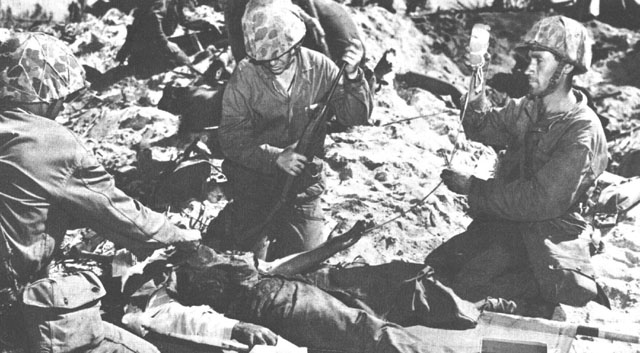
Corpsmen treating wounded Marine on Eniwetok Island 

“You guys are the Marine’s doctors; There’s no better in the business than a Navy Corpsman….”  Lieutenant General Lewis B. “Chesty” Puller, U.S.M.C

The numbers speak volumes: 22 Congressional Medals of Honor,174 Navy Crosses, 31 Distinguished Service Crosses (US Army Decoration), 946 Silver Stars1582 Bronze Stars, 22 Ships named after Corpsmen and 2012 Corpsmen killed in action since President William McKinley the establishment of the rating by by Congress which was into law on June 17th 1898.

Known by Marines and Sailors simply as “Doc” Corpsmen have served everywhere the Navy and Marine Corps have served or fought since the Spanish American War. The rating is quite remarkable because the Corpsmen are often the only medical support immediately available to sailors and Marines at “the tip of the spear.”

As medicine and surgery became more scientific and advanced during the industrial and scientific revolutions of the 1800s military physicians began to lobby for trained assistants.  Early in our nation’s history it was up to individual ships Captains to appoint assistants to the ship’s surgeons. Initially known by the British Royal Navy nickname “Lolly Boys” which referred to the ladle of porridge given to the sick, the men helped the surgeon prepare the operating area usually found deep in the hold of the ship on the Orlop Deck before battle and to help keep the surgeon supplied with hot irons to cauterize wounds and to sand the deck to keep the surgeon from slipping on the blood of the wounded.  The terminology would change throughout the years and in 1841 a senior rating of Surgeon’s Steward was introduced and later changed to Apothecary which required the completion of a course in basic pharmacy.

By the 1870s pressure was growing for reform of the rating but it was not until 1897, 10 years after the US Army established its enlisted Hospital Corps that the reformers were successful and the Surgeon General and his supporters were able to convince the Navy Department to push for the reforms in Congress.

The new Corpsmen served throughout the fleet and with the Marines and the rating was expanded to include two Apprentice ranks, three grades of Petty Officers and a Chief Petty Officer who were called Pharmacist Mates. Following World War Two the Navy changed the name of the rating to the generic term that Sailors and Marines had used for years, Hospital Corpsman or Hospitalman. The current rank structure was adopted in 1958.

Corpsmen with the Marines in every battle since their inception in 1898. They have  served aboard ships and often are the sole medical provider. Those serving in such capacity receive additional training as Independent Duty Corpsmen.  Those that serve with the Marines receive additional training at Field Medical Service School while many others receive specialized training in various technical fields within the Medical Department.  Many serve with the Marines, EOD, SEALS, Seabees and in Field Hospitals in Afghanistan caring for US and Allied wounded as well as local Afghan civilians. They can be found around the world wherever the Navy is in humanitarian and operations from Haiti to Indonesia. In every clime and place Corpsmen have accompanied Marines and Sailors to war. Today over 20,000 active duty and reserve Corpsmen serve aboard ships, in medical facilities, with EOD, Special Warfare, the Seabees and with the Fleet Marine Force. Many Navy Physicians, Nurses and Medical Service Corps Officers began their careers as Corpsmen.

As a Navy Brat a lot of my medical care as a child came from Corpsmen. One saved me from an overdose of baby Aspirin when I was about 3 years old when we were stationed in the Philippines, another set a cast on my arm when I broke it jumping my bike across a ditch in 6th grade. As an adult I have had the honor of serving with Corpsmen in the Fleet Marine Force, aboard the USS Hue City, in Iraq, with Navy EOD and for the past four years in Naval Medical Centers and Hospitals.

Corpsmen are amazing, especially when you need them.

Happy Birthday “Doc.”

Peace

Padre Steve+

Leave a comment

Filed under History, US Navy

The Battleships of D-Day

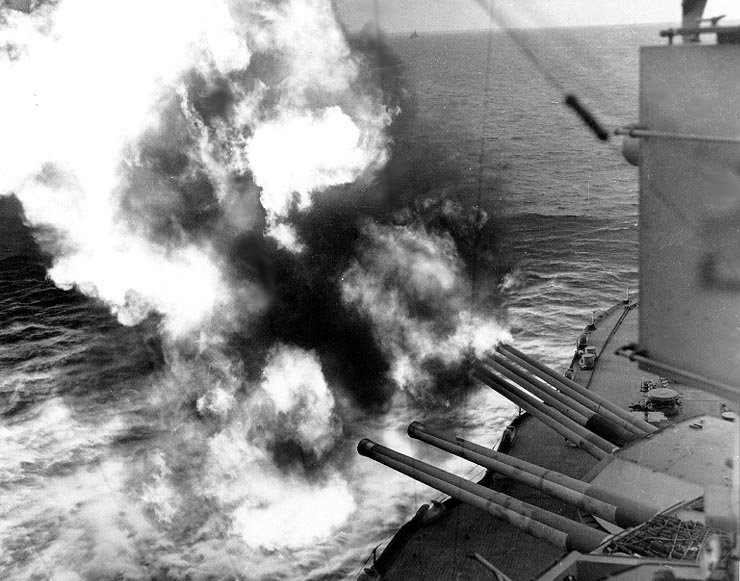
The 14″ Guns of USS Nevada in action at Normandy

On June 6th 1944 Allied Forces landed on the beaches of Normandy. Six American, British and Canadian Infantry Divisions, three Airborne Divisions and numerous supporting units came ashore in landing craft or were airdropped into Normandy. Backing them was an immense Naval Task Force which provided naval gunfire support, screened the force from German U-Boat or surface naval forces and transported the massive ground force.  It was an amazing armada.

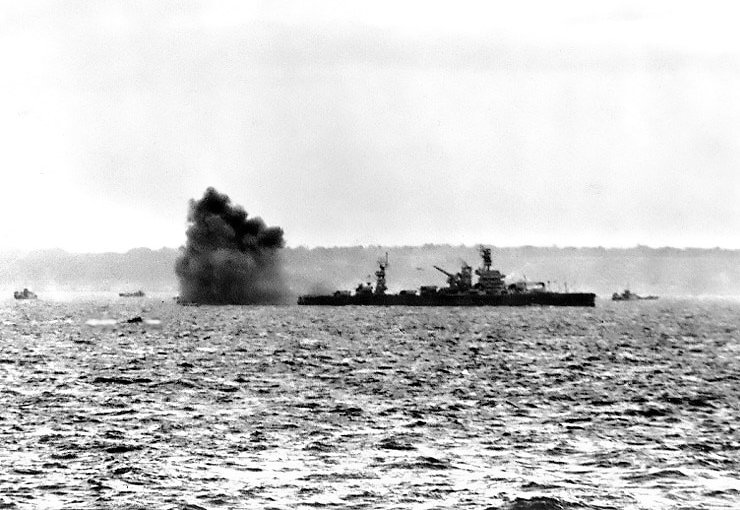
HMS Rodney bombarding German positions off Caen

It was an armada that also is forgotten by many who read about Normandy or whose only exposure to the landings are films such as Saving Private Ryan. Today I think it is fitting to remember Battleships that served at Normandy, USS Arkansas, USS Texas, USS Nevada, HMS Warspite, HMS Ramillies and HMS Rodney.

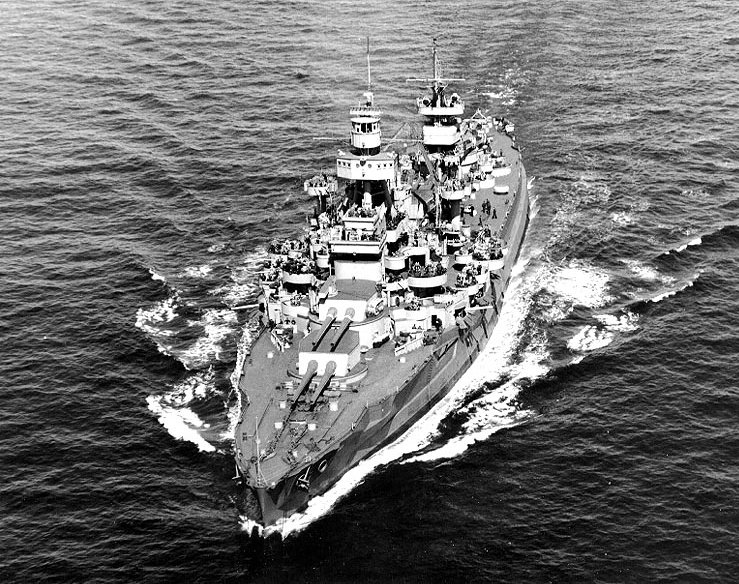
USS Arkansas off Omaha Beach

The naval gunfire support force included Battleships, Cruisers and Destroyers as well as specialized gunfire support ships.  The largest and most powerful ships were the six American and British Battleships.  These ships were important in providing the heavy firepower needed to destroy the strongest fortifications and shore batteries and to fire at targets far beyond the shoreline that were vital for German reinforcements.

However the ships involved were not the modern behemoths which were built in the 1930s and since the beginning of the war but rather among the oldest ships still active in either the United States or the British Royal Navy. At one time they had all been the hearts for their navies but now old, slow and with less than modern armament and fire control systems they were regulated to supporting amphibious forces or escorting convoys.

USS Arkansas BB-33

The oldest of these venerable ships was the USS Arkansas BB-33 which was commissioned in 1912. A Wyoming Class Battleship she mounted twelve 12” guns in six twin turrets, two forward, two aft and two midships. She displaced just over 27,000 tons. She had spent most of the war escorting convoys in the Atlantic before being assigned to the Normandy landings. She stood off Omaha Beach dueling with German shore batteries and pounding the German troops who were making Omaha a living hell for the men of the US 1st and 29th Infantry Divisions.  She would continue her valuable service off of Normandy and would do the same in to support the landings in Southern France before steaming to the Pacific where she would do the same at Iwo Jima and Okinawa.

USS Texas BB-35

The USS Texas, BB-35 of the New York class had been in commission since 1914. She mounted ten 14” guns in 5 twin turrets, two forward, two aft and one midships and was slightly larger than the Arkansas.  More modern she was more extensively modernized between the wars than was Arkansas and was one of the first US ships to carry experimental radar sets.  She also conducted convoy operations but was used to bombard Vichy French troops and positions during Operation Torch, the Allied invasion  of North Africa.  At D-day she was in the western sector of Omaha and bombarded Point Du Hoc and cruised to within 3000 yards of the beach to clear the western exits of the beach near Vierville.  She remained in the area a number of days and would subsequently support the attack on Cherbourg, the invasion of South France and then serve in the Pacific at Iwo Jima and Okinawa.

USS Nevada BB-36

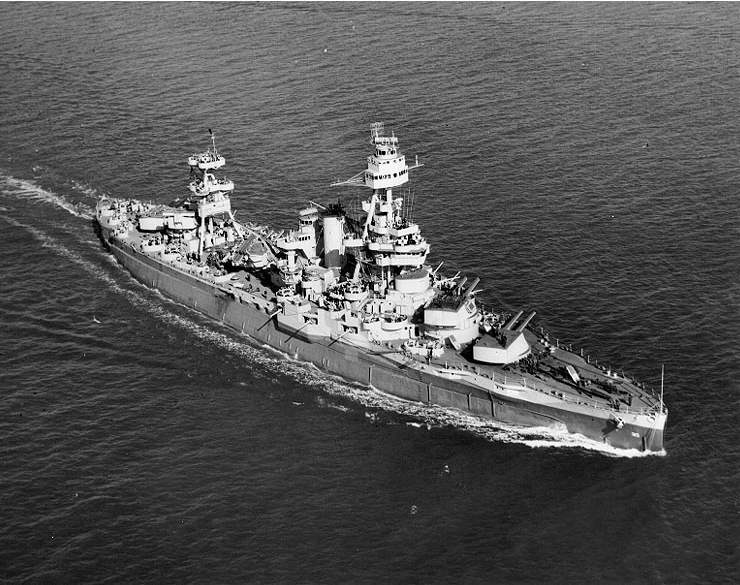
The USS Nevada BB-36 was the first of a new class of battleships which set the basic pattern of US Battleship design through the ratification of the Washington Naval Treaty. Her main battery of ten 14” guns was mounted in four turrets, mounted fore and aft two triple and 2 twin turrets.  She was he powered by oil fired boilers as opposed to coal and   was designed with a longer cruising radius to meet the demands of War Plan Orange.  Nevada received major upgrades between the wars and on December 7th 1941 was moored on Battleship Row when Peal Harbor was attacked by the Japanese. The only Battleship to get underway during the attack Nevada was set upon by Japanese aircraft as she steamed toward the harbor entrance. Heavily damaged she was grounded off Hospital Point. She was re-floated and sailed to the United States where she was heavily modernized with a modern AA battery of twin 5” 38 caliber guns, and fire direction radars. She was modernized to the point that she no longer resembled the ship sunk at Pearl Harbor. After her repair and modernization she participated in the invasion of Attu Island and did convoy escort duty before reporting for the invasion of Normandy. Nevada supported the US 4th Infantry Division at Utah Beach and subsequently served with Texas and Arkansas in South France before going to the Pacific to support the invasions of Iwo Jima and Okinawa. Had the war continued she would have been involved in the invasion of the Japanese Mainland.

HMS Warspite

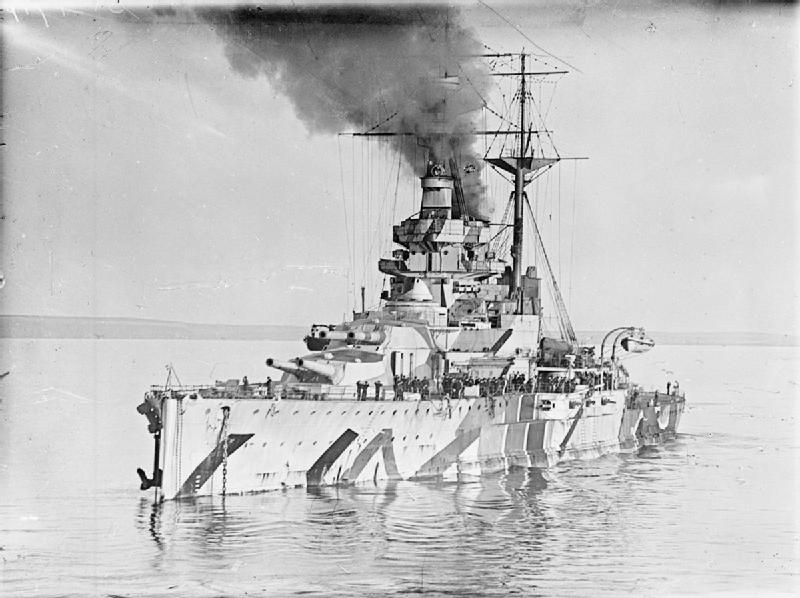
The Royal Navy Battleships of D-Day were also elderly veterans. The eldest was the heroic HMS Warsipte commissioned in 1915 and a veteran of the Battle of Jutland and numerous actions during the Second World War including the slaughter of the German Destroyers at Narvik, the Battle of Cape Matapan and the invasion of Sicily and Italy.  The Queen Elizabeth Class Battleship mounted eight 15” guns in twin turrets and was extensively modernized between the wars. At Salerno Warspite was hit by three of the earliest guided missiles, the Fritz-X type launched by Luftwaffe Aircraft. She was heavily damaged and required major repairs before returning to service at Normandy. She supported British troops at Sword Beach and later Gold Beach. She again was heavily damaged by a magnetic mine and received temporary repairs to allow her to continue bombardment duties against German positions France and Belgium before being placed in reserve in January 1945.

HMS Ramillies

The HMS Ramillies was a Revenge Class Battleship commissioned in 1917. These ships were a compromise design that was smaller, slower and cheaper than the Queen Elizabeth Class but had the same main battery of eight 15” guns.  The compromises prevented them from receiving significant upgrades between the wars and limited their employment. Ramillies operated as a convoy escort and was also involved in action in  the Mediterranean and Indian Ocean. She participated in the hunt for the German Pocket Battleship Graf Spee and shielded Convoy HX-106 from the Scharnhorst and Gneisenau and later took part in the hunt for the Bismarck. However she but was not engaged against any of the German ships but her presence prevented Admiral Lutjens from risking Scharnhorst and Gneisenau to attack the convoy. She took part in the initial battle between the Royal Navy and the Italians at the Battle of Cape Spartivento getting off several salvos before her slow speed forced her out of the action. She was heavily damaged by a torpedo from a Japanese mini-submarine in Diego Suarez harbor during the invasion of Madagascar in May 1942. Following repairs and the addition of extra deck armor and modern anti-aircraft guns she returned to action at Normandy were she supported British troops ashore and drove off an attack by German Destroyers. She stayed in action firing over 1000 shells at Normandy before supporting the invasion of Southern France. Too slow to be of use in the Pacific she was placed in Reserve in January 1945.

HMS Rodney

The youngest of the Battlewagons at Normandy on June 6th was the HMS Rodney which was commissioned in 1927. She and her sister ship HMS Nelson were to be the first of the post WWI super battleships and was designed as a larger and more powerful ship. With the limitations of the Washington Naval Treaty the ships were “cut down” and reduced in size and speed. Her armament made her one of the most powerful battleships of period but her engineering plant was not always reliable. Since she was relatively modern she did not receive any major refits before the war and apart from a repairs to her engines in Boston in 1941 (before the US entry into the war) and a brief refit in 1942 she received no further refits during the war. With the HMS King George V she helped sink the Bismarck and would escort convoys and participate in the Allied invasions of North Africa, Sicily and Salerno before being assigned to the Normandy invasion force attacking targets near Caen.  Her sister HMS Nelson was held in reserve and joined the battle on June 10th but she was not present on D-Day.

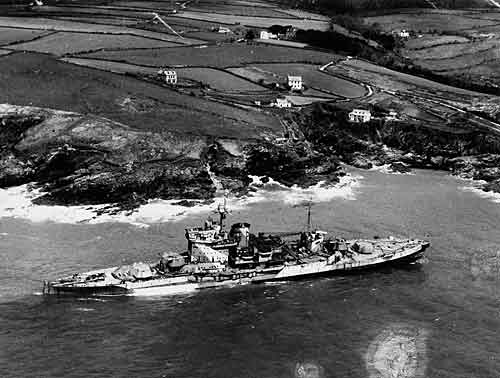
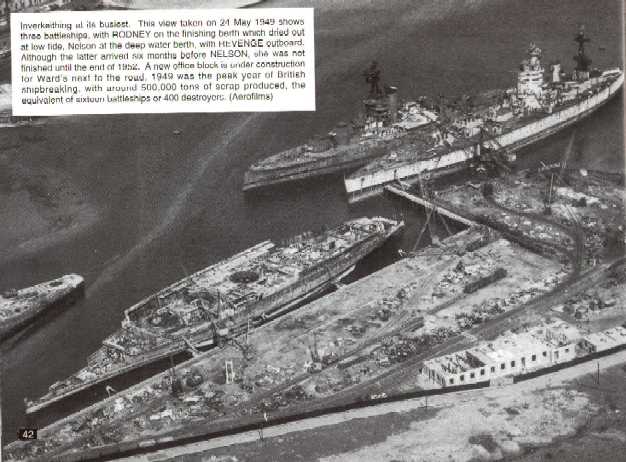
Warspite aground and Rodney being scrapped (below)

Despite their age and limitations all of these ships and their performed heroically during the war. The post war period was not as kind to the ships. Arkansas and Nevada were used in the Atomic Bomb tests at Bikini Atoll. Nevada survived and was expended as a target in 1948. All of the British ships were scrapped following the war due to their age, wear and damage incurred during the war. Warspite was being towed to the breakers when she broke a tow line and went aground. She ended up being partially scrapped in place.  Mementos of all these ships remain including a gun from Ramillies at the Imperial War Museum. The lone survivor was the USS Texas which became a museum ship and memorial at the San Jacinto battlefield in 1948. She is the last of the Dreadnought ships remaining. Other more modern US Battleships have been preserved but only Texas remains from those ships that at one time ruled the waves and pounded the Germans at Normandy.

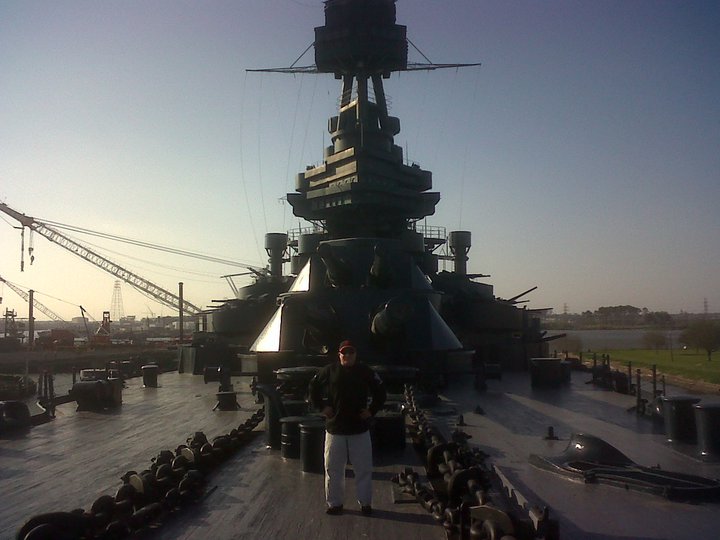
The author aboard USS Texas in March 2011

The fire support provided by these proud ships and their consorts ensured the success of the Normandy landings. Without them it is very possible that the landings would not have succeeded and many more Allied soldiers would have died and the war extended.

To these great ships and all their heroic crews…

Peace

Padre Steve+

28 Comments

Filed under History, Military, Navy Ships, US Navy, world war two in europe

Compounding Disaster: The Loss of the Mikuma at Midway

Mikuma as Built

Admiral Isoroku Yamamoto was still attempting to digest the calamity that had befallen Admiral Nagumo’s carrier task force. In the shocked atmosphere of the mighty Super Battleship Yamato’s command center the Staff of the Combined Fleet was hastily attempting to arrive at a solution which might reverse the disaster and bring victory.  Admiral Ugaki, Yamamoto’s Chief of Staff despite his personal doubts ordered Vice Admiral Nobutake Kondo to prepare for a night surface engagement with the US Fleet and to dispatch a strong surface force to bombard Midway in order to prevent the Americans from reinforcing it and to prevent its further use against his forces should the invasion move forward.  Kondo organized his fleet to attempt to find the American carriers and bring them to battle before dawn.

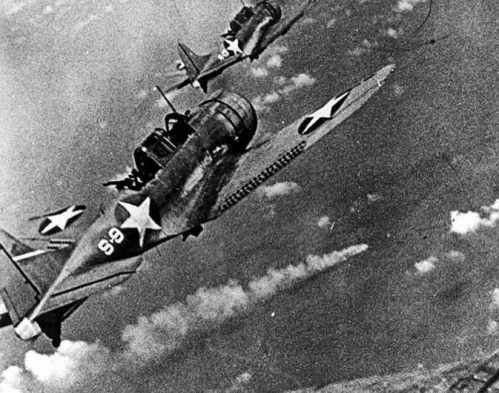
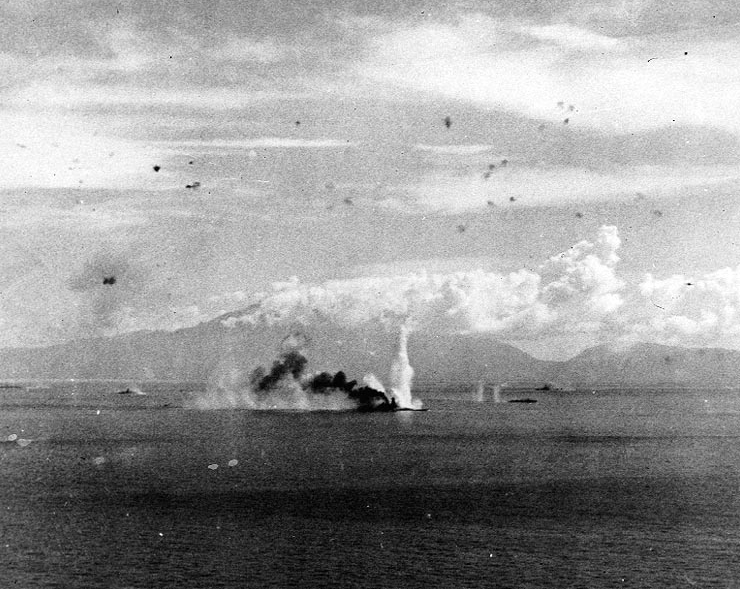
SBD Dauntless Dive Bombers from Hornet attacking Mogami and Mikuma 

Kondo detached Vice Admiral Takeo Kurita’s Close Support Group composed of Cruiser Seven, the fastest and most modern cruisers in the Imperial Navy proceed at full speed to attack Midway.  Kurita’s cruisers, the Kumano, Suzuya, Mikuma and Mogami were each armed with 10 8” guns and were escorted by the two destroyers.

Kurita’s force was 80 miles from Midway when Yamamoto realizing that his plan was unrealistic ordered Kondo’s forces to retreat and rendezvous with his main force shortly after midnight. The order was met with a measure of relief by most officers in the force and the force turned northwest and steamed at 28 knots to meet the Main Body.  At 0215 lookouts on Kumano sighted a submarine on the surface which turned out to be the USS Tambor which had been shadowing the group, and made a signal for the force to make a emergency 45 degree turn to port.

During the process Mogami’s Navigator took over from the watch to oversee the tricky maneuver. In doing so he thought that there was too much distance between him and the ship ahead, the Mikuma. So he adjusted his course to starboard and then realized his mistake. The ship he thought was Mikuma was actually Suzuya and Mikuma was directly ahead. As soon as he recognized his mistake Mogami’s Navigator ordered a hard turn to port and reversed the engines but it was too late. Mogami’s bow crashed into Mikuma’s port quarter. The impact caused minimal damage to Mikuma but Mogami was heavily damaged. She lost 40 feet of her bow and everything else was bent back to port at right angles to her number one turret.

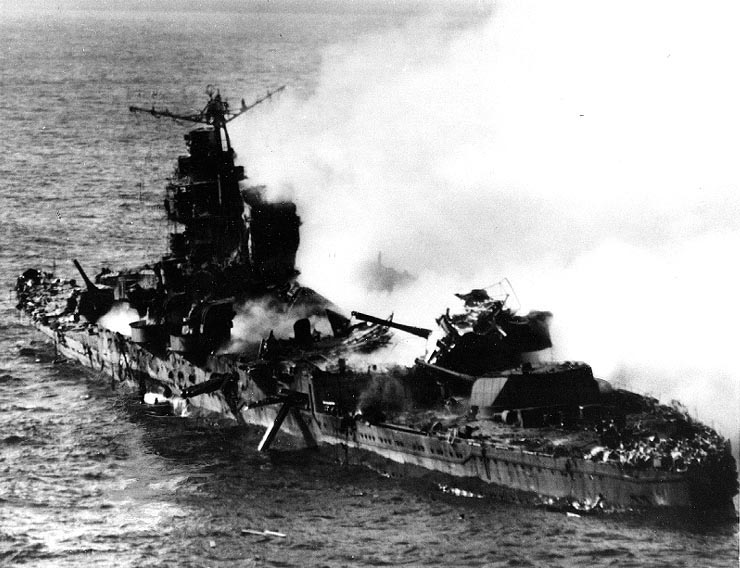
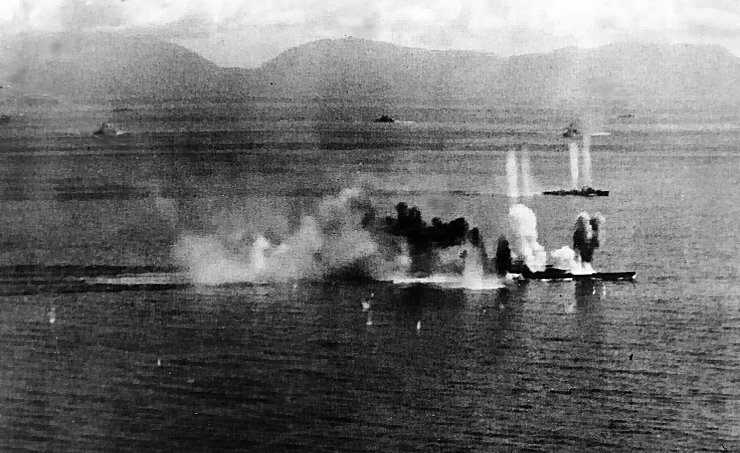
Ariel Photo of Mikuma damaged

Mogami’s damage control teams isolated the damage and worked the ship up to 12 knots. This was not fast enough for Kurita to make his rendezvous so he left Mikuma and the destroyers to escort Mogami while he steamed ahead with Kumano and Suzuya.

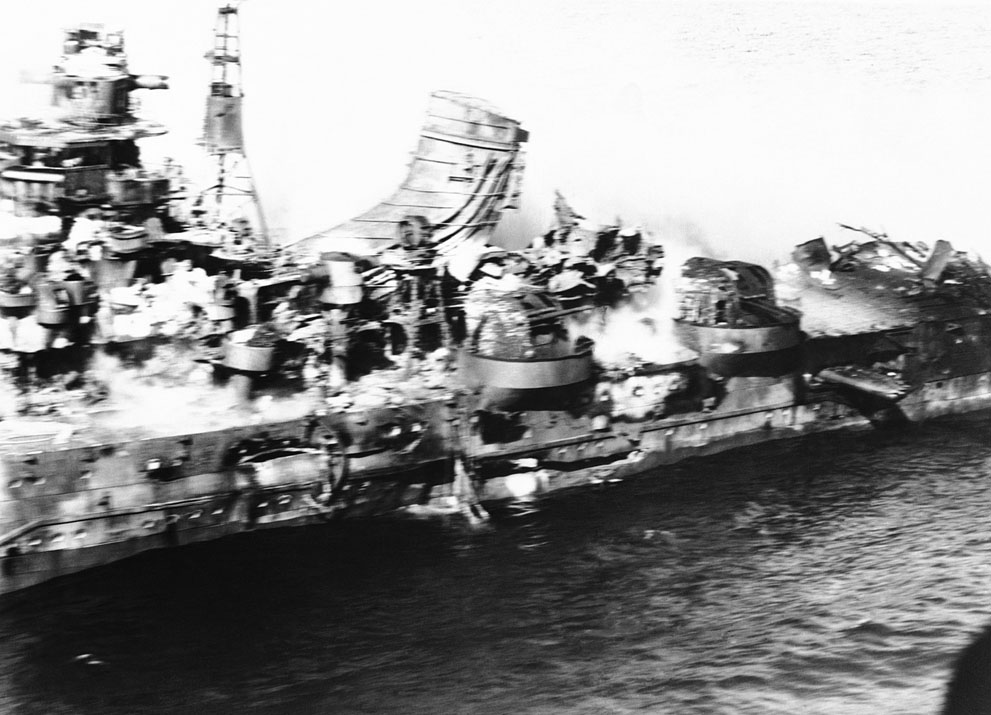
Mikuma adrift and sinking. The wreckage of Captain Fleming’s Vindicator can be seen on X- Turret 

Tambor’s skipper LCDR John W Murphy sent a contact report at 0300 reporting “many unidentified ships.” He followed this with more detailed information and the Americans on Midway began to launch its remaining serviceable aircraft to attack the threat. A flight of B-17 Bombers launched at 0430 could not find the Japanese ships but at 0630 a PBY Catalina found the Japanese and radioed Midway “two Japanese battleships streaming oil.”  The remaining 12 aircraft of VSMB-241 under command of Captain Marshall Tyler a mix of SBD Dauntless and SB2U Vindicators took off at 0700. His force attacked at 0808 scoring no hits but Captain Richard Fleming, his Vindicator on fire dropped his bomb and then crashed his aircraft into Mikuma’s after turret. The fire was sucked down air intakes into the starboard engine room with disastrous results. The engineers were suffocated by the smoke and fumes and Mikuma was greatly reduced in speed.

Close up shot of Mikuma with survivors visible 

The two ships limped northwest at 12 knots escorted by the destroyers and were unmolested through much of the day with the exception of an ineffective attack by the B-17s at 0830. The following morning the Dive Bombers of Enterprise and Hornet were at work and found the crippled Japanese ships. Waves over US Dive Bombers attacked the cruisers throughout the morning and into the afternoon. Mikuma was hit at least 5 times and secondary explosions of ammunition and torpedoes doomed the ship. Mogami was also heavily damaged but remained afloat while both destroyers received bomb damage.  At sunset the tough cruiser rolled over to port and sank into the Pacific. Mogami whose damage control teams had performed miracles to keep their ship afloat helped the destroyers rescue survivors from Mikuma.  Only 240 were rescued with 650 officers and sailors going down with the ship.

The action against the cruisers ended the combat operations at Midway. The Japanese ships were doomed by Yamamoto’s decision to try to salvage victory from defeat and the error of Mogami’s Navigator during the emergency turn when Kumano sighted Tambor. The only thing that kept the result from being total was the efficacy of Mogami’s damage control teams.  Mogami was out of the war for 10 months following repairs and conversion to an Aircraft Cruiser in which her aft turrets were removed to increase the number of float plane scouts that the ship could carry. She rejoined the fleet in April 1943 and was sunk following the Battle of the Surigao Strait on 25 October 1944.

The Mogami and Mikuma proved to be tough ships to sink. Unprotected by friendly aircraft they fought hard against the unopposed American Dive Bombers. They suffered massive damage from 500 and 1000 pound bombs, both direct hits and near misses. Mogami was saved by the skill of her damage control teams and the foresight of her Damage Control Officer to jettison her torpedoes so that they did not explode and compound the damage wrought by the American bombs.

For the Americans it was a fitting end to the Battle of Midway and revenge for the Battle of the Sunda Strait where Mikuma and Mogami sank the USS Houston.

Peace

Padre Steve+

3 Comments

Filed under History, Military, Navy Ships, US Navy, world war two in the pacific

70 Years: Celebrating the Miracle at Midway

It is hard to imagine now but in June of 1942 it seemed a good possibility that the Americans and British could be on the losing side of the Second World War.

In June 1942 the Japanese onslaught in the Pacific appeared nearly unstoppable. The Imperial Navy stormed across the Pacific and Indian Oceans in the months after Pearl Harbor decimating Allied Naval forces that stood in their way.  The British Battleships HMS Prince of Wales and HMS Repulse were sunk by land based aircraft off of Singapore. A force of Royal Navy cruisers and the Aircraft Carrier HMS Hermes were sunk by the same carriers that struck Pearl Harbor in the Indian Ocean.  Darwin Australia was struck with a devastating blow on February 19th and on February 27th the Japanese annihilated the bulk of the American, British, Dutch and Australian naval forces opposing them at the Battle of the Java Sea. American forces in the Philippines surrendered on May 8th while the British in Singapore surrendered on February 15th.

In only one place had a Japanese Naval task force been prevented from its goal and that was at the Battle of the Coral Sea.  Between 4-8 May the US Navy’s Task Force 11 and Task Force 17 centered on the Carriers USS Lexington and USS Yorktown prevented a Japanese invasion force from taking Port Moresby. Their aircraft sank the light carrier Shoho, damaged the modern carrier Shokaku and decimated the air groups of the Japanese task force. But it was the unexpected raid by US Army Air Corps B-25 Bombers launched from the USS Hornet under command of Colonel Jimmy Doolittle on April 18th 1942 which embarrassed Yamamoto so badly that he ordered the attack to take Midway and destroy the remaining US Naval power in the Pacific.

In May US Navy code breakers discovered the next move of the Imperial Navy an attack on Midway Island and the Aleutian islands.   Since the occupation of Midway by Japanese forces would give them an operational base less than 1000 miles from Pearl Harbor Admiral Chester Nimitz committed the bulk of his naval power, the carriers USS Enterprise CV-6, USS Yorktown CV-5 and USS Hornet CV-8 and their 8 escorting cruisers and 15 destroyers.  His force of 26 ships with 233 aircraft embarked to defend Midway while a force of 5 cruisers and 4 destroyers was dispatched to cover the Aleutians.  Midway itself had a mixed Marine, Navy and Army air group of 115 aircraft which included many obsolete aircraft, 32 PBY Catalina Flying Boats and 83 fighters, dive bombers, torpedo planes and Army Air Force bombers piloted by a host of inexperienced but resolute airmen.

The Japanese Fleet was led by Admiral Isoroku Yamamato and was built around the elite First Carrier Striking Group composed of the Pearl Harbor attackers Akagi, Kaga, Soryu and Hiryu. Led by Vice Admiral Chuichi Nagumo its highly trained and combat experienced air groups composed of 273 aircraft. This force was escorted by 2 Battleships, 3 Cruisers 12 Destroyers. Yamamoto commanded a force of  2 light carriers, 5 Battleships, 11 cruisers and 27 destroyers.  Meanwhile a  force of 4 battleships, 12 destroyers assigned screen to the Aleutian invasion force which was accompanied by 2 carriers 6 cruisers and 10 destroyers. The other carriers embarked a further 114 aircraft.  The Japanese plan was ambitious but it was so ambitious that the Japanese Task forces were scattered over thousands of square miles of the Northern Pacific Ocean from which they could not rapidly come to the support of each other.

With the foreknowledge provided by the code breakers the US forces hurried to an intercept position northeast of Midway. They eluded the Japanese submarine scout line which the Japanese Commander Admiral Yamamoto presumed would find them when they sailed to respond to the Japanese attack on Midway.  Task Force 16 with the Enterprise and Hornet sailed first under the command of Rear Admiral Raymond A Spruance in place of the ailing William “Bull” Halsey. Task Force 17 under Rear Admiral Frank “Jack” Fletcher was built around the Yorktown which had been miraculously brought into fighting condition after suffering heavy damage at Coral Sea. Fletcher assumed overall command by virtue of seniority and Admiral Nimitz instructed his commanders to apply the principle of “calculated risk” when engaging the Japanese as the loss of the US carriers would place the entire Pacific at the mercy of the Japanese Navy.

On June 3rd a PBY Catalina from Midway discovered the Japanese invasion force and US long range bombers launched attacks against but inflicted no damage. On the morning of the 4th the Americans adjusted their search patterns in and the Japanese came into range of Midway and commenced their first strike against the island.  In response land based aircraft from Midway attacked the Japanese carrier force taking heavy casualties and failing to damage the Japanese task force.

The American Carrier task forces launched their strike groups at the Japanese fleet leaving enough aircraft behind of the Combat Air Patrol and Anti-submarine patrol.  As the Americans winged toward the Japanese fleet the Japanese were in confused.  A scouting report by an aircraft that had been delayed at launch discovered US ships but did not identify a carrier until later into the patrol.  This was the Yorktown and TF 17. The Japanese attempted to recover their strike aircraft and prepare for a second strike on the island and then on discovery of the carrier embarked on the task of unloading ground attack ordnance in favor of aerial torpedoes and armor piercing bombs.  The hard working Japanese aircrew did not have time to stow the ordnance removed from the aircraft but by 1020 they had the Japanese strike group ready to launch against the US carriers.

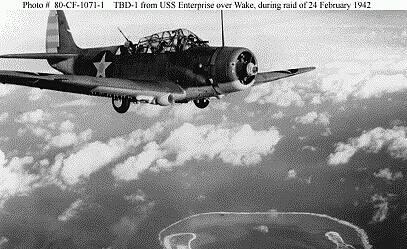
As the Japanese crews worked the Japanese carriers were engaged in fending off attacks by the US torpedo bomber squadrons, VT-6 from Enterprise, VT-8 from Hornet and VT-3 from Yorktown.  The Japanese Combat Air Patrol ripped into the slow, cumbersome and under armed TBD Devastators as they came in low to launch their torpedoes.  Torpedo Eight from Hornet under the command of LCDR John C Waldron pressed the attack hard but all 15 of the Devastators were shot down.  Only Ensign George Gay’s aircraft was able to launch its torpedo before being shot down and Gay would be the sole survivor of the squadron.

Torpedo 6 under the command of LCDR Eugene Lindsey suffered heavy casualties losing 10 of 14 aircraft with Lindsey being one of the casualties.  The last group of Devastators to attack was Torpedo 3 under the command of LCDR Lem Massey from the Yorktown.  These aircraft were also decimated and Massey killed but they had drawn the Japanese Combat Air Patrol down to the deck leaving the task force exposed to the Dive Bombers of the Enterprise and Yorktown.

There had been confusion among the Americans as to the exact location of the Japanese Carriers, the Bombing 8 and Scouting 8 of Hornet did not find the carriers and had to return for lack of fuel with a number of bombers and their fighter escort having to ditch inn the ocean and wait for rescue.  The Enterprise group under LCDR Wade McClusky was perilously low on fuel when the wake of a Japanese destroyer was spotted.  McClusky followed it to the Japanese Task Force.  The Yorktown’s group under LCDR Max Leslie arrived about the same time.  The found the skies empty of Japanese aircraft. Aboard the Japanese ships there was a sense of exhilaration as each succeeding group of attackers was brought down and with their own aircraft ready to launch and deal a fatal blow to the American carrier wondered how big their victory would be.

At 1020 the first Zero of the Japanese attack group began rolling down the flight deck of the flagship Akagi, aboard Kaga aircraft were warming up as they were on the Soryu.  The unsuspecting Japanese were finally alerted when lookouts screamed “helldivers.” Wade McClusky’s aircraft lined up over the Akagi and Kaga pushing into their dives at 1022. There was a bit of confusion when the bulk of Scouting 6 joined the attack of Bombing 6 on the Kaga.  The unprepared carrier was struck by four 1000 pound bombs which exploded on her flight deck and hangar deck igniting the fully fueled and armed aircraft of her strike group and the ordnance littered about the hangar deck.  Massive fires and explosions wracked the ship and in minutes the proud ship was reduced to an infernal hell with fires burning uncontrollably. She was abandoned and would sink at 1925 taking 800 of her crew with her.

LT Dick Best of Scouting 6 peeled off from the attack on Kaga and shifted to the Japanese flagship Akagi. On board Akagi were two of Japans legendary pilots CDR Mitsuo Fuchida leader of and CDR Minoru Genda the architect of the Pearl Harbor attack and subsequent string of Japanese victories.  Both officers were on the sick list and had come up from sick bay to watch as the fleet was attacked.  Seeing Kaga burst into flames they stood mesmerized until Akagi’s lookouts screamed out the warning “helldivers” at 1026.  Best’s aircraft hit with deadly precision landing tow of their bombs on Akagi’s flight deck creating havoc among the loaded aircraft and starting fires and igniting secondary explosions which turned the ship into a witch’s cauldron.  By 1046 Admiral Nagumo and his staff were forced to transfer the flag to the cruiser Nagara as Akagi’s crew tried to bring the flames under control. They would do so into the night until nothing more could be done and abandoned ship at 2000.  Admiral Yamamoto ordered her scuttled and at 0500 on June 5th the pride of the Japanese carrier force was scuttled.

VB-3 under LCDR Max Leslie from the Yorktown stuck the Soryu with 17 aircraft, only 13 of which had bombs due to an electronic arming device malfunction on 4 of the aircraft including the squadron leader Leslie.  Despite this they dove on the Soryu at 1025 hitting that ship with 3 and maybe as many as 5 bombs. Soryu like her companions burst into flames as the ready aircraft and ordnance exploded about her deck. She was ordered abandoned at 1055 and would sink at 1915 taking 718 of her crew with her.

The remaining Japanese flattop the Hiryu attained the same fate later in the day after engaging in an epic duel with the Yorktown which her aircraft heavily damaged. Yorktown was abandoned after a second strike but when she did not sink her her returned to attempt to save her. However despite their efforts she and the destroyer USS Hamman DD-412 were torpedoed by the Japanese Submarine I-168. Hamman sank almost immediately with heavy loss of life while Yorktown sank on the morning of the 7th.

It was quite miraculous what happened at Midway in those five pivotal minutes.  Authors have entitled books about Midway Incredible Victory and Miracle at Midway and the titles reflect the essence of the battle.  A distinctly smaller force defeated a vastly superior fleet in terms of experience, training and equipment and when it appeared that the Japanese Fleet would advance to victory in a span of less than 5 minutes turn what looked like certain defeat into one of the most incredible and even miraculous victories in the history of Naval warfare.  In those 5 minutes history was changed in a breathtaking way.  While the war would drag on and the Japanese still inflict painful losses and defeats on the US Navy in the waters around Guadalcanal the tide had turned and the Japanese lost the initiative in the Pacific never to regain it.   The Japanese government hid the defeat from the Japanese people instead proclaiming a great victory while the American government could not fully publicize the information that led to the ability of the US Navy to be at the right place at the right time and defeat the Imperial Navy.

When one looks at implications of the victory it did a number of things. First it changed the course of the war in the Pacific probably shortening it by a great deal.  Secondly it established the aircraft carrier and the fast carrier task force as the dominant force in naval warfare which some would argue it still remains.  Finally those five minutes ushered in an era of US Navy dominance of the high seas which at least as of yet has not ended as the successors to the Enterprise, Hornet and Yorktown ply the oceans of the world and the descendants of those valiant carrier air groups ensure air superiority over battlefields around the world.

Peace

Padre Steve+

4 Comments

Filed under History, Military, Navy Ships, US Navy, world war two in the pacific

Happy Birthday Chief’s: Navy Chief Petty Officers Celebrate 119 Years of Service

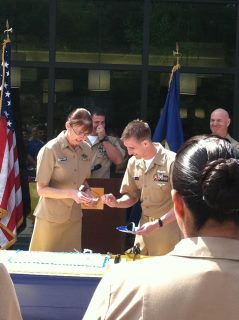
On Sunday April 1st the US Navy Chief Petty Officer Rank officially celebrated it’s 119th Anniversary. Today in most Navy commands as well as Marine Corps units that have Navy Chief’s assigned that anniversary was celebrated. I was in attendance today as our command celebrated the “birthday” of the Chief Petty Officer rank with the cutting of a cake.

The rank and pay grade of Chief Petty Officer was officially established on 1 April 1893 but the roots are deeper to the years prior to the Civil war as the rating structure of Petty Officers became more formalized and in 1864 with the pay manual listing Chief Boatswain’s Mate, Boatswain’s Mate in Charge, Boatswain’s Mate, Chief Gunner’s Mate, Gunner’s Mate in Charge, Gunner’s Mate, Chief Quartermaster and Quartermaster in the list of ratings.  The development continued in the 1880s with the formalization of Petty Officer ratings and Pay Grades as well as that of Seamen.

The 1893 regulations listed 9 Chief Petty Officer Ratings divided between three branches, the Seaman Branch which was composed of Chief Master at Arms, Chief Boatswain’s Mate, Chief Quartermaster and Chief Gunner’s Mate. The Artificer Branch had the Chief Machinist and Chief Carpenter’s Mate and the Special Branch had the Chief Yeoman, Apothecary (the future Pharmacist Mate and Hospital Corpsman) and Band Masters.  Pay for all Petty Officers and enlisted ranks was standardized in 1920 and in 1958 the Grades of Senior Chief Petty Officer and Master Chief Petty Officer were established.  Today Chiefs form the backbone of Navy commands around the world, from SEAL and EOD teams, surface ships, submarines, aviation squadrons, shore commands and medical units.

Above: Chief Aviation Ordnanceman John William Finn was awarded the Medal of Honor for extraordinary heroism and distinguished service during the December 7, 1941 Japanese air attack on Naval Air Station Kanoehe Bay, Oahu, T.H. He is wearing the medal in this photograph. 

Navy Chiefs wear a Khaki uniform similar to that of Commissioned Officers and on ships have their own berthing and Mess area in which only Chiefs or invited guests are allowed. The area is called the “Chief’s Mess” and nicknamed the “Goat Locker.”

While the three pay grades of Chiefs correspond to the pay grades of senior non-commissioned officers in the Army, Marine Corps and Air Force no other service sets its senior NCOs apart as does the Navy nor gives them the same measure of authority. Part of this goes back to the maritime tradition where a ship once it departs harbor has to depend on the skills and abilities of every member to the crew and that help should there be trouble will seldom be close at hand.

Cake cutting at Naval Hospital Camp LeJeune 

Navy Chiefs have been the linchpin of the Navy for 119 years. They are depended upon to help train new sailors as well as help train and advise Commissioned Officers. I have been fortunate to have served with some of the finest Chiefs in the Navy aboard the USS Hue City, EOD Group Two, 2nd Marine Division and the Naval Medical Center Portsmouth VA and now at Naval Hospital Camp LeJeune NC.

My Dad Aviation Storekeeper Chief Carl Dundas shortly after his promotion to Chief in 1967

Additionally I am blessed to be a “Chief’s kid.” My late father, Aviation Storekeeper Chief Carl Dundas retired from the Navy in 1974. I grew up in a Navy family and was blessed to have the Chiefs that my dad served alongside during his career and their families remain engaged with my parents. My dad died from complications associated with Alzheimer’s Disease in June of 2010 but to the end he was a Chief.

Blessings to all that wear or have worn the Khaki uniform and Fouled Anchor that symbolize this proud tradition.

Peace

Padre Steve+

2 Comments

Filed under Military, US Navy

A Weekend of Old Navy Movies: Mister Roberts, The Caine Mutiny and In Harm’s Way

Well I have the duty pager for the hospital this weekend so I have been hanging out at the Island Hermitage with my dog Molly watching classic Navy movies.

Friday night I watched the classic film Mister Roberts. Yesterday I watched In Harm’s Way and The Caine Mutiny.
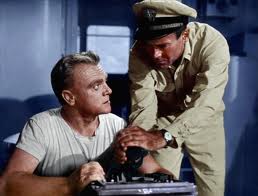
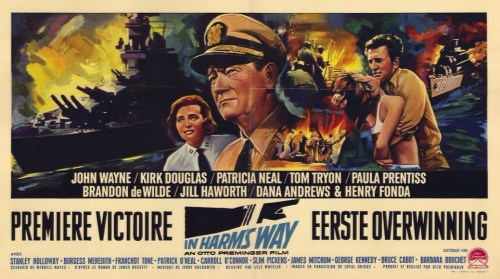
All three films are fictional and because of that I find them great for understanding the complexity of Navy life and leadership.  Mister Roberts and the Caine Mutiny the films deal with the complexities of life and leadership on small and rather insignificant ships while In Harm’s Way deals with more senior officers and their lives. All three deal with subjects that are uncomfortable because they still exist not just in the Navy but throughout the military. Thus all three offer insights into toxic leaders, poor morale, discipline, mental illness, alcoholism and subjects such as sexual assault and suicide.
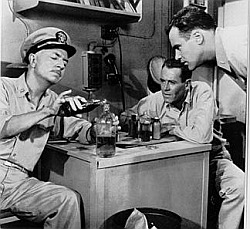
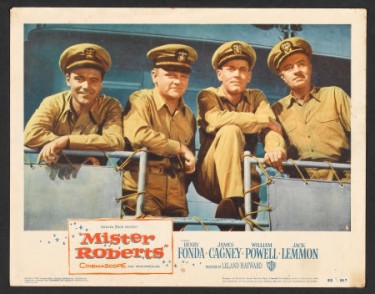
Mister Roberts stared Henry Fonda, James Cagney, Jack Lemmon and William Powell. It is set on the USS Reluctant a Light Cargo Ship in the backwaters of the Pacific in the closing months of the Second World War. Released in 1955 the film was based on the 1946 novel of the same name by Thomas Heggen.

http://www.tcm.com/mediaroom/video/323485/Mister-Roberts-Movie-Clip-Up-All-Night.html

Cagney plays a despotic former Merchant Marine Captain, LCDR Morton an officer of the type that the Navy did not want portrayed on film then, and still doesn’t today.  He is petty, self serving and rules as a tyrant in order to secure his promotion to Commander. His prize possession is a palm tree which was awarded to the ship for handling the most cargo which he believes will be his ticket to promotion. Lemon plays the ship’s Laundry and Morale Officer Ensign Frank Pulver who creatively finds ways of avoiding work. He is so successful that Captain Morton doesn’t know who he is despite having been on the ship 14 months. Pulver provides amusement and aggravation to Henry Fonda plays the ship’s Cargo Officer LTJG Doug Roberts. Roberts is liked by the crew and always in conflict with hs captain.  He is desperate to be transferred off the Reluctant and serve on a ship on the front lines. He fears that the war will pass him by and sends in letter after letter to get transferred to a fighting ship only to have Morton send them on without recommending approval.
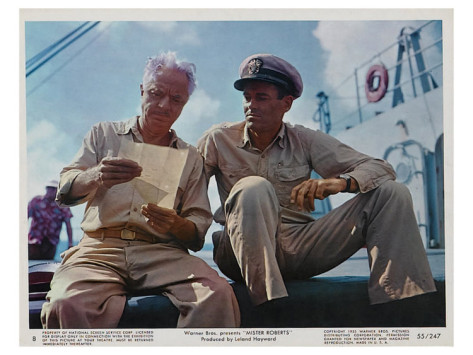
Roberts is caught in the position of many young leaders where they are torn between their duty and their loyalty to their crew.  Eventually he  William Powell in his last film plays ship’s Medical Officer, the wise sage whose advice and counsel is invaluable to Roberts.  Eventually Roberts gets off the ship because the crew forges a request for transfer along with a forged recommendation from the Captain. When he leaves the ship the crew presents him with their “Medal” the “Order of the Palm.” He is transferred to a destroyer and is killed in action. His final letter to Ensign Pulver tells of his appreciation for the crew and comes along with a letter from a friend of Pulver’s on board the destroyer Roberts was transferred telling of Roberts being killed when the ship was hit by a kamikaze.

In the letter Roberts expresses that he finally understood the enemy faced by those in rear areas and all of those that cannot see why they matter or know their place in a war.  The challenge of leaders to understand “that the unseen enemy of this war is the boredom that eventually becomes a faith and, therefore, a terrible sort of suicide.”  He finally after having seen combat that those that he served with on the Reluctant “Right now I’m looking at something that’s hanging over my desk. A preposterous hunk of brass attached to the most bilious piece of ribbon I’ve ever seen. I’d rather have it than the Congressional Medal of Honor. It tells me what I’ll always be proudest of: That at a time in the world when courage counted most I lived among 62 brave men.” 
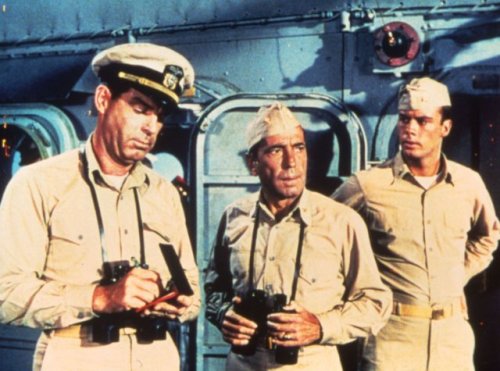
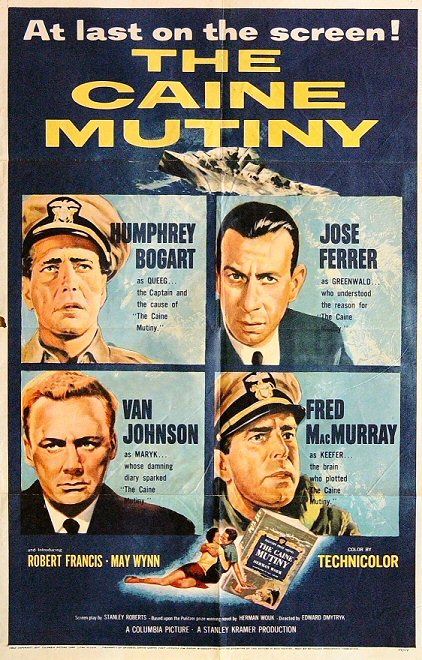
The Caine Mutiny adapted from the novel written by Herman Wouk deals with a another ship where leadership challenges abound. The Captain of the ship, LCDR Queeg played by Humphrey Bogart is plagued by doubt, fear and paranoia.  A Regular Navy Officer on with a wardroom of reservists he comes to the ship battered from two years in the Atlantic. He is also plagued by his Communications Officer, LT Tom Keefer played by Fred MacMurray who spends the time not writing a novel in spreading poison about his ship, the Navy and his commanding officers. Queeg begs for their support and understanding.

http://www.tcm.com/mediaroom/video/413561/Caine-Mutiny-The-Movie-Clip-Like-A-Family.html

However Keefer is so successful at undermining Queeg that in the midst of a typhoon the Executive Officer, LT Steve Maryk played by Van Johnson takes command and relieves Queeg on the bridge supported by the Officer of the deck Ensign Willie Keith.
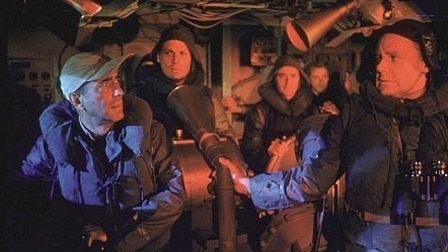
http://www.youtube.com/watch?v=vtqf0CCVUek

Maryk is tried and acquitted at court marital but his defense attorney, LT Barney Greenwald played by Jose Ferrer has to destroy Queeg on the witness stand to do it.  During the trial Keefer is called as a witness for the prosecution lies on the stand to avoid incriminating himself while damaging the case of his friend Maryk. At the end Greenwald confronts Kiefer at a party and provides the leadership lesson for a wardroom which abandoned their sick captain long before the mutiny occurred.

http://www.youtube.com/watch?v=EKeISsYKROI

[Greenwald staggers into the Caine crew’s party, inebriated] 

Lt. Barney Greenwald: Well, well, well! The officers of the Caine in happy celebration! 

Lt. Steve Maryk: What are you, Barney, kind of tight? 

Lt. Barney Greenwald: Sure. I got a guilty conscience. I defended you, Steve, because I found the wrong man was on trial. 

[pours himself a glass of wine] 

Lt. Barney Greenwald: So, I torpedoed Queeg for you. I had to torpedo him. And I feel sick about it. 

[drinks wine] 

Lt. Steve Maryk: Okay, Barney, take it easy. 

Lt. Barney Greenwald: You know something… When I was studying law, and Mr. Keefer here was writing his stories, and you, Willie, were tearing up the playing fields of dear old Princeton, who was standing guard over this fat, dumb, happy country of ours, eh? Not us. Oh, no, we knew you couldn’t make any money in the service. So who did the dirty work for us? Queeg did! And a lot of other guys. Tough, sharp guys who didn’t crack up like Queeg. 

Ensign Willie Keith: But no matter what, Captain Queeg endangered the ship and the lives of the men. 

Lt. Barney Greenwald: He didn’t endanger anybody’s life, you did, all of you! You’re a fine bunch of officers. 

Lt. JG H. Paynter Jr.: You said yourself he cracked. 

Lt. Barney Greenwald: I’m glad you brought that up, Mr. Paynter, because that’s a very pretty point. You know, I left out one detail in the court martial. It wouldn’t have helped our case any. 

[to Maryk] 

Lt. Barney Greenwald: Tell me, Steve, after the Yellowstain business, Queeg came to you guys for help and you turned him down, didn’t you? 

Lt. Steve Maryk: [hesitant] Yes, we did. 

Lt. Barney Greenwald: [to Paynter] You didn’t approve of his conduct as an officer. He wasn’t worthy of your loyalty. So you turned on him. You ragged him. You made up songs about him. If you’d given Queeg the loyalty he needed, do you suppose the whole issue would have come up in the typhoon? 

[to Maryk] 

Lt. Barney Greenwald: You’re an honest man, Steve, I’m asking you. You think it would’ve been necessary for you to take over? 

Lt. Steve Maryk: [hesitant] It probably wouldn’t have been necessary. 

Lt. Barney Greenwald: [muttering slightly] Yeah. 

Ensign Willie Keith: If that’s true, then we were guilty. 

Lt. Barney Greenwald: Ah, you’re learning, Willie! You’re learning that you don’t work with a captain because you like the way he parts his hair. You work with him because he’s got the job or you’re no good! Well, the case is over. You’re all safe. It was like shooting fish in a barrel. 

[long pause; strides toward Keefer] 

Lt. Barney Greenwald: And now we come to the man who should’ve stood trial. The Caine’s favorite author. The Shakespeare whose testimony nearly sunk us all. Tell ’em, Keefer! 

Lieutenant Tom Keefer: [stiff and overcome with guilt] No, you go ahead. You’re telling it better. 

Lt. Barney Greenwald: You ought to read his testimony. He never even heard of Captain Queeg! 

Lt. Steve Maryk: Let’s forget it, Barney! 

Lt. Barney Greenwald: Queeg was sick, he couldn’t help himself. But you, you’re *real* healthy. Only you didn’t have one tenth the guts that he had. 

Lieutenant Tom Keefer: Except I never fooled myself, Mr. Greenwald. 

Lt. Barney Greenwald: I’m gonna drink a toast to you, Mr. Keefer. 

[pours wine in a glass] 

Lt. Barney Greenwald: From the beginning you hated the Navy. And then you thought up this whole idea. And you managed to keep your skirts nice, and starched, and clean, even in the court martial. Steve Maryk will always be remembered as a mutineer. But you, you’ll publish your novel, you’ll make a million bucks, you’ll marry a big movie star, and for the rest of your life you’ll live with your conscience, if you have any. Now here’s to the *real* author of “The Caine Mutiny.” Here’s to you, Mr. Keefer. 

[splashes wine in Keefer’s face] 

Lt. Barney Greenwald: If you wanna do anything about it, I’ll be outside. I’m a lot drunker than you are, so it’ll be a fair fight. 
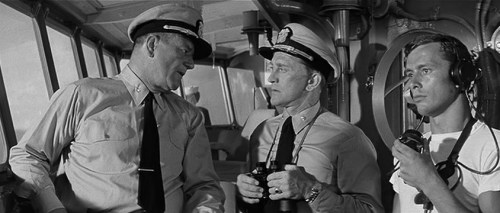
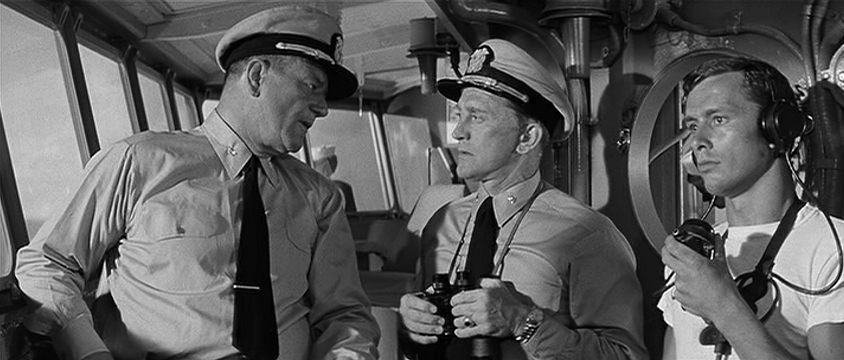
In Harm’s Way was filmed a decade after the Caine Mutiny and Mister Roberts. Starring John Wayne, Kirk Douglas, Henry Fonda, Patricia Neal, Burgess Meredith and Tom Tryon it was a epic that was panned by critics as having a shallow plot. It involved the intersecting lives of a number of officers during the war with John Wayne playing Rear Admiral “Rock” Torrey. Although the plot is relatively shallow the film brings up several very serious subjects that are faced by leaders even today.  The topics of alcoholism, sexual assault and suicide are touched upon through the character played by Kirk Douglas, Captain Paul Eddington.  Eddington is plagued by alcoholism and a failed marriage that ended when his wife was killed while with an Army Air Corps Officer on the morning of the Peal Harbor attack.  Sentenced to a backwater assignment he is called to be Torrey’s Chief of Staff.  In that position he ends up raping a nurse played by Jill Howarth that happens to be the fiancee of Torrey’s son. She then commits suicide. When Eddington discovers that she is dead he sets off on a suicide mission to find the Japanese fleet.

http://www.tcm.com/mediaroom/video/348030/In-Harm-s-Way-Movie-Clip-The-Navy-s-Never-Wrong.html

The questions raised in the film are not answered, there is no Barney Greenwald to point out the moral of the story.  John Wayne plays a flawed hero surrounded by characters of that are all in some way dealing with their own personal demons. However the questions are those that have been faced by military leaders for generations.  How does a leader deal with men and women in failing marriages? How does one deal with those that simply are advancing their own careers? How does a leader deal with key staff that are dealing with alcoholism? How does one prevent sexual assault in a combat area and prevent suicide?  The truth is that we still deal with all of these questions and none of us or any military in the world has solved any of them.  Perhaps Henry Fonda as Admiral Nimitz sums up the situation that we still face “Well, we all know the Navy’s never wrong. But in this case, it was a little weak on bein’ right.”

Taken as a whole the three films all are valuable for today’s naval leader as well as military leaders in general. The I do learn something new every time that I watch them and all challenge me to be a better leader.

Peace

Padre Steve+

3 Comments

Filed under film, leadership, Military, movies, US Navy, world war two in the pacific

Tension in the Gulf: Don’t Miscalculate; Speak Softly and Carry a Big Stick

“War is the unfolding of miscalculations.” Barbara Tuchman

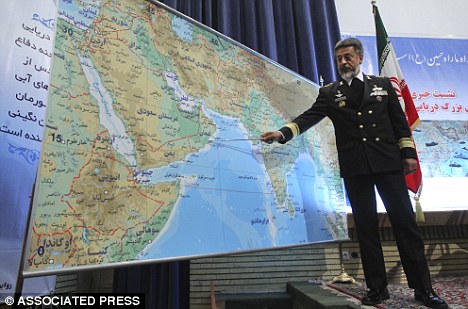
Iran’s navy chief Habibollah Sayyari briefs media on the naval exercise 

The greatest danger in the current war of words between Iran and the United States is the danger that the Iranians one side or the other will miscalculate the will, resolve and strength of the other.  Teddy Roosevelt made the comment “speak softly and carry a big stick.” The Iranians have been shouting loudly and brandishing a small stick and if they are not careful they will bluster their way into a naval war that they cannot win and that will cause significant economic and physical disruption in the region.

The Iranian Navy and Revolutionary Guards Naval Forces are about halfway into a 10 day series of exercises in the Gulf of Oman, the Strait of Hormuz and the Northern Arabian Gulf, or what they call the Persian Gulf. Iranian leaders have increased their rhetoric in regard to closing the Strait of Hormuz if more sanctions are leveled against them for their nuclear program.

The bellicosity of the Iranians comes at a time when they are feeling internal political pressure from Iranian young people, as well as external diplomatic and most likely espionage campaigns.  The latter are designed to slow down or halt their nuclear program which most analysts now believe to be designed to produce nuclear weapons.

For what it is the Iranian Navy can threaten the strait and maybe even close it for a limited time. It is possible if they ever launched a surprise attack on an isolated US or Western warship using their “swarm” tactics close inshore to Iran in the constricted waters of the strait or in a narrow part of the NAG that they could sink or cause severe damage to it.  They would probably mine the straits if they could do so before hostilities began or before sufficient forces could be deployed to stop them. Likewise their missile forces and special operations forces could cause some damage and chaos in the Gulf but the repercussions would isolate and devastate Iran.  However closing the strait or attacking a US or Western warship would be the end of Iran’s naval forces and cause more damage to the country than its leaders are willing to accept at least right now. The Iranians would find that they were fighting far more than the United States Navy should this happen and their Russian and Chinese supporters would more than likely do everything possible to dissuade them from trying this.  Since China imports the bulk of its oil from the Gulf it is unlikely that they would support the Iranians.

While such a direct attack is unlikely the possibility of an accidental war caused by miscalculation on the part of one side or the other is always real and should the Israelis strike Iran’s nuclear facilities Iran would certainly retaliate against Israel but also US Forces and installations in the Gulf and probably against the Gulf States and even Iraq.

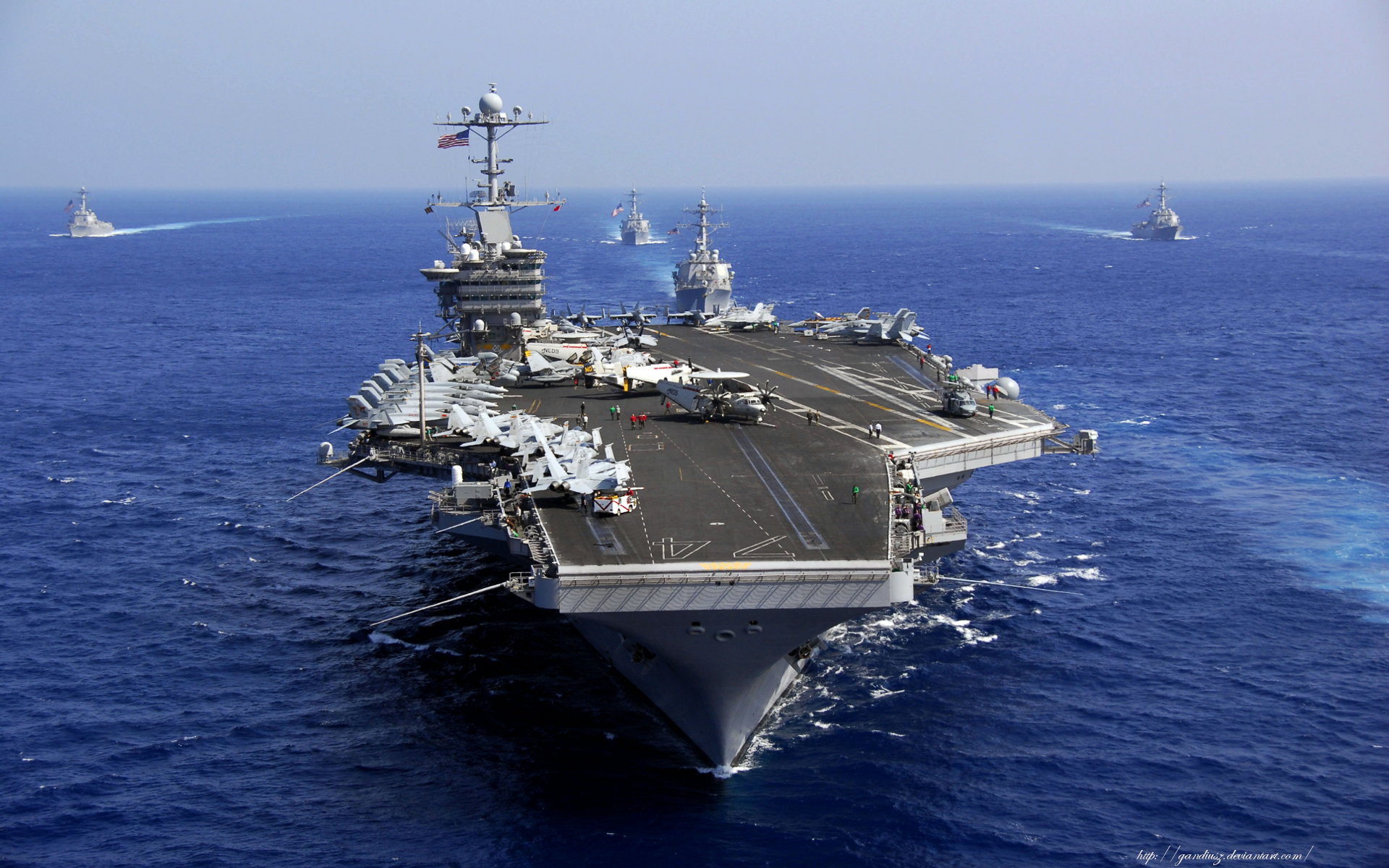
USS John C Stennis (US Navy Photo)

Regarding how such a campaign would be fought the United States would stand off a safe distance and pound Iranian naval, air and coastal defenses and not allow Iranian surface ships to get close enough to make a swarm attack.  This is a big reason that the USS John C. Stennis transited the straits and entered the Gulf of Oman (GOO).  Operating in the open seas gives the blue water US Navy the edge. The Iranian navy’s ships lack the range and endurance for sustained operations at sea and could not sustain a blockade. US attack submarines would hunt down the Iranian Kilo class subs before they could become a threat and US Naval Aviation assets would sweep the surface assets of the Iranian Navy and Revolutionary Guard Naval Forces from the sea while destroying Iranian coastal defenses on the islands in and the Iranian side of the strait.  Once the strait was cleared tanker traffic would resume and Iran would be the biggest loser.  History shows time and time again that light coastal naval forces are no match for a professional seagoing navy even if they score an occasional victory.

Much has been made about Iranian claims to have tracked the USS John C Stennis as she transited the straits.  That is nothing new, the Iranians have air, sea and land surveillance of the narrow straits. The fact is that US ships transit the strait and its approaches on high alert and have done so since the Tanker Wars of the 1980s.  Every Iranian move is watched by the US Navy.  Likewise while transiting the strait the ships of both sides communicate with each other regarding navigation.  It is standard practice.

Since I believe that the Iranians despite their rhetoric are far more prudent than some believe and that they will not launch an unprovoked attack. Even if they succeeded in temporarily closing the straits and even scoring some kind of naval victory by sinking a US ship the victory would be extremely short lived. US and other forces would stream to the region and devastate all that is Iran. The costs for the Iranians and their long term goal of regional hegemony would be too great for them to intentionally start a naval confrontation in the Gulf.  However the chances of either side miscalculating and stumbling into war should not be underestimated.

The biggest danger now is the potential for miscalculation but Iran’s long term goal of dominating the Gulf and acquiring nuclear weapons will probably keep them from attempting anything of this sort. That said there are factions in Iran that could try to use the threat of new sanctions to force a confrontation in the straits and for that we must be ready to meet the threat.  Iranian threats should not be disparaged nor their political and military will underestimated. To underestimate an Iran’s capabilities and will are extremely dangerous. At the same time we should not overestimate their capabilities and yield to their threats when they threaten to cut off the flow of oil from the Gulf.

The United States needs to follow Theodore Roosevelt’s advice and remember history as we follow the situation and ensure that whatever Iran does that we will not be surprised or unprepared.

Peace

Padre Steve+

Leave a comment

Filed under Foreign Policy, History, middle east, national security, US Navy

GO NAVY! BEAT ARMY! Padre Steve is Passionate About Navy

I have always been a fan of Navy. I was born in a Navy hospital and grew up as a Navy Brat.  My dad was a Navy Chief Petty Officer and retired from the Navy in 1974. However my dad for all of his virtues, love of the Navy, distain for the Army was not a fan of the Naval Academy during the Army Navy Game. I remember asking him about this and it turns out that as a kid he was a fan of the Military Academy sometimes known as “Army” at this time of year.  He was a man of of principle and never wavered in his support of Army football during the Army Navy Game.

As for me I have been a “flip flopper” in much of my life. I grew up as a Navy brat and entered the Army because Judy said that she wouldn’t marry me if I joined the Navy but that the Army was okay.  No to be truthful I did ask the Navy ROTC unit at UCLA about the possibilities of entering the Navy but to do so they wanted me to change my major in my senior year of college from History to something in the hard sciences, Mathematics or Engineering.  Since I had no desire to repeat several years of college I asked “who will take me?”  I was told to “see the people in green down the hall.”  Thus I ended up in the Army.

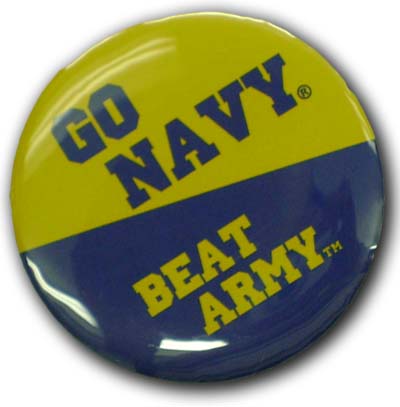
Now when I was in the Army I remained faithful to the Navy.  I had a “Go Navy” button that I would keep in my uniform pocket especially during the weeks leading up to the Army-Navy Game.  Well after 17 1/2 years of service in the Army, Army National Guard and Army Reserve I declared free agency and resigned my Army Reserve commission as a Major to enter the Navy, reducing in rank to do so. Judy was not pleased because I basically made the decision without consulting her, even though she probably would have agreed if I had asked her but what can I say? I am a man. A manly one at that. However Judy has remained with me for all of these years she has been a military wife for over 28 years now and probably has another 5-8 or more to go.  God bless her and the other military spouses that choose to endure the career choices of their husbands or wives.  But I digress…

The fact is that through thick and thin and despite the fact that I was a military service “flip-flopper” I have always been true to the Naval Academy in its rivalry against the Army and the Air Force.  The fact that I was in the Army for many years never took away from the fact that as a kid I loved the Navy and always was for Navy in the Army-Navy Game. The fact that my dad who was a career Navy man always cheered for the Army is inspirational to me. My dad was a man of character and never abandoned the team that he cheered as a child.  Like him I have not wavered in my support of the team that I cheered as a child. The irony is that I spent nearly a full career in the Army before going to the Navy.

As for the “Go Navy” button I gave it to my best friend in Germany a now retired German Army Officer who spent the first three years of his military career in the German Navy.  Gottfried never left his navy roots and I gave the button to him many years ago.  He may have spent most of his career in the German Army but still is a Navy man at heart.

On Saturday the Midshipmen of the Naval Academy will play the Cadets of Army. The Navy Goat will face the Army Mule yet again in this great American tradition. While we may be adversaries on the gridiron we are brothers on battlefield and in the defense of the United States and our friends.  I have served over 30 years in the Army and Navy. Though I admire and respect my friends in the Army I can only say one thing about the Army-Navy Game….


GO NAVY! BEAT ARMY!

Peace

Padre Steve+

2 Comments

Filed under Just for fun, Military, sports and life, US Navy

Remembering John F Kennedy

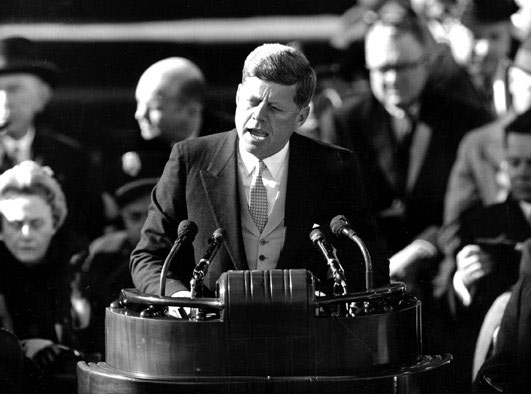
“And so my fellow Americans: Ask not what your country can do for you; ask what you can do for your country.” John F. Kennedy

“Now the trumpet summons us again. Not as a call to bear arms, though arms we need; not as a call to battle, though embattled we are; but a call to bear the burden of a long twilight struggle, year in and year out, ‘rejoicing in hope, patient in tribulation’, a struggle against the common enemies of man: tyranny, poverty, disease, and war itself.”  John F. Kennedy

It is hard to believe that it has been 48 years since President John F Kennedy was assassinated in Dallas Texas on a sunny November afternoon.  The two shots that killed  the President were fired by Lee Harvey Oswald according to the Warren Commission and subsequent inquiries although there are a host of conspiracy theories regarding the assassination. My purpose is not to prove or disprove the official version or any alternative explanation although I personally believe that Oswald was the lone gunman.  It is merely to remember a horrible event in the life of our nation and how easily it could happen again.

Kennedy was not the first President killed by an assassin. Four Presidents of the United States have died by the hand of assassins. The first was Abraham Lincoln killed by John Wilkes Booth on Good Friday 1865.  The next was James A Garfield who was shot on July 2nd 1881 by Charles Guiteau a disgruntled supporter who claimed that he had been commanded by God to kill a the President who he believed to be ungrateful for his support.  Garfield died on September 19th probably due to the incompetence of his doctors.   The third was William McKinley who was shot by Leon Czolgosz on September 6th 1901. McKinley died on September 14th.  Over 20 other attempts have been made on incumbent or former Presidents of which one wounded Theodore Roosevelt after his Presidency and another which nearly killed President Ronald Reagan on March 30th 1981.  Gerald Ford had two close brushes with female assassins within 2 weeks of each other in September 1975. More recent attempts have been made on George H.W Bush, Bill Clinton and George W Bush.  A man was arrested for shooting at the White House last week but President Obama was away from Washington during the attack.

However Kennedy’s assassination tends to be the most talked about and studied and has left a scar on the country that really hasn’t healed. I can remember the effect that it as well as the subsequent killings of Martin Luther King Jr. and Robert F Kennedy had on my parents in the following years.  My mother recounted how she felt when she heard the news of Kennedy’s death on Armed Forces Radio while we were stationed in the Philippines.  I remember the times around the anniversary of his assassination we would watch television shows about it and the movie PT-109. While I do not have direct memories of President Kennedy’s assassination I do remember those of Dr King and Senator Kennedy as well as the subsequent attempts on President Ford, Reagan, Bush, Clinton and Bush.

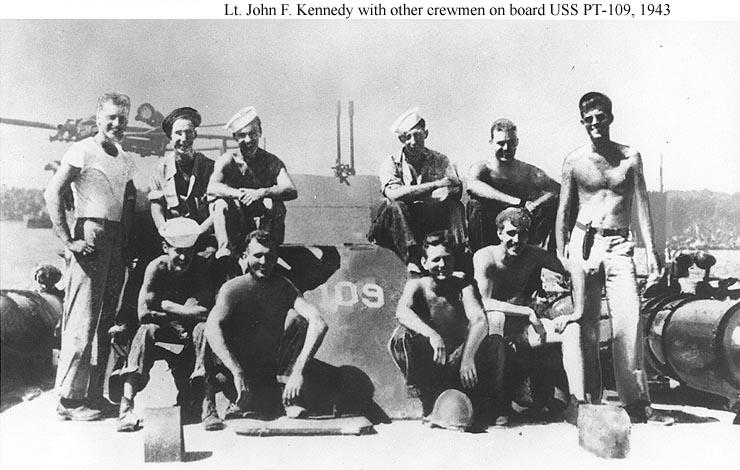
John F Kennedy is one of my favorite Presidents. I know that John F Kennedy was a deeply flawed man and I do not gloss over his failings either as a man or some of his decisions while President. He was certainly not perfect or That being said I still I admire him.  He volunteered to serve in combat on PT Boats despite having chronic lower back problems tht kept him out of the Army and necessitated a waiver to enter the Navy. His actions in saving his crew after his PT-109 was sunk were nothing short of heroic and his crew knew it. After he his crew was rescued Kennedy elected to remain in action and commanded PT-59 in combat rescuing Marines on Choisuel Island. Kennedy’s citation for the Navy and Marine Corps Medal read:

For extremely heroic conduct as Commanding Officer of Motor Torpedo Boat 109 following the collision and sinking of that vessel in the Pacific War Theater on August 1–2, 1943. Unmindful of personal danger, Lieutenant (then Lieutenant, Junior Grade) Kennedy unhesitatingly braved the difficulties and hazards of darkness to direct rescue operations, swimming many hours to secure aid and food after he had succeeded in getting his crew ashore. His outstanding courage, endurance and leadership contributed to the saving of several lives and were in keeping with the highest traditions of the United States Naval Service.

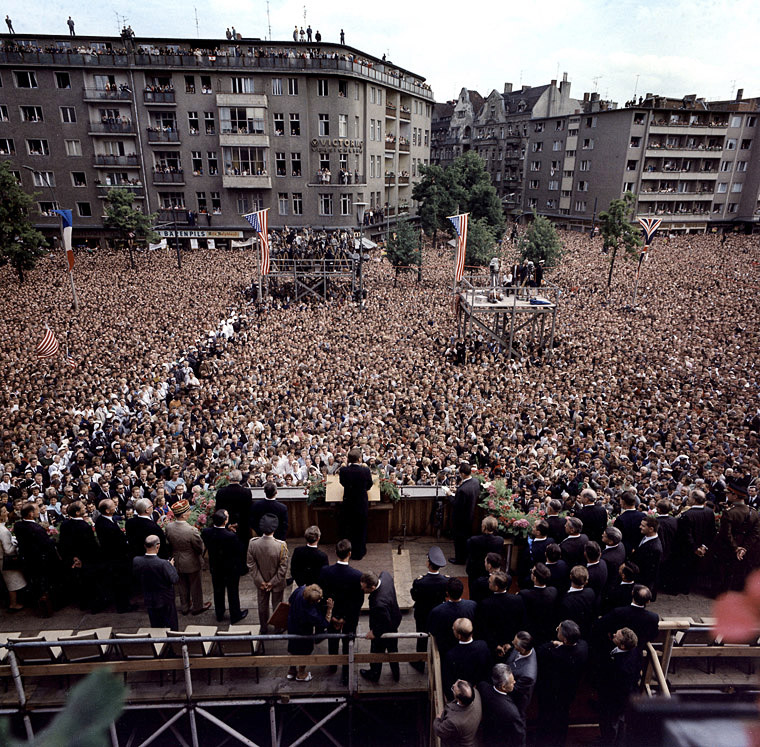
His speeches still inspire me and as a child a had a copy of his book Profiles in Courage . I grew up with his promise to put a man on the Moon by the end of the decade, the creation of the Peace Corps, his backing of Special Forces, his love of the Navy, the great “Ich bin ein Berliner” speech, his support of the Civil Rights movement and and his defusing of the Cuban Missile Crisis all inspire me.  His inauguration speech where he said “Ask not what your country can do for you but what you can do for your country” was and still is a lot of my motivation for serving in the Navy.  John F Kennedy symbolized to me as a young person the hope of a country that had he lived might be different today.

I could be critical and point out all of John Kennedy’s flaws and contradictions.  But then too easy to do. People make a living doing that. People often forget that Kennedy was a hero, not perfect but a hero. I wish a quarter of our current elected officials served their country in combat as Kennedy did and understood what real danger and heroism is. Instead with very few exceptions we have elected men as flawed and contradictory as John F Kennedy with none of the personal courage the vast bulk who would happily order soldiers to their death but have no earthy clue about the dangers of war and the sacrifice involved. That John F Kennedy understood. That earns my respect.

I tremble when I think that someone would have such a deep hatred of him or for that matter any other President that they would kill or attempt to kill them.  That kind of hatred goes beyond me.  Lee Harvey Oswald was a small and pathetic man who needed to be a revolutionary, who needed to be important failing everything else he killed the President. Unfortunately there are people like Oswald on all sides of the political, ideological and religious spectrum who will gladly trade the life of a President or any other public figure for their moment in the spotlight and need to demonstrate their importance to the world.

I fear for our country because of the intense hatred that has become part and parcel of our political landscape. The hatred is almost palpable and while much is directed at President Obama because he is the incumbent President his successor if a Republican would likely have similar hatred directed at him just from different people.  Thus I do pray for the safety of our leaders and for God to protect us from ourselves.

While I do so I remember the President whose life was cut short by the bullets fired by Lee Harvey Oswald.

Peace

Padre Steve+

3 Comments

Filed under History, leadership, Political Commentary, US Navy

The Battle of Leyte Gulf: Sinking the Musashi

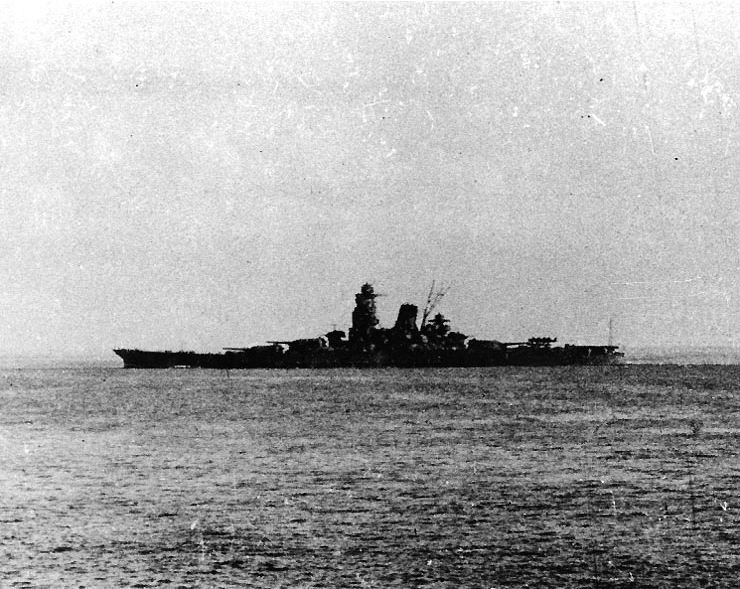
IJNS Musashi

This is the second in a series of articles about the Battle of Leyte Gulf.  The first article in the series is liked here and is entitled

The Battle of Leyte Gulf: Introduction and the Battle of Palawan Passage

Following the loss of Atago, Maya and Takao Vice Admiral Takeo Kurita’s Center Force had an uneventful rest of the day on the 23rd as his ships kept a watchful eye and ear for more US Navy submarines.  At about 0800 on 24 October the Center Force was spotted by 3 B-24 Liberator bombers which promptly reported them.

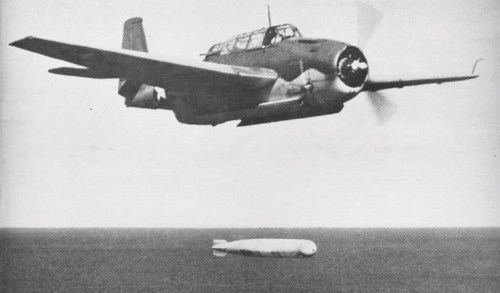
TBF Avenger dropping its “fish” 19 would hit Musashi

One of the ships in the Center Force was the IJNS Musashi, sister ship of the mighty Yamato which was also in the force. The two battlewagons were the largest battleships ever built.  With a full load displacement of 72,800 tons and an armament of nine 18.1 inch guns, the largest battery ever mounted on a warship the two behemoths also had massive anti-aircraft batteries and the Japanese were counting on them leading the Center Force to a miraculous victory during the battle.  Admiral Kurita addressed his commanders prior to the battle:

“I know that many of you are strongly opposed to this assignment.  But the war situation is far more critical than any of you can possibly know.  Would it not be shameful to have the fleet remain intact while our nation perishes?  I believe that the Imperial General Headquarters is giving us a glorious opportunity.  Because I realize how very serious the war situation actually is, I am willing to accept even this ultimate assignment to storm into Leyte Gulf.  You must all remember that there are such things as miracles.”

Musashi or Yamato under attack October 24th 1944

At 1000 the Musashi’s radar picked up approaching aircraft.  These were from the USS Intrepid and the USS Cabot which were assigned to Rear Admiral Gerard Bogan’s Task Group 38.4. The anti-aircraft crews and damage control teams prepared as the ship’s bugle sounded the alarm.  As the aircraft came closer the main guns of the Musashi fired but ceased fire as the aircraft drew closer.  Helldiver dive bombers plunged downward at the ships of the Center Force and F6F Hellcat fighters unopposed by enemy fighters conducted strafing runs as TBF Avenger torpedo bombers dropped their deadly loads at the Musashi.  The big ship avoided two of the “fish” but a third struck causing little damage and the first wave few away.  Musashi reported that she had sustained a hit and continued on.  The Japanese sailors knew that this would not be the last attack.  Though Musashi had weathered the first strike the American fliers hit the battleships Nagato, Yamato and severely damaged the heavy cruiser Myōkō.

Musashi hit

At 1140 the Musashi’s radar picked up the next wave of attackers and at 1203.  These were from the Intrepid, Essex and Lexington.  Hitting the Center Force in two waves a half hour apart these aircraft delivered punishing blows on Musashi. She was hit by 3 torpedoes and 2 bombs. The torpedoes caused damage that caused a 5 degree list and was down six feet by the bow. The torpedo damage was concentrated midships and one torpedo flooded her number 4 engine room. One of the bombs hit an engine room and disabled her port inline propeller shaft.  With her speed reduced she proceeded on.

Musashi

Thirty minutes following this attack at about 1330 Musashi was attacked again by Helldivers and Avengers. She is hit by 4 1000 pound bombs and 4 torpedoes.  She was now so badly damage that she could no longer keep up with the fleet and dropped behind to fend for herself.  At 1350 this attack ends with her speed reduced to 20 knots and with her down 13 feet by the bow and nearly all of her trim and void tanks full. There is now little room for any more damage forward.

Separated from the fleet Musashi was now attacked by aircraft from the Enterprise, Cabot, Franklin and Intrepid that score hits with 11 bombs including the deadly 1000 pounders and 8 torpedoes.  During the course of these attacks which ended after 1530 Musashi sustained 19 torpedo and 17 bomb hits and taken 18 near hits close aboard. At 1620 her skipper Rear Admiral Toshihira Inoguchi began desperate damage control measures to control the increasing list which had reached 10 degrees to port.  Dead in the water she continued to list further and when the list reached 12 degrees at 1915 Inoguchi ordered preparations to abandon ship.  The surviving crew assembled on the deck, the battle flag and the Emperor’s portrait were removed.  Admiral Inoguchi gave his personal notebook to his Executive officer Captain Kenkichi Kato and directed then him to abandon ship. Admiral Inoguchi retired to his cabin and was not seen again.  At 1930 with the list now 30 degrees Captain Kato gave the order to abandon ship and soon with the list increasing further men began to slide across the decks being crushed in the process.  Panic broke out among the crew which had been assembled by divisions and Captain Kato ordered “every man for himself.”  At 1936 the ship capsized and port and went down by the bow sinking in 4,430 feet of water in the Visayan Sea at 13-07N, 122-32E.

The destroyers Kiyoshimo, Isokaze and Hamakaze rescued 1,376 survivors including Captain Kato, but 1,023 of Musashi’s 2,399 man crew were lost including her skipper, Rear Admiral Inoguchi who was promoted Vice Admiral, posthumously.

The rest of the Center Force under Kurita turned around to get out of range of the aircraft, passing the crippled Musashi as his force retreated. Kurita’s retreat was temporary and Kurita waited until 17:15 before turning around again to head for the San Bernardino Strait hoping to find it empty of American ships.  His force was still battle worthy because the majority of the 259 sorties were directed on Musashi and the Heavy Cruiser Myōkō which retired heavily damaged. The Southern Force which had also been hit by American carrier air strikes also continued its push toward Surigao Strait.  The Battle of Surigao Strait, the revenge of the Pearl Harbor Battleships will be the next article in this series.

Peace

Padre Steve+

3 Comments

Filed under History, Military, Navy Ships, US Navy, world war two in the pacific