Tag Archives: al anbar province

Never Forget, They are Not Just Names… Reflections on War, Loss and Change: Iraq, Afghanistan and Deep Space Nine

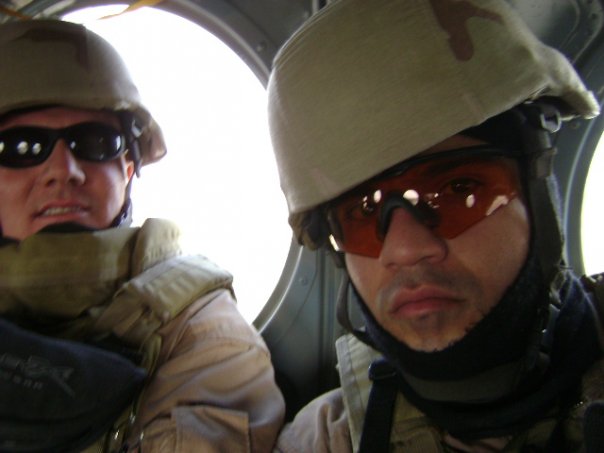
481801_10151367001287059_1003164983_n-1.jpg

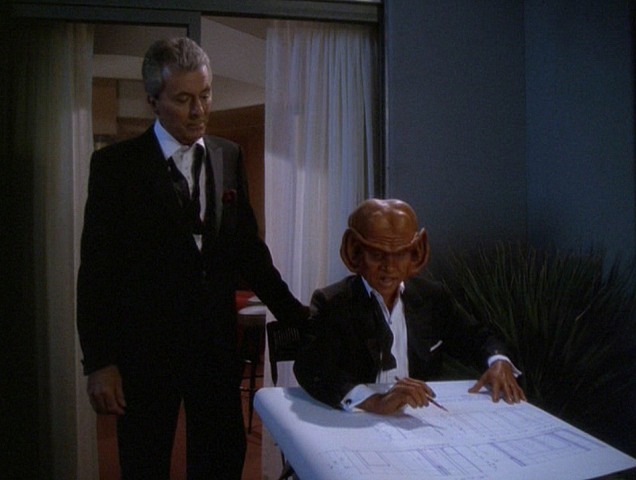
KIRA: Sir, the latest casualty reports have just been posted.
SISKO: How many this time?
KIRA: Including the troops lost at AR five five eight, seventeen hundred and thirty.
SISKO: Seventeen hundred thirty.
KIRA: That’s a lot of names.
SISKO: They’re not just names. It’s important we remember that. We have to remember.

I have had trouble sleeping the past couple of weeks and I think that late last night or early this morning I figured it out.

I am remembering.

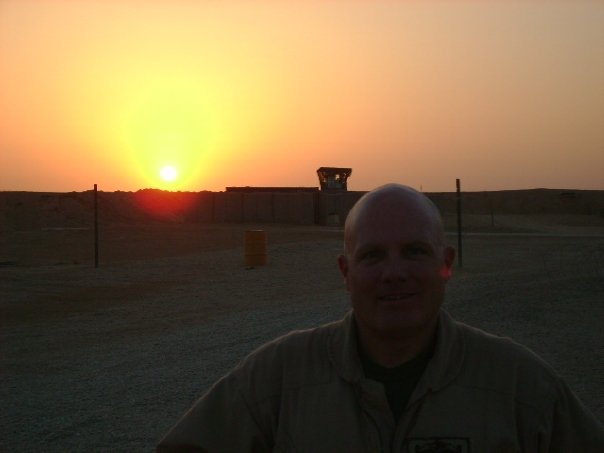
It was about this time of year six years ago I was getting ready to celebrate my 24th wedding anniversary with Judy knowing that about a week and a half later I would be leaving for Iraq for duty in Al Anbar Province with our advisors and wondering, if at the height of the war I would come back.

Of course I did come back and the following year in 2008 we celebrated our 25th anniversary as I melted down, collapsing due to PTSD. I was home but I wasn’t.

Every time I see or read a casualty report I still feel a chill, knowing how easily my life could have ended. I saw a report yesterday that four American troops were killed by indirect fire at Bagram Air Base near Kabul. Reading it I remembered the rocket the flew over my head the night I was flying out of Camp Victory for Anbar and how nonchalant I was when a young soldier ran up to me in his PT gear nearly in a panic asking me “what was that?” and my response, “oh it was just a rocket.” We were not far from the eastern perimeter of the base in an area of tents set out as transient quarters gunship helicopters flew over the camp and the city beyond the walls, machine guns rattled in the distance as explosions echoed in the distance as American soldiers and Iraqi security forces battled insurgents not very far from where we sat.

This past week a number of things have been triggering me. The Marines have been conducting exercises at Camp LeJeune and I have heard artillery in the distance and aircraft have been taking off and landing at the auxiliary airfield across the sound a couple miles away.

652_53210437058_4925_n

Even though it is still two weeks until July 4th the tourists and summer rental types are already shooting off fireworks in the neighborhood near the beach. Last night I barely slept and tonight the tourist insurgents have been going mad with the fireworks. I was out walking Molly when some rather large commercial type fireworks went off a couple hundred yards away on the next street over. I nearly went to ground until I realized that they were only fireworks. I thought about July 4th 2011 when Judy brought Molly down and we went down to the beach to watch the fireworks. That night I was terrified and only the unflappable calm of Molly sitting beside me barking at the fireworks to protect me kept me together. Tonight Molly was as unflappable as ever, not bothered by the explosions. That made me laugh despite the near panic that I found myself. It is amazing what a little dog, now blind but still very relevant can do for someone like me dealing with the PTSD Mad Cow. I hate July 4th now, not what it means but all the explosions.

6095_128718117058_1466465_n

Molly supervising my writing in 2008 or 2009

Tonight I was watching Star Trek Deep Space Nine on DVD and the end of the season seven episode The Siege of AR-558 got me a bit. At the end of the episode Captain Sisko and Colonel Kira are discussing the latest casualty lists, which Sisko posts each week for his crew. I quoted it at the beginning of the article and it really spoke to me.

Some 6700 American Soldiers, Marines, Sailors and Airmen have died in Iraq or Afghanistan close to 50,000 more wounded and probably a couple hundred thousand afflicted with PTSD or Traumatic Brain Injury. Hundreds, if not thousands more, active duty, reserve and former service members have taken their own lives after returning. Of course those numbers don’t count the troops from NATO or the Iraq Coalition Forces, the Iraqi and Afghan troops that have fought and died alongside us or the hundreds of thousands of civilians who have been killed, wounded or driven from their homes.

But they are more than numbers. Every one has a name, the dead and those who have come back in some way forever changed by war. It is important that we never forget that. They cannot be just numbers, otherwise we dehumanize them and avoid the real cost of war, especially the human costs. I think that Smedley Butler said it the best:

“This bill renders a horrible accounting. Newly placed gravestones. Mangled bodies. Shattered minds. Broken hearts and homes. Economic instability. Depression and all of its attendant miseries. Back -breaking taxation for generations and generations. For a great many years as a soldier I had a suspicion that war was a racket; not only until I retired to civilian life did I fully realize it….”

As I write the situation in Afghanistan is still dangerous and this week I saw another friend, a surgeon from my hospital depart for duty there. Likewise there is much debate about the US and NATO role in the Syrian Civil War, something that seems to me will eventually involve US forces in yet another war.

I guess that is why I can’t sleep and why some of my dreams have been so disturbing lately. I know that I will get through this as I have been through much worse over the past six years.

Another episode of Deep Space Nine entitled Paper Moon that I watched tonight dealt with the young Ferengi officer Nog who was wounded at AR-558, losing a leg and his struggles after returning to the station dealing with the trauma of war, loss and change.

10

Nog tells his holographic friend the lounge singer Vic Fontaine played by James Darren When the war began…I was eager. I wanted to test myself. I wanted to prove I had what it took to be a soldier. And I saw a lot of combat. I saw a lot of people get hurt. I saw a lot of people die, but I didn’t think anything was going to happen to me.” I didn’t think that anything would happen to me either, I thought that I was immune from trauma and PTSD, I was an expert in dealing with trauma but I came back changed.

At the end of the episode as he comes to terms with his loss and the change he is asked by his father’s new wife “Are you okay?” and he replies “No. But I will be.”

I will be too. Tonight I hope to sleep.

Peace

Padre Steve+

6 Comments

Filed under iraq,afghanistan, middle east, News and current events, PTSD, Tour in Iraq

Transitions in the Military: New Assignments

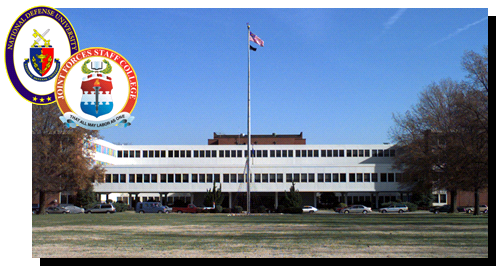
NDU-JFSC-campus

In the Navy, as well as most military branches in the United States the officer community regardless of their specialty have branch, corps or specialty managers. These men and women work with the services and the individual officers to fill assignments. In the Navy these men and women are called “Detailers” and the process of assignments called detailing.

This afternoon I received a call from my detailer. I am coming up on my “projected Rotation Date” or PRD in October and have been negotiating for orders. The process was disrupted by some other changes in the system and I have been waiting a bit longer than normal to find out what I would be doing next.

In my last two assignments I had no choice. In 2006 the assignment that I thought I had was changed and in 2008 I was requested by name for an assignment at Naval Medical Center Portsmouth and in 2010, a year before I expected to rotate and less than a week after I had been selected for promotion to the rank of Commander I was informed that I would be assigned as the Command Chaplain at the Naval Hospital Camp Lejeune North Carolina. I have now completed most of that tour and was awaiting word.

What I wanted to do was to teach and be the Chaplain at the Joint Forces Staff college in Norfolk. It has been an assignment that I have wanted for a number of years. It combines being an instructor in Ethics for students from the Army, Navy, Marines, Air Force, Coast Guard and foreign officers attending the courses at the college, as well as having chapel responsibilities. However I was told a couple of months ago that the assignment was going to another chaplain. I was disappointed because it was a billet that I thought that I was uniquely qualified.

I had spent 17 1/2 years in the Army, been a company commander as well as battalion, group and brigade staff officer before becoming a chaplain. Additionally my military and civilian education which include the Marine Corps Command and Staff College and a Masters Degree in military history and some rather unusual assignments including a joint tour in Iraq as chaplain to American advisors in Al Anbar province as a member of the Iraq Assistance Group, made me, at least in my opinion an ideal choice.

However as of a couple of months ago the billet was already filled. Thus I had no idea what assignment that I would get and since there were very few assignments available in my detailing “window.”

I was expecting a call in the next week or so, but I did not expect the detailer to tell me that I would get the Joint Forces Staff College job. I am happy to get it. It will mean that I will return to the Norfolk area in the September-October time frame. The position will allow me to teach in a very interesting setting as well as pastor the chapel congregation.   It will also allow me to continue my academic education and writing. It will also allow me to be at home after a three year tour away from my wife Judy. For that I am most grateful.

Since it is a non-deploying billet it probably will not help my chances too much to make Captain in a view years, but that is not my goal. My goal is to be at the place where I can do the most good, take advantage of my skills and experience and which will challenge me to continue to grow as a human being, priest, chaplain and Naval officer.

It is good news and I am happy that the detailers and senior leadership honored my request for the assignment. The timing allows me to finish well where I currently serve and contribute the the continuing mission of healing the minds, bodies and spirits of Marines and Sailors, including those wounded, ill or injured in war at Camp LeJeune.

It is a good day.

Peace

Padre Steve+

4 Comments

Filed under Military, US Navy

A Place of Peace: Where My Iraq Meets the Atlantic

35923_10151361668782059_785733223_n

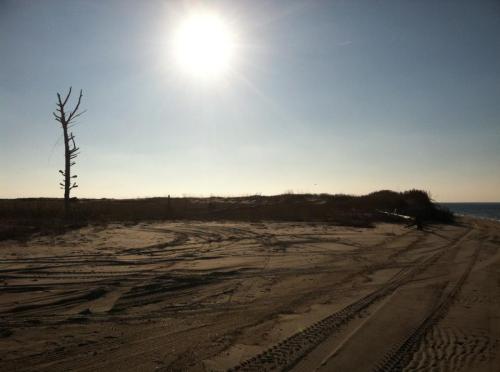
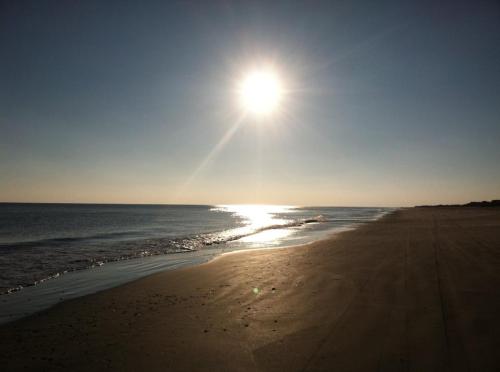
Where Iraq Meets the Atlantic

I have talked about things bring me peace amidst the struggles of life in recent days and in one post I briefly mentioned that while running on the beach in Emerald Isle it was the place where in that moment “Iraq met the Atlantic.”

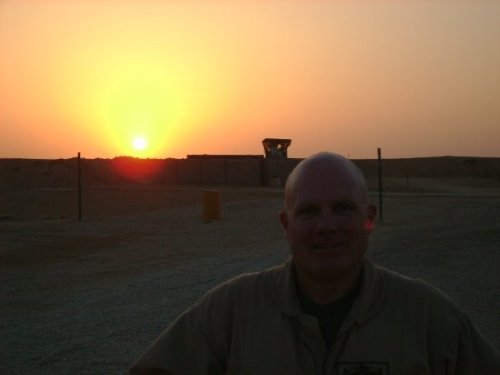
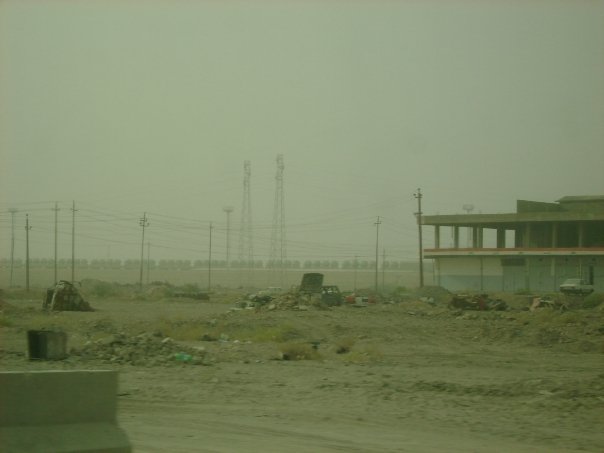
It has been nearly 5 years since I left Iraq in February of 2008 but there are times that it feels like I have never left and times when I would like to be back there. I have always loved the ocean and the desert. For some reason the vast expanses of barren desert and the untamed ocean draw me to them like nothing else.

262_29132267058_9181_n

I have struggled with a lot over the past 5 years. However as I mentioned recently it seems that things are coming together in ways that I have never could have fathomed even a few months ago. On Wednesday I needed to take a day off to reflect and gather my thoughts after a particularly cathartic sequence of events. One of the things that I did that day was to rest, but then to run along the beach where I live.

198177_10151361204842059_1890411795_n

I mentioned to a couple of people that it was like Iraq met the Atlantic and they didn’t understand, until I showed the pictures. I guess though that the juxtaposition of the Western Desert of Iraq, sometimes known as the Syrian Desert and the Atlantic Ocean would seem strange to most people, unless they have experienced both in their stark beauty.

270107_10151361199622059_1286921284_n

I ran about seven and a half miles Wednesday along the beach and it was breathtaking. The deep blue skies and seas met with the desert tan of the sands of the beach. There were few people out that day so the beach was nearly deserted and I was alone with nature and God. It has been many years since I felt that depth of peace in my soul that I felt on Wednesday.

262_29132262058_8844_n

I really can’t explain it and most people will probably never understand and I have learned that such a lack of understanding is okay. There is a big part of me that is still in the Iraqi desert and will always be there. There in the land of Abraham, amid the barren deserts, the rich valley of the Euphrates river valley, the battered cities and town of war torn Al Anbar Province many of my hopes and dreams still live. When I ran along the beach that day it was like I had returned, but instead of being traumatic it was peaceful.

262_29132227058_6903_n

I pray for the people of Iraq, especially those in Al Anbar Province and the Iraqi military. I pray that they will know peace and that their country, so long victimized by tyrants, devastated by war and torn by terrorism and civil-religious strife will be a place of blessing.

295_26912097058_4309_n

As T.E. Lawrence wrote about 85 years ago: “We were fond together because of the sweep of open places, the taste of wide winds, the sunlight, and the hopes in which we worked. The morning freshness of the world-to-be intoxicated us. We were wrought up with ideas inexpressible and vaporous, but to be fought for. We lived many lives in those whirling campaigns, never sparing ourselves: yet when we achieved and the new world dawned, the old men came out again and took our victory to remake in the likeness of the former world they knew. Youth could win, but had not learned to keep, and was pitiably weak against age. We stammered that we had worked for a new heaven and a new earth, and they thanked us kindly and made their peace.” 

262_29132307058_1522_n

Peace

Padre Steve+


3 Comments

Filed under History, iraq,afghanistan, Tour in Iraq

The Fallacy of “Complete” Victory and the Seeds of Perpetual War and the Way to Peace

“We learn from history that complete victory has never been completed by the result that the victors always anticipate—a good and lasting peace. For victory has always sown the seeds of a fresh war, because victory breeds among the vanquished a desire for vindication and vengeance and because victory raises fresh rivals.” B H Liddell Hart

The current conflict between Israel and Hamas in Gaza has brought into light the fallacy of the belief that military victories alone can bring peace. One would think that leaders would know this and understand the basic truth of this key aspect of the human condition but it seems that we are doomed in every generation for leaders to ignore this basic fact of human life and civilization.

While one can easily criticize the Israelis and Palestinian Arabs for their unremitting hostility and desire for revenge they are not unique. Europe bears the scars of over 1500 years of Christendom’s own tribal and religious hatreds, many which still simmer underneath the surface of “free and democratic society.” Asia is rife with ethnic hatred and desire for revenge for actions committed by people long dead. Africa, the same except for the most part those in the “First World” be they Americans, Europeans or Asians only care about Africa for its natural resources, otherwise we would have acted to stop the various genocides on that rich, beautiful and diverse but seemingly cursed continent. The inter-Islamic and other Middle Eastern and Central Asian Moslems likewise have their hatreds, try as they might Arabs and Persians despite a common allegiance to Islam are mortal enemies with animosities that pre-date their conversion to Islam. Even we Americans are not immune to such hostility in our own country and against those that we label as our enemies overseas.

Despite this there are those that first and always resort to military force or terrorist violence to attempt to fight the “war to end all wars.”

The current episode of violence in Gaza is simple another chapter in what has been an unending series of wars since the establishment of the State of Israel. The time since has been marked by major wars in 1948, 1956, 1967, 1973 and 1981 the Palestinian Infatada as well as border conflicts between Israel, Fatah, Hamas and Hezbollah that have occurred since. These wars forced exodus of Palestinian Arabs from their ancestral homes, as well as the practical end of substantial Jewish and Christian communities in Moslem dominated nations.

The Israelis have in many cases lived under threat of invasion and destruction by neighboring Arab states for much of their history even while maintaining control of territories that they occupy by brutal force in the name of their own security. In some sense the Israeli position is understandable. They occupy but a small portion of land and threats of extermination, real and propagandistic by Arab and nations and the Iranians cause them to see these threats as existential threats.

The Arabs on the other hand deal with centuries of humiliation at the hand of foreigners, many Christian and European, but also that of the Turk and Persian. The constant drumbeat of military defeats endured by them at the hands of the Israelis and the support of Israel by western nations, some of whom ran the brutal colonial administrations which divided their lands, appointed despots as surrogates and exploited their natural resources has ingrained in them a deep seated need for revenge and respect.

I know from my time in Iraq and other Middle Eastern countries that the key to friendship and mutual respect is the simple act of taking time to know and appreciate the culture, history, faith and traditions of other people. I frequently in my dealings with Iraqi officers in Al Anbar Province opened doors by taking the time to learn their history, which goes back several millennia as the cradle of civilization and to be both polite and respectful in dealing with them. Iraqi officers were surprised that I knew the positive contributions of Iraqi military officers to Iraq, including the abolition of child labor, public education, the expansion of universities, universal suffrage and public works that benefited all Iraqis before the takeover of the country by Saddam Hussein and his Ba’ath Party. Likewise the fact that I could name the victories of Iraq forces against the British at Al Kut in the First World War, the largest surrender of British forces during the war as well as other victories gained me their respect and friendship as the “American” or “Christian Imam.”

However most Americans have not learned this despite over a decade of war in Afghanistan and Iraq. I was listening to a friend today who was upset that the government of Iraq was urging that Arabs use oil as a weapon against the United States to force the United States to change its policy in regard to the Palestinians. The argument presented on Fox News and echoed around much of the country is that the statement of the Iraqis is an act of ingratitude by a country that we “liberated.”

But that is our fiction that we create to absolve ourselves from the fact that over a period of 20 years American and other Western nations destroyed Iraq and humiliated its people. Yes we overthrew Saddam Hussein, a brutal dictator, a man that we supported for years as an ally until he crossed a line that we determined that he should not cross when he invaded Kuwait in 1990. To Shi’te Iraqis the overthrow of Saddam in 2003 was liberation, but it was “liberation” that followed the betrayal of them in 1991 where after encouraging them to revolt against Saddam we allowed them to be slaughtered by his Republican Guard.

To the Sunni of Anbar Province who after realizing that the radicals of Al Qaeda who were bringing more destruction to them than the Americans and allied themselves with the United States military in 2007, the Anbar Awakening the withdraw of American forces was an abandonment. They made our exit from Iraq possible and helped break the back of Al Qaeda, and for their trouble they believe that they have been abandoned to a corrupt Shi’te led government in Baghdad.

In light of all of this who can blame the Iraqis for making those statements. How would be we feel if that were to happen to us in the United States, or in Western Europe? Actually we know from history how we would feel. The answer is obvious in our history as well as our current actions and attitudes. We would not rest until those that brought destruction on our country and betrayed our people were defeated.

It is no wonder that Sun Tzu said that “To win one hundred victories in one hundred battles is not the acme of skill. To subdue the enemy without fighting is the acme of skill.”

Likewise Abraham Lincoln asked a question that those consumed by the need to destroy their enemies by military force should ask before ever mobilizing an army for war: “Am I not destroying my enemies when I make friends of them?”

Peace

Padre Steve+

2 Comments

Filed under History, iraq,afghanistan, middle east, Military, Tour in Iraq

I Left My Heart in Al Anbar…Visions of Iraq 5 Years Later

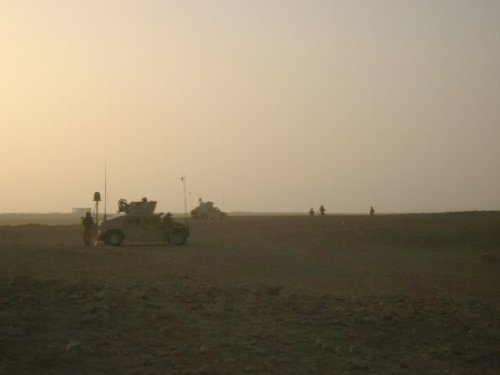
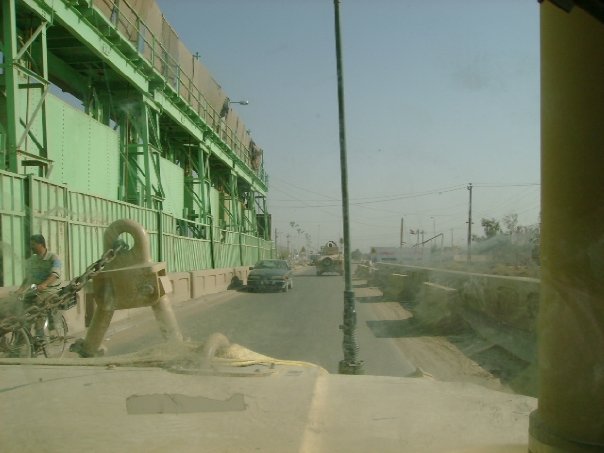
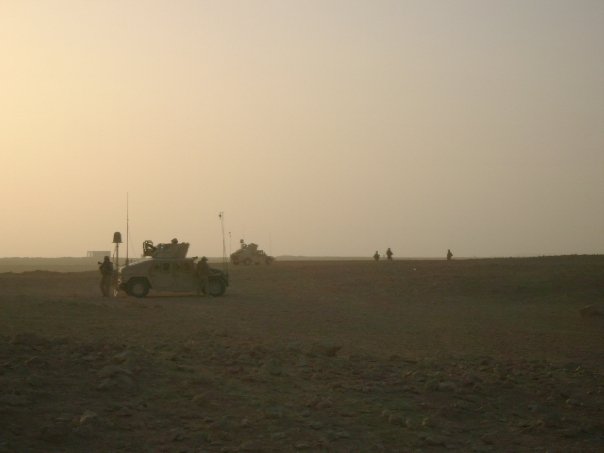
I left Iraq in early 2008. My experience of Iraq was with various teams of advisors in Al Anbar Province. I travelled thousands of miles hot cramped HUMMVs and in tightly packed aircraft to get to these far flung teams of 12-30 Americans in places from the Syrian border at Al Waleed, Al Qaim and various COPs on the border, back to Fallujah and almost everywhere in between, occasionally taking fire and most of the time isolated, and sometimes alone and unarmed except for the presence of my Religious Programs Specialist and Bodyguard, RP1 Nelson Lebron.

For those unaware of geography Anbar Province is about the same size in area as the State of North Carolina. The Euphrates River runs through it, a shimmering blue swath bordered by a narrow green valley that cuts through an endless sea of yellow brown sand speckled with small towns and a few larger sized cities. The Provincial Capital, Ar Ramadi is in the east central part of the province about 65 miles west of Baghdad. It is a city of about 440,000 people at the time of the US invasion.

In 2007 Ramadi and Al Anbar Province was the turning point for the United States in the Iraq War. The Sunni tribes of the province decided that their interests were better served by cooperating with the United States Forces rather than continue to endure the terrorism of foreign Al Qaida members.

It was to Al Anbar Province that I deployed in 2007. I was assigned to the Iraq Assistance Group with duties to serve the advisor teams assigned to the Iraqi Army, Border Forces, Police, Highway Patrol and Port of Entry Police. While there I also served members of Provincial Reconstruction Teams.

I have been thinking a lot about Iraq lately as I have been having to recount my experiences as I get ready for EMDR and Biofeedback therapy to treat my PTSD. I have been surprised by how strong the memories are of my time there.

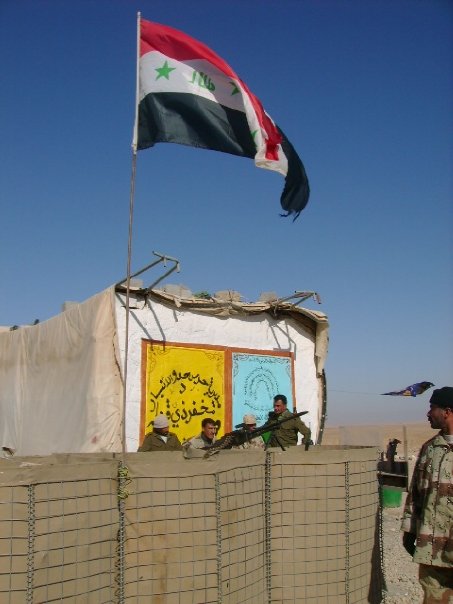
Today I was talking with my therapist and the discussion came to one of my experiences at a base on the banks of the Euphrates in Ramadi. At least part of it was known as COP Snake Pit. It is a base included a Joint Security Operations Center run by the US Army, a Police training facility an Iraqi Military and Police forces, an Advisor of Marines woking with the Iraqi Army 7th Division and an Iraqi Detention Facility. Surrounded by Hesco Barriers and walls not far from a number of high speed avenues of approach an easy target for any attacker. In fact since the United States left Iraq the detention facility and Operations center have been attacked by Al Qaida linked insurgents.

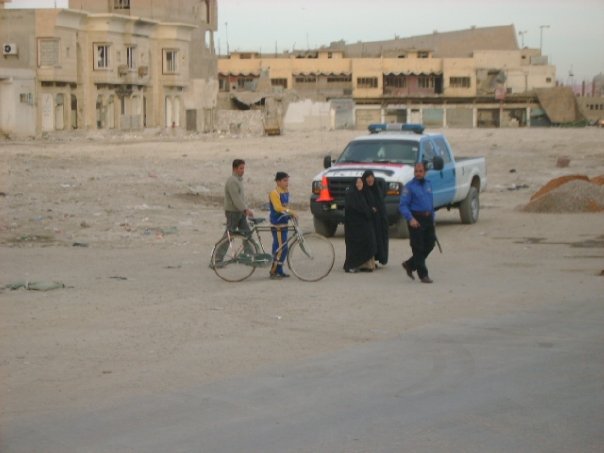
When we visited there Iraqi forces were in charge of the perimeter security while a small number of Americans worked at three isolated areas within the base. For me the memories of walking through the prison as well as getting to address the first class of female Iraqi Police cadets in Anbar.

The memories of that visit are still etched deep in my mind. When I close my eyes I can see the inside of that prison as well as the faces of those brave Iraqi women who risked their lives and those of their families to become Police officers in war torn Ramadi. As I talked with my therapist those memories were so strong. I talked about things today that I have not shared with anyone and which are still hard to write about. Eventually I will, but not tonight, it will be hard enough to sleep as it is.

For most people the Iraq war is not even a memory. Most Americans are untouched by war and cannot imagine what either our troops or the Iraqi people went through and it is hard to explain.

Since I am all verklempt right now I think I will stop for the night. But as I told my therapist today to paraphrase Tony Bennett’s immortal song I Left my Heart in San Francisco I left my at least part of my heart in Al Anbar.

Peace

Padre Steve+

1 Comment

Filed under iraq,afghanistan, middle east, Military, PTSD, Tour in Iraq

Casing the Colors in Iraq

Today the colors were cased in a ceremony at the US Airbase co-located at the Baghdad International Airport.  It really is hard to believe that this excursion in Mesopotamia is over.  The ceremony marked the formal end to the US military operation in Iraq although a few thousand troops are finishing the retrograde of equipment from the country.

The fact that we might not end up in Iraq again if the Iranians push their Iraq Arab Shia friends too hard. They may share a common strain of Islam but there really is no love lost between the Arabs and the Persians as many Iraqis will derisively call them.  The Iraqis are a proud people and remember Persian rule like it was yesterday. The Persians treated Arabs like dirt and though it was centuries ago the Arabs have not forgotten.  My Iraqi friends both Sunni and Shia recognized that Iran was a threat and hope that if Iran ever attempted to take Iraq over that we would help defend Iraq.

The current US involvement is over after 4484 American service members were killed in action and 32000 wounded.  318 coalition Allied troops died.  The Iraqi Security Forces have lost 8825 soldiers killed with a further 1300 killed during the initial invasion of the country.  Over 100,000 Iraqi civilians are believed to have been killed and some agencies have estimated far higher totals.  Of course the Iraqis are still taking casualties as extremist groups both Shia and Sunni continue their blood feud and the Shia majority tries to solidify its power over the minority former ruling party Sunni.  Over a trillion dollars was spent on the war by the United States and long term costs are expected to reach 2-3 Trillion dollars.  Of course Iraq is still reeling from all of the damage and its involvement in wars with Iran from 1980-1988, the invasion of Kuwait by Saddam Hussein in 1990 and the United States response Operation Desert Storm, the post war sanctions and the enforcement of an oil embargo and a no-fly zone to keep Saddam contained even as he butchered thousands of Iraqis who rose up against him after he was driven from Kuwait and the the current war which began in 2003.

But the numbers are not just numbers, behind every one is a family, wives, husbands, parents, siblings and children as well as friends.  Every one has a name and a face and all meant something to somebody and left a void when they died or were irreversibly changed by the war.  That pain and cost will go on for a long time and there are no words that adequately compensate for these losses. Faith and trust in God’s grace help some but others struggle, even believers.  That I know for a fact because I still do.

I remember flying into Baghdad in 2007 it was the height of the “surge” and I was going to provide Chaplain support to US Advisors to Iraqi Army, Border, Police and other Security Forces in Al Anbar Province.  At the time the base was shelled and when we exited the aircraft it was no peacetime drill we left in our full gear and were brief on what to do should we encountered incoming fire.  It was in Baghdad that I first experienced a rocket attack when one flew over my head.  But now the bases are empty, it must be surreal to be one of the last Americans leaving the country.

For me the end of our involvement is a strange experience.  It was hard to believe in 2007 that we would ever leave. The great edifices that we erected around country some of which were going up even when I was there are mostly empty except for some taken over by the Iraqi military.  Former military bases even in this country are a surreal site.  I have been to a number that were closed following the end of the Cold War.  Fort Wolters Texas near Fort Worth is an example. When I would go to a small section of the base used by the National Guard I would go past many mostly unused buildings including what had been a brand new hospital which opened just before the base was closed following Vietnam. The last time I flew through the former George Air Force Base  when going to and returning from Twenty-Nine Palms it was a ghost town except a few businesses and hundreds of former commercial jets parked on the tarmac. I remember going through recently closed American bases in Germany in the 1990s and saw installations empty. I was also the final Federal Chaplain at Fort Indiantown Gap Pennsylvania when it was transferred to the National Guard.  Built during World War II it was a throwback to a different era. The base has been revitalized as a sizable ground and aviation training center by the Guard with much new construction but the sight of all the World War II “temporary” wooden buildings was amazing. Vast areas of the base we unused and some complete areas were demolished. I helped in getting the main Post Chapel Renovated in order that the existing congregation would be able to continue with a contract Chaplain paid by the Guard and activated or drilling Guard Chaplains.  We had to decommission or convert some to other uses and saved one which was donated to a church 40 miles away who paid to have it deconstructed and rebuilt on their own land. But I digress…

When I was in Iraq in many places there were the remains of Saddam Hussein’s military.  The base that I operated from had a number of abandoned or damaged Iraqi bombers and fighter aircraft parked at it.  Of course most of the existing buildings were converted to American use.  The biggest of these were the Al Faw Palace complex at Camp Victory but Camp Fallujah was the site of one of the Baath Party resorts used by Uday and Qusay Hussein.  I stayed there couple of days while traveling from Baghdad to Taqaddum which was my base of operations because of the capability to get around by air to where I needed to go and proximity to many advisor teams supporting the Iraqi First and Seventh Divisions.

Back then all were major bases with a large American presence which was inflated by many of the contractors, American and from other countries that supported base operations from the chow hall, to the laundry, the fire department and even the cleaning of the shower trailers and countless porta-johns.

People will debate for many years whether the war was worth it and I can only say that I hope that history will show that it was despite the huge loss of life, the destruction of a country and the vast expenditure of the national treasury.  It is probably too early to make that judgement, we tend to be pretty bad in making those decisions in the moment.  That is one of the problems in this age of information overload.  We have lots of data but no historical context and we make decisions that we think are correct but find out years later were tragically erroneous.

At the same time we cannot go back in time and change the past. For good or for bad we have to go forward from now and hopefully in time Iraq and its people will recover from the effects of over 30 years of war and economic sanctions.  We will find out over the next 10 to 50 years what the real effect is.  But for now we are left with a weak Iraq, a strong and threatening Iran and our own diminished military capacity and weak economy as well as a war that is not going well in Afghanistan.

I doubt that that can give comfort to the families of those that died in Iraq or came back wounded in mind body or spirit.  I know that I came back different, PTSD has a way of doing that.

But I am proud of the Marines, Soldiers, Sailors, Airmen and Iraqi officers that I served alongside in the badlands of Al Anbar Province mostly far away from the immediate help of any big units if they got in trouble.  I know how valiant and skilled they were fighting Al Qaida Iraq and other insurgents and even foreign fighters from places like Chechnya aided by Iran and others.  It was a brutal fight at times but the men of the Iraqi 1st and 7th Divisions and our advisors helped turn the tide during 2007 and 2008.  Without their diligence and toughness combined with the help of Iraqi civilians the war would have ended differently.

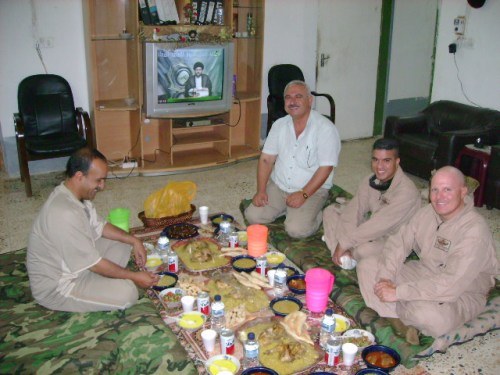
Tonight as I walked the dog to the beach I looked up at the sky. In our neighborhood there are not many street lights and most are clustered in one small area. Since many residents are not here in the winter many of the homes are dark as well and there are areas that have no houses but are lots covered in pine trees.  In the dark I was thinking about Iraq and I could hear the sound of the sea crashing on the beach.  I looked up at the sky and saw the most stars I have seen since being out on the Syrian border in December 2007.  I was reminded that I left part of me in Iraq and I pray for the Iraqis that I served with and those that provided us hospitality during our missions.

As I walked I thought of the words of Otto Von Bismarck one of the greatest statesmen that every lived.  Our war in Iraq was a preventive war.  Bismarck said that “Preventive war is like committing suicide out of fear of death.”  I pray that in our case that he was not right and that we think long and hard before entering another preventive war with anyone.  Bismarck, who knew war commented that “Anyone who has ever looked into the glazed eyes of a soldier dying on the battlefield will think hard before starting a war.” Unfortunately the vast majority of our elected leaders have ever done that.  Bismarck was certainly no pacifist but warned us that “I consider even a victorious war as an evil, from which statesmanship must endeavor to spare nations.”

The world is not a safe place and our near about 140,000 US and NATO troops are still engaged against a stubborn enemy in Afghanistan that has been aided by wavering allies such as Pakistan and sworn enemies like Iran.  War seems to threaten on many fronts.  I pray that we will be prudent before entering another.

I have rambled a bit tonight because I have so many thoughts and images of the war.  I trust your indulgence.  But for now the colors have been cased and our military involvement in Iraq is over.  We can only pray that Iraq will recover and become a free and prosperous country that treats its citizens well and that we too will recover from this war.  But then Bismarck is sometimes quoted saying that “There is a Providence that protects idiots, drunkards, children, and the United States of America.” I do hope that if he did say this that he was right.

Peace and and as my Iraqi friends would say Inshallah (إن شاء الله)

Padre Steve+

1 Comment

Filed under iraq,afghanistan, PTSD, Tour in Iraq

The Brotherhood: Veterans Day 2013

I am always a bit on the melancholy side on Veterans Day.  This year is no different but is a bit different because for the United States the war in Iraq is over, at least for now while the war in Afghanistan grinds on as we prepare to transition.

For me our wars are more about the incredibly small number of Americans who for the past 12 years have borne the burden of these wars.  They are my brothers and sisters, the 0.45% of Americans that serve in the military.  While this is a terribly low number it is only marginally lower than most of our previous wars.

In fact for most of our history it has always been a small minority of Americans that have fought our wars.  Kind of funny when you think about how much our culture worships militarism. World War II was an anomaly as just over 16.1 million people or 9% of the population served in the military then.  That number while large pales in comparison with percentages of those that served in other nations involved in the Second World War. The reason that I point this out is just to say that as a nation it has always been the few that have borne the cost of war. We are “the few.”

This story shall the good man teach his son;
And Crispin Crispian shall ne’er go by,
From this day to the ending of the world,
But we in it shall be remembered-
We few, we happy few, we band of brothers;
For he to-day that sheds his blood with me
Shall be my brother; be he ne’er so vile,
This day shall gentle his condition;
And gentlemen in England now-a-bed
Shall think themselves accurs’d they were not here,
And hold their manhoods cheap whiles any speaks
That fought with us upon Saint Crispin’s day.

From the Speech of King Henry V at Agincourt in Shakespeare’s “Henry V” 1599

In the midst of the petty politics surrounding the Afghan War so so ponderously and pompously purveyed by politicians and pundits of all strains I feel the need to speak up for that small band of brothers that has served in these wars. They are to steal a phrase applied to a previous generation the “New Greatest Generation” something that I am loathe to apply to much of the population at large.  You see the cost of these wars is finally beginning to sink in, at least the financial cost. The real fact of the matter is that these ill advised wars have harmed us as a military and as a nation, our superpower status which was uncontested before 9-11-2001 is challenged because our military is hollowed out, economy weakened and our moral authority questioned by those wars, war crimes and spy scandals.

I’m not so sure that the human cost factors in for most Americans because the tiny percentage of the population that serve in the wars. The fact is that the volunteer military is an insular community which for the most part is based on bases away from most of the population. We have become a society apart from the society.

We used to have big bases in or near major cities, the New York Naval Yard, the Presidio of San Francisco, Long Beach Naval Shipyard, Fort Devens Massachusetts near Boston, Fort Benjamin Harrison Indiana at Indianapolis.  But after the Cold War they and hundreds of other bases were eliminated and with them a connection to the active duty military.  That is not the fault of the people in the big cities it just happened that way, no the military with a few exceptions is based away from most of the population. As a result people may support the troops but most have no idea what they do, how they live and what they suffer.

In spite of that this many of the new Greatest Generation’s accomplishments will largely go unheralded by history. Unlike the “Greatest Generation” of World War Two they will probably not receive the full honors and accolades due them.  This brotherhood of war who have served in the current War on Terror, Iraq and Afghanistan campaigns have now been serving in a war that is now twice as long as the American involvement in World War Two.  Many, like me have been in this since the beginning and many have made multiple deployments to the combat zones.  And many of us, if not most of us would go again. I know that I would because part of me is still in Iraq; for me this war is still un-won and un-finished.

The battles, Fallujah, Ramadi, Haditha, Mosul, Baghdad, Tal Afar, Marjah, Kandahar, Anaconda, Wanat and thousands of other places significant and insignificant are vivid in the minds of those that were there. Unfortunately for most of their countrymen they might as well be on a different planet.

With no disrespect to the Greatest Generation of World War Two, most who were drafted, all of the current Soldiers, Sailors, Marines, Airmen and Coast Guardsmen volunteered to serve in time of war.

At any given time only about one half of one percent is in uniform.  In the three years and ten months of the Second World War about 16.1 Million Americans served in the military, the vast majority being draftees.  Likewise the current generation has fought the war alone.  The vast bulk of the country has lived in peace untouched by any inconvenience to daily life such as gas and food rationing, requirements to work in war industries and the draft as were citizens in World War Two.

In the Second World War Americans shared the burden which in large part has not occurred in this war.  While many have pitched in to help and volunteered to help veterans and their families the vast majority of people in this country are untouched by the war, not that there is anything wrong with that.  This is simply a comparison of the situation that those who served in World War Two and the present conflicts faced.  So I have to say that our current “Greatest Generation” is only a small part of the generation, as the line in Henry V “we few, we happy few who fought together….”

These Soldiers, Sailors, Marines and Airmen from the United States as well as our Allies who serve alongside of us are my brothers and sisters.  They too are volunteers and represent a miniscule portion of their countries population. I am friends with military personnel from the UK, Canada and Germany who have served in the various combat zones or at sea and met quite a few others from France, the Netherlands and Australia. Of course my Iraqi friends who I served with while with our advisers in Al Anbar province who are not only trying to bring peace and stability back to their country but have to worry about the possibility that their families become the target of terrorists.

There are a number of things that unite us in this relatively small brotherhood.  However, I think that this brotherhood could also be extended to our brothers who fought in Vietnam, French, Vietnamese, Australian, South Korean and American, the French who served in Algeria and the Americans and others that served in Korea.  All of these wars were unpopular. All had little support on the home front and often returning veterans found themselves isolated and their sacrifices ignored or disrespected.  For those Americans who serve in the current wars I can say that at least to this point the public has been much more supportive than they were to our Vietnam brothers, many of who were even disrespected by World War Two vets who had fought in “a real war.”  I cannot count the Gulf War in this list as it was hugely successful and the returning vets were hailed as conquering heroes with ticker tape parades.

Our shared brotherhood includes our scars, physical, psychological, neurological and spiritual.  Those who served on the ground in Iraq and Afghanistan as well as those who served in Vietnam, French Indo-China and Algeria have a common shared experience.  All fought people who didn’t or don’t like foreigners no matter how noble our intentions and who by the way have a long history of outlasting people that they believe to be invaders or occupiers.  We have had to fight wars with no front lines, no major units arrayed against us, but rather asymmetrical threats propagated by creatively devious foes who use low tech easily available technology and a willingness to sacrifice themselves and others to force attempt to kill us.  Thus we have cleverly designed and often quite powerful IEDs or Improvised Explosive Devices which can obliterate a HUMMV.

These threats create a situation where there is no front line and thus where every excursion outside of a FOB (Forward Operating Base) or COP (Coalition Outpost) is automatically a trip into a potential danger zone.  Enemies can infiltrate bases posing as local nationals in either military uniform or as workers, rockets and mortars can be lobbed onto even the largest and most secure bases at any time and any vehicle driving by you on the road could be loaded with explosives and just waiting to blow you up while insurgents with automatic weapons and Anti-Tank Rocket Propelled Grenades (RPGs) have taken down helicopters.  When you have taken fire on the road, in the air and had rockets whiz over your head you this becomes a reality that you never forget.

As a result we many men and women with physical wounds as well as wounds that have damaged the psyche or the soul.  PTSD is very common either from a direct encounter or the continual wear and tear of being in a danger zone wondering if you were to get hit that day every day of a tour.  I have lost count now of people that I know who have mild to severe symptoms of PTSD.  Traumatic Brain injury is another condition men and women attacked by IEDs, mortars and rockets experience. Likewise there are the injuries that shatter the soul.  These are the images of ruined buildings, burned out vehicles, wounded bodies, injured children, refugees and wars desolation that can leave a person’s faith in God, or ideals that he or she believes in weakened or even destroyed.  There are the smells of smoke, death, diesel, garbage and sewage that when encountered far away from the combat zone send us back.

The wars have been costly in lives and treasure.  The “up front” casualty numbers are below; they do not include those with PTSD or mild to moderate TBI. They also do not count those that have died later after their service in VA or other civilian care, those that did not report their injuries and those that have committed suicide.

Iraq                   KIA    US  4483       UK 179    Other  139           Total  4801

Afghanistan     KIA  US  2290         UK 446     Other 659        Total  3395

US Wounded   Iraq  32224      Afghanistan   17674

The financial cost: over 1.2 trillion dollars and counting.

As many idealistic and patriotic military personnel question God, their National Leadership and even themselves because of their experience in Iraq or Afghanistan.  I cannot get the image of a refugee camp on the Iraqi Syrian border full of Palestinian refugees who have nowhere to go; they had been invited to Iraq under Saddam and have been sitting on the border trying to get home for years now.  The Palestinian authority wants nothing to do with them. I cannot smell smoke or hear a helicopter or pass a freshly fertilized field without being reminded of Iraq.

These men and women are my brothers and sisters.   I have seen quite a few of my colleagues at the Naval Medical Center and Naval Hospital deploy and deploy, the medical personnel don’t get much of a break.  These are my friends and I do get concerned for them and pray earnestly for their safe return.  I wish that I could go with them because I know them and have already walked with them through the dark valley of the shadow of death in the Medical Center ICU or the wards and clinics of the Naval Hospital.  We already have a bond that will not be broken.

It is now six years since I served in Iraq and five years since my PTSD crash.  However, I still would do it again in a heartbeat.  There is something about doing the job that you were both trained to do and called to do that makes it so.  Likewise the bonds of friendship and brotherhood with those who you serve are greater than almost any known in the human experience.  Shared danger, suffering and trauma bind soldiers together, even soldiers of different countries and sometimes with enemies.

I remember the conversation that I had with an Iraqi Merchant Marine Captain on a ship that we had apprehended for smuggling oil violating the United Nations sanctions.  The man was a bit older than me, in his early 60s.  He had been educated in Britain and traveled to the US in the 1960s and 1970s. He had the same concerns as any husband and father for his family and had lost his livelihood after Saddam invaded Kuwait in 1990.   He was a gentleman who provided for his crew and went out of his way to cooperate with us.  In our last meeting he said to me: “Someday I hope that like the Americans, British and the German soldiers at the end of the Second World War can meet after the war is over, share a meal and a drink in a bar and be friends.”  That is my hope as well.

In the final episode of the series Band of Brothers there is a scene where one of the American soldiers, Joseph Liebgott who came from a German Jewish family interprets the words of a German General to his men in the prisoner compound.  The words sum up what the Americans had felt about themselves and likewise the bond that all soldiers who serve together in war have in common, if you have seen the episode you know how powerful it is, I ended up crying when I heard it the first time and cannot help but do so now that I have been to the badlands of Al Anbar Province.

“Men, it’s been a long war, it’s been a tough war. You’ve fought bravely, proudly for your country. You’re a special group. You’ve found in one another a bond that exists only in combat, among brothers. You’ve shared foxholes, held each other in dire moments. You’ve seen death and suffered together. I’m proud to have served with each and every one of you. You all deserve long and happy lives in peace.”

As do we.

Peace

Padre Steve+

3 Comments

Filed under Military, History, shipmates and veterans

Semper Fidelis! Happy 236th Birthday Marine Corps!

In 1775 a committee of the Continental Congress met at Philadelphia’s Tun Tavern to draft a resolution calling for two battalions of Marines able to fight for independence at sea and on shore.  The resolution was approved on November 10, 1775, officially forming the Continental Marines. The first order of business was to appoint Samuel Nicholas as the Commandant of the newly formed Marines. Robert Mullan the owner and proprietor of the said Tun Tavern became Nicholson’s first captain and recruiter. They began gathering support and were ready for action by early 1776.  They served throughout the War for Independence and like the Navy they were disbanded in April 1783 and reconstituted as the Marine Corps in 1798. The served on the ships of the Navy in the Quasi-war with France, against the Barbary Pirates where a small group of 8 Marines and 500 Arabs under Lieutenant Presley O’Bannon made a march of 500 miles across the Libyan Desert to lay siege Tripoli but only reached Derna. The action is immortalized in the Marine Hymn as well as the design of the Marine Officer’s “Mameluke” Sword. They served in the War of 1812, the Seminole Wars and in the Mexican-American War where in the storming of the on Chapultepec Palace they continued to build and enduring legacy. In the months leading up to the Civil War they played a key role at home and abroad.  In October 1859 Colonel Robert E. Lee led Marines from the Marine Barracks Washington DC to capture John Brown and his followers who had captured the Federal Armory at Harper’s Ferry.

The Corps would serve through the Civil War and on into the age of American Expansion serving in the Spanish American War in the Philippines, Puerto Rico and Cuba where they seized Guantanamo Bay at the battle of Cuzco Wells.  The would serve in China and be a key component of the international force that defended foreign diplomats during the Boxer Revolt as well as the international force that would relieve the diplomatic compound in Peking (Beijing).  In World War One the Marines stopped the German advance at Chateau Thierry and cemented their reputation as an elite fighting force at Belleau Wood where legend has it that the Germans nicknamed them Teufelhunden or Devil Dogs, a name that they Marines have appropriated with great aplomb.

During the inter-war years the Marines were quite active in the Caribbean and Asia and also developed amphibious tactics and doctrine that would be put to use in the Pacific Campaign.  During the war the Marines served in all theaters but won enduring fame at Wake Island, Guadalcanal, Tarawa, Iwo Jima, Okinawa and numerous other battles in the Pacific war. Marine Aviators flew in some the most desperate actions in the war to support the Navy and amphibious operations ashore.

After the war the Truman Administration sought to eliminate the Marine Corps but the Corps was saved by the efforts of Americans across the country and Marine supporters in Congress.  That was a good thing because the Marines were instrumental in keeping the North Koreans from overrunning the South during the Korean War on the Pusan Perimeter, turned the tide at Inchon and helped decimate Communist Chinese forces at the Chosin Reservoir.  After Korea the Marines would serve around the World in the Caribbean and Lebanon and in Vietnam where at Da Nang Keh Sanh, Hue City, Con Thien fighting the North Vietnamese and their Viet Cong allies.  The Marines took the initiative to implement innovative counter insurgency measures such as the Combined Action Platoons which enjoyed tremendous success until they were shut down by the Army high command.  These lessons would serve the Marines well in the new millennium during the Anbar Awakening in Iraq which changed the course of that insurgency and war.

The Marines would again be involved around the World after Vietnam serving in the Cold War, in Lebanon and the First Gulf War which was followed by actions in Somalia, the Balkans and Haiti. After the attacks of September 11th 2001 the Marines were among the first into Afghanistan helping to drive the Taliban from power. In the Iraq Campaign the Marines had a leading role both in the invasion and in the campaign in Al Anbar Province.  After theirwithdraw from Iraq the Marines became a central player in Afghanistan where today they are engaged around Khandehar and in Helmand Province.

The Marines are elite among world military organizations and continue to “fight our nations battles on the air and land and sea.” The Corps under General John LeJeune institutionalized the celebration of the Marine Corps Birthday and their establishment at Tun Tavern. General LeJeune issued this order which is still read at every Marine Corps Birthday Ball or observance:

MARINE CORPS ORDER No. 47 (Series 1921)
HEADQUARTERS
U.S. MARINE CORPS Washington, November 1, 1921

The following will be read to the command on the 10th of November, 1921, and hereafter on the 10th of November of every year. Should the order not be received by the 10th of November, 1921, it will be read upon receipt.

On November 10, 1775, a Corps of Marines was created by a resolution of Continental Congress. Since that date many thousand men have borne the name “Marine”. In memory of them it is fitting that we who are Marines should commemorate the birthday of our corps by calling to mind the glories of its long and illustrious history.

The record of our corps is one which will bear comparison with that of the most famous military organizations in the world’s history. During 90 of the 146 years of its existence the Marine Corps has been in action against the Nation’s foes. From the Battle of Trenton to the Argonne, Marines have won foremost honors in war, and in the long eras of tranquility at home, generation after generation of Marines have grown gray in war in both hemispheres and in every corner of the seven seas, that our country and its citizens might enjoy peace and security.

In every battle and skirmish since the birth of our corps, Marines have acquitted themselves with the greatest distinction, winning new honors on each occasion until the term “Marine” has come to signify all that is highest in military efficiency and soldierly virtue.

This high name of distinction and soldierly repute we who are Marines today have received from those who preceded us in the corps. With it we have also received from them the eternal spirit which has animated our corps from generation to generation and has been the distinguishing mark of the Marines in every age. So long as that spirit continues to flourish Marines will be found equal to every emergency in the future as they have been in the past, and the men of our Nation will regard us as worthy successors to the long line of illustrious men who have served as “Soldiers of the Sea” since the founding of the Corps.

JOHN A. LEJEUNE,
Major General
Commandant

I have had the privilege of serving with the Marines in peace and war and the most memorable Marine Corps Birthday celebrations for me were in Ramadi with the Marine advisors to the Iraqi 7th Division and with the Marine Security Force Company at Guantanamo Bay Cuba. The highlight of my career was serving with the Marines in Iraq and I wear my Iraq Campaign Medal with pride.  The Marines have helped my professional development as an office through the Amphibious Warfare Course, Command and Staff College and the Fleet Marine Force Officer Qualification. I count my Marines as some of my most enduring friends.

Happy Birthday Marines. Thank you for all you do.

Peace

Padre Steve+

1 Comment

Filed under History, Military

The Bond

This story shall the good man teach his son;
And Crispin Crispian shall ne’er go by,
From this day to the ending of the world,
But we in it shall be remembered-
We few, we happy few, we band of brothers;
For he to-day that sheds his blood with me
Shall be my brother; be he ne’er so vile,
This day shall gentle his condition;
And gentlemen in England now-a-bed
Shall think themselves accurs’d they were not here,
And hold their manhoods cheap whiles any speaks
That fought with us upon Saint Crispin’s day.

From the Speech of King Henry V at Agincourt in Shakespeare’s “Henry V” 1599

In the midst of the petty politics surrounding the Afghan War so so ponderously and pompously purveyed by politicians and pundits of all strains I feel the need to speak up for that small band of brothers that has served in these wars. They are to steal a phrase applied to a previous generation the “New Greatest Generation” something that I am loathe to apply to much of the population at large.  You see the cost of these wars is finally beginning to sink in, at least the financial cost. I’m not so sure that the human cost factors in for most people because the tiny percentage of the population that serve in the wars. The fact is that the volunteer military is an insular community which for the most part is based on bases away from most of the population. We used to have big bases in or near major cities, the New York Naval Yard, the Presidio of San Francisco, Long Beach Naval Shipyard, Fort Devens Massachusetts near Boston, Fort Benjamin Harrison Indiana at Indianapolis.  But after the Cold War they and hundreds of other bases were eliminated and with them a connection to the active duty military.  That is not the fault of the people in the big cities it just happened that way, no the military with a few exceptions is based away from most of the population. As a result people may support the troops but most have no idea what they do, how they live and what they suffer.

In spite of that this new Greatest Generation’s accomplishments will largely go unheralded by history. Unlike the “Greatest Generation” of World War Two they will probably not receive the full honors and accolades due them.  This brotherhood of war who have served in the current War on Terror, Iraq and Afghanistan campaigns have now been serving in a war that is now twice as long as the American involvement in World War Two.  Many, like me have been in this since the beginning and many have made multiple deployments to the combat zones.  And many of us, if not most of us would go again. I know that I would because part of me is still in Iraq; for me this war is still un-won and un-finished.

The battles, Fallujah, Ramadi, Haditha, Mosul, Baghdad, Tal Afar, Marjah, Kandahar, Anaconda, Wanat and thousands of other places significant and insignificant are vivid in the minds of those that were there. Unfortunately for most of their countrymen they might as well be on a different planet.

With no disrespect to the Greatest Generation of World War Two, all of the current Soldiers, Sailors, Marines, Airmen and Coast Guardsmen volunteered to serve in time of war.  At any given time only about one half of one percent is in uniform.  In the three years and ten months of the Second World War about 16.1 Million Americans served in the military, the vast majority being draftees.  Likewise the current generation has fought the war alone.  The vast bulk of the country has lived in peace untouched by any inconvenience to daily life such as gas and food rationing, requirements to work in war industries and the draft as were citizens in World War Two.  In the Second World War Americans shared the burden which in large part has not occurred in this war.  While many have pitched in to help and volunteered to help veterans and their families the vast majority of people in this country are untouched by the war, not that there is anything wrong with that.  This is simply a comparison of the situation that those who served in World War Two and the present conflicts faced.  So I have to say that our current “Greatest Generation” is only a small part of the generation, as the line in Henry V “we few, we happy few who fought together….”

These Soldiers, Sailors, Marines and Airmen from the United States as well as our Allies who serve alongside of us are my brothers and sisters.  They too are volunteers and represent a miniscule portion of their countries population. I am friends with military personnel from the UK, Canada and Germany who have served in the various combat zones or at sea and met quite a few others from France, the Netherlands and Australia. Of course my Iraqi friends who I served with while with our advisers in Al Anbar province who are not only trying to bring peace and stability back to their country but have to worry about the possibility that their families become the target of terrorists.

There are a number of things that unite us in this relatively small brotherhood.  However, I think that this brotherhood could also be extended to our brothers who fought in Vietnam, French, Vietnamese, Australian, South Korean and American, the French who served in Algeria and the Americans and others that served in Korea.  All of these wars were unpopular. All had little support on the home front and often returning veterans found themselves isolated and their sacrifices ignored or disrespected.  For those Americans who serve in the current wars I can say that at least to this point the public has been much more supportive than they were to our Vietnam brothers, many of who were even disrespected by World War Two vets who had fought in “a real war.”  I cannot count the Gulf War in this list as it was hugely successful and the returning vets were hailed as conquering heroes with ticker tape parades.

Our shared brotherhood includes our scars, physical, psychological, neurological and spiritual.  Those who served on the ground in Iraq and Afghanistan as well as those who served in Vietnam, French Indo-China and Algeria have a common shared experience.  All fought people who didn’t or don’t like foreigners no matter how noble our intentions and who by the way have a long history of outlasting people that they believe to be invaders or occupiers.  We have had to fight wars with no front lines, no major units arrayed against us, but rather asymmetrical threats propagated by creatively devious foes who use low tech easily available technology and a willingness to sacrifice themselves and others to force attempt to kill us.  Thus we have cleverly designed and often quite powerful IEDs or Improvised Explosive Devices which can obliterate a HUMMV.

These threats create a situation where there is no front line and thus where every excursion outside of a FOB (Forward Operating Base) or COP (Coalition Outpost) is automatically a trip into a potential danger zone.  Enemies can infiltrate bases posing as local nationals in either military uniform or as workers, rockets and mortars can be lobbed onto even the largest and most secure bases at any time and any vehicle driving by you on the road could be loaded with explosives and just waiting to blow you up while insurgents with automatic weapons and Anti-Tank Rocket Propelled Grenades (RPGs) have taken down helicopters.  When you have taken fire on the road, in the air and had rockets whiz over your head you this becomes a reality that you never forget.

As a result we many men and women with physical wounds as well as wounds that have damaged the psyche or the soul.  PTSD is very common either from a direct encounter or the continual wear and tear of being in a danger zone wondering if you were to get hit that day every day of a tour.  I have lost count now of people that I know who have mild to severe symptoms of PTSD.  Traumatic Brain injury is another condition men and women attacked by IEDs, mortars and rockets experience. Likewise there are the injuries that shatter the soul.  These are the images of ruined buildings, burned out vehicles, wounded bodies, injured children, refugees and wars desolation that can leave a person’s faith in God, or ideals that he or she believes in weakened or even destroyed.  There are the smells of smoke, death, diesel, garbage and sewage that when encountered far away from the combat zone send us back.

The wars have been costly in lives and treasure.  The “up front” casualty numbers are below; they do not include those with PTSD or mild to moderate TBI. They also do not count those that have died later after their service in VA or other civilian care, those that did not report their injuries and those that have committed suicide.

Iraq                   KIA    US  4463       UK 179    Other  139           Total  4781

Afghanistan     KIA  US  1637         UK 374     Other 537        Total  2548

US Wounded   Iraq  32227      Afghanistan   11191

The financial cost: over 1.2 trillion dollars and counting.

As many idealistic and patriotic military personnel question God, their National Leadership and even themselves because of their experience in Iraq or Afghanistan.  I cannot get the image of a refugee camp on the Iraqi Syrian border full of Palestinian refugees who have nowhere to go; they had been invited to Iraq under Saddam and have been sitting on the border trying to get home for years now.  The Palestinian authority wants nothing to do with them. I cannot smell smoke or hear a helicopter or pass a freshly fertilized field without being reminded of Iraq.

These men and women are my brothers and sisters.   I have seen quite a few of my colleagues at the Naval Medical Center and Naval Hospital deploy and deploy, the medical personnel don’t get much of a break.  These are my friends and I do get concerned for them and pray earnestly for their safe return.  I wish that I could go with them because I know them and have already walked with them through the dark valley of the shadow of death in the Medical Center ICU or the wards and clinics of the Naval Hospital.  We already have a bond that will not be broken.

It is now four years since I was in the process of leaving for Iraq and three years since my PTSD crash.  However, I still would do it again in a heartbeat.  There is something about doing the job that you were both trained to do and called to do that makes it so.  Likewise the bonds of friendship and brotherhood with those who you serve are greater than almost any known in the human experience.  Shared danger, suffering and trauma bind soldiers together, even soldiers of different countries and sometimes with enemies.  I remember the conversation that I had with an Iraqi Merchant Marine Captain on a ship that we had apprehended for smuggling oil violating the United Nations sanctions.  The man was a bit older than me, in his early 60s.  He had been educated in Britain and traveled to the US in the 1960s and 1970s. He had the same concerns as any husband and father for his family and had lost his livelihood after Saddam invaded Kuwait in 1990.   He was a gentleman who provided for his crew and went out of his way to cooperate with us.  In our last meeting he said to me: “Someday I hope that like the Americans, British and the German soldiers at the end of the Second World War can meet after the war is over, share a meal and a drink in a bar and be friends.”  That is my hope as well.

In the final episode of the series Band of Brothers there is a scene where one of the American soldiers, Joseph Liebgott who came from a German Jewish family interprets the words of a German General to his men in the prisoner compound.  The words sum up what the Americans had felt about themselves and likewise the bond that all soldiers who serve together in war have in common, if you have seen the episode you know how powerful it is, I ended up crying when I heard it the first time and cannot help but do so now that I have been to the badlands of Al Anbar Province.

“Men, it’s been a long war, it’s been a tough war. You’ve fought bravely, proudly for your country. You’re a special group. You’ve found in one another a bond that exists only in combat, among brothers. You’ve shared foxholes, held each other in dire moments. You’ve seen death and suffered together. I’m proud to have served with each and every one of you. You all deserve long and happy lives in peace.”

As do we.

Peace

Padre Steve+
2 Comments

Filed under History, iraq,afghanistan, Military, PTSD, shipmates and veterans, Tour in Iraq

The Minstrel Boy: The Song of Souls Changed by War

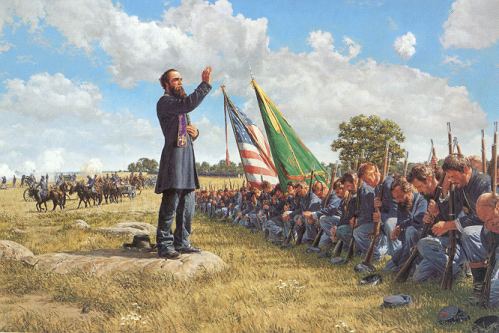
Fr Corby gives absolution to the Irish Brigade at Gettysburg

The Minstrel Boy (Thomas Moore)

The minstrel boy to the war is gone,
In the ranks of death ye will find him;
His father’s sword he hath girded on,
And his wild harp slung behind him;
“Land of Song!” said the warrior bard,
“Tho’ all the world betray thee,
One sword, at least, thy rights shall guard,
One faithful harp shall praise thee!”

The Minstrel fell! But the foeman’s chain
Could not bring his proud soul under;
The harp he lov’d ne’er spoke again,
For he tore its chords asunder;
And said “No chains shall sully thee,
Thou soul of love and bravery!
Thy songs were made for the pure and free
They shall never sound in slavery!”

The Minstrel Boy will return we pray
When we hear the news we all will cheer it,
The minstrel boy will return one day,
Torn perhaps in body, not in spirit.
Then may he play on his harp in peace,
In a world such as heaven intended,
For all the bitterness of man must cease,
And ev’ry battle must be ended.

(Last verse anonymous Civil War)

Three years ago I was in the process of returning home from Iraq spending my last couple of days in country before flying out to Kuwait and then the United States. I was already in a rather melancholy state knowing that the Chaplain incoming higher headquarters had turned off my relief for Al Anbar Province after I had paved the way for him with all of the teams of advisors that I had worked with during my time serving them. My relief a personal friend was diverted to the Army advisors with a different Iraqi Division in the north of the country. I felt that the incoming senior chaplain had betrayed and abandoned the men that I worked so hard to care for. Later I heard that he had disregarded my heavily detailed after action reports and told at least one senior chaplain that he “had heard that I was out there but didn’t know if I had done anything.”

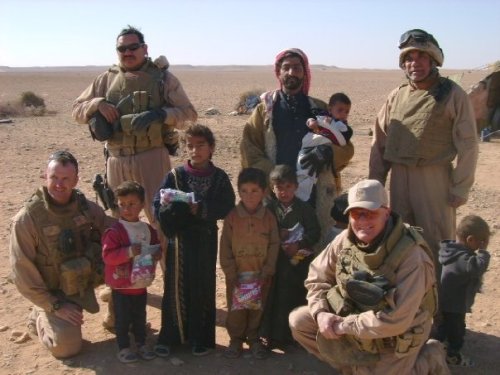
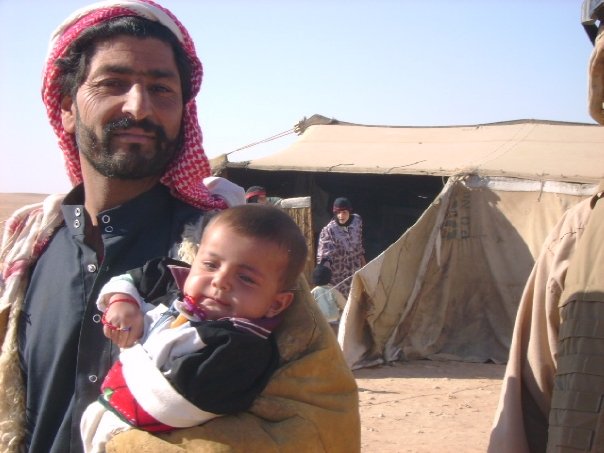
On the Syrian Border with members of a Border Team and Bedouin family

It was at that point that I realized that you could do your job and sacrifice yourself to complete a mission only to have someone with their own agenda do what they could to discredit you.  Where the senior Chaplain that I worked for did all that he could to support my team’s mission and see that we were properly recognized at Multi-National Corps Iraq in Baghdad his successor dismissed our work. It was the first time in my Navy career that I had experienced that.  I think it was the fact that I worked for a non-traditional billet working for an Army led joint command outside the normal Navy-Marine Corps chain was a big part of this. Inter-service rivalries and the distain of those bound by conventional thinking are not new and those that have done such non-conventional work have frequently been treated in a similar manner.

Looking back there are some songs which are particularly meaningful to me after my time in Iraq that send a chill up my spine when I hear them. One of these is the patriotic Irish song The Minstrel Boy written by Thomas Moore while a student in honor of friends killed in the Irish Rebellion of 1798.  The song was very popular among soldiers of Irish descent in the American Civil War as well as soldiers fighting in Irish Regiments in World War One and World War Two.

The song is powerful when you hear it for it speaks of the reality of war, war that changes those, even those that return home are not unchanged by it.  It speaks of the sacrifices required by those that go to war and even the effects on the community, the loss of young people.  The final verse added by an anonymous author during the American Civil War in a sense is a prayer, a prayer of return as well as reconciliation. It has been recorded a number of times including an instrumental during the film Blackhawk Down. Another rendition is in the telvision mini-series Rough Riders about the 1st U.S. Volunteer Cavalry at the Battle of San Juan Hill.

http://www.youtube.com/watch?v=un_AVYB-GI8&feature=player_embedded

My life has been changed and faith challenged. When I went to Iraq I still maintained a sense of idealism.   After Iraq and having to deal with PTSD and a psychological, spiritual and physical breakdown as well as a profound sense of abandonment by some senior chaplains, my former church and even God I am a different person. My faith which had been shattered to the point of being a practical agnostic for nearly two years has returned. I don’t regret that and do believe that it is a good thing. If we are not changed by what God allows or by what life brings I don’t think that we grow. As a Priest I wonder if I could work in the environment that I work without having gone through what I did.

I see many of the “minstrel boys” and girls of our era and having also been to war and come back changed the last lines of the final verse is a prayer that I echo. One of the versions that I particularly like is the one sung in the Star Trek the Next Generation episode “The Wounded.” While it is only the first verse it deals with the lives of two officers whose lives are forever changed by war. http://www.youtube.com/watch?v=RJudJ9S579A

This is dedicated to all those who have served who have gone through the pain of war and return until war shall be no more.

Peace

Padre Steve+

5 Comments

Filed under faith, film, History, iraq,afghanistan, Tour in Iraq, US Navy