Tag Archives: captain jean luc picard

Star Trek God and Me…1966 Until Hopefully Far into the Future

star_trek_into_darkness-HD

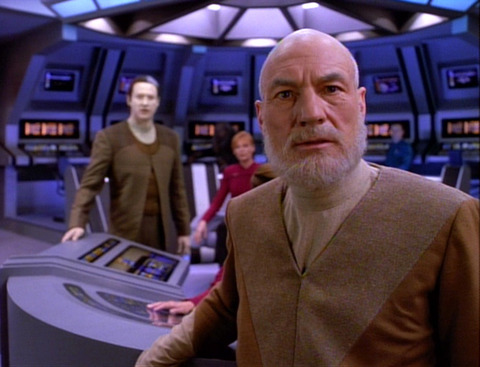
Capt. Picard: I sincerely hope that this is the last time that I find myself here.

Q: You just don’t get it, do you, Jean-Luc? The trial never ends. We wanted to see if you had the ability to expand your mind and your horizons. And for one brief moment, you did.

Capt. Picard: When I realized the paradox.

Q: Exactly. For that one fraction of a second, you were open to options you had never considered. That*is the exploration that awaits you. Not mapping stars and studying nebulae, but charting the unknown possibilities of existence.

I can’t wait. The next installment of the Star Trek franchise Star Trek Into Darkness comes out this week. It is the second episode of the new cinematic re-boot of the franchise and as someone that grew up and matured with the series in its various television forms as well as on the big screen I am rather excited.

When I first saw the hints of the new movie franchise a couple of years before it premiered in 2009 I wondered about it. I wondered how they could pull of the feel of the original series. I heard friends rave about it and every review I read was sweet. The movie was great.  The cast, most of whom I had seen very little of in other roles, had the feel of the old cast.  Chris Pine (Kirk), Zachary Qunito (Spock), Karl Urban (McCoy) and Simon Pegg (Scotty) had great chemistry.  The supporting cast worked well too.  I was simply blown away as they pulled this off and managed to do a “prequel” which worked.

Star-Trek-TV-series-cast-007

As a side note, my undergraduate campus, California State University at Northridge served as Starfleet Academy.  All in all it was a very satisfying experience and the crowd applauded loudly as the final credits came up, preceded by Leonard Nimoy  doing a voice over as the Enterprise went by saying; “Space: the final frontier. These are the voyages of the starship Enterprise. Her ongoing mission: to explore strange new worlds, to seek out new life-forms and new civilizations; to boldly go where no one has gone before.”  This was followed by the theme music of the original series as the credits rolled out.  That was special.

As I said I will see the second installment of this series sometime later this week. From the trailers and reviews it looks quite good. I haven’t seen it but when I do I will review it. From what I have read it does seem to tackle issues that many of us will be familiar with in the post-9-11-2001 world.

images-22

I grew up with Star Trek. I remember as a kid when the original series was still on NBC and when it went into syndication I tried to watch it whenever it was on, or whenever I could get control of the television.  There was something that captured my imagination, a glimpse of a positive future, possibility and adventure.  Since I have always been seeking new frontiers, note my career in the military, Star Trek, the Original Series was an inspiration.  Kirk, Spock, Scottie, McCoy, Uhura, Sulu, Chekov and Nurse Chapel became part of my life.  When not watching it I was reading Star Trek novels, something that I continued with Star Trek the Next Generation. I was fascinated by the Klingons and Romulans, the though of other planets with other intelligent beings was something that did not frighten me, or cause me to question my Christian faith.  Since I have always believed in a very big God, the fact that God did not have to be limited to just dealing with humans seemed, as Spock would put it “logical.”

20130403-153235.jpg

No I know that some people could be offended by this, or could give me some flak for what I just said.  But I see no reason why God couldn’t be working in all of the gazillion galaxies, solar systems, planets and maybe even parallel or alternate universes.  Why not?  What if there was a planet where there was no fall and the inhabitants didn’t screw it up?  I think it would be cool.  My God is big, in fact the Bible and the Christian tradition is pretty clear that God is like really super duper powerful and capable of handling a whole lot of stuff all at once.

In fact we Christians like to call God omnipotent, omniscient, omnipresent and a bunch of other “oms” most of which are not even biblical concepts, but we have borrowed and used them so much to explain the God that we believe in that you would thing that they are.  Likewise, at least some of us believe that God is a creative God and if we do really believe all of those “om” descriptions that we ascribe to God why should we be threatened that there might be other live, other civilizations out there?

So why would we look out and see this vast universe and say: “Nope Clem, just us out here.” So since I am backed up by the testimony of Scripture and Tradition about some of the attributes of God I think it is safe to say that God indeed could well be working elsewhere in the universe.  If I believe that God is who Scripture state him to be, then I have to at least give some thought to this possibility.  Can I positively say this is the case? No, but I can infer it from what the faith teaches me about God and by what science has revealed to us over the past couple of hundred years.  None  of this takes anything away from God working his plan of redemption through Christ with humanity.

Anyway that rabbit chased back into the woods, I continue. I followed the Star Trek movies, with The Wrath of Khan and The Voyage Home being my favorites.  Not long after I learned to drive in high school a friend and I went to a Halloween party.  I had made me a Mr. Scott uniform and my friend was dressed as an alien.  After the party we headed home. We had just gotten on I-5 and I looked at him and said  “set course 010 Warp 8” and being young and dumb took my 1966 Buick LeSabre 400 with a twin barrel carburetor up to about 90 MPH. I noticed a pair of headlights coming up behind me.  I slowed down for the Benjamin Holt Drive exit and exited the freeway where a stoplight was red.  Beside me pulled a CHP cruiser.  The trooper looked at us, me with my Star Trek uniform and my friend in his alien suit, laughed and waved.  I watched my speedometer like a hawk the rest of the way home and prayed that the trooper would not turn around to get me.

blm130512

Later in Germany I was driving my first German “beater” a 1976 faded and rusted powder blue Ford Escort nicknamed “the Blue Max” to my base on a Saturday with Judy.  Ahead of us a Mercedes crept along going well under the speed limit of 100 km/h and it was driving both of us crazy. People that do the same here in my post-Iraq PTSD world and I wish I had phasers or something to blast them out of my way, perhaps a transporter or tractor beam would be maybe a tad less violent.

Since we were on a two lane state highway going through the hills of the Saarland along the bank of the Nahe River there was no way to get around this guy.  My little car known as the “Blue Max” had its emergency flasher located on the center of the dashboard. It was a red button about an in round.  I looked at Judy and said “fire phasers.”  I reached down pushed the button of and on and in front of us the strangest thing happened.  There was a boom, a flash and the guy’s muffler and tail pipe dropped off.  I avoided the debris and he coasted to a halt alongside the road.  Judy and I both looked at each other with looks of shock and disbelief.  Yet it had happened.  I have tried this again on every other car that I have owned with no effect.  I guess phasers are not standard on this side of the Atlantic.

When Star Trek, the Next Generation, or TNG came out in 1987 I was a young Army Captain getting ready to go to seminary the following year.  I fell in love with TNG and its cast.  In fact during my clinical pastoral education residency my supervisor was able to use analogies from the TNG characters, Lieutenant Worf and Lieutenant Commander Data to help me gain insights into what was going on in me.

7157_5

I have a lot of affinity for both of these characters as someone who wrestled with where I fit in life and the world, and where was home. I shared that with these characters, particularly Picard and Worf.  There were a couple of episodes dealing with Captain Picard entitled “Family” and “Tapestry” which actually woke me up to a couple of things in my life. I think I can say that the Deity Herself used them to help me through that time when I was still sorting through my life, vocation and issues of home and heart. I thought that the character development in TNG was great and I still will watch TNG whenever I come across it or want to pull out one of my DVDs.

I liked the darkness of Deep Space Nine and the fact that baseball was a part of it. DS9 fascinates me, like TNG it is quite complex in the way it is written and in the way that the characters were developed. The carry over of certain characters and story lines from TNG made it especially interesting. I like the fact that the bulk of the story centers on a Star Base and that you never always know who the good guys and the bad guys are. It kind of reminds me of my service in Iraq. Distrustful political factions, religion, power struggles, competing powers and terrorist groups of various kinds make DS9 a lot like real life, the live that I have lived and continue to live in.

Emissary - 2

One of the things that I really liked about DS9 was the way that the writers incorporated religion and faith into the script. I know that some people don’t like the fact that they did not incorporate Christianity into it and saw that as an affront but the themes brought out with the Bajorans, Cardassians and even the Ferengi in terms of faith, theology, religious structure and philosophy have a lot in common with many religions that we know here on earth. The fact that it does not deal with any religion practiced here makes it a wonderful vehicle for religious discussion for anyone of faith.

Another thing that the writers of DS9 did was to bring back the alternate universe first shown in TOS in the episode Mirror Mirror. To me the whole concept of alternate universes and possibly other versions of me is fascinating. To wonder what I might be like in some alternate reality is quite fascinating to think about.

I did not take as well to Voyager or Enterprise as my life was getting really busy with military deployments and operations. When I am done with DS9 I will probably start doing Voyager. As was the case I ended up collecting the entire TNG series on DVD and am well on my way to collecting all of DS9. In fact I have watched every TNG episode back to back between last years 2012 World Series and Opening Day 2013 and I am a bit over two thirds of the way through season IV of DS9.

I have a jacket similar to the TNG jacket in Science/Medical Blue with the communicator badge and Lieutenant Commander collar insignia. I also have a very rare Starfleet Chaplain pin with a white Greek Cross on it.  This came out of one of the old TOS Technical Manuals dealing with rank and branches of Starfleet.

So I guess I am a Trekkie, or Trekker, depending on which Star Trek sect I belong, but nonetheless, Star Trek has been, and will remain part of my life.  Thanks Gene Roddenberry, and all who over the years have brought the Star Trek universe to us.

Live long, and prosper my friends.

Peace,

Padre Steve+
2 Comments

Filed under christian life, faith, Loose thoughts and musings, philosophy, Religion, star trek

All that We Are and Can Be: Where Past, Present and Future Meet

68136_10151386881662059_2126249630_n

“The past always seems better when you look back on it than it did at the time. And the present never looks as good as it will in the future.” Peter Benchley “Jaws”

St Augustine of Hippo once asked “How can the past and future be, when the past no longer is, and the future is not yet?”

It is an interesting question but I think that the question is flawed. I think that the past lives in the present much more than we would like to think and that our future, though unwritten can unfold in a multitude of ways and possibilities.

Many of us live in the past as if it were today. We, individually and collectively, as individuals and nations live in the past and look to it much more fondly than when it was our present. I think that historian Will Durant possibly said it the best: “The past is not dead. Indeed, it is often not even past.”

As a historian myself I value the past and seek answers and wisdom from it to use in the present because what we do in the present does, for better or worse defines our future. Confucius said “study the past if you would define the future.” He did not say to live in the past.

That is something that I have been learning for close to 20 years now when my Clinical Pastoral Education Supervisor, using a Star Trek Next Generation metaphor from the episode A Matter of Time.  In the episode a shadowy visitor claiming to be from the future refuses to help claiming that if he were to help that his “history – would unfold in a way other than it already has.”

Finally Picard is forced to make a decision and confronts the visitor, who turns out to be a thief from the past using time travel to collect technology to enrich himself. Picard responds:

“A person’s life, their future, hinges on each of a thousand choices. Living is making choices! Now, you ask me to believe that if I make a choice other than the one that appears in your history books, then your past will be irrevocably altered. Well… you know, Professor, perhaps I don’t give a damn about your past, because your past is my future, and as far as I’m concerned, it hasn’t been written yet!”

It was in telling me that my future did not have to be my past that opened a door of life and faith that I had never experienced before and which showed me that life was to be boldly lived in the present. While it meant a lot then, it means more now for the past according to William Shakespeare “is prologue.”

We cannot help being influenced by the past. We should indeed learn from it, but we cannot remain in it or try to return to it. Kierkegaard said that  “Life can only be understood backwards; but it must be lived forwards.” 

Since I am a Christian my faith in that future is in the God who is eternal, the God of love. Victor Hugo in Les Miserables said “Love is the only future God offers.” That is the future that I want to envision.

Living is making choices and the future hinges on thousands of them. Many of these choices we make automatically without thought simply because we have always done them that way, or because that is how it was done in the past. However, if we want to break the cycle, if we want to live in and envision that future of the God of love then we have to live in the present though the past lives in us.

T.S. Elliot penned this verse:

“For last year’s words belong to last year’s language
And next year’s words await another voice.
And to make an end is to make a beginning.

Peace

Padre Steve+

2 Comments

Filed under faith, philosophy

Horizons, Tapestries and the Possibilities of Different Futures

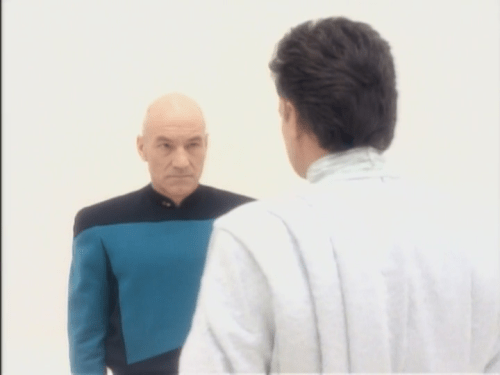
Captain Picard: I sincerely hope that this is the last time that I find myself here. 

Q: You just don’t get it, do you, Jean-Luc? The trial never ends. We wanted to see if you had the ability to expand your mind and your horizons. And for one brief moment, you did. 

Captain Picard: When I realized the paradox. 

Q: Exactly. For that one fraction of a second, you were open to options you had never considered. That is the exploration that awaits you. Not mapping stars and studying nebulae, but charting the unknown possibilities of existence. 

Yesterday I wrote about epiphanies that were occurring in my personal, spiritual and professional life. As I mentioned yesterday they were brought about during a rather cathartic session with my Doctor regarding my PTSD. I think that it was a breakthrough type session because so many new horizons seemed to open at once. Last night it was hard to put it all into words or to sort things out. So after I published that article I went to bed and was subjected to the most intense night of dreams that I have ever experienced and that is saying a lot because my dreams are often frighteningly real. They are like super high definition to begin with because my brain goes into warp drive when my eyes are closed, but last night even more so.

It was like past present and multiple futures intersecting around the them of roads taken, roads not taken and the possibility of different roads home. They spanned my life and many dealt with my time in Iraq while others seemed a blend of many experiences. It was positively surreal. So much so that when the alarm rang I was absolutely exhausted having not slept the previous night because I had left all of my sleep medicines in my gym bag that I had taken to work. So I made a direct call to my Commanding Officer to let him know what was going on and that I needed to take a personal day to rest and reflect on the flood of spiritual, emotional and existential things that I had experienced in the past day. If I had to give an example of what last night was like, it was like the final episode of the Star Trek Next Generation series as Captain Picard kept switching between different realities of past, present and future while being relentlessly grilled by the being simply known as “Q”.

So this morning I rested, spent time with my dog Molly, pretty much avoided the computer and television and then went out and ran about 7.5 miles on the beach. The weather was wonderful and the tide conditions were such that the nearly deserted beach was optimal for running. As I ran the brilliant blue of the sky, the calm waves of the deep blue Atlantic lapping upon the tan sands of the beach. It was as if I was running where the sands of the Western Iraqi Desert met the Atlantic. I was at peace and the images of the previous night began to make sense.

They were about roads, paths, possibilities and the journey to home, wherever or whatever that it is. They were a juxtaposition of past, present and future and variations of each. People, places, images and actions blended together in ways that were at times comforting and other times terrifying. But they were all about possibilities new and unimaginable and as Q told Picard “charting the unknown possibilities of existence” and not being trapped in the past that we cannot change, that even if we could would make us less than we are now.

In another episode of Next Generation called Tapestry, Picard has a death experience where he is confronted by Q and regretting decisions that he made which helped cause his death Q offered him a chance to go back and make it different. When Picard found that the Picard that played it safe was not a person that he would want to be he confronted Q.

LT. j.g. Picard: You having a good laugh now, Q? Does it amuse you to think of me living out the rest of my life as a dreary man in a tedious job?

Q: I gave you something most mortals never experience: a second chance at life. And now all you can do is complain? 

Lt. j.g. Picard: I can’t live out my days as that person. That man is bereft of passion… and imagination! That is not who I am!

Q: Au contraire. He’s the person you wanted to be: one who was less arrogant and undisciplined in his youth, one who was less like me… The Jean-Luc Picard you wanted to be, the one who did not fight the Nausicaan, had quite a different career from the one you remember. That Picard never had a brush with death, never came face to face with his own mortality, never realized how fragile life is or how important each moment must be. So his life never came into focus. He drifted through much of his career, with no plan or agenda, going from one assignment to the next, never seizing the opportunities that presented themselves. He never led the away team on Milika III to save the Ambassador; or take charge of the Stargazer’s bridge when its captain was killed. And no one ever offered him a command. He learned to play it safe – and he never, ever, got noticed by anyone.

It is funny that those two episodes of Star Trek TNG came up a number of times this week with different people. I think what I am discovering is that life is a limitless set of possibilities and that our past, as tangled and messy as it may be at time is part of a tapestry that is who we are but not what we can become. As Picard noted to Counselor Troy after his resuscitation:  There are many parts of my youth that I’m not proud of. There were… loose threads – untidy parts of me that I would like to remove. But when I pulled on one of those threads – it’d unravel the tapestry of my life.

Past, present and future. Dreams and reality, hopes and fears, things real and things imagined. A future unexplored and hopeful so long as we are willing appreciate our past without being trapped by it, to live in the present and imagine the future that we have yet to chart.

But to do this we have to be willing to take the risks, be authentic and realize the possibilities that God in his love and grace imagines for our future.

Peace

Padre Steve+

2 Comments

Filed under faith, philosophy, PTSD

Star Trek God and Me: Ecclesiastical Tyranny Today, the Drumhead Revisited

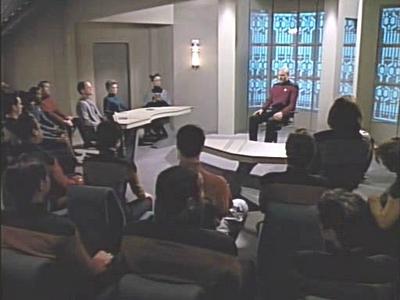
Picard being interrogated by Satie and her assistants (Paramount Pictures)

We think we’ve come so far. Torture of heretics, burning of witches it’s all ancient history. Then – before you can blink an eye – suddenly it threatens to start all over again. Captain Lean Luc Picard (Patrick Stewart) Star Trek the Next Generation “The Drumhead”

Back in May of 2009 when still struggling with faith, belief and God as I wrestled with PTSD and a number of other life issues I wrote an article entitled Star Trek, God and Me 1966 to 2009 . At the time I was pretty much a mess but as I wrote it I realized that all of life is connected and my Christian faith does not occur in a void that has no connection with the rest of life. It is this rediscovery of the reality of faith that helps guide me now. I make no claims to be correct on everything and I am much more apt to err on the side of grace, although I have a lot of difficulty with those that use the Christian faith as a weapon to subjugate others and to deny civil and religious rights and human dignity to those that believe differently than they do.  This is why I write today.

I remember as a teenager going to a pretty conservative church which in many ways was basically an evangelical Christian subculture that looked out at the world as if it were the enemy and “non-Christians” as if they were lesser people because they were not “saved.”  In fact if you mentioned that you knew someone that was not a member of the church people almost invariably would ask if the person was “saved.”  This subcultural attitude which is actually quite prejudicial even if it is well intentioned pervades much of contemporary Evangelicalism and when some Evangelical leaders suggest dialogue and relationships with the “unsaved” which are respectful to non-Christians they are often labeled as “liberals” or “heretics.”

This has happened to me in the past couple of years since returning from Iraq and having to leave the Church that I served for 14 years as a Priest and Canon.  I wrote an article called Faith Journey’s: Why I am Still a Christian in September of 2010 which detailed the journey that I have been on. When I left the church I wrote another article that was picked up on another blog which was entitled The Church Maintained in Love: Maintaining Integrity and Preserving Relationships When Asked to Leave a Church.  A number of people made comments on that article either positive or handled with grace and love but one anonymous person posted a comment which showed the extreme ugliness of some “Christian” conservatives who are quite willing to use character assassination, sound bites and absolute lies to smear another Christian brother who happens to disagree with them.  The moderator of that blog took down the comment because it was so off base and offered his apologies to me having been a target of people in our former church when he left years ago. Though the post was anonymous it had to be someone that knew me because it was very personal couched in “religious piety” but filled with lies and distortions. So much for Christian love….

But back to the Star Trek theme which believe it or not weaves its way through this saga. It seems to me that a lot of Christians talk big but act like they are afraid of the big bad world and if criticized fall into the litany of how bad things are, how the world hates Christians and hunker down into a fortress mentality.  Others keep the fortress but decide that it is high time that they as Christians “kick some liberal ass” and declare “war” on those not like them.  Some couch this in more moderate terms but others like the bomb-throwing activist Randall Terry show the dark side of this mentality:

“Let a wave of intolerance wash over you. I want you to let a wave of hatred wash over you. Yes, hate is good…. If a Christian voted for Clinton, he sinned against God. It’s that simple…. Our goal is a Christian Nation… we have a biblical duty, we are called by God to conquer this country. We don’t want equal time. We don’t want Pluralism. We want theocracy. Theocracy means God rules. I’ve got a hot flash. God rules.”  [Randall Terry, Head of Operation Rescue, from The News Sentinel, Fort Wayne, Indiana, Aug 15, 1993]

“Let a wave of intolerance wash over you. I want you to let a wave of hatred wash over you. Yes, hate is good…” The continued twisted “Christian”  message of Randall Terry (Life Magazine)


The quote is nearly 18 years old but the attitude is quite common today as “Christians” gird themselves for war.  If you ask me the attitude is not Christian at all, but something out of the Middle Eastern mindset of the Old Testament which found its way into some parts of the Christian faith especially the Calvinism espoused by the Puritans who initially settled New England which is used as a pattern by Christian “Reconstructionists” and others of similar thinking. It seems to me to represent all that Jesus condemned many of his religious contemporaries for doing.  Jesus preached the Kingdom of God was at hand and for people to repent, however his harshest warnings and condemnations came not on the people that the religious considered the “unsaved” the Gentiles, prostitutes, tax collectors and other sinners but at the smug religious people that ruled that ruled their countrymen with a religious law often more draconian than that of the oppressive Romans especially in the way that it treated others outside the fold.

The attitude is actually quite poisonous when you look at it in light of history and the effect that such an approach to life and others.  I can go to historic examples galore since we as Christians often have a sordid record when it comes to treating those that Christ gave his life for with any kind of love, charity or compassion often engaging in wars, pogroms, persecution, the Inquisition and state/church sanctioned mass murder even against fellow Christians that don’t agree with are particular line of thought.  But if I do that it strikes some as if I am trying to be unfair, so I will go to a Star Trek example which I used a while back in another post on a different subject but it fits.

The example comes from the Star Trek TNG episode called “The Drumhead” The episode involves a suspected case of sabotage and spying on the Enterprise and a retired Admiral is sent to investigate. Though evidence leads away from this conclusion the Admiral and her aid drive home the point and widen the investigation for any suspicious acts. Soon the loyalty of anyone that raises a voice to question the premise of the investigation is suspect to include the Captain, Jean Luc Picard.

The Admiral is a true believer in the Federation, actually a Zealot who describes a life that is quite similar to modern Zealots of religious and non-religious varieties in conservative and liberal thought in this and other countries. Zealots tend to surround themselves with others like them and often live lonely isolated existences in which they are on a mission to make sure that the edicts of their faith are obeyed and enforced by whatever religious or governmental structures will accommodate them.  Admiral Satie, the investigator details her life to Picard: “Captain, may I tell you how I spent the past four years? From planet to starbase to planet. I have no home. I live on starships and shuttlecraft. I haven’t seen a family member in years. I have no friends. But I have a purpose. My father taught me from the time I was a little girl still clutching a blanket, that the United Federation of Planets is the most remarkable institution ever conceived. And it is my cause to make sure that this… extraordinary union be preserved.” Simply substitute the “United States of America” or “Christianity” for the United Federation of Planets and the picture paints a picture of us today.

After a lengthy opening the Admiral throws this at Picard: “I question your actions, Captain; I question your choices, I question your loyalty!”

Picard dares to reply with a quote from the Admiral’s father, a noted jurist: “You know, there are some words I’ve known since I was a schoolboy: “With the first link, the chain is forged. The first speech censured, the first thought forbidden, the first freedom denied, chains us all irrevocably.” Those words were uttered by Judge Aaron Satie, as wisdom and warning. The first time any man’s freedom is trodden on, we’re all damaged. I fear that today…”

The Admiral becomes furious and turns her wrath against Picard: “How dare you! You who consort with Romulans, invoke my father’s name to support your traitorous arguments! It is an offense to everything I hold dear! And to hear those words used to subvert the United Federation of Planets. My father was a great man! His name stands for integrity and principle. You dirty his name when you speak it! He loved the Federation. But you, Captain, corrupt it. You undermine our very way of life. I will expose you for what you are. I’ve brought down bigger men than you, Picard!”

One only has to look at other Zealots of the Reconstructionist theology to see where this is going: Gary North one of the long time leaders of this movement said: “So let us be blunt about it: We must use the doctrine of religious liberty to gain independence for Christian schools until we train up a generation of people who know that there is no religious neutrality, no neutral law, no neutral education, and no neutral civil government. Then they will be get busy in constructing a Bible-based social, political and religious order which finally denies the religious liberty of the enemies of God.” –Gary North, “The Intellectual Schizophrenia of the New Christian Right” in Christianity and Civilization: The Failure of the American Baptist Culture, No. 1 (Spring, 1982), p. 25

Another important leader of the Christian right noted “We are engaged in a social, political, and cultural war. There’s a lot of talk in America about pluralism. But the bottom line is somebody’s values will prevail. And the winner gets the right to teach our children what to believe.” — Gary Bauer, Family Research Council.

Unfortunately the leaders of this particular view of Christianity are not much different than the fictitious Admiral Satie and I do expect that their crusade will not be done anytime soon.  I know the character of such people having been their target.  Based on the words of my critic who totally twisted what I said and believe in this pejorative and frankly distorted screed:

From his writings on his blog, it’s quite clear that he is the one who’s taking a new direction away from Scripture and the ancient faith, which is the basis for his departure. Fr. Steve has changed his beliefs to now accept women priests, gay “saints”, Muslim “saints”, etc. I might call the acceptance of women priests “liberal”, but the other two are really just heresy – though I’m certain many (particularly Catholic and Orthodox) readers would lump women priests into the heresy category as well. Didn’t Jesus really die on the Cross to reconcile us to God teaching us that He is the only way to the Father? Yet Fr. Steve now believes that it was unnecessary for Jesus to atone for our sins as even Muslims can obtain Heaven without the Cross. And hasn’t God repeatedly taught us throughout Scripture that homosexual sex is condemned as an abomination. Yet Fr Steve now believes God didn’t really say that at all and that gay sex is okay with God….I will pray for Fr. Steve, that the Holy Spirit will reveal the Truth to him and bring him back to the true faith whether that’s with the CEC or another communion.”

The person that wrote this was anonymous and posed as an administrator on the other site using the name “admin.” What bothers me is the disingenuousness of the statement and the manner in which my beliefs were twisted to include implying that I had denied the “true faith” were bandied about by this person who as I said had to know me especially since my former church is a very small communion which has been shrinking for years due to its own internal problems. I have my suspicions of who the writer might be but cannot prove it beyond a doubt and the fact that he hid his identity is telling, only cowards that have no honor make such attacks from the shadows rather than speaking to a brother in person as the words of Scripture command.

The sad thing is that everything that I wrote is backed by the teachings of the Catholic Church and the Second Vatican Council and I never denied the Creeds, Councils and my Scriptural hermeneutics (not the way they were twisted) were within the bounds of the Christian faith in belief that the love and grace of God triumph over sin and unbelief and that we cannot earn that grace.  But according to my critic I am an apostate who has left the faith and my words are twisted beyond belief to “prove” his point.  This is the kind of person that uses the Creeds and Scripture not as means to faith and expressions of a living faith based on the mercy grace and love of God but as means of ecclesiastical control, not much different from that of the Medieval Catholic Church which I am sure that he would condemn since he refuses to be reconciled to Rome. It is funny to be criticized as a heretic by someone who would qualify as such if judged he were by Rome or even Orthodoxy.

Randall Terry, Gary Bauer, my anonymous critic and others represent the nature of the Admiral Satie in our universe and time-space continuum as opposed to the hypothetical future of Star Trek.  Just watch their behavior in the coming months and years. The war is afoot and woe betides anyone that stands in their way.  At the end of the Drumhead episode when Satie’s and her investigation are discredited Captain Picard and his Security Chief Lieutenant Worf a Klingon, gives us final word of warning about the Satie’s of this world:

Lieutenant Worf: [referring to Admiral Satie] I think… after yesterday, people will not be so ready to trust her.

Captain Jean-Luc Picard: Maybe. But she, or someone like her, will always be with us, waiting for the right climate in which to flourish, spreading fear in the name of righteousness. Vigilance, Mister Worf – that is the price we have to continually pay.

I guess that is why God still speaks to me through Star Trek; sometimes the words are pretty prophetic and speak to us in ways that those who loudly proclaim themselves to be on God’s side in a social, political and cultural war ever will.

Peace

Padre Steve+

8 Comments

Filed under christian life, faith, philosophy, Political Commentary, Religion, star trek

Star Trek the Next Generation: Captain Jean-Luc Picard Deals with PTSD

Counselor Deanna Troi: Interesting.
Captain Jean-Luc Picard: Counselor…
Counselor Deanna Troi: I just find it interesting. Captain Jean-Luc Picard, the man who couldn’t be pried out of his seat for a vacation for three years!
Captain Jean-Luc Picard: It’s Earth. It’s home. Do I need another reason?
Counselor Deanna Troi: I don’t know, what do you think?
Captain Jean-Luc Picard: Your help has been invaluable during my recovery, but…look, I’m, uh…I’m better! The injuries are healing.
Counselor Deanna Troi: Those you can see in the mirror.
Captain Jean-Luc Picard: The nightmares have ended. All I need now is a little time to myself.
Counselor Deanna Troi: I agree. In fact, I’m delighted you’re going. It’s just that…the choice of where you’re going could stand some scrutiny.
Captain Jean-Luc Picard: If you wish to believe my going home is a direct result of being held captive by the Borg, be my guest.
Counselor Deanna Troi: Is that what you believe?
Captain Jean-Luc Picard: I hate it when you do that.
Counselor Deanna Troi: Captain, you do need time. You cannot achieve complete recovery so quickly. And it’s perfectly normal after what you’ve been through, to spend a great deal of time trying to find yourself again.
Captain Jean-Luc Picard: And what better place to find oneself than on the streets of one’s home village.
Counselor Deanna Troi: Interesting.

I have always found the Star Trek TNG episode Family quite compelling.  The episode (Season 4 Episode 2) deals with Captain Jean Luc Picard’s return home following his capture and assimilation by the race known as the Borg during The Best of Both World’s Part 1 and II (Season 3 Episode 26 and Season 4 episode 1.)

The story is interesting because it deals with some of the issues that people traumatized in combat deal with as they try to find themselves again.  In the story Captain Picard, in a very typical manner of someone traumatized by combat believes that his injuries are healing.  His counselor, Deanna Troi who serves as the Ship’s “Counselor” challenges him on his belief that he has recovered and his choice of where he wants to go to find himself again.

I saw the episode when I was in Seminary not long after completing the Chaplain Officer Basic Course and then saw it again when I was going through my Clinical Pastoral Education Residency.  It was during that process, one in which I was trying to find and define what “home” was, that it really caught me.  I was Captain Picard, the brother who left home to explore and travel while serving in the military.   My brother Jeff was Picard’s brother Robert.  He is the one who stayed home and minded family business.  The parallels then got me and even more so now.  My Residency Supervisor used this to good effect during that time in dealing with the issues of home, but the post combat and PTSD part was yet to come.

Back in the days of my residency I struggled with another of issues related to being a military brat and having begun a career in the Army.  In a sense I was a nomad.  I had lived a lot of places but none were really home, even where I had spent all of junior and senior high school.  Like Picard my eyes were set on far horizons of exploration and adventure of military life.  My brother Jeff on the other hand like Picard’s brother was content at staying at home, being near our parents, getting established in the school district and taking care of his family.   We both chose our own paths and both were right for us.  I still long for adventure and exploration but have begun to settle down.

When it came to the placement of the PTSD in this picture it was after Iraq that I had a crisis in a number of areas in my life and every time I thought that I was doing better and maybe even “getting well” that there was always something that could trigger the memories, bring back the dreams and keep me from sleep.  I can say that a year and a half after my return from Iraq I am doing better in a lot of ways but still having struggles with anxiety insomnia and hyper-vigilance.  I did find out that there is one thing that does not evoke a startle reflex is a foul ball that comes back against the screen in from of me in Section 102 at the Church of Baseball Harbor Park Parish.  Last night while taking pictures right up against the screen I had several balls that hit within a couple of feet of me, one of which hit my camera and knocked it out of my hand.  Anywhere else loud noise, unexpected crashes, things flying past me sends me into a hyper-alert status.

picard familyPicard Meets His Family after Many Years and Wounds Away

When Picard goes home it is not the confident Starship Captain who returns, but a man unsure of himself and where he fits in life.  His encounter with the Borg has changed him and he contrary to assurances to Counselor Troi is still wounded.  When I returned from Iraq I wondered where I fit, I felt like I had abandoned my advisers in Al Anbar when I returned because my relief had to be sent elsewhere do to circumstances beyond my control.  I did not feel a part of my own unit as nothing was the same when I came back.  I felt weak, useless and at the end of my rope after having completed incredible tour in combat of my then 26 years in the military.  Physically I was falling apart; I had several nagging injuries from Iraq that caused chronic pain.  I was flashing back with every moment, fires burning in the Great Dismal Swamp had turned our air the color of an Iraq sand storm while the smell was like that of the ever present burn pits, both military and Iraqi.  Walking out the door one morning with my neighborhood shrouded in smoke I began to melt down.  That day we had a seminar done by a nationally known speaker dealing with trauma and combat with the associated feelings and emotions.  At the end of the day I was a wreck.  My Unit Doctor, Chris Rogan looked at me and said “Chaplain you don’t look good, are you okay?”  I said “no I’m not, I’m losing it and I’m scared.”  That was the place where I finally began to get help.  It has been about 14 months since I started and it is still a process.  We made a trip home that summer and I did not do well.  It was painful and I had great difficulty both in the travel as well as the visit.  When I hear fellow vets talking about the surreal and often painful times that they experience I can understand.  The fact is that you can be with a hundred friends and family members and be totally alone when you return home because it is something that you cannot really share and that they usually don’t understand.  Once again I have been fortunate.  My little brother actually listens to me and lets me vent when I need to.  Of course dealing with our family’s stuff this is a two way street.

not a happy camperVisiting Home and not Doing Well

In the story Picard is offered a chance to leave Starfleet and go to work on a project under the ocean on Earth.  He is sorely tempted to take it but before he can he has an encounter with his brother who challenges his decision.  They exchange words and Captain Picard feeling picked on starts a fight.  During the fight he breaks down about his experiences sobbing in his brother’s arms.  “His brother then said: So – my brother is a human being after all. This is going to be with you a long time, Jean-Luc. A long time. You’ll have to learn to live with it. You have a simple choice now. Live with it below the sea with Louis, or above the clouds with the Enterprise.”

In a sense that is something that all of us who serve after having been traumatized by the experience of wart have to deal with, the physical as well as the psychological and spiritual wounds.  For me it was the realization that I was human after all and the slow realization that this will be with me a long time.  The choice is how I choose to live my life and where I do so.

In the series and subsequent Star Trek: The Next Generation films Picard is forced to deal with his psychological wounds from the encounter with the Borg culminating in the second of those films Star Trek: First Contact. In it Starfleet Command leave Picard and the Enterprise out of the battle leading to this exchange between Picard and his First Officer which deals with the stigma associated with such an injury.

Cmdr. William Riker: Captain, why we are we out here chasing comets?
Captain Jean-Luc Picard: Let’s just say Starfleet has every confidence in the Enterprise and her crew – they’re just not sure about her Captain. They believe that a man who was once captured and assimilated by the Borg should not be put in a situation where he would face them again. To do so would introduce “an unstable element to a critical situation.”
Cmdr. William Riker: That’s ridiculous. Your experience with the Borg makes you the perfect man to lead this fight.
Captain Jean-Luc Picard: Admiral Hayes disagrees.

The stigma associated with psychological injuries is far greater than that of physical injuries.  The unseen injuries are not as well understood and those who suffer them often are broken down by the system as they try to get help and many simply go underground and self medicate.  Last year two Army Generals opened up about their struggles with PTSD. I was fortunate to have people come alongside of me when I went down hard.  People who did not give up on me and kept faith by caring about me when I was and still get down.

See the article at: http://edition.cnn.com/2009/HEALTH/03/06/generals.ptsd/

Despite this and the efforts of many in the Military to help those with PTSD and other “unseen” injuries, to include medical conditions brought on by exposure to toxins in the combat zone, there is still the stigma.  As the young officer suffering from a rare and eventually fatal pulmonary condition acquired in Iraq as well as yet untreated PTSD “I squarely wish I had lost my legs then than the lung function that I have lost!”

Captain Picard’s story of course is fictional, but it demonstrates to some degree what those who experience the psychological and spiritual wounds of war face when they “come home.”  This stuff doesn’t go away.  Here are some of the comments that I have had from readers who deal with their own or a family members PTSD.

Australian Vietnam Veteran who wrote me said:  “As an Australian Vietnam Veteran with PTSD, I find these articles fascinating. I long wondered why the world had to be such a hostile mongrel place. Then 30 years later I was diagnosed with PTSD and I can now relate to why I have the condition but the world has not changed and medication is of limited use. There are many of us who are still very isolated and have to limit our social contacts. I recently started a Vietnam Veterans group, for members of our small unit, on the web and I found men who were relieved to be part of something and someone they could relate to as they had all but withdrawn from society. Sadly a few of them refuse to take any medication for their medical conditions as they see that as prolonging their miserable existence.”

A family member of a WWII veteran said: “thank you. It’s really needed for women to read articles/memoirs like that. It’s easy to say someone has PTSD, but another to live with and love who has it. I come from a family with rich military history and this is an everyday issue. Never goes away, even after 40 – 60 years.”

A USMC Vietnam Vet that I know wrote: “It’s a bitch at times, and the sleep, or lack of will eventually come, although it will never be a fully restful sleep. The Hyper vigilance seems never to go away. Yes it could be good, but eventually it can be bad…. well do I know both.”

An Army Chaplain from Iraq noted: “I too am a chaplain who felt that he and his assistant were the best equipped to handle the horrors of war – just to find out after being home for about a year just how much I had changed. I was sitting with my daughter in my lap one weekend afternoon when she asked, “Daddy, why don’t you play and laugh with us like you use to before you went to Iraq?” It was the key event that brought everything to a point where I could get help. In the months since there have been good days and definitely bad days – however, my faith remains strong….”

I run into people like this every day in the course at work who deal with this and sometimes it spills over into my stuff.  However I am glad to know that I am not alone.  To those who have helped me since I have be back, Chris, Two Feathers, Limey, Greg, Jesse, Jeff, Elmer, my longsuffering wife the Abbess of the Abbey Normal Judy and my brother Jeff, Colonel P and Janet, the folks I work with, the people at Harbor Park, especially Ray, Charlie and the Vietnam Veterans of America who man the beer stand on the concourse behind home plate and all the others who have come alongside I am grateful.  It is my sincere wish and prayer that all veterans will have such fine people there for them when they hit the wall.

Peace, Steve+

Leave a comment

Filed under iraq,afghanistan, PTSD, star trek

Benjamin Sisko, Star Trek Deep Space Nine and the Less than Sexy Command of Military Bases

Note: I write this after Judy and I did something that we never normally do…no not that, whatever that is in your dirty minds.  For us this was to watch a movie in a theater a second time.  We did this tonight.  We went and saw the Star Trek movie again and enjoyed it as much as the first time.  As I thought about us seeing it this afternoon I was writing on another topic, but it was much too involved for my brain at this moment in time.  So I saved it and went back to Star Trek.  This is the first in a series about Star Trek Captains and deals with the only Captain on a Star Trek series who is not Captain of a Star Ship, but rather a Star Base. In this case, Captain Benjamin Sisko of Deep Space Nine.  In some ways I dedicate this to those fine officers who do not get the commands at sea, or if they are in the Army or Marines those who command bases or garrisons rather than maneuver units.  I dedicate this particular post to Colonel Tom Allmon, US Army Retired who I served with at Fort Indiantown Gap Pennsylvania and who later commanded Fort Meyer Virginia.  This will be a first of a series that will appear periodically dealing with characters from the various Star Trek series and films and work them into what commanders and staff officers in the U.S. Military deal with on a daily basis.

“There is more to baseball than physical strength. It’s, uh… it’s about courage; and it’s also about faith; and it is also about heart. And if there’s one thing our Vulcan friends lack, it’s heart.” Captain Benjamin Sisko

Odo_ejecting_SiskoSisko being thrown from the game against the Vulcan Logicians

Star Trek Commanding Officers are interesting to compare and contrast and usually have a lot to do with how each Star Trek series was received.  I know a lot of people who like Captain Kirk over Captain Picard or Picard over Kirk.  There are those who prefer Kathryn Janeway to any of the men.  Of course all of these were the Captains of Federation starships.  Like any naval service it is the Captains of warships that have the “sexy” jobs.  Commanding officers of service vessels, auxiliaries or bases tend not to be the commanders who are being groomed for Flag rank.  The newer and more powerful the vessel is, the more likely that the skipper is being groomed for a higher level command.    This is true in any Navy and is certainly true in the world of Star Trek.  Thus we have the unusual situation for a us to deal with and perhaps the reason that some people do not care for Deep Space Nine as much as for the series involving Starships as the setting for the show.  Captain Benjamin Sisko of Deep Space Nine doesn’t command a ship. In fact he is the survivor of the USS Saratoga, a ship lost when the Federation fleet was decimated by the Borg at Wolf 359 in which his wife is killed in action.

Having served at sea and ashore I can say that the divide between commanders of warships and those of bases is deep.  This is not a pejorative statement at all, but a recognition that the services tend to weigh command of a warship higher than that of a base.  Both situations require men and women of certain temperament and ability.  Good commanders can function and adapt anywhere but may because of the needs of the service find themselves in assignments that are less glamorous and maybe even less desirable from a career point of view.  Such is the case with Benjamin Sisko.  He is sent to an important but remote base with a small Federation staff off the planet Bejor which recently gained its independence from the Cardassian Empire.  The space station had previously been a Cardassian station.

Sisko’s assignment like that of any overseas base commander is an interesting weave of station commander, quasi-ambassador to the Bejoran government, small town mayor and overseer of security in the sector which becomes much more important with the discovery of a “worm hole” in space nearby.  In the process he must deal with the ever present Cardassians who through Gul Dukat the former station commander continually attempt to re-assert their dominance and authority over both the station a Bajor.  As the series moves along he is forced more onto a war footing as a race from a sector of the galaxy connected through the worm hole attempts to invade the sector which Deep Space Nine serves as the outpost and tripwire.

All through this Sisco must deal with a multiplicity of problems, not unlike commanders of US Naval bases in sensitive and potentially volatile regions do on a daily basis today.  Sisko must deal with the unique history, culture and religion of the Bajorans.  Likewise he has to deal with the divides between moderate and fundamentalists in the Bajoran religion. He also must deal with tensions between the religious Bajorans and Bejoran secularists all the while trying to heal the scars of the Cardassian occupation, physical, physiological and spiritual to the people of Bajor.

As if this were not enough he has a host of potential problems on his station.  The station has a strong presence of people who in today’s parlance would be called Third Country Nationals, or TCNs.  These individuals and their families run shops, bars and restaurants on the station, sometimes within not quite within the margins of legality, in particular the Bartender Quark and tailor Garak.  Captain Sisko deals with all of this in addition to normal issues that any commander would face dealing with his own personnel, operations and logistics functions.  While he is the base commander he has a Bajoran as his deputy and Bajoran personnel throughout the station who have to work with Starfleet personnel.

It would similar situation to that faced by US commanders of bases in the Middle East who have to deal with very similar issues today.  That is what makes Sisko for me such an interesting character.  His job is not the wide ranging, high visibility “sexy” star ship Captain assignment.  This as well as the more dark underlying tone of the show makes it more of a mystery.  Sisko, who brings with him a love of Jazz, New Orleans cuisine and baseball is an interesting character, if nothing else from my perspective the subject of baseball.   He introduces baseball to the station, even forming a team which plays the Vulcans who are surprisingly good ballplayers.  It could be that baseball is a game that the analytical Vulcans would find an affinity.  Baseball is filled with intricate nuances and statistical probabilities that would numb the mind of a Klingon, who are most likely Football fans, but which are the delight of Vulcans.  If the Romulans were to take up the game they would probably play it with a harder edge and more emotion than the Vulcans but would appreciate the logic of the game.  Even still Benjamin Sisko and the ever present baseball on his desk are something that I appreciate.

The commanders of bases on the edge of empire that Sisko represents and the complexities of their commands are seldom recognized.  Their jobs are not sexy, and most do not get picked to be Flag or General Officers.  Those picks generally are reserved for those who command at sea or command maneuver units or if in the Air Force those who command Fighter or Bomber Wings.  The men and women who command bases both in the United States and overseas fill an important role. While not glamorous they are the people that tend to be the face of the United States military and government wherever they are stationed.  When they do their jobs well they go unnoticed, because what they do is not sexy.  At the same time if they screw up it can be damaging for the country if overseas, or for the services if in the United States.

God bless all the Tom Allmon’s and Benjamin Sisko’s who deal with complex situations often in obscurity who through their patience, diplomacy and people skills care for their people, accomplish the mission and balance all within the confines of dealing with local communities and political nuances that most people cannot fathom.

Peace, Steve+

4 Comments

Filed under Baseball, philosophy, Religion, star trek