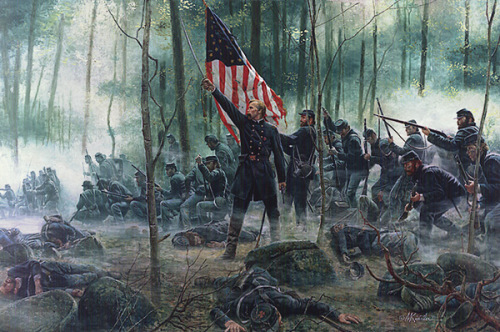
Tag Archives: citizen soldiers

A Reflection on the Importance of Citizen Soldiers

Friends of Padre Steve’s World

I am pre-posting my blogs for the coming week as I will be in Germany for the Oktoberfest as well as to visit Nuremberg and the site of the War Crimes Trials, and the Concentration Camp at Dachau. This is a section of my Gettysburg text that deals with the importance of citizen soldiers.

This will be posted about the time I get to my hotel and after the trip to Dachau. If I get a chance to post something new during the week I will.

Have a great day,

Peace

Padre Steve+

“As soldier and citizen, today’s armed forces officer is a champion of both the nation’s defense and the principles upon which the nation was founded. Taking an oath to support and defend the Constitution means swearing to uphold the core values that define the essence of American citizenship; the armed forces officer is first and foremost a citizen who has embraced the ideals of the nation—only then can he or she defend those principles with true conviction.” [1]

The human dimension of war is the most important, regardless of the technological changes inherent in it. The British military theorist Colin S. Gray wrote: “Notwithstanding the vast and really untraceable complexity of the workings of war, peace, and strategy, by far the most, important among them is the human. This has always been the case. It is true today, and no grand design for the transformation of military power or no radical change predicted in the character of war can alter the eternal merit in this dictum.” [2] In this chapter we look at the tradition of the citizen soldier and military.

Carl Von Clausewitz, a veteran of the Napoleonic wars and product of Classical German Liberal thought noted in his masterpiece of military thought On War, that “Any complex activity, if it is to be carried on with any degree of virtuosity, calls for appropriate gifts calls for appropriate gifts of intellect and temperament. If they are outstanding, and reveal themselves in exceptional achievements, their possessor is called a “genius.” [3]

Within the U.S. Army the example of Joshua Chamberlain at the Battle of Little Round Top has occupied a prominent place in Army leadership manuals including FM 22-100 and its successor FM 6-22.  However, that being said even those that learn about Chamberlain from this seldom delve deeper into his character, development as a leader and significance, at Little Round Top, Appomattox and after the war. Likewise the examples of both Warren and Vincent which are key to Chamberlain and his regiment even being on the hill are ignored in that publication.

It is important to discuss Vincent and Chamberlain for more than their direct contributions to the battle. Those are widely known and in a sense have become part of the myth that is our understanding of Gettysburg. While discussing those actions it is also necessary to put them into context with the character of both men, the cause that they fought. Likewise it is important to address in this age of the professional all volunteer force the importance of Citizen Soldiers in any kind of democracy or representative republic, a sociological question that military professionals as well as our elected officials and citizenry would do well to revisit.

This is particularly important now as various elected leaders, think tanks, defense contractors and lobbyists are all questioning the economic “liabilities” of the All-Volunteer force as well as the disconnect between the broader military and society at large. This means that there will be efforts to determine how the military will be manned, trained and employed, and if military leaders are ignorant of our history, the vital connection between the military and the citizenry and the contributions of Citizen Soldiers then we will be caught flat footed and unprepared in the coming debates. If that happens those decisions could be made by “bean counters” with little appreciation for what military professionalism and readiness entails, as well as think tanks and lobbyists for the defense industry who have their own motivations for what they do, often more related to their profits, power and influence than national security.

The armies that fought the Civil War for the most part were composed of volunteers who of a myriad of reasons went off to fight that war. Gouverneur Warren is a character whose life and career before and after the Civil War was much more like currently serving regular officers and to some extent the much more professional and hardened by war officer corps of the Reserve Components of each of our Armed Services, in particular the much active and deployed Army National Guard and Army Reserve.

The reserve components still do reflect much of the citizen soldier tradition but that being said between deployments, other activations and required schooling, those assets are much more on par with their active counterparts than they ever have been in our history. The reserves now, contrary to General Creighton Abrams desire to use them “to shield the regular army from misuse by feckless policy makers” were depended on for essential support functions, which in Abrams view would “preclude Washington from waging large scale war without first making the politically difficult decision to mobilize,” [4] are an integral part of how the nation conducts war without mobilizing the people, that key element of Clausewitz’s “paradoxical Trinity.” 

“American defense policy has traditionally been built upon pluralistic military institutions, most notably a mix force of professionals and citizen soldiers.” [5] Gouverneur Warren and many like him at Gettysburg, including men like John Buford, Lewis Armistead, Winfield Scott Hancock, George Meade and Robert E. Lee represented what until the beginning of the Cold War was the smaller pillar of our pluralistic military institution; that of the long term professional. Many others at Gettysburg represent what Strong Vincent, Joshua Chamberlain, John Gordon represented the volunteer citizen soldier who enlisted to meet the crisis.

Until World War II and the advent of the Cold War these dual pillars existed side by side. Following the Second World War along with the small-wars that went along as part of it the world changed, and the wars that occurred, such as Korea and Vietnam “occurred on a scale too small to elicit a sustained, full-fledged national commitment, yet too large for a prewar-style regular army to handle.” [6] Because of this “military requirements thus became a fundamental ingredient of foreign policy, and military men and institutions acquired authority and influence far surpassing that ever previously possessed by military professionals on the American scene.” [7] General Anthony Zinni noted that the foreign policy results of this transformation have resulted in the United States becoming “an empire” [8] something that no American living in 1863 could have ever contemplated.

This was part of a revolution in military affairs far more important than the application of technology which brought it about, the Atomic Bomb; it was a revolution in national strategy which fundamentally changed American thinking regarding the use of the military instrument in relationship to diplomacy, and the relationship of the military to society at large. Russell Weigley noted: “To shift the American definition of strategy from the use of combats for the object of wars to the use of military force for the deterrence of war, albeit while still serving the national interests in an active manner, amounted to a revolution in the history of American military policy….” [9]

The policy worked reasonably well until Vietnam and the inequities of the system showed its liabilities and brought about a change from politicians. Lieutenant General Hal Moore wrote of the Vietnam era: “The class of 1965 came out of the old America, a nation that disappeared forever in the smoke that billowed off the jungle battlegrounds where we fought and bled. The country that sent us off to war was not there to welcome us home. It no longer existed.” [10]

The debacle of Vietnam and the societal tidal wave that followed brought about the end of the selective service system, by which the large army needed to fight wars was connected to the society at large and the creation of the All-Volunteer force by President Nixon in 1974. The ethos that every citizen was a soldier was destroyed by Vietnam and even men like General William Westmoreland who warned that “absent “the continuous movement of citizens in and out of the service,…the army could “become a danger to our society-a danger that our forefathers so carefully tried to preclude.” [11]

This cultural shift is something that none of the professional officers of the small ante-bellum army like Warren would have ever imagined much less men like Vincent or Chamberlain who were true citizen-soldiers. Thus for currently serving officers it is important to recognize this key change as it applies to American military strategy as well as the place the military occupies in our society.

This makes it important to our study as we examine the actions of Vincent and Chamberlain outside of myth and legend.  We must see the implications that they can have not only on the battlefield but in our relationship to the American citizenry and society. It is to put in in classic terms a return to understanding the relationship between the military and the people so powerfully enunciated in Clausewitz’s concept of war being a “paradoxical Trinity” of “primordial violence, hatred and enmity,… the element of chance and probability within which the creative spirit is free to roam; and of its element of subordination, as an instrument of policy….” [12] In Clausewitz’s understanding these are the people, the commander and his army and the government.

While Warren represents the professional officer; Strong Vincent, Joshua Chamberlain and thousands more like them, just men who served in the Civil War represented an important part of our military tradition that no longer exists in such a form. An exception to this might be in example of young men and women that volunteer to serve in the reserve components and leave after they complete their service obligation. Honestly, we no longer have a system that allows, nor do we actively encourage men like Vincent and Chamberlain to leave lucrative civilian employment or academia to serve alongside the professionals in positions of responsibility leading regiments or brigades or serving as senior staff officers unless they are already part of the military in our reserve components.

The examples of Vincent, Chamberlain and so many other citizen soldiers demonstrate the profound of this important legacy, which was for so long one of the twin pillars of our national defense. While this is still to some extent carried on by the reserve components of the United States military service, we no longer provide the opportunity for outsiders such as Vincent and Chamberlain to serve in that manner. While it is true that a great number of citizen soldiers did not perform to the level of Vincent or Chamberlain during the war, the same can be said of some of many of the Regular officers who served alongside of them and often failed miserably, examples of who can be found throughout the Battle of Gettysburg.

That being said, in the coming years military professionals will have to engage lawmakers and the bureaucracy of the Pentagon as the shape of the future military, especially the land components is debated and decided upon by politicians. Thus, it is of the utmost importance of revisiting the tradition of the citizen soldier and how it can be renewed in the coming years. In fact General Stanley McChrystal said in 2012 “I think we ought to have a draft” because a “professional military necessarily becomes “unrepresentative of the population” and “cannot properly represent the country as a whole.” [13] That will be a question for policy makers to debate and for military professionals to consider.

While warfare may have grown more complex, at its heart it remains a primordial art, where true leaders learn the trade and excel in battle or in staff work. The American naval warfare theorist Alfred Thayer Mahan, son of Dennis Hart Mahan who was so instrumental in the education of so many of the professional officers who served at Gettysburg wrote something that while directed toward naval leaders is applicable to our discussion here: “Historically, good men with poor ships are better than poor men with good ships; over and over the French Revolution taught this lesson, which in our own age, with its rage for the last new thing in material improvement, has largely dropped out of our memory.” [14]

The question that military professionals, politicians and those who determine policy must ask regarding the future military is whether we will re-enliven this tradition outside of the established reserve components and provide opportunity for men like Vincent, Chamberlain and so many others who throughout our history have demonstrated the aptitude necessary to become models of leadership and military competence without having grown up in the military system. It is a question that is certainly worth debating as we go forward in an era of military cuts and potential changes in how we man, pay and train our forces for the challenges that will most certainly arise.

Chamberlain’s words about the men that he served alongside like his commanding officer, Strong Vincent are a fitting way to close.

“It is something great and greatening to cherish an ideal; to act in the light of truth that is far-away and far above; to set aside the near advantage, the momentary pleasure; the snatching of seeming good to self; and to act for remoter ends, for higher good, and for interests other than our own.” [15]

Notes

[1] _______. The Armed forces Officer U.S. Department of Defense Publication, Washington DC. January 2006 p.2

[2] Gray, Colin S. Fighting Talk: Forty Maxims on War, Peace, and Strategy Potomac Book, Dulles VA 2009 p.93

[3] Clausewitz, Carl von. On War Indexed edition, edited and translated by Michael Howard and Peter Paret, Princeton University Press, Princeton NJ 1976 p.100

[4] Bacevich, Andrew J. Breach of Trust: How Americans Failed their Soldiers and Their Country Metropolitan Books, Henry Holt and Company, New York 2013 Amazon Kindle Edition p.105

[5] Millet, Allan R. and Maslowski, Peter, For the Common Defense: A Military History of the United States The Free Press a Division of Macmillan Inc. New York, 1984 p.xii

[6] Ibid. Bacevich, Breach of Trust: How Americans Failed their Soldiers and Their p.50

[7] Huntington, Samuel P. The Soldier and the State: The Theory and Politics of Civil-Military Relations, The Belknap Press of Harvard University Press, Cambridge MA and London 1957 p.345

[8] Zinni, Tony. The Battle for Peace: A Frontline Vision of America’s Power and Purpose Palgrave McMillian, New York 2006 p.4

[9] Weigley, Russell F. The American Way of War: A History of United States Military History and Policy University of Indiana Press, Bloomington IN, 1973 pp.367-368

[10] Moore, Harold G. and Galloway Joseph L We Were Soldiers Once…And Young Harper Perennial Books New York 1992 pp. xix-xx

[11] Ibid. Bacevich Breach of Trust p.58

[12] Ibid. Clausewitz On War p.89

[13] Ibid. Bacevich Breach of Trust p.121

[14] Mahan, Alfred T. The Influence of Sea Power upon the French Revolution and Empire 1793-1812 Little Brown and Company, Boston 1892 p.102

[15] Chamberlain, Joshua Lawrence. Chamberlain’s Address at the dedication of the Maine Monuments at Gettysburg, October 3rd 1888 retrieved from http://www.joshualawrencechamberlain.com/maineatgettysburg.php 4 June 2014
Leave a comment

Filed under Loose thoughts and musings

The Importance of Citizen Soldiers: Strong Vincent and Joshua Chamberlain at Little Round Top and American Military Sociology

dont give an inch

“As soldier and citizen, today’s armed forces officer is a champion of both the nation’s defense and the principles upon which the nation was founded. Taking an oath to support and defend the Constitution means swearing to uphold the core values that define the essence of American citizenship; the armed forces officer is first and foremost a citizen who has embraced the ideals of the nation—only then can he or she defend those principles with true conviction.” [1]

While the professional Gouverneur Warren through himself into the battle to save Little Round Top, as did many others the story of the battle dictates that we must discuss the actions of two “citizen soldiers” without whom the battle may have been lost, Colonel Strong Vincent and Colonel Joshua Chamberlain. Both are depicted and immortalized in the film Gettysburg which is based on Michael Shaara’s Pulitzer Prize winning novel The Killer Angels. As such their actions are known more than many others that are covered in this account of the Battle of Gettysburg.

Within the U.S. Army the example of Chamberlain at the Battle of Little Round Top has occupied a prominent place in Army leadership manuals including FM 22-100 and its successor FM 6-22, however, that being said even those that learn about Chamberlain from this seldom delve deeper into his character, development as a leader and significance, at Little Round Top, Appomattox and after the war, likewise the examples of both Warren and Vincent which are key to Chamberlain and his regiment even being on the hill are ignored in that publication.

It is important to discuss Vincent and Chamberlain for more than their direct contributions to the battle. Those are widely known and in a sense have become part of the myth that is our understanding of Gettysburg. While discussing those actions it is also necessary to put them into context with the character of both men, the cause that they fought. Likewise it is important to address in this age of the professional all volunteer force the importance of Citizen Soldiers in any kind of democracy or representative republic, a sociological question that military professionals as well as our elected officials and citizenry would do well to revisit.

This is particularly important now as various elected leaders, think tanks, defense contractors and lobbyists are all questioning the economic “liabilities” of the All-Volunteer force as well as the disconnect between the broader military and society at large. This means that there will be efforts to determine how the military will be manned, trained and employed, and if military leaders are ignorant of our history, the vital connection between the military and the citizenry and the contributions of Citizen Soldiers then we will be caught flat footed and unprepared in the coming debates. If that happens those decisions could be made by “bean counters” with little appreciation for what military professionalism and readiness entails, as well as think tanks and lobbyists for the defense industry who have their own motivations for what they do, often more related to their profits, power and influence than national security.

The armies that fought the Civil War for the most part were composed of volunteers who of a myriad of reasons went off to fight that war. Gouverneur Warren is a character whose life and career before and after the Civil War was much more like currently serving regular officers and to some extent the much more professional and hardened by war officer corps of the Reserve Components of each of our Armed Services, in particular the much active and deployed Army National Guard and Army Reserve. The reserve components still do reflect much of the Citizen Soldier tradition but that being said between deployments, other activations and required schooling, those assets are much more on par with their active counterparts than they ever have been in our history.

“American defense policy has traditionally been built upon pluralistic military institutions, most notably a mix force of professionals and citizen soldiers.” [2] Warren represented what until the beginning of the Cold War was the smaller pillar of that pluralistic institution that of the long term professional while Vincent and Chamberlain represented the volunteer citizen soldier who enlisted to meet the crisis.

Until World War II and the advent of the Cold War these dual pillars existed side by side. Following the Second World War along with the small-wars that went along as part of it the world changed, and the wars that occurred, such as Korea and Vietnam “occurred on a scale too small to elicit a sustained, full-fledged national commitment, yet too large for a prewar-style regular army to handle.” [3] Because of this “military requirements thus became a fundamental ingredient of foreign policy, and military men and institutions acquired authority and influence far surpassing that ever previously possessed by military professionals on the American scene.” [4] General Tony Zinni noted that the foreign policy results of this transformation have resulted in the United States becoming “an empire” [5] something that no American living in 1863 could have ever contemplated.

This was part of a revolution in military affairs far more important than the application of technology which brought it about, the Atomic Bomb; it was a revolution in national strategy which fundamentally changed American thinking regarding the use of the military instrument in relationship to diplomacy, and the relationship of the military to society at large. Russell Weigley noted: “To shift the American definition of strategy from the use of combats for the object of wars to the use of military force for the deterrence of war, albeit while still serving the national interests in an active manner, amounted to a revolution in the history of American military policy….” [6]

The policy worked reasonably well until Vietnam and the inequities of the system showed its liabilities and brought about a change from politicians. Lieutenant General Hal Moore wrote of the Vietnam era: “The class of 1965 came out of the old America, a nation that disappeared forever in the smoke that billowed off the jungle battlegrounds where we fought and bled. The country that sent us off to war was not there to welcome us home. It no longer existed.” [7]

The debacle of Vietnam and the societal tidal wave that followed brought about the end of the selective service system, by which the large army needed to fight wars was connected to the society at large and the creation of the All-Volunteer force by President Nixon in 1974. The ethos that every citizen was a soldier was destroyed by Vietnam and even men like General William Westmoreland who warned that “absent “the continuous movement of citizens in and out of the service,…the army could “become a danger to our society-a danger that our forefathers so carefully tried to preclude.” [8]

This cultural shift is something that none of the professional officers of the small ante-bellum army like Warren would have ever imagined much less men like Vincent or Chamberlain who were true citizen-soldiers. Thus for currently serving officers it is important to recognize this key change as it applies to American military strategy as well as the place the military occupies in our society. This makes it important to our study as we examine the actions of Vincent and Chamberlain outside of myth and legend and see the implications that they can have not only on the battlefield but in our relationship to the American citizenry and society. It is to put in in classic terms a return to understanding the relationship between the military and the people so powerfully enunciate in Clausewitz’s Trinity.

While Warren represents the Strong Vincent and Joshua Chamberlain represented that important part of our military tradition that really, except in the case of young men and women that volunteer to serve and leave the military after their obligated service really no longer exists. We no longer have a system that allows, nor do we actively encourage men like Vincent and Chamberlain to leave lucrative civilian employment or academia to serve alongside the professionals in positions of responsibility leading regiments or brigades or serving as senior staff officers unless they are already part of the military in our reserve components.

vincent

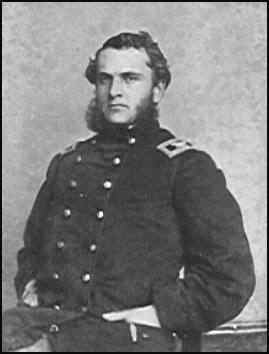
Colonel Strong Vincent was a 26 year old Harvard graduate and lawyer from Erie Pennsylvania. Vincent enlisted and then was appointed as a 1st Lieutenant and Adjutant of the Erie Regiment because of his academic and administrative acumen. He married his wife Elizabeth the same day. Vincent like many young northerners believed in the cause of the Union undivided, and he wrote his wife shortly after after the regiment went to war on the Peninsula:

“Surely the right will prevail. If I live we will rejoice in our country’s success. If I fall, remember you have given your husband to the most righteous cause that ever widowed a woman.”[9]

Vincent was commissioned as a Lieutenant Colonel in the 83rd Pennsylvania September 14th 1861. The young officer learned his trade well and was considered a “strict disciplinarian and master of drill.” [10] That being said one enlisted man remarked that “no officer in the army was more thoughtful and considerate of  the health and comfort of his men.” He assumed command of the regiment when the commander was killed during the Seven Days in June of 1862 where he learned lessons that he would help impart to his fellow officers as well as subordinates, including Chamberlain. Following a bout with a combination of Malaria and Typhoid that almost killed him, he took command of the regiment. He commanded the regiment at Fredericksburg and was promoted to command the 3rd Brigade when its commander was killed at Chancellorsville in May 1863. Vincent was offered the chance to serve as the Judge Advocate General of the Army of the Potomac in the spring of 1863 after spending three months on court-martial duty. But refused the offer in order to remain in the fight commanding troops. [11]

Unlike most other brigade commanders, Vincent was still a Colonel, and he, like many others would in his place hoped that going into action to save Sickles’ command “will either bring me my stars, or finish my career as a soldier.” [12] On July first, Vincent, a native Pennsylvanian came to Hanover and learning that battle had been joined, ordered “the pipes and drums of the 83rd Pennsylvania to play his brigade through the town and ordered the regiments to uncover their flags again….” [13] As the brigade marched through the town Vincent “reverently bared his head” and announced to his adjutant, “What death more glorious can any man desire than to die on the soil of old Pennsylvania fighting for that flag?” [14]

Vincent was known for his personal courage and a soldier of the 83rd Pennsylvania observed “Vincent had a particular penchant for being in the lead….Whenever or wherever his brigade might be in a position to get ahead…, he was sure to be ahead.” [15] That courage and acumen to be in the right place at the right time was in evidence when he led his brigade into battle on July second.

On July 2nd Barnes’ division of V Corps, which Vincent’s brigade was a part was being deployed to the threat posed by the Confederate attack of McLaws’ division on the Peach Orchard and the Wheat Field to reinforce Sickles’ III Corps. While that division marched toward the Peach Orchard, Vincent’s 3rd Brigade was the trail unit. When Gouverneur Warren’s aide, Lieutenant Randall Mackenzie [16] came toward the unit in search of Barnes he came across Vincent and his brigade near the George Weikert house on Cemetery Ridge awaiting further orders. [17] Vincent intercepted him and demanded what his orders were. Upon being told that Sykes’ orders to Barnes were to “send one of his brigades to occupy that hill yonder,” [18] Vincent, defied normal protocol assuming that Barnes was drunk [19] told Mackenzie “I will take responsibility of taking my brigade there.” [20]

It was a fortunate thing for the Union that he did. His quick action to get his brigade, clear orders to his subordinate commanders and skilled analysis of the ground were a decisive factor in the Union forces holding Little Round Top. He ordered Colonel James C. Rice of the 44th New York to lead the brigade up to the hill while he and his aide went forward to scout positions as the brigade moved forward at the double quick “across the field to the road leading up the north shoulder of the hill” with Chamberlain’s 20th Maine in the lead. [21] Looking at the ground which had the valley and Devil’s Den, occupied by the end of Sickles’ line, he chose a position along a spur of the hill running from the northwest to the southeast to place his regiments where they could intercept the Confederate troops of Hood’s division which he could see advancing toward the hill.

The 16th Michigan, his smallest regiment was placed on the right of the brigade. That section of the line was located on massive boulders that placed it high above the valley below, making it nearly impregnable to frontal attack. He deployed the 83rd Pennsylvania and 44th New York, known as Butterfield’s Twins to their left at the request of Rice who told him “In every battle that we have engaged the Eighty-third and Forty-fourth have fought side by side. I wish that it might be so today.” [22] Those units were deployed below the crest among the large number of boulders; the 83rd was about two-thirds of the way down the way down the slope where it joined the right of the 44th, whose line angled back up the slope to the southeast.

Vincent deployed the 20th Maine on his extreme left of his line, and in fact the extreme end of the Union line. Vincent knew that if this flank was turned and Chamberlain overrun that it would imperil the entire Union position. Vincent came up to Chamberlain who remembered that Vincent said “in an awed, faraway voice. “I place you here….This is the left of the Union line. You understand. You are to hold this ground at all costs.” [23]

chamberlain

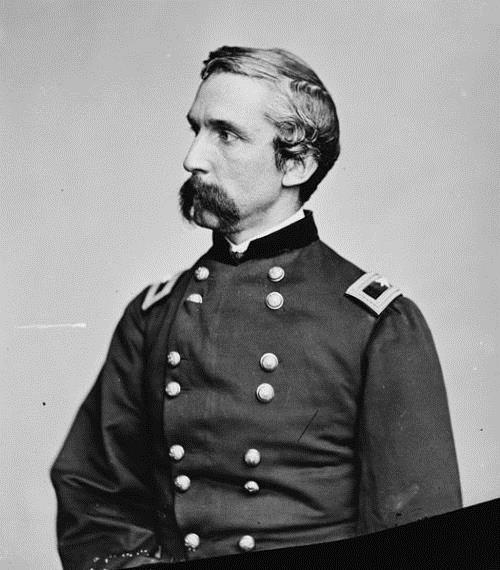
Colonel Joshua Chamberlain was another one of the citizen soldiers whose performance and leadership on Little Round Top saved the Union line that hot July evening. A graduate of Bowdoin College and Bangor Theological Seminary, Chamberlain was fluent in nine languages other than English. He was Professor of Rhetoric at Bowdoin before seeking an appointment in a Maine Regiment without consulting either the college or his family. He was offered command of the 20th Maine but asked to be appointed as a Lieutenant Colonel which he was in August 1862. He fought at Fredericksburg and was named commander of the regiment when Colonel Adelbert Ames, his commander was promoted following Chancellorsville.

Like Vincent, Chamberlain was also a quick student and rapidly adapted to being a soldier, officer and commander of troops in combat. On receiving his orders Chamberlain deployed his small regiment halfway down the southern slope facing the small valley between Little and Big Round Top. As a result of his experience in battle and the tenacity of the Confederate army he became an advocate of the tactics that William Tecumseh Sherman would later employ during his march to the sea in 1864. He wrote his wife before Chancellorsville:

“We must fight them more vindictively, or we shall be foiled at every step.  We must desolate the country as we pass through it, and not leave a trace of a doubtful friend or foe behind us; make them believe that we are in earnest, terribly in earnest; that to break this band in twain is monstrous and impossible; that the life of every man, yea, of every weak woman or child in the entire South, is of no value whatever compared with the integrity of the Union.”

Since Chamberlain’s account is so important I will forgo a discussion of his tactics and instead quote the sections of his after action report that explains his actions. Chamberlain wrote:

“On reaching the field at about 4 p.m. July 2d, Col. Vincent commanding the Brigade, placing me on the left of the Brigade and consequently on the extreme left of our entire line of battle, instructed me that the enemy were expected shortly to make a desperate attempt to turn our left flank, and that the position assigned to me must be held at every hazard.

I established my line on the crest of a small spur of a rocky and wooded hill, and sent out at once a company of skirmishers on my left to guard against surprise on that unprotected flank.

These dispositions were scarcely made when the attack commenced, and the right of the Regt. found itself at once hotly engaged. Almost at the same moment, from a high rock which gave me a full view of the enemy, I perceived a heavy force in rear of their principal line, moving rapidly but stealthily toward our left, with the intention, as I judged, of gaining our rear unperceived. Without betraying our peril to any but one or two officers, I had the right wing move by the left flank, taking intervals of a pace or two, according to the shelter afforded by rocks or trees, extending so as to cover the whole front then engaged; and at the same time moved the left wing to the left and rear, making a large angle at the color, which was now brought to the front where our left had first rested.

This hazardous maneuvre was so admirably executed by my men that our fire was not materially slackened in front, and the enemy gained no advantage there, while the left wing in the meantime had formed a solid and steady line in a direction to meet the expected assault. We were not a moment too soon; for the enemy having gained their desired point of attack came to a front, and rushed forward with an impetuosity which showed their sanguine expectations.

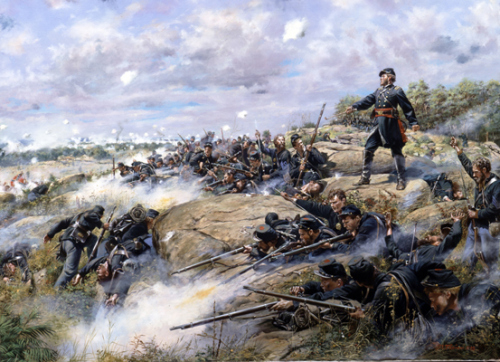
Their astonishment however was evident, when emerging from their cover, they met instead of an unsuspecting flank, a firm and ready front. A strong fire opened at once from both sides, and with great effect, the enemy still advancing until they came within ten paces of our line, where our steady and telling volleys brought them to a stand. From that moment began a struggle fierce and bloody beyond any that I have witnessed, and which lasted in all its fury, a full hour. The two lines met, and broke and mingled in the shock. At times I saw around me more of the enemy than of my own men. The edge of conflict swayed to and fro -now one and now the other party holding the contested ground. Three times our line was forced back, but only to rally and repulse the enemy. As often as the enemy’s line was broken and routed, a new line was unmasked, which advanced with fresh vigor. Our “sixty rounds” were rapidly reduced; I sent several messengers to the rear for ammunition, and also for reinforcements. In the mean time we seized the opportunity of a momentary lull to gather ammunition and more serviceable arms, from the dead and dying on the field. With these we met the enemy’s last and fiercest assault. Their own rifles and their own bullets were turned against them. In the midst of this struggle, our ammunition utterly failed. The enemy were close upon us with a fresh line, pouring on us a terrible fire. Half the left wing already lay on the field. Although I had brought two companies from the right to its support, it was now scarcely more than a skirmish line. The heroic energy of my officers could avail no more. Our gallant line withered and shrunk before the fire it could not repel. It was too evident that we could maintain the defensive no longer. As a last desperate resort, I ordered a charge. The word “fix bayonets” flew from man to man. The click of the steel seemed to give new zeal to all. The men dashed forward with a shout. The two wings came into one line again, and extending to the left, and at the same time wheeling to the right, the whole Regiment described nearly a half circle, the left passing over the space of half a mile, while the right kept within the support of the 83d Penna. thus leaving no chance of escape to the enemy except to climb the steep side of the mountain or to pass by the whole front of the 83d Penna. The enemy’s first line scarcely tried to run-they stood amazed, threw down their loaded arms and surrendered in whole companies. Those in their rear had more time and gave us more trouble. My skirmishing company threw itself upon the enemy’s flank behind a stone wall, and their effective fire added to the enemy’s confusion. In this charge we captured three hundred and sixty eight prisoners, many of them officers, and took three hundred stand of arms. The prisoners were from four different regiments, and admitted that they had attacked with a Brigade.” [24]

Colonel William Oates of the 15th Alabama would give Chamberlain and his regiment the credit for stopping his attack. Oates wrote: “There have never been harder fighters than the Twentieth Maine and their gallant Colonel. His skill and persistency and the great bravery of his men saved Little Round Top and the Army of the Potomac from defeat.” [25]

chamberlain lrt

As with any firsthand account, aspects of Chamberlain’s accounts are contested by others at the scene. Oates notes that he ordered the retreat and that there were not as many prisoners taken, one of Chamberlain’s company commanders disputes the account of the order of the bayonet charge however the fact is that Chamberlain who was outnumbered nearly two to one by the 15th and 47th Alabama regiments “offset this superiority with strength of position, iron determination and better tactics.” [26] Also a factor was the fatigue of the Confederates, these regiments and their parent unit, Law’s brigade of Hood’s division had conducted a grueling 28 mile march to get to the battlefield and were exhausted by the time that they arrived.

Vincent was mortally wounded while leading the defense of the hill. While he was standing on a large boulder with a riding crop ordering the men of the 16th Michigan who were beginning to waiver he cried out “Don’t yield an inch now men or all is lost,[27]he was struck by a bullet which hit him in the groin. As he was being carried from the field to the hospital where he died on July 7th, “This is the fourth or fifth time they have shot at me…and they have hit me at last.” [28]

As Vincent lay dying he was visited by many comrades, visited by Sykes and Barnes he told them “I presume… I have dune my last fighting.” Meade recommended Vincent for posthumous promotion to Brigadier General, but the request was lost.

Two months after his death his wife gave birth to a baby girl. The baby would not live a year and was buried next to him. One wonders what heights of leadership the young colonel might have achieved had he not died at Gettysburg. He was a man who understood the nature of total war, an excellent leader and skilled tactician.

Chamberlain survived the war to great acclaim being wounded three times and receiving the surrender of the Army of Northern Virginia at Appomattox on April 9th 1865.

The examples of these two citizen soldiers demonstrate the importance of this legacy, which is still to some extent carried on by the reserve components of the United States military service. That being said, in the coming years military professionals will have to engage lawmakers and the bureaucracy of the Pentagon as the shape of the future military, especially the land components is debated and decided upon by politicians. Thus, it is of the utmost importance of revisiting the tradition of the citizen soldier and how it can be renewed in the coming years.

Chamberlain’s words about the men that he served alongside like his commanding officer, Strong Vincent are a fitting way to close.

“It is something great and greatening to cherish an ideal; to act in the light of truth that is far-away and far above; to set aside the near advantage, the momentary pleasure; the snatching of seeming good to self; and to act for remoter ends, for higher good, and for interests other than our own.” [29]

Notes

[1] _______. The Armed forces Officer U.S. Department of Defense Publication, Washington DC. January 2006 p.2

[2] Millet, Allan R. and Maslowski, Peter, For the Common Defense: A Military History of the United States The Free Press a Division of Macmillan Inc. New York, 1984 p.xii

[3] Bacevich, Andrew J. Breach of Trust: How Americans Failed their Soldiers and Their Country Metropolitan Books, Henry Holt and Company, New York 2013 Kindle Edition Amazon Edition p.50

[4] Huntington, Samuel P. The Soldier and the State: The Theory and Politics of Civil-Military Relations, The Belknap Press of Harvard University Press, Cambridge MA and London 1957 p.345

[5] Zinni, Tony. The Battle for Peace: A Frontline Vision of America’s Power and Purpose Palgrave McMillian, New York 2006 p.4

[6] Weigley, Russell F. The American Way of War: A History of United States Military History and Policy University of Indiana Press, Bloomington IN, 1973 pp.367-368

[7] Moore, Harold G. and Galloway Joseph L We Were Soldiers Once…And Young Harper Perennial Books, 1992 pp. xix-xx

[8] Ibid. Bacevich Breach of Trust p.58

[9] ________. Erie County Historical Society http://www.eriecountyhistory.org/wp-content/uploads/2008/10/strongvincent.pdfretrieved 9 June 2014

[10] Golay, Michael. To Gettysburg and Beyond: The Parallel Lives of Joshua Lawrence Chamberlain and Edward Porter Alexander Crown Publishers Inc. New York 1994 p.129

[11] Leonardi, Ron Strong Vincent at Gettysburg Barringer-Erie Times News retrieved June 9th 2014 from http://history.goerie.com/2013/06/30/strong-vincent-at-gettysburg/

[12] Guelzo, Allen C. Gettysburg: The Last Invasion Vintage Books a Division of Random House, New York 2013 p.264

[13] Pfanz, Harry F. Gettysburg: The Second Day. University of North Carolina Press, Chapel Hill 1987 p.51

[14] Ibid. Guelzo Gettysburg: The Last Invasion Vintage p.159

[15] Tredeau, Noah Andre. Gettysburg: A Testing of Courage, Harper Collins Publishers, New York 2002 p.305

[16] Some such as Guelzo believe this may have been Captain William Jay of Sykes staff.

[17] Ibid. Tredeau, Gettysburg: A Testing of Courage p.327

[18] Ibid. Guelzo Gettysburg: The Last Invasion Vintage p.262

[19] Ibid. Guelzo Gettysburg: The Last Invasion Vintage p.262

[20] Ibid. Tredeau, Gettysburg: A Testing of Courage p.327

[21] Coddington, Edwin B. The Gettysburg Campaign: A Study in Command, A Touchstone Book, Simon and Schuster New York, 1968 p.389

[22] Ibid. Pfanz, Gettysburg: The Second Day. p.213

[23] Ibid. Golay To Gettysburg and Beyond p.157

[24] Chamberlain, Joshua Lawrence. Official Narrative of Joshua Chamberlain of July 6th 1863, Maine Military Historical Society, Inc., Augusta, Maine, copyright 1989 U.S. Army Combat Studies Institute Reprint, retrieved from http://usacac.army.mil/cac2/cgsc/carl/download/csipubs/chamberlain.pdf June 15th 2014

[25] Oates, Willam C. and Haskell, Frank A. Gettysburg Bantam Books edition, New York 1992, originally published in 1905 p.98

[26] Ibid.Coddington The Gettysburg Campaign: A Study in Command p.393

[27] Ibid. Guelzo Gettysburg: The Last Invasion Vintage p.272

[28] Ibid. Tredeau, Gettysburg: A Testing of Courage p.361

[29] Chamberlain, Joshua Lawrence. Chamberlain’s Address at the dedication of the Maine Monuments at Gettysburg, October 3rd 1888 retrieved from http://www.joshualawrencechamberlain.com/maineatgettysburg.php 4 June 2014
Leave a comment

Filed under civil war, History, leadership, Military, national security

Counting the Cost: Reflections on Armed Forces Day 2014

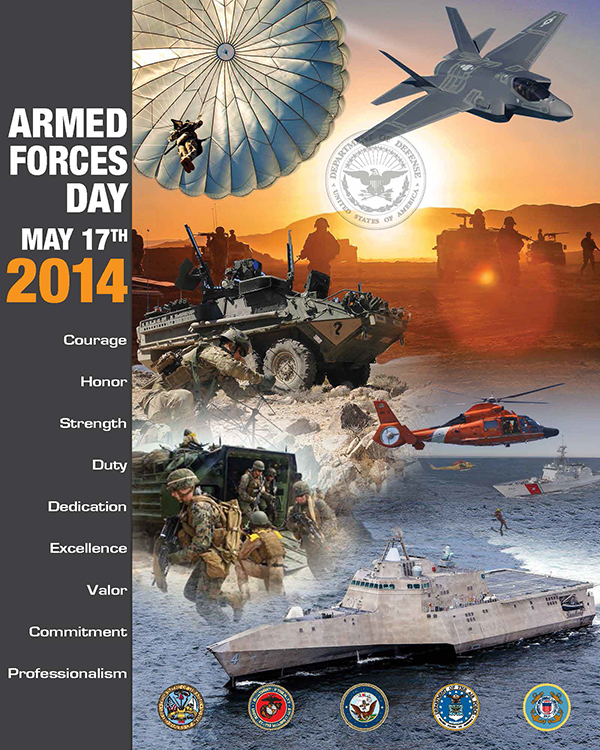
Event-Armed-Forces-Day-poster-2014

“What is the cost of war? what is the bill?…“This bill renders a horrible accounting. Newly placed gravestones. Mangled bodies. Shattered minds. Broken hearts and homes. Economic instability. Depression and all of its attendant miseries. Back -breaking taxation for generations and generations. For a great many years as a soldier I had a suspicion that war was a racket; not only until I retired to civilian life did I fully realize it….” Major General Smedley Butler USMC

Today is Armed Forces Day and unfortunately most of the country will not notice unless they are attending a Baseball game where it is being observed or some special event on a base, national cemetery, monument or VFW hall.

There are also a fair number of local celebrations to honor members of the Armed Forces across the country but for the most part they are small and not well publicized. As a career officer and son of a Vietnam veteran Navy Chief I appreciate those events and the people that put them together. Being a veteran of Operation Iraqi Freedom and Operation Enduring Freedom, especially those that have taken the time to honor Iraq and Afghanistan veterans.

At any given time less than 1% of Americans are serving in all components of the military. For over 10 years we have been at war in Afghanistan and Iraq as well as other locations that we don’t like to talk about too much. However this has not been the effort of a nation at war, it is the war of a tiny percentage of the population.

As a nation we are disconnected from the military and the wars that the military fights. The fact is that most Americans do not have a personal or vested interest in these wars, they have been insulated by political leaders of both parties from them. There is no draft, and no taxes were raised to fund the wars and the military is now worn out.

We have been at war for nearly 14 years and truthfully there is no end in sight. In that time every single Soldier, Sailor, Marine and Airman volunteered for duty or reenlisted during this time period. Motives may have varied from individual to individual, but unlike the World Wars, Korea and Vietnam every single one volunteered to serve in time of war. I think that this makes the current generation of veterans quite unique, we are no longer a military composed of citizen soldiers we are now, even our reserve components a Warrior caste, set apart from the society that we serve.

There is a tragic disconnection between the military and civilian society in the United States. This is the result of deliberate public policy since the end of the Vietnam War supported by both political parties. For almost 40 years we have relied on an all volunteer force. It is that relatively small and socially isolated military which is sent to fight wars while the bulk of the population is uninvolved and corporations, lobbyists and think tanks get rich.

Andrew Bacevich wrote in his new book Breach of Trust: How Americans failed their Soldiers and their Country:

“Rather than offering an antidote to problems, the military system centered on the all-volunteer force bred and exacerbated them. It underwrote recklessness in the formulation of policy and thereby resulted in needless, costly, and ill-managed wars. At home, the perpetuation of this system violated simple standards of fairness and undermined authentic democratic practice. The way a nation wages war—the role allotted to the people in defending the country and the purposes for which it fights—testifies to the actual character of its political system. Designed to serve as an instrument of global interventionism (or imperial policing), America’s professional army has proven to be astonishingly durable, if also astonishingly expensive. Yet when dispatched to Iraq and Afghanistan, it has proven incapable of winning. With victory beyond reach, the ostensible imperatives of U.S. security have consigned the nation’s warrior elite to something akin to perpetual war.”

Bacevich, a retired Army Colonel and Vietnam veteran who lost a son in Iraq is dead on, as is Rachel Maddow who wrote in her outstanding book Drift: The Unmooring of American Military Power:

“The reason the founders chafed at the idea of an American standing army and vested the power of war making in the cumbersome legislature was not to disadvantage us against future enemies, but to disincline us toward war as a general matter… With citizen-soldiers, with the certainty of a vigorous political debate over the use of a military subject to politicians’ control, the idea was for us to feel it- uncomfortably- every second we were at war. But after a generation or two of shedding the deliberate political encumbrances to war that they left us… war making has become almost an autonomous function of the American state. It never stops.” 

The lobbyists, pundits, politicians and preachers that promote war don’t care about the troops. This is because no matter who is in office or who controls congress these people and corporations will promote policies that keep them employed and their businesses enriched. Marine Major General and Medal of Honor winner Smedley Butler was quite right when he said:

“War is a racket. It always has been. It is possibly the oldest, easily the most, surely the most vicious. It is the only one international in scope. It is the only one in which the profits are reckoned in dollars and the losses in lives. A racket is best described, I believe, as something that is not what it seems to the majority of the people. Only a small ‘inside’ group knows what it is about. It is conducted for the benefit of the very few, at the expense of the very many. Out of war a few people make huge fortunes.”

I think that the reason that our current wars have gone on so long is the that misguided policies have brought about a chronic disconnection in our society between those that serve in the military. But how can there not be when in the weeks after 9-11 people like President Bush and others either directly or in a manner of speaking told people to “go shopping” * as we went to war in Afghanistan? When I returned from Iraq I returned to a nation that was not at war whose leaders used the war to buttress their respective political bases.

The results are terrible. Suicide rates are continuing to rise among veterans who have returned to find that neither the VA nor the civilian mental health care sector is prepared to care for them.

I think that Armed Forces Day should be better celebrated and I am grateful to the people that do things every day to thank and support military personnel. These wonderful people that do this come from across the political spectrum. Some are veterans and others non-veterans. But they care for and appreciate the men and women that serve in and fight the wars that no-one else can be bothered to fight.

481801_10151367001287059_1003164983_n-2

Of course the politicians, pundits, preachers and the defense contractors, banks and lobbyists will find a way to profit. They will do so no matter how many more troops are killed, wounded or injured and how badly it affects military personnel or their families and will push to abandon those who fought as they do after every war. After all, to quote Smedley Butler, “war is a racket.”

Peace

Padre Steve+

President Bush’s actually words were “Now, the American people have got to go about their business. We cannot let the terrorists achieve the objective of frightening our nation to the point where we don’t — where we don’t conduct business, where people don’t shop…” http://georgewbush-whitehouse.archives.gov/news/releases/2001/10/20011011-7.html

2 Comments

Filed under History, iraq,afghanistan, leadership, Military, national security, Political Commentary