Tag Archives: civil war artillery

U.S. Army Artillery Doctrine and Tactics from the Mexican War to the Wilderness

Friends of Padre Steve’s World,

It has been a very long day. My legs hurt, I broke the big toe on my right foot Thursday afternoon, and between real work and work at home I put on about 7.5 miles on my legs. Thankfully I used Mr. Cane, who came into my life when I broke my tib-fib near the knee back in 2011 was there to help me out. I showed up at command PT dressed out in my PT uniform with Mr. Cane, but it was not the “Cane Mutiny.” Yes, that is a very bad pun, but when your are as tired as I am and in as much pain you really don’t care, but I digress… 

I still am working on my article about the President’s terrible week which seems to get more fascinating by the hour. Maybe after a long day working in the house tomorrow, ripping out nasty old carpet. laying some flooring in closets, and doing a bunch of other stuff I might try to finish it tomorrow, which is actually today because I am still awake and it is after midnight. 

So what the hell, tonight I am reposting a section of my unpublished Civil War book A Great War in a Revolutionary Age of Change. This section continues one that I posted two or three weeks ago dealing with U.S. Army artillery. This particular section deals with the period between 1846 and the summer of 1864. It is as non-partisan as you can get, but I hate to admit that the thought of  M-1857 12 Pound smoothbore “Napoleons” firing at massed Confederate infantry in the open  as they did during Pickett’s Charge does warm my heart. Oh my God it almost gives me a woody, but that isn’t exactly very Christian of me, but as I readily admit I am no saint and pretty much a Mendoza Line Christian. At least I can admit it. 

So have a great day and please get some sleep. 

Peace,

Padre Steve+

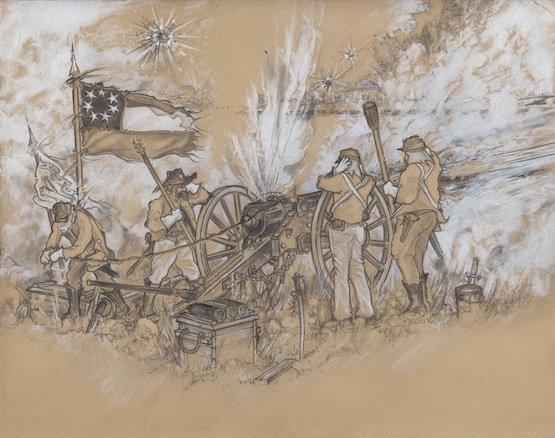
fig20

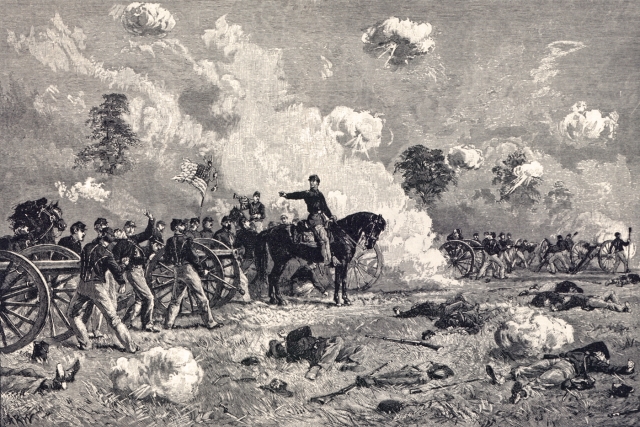
American artillery doctrine subordinated the artillery to the infantry. Doctrine dictated that on the offensive “was for about one-third of the guns to occupy the enemy’s artillery and two-thirds to fire on the infantry and cavalry. Jomini liked the concentrated offensive cannonade where a breach of the line was to be attempted.” [1] But being such a small service, it was difficult for Americans to actually implement Napoleonic practices, or organization as the organization itself “was rooted in pre-Napoleonic practice, operating as uncoordinated batteries.” [2]

American artillerymen of the Mexican War could not match the massive firepower and concentration of Napoleon’s army. Instead it utilized mobile tactics, which gave it “the opportunity to maneuver in open country to support the infantry.” [3] During the war the actions of the highly mobile light batteries proved decisive, as did the spirit of their officers and soldiers. The Americans may not have had the organization of Napoleon, but “the audacious spirit was there.” [4] In a number of engagements American batteries employed the artillery rush, even gaining the admiration of Mahan, a noted exponent of the defensive. Among the leaders of the artillery at the Battle of Buena Vista were Captain Braxton Bragg, and Lieutenants John Reynolds and George Thomas, all of who would go on to fame in the Civil War. During a moment when Mexican forces threatened to overwhelm the American line, Bragg’s battery arrived:

“Without support, Bragg whirled his guns into battery only a few rods from the enemy…. The Mississippi Rifles and Lane’s Hoosiers also double-quicked from the rear of the plateau. From then on it was a storybook finish for the Americans, and artillery made the difference. Seventeen guns swept the Mexicans with grape and canister…. Reynolds, Thomas, and the others stood to the work with their captains until 5 o’clock. Santa Ana was through…” [5]

At Casa Mata outside of Mexico City, Americans found their flank threatened by Mexican cavalry. Captain James Hunter and Lieutenant Henry Hunt observed the situation and “Without awaiting orders they rushed their guns to the threatened sector…  With Duncan directing them, all stood their posts long enough to spray the front ranks of mounted Mexicans with canister, the shotgun effect of which shredded the half-formed attack columns, dissolving all alignment and sending the lancers scrambling rearward in chaos…” [6] As a result these and other similar instances the artillery came out of the war with a sterling reputation and recognition of their gallant spirit. John Gibbon reflected such a spirit when he wrote: “Batteries derive all their value from the courage and skill of the gunners; from their constancy and devotion on difficult marches; from the quickness and capacity of the officers; and especially from the good condition and vigor of the teams, without which nothing can be undertaken.” [7]

At the beginning of the war U.S. Army doctrine recommended placing batteries equally across the line and concentrating them as needed. The last manual on artillery tactics Instruction for Field Artillerypublished in 1859 retained much of its pre-Mexican War content and the doctrine in it provided that artillery was to “be organized at the regiment and brigade level with no reserve.” [8] Nonetheless some artillery officers discussed the possibilities of concentration, Grand Batteries, and the artillery reserve, no changes in organization occurred before the war. However, these discussions were all theoretical, as practical experience of these officers was limited to the small number of weapons employed in the Mexican War, and the “immediate problem was the organization of an unaccustomed mass of artillery.” [9] The Artillerist’s Manual, a highly technical treatise on gunnery was written by Captain John Gibbon in 1859 while he was serving at West Point and used by artillerymen of both sides during the war.  In  Gibbon described the principle object of the artillery was to, “sustain the troops in the attack and defense, to facilitate their movements and to oppose the enemy’s; to destroy his forces as well as the obstacles that protect them; and to keep up the combat until the opportunity for a decisive blow.”  [10]

Since the United States Army traditionally drawn their doctrine from the French this meant going back to the Napoleonic model the foundational unit of which was the battery. The field artillery batteries were classed as either foot artillery or horse artillery. The horse artillery accompanied the cavalry and all gun crews went into battle mounted as cavalrymen. The soldiers of the foot artillery either rode with the guns or walked. The battery was the basic unit for American artillery and at the “start of the war the artillery of both sides was split into self-contained batteries, and each battery allocated to a particular brigade, regiment or even battalion of infantry.” [11]

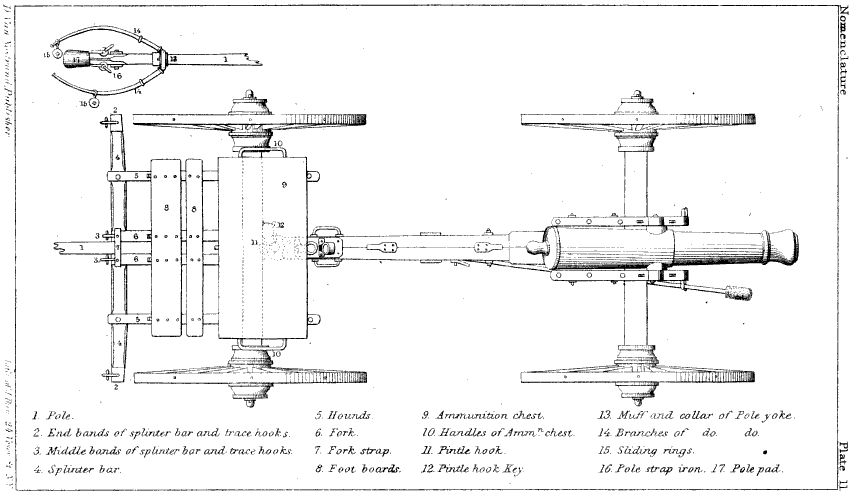
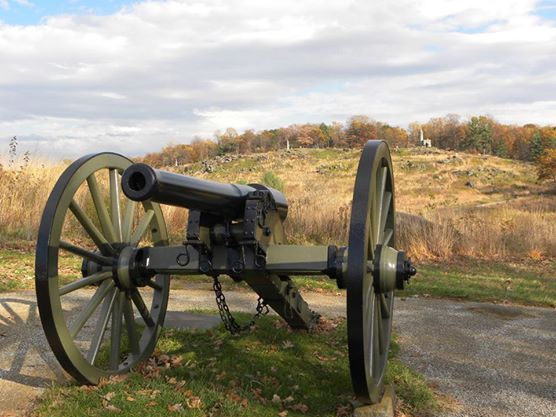
12 pound napoleon

At the battery level Union artillery was organized by type into six-gun batteries. Confederate artillery units were organized into four or six-gun batteries in which the guns were often of mixed type. This often led to supply problems for Confederate gunners and inconsistent rates of fire and or range. Confederate gunners also had to deal with poor quality power and explosive shells, a condition that only worsened as the war continued. The well-trained Union gunners had better quality ammunition and gunpowder as well as what seemed to the Confederates to have limitless ammunition.

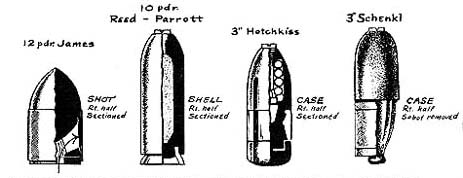
Each gun was manned by a seven-man crew and transported by a team of horses that towed a limber, which transported the cannon and a caisson, which transported the ammunition. The caissons would normally be stocked with four chests of ammunition. For a Napoleon “a standard chest consisted of twelve shot, twelve spherical case, four shells, and four canister rounds for a total of 112 rounds of long range ammunition.” [12] In addition to the ammunition carried in the caissons of each gun, more ammunition was carried in the corps and division supply trains.

As the war progressed the both the Union and Confederate armies reorganized their field artillery. In the North this was a particular problem due to the lack of flexibility and politics in the Army which were prejudiced against large artillery formations, despite the great numbers of batteries and artillerymen now in the army. However the Federal army had good artillerymen. The Regular Army batteries were the foundation of the artillery service. Unlike the infantry units which were overwhelmingly composed of volunteer soldiers, the artillerymen were regulars, many who had served for years in the ante-bellum army.

Since there were few billets for senior artillerymen many artillery officers volunteered or were selected to serve in the infantry to get promoted or to take advantage of their experience and seniority. One of those chose was John Reynolds who promote to Lieutenant Colonel and given orders to form an infantry regiment. Before he could get started in that work he was made a Brigadier General of Volunteers. He wrote: “I would, of course, have preferred the Artillery arm of service, but could not refuse the promotion offered me under any circumstance, much less at this time, when the Government has a right to my services in any capacity.” [13] Other artillerymen who rose to prominence outside of the branch during the war included William Tecumseh Sherman, George Meade, John Gibbon, George Thomas, Ambrose Burnside, and Abner Doubleday, and Confederates Stonewall Jackson, Braxton Bragg, Jubal Early, and A.P. Hill.

However, General Winfield Scott took action to keep a core of experienced artillery officers with the artillery. At Scott’s behest, “the War Department limited the resignations of artillerymen to accept higher rank in infantry regiments, resulting in a core of capable and experienced officers.” [14]  This allowed George McClellan to select two exceptional artillery veterans, William Barry and Harry Hunt to “organize the branch and to oversee training.” [15] McClellan appointed Barry, who had been commissioned in 1836 as the head of his artillery. After the defeat at Bull Run, Barry “prepared as set of guidelines or principles for the artillery service. He prescribed a uniform caliber of guns in each battery, four to six cannon in each battery, and that four batteries – one Regular Army and three volunteer – be attached to each division.” [16]  In this organization, McClellan and Barry “called for the Regular Army battery commander to take charge of those batteries assigned to the division. This was in addition to his responsibilities to his own battery.” The practical effect of this was that “with the exception of the Artillery Reserve, the highest artillery command remained that of a Captain.” [17]

Hunt was responsible for the organization of the Artillery Reserve and the siege train. The Artillery Reserve was given eighteen batteries, about 100 guns or about one-third of the army’s artillery. It would be a source from which to replace and reinforce batteries on the line, but Hunt also understood its tactical employment. He explained:

‘In marches near the enemy it is often desirable to occupy positions with guns for special purposes: the command fords, to cover the throwing and taking up bridges, and for other purposes for which it would be inconvenient and unadvisable to withdraw their batteries from the troops. Hence the necessary reserve of artillery.” [18]

Hunt’s Artillery Reserve would be of great value in the early battles of maneuver. “The primary advantage of the army artillery reserve was the flexibility it gave the commander, making it unnecessary to go through the division or corps commanders. The reserve batteries could be used whenever or wherever needed.” [19] But this would not be in the offense role that Napoleon used his artillery to smash his opponents, for technology and terrain would seldom allow it; but rather in the defense; especially at the battles of Malvern Hill and Gettysburg. However, “Gettysburg was the last battle of the Civil War in which field artillery fire was paramount…” but “By the end of 1863, the tide of war had changed in the eastern theater, with both sides making more use of field fortifications to cover themselves from the murderous fire of the infantry rifle.” [20]

Even so, lack of promotion opportunity for artillerymen was a problem for both sides during the war, and artillerymen who showed great promise were sometimes promoted and sent to other branches of service. A prime example of such a policy was Captain Stephen Weed “who fought his guns brilliantly in the first two years of the war, and a Chancellorsville even commanded the artillery of a whole army corps.” Henry Hunt “singled him out as having a particular flair for handling large masses of cannon, and wanted to see him promoted.” [21] He was promoted to Brigadier General but in the infantry where he would lead a brigade and die helping to defend Little Round Top. In all “twenty-one field-grade artillery officers in the Regular Army became generals in the Volunteers, but only two remained with the artillery branch.” [22]

Both Barry and Hunt sought to rectify this issue. Barry insisted that a “battery of artillery was the equivalent of a battalion of infantry” [23] and pressed for a higher grade structure for the artillery. Colonel Charles Wainwright wrote of their efforts: “Many officers of the regular artillery have long been trying to get a recognition of their arm of the service, doing away with the regiments and making a corps of it, the same as the engineers and ordnance. McClellan and Hunt drew up a plan soon after Antietam, which by Stanton and Halleck, but nothing more has been hear of it.” [24]

However, Barry and Hunt were opposed by War Department insiders. General Lorenzo Thomas, the Adjutant General used law and regulation to prevent promotions in the artillery beyond Captain and as to General Officers as well. Thomas insisted that the battery was equivalent of an infantry company or cavalry troop. He noted “that laws long in force stipulated that only one general officer could be appointed per each for each forty infantry companies or cavalry troops.” [25] He applied this logic to the artillery as well, which meant in the case of the Army of the Potomac which had over sixty batteries that only one general could be appointed. The result could be seen in the organization of the Army of the Potomac at Gettysburg, the artillery component, “which included approximately 8,000 men with 372 pieces – almost the manpower (and certainly the firepower) of a complete army corps. It included only two general officers… then there were three colonels and no other high ranks at all. One army corps had its guns commanded by a lieutenant.” [26] Over time the situation would improve and the artillery given some autonomy within the Army, at Gettysburg Meade gave Hunt command authority to employ the artillery as he deemed necessary, even over the objections of the corps commanders.

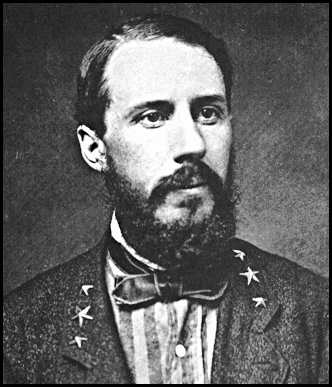
General Henry Hunt was probably the most instrumental officer when it came to reorganizing Union artillery organizations in the Army of the Potomac. Following the Battle of Chancellorsville, Hunt prevailed upon the army commander, Joseph Hooker to create “artillery brigades assigned to each corps. This overcame a problem at Chancellorsville, where the batteries of uncommitted divisions had gone unused. The reorganization also made a practical adjustment to the situation where the attrition of divisions was making the corps the basic tactical unit.” [27] In the reorganization the infantry brigades retained their assigned batteries for direct support, but the guns of the divisions were organized into brigades at the corps level. The artillery brigades of the infantry corps had “from four to eight batteries, depending on the size of the corps.” [28] Despite being reflagged as brigades the command structure was not increased. This was often due to the fact “that for much of the war commanding officers persisted in regarding artillery as merely a subsidiary technical branch, an auxiliary which might add a little extra vitality to a firing line if conditions were favourable – but more typically would not.” [29] Dr. Vardell Nesmith noted:

“Resistance within the Army to formalizing tactical organizations for field artillery above the level of the battery was a complex phenomenon. Certainly there was some hesitance on the part of the Army establishment to create new organizations that would come between infantry and cavalry commanders and their fire support assets. Also one cannot discount the institutionalized tendency to keep everyone in their proper place – in other words, to keep a new power group from organizing.” [30]

Organized into brigades the Artillery Reserve became the instrument of the Army commander and served as what we would now call “general support”artillery where they were invaluable to Union army commanders to be available to augment other batteries and to replace batteries which had suffered casualties while on line. The organization of the artillery into brigades, even if they were field expedient organizations did much to increase the effectiveness of the arm. They supplanted “the battery in tactics and to considerable degree in administration. Supply and maintenance were improved, and more efficient employment and promptness and facility of movement resulted. In addition, the concentration of batteries was favorable for instruction, discipline, and firepower. Fewer guns were needed, and in 1864, the number of recommended field pieces per 1,000 men was reduced from 3 to 2.5.” [31]

henryhunt

General Henry Hunt

Hunt lobbied the War Department to provide a staff for each brigade, but since the new units were improvised formations no staffs were created and no promotions authorized for their commanders. Colonel Wainwright proposed a congressional bill to organizer volunteer artillery units into a corps of artillery, but lamented:

“Both Barry and General Hunt while commanding the artillery of this army have frequently complained in their reports of the great want of field officers. Were the light batteries of each state organized as a corps, and provided with field officers in the proportion proposed in the bill referred to above, this want would be provided for. The officers of light batteries also have a claim demanding some such change. No class of officers in our volunteer service stand as high as high as those of our light batteries. I say without hesitation that they are very far superior as a class in all respects to the officers of the infantry or cavalry. Yet for them there is not a chance at this time any chance of promotion above a simple captaincy, except in the few light regiments spoken of. I can point to several cases of captains of light batteries who, from this want of field officers, have for the past year exercised all the authority and borne all the responsibility of a brigadier-general.” [32]

But change did come, however slowly and with great resistance from the War Department bureaucracy, and the artillery service “did succeed in winning some measure of recognition for its independent status and tactics. After Gettysburg the army’s artillery commander was accept as having overriding authority in gunnery matters, with the infantry relegated to a merely consulting role, although in practice the change brought little improvement.” [33] The beginning of this came in August 1863 when George Meade promulgated an order that “defined Hunt’s authority in matters of control of the artillery in the Army of the Potomac. The order “definitely stated that Hunt was empowered to supervise and inspect every battery in the army, and in battle to employ them “under the supervision of the major-general commanding.” [34] The order was important but still did not go far enough to remedy the problem of a lack of field officers in the artillery, a problem that was not completely remedied during the war although Ulysses Grant did allow a limited number of promotions to provide more field grade officers in the artillery service of the Army of the Potomac and other armies under his command in the Eastern Theater. Likewise some additional billets were created in the brigades as brigade commanders “were authorized a staff consisting of an adjutant, quartermaster, commissary officer, ordnance officer (an artillery officer on ordnance duty), medical officer, and artillery inspector, with each staff officer having one or more assistants…” However the staff officers had to be detailed from the batteries, thereby reducing the number of officers present with those units”[35] However, in most cases the brigade commanders remained Captains or First Lieutenants.

In the Western theater there was a trend toward the centralization of the artillery in the various armies depending on the commander and the terrain and the size of the operation. As the war progressed in the west commanders began to group their artillery under brigades, divisions, and finally under the various army corps. At Shiloh Grant concentrated about 50 guns “in the notorious “Hornet’s Nest,” perhaps saving him from defeat.” [36] Artillery tactics shifted away from the offense to the defense and even during offensive operations western commanders were quick to entrench both their infantry and artillery. During the Atlanta campaign and march to the sea William Tecumseh Sherman successfully reduced his artillery complement first to 2 guns per 1,000 men then to 1 per 1,000. [37] This was in large part because he was conducting a campaign of maneuver and was far from his logistics base. Since supplies had to be carried with the army itself with a heavy reliance on forage, Sherman recognized that his army had to be trimmed down. Likewise, “the terrain and concept of operations must have been very important in his decision.” His “rapid, almost unopposed raid through Georgia gave no opportunities for the massing of large batteries in grand manner.” [38] During the campaign Sherman marched without a siege train and reinforced his cavalry division with light artillery batteries.

Notes 

[1] Ibid. Hagerman The American Civil War and the Origins of Modern Warfare p.21

[2] Ibid, Bailey Field Artillery and Firepower p.195

[3] Ibid, Bailey Field Artillery and Firepower p.194

[4] Ibid. Nesmith Stagnation and Change in Military Thought: The Evolution of American Field Artillery Doctrine, 1861-1905 – An Example p.6

[5] Nichols, Edward J. Toward Gettysburg: A Biography of General John Reynolds, The Pennsylvania State University Press 1958, reprinted by Old Soldier Book Gaithersburg MD 1987 p.43

[6] Ibid. Longacre The Man Behind the Guns: A Military Biography of General Henry J. Hunt, Chief of Artillery, Army of the Potomac pp.53-54.

[7] Gibbon, John. Artillerist’s Manual: Compiled from Various Sources and Adapted to the Service of the United States. 1859 retrieved from http://www.artilleryreserve.org/Artillerists%20Mannual.pdf 19 January 2017 pp.345-346

[8] Ibid. Hagerman The American Civil War and the Origins of Modern Warfare p.22

[9] Ibid. Nesmith Stagnation and Change in Military Thought: The Evolution of American Field Artillery Doctrine, 1861-1905 – An Example p.19

[10] Ibid. Gibbon  Artillerist’s Manual: Compiled from Various Sources and Adapted to the Service of the United States. p.343

[11] Ibid. Griffith, Battle Tactics of the Civil War p.165

[12] Gottfried, Bradley The Artillery of Gettysburg Cumberland House Publishing, Nashville TN 2008 p.15

[13] Ibid. Nichols Toward Gettysburg: A Biography of General John Reynoldsp.75

[14] Wert, Jeffry D. The Sword of Lincoln: The Army of the Potomac Simon and Schuster, New York and London 2005 p.39

[15] Ibid. Wert The Sword of Lincoln: The Army of the Potomac p.39

[16] Ibid. Wert The Sword of Lincoln: The Army of the Potomac p.40

[17] Ibid. Nesmith Stagnation and Change in Military Thought: The Evolution of American Field Artillery Doctrine, 1861-1905 – An Example pp.21-22

[18] Ibid. Longacre The Man Behind the Guns: A Military Biography of General Henry J. Hunt, Chief of Artillery, Army of the Potomac p.98

[19] Ibid. McKenny The Organizational History of Field Artillery 1775-2003 p.65

[20] Ibid. McKenny The Organizational History of Field Artillery 1775-2003 p.74

[21] Ibid. Griffith, Battle Tactics of the Civil War p.166

[22] Ibid. McKenny The Organizational History of Field Artillery 1775-2003 p.60

[23] Ibid. Nesmith Stagnation and Change in Military Thought: The Evolution of American Field Artillery Doctrine, 1861-1905 – An Example p.22

[24] Wainwright, Charles S. A Diary of Battle: The Personal Journal of Colonel Charles S. Wainwright 1861-1865 edited by Allan Nevins, Da Capo Press, New York 1998 p.336

[25] Ibid. Longacre The Man Behind the Guns: A Military Biography of General Henry J. Hunt, Chief of Artillery, Army of the Potomac p.100

[26] Ibid. Griffith, Battle Tactics of the Civil War p.166

[27] Ibid. Hagerman The American Civil War and the Origins of Modern Warfare p.94

[28] Ibid. Hagerman The American Civil War and the Origins of Modern Warfare p.94

[29] Ibid. Griffith, Battle Tactics of the Civil War p.166

[30] Ibid. Nesmith Stagnation and Change in Military Thought: The Evolution of American Field Artillery Doctrine, 1861-1905 – An Example pp.22-23

[31] Ibid. McKenny The Organizational History of Field Artillery 1775-2003 p.62

[32] Ibid. Wainwright. A Diary of Battle: The Personal Journal of Colonel Charles S. Wainwright 1861-1865 p.337

[33] Ibid. Griffith, Battle Tactics of the Civil War p.166

[34] Ibid. Longacre The Man Behind the Guns: A Military Biography of General Henry J. Hunt, Chief of Artillery, Army of the Potomac p.181

[35] Ibid. McKenny The Organizational History of Field Artillery 1775-2003 p.61

[36] Ibid, Bailey Field Artillery and Firepower p.198

[37] Ibid. Hagerman The American Civil War and the Origins of Modern Warfare p.284

[38] Ibid. Griffith, Battle Tactics of the Civil War p.178

Leave a comment

Filed under artillery, civil war, Gettysburg, History, leadership, Military, us army

Confederate Artillery Organization 1861-1865

confederate-artillery

Friends of Padre Steve’s World,

Yes, indeed, another of my articles dealing with Civil War artillery. Geeks, wonks, and buffs rejoice.

Until tomorrow,

Peace

Padre Steve+

At the beginning of the war the Confederacy hastily formed an artillery service. As in the Union army the basic unit was the battery, and these batteries were initially assigned to infantry brigades. As such, the Confederate organization had the same problems as their Union counterparts. Infantry commanders with little or no understanding in the use and deployment of their artillery frequently interfered with their artillerymen. Since the Confederates had very little field artillery to begin the war and most was concentrated in the east, Confederate tactical and organizational developments began with the Army of Northern Virginia and were later introduced to other commands.

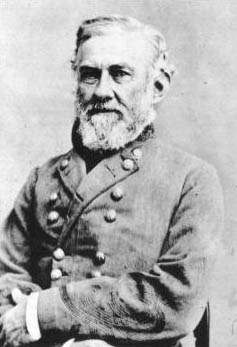
The artillery was assigned to brigades, but Confederate divisions did have an artillery chief, however, these officers had “difficulty supervising the batteries. The brigade commanders resented the artillery chief’s intervention, and the entire system created divided authority and responsibility.” [1] Like the Army of the Potomac, the Confederates formed an artillery reserve under Brigadier General William Pendleton a graduate of West Point where he graduated a year behind Robert E. Lee and classmate of Joseph Johnston. Pendleton organized and commanded a battery at First Manassas. Joseph Johnston recognized his administrative ability, thus a personal relationship as well as “circumstance and a certain aptitude for organization give him an advancement to the post chief of artillery.” [2] When Lee took command of the army outside of Richmond Pendleton found himself busy. “With Lee’s encouragement…Pendleton, culled the unattached artillery around Richmond, with a view of transferring guns to field batteries.” [3] Lee retained Pendleton as artillery chief after the Seven Days even though his “performance in the campaign had revealed his serious shortcoming as an artillery commander,” [4] as well as in the organization of the Army’s artillery.

In June 1862 Lee had Pendleton revise the regulations governing the artillery. These regulations “centralized all batteries under a chief of artillery for each division.” [5] This was a step forward but effectiveness was undercut by the brigade commanders who had operational control once they were attached. Likewise, while the organization gave great flexibility to the artillery, the “parochialism of the division itself now became the problem. There was no mechanism to mass guns from more than one division except by drawing on the reserve.” [6]

Pendleton’s lack of ability was demonstrated at both Antietam and Chancellorsville and as artillery chief he was slow to introduce organizational changes to improve the effectiveness of the artillery. Lee treated Pendleton with deference and although he recognized Pendleton “could not compare with Alexander or a handful of other officers in the artillery in ability and execution. Lee understood that and slowly pushed Pendleton into roles of decreasing importance and responsibility.” [7] After the Seven Days, Porter Alexander wrote: “Our artillery, too, was even in worse need of reorganization. A battery was attached, or supposed to be, to every brigade of infantry. Besides these, a few batteries were held in reserve under old General Pendleton. Naturally our guns & ammunition were far inferior to the enemy’s, & this scattering of the commands made it impossible ever to mass our guns in effective numbers. For artillery fire loses effect if scattered.” [8]

WNPendelton

Brigadier General William Pendleton, CSA

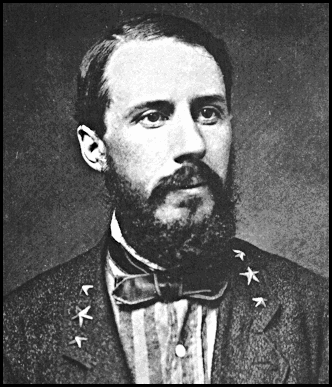
One are that the Confederates advanced more rapidly than the Union was in the appointment of field grade officers in the artillery. The first Confederate Secretary of War Judah P. Benjamin, successfully urged the Confederate Provisional Congress to authorize the appointment of “officers of artillery above the rank of captain, without reference to the number of batteries under the actual command of the officers so appointed, not to exceed in number, however, one brigadier general for every eighty guns, and one major for every sixteen guns.” Additional officers of the rank of captain and first lieutenant (not to exceed eighty) were authorized in April 1862.” [9] This gave the Confederates a good sized corps of field grade artillery officers from which they would need to eventually staff artillery battalions in 1863. Among these officers were Porter Alexander, Thomas Rosser, Stapleton Crutchfield, and John Pelham.

alexander

Brigadier General Edward Porter Alexander 

During the winter of 1862-1863 Pendleton belatedly complained to Lee about the organizational weaknesses and limitations of the artillery arm of the Confederate Army of Northern Virginia. That process had begun during the summer of 1862 and Pendleton “delegated reorganization to Alexander and Col. Stapleton Crutchfield, Jackson’s chief.” [10] Alexander and Crutchfield developed “the first modern battalion system in artillery organization.” [11] Pendleton, Crutchfield, and Alexander “recommended consolidating every four batteries into a battalion, with one battery assigned to each division.” [12] The commander of the artillery battalion supporting each division became the chief of the divisional artillery. Each corps had its own senior artillery staff officer, usually a Colonel or Lieutenant Colonel, however as Alexander noted, at first the chief “was little more than the title given to the ranking battalion commander. But in battle he occupied himself principally with his own battalion.” [13] In addition to the battalions attached to each division, “each corps had two battalions, which it could employ in conjunctions with divisions for heavy, concentrated fire.” [14]

Lee approved the changes on February 16th 1863, in time for the coming spring and summer campaigns, and “completed the reorganization during the winter when he assigned a field grade officer to each battalion and reduced the artillery reserve to six batteries.” [15]

After Chancellorsville all of the batteries that had been Lee’s artillery reserve were reassigned to the various corps. Pendleton’s duties were now restricted to advising Lee on artillery matters while remaining Lee’s spiritual adviser, and unofficial enforcer of morality in the Army of Northern Virginia. While this was a great step forward to give Lee’s Corps commanders control of their artillery gave took, the reorganization took away any flexibility that Lee might need to send artillery where it was needed in the Gettysburg campaign of 1863, and Pendleton, although having no command authority interfered with the Confederate artillery preparations for Pickett’s Charge by redeploying artillery batteries that Alexander had designated for the mission and removing the artillery train to the rear without Alexander’s knowledge, thus ensuring that Alexander could not resupply his caissons or guns during that fateful attack.

The Confederate artillery organization remained the same throughout the remainder of the war, its battalion structure was very similar to the later Union organization of the artillery brigades which were assigned to divisions, despite the difference in nomenclature. The pioneering work in organizing artillery battalions and brigades that were for practical purposes assigned to the same division would be the basis of modern artillery organization and would be adopted by the European armies of Britain, France, Austria, and Prussia in the years following the war.

Notes

[1] Ibid. McKenny The Organizational History of Field Artillery 1775-2003 p.59

[2] Freeman, Douglas Southall, Lee’s Lieutenant’s a Study in Command, One volume abridgement by Stephen W Sears, Scribner, New York 1998 p.35

[3] Glatthaar, Joseph T. General Lee’s Army from Victory to Collapse The Free Press, Simon and Schuster, New York and London 2008 p.131

[4] Wert, Jeffry D. A Glorious Army: Robert E. Lee’s Triumph 1862-1863 Simon and Schuster, New York and London 2011 p.64

[5] Ibid. Hagerman The American Civil War and the Origins of Modern Warfare p.131

[6] Ibid. Hagerman The American Civil War and the Origins of Modern Warfare p.132

[7] Ibid. Glatthaar General Lee’s Army from Victory to Collapse 2008 p.340

[8] Ibid. Alexander Fighting for the Confederacy: The Personal Recollections of General Edward Porter Alexander p.104

[9] Ibid. McKenny The Organizational History of Field Artillery 1775-2003 p.61

[10] Golay, Michael. To Gettysburg and Beyond: The Parallel Lives of Joshua Lawrence Chamberlain and Edward Porter Alexander, Crown Publishers, New York 1994 p.135

[11] Ibid. Hagerman The American Civil War and the Origins of Modern Warfare p.132

[12] Ibid. Glatthaar General Lee’s Army from Victory to Collapse 2008 p.249

[13] Ibid. Alexander Fighting for the Confederacy: The Personal Recollections of General Edward Porter Alexander p.168

[14] Ibid. Golay To Gettysburg and Beyond: The Parallel Lives of Joshua Lawrence Chamberlain and Edward Porter Alexander p.249

[15] Ibid. Hagerman The American Civil War and the Origins of Modern Warfare p.132


1 Comment

Filed under civil war, History, Military

American Artillery in the Civil War: The Wilderness Campaign and Reorganization

wilderness

Friends of Padre Steve’s World,

Another in my series of rather geek-like articles on Civil War artillery.

Have a great day.

Peace

Padre Steve+

The American Civil War was a transitional time for artillery technology, organization and tactics. The organization of the artillery service of the Army of the Potomac remained as it was up until the Overland or Wilderness Campaign, although “Corps brigades were increased to eight or nine batteries.” However, “having created a sound artillery organization and proven it at Gettysburg, the Union would have little immediate use for it” [1] as the changing conditions of war in the Wilderness changed how Grant and Meade organized the artillery.

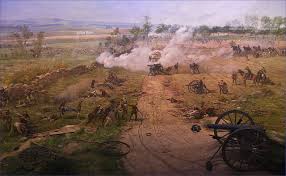
The Artillery Reserve, a throwback to Napoleonic times, which had along with the rest of the Union artillery at Gettysburg performed so brilliantly in a defensive stand with wide open fields of interlocking fire would never again have such an opportunity to wreak destruction on advancing Confederate infantry in the open. Instead it was forced into the offensive in terrain that was seldom conducive to employing massed numbers of guns. During the campaign the Artillery Reserve consisted of “two field artillery brigades of twelve batteries each, one heavy brigade, which was largely employed as a guard and construction unit, and two brigades of horse artillery, which were on duty with Major Phil Sheridan’s cavalry corps.” [2] By the time of the Wilderness Campaign the size of the Army of the Potomac’s artillery numbered 274 cannon. [3] In terms of artillery types Hunt had 154 rifled guns and 120 Napoleons in the organic components of his army, of the rifled guns the majority were the 3” Ordnance rifles as Hunt had sent most of his Parrot batteries away due to their tendency to burst and their unpopularity with their gun crews. [4] The artillery was bolster with a battery of eight 24 pound brass Coehorn mortars. These were light weapons which weighed only 164 pounds and could be carried by two men. They “were fired at an angle of 45 degrees which permitted them to hurl a shell in a very high arch to a distance of 1,200 yards at full charge.” [5]

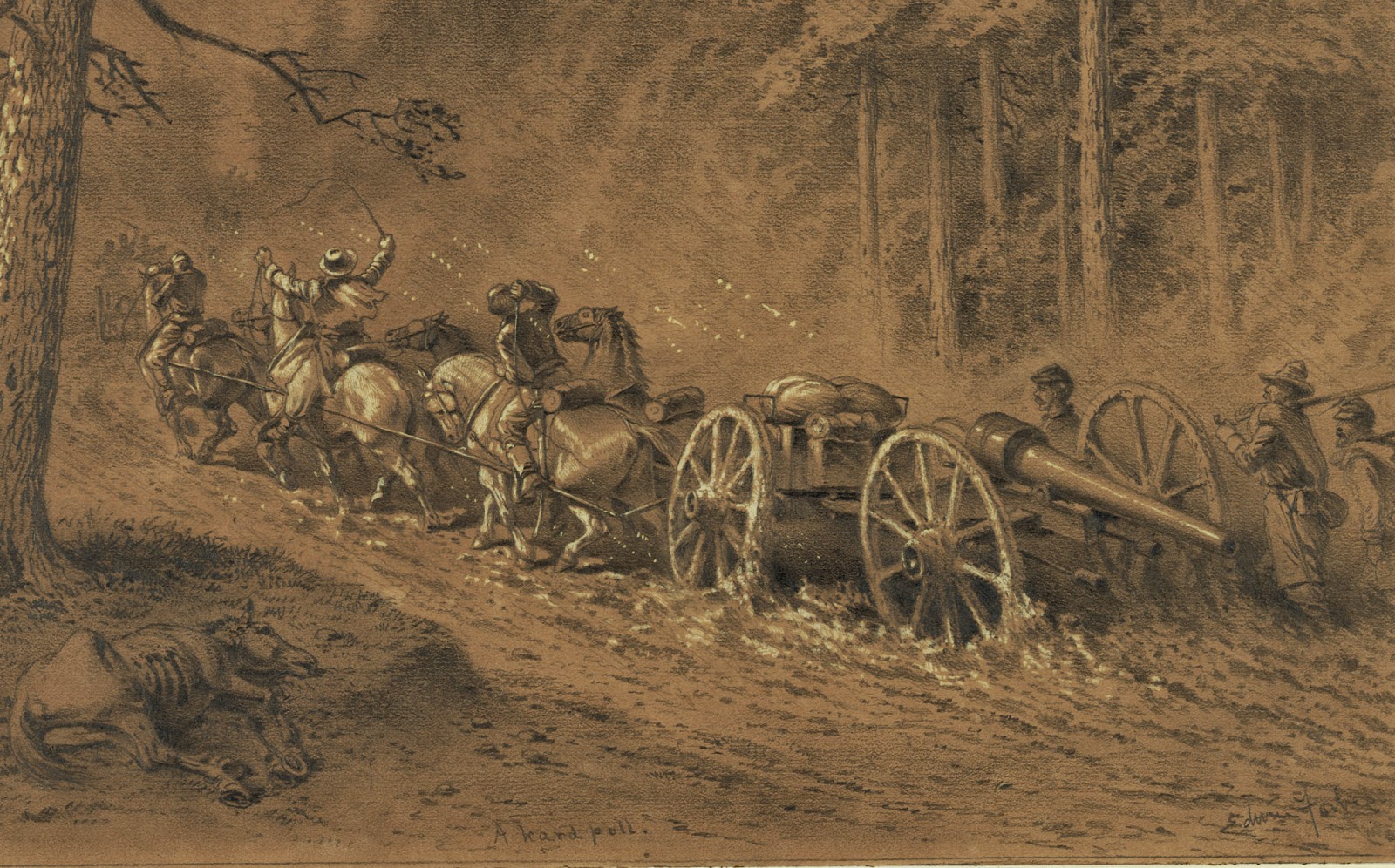
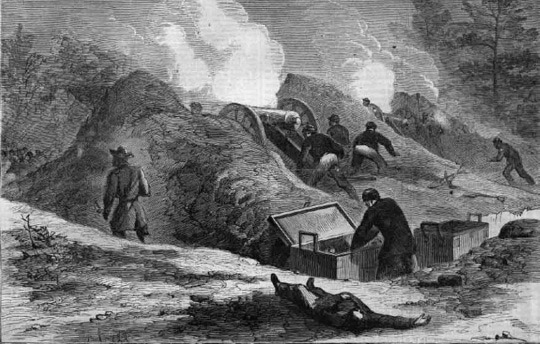
The campaigns of 1864 forced Union army commanders to change how they employed their artillery. This came first during the Wilderness campaign where the heavily wooded terrain, poor visibility, and an enemy dug in behind earthen walls and abattis limited the artillery’s effectiveness. The fighting between enemies that could barely see what they were shooting at resulted in close range firefights between infantry with few artillery pieces in direct support. When engaged, the artillery of both sides dealt death at close range in support of infantry, on the defensive the guns were dug in to protect them and their crews from the close range fire of enemy artillery and infantry. The heavy brush limited the ability of the artillery to move off the main roads as one artilleryman noted that they could do nothing “because no horses could have pulled a gun through the brush in which the infantry were fighting.” [6] One officer described the conditions of the Wilderness as “a wrestle as blind as midnight, a gloom that made manoeuvers impractical, a jungle where regiments stumbled on each other and the enemy by turns, firing sometimes into their own ranks, and guided only by the crackling of bushes or the cheers and cries that rose from the depths around.” [7]

With his guns finding little employment “Grant order that the Artillery Reserve be returned to Washington.” [8] To achieve the reduction in the number of guns without undoing his organization, Hunt recommended that the batteries be reduced from six guns to four. This was done but Hunt lost his Artillery Reserve as Meade had those reduced batteries reassigned to each of the infantry corps and the Reserve’s commander, Colonel Henry Burton, “appointed Inspector of Artillery.” [9] However, “most of the pieces ordered away were returned for the siege of Petersburg.” [10] Grant wrote:

“The Wilderness and Spotsylvania battles convinced me that we had more artillery than could ever be brought to action at any one time. It occupied much of the road marching, and taxed the trains in bringing up forage. Artillery is very useful when it can be brought into action, but it is a burdensome where it cannot be used. Before leaving Spotsylvania, therefore, I sent back to the defenses of Washington over one hundred pieces of artillery, with horses and caissons… and still left us with more artillery than could be advantageously used.” [11]

wilderness10

During the Wilderness Campaign the Confederate artillery suffered under similar conditions to Grant’s armies. Porter Alexander noted that when his artillery arrived that Lee, “directed me to send back all the artillery with our column to Parker’s Store, as there was no possibility of using it in the woods where we would be fighting, & it would be in the way.” [12] Where they were employed on the defensive the Confederate guns gave good account of themselves. Where they were not deployed attacking Union forces found their task easier, as when Winfield Scott Hancock’s massed attack at Spotsylvania succeeded, However, when the Confederates were able to deploy their artillery Union losses could be dreadful. This was the case at Cold Harbor where Grant ordered a frontal assault on well prepared Confederate defenders who had their artillery in positions where it had advancing Union forces in a crossfire.

The siege of Petersburg changed the way artillery was employed in the east yet again. “After Petersburg, field tactics were scarcely relevant, although concentrations of fire remained essential.” [13]

Many commentators after the war decried the effectiveness of the artillery by claiming that less than ten percent of casualties were caused by it. As J.B.A. Bailey notes, “This figure seems highly improbable, since the wound inflicted by a canister ball, which was the artillery’s most lethal projectile, would have been impossible to distinguish from that inflicted by a musket ball.” [14] However, even more important than the number of casualties inflicted on the enemy, but it was the shock power and deterrent effect that artillery had on the enemy, especially on the defensive. Colonel Jennings Wise, who chronicled the history of Lee’s artillery wrote:

“We often hear the sneering criticism that at such and such a battle but 1 or 2 per cent of the enemy’s loss was due to fire of the artillery. Any such test entirely erroneous. Not only do the guns exert a tremendous moral effect in support of their infantry, and adverse to the enemy, but they do far more. They often preclude heavy damage from the enemy by preventing him from essaying an assault against the positions the guns occupy. Then, again, by forcing them to seek cover, they eliminate their antagonisms to that extent… Let us hear no more of artillery efficiency as measured by the number of its victims.” [15]

Descriptions of the effect of the Union artillery on Pickett’s charge at Gettysburg bear this out. “The Confederate losses mounted at an alarming rate. The psychological impact of artillery casualties was great, for the big guns not only killed but mangled bodies, tore them apart, or disintegrated them.” [16] A survivor wrote his wife days later: “If the crash of worlds and all things combustible had been coming in collision with each other, it could not have surpassed it seemingly. To me it was like the “Magazine of Vengeance” blown up.” [17] A soldier of Kemper’s brigade recalled that “The atmosphere was rent and broken by the rust and crash of projectiles…The sun, but a few minutes before so brilliant, was now darkened. Through this smoky darkness came the missiles of death…the scene beggars description…Many a fellow thought his time had come…Great big, stout hearted men prayed, loudly too….” [18] Colonel Joseph Mayo of the 3rd Virginia regiment was heavily hit. One of its survivors wrote: “when the line rose up to charge…it appeared that as many were left dead and wounded as got up.” [19]

Notes 

[1] Ibid, Bailey Field Artillery and Firepower p.203

[2] Ibid. Nesmith Stagnation and Change in Military Thought: The Evolution of American Field Artillery Doctrine, 1861-1905 – An Example p.35

[3] Ibid. McKenny The Organizational History of Field Artillery 1775-2003 p.68

[4] Ibid. Longacre The Man Behind the Guns: A Military Biography of General Henry J. Hunt, Chief of Artillery, Army of the Potomac pp.190-191

[5] Ibid. Nesmith Stagnation and Change in Military Thought: The Evolution of American Field Artillery Doctrine, 1861-1905 – An Example p.36

[6] Ibid. Longacre The Man Behind the Guns: A Military Biography of General Henry J. Hunt, Chief of Artillery, Army of the Potomac p.194

[7] Ibid. Fuller Grant and Lee: A Study in Personality and Generalship  p.214

[8] Ibid. Nesmith Stagnation and Change in Military Thought: The Evolution of American Field Artillery Doctrine, 1861-1905 – An Example p.36

[9] Lyman, Theodore, Meade’s Army: The Private Notebooks of Lt. Col. Theodore Lyman, edited by David W. Lowe, The Kent State University Press, Kent, Oho 2007 p.162

[10] Ibid. McKenny The Organizational History of Field Artillery 1775-2003 p.67

[11] Grant, Ulysses S. Personal Memoirs of U.S. Grant Volume 2 Charles L. Webster and Company, New York 1886 p.241

[12] Ibid. Alexander Fighting for the Confederacy: The Personal Recollections of General Edward Porter Alexander p.359

[13] Ibid, Bailey Field Artillery and Firepower p.204

[14] Ibid, Bailey Field Artillery and Firepower pp.196-197

[15] Ibid. Griffith, Battle Tactics of the Civil War p.167

[16]Hess, Earl J. Picketts Charge: The Last Attack at Gettysburg University of North Carolina Press, Chapel Hill and London 2001 p.153

[17] Wert, Jeffery D. Gettysburg Day Three A Touchstone Book, New York 2001 p.181

[18] Dowdy, Clifford. Lee and His Men at Gettysburg: The Death of a Nation Skyhorse Publishing, New York 1986, originally published as Death of a Nation Knopf, New York 1958 p.294

[19] Ibid. Wert Gettysburg Day Three p.179

Leave a comment

Filed under civil war, History, Military

American Artillery, Doctrine, and Tactics from the Mexican War to the Wilderness

Friends of Padre Steve’s World,

I continue to work on my Civil War books. Today an excerpt dealing with American artillery during the Civil War. This is the follow-on article to the one that I posted last week,

Have a great day,

Peace

Padre Steve+

fig20

American artillery doctrine subordinated the artillery to the infantry. Doctrine dictated that on the offensive “was for about one-third of the guns to occupy the enemy’s artillery and two-thirds to fire on the infantry and cavalry. Jomini liked the concentrated offensive cannonade where a breach of the line was to be attempted.” [1] But being such a small service, it was difficult for Americans to actually implement Napoleonic practices, or organization as the organization itself “was rooted in pre-Napoleonic practice, operating as uncoordinated batteries.” [2]

American artillerymen of the Mexican War could not match the massive firepower and concentration of Napoleon’s army. Instead it utilized mobile tactics, which gave it “the opportunity to maneuver in open country to support the infantry.” [3] During the war the actions of the highly mobile light batteries proved decisive, as did the spirit of their officers and soldiers. The Americans may not have had the organization of Napoleon, but “the audacious spirit was there.[4] In a number of engagements American batteries employed the artillery rush, even gaining the admiration of Mahan, a noted exponent of the defensive. Among the leaders of the artillery at the Battle of Buena Vista were Captain Braxton Bragg, and Lieutenants John Reynolds and George Thomas, all of who would go on to fame in the Civil War. During a moment when Mexican forces threatened to overwhelm the American line, Bragg’s battery arrived:

“Without support, Bragg whirled his guns into battery only a few rods from the enemy…. The Mississippi Rifles and Lane’s Hoosiers also double-quicked from the rear of the plateau. From then on it was a storybook finish for the Americans, and artillery made the difference. Seventeen guns swept the Mexicans with grape and canister…. Reynolds, Thomas, and the others stood to the work with their captains until 5 o’clock. Santa Ana was through…” [5]

At Casa Mata outside of Mexico City, Americans found their flank threatened by Mexican cavalry. Captain James Hunter and Lieutenant Henry Hunt observed the situation and “Without awaiting orders they rushed their guns to the threatened sector…  With Duncan directing them, all stood their posts long enough to spray the front ranks of mounted Mexicans with canister, the shotgun effect of which shredded the half-formed attack columns, dissolving all alignment and sending the lancers scrambling rearward in chaos…” [6] As a result these and other similar instances the artillery came out of the war with a sterling reputation and recognition of their gallant spirit. John Gibbon reflected such a spirit when he wrote: “Batteries derive all their value from the courage and skill of the gunners; from their constancy and devotion on difficult marches; from the quickness and capacity of the officers; and especially from the good condition and vigor of the teams, without which nothing can be undertaken.” [7]

At the beginning of the war U.S. Army doctrine recommended placing batteries equally across the line and concentrating them as needed. The last manual on artillery tactics Instruction for Field Artillery, published in 1859 retained much of its pre-Mexican War content and the doctrine in it provided that artillery was to “be organized at the regiment and brigade level with no reserve.” [8] Nonetheless some artillery officers discussed the possibilities of concentration, Grand Batteries, and the artillery reserve, no changes in organization occurred before the war. However, these discussions were all theoretical, as practical experience of these officers was limited to the small number of weapons employed in the Mexican War, and the “immediate problem was the organization of an unaccustomed mass of artillery.” [9] The Artillerist’s Manual, a highly technical treatise on gunnery was written by Captain John Gibbon in 1859 while he was serving at West Point and used by artillerymen of both sides during the war.  In  Gibbon described the principle object of the artillery was to, “sustain the troops in the attack and defense, to facilitate their movements and to oppose the enemy’s; to destroy his forces as well as the obstacles that protect them; and to keep up the combat until the opportunity for a decisive blow.”  [10]

Since the United States Army traditionally drawn their doctrine from the French this meant going back to the Napoleonic model the foundational unit of which was the battery. The field artillery batteries were classed as either foot artillery or horse artillery. The horse artillery accompanied the cavalry and all gun crews went into battle mounted as cavalrymen. The soldiers of the foot artillery either rode with the guns or walked. The battery was the basic unit for American artillery and at the “start of the war the artillery of both sides was split into self-contained batteries, and each battery allocated to a particular brigade, regiment or even battalion of infantry.” [11]

At the battery level Union artillery was organized by type into six-gun batteries. Confederate artillery units were organized into four or six-gun batteries in which the guns were often of mixed type. This often led to supply problems for Confederate gunners and inconsistent rates of fire and or range. Confederate gunners also had to deal with poor quality power and explosive shells, a condition that only worsened as the war continued. The well-trained Union gunners had better quality ammunition and gunpowder as well as what seemed to the Confederates to have limitless ammunition.

Each gun was manned by a seven-man crew and transported by a team of horses that towed a limber, which transported the cannon and a caisson, which transported the ammunition. The caissons would normally be stocked with four chests of ammunition. For a Napoleon “a standard chest consisted of twelve shot, twelve spherical case, four shells, and four canister rounds for a total of 112 rounds of long range ammunition.” [12] In addition to the ammunition carried in the caissons of each gun, more ammunition was carried in the corps and division supply trains.

As the war progressed the both the Union and Confederate armies reorganized their field artillery. In the North this was a particular problem due to the lack of flexibility and politics in the Army which were prejudiced against large artillery formations, despite the great numbers of batteries and artillerymen now in the army. However the Federal army had good artillerymen. The Regular Army batteries were the foundation of the artillery service. Unlike the infantry units which were overwhelmingly composed of volunteer soldiers, the artillerymen were regulars, many who had served for years in the ante-bellum army.

Since there were few billets for senior artillerymen many artillery officers volunteered or were selected to serve in the infantry to get promoted or to take advantage of their experience and seniority. One of those chose was John Reynolds who promote to Lieutenant Colonel and given orders to form an infantry regiment. Before he could get started in that work he was made a Brigadier General of Volunteers. He wrote: “I would, of course, have preferred the Artillery arm of service, but could not refuse the promotion offered me under any circumstance, much less at this time, when the Government has a right to my services in any capacity.” [13] Other artillerymen who rose to prominence outside of the branch during the war included William Tecumseh Sherman, George Meade, John Gibbon, George Thomas, Ambrose Burnside, and Abner Doubleday, and Confederates Stonewall Jackson, Braxton Bragg, Jubal Early, and A.P. Hill.

However, General Winfield Scott took action to keep a core of experienced artillery officers with the artillery. At Scott’s behest, “the War Department limited the resignations of artillerymen to accept higher rank in infantry regiments, resulting in a core of capable and experienced officers.” [14]  This allowed George McClellan to select two exceptional artillery veterans, William Barry and Harry Hunt to “organize the branch and to oversee training.” [15] McClellan appointed Barry, who had been commissioned in 1836 as the head of his artillery. After the defeat at Bull Run, Barry “prepared as set of guidelines or principles for the artillery service. He prescribed a uniform caliber of guns in each battery, four to six cannon in each battery, and that four batteries – one Regular Army and three volunteer – be attached to each division.” [16]  In this organization, McClellan and Barry “called for the Regular Army battery commander to take charge of those batteries assigned to the division. This was in addition to his responsibilities to his own battery.” The practical effect of this was that “with the exception of the Artillery Reserve, the highest artillery command remained that of a Captain.” [17]

Hunt was responsible for the organization of the Artillery Reserve and the siege train. The Artillery Reserve was given eighteen batteries, about 100 guns or about one-third of the army’s artillery. It would be a source from which to replace and reinforce batteries on the line, but Hunt also understood its tactical employment. He explained:

‘In marches near the enemy it is often desirable to occupy positions with guns for special purposes: the command fords, to cover the throwing and taking up bridges, and for other purposes for which it would be inconvenient and unadvisable to withdraw their batteries from the troops. Hence the necessary reserve of artillery.” [18]

Hunt’s Artillery Reserve would be of great value in the early battles of maneuver. “The primary advantage of the army artillery reserve was the flexibility it gave the commander, making it unnecessary to go through the division or corps commanders. The reserve batteries could be used whenever or wherever needed.” [19] But this would not be in the offense role that Napoleon used his artillery to smash his opponents, for technology and terrain would seldom allow it; but rather in the defense; especially at the battles of Malvern Hill and Gettysburg. However, “Gettysburg was the last battle of the Civil War in which field artillery fire was paramount…” but “By the end of 1863, the tide of war had changed in the eastern theater, with both sides making more use of field fortifications to cover themselves from the murderous fire of the infantry rifle.” [20]

Even so, lack of promotion opportunity for artillerymen was a problem for both sides during the war, and artillerymen who showed great promise were sometimes promoted and sent to other branches of service. A prime example of such a policy was Captain Stephen Weed “who fought his guns brilliantly in the first two years of the war, and a Chancellorsville even commanded the artillery of a whole army corps.” Henry Hunt “singled him out as having a particular flair for handling large masses of cannon, and wanted to see him promoted.” [21] He was promoted to Brigadier General but in the infantry where he would lead a brigade and die helping to defend Little Round Top. In all “twenty-one field-grade artillery officers in the Regular Army became generals in the Volunteers, but only two remained with the artillery branch.” [22]

Both Barry and Hunt sought to rectify this issue. Barry insisted that a “battery of artillery was the equivalent of a battalion of infantry” [23] and pressed for a higher grade structure for the artillery. Colonel Charles Wainwright wrote of their efforts: “Many officers of the regular artillery have long been trying to get a recognition of their arm of the service, doing away with the regiments and making a corps of it, the same as the engineers and ordnance. McClellan and Hunt drew up a plan soon after Antietam, which by Stanton and Halleck, but nothing more has been hear of it.” [24]

However, Barry and Hunt were opposed by War Department insiders. General Lorenzo Thomas, the Adjutant General used law and regulation to prevent promotions in the artillery beyond Captain and as to General Officers as well. Thomas insisted that the battery was equivalent of an infantry company or cavalry troop. He noted “that laws long in force stipulated that only one general officer could be appointed per each for each forty infantry companies or cavalry troops.” [25] He applied this logic to the artillery as well, which meant in the case of the Army of the Potomac which had over sixty batteries that only one general could be appointed. The result could be seen in the organization of the Army of the Potomac at Gettysburg, the artillery component, “which included approximately 8,000 men with 372 pieces – almost the manpower (and certainly the firepower) of a complete army corps. It included only two general officers… then there were three colonels and no other high ranks at all. One army corps had its guns commanded by a lieutenant.” [26] Over time the situation would improve and the artillery given some autonomy within the Army, at Gettysburg Meade gave Hunt command authority to employ the artillery as he deemed necessary, even over the objections of the corps commanders.

General Henry Hunt was probably the most instrumental officer when it came to reorganizing Union artillery organizations in the Army of the Potomac. Following the Battle of Chancellorsville, Hunt prevailed upon the army commander, Joseph Hooker to create “artillery brigades assigned to each corps. This overcame a problem at Chancellorsville, where the batteries of uncommitted divisions had gone unused. The reorganization also made a practical adjustment to the situation where the attrition of divisions was making the corps the basic tactical unit.” [27] In the reorganization the infantry brigades retained their assigned batteries for direct support, but the guns of the divisions were organized into brigades at the corps level. The artillery brigades of the infantry corps had “from four to eight batteries, depending on the size of the corps.” [28] Despite being reflagged as brigades the command structure was not increased. This was often due to the fact “that for much of the war commanding officers persisted in regarding artillery as merely a subsidiary technical branch, an auxiliary which might add a little extra vitality to a firing line if conditions were favourable – but more typically would not.” [29] Dr. Vardell Nesmith noted:

“Resistance within the Army to formalizing tactical organizations for field artillery above the level of the battery was a complex phenomenon. Certainly there was some hesitance on the part of the Army establishment to create new organizations that would come between infantry and cavalry commanders and their fire support assets. Also one cannot discount the institutionalized tendency to keep everyone in their proper place – in other words, to keep a new power group from organizing.” [30]

Organized into brigades the Artillery Reserve became the instrument of the Army commander and served as what we would now call “general support” artillery where they were invaluable to Union army commanders to be available to augment other batteries and to replace batteries which had suffered casualties while on line. The organization of the artillery into brigades, even if they were field expedient organizations did much to increase the effectiveness of the arm. They supplanted “the battery in tactics and to considerable degree in administration. Supply and maintenance were improved, and more efficient employment and promptness and facility of movement resulted. In addition, the concentration of batteries was favorable for instruction, discipline, and firepower. Fewer guns were needed, and in 1864, the number of recommended field pieces per 1,000 men was reduced from 3 to 2.5.” [31]
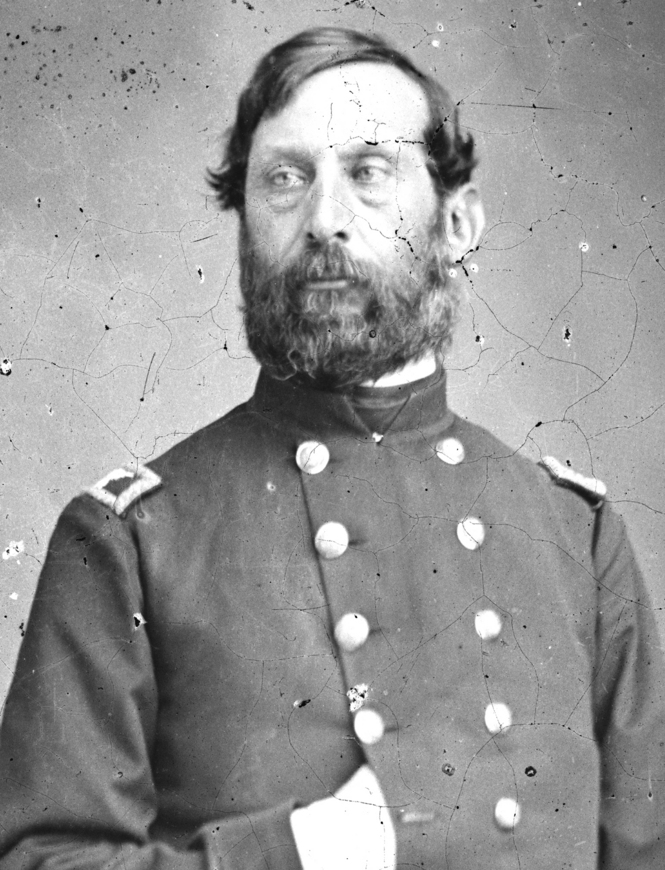
henryhunt

General Henry Hunt

Hunt lobbied the War Department to provide a staff for each brigade, but since the new units were improvised formations no staffs were created and no promotions authorized for their commanders. Colonel Wainwright proposed a congressional bill to organizer volunteer artillery units into a corps of artillery, but lamented:

“Both Barry and General Hunt while commanding the artillery of this army have frequently complained in their reports of the great want of field officers. Were the light batteries of each state organized as a corps, and provided with field officers in the proportion proposed in the bill referred to above, this want would be provided for. The officers of light batteries also have a claim demanding some such change. No class of officers in our volunteer service stand as high as high as those of our light batteries. I say without hesitation that they are very far superior as a class in all respects to the officers of the infantry or cavalry. Yet for them there is not a chance at this time any chance of promotion above a simple captaincy, except in the few light regiments spoken of. I can point to several cases of captains of light batteries who, from this want of field officers, have for the past year exercised all the authority and borne all the responsibility of a brigadier-general.” [32]

But change did come, however slowly and with great resistance from the War Department bureaucracy, and the artillery service “did succeed in winning some measure of recognition for its independent status and tactics. After Gettysburg the army’s artillery commander was accept as having overriding authority in gunnery matters, with the infantry relegated to a merely consulting role, although in practice the change brought little improvement.” [33] The beginning of this came in August 1863 when George Meade promulgated an order that “defined Hunt’s authority in matters of control of the artillery in the Army of the Potomac. The order “definitely stated that Hunt was empowered to supervise and inspect every battery in the army, and in battle to employ them “under the supervision of the major-general commanding.” [34] The order was important but still did not go far enough to remedy the problem of a lack of field officers in the artillery, a problem that was not completely remedied during the war although Ulysses Grant did allow a limited number of promotions to provide more field grade officers in the artillery service of the Army of the Potomac and other armies under his command in the Eastern Theater. Likewise some additional billets were created in the brigades as brigade commanders “were authorized a staff consisting of an adjutant, quartermaster, commissary officer, ordnance officer (an artillery officer on ordnance duty), medical officer, and artillery inspector, with each staff officer having one or more assistants…” However the staff officers had to be detailed from the batteries, thereby reducing the number of officers present with those units” [35] However, in most cases the brigade commanders remained Captains or First Lieutenants.

In the Western theater there was a trend toward the centralization of the artillery in the various armies depending on the commander and the terrain and the size of the operation. As the war progressed in the west commanders began to group their artillery under brigades, divisions, and finally under the various army corps. At Shiloh Grant concentrated about 50 guns “in the notorious “Hornet’s Nest,” perhaps saving him from defeat.” [36] Artillery tactics shifted away from the offense to the defense and even during offensive operations western commanders were quick to entrench both their infantry and artillery. During the Atlanta campaign and march to the sea William Tecumseh Sherman successfully reduced his artillery complement first to 2 guns per 1,000 men then to 1 per 1,000. [37] This was in large part because he was conducting a campaign of maneuver and was far from his logistics base. Since supplies had to be carried with the army itself with a heavy reliance on forage, Sherman recognized that his army had to be trimmed down. Likewise, “the terrain and concept of operations must have been very important in his decision.” His “rapid, almost unopposed raid through Georgia gave no opportunities for the massing of large batteries in grand manner.” [38] During the campaign Sherman marched without a siege train and reinforced his cavalry division with light artillery batteries.

Notes 

[1] Ibid. Hagerman The American Civil War and the Origins of Modern Warfare p.21

[2] Ibid, Bailey Field Artillery and Firepower p.195

[3] Ibid, Bailey Field Artillery and Firepower p.194

[4] Ibid. Nesmith Stagnation and Change in Military Thought: The Evolution of American Field Artillery Doctrine, 1861-1905 – An Example p.6

[5] Nichols, Edward J. Toward Gettysburg: A Biography of General John Reynolds, The Pennsylvania State University Press 1958, reprinted by Old Soldier Book Gaithersburg MD 1987 p.43

[6] Ibid. Longacre The Man Behind the Guns: A Military Biography of General Henry J. Hunt, Chief of Artillery, Army of the Potomac pp.53-54.

[7] Gibbon, John. Artillerist’s Manual: Compiled from Various Sources and Adapted to the Service of the United States. 1859 retrieved from http://www.artilleryreserve.org/Artillerists%20Mannual.pdf 19 January 2017 pp.345-346

[8] Ibid. Hagerman The American Civil War and the Origins of Modern Warfare p.22

[9] Ibid. Nesmith Stagnation and Change in Military Thought: The Evolution of American Field Artillery Doctrine, 1861-1905 – An Example p.19

[10] Ibid. Gibbon  Artillerist’s Manual: Compiled from Various Sources and Adapted to the Service of the United States. p.343

[11] Ibid. Griffith, Battle Tactics of the Civil War p.165

[12] Gottfried, Bradley The Artillery of Gettysburg Cumberland House Publishing, Nashville TN 2008 p.15

[13] Ibid. Nichols Toward Gettysburg: A Biography of General John Reynolds p.75

[14] Wert, Jeffry D. The Sword of Lincoln: The Army of the Potomac Simon and Schuster, New York and London 2005 p.39

[15] Ibid. Wert The Sword of Lincoln: The Army of the Potomac p.39

[16] Ibid. Wert The Sword of Lincoln: The Army of the Potomac p.40

[17] Ibid. Nesmith Stagnation and Change in Military Thought: The Evolution of American Field Artillery Doctrine, 1861-1905 – An Example pp.21-22

[18] Ibid. Longacre The Man Behind the Guns: A Military Biography of General Henry J. Hunt, Chief of Artillery, Army of the Potomac p.98

[19] Ibid. McKenny The Organizational History of Field Artillery 1775-2003 p.65

[20] Ibid. McKenny The Organizational History of Field Artillery 1775-2003 p.74

[21] Ibid. Griffith, Battle Tactics of the Civil War p.166

[22] Ibid. McKenny The Organizational History of Field Artillery 1775-2003 p.60

[23] Ibid. Nesmith Stagnation and Change in Military Thought: The Evolution of American Field Artillery Doctrine, 1861-1905 – An Example p.22

[24] Wainwright, Charles S. A Diary of Battle: The Personal Journal of Colonel Charles S. Wainwright 1861-1865 edited by Allan Nevins, Da Capo Press, New York 1998 p.336

[25] Ibid. Longacre The Man Behind the Guns: A Military Biography of General Henry J. Hunt, Chief of Artillery, Army of the Potomac p.100

[26] Ibid. Griffith, Battle Tactics of the Civil War p.166

[27] Ibid. Hagerman The American Civil War and the Origins of Modern Warfare p.94

[28] Ibid. Hagerman The American Civil War and the Origins of Modern Warfare p.94

[29] Ibid. Griffith, Battle Tactics of the Civil War p.166

[30] Ibid. Nesmith Stagnation and Change in Military Thought: The Evolution of American Field Artillery Doctrine, 1861-1905 – An Example pp.22-23

[31] Ibid. McKenny The Organizational History of Field Artillery 1775-2003 p.62

[32] Ibid. Wainwright. A Diary of Battle: The Personal Journal of Colonel Charles S. Wainwright 1861-1865 p.337

[33] Ibid. Griffith, Battle Tactics of the Civil War p.166

[34] Ibid. Longacre The Man Behind the Guns: A Military Biography of General Henry J. Hunt, Chief of Artillery, Army of the Potomac p.181

[35] Ibid. McKenny The Organizational History of Field Artillery 1775-2003 p.61

[36] Ibid, Bailey Field Artillery and Firepower p.198

[37] Ibid. Hagerman The American Civil War and the Origins of Modern Warfare p.284

[38] Ibid. Griffith, Battle Tactics of the Civil War p.178


2 Comments

Filed under civil war, History, Military

The King of Battle at Gettysburg: Union and Confederate Artillery Types and Organization

cemeteryridgearty

Note to my friends at Padre Steve’s World: This is another in my articles on Gettysburg that I am preparing for my next “Staff Ride” for the incoming class at the Staff College where I teach. Eventually I will have a page with a tab at the top of this site for my readers to access all of those articles.

The Artillery of the Army of the Potomac at Gettysburg proved that it was the “King of Battle” and a key part of Union commanders and their use of combined arms. The superiority of the Federal artillery at Gettysburg over their Confederate counterparts was not simply due to the numbers of guns employed, it was in the manner that they were employed and the manner that Federal commanders employed the artillery under their command.

porteralexanderColonel Porter Alexander

This is not to say that the Confederate artillerymen were inferior to their Federal counterparts, Porter Alexander, who commanded First Corps artillery under Longstreet was an excellent artillery commander, although Brigadier General Henry J. Hunt was by far superior to his Confederate Counterpart Brigadier General William Pendleton. The problems lay in equipment, ammunition and their employment by their carious Corps and division commanders.

henryhuntBrigadier General Harry Hunt

Hunt and Pendleton were both graduates of the West Point, however Pendleton had left active service in the 1830s to become an Episcopal Priest and had no combat experience. Hunt remained in the Army, served in Mexico and at the beginning of the war was the the chief artillery instructor at West Point. His treatise on the use of artillery Instructions for Field Artillery published by the War Department in 1861 was the primary instruction for all Union artillery units.

WNPendeltonBrigadier General William Pendleton

Union and Confederate organizations differed. Hunt was instrumental in reorganizing Union artillery organizations. Brigades retained their assigned batteries for direct support of those units. Divisions and Corps lost their artillery which was brought into an Artillery Reserve for greater flexibility on the battlefield. As such the Artillery Reserve became the instrument of of the Army commander and served as what we would now call “general support” artillery. The organization allowed Meade to better manage his artillery at Gettysburg and employ it where he needed at the time where it was most required. This ensured that Meade and his subordinate commanders had a good command of fires throughout the battle.

HD_WilkesonBattery_z.preview

Hunt and his subordinates sought to concentrate their artillery but also to employ cross fires on advancing enemy infantry. During the battle Union artillery was particularly effective during Buford’s delaying action where its skillful employment caused Heth and Pender’s Divisions large number of casualties on July 1st. At Cemetery Hill on the evening of July 1st where Howard’s positioning of batteries on that hill with Steinwehr’s Division ensured that it held.  On July 2nd it was used with great effect during the savage fighting at the Peach Orchard, the Wheat Field, Devil’s Den and Little Round Top. However its greatest effect was in decimating Pickett’s Division and supporting units on July 3rd. 

The Confederate Artillery was assigned to each Army Corps and although Pendleton was Lee’s Artillery Chief he had little influence on the battle. Instead that authority was dispersed to the artillerymen serving under each Corps commander. While this worked well at the corps level it ensured that Lee had no way of effectively coordinating fires throughout the battle. As such on the third day Porter Alexander, a battalion commander and Longstreet’s senior artilleryman was limited to his First Corps batteries and whatever artillery was lent by A. P. Hill’s Third Corps as the artillery of Second Corps was unavailable and on the wrong side of the battlefield when needed.

At the battery level Union artillery was on the whole organized by type in six gun batteries. Confederate artillery units were organized in four or six gun batteries in which types of guns were often mixed, leading to supply problems and inconsistency in rates of fire and range. Union batteries also had better quality ammunition and gunpowder supplies.

smoothboreammorifledammo6pdrcarriagetravelcaisson-and-limber
Field Artillery batteries were of two types. Foot Artillery which accompanied the Infantry and Horse Artillery which accompanied the Cavalry. The crews of the Foot Artillery either marched alongside their guns or rode on the caissons. The crews of the Horse Artillery rode horses in order to better keep up with the Cavalry Units they supported.

Parrott-Answer-LRESM

All the field artillery weapons were line of sight weapons. They had neither the range nor the fire direction capability for indirect fire. Ammunition included solid shot, exploding shells and canister which was used at short range against infantry.

The increase in range and effectiveness of rifled muskets made the job of the artilleryman more dangerous than it had been in previous wars. Thus when employed in the offense or during close assaults artillerymen were exposed to musket fire resulting in heavier casualties among the gun crews.

At Gettysburg the Army of the Potomac about 360 guns, the total number of guns available to Lee and the Army of Northern Virginia varies depending on the source between 262 and 241 guns.

The Union for the most part used weapons made in the United States, whereas the Confederates having few ordnance factories of their own were limited and attempted to obtain weapons from Europe. At Gettysburg it had two of the 2.75 inch Whitworth Breechloading Rifles were the most modern and long range weapons on the battlefield and prefigured the field artillery weapons that would dominate the battlefield in the Twentieth Century.

cannons

There were three basic types of cannon used at Gettysburg. Rifled cannon, Smoothbores and Howitzers. The bulk of Federal Artillery was made up of rifled cannon, especially the 3” Ordnance Rifle of which Meade had 146 at Gettysburg. There were also 142 of the M 1857 12 pound smoothbore “Napoleon’s” named after Emperor Napoleon III of France. Forty to forty-four percent of the guns available to Lee’s Army of Northern Virginia were Napoleons, of which they had 107 at Gettysburg. The technical details of each type are listed below.

Rifled Cannon
 999130_10152038135167059_1801660138_n

10-Pounder Parrott Rifle, M ’63

Bore Diameter             3.0 in (7.64 cm)
Tube Material              Cast and Wrought Iron
Tube Length                78 in (198 cm)
Tube Weight                890 lb (404 kg)
Powder Charge           1 lb (0.45 kg)
Range (5° Elevation)   2,000 yd (1,829 m)

10-Pounder Parrott Rifle, M ’61

Bore Diameter             2.9 in (7.37 cm)
Tube Material              Cast and Wrought Iron
Tube Length                78 in (198 cm)
Tube Weight                890 lb (404 kg)
Powder Charge           1 lb (0.45 kg)
Range (5° Elevation)   2,000 yd (1,829 m)

At Gettysburg (total M61 and M63)
60 Union; 42 Confederate

20-Pounder Parrott Rifle

Bore Diameter                 3.67 in (9.32 cm)
Tube Material                  Cast and Wrought Iron
Tube Length                    89 in (226 cm)
Tube Weight                    1,750 lb (794 kg)
Powder Charge                2 lb (0.91 kg)
Range (5° Elevation)        2,100 yd (1,920 m)
At Gettysburg 24 Union

3.67-Inch Navy Parrott Rifle

Bore Diameter                 3.67 in (9.32 cm)
Tube Material                  Cast and Wrought Iron
Tube Length                    89 in (226 cm)
Tube Weight                    1,750 lb (794 kg)
Powder Charge               2 lb (0.91 kg)
Range (5° Elevation)       2,100 yd (1,920 m)
At Gettysburg                  4 Confederate

cemeteryridge
3-Inch Ordnance Rifle

Bore Diameter                 3.0 in (7.62 cm)
Tube Material                  Wrought Iron
Tube Length                    73 in (185 cm)
Tube Weight                   816 lb (370 kg)
Powder Charge              1 lb (0.45 kg)
Range (5° Elevation)      1,835 yd (1,678 m)
At Gettysburg                 146 Union; 73 Confederate

14-Pounder James Rifle

Bore Diameter                3.80 in (9.65 cm)
Tube Material                 Bronze
Tube Length                   65 in (165 cm)
Tube Weight                   918 lb (416 kg)
Powder Charge              0.75 lb (0.34 kg)
Range (5° Elevation)     1,700 yd (1,554 m)
At Gettysburg                4 Union

12-Pounder (2.75 Inch) Whitworth Breechloading Rifle

Bore Diameter                2.75 in (7 cm)
Tube Material                 Iron and Steel
Tube Length                   104 in (264 cm)
Tube Weight                   1,092 lb (495 kg)
Powder Charge              1.75 lb (0.79 kg)
Range (5° Elevation)      2,800 yd (2,560 m)
At Gettysburg                  2 Confederate

Blakely Rifle

Bore Diameter                 3.4 in (8.64 cm)
Tube Material                  Steel
Tube Length                    59 in (150 cm)
Tube Weight                    800 lb (363 kg)
Powder Charge               1 lb (0.45 kg)
Range (5° Elevation)       1,850 yd (1,691 m)
At Gettysburg                   3 Confederate

Smoothbore

1497705_10152329726382059_1343167358_n

12-Pounder Napoleon-Federal Manufacture

Bore Diameter               4.62 in (11.73 cm)
Tube Material                Bronze
Tube Length                  66 in (168 cm)
Tube Weight                 1,227 lb (557 kg)
Powder Charge            2.5 lb (1.13 kg)
Range (5° Elevation)    1,619 yd (1480 m)
At Gettysburg               142 Union

12-Pounder Napoleon-Confederate Manufacture

Bore Diameter              4.62 in (11.73 cm)
Tube Material               Bronze
Tube Length                 66 in (168 cm)
Tube Weight                 1,227 lb (557 kg)
Powder Charge            2.5 lb (1.13 kg)
Range (5° Elevation)    1,619 yd (1480 m)
At Gettysburg               107 Confederate

6-Pounder Field Gun

Bore Diameter              3.67 in (9.32 cm)
Tube Material               Bronze
Tube Length                 60 in (152 cm)
Tube Weight                 884 lb (401 kg)
Powder Charge            1.25 lb (0.57 kg)
Range (5° Elevation)    1,523 yd (1,393 m)
At Gettysburg                1 Confederate

Howitzers

12-Pounder Field Howitzer

Bore Diameter              4.62 in (11.73 cm)
Tube Material               Bronze
Tube Length                 53 in (135 cm)
Tube Weight                788 lb (357 kg)
Powder Charge           1 lb (0.45 kg)
Range (5° Elevation)   1,072 yd (980 m)
At Gettysburg               2 Union; 26 Confederate

24-Pounder Field Howitzer

1454601_10152040914857059_709344690_n

Bore Diameter               5.82 in (14.78 cm)    
Tube Material                Bronze
Tube Length                  65 in (165 cm)
Tube Weight                  1,318 lb (598 kg)
Powder Charge             2 lb (0.91 kg)
Range (5° Elevation)     1,322 yd (1,209 m)
At Gettysburg                4 Confederate

20140308-231743.jpg

So until tomorrow,

Peace

Padre Steve+

1 Comment

Filed under civil war, History, Military