Tag Archives: cold war

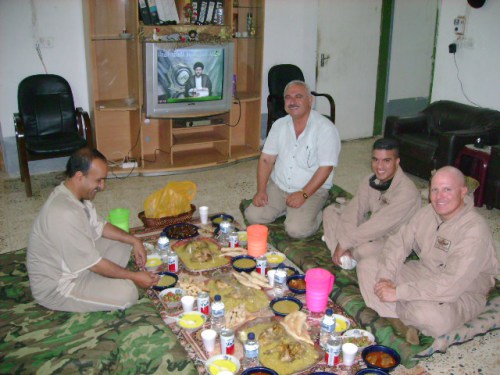
The Bond

img_0602

Friends of Padre Steve’s World,

Today is going to be a busy and sad day as we gather with friends to remember the life of our friend Dave Shaw. I wrote about his unexpected loss over the weekend and as such, since I am not going to have time to write anything new I am going to reach back into the archives an re-post an article that I wrote back in June of 2011 about the bond that is shared by those who go to war. Dave served as a Navy Corpsman aboard various Navy ships, hospitals, and with the Marines. He retired as a Chief Petty Officer, as did my dad. He was a friend and brother, and, like so many others he will be missed.

Peace

Padre Steve+

This story shall the good man teach his son;
And Crispin Crispian shall ne’er go by,
From this day to the ending of the world,
But we in it shall be remembered-
We few, we happy few, we band of brothers;
For he to-day that sheds his blood with me
Shall be my brother; be he ne’er so vile,
This day shall gentle his condition;
And gentlemen in England now-a-bed
Shall think themselves accurs’d they were not here,
And hold their manhoods cheap whiles any speaks
That fought with us upon Saint Crispin’s day.

From the Speech of King Henry V at Agincourt in Shakespeare’s “Henry V” 1599

In the midst of the petty politics surrounding the Afghan War so so ponderously and pompously purveyed by politicians and pundits of all strains I feel the need to speak up for that small band of brothers that has served in these wars. They are to steal a phrase applied to a previous generation the “New Greatest Generation” something that I am loathe to apply to much of the population at large. You see the cost of these wars is finally beginning to sink in, at least the financial cost. I’m not so sure that the human cost factors in for most people because the tiny percentage of the population that serve in the wars. The fact is that the volunteer military is an insular community which for the most part is based on bases away from most of the population. We used to have big bases in or near major cities, the New York Naval Yard, the Presidio of San Francisco, Long Beach Naval Shipyard, Fort Devens Massachusetts near Boston, Fort Benjamin Harrison Indiana at Indianapolis. But after the Cold War they and hundreds of other bases were eliminated and with them a connection to the active duty military. That is not the fault of the people in the big cities it just happened that way, no the military with a few exceptions is based away from most of the population. As a result people may support the troops but most have no idea what they do, how they live and what they suffer.

In spite of that this new Greatest Generation’s accomplishments will largely go unheralded by history. Unlike the “Greatest Generation” of World War Two they will probably not receive the full honors and accolades due them. This brotherhood of war who have served in the current War on Terror, Iraq and Afghanistan campaigns have now been serving in a war that is now twice as long as the American involvement in World War Two. Many, like me have been in this since the beginning and many have made multiple deployments to the combat zones. And many of us, if not most of us would go again. I know that I would because part of me is still in Iraq; for me this war is still un-won and un-finished.

The battles, Fallujah, Ramadi, Haditha, Mosul, Baghdad, Tal Afar, Marjah, Kandahar, Anaconda, Wanat and thousands of other places significant and insignificant are vivid in the minds of those that were there. Unfortunately for most of their countrymen they might as well be on a different planet.

With no disrespect to the Greatest Generation of World War Two, all of the current Soldiers, Sailors, Marines, Airmen and Coast Guardsmen volunteered to serve in time of war. At any given time only about one half of one percent is in uniform. In the three years and ten months of the Second World War about 16.1 Million Americans served in the military, the vast majority being draftees. Likewise the current generation has fought the war alone. The vast bulk of the country has lived in peace untouched by any inconvenience to daily life such as gas and food rationing, requirements to work in war industries and the draft as were citizens in World War Two. In the Second World War Americans shared the burden which in large part has not occurred in this war. While many have pitched in to help and volunteered to help veterans and their families the vast majority of people in this country are untouched by the war, not that there is anything wrong with that. This is simply a comparison of the situation that those who served in World War Two and the present conflicts faced. So I have to say that our current “Greatest Generation” is only a small part of the generation, as the line in Henry V “we few, we happy few who fought together….”

These Soldiers, Sailors, Marines and Airmen from the United States as well as our Allies who serve alongside of us are my brothers and sisters. They too are volunteers and represent a miniscule portion of their countries population. I am friends with military personnel from the UK, Canada and Germany who have served in the various combat zones or at sea and met quite a few others from France, the Netherlands and Australia. Of course my Iraqi friends who I served with while with our advisers in Al Anbar province who are not only trying to bring peace and stability back to their country but have to worry about the possibility that their families become the target of terrorists.

There are a number of things that unite us in this relatively small brotherhood. However, I think that this brotherhood could also be extended to our brothers who fought in Vietnam, French, Vietnamese, Australian, South Korean and American, the French who served in Algeria and the Americans and others that served in Korea. All of these wars were unpopular. All had little support on the home front and often returning veterans found themselves isolated and their sacrifices ignored or disrespected. For those Americans who serve in the current wars I can say that at least to this point the public has been much more supportive than they were to our Vietnam brothers, many of who were even disrespected by World War Two vets who had fought in “a real war.” I cannot count the Gulf War in this list as it was hugely successful and the returning vets were hailed as conquering heroes with ticker tape parades.

Our shared brotherhood includes our scars, physical, psychological, neurological and spiritual. Those who served on the ground in Iraq and Afghanistan as well as those who served in Vietnam, French Indo-China and Algeria have a common shared experience. All fought people who didn’t or don’t like foreigners no matter how noble our intentions and who by the way have a long history of outlasting people that they believe to be invaders or occupiers. We have had to fight wars with no front lines, no major units arrayed against us, but rather asymmetrical threats propagated by creatively devious foes who use low tech easily available technology and a willingness to sacrifice themselves and others to force attempt to kill us. Thus we have cleverly designed and often quite powerful IEDs or Improvised Explosive Devices which can obliterate a HUMMV.

These threats create a situation where there is no front line and thus where every excursion outside of a FOB (Forward Operating Base) or COP (Coalition Outpost) is automatically a trip into a potential danger zone. Enemies can infiltrate bases posing as local nationals in either military uniform or as workers, rockets and mortars can be lobbed onto even the largest and most secure bases at any time and any vehicle driving by you on the road could be loaded with explosives and just waiting to blow you up while insurgents with automatic weapons and Anti-Tank Rocket Propelled Grenades (RPGs) have taken down helicopters. When you have taken fire on the road, in the air and had rockets whiz over your head you this becomes a reality that you never forget.

As a result we many men and women with physical wounds as well as wounds that have damaged the psyche or the soul. PTSD is very common either from a direct encounter or the continual wear and tear of being in a danger zone wondering if you were to get hit that day every day of a tour. I have lost count now of people that I know who have mild to severe symptoms of PTSD. Traumatic Brain injury is another condition men and women attacked by IEDs, mortars and rockets experience. Likewise there are the injuries that shatter the soul. These are the images of ruined buildings, burned out vehicles, wounded bodies, injured children, refugees and wars desolation that can leave a person’s faith in God, or ideals that he or she believes in weakened or even destroyed. There are the smells of smoke, death, diesel, garbage and sewage that when encountered far away from the combat zone send us back.

The wars have been costly in lives and treasure. The “up front” casualty numbers are below; they do not include those with PTSD or mild to moderate TBI. They also do not count those that have died later after their service in VA or other civilian care, those that did not report their injuries and those that have committed suicide.

Iraq KIA US 4463 UK 179 Other 139 Total 4781

Afghanistan KIA US 1637 UK 374 Other 537 Total 2548

US Wounded Iraq 32227 Afghanistan 11191

The financial cost: over 1.2 trillion dollars and counting.

As many idealistic and patriotic military personnel question God, their National Leadership and even themselves because of their experience in Iraq or Afghanistan. I cannot get the image of a refugee camp on the Iraqi Syrian border full of Palestinian refugees who have nowhere to go; they had been invited to Iraq under Saddam and have been sitting on the border trying to get home for years now. The Palestinian authority wants nothing to do with them. I cannot smell smoke or hear a helicopter or pass a freshly fertilized field without being reminded of Iraq.

These men and women are my brothers and sisters. I have seen quite a few of my colleagues at the Naval Medical Center and Naval Hospital deploy and deploy, the medical personnel don’t get much of a break. These are my friends and I do get concerned for them and pray earnestly for their safe return. I wish that I could go with them because I know them and have already walked with them through the dark valley of the shadow of death in the Medical Center ICU or the wards and clinics of the Naval Hospital. We already have a bond that will not be broken.

It is now four years since I was in the process of leaving for Iraq and three years since my PTSD crash. However, I still would do it again in a heartbeat. There is something about doing the job that you were both trained to do and called to do that makes it so. Likewise the bonds of friendship and brotherhood with those who you serve are greater than almost any known in the human experience. Shared danger, suffering and trauma bind soldiers together, even soldiers of different countries and sometimes with enemies. I remember the conversation that I had with an Iraqi Merchant Marine Captain on a ship that we had apprehended for smuggling oil violating the United Nations sanctions. The man was a bit older than me, in his early 60s. He had been educated in Britain and traveled to the US in the 1960s and 1970s. He had the same concerns as any husband and father for his family and had lost his livelihood after Saddam invaded Kuwait in 1990. He was a gentleman who provided for his crew and went out of his way to cooperate with us. In our last meeting he said to me: “Someday I hope that like the Americans, British and the German soldiers at the end of the Second World War can meet after the war is over, share a meal and a drink in a bar and be friends.” That is my hope as well.

In the final episode of the series Band of Brothers there is a scene where one of the American soldiers, Joseph Liebgott who came from a German Jewish family interprets the words of a German General to his men in the prisoner compound. The words sum up what the Americans had felt about themselves and likewise the bond that all soldiers who serve together in war have in common, if you have seen the episode you know how powerful it is, I ended up crying when I heard it the first time and cannot help but do so now that I have been to the badlands of Al Anbar Province.

“Men, it’s been a long war, it’s been a tough war. You’ve fought bravely, proudly for your country. You’re a special group. You’ve found in one another a bond that exists only in combat, among brothers. You’ve shared foxholes, held each other in dire moments. You’ve seen death and suffered together. I’m proud to have served with each and every one of you. You all deserve long and happy lives in peace.”

As do we.

Peace

Padre Steve+

1 Comment

Filed under iraq,afghanistan, Military, remembering friends, shipmates and veterans, US Navy

The Long Shadow of Hiroshima

Cloud

Friends of Padre Steve’s World

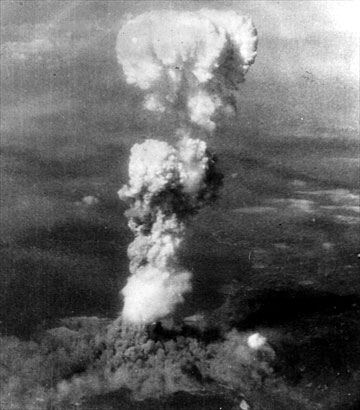
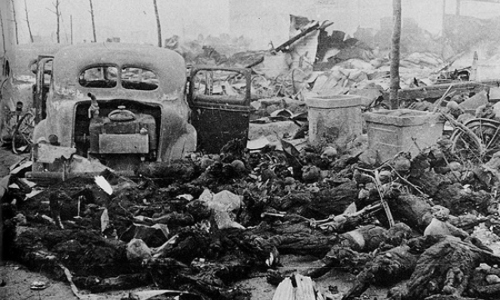
Seventy years ago the world changed. A remarkably destructive weapon was introduced in combat, a single bomb that annihilated the city of Hiroshima Japan. The effects were immediate, 70,000 to 80,000 people were killed, tens of thousands of others wounded, many of whom would suffer from the effects of radiation and radiation burns the rest of their lives. Within days a second bomb was dropped on Nagasaki with similar results, and Japan sued for peace. The Second World War was over and a new world was born, a world under the shadow of nuclear weapons.

John Hersey in his book on Hiroshima wrote: “The crux of the matter is whether total war in its present form is justifiable, even when it serves a just purpose. Does it not have material and spiritual evil as its consequences which far exceed whatever good might result? When will our moralists give us an answer to this question?” I have to echo his thoughts.

I teach the ethics of war to senior military officers at a major US. Military Staff College. One of the things that we do in the class is to have the officers do presentations on different historical, or potential ethical problems faced by national policy makers, military commanders and planners. The goal is to have these men and women dig deep and examine the issues, and think about the implications of what they will do when they go back out to serve as commanders, staff officers, advisors to civilian leaders and planners.

In each class at least one student deals with the use of the Atomic bombs, often these are Air Force or Navy officers who have served with nuclear forces. Unlike the depiction in the classic movie Dr. Strangelove or other depictions that show officers in these forces as madmen, the fact is that I have been impressed with the thoughtfulness and introspective nature of these men and women. The sincerely wrestle with the implications of the use of these weapons, and many are critical of the use of them at Hiroshima and Nagasaki. That is comforting to me to know that at least in the U.S. military that there are many who can reflect and do try to look at things not just from a purely military standpoint. Of course since I know humanity I figure that there are others in our ranks who are not so reflective or sensitive to the moral implications of the use of these weapons.

I am no stranger to what these weapons, as well as chemical and biological weapons can do. Thirty years ago when I was a young Army Medical Service Corps lieutenant I was trained as a Nuclear, Chemical and Biological Defense Officer. I learned the physical effects of exposure to these weapons, how many Rads of radiation a person could receive before they became sick and died. I learned what radiation exposure does to people at each stage. We trained with maps to chart fallout patterns, and the maps had the cities and towns that we lived in, this was Cold War Germany and yes both NATO and the Warsaw Pact expected that tactical nuclear weapons and chemical weapons would be used and we had to be able to operate in contaminated environments. We operated under the idea of Mutual Assured Destruction or MAD as a deterrent to war. It was chilling and made me realize that the use of these weapons today would be suicidal. When Chernobyl melted down we were in the fallout zone and were given instructions on what we could and could not do in order to minimize any possible exposure to radiation poisoning.

So when it comes to the first use of the Atomic bomb I am quite reflective. As a historian, military officer, chaplain and priest who has been trained on what these weapons can do I have a fairly unique perspective. Honestly, as a historian I can understand the reasons that President Truman ordered its use, and I can understand the objections of some of the bomb’s designers on why it should not be used. I’ve done the math and the estimates of casualties had there been an invasion of the Japanese home islands is in the millions, most of which would have been Japanese civilians.

9674_Photo_5

My inner lawyer can argue either point well, that being said the manner in which it was used at Hiroshima and Nagasaki troubles me. Hiroshima did have military targets, but a big part of the choice was its location, surrounded by hills, which created a bowl that would focus the explosion and maximized its effect. Many of the larger military and industrial targets lay outside the kill zone. The designers and officers on the committee wanted to show the Japanese, as well as the world the destructive power of the weapon. Those who opposed its use hoped that it would convince the leaders of nations that war itself needed to be prevented. The recommendation of the committee can be found here:

http://www.atomicarchive.com/Docs/ManhattanProject/Interim.shtml

Of the 150 scientists who were part of the bomb’s design team only 15% recommended the military use without a demonstration to show the Japanese the destructive power of the bomb and a chance to end the war. The poll of the scientists can be found here:

http://www.atomicarchive.com/Docs/ManhattanProject/Poll.shtml

Leo Szilard wrote a letter to Edward Teller seeking his support in sending a petition to President Truman regarding his opposition to the use of the weapon based on purely moral considerations. Szilard wrote:

“However small the chance might be that our petition may influence the course of events, I personally feel that it would be a matter of importance if a large number of scientists who have worked in this field wont clearly and unmistakably on record as to their opposition on moral grounds to the use of these bombs in the present phase of the war.

Many of us are inclined to say that individual Germans share the guilt for the acts which Germany committed during this war because they did not raise their voices in protest against those acts, Their defense that their protest would have been of no avail hardly seems acceptable even though these Germans could not have protested without running risks to life and liberty. We are in a position to raise our voices without incurring any such risks even though we might incur the displeasure of some of those who are at present in charge of controlling the work on “atomic power.”

The entire text is here:

http://www.atomicarchive.com/Docs/ManhattanProject/SzilardTeller1.shtml

The two petitions of the scientists to the President are here, the second letter concludes with this recommendation:

“If after the war a situation is allowed to develop in the world which permits rival powers to be in uncontrolled possession of these new means of destruction, the cities of the United States as well as the cities of other nations will be continuous danger of sudden annihilation. All the resources of the United States, moral and material, may have to be mobilized to prevent the advent of such a world situation. Its prevention is at present the solemn responsibility of the United States–singled out by virtue of her lead in the field of atomic power.

The added material strength which this lead gives to the United States brings with it the obligation of restraint and if we were to violate this obligation our moral position would be weakened in the eyes of the world and in our own eyes. It would then be more difficult for us to live up to our responsibility of bringing the unloosened forces of destruction under control.

In view of the foregoing, we, the undersigned, respectfully petition: first, that you exercise your power as Commander-in-Chief to rule that the United States shall not resort to the use of atomic bombs in this war unless the terms which will be imposed upon Japan have been made public in detail and Japan knowing these terms has refused to surrender; second, that in such an event the question whether or not to use atomic bombs be decided by you in the light of the consideration presented in this petition as well as all the other moral responsibilities which are involved.”

http://www.atomicarchive.com/Docs/ManhattanProject/SzilardPetition.shtml

http://www.atomicarchive.com/Docs/ManhattanProject/Petition.shtml

Ralph Bard, Undersecretary of the Navy wrote to Secretary of War Stimson his opinion on July 17th 1945:

“Ever since I have been in touch with this program I have had a feeling that before the bomb is actually used against Japan that Japan should have some preliminary warning for say two or three days in advance of use. The position of the United States as a great humanitarian nation and the fair play attitude of our people generally is responsible in the main for this feeling.”

I think that those who debate the history of this need to look at the entire picture and read the letters, the documents and take into account everything. My hope is that leaders, policy makers, legislators and we the people continue to work to eliminate nuclear weapons. It is true that the nuclear stockpiles of the United States and Russia are significantly smaller than when the Cold War ended, but even so what remain are more than enough to extinguish human life on the planet. Add to these the Chinese, French, British, Indian, Pakistani and the hundreds of undeclared weapons of Israel the fact is that there remains the possibility that they could be used. Likewise there are nuclear programs in other nations which given enough time or believing them necessary could produce weapons, including Iran and Saudi Arabia. Add to this the possibility of a terrorist group producing or acquiring a weapon the world is still a very dangerous place.

26362hiroshima_shame

That is the world that we live in and the world in which policy makers, legislators and educated people who care about the world must attempt to make safe. If you asked me I would say outlaw them, but that will never happen. Edward Teller wrote Leon Szilard:

“First of all let me say that I have no hope of clearing my conscience. The things we are working on are so terrible that no amount of protesting or fiddling with politics will save our souls…. Our only hope is in getting the facts of our results before the people. This might help to convince everybody that the next war would be fatal. For this purpose actual combat use might even be the best thing…. But I feel that I should do the wrong thing if I tried to say how to tie the little toe of the ghost to the bottle from which we just helped it to escape…”

The ghost is out of the bottle, and nothing can ever get it back in. We can only hope and pray that reasonable people prevent any of these weapons from ever being used and that war itself would end.

Peace

Padre Steve+

2 Comments

Filed under ethics, History, Military, News and current events, Political Commentary, world war two in the pacific

Barak Obama and the Beginning of the End of the Castro Regime

negate

In 1961 the Kennedy administration imposed a diplomatic and economic embargo on the nascent Castro regime in Cuba. At the time with the Cold War going full steam ahead the decision seemed logical and appropriate. Never mid the fact that decades of American policy which favored the Bautista dictatorship, the economic interests of American corporations and did nothing to help Cuba’s poor had helped bring about Castro’s rule. Likewise never mind the fact that Americans using Cuban mercenaries only pushed Castro further into Soviet orbit with the Bay of Pigs invasion.

But following the Cuba missile crisis the embargo and diplomatic isolation remained in place. However, in 1972 President Richard Nixon brokered a deal of detente with the Soviet Union, a superpower that was an existential threat to the United States, as well as Mao Tse Tung’s Communist China, a power that we had fought to a standstill in Korea, and which had just a few years before embarked on its “cultural revolution” one of the bloodiest and ruthless events of the twentieth century.

Nixon was a diplomatic genius who was not so wedded to his own extremely anti-Communist ideology not to recognize when a moment to change history was in the offing. Otto Von Bismarck noted that “The statesman’s task is to hear God’s footsteps marching through history and then to try to catch onto his coattails as He marches past.”

Bismarck was right and both Nixon and Obama heard the footsteps of God in terms of diplomacy and foreign relations. Sadly very few ideologues, like Senator Marco Rubio ever get this nuance and would rather maintain a failed policy that neither benefits the United States or the Cuban people, but which is one of the few things that have kept the Castro brothers in business long after most Communist regimes ended up on the ash-heap of history.

The amazing thing is that the polices of Richard Nixon regarding the Soviet Union and China had dramatic and positive effects that his successors, be they Republican or Democrat really did not grasp. Instead, when the Iron curtain came down we in the west did all that we could to humiliate the former USSR and brought about the bellicose dictator by another name Vladimir Putin. Likewise we failed to understand the pragmatic and nationalistic nature of the Chinese Communist regime that was brought about by Mao’s successor Deng Xiaoping. In both cases our failure to grasp the reality of our former opponents created new adversaries.

But such was not the case with Cuba. Cuba was different, especially after the Cold War ended. Despite our differences Cuba and the United States should have been able to overcome the effects of Castro’s seizure of power and brokered an understanding. Yes Castro was and is a Communist, but that, even during the Cold War did not prevent effective diplomacy with other Communist states such as Tito’s Yugoslavia, a country that had there been a conflict between the Soviet Union and NATO that might have well sided with the west. But with Cuba there was no nuance. Castro was the enemy.

The irony was that in the 1970s, 1980s and 1990s it was Cuban soldiers that protected U.S. based oil company refineries, installations and American personnel in Angola against CIA sponsored insurgents.

The American economic embargo has been a failure for decades. This was even more the case after after the fall of the Soviet Union when our allies in South and Central America and Europe realized that Cuba was no longer a threat and refused to support our embargo, rendering it impotent, except in the domestic politics of South Florida. Only fools believe that continuing it will change Cuba. The economic and diplomatic isolation has been going on for 53 years, 23 of them after the fall of the Iron curtain, and it has failed. Fools like Marco Rubio who even before President Obama made his announcement was at a microphone condemning the decision. But then Marco Rubio is both an ideologue who basks in his status of being a victim of the dying Castro regime.

The arguments of Rubio and the other partisan flacks in the American domestic political scene for maintaining the economic embargo and diplomatic isolation are not only short sighted and play to their own local political constituency, but they work against the United States in trying to achieve a responsible and workable solution to the impasse that has poisoned Cuban-American relations for six decades.

The fact is, despite the protestation of Rubio and others we deal with a lot more unsavory characters than the Castros. Yes, they are thugs. Yes they run a police state with few freedoms and where religious liberty is not protected, but they didn’t support Al Qaida like some of our closest allies in the Middle East did, they never near sank a U.S. Navy ship like Israel did in the six day war, and they didn’t kill or wound tens of thousands of U.S. military personnel like the Chinese did when they intervened in the Korea War. From a terrorist or real military threat to U.S. National Security interests the Cubans are minor leaguers and their leaders know that.

President Obama has brought about a political and diplomatic coup in Cuban-America relations, and for now on there will be no going back. Maybe now the United States and Cuba will be able to fulfill our common destinies to work together for the betterment of our hemisphere and world.

Of course for taking this long overdue action, something that either President Bush or President Clinton should have done years ago is now being called a traitor and worse by his domestic political opponents. However, like Pope John Paul II, Pope Benedict and now Pope Francis realized, the time has come for change in our relationship.

This is a historic day and a decision that was long overdue. It is a watershed, and even if the Congress refuses to lift the economic aspects, things in Cuba will change. Freedom will come and soon Cubans and Americans will finally have the chance to build a constructive and positive relationship that helps both peoples.

I have stood at the Northeast Gate of Guantanamo Bay, I have looked over the fence line at Cuba, and I pray that one day I will see the rest of that country.

This is a good night… And as a side note it will be great for baseball. Just imagine the course of history had Fidel Castro been drafted by the Yankees in the early 1950s. Hell he might be the President of the America League by now and he might not have agreed with the designated hitter rule.

But that being sad, Barak Obama should be getting the accolades given to  Nixon, and later Ronald Reagan when he dealt with Gorbachev in 1986 and 1987. This is a watershed and it will change Cuban-American relations for the better, and help the Cuban people. This is a win for the good guys, and even more importantly it will be a win for baseball.

Peace

Padre Steve+

1 Comment

Filed under Foreign Policy, leadership, national security, Political Commentary

Der Schicksaltag: An Execution, an Abdication, a Beer Hall Putsch, Kristallnacht, and the Fall of the Wall

Hitler-Putsch, M¸nchen, Marienplatz

Schicksaltag: The Fateful Day and the Beer Hall Putsch November 9th 1923

There are some days in history that are crammed full world changing events, and sometimes those events occur, for good or bad and sometimes good and bad in different countries. In the United States July 4th is not only Independence Day, but eighty-seven years later marked the surrender of Vicksburg and the retreat of Robert E. Lee’s army from Gettysburg. Likewise it was the day that the Louisiana Purchase was announced in 1803 and that in 1826 the Thomas Jefferson and John Adams died. In Russia however it was on July 4th 1918 that Czar Nicholas and his family were killed by the Bolsheviks.

Since 1918 November 9th has been a day in German history that has impacted both Germany and the world in many ways. In a sense it is almost hard to believe that so much occurred on that day. It is known by many as Der Schicksaltag (the fateful day).

robert-blum-03


Robert Blum

In 1848 a member of the Frankfurt Parliament, Robert Blum was arrested and executed executed for traveling to Vienna to support the 1848 democracy uprising there. A liberal, humanist and democrat Blum advocated German unification without Prussian dominance, protested Prussian oppression of Poles, stood against anti-Semitism and for the rights of Catholics in heavily Protestant German kingdoms. Blum’s dream remained unfulfilled for over a century after his death.

Wilhelm II. (4.v.l.) geht am Tag der Unterzeichnung seiner Abdankung über die Grenze in das holländische Exil


Kaiser Wilhelm II Cross the Dutch Border Following his Abdication

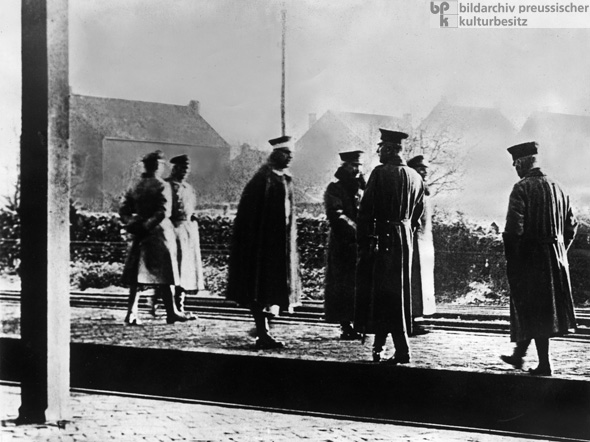
It was a gloomy day at the military headquarters of Kaiser Wilhelm II on November 9th 1918 when General Wilhelm Groener looked his sovereign in the eye and told Kaiser Wilhelm that the war was lost, and that he no longer had the support of the Army. The Kaiser, reeling from battlefield defeats and the mutiny of the High Seas Fleet was stunned, and Field Marshal Paul von Hindenburg, who had for all practical intents directed the war effort meekly nodded his concurrence with Groener. The Kaiser abdicated the throne and departed in his private train to the Netherlands the next day.

ausrufung-der-republik-in-berlin-preview-image_900x510


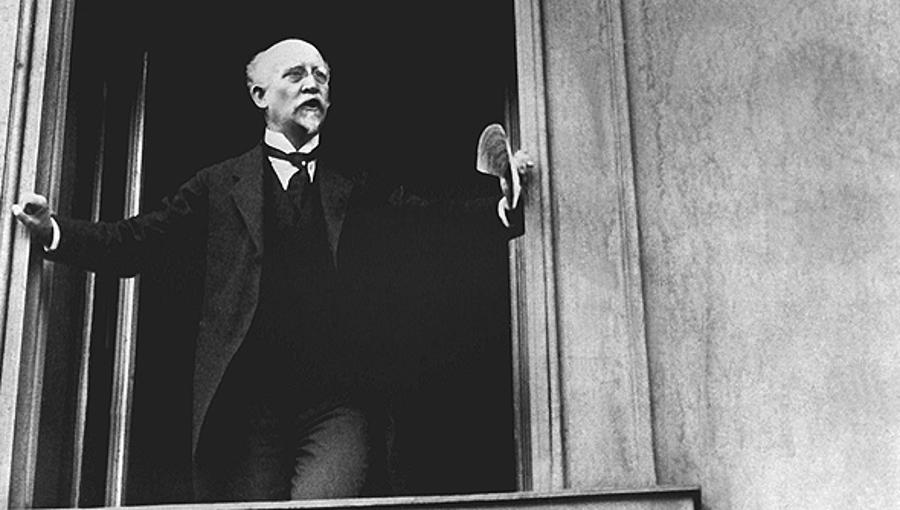
Phillip Scheidemann Proclaims the Republic 

In Berlin Majority Socialist parliament member Philip Scheidemann proclaimed the Republic, in part to prevent a Soviet takeover, which became known as the Weimar Republic. However, the promise of democracy was soured by a continued allied blockade, a humiliating peace treaty, loss of territory, and occupation of the industrial areas of the Ruhr and Saar by France and Belgium, heavy reparations, and war guilt; compounded by civil war between various right and left wing factions and major economic problems including massive hyper-inflation doomed the young republic.

Beer Hall Putsch


Beer Hall Putsch

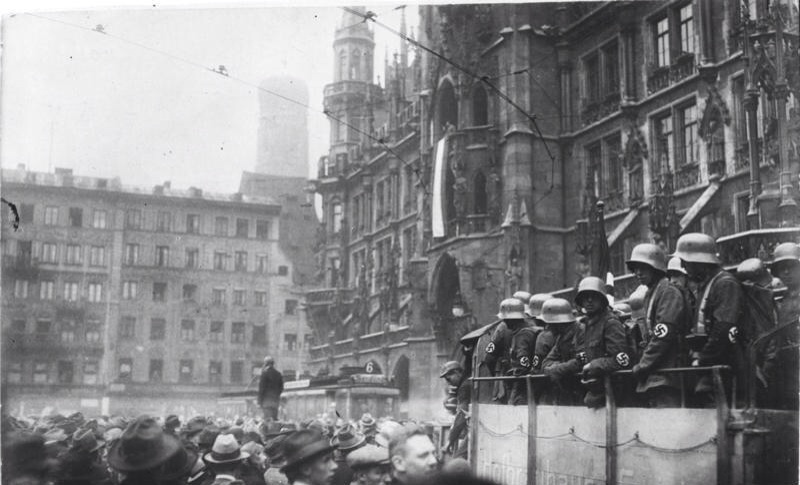
Five years later an Austrian in Munich who had fought and been wounded fighting for Germany in the First World War gathered with his political sympathizes and para-military street thugs and attempted a putsch. The man was Adolf Hitler, the head of the small and radical National Socialist Deutches Arbeiter Partei, or National Socialist German Workers Party, which he hoped that his putsch would result in a popular uprising against the German government in Berlin. The putsch was a failure and ended in bloodshed at the Feldherrnhalle on Munich’s Odeonsplatz.

Hitler was wounded, convicted of treason and jailed for nine months at the Landesberg prison where he wrote his book Mein Kampf and continued to recruit others to his cause. Under ten years later Hitler was appointed Chancellor by President Hindenburg. He quickly banned political opposition and began his persecution of Jews and others that he believed to be sub human and on Hindenburg’s death in 1934 merged the office of Chancellor and President become the leader of Nazi Germany.

In November 1938 Hitler’s and his henchmen were looking for a reason to openly begin persecuting the Jews, something that they had already been doing since the seizure of power. One of the chief reasons for this was to seize the property and financial resources of German Jews, which coincided with the expulsion of Polish Jews from Germany. A reason was furnished when a young Polish man, Herschel Grynszpan, whose parents were expelled from Germany on November 3rd went to the German embassy in Paris and shot and mortally wounded Ernst von Rath, a young diplomat, who reportedly had some anti-Nazi sentiments.

kristallnacht1


The murder was what Josef Goebbels needed and on the night of November 9th Nazi storm troopers ransacked Jewish businesses, homes and synagogues causing hundreds of millions of Reichsmarks in damage, destroying over 200 synagogues and 7000 businesses. About 100 Jews were killed during the rampage, which went unchecked by police. Another 2000-3000 subsequently died either by suicide or in concentration camps. About 30,000 Jewish men were incarcerated. To add to the insult to injury Jews were charged for the damage done to their property and insurance payments that should have gone to them were collected by the state. The night became known as Kristallnacht, the night of broken glass and marked a major turn in the open Nazi persecution of Jews in Germany, which would extend throughout Europe and end in the Final Solution and the systematic murder of nearly six million Jews. World War Two ended with the total defeat of Germany and the Nazi regime.

berlin_wall_02


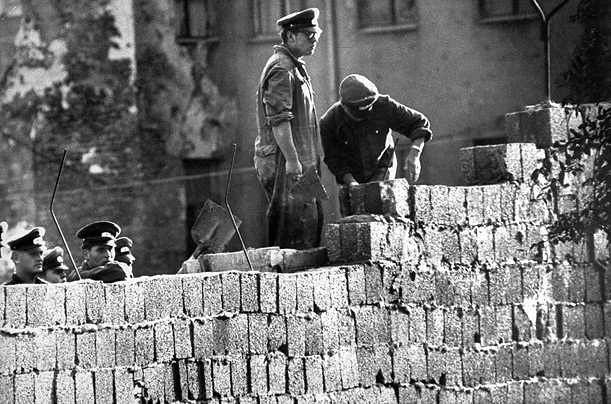
Occupied by the allied powers Germany was split in two, the East under the domination of the Soviet Union which became the German Democratic Republic, and the West which supported by the United States and Britain became the Federal Republic of Germany. The divided country became the focal point of what became the Cold War, the fortified border became infamous as the Iron Curtain. The divided Berlin was blockaded by the Soviets in 1948 and the subsequent airlift kept West Berlin Free. However in August 1961 as the Cold War escalated the leaders of East Germany erected a fence which became the Berlin Wall, a wall which was effectively a means to imprison the population. It seemed to be a fixture that would never come down.

berlin-wall_1412605c

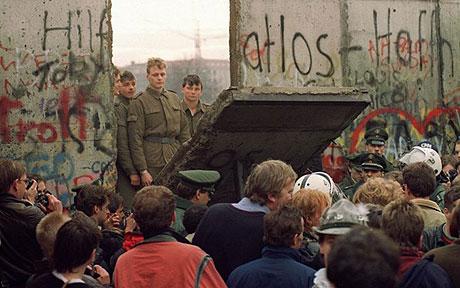
But in the 1980s the Cold War began to thaw, the economically strapped Soviet Union was bogged down in a costly war in Afghanistan, and a struggle against a Polish democratic movement; Premier Gorbachev sought to relieve the situation with a policy of openness. It backfired, throughout Eastern Europe, pro-democracy and pro-freedom groups began to protest the status quo, and as borders were opened hundreds of thousands of Eastern Europeans including thousands of East Germans went west through Hungary and Czechoslovakia. East Germans began to gather at the wall and on November 9th 1989 a tottering East German government decided to open border crossing points, but on hearing the news hundreds of thousands of people gathered at the six crossings demanding to be let through, finally, ignoring orders, Stasi Lieutenant Colonel Harald Jäger who commanded the Bornholmer Strasse crossing opened the gates. The wall had fallen and 339 days later East Germany was dissolved and Germany reunited.

The new Germany is the economic heart of the European Union and has become a champion of human rights and social progress. It has now been twenty five years since the Wall fell, seventy-six years since Kristallnacht, eighty-nine years since the Beer Hall Putsch and ninety-six years since the abdication of Kaiser Wilhelm II. These are all important events, and our challenge as citizens of the world is never to forget just how important and fateful each was, and why November 9th is indeed the “fateful day.”

Peace,

Padre Steve+

2 Comments

Filed under History

The Long and Winding Road of 31 Years of Commissioned Service

hogansheroeslook

Today marks another milestone in my life and career, at least in terms of longevity. Thirty-one years ago today I was with my soon to be wife Judy, as well as my dad and brother at UCLA where I was being commissioned as a Second Lieutenant in the U.S. Army. Six days later I married Judy who has over the past 31 years seen me go my down the long and winding road of my military career. Truthfully the long and winding road has been to use the words of Jerry Garcia a “long strange trip” and usually not the Yellow Brink Road.

commissioningmeandjudy557thcmdpic2ndplt557motorofficerpromotiontocpt

Let’s see…service as a Medical Service Corps Officer, platoon, leader, company executive officer, maintenance officer, NBC officer, and company commander, and brigade adjutant. Texas Army National Guard, Armor officer, Chaplain Candidate (Staff Specialist Branch) and Chaplain serving with Combat Engineers, and Chaplain in the Virginia National Guard with the Light Infantry. Army Reserve Chaplain, drilling and mobilized to support Bosnia mission, Installation Chaplain at Fort Indiantown Gap Pennsylvania.

checkpointcharliekoreandmzbrabdenburgertornegate

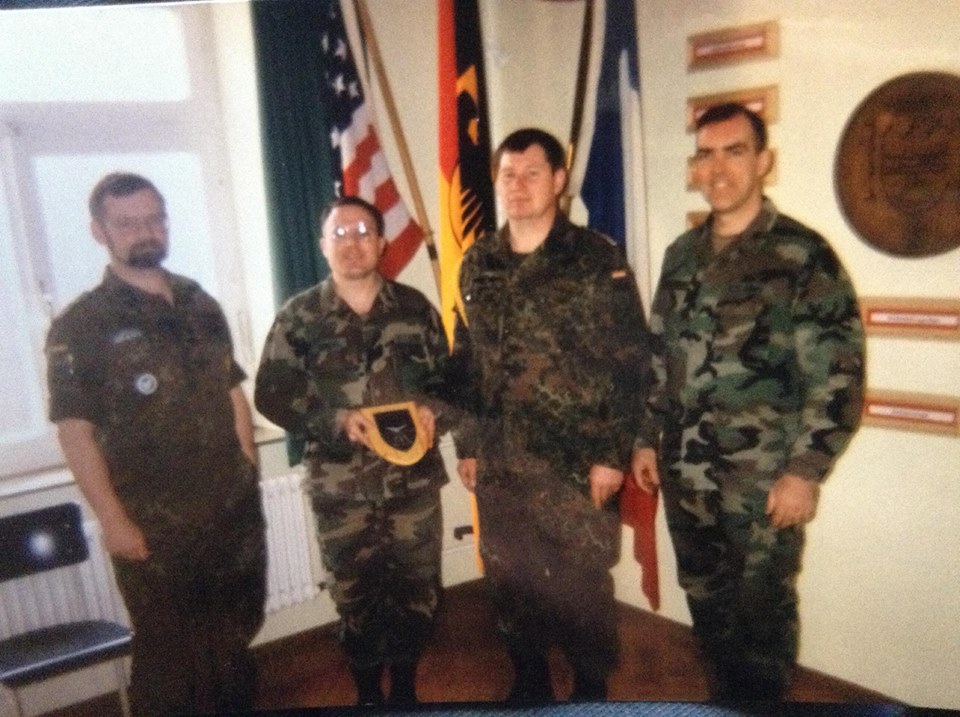
The Army, Cold War Germany, the Fulda Gap and the Berlin Wall, supporting the Bosnia mission, exercises, and active duty for training, even doing an exchange program with the German Bundeswehr.

flakfeuerwurzburg

AHSparadeeasterboardingteamfujibostonhuecityscotland

Then the path took a different direction. After 17 1/2 years in the Army Judy was looking forward to the day that I would retire from the reserves and she would have me back. Instead, I took off my rank as an Army Reserve Major and became a Navy Chaplain. Two tours with the Marine Corps, Second Marine Division and Marine Security Forces, Sea Duty on the USS Hue City, a tour with EOD, interspersed with an individual augmentee in Iraq followed by 5 years working in Medical Naval Centers or hospitals and finally serving as Chaplain and doing teaching in military ethics and military history at the Joint Forces Staff College.

jordannellieandmeiraqramadibettertimesdinner-w-bg-sabah1

Lots of field exercises and underway periods at sea, travel around the world to support deployed Marines, a Marine Deployment to Okinawa, mainland Japan and Korea including the DMZ. Then along came the 9-11-2001 attacks and war. A deployment to the Horn of Africa, the Gulf of Oman and the Northern Arabian Gulf in support of Operation Enduring Freedom and Operation Southern Watch aboard the Hue City, served as a member of a boarding team making 75 missions to detained Iraqi Oil Smugglers and helping keep peace on those miserable ships. Traveling to Europe, the Middle East, Asia and Guantanamo Bay Cuba with the Marine Security Forces, standing at Gitmo’s Northeast Gate, and completing the “Commie Trifeca” of Cold War German, Korea and Cuba.

easterramadi2boarding teamnellieandme

Then there was EOD, serving with some of the most amazing men and women I have ever met, a tour in Iraq with my trusty assistant, bodyguard and friend Nelson Lebron. Of course as any reader of this site knows the time in Iraq changed me forever, the aftereffects of that tour remain with me every day, the battle with PTSD, anxiety, hyper-vigilance, depression and the shattering effect of seeing that my government leaders had lied about the reasons for war and by their actions devastated a country and helped throw a region into chaos. I saw the suffering of Americans as well as Iraqis in Al Anbar Province, death, badly injured Marines, soldiers and Iraqis, poorly treated third world nationals working for Halliburton and other contractors. After coming home dealing with all of my shit while trying to care for others in back to back tours at two different Naval Medical centers or hospitals. The ongoing violence in Iraq and the fact that that unfortunate country and its people are going to suffer more haunts me. I miss Iraq, I would go back not because I love war, but because I care about the Iraqi people.

normandysstaffridestaffride

Now I minister, celebrate Eucharist in my little chapel, care for people and teach. The highlight of my life is leading our institution’s Gettysburg Staff Ride and being able to research, read, ponder, analyze and write about that campaign, the Civil War and relate it to what we teach at our institution.

meandjudyLCDRusmcballgitmojudynellieme

Throughout my career there have been two constants, my long suffering wife Judy who has spent close to ten of the last 17 or 18 years without me and those who I served alongside, many of who I am still in contact with through Facebook. I am amazed at the quality of men and women who have served alongside of me since 1981. The funny thing is that even though I probably still have another five to six years until I finally retire to civilian life, that I am watching men and women who entered the military 10-13 years after me retiring from the military.

antichaps

Thankfully I still love what I do and serve in a great place. To those who have served alongside me all these years in any capacity I thank you. You don’t get to where I am in life without a good deal of help, sage advice from men and women not afraid to speak the truth and without a bit of good luck and fortune and maybe a bit of the grace and mercy of God.

Yes it has been a long strange trip down a long and winding road, but it has been more than I could ever imagine.

Have a great night and thanks for reading,

Peace

Padre Steve+


1 Comment

Filed under Loose thoughts and musings, Military, ministry

The Importance of Citizen Soldiers: Strong Vincent and Joshua Chamberlain at Little Round Top and American Military Sociology

dont give an inch

“As soldier and citizen, today’s armed forces officer is a champion of both the nation’s defense and the principles upon which the nation was founded. Taking an oath to support and defend the Constitution means swearing to uphold the core values that define the essence of American citizenship; the armed forces officer is first and foremost a citizen who has embraced the ideals of the nation—only then can he or she defend those principles with true conviction.” [1]

While the professional Gouverneur Warren through himself into the battle to save Little Round Top, as did many others the story of the battle dictates that we must discuss the actions of two “citizen soldiers” without whom the battle may have been lost, Colonel Strong Vincent and Colonel Joshua Chamberlain. Both are depicted and immortalized in the film Gettysburg which is based on Michael Shaara’s Pulitzer Prize winning novel The Killer Angels. As such their actions are known more than many others that are covered in this account of the Battle of Gettysburg.

Within the U.S. Army the example of Chamberlain at the Battle of Little Round Top has occupied a prominent place in Army leadership manuals including FM 22-100 and its successor FM 6-22, however, that being said even those that learn about Chamberlain from this seldom delve deeper into his character, development as a leader and significance, at Little Round Top, Appomattox and after the war, likewise the examples of both Warren and Vincent which are key to Chamberlain and his regiment even being on the hill are ignored in that publication.

It is important to discuss Vincent and Chamberlain for more than their direct contributions to the battle. Those are widely known and in a sense have become part of the myth that is our understanding of Gettysburg. While discussing those actions it is also necessary to put them into context with the character of both men, the cause that they fought. Likewise it is important to address in this age of the professional all volunteer force the importance of Citizen Soldiers in any kind of democracy or representative republic, a sociological question that military professionals as well as our elected officials and citizenry would do well to revisit.

This is particularly important now as various elected leaders, think tanks, defense contractors and lobbyists are all questioning the economic “liabilities” of the All-Volunteer force as well as the disconnect between the broader military and society at large. This means that there will be efforts to determine how the military will be manned, trained and employed, and if military leaders are ignorant of our history, the vital connection between the military and the citizenry and the contributions of Citizen Soldiers then we will be caught flat footed and unprepared in the coming debates. If that happens those decisions could be made by “bean counters” with little appreciation for what military professionalism and readiness entails, as well as think tanks and lobbyists for the defense industry who have their own motivations for what they do, often more related to their profits, power and influence than national security.

The armies that fought the Civil War for the most part were composed of volunteers who of a myriad of reasons went off to fight that war. Gouverneur Warren is a character whose life and career before and after the Civil War was much more like currently serving regular officers and to some extent the much more professional and hardened by war officer corps of the Reserve Components of each of our Armed Services, in particular the much active and deployed Army National Guard and Army Reserve. The reserve components still do reflect much of the Citizen Soldier tradition but that being said between deployments, other activations and required schooling, those assets are much more on par with their active counterparts than they ever have been in our history.

“American defense policy has traditionally been built upon pluralistic military institutions, most notably a mix force of professionals and citizen soldiers.” [2] Warren represented what until the beginning of the Cold War was the smaller pillar of that pluralistic institution that of the long term professional while Vincent and Chamberlain represented the volunteer citizen soldier who enlisted to meet the crisis.

Until World War II and the advent of the Cold War these dual pillars existed side by side. Following the Second World War along with the small-wars that went along as part of it the world changed, and the wars that occurred, such as Korea and Vietnam “occurred on a scale too small to elicit a sustained, full-fledged national commitment, yet too large for a prewar-style regular army to handle.” [3] Because of this “military requirements thus became a fundamental ingredient of foreign policy, and military men and institutions acquired authority and influence far surpassing that ever previously possessed by military professionals on the American scene.” [4] General Tony Zinni noted that the foreign policy results of this transformation have resulted in the United States becoming “an empire” [5] something that no American living in 1863 could have ever contemplated.

This was part of a revolution in military affairs far more important than the application of technology which brought it about, the Atomic Bomb; it was a revolution in national strategy which fundamentally changed American thinking regarding the use of the military instrument in relationship to diplomacy, and the relationship of the military to society at large. Russell Weigley noted: “To shift the American definition of strategy from the use of combats for the object of wars to the use of military force for the deterrence of war, albeit while still serving the national interests in an active manner, amounted to a revolution in the history of American military policy….” [6]

The policy worked reasonably well until Vietnam and the inequities of the system showed its liabilities and brought about a change from politicians. Lieutenant General Hal Moore wrote of the Vietnam era: “The class of 1965 came out of the old America, a nation that disappeared forever in the smoke that billowed off the jungle battlegrounds where we fought and bled. The country that sent us off to war was not there to welcome us home. It no longer existed.” [7]

The debacle of Vietnam and the societal tidal wave that followed brought about the end of the selective service system, by which the large army needed to fight wars was connected to the society at large and the creation of the All-Volunteer force by President Nixon in 1974. The ethos that every citizen was a soldier was destroyed by Vietnam and even men like General William Westmoreland who warned that “absent “the continuous movement of citizens in and out of the service,…the army could “become a danger to our society-a danger that our forefathers so carefully tried to preclude.” [8]

This cultural shift is something that none of the professional officers of the small ante-bellum army like Warren would have ever imagined much less men like Vincent or Chamberlain who were true citizen-soldiers. Thus for currently serving officers it is important to recognize this key change as it applies to American military strategy as well as the place the military occupies in our society. This makes it important to our study as we examine the actions of Vincent and Chamberlain outside of myth and legend and see the implications that they can have not only on the battlefield but in our relationship to the American citizenry and society. It is to put in in classic terms a return to understanding the relationship between the military and the people so powerfully enunciate in Clausewitz’s Trinity.

While Warren represents the Strong Vincent and Joshua Chamberlain represented that important part of our military tradition that really, except in the case of young men and women that volunteer to serve and leave the military after their obligated service really no longer exists. We no longer have a system that allows, nor do we actively encourage men like Vincent and Chamberlain to leave lucrative civilian employment or academia to serve alongside the professionals in positions of responsibility leading regiments or brigades or serving as senior staff officers unless they are already part of the military in our reserve components.

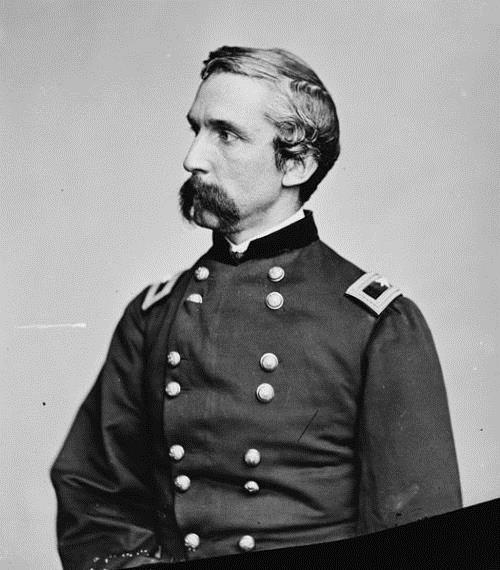
vincent

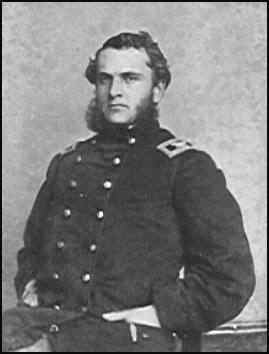
Colonel Strong Vincent was a 26 year old Harvard graduate and lawyer from Erie Pennsylvania. Vincent enlisted and then was appointed as a 1st Lieutenant and Adjutant of the Erie Regiment because of his academic and administrative acumen. He married his wife Elizabeth the same day. Vincent like many young northerners believed in the cause of the Union undivided, and he wrote his wife shortly after after the regiment went to war on the Peninsula:

“Surely the right will prevail. If I live we will rejoice in our country’s success. If I fall, remember you have given your husband to the most righteous cause that ever widowed a woman.”[9]

Vincent was commissioned as a Lieutenant Colonel in the 83rd Pennsylvania September 14th 1861. The young officer learned his trade well and was considered a “strict disciplinarian and master of drill.” [10] That being said one enlisted man remarked that “no officer in the army was more thoughtful and considerate of  the health and comfort of his men.” He assumed command of the regiment when the commander was killed during the Seven Days in June of 1862 where he learned lessons that he would help impart to his fellow officers as well as subordinates, including Chamberlain. Following a bout with a combination of Malaria and Typhoid that almost killed him, he took command of the regiment. He commanded the regiment at Fredericksburg and was promoted to command the 3rd Brigade when its commander was killed at Chancellorsville in May 1863. Vincent was offered the chance to serve as the Judge Advocate General of the Army of the Potomac in the spring of 1863 after spending three months on court-martial duty. But refused the offer in order to remain in the fight commanding troops. [11]

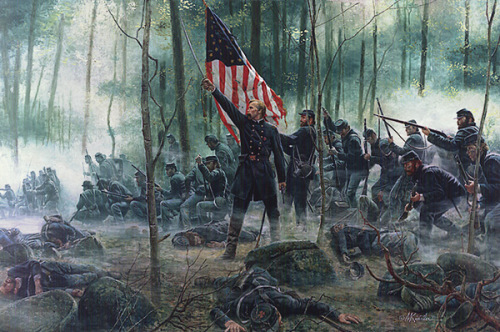
Unlike most other brigade commanders, Vincent was still a Colonel, and he, like many others would in his place hoped that going into action to save Sickles’ command “will either bring me my stars, or finish my career as a soldier.” [12] On July first, Vincent, a native Pennsylvanian came to Hanover and learning that battle had been joined, ordered “the pipes and drums of the 83rd Pennsylvania to play his brigade through the town and ordered the regiments to uncover their flags again….” [13] As the brigade marched through the town Vincent “reverently bared his head” and announced to his adjutant, “What death more glorious can any man desire than to die on the soil of old Pennsylvania fighting for that flag?” [14]

Vincent was known for his personal courage and a soldier of the 83rd Pennsylvania observed “Vincent had a particular penchant for being in the lead….Whenever or wherever his brigade might be in a position to get ahead…, he was sure to be ahead.” [15] That courage and acumen to be in the right place at the right time was in evidence when he led his brigade into battle on July second.

On July 2nd Barnes’ division of V Corps, which Vincent’s brigade was a part was being deployed to the threat posed by the Confederate attack of McLaws’ division on the Peach Orchard and the Wheat Field to reinforce Sickles’ III Corps. While that division marched toward the Peach Orchard, Vincent’s 3rd Brigade was the trail unit. When Gouverneur Warren’s aide, Lieutenant Randall Mackenzie [16] came toward the unit in search of Barnes he came across Vincent and his brigade near the George Weikert house on Cemetery Ridge awaiting further orders. [17] Vincent intercepted him and demanded what his orders were. Upon being told that Sykes’ orders to Barnes were to “send one of his brigades to occupy that hill yonder,” [18] Vincent, defied normal protocol assuming that Barnes was drunk [19] told Mackenzie “I will take responsibility of taking my brigade there.” [20]

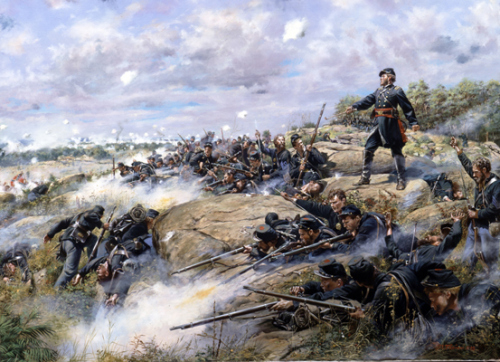
It was a fortunate thing for the Union that he did. His quick action to get his brigade, clear orders to his subordinate commanders and skilled analysis of the ground were a decisive factor in the Union forces holding Little Round Top. He ordered Colonel James C. Rice of the 44th New York to lead the brigade up to the hill while he and his aide went forward to scout positions as the brigade moved forward at the double quick “across the field to the road leading up the north shoulder of the hill” with Chamberlain’s 20th Maine in the lead. [21] Looking at the ground which had the valley and Devil’s Den, occupied by the end of Sickles’ line, he chose a position along a spur of the hill running from the northwest to the southeast to place his regiments where they could intercept the Confederate troops of Hood’s division which he could see advancing toward the hill.

The 16th Michigan, his smallest regiment was placed on the right of the brigade. That section of the line was located on massive boulders that placed it high above the valley below, making it nearly impregnable to frontal attack. He deployed the 83rd Pennsylvania and 44th New York, known as Butterfield’s Twins to their left at the request of Rice who told him “In every battle that we have engaged the Eighty-third and Forty-fourth have fought side by side. I wish that it might be so today.” [22] Those units were deployed below the crest among the large number of boulders; the 83rd was about two-thirds of the way down the way down the slope where it joined the right of the 44th, whose line angled back up the slope to the southeast.

Vincent deployed the 20th Maine on his extreme left of his line, and in fact the extreme end of the Union line. Vincent knew that if this flank was turned and Chamberlain overrun that it would imperil the entire Union position. Vincent came up to Chamberlain who remembered that Vincent said “in an awed, faraway voice. “I place you here….This is the left of the Union line. You understand. You are to hold this ground at all costs.” [23]
chamberlain

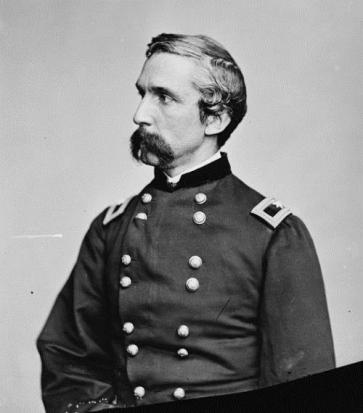
Colonel Joshua Chamberlain was another one of the citizen soldiers whose performance and leadership on Little Round Top saved the Union line that hot July evening. A graduate of Bowdoin College and Bangor Theological Seminary, Chamberlain was fluent in nine languages other than English. He was Professor of Rhetoric at Bowdoin before seeking an appointment in a Maine Regiment without consulting either the college or his family. He was offered command of the 20th Maine but asked to be appointed as a Lieutenant Colonel which he was in August 1862. He fought at Fredericksburg and was named commander of the regiment when Colonel Adelbert Ames, his commander was promoted following Chancellorsville.

Like Vincent, Chamberlain was also a quick student and rapidly adapted to being a soldier, officer and commander of troops in combat. On receiving his orders Chamberlain deployed his small regiment halfway down the southern slope facing the small valley between Little and Big Round Top. As a result of his experience in battle and the tenacity of the Confederate army he became an advocate of the tactics that William Tecumseh Sherman would later employ during his march to the sea in 1864. He wrote his wife before Chancellorsville:

“We must fight them more vindictively, or we shall be foiled at every step.  We must desolate the country as we pass through it, and not leave a trace of a doubtful friend or foe behind us; make them believe that we are in earnest, terribly in earnest; that to break this band in twain is monstrous and impossible; that the life of every man, yea, of every weak woman or child in the entire South, is of no value whatever compared with the integrity of the Union.”

Since Chamberlain’s account is so important I will forgo a discussion of his tactics and instead quote the sections of his after action report that explains his actions. Chamberlain wrote:

“On reaching the field at about 4 p.m. July 2d, Col. Vincent commanding the Brigade, placing me on the left of the Brigade and consequently on the extreme left of our entire line of battle, instructed me that the enemy were expected shortly to make a desperate attempt to turn our left flank, and that the position assigned to me must be held at every hazard.

I established my line on the crest of a small spur of a rocky and wooded hill, and sent out at once a company of skirmishers on my left to guard against surprise on that unprotected flank.

These dispositions were scarcely made when the attack commenced, and the right of the Regt. found itself at once hotly engaged. Almost at the same moment, from a high rock which gave me a full view of the enemy, I perceived a heavy force in rear of their principal line, moving rapidly but stealthily toward our left, with the intention, as I judged, of gaining our rear unperceived. Without betraying our peril to any but one or two officers, I had the right wing move by the left flank, taking intervals of a pace or two, according to the shelter afforded by rocks or trees, extending so as to cover the whole front then engaged; and at the same time moved the left wing to the left and rear, making a large angle at the color, which was now brought to the front where our left had first rested.

This hazardous maneuvre was so admirably executed by my men that our fire was not materially slackened in front, and the enemy gained no advantage there, while the left wing in the meantime had formed a solid and steady line in a direction to meet the expected assault. We were not a moment too soon; for the enemy having gained their desired point of attack came to a front, and rushed forward with an impetuosity which showed their sanguine expectations.

Their astonishment however was evident, when emerging from their cover, they met instead of an unsuspecting flank, a firm and ready front. A strong fire opened at once from both sides, and with great effect, the enemy still advancing until they came within ten paces of our line, where our steady and telling volleys brought them to a stand. From that moment began a struggle fierce and bloody beyond any that I have witnessed, and which lasted in all its fury, a full hour. The two lines met, and broke and mingled in the shock. At times I saw around me more of the enemy than of my own men. The edge of conflict swayed to and fro -now one and now the other party holding the contested ground. Three times our line was forced back, but only to rally and repulse the enemy. As often as the enemy’s line was broken and routed, a new line was unmasked, which advanced with fresh vigor. Our “sixty rounds” were rapidly reduced; I sent several messengers to the rear for ammunition, and also for reinforcements. In the mean time we seized the opportunity of a momentary lull to gather ammunition and more serviceable arms, from the dead and dying on the field. With these we met the enemy’s last and fiercest assault. Their own rifles and their own bullets were turned against them. In the midst of this struggle, our ammunition utterly failed. The enemy were close upon us with a fresh line, pouring on us a terrible fire. Half the left wing already lay on the field. Although I had brought two companies from the right to its support, it was now scarcely more than a skirmish line. The heroic energy of my officers could avail no more. Our gallant line withered and shrunk before the fire it could not repel. It was too evident that we could maintain the defensive no longer. As a last desperate resort, I ordered a charge. The word “fix bayonets” flew from man to man. The click of the steel seemed to give new zeal to all. The men dashed forward with a shout. The two wings came into one line again, and extending to the left, and at the same time wheeling to the right, the whole Regiment described nearly a half circle, the left passing over the space of half a mile, while the right kept within the support of the 83d Penna. thus leaving no chance of escape to the enemy except to climb the steep side of the mountain or to pass by the whole front of the 83d Penna. The enemy’s first line scarcely tried to run-they stood amazed, threw down their loaded arms and surrendered in whole companies. Those in their rear had more time and gave us more trouble. My skirmishing company threw itself upon the enemy’s flank behind a stone wall, and their effective fire added to the enemy’s confusion. In this charge we captured three hundred and sixty eight prisoners, many of them officers, and took three hundred stand of arms. The prisoners were from four different regiments, and admitted that they had attacked with a Brigade.” [24]

Colonel William Oates of the 15th Alabama would give Chamberlain and his regiment the credit for stopping his attack. Oates wrote: “There have never been harder fighters than the Twentieth Maine and their gallant Colonel. His skill and persistency and the great bravery of his men saved Little Round Top and the Army of the Potomac from defeat.” [25]

chamberlain lrt

As with any firsthand account, aspects of Chamberlain’s accounts are contested by others at the scene. Oates notes that he ordered the retreat and that there were not as many prisoners taken, one of Chamberlain’s company commanders disputes the account of the order of the bayonet charge however the fact is that Chamberlain who was outnumbered nearly two to one by the 15th and 47th Alabama regiments “offset this superiority with strength of position, iron determination and better tactics.” [26] Also a factor was the fatigue of the Confederates, these regiments and their parent unit, Law’s brigade of Hood’s division had conducted a grueling 28 mile march to get to the battlefield and were exhausted by the time that they arrived.

Vincent was mortally wounded while leading the defense of the hill. While he was standing on a large boulder with a riding crop ordering the men of the 16th Michigan who were beginning to waiver he cried out “Don’t yield an inch now men or all is lost,[27]he was struck by a bullet which hit him in the groin. As he was being carried from the field to the hospital where he died on July 7th, “This is the fourth or fifth time they have shot at me…and they have hit me at last.” [28]

As Vincent lay dying he was visited by many comrades, visited by Sykes and Barnes he told them “I presume… I have dune my last fighting.” Meade recommended Vincent for posthumous promotion to Brigadier General, but the request was lost.

Two months after his death his wife gave birth to a baby girl. The baby would not live a year and was buried next to him. One wonders what heights of leadership the young colonel might have achieved had he not died at Gettysburg. He was a man who understood the nature of total war, an excellent leader and skilled tactician.

Chamberlain survived the war to great acclaim being wounded three times and receiving the surrender of the Army of Northern Virginia at Appomattox on April 9th 1865.

The examples of these two citizen soldiers demonstrate the importance of this legacy, which is still to some extent carried on by the reserve components of the United States military service. That being said, in the coming years military professionals will have to engage lawmakers and the bureaucracy of the Pentagon as the shape of the future military, especially the land components is debated and decided upon by politicians. Thus, it is of the utmost importance of revisiting the tradition of the citizen soldier and how it can be renewed in the coming years.

Chamberlain’s words about the men that he served alongside like his commanding officer, Strong Vincent are a fitting way to close.

“It is something great and greatening to cherish an ideal; to act in the light of truth that is far-away and far above; to set aside the near advantage, the momentary pleasure; the snatching of seeming good to self; and to act for remoter ends, for higher good, and for interests other than our own.” [29]

Notes

[1] _______. The Armed forces Officer U.S. Department of Defense Publication, Washington DC. January 2006 p.2

[2] Millet, Allan R. and Maslowski, Peter, For the Common Defense: A Military History of the United States The Free Press a Division of Macmillan Inc. New York, 1984 p.xii

[3] Bacevich, Andrew J. Breach of Trust: How Americans Failed their Soldiers and Their Country Metropolitan Books, Henry Holt and Company, New York 2013 Kindle Edition Amazon Edition p.50

[4] Huntington, Samuel P. The Soldier and the State: The Theory and Politics of Civil-Military Relations, The Belknap Press of Harvard University Press, Cambridge MA and London 1957 p.345

[5] Zinni, Tony. The Battle for Peace: A Frontline Vision of America’s Power and Purpose Palgrave McMillian, New York 2006 p.4

[6] Weigley, Russell F. The American Way of War: A History of United States Military History and Policy University of Indiana Press, Bloomington IN, 1973 pp.367-368

[7] Moore, Harold G. and Galloway Joseph L We Were Soldiers Once…And Young Harper Perennial Books, 1992 pp. xix-xx

[8] Ibid. Bacevich Breach of Trust p.58

[9] ________. Erie County Historical Society http://www.eriecountyhistory.org/wp-content/uploads/2008/10/strongvincent.pdfretrieved 9 June 2014

[10] Golay, Michael. To Gettysburg and Beyond: The Parallel Lives of Joshua Lawrence Chamberlain and Edward Porter Alexander Crown Publishers Inc. New York 1994 p.129

[11] Leonardi, Ron Strong Vincent at Gettysburg Barringer-Erie Times News retrieved June 9th 2014 from http://history.goerie.com/2013/06/30/strong-vincent-at-gettysburg/

[12] Guelzo, Allen C. Gettysburg: The Last Invasion Vintage Books a Division of Random House, New York 2013 p.264

[13] Pfanz, Harry F. Gettysburg: The Second Day. University of North Carolina Press, Chapel Hill 1987 p.51

[14] Ibid. Guelzo Gettysburg: The Last Invasion Vintage p.159

[15] Tredeau, Noah Andre. Gettysburg: A Testing of Courage, Harper Collins Publishers, New York 2002 p.305

[16] Some such as Guelzo believe this may have been Captain William Jay of Sykes staff.

[17] Ibid. Tredeau, Gettysburg: A Testing of Courage p.327

[18] Ibid. Guelzo Gettysburg: The Last Invasion Vintage p.262

[19] Ibid. Guelzo Gettysburg: The Last Invasion Vintage p.262

[20] Ibid. Tredeau, Gettysburg: A Testing of Courage p.327

[21] Coddington, Edwin B. The Gettysburg Campaign: A Study in Command, A Touchstone Book, Simon and Schuster New York, 1968 p.389

[22] Ibid. Pfanz, Gettysburg: The Second Day. p.213

[23] Ibid. Golay To Gettysburg and Beyond p.157

[24] Chamberlain, Joshua Lawrence. Official Narrative of Joshua Chamberlain of July 6th 1863, Maine Military Historical Society, Inc., Augusta, Maine, copyright 1989 U.S. Army Combat Studies Institute Reprint, retrieved from http://usacac.army.mil/cac2/cgsc/carl/download/csipubs/chamberlain.pdf June 15th 2014

[25] Oates, Willam C. and Haskell, Frank A. Gettysburg Bantam Books edition, New York 1992, originally published in 1905 p.98

[26] Ibid.Coddington The Gettysburg Campaign: A Study in Command p.393

[27] Ibid. Guelzo Gettysburg: The Last Invasion Vintage p.272

[28] Ibid. Tredeau, Gettysburg: A Testing of Courage p.361

[29] Chamberlain, Joshua Lawrence. Chamberlain’s Address at the dedication of the Maine Monuments at Gettysburg, October 3rd 1888 retrieved from http://www.joshualawrencechamberlain.com/maineatgettysburg.php 4 June 2014

Leave a comment

Filed under civil war, History, leadership, Military, national security

Nothing is as Clear and Certain as it Appears to Be: The Ukraine Crisis

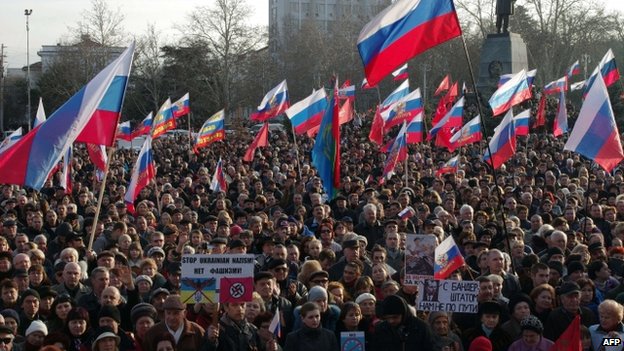
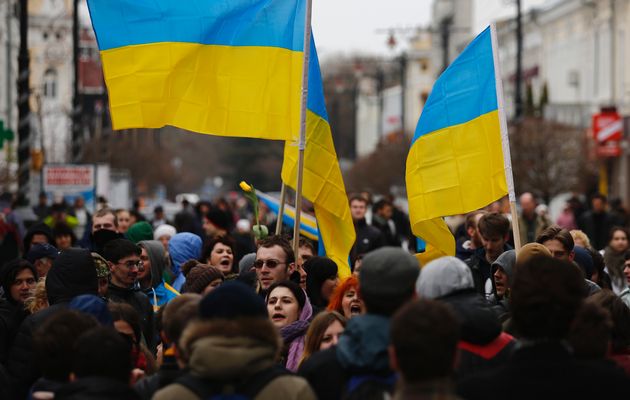
_73179624_021282371-1

“in the midst of war and crisis nothing is as clear or as certain as it appears in hindsight” Barbara Tuchman The Guns of August

There is nothing more uncertain than how leaders and people will react in crisis. We would like to think that we can be certain in our predilections, but we cannot because the reality is that human nature is always at play, and human beings have a penchant for doing things that are not expected.

030114_Breaking_ObamaPutin_640

It did not take long after the showcase of the Sochi Olympic Games for Vladimir Putin to move against the Ukraine and for all practical purposes annex the Crimea. But now after a few weeks it seems that the West is beginning to galvanize in its opposition to the Russian action. Germany is leading the charge from the side of the European Union, with Chancellor Merkel taking the lead. President Obama and Secretary of State John Kerry have been taking a hard diplomatic line while military forces gather.

It appears that targeted economic sanctions are in the offing while the European Union prepares to help supply the Ukraine’s energy needs.

140307064907-02-ukraine-0307-horizontal-gallery

The Russians have blockaded the small Ukrainian Navy in its Crimean ports, it has an estimated 30,000 soldiers in the Crimea and other forces are conducting “exercises” near the Ukrainian border. The Provisional Government of the Ukraine has called up its reserve forces, the United States is deploying naval and air force units to the Black Sea, the Eastern Mediterranean as well as Poland and the Baltic States.

But at the same time this is not the Cold War where two ideological blocks wrestled for domination. Instead the motivations, geopolitical and economic factors that connect the West and Russia make this much more complicated. Money is a big factor and it is of interest to note that a good amount of the resupply of US and NATO forces in Afghanistan is conducted over what is called the Northern Route, which goes through Russia and the Ukraine.

Ethnolingusitic_map_of_ukraine

The situation in the Crimea and the Ukraine is potentially volatile. Any situation that costs the lives of Ukrainians of either Ukrainian or Russian background could spiral out of control. Passions on both sides are running high. We in the West also need to remember that many Russians and men like Putin still feel the humiliation of the end of the Cold War, the collapse of the Warsaw Pact and end of the Soviet Union. Many Russians who even now are not fans of the Soviet system long for the days of empire and Russian hegemony in Eastern Europe.

In 1914 France was motivated by the humiliation that she suffered in 1871 at the hands of Prussia and the loss of Alsace Lorraine. The Russians have a similar attachment to areas where sizable ethnic Russian populations live, including the Eastern Ukraine and the Baltic. One has to remember the words of Otto Von Bismarck who said: “A generation that has taken a beating is always followed by a generation that deals one.”
2014-03-08T151114Z_01_TPE13_RTRIDSP_3_UKRAINE-CRISIS-CONVOY-08-03-2014-17-03-33-245

When looking at why this is happening we have to remember history.  Likewise we have to also remember the historic Russian paranoia when it comes to the influence of Europe and the West on areas that they believe are still part of Greater Russia. Their memory is long and past wounds are still fresh. Thus the blundering of the EU during the Fall of 2013 in its dealings with Ukraine, dealings which looked to the Russians like an attempt to draw Ukraine further away from them helped cause this situation. Likewise the Eastward expansion of NATO in the 1990s and early 2000s following the collapse of the Soviet Union and Warsaw Pact is considered both an insult and threat. The same is true of the presence of the American Anti-Ballistic Missile system in Poland, which is considered by many Russians to be directed at them, not Iran.

The situation is complex and influenced by many factors, and unlike some American politicians and pundits say, it has nothing to do with Benghazi or even what they claim is the “weakness” of President Obama. The roots of this crisis are long standing and diverse and have almost everything to do Russia’s relationship with Europe and very little to do with the United States. Thus for American politicians and pundits to demonstrate their woeful ignorance of history by blaming this all on President Obama is so self serving and transparent that it is embarrassing. But then American politics is almost always a demonstration of ignorance and arrogance.

The problem for the United States is that we have little credibility when it comes criticizing nations like Russia when they do the same as we do. Our actions to invade Iraq in 2003, actions which under the criteria that we laid down at Nuremberg violated international law make it hard for any American leader to criticize another power. This is true even when Putin’s actions, also illegal under international law are no worse and certainly by the historic ties of Crimea to Russia are more justifiable than what we did in Iraq.

Thus the outright hypocrisy of the architects of that invasion like Dick Cheney and Donald Rumsfeld shamelessly attack President Obama for his “weak” response to Putin’s actions are in large part to blame for them. They squandered our international standing and credibility, broke the military and bankrupted the country. They then lay the blame on Obama. By the decisions that they made and the subsequent consequences they tied Obama’s hands.

2014-03-10T173616Z_1863090881_GM1EA3B04DT01_RTRMADP_3_UKRAINE-CRISIS-CRIMEA.r

Sometimes these crisis blow over. Sometimes they stabilize but cause problems that continue for some time after the initial crisis. But there are some times that they take on a life of their own and that the people who think they are directing events end up being caught up in them, often with tragic results. While I do not think this will end in war, the possibility of such cannot be dismissed.

Tuchman in her book The March of Folly: From Troy to Vietnam wrote:

“A phenomenon noticeable throughout history regardless of place or period is the pursuit by governments of policies contrary to their own interests. Mankind, it seems, makes a poorer performance of government than of almost any other human activity. In this sphere, wisdom, which may be defined as the exercise of judgment acting on experience, common sense and available information, is less operative and more frustrated than it should be. Why do holders of high office so often act contrary to the way reason points and enlightened self-interest suggests? Why does intelligent mental process seem so often not to function?”

Peace

Padre Steve+

3 Comments

Filed under Foreign Policy, History, national security, News and current events

Policies Contrary to Their Own Interests: Putin’s New Cold War

140303080112-01-ukraine-0303-horizontal-gallery

“A phenomenon noticeable throughout history regardless of place or period is the pursuit by government of policies contrary to their own interests.” Barbara Tuchman

Today Russian forces continued their occupation of Crimea in spite of international outrage. Not only did they continue to build up their forces in Ukraine to the point that they operationally control the peninsula, they upped the ante demanding that Ukrainian army and navy units to surrender by Wednesday or face a “military storm.”

praguePrague 1968

It is something that Europe has not seen since the Cold War when the Soviet Union used military force and violence to put down revolts in Hungary and Czechoslovakia.

Polen, Parade vor Adolf HitlerCzechoslovakia 1939

However, I think in political terms it is much closer to Hitler’s invasion of Czechoslovakia in 1939 after Britain France and Italy stripped that country of its power by forcing the Czechs to surrender the Sudetenland to Hitler in October of 1938. Up to that moment the European powers bet on the appeasement of the Hitler regime. In a sense over the past decade the West has given Putin free reign to exercise his power over former territories, coercing them and occasionally using economic and even military power to bring them into line.

But now it is Ukraine. a complex region where Asiatic Russia meets Europe. The Ukraine is not Georgia or Chechnya. It is a region that has been a battlefield between Russia, the indigenous peoples as well as Germany, Poland, the Austro-Hungarian Empire and Turkey. It is the dividing line between western Catholicism and Russian Orthodoxy. In the 1850s even England and France found themselves intervening in the Crimea.

474933475-russias-president-vladimir-putin-attends-a-meeting-in.jpg.CROP.promo-mediumlarge

I believe that Putin under the flimsiest of pretensions has elected to use military force to attempt to coerce the Ukraine back under the thumb of a Russian Hegemon and to frighten the West into not intervening. It is a mistake. Just as in 1938 when Hitler believed that he could continue to steamroll the through Europe without war. In betting on the weakness of the West, Putin is playing the same game. Contrary to the speculation that Putin is doing this as a show of strength it is actually a display of Putin’s domestic insecurity.

Russia is not nearly as economically or militarily strong as Putin acts. There are serious ethnic and social divisions in the country and despite its assertions the Russian economy is much more dependent on the good graces of other nations as it is not. Already following Putin’s move into the Crimea the Russian currency and stock markets are tanking. I suspect that the West will soon impose sanctions that hit Russian economic and banking oligarchs where it hurts which will undercut support for Putin where he needs it most. Likewise I expect that Russia will be expelled from the G-8 and possibly cut off from other international banking and economic organizations.Likewise both the U.S. and the United Kingdom are bound by treaty to protect the territorial integrity of the Ukraine.

140302073009-03-ukraine-0203-horizontal-galleryPutin has had a run of success until now. However his crackdown against dissidents, campaigns against homosexuals and the state supported Russian Orthodox Church assault against other Christian denominations have already undermined his credibility as a world leader.

The invasion of the Ukraine will solidify opposition to Russia abroad, and increase anti-Putin sentiment in Russia. Should the Russian military attempt to invade other parts of Ukraine as they are threatening, Putin will find that he has bit off more than he can chew. His forces are certainly more than a match for the Ukrainian military, but he will not be able to hold or occupy the vast areas of the Ukraine in the face of opposition that will rapidly move toward a protracted insurgency. This insurgency will be supported by nations such as Chechnya which will take the war to the heart of Russia. It will turn out worse for Russia than the invasion of Afghanistan for the Soviet Union.

A new Cold War has already begun, Putin has made sure of that. The world that existed just three weeks ago when athletes from around the world gathered in Sochi for the Winter Olympics no longer exists. The only thing that we can hope is that the new Cold War does not become a hot war.

I am reminded of Barbara Tuchman’s words in The Guns of August: “The muffled tongue of Big Ben tolled nine by the clock as the cortege left the palace, but on history’s clock it was sunset, and the sun of the old world was setting in a dying blaze of splendor never to be seen again.” 

The world that we knew is now changed.

Let us pray for peace.

Padre Steve+


1 Comment

Filed under Foreign Policy, History, national security, News and current events

An Unsettled Saturday

947188_10151670056587059_1172426886_n

I am attempting to relax today and while I am still working on doing research and writing for my upcoming Gettysburg Staff ride with our Staff College students my mind is unsettled today. It appears that I have a lot going on in it. As Hedley Lamarr said: “My mind is a raging torrent, flooded with rivulets of thought cascading into a waterfall of creative alternatives.”

DSCN8774

As I said I have a lot more work to do on Gettysburg to prep me and my students for the trip. In the next few days I need to write a few articles as well as do some editing on others that they can use for the trip and their future reference. Likewise I need to take my materials and decide exactly what events and people I want to focus on as we walk the battlefield Saturday and Sunday.

Gay-Turn-away-law-passed-to-further-Discriminate-service-for-Gay-persons

Because of that I have not been doing much writing on other subjects that I think are important. These include the recent focus some to attempt to use their religious beliefs to legislate discrimination by the state on those that the disapprove. I did write about what was happening in Kansas a couple of weeks back but have not had any time to write about the situation in Arizona as well as other battleground states in the struggle of the LGBT community for basic civil rights that others enjoy.

AP_Crimea_soldiers_bc_140301_16x9_992

Likewise I am very concerned with what is going on in Russia and the Ukraine and worried that the West and Russia have entered a new Cold War. When I think about that I remember the euphoria of the Iron Curtain falling, and how the West missed the opportunity to embrace Russia and instead treated her as a defeated power. In a sense I can understand the Russians taking advantage of the West’s weakness to re-stake in some manner its claim to Crimea. Whether they outright annex it, use their military and economic leverage to get the region autonomy or divide it along ethnic lines is not the point. The point is that this goes back long before Putin and is the product of centuries of intrigue and political calculation going back to Catherine the Great.

In a sense the end of the Cold War was a defeat for the old Soviet Union.  But I think that the West in its triumphant celebration and euphoria about “democracy” taking over failed to remember something that is common to the end of all wars that beget new ones. Eric Hoffer wrote: “A war is not won if the defeated enemy has not been turned into a friend.” Sadly to say we did not attempt in any real way to make Russia a friend, and now it appears they are once again an enemy.

I certainly do not condone what Putin and the Russian legislature is doing to ratchet up the tensions by sending in troops, moving naval forces and potentially recalling their ambassadors to the United States and maybe the EU. It is very dangerous and any time a nation embarks on military conquest to solve a problem it almost inevitably produces undesired negative effects. It is my hope that the crisis will be defused and that Ukrainians and Russians in the Ukraine can sort this out. Unfortunately I think that things will get worse before they get better. At best I think we can hope for is a partition of the region and a Cold War, at worst a regional war between Ukrainians and Russians that could draw in others.

orioles-spring-training

However, amid the din of these crisis, as well as the continued disruption of home life as we wait for the repairs and reconstruction following our great household flood there is hope. Baseball spring training games are beginning and opening day is a mere 30 days away.

As Sharon Olds wrote back in 1987: Baseball is reassuring.  It makes me feel as if the world is not going to blow up.” 

With that in mind I wish you peace,

Padre Steve+

1 Comment

Filed under Baseball, civil war, News and current events

Spendin’ the Nighttime Reminiscing: Padre Steve Remembers the Music of the 1970s and Early 1980s

me-and-judy-dorm

I don’t know about you but the music that I really enjoy is the music that was popular when I was in Junior High, High School and College.  For me that period spanned the years 1971-1983.

richardnixon-flickrcommons1

It was a turbulent era. The Vietnam War was ending and Nixon was resigning due to the Watergate break in cover-up despite going to China and establishing the beginning of detente with the Soviet Union.  Assassination attempts on political leaders, successful and unsuccessful, were common. Two attempts were made on Gerald Ford.  Prime Minister Aldo Moro of Italy and President Anwar Sadat of Egypt victim fell to terrorists while President  Ronald Reagan and Pope John Paul II were felled by bullets which did not prove fatal.

gas-lines

The Cold War was tense despite the beginning of detente and signing of Nuclear Weapons treaties between the United States and the Soviet Union. The Middle East was in turmoil even as Egypt and Israel hammered out a peace treaty withe the help of US President Jimmy Carter. In Iran a revolution swept the Shah of Iran out of power bringing the Ayatollah Khomeini into power.  The seizure of the US Embassy and the 444 day hostage crisis punctuated by a failed rescue attempt demoralized the United States. In October 1983 247 Marines were killed in a terror bombing of their barracks at the Beirut International Airport.

Mortar_attack_on_Shigal_Tarna_garrison,_Kunar_Province,_87

The Soviets invaded Afghanistan which would become their Vietnam, as part of the Cold War this lead to US involvement with Mujahideen. The US support with the Mujahideen was a fateful alliance that brought the Taliban to prominence and introduced the world to Osama Bin Laden. The Cubans were fighting in Angola while the Anti-Apartheid movement struggled with its leader Nelson Mandela languishing in a South African prison.

70s-iranian-hostages

High profile terrorist attacks became common. The Palestinian terrorist group Black September killed Israeli athletes at the 1972 Munich Olympics. European terrorist organizations including the Red Brigades, the Red Army Faction and Bader Meinhof gang, the Irish Republican Army and the American Weather Underground provided a constant string of terrorist attacks even as Middle Eastern terrorist groups highjacked airliners in daring fashion, matched at times by equally rescues by Israeli and German anti-terrorist units.

The American and the world economies were in a state of recession much of the era. There was a major recession, the American auto industry needed bailouts, inflation was running in double digits as was the unemployment rate. The dollar was weak and OPEC wreaked havoc on world oil markets with embargoes in 1973 and 1979.

Casey Kasem AT40 Ad

However it was music in the 1970s and early 1980s that provided a diversion for many people looking for respite from all the bad news that echoed around the airwaves and in the newspapers.  Thankfully there wasn’t a 24 hour cable news cycle yet otherwise people would have probably been jumping off of buildings.  It was the heyday of AM Top 40 type stations and the beginning of rock oriented FM music stations. Kasey Kasem gave voice to the hits with American Top 40. As for me I had countless 45s and LPs of my favorite groups and artists.

628x471-8

I listened  Doctor Donald D Rose of KFRC in San Francisco and my car, a 1966 Buick LeSabre 400 had a retro-fitted 8-Track tape player and speakers.

Great groups and artists ruled the pop and rock airwaves and the era produced some of the best rock, pop, R&B, soul, country-rock, disco and new-wave music ever done. It really was an amazing era both in quality and diversity of music .

It was not “message music” like much 60’s music but focused on entertainment.  Power groups like Journey, Starship, REO Speedwagon and Boston made power ballads, while AC/DC and KISS shocked and entertained at the same time.  Groups like the Blondie, the Eagles, Chicago, Paul McCartney and Wings, Abba and the Commodores dominated the pop charts while individual artists such as Olivia Newton-John, Elton John, Carly Simon, John Denver, Lionel Ritchie, Barry Manilow and others satisfied the more mainstream pop crown.  Disco enjoyed a brief heyday with the popularity of Saturday Night Fever and the Bee Gees.  R&B enjoyed a renaissance due to the unlikely duo of the Blues Brothers who helped re-launch the careers of Aretha Franklin, Johnny Lee Hooker, Cab Calloway and a host of others. Country crossovers became big with Kenny Rogers, Dolly Parton and Glenn Campbell leading the way.  As the 80’s came along new groups and styles were introduced including New Wave and Rap. It was music that helped us through those times.

I listen to that music all the time and remember those turbulent days well. It certainly wasn’t the fact that things were great in the world. That being said despite bad news there was still some sense of that things would work out okay.  Music helped provide part of that sense of hope. It was an escape and the music of that time is still with us. Many of those those groups haven’t gone away and people look back with fondness to the music of the era even as the artists age and pass away.

Here are some of my favorites with links to the videos, they are in no particular order nor are the representative of all the groups that I have in my library of CDs and DVDs, but I enjoy the heck out of them.  Have fun and enjoy.

Peace,

Padre Steve+

Little River Band “Reminiscing” http://www.youtube.com/watch?v=CZ_3G4xqSDQ

olivia-if-not-for-you-a

Olivia Newton-John “Magic”

http://www.youtube.com/watch?v=r7WPwH8Rd6g

and “I Honestly Love You”

http://www.youtube.com/watch?v=6zGLSnZGZts 

commodores

The Commodores “Sail On” 

http://www.youtube.com/watch?v=zg-ivWxy5KE

the-eagles-hotel-california

The Eagles “Hotel California” 

http://www.youtube.com/watch?v=mnkJcjBCG88

ac-dc

AC/DC “You Shook Me All Night Long”

http://www.youtube.com/watch?v=Lo2qQmj0_h4

KISS “I Was Made for Loving You” 

http://www.youtube.com/watch?v=q7fxN3g5sLw

Kenny Rogers and Dolly Parton: Islands in the Stream http://www.youtube.com/watch?v=recWNQddJeE&feature=related

Rupert Holmes: Escape (The Pina Colada Song) http://www.youtube.com/watch?v=DaOXWJKsX-U

donna2

Donna Summer: Last Dance http://www.youtube.com/watch?v=7cPIT_T3mYU

Roberta Flack: The First Time Ever I Saw Your Face http://www.youtube.com/watch?v=r9jmusgMgro&feature=related

bee-gees1

Bee Gees “How Deep is You Love

http://www.youtube.com/watch?v=XpqqjU7u5Yc

Dr Hook “Cover of the Rolling Stone” 

http://www.youtube.com/watch?v=fJu6Up9w2Hc

John Denver: Take Me Home Country Roads http://www.youtube.com/watch?v=ukUL_I14GPw

Three Dog Night, Joy to the World http://www.dailymotion.com/video/x2x3af_three-dog-night-joy-to-the-world_people

the-carpenters

The Carpenters “Rainy Days and Mondays” http://www.youtube.com/watch?v=dPmbT5XC-q0

Paul McCartney and Wings  “Band on the Run http://www.youtube.com/watch?v=7Qx2jEfBsqY

The Trammps “Disco Inferno” http://www.youtube.com/watch?v=A_sY2rjxq6M

rod_stewart

Rod Stewart “Tonight’s the Night”

http://www.dailymotion.com/video/x1p96h_rod-stewarttonights-the-nightgonna_music

abba

Abba “The Winner Takes it All” http://www.youtube.com/watch?v=92cwKCU8Z5c

and “Waterloo” 

http://www.youtube.com/watch?v=Sj_9CiNkkn4

Elvis Presley: Suspicious Minds

 http://www.youtube.com/watch?v=SBmAPYkPeYU

elton_john_70s

Elton John “Goodbye Yellow Brick Road” 

http://www.youtube.com/watch?v=9kMVdazvII4 

Journey “Don’t Stop Believing” 

http://www.youtube.com/watch?v=VcjzHMhBtf0

Albert Hammond: It Never Rains in Southern California http://www.youtube.com/watch?v=-pyC7WnvLT4

queen

Queen: Bohemian Rhapsody http://www.youtube.com/watch?v=fJ9rUzIMcZQ

blondie

Blondie “Heart of Glass” 

http://www.youtube.com/watch?v=WGU_4-5RaxU

Neil Diamond: Sweet Caroline

 http://www.youtube.com/watch?v=1vhFnTjia_I

Boz Skaggs “Lido Shuffle” http://www.youtube.com/watch?v=DIu0jQ5TaRQ&feature=PlayList&p=8201408B8B6E42C8&index=2

Katrina and the Waves “Walking on Sunshine” http://www.youtube.com/watch?v=iPUmE-tne5U

Billy Joel “Piano Man” http://www.youtube.com/watch?v=gxEPV4kolz0

barry-manilow

Barry Manilow “Mandy” http://www.youtube.com/watch?v=AM7SQzq3yHQ

Heart: Crazy on You

 http://www.youtube.com/watch?v=4gpNqB4dnT4&feature=related

villagepeople

Village People: YMCA

 http://www.youtube.com/watch?v=CS9OO0S5w2k

Fleetwood Mac “Don’t Stop Thinking About Tomorrow”

http://www.youtube.com/watch?v=a8arvEzHsA8

laurabranigan1990

Laura Branigan “Gloria”

http://www.youtube.com/watch?v=1tVutw8rjFk

Carly Simon “You’re So Vain”

http://www.youtube.com/watch?v=mQZmCJUSC6g

Chicago “Saturday in the Park”

http://www.youtube.com/watch?v=nWxA3e9f6rY

linda_ronstadt_usa_11

Linda Ronstadt “When Will I Be Loved”

http://www.youtube.com/watch?v=OmE7tTzJkbU

Foghat “Third Time Lucky”

http://www.youtube.com/watch?v=Fj1O2KtH4kE

The Captain and Tennille “Do that to Me One More Time”

http://www.youtube.com/watch?v=KNHcgk5bf7o&feature=related

kingdingeling_blues_brothers_most

Finally, the Blues Brothers “Everybody Needs Somebody”

http://www.mojvideo.com/video-the-blues-brothers-everybody-needs-somebody-to-love/ac0b631b54ff095fd5c0

2 Comments

Filed under History, music