Tag Archives: colonel augustus van horn ellis

July 2nd at Gettysburg Pt. 4: The Confederate Storm at Devil’s Den

Friends of Padre Steve’s World

For those that have followed my writing for some time you know that I teach military history and ethics at the Joint Forces Staff College. One of the great joys that I have is leading the Gettysburg Staff Ride, which is an optional event for students that want to participate. When I took the position here I took some of my older writings on Gettysburg and put them into a student study guide and text. That was two years ago. Then the text was about 70 pages long. It is now about 925 pages long and eventually I hope to get it published. When and if that happens I expect it to become two, and possibly three books.

This is the fourth of a series of articles that I will be posting potions of a chapter that I have rewritten about the critical battles on the south side of the battlefield on July 2nd 1863, the battle for Devil’s Den, the Wheatfield, the Peach Orchard, and the final repulse on Cemetery Ridge.

As you read this don’t just look at the events, but look at the people, and their reaction to the what they encountered on the battlefield, for that understanding of people is where we come to understand history.

So even if you are not a Civil War buff, or even a history buff, take the time to look at the people, their actions, and the things that made them who they were, and influenced what they did. History is about people.

So please enjoy,

Peace

Padre Steve+

Men_of_Granite

Fix bayonets my brave Texans

The delays had taken a toll on the Confederate plan. By the time Hood and McLaws divisions were in place along with Anderson’s division from Hill’s Third Corps it was nearly four o’clock. Throughout the day the senior commanders of the Army of Northern Virginia had made a thorough mess of their chances for success, but when the attack began it blew into the Federal forces like a violent storm as the Confederate troops fell upon the soldiers of Sickles Third Corps.

However, the Confederate assault was marred by still more command and control issues, the most important which happened in Hood’s division.. “Contrary to orders Hood had moved his division away from the Emmitsburg road for the purpose of taking Little Round Top and outflanking the Union position on the heights of Devil’s Den.” [1] Riding in front of his old Texas brigade, Hood called out “Fix bayonets my brave Texans…forward and take those heights.” His loyal troops responded to their former commander, and cheered his words in response: “Follow the Lone Star Flag to the Top of the mountain!” Cried the lieutenant colonel of the 1st Texas, and there “arose such a wild indescribable battle yell that no one having heard ever forgot.” [2]

McLaws had waited until Hood’s troops advanced across the rough ground that separated his division from “Smith recalled that his guns “tore gap after gap in the ranks of the Confederate foe.” Robertson agreed, reporting that as his brigade advanced through the intervening fields, “for half a mile we were exposed a heavy and destructive fire of canister, grape, and shell” [3] Little Round Top and Devil’s Den. As Hood’s division moved forward it came under artillery fire from the four 10 pound Parrot Rifles of Captain James Smith’s 4th New York Independent Battery on Houck’s Ridge above Devil’s Den and it began to sustain casualties. . Among the earliest to fall was John Bell Hood who was badly wounded when a shell “exploded above his head, and one of the fragments tore into his left arm.” The arm would have to be amputated and as he was taken away by stretcher-bearers recalled that he experienced “deep distress of mind and heart at the inevitable fate of my brave fellow-soldiers, who formed one of the greatest divisions of that world-renown army….” [4]

The absence of Hood would create a leadership void in his division as it made its attack on Devil’s Den and Little Round Top as his successor Evander Law was deeply engaged in leading his brigade in its epic fight at Little Round Top, and not able to influence or coordinate the attacks of the remaining brigades of the division. Coordination “between the brigades soon dissolved. Regiments in Law’s Alabama brigade veered apart, and a gap formed in the center of Jerome Robertson’s Texas Brigade. While these units angled toward the Round Tops, behind them, moving towards Rose’s Woods and Devil’s Den came the pair of Georgia brigades under Henry Benning and George T. Anderson.” [5] Order broke down, and soon control was at the company commander level or lower, “Every fellow was his own general,” a Texan later wrote. “Private soldiers give commands as loud as officers, nobody paying attention to either. [6] In the absence of Hood, Brigadier, and feeling the pressure of the situation, General J.B. Robertson commanding the Texas Brigade on Law’s left, took the initiative and sent couriers to Henry Benning and George Anderson “urging them to hurry their brigades to his support.” [7]

As Law’s brigade and two of Robertson’s regiments assaulted Little Round Top, the remainder of Robertson’s brigade as well as those of Benning and Anderson attacked the Federal position on Devil’s Den. There a fierce fight ensued as the badly outnumbered troops of the 124th New York under the command of Colonel Augustus Van Horn Ellis, and the four guns of Smith’s 4th New York Independent Battery refused to yield the hill to Robertson and Benning’s troops.

Men_Must_See_Us_Today_Gettysburg

The 124th New York was raised in Orange County New York, and a veteran unit, but it had taken many casualties and during the afternoon of July 2nd 1863 it went into action with just 18 officers and 220 men, in a position just to the left rear of Smith’s battery. The left flank of the 124th was protected by the tiny 4th Maine Infantry and the two remaining guns of Smith’s battery. Captain Smith whose battery had already expended its supply of case shot called out, “Give them she’ll! Give them solid shot! Damn them, give them anything!” [8]

Led by their gallant commander, who against the advice of a number of officers, mounted his horse and further exposed himself to enemy fire, the New Yorkers of the 124th were aware of their critical place on the battlefield. Looking at his Major Cromwell, Ellis remarked “the men must see us today.” [9] Cromwell cried out the order to charge the advancing Texans, and “the New Yorkers rushed down the west face of Houck’s Ridge at the double-quick. The 1st Texas reeled back some 200 yards under the surprise onslaught. “The conflict at this point defied description,” wrote an officer of e 124th. “Roaring cannon, crashing rifles, screeching shots, bursting shells, hissing bullets, cheers, shouts, shrieks and groans….” [10] A Confederate soldier wrote that the battle “was more like Indian fighting…than anything I experienced in the war.” [11] A reporter from the Savannah Republican accompanying Benning’s brigade wrote, “Down the plunging shot came…bursting before and around and everywhere tearing up the ground in a terrific rain of death….[As Benning’s brigade] approached the [Yankee] guns, the rain of grape and canister began! Mingling their sharp cries with the shrill whistle of the mad minnie balls which seemed to come in showers.” [12] The gallant regiment held off several attacks by Robertson’s Texans, and Ellis was killed by a bullet, as was Major Cromwell, and many of their gallant soldiers. “In the savage hand-to-hand fighting among the rocks, men shot at one another from the opposite side of the same Boulder, sometimes so close that clothing caught fire from the blaze of an enemy’s rifle. The high-pitched Rebel yell and the full-throated Federal huzzahs echoed through the rocks as first one side and then the other gave way…” [13]

In his after action report, Henry Benning wrote:

“When my first line reached the foot of the peak, I found there a part of the First Texas, struggling to make the ascent… The part of the First Texas…falling in with my brigade, the whole line commenced ascending the rugged…steep [incline] and, on the right, crossing the gorge. The ground was difficult – rocks in many places presenting, by their precipitous sides, insurmountable obstacles, while the fire of the was very heavy and very deadly. The progress was, therefore, not very rapid, but it was regular and uninterrupted….” [14]

With their supporting infantry considerably weakened, Smith’s guns were in danger. Some of Robertson’s troops had reached the base of the hill and taken cover behind a stone wall where they could take Smith’s artillery men under fire. Smith “could no longer depress his guns sufficiently to hit the Rebels. Occupying the low ground and using boulders for cover, the Confederates began to pick off Smith’s gunners. Smith “saw it would be impossible…to hold my position without assistance” and fell back…but the loss of artillery support was the beginning of the collapse of Sickles left flank.” [15] To the left in the Plum Run Valley, which later became known as the Valley of Death, the 4th Maine and Smith’s remaining guns fought off attacks by Robertson and Benning’s brigades before being forced to retreat. With his left now threatened Brigadier General Hobart Ward dispatched the 99th Pennsylvania to protect it, thinning his lines to do so. The Pennsylvanians of the 99th as well as men from the 124th New York, and the 4th Maine launched a counter-attack which succeeded in regaining the lower section of Houck’s Ridge. A soldier of the 99th recalled the moment his unit entered the fight, “Above the crack of the rifle, the scream of shells and the cries of the wounded, could be heard the shout of for “Pennsylvania and our homes…” [16] The cost had been great, but the ridge had been retaken from it the Union men rained fire down on the Alabamians below them in the Valley of Death. Hood’s men occupied Devil’s Den and secured a small lodgment on Houck’s Ridge which enabled the assault on Little Round Top to continue.

In a sense the fight at Devil’s Den was a victory for the Confederates as they had forced Ward’s troops from the position, but the human cost had been high among the men of the assaulting regiments. Robertson was wounded and had to be carried from the field, and most of the field officers of the Texas brigade were either killed or wounded leading their troops in the fight. Historian Harry Pfanz wrote, “The hard fighting at Devil’s Den, together with the sinister character of the spot, gave it a hallowed place in American history that might actually exceed its actual significance.” [17]

Robertson’s Texans and some of Law’s Alabamians surged up the slope of Little Round Top. But the sacrifice of the New Yorkers and Maine men was not in vain, they had helped buy the needed minutes for the soldiers of Colonel Strong Vincent’s brigade to arrive at the summit of Little Round Top, and Confederate casualties had been very heavy even before they attempted to scale the heights of Little Round Top.

To be continued…

Notes

[1] Ibid. Coddington The Gettysburg Campaign p.402

[2] Ibid. Guelzo Gettysburg, the Last Invasion p.256

[3] Ibid. Hessler Sickles at Gettysburg p.166

[4] Ibid. Pfanz The Second Day at Gettysburg pp.172-173

[5] Ibid. Wert A Glorious Army p.259

[6] Ibid. Foote The Stars in Their Courses p.128

[7] Ibid. Coddington The Gettysburg Campaign a Study in Command p.402

[8] Ibid. Sears Gettysburg p.273

[9] Ibid. Pfanz The Second Day at Gettysburg p.293

[10] Ibid. Sears Gettysburg pp.273-274

[11] Ibid. Foote The Stars in Their Courses p.128

[12] Ibid. Trudeau Gettysburg, A Testing of Courage p.342

[13] Ibid. Dowdy Lee and His Men at Gettysburg p.211

[14] Luvaas, Jay and Nelson, Harold W. Editors The U.S. army War College Guide to the Battle of Gettysburg, South Mountain Press Incorporated, Carlisle PA 1986 p.99

[15] Ibid. Hessler Sickles at Gettysburg p.166

[16] Ibid. Trudeau Gettysburg, A Testing of Courage p.345

[17] Ibid. Pfanz Gettysburg, the Second Day

Leave a comment

Filed under civil war, Gettysburg, History, Military

Hell at the Peach Orchard

Friends of Padre Steve’s World

Today is another visitation of the Battle of Gettysburg. This too is part of my Gettysburg text, and in the next couple of months I plan on revising, editing and adding to this section. However, since I have recently posted the more recent revisions to parts of that text I have I have tried to avoid repeating those and instead posting this. The Battle of the Peach Orchard, Devil’s Den and the Wheat Field were some of the bloodiest and most confusing battles not only of July 2nd at Gettysburg, but of any during the Civil War. 

Though this is pretty much an unedited version of past work that I will be updating I do hope that you will find it interesting as well as informative.

Peace

Padre Steve+
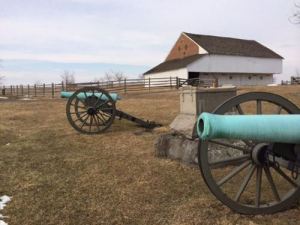
12 pound napoleon

On July 2nd 1863 as on the first day of battle and throughout the Gettysburg campaign issues of command and control would be of paramount importance to both armies. On the second day the glaring deficiencies of Robert E Lee and his corps commanders command and control at Gettysburg would again be brought to the fore. Likewise the exemplary command of the Army of the Potomac by George Meade, Winfield Scott Hancock, staff artillery officer Henry Hunt and staff engineer Gouverneur Warren exemplified the best aspects of what we now define as Mission Command.

On the morning of July 2nd the Army of the Potomac was mostly assembled on the high ground from Culp’s Hill to Cemetery Hill and along Cemetery Ridge. In the north XII Corps under the command of Major General Henry Slocum held Culp’s Hill. The battered remnants of I and XI Corps under the command of Oliver Howard and Abner Doubleday held Cemetery Hill while Winfield Scott Hancock’s crack II Corps extended the line down Cemetery Ridge. To II Corps right was Dan Sickles’ III Corps with George Sykes V Corps in Reserve. John Sedgwick’s VI Corps was still enroute, marching up the Baltimore Pike.

corby

Father Corby gives General Absolution to the Irish Brigade on July 2nd 

It was a solid and well laid out position which commanded the battlefield. Major General Gouverneur Warren the Army’s Staff Engineer Officer who had been sent by Meade to assist Hancock the night of the first wrote his wife that morning: “we are now all in line of battle before the enemy in a position where we cannot be beaten but fear being turned.”[1]

There was one notable problem, Dan Sickles did not like the position assigned to his corps. His corps which joined the left flank of II Corps was to extend down Cemetery Ridge to Devil’s Den and Little Round Top. All morning he had been lobbying Meade, through Meade son and Aide-de-Camp Captain George Meade, the Artillery Reserve Commander Henry Hunt, Warren and even Meade himself to no avail. Sickles was disturbed because John Buford’s Cavalry division which has been deployed on the Federal left had been moved to the rear by Pleasanton the Cavalry Corps commander and not replaced.
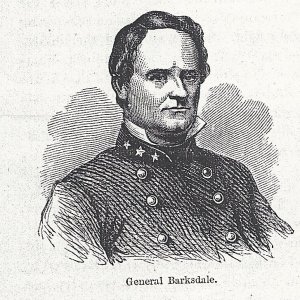
GeneralBarksdale_zps3678f799

Hunt who had accompanied Sickles back to his corps pointed out that the position was too exposed and too expansive for the number of troops Sickles had in his corps. He advised Sickles not to advance and assured Sickles that he would discuss Sickles’ concerns with Meade. [2]

To remedy the situation he sent out four companies of Sharpshooters supported by the 3rd Maine Infantry to make a reconnaissance. Those troops ran into a large force of advancing Confederate Infantry near Seminary Ridge and withdrew, Colonel Brenden of the Sharpshooters informing Sickles of the Confederate advance.

sickles

Major General Dan Sickles 

Sickles now felt that the Union line was about to be turned as it had been at Chancellorsville and without consulting Meade or Hancock took it upon himself to save the situation. It was an act of brazen insubordination, but typical of the mercurial, vain and scandal plagued man who “wore notoriety like a cloak” and “whether he was drinking, fighting, wenching or plotting, he was always operating with the throttle wide open.”[3]

About mid-afternoon Sickles advanced III Corps forward in a “mile long line of battle with waving flags and rumbling batteries rolling west into the afternoon sunlight.” [4] The sight confused other commanders such as John Gibbon commanding a division in II Corps who watched in amazement from his vantage point on Cemetery Ridge. Sickles advanced nearly a mile in front of his previous position opening a gap between III Corps and II Corps. He attempted to hold a new line that was longer and more exposed than the number of troops that he had available. He placed Humphrey’s division along the Emmitsburg Road and extended Birney’s division through the Peach Orchard, a wheat field down to Devil’s Den where he ran out of troops.

Sickles had formed an exposed and vulnerable salient which was too thinly manned for its length. It was open to attack on three sides, had little depth, no reserves and no place to fall back to as an alternate position.[5] It was also about to be hit by the full fury and power of Hood’s and McLaws’ divisions of Longstreet’s First Corps supported by Alexander’s 46 well placed artillery pieces [6] all about to open fire on Sickles badly deployed corps.

About 3 PM Meade broke from a planned commander’s conference to investigate what had happened to Sickles and III Corps, accompanying Meade was Warren. Warren who was most familiar with that part of the battlefield noted that III Corps was “very badly disposed on that part of the field.” [7]

Confronting Sickles in the Peach Orchard Meade was visibly perturbed. Meade informed Sickles that “General I am afraid that you are too far out” [8] attempting to control his temper. Sickles disagreed and said with support he could hold the position because it was higher ground than what he had previously occupied. Meade then pointed out the obvious stating “General Sickles this is in some respects higher ground than that to the rear, but there is still higher in front of you…” [9] As the conversation progressed Meade told Sickles that “this is neutral ground, our guns command it as well as the enemy’s. The reason you cannot hold it applies to them.” [10]

Sickles offered to withdraw but as he did so the Confederate cannonade began signaling the beginning of Longstreet’s attack. Meade told Sickles “I wish to God you could [withdraw]…but those people will not permit it.”[11]Another account states that Meade told Sickles “You cannot hold this position but the enemy will not let you get away without a fight.” [12]

Since Sedgwick’s powerful VI Corps had just arrived Meade ordered it into reserve. He then ordered Sykes V Corps from its reserve position and one division of II Corps to support the dangerously exposed III Corps around the Peach Orchard and Wheat Field. He then told Sickles “if you need more artillery call on the reserve!” [13] It was an action that very likely saved the day, another example of Meade taking control of a bad situation preventing it from becoming even worse.

For Lee and Longstreet the morning had been spent disagreeing on a plan to crush Meade. Though his army was operating on exterior lines with his corps having no way to effectively coordinate their actions and still lacking Stuart’s Cavalry, Pickett’s Infantry division and Law’s brigade of Hood’s division Lee insisted that Longstreet and First Corps make a frontal attack on the Union left. Longstreet demurred and tried to convince Lee of turning the Union flank to the south of the Round Tops. Longstreet told Hood “The General is a little nervous this morning; he wishes me to attack; I do not wish to do so without Pickett. I never like to go into battle with one boot off.” [14]

Lee did not believe that such a move could succeed without the assistance of Stuart’s cavalry and Longstreet did not believe that with Pickett’s division that his corps had the combat power to successfully complete the mission. Hood objected to the attack pleading with Longstreet that it was “unwise to attack up the Emmitsburg Road, as ordered” and requested that he be allowed to “turn Round Top and attack the enemy flank and rear.” [15]

The debate between Longstreet and Hood continued as Hood objected and Longstreet reiterated Lee’s insistence on the planned attack. Hood pleaded for freedom of maneuver believing that an attack up the rocky hills was doomed and later noted “it seemed to me that the enemy occupied a position so strong- I may say impregnable – that independently of their flank fire, they could easily repulse our attack by merely throwing or rolling stones down the mountainside as we approached.” [16] Despite his objections to the plan Longstreet ordered Hood to attack as Lee planned and after a fourth attempt by Hood to persuade Longstreet to change the plan Longstreet told his subordinate “We must obey the orders of General Lee.” [17]

However in addition to his contention with Lee and Hood Longstreet had to deal with Lee jumping the chain of command. With Longstreet in earshot order McLaws to make an attack on the Peach Orchard and ignored McLaws repeated requests to make a further reconnaissance before launching the attack. By the time Hood and McLaws divisions were in place along with Anderson’s division from Hill’s Third Corps it was nearly four o’clock. The senior commanders of the Army of Northern Virginia had functioned poorly throughout the day but when the attack began it was like a violent storm as Confederate troops fell upon the exposed Federal III Corps.

When the attack was launched McLaws division and the left wing of Hood’s division struck the exposed positions of III Corps. Sickles was severely wounded by a bouncing cannon ball which shattered a leg and knocked him out of the fight. Hood too was badly wounded early in the action leaving command of his division to Brigadier General Evander Law. Law whose brigade had just arrived on the battlefield after a long march from New Guilford in the Cumberland Valley continued to command his own brigade in the assault leaving the rest of the division to fend for themselves and Robertson took the initiative to bring up the rest of the division. [18]

McLaws’ and Hood’s soldiers hit Sickles Corps hard shattering it. Despite fierce resistance from the Federal forces Sickles’ corps was forced to retreat. The reinforcements ordered to the sector from V Corps, II Corps and the artillery reserve arrived piecemeal and also sustained heavy casualties but eventually helped to stem the Confederate tide. III Corps was wrecked and effectively out of the battle but the actions of Meade, Hancock, Warren, Gibbon, Sykes and Hunt to respond to Sickles folly kept the Confederates from sweeping the field.

Law, Robertson’s and Benning’s brigades opened Hood’s attack toward Devil’s Den and Little Round Top. Fierce fighting ensued at Devil’s Den where the Federal line, occupied by Colonel A. Van Horn Ellis’ 124th New York and 4 guns of Smith’s artillery battery put up a stiff resistance. Ellis’s small regiment numbered but 18 officers and 220 men when it entered the fight but it held off several charges of the Texans and even conducted a counter-attack before being overwhelmed by fresh troops from Benning’s brigade.

During the fight Ellis mounted his horse noting that “The men must see us today.” [19] Ellis died in the action as did many of his brave soldiers. In the valley between Devil’s Den and the Round Tops the 4th Maine and Smith’s 2 remaining guns fought large numbers of Hood’s troops and as the outnumbered Federals fell back the Texan’s of Robertson’s brigade and Law’s Alabamians surged toward the rocky hill.

Brigadier General William Barksdale’s Mississippi brigade had distinguished itself at Fredericksburg now stormed the Federal positions. The Mississippians broke through the salient and drove forward driving broken Federal regiments and batteries before them. Barksdale continued to lead his brigade forward though it had suffered significant casualties and was losing cohesion. Barksdale insisted on continuing to advance and would not stop to take time to reform his lines shouting at one of his regimental commanders “No! Crowd them- we have them on the run. Move your regiments.” [20]
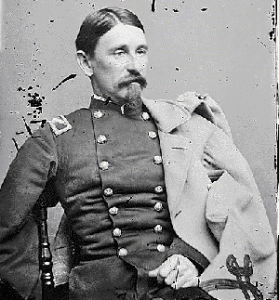
willard

George Willard 

As the brigade reached the lower portion of Cemetery Ridge a fresh Federal brigade commanded by Colonel George Willard struck the Mississippians. Willard’s brigade was seeking redemption having been one of the units forced to surrender at Harpers Ferry the previous September. His troops fresh and full of fight fell upon the Mississippians who were spent and disorganized having reached their culminating point. Barksdale continued to urge on his men but was mortally wounded and his troops driven back by the New Yorkers. Willard did not live long to savor the redemption as he was hit by a cannon ball and killed instantly.

To the north of the salient Anderson’s division of Hill’s corps attacked toward Cemetery Ridge meeting heavy resistance. Cadmus Wilcox’s brigade advanced unsupported up to Cemetery Ridge which due to the dispatch of troops to the Peach Orchard was only lightly defended. When Hancock saw the threat he ordered the 1st Minnesota commanded by Colonel William Covill, all of 262 men to charge the advancing Confederates telling Covill: “Colonel, do you see those colors?…Then take them.” [21] Between 170-178 of the Minnesotans fell in the counter-attack but they succeeded in blunting Wilcox’s attack and Wilcox seeing no help or support withdrew from Cemetery Ridge.
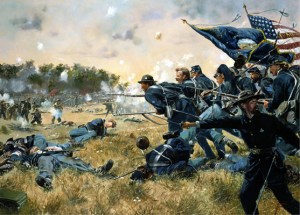
The First Minnesota

The Charge of Willard’s Brigade 

By the evening fresh Federal troops directed by Meade, Hancock and Hunt poured into the sector. By the end of the day despite sustaining massive casualties the Federal Army held its ground in large part thanks to the active role played by Meade, Hancock, Warren and Hunt in anticipating danger and bringing the appropriate forces to bear.

The fighting around the Peach Orchard, the Wheat field and Devil’s Den was confusing as units of both sides became mixed up and cohesion was lost. Both sides sustained heavy casualties but Lee’s Army could ill afford to sustain such heavy losses. By the end of the evening both McLaws and Hood’s divisions were spent having lost almost half of their troops as casualties. Hood was severely wounded early in the fight, and many other Confederate commanders were killed or mortally wounded including the irrepressible Barksdale. Combined with the repulse at Little Round Top the Confederate troops consolidated their positions.

In the end though McLaws’ and Hood’s divisions had succeeded in thrashing Sickles’ exposed salient they were unsuccessful at breaking the Federal line. Casualties were heavy on both sides but the attack had failed and it had failed because of senior leadership of Lee and his corps commanders. One of Lee’s biographer’s wrote “Longstreet was disgruntled, Ewell was inept and Hill was unwell.” [22] To make matters worse Lee did not assert himself and even his most devoted biographer Douglas Southall Freeman would write that on July 2d “the Army of Northern Virginia was without a commander.” [23]

mcgilvery

Freeman McGilvery

This Fiery Line” Lieutenant Colonel Freeman McGilvery and the Artillery at the Trostle Farm and Plum Run

The disaster that engulfed Sickles’ III Corps now threatened the Federal center. Meade and Hancock rushed reinforcements in the form of V Corps and much of II Corps. The tip of the Sickle’s salient at Sherfy’s Peach Orchard manned by Graham’s brigade of David Birney’s division was overwhelmed and retreated in disorder. Once “the angle had been breached, the lines connecting to it on the east and north were doomed.” [24] This exposed the left of Humphrey’s division and it too was forced to retreat under heavy pressure sustaining heavy casualties. The final collapse of Humphrey’s division a large gap opened in the Federal lines between the elements of V Corps fighting along Devil’s Den and Little Round Top and II Corps along the central portion of Cemetery Ridge.

When Meade realized the seriousness of the situation he gave Sickles’ free reign to call for reinforcements from Harry Hunt’s Artillery Reserve as III Corps had only batteries organic to it. Those five batteries were in the thick of the fighting providing invaluable support to Sickles’ hard pressed and outnumbered corps. Firing canister and grapeshot they cut swaths of death and destruction through the massed ranks of wildly cheering Confederates of Kershaw and Semmes and Barksdale’s brigades of McLaws’ division. Kershaw recalled:

“The Federals…opened on these doomed regiments a raking fire of grape and canister, at short distance, which proved most disastrous, and for a time destroyed their usefulness. Hundreds of the bravest and best men of Carolina fell….” [25]

The Confederates believed that they had cut the Union line in half and advanced through the Peach Orchard and across the Wheat Field toward Cemetery Ridge. But they were to befall another furiously conducted defense, this by artillery hastily collected along what is known as the Plum Run Line.
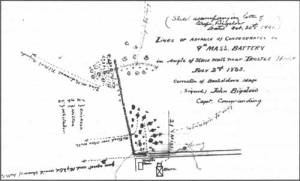
fig23

Among the artillery called into action was the First Volunteer Brigade under the command of Lieutenant Colonel Freeman McGilvery. McGilvery, a Maine native was a former sea captain who had organized and commanded the 6th Maine Battery at the beginning of the war. He commanded it with distinction in a number of engagements. Promoted to Major in early 1863 he assumed command of the Brigade and fought at Chancellorsville and was promoted to Lieutenant Colonel in June as the Army of the Potomac pursued Lee’s Army.

McGilvery rode into the maelstrom of the retreating III Corps soldiers and broken guns. His horse was hit four times but he remained unwounded despite “exposing himself to enemy missiles on all parts of the field from Cemetery Ridge to the Peach Orchard.” [26] He noted that there was no infantry anywhere that could plug the gap and acted instantly on his own authority to make a decision that likely saved the Union line.
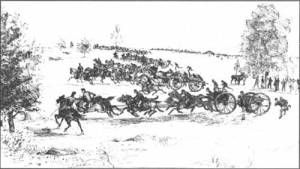
fig20

Bigelow’s Artillery

In the confusion of III Corps disintegration three of his batteries had withdrawn leaving Captain John Bigelow’s 9th Massachusetts battery alone at the Trostle farm telling them they must “hold at all hazards.” [27] Bigelow later explained that McGilvery said that “for 4 or 500 yards in my rear there were no Union troops.” He was then instructed by McGilvery “For heavens [sic] sake hold that line…until he could get some other batteries in position…” [28] In another account Bigelow recorded “Captain Bigelow…there is not an infantryman back of you along the whole line which Sickles moved out; you must remain where you are and hold your position at all hazards, and sacrifice your battery if need be, until at least I can find some batteries to put in position and cover you.” [29]

The order could have been considered suicidal; the 21st Mississippi was nearly upon them and they were but one battery and barely one hundred troops. Bigelow did not hesitate to obey; he brought his guns into line at the Trostle house “facing one section slightly to the southwest and the other two sections directly into the path of the oncoming Confederates.” [30]
barksdales_charge_lg

Barksdale’s Charge

Bigelow’s artillerymen fought like demons he described the effect of his fire on Kershaw’s South Carolinians “the Battery immediately enfiladed them with a rapid fire of canister, which tore through their ranks and sprinkled the field with their dead and wound, until they disappeared in the woods on our left, apparently a mob.” [31] They poured a merciless stream of fire into the advancing Confederates until “they had exhausted their supply of canister and the enemy began to close in on his flanks.” [32] A German born gunner noted “we mowed them down like grass, but they were thick and rushed up.” [33] A hand to hand fight ensued among the guns but the Massachusetts men escaped losing 28 of its 104 men engaged,[34] the brave commander Bigelow was wounded and nearly captured but one of his men helped him to the rear.

Their sacrifice was not in vain. They bought McGilvery an additional 30 minutes to set up a line of guns along Plum Run. Hunt praised the battery “As the battery had sacrificed itself for the safety of the line, its work is specially noticed as typical of the service that artillery is not infrequently called to render, and did render in other instances at Gettysburg besides this one.”[35]

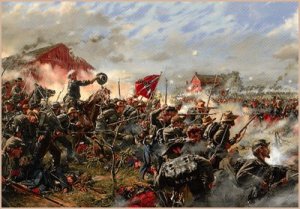
Barksdale’s brigade did not pause and continued in their relentless advance towards Cemetery Ridge, sweeping Union stragglers up as they moved forward led by their irrepressible Colonel. Before them was McGilvery’s new line, hastily cobbled together from any batteries and guns that he could find. Initially composed of 13-15 guns of four different batteries he was joined by two more batteries giving him about 25 guns in all. Subjected to intense Confederate artillery fire and infantry attacks his guns held on even as their numbers were reduced until only six guns remained operational. “Expertly directed by McGilvery a few stouthearted artillerymen continued to blaze away and keep the low bushes in front of them clear of lurking sharpshooters. Although they had no infantry supports, they somehow managed to create the illusion that the woods to their rear were filled with them, and they closed the breach until the Union high command could bring up reinforcements.” [36]

The reinforcements came in the form of Colonel George Willard’s “Harper’s Ferry” Brigade which was looking for revenge and redemption. This unit hit Barksdale’s now disorganized force which had reached its cumulating point hard. Willard was killed and Barksdale mortally wounded and captured in the violent clash which spelled the end of one of the greatest threats to the Union line of the entire battle. Philip Tucker in his book Barksdale’s Charge: The True High Tide of the Confederacy at Gettysburg, July 2, 1863 refers to Barksdale’s charge as the real “high water mark of the Confederacy.”

However it was McGilvery who recognized the emergency confronting the line and on his own took responsibility to rectify the situation. He courageously risked “his career in assuming authority beyond his rank” [37] and without his quick action, courage under fire and expert direction of his guns Barksdale’s men might have completed the breakthrough that could have won the battle for General Lee despite all of the mistakes committed by his senior leaders that day.

It was another example of an officer who had the trust of his superiors who did the right thing at the right time. It is an example of an officer used the principles of what we today call Mission Command to decisively impact a battle. McGilvery rose higher in the Federal service and was promoted to Colonel and command of the artillery of X Corps. He was slightly wounded in a finger at the battle of Deep Bottom in August 1864. The wound did not heal properly so surgeon’s decided to amputate the finger. However they administered a lethal dose of chloroform anesthesia and he died on September 9th, the Union losing one its finest artillerymen. He was buried in his native Maine and the State legislature designated the first Saturday in September as Colonel Freeman McGilvery Day in 2001.

Notes

[1] Jordan, David M. Happiness is Not My Companion: The Life of G.K. Warren Indiana University Press, Bloomington Indiana 2001 p.89

[2] Foote, Shelby The Civil War, A Narrative: Fredericksburg to Meridian. Vintage Books, a Division of Random House, New York 1963 p.495

[3] Catton, Bruce The Army of the Potomac: Glory Road Doubleday and Company, Garden City New York, 1952 pp.150-151

[4] Ibid p.288

[5] Ibid. Foote p.496

[6] Ibid. p.289

[7] Ibid. Jordan p.90

[8] Ibid. Foote p.496

[9] Schultz, Duane The Most Glorious Fourth: Vicksburg and Gettysburg July 4th 1863. W.W. Norton and Company New York and London, 2002 p.251

[10] Sears, Stephen Gettysburg Houghton Mifflin Company Boston and New York 2004 p.263

[11] Ibid.

[12] Ibid. Sears p.263

[13] Ibid. Foote p.497

[14] Pfanz, Harry W. Gettysburg the Second Day University of North Carolina Press, Charlotte and London, 1987 p.112

[15] Ibid. Foote p.499

[16] Ibid.

[17] Ibid.

[18] Coddington, Edwin B. The Gettysburg Campaign a Study in Command A Touchstone Book, Simon and Schuster, New York 1968 pp.402-403

[19] Ibid. Pfanz p.293

[20] Trudeau, Noah Andre Gettysburg a Testing of Courage Perennial Books, Harper Collins Publishers, New York 2002 p.368

[21] Ibid. p.393

[22] Taylor, John M. Duty Faithfully Performed: Robert E Lee and His Critics Brassey’s, Dulles VA 1999 p.149

[23] Freeman, Douglas S. R.E. Lee volume 3 Charles Scribner’s Sons, New York 1935 p.150

[24] Trudeau, Noah Andre Gettysburg: A Testing of Courage Harper Collins, New York 2002 p.368

[25] Kershaw, J.B. Kershaw’s Brigade at Gettysburg in Battles and Leaders of the Civil War Volume III, The Tide Shifts. Edited by Robert Underwood Johnson and Clarence Clough Buel Castle, Secaucus NJ p.335

[26] Coco, Gregory A A Concise Guide to the Artillery at Gettysburg Colecraft Industries, Orrtanna PA 1998 p.31

[27] Hunt, Harry I Proceeded to Cemetery Hill in Battles and Leaders of the Civil War Bradford, Ned editor, Meridian Books, New York 1956 p.378

[28] Guelzo, Allen C Gettysburg, The Last Invasion Vintage Books, a Division of Random House, New York 2013 p.314

[29] Ibid. Trudeau p.385

[30] Ibid.

[31] Bigelow, The Peach Orchard, 54; History of the Fifth, 638 retrieved from WE SAVED THE LINE FROM BEING BROKEN: Freeman McGilvery, John Bigelow, Charles Reed and the Battle of Gettysburg by Eric Campbell http://www.nps.gov/history/history/online_books/gett/gettysburg_seminars/5/essay4.htm#52

[32] Coddington, Edwin. The Gettysburg Campaign: A Study in Command Touchstone Books, New York 1960 p.416

[33] Ibid. Guelzo pp.314-315

[34] Ibid Hunt p.379

[35] Ibid. Hunt. P.379

[36] Ibid. Coddington p.417.

[37] Ibid. Coddington.

Leave a comment

Filed under civil war, Gettysburg, History, leadership, Military

Gettysburg Day Two: The Peach Orchard, Wheat Field and Devil’s Den

barksdales_charge_lg

“Mission command is the conduct of military operations through decentralized execution based upon mission-type orders. Successful mission command demands that subordinate leaders at all echelons exercise disciplined initiative, acting aggressively and independently to accomplish the mission. Essential to mission command is the thorough knowledge and understanding of the commander’s intent at every level of command.” From the Mission Command White Paper and JP 3-31

As on the first day of battle and throughout the Gettysburg campaign issues of command and control would be of paramount importance. On the second day the glaring deficiencies of Robert E Lee and his corps commanders command and control at Gettysburg would again be brought to the fore while the exemplary command of the Army of the Potomac by George Meade, Winfield Scott Hancock, staff artillery officer Henry Hunt and staff engineer Gouverneur Warren exemplified the best aspects of what we now define as Mission Command.

On the morning of July 2nd the Army of the Potomac was mostly assembled on the high ground from Culp’s Hill to Cemetery Hill and along Cemetery Ridge. In the north XII Corps under the command of Major General Henry Slocum held Culp’s Hill. The battered remnants of I and XI Corps under the command of Oliver Howard and Abner Doubleday held Cemetery Hill while Winfield Scott Hancock’s crack II Corps extended the line down Cemetery Ridge. To II Corps right was Dan Sickles’ III Corps with George Sykes V Corps in Reserve. John Sedgwick’s VI Corps was still enroute, marching up the Baltimore Pike.

It was a solid and well laid out position which commanded the battlefield. Major General Gouverneur Warren the Army’s Staff Engineer Officer who had been sent by Meade to assist Hancock the night of the first wrote his wife that morning: “we are now all in line of battle before the enemy in a position where we cannot be beaten but fear being turned.” (1)

sicklesMajor General Dan Sickles

There was one notable problem, Dan Sickles did not like the position assigned to his corps. His corps which joined the left flank of II Corps was to extend down Cemetery Ridge to Devil’s Den and Little Round Top. All morning he had been lobbying Meade, through Meade son and Aide-de-Camp Captain George Meade, the Artillery Reserve Commander Henry Hunt, Warren and even Meade himself to no avail. Sickles was disturbed because John Buford’s Cavalry division which has been deployed on the Federal left had been moved to the rear by Pleasanton the Cavalry Corps commander and not replaced.

Hunt who had accompanied Sickles back to his corps pointed out that the position was too exposed and too expansive for the number of troops Sickles had in his corps. He advised Sickles not to advance and assured Sickles that he would discuss Sickles’ concerns with Meade. (2)

To remedy the situation he sent out four companies of Sharpshooters supported by the 3rd Maine Infantry to make a reconnaissance. Those troops ran into a large force of advancing Confederate Infantry near Seminary Ridge and withdrew, Colonel Brenden of the Sharpshooters informing Sickles of the Confederate advance.

Sickles now felt that the Union line was about to be turned as it had been at Chancellorsville and without consulting Meade or Hancock took it upon himself to save the situation. It was an act of brazen insubordination, but typical of the mercurial, vain and scandal plagued man who “wore notoriety like a cloak” and “whether he was drinking, fighting, wenching or plotting, he was always operating with the throttle wide open.” (3)

About mid-afternoon Sickles advanced III Corps forward in a “mile long line of battle with waving flags and rumbling batteries rolling west into the afternoon sunlight.” (4) The sight confused other commanders such as John Gibbon commanding a division in II Corps who watched in amazement from his vantage point on Cemetery Ridge. Sickles advanced nearly a mile in front of his previous position opening a gap between III Corps and II Corps. He attempted to hold a new line that was longer and more exposed than the number of troops that he had available. He placed Humphrey’s division along the Emmitsburg Road and extended Birney’s division through the Peach Orchard, a wheat field down to Devil’s Den where he ran out of troops.

gettysburg-peach-orchard

Sickles had formed an exposed and vulnerable salient which was too thinly manned for its length. It was open to attack on three sides, had little depth, no reserves and no place to fall back to as an alternate position. (5) It was also about to be hit by the full fury and power of Hood’s and McLaws’ divisions of Longstreet’s First Corps supported by 46 well placed artillery pieces (6) all about to open fire on Sickles badly deployed corps.

About 3 PM Meade broke from a planned commander’s conference to investigate what had happened to Sickles and III Corps, accompanying Meade was Warren. Warren who was most familiar with that part of the battlefield noted that III Corps was “very badly disposed on that part of the field.”7

Confronting Sickles in the Peach Orchard Meade was visibly perturbed. Meade informed Sickles that “General I am afraid that you are too far out” (8) attempting to control his temper. Sickles disagreed and said with support he could hold the position because it was higher ground than what he had previously occupied. Meade then pointed out the obvious stating “General Sickles this is in some respects higher ground than that to the rear, but there is still higher in front of you…” (9) As the conversation progressed Meade told Sickles that “this is neutral ground, our guns command it as well as the enemy’s. The reason you cannot hold it applies to them.”(10)

Sickles offered to withdraw but as he did so the Confederate cannonade began signaling the beginning of Longstreet’s attack. Meade told Sickles “I wish to God you could [withdraw]…but those people will not permit it.” (11) Another account states that Meade told Sickles “You cannot hold this position but the enemy will not let you get away without a fight.”(12)

Since Sedgwick’s powerful VI Corps had just arrived Meade ordered it into reserve. He then ordered Sykes V Corps from its reserve position and one division of II Corps to support the dangerously exposed III Corps around the Peach Orchard and Wheat Field. He then told Sickles “if you need more artillery call on the reserve!” (13) It was an action that very likely saved the day, another example of Meade taking control of a bad situation preventing it from becoming even worse.

For Lee and Longstreet the morning had been spent disagreeing on a plan to crush Meade. Though his army was operating on exterior lines with his corps having no way to effectively coordinate their actions and still lacking Stuart’s Cavalry, Pickett’s Infantry division and Law’s brigade of Hood’s division Lee insisted that Longstreet and First Corps make a frontal attack on the Union left. Longstreet demurred and tried to convince Lee of turning the Union flank to the south of the Round Tops. Longstreet told Hood “The General is a little nervous this morning; he wishes me to attack; I do not wish to do so without Pickett. I never like to go into battle with one boot off.” (14)

Lee did not believe that such a move could succeed without the assistance of Stuart’s cavalry and Longstreet did not believe that with Pickett’s division that his corps had the combat power to successfully complete the mission. Hood objected to the attack pleading with Longstreet that it was “unwise to attack up the Emmitsburg Road, as ordered” and requested that he be allowed to “turn Round Top and attack the enemy flank and rear.”(15)

HD_hoodJB1Major General John Bell Hood

The debate between Longstreet and Hood continued as Hood objected and Longstreet reiterated Lee’s insistence on the planned attack. Hood pleaded for freedom of maneuver believing that an attack up the rocky hills was doomed and later noted “it seemed to me that the enemy occupied a position so strong- I may say impregnable – that independently of their flank fire, they could easily repulse our attack by merely throwing or rolling stones down the mountainside as we approached.”(16) Despite his objections to the plan Longstreet ordered Hood to attack as Lee planned and after a fourth attempt by Hood to persuade Longstreet to change the plan Longstreet told his subordinate “We must obey the orders of General Lee.” (17)

However in addition to his contention with Lee and Hood Longstreet had to deal with Lee jumping the chain of command. With Longstreet in earshot order McLaws to make an attack on the Peach Orchard and ignored McLaws repeated requests to make a further reconnaissance before launching the attack. By the time Hood and McLaws divisions were in place along with Anderson’s division from Hill’s Third Corps it was nearly four o’clock. The senior commanders of the Army of Northern Virginia had functioned poorly throughout the day but when the attack began it was like a violent storm as Confederate troops fell upon the exposed Federal III Corps.

mclawsMajor General Lafayette McLaws

When the attack was launched McLaws division and the left wing of Hood’s division struck the exposed positions of III Corps. Sickles was severely wounded by a bouncing cannon ball which shattered a leg knocking him out of the fight, Hood too was badly wounded early in the action leaving command of his division to Brigadier General Evander Law, whose brigade had just arrived on the battlefield after a long march from New Guilford in the Cumberland Valley. Though now in command Law continued to command his own brigade in the assault and Robertson took the initiative to bring up the rest of the division. (18)

McLaws and Hood’s soldiers hit Sickles Corps hard shattering it. Despite fierce resistance from the Federal forces Sickles’ corps was forced to retreat. The reinforcements ordered to the sector from V Corps, II Corps and the artillery reserve arrived piecemeal and also sustained heavy casualties but eventually helped to stem the Confederate tide. III Corps was wrecked and effectively out of the battle but the actions of Meade, Hancock, Warren, Gibbon, Sykes and Hunt to respond to Sickles folly kept the Confederates from sweeping the field.

fig33

Law, Robertson’s and Benning’s brigades opened Hood’s attack toward Devil’s Den and Little Round Top.
Fierce fighting ensued at Devil’s Den where the Federal line, occupied by Colonel A. Van Horn Ellis’ 124th New York and 4 guns of Smith’s artillery battery put up a stiff resistance. Ellis’s small regiment numbered but 18 officers and 220 men when it entered the fight but it held off several charges of the Texans and even conducted a counter-attack before being overwhelmed by fresh troop’s from Benning’s brigade. During the fight Ellis mounted his horse noting that “The men must see us today.”(19) Ellis died in the action as did many of his brave soldiers. In the valley between Devil’s Den and the Round Tops the 4th Maine and Smith’s 2 remaining guns fought large numbers of Hood’s troops and as the outnumbered Federals fell back the Texan’s of Robertson’s brigade and Law’s Alabamians surged toward the rocky hill.

Col. Van Horne Ellis, 124th N.Y. InfColonel Augustus Van Horn Ellis

Brigadier General William Barksdale’s Mississippi brigade which had distinguished itself at Fredericksburg stormed the Federal positions breaking through the salient and driving forward. He led his brigade forward though it had suffered significant casualties and was losing cohesion. Barksdale insisted on continuing to the advance and not taking time to reform his lines shouting at one of his regimental commanders “No! Crowd them- we have them on the run. Move your regiments.” (20 )

GeneralBarksdale_zps3678f799willardBarksdale and Willard (below)

As the brigade reached the lower portion of Cemetery Ridge a fresh Federal brigade commanded by Colonel George Willard struck the Mississippians. Willard’s brigade was seeking redemption having been one of the units forced to surrender at Harpers Ferry the previous September. His troops fresh and full of fight fell upon the Mississippians who were spent and disorganized having reached their culminating point. Barksdale continued to urge on his men but was mortally wounded and his troops driven back by the New Yorkers. Willard did not live long to savor the redemption as he was hit by a cannon ball and killed instantly.

The First MinnesotaFirst Minnesota attacks Wilcox’s Brigade

To the north of the salient Anderson’s division of Hill’s corps attacked toward Cemetery Ridge meeting heavy resistance. Cadmus Wilcox’s brigade advanced unsupported up to Cemetery Ridge which due to the dispatch of troops to the Peach Orchard was only lightly defended. When Hancock saw the threat he ordered the 1st Minnesota commanded by Colonel William Covill, all of 262 men to charge the advancing Confederates telling Covill: “Colonel, do you see those colors?…Then take them.” 21 Between 170-178 of the Minnesotans fell in the counter-attack but they succeeded in blunting Wilcox’s attack and Wilcox seeing no help or support withdrew from Cemetery Ridge.

By the evening fresh Federal troops directed by Meade, Hancock and Hunt poured into the sector. By the end of the day despite sustaining massive casualties the Federal Army held its ground in large part thanks to the active role played by Meade, Hancock, Warren and Hunt in anticipating danger and bringing the appropriate forces to bear.

The fighting around the Peach Orchard, the Wheat field and Devil’s Den was confusing as units of both sides became mixed up and cohesion was lost. Both sides sustained heavy casualties but Lee’s Army could ill afford to sustain such heavy losses. By the end of the evening both McLaws and Hood’s divisions were spent having lost almost half of their troops as casualties. Hood was severely wounded early in the fight, and many other Confederate commanders were killed or mortally wounded including the irrepressible Barksdale. Combined with the repulse at Little Round Top the Confederate troops consolidated their positions.

In the end though McLaws’ and Hood’s divisions had succeeded in thrashing Sickles’ exposed salient they were unsuccessful at breaking the Federal line. Casualties were heavy on both sides but the attack had failed and it had failed because because of senior leadership of Lee and his corps commanders. One of Lee’s biographer’s wrote “Longstreet was disgruntled, Ewell was inept and Hill was unwell.” (22) To make matters worse Lee did not assert himself and even his most devoted biographer Douglas Southall Freeman would write that on July 2d “the Army of Northern Virginia was without a commander.” (23)

Until the next installment,

Peace

Padre Steve+

1 Jordan, David M. Happiness is Not My Companion: The Life of G.K. Warren Indiana University Press, Bloomington Indiana 2001 p.89

2 Foote, Shelby The Civil War, A Narrative: Fredericksburg to Meridian. Vintage Books, a Division of Random House, New York 1963 p.495 

3 Catton, Bruce The Army of the Potomac: Glory Road Doubleday and Company, Garden City New York, 1952 pp.150-151

4 Ibid p.288 

5 Ibid. Foote p.496

6 Ibid. p.289

7 Ibid. Jordan p.90 

8 Ibid. Foote p.496

9 Schultz, Duane The Most Glorious Fourth: Vicksburg and Gettysburg July 4th 1863. W.W. Norton and Company New York and London, 2002 p.251

10 Sears, Stephen Gettysburg Houghton Mifflin Company Boston and New York 2004 p.263

11 Ibid. 

12 Ibid. Sears p.263

13 Ibid. Foote p.497

14 Pfanz, Harry W. Gettysburg the Second Day University of North Carolina Press, Charlotte and London, 1987 p.112 

15 Ibid. Foote p.499

16 Ibid. 

17 Ibid.

18 Coddington, Edwin B. The Gettysburg Campaign a Study in Command A Touchstone Book, Simon and Schuster, New York 1968 pp.402-403

19 Ibid. Pfanz p.293

20 Truedeau, Noah Andre Gettysburg a Testing of Courage Perennial Books, Harper Collins Publishers, New York 2002 p.368

21 Ibid. p.393

22 Taylor, John M. Duty Faithfully Performed: Robert E Lee and His Critics Brassey’s, Dulles VA 1999 p.149

23 Freeman, Douglas S. R.E. Lee volume 3 Charles Scribner’s Sons, New York 1935 p.150


1 Comment

Filed under civil war, History, leadership, Military
