Tag Archives: D-Day

The Longest Day and Afterwards: D-Day and the Normandy Campaign, an Introduction

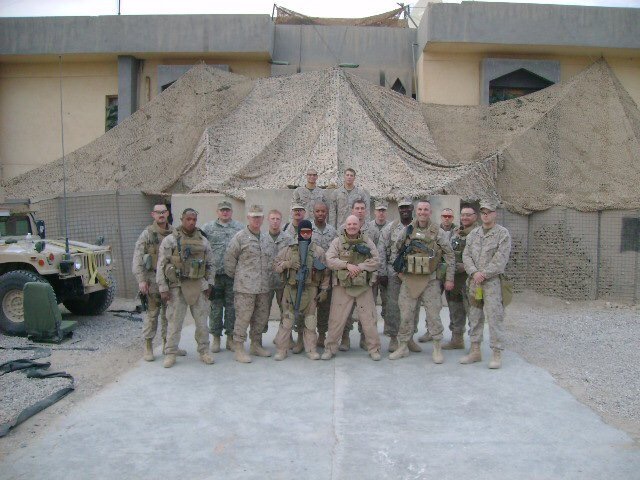
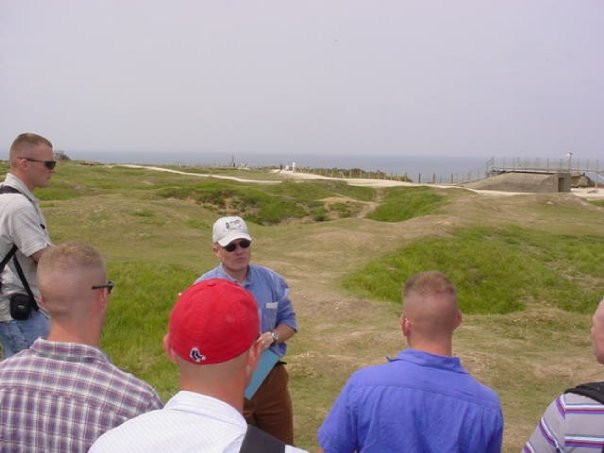
The author with Marines at Point du Hoc, Normandy in 2004

Friends of Padre Steve’s World,

Every year about this time I try to write about D-Day.  This year I spent more time on the Battle of Midway writing or rewriting a total of five articles.

Since we are now about to begin a time of major repairs to our home due to flooding from an plugged air conditioning condensation drains I have decided to do is to re-post a short research paper that I did for one of my Master’s degree courses tonight, actually posting it on Sunday night for publication today, and hope to follow it up with some more articles over the week on specific aspects and personalities of the campaign.  What I hope is that people that are not familiar with the campaign as well as those that are can use this as a portal to other resources on the web and in print.

I have visited Normandy once in 2004 on a trip with the Marines of the Marine Security Force Company Europe that took me to Belleau Wood as well as Normandy.  In both places I had the good fortune to be able to explain aspects of both battles, at Normandy discussing the invasion from the German side of the fence.  The Normandy battlefields are well worth visiting.  Hopefully in the next few years I will get a chance to go back and do some serious exploring.

Introduction

General Dwight D Eisenhower Commander in Chief Allied Forces Europe

The American landings on Omaha Beach were critical to the success of the Allied invasion northwestern Europe in the overall Overlord plan.  Without success at Omaha there would have been a strong chance that the German 7th Army and Panzer Group West could have isolated the remaining beachheads, and even if unsuccessful at throwing the Allies into the sea could have produced a stalemate that would have bled the Allies white.  This quite possibly could have led to a political and military debacle for the western allies which would have certainly changed the course of World War II and maybe the course of history.[i] This is not to say the Germans would have won the war, but merely to state that a defeat on Omaha could have changed the outcomes of the war significantly.   Subsequent to the successful landing there were opportunities both for the Allies and the Germans to change the way that the campaign unfolded, thus the battles leading up to the breakout at Avranches are critical to its development and the subsequent campaign in France.

OVERLORD: The Preparations

Eisenhower’s Key Lieutenants: Patton, Bradley and Montgomery

The planning for the Normandy invasion began in earnest after the QUADRANT conference in Quebec in August 1943.  The timetable for the operation was established at the Tehran conference where Stalin sided with the Americans on the need for an invasion of France in the spring of 1944.[ii] Prior to this there had been some planning by both the British and Americans for the eventual invasion initially named ROUNDUP.  These preparations and plans included a large scale raid at Dieppe in 1942 which ended in disaster but which provided needed experience in what not to do in an amphibious assault on a heavily defended beach.        The failure at Dieppe also darkened the mood of the Allies, the British in particular to the success of such operations, bringing to mind the failed Gallipoli campaign of 1915 as well as the opposed landings at Salerno and the USMC experience at Tarawa.[iii] Despite this the Americans led by General Marshall pushed for an early invasion of northwest Europe. Churchill and the British due to their weakness in land power pushed for land operations in the Mediterranean, and even in Norway as an option to the assault in France. The conflicted mindset of the Allies left them in the position of planning almost exclusively for the success of the initial landings and build up to the near exclusion of planning for the subsequent campaign once they landed. This especially included what one writer described as “the maze of troubles awaiting behind the French shore.”[iv]

Field Marshal Erwin Rommel, Commander of Army Group B

Despite conflicts between the Americans and British political and military leadership the planning for the Normandy landings detailed in NEPTUNE and OVERLORD moved ahead.  General Dwight Eisenhower was appointed as the commander of SHAEF with his major subordinates for Land, Air and Sea which caused consternation on both sides of the Atlantic.[v] [vi] The planned operation was expanded from the initial 3 division assault on a narrow front to a minimum 5 division assault on a broad front across Normandy[vii]supplemented by a strong airborne force.[viii] Overall the plan as it developed reflected a distinctly “American willingness to confront the enemy head-on in a collision which Britain’s leaders had sought for so long to defer.”[ix] It is ironic in a sense that the British avoidance of the head on attack was based on their known lack of manpower.  Britain had few infantry reserves to sustain the war effort and the Americans only late recognized their own deficiency in both quantity and quality of infantry forces on which their strategy depended.  That the western allies, so rich in material and natural resources would be so deficient in infantry manpower was a key constraint on the subsequent campaign in France and Germany.  The shortage of infantry forces would cause great consternation among the Allies as the campaign in France wore on.

German Beach Obstacles

The Germans too faced manpower shortages due to the immense losses sustained on the Eastern front, those lost in Africa and those tied down in Italy, the Balkans and Norway as well as the drain caused by Luftwaffe Field Divisions and troops diverted into the Waffen-SS.   The German Army resorted to smaller divisions and the created many “static” divisions manned by elderly or invalid Germans to plug the gaps along the Atlantic wall. The Germans were also forced to recruit “Volksdeutsch” and foreign “volunteers” to fill out both Wehrmacht and Waffen-SS formations.

German fortifications at the Pas de Calais

Prior to the final decision to mount an invasion the Allied planners had contended with the location of the assault in northwestern France.  The Pas de Calais provided a direct route was rejected because it was where the Germans would expect the strike to occur and because it was where the German defenses were strongest.  The fiasco at Dieppe had provided ample proof of what could happen when making an assault into a heavily fortified port.  Likewise the mouth of the Seine near Le Harve was rejected because of the few beaches suitable for landing and because the forces would be split on both sides of the river.  Brittany was excluded due to its distance from the campaigns objectives in Germany.[x]This left Normandy which offered access to a sufficient number of ports and offered some protection from the weather. Normandy offered options to advance the campaign toward the “Breton ports or Le Harve as might be convenient.”[xi] Omaha beach, situated on the center right of the strike would be crucial to the success of the assault situated to the left of UTAH and the right of the British beaches.

Rommel inspecting beach obstacles

Once Normandy was selected as the location for the strike by the Allies, the planning sessions remained contentious.  This was especially true when the Allies debated the amount and type of amphibious lift that could be provided for the landings, particularly the larger types of landing ships and craft to support the Normandy invasion and the planned invasion of southern France, Operation ANVIL.  The increase in OVERLORD requirements for landing craft had an impact in the Mediterranean and resulted in ANVIL being postponed until later in the summer.
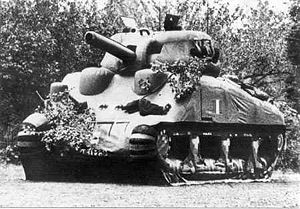
“Dummy” Sherman Tank: The Allies created a fictional Army Group to deceive German planners

As part of their preparations the Allies launched a massive deception campaign, Operation FORTITUDE.  This operation utilized the fictitious First Army Group under the “command” of General George Patton. Patton was still smarting from his relief of command of 7th Army following slapping commanded an “Army Group” which incorporated the use of dummy camp sites, dummy tanks, aircraft and vehicles, falsified orders of battle and communications to deceive German intelligence.[xii] The success of this effort was heightened by the fact that all German intelligence agents in the U.K. had been neutralized or turned by the British secret service.  Additionally the Luftwaffe’s limited air reconnaissance could only confirm the pre-invasion build ups throughout England without determining the target of the invasion.[xiii] The German intelligence chief in the west, Colonel Baron von Roenne “was deceived by FORTITUDE’s fantasy invasion force for the Pas de Calais.”[xiv] Despite this Commander of the 7thArmy recognized by 1943 that Normandy was a likely Allied target and efforts were made to shift 7th Army’s center of gravity from Brittany to Normandy.  The one potential German success in getting wind of when the Allied landings would occur was lost when German intelligence discovered two lines of Verlaine’s “Chason d’ Automme” in June 1944 which were to alert the French Resistance of the invasion.  The security section of 15th Army heard them transmitted on the afternoon of 5 June and notified General Jodl at OKW, but no action was taken to alert forces on the coast.[xv] Allied intelligence was aided by ULTRA intercepts of coded German wireless transmissions. However this was less of a factor than during the African and Italian campaigns as more German communications were sent via secure telephone and telegraph lines vice wireless.[xvi] Allied deception efforts were for the most part successful in identifying German forces deployed in Normandy. However they were uncertain about the location of the 352nd Infantry Division which had been deployed along OMAHA and taken units of the 709th Infantry Division under its command when it moved to the coast.[xvii]

USAAF B-17 Bombers and others helped isolate German forces in Normandy by bombing railroads, bridges, and supply lines

The Allied air campaign leading up to the invasion was based on attempting to isolate the invasion site from German reinforcements. Leigh-Mallory the Air Chief developed the “TRANSPORTATION PLAN” which focused efforts on destroying the French railroad infrastructure.[xviii] A more effective effort was led by General Brereton and his Ninth Air Force which was composed of medium bombers and fighters.  Brereton’s aircraft attacked bridges and rapidly achieved success in crippling German efforts to reinforce Normandy.[xix] Max Hastings gives more credit to the American bombing campaign in Germany to crippling the German defense in the west. General Spaatz and the 8th Air Force destroyed German production capacity in oil and petroleum as well as the degraded the German fighter force.  The American daylight raids so seriously degraded the German fighter force that it could not mount effective resistance to the invasion.[xx] Russell Weigley also notes that Albert Speer the Reich Armaments Minister said that “it was the oil raids of 1944 that decided the war.”[xxi]
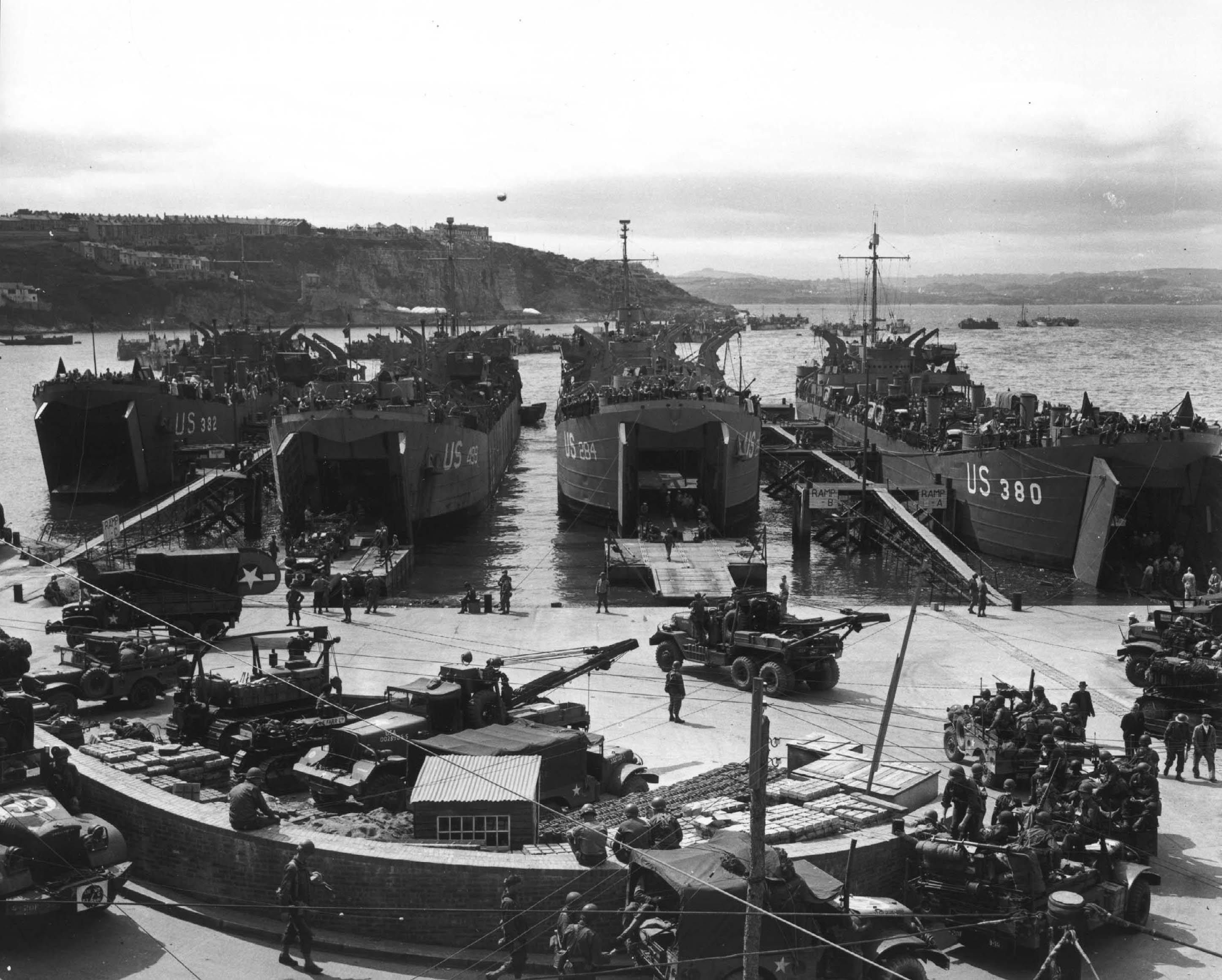
 

US Navy LST’s being loaded for the invasion

Planning and preparations for OMAHA were based around getting the 1st and 29th Infantry Divisions ashore and them securing a beachhead “twenty-five kilometers wide and eight or nine kilometers deep.”[xxii] American preparations were thorough and ambitious, but the American assault would go through the most heavily defended sector of German defenses in Normandy.  The landing beaches were wide and bordered by dunes which were nearly impassable to vehicles and “scrub covered bluffs thirty to fifty meters high…rough and impassable to vehicles even to tracked vehicles except at a few places.  The exits were unimproved roads running through four or five draws that cut the bluffs.”[xxiii] Dug in along those bluffs was the better part of the 352nd Division. The Americans compounded their selection of a difficult and heavily defended landing zone the Americans failed to take advantage of many of the “gadgets” that were offered by the British which in hindsight could have aided the Americans greatly.  The Americans made use of two battalions of DD (Dual Drive) tanks but turned down the offer of flail tanks, flamethrower tanks, and engineer tanks, the “funnies” developed by General Hobart and the British 79th Armored Division.[xxiv]

Dual Drive amphibious tanks were included as part of the US invasion package

Weigley believes that the American view of “tanks as instruments of mobility rather than of breakthrough power.” Likewise the Americans victories in the First World War were won by infantry with little tank support.[xxv] In this aspect the Americans were less receptive to utilizing all available technology to support their landings, something that when considering the fact that Americans were great lovers of gadgets and technology. The British use of the Armor, including the “Funnies” on the beaches to provide direct fire into German strong points lessened their infantry casualties on D-Day. Due to this lack of armor support on the beach American forces on OMAHA had little opportunity to exercise true combined arms operations during the initial landings.[xxvi]


Rommel with Artillerymen of the 21st Panzer Division in Normandy

German preparations for an Allied landing in Normandy were less advanced than the Pas de Calais.  However they had made great strides since late 1943. Field Marshal Rommel greatly increased defensive preparations along the front, including the Normandy beaches.  One of Rommel’s initiatives was to deploy Panzer Divisions near the coast where they could rapidly respond to an invasion.  However Rommel did not get everything that he wanted.  The OKW only allotted him two Panzer Divisions to be deployed near the Normandy beaches.  Only one of these the 21st Panzer Division was deployed near Caen in the British sector.  One wonders the result had the 12th SS Panzer Division been deployed behind OMAHA. [xxvii]

OMAHA: The Landings

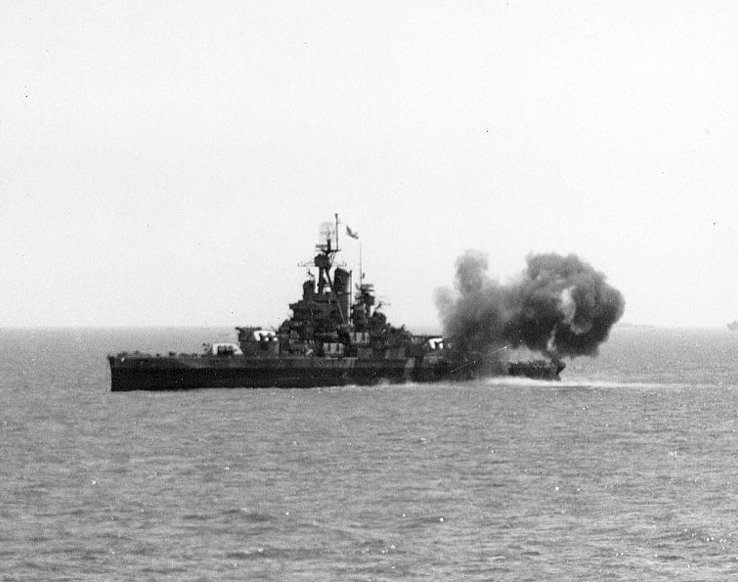
The venerable USS Nevada, resurrected from the mud of Pearl Harbor bombarding German positions at Utah Beach

Like the rest of the Allied invasion forces the 1st and 29th U.S. Infantry Divisions set sail from their embarkation ports with the intent of landing on June 5th.  General Bradley, commanding the First Army until the American XII Army Group would be activated accompanied the invasion force.  The OMAHA landing was under the command of General Gerow and his V Corps while VII Corps led by the 4th Infantry Division landed at Utah supported by airdrops of the 82nd and 101st Airborne Divisions inland.  American command and control during the invasion was exercised from sea as in the Pacific, although General Officers were to go ashore with each of the American divisions.  A severe channel storm disrupted the plan to land on the 5th and Eisenhower delayed the invasion one day catching a break in the weather and electing to go on the 6th.[xxviii] This delay while uncomfortable for the embarked troops caused the Germans to believe that no invasion would take place until the next favorable tide and moon cycle later in the month.[xxix] The assumption that no invasion was possible ensured that a number of key senior German leaders, including Rommel were absent from the invasion front when the Allies landed.[xxx]

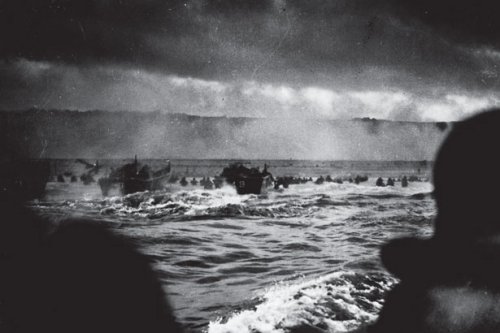
US Troops ride a LCVP toward Omaha 

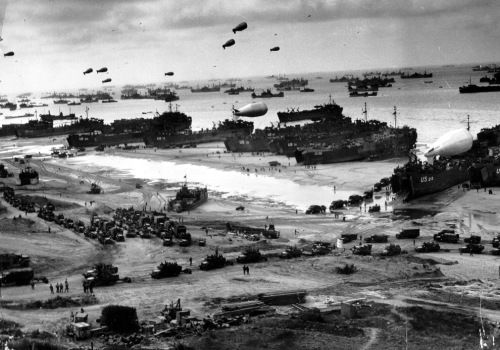
The landing beaches at OMAHA stretched about 6500 meters from Colleville-Sur-Mer to Vierville-Sur-Mere in the west.  The beaches are wide with bluffs overlooking them and a seawall between the beaches and the bluffs.  Additionally several small towns dot the beach. To the west of the town of Vierville, a prominent height overlooked the entire beachhead.  Named Pont du Hoc, it was believed to house a 150mm battery sighted where it could enfilade the OMAHA landing zones.  The Americans assigned to the 2nd Ranger Battalion to make a seaborne assault to land, scale the cliffs and take the battery.  Companies from this battalion made a heroic landing and scaled the cliffs to capture the strongpoint only to discover that the guns had not been emplaced.  The Rangers took heavy casualties and held their isolated beachhead against German counterattacks until relieved by the 29th Division on the morning of June 8th.[xxxi]

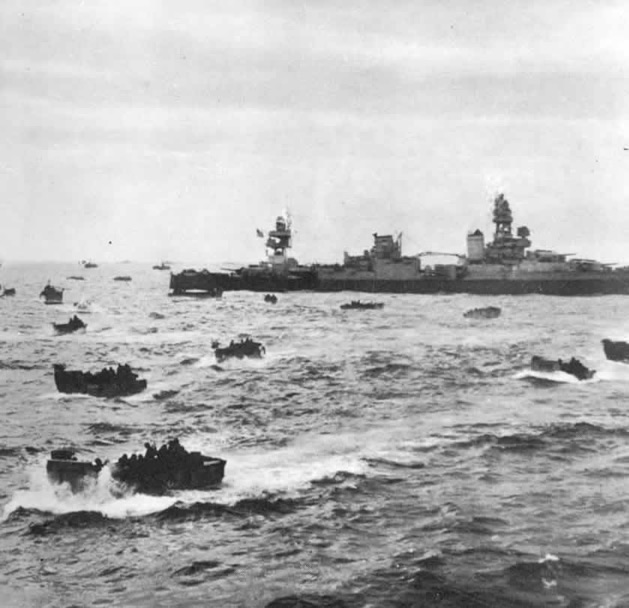
Landing craft passing the USS Augusta in heavy seas heading toward Omaha Beach

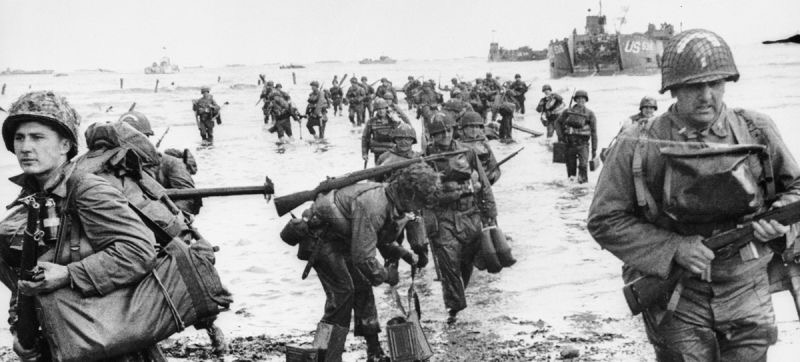
H-Hour for OMAHA was 0630.  Unfortunately the assault troops were transferred to their LCVP landing craft 16-20 kilometers from the beach.  The result was a long and dangerous ride in the small craft for the infantry.  Most of the infantry were completely soaked in sea spay and seasick before going ashore and they carried loads far above what they normally would carry into battle.[xxxii] The Armor support was one battalion of DD tanks, the 741stArmored Battalion, supporting the 16th Infantry Regiment of 1st Infantry Division. These were also launched too far out and nearly all of the tanks were swamped and lost before firing a shot in anger.[xxxiii] Other American support units needed to provide firepower on the beach were equally unfortunate. Weigley notes that at OMAHA “at least 10 of the LCVPs sank” as did “the craft carrying almost all of the 105mm howitzers that were to be the first artillery ashore after the tanks.”[xxxiv] The losses would cripple the assault on OMAHA and nearly cause its abandonment.

Bloody Omaha

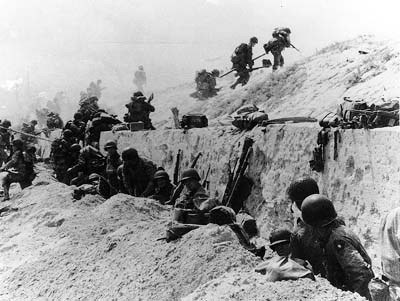
As the soldiers of the American divisions on OMAHA came ashore they faced German defenders of the 352nd, 716th and a regiment of the 709th Infantry Division, the latter under the tactical command of the 352nd.   Without the bulk of their tanks artillery and lacking close air support the Americans struggled across the beaches and were cut down in large numbers before being pinned down behind the sea wall.[xxxv] With the Americans pinned down on the beach unable to advance, the time tables for the reinforcing waves became snarled amid the German beach obstacles which had not been cleared.  This was in large part due to 40% casualties among the Combat Engineers and the loss of all but five bulldozers.[xxxvi] Naval officers were frustrated in their attempts to provide naval gunfire support by the lack of identifiable targets on the beaches.  Yet German strongpoint’s were “knocked out by either by superbly directed vigorous gunfire from destroyers steaming as close as 800 yards offshore, or by determined action from Rangers or infantry.[xxxvii]


US Infantry struggles ashore at Omaha

Soldiers ashore discovered that they were not facing the static 716th Division but the veteran 352nd Division as well.[xxxviii] Only the leadership and actions of Brigadier General Norman Cota the 29th Division’s Deputy Commander and Colonel Charles Canham of the 116th Infantry kept the situation from complete collapse.  They were able to rally their troops. Under their leadership small units from the 116th which had its linage back to the “Stonewall Brigade” as well as elements of the 16th and 18th Infantry Regiments began to move forward.  Surviving junior leaders began to lead survivors through the dunes and up the bluffs to attack German defenders of the roads leading up from the beach from the flank and rear.  A mid-day break in the weather allowed some close tactical air support giving the troops badly needed support.

US 1st Infantry Division Troops at the Omaha sea wall

With the situation desperate General Bradley considered the evacuation of OMAHA.  At sea events were as confused as Bradley and his staff attempted to make sense of what was going on.  Even later in the evening there was discussion of diverting all further reinforcements from OMAHA to the British beaches.[xxxix]At 1330 hours “Gerow signaled Bradley: “Troops formerly pinned down on beaches…advancing up heights behind beaches.”[xl] By the end of the day Bradley’s aid Major Hansen noted Bradley’s comments to Collins: “They are digging in on Omaha beach with their fingernails. I hope they can push in and get some stuff ashore.”  And Montgomery: “Someday I’ll tell Gen[eral] Eisenhower just how close it was for a few hours.”[xli]
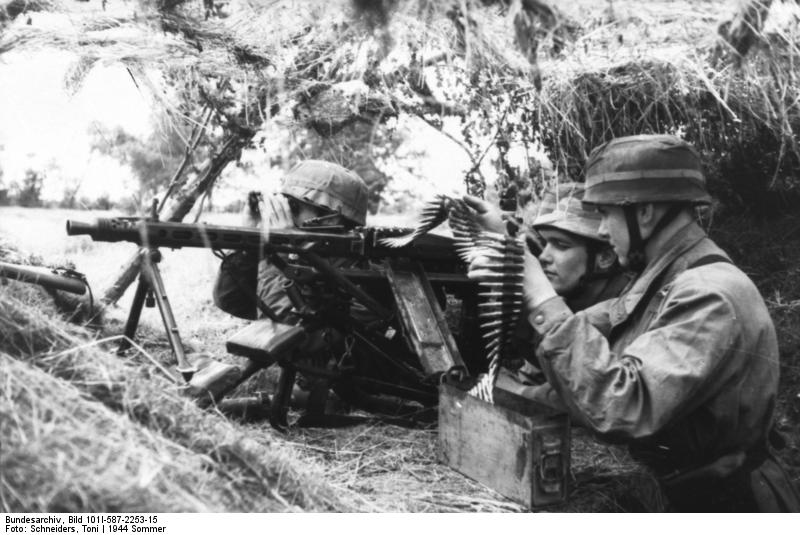
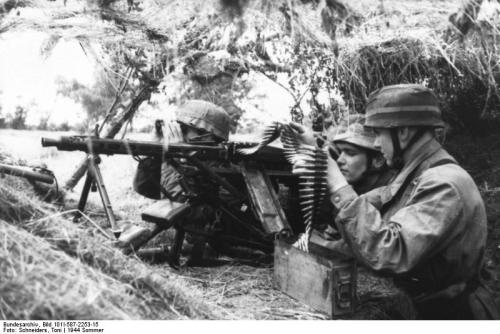
German Fallschirmjaeger Trüppen in Normandy, the German Parachute forces fighting in an infantry role were very effective in the Normandy campaign

The landings at OMAHA succeeded at a cost of over 2000 casualties.  Critical to the success of the landings were the German inability to reinforce their defending troops on the beach.  Likewise the weakness of the units available to mount the standard counterattack that was critical to German defensive plans on D-Day itself kept the Germans from driving the Americans back into the Channel. The 352nd Division fought superbly under the full weight of V Corps and the British XXX Corps on its right suffering heavy casualties as they contested every inch of ground.  The 716th Division composed of second rate troops melted under the onslaught.  Allied air supremacy played a key role as sorties by the 8th and 9th Air Forces helped keep German reinforcements from arriving and interdicted counter attacks inland.  Weigley credits the Allied air superiority with the success of the landings and with limiting casualties.[xlii]Von Rundstedt and other German commanders in France were limited by the delay and refusal of Hitler and OKW to release Panzer reserves when needed most early on June 6th.  By the close of D-Day allied forces had secured the five invasion beaches but not achieved their objectives of taking Caen and Bayuex.  Since the forces on the various beachheads had not linked up the beaches would have been extremely vulnerable had the Germans been able to mount a rapid counterattack by Panzers and strong infantry formations as they had at Salerno.

Major Battles to the Breakout at Avranches

Securing the Beachheads

It took the V and VII Corps nearly a week to secure the beachheads. German forces including the stalwart 352nd Division resisted stubbornly and mounted sharp local counterattacks which kept the Americans off balance.  Elements of the 29th Division and the 90th Division began to push inland and to expand the beachhead toward UTAH. Opposed by the 352nd Division and elements of the 91st Airlanding Division and other non-divisional units the fighting revealed the inexperience of the American infantry formations and the uneven quality of their leadership.  As the Americans tackled the Germans in the labyrinth of the Bocage country the defensive skill of the Germans cost many American lives and delayed the joining of the beachheads. On the 13th the link up was solid enough to enabling the Americans to conduct the follow up operations needed to expand the beachhead, secure Cherbourg and clear the Cotentin.
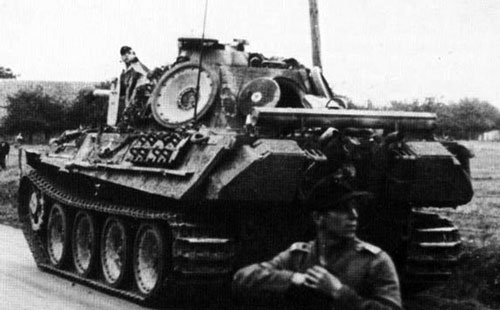
A Panther tank of the Panzer Lehr Division in Normandy

In some American divisions the hard fighting triggered a leadership crisis.  The lack of success of the 90th Division led General “Lightening Joe” Collins of VII Corps relieve the division commander and two regimental commanders of command, a portent of things to come with other American units.[xliii] As the V and VII corps pushed into the “Bocage” they were followed by a massive build up of troops and equipment delivered to the beaches and to the artificial “Mulberry” harbors.  Despite their numeric superiority, air supremacy and massive Naval gunfire support and facing the weakened 352nd, 91st and the 6thParachute Regiment and other less than quality formations, survivors of the static divisions, the Americans made painfully slow progress as they moved off the beachhead and into the Bocage.[xliv]

The Capture of Cherbourg

US Soldiers of the 29th Division surrender to German Fallschirmjaeger in Normandy

Once the beachheads had been consolidated the Americans turned their attention toward Cherbourg. Cherbourg was the major naval port at the far northwest tip of the Cotentin.  D-Day planners counted on its swift capture and rehabilitation to serve as a supply port for the Allied forces. The 9th Division drove south to the coast near Barneville on the 18th of June cutting off the German forces covering the approaches to Cherbourg.[xlv] This put the Germans in a bind as the 7th Army “had to split its forces in the peninsula in order to hold the fortress a little longer and thus to gain time for the establishment of the southern front on the Cotentin peninsula.[xlvi] The German forces arrayed before Cherbourg waged a desperate defense centered around the 243rd Infantry Division and other assorted battle groups of LXXXIV Corps, whose commander General Marcks one of the best German Generals was killed in action on 12 June.[xlvii] The U.S. VII Corps under Collins with the 9th, 4th and 79th Divisions pushed up the peninsula capturing Cherbourg on June 29th.  Bradley pushed hard for the capture of the port as the Mulberries had been ravaged by a severe Channel storm the week prior. The port of Cherbourg was thoroughly demolished by German engineers and would not be fully operational for months. The loss of the Mulberries and delay in Cherbourg’s availability meant that few supplies were landed on the beaches would “hinder the escape from the constricting land of the hedgerows into which the Americans had come in search of a port.[xlviii]

The Battle of Caumont Gap
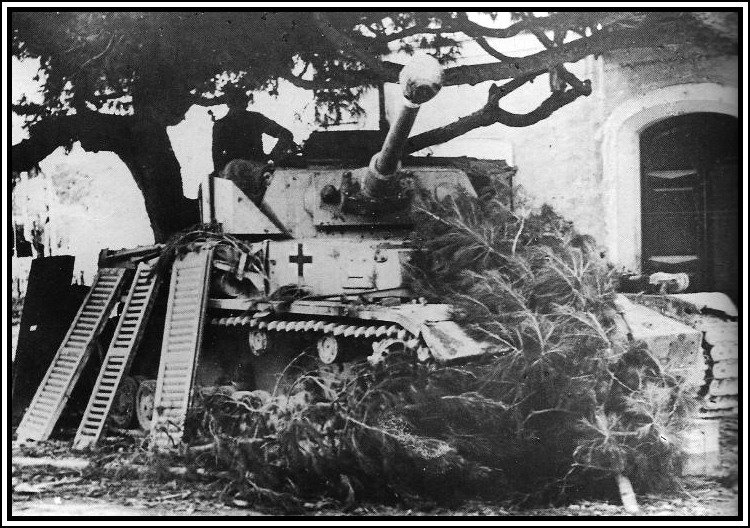
Panzer IV Tank in Normandy

V Corps under Gerow made a cautious advance by phase lines toward Caumont, St Lo and Carentan.  The deliberate advance by the Corps toward a line weakly held by the Reconnaissance battalion of the 17th SS Panzer Grenadier Division was directed by Bradley who did not want to divert attention from the effort against Cherbourg.   After capturing Caumont V Corps halted and continued aggressive patrolling to deceive the Germans while digging in.[xlix] The possibility existed that a strong push against the weak German line could have led to an opportunity to envelope the German line west of Caen. This was a missed opportunity that in part led to the bloody and controversial campaign to capture Caen.[l]

British efforts around Caen

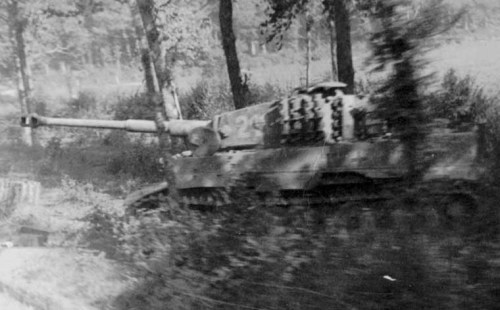
German Panzer Ace Waffen SS Captain Michale Wittman single handedly destroyed a British Battalion at Villers Bocage in his Tiger Tank

Montgomery had ambitious plans to break out of Normandy by capturing Caen on D-Day and driving toward Falaise and Argentan.  The British plans for this were frustrated by the rapid reinforcement of the sector by the Germans and the activities of 21st Panzer, Panzer Lehr, and the 12th SS Panzer Divisions.  A flanking maneuver at Villers-Bocage was frustrated by a few Tiger tanks led by the legendary Waffen SS Panzer commander Captain Michael Wittman whose tanks devastated a British Armored battalion.[li]

Wreckage of a British Battalion at Villers Bocage

A series of disastrous attacks toward Caen (EPSOM, CHARNWOOD and GOODWOOD) strongly supported by air strikes and Naval gunfire finally succeeded in taking that unfortunate city on July 18th but failed to take the heights beyond the town.[lii]

British operations like Operation Epsom met setback after setback against dug in German forces outside of Caen

Against crack well dug in German forces the British took heavy casualties in tanks and infantry seriously straining their ability to conduct high intensity combat operations in the future.[liii] The one benefit, which Montgomery would claim after the war as his original plan was that German forces were fixed before Caen and ground down so they could not be used against Bradley’s breakout in the west at St Lo.[liv]

Clearing the Bocage: The Battle of the Cotentin Plain

US M-5 Light Tank in Normandy

Other German forces arrived, and reinforced the Caumont gap which no longer “yawned invitingly in front of V Corps.” [lv] Bradley wished to push forward rapidly to achieve a breakthrough in the American sector.[lvi] Facing the most difficult terrain in France amid the Bocage and swamps that limited avenues of approach to the American divisions committed to the offensive.  The Americans now faced their old foe the 352nd division as well various elements of II Parachute Corps, the 17th SS Panzer Grenadier and Panzer Lehr Divisions.  American tanks and infantry made slow progress and incurred high losses as they dueled the Germans at close range.  In the VIII Corps sector alone the attack “consumed twelve days and 10,000 casualties to cross eleven kilometers of the Bocage…the achievements of the VII and XIX Corps were no better than comparable.[lvii]

St. Lo
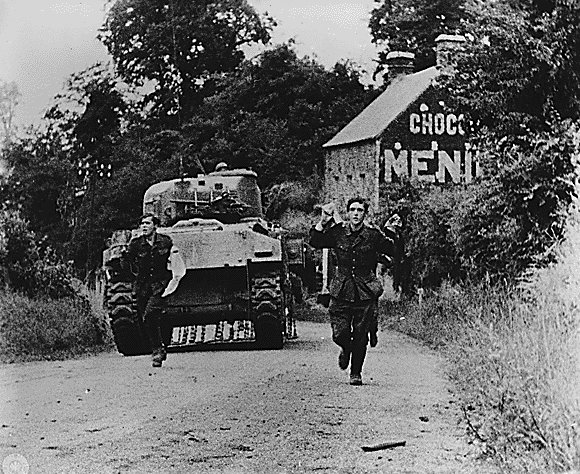
US Tanks advancing with German prisoners moving back to US lines at St Lo

St. Lo was a key to Bradley’s breakout efforts.  His Army had to capture it and the roads leading out of it to launch Operation COBRA along the coast.  The task of capturing St. Lo was assigned to GEROW’S V Corps and Corlett’s XIX Corps.  They faced opposition from the tough paratroops of the German 3rd Parachute Division of II Parachute Corps.  The 2nd, 29th, 30th and 83rd Divisions fought a tough battle advancing eleven kilometers again with high numbers of casualties especially among the infantry to secure St. Lo on 18 July.[lviii] They finally had cleared the hedgerows.  St Lo epitomized the struggle that the American Army had to overcome in the Bocage.  Hard fighting but outnumbered German troops in excellent defensive country exacted a terrible price in American blood despite the Allied control of the skies.[lix]

Operation COBRA

US 155mm Howitzers in Normandy, the Germans had profound respect for American Artillery, a respect that they did not share for American Infantry or Armor forces

With the Bocage behind him Bradley desired to push the Germans hard.  COBRA was his plan to break out of Normandy.  Bradley ably assisted by Collins they realized that the better terrain, road networks favored a breakout.  American preparations included a technical advance that allowed tanks to plow through hedgerows. This was the “Rhino” device fashioned by American troops which was installed on 3 of every 5 First Army Tanks for the operation.[lx] VII Corps was to lead the attack which was to begin on July 24th. American planning was more advanced than in past operations.  Collins and Bradley planned for exploitation operations once the breakthrough had been made. A massive air bombardment would precede the attack along with an artillery barrage by Collins corps artillery which was reinforced by additional battalions.   A mistake by the heavy bombers in the 24th resulted in the American troops being hit with heavy casualties and a postponement of the attack until the 25th.[lxi] The following day the attack commenced.  Another mistake by the bombers led to more American casualties[lxii] but VII Corps units pressed forward against the determined resistance of the survivors of Panzer Lehr and the remnants of units that had fought the Americans since the invasion began.  Although it was a “slow go” on the 25th Bradley and his commanders were already planning for and beginning to execute the breakout before the Germans could move up reinforcements.  The 26th of June brought renewed attacks accompanied by massive air strikes.

The Devastated town of St Lo 

While not much progress was made on the 26th, the Americans discovered on the 27th that the German forces were retreating.  The capture of Marigny allowed VIII Corps to begin exploitation down the coastal highway to Coutances.  On the 27th General Patton was authorized to take immediate command of VIII Corps a precursor to the activation of his 3rdArmy.  COBRA ripped a hole in the German line and inflicted such heavy casualties on the German 7th Army that it could do little to stop the American push.[lxiii] As the American forces pushed forward they reinforced their left flank absorbing the local German counterattacks which were hampered by the Allied close air support.

Avranches and Beyond

US Forces advance through the ruins of St Lo

As the breakthrough was exploited the command of the forces leading it shifted to Patton and the newly activated 3rd Army. By the 28th VIII Corps led by the 4th and 6th Armored Divisions had reached Avranches and established bridgeheads over the See River with additional bridges being captured intact on the 30th.[lxiv] The capture of Avranches allowed the Americans to begin exploitation operations into Brittany and east toward the Seine. Weigley notes that for the first time in the campaign that in Patton the Americans finally had a commander who understood strategic maneuver and would use it to great effect.[lxv]

Conclusion

The American campaign in Normandy cost the U.S. Army a great deal. It revealed weaknesses in the infantry, the inferiority of the M4 Sherman tank to most German types, problems in tank-infantry cooperation and also deficiencies in leadership at senior, mid-grade and junior levels. Heavy casualties among infantry formations would lead to problems later in the campaign. Numerous officers were relieved including Division and Regimental commanders.  Nonetheless during the campaign the Americans grew in their ability to coordinate air and ground forces and adapt to the conditions imposed on them by their placement in the Cotentin.  The deficiencies would show up in later battles but the American Army learned its trade even impressing some German commanders on the ground in Normandy.[lxvi]

[i] See the alternative history of by Peter Tsouras Disaster at D-Day: The Germans Defeat the Allies, June 1944, Greenhill Books, London 1994. Tsouras describes the defeat of the Omaha landings and the effect on the course of the campaign leading to the overthrow of Hitler and a negotiated armistice in the west.  While this outcome could be rigorously debated other outcomes could have led to the fall of the Roosevelt and Churchill governments and their replacement by those not committed to unconditional surrender or a continuation of the war that brought about more German missile attacks on the U.K. and the introduction of other advanced German weapons that could have forced such a settlement. Another option could have led to the dropping of the Atomic Bomb on a German city vice Hiroshima.

Notes 

[ii] Weigley, Russell F. Eisenhower’s Lieutenants: The Campaign of France and Germany, 1944-1945, Indiana University Press, Bloomington IN, 1981 p.33

[iii] Ibid pp. 34-35

[iv] Ibid p.35

[v] General Montgomery 21st Army group and Land Forces, Admiral Sir Bertram Ramsey as Allied Naval Expeditionary Force and Air Marshall Sir Trafford Leigh-Mallory as Commander in Chief Allied Expeditionary Air Force. Weigley p.43

[vi] Max Hastings in Overlord: D-Day and the Battle for Normandy Vintage Books, New York, 1984, comments that many in Britain wondered if Eisenhower with the lack of actual battle experience could be a effective commander and that Eisenhower was disappointed in the appointment of Leigh-Mallory and Ramsey, and had preferred Alexander over Montgomery, pp. 28-29.

[vii] Ibid. Weigley p.40.  Montgomery was the first to object to the 3 division narrow front invasion rightly recognizing that seizing Caen with its road junctions could provide a springboard for the campaign into open country.

[viii] Ibid. p.37

[ix] Hastings, Max. Overlord: D-Day and the Battle for Normandy Vintage Books, New York, 1984 p.29  Hastings finds the irony in the selection of the British officers to execute the plan that reflected the American way of thinking.

[x] The Germans agreed with this in their planning leaving Brittany very lightly defended.  See  Isby, David C. Ed. “The German Army at D-Day: Fighting the Invasion.” p.27 The report of General Blumentritt, Chief of Staff OB West noted that only 3 divisions were assigned to Brittany.

[xi] Ibid. Weigley, pp. 39-40

[xii] Ibid. p.73

[xiii] See Isby p. 69.  General Max Pemsel of 7th Army noted that “During  the spring of 1944, Seventh Army received only tow good photographs of British southern ports, which showed large concentrations of landing craft.”

[xiv] Ibid. Hastings p.63.  Hastings comments also about the success of using the turned Abwehr agents.

[xv] Warlimont, Walter. “Inside Hitler’s Headquarters: 1939-1945.” Translated from theGerman by R.H. Barry. Presidio Press, Novao CA, English Edition Copyright 1964 Wiedenfeld and Nicholson Ltd. Pp.422-423

[xvi] Ibid. Weigley pp. 53-54

[xvii] Ibid. p. 67

[xviii] Ibid. pp.57-64  Weigley spends a great deal of time on the wrangling between Eisenhower, Leigh Mallory and Spaatz on the nature of the plan, the allocation of forces both strategic and tactical assigned to carry it out and its success, or in the light of postwar analysis the lack of effect that it had on German operations.

[xix] Ibid. p.67-68.

[xx] Ibid. Hastings pp. 43-44 In large part due to the long range P-51 Mustang which accompanied the American bombing raids beginning in 1943.  Another comment is that the campaign drew the German fighters home to defend Germany proper and prevented their use in any appreciable numbers over the invasion beaches.

[xxi] Ibid. Weigley p.69

[xxii] Ibid. p.89

[xxiii] Ibid. pp. 88-89

[xxiv] Ibid. p.87

[xxv] Ibid. Weigley also talks about the rejection of General Corlett’s ideas to use Amtracks used by the Marines in the Pacific to land on less desirable, but less defended beaches to lessen casualties on the beaches and the need for additional support equipment even on smooth beaches.  One of Corlett’s criticisms was that too little ammunition was allotted to supporting the landings and not enough supporting equipment was provided. pp. 46-47

[xxvi] Hastings notes that with the strength and firepower of the German forces on OMAHA that many of these vehicles had they been employed would like have ended up destroyed further cluttering the beachhead. “Overlord” p.102

[xxvii] The battle over the deployment of the Panzer Divisions is covered by numerous historians.  The source of the conflict was between Rommel who desired to place the Panzer Divisions on the Coast under his command due to the fear that Allied air superiority would prevent the traditional Panzer counterthrust, General Gyer von Schweppenburg commander of Panzer Group West (Later the 5th Panzer Army) and Field Marshal Von Rundstedt who desired to deploy the divisions order the command of Rundstedt for a counter attack once the invasion had been launched, a strategy which was standard on the Eastern Front, and Hitler who held most of the Panzer reserve including the SS Panzer Divisions under his control at OKW.  Hitler would negotiate a compromise that gave Rommel the satisfaction of having three Panzer Divisions deployed behind coast areas in the Army Group B area of responsibility.  21stPanzer had those duties in Normandy.

[xxviii] Ibid. p.74-75

[xxix] Von Luck, Hans.  “Panzer Commander“ Dell Publishing, New York, 1989 pp. 169-170.  Von Luck a regiment commander in 21st Panzer noted that General Marcks of 84th Corps had predicted a 5 June invasion at a conference May 30th.

[xxx] Almost every D-Day historian talks about the weather factor and its effect on the German high command’s reaction to the invasion.  Rommel was visiting his wife for her birthday and planned to make a call on Hitler. Others including commanders of key divisions such as the 91st Airlanding Division were off to a war game in Rennes and the 21st Panzer Division to Paris.

[xxxi] Ibid. Weigley p. 96

[xxxii] See Cornelius Ryan, “The Longest Day” Popular Library Edition, New York 1959. pp. 189-193 for a vivid description of the challenges faced by soldiers going from ship to landing craft and their ride in to the beaches.

[xxxiii] Ibid. Weigley. p.78 Weigley talks about the order for the tanks to be carried ashore on their LCTs that did not get transmitted to the 741st.

[xxxiv] Ibid.

[xxxv] Ibid. Weigley  p. 87 The weather prevented the aerial bombardment from being effective. Because the bombers could not see their targets they dropped their bomb loads further inland, depriving the infantry of support that they were expecting.  Naval gunfire support had some effect but had to be lifted as the troops hit the beach leaving much of that support to come from Destroyers and specially equipped landing craft which mounted rockets and guns.

[xxxvi] Ibid. Hastings. pp. 90-91.

[xxxvii] Ibid. p.99

[xxxviii] Ibid. Weigley p.80

[xxxix] Ibid. p.101  Also see Weigley p.80

[xl] Ibid. p.99

[xli] Ibid. Weigleyp.95

[xlii] Ibid. p.94

[xliii] Ibid. p.99 Both Weigley and Hastings make note of the failure of both the Americans and British to train their troops to fight in the bocage once they had left the beaches.

[xliv] Ibid. Hastings. pp.152-153

[xlv] Ibid. Weigley p.101

[xlvi] Isby, David C., Ed. “Fighting in Normandy: The German Army from D-Day to Villers-Bocage.” Greenhill Books, London,  2001.  p.143

[xlvii] Ibid. Hastings p.173 Allied fighter bombers exacted a fearful toll among German commanders. The Commanders of the 243rd and 77th Divisions fighting in the Cotentin were also killed by air attacks on the 17th and 18th.   Further east facing the British the commander of the 12th SS Panzer Division, Fritz Witt on the 17th.

[xlviii] Ibid. Weigley. p.108

[xlix] Ibid. p.111-112.

[l] Ibid.

[li] The efforts of the 51st Highland Division and 7th Armored Division were turned aside by the Germans in the area and were dramatized by the destruction of  a British armored battalion by SS Captain Michael Wittman and his platoon of Tiger tanks.  See Hastings pp.131-135.

[lii] The British 8th Corps under General O’Connor lost 270 tanks and 1,500 men on 18 July attempting to crack the German gun line on the ridge beyond Caen. Weigley, pp.145-146.

[liii] Hastings comments about the critical British manpower shortage and the pressures on Montgomery to not take heavy casualties that could not be replaced. Overlord. pp.241-242.

[liv] Ibid. Weigley pp.116-120

[lv] Ibid. p.122

[lvi] Ibid. p121 Bradley told Eisenhower “when we hit the enemy this time we will hit him with such power that we can keep going and cause a major disaster.”

[lvii] Ibid. 134

[lviii] Ibid. Weigley. pp. 138-143.  Weigley notes of 40,000 U.S. casualties in Normandy up to the capture of St. Lo that 90% were concentrated among the infantry.

[lix] Weigley quotes the 329th Regiment, 83rd Division historian “We won the battle of Normandy, [but] considering the high price in American lives we lost. P.143. This is actually a provocative statement that reflects America’s aversion to massive casualties in any war.

[lx] Ibid. p.149

[lxi] Ibid. p. 152

[lxii] Ibid. pp. 152-153.  Among the casualties were the command group of the 9th Division’s 3rd Battalion 47th Infantry and General Leslie McNair who had come to observe the assault.

[lxiii] Ibid. pp.161-169. Weigley notes the advances in U.S. tactical air support, the employment of massive numbers of U.S. divisions against the depleted German LXXXIV Corps, and the advantage that the “Rhino” device gave to American tanks by giving them the ability to maneuver off the roads for the first time.

[lxiv] Ibid. pp.172-173.

[lxv] Ibid. p.172

[lxvi] Ibid. Isby, David C. “Fighting in Normandy,” p.184, an officer of the 352nd Division referred to the American soldier “was to prove himself a in this terrain an agile and superior fighter.”

Bibliography

Carell, Paul. “Invasion: They’re Coming!” Translated from the German by E. Osers, Bantam, New York 1964.

Hastings, Max. Overlord: D-Day and the Battle for Normandy Vintage Books, New York, 1984

Isby, David C. Ed. “The German Army at D-Day: Fighting the Invasion.” Greenhill Books, London 2004

Isby, David C., Ed. “Fighting in Normandy: The German Army from D-Day to Villers-Bocage.” Greenhill Books, London, 2001.

Ryan, Cornelius, “The Longest Day” Popular Library Edition, New York 1959

Tsouras, Peter. “Disaster at D-Day: The Germans Defeat the Allies, June 1944,”Greenhill Books, London 1994.

Von Luck, Hans.  “Panzer Commander“ Dell Publishing, New York, 1989

Warlimont, Walter. “Inside Hitler’s Headquarters: 1939-1945.” Translated from theGerman by R.H. Barry. Presidio Press, Novao CA, English Edition Copyright 1964 Wiedenfeld and Nicholson Ltd. Warlimont, Walter. “Inside Hitler’s Headquarters: 1939-1945.” Translated from theGerman by R.H. Barry. Presidio Press, Novao CA, English Edition Copyright 1964 Wiedenfeld and Nicholson Ltd.

Weigley, Russell F. Eisenhower’s Lieutenants: The Campaign of France and Germany, 1944-1945, Indiana University Press, Bloomington IN, 1981

Leave a comment

Filed under History, leadership, Military, nazi germany, us army, US Army Air Corps, world war two in europe

Anniversaries of Watershed Events: Midway, D-Day, and the Assassination of Robert F Kennedy


D-Day, June 6th 1944

Friends of Padre Steve’s World,

I am posting a small thought to begin the weekend. For those that do not know, the next several days are full of the anniversaries many events

On June 3rd 1940, the British finished the evacuation of the British Expeditionary Force and some French forces from Europe at Dunkirk, though defeated, the British action preserved the British Army and kept Britain in the war.


Midway 

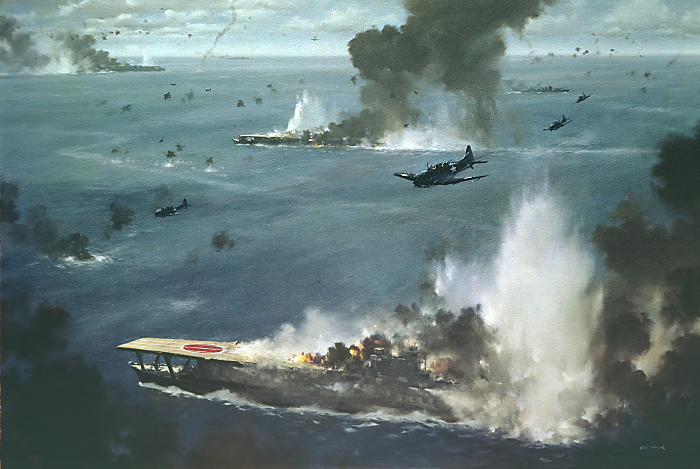
From June 4th through June 6th 1942 a small American fleet defeated a much larger, more experienced and better equipped fleet at the Battle of Midway. The battle did not end the war, but it ensured that Japan never could win the war against the United States in the Pacific. It was a turning point. It has rightly been called an “Incredible Victory” as all the elements that make war what it is, the element of chance, the element of friction, and the  element of surprise all broke the American way. The Japanese leaders, and for that matter many if not the vast majority of their soldiers and sailors were full of hubris, believing themselves invincible they were decisively defeated.

Two Years later on June 6th 1944, Allied forces landed on the Normandy Peninsula of France to begin their long awaited attack on Nazi occupied Europe. The invasion, code named Operation Overlord did not end the war, but coupled with the Soviet offensive against the German Army Group Center which began just two weeks later, Operation Bagration, it was the beginning of the end for Hitler’s Germany.

Twenty-six years earlier U.S. Marines and Army soldiers turned back the Germans at the Battle of Belleau Wood near Chateau-Thierry France. The effort blocked a German drive on Paris, giving the Allies the time to begin a counter-offensive that would end the war.


Senator Robert F. Kennedy lays Mortally Wounded after being shot by Sirhan Sirhan 

But in addition to the battles other important events shook the world, in 1919 the Congress passed the 19th Amendment, which when ratified gave women the right to vote. In 1968, Senator Robert F. Kennedy was gunned down by the assassin Sirhan Sirhan in Los Angeles after winning the Democratic Party primary. He would have been the odds on favorite to defeat Republican Richard Nixon in the general election. On June 8th 1789 James Madison introduced twelve amendments to the U. S. Constitution, of which ten were ratified by the states to become known as the Bill of Rights. On June 8th 1967, the USS Liberty, a surveillance ship, was attacked by Israeli ships and aircraft during the Six Day Warthe attack resulted in the death of 34 American sailors and the wounding of 171 more.

Of course there are numerous other events that took place at different times on these days, some which were very important, and others which are interesting but less important in terms of their historical impact. I’ll be writing about some of these events in the coming days.

Have a great day,

Peace

Padre Steve+

1 Comment

Filed under History, Military, World War II at Sea, world war two in europe, world war two in the pacific

A D-Day Requiem: The Beginning of the End of the Atlantic Alliance

imagesCA580JS0

Friends of Padre Steve’s World,

It is hard to believe now as we look at the serene beaches of Normandy that seventy years ago they were places of desperate combat in which hundreds of thousands of Allied and German soldiers, sailors, airmen and marine-commandos battled in a contest that helped free Europe of Nazi tyranny and changed the course of history. What they did helped change the world and brought about a measure of peace and security unparalleled in modern history as the free nations of the Atlantic Alliance charter a course for democracy and freedom. Unfortunately it seems that now the United States led by a President who cares nothing for the alliances so carefully built over the past seven decades has set a course to abandon that work, and our long time allies have come to realize that under this President that the United States is an unreliable partner. They have forgotten the words of Ronald Reagan who said: “From a terrible war we learned that unity made us invincible; now, in peace, that same unity makes us secure.”

The men who fought there were young, most in their twenties, but some in their teens or thirties as well as a smattering of senior leaders or old career soldiers in their 40s and 50s. When I first began to read about and study the battle a good number were still alive, most about the same age as I am now. Today, their ranks thinning they are passing into history. When the 80th anniversary is celebrated, the few that remain will all be about 100 years old, and even now, the youngest of these men are over 90 years old.

On June 6th 1944 the Allies invaded German controlled France on the beaches of Normandy. By that evening the Allied Expeditionary Force had landed six infantry divisions on five invasion beaches and the bulk of three airborne divisions on the approaches to those beaches. Near 175,000 Allied Soldiers, Sailors, Airmen and Marine Commandos were involved in the attack and nearly 10,000 would listed be as killed, wounded or missing by the end of the day, over half on Omaha Beach.

General Dwight D. Eisenhower sent them forward with this message:

You are about to embark upon the Great Crusade, toward which we have striven these many months. The eyes of the world are upon you. The hopes and prayers of liberty-loving people everywhere march with you.  In company with our brave Allies and brothers-in-arms on other Fronts, you will bring about the destruction of the German war machine, the elimination of Nazi tyranny over the oppressed peoples of Europe, and security for ourselves in a free world….

The names of the invasion beaches and the units involved have been immortalized in history, in film and literature. The American 101st Airborne “Screaming Eagles,” the “All American” 82nd Airborne Division and British 6th Airborne Division “Red Devils” made the largest night airborne drop and battled Germans, the elements as the struggled to reorganize on the heels of widely scattered drops.  The Americans battled the German 91st Airlanding Division and the crack 6th Parachute Regiment, while the British faced men of the 716th “Static” Infantry Division and battle groups of the nearby 21st Panzer Division.

On Sword Beach men of the 3rd British Division and 27th Armored Brigade teamed with the 1st Special Services Brigade composed of Army and Royal Marine Commandos made the assault, to their right on Juno Beach the Canadians of the 3rd Canadian Division, 2nd Canadian Armored Brigade and two Royal Marine Commandos (battalions) while to their right on the middle invasion beach, God Beach the British 50th (Northumbrian) Infantry Division and 8th Armored Brigade went ashore with elements of the British 79th Armored Division and the 47th Royal Marine Commando.

To the right of the British landed the American V Corps on Omaha Beach, the 1st Infantry Division, the famous “Big Red One” and the 29th “Blue and Gray” Infantry Division of the Virginia and Maryland National Guard. They would fight the most seasoned Germans on the beaches that day, the hardened combat veterans of the 352nd Infantry Division.  The battle of Omaha was nearly a disaster and a one point General Omar Bradley contemplated withdraw from the beach.  The American troops, including the men of the 2nd Ranger Battalion who scaled the cliffs of Point du Hoc to protect the beach from enfilade fire from German artillery mounted on the point, yet the German guns had not yet been emplaced and the Rangers fought a bitter battle against strong German resistance on that rugged mount.  On the far right the American VII Corps led by the 4th Infantry Division assaulted Utah Beach; fortunately the Americans landed away from their planned point of assault and faced little resistance. Had they landed in the correct location they might fared as their neighbors on Omaha Beach.

Offshore the venerable battleships HMS Warspite and HMS Ramillies and the USS Texas, USS Nevada and USS Arkansas provided fire support to the beaches aided by the Free Naval Forces of France, the Netherlands, Poland and Norway.  The French forces included the cruisers Montcalm and Georges Leygues.

Names such has St Mere-Eglise and Pegasus Bridge, the Merville Battery, Point du Hoc and Bloody Omaha remain etched in the minds of the dwindling number of surviving veterans as well as historians, military personnel and others that take the time to remember the sacrifices of these men.

The Men came from all parts of the United States and the British Commonwealth. Additionally personnel from France and other countries occupied by Nazi Germany were represented in the land, air and naval forces involved.  For the French, humiliated by their defeat in 1940 and divided by the Vichy and Free French divide were determined, despite their small numbers to liberate their homeland.

They were opposed by four German Divisions, a Luftwaffe Fallschirmjaeger regiment and elements of the 21st Panzer Division.  The Germans with nothing in the way of air support and no significant naval forces were on their own. Hitler had refused Rommel’s request to deploy Panzer divisions near the beaches and was not awakened when word came of the invasion.  German soldiers fought with considerable valor and would do so throughout the Normandy campaign, even if they fought for a regime that was evil at its core.

As the battle continued President Franklin Delano Roosevelt addressed the nation and asked all Americans to join him in this prayer:

My Fellow Americans:

Last night, when I spoke with you about the fall of Rome, I knew at that moment that troops of the United States and our Allies were crossing the Channel in another and greater operation. It has come to pass with success thus far.

And so, in this poignant hour, I ask you to join with me in prayer:

Almighty God: Our sons, pride of our nation, this day have set upon a mighty endeavor, a struggle to preserve our Republic, our religion, and our civilization, and to set free a suffering humanity.

Lead them straight and true; give strength to their arms, stoutness to their hearts, steadfastness in their faith.

They will need Thy blessings. Their road will be long and hard. For the enemy is strong. He may hurl back our forces. Success may not come with rushing speed, but we shall return again and again; and we know that by Thy grace, and by the righteousness of our cause, our sons will triumph.

They will be sore tried, by night and by day, without rest — until the victory is won. The darkness will be rent by noise and flame. Men’s souls will be shaken with the violences of war.

For these men are lately drawn from the ways of peace. They fight not for the lust of conquest. They fight to end conquest. They fight to liberate. They fight to let justice arise, and tolerance and goodwill among all Thy people. They yearn but for the end of battle, for their return to the haven of home.

Some will never return. Embrace these, Father, and receive them, Thy heroic servants, into Thy kingdom.

And for us at home — fathers, mothers, children, wives, sisters, and brothers of brave men overseas, whose thoughts and prayers are ever with them — help us, Almighty God, to rededicate ourselves in renewed faith in Thee in this hour of great sacrifice.

Many people have urged that I call the nation into a single day of special prayer. But because the road is long and the desire is great, I ask that our people devote themselves in a continuance of prayer. As we rise to each new day, and again when each day is spent, let words of prayer be on our lips, invoking Thy help to our efforts.

Give us strength, too — strength in our daily tasks, to redouble the contributions we make in the physical and the material support of our armed forces.

And let our hearts be stout, to wait out the long travail, to bear sorrows that may come, to impart our courage unto our sons wheresoever they may be.

And, O Lord, give us faith. Give us faith in Thee; faith in our sons; faith in each other; faith in our united crusade. Let not the keenness of our spirit ever be dulled. Let not the impacts of temporary events, of temporal matters of but fleeting moment — let not these deter us in our unconquerable purpose.

With Thy blessing, we shall prevail over the unholy forces of our enemy. Help us to conquer the apostles of greed and racial arrogances. Lead us to the saving of our country, and with our sister nations into a world unity that will spell a sure peace — a peace invulnerable to the schemings of unworthy men. And a peace that will let all of men live in freedom, reaping the just rewards of their honest toil.

Thy will be done, Almighty God.

Today we remember those men who were a part of the Great Crusade to liberate Europe from the Nazi oppressors. On the 40th anniversary of the invasion President Ronald Reagan eulogized those who fought and died for the freedom of the world:

Today, in their memory, and for all who fought here, we celebrate the triumph of democracy.  We reaffirm the unity of democratic people who fought a war and then joined with the vanquished in a firm resolve to keep the peace.

From a terrible war we learned that unity made us invincible; now, in peace, that same unity makes us secure. We sought to bring all freedom-loving nations together in a community dedicated to the defense and preservation of our sacred values.  Our alliance, forged in the crucible of war, tempered and shaped by the realities of the post-war world, has succeeded.  In Europe, the threat has been contained, the peace has been kept.

Today, the living here assembled:  officials, veterans, area citizens, pay tribute to what was achieved here 40 years ago.  This land is secure.  We are free.  These things are worth fighting and dying for.

President Obama continued in the tradition of President Reagan when he noted on the 70th anniversary of the landings:

“We are on this Earth for only a moment in time.  And fewer of us have parents and grandparents to tell us about what the veterans of D-Day did here 70 years ago.  As I was landing on Marine One, I told my staff, I don’t think there’s a time where I miss my grandfather more, where I’d be more happy to have him here, than this day.  So we have to tell their stories for them.  We have to do our best to uphold in our own lives the values that they were prepared to die for.  We have to honor those who carry forward that legacy, recognizing that people cannot live in freedom unless free people are prepared to die for it.”

The words of Roosevelt, Reagan, and Obama are powerful reminders of what was accomplished on that fateful day, June 6th 1944. I hope and pray that as we remember that day and those brave men that we will never forget. Sadly, it appears that President Trump, his advisors, and many of his followers have forgotten just how important this is and I’m sure that if he were still alive that Ronald Reagan himself would agree with me.

Peace

Padre Steve+

3 Comments

Filed under History, News and current events, Political Commentary, world war two in europe

People Cannot Live in Freedom Unless Free People are Prepared to Die for It: D-Day at 73

img_0061

Friends of Padre Steve’s World,

I find the days around Memorial Day and the anniversaries of the Battle of Midway and the D-Day landings to be a time when I become quite reflective about what it means to be a career American military officer, combat veteran, and the son of a Navy Chief who was also a combat veteran. I am also an uncle to a young man who likely will be enlisting in the Army in the coming weeks.

When he spoke on Omaha Beach during the ceremony marking the 70th Anniversary of the D-Day landings President Barak Obama said:

“We are on this Earth for only a moment in time.  And fewer of us have parents and grandparents to tell us about what the veterans of D-Day did here 70 years ago.  As I was landing on Marine One, I told my staff, I don’t think there’s a time where I miss my grandfather more, where I’d be more happy to have him here, than this day.  So we have to tell their stories for them.  We have to do our best to uphold in our own lives the values that they were prepared to die for.  We have to honor those who carry forward that legacy, recognizing that people cannot live in freedom unless free people are prepared to die for it.”

All of my adult life I have striven to uphold those values that those men were prepared to die for, and for almost 36 years of Army and Navy service that I have been prepared to do so at a moment’s notice.

Seventy-three years ago the liberation of France began on the beaches of Normandy.  Soldiers from 6 Allied Infantry and 3 Airborne Divisions supported by an Armada of over 5000 ships and landing craft and several thousand aircraft braved weather, heavy seas and in places fierce German resistance to gain the foothold on beaches named Omaha, Utah, Gold, Sword and Juno.  Over the next seven weeks the Allied soldiers advanced yard by yard through the hedgerows and villages of Normandy against ferocious German resistance before they were able to break out of the lodgment area and begin the drive across France. In his D-Day message to his troops General Dwight Eisenhower reminded them that their mission was the elimination of Nazi tyranny over oppressed peoples of Europe, and security for ourselves in a free world.” There are still those in the world who subject their people to tyranny and attempt to destabilize and overthrow the governments of liberty loving peoples, likewise Eisenhower knew that security for ourselves meant close alliances with those who have our values and not isolating ourselves from the world.

The fighting was bloody, most American, British and Canadian infantry battalions and regiments suffered nearly 100% casualty rates in Normandy.  Replacements were fed in at a cyclic rate to make up the losses even as fresh divisions flowed ashore, but the losses were terrible.  By the time the landings took place, the British having been at war for nearly five years were bled out.  They had little left to replace their losses.  From Normandy on the British were losing combat power at a rate that they could not make up.

For the Americans there was another problem.  The US High command decided to limit the Army to 90 Divisions.  Many of these were committed to the Pacific and Mediterranean theaters.   Likewise, American Infantry units were generally made up of the lowest caliber of recruits, led often by the poorest officers; the best went to either the Air Corps or technical branches of the Army.

Now this is not to criticize veterans, but it is a factor in the campaign.  Most US Infantry Divisions with the exceptions of those previously blooded in North Africa and Sicily often performed badly in action.  Some, after being manhandled by the Germans had their leadership replaced and became excellent combat units.  However, every new division that arrived in France after D-Day always got the worst of their initial engagement against German forces.

While performance suffered there was another problem for the Americans.  With the limitation in number of divisions, they stopped building infantry divisions, upon whom the bulk of the campaign depended. Thus they had little in the way of trained infantry replacements to make up heavy losses in Normandy.  By late 1944 during the Battle of the Bulge the American infantry crisis was so bad that 30,000 Air Corps candidates were trained as infantry and soldiers support units such as Ant-Aircraft battalions were used to bolster infantry units.

Had the Germans been able to hold out and had they not been bled white by the Red Army on the Easter Front, had they not lost the nearly their entire Army Group Center in the Red Army offensive of 1944 it is conceivable that the British and American offensive in the West would have ground to a halt for lank of infantry in 1945.  In spite of this there was no lack of individual courage among the troops engaged; the courage and sacrifice of all who fought there should not be forgotten.

The human toll among the combatants both Allied and German, as well as the local populace was especially traumatic.  While the American, Canadian and British people are keen to remember the sacrifices made by our soldiers we often forget the toll among the French civilian population of Normandy as well as the German soldiers, mostly conscripts, sacrificed by the Nazi regime.  Normandy suffered more than any part of France during the liberation.  In the months leading up to D-Day Allied Air Forces unleashed hell on Normandy to attempt to lessen potential German resistance.  The Allied Naval bombardment added to the carnage ashore and once the campaign began the combined fires of both Allied and German forces devastated the region.  Whole cites such as Caen were destroyed by Allied Air forces and an estimated 30,000 French civilians were killed during the Normandy campaign, 3000 on D-Day alone.  I think it can be said that the blood of the civilians of Normandy was shed for the freedom of all of France.

The campaign in Normandy was one of the most viciously contested in western military history.  German forces, especially Paratroops of the 2nd, 3rd, 5th and 6th Fallschirmjager Divisions, German Army Panzer Divisions such as the 2nd, 21st, 116th and Panzer Lehr and those of the Waffen-SS, especially the 1st, 2nd and 12th SS Panzer Divisions held the line against ever increasing Allied forces.  As they sacrificed themselves Hitler refused to commit more forces to Normandy and insisted that his Army contest every meter of ground.  He forbade his commanders to withdraw to more defensible positions along the Seine.

Hitler’s decisions actually shortened the campaign.  Whatever the crimes of the Hitler Regime and Nazism, which were among the most heinous in history, one can never question the valor, courage and sacrifice of ordinary German soldiers.  For those Americans who lump all Germans who fought in World War II with the evil of the Nazi regime, please do not forget this fact:  There are those today, even in this country that make the same charge against Americans who have fought in Iraq and those at home and abroad who have labeled the US as an aggressor nation. As President Trump continues to go his own way to make the United States a pariah nation we have to be very aware of the costs of it and also remember that the Americans who went ashore on D-Day did so to help defeat a pariah nation that had flaunted every standard of justice in attempting to make Germany Great Again. When you judge others, know that the same standard will be applied to you someday and it is possible that our day may come sooner than we think. It is as Justice Robert Jackson who served as the Chief Prosecutor at the Nuremberg War Crimes Tribunal wrote:

“If certain acts of violation of treaties are crimes, they are crimes whether the United States does them or whether Germany does them, and we are not prepared to lay down a rule of criminal conduct against others which we would not be willing to have invoked against us.”

Normandy was a near run thing for the Allies.  First the weather almost delayed it by 2 to 4 weeks.  Had that happened the Germans might have been even better prepared to meet the invasion.  Likewise, the Red Army’s devastating offensive which annihilated Army Group Center in June kept the Germans from transferring additional forces from the Russian Front to Normandy.  On D-Day itself there were a number of times where Lady Luck, or maybe the Deity Herself, saved the Allies from disaster.

Any person who has seen Saving Private Ryan, The Longest Day or Band of Brothers knows a little bit about how close Overlord came to failure.  Allied Airborne units were dispersed throughout the region after they drooped.  Many units were not fully operational for more than a day as they sought to organize themselves and gather their troops.  At Omaha Beach the Americans had not counted on the presence of the first rate German 352nd Infantry Division.  This division, despite being pounded by naval and air forces almost cause General Bradley to withdraw from Omaha.  At Utah the soldiers of the 4th Infantry division escaped a similar mauling by landing on the wrong beach.  Had they landed at the planned beaches they would have ran into the same kind of resistance from well dug in German forces.  At Gold Juno and Sword British forces benefited from confusion in the German command which kept the 21st Panzer Division from descending on the British forces and quite possibly splitting the British zones.

The Allies benefited from the absence of Field Marshall Erwin Rommel, Commander of Army Group B who because of the ad weather assumed no invasion was possible and traveled to German to celebrate his wife’s birthday.  Finally, and perhaps most important they benefited by Hitler’s refusal to immediately commit forces, including his Panzer reserve to defeat the invasion at the beachhead.

For those who fought in Normandy and those civilians who lived through it the memories are still vivid. Many suffer the effects of PTSD, grief and other wounds, physical, emotional and spiritual.  When one is exposed to the danger and destruction of war, the smell of death, the sight of burned out cities, vehicles and the suffering of the wounded and dying, it makes for a lifetime of often painful memories.

For some of the German, British and American veterans, the struggle in Normandy has given way to long lasting friendships.  Many of those who fought against the Allied onslaught became fast friends after the war. Those who fought against each other were soon allies as part of NATO and soldiers of nations which were once bitter enemies serve together in harm’s way in Afghanistan.  The generation that fought at Normandy is rapidly passing away, their numbers ever dwindling they remain a witness to courage, sacrifice and reconciliation.

In the end it is reconciliation and healing that matters. Some scars of war never pass away; some memories are far too painful to release.  Yet we who serve often strive to reconcile.  In 2002 while deployed at sea for Operation Enduring Freedom I was an advisor to a boarding team from my ship.  It was our job to make sure that impounded ships which were breaking the UN embargo on Iraq were not in danger of sinking, and that their crews had food, water and medical care.  Since many of these ships remained at anchor for 2-4 weeks in the heat of the Arabian Gulf, this was important.

The delays imposed by UN rules sometimes meant that the sailors of these ships grew resentful.  It was my job to spend time with the Masters of these ships to keep things calm and work out any issues that arose.  On one of these ships I met an Iraqi merchant skipper.  The man was well traveled, educated in the U.K. in the 1960s and in his career a frequent visitor to the US. In 1990 he was the senior captain of the Kuwaiti shipping line.  Then Saddam Hussein invaded Kuwait.  As a result of this when Kuwait was liberated he lost his job.  His nation was an international pariah.  Since his life was the sea he took up the only job possible to support his family, what he knew best, captaining ships.  He was most apologetic for the trouble that he and others like him caused us.  We shared much during those visits.   One of his daughters was in medical school and other children in university.  He longed for the day when Iraq would be free.  On our last talk before his ship was released he remarked to me “I hope one day we will meet again.  Maybe someday like the American, British and German soldiers after the war, we can meet in a pub, share a drink and be friends.” 

I too pray for that, especially after my tour in Al Anbar five years after I encountered that Iraqi Merchant Captain.  Maybe someday we will. I thought of him almost every day that I was in Iraq. I only hope that he and his family have survived the war, the continuing violence in Iraq and are doing well. There is hardly a day that goes by that I do not think of this man or the Iraqis that I had the honor of serving alongside in Al Anbar in 2007 and 2008.

President Obama remarked in Normandy last week about the veterans of the 9-11 Generation of service members, of which I and so many others like me are part:

“And this generation — this 9/11 Generation of service members — they, too, felt something.  They answered some call; they said “I will go.”  They, too, chose to serve a cause that’s greater than self — many even after they knew they’d be sent into harm’s way.  And for more than a decade, they have endured tour after tour.”

The survivors of the D-Day landings and those on the other side of the hill are continuing to pass from the bonds of this earth and into eternity. We owe it to them and to the world to make what they sacrificed themselves to do into reality, battling tyranny and striving for peace and security.

Peace,

Padre Steve+

Leave a comment

Filed under History, Military, world war two in europe

We, We Happy Few, We Band of Brothers: Reflecting on D-Day


Friends of Padre Steve’s World,

Seventy-two years ago today American, British, Canadian, and Free French forces landed on the beaches of France on the Normandy Peninsula to begin the liberation of Europe. 

I have written a good number of articles about the invasion on this site, in fact you can look them up, but instead of editing an older article or looking at some aspect of the invasion that I haven’t before I wanted to share a few thoughts. 

This past week, beginning during the Memorial Day weekend I spent a lot of time doing reading and reflection. I also decided to watch a number of films, and series that dealt with D-Day and the fight to liberate Europe from the Nazis. I have been to Normandy, in fact I have actually taught there at Sainte Mere Eglise and Pont du Hoc just prior to the 60th anniversary of D-Day. For me it was a moving experience to stand in those locations where so many men contended against the military forces of a regime so evil that it defies the imagination. 

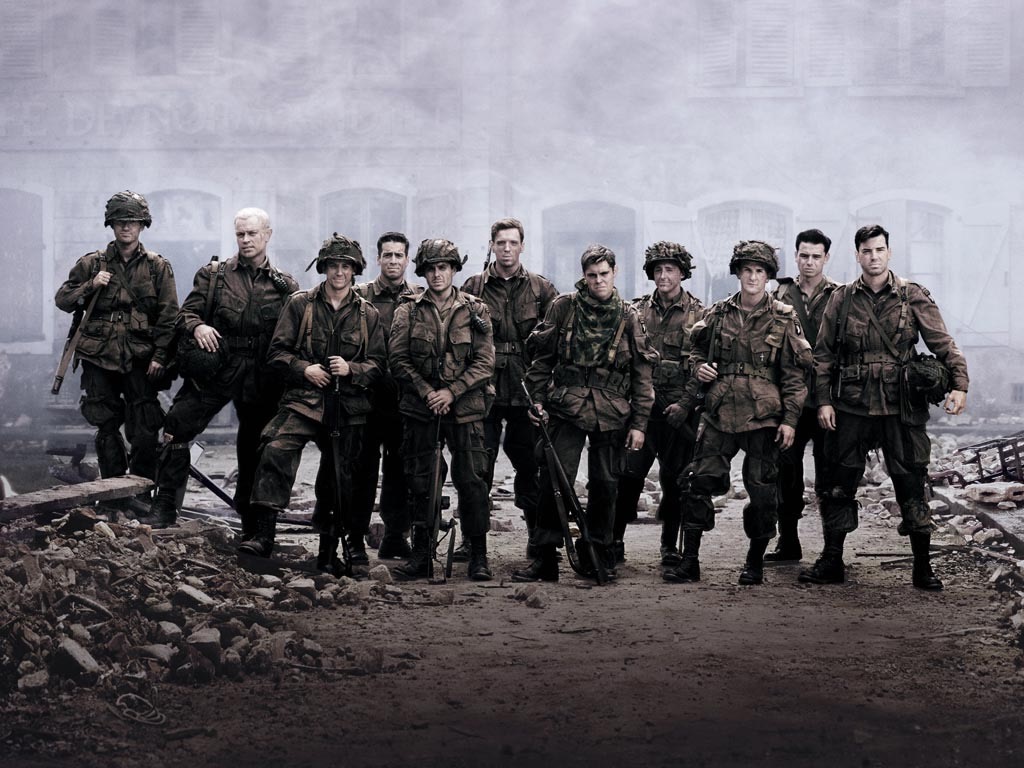
As I said, in addition to reading and reflecting I took time to watch some films, as well as a television mini-series that dealt with that time in history. I watched the film A Bridge too Far on Memorial Day and then began to watch the ten episodes of the series Band of Brothers. When I was done with those last night I watched the film the Longest Day. I thought about watching Saving Private Ryan, but every time I watch that film I am so overcome with emotion that it is hard to function the next day. 


Anyway, this was the first time that I have watched all ten episodes of Band of Brothers in order in a short period of time. I was glad that I did it that way. As I watched it I thought of my own service and those men who have been my “band of brothers” be it in Iraq, or on a boarding team in the Persian Gulf. There is something about serivice in a combat zone and in harm’s way which cannot be replicated in any other part of life. 

The series really captures the constant wear and tear on the human mind, body, and spirit when one goes to war. It captures the bonds that most people today never experience. There were quite a few times where I knew exactly what they were going through, what they were thinking, and what they felt; including the paradoxes of seeing the evil committed by some, but also of recognizing that many of the enemy soldiers were really not that different from us. 

Today we remember that ever shrinking number of men who landed on the beaches of Normandy, fought their way across France, Belgium, and Holland before driving into Hitler’s Germany. I have had the great honor of knowing a number of those men, and even burying one of the men who served in the unit immortalized in Band of Brothers. In this time when so many have never served in the military in any form, and even fewer who have served in combat, it is important not to forget their memory, nor those who have served in subsequent wars. 

There was a segment of one of the Band of Brothers episodes where one of the soldiers was reflecting on how distant the war was to many Americans by New Year’s Day 1945, even though the men were fighting and dying to repel the Germans after the Ardennes Offensive, which we now call the Battle of the Bulge and others were fighting and dying against the Japanese in the Pacific. Those men wondered what it would be like to return home after the war, among a people who didn’t understand. It was a question that many of us asked when we came home from Iraq, and others did coming home from Korea, Vietnam, or Afghanistan. 


The men of the Band of Brothers had the same kind of issues coming home as we do today, some dealt with them better than others, just like today. But the way changed them all and it also bound them to each other. 

In his play Henry V William Shakespeare wrote, 

“And Crispin Crispain shall ne’er go by, From this day to the ending of the world, 

But we in it shall be remembered – We few, we happy few, we band of brothers; 

For he today who sheds his blood with me shall be my brother; be he ne’er so vile,

This day shall gentle his condition;

And gentlemen in England now abed shall think themselves accurs’d they were not here,

And hold their man hoods cheap while any speaks that fought with us on Saint Crispin’s Day” 

We, we happy few, we band of brothers. 

Peace,

Padre Steve+


Leave a comment

Filed under History, iraq,afghanistan, Military, movies, world war two in europe

Watershed Days


D-Day, June 6th 1944

Friends of Padre Steve’s World,

Today I am posting just a relatively small thought. For those that do not know, the next few days are full of amazing historical events.

On June 3rd 1940, the British finished the evacuation of the British Expeditionary Force and some French forces from Europe, though defeated, the British action preserved the British Army and kept Britain in the war. 


Midway 

 From June 4th through June 6th 1942 a small American fleet defeated a much larger, more experienced and better equipped fleet at the Battle of Midway. The battle did not end the war, but it ensured that Japan never could win the war against the United States in the Pacific. It was a turning point. It has rightly been called an “Incedible Victory” as all the elements that make war what it is, the element of chance, the element of friction, and the  element of surprise all broke the American way. The Japanese leaders, and for that matter many if not the vast majority of their soldiers and sailors were full of hubris, believing themselves invincible they were decisively defeated. 

Two Years later on June 6th 1944, Allied forces landed on the Normandy Peninsula of France to begin their long awaited attack on Nazi occupied Europe. The invasion, code named Operation Overlord did not end the war, but coupled with the Soveit offensive against the German Army Group Center which began just two weeks later, Operation Bagration, it was the beginning of the end for Hitler’s Germany. 

Twenty-six years earlier, two-regiments of U.S. Marines turned back the Germans at the Battle of Belleau Wood near Chateau-Thierry France. The effort blocked a German drive on Paris, giving the Allies the time to begin a counter-offensive that would end the war. 


Senator Robert F. Kennedy lays Mortally Wounded after being shot by Sirhan Sirhan 

But in addition to the battles other important events shook the world, in 1919 the Congress passed the 19th Amendment, which when ratified gave women the right to vote. In 1968, Senator Robert F. Kennedy was gunned down by the assassin Sirhan Sirhan in Los Angeles after winning the Democratic Party primary. He would have been the odds on favorite to defeat Republican Richard Nixon in the general election. On June 8th 1789 James Madison introduced twelve amendments to the U. S. Constitution, of which ten were ratified by the states to become known as the Bill of Rights. On June 8th 1967, the USS Liberty, a surveillance ship, was attacked by Israeli ships and aircraft during the Six Day War, the attack resulted in the death of 34 American sailors and the wounding of 171 more. 

Of course there are numerous other events that took place, some which were very important, and others which are Interesting but less important in world history, though they were important in certain countries or regions. I’ll be tacking some of these events in the coming days. 

Have a great day,

Peace

Padre Steve+

Leave a comment

Filed under History, world war one, world war two in europe, world war two in the pacific

Coming this Week: Midway, D-Day and the Greatest Generation

Friends of Padre Steve’s World

I hope that your week is starting out well. This week promises to be interesting on Padre Steve’s World as I will be doing some writing about  the Battle of Midway and the Normandy landings. I have done a lot on both subjects before but will try to be doing something different with them. The reason why I do this is because both battles are important. Each in their own way was a watershed that helped to change the course of the war.

Now those who know me and probably many who regularly follow my writings know that I don’t readily fit into anyone’s mold. I am a career military officer, chaplain and military historian and I am certainly a liberal-progressive  in most of my politics, at least as defined in the current American political-ideological climate. I am a curious blend of idealist and realist, I like to think the best about my country, but know that we don’t always live up to the ideals enunciated in the Declaration of Independence. This makes me true minority group. But I digress…

Battle%20of%20Midway%20flat_080817160843

The Battle of Midway, which was fought on June 4-6 1942 turned back the previously undefeated Japanese Imperial Navy by all that the U.S. Navy had left, three aircraft carriers and a handful of surface ships in a classic David versus Goliath encounter. The battle is referred sometimes referred to, with good reason, as the Miracle at Midway or the Incredible Victory. Had the U.S. Navy lost at Midway, the Japanese would have held a dominant position in the Pacific, and though the United States would probably still won the war, it may have taken at least an extra  year, maybe more for that to happen.

british commandos d-day

The Allied invasion of France on in Normandy was another watershed moment. In June 1944 Nazi Germany still had a stranglehold on much of Europe. Finally, the Allied Expeditionary Force under Dwight D. Eisenhower was ready to attack. It was the greatest amphibious operation ever conducted. Six Allied Infantry divisions and three Airborne Divisions supported by an invasion fleet of 5,000 ships and landing craft and thousands of warplanes were sent against the Germans. Had the invasion failed, the result would have been disastrous. The Germans would have been able to shift troops to the Eastern Front where Josef Stalin’s Soviet Red Army was about to launch its offensive on the German Army Group Center, an event that might have led to stalemate in the East.

Political pressure was already going against Winston Churchill and Franklin Roosevelt as the war continued and a defeat could have brought to power politicians in Britain and the United States willing to make a deal for peace with the Nazis. Such an occurrence would have led to even more genocide in Nazi occupied territories and the possibility of a Nazi atomic bomb, and please remember the Germans were far beyond the United States in building delivery systems, including ballistic missiles for such weapons. The thought of either instance is too horrifying to imagine. Likewise the thought of Imperial Japan continuing to rape China and Indochina, the East Indies and to possibly even to threaten Australia and India is equally horrifying.

These are things that more than seventy years later that we forget, to our detriment,  but they were the reality that our grandparents and great-grandparents who were part of that Greatest Generation faced.

Now, these seventy years later most of the men and women of that generation who defeated the mortal enemies of freedom, and I do not use that term flippantly are passing away. The young ones are in their late eighties, soon most will be gone, and the question has to be asked: Would we find the wherewithal to stand against mortal enemies of freedom, and then when the war was over, help them rebuild their shattered nations and turn former enemies into friends, even while ensuring that war criminals were brought to justice?

I would hope so, but I don’t know. I guess that is why I am a realist.

So until tomorrow I wish you a good night.

Peace

Padre Steve+

Leave a comment

Filed under History, leadership, Military, World War II at Sea, world war two in europe, world war two in the pacific

V.E. Day at 70: Remember Sacrifice 

dscn0044

Seventy years ago World War Two in Europe officially ended. It is hard to believe that it has been that long. The men and women who fought in the war, known as the Greatest Generation now had endured the collapse of one world order after the First World War, the Great Depression and finally fought the Second World War which on May 8th 1945 was ending in Europe even as it raged on in Asia and the Pacific.

For most Americans the 1920s and 1930s were decades of isolationism, where idealists believed that the United States could stay out of the wars and rumors of wars. In 1939 Hitler’s legions stormed across Europe after bamboozling the British, French and even the Soviet Union about their intentions. Even so in 1939 many Americans believed that we could remain neutral in any conflict, but by mid-1941, with France and most of Europe under Nazi rule, with Hitler’s armies advancing on Moscow and Great Britian standing alone the writing on the wall was growing increasing legible. As such the reluctant nation began to mobilize large numbers of soldiers and to build up its Navy and Air Force, and on December 7th 1941 Japan attacked Pearl Harbor and other U.S. Installations thoughout the Western Pacific and a day later Nazi Germany declared war on the United States. The latter was really a huge mistake by Hitler who had he been thinking should have done everything in his power to keep the United States out of Europe. It would be a fatal mistake.

The United States and Britian determined that Germany was a greater threat than Japan decided that the defeat of Germany took precedence and devoted their efforts to that. Even so U.S. Forces in the Pacific, primarily built around the Navy took the offensive against Japan in August 1942 at Guadalcanal. But in Europe the U.S. And Britian invaded North Africa to drive the Germans and their Italian allies out, moved in to Sicily and Itslly, knocking the Itslians out of the war in 1943. At sea allied naval forces won the Battle of the Atlantic against Hitler’s U-Boats which had sunk thousands of ships totaling millions of tons of cargo and lost lives. American war materials and supplies provided massive assistance to the British and to the Soviet Union, the latter whose Red Army had broken the back of the vaunted Wehrmacht on the Eastern Front and who by 1944 were on the offensive. In the air the United States Army Air Corps and the British Royal Air Force  waged a non-stop air campaign to defeat Hitler’s Luftwaffe and bomb German industrial targets and population centers. 

Then on June 6th 1944 came D-Day, the Allied invasion of Europe, Hitler meddled in the affairs of his commanders ordering a no-retreat policy in Normandy. After a brutal campaign the Allies broke out of Normandy liberating France, much of Belgium and about half of the Netherlands by the end of September. The Germans launched a last ditch offensive against the Americans in December 1994, that battle, nicknamed the Battle of the Bulge hastened the end of the war. By the early Spring of 1945 the American, British, French and Soviet forces, aided by military forces of liberated nations were closing in on the heart of Germany. With the American Army on the Elbe River and the Soviets battling street by street in Berlin and just blocks away, Hitler committed suicide in his Fuhrer Bunker on April 30th 1945. Within days his successor, Admiral Karl Donitz was seeking an end to the war. Forced to surrender unconditionally Donitz ordered German forces to surrender on May 8th 1945. 

General Dwight Eisenhower issued his announcement of the endo of the war: 

eisenhower ve day message


ny times ve day


Men and women of the Allied Expeditionary Force:

The crusade on which we embarked in the early summer of 1944 has reached its glorious conclusion . . .

“Your accomplishments at sea, in the air, on the ground and in the field of supply, have astonished the world. Even before the final week of the conflict, you had put 5,000,000 of the enemy permanently out of the war. You have taken in stride military tasks so difficult as to be classed by many doubters as impossible. You have confused, defeated and destroyed your savagely fighting foe. On the road to victory you have endured every discomfort and privation and have surmounted every obstacle ingenuity and desperation could throw in your path. You did not pause until our front was firmly joined up with the great Red Army coming from the East, and other Allied Forces, coming from the South.

Full victory in Europe has been attained. 

Eisenhower’s announcement of the end of the war is shown in the link below. 

https://www.youtube.com/watch?v=wR99iTgKedc

Now the men and women of the Greatest Generation are passing away, most of those that I personally knew have died. The young ones who are still with us are in their late 80s and early 90s, most if not all will be gone in the next 10-15 years. 

So as you think about today, remember those men and women. Remember the evil that they fought to defeat and hope that if Americans, and by the way I don’t just mean the professional military which has been fighting our wars for the past 14 years, but all Americans have to make such sacrifices again, that we will be up to it. Sadly, I don’t know if we would be. 

That may sound harsh but that generation sacrificed to win the war. Their political leaders did not cut taxes and then telli people to go shopping while the less than one percent that constituted the military went and fought the wars. No they gave up things, and millions served in the military or in war related industries. When I came home from Iraq I was stunned at just how distant the country was from the war. Unlike World War II only a few Americans even have skin in the game that we call war. That is so different than World War II. But that my friends is just my opinion. 

So please don’t forget that true greatness requires both sacrifice and magnanimity. 

Peace

Padre Steve+ 

2 Comments

Filed under History, world war two in europe

D-Day at 70 Years and Forever: Courage, Sacrifice and Reconciliation…

d-day-opener1Omaha Beach

“We are on this Earth for only a moment in time.  And fewer of us have parents and grandparents to tell us about what the veterans of D-Day did here 70 years ago.  As I was landing on Marine One, I told my staff, I don’t think there’s a time where I miss my grandfather more, where I’d be more happy to have him here, than this day.  So we have to tell their stories for them.  We have to do our best to uphold in our own lives the values that they were prepared to die for.  We have to honor those who carry forward that legacy, recognizing that people cannot live in freedom unless free people are prepared to die for it.” President Barack Obama at the 70th Anniversary of the D-Day Landings, June 6th 2014

Seventy years ago the liberation of France began on the beaches of Normandy.  Soldiers from 6 Allied Infantry and 3 Airborne Divisions supported by an Armada of over 5000 ships and landing craft and several thousand aircraft braved weather, heavy seas and in places fierce German resistance to gain the foothold on beaches named Omaha, Utah, Gold, Sword and Juno.  Over the next seven weeks the Allied soldiers advanced yard by yard through the hedgerows and villages of Normandy against ferocious German resistance before they were able to break out of the lodgement area and begin the drive across France.

dday371

The fighting was bloody, most American, British and Canadian infantry battalions and regiments suffered nearly 100% casualty rates in Normandy.  Replacements were fed in at a cyclic rate to make up the losses even as fresh divisions flowed ashore, but the losses were terrible.  By the time the landings took place, the British having been at war for nearly five years were bled out.  They had little left to replace their losses.  From Normandy on the British were losing combat power at a rate that they could not make up.

For the Americans there was another problem.  The US High command decided to limit the Army to 90 Divisions.  Many of these were committed to the Pacific and Mediterranean theaters.   Likewise, American Infantry units were generally made up of the lowest caliber of recruits, led often by the poorest officers, the best went to either the Air Corps or technical branches of the Army.

Now this is not to criticize veterans, but it is a factor in the campaign.  Most US Infantry Divisions with the exceptions of those previously blooded in North Africa and Sicily often performed badly in action.  Some, after being manhandled by the Germans had their leadership replaced and became excellent combat units.  However, every new division that arrived in France after D-Day always got the worst of their initial engagement against German forces.

While performance suffered there was another problem for the Americans.  With the limitation in number of divisions, they stopped building infantry divisions, upon whom the bulk of the campaign depended. Thus they had little in the way of trained infantry replacements to make up heavy losses in Normandy.  By late 1944 during the Battle of the Bulge the American infantry crisis was so bad that 30,000 Air Corps candidates were trained as infantry and soldiers support units such as Ant-Aircraft battalions were used to bolster infantry units.

tiger2falaise16hh1

Had the Germans been able to hold out and had they not been bled white by the Red Army on the Easter Front, had they not lost the nearly their entire Army Group Center in the Red Army offensive of 1944 it is conceivable that the British and American offensive in the West would have ground to a halt for lank of infantry in 1945.  In spite of this there was no lack of individual courage among the troops engaged; the courage and sacrifice of all who fought there should not be forgotten.

caen_ruins1The Ruins of Caen

The human toll among the combatants both Allied and German, as well as the local populace was especially traumatic.  While the American, Canadian and British people are keen to remember the sacrifices made by our soldiers we often forget the toll among the French civilian population of Normandy as well as the German soldiers, mostly conscripts, sacrificed by the Nazi regime.  Normandy suffered more than any part of France during the liberation.  In the months leading up to D-Day Allied Air Forces unleashed hell on Normandy to attempt to lessen potential German resistance.  The Allied Naval bombardment added to the carnage ashore and once the campaign began the combined fires of both Allied and German forces devastated the region.  Whole cites such as Caen were destroyed by Allied Air forces and an estimated 30,000 French civilians were killed during the Normandy campaign, 3000 on D-Day alone.  I think it can be said that the blood of the civilians of Normandy was shed for the freedom of all of France.

Normandie, Fallschirmjäger mit MG 42

The campaign in Normandy was one of the most viciously contested in western military history.  German forces, especially Paratroops of the 2nd, 3rd, 5th and 6th Fallschirmjager Divisions, German Army Panzer Divisions such as the 2nd, 21st, 116th and Panzer Lehr and those of the Waffen-SS, especially the 1st, 2nd and 12th SS Panzer Divisions held the line against ever increasing Allied forces.  As they sacrificed themselves Hitler refused to commit more forces to Normandy and insisted that his Army contest every meter of ground.  He forbade his commanders to withdraw to more defensible positions along the Seine.

Hitler’s decisions actually shortened the campaign.  Whatever the crimes of the Hitler Regime and Nazism, which were among the most heinous in history, one can never question the valor, courage and sacrifice of ordinary German soldiers.  For those Americans who lump all Germans who fought in World War II with the evil of the Nazi regime, please do not forget this fact:  There are those today, even in this country that make the same charge against Americans who have fought in Iraq and those at home and abroad who have labeled the US as an aggressor nation.  When you judge others, know that the same standard will be applied to you someday. It is as Justice Robert Jackson who served as the Chief Prosecutor at the Nuremberg War Crimes Tribunal wrote:

“If certain acts of violation of treaties are crimes, they are crimes whether the United States does them or whether Germany does them, and we are not prepared to lay down a rule of criminal conduct against others which we would not be willing to have invoked against us.”

Normandy was a near run thing for the Allies.  First the weather almost delayed it by 2 to 4 weeks.  Had that happened the Germans might have been even better prepared to meet the invasion.  Likewise, the Red Army’s devastating offensive which annihilated Army Group Center in June kept the Germans from transferring additional forces from the Russian Front to Normandy.  On D-Day itself there were a number of times where Lady Luck, or maybe the Deity Herself, saved the Allies from disaster.

Any person who has seen Saving Private Ryan, The Longest Day or Band of Brothers knows a little bit about how close Overlord came to failure.  Allied Airborne units were dispersed throughout the region after they drooped.  Many units were not fully operational for more than a day as they sought to organize themselves and gather their troops.  At Omaha Beach the Americans had not counted on the presence of the first rate German 352nd Infantry Division.  This division, despite being pounded by naval and air forces almost cause General Bradley to withdraw from Omaha.  At Utah the soldiers of the 4th Infantry division escaped a similar mauling by landing on the wrong beach.  Had they landed at the planned beaches they would have ran into the same kind of resistance from well dug in German forces.  At Gold Juno and Sword British forces benefited from confusion in the German command which kept the 21st Panzer Division from descending on the British forces and quite possibly splitting the British zones.

The Allies benefited from the absence of Field Marshall Erwin Rommel, Commander of Army Group B who because of the ad weather assumed no invasion was possible and traveled to German to celebrate his wife’s birthday.  Finally, and perhaps most important they benefited by Hitler’s refusal to immediately commit forces, including his Panzer reserve to defeat the invasion at the beachhead.

For those who fought in Normandy and those civilians who lived through it the memories are still vivid. Many suffer the effects of PTSD, grief and other wounds, physical, emotional and spiritual.  When one is exposed to the danger and destruction of war, the smell of death, the sight of burned out cities, vehicles and the suffering of the wounded and dying, it makes for a lifetime of often painful memories.

For some of the German, British and American veterans, the struggle in Normandy has given way to long lasting friendships.  Many of those who fought against the Allied onslaught became fast friends after the war. Those who fought against each other were soon allies as part of NATO and soldiers of nations which were once bitter enemies serve together in harm’s way in Afghanistan.  The generation that fought at Normandy is rapidly passing away, their numbers ever dwindling they remain a witness to courage, sacrifice and reconciliation.

In the end it is reconciliation and healing that matters. Some scars of war never pass away; some memories are far too painful to release.  Yet we strive to reconcile.  In 2002 while deployed at sea for Operation Enduring Freedom I was an advisor to a boarding team from my ship.  It was our job to make sure that impounded ships which were breaking the UN embargo on Iraq were not in danger of sinking, and that their crews had food, water and medical care.  Since many of these ships remained at anchor for 2-4 weeks in the heat of the Arabian Gulf, this was important.

The delays imposed by UN rules sometimes meant that the sailors of these ships grew resentful.  It was my job to spend time with the Master’s of these ships to keep things calm and work out any issues that arose.  On one of these ships I met an Iraqi merchant skipper.  The man was well traveled, educated in the U.K. in the 1960s and in his career a frequent visitor to the US. In 1990 he was the senior captain of the Kuwaiti shipping line.  Then Saddam Hussein invaded Kuwait.  As a result of this when Kuwait was liberated he lost his job.  His nation was an international pariah.  Since his life was the sea he took up the only job possible to support his family, what he knew best, captaining ships.  He was most apologetic for the trouble that he and others like him caused us.  We shared much during those visits.   One of his daughters was in medical school and other children in university.  He longed for the day when Iraq would be free.  On our last talk before his ship was released he remarked to me “I hope one day we will meet again.  Maybe someday like the American, British and German soldiers after the war, we can meet in a pub, share a drink and be friends.” 

dinner-w-bg-sabah1Me with Iraqi General Sabah in his Quarters in Ramadi 2007

I too pray for that, especially after my tour in Al Anbar five years after I encountered that Iraqi Merchant Captain.  Maybe someday we will. I thought of him almost every day that I was in Iraq. I only hope that he and his family have survived the war, the continuing violence in Iraq and are doing well. There is hardly a day that goes by that I do not think of this man or the Iraqis that I had the honor of serving alongside in Al Anbar in 2007 and 2008.

President Obama remarked in Normandy last week about the veterans of the 9-11 Generation of service members, of which I and so many others like me are part:

“And this generation — this 9/11 Generation of service members — they, too, felt something.  They answered some call; they said “I will go.”  They, too, chose to serve a cause that’s greater than self — many even after they knew they’d be sent into harm’s way.  And for more than a decade, they have endured tour after tour.”

God bless all those who fought at Normandy and give your peace to all who have served since then. Be with our troops as they serve in Afghanistan. Heal the wounds of war and bring your peace to the nations. Amen

Peace, Steve+

1 Comment

Filed under History, iraq,afghanistan, Military, News and current events, world war two in europe

“They fight to liberate” Remembering the Men of D-Day at 70 Years

It is hard to believe now as we look at the serene beaches of Normandy that seventy years ago they were places of desperate combat in which hundreds of thousands of Allied and German soldiers, sailors, airmen and marine-commandos battled in a contest that helped free Europe of Nazi tyranny and changed the course of history.

Then they were young, most in their twenties, but some in their teens or thirties as well as a smattering of senior leaders or old career soldiers in their 40s and 50s. When I first began to read about and study the battle a good number were still alive, most about the same age as I am now. Today, their ranks thinning they are passing into history. When the 80th anniversary is celebrated, the few that remain will all be about 100 years old, and even now, the youngest of these men are nearing 90 years old.

On June 6th 1944 the Allies invaded German controlled France on the beaches of Normandy. By that evening the Allied Expeditionary Force had landed six infantry divisions on five invasion beaches and the bulk of three airborne divisions on the approaches to those beaches. Near 175,000 Allied Soldiers, Sailors, Airmen and Marine Commandos were involved in the attack and nearly 10,000 would listed be as killed, wounded or missing by the end of the day, over half on Omaha Beach.

General Dwight D. Eisenhower sent them forward with this message:

You are about to embark upon the Great Crusade, toward which we have striven these many months. The eyes of the world are upon you. The hopes and prayers of liberty-loving people everywhere march with you.  In company with our brave Allies and brothers-in-arms on other Fronts, you will bring about the destruction of the German war machine, the elimination of Nazi tyranny over the oppressed peoples of Europe, and security for ourselves in a free world….

d-day-order

The names of the invasion beaches and the units involved have been immortalized in history, in film and literature. The American 101st Airborne “Screaming Eagles,” the “All American” 82nd Airborne Division and British 6th Airborne Division “Red Devils” made the largest night airborne drop and battled Germans, the elements as the struggled to reorganize on the heels of widely scattered drops.  The Americans battled the German 91st Airlanding Division and the crack 6th Parachute Regiment, while the British faced men of the 716th “Static” Infantry Division and battle groups of the nearby 21st Panzer Division.

On Sword Beach men of the 3rd British Division and 27th Armoured Brigade teamed with the 1st Special Services Brigade composed of Army and Royal Marine Commandos made the assault, to their right on Juno Beach the Canadians of the 3rd Canadian Division, 2nd Canadian Armoured Brigade and two Royal Marine Commandos (battalions) while to their right on the middle invasion beach, God Beach the British 50th (Northumbrian) Infantry Division and 8th Armoured Brigade went ashore with elements of the British 79th Armoured Division and the 47th Royal Marine Commando.

british commandos d-day

To the right of the British landed the American V Corps on Omaha Beach, the 1st Infantry Division, the famous “Big Red One” and the 29th “Blue and Gray” Infantry Division of the Virginia and Maryland National Guard. They would fight the most seasoned Germans on the beaches that day, the hardened combat veterans of the 352nd Infantry Division.  The battle of Omaha was nearly a disaster and a one point General Omar Bradley contemplated withdraw from the beach.  The American troops, including the men of the 2nd Ranger Battalion who scaled the cliffs of Point du Hoc to protect the beach from enfilade fire from German artillery mounted on the point, yet the German guns had not yet been emplaced and the Rangers fought a bitter battle against strong German resistance on that rugged mount.  On the far right the American VII Corps led by the 4th Infantry Division assaulted Utah Beach; fortunately the Americans landed away from their planned point of assault and faced little resistance. Had they landed in the correct location they might fared as their neighbors on Omaha Beach.

Offshore the venerable battleships HMS Warspite and HMS Ramillies and the USS Texas, USS Nevada and USS Arkansas provided fire support to the beaches aided by the Free Naval Forces of France, the Netherlands, Poland and Norway.  The French forces included the cruisers Montcalm and Georges Leygues.

Names such has St Mere-Eglise and Pegasus Bridge, the Merville Battery, Point du Hoc and Bloody Omaha remain etched in the minds of the dwindling number of surviving veterans as well as historians, military personnel and others that take the time to remember the sacrifices of these men.

imagesCAVKIRWX

The Men came from all parts of the United States and the British Commonwealth. Additionally personnel from France and other countries occupied by Nazi Germany were represented in the land, air and naval forces involved.  For the French, humiliated by their defeat in 1940 and divided by the Vichy and Free French divide were determined, despite their small numbers to liberate their homeland.

imagesCAD1R273

They were opposed by four German Divisions, a Luftwaffe Fallschirmjaeger regiment and elements of the 21st Panzer Division.  The Germans with nothing in the way of air support and no significant naval forces were on their own. Hitler had refused Rommel’s request to deploy Panzer divisions near the beaches and was not awakened when word came of the invasion.  German soldiers fought with considerable valor and would do so throughout the Normandy campaign, even if they fought for a regime that was evil at its core.

american cemetery

As the battle continued President Franklin Delano Roosevelt addressed the nation and asked all Americans to join him in this prayer:

My Fellow Americans:

Last night, when I spoke with you about the fall of Rome, I knew at that moment that troops of the United States and our Allies were crossing the Channel in another and greater operation. It has come to pass with success thus far.

And so, in this poignant hour, I ask you to join with me in prayer:

Almighty God: Our sons, pride of our nation, this day have set upon a mighty endeavor, a struggle to preserve our Republic, our religion, and our civilization, and to set free a suffering humanity.

Lead them straight and true; give strength to their arms, stoutness to their hearts, steadfastness in their faith.

They will need Thy blessings. Their road will be long and hard. For the enemy is strong. He may hurl back our forces. Success may not come with rushing speed, but we shall return again and again; and we know that by Thy grace, and by the righteousness of our cause, our sons will triumph.

They will be sore tried, by night and by day, without rest — until the victory is won. The darkness will be rent by noise and flame. Men’s souls will be shaken with the violences of war.

For these men are lately drawn from the ways of peace. They fight not for the lust of conquest. They fight to end conquest. They fight to liberate. They fight to let justice arise, and tolerance and goodwill among all Thy people. They yearn but for the end of battle, for their return to the haven of home.

Some will never return. Embrace these, Father, and receive them, Thy heroic servants, into Thy kingdom.

And for us at home — fathers, mothers, children, wives, sisters, and brothers of brave men overseas, whose thoughts and prayers are ever with them — help us, Almighty God, to rededicate ourselves in renewed faith in Thee in this hour of great sacrifice.

Many people have urged that I call the nation into a single day of special prayer. But because the road is long and the desire is great, I ask that our people devote themselves in a continuance of prayer. As we rise to each new day, and again when each day is spent, let words of prayer be on our lips, invoking Thy help to our efforts.

Give us strength, too — strength in our daily tasks, to redouble the contributions we make in the physical and the material support of our armed forces.

And let our hearts be stout, to wait out the long travail, to bear sorrows that may come, to impart our courage unto our sons wheresoever they may be.

And, O Lord, give us faith. Give us faith in Thee; faith in our sons; faith in each other; faith in our united crusade. Let not the keenness of our spirit ever be dulled. Let not the impacts of temporary events, of temporal matters of but fleeting moment — let not these deter us in our unconquerable purpose.

With Thy blessing, we shall prevail over the unholy forces of our enemy. Help us to conquer the apostles of greed and racial arrogances. Lead us to the saving of our country, and with our sister nations into a world unity that will spell a sure peace — a peace invulnerable to the schemings of unworthy men. And a peace that will let all of men live in freedom, reaping the just rewards of their honest toil.

Thy will be done, Almighty God.

imagesCA7UVUXS

Today we remember them. On the 40th anniversary of the invasion President Ronald Reagan eulogized those who fought and died for the freedom of the world:

Today, in their memory, and for all who fought here, we celebrate the triumph of democracy.  We reaffirm the unity of democratic people who fought a war and then joined with the vanquished in a firm resolve to keep the peace.

From a terrible war we learned that unity made us invincible; now, in peace, that same unity makes us secure.  We sought to bring all freedom-loving nations together in a community dedicated to the defense and preservation of our sacred values.  Our alliance, forged in the crucible of war, tempered and shaped by the realities of the post-war world, has succeeded.  In Europe, the threat has been contained, the peace has been kept.

Today, the living here assembled:  officials, veterans, area citizens, pay tribute to what was achieved here 40 years ago.  This land is secure.  We are free.  These things are worth fighting and dying for.

imagesCA580JS0

His words are powerful reminders of what was accomplished on that fateful day, June 6th 1944. I hope and pray that as we remember that day and those brave men that we will never forget.

Peace

Padre Steve+

3 Comments

Filed under History, Military, world war two in europe