Tag Archives: dr martin luther king jr

Now More than Ever: The Importance of Dr. King’s Dream

Friends of Padre Steve’s World,

Dr. Martin Luther King Jr. has always been one of my heroes. This time of year I always ponder the importance of his life and work for civil rights, and I wonder what might have been had this man of peace not been cut down in cold blood at the young age of 39 by James Earl Ray on April 4th 1968. He was an amazing and courageous man whose memory should not be let to one day a year.

We live in a world where a minority of voters elected a man as President who through his words and actions demonstrates daily that he cares not for anything that Dr.King stood for. Thus, we have to ensure, though our words and actions that it is not allowed to die. Doing that may involve a high cost as the President-Elect is not known for playing nice with his opponents and now that he will have the police power of the state and a compliant Congress at his back you can expect that opponents will be harassed, intimidated, and maybe worse.

Dr. King was a man of courage, a man of honor, a man of conviction. But he came of age in a time when many people were willing to maintain the status quo and play things safe, like many clergy, even African-American clergy. Many pastors of the era, remained quiet about the conditions of segregation, and the racism of the day. Their lack of action did not mean they were bad people, they just understood that if they spoke up, their lives, and the lives of their families and congregations could be in danger. As such many pastors just hoped to see things slowly improve, without rocking the boat, and without endangering themselves or their families. They had seen what happened to blacks who spoke up or confronted the evil, lynching’s, cross burnings, threats and murder. They had contented themselves with just trying to get along. At the beginning of the movement, many pastors did not support or gave only lukewarm support to Dr. King, Andrew Young, Fred Shuttlesworth, and Ralph Abernathy going into that critical year of 1963.
lossless-page1-560px-Rosa_Parks_(detail).tiff

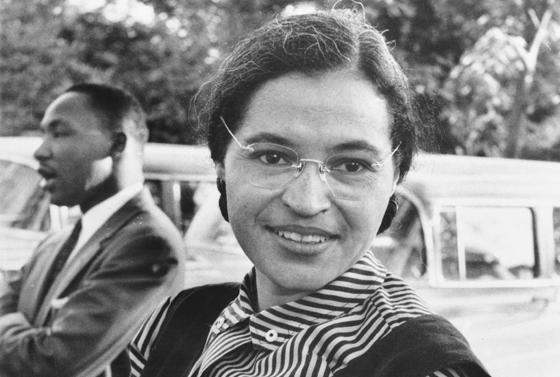
King did not start out to become a Civil Rights leader. However, he was inspired to actively join the movement through the example of Rosa Parks, who defiance of the law for blacks to sit “in the back of the bus” in 1955. He led the Montgomery Bus Boycott which lasted for 385 days. The reaction among segregationists to King and his protest was against violent. King’s house was bombed, and his life threatened. But he refused to stand down.

King’s leadership of the boycott brought the young pastor to national prominence. However, by 1963 much of the Civil Rights movement and the African American community was despairing of the lack of progress. Many people had become disenchanted with King, not considering him bold enough despite his rhetorical abilities.

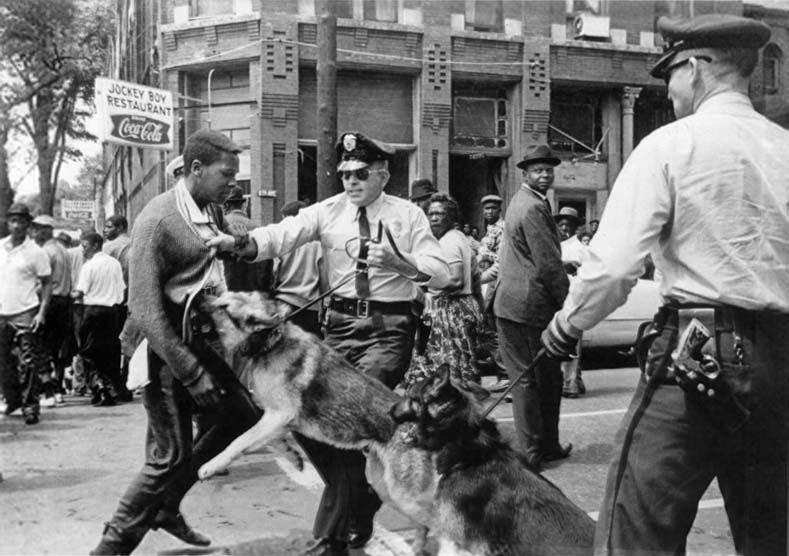
But in April 1963, working with other Civil Rights leaders in Birmingham Alabama King relit the fires of the movement. Montgomery Police Chief “Bull” Conner used his police force to violently attack the demonstrators. Conner ordered his men to unleash their police dogs on the protestors, and used high pressure water cannon against them, including women, children and the elderly. The violent reaction to the protests shocked much of America and the world.

King was arrested and in the Birmingham jail composed one of his most famous works, the Letter from the Birmingham Jail.  The letter was a social, political and theological masterpiece. It was some of his harshest criticism was of white liberals, as well as black moderates:

“I have almost reached the regrettable conclusion that the Negro’s great stumbling block in his stride toward freedom is not the White Citizen’s Councilor or the Ku Klux Klanner, but the white moderate, who is more devoted to “order” than to justice; who prefers a negative peace which is the absence of tension to a positive peace which is the presence of justice; who constantly says: “I agree with you in the goal you seek, but I cannot agree with your methods of direct action”; who paternalistically believes he can set the timetable for another man’s freedom; who lives by a mythical concept of time and who constantly advises the Negro to wait for a “more convenient season”

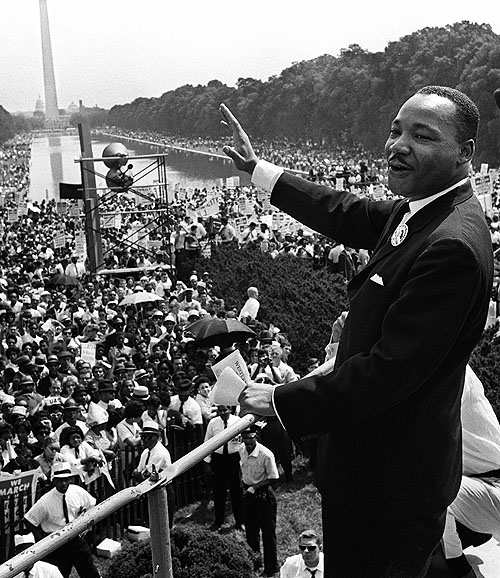
King continued his activism until his assassination. In August 1963 he led the March on Washington for Jobs and Freedom, where before a crowd of an estimated 200,000-300,000 he gave his I Have a Dream Speech.

http://www.americanrhetoric.com/speeches/mlkihaveadream.htm

The crescendo of the speech was remarkable and is perhaps one of the most remembered speeches in American history.

Let us not wallow in the valley of despair, I say to you today, my friends.

And so even though we face the difficulties of today and tomorrow, I still have a dream. It is a dream deeply rooted in the American dream.

I have a dream that one day this nation will rise up and live out the true meaning of its creed: “We hold these truths to be self-evident, that all men are created equal.”

I have a dream that one day on the red hills of Georgia, the sons of former slaves and the sons of former slave owners will be able to sit down together at the table of brotherhood.

I have a dream that one day even the state of Mississippi, a state sweltering with the heat of injustice, sweltering with the heat of oppression, will be transformed into an oasis of freedom and justice.

I have a dream that my four little children will one day live in a nation where they will not be judged by the color of their skin but by the content of their character.

I have a dream today!

I have a dream that one day, down in Alabama, with its vicious racists, with its governor having his lips dripping with the words of “interposition” and “nullification” — one day right there in Alabama little black boys and black girls will be able to join hands with little white boys and white girls as sisters and brothers.

I have a dream today!

I have a dream that one day every valley shall be exalted, and every hill and mountain shall be made low, the rough places will be made plain, and the crooked places will be made straight; “and the glory of the Lord shall be revealed and all flesh shall see it together.”2

This is our hope, and this is the faith that I go back to the South with.

With this faith, we will be able to hew out of the mountain of despair a stone of hope. With this faith, we will be able to transform the jangling discords of our nation into a beautiful symphony of brotherhood. With this faith, we will be able to work together, to pray together, to struggle together, to go to jail together, to stand up for freedom together, knowing that we will be free one day.

And this will be the day — this will be the day when all of God’s children will be able to sing with new meaning:

My country ’tis of thee, sweet land of liberty, of thee I sing.

Land where my fathers died, land of the Pilgrim’s pride,

From every mountainside, let freedom ring!

And if America is to be a great nation, this must become true.

And so let freedom ring from the prodigious hilltops of New Hampshire.

Let freedom ring from the mighty mountains of New York.

Let freedom ring from the heightening Alleghenies of Pennsylvania.

Let freedom ring from the snow-capped Rockies of Colorado.

Let freedom ring from the curvaceous slopes of California.

But not only that:

Let freedom ring from Stone Mountain of Georgia.

Let freedom ring from Lookout Mountain of Tennessee.

Let freedom ring from every hill and molehill of Mississippi.

From every mountainside, let freedom ring.

And when this happens, and when we allow freedom ring, when we let it ring from every village and every hamlet, from every state and every city, we will be able to speed up that day when all of God’s children, black men and white men, Jews and Gentiles, Protestants and Catholics, will be able to join hands and sing in the words of the old Negro spiritual:

                Free at last! Free at last!

                Thank God Almighty, we are free at last!

King knew the dangers and the risks of appealing to a strategy of non-violence based on love of his enemies. King spoke to the world when he accepted the Nobel Peace Prize in 1964:

“Here and there an individual or group dares to love, and rises to the majestic heights of moral maturity. So in a real sense this is a great time to be alive. Therefore, I am not yet discouraged about the future. Granted that the easygoing optimism of yesterday is impossible. Granted that those who pioneer in the struggle for peace and freedom will still face uncomfortable jail terms, painful threats of death; they will still be battered by the storms of persecution, leading them to the nagging feeling that they can no longer bear such a heavy burden, and the temptation of wanting to retreat to a more quiet and serene life. Granted that we face a world crisis which leaves us standing so often amid the surging murmur of life’s restless sea. But every crisis has both its dangers and its opportunities. It can spell either salvation or doom. In a dark confused world the kingdom of God may yet reign in the hearts of men.”  http://www.nobelprize.org/nobel_prizes/peace/laureates/1964/king-lecture.html 

Dr. King understood how easy hatred could consume people and movements and urged  people not to follow the course of hate, he wrote:

“Returning hate for hate multiplies hate, adding deeper darkness to a night already devoid of stars. Darkness cannot drive out darkness; only light can do that. Hate cannot drive out hate; only love can do that. Hate multiplies hate, violence multiplies violence, and toughness multiplies toughness in a descending spiral of destruction.”

The day before his assassination in Memphis, Dr. King still recognized what he might face. His “I have been to the Mountaintop” speech http://www.americanrhetoric.com/speeches/mlkivebeentothemountaintop.htm recounted many of the things that he had encountered, including an assassination attempt in 1958 which had come close to killing him. It was an amazing speech and one wonders if having lived under threat so long that he almost had a premonition of his death the next day.

And then I got into Memphis. And some began to say the threats, or talk about the threats that were out. What would happen to me from some of our sick white brothers?

Well, I don’t know what will happen now. We’ve got some difficult days ahead. But it really doesn’t matter with me now, because I’ve been to the mountaintop.

And I don’t mind.

Like anybody, I would like to live a long life. Longevity has its place. But I’m not concerned about that now. I just want to do God’s will. And He’s allowed me to go up to the mountain. And I’ve looked over. And I’ve seen the Promised Land. I may not get there with you. But I want you to know tonight, that we, as a people, will get to the promised land!

Dr. King’s dream is not dead and we who live today cannot allow it to die. There is still much work to see justice done for all Americans as well as those suffering from violence, persecution, discrimination and poverty around the world.

It is 2016. It has been 54 years since Dr. King sat in the Birmingham jail. Sadly, there are some who long for a return to the day of Jim Crow. In some states there have been and there are ongoing attempts to return it by stealth, especially through restrictions on voting that predominantly impact African Americans and the poor. Racism is not dead, nor are so many other “isms.” As Dr. King told us, “Now is the time to make real the promises of democracy,” and “It would be fatal for the nation to overlook the urgency of the moment.”

Dr. King and many of the leaders of the Civil Rights Movement have passed on. Likewise, many people today are complacent about the injustices present in our society, injustices experienced by many people. We need a generation of new men and women with hearts like Dr. King’s, who will be the conscience of the nation and confront these injustices.
Birmingham_campaign_dogs

Likewise we cannot ghettoize Dr. King’s accomplishments as being something that only helped African Americans. They have helped all of us. Dr. King’s courage in standing for Constitutional Amendments that many of his opponents despised, the 13th, 14th, 15th and 19th Amendments, as well as the Civil Rights Act and Voting Rights Acts is of fundamental importance to all Americans, even those that think they don’t matter.

President Ulysses Grant was absolutely correct when he pointed out the plight of white Southerners in the ante-bellum South. They were people so bound to the slavery system and their place in it that they could not see how badly it hurt them so long as they had a group, in this case African American slaves who were below them. Grant wrote:

“The great bulk of the legal voters of the South were men who owned no slaves; their homes were generally in the hills and poor country; their facilities for educating their children, even up to the point of reading and writing, were very limited; their interest in the contest was very meagre–what there was, if they had been capable of seeing it, was with the North; they too needed emancipation. Under the old regime they were looked down upon by those who controlled all the affairs in the interest of slave-owners, as poor white trash who were allowed the ballot so long as they cast it according to direction.”

That my friends is descriptive of how President Elect Trump and the Republican Congress view those who put them in office. Trump supporters do not seem to realize that they will be hurt the most by the incoming administration and congresses policies. They too need emancipation and deliverance, thus we have to remain strong, for they too are our brothers and sisters.

Representative John Lewis, one of the original Freedom Riders was beaten numerous times during those protests. When leading the march across the Pettus Bridge in Selma, Lewis had his skull fractured by a State Trooper when he stopped to pray.  Lewis’s words call us to action today:

“If not us, then who? If not now, then when?” 

Representative Lewis is still speaking out, and enduring the attacks of the President-Elect, and we must join him. We cannot let Dr. King’s dream die.

Peace

Padre Steve+

Leave a comment

Filed under civil rights, History, News and current events, Political Commentary

Neither Safe, nor Politic, nor Popular: The Call of Dr. Martin Luther King Jr.

martin luther king jr

Friends of Padre Steve’s World

On a weekend where we honor the life of Dr. Martin Luther King Jr. we saw our President-Elect stoop to a Twitter tirade against Representative John Lewis, a true hero of the Civil Rights movement because Lewis dared to question his legitimacy. A true statesman would have either ignored it or simply making the comment that Lewis is entitled to his opinion. But our President-Elect has incapable of such behavior. When he was at Liberty University last year on Martin Luther King Day, he only mentioned Dr. King in regard to the fact that he had set a record for attendance at Liberty.

Even longstanding conservatives bastions in Congress who have worked with Mr. Lewis, and conservative media titans were  shocked by President-Trump’s action and many rightly commented that the only person that Donald Trump has not attacked is Vladimir Putin.

Like a lot of people it seems it seems that our soon to be President seeks to marginalize Dr. King’s life and work by simply relegating him to the pages of history. The attitude of such people seems to be that maybe Dr. King may important in his day, but that we have advanced to the point that we don’t need to see beyond the King of history, but the President-Elect seems not even to care about that. It is a sad spectacle where the man who was elected to be all of our President dismisses such an important man in our history.

So now more than ever it is important for all Americans remember and act upon the legacy of Dr. King.

Dr. King was a man of tremendous personal courage. Nearly every day of his public ministry and advocacy for the rights of African Americans and the poor his life was in danger. Of course he, like so many other men who throughout history understood that those that champion the cause of justice and peace must ask hard questions. They must engage in hard thinking. They must challenge their own beliefs as well as those that they come in contact, and they must do so from the least safe place to do so, the place of conscience which commands us to do what is right.

In 1968 Dr. King said something that should make us all look in the mirror and ask who we really are and what we represent. He noted how cowardice, expediency and vanity all vie with conscience. He said:

“On some positions, Cowardice asks the question, “Is it safe?” Expediency asks the question, “Is it politic?” And Vanity comes along and asks the question, “Is it popular?” But Conscience asks the question “Is it right?” And there comes a time when one must take a position that is neither safe, nor politic, nor popular, but he must do it because Conscience tells him it is right.” 

If you look closely at what Dr. King said one can almost see every political, business or religious leader make decisions about things which matter to people, but without facing the demands of conscience.

It would be easy just to say this of many of our leaders, especially the President-Elect, however, it is also true of most of us as well. I hate to admit it is regardless of our protestations most of us follow the demands of cowardice, expediency or vanity rather than conscience. We do it not because we are bad people, but because we fear the potential negative consequences of doing the right thing, we count the cost and decide we cannot pay it.

Every time we make these decisions not to do the right thing, but to shrink in cowardice, and appeal to the cold calculations of being politic, or choosing to go with what is popular, something in us dies.

Dietrich Bonhoeffer, the German pastor and martyr wrote about the results of such equivocation from prison:

“We have been silent witnesses of evil deeds: we have been drenched by many storms; we have learnt the arts of equivocation and pretense; experience has made us suspicious of others and kept us from being truthful and open; intolerable conflicts have worn us down and even made us cynical. Are we still of any use?”

But to follow the demands of conscience requires us to think, and think critically. Too often we simply do things or support causes because we are comfortable with the ideas, and because we do not want to face inconvenient or uncomfortable ideas. We do not like to be challenged. I think that is why there is such a great appeal to often ignorant loud mouthed politicians, pundits and preachers, the Unholy Trinity, to do our thinking for us. The pundits, preachers and politicians often appeal to the must base human instincts to turn citizens against each other, or to drive up support for their ideology. Such ideas are made more destructive when they appear as “memes” on social media, attached to pictures which are designed to invoke an emotional response of anger, hatred and resentment at person or group being demonized. In following them we can become unthinking fanatics, convinced of our rightness without ever examining what we believe to see if it really true.

This is not thinking when we follow the lead of such people, regardless of their ideology. In doing so we give up our right and responsibility to think for ourselves and ask the hard questions. Eric Hoffer noted how ideology blinds us:

“A doctrine insulates the devout not only against the realities around them but also against their own selves. The fanatical believer is not conscious of his envy, malice, pettiness and dishonesty. There is a wall of words between his consciousness and his real self.”

Dr. King’s words spoken in 1963 are equally true today:

“Rarely do we find men who willingly engage in hard, solid thinking. There is an almost universal quest for easy answers and half-baked solutions. Nothing pains some people more than having to think.”

I hope that in 2017 we may we find in Dr. King’s words inspiration to be people of character and conscience. But to do so we must start doing the hard thinking that allows us to follow the demands of conscience and not cowardice. We must do the hard thinking that places justice over popularity and the hard thinking which exposes the emptiness of brazen political calculation embodied in the easy answers and half-baked solutions of the Unholy Trinity.

Sadly, I don’t think that most people want to do this type of thinking, our materialistic culture does not value it. As a result I fully expect we give up our rights as a people to a few oligarchs who throw a few small breaks our way while they expand their control, power and wealth. It’s a bad formula and we all suffer for it.

In spite of that it is time to stop asking if things are safe, politic, popular, or expedient and do the hard work and thinking that conscience demands. If we don’t we deserve what we get. I’m sure that Dr. King would agree.

Peace

Padre Steve+

1 Comment

Filed under civil rights, culture, ethics, History, leadership, News and current events, Political Commentary

New Years Eve: Our Hopes and Our Will to Try

cropped-307278_10151416014837059_1368025422_n.jpg

Friends of Padre Steve’s World,

It is New Year’s Eve and in some parts of the world it is already 2017, it is amazing how time flies.

After the year that was 2016 with its seeming unending cycle of violence, hate, war, destruction, and political turmoil including Brexit and the 2016 Presidential campaign that culminated in the election of Donald Trump is over. Overall 2016 was a difficult year, and some would even call it bad. One hundred years ago the world was engaged in a war that was killing thousands of men a day. Some hoped that 1917 would be better, but it wasn’t. In fact in some ways the conflagration that had erupted in 1914 would get far worse.

I hope that 2017 is different and turns out better than 2016, we certainly could use a break, but the forces of history and nature are sometimes greater than our hopes, but we can always hope. Even so more than hope we who believe in liberty, freedom, humanity, brotherhood, and justice must work against the forces of war, terrorism, dehumanization, and political ideologies that are designed to enslave, devalue, and marginal people based on race, religion, gender, color, or belief.

I believe that the forces that made 2016 so terrible will not take a break and that we need to stand up and do the right and sometimes the hard things in order to protect liberty. The time for safe zones is past, as progressives we have to toughen up; think rationally, and act strategically if we are to protect the liberties of all people, including people who will find out far to late that they placed their trust in the wrong place. But I digress…

Many people will see in the New Year singing Auld Lang Syne. I suppose that as Judy and I pop the Champagne and toast tonight when we watch the Ball descend in Times Square on our television, safe from all the drunk drivers that we will as well. Not that we will be isolated, we will go out earlier and see our friends at Gordon Biersch around dinner time and get out before the crowds get going and the place gets too loud and crazy for our tastes.

But my favorite song for the New Year is Abba’s Happy New Year.  Like Auld Lang Syne it is a melancholy song of the end of one year’s hopes, dreams and expectations and hopes and dreams for the New Year. I think one of the lines that I like, one which I think calls on us to actually do more than hope, but to act on hope, is “May we all have a vision…” A vision requires that we begin to imagine a better future, in a sense it is to dream, as Martin Luther King Jr. dreamed, I have a dream that one day this nation will rise up and live out the true meaning of its creed: “We hold these truths to be self-evident, that all men are created equal.”

To fulfill that dream and vision we must live, work, dream and imagine that things can be better, and as Dr. King said, Let us not wallow in the valley of despair, I say to you today, my friends.

And so even though we face the difficulties of today and tomorrow, I still have a dream…

The song, Happy New Year ends with this verse, May we all have our hopes, our will to try, If we don’t we might as well lay down and die, You and I

Here is wishing you the best New Year possible, and I for one will not lay down and die.

Peace

Padre Steve+

4 Comments

Filed under History, Loose thoughts and musings, News and current events, Political Commentary

The Rollback and the Response: Jim Crow to Civil Rights

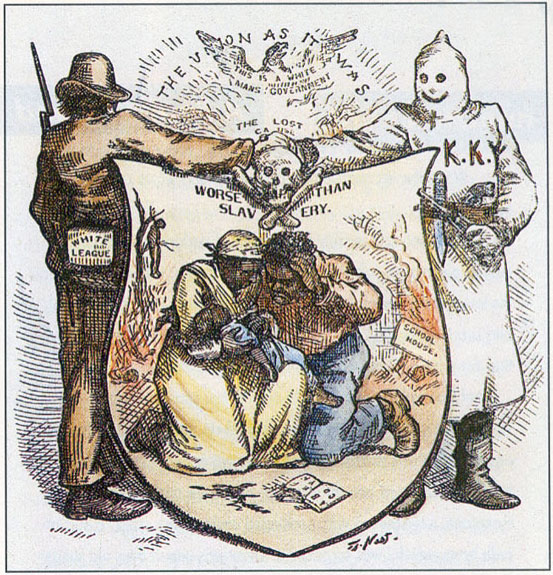
KKK-Nast

Friends of Padre Steve’s World,

Today I have a revised section of my Cicil War text “A Great War in an Age of Revolutionary Change.” I have being doing some final touches on it before I start working on final edits before seeking a publisher. I think it is important and timely in a day when state legislatures throughout the “Old South” are passing laws that seek to restrict voting rights against minorities and the elderly in order to diminish their political power, or to pass legislation designed to discriminate against LGBTQ people based solely on religious dogma. 

In such a world it is important to remember what happened to African Americans after Southern Whites reclaimed power following the collapse of Reconstruction.

Have a great day.

Peace

Padre Steve+

The Supreme Court, Congress, the Presidents as well as state governments systematically rolled back the rights of African Americans after Reconstruction ended. The Courts were the first to do this and once they had set the precedent were followed by the now Democrat controlled Congress and President Grover Cleveland. In 1883 “the Civil Rights Act of 1875, outlawing discrimination against Negroes using public facilities, was nullified by the Supreme Court, which said: “individual invasion of individual rights is not the subject-matter of the amendment.” The Fourteenth Amendment, it said, was aimed at state action only. No state shall…” [1] Associate Justice Joseph Bradley who had so eviscerated the Enforcement Act again played his hand in overturning a law that he despised on principle. He had written when Grant first signed the act in 1875 “to deprive white people of the right of choosing their own company would be to introduce another kind of slavery…. It can never be endured that the white shall be compelled to lodge and eat and sit with the Negro. The latter can have his freedom and all legal and essential privileges without that. The antipathy of race cannot be crushed and annihilated by legal enactment.” [2] In writing to overturn the Civil Rights Act of 1875 Bradley wrote that such laws were made African Americans a “special favorite of laws” and ignored the fact that in most of the country blacks were indeed not a favorite and were in fact still the subject of discrimination, segregation, political disenfranchisement, systematized violence, murder and lynching.

The actions of the court and alliances between Northern corporations and Southern landowners led to even more discrimination and disenfranchisement for blacks, “From the 1880s onward, the post-Reconstruction white governments grew unwilling to rely just on intimidation at the ballot box and themselves in power, and turned instead to systematic legal disenfranchisement” [3] which furthered the black codes into what we now call the era of Jim Crow.

For years after the Supreme Court’s Cruikshank decision blacks throughout the South attempted to vote despite intense opposition from Southern whites and armed bands of thugs. But with White Democrats now in charge of local government and “in control of the state and local vote-counting apparatus, resistance to black voting increasingly took the form of fraud as well as overt violence and intimidation. Men of color who cast Republican votes often found later that they had been counted for the party of white supremacy.” [4]

In 1896 the Supreme Court in the case of Plessy v. Ferguson upheld the black codes and Jim Crow laws. That ruling established the “separate but equal” doctrine and ushered in an era of de jure segregation in almost all arenas of life including education, transportation, entertainment and health care. The limited social equity and privileges enjoyed by blacks, not only in the South, but in the entire nation were erased by the stroke of the judicial pen. The justices ruled on the concept that the Constitution only guaranteed or protected a people’s political rights in the social arena that African-Americans could not interact with whites and assumed their racial inferiority.

Not all on the Court agreed with these rulings. One of them was Associate Justice John Harlan, who was a former slaveholder. Harlan dissented in the Court’s majority decision to overturn the Civil Rights Act of 1875 and also in Plessy v. Ferguson. In the case of the Civil Rights Act ruling Harlan insisted “our Constitution is color blind” [5] and wrote a strongly worded opinion:

“The destinies of two races, in this country are indissolubly linked together, and the interests of both require that the common government of all should not permit the seeds of race hate to be planted under the sanction of law. What can more certainly arouse race hate, what more certainly create and perpetuate a feeling of distrust between these races, than state enactments, which, in fact, proceed on the ground that colored citizens are so inferior and degraded that they cannot be allowed to sit in public coaches occupied by white citizens? That, as all will admit, is the real meaning of such legislation as was enacted in Louisiana.” [6]

As eloquent and as correct as Justice Harlan’s argument was, it was not sufficient to turn the tide of the new Court backed segregation laws. Harlan “was fighting a force greater than the logic of justice; the mood of the Court reflected a new coalition of northern industrialists and southern businessmen-planters.” [7] The “separate but equal” measures approved by the Court majority in Plessy v. Ferguson led to the widespread passage of Jim Crow laws, not only in the South but in other areas of the country. The Jim Crow era took nearly a century to reverse, and “only began to disappear with Brown v. Board of Education in 1954 and the Civil Rights and Voting Rights Acts of 1964 and 1965.” [8]

In order to get around the Fifteenth Amendment state governments in the South employed a strategy of subterfuges to suppress the African American vote. Along with the ever present threats of voter intimidation from armed White Supremacist groups, the states complicated the processes of voter registration and voting in order to make it nearly impossible for blacks to vote and into political oblivion. “Redeemer” governments in the post-Reconstruction South through the use of literary tests and poll taxes, the later which required people to pay in order to vote. The literacy and educational requirements mandated that “perspective registrants to “interpret” a section of the state constitution, and enacted standards which few blacks could fulfill, such as limiting registration to those whose grandfathers had voted.” Of course few blacks could meet the latter requirement as their grandfathers had been slaves and ineligible to vote. The laws were so devious that “when a journalist asked an Alabama lawmaker could pass his state’s understanding” test, the legislator replied, That would depend on entirely on which way he was going to vote.” [9]

These court decisions and legislation strengthened racism and discrimination against blacks, “effectively excluding blacks from public places, from the right to votes, from good public education, and so forth.” [10] The Plessy ruling was a watershed. Southern legislators, now unencumbered by Federal interference passed “state laws mandating racial segregation in every aspect of life, from schools to hospitals, waiting rooms to toilets, drinking fountains to cemeteries…segregation was part of a complex system of white domination, in which each component – disenfranchisement, unequal economic status, inferior education – reinforced the others.” [11]

For decades future courts would cite Plessy and Cruikshank as well as other decisions as precedent in deny rights to blacks. It would not be until 1954 when the Supreme Court overturned Plessy and the “Separate but Equal” Jim Crow laws in Brown v. Board of Education. Brown was a watershed for it deemed that separate schools were “inherently unequal.” The reaction across the South, especially Mississippi was stunned shock, disbelief and anger. “A Mississippi judge bemoaned “black Monday” and across the South “Citizen’s Councils” sprung up to fight the ruling. [12]

Mississippi led the way in disenfranchising black voters through the use of voter qualifications that would eliminate most blacks from the rolls of voters. In 1895 the state legislature passed a measure that would “technically apply to everybody but actually eliminate the Negro without touching the white.” [13] The move was in open defiance of the Fifteenth Amendment and resulted in tens of thousands of black voters being dropped from the rolls, in most cases under 5% of black voters who had been eligible to vote in 1885 remained eligible in 1896. Mississippi was rewarded in 1898 when the Supreme Court in Williams v. Mississippi that “there was no reason to suppose that the state’s new voting qualification were aimed specifically at Negroes.” [14] “In 1900 blacks comprised 62 percent of Mississippi, the highest percentage in the nation. Yet the state had not one black elected official.” [15]

Violence was used with great effect and between 1880 and 1968 approximately 3,500 people were murdered or lynched throughout the South. In 1892 alone 235 blacks were lynched “and throughout the decade, whites lynched an average of 150 southern blacks per year.” [16] This had become a far easier task and far less dangerous for the perpetrators of violence against blacks as Supreme Court “interpreted black people’s other constitutional rights almost out of existence.” [17] Since the court had “limited the federal government’s role in punishing violations of Negro rights” this duty fell to the states, which seldom occurred, and when “those officials refused to act, blacks were left unprotected.” [18]

The effects of these actions were shown in the number of African Americans in elected office. In 1869 there were two African American United States Senators and twenty black members of the House of Representatives. After Reconstruction ended these numbers dwindled and “the last black left Congress in 1901.” [19]

One of these was the case of United States v. Harris where the federal prosecutors had indicted “twenty members of a Tennessee lynch mob for violating section two of the enforcement Act, which outlawed conspiracies to deprive anyone of “equal protection of the laws.” However the Court struck down section 2 because the “lynching was not a federal matter, the Court said, because the mob consisted only of private individuals.” [20]

Many Southern states, especially Mississippi continued to tighten Jim Crow throughout the first half of the twentieth century. “In 1922 a new Jim Crow law kept up with the times by segregating taxis. In 1930 another new law prohibited “publishing, printing, or circulating any literature in favor of or urging inter-racial marriage or social equality.” [21] Not only were physical barriers being erected, but thought and free speech was now illegal if one supported equal rights.

martin-luther-king-jr

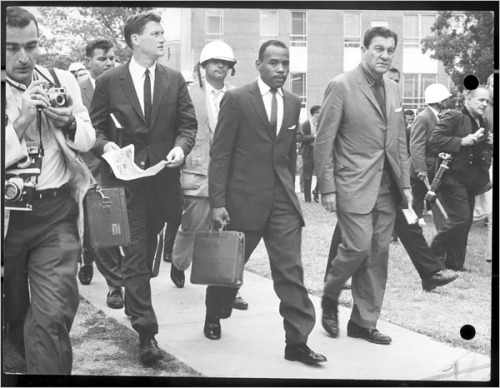
This remained the case until the 1960s when during the Freedom Rides when Mississippi again became a battleground in the Civil Rights movement. In 1961 James Meredith, a veteran of the U.S. Air Force, became the first black to ever be admitted to the University of Mississippi. His admission was fought by the university, Mississippi politicians including U.S. Senator James Eastland, Governor Ross Barnett, numerous congressmen and state representatives, and a populace that threatened violence and even war if the Federal government or courts order them to comply. Governor Barnett spoke for many when he made a statewide television address in September 1961 “We must either submit to the unlawful dictates of the federal government or stand up like men and tell them ‘NEVER!’” [22] He then called for the arrest of any federal officials who attempted to hold a state official for defying federal court orders. Backed by federal court orders to admit Meredith, and by the Brown v. Board of Education ruling, Attorney General Robert F. Kennedy called Barnett on September 24th.

“Governor,” Kennedy observed, “you a part of the United States.”

            “We have been a part of the United States, but I don’t know whether we are or not.”

            Are you getting out of the Union?”

            “It looks like we are being kicked around – like we don’t belong to it.”

            Back to specifics again, Kennedy ended the talk with a typical crisp wrap-up. “My job is to enforce the laws of the United States.” [23]

The resultant conflict nearly came to violence as thousands of Mississippians, whipped into an anti-black and anti-federal government frenzy by their elected leaders, radio, and television and newspaper commentators and supported by the KKK, the John Birch Society and other groups mobilized to fight the “invasion.” Eventually a deal was reached to admit Meredith on September 30th. As Meredith entered the campus he was protected by Federal Marshals and Border Patrol officers, as well as the State Police, which had just a few hours before been deployed to keep Meredith and the federals out. Despite this thousands of people ringed the campus, and the Confederate Battle Flag was raised over the Civil War memorial on campus. The rioters uttered death threats and assaulted anyone who supported Meredith. Members of the press, even southerners, faculty members and civilian supporters were beaten, bricks, stones and bottles thrown, tires of federal vehicles slashed. Finally the marshals themselves were attacked and eight injured, forcing them to deploy tear gas to protect themselves and the State police withdrew.

tumblr_ly9o466dxz1r4tvc5o1_500

James Meredith being escorted to Ole Miss

Eventually U.S. Army MPs and mobilized National Guard units were called up and battled Molotov cocktails that were being thrown by the anti-integration protests to relieve the beleaguered marshals and border patrolmen. The troops finally cleared the campus and ended the riot. During the riot 160 marshals were hurt, some 28 of who were wounded by bullets fired by the protestors. The next morning with Meredith admitted to the university a local clergyman saw the Confederate flag still flying and “with firm step, he strode out to the pole, loosened the halyard and lowered the Confederate flag.” [24]

The battle to integrate Ole’ Miss was over. Meredith graduated peacefully in August of 1963 and by then Mississippi abandoned its defiance of Federal authority, but many in the state still protested the admission as well as the later passage of the Civil Rights and Voting Rights Acts. Violence still occurred and even intensified at times as the Civil Rights movement, now led by Dr. Martin Luther King Junior made headway. King wrote in the Letter from a Birmingham Jail:

“One day the South will recognize its real heroes. They will be the James Merediths, with the noble sense of purpose that enables them to face jeering and hostile mobs, and with the agonizing loneliness that characterizes the life of the pioneer. They will be old, oppressed, battered Negro women, symbolized in a seventy two year old woman in Montgomery, Alabama, who rose up with a sense of dignity and with her people decided not to ride segregated buses, and who responded with ungrammatical profundity to one who inquired about her weariness: “My feets is tired, but my soul is at rest.” They will be the young high school and college students, the young ministers of the gospel and a host of their elders, courageously and nonviolently sitting in at lunch counters and willingly going to jail for conscience’ sake. One day the South will know that when these disinherited children of God sat down at lunch counters, they were in reality standing up for what is best in the American dream and for the most sacred values in our Judaeo Christian heritage, thereby bringing our nation back to those great wells of democracy which were dug deep by the founding fathers in their formulation of the Constitution and the Declaration of Independence.” [25]

In South Carolina, which had fought integration in the courts outgoing Governor Ernest F. Hollings read King’s letter and knew that he had been on the wrong side of history. The Democrat Governor realized that the handwriting was on the wall, and that South Carolina was different than Mississippi. Hollings knew that South Carolina’s racism was the old aristocratic type, which gave more value to an orderly society. As such Hollings told the legislature:

“As we meet, South Carolina is running out of courts. If and when every legal remedy has been exhausted, the General Assembly must make clear South Carolina’s choice, a government of laws rather than a government of men. As determined as we are, we of today must realize the lesson of once hundred years ago, and move on for the good of South Carolina and our United States. This should be done with dignity. It must be done with law and order.” [26] When Clemson University admitted its first student later in the year, there was no violence.

Hollings later remembered that for years he had supported and enforced the Jim Crow laws in his state. However, King’s Letter from a Birmingham Jail changed him, it was for him a moment like the Apostle Paul on the Road to Damascus. He admitted, “as governor, for four years, I enforced those Jim Crow laws. I did not understand, I did not appreciate what King had in mind… until he wrote that letter. He opened my eyes and set me free.” [27]

More violence would occur in Mississippi and other states during the 1960s. During the Freedom Rides, students and educators came from around the nation to the state to help register blacks to vote in 1964. This brought generations of barely concealed hatred to the surface. Bruce Watson in his book Freedom Summer wrote:

“In Mississippi’s most remote hamlets, small “klaverns” of ruthless men met in secret to discuss the “nigger-communist invasion of Mississippi.” They stockpiled kerosene, shotguns, and dynamite, then singled out targets – niggers, Jews, “nigger-lovers.” One warm April night, their secret burst into flames. In some sixty counties, blazing crosses lit up courthouse lawns, town squares, and open fields. The Klan was rising again in Mississippi. Like “White Knights” as their splinter group was named, the Klan planned a holy war against the “dedicated agents of Satan…determined to destroy Christian civilization.” The Klan would take care of your business, a recruiting poster said. “Get you Bible out and PRAY! You will hear from us.” [28]

Eventual the violence of these people led to the killings of three of the organizers, Michael Schwerner, James Cheney and Andrew Goldman were killed by a group of Klansmen led by members of the Neshoba County Sheriff’s Department on June 21st 1964. The resultant search for their bodies and the subsequent investigation transfixed the nation and led to the passage of the Civil Rights and Voting Rights Acts of 1964 and 1965.

After he left office, Ulysses Grant gave an interviewer a sober assessment of Reconstruction’s failure. Grant concluded that at the end of the war what the South really needed was a benevolent dictatorship until it could be fully reintegrated into the Union. Instead the South remained defiant and using subterfuge mixed with targeted violence wore down the will northerners to fully pursue and implement Reconstruction. He told the interviewer:

“Military rule would have been just to all… the Negro who wanted freedom, the white man who wanted protection, the Northern man who wanted Union. As state after state showed a willingness to come into the Union, not on their terms but upon ours, I would have admitted them. The trouble about the military rule in the South was that our people did not like it. It was not in accordance with our institutions. I am clear now that it would have been better to suffrage, reconstruction, State governments, for ten year, and held the South in a territorial condition. But we made our scheme, and we must do what we must with it.” [29]

Grant was correct in his analysis. The policies enacted by the North in 1865 that were considered benevolent were seized upon as signs of weakness in the defeated South. The leaders of the South knew that the Republican Party was a coalition and worked to push the fault lines of the Republicans until they broke, and they were successful. The Confederacy may have lost the war in a military and economic sense, but in the “ways that mattered most to white Southerners – socially, politically, and ideologically – the South itself did not.” [30] Grant died in 1885 hailed throughout the nation, but knowing that he was unable to secure the new birth of freedom, that he and his friend Abraham Lincoln and so many others had fought for in the Civil War.

The example of Reconstruction’s failure shows that in order to secure peace that military victory must be accompanied by the political will to ensure that the avowed goals of that victory are secured after the war in ensuring a just peace. In retrospect, a harsh peace and a long period of nation building may have benefited the nation more than botched reconstruction, but as Grant noted “our people did not like it.”

Southerners may have lost the shooting war, but they could not and would not accept the peace. By successfully wearing down the will of the people of the North and exploiting the fissures in varying components of the Republican Party, they succeeded in winning the things most important to them in regard to race relations and White Supremacy.

After the war, White Southerners resorted to all means to reverse their military defeat through political, social, economic and judicial means and “justice was sacrificed for the unjust peace ushered in by “redemption” of the South, a peace marred by Jim Crow, poverty and lynching.” [31] Most Northern leaders, politicians, the media and the clergy failed to appreciate this until it was far too late, and hindered by President Johnson’s opposition failed to win the peace in the South when they had the best chance. They failed to appreciate that even after the shooting is often that “there is a need for further threats, and indeed action, because postwar disorder and even chaos will have to be address, and victorious allies are always likely to squabble over the spoils of victory” [32] as certain was the case in the divided Republican Party of the Reconstruction era. By the time Ulysses S. Grant was elected President many in the North were already tiring of Reconstruction and African Americans and when he resorted to harsh yet effective means of quelling violence and enforcing the laws many, even in his own Republican Party rebelled, ensuring the former Confederates of a political and social victory that took nearly another hundred years to end, if indeed it is truly ended, a proposition that I think is ludicrous as for many the Civil War is not over.

Notes

[1] Ibid. Zinn The Other Civil War p.57

[2] Ibid. Lane The day Freedom Died p.253

[3] Ibid. Guelzo Fateful Lightening p.526

[4] Ibid. Lane The day Freedom Died p.251

[5] Ibid. Zinn The Other Civil War p.58

[6] LaMorte, Michael W. School Law: Cases and Concepts 9th Edition 2008 Allyn and Bacon Inc. 2008 p.300

[7] Ibid. Zinn A People’s History of the United States pp.204-205

[8] Ibid. Huntington Who are We? p.54

[9] Ibid. Goldfield Still Fighting the Civil War: The American South and Southern History p.197

[10] Gonzalez, Justo L. The History of Christianity Volume 2: The Reformation to the Present Day Harper and Row Publishers San Francisco 1985 p.252

[11] Ibid. Foner Forever Free p.208

[12] Ibid. Watson Freedom Summer p.46

[13] Ibid. Lord The Past that Wouldn’t Die p.22

[14] Ibid. Lord The Past that Wouldn’t Die p.23

[15] Ibid. Watson Freedom Summer p.41

[16] Ibid. Goldfield Still Fighting the Civil War: The American South and Southern History, Updated Edition, p.206

[17] Ibid. Lane The day Freedom Died p.253

[18] Ibid. Langguth After Lincoln p.338

[19] Ibid. Zinn A People’s History of the United States p.200

[20] Ibid. Lane The day Freedom Died p.253

[21] Ibid. Lord The Past that Wouldn’t Die p.25

[22] Ibid. Lord The Past that Wouldn’t Die p.139

[23] Ibid. Lord The Past that Wouldn’t Die p.159

[24] Ibid. Lord The Past that Wouldn’t Die p.231

[25] King, Martin Luther Letter from a Birmingham Jail 16 April 1963 Retrieved from https://www.africa.upenn.edu/Articles_Gen/Letter_Birmingham.html 15 September 2016

[26] Bass, Jack and Nelson, Jack The Orangeburg Massacre Mercer University Press, Macon and Atlanta 1984, 1996 & 2002 pp.11-12

[27] Ibid. Goldfield Still Fighting the Civil War: The American South and Southern History, Updated Edition, p.74

[28] Ibid. Watson Freedom Summer p.12

[29] Ibid. Lane The day Freedom Died p.254

[30] Ibid. Lane The day Freedom Died p.254

[31] Ibid. McPherson The War that Forged a Nation p. 191

[32] Ibid. Gray Fighting Talk p.14

2 Comments

Filed under civil rights, civil war, History, Political Commentary

The Appalling Silence of Good People

img_0071

Friends of Padre Steve’s World,

I have been asked by some people why I as a chaplain, priest, and military officer, not to mention the fact that I am heterosexual, so strongly support my Gay and Lesbian friends, as well as the LGBTQ community. My answer has to echo the words of Albert Einstein who said “If I were to remain silent, I’d be guilty of complicity.”

Many times the question is crouched in theological terms, and those that ask presume that I am supporting sin, and aiding as some say the “enemies of God.” The problem is, that if being Gay is a sin, then why are not all those concerned about them doing something other than condemning them unto their last breath? Likewise why are the sin hunters who hate LGBTQ people with unmatched passion; who use local, state and when possible attempt to use the Federate government to legislate against equality for LGBTQ people, and who remain dreadfully silent when Gays are attacked and killed, never condemn those that practice what are called the Seven Deadly Sins? If you don’t know them here they are; pride, envy, gluttony, lust, anger, greed, and sloth. They infect our society root and branch, and dare I say our hallowed religious institutions, from which so much of the anti-Gay venom spews forth.

I wish I knew the answer to that, but for some reason it seems that religions in general tend to condemn, persecute, and even sanction the killing of Gays, especially Gay men, more than any other institutions. Christians, Muslims, Hindus, Jews, there are elements in all these religions who are not content with simply preaching against homosexuality, but wherever they have control of government to persecute and kill LGBTQ people.

Early Sunday morning a man whose personal hatred toward Gay men, and radical Islamic religious based terrorist ideology formed a nexus of evil that allowed him to kill about fifty men and women, while wounding over fifty more. This was certainly a terrorist act, in the words of the man who committed the massacre an act done in the name of his understanding of Islam, and in accordance with the overall goals of the Islamic State.

We will find out if there is a deeper connection between the killer and the Islamic State, but that is not the biggest question here. Why did he strike a Gay nightclub versus any other soft target? There are hundreds if not thousands of soft targets in South Florida, including some which would have just as easy, and symbolic as symbols of America or even Christianity. Why not a sporting event, a non-gay nightclub, a park, a school, or even a church? Well, because here is what many Americans don’t want to admit, he hated Gays, and specifically targeted them on Pride weekend. Those two factors my friends are the key. He could have attacked anything, but he chose to kill mass numbers of Gays and others gathered at the Pulse nightclub.

Sadly he is not alone and has found significant support from anti-Gay Christian leaders like Pastor Steven Anderson and Walid Shoebat who both would prefer Gays to be killed, in fact Anderson’s only issue was the fact that it should have been the government that killed them, not the terrorist. Shoebat said that the only people mourning over the victims of the massacre are “liberals, idiots, and Gay lovers.”  I will not repeat rest of their hate filled venom here because it boggles the mind. How such people can even call themselves Christians is beyond me.

Mercifully others who are often at the front in condemning Gays have been relatively silent and mentioned that they will be “praying for the victims and their families.” But such prayers are cheap, unless you actually care about the people you are praying for, and unless you can empathize with them. Sadly, many of these religious leaders and their political allies have no intent of backing down on their work to curtail, limit, or roll back the rights of LGBTQ people, even to the point of criminalizing homosexuality.

But then there are others who are genuinely good people, who have friendships with Gays and even have Gay family members but still refuse to take the necessary step to support the basic human and legal rights of their friends and family members, and who for whatever reason, fear of being ostracized by their church or any number of a myriad of other reasons remain silent when horrible, inhuman crimes take place. But then Dr. Martin Luther King Jr. noted, “Not only will we have to repent for the sins of bad people; but we also will have to repent for the appalling silence of good people.”

All I know is that I will continue to speak out for LGBTQ people, and I will not be silent. I am sure that will lose me some friends, but I cannot stand by and remain silent, it would make me complicit with the man that killed and wounded all of those innocent people, and with the religious leaders that harbor the same views.

That is all for now. Have a good day, and please, even if you do not agree with me on anything else, and please take the time to try to feel a measure of empathy for those killed, those wounded, and those who grieve for them, and if you can take the next step to speak up for them. I promise that you will not regret that decision.

Peace

Padre Steve+

5 Comments

Filed under civil rights, crime, ethics, faith, LGBT issues, Political Commentary, Religion

The Slow Integration of Major League Baseball

Jackie Robinson Shaking Branch Rickey's Hand

Friends of Padre Steve’s World,

Back in 1947 Branch Rickey told Jackie Robinson, “Jackie, we’ve got no army. There’s virtually nobody on our side. No owners, no umpires, very few newspapermen. And I’m afraid that many fans will be hostile. We’ll be in a tough position. We can win only if we can convince the world that I’m doing this because you’re a great ballplayer, a fine gentleman.”

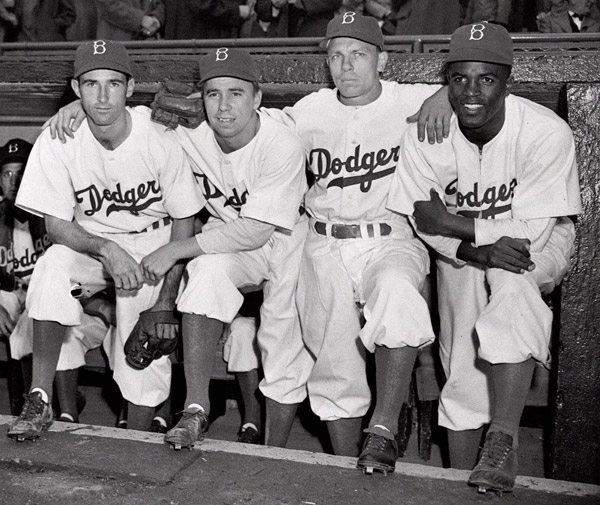
My friends, last week pitchers and catchers reported to their teams for the 2016 Baseball Spring Training, and it is time to reflect again on how Branch Rickey’s signing of Jackie Robinson helped advance the Civil Rights of Blacks in the United States. What Rickey did was a watershed, and though it took time for every team in the Major Leagues to integrate, the last being the Boston Red Sox in 1959, a dozen years after Jackie Robinson broke the color barrier.

Branch Rickey shook the foundations of America when he signed Jackie Robinson to a Major League deal in 1947, a year before President Truman desegregated the military and years before Jim Crow laws were overturned in many states.

Robinson and the early pioneers of the game did a service to the nation. They helped many white Americans see that Blacks were not only their equals as human beings, and as it was note about Ernie Banks and others that soon “little white boys wanted to grow up and be Ernie Banks.” 

robinson2-popup

Charles Thomas

But for Rickey the crusade to integrate baseball began long before 1947. In 1903, Rickey, then a coach for the Ohio Wesleyan University baseball team had to console his star player, Charles Thomas when a hotel in South Bend Indiana refused him a room because he was black. Rickey found Thomas sobbing rubbing his hands together and repeating “Black skin. Black skin. If only I could make them white.” Rickey attempted to console his friend saying “Come on, Tommy, snap out of it, buck up! We’ll lick this one day, but we can’t if you feel sorry for yourself.”

Thomas, encouraged by Rickey was remembered by one alumnus who saw a game that Thomas played in noted that “the only unpleasant feature of the game was the coarse slurs cast at Mr. Thomas, the catcher.” However, the writer noted something else about Thomas that caught his eye: “But through it all, he showed himself far more the gentleman than his insolent tormentors though their skin is white.”

Baseball like most of America was not a place for the Black man. Rickey, a devout Christian later remarked “I vowed that I would always do whatever I could to see that other Americans did not have to face the bitter humiliation that was heaped upon Charles Thomas.”

In April 1947 Rickey, now the owner of the Brooklyn Dodgers had one African-American ballplayer at the Dodgers’ Spring Training site in Daytona Beach Florida. The South was still a hotbed of racial prejudice, Jim Crow was the law of the land and Blacks had no place in White Man’s baseball. That player was Jackie Robinson.

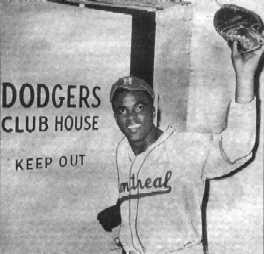
The Dodgers had been coming to Florida for years. Rickey moved the Dodgers from Jacksonville to Daytona Beach in 1947 after Jacksonville had refused to alter its segregation laws to allow an exhibition game between the Dodgers International League affiliate the Montreal Royals, for whom Robinson starred.

That was the year that Rickey signed Robinson to a minor league contract with the Royals.  When Rickey called up Robinson 6 days prior to the 1947 season, it was  Robinson broke the color barrier for the Dodgers and Major League Baseball. However it would take another 12 years before all Major League teams had a black player on their roster.

robinson-dodgers

It is hard to imagine now that even after Jackie Robinson had broken the color barrier that other teams did not immediately sign black players. However Rickey and Robinson broke the color barrier a year before Harry Truman had integrated the Armed Forces and seven years before the Supreme Court ruled the segregation of public schools illegal. But how could that be a surprise? The country was still rampant with unbridled racism. Outside of a few Blacks in the military and baseball most African Americans had few rights. In the North racism regulated most blacks to ghettos, while in the South, Jim Crow laws and public lynching of progressive or outspoken Blacks.

But Jackie Robinson and Branch Rickey helped bring about change, and soon other teams were following suit.

roy-campanella-ap2

Roy Campenella

The Cleveland Indians under their legendary owner Bill Veeck were not far behind the Dodgers in integrating their team. They signed Larry Doby on July 5th 1947. Doby would go on to the Hall of Fame and was a key player on the 1948 Indian team which won the 1948 World Series, the last that the storied franchise has won to this date.

The St. Louis Browns signed Third Baseman Hank Thompson 12 days after the Indians signed Doby. But Thompson, Robinson and Doby would be the only Blacks to play in that inaugural season of integration. They would be joined by others in 1948 including the immortal catcher Roy Campanella who signed with the Dodgers and the venerable Negro League pitcher, Satchel Paige who was signed by the Indians.

WillieMays

Willie Mays and Monte Ervin

monte_irvin

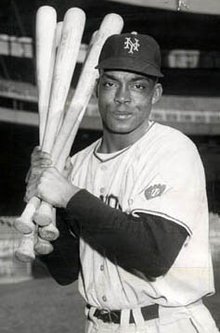
It was not until 1949 when the New York Giants became the next team to integrate. They brought up Monte Irvin and Hank Thompson who they had acquired from the Browns. In 1951 these men would be joined by a young, rookie Willie Mays to become the first all African-American outfield in the Major Leagues. Both Mays and Irvin would enter the Hall of Fame and both are still a key part of the Giants’ story. Despite their age have continued to be active in with the Giants and Major League Baseball.

The Boston Braves were the next to desegregate calling up Samuel “the Jet” Jethroe to play Center Field. Jethroe was named the National League Rookie of the Year in 1950. In 1951 the Chicago White Sox signed Cuban born Minnie Minoso who had played for Cleveland in 1949 and 1951 before signing with the White Sox. Minoso would be elected to 9 All-Star teams and win 3 Golden Gloves awards during his illustrious career.

BANKS-ERNIE

Ernie Banks

The Chicago Cubs and Philadelphia Athletics integrated at the end of the 1953 season. The Cubs signed Shortstop Ernie Banks who would go on to be a 14 time All-Star, 2 time National League MVP and be elected to the Hall of Fame in 1977 on the first ballot and sadly he died a year ago. The Athletics called up pitcher Bob Trice from their Ottawa Farm team where he had won 21 games. Trice only pitched in 27 Major League games over the course of three seasons with the Athletics.

Four teams integrated in 1954. The Pittsburgh Pirates acquired Second Baseman Curt Roberts from Denver of the Western League as part of a minor league deal. He would play 171 games in the Majors.  He was sent to the Columbus Jets of the International League in 1956 and though he played in both the Athletics and Yankees farm systems but never again reached the Majors. The St. Louis Cardinals, the team that had threatened to not play against the Dodgers and Jackie Robinson in 1947 traded for First Baseman Tom Alston of the Pacific Coast League San Diego Padres. Alston would only play in 91 Major League games with his career hindered by bouts with depression and anxiety. The Cincinnati Reds brought up Puerto Rican born First Baseman Nino Escalera and Third Baseman Chuck Harmon. Harmon had played in the Negro Leagues and had been a Professional Basketball player in the American Basketball League. Harmon who was almost 30 when called up played just 4 years in the Majors. Both he and Escalera would go on to be Major League scouts. Escalera is considered one of the best First Baseman from Puerto Rico and was elected to the Puerto Rican Baseball Hall of Fame. Harmon’s first game was recognized by the Reds in 2004 and a plaque hangs in his honor. The Washington Senators called up Cuban born Center Fielder Carlos Paula from their Charlotte Hornets’ farm team in September 1954. Paula played through the 1956 season with the Senators and his contract was sold to the Sacramento Salons of the Pacific Coast League. He hit .271 in 157 plate appearances with 9 home runs and 60 RBIs. He died at the age of 55 in Miami.

elston-howard

Elston Howard

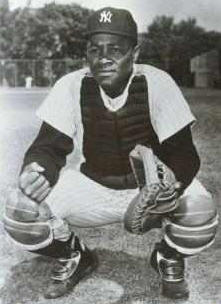
In April 1955 the New York Yankees finally integrated 8 years after the Dodgers and 6 years after the Giants. They signed Catcher/Left Fielder Elston Howard from their International League affiliate where he had been the League MVP in 1954. Howard would play 13 years in the Majors with the Yankees and later the Red Sox retiring in 1968. He would be a 12-time All Star and 6-time World Series Champion as a player and later as a coach for the Yankees. He died of heart disease in 1980.  His number 32 was retired by the Yankees in 1984.

The Philadelphia Phillies purchased the contract of Shortstop John Kennedy from the Kansas City Monarchs of the Negro League at the end of the 1956 season. Kennedy played in just 5 games in April and May of 1957.

In 1958 the Detroit Tigers obtained Dominican born Utility Player Ozzie Virgil Sr. who had played with the Giants in 1955 and 1956. Virgil would play 9 seasons in the Majors with the Giants, Tigers, Athletics and Pirates and retire from the Giants in 1969. He later coached for 19 years in the Majors with the Giants, Expos, Padres and Mariners.

The last team to integrate was the Boston Red Sox who signed Infielder Pumpsie Green. Green made his debut on 21 July 1959 during his three years with the Red Sox was primarily used as a pinch runner. He played his final season with the New York Mets in 1963. He was honored by the Red Sox in 2009 on the 50th anniversary of breaking the Red Sox color barrier.

robbyii

It took 12 years for all the teams of the Major Leagues to integrate, part of the long struggle of African Americans to achieve equality not just in baseball but in all areas of public life.  These men, few in number paved the way for African Americans in baseball and were part of the inspiration of the Civil Rights Movement itself.  They should be remembered by baseball fans, and all Americans everywhere for their sacrifices and sheer determination to overcome the obstacles and hatreds that they faced. It would not be until August of 1963 that Martin Luther King Jr. would give his I Have a Dream speech and 1964 that African Americans received equal voting rights.

Spring training for the 2016 season is about to begin in Florida and Arizona, in what are called the Grapefruit and Cactus Leagues. It is hard to believe that only 68 years ago that only one team and one owner dared to break the color barrier that was, then, and often today is still a part of American life.

However in those 69 years despite opposition and lingering prejudice African Americans in baseball led the way in the Civil Rights Movement and are in large part responsible for many of the breakthroughs in race relations and the advancement of not only African Americans, but so many others.

We can thank men like Charles Thomas, Jackie Robinson and Branch Rickey for this and pray that we who remain, Black and White, Asian, and Latin American, as well as all others who make up our great nation will never relinquish the gains that have been won at such a great cost.

Today we have a Black President who has the same kind of racial epitaphs thrown at him every day by whites who as they did to Charles Thomas, Jackie Robinson and so many other pioneers, Frankly such behavior can only be called what is it, unrepentant, unabashed, and evil racism. The fact is that such people don’t think that any Black man should hold such high an office, just as they did not think that Blacks should be allowed to play integrated baseball. It is anathema to them, and that is why their unabashed hatred for Obama runs so deep. They may disagree with his policies, but I guarantee if Obama was white, their opposition to him would be far more civil and respectful. But because he is half-black, and has a funny name they hate him with a passion, a passion that scares me, because words and hateful beliefs can easily become actions.

Racism still exists, but one day thanks to the efforts of the early ball-players as well as pioneers like President Obama, and the undying commitment of decent Americans to accept people regardless of race, ethnicity, gender, religion, or even sexual orientation, we will see a new birth of freedom.

Peace

Padre Steve+

1 Comment

Filed under Baseball, civil rights, History, Political Commentary

The Dream: Remembering Dr. Martin Luther King Jr.

index

Friends of Padre Steve’s World,

Dr. Martin Luther King Jr. has always been one of my heroes. This time of year I always ponder the importance of his life and work for civil rights, and I wonder what might have been had this man of peace not been cut down in cold blood at the young age of 39 by James Earl Ray on April 4th 1968. He was an amazing and courageous man whose memory should not be let to one day a year. We have to ensure, though our words and actions that it is not allowed to die.

King was a man of courage, a man of honor, a man of conviction. But he came of age in a time when many people were willing to maintain the status quo and play things safe, like many clergy, even African-American clergy. Many pastors of the era, remained quiet about the conditions of segregation, and the racism of the day. Their lack of action did not mean they were bad people, they just understood that if they spoke up, their lives, and the lives of their families and congregations could be in danger. As such many pastors just hoped to see things slowly improve, without rocking the boat, and without endangering themselves or their families. They had seen what happened to blacks who spoke up or confronted the evil, lynching’s, cross burnings, threats and murder. They had contented themselves with just trying to get along. At the beginning of the movement, many pastors did not support or gave only lukewarm support to Dr. King, Andrew Young, Fred Shuttlesworth, and Ralph Abernathy going into that critical year of 1963.

lossless-page1-560px-Rosa_Parks_(detail).tiff

King did not start out to become a Civil Rights leader. However, he was inspired to actively join the movement through the example of Rosa Parks, who defiance of the law for blacks to sit “in the back of the bus” in 1955. He led the Montgomery Bus Boycott which lasted for 385 days. The reaction among segregationists to King and his protest was against violent. King’s house was bombed, and his life threatened. But he refused to stand down.

King’s leadership of the boycott brought the young pastor to national prominence. However, by 1963 much of the Civil Rights movement and the African American community was despairing of the lack of progress. Many people had become disenchanted with King, not considering him bold enough despite his rhetorical abilities.

But in April 1963, working with other Civil Rights leaders in Birmingham Alabama King relit the fires of the movement. Montgomery Police Chief “Bull” Conner used his police force to violently attack the demonstrators. Conner ordered his men to unleash their police dogs on the protestors, and used high pressure water cannon against them, including women, children and the elderly. The violent reaction to the protests shocked much of America and the world.

King was arrested and in the Birmingham jail composed one of his most famous works, the Letter from the Birmingham Jail.  The letter was a social, political and theological masterpiece. It was some of his harshest criticism was of white liberals, as well as black moderates:

“I have almost reached the regrettable conclusion that the Negro’s great stumbling block in his stride toward freedom is not the White Citizen’s Councilor or the Ku Klux Klanner, but the white moderate, who is more devoted to “order” than to justice; who prefers a negative peace which is the absence of tension to a positive peace which is the presence of justice; who constantly says: “I agree with you in the goal you seek, but I cannot agree with your methods of direct action”; who paternalistically believes he can set the timetable for another man’s freedom; who lives by a mythical concept of time and who constantly advises the Negro to wait for a “more convenient season”

King continued his activism until his assassination. In August 1963 he led the March on Washington for Jobs and Freedom, where before a crowd of an estimated 200,000-300,000 he gave his I Have a Dream Speech.

http://www.americanrhetoric.com/speeches/mlkihaveadream.htm

The crescendo of the speech was remarkable and is perhaps one of the most remembered speeches in American history.

Let us not wallow in the valley of despair, I say to you today, my friends.

And so even though we face the difficulties of today and tomorrow, I still have a dream. It is a dream deeply rooted in the American dream.

I have a dream that one day this nation will rise up and live out the true meaning of its creed: “We hold these truths to be self-evident, that all men are created equal.”

I have a dream that one day on the red hills of Georgia, the sons of former slaves and the sons of former slave owners will be able to sit down together at the table of brotherhood.

I have a dream that one day even the state of Mississippi, a state sweltering with the heat of injustice, sweltering with the heat of oppression, will be transformed into an oasis of freedom and justice.

I have a dream that my four little children will one day live in a nation where they will not be judged by the color of their skin but by the content of their character.

I have a dream today!

I have a dream that one day, down in Alabama, with its vicious racists, with its governor having his lips dripping with the words of “interposition” and “nullification” — one day right there in Alabama little black boys and black girls will be able to join hands with little white boys and white girls as sisters and brothers.

I have a dream today!

I have a dream that one day every valley shall be exalted, and every hill and mountain shall be made low, the rough places will be made plain, and the crooked places will be made straight; “and the glory of the Lord shall be revealed and all flesh shall see it together.”2

This is our hope, and this is the faith that I go back to the South with.

With this faith, we will be able to hew out of the mountain of despair a stone of hope. With this faith, we will be able to transform the jangling discords of our nation into a beautiful symphony of brotherhood. With this faith, we will be able to work together, to pray together, to struggle together, to go to jail together, to stand up for freedom together, knowing that we will be free one day.

And this will be the day — this will be the day when all of God’s children will be able to sing with new meaning:

My country ’tis of thee, sweet land of liberty, of thee I sing.

Land where my fathers died, land of the Pilgrim’s pride,

From every mountainside, let freedom ring!

And if America is to be a great nation, this must become true.

And so let freedom ring from the prodigious hilltops of New Hampshire.

Let freedom ring from the mighty mountains of New York.

Let freedom ring from the heightening Alleghenies of Pennsylvania.

Let freedom ring from the snow-capped Rockies of Colorado.

Let freedom ring from the curvaceous slopes of California.

But not only that:

Let freedom ring from Stone Mountain of Georgia.

Let freedom ring from Lookout Mountain of Tennessee.

Let freedom ring from every hill and molehill of Mississippi.

From every mountainside, let freedom ring.

And when this happens, and when we allow freedom ring, when we let it ring from every village and every hamlet, from every state and every city, we will be able to speed up that day when all of God’s children, black men and white men, Jews and Gentiles, Protestants and Catholics, will be able to join hands and sing in the words of the old Negro spiritual:

                Free at last! Free at last!

                Thank God Almighty, we are free at last!

King knew the dangers and the risks of appealing to a strategy of non-violence based on love of his enemies. King spoke to the world when he accepted the Nobel Peace Prize in 1964:

“Here and there an individual or group dares to love, and rises to the majestic heights of moral maturity. So in a real sense this is a great time to be alive. Therefore, I am not yet discouraged about the future. Granted that the easygoing optimism of yesterday is impossible. Granted that those who pioneer in the struggle for peace and freedom will still face uncomfortable jail terms, painful threats of death; they will still be battered by the storms of persecution, leading them to the nagging feeling that they can no longer bear such a heavy burden, and the temptation of wanting to retreat to a more quiet and serene life. Granted that we face a world crisis which leaves us standing so often amid the surging murmur of life’s restless sea. But every crisis has both its dangers and its opportunities. It can spell either salvation or doom. In a dark confused world the kingdom of God may yet reign in the hearts of men.”  http://www.nobelprize.org/nobel_prizes/peace/laureates/1964/king-lecture.html 

Dr. King understood how easy hatred could consume people and movements and urged  people not to follow the course of hate, he wrote:

“Returning hate for hate multiplies hate, adding deeper darkness to a night already devoid of stars. Darkness cannot drive out darkness; only light can do that. Hate cannot drive out hate; only love can do that. Hate multiplies hate, violence multiplies violence, and toughness multiplies toughness in a descending spiral of destruction.”

https://www.youtube.com/watch?v=IDl84vusXos

The day before his assassination in Memphis, Dr. King still recognized what he might face. His “I have been to the Mountaintop” speech http://www.americanrhetoric.com/speeches/mlkivebeentothemountaintop.htm recounted many of the things that he had encountered, including an assassination attempt in 1958 which had come close to killing him. It was an amazing speech and one wonders if having lived under threat so long that he almost had a premonition of his death the next day.

And then I got into Memphis. And some began to say the threats, or talk about the threats that were out. What would happen to me from some of our sick white brothers?

Well, I don’t know what will happen now. We’ve got some difficult days ahead. But it really doesn’t matter with me now, because I’ve been to the mountaintop.

And I don’t mind.

Like anybody, I would like to live a long life. Longevity has its place. But I’m not concerned about that now. I just want to do God’s will. And He’s allowed me to go up to the mountain. And I’ve looked over. And I’ve seen the Promised Land. I may not get there with you. But I want you to know tonight, that we, as a people, will get to the promised land!

Dr. King’s dream is not dead and we who live today cannot allow it to die. There is still much work to see justice done for all Americans as well as those suffering from violence, persecution, discrimination and poverty around the world.

It is 2016. It has been 53 years since Dr. King sat in the Birmingham jail. Sadly, there are some who long for a return to the day of Jim Crow. In some states there have been and there are ongoing attempts to return it by stealth, especially through restrictions on voting that predominantly impact African Americans and the poor. Racism is not dead, nor are so many other “isms.” As Dr. King told us, “Now is the time to make real the promises of democracy,” and “It would be fatal for the nation to overlook the urgency of the moment.”

Dr. King and many of the leaders of the Civil Rights Movement have passed on. Likewise, many people today are complacent about the injustices present in our society, injustices experienced by many people. We need a generation of new men and women with hearts like Dr. King’s, who will be the conscience of the nation and confront these injustices.

Birmingham_campaign_dogs

Representative John Lewis, one of the original Freedom Riders was beaten numerous times during those protests. When leading the march across the Pettus Bridge in Selma, Lewis had his skull fractured by a State Trooper when he stopped to pray.  Lewis’s words call us to action today:

“If not us, then who? If not now, then when?” 

We cannot let Dr. King’s dream die.

Peace

Padre Steve+

Leave a comment

Filed under civil rights, laws and legislation, Political Commentary

May We All Have a Vision: New Year 2016

68136_10151386881662059_2126249630_n

Friends of Padre Steve’s World,

It is New Year’s Eve and in some parts of the world it is already 2016, it is amazing how time flies. After the year that was 2015 with its seeming unending cycle of violence, hate, war and destruction is over. I hope that 2016 is different, we certainly could use a break, but the forces of history and nature are sometimes greater than our hopes, but I can always hope.

Many people will see in the New Year singing Auld Lang Syne. I suppose that as Judy and I pop the Champagne and toast tonight when we watch the Ball descend in Times Square on our television, safe from all the drunk drivers that we may as well. Not that we will be isolated, we will go out earlier and see our friends at Gordon Biersch around dinner time and get out before the crowds get going and the place gets too loud and crazy for our tastes.

But my favorite song for the New Year is Abba’s Happy New Year.  Like Auld Lang Syne it is a melancholy song of the end of one year’s hopes, dreams and expectations and hopes and dreams for the New Year. I think one of the lines that I like, one which I think calls on us to actually do more than hope, but to act on hope, is “May we all have a vision…” A vision requires that we begin to imagine a better future, in a sense it is to dream, as Martin Luther King Jr. dreamed, I have a dream that one day this nation will rise up and live out the true meaning of its creed: “We hold these truths to be self-evident, that all men are created equal.”

To fulfill that dream and vision we must live, work, dream and imagine that things can be better, and as Dr. King said, Let us not wallow in the valley of despair, I say to you today, my friends.

And so even though we face the difficulties of today and tomorrow, I still have a dream…

The song, Happy New Year ends with this verse, May we all have our hopes, our will to try, If we don’t we might as well lay down and die, You and I

Here is wishing you the best New Year possible, and I for one will not lay down and die.

Peace

Padre Steve+
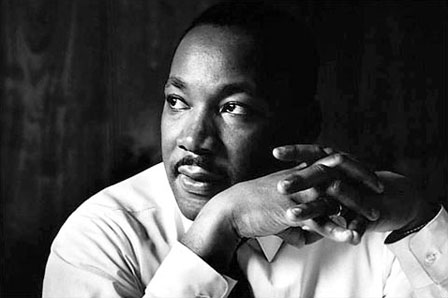
1 Comment

Filed under Loose thoughts and musings

Who is Guilty? Racism & the Birmingham Church Bombing

SixteenthStBaptistBomb05

Friends of Padre Steve’s World

On September 16th 1963 a young Southern White lawyer in Birmingham Alabama spoke these words after a black church was bombed and the police attacked peaceful protesters:

“from anger and despair, from frustration and empathy. And from years of hopes, hopes that were shattered and crumbled with the steps of that Negro Baptist Church.”

Most Americans will not recognize the names and I would dare say that many do not even know about what happened in Birmingham Alabama 52 years ago today. At 10:22 in the morning on September 15th 1963 a bomb exploded during the worship service at the 16th Street Baptist Church. It was one of the most brazen attacks against a church in the modern era, and men who claimed to be “Christians” committed it.

MCNAIR ROBERTSON COLLINS WESLEY

Four young girls, three 14 year olds and one 13 year old were killed. Addie Mae Collins, Denise McNair, Carole Robertson and Cynthia Wesley lost their lives that day. Twenty-two other church members were wounded in an attack, which was carried out by members of the KKK and tacitly approved of by many political leaders including Alabama Governor George Wallace. Why were they killed and why were the others wounded? For the crime of being black and the crime of their church serving as a focal point of the Civil Rights movement.

Likewise, most people, including many blacks do not know that before that beginning in 1955 there had been 19 other bombings of black churches and the homes of black leaders in Birmingham before this one. But even before that outbreak of violence, Birmingham had become known as “Bombingham” because over 50 bombing attacks against blacks, black churches and black institutions in the years after the First World War.

The church had served as a focal point of the Freedom Summer where Civil Rights activists and students from around the country had met, trained and organized to register blacks to vote. This made it a prominent target for violence.

1179981

Early in the morning of September 15th four members of the United Klans of America Frank Bobby Cherry, Thomas Blanton, Herman Cash and Robert Chambliss placed a box of 10 sticks of dynamite under the church steps near the basement. A time delay detonator was set o ensure that the church was filled when the bomb went off. The blast occurred as children were entering the to listen to a sermon, ironically entitled “The Love that Forgives.”

The attack was a heinous crime and an act of cold-blooded premeditated murder that maybe a number of years before might not have made the news in much of the country. But this was 1963 and over the preceding months of the Freedom Summer opened the eyes of people across the nation to what was happening in the South. The brutal attacks on many blacks, civil rights workers and student volunteers during that time raised the profile of the Civil Rights Movement and shown the ugly hatred towards blacks held by many Southerners hidden underneath the veneer of polite Southern hospitality.

315

Blacks protested and were met with a massive police response coordinated by Governor Wallace that brought about more violence, and more dead blacks. A day later a young white lawyer, Charles Morgan Jr.; a true Southerner by right and heritage spoke to the White Businessman’s club of Birmingham. His words were forceful and to the point. Instead of simply asking why, the young man began his speech with this poignant remark:

“Four little girls were killed in Birmingham yesterday. A mad, remorseful worried community asks, “Who did it? Who threw that bomb? Was it a Negro or a white?” The answer should be, “We all did it.” Every last one of us is condemned for that crime and the bombing before it and a decade ago. We all did it.”

He continued, A short time later, white policemen kill a Negro and wound another. A few hours later, two young men on a motorbike shoot and kill a Negro child. Fires break out, and, in Montgomery, white youths assault Negroes. And all across Alabama, an angry, guilty people cry out their mocking shouts of indignity and say they wonder, “Why?” “Who?” Everyone then “deplores” the “dastardly” act. But you know the “who” of “Who did it” is really rather simple.”

Not only was the attack heinous, but, the response of many in law enforcement at the local level and even at the office of FBI Director J. Edgar Hoover was criminal. Hoover refused to investigate, and although a witness identified Chambliss, he was not charged with the bombing; instead he was charged for having a case of dynamite without a permit. He was fined $100 and given a six-month jail sentence.

765026275

Thought FBI agents had investigated the crime and discovered evidence against all four men, Hoover ordered the evidence not be provided to local or Federal prosecutors. So for eight years the crime was covered up.

However in 1971 Bill Baxley was elected Attorney General of Alabama. Baxley re-opened the case and requested the FBI files, which had been suppressed by Hoover, who had died in 1972. In 1977 Chambliss was indicted and convicted of first degree murder, he died in prison. Blanton was tried in 2001, convicted of four counts of murder and sentenced to life in prison. Cash died in 1994 with ever having been charged with a crime and Cherry was convicted in 2002, sentenced to life in prison and died in 2004.

The attack and the deaths of the four girls served as a catalyst in the Civil Rights Movement. In 1964 President Lyndon Johnson signed the Civil Rights Act. However it did not end the fight for equality, and others would die in its aftermath, including Dr. Martin Luther King Jr. who died at the hands of an assassin’s bullet less than 4 years later.

Since the passage of the Civil Rights Act of 1964 and the Voters Rights Act of 1965 many blacks have been elected to local, state and federal offices or served in some of the highest ranks of the military, judiciary, and at the Cabinet level. Two, Colin Powell and Condoleezza Rice have served as Secretary of State, two, Eric Holder and Loretta Lynch, as Attorney General of the United States; one, Clarence Thomas, as a Justice of the Supreme Court; and one, Barak Obama elected as President of the United States. Black sports stars, actors and singers are celebrated as heroes among much of society.

But despite these advances, racism is still quite prevalent. One of my former co-workers from Georgia, a white Southern Baptist minister and retired military chaplain noted that many whites may not be explicitly racists in interpersonal relationships with blacks, but have an attitude that blacks still need “to stay in their place.” He noted that he thinks that quite a few believe that many whites believe that this is a large part of the reason that President Obama is opposed and even hated by so many whites. It is not just politics or ideology. While politics may play a role the root of the hatred is racism because I cannot for the life of me imagining any white Democrat, including Hilary Clinton getting this kind of treatment.

But the sad truth is there still is an undercurrent of unrepentant racism in the country and not just the South. In fact many places in the South have seen greater advances in racial relations than other parts of the country. That is not to say that there are those who would attempt to disenfranchise blacks, some of the voting laws recently passed are designed to ensure that significant parts of the black population, specifically the elderly and students living away from home have greater difficulty voting. It is actually a more insidious method than past Jim Crow laws because the drafters of these laws hope to keep just enough black and other poor or minority voters from voting to ensure that they maintain power. Some of those who drafted or supported these state laws designed to disenfranchise voters have openly admitted that fact.

Not only is racial prejudice experienced by blacks, it is experienced by many Americans of Hispanic origins, some of Asian descent but also by those of Middle Eastern, Iranian, Pakistani or Indian descent. And yes, people of all races, including racial, ethnic and religious minorities can be as racist and violent as the men who bombed the 16th Street Baptist Church 52 years ago. Racism is an ugly part of our human condition and no matter whom it is targeted against, and who does the targeting, it is wrong and needs to be fought.

The Southern Poverty Law Center http://www.splcenter.org lists 784 active hate groups of all types operating across the country, including neo-Nazis, Klansmen, white nationalists, neo-Confederates, racist skinheads, black separatists, border vigilantes and others. (See the Hate Map here https://www.splcenter.org/hate-map) The number is down from recent because a number of more the virulent White Supremacist and militia groups have gone underground, shut down websites and social media pages.

Too many people have died in this struggle to stop now. If today you read this before or after going to church, remember those four little girls who died at the hands of four murdering, racist Klansmen. Likewise remember that there are others out there full of hate who would not hesitate to do the same again and others who would actively support those efforts. Sometimes even in the name of God.

As for me I will fight it no matter whom it is against.

Charles Morgan Jr. closed the speech which brought about death threats against him and his family and forced him to leave Birmingham with these words.

“And who is really guilty? Each of us. Each citizen who has not consciously attempted to bring about peaceful compliance with the decisions of the Supreme Court of the United States, every citizen who has ever said “they ought to kill that nigger,” every citizen who votes for the candidate with the bloody flag, every citizen and every school board member and schoolteacher and principal and businessman and judge and lawyer who has corrupted the minds of our youth; every person in this community who has in any way contributed during the past several years to the popularity of hatred, is at least as guilty, or more so, than the demented fool who threw that bomb.”

10morgan01-190

Charles Morgan Jr.

Charles Morgan died in 2009, but after he left Birmingham he went on to lead a remarkable life, especially in his commitment to Civil Rights and Justice. The New York Times obituary noted:

“Among his many cases as a civil rights lawyer, Mr. Morgan sued to desegregate his alma mater, the University of Alabama; forced a new election in Greene County, Ala., that led to the election of six black candidates for local offices in 1969; and successfully challenged racially segregated juries and prisons. After the civil rights movement began to subside, Mr. Morgan, as a leader of the American Civil Liberties Union, fought three celebrated court cases involving protests against the Vietnam War.

He represented Muhammad Ali in his successful court fight to avoid being drafted. He represented the civil rights activist Julian Bond in the early stages of an ultimately successful lawsuit after Mr. Bond had been denied a seat in the Georgia legislature because of his antiwar views. And he defended an officer when he was court-martialed for refusing to help instruct Green Berets headed for Vietnam.”

We cannot ever let ourselves forget that it was supposedly Christian men who bombed a church and killed those four little girls, and that as long as all of us fail to live up to our responsibilities such things will happen again. If we do not, we are as guilty as those who throw the bombs, shoot the bullets, and those preachers, pundits and politicians who deny the fact that these things are still commonplace.

Yes, my friends, we will be at least as guilty as the brazen killers who continue to try to kill the dreams of those who are not like them. As for me, I hope that I will be as committed to stand for the rights of the oppressed and for justice as did Charles Morgan.

Peace

Padre Steve+

1 Comment

Filed under christian life, civil rights, crime, History, Political Commentary

Critical Thinking & Conscience: Learning from Dr. Martin Luther King Jr.

index

Friends of Padre Steve’s World

I have been taking the time to do some reading and reflecting and yesterday I wrote a short piece about reason, critical thinking and the challenge of unreason and anti-intellectualism in our society. As I did that I was reminded of the words of Dr. Martin Luther King Jr. as he addressed issues prevalent in the 1960s; many of which unfortunately are still with us today.

A lot of people today seek to marginalize Dr. King’s life and work by simply relegating him to the pages of history. The attitude of such people seems to be that maybe Dr. King was important in his day, but that we have advanced to the point that we don’t need to see beyond the King of history. Thus we miss so much of what he still teaches us today.

Dr. King was a man of tremendous personal courage. Nearly every day of his public ministry and advocacy for the rights of African Americans and the poor his life was in danger. Of course he, like so many other men who throughout history understood that those that champion the cause of justice and peace must ask hard questions. They must engage in hard thinking. They must challenge their own beliefs as well as those that they come in contact, and they must do so from the least safe place to do so, the place of conscience which commands us to do what is right.

In 1968 Dr. King said something that should make us all look in the mirror and ask who we really are and what we represent. He noted how cowardice, expediency and vanity all vie with conscience. He said:

“On some positions, Cowardice asks the question, “Is it safe?” Expediency asks the question, “Is it politic?” And Vanity comes along and asks the question, “Is it popular?” But Conscience asks the question “Is it right?” And there comes a time when one must take a position that is neither safe, nor politic, nor popular, but he must do it because Conscience tells him it is right.” 

If you look closely at what Dr. King said one can almost see every political, business or religious leader make decisions about things which matter to people, but without facing the demands of conscience.

It would be easy just to say this of our leaders. However, it is also true of most of us, for regardless of our protestations most of us follow the demands of cowardice, expediency or vanity rather than conscience. We do it not because we are bad people, but because we fear the potential negative consequences of doing the right thing, we count the cost and decide we cannot pay it.

Every time we make these decisions not to do the right, but to shrink in cowardice, appeal to the calculation of being politic, or choose to go with what is popular, something in us dies.

Dietrich Bonhoeffer, the German pastor and martyr wrote about the results of such equivocation from prison:

“We have been silent witnesses of evil deeds: we have been drenched by many storms; we have learnt the arts of equivocation and pretense; experience has made us suspicious of others and kept us from being truthful and open; intolerable conflicts have worn us down and even made us cynical. Are we still of any use?”

But to follow the demands of conscience requires us to think, and think critically. Too often we simply do things or support causes because we are comfortable with the ideas, and because we do not want to face inconvenient or uncomfortable ideas. We do not like to be challenged. I think that is why there is such a great appeal to often ignorant loud mouthed politicians, pundits and preachers, the Unholy Trinity, to do our thinking for us. The pundits, preachers and politicians often appeal to the must base human instincts to turn citizens against each other, or to drive up support for their ideology. Such ideas are made more destructive when they appear as “memes” on social media, attached to pictures which are designed to invoke an emotional response of anger, hatred and resentment at person or group being demonized. In following them we can become unthinking fanatics, convinced of our rightness without ever examining what we believe to see if it really true.

This is not thinking when we follow the lead of such people, regardless of their ideology. In doing so we give up our right and responsibility to think for ourselves and ask the hard questions. Eric Hoffer noted how ideology blinds us:

“A doctrine insulates the devout not only against the realities around them but also against their own selves. The fanatical believer is not conscious of his envy, malice, pettiness and dishonesty. There is a wall of words between his consciousness and his real self.”

Dr. King’s words spoken in 1963 are equally true today:

“Rarely do we find men who willingly engage in hard, solid thinking. There is an almost universal quest for easy answers and half-baked solutions. Nothing pains some people more than having to think.”

I hope that we may we find in Dr. King’s words inspiration to be people of character and conscience today. But to do so we must start doing the hard thinking that allows us to follow the demands of conscience and not cowardice. We must do the hard thinking that places justice over popularity and the hard thinking which exposes the emptiness of brazen political calculation embodied in the easy answers and half-baked solutions of the Unholy Trinity. Sadly, I don’t think that most people want to do this type of thinking, our materialistic culture does not value it and as a result we give up our rights as a people to a few oligarchs who throw a few small breaks our way while they expand their control, power and wealth. It’s a bad formula and we all suffer for it. It is time to stop asking if things are safe, politic, or expedient and do the hard work and thinking that conscience demands.

Peace

Padre Steve+

Leave a comment

Filed under civil rights, ethics, History, Political Commentary