Tag Archives: easter

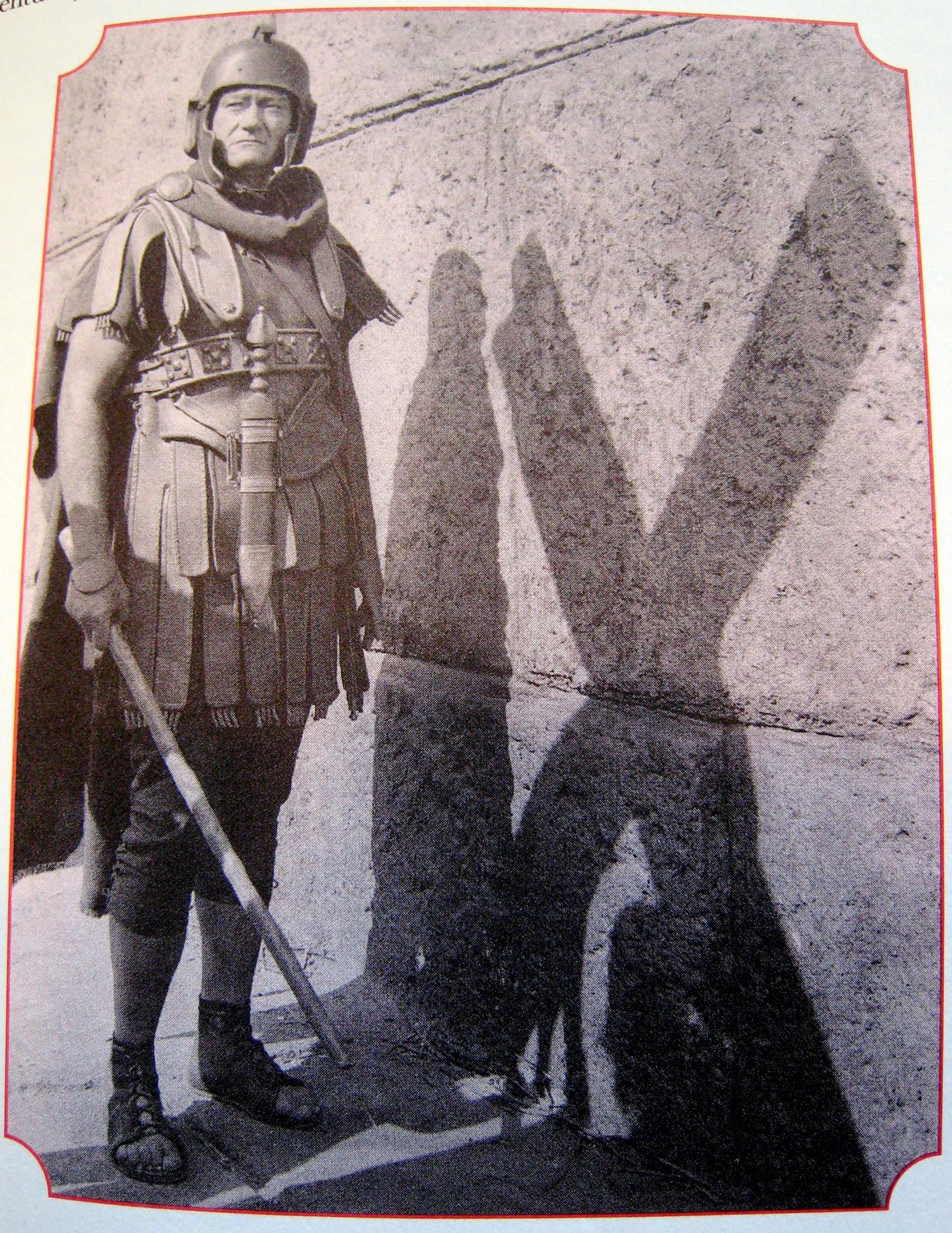
Easter Special: Trouble in River City the Centurion’s Easter: An Empty Tomb, Duplicitous Politicians and a Lingering Question

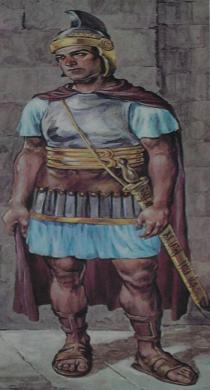
The pounding on his door awakened Longinus before he expected on this day after the Jewish Passover. He was hoping perhaps beyond hope that the worst was over and that in a few days he could take his soldiers back to the confines of Caesarea and away from the troubled city of Jerusalem. He was tired of this duty and longed for service with a real Legion with real Roman soldiers. He wiped the sleep from his eyes and went to the door of his quarters in Fortress Antonia.  He opened the door to find his Adjutant Marcus with a look of near panic on his face.

He asked the young officer to come into his quarters and take a seat at his table. He took a wineskin and poured the contents into two cups. He asked Marcus what was so urgent and frightening that he had to be at his quarters well before the duty day began. The young man took off his helmet to reveal a crop of blondish brown hair common to the Tyrol in the northern part of Italy and told an almost unbelievable story. He explained that there was trouble at the tomb of the itinerant preacher named Jesus. The two guards from their unit who had relieved the previous watch at the tomb had evidently fallen asleep and there had been a break in.  They claimed that they had been overcome when some kind of angelic being who had descended in front of them and some of the women who had been at the execution site previously.  The story seemed preposterous but Longinus could not believe that they had fallen asleep on duty either as such could be punished by a death sentence.  Adding to the confusion was a report that two of the preacher’s “disciples” had reportedly entered the tomb and claimed that the body was gone as had some of the women that had been there at the crucifixion.  It was unbelievable but yet in light of the strangeness of the man and his execution.  Longinus had the Adjutant bring the two soldiers to him along with the Sergeant of the Guard to explain what had happened.

The two soldiers, one a Samaritan and the other a Greek had good reputations in the unit. Neither had given him cause for concern and the terrified expression on their faces as they explained what happened gave Longinus reason to believe them. Yes it was possible that they were lying but Longinus believed their story. I found that not to believe them and their story that they heard the angel or whatever it was tell the women that the preacher had been raised from the dead. Longinus was not much of a believer in miracles angels or any sort of magic hocus pocus purveyed by seers, magicians or fortune tellers but here he was believing this outlandish story because to disbelieve would mean that there was a serious breakdown of discipline by two outstanding soldiers. He had some soldiers that he wouldn’t believe for an Athenian minute if they told him such a tale but he believed these men and he again thought of his words as the preacher hung dying on the cross on that evil hill.

Longinus went to Pilate’s headquarters when he and the other Centurions were participants in a meeting with the High Priest and his representatives and two of Herod’s people.  The meeting reminded him of a meeting of criminals.  The High Priest and his representatives were livid and Herod’s henchmen voiced their displeasure regarding the lapse of the Roman soldiers that allowed this to happen. Longinus spoke for his men and said that as improbable as it was that he believed their story. That only made the non-Romans angrier; he almost thought that they were engaging Pilate in some histrionic episode in order to force Pilate to do their bidding. They insisted that Longinus’ soldiers had to have fallen asleep and or that they had conspired with the preacher’s followers to remove the body from the tomb. This angered Longinus to the point that he interrupted their ranting to defend his men’s honor. Pilate finally ordered Longinus and the High Priest to be silent.  He asked the non-Romans to step outside while he conferred with Longinus and the other Centurions.

Pilate explained his dilemma. He was afraid that if he sent the High Priest away by supporting his soldiers that there would be a revolt in the streets. He had seen the tumult on the streets by the supporters of the High Priest when he tried to release the “King of the Jews” and felt that this would be worse for security. He advised the Centurions that while he had no reason to doubt them or their men that he had to placate the High Priest and Herod in order to avoid chaos, chaos that could lose him his job if he wasn’t careful. Likewise he did not feel that he had the manpower in the city to handle a full-fledged revolt and that he would have to call for reinforcements from the Legions based in Syria, something that he was loathe to do as this would get back to the Emperor.

Longinus thought back to the day of the execution.  Pilate had agreed to place a guard at the tomb at the urging of the High Council. Longinus had argued against placing any soldiers at the tomb as he felt that since the “King of the Jews” them man that he had called the “son of God” was dead that Rome’s obligation was over. The whole thing reeked of politics, Longinus was overruled by Pilate who explained that Roman soldiers needed to guard the tomb because the High Priest who Longinus detested as much as Pilate insisted that Jesus’ followers would attempt to steal the body and claim that he had been raised from the dead to lead a revolt against the Council and eventually Rome itself.  Added to the Judean witches’ cauldron was Herod, the corpulent and corrupt “King” of Judea.  If Longinus detested Pilate and Caiaphas he hated Herod and all that he stood for, it made him wonder why Roman lives and treasure were spent to solve the problems of this God-forsaken land which he believed would still be trouble two millennia from now if the world lasted that long. Longinus believed that as long as Rome allowed the High Council and Herod to rule the region by proxy that the troubles would never end. He believed that it was only a matter of time before these people, led by the Zealots would revolt as they had against the Seleucids nearly 200 years before. He knew if that happened that Rome would crush the revolt and not leave as much as a house standing.  He hated this occupation and all that it stood for, especially when he saw a good man, an innocent man killed for no good reason other than the politics of it all. It sickened him.

When he was done explaining his decision to Longinus and the other Centurions he called the now quite irate non-Romans back into the proceedings.  He told the High Priest and Herod’s men that he would disciple the soldiers involved and he would assist them in finding just what parties removed the body from the tomb.  In the mean time he would suppress any stories coming from the soldiers about this supposed “resurrection.”  The High Priest and Herod’s men agreed that this would suffice and thanked Pilate for his time and effort. Longinus and the other Centurions quietly seethed as this took place. When the non-Roman parties had left Pilate ensured the officers that no action would be taken against the men and that he would not actively assist the Jews in trying to find the perpetrators of the event. He then let the officer know that they would remain in Jerusalem for another week to allow the multitude of pilgrims to leave the city and then they would return to Caesarea.

Longinus left with the others and met his Adjutant and stepped into the court of the fortress. He was very unhappy with the deal that Pilate made with the High Priest and Herod.  He felt that he had dishonored his soldiers and the unit for the sake of political expediency. He felt ashamed of the Empire for what Pilate had done in cooperating with these people from beginning to end during this affair. He would not forget.

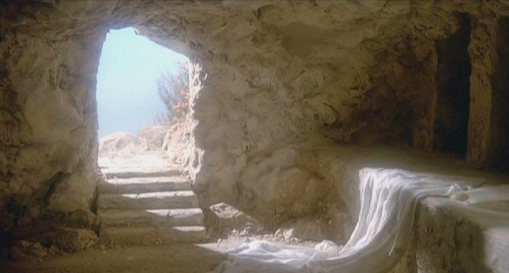
That night he felt compelled to walk to the empty tomb.  In the darkness he looked into the sepulcher aided by a lantern. He saw the grave cloths where they remained; the large stone was rolled away and the seal that had been placed on it was broken.  He looked for any evidence to suggest that his soldiers had fallen asleep but could not find any.  Nor did he see how anyone could have stolen the body and gotten very far without being seen by anyone. Convinced by what he saw he set down in the tomb and thought about this man.  He looked at ground where the body had been placed.  In the dim light he noticed what appeared to be some thorns.  He reached down He would have to find out more about him if he truly was the son of God.

He walked back to the fortress when he went to the Officer’s Mess and had the steward pour him some wine. He drank quite a few before the evening was out and then went to his quarters where he lay down exhausted and perplexed by the events of the past few days.

Peace

Padre Steve+

5 Comments

Filed under faith, Religion

Holy Week and the Outcasts

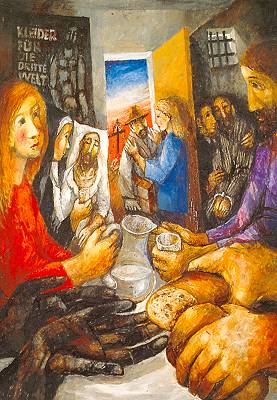
Sieger Köder
“Barmherzigkeit”

“Let us not underestimate how hard it is to be compassionate. Compassion is hard because it requires the inner disposition to go with others to place where they are weak, vulnerable, lonely, and broken. But this is not our spontaneous response to suffering. What we desire most is to do away with suffering by fleeing from it or finding a quick cure for it.” Henri Nouwen

Holy Week is here and on my way home from work and a visit with my shrink I was doing some thinking about Christians that have suffered a crisis in faith or loss of faith. I meet them all the time and read their stories on blogs, books and social media.  Of course I run across more now because I have gone through such a crisis and have written about it and through that had my story publicized. As a result I am contacted by people who have suffered trauma, especially related to PTSD as well as those that care for such people.

For many of the people Holy Week and Easter can be particularly painful. Having known plenty of these people I can say that this phenomena is one of the more tragic aspects of the season.  People who at one time felt the presence of God in their life only sense emptiness and aloneness which sometimes becomes a feeling of hopelessness where even death appears more comforting than life in the present.

I say this because people suffering through this often go unnoticed or are ignored in church. Their loss could be that of a spouse or child, the loss of something else significant or the experience of trauma that devastates them but no matter the cause of the suffering many people discover that they are now outcasts in the place where they should be cared about more than anywhere else.

Likewise there are many pastors and priests who are either unaware of them, uncomfortable around them or irritated by them because they don’t respond like “normal” people do to the message of Easter.  I have found from my own experience returning from Iraq that Easter despite the message of resurrection and hope often triggers a despair of life itself when one no longer senses the presence of God and feels alone against the world, especially in church.

Years ago I believed that if someone was in the midst of a crisis in faith if they read the Bible more, prayed more and made sure that they were in church that things would work out.  I believed then that somehow with a bit of counseling, the right concept of God and involvement in church activities that God would “heal” them.  Call me a heretic but that line of thinking is nice for people experiencing a minor bump in their life but absolutely stupid advice for people who are severely traumatized or clinically depressed and suicidal who no longer perceive the presence of God in their lives.  For those abused by parents or clergy this is I think an even deeper wound one in which the very concept and understanding of God becomes skewed in the minds and hearts of the victims.

I cannot condemn those who have lost their faith or are wavering in their faith due to trauma, abuse or other psychological reason. The numbers of people have been victimized by family, teachers, clergy other authority figures or physical trauma related to accidents, near death experiences or combat is mind numbing. They are all over the place and many go unnoticed in the church.

Sometimes the damage wrought on people makes it nearly impossible for them to comprehend a God who both cares about them and who is safe to approach.  My experience came from Iraq and the trauma of my return and were absolutely frightening so much so that I left a Christmas Eve Mass in 2008 and walked through the dark wondering if God even existed.  My isolation from Christian community and sense of despair during that time showed me that such a loss of faith is not to be trifled with or papered over with the pretty wallpaper or neat sets of “principles” drawn up in the ivory theological towers by theologians and “pastors” who refuse to deal with the reality of the consequences of a fallen world and their impact on real people.

Those that I have talked to and read about who have suffered a crisis or loss of faith almost always mention to me is that that feel cut off and even abandoned by God.  It is not simply depression that they are dealing with but despair of life itself when death or just going to sleep is preferable to living. This overwhelming despair impacts almost all of life.  It is if they never are able to leave the “God forsakenness” of Good Friday and cannot climb out of the tomb.   For some the pain is so much that suicide becomes an option and the belief that their family, friends and loved ones would be better off without them. I have seen this too many times to count.

It is hard to reach out to people in this situation.  I have to admit in my case that it was only people who chose to remain with me and walk with me through the ordeal in spite of my frequent crashes, depression, anger and even rage that helped get me through the worst of this.  However I’m sure that my condition burned some people out.  There were some that would not walk with me as I first began to go down this road and the sad thing is that many were ministers and fellow chaplains.  In some ways I don’t blame them.  However it is telling that the first person that asked me about my spiritual life “or how I was with the Big Guy” was my first therapist.

The topic of a loss of faith or the reality of feeling God forsaken is had to deal with but is something that we need to face especially during Holy Week. The Cross necessitates this, Jesus was considered “God-Forsaken” and that is what is so perplexing about Good Friday.

Yet scripture plainly teaches that we are to “bear one another’s burdens, and in this way you will fulfill the law of Christ.”  As Dietrich Bonhoeffer said  We must learn to regard people less in light of what they do or omit to do, and more in the light of what they suffer.”  It is our willingness to be with people in their suffering that is one of the true marks of the Christian.  Being with someone in triumph is far easier than with those who suffer the absence of God.  It is presence and love not sermons that people who have lost their faith need as Bonhoeffer so eloquently said “Where God tears great gaps we should not try to fill them with human words.”

I do pray that as we walk with Jesus this Holy Week that we will not forget those who despair of live and feel as if they are “God-forsaken.”

Peace

Padre Steve+

2 Comments

Filed under christian life, faith, Pastoral Care, PTSD, Religion

The Paradox of the Passion: Reflections on Palm or Passion Sunday

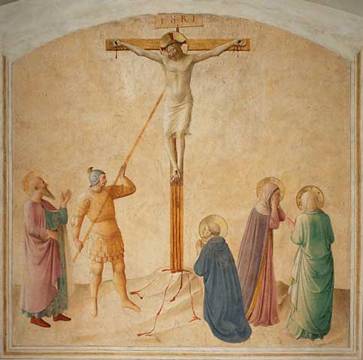
I celebrated a quiet Palm Sunday liturgy this morning.  As I read the scriptures, especially the Passion Narrative of Mark the Evangelist I was moved in a way that I have not been for some time and found that my time of prayer following the readings and the recitation of the Creed was perhaps more impassioned on account of all the suffering and injustice that I see in the world.  As such I wondered what to write and thought about the story of Longinus the Centurion who was according to tradition the Centurion at the foot of the Cross of the day of the crucifixion.  I went back through a number of articles that I wrote last year about what I imagined a soldier and officer of his time might imagine in such a situation and I will repost those articles on Good Friday, Holy Saturday and Easter. However today I decided to go back into my archives and repost with a few modification a more theological reflection on this Sunday which marks the beginning of Holy Week for Christians around the world. 

“Although we praise our common Lord for all kinds of reasons, we praise and glorify him above all for the cross. Paul passes over everything else that Christ did for our advantage and consolation and dwells incessantly on the cross. The proof of God’s love for us, he says, is that Christ died for us while we were yet sinners. Then in the following sentence he gives us the highest ground for hope: If, when we were alienated from God, we were reconciled to him by the death of his Son, how much more, now that we are reconciled, shall we be saved by his life!” John Chrysostom (AD 347-407)

“God speaking to Luther: “Discipleship is not limited to what you can comprehend—it must transcend all comprehension. … Not to know where you are going is the true knowledge. My comprehension transcends yours. Thus Abraham went forth from His father… not knowing whither he went. … Behold, that is the way of the cross. You cannot find it yourself, so you must let me lead you as though you were a blind man. Wherefore it is not you, no man… but I myself, who instruct you by my Word and Spirit in the way you should go. Not the work which you choose, not the suffering you devise, but the road which is clean contrary to all you choose or contrive or desire—that is the road you must take. To that I call you and in that you must be my disciple.” Dietrich Bonhoeffer the Cost of Discipleship

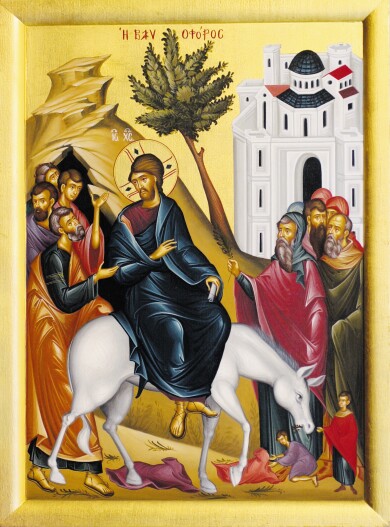
Palm or Passion Sunday always is a day that invokes mixed emotions in me. It is the last Sunday of the Lenten Season and in modern times has become a juxtaposition of two events, the Triumphant Entry of Jesus into Jerusalem where he according to all four Gospels was greeted by crowds of people who lined the street with palms as Jesus riding on a donkey processed from Bethany and Bethphage where he had been staying with Lazarus into Jerusalem and the narrative of the Passion.  As such it is a roller coaster ride in our experience of walking with Jesus in the most difficult times.

This particular occasion is the Sunday where the disciples of Jesus are confronted with the reality that our earthy expectations of him do not meet the reality of his condensation to walk among us fully Divine yet fully Human but one too well acquainted with suffering, rejection and shame.  He shatters our expectations that he will bless any particular political or social ideology that we allow to take pre-eminence over him, even those that invoke his name. Thus our liturgy brings us to this strange day where in a sense we are confronted with celebrating the entrance of the King and in the next breath cursing him and betraying him to those who torture and crucify him.

In the Roman Catholic and Anglican liturgy the observance is divided between the Liturgy of the Palms which takes place outside the Church Nave either outside the church building or in the Narthex in cold or inclement weather.  After an opening collect and reading of the Gospel passage from one of the synoptic Gospels, which one depends on which of the three year liturgical readings that the church is in. Following the reading of the Gospel the congregation led by choir, acolytes and clergy process into the church reciting the words of Psalm 118: 18-29 or singing a hymn such as “All Glory Laud and Honor.”  Once the congregation is in the church the Liturgy of the Word continues and when the Passion Gospel is read and specific roles may be assigned to members of the congregation, while the congregation remains seated through the first part of the Passion the congregation stands at the verse where “Golgotha” is mentioned and remains standing.

The liturgy takes the congregation on an emotional and spiritual roller coaster.  As the congregation begins outside the following is read:

When Jesus had come near Bethphage and Bethany, at the place called the Mount of Olives, he sent two of the disciples, saying, “Go into the village ahead of you, and as you enter it you will find tied there a colt that has never been ridden. Untie it and bring it here. If anyone asks you, ‘Why are you untying it?’ just say this, ‘The Lord needs it.’” So those who were sent departed and found it as he had told them. As they were untying the colt, its owners asked them, “Why are you untying the colt?” They said, “The Lord needs it.” Then they brought it to Jesus; and after throwing their cloaks on the colt, they set Jesus on it. As he rode along, people kept spreading their cloaks on the road. As he was now approaching the path down from the Mount of Olives, the whole multitude of the disciples began to praise God joyfully with a loud voice for all the deeds of power that they had seen, saying,

“Blessed is the king who comes in the name of the Lord!

Peace in heaven, and glory in the highest heaven!”

Some of the Pharisees in the crowd said to him, “Teacher, order your disciples to stop.” He answered, “I tell you, if these were silent, the stones would shout out.” Luke 19:29-40

It is hard when you read this passage and be caught in the reenactment of this procession not to feel the excitement that must have accompanied that procession.  It has the feeling of a victory parade but this road ends in a manner that those present, those seeking an earthly king and Messiah who would drive our the Roman oppressor and restore the kingdom to Israel would not expect with some of them perhaps playing a role in the drama that would take place later in the week.  I particularly like the hymn “All Glory Laud and Honor.”

All glory, laud and honor,
To Thee, Redeemer, King,
To Whom the lips of children
Made sweet hosannas ring.

Thou art the King of Israel,
Thou David’s royal Son,
Who in the Lord’s Name comest,
The King and Blessèd One.
Refrain

The company of angels
Are praising Thee on High,
And mortal men and all things
Created make reply.
Refrain

The people of the Hebrews
With palms before Thee went;
Our prayer and praise and anthems
Before Thee we present.
Refrain

To Thee, before Thy passion,
They sang their hymns of praise;
To Thee, now high exalted,
Our melody we raise.
Refrain

Thou didst accept their praises;
Accept the prayers we bring,
Who in all good delightest,
Thou good and gracious King.

During the Liturgy of the Word one of the following is read, either Isaiah 45:21-25 or Isaiah 52:13-53:12, the second being the Song of the Suffering Servant.  The Psalm is Psalm 22 where the Psalmist foretells Jesus’ anguished cry from the Cross; “My God, my God, why have you forsaken me? and are so far from my cry and from the words of my distress?”And then we have the New Testament reading Philippians 2: 5-11, the hymn to Christ is read:

Let the same mind be in you that was in Christ Jesus, who, though he was in the form of God, did not regard equality with God as something to be exploited, but emptied himself, taking the form of a slave, being born in human likeness. And being found in human form, he humbled himself and became obedient to the point of death– even death on a cross. Therefore God also highly exalted him and gave him the name that is above every name, so that at the name of Jesus every knee should bend, in heaven and on earth and under the earth, and every tongue should confess that Jesus Christ is Lord, to the glory of God the Father.”
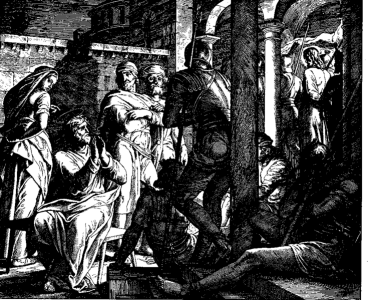
This year the Passion Narrative is that of Mark (14:1-15:47) but I find the passage in Luke 22:39-71 and 23:1-49 (50-56) to be more dramatic.  The three parts of Luke’s narrative that stand out in this narrative for me are Peter’s denial of Jesus, the interaction of Jesus with those crucified with him and that of the Centurion:

“Then they seized him and led him away, bringing him into the high priest’s house. But Peter was following at a distance. When they had kindled a fire in the middle of the courtyard and sat down together, Peter sat among them. Then a servant-girl, seeing him in the firelight, stared at him and said, “This man also was with him.” But he denied it, saying, “Woman, I do not know him.” A little later someone else, on seeing him, said, “You also are one of them.” But Peter said, “Man, I am not!” Then about an hour later still another kept insisting, “Surely this man also was with him; for he is a Galilean.” But Peter said, “Man, I do not know what you are talking about!” At that moment, while he was still speaking, the cock crowed. The Lord turned and looked at Peter. Then Peter remembered the word of the Lord, how he had said to him, “Before the cock crows today, you will deny me three times.” And he went out and wept bitterly.”

Peter’s denial is in large part because he has had his illusions about Jesus shattered and the fact that he had not understood the message up to that point.  As Bonhoeffer says “Jesus is a rejected Messiah. His rejection robs the passion of its halo of glory. It must be a passion without honor. Suffering and rejection sum up the whole cross of Jesus. To die on the cross means to die despised and rejected of men. Suffering and rejection are laid upon Jesus as a divine necessity, and every attempt to prevent it is the work of the devil, especially when it comes from his own disciples; for it is in fact an attempt to prevent Christ from being Christ.”

Likewise Jesus interaction with the condemned thieves that were crucified with him:

“One of the criminals who were hanged there kept deriding him and saying, “Are you not the Messiah? Save yourself and us!” But the other rebuked him, saying, “Do you not fear God, since you are under the same sentence of condemnation? And we indeed have been condemned justly, for we are getting what we deserve for our deeds, but this man has done nothing wrong.” Then he said, “Jesus, remember me when you come into your kingdom.” He replied, “Truly I tell you, today you will be with me in Paradise.”

Mark (15:25-32) records that interaction in this manner:

“It was nine o’clock in the morning when they crucified him. The inscription of the charge against him read, “The King of the Jews.” And with him they crucified two bandits, one on his right and one on his left. Those who passed by derided him, shaking their heads and saying, “Aha! You who would destroy the temple and build it in three days, save yourself, and come down from the cross!” In the same way the chief priests, along with the scribes, were also mocking him among themselves and saying, “He saved others; he cannot save himself. Let the Messiah, the King of Israel, come down from the cross now, so that we may see and believe.” Those who were crucified with him also taunted him.”

The final passage from this narrative that strikes me is the moment of Jesus’ death on the Cross:

“It was now about noon, and darkness came over the whole land until three in the afternoon, while the sun’s light failed; and the curtain of the temple was torn in two. Then Jesus, crying with a loud voice, said, “Father, into your hands I commend my spirit.” Having said this, he breathed his last. When the centurion saw what had taken place, he praised God and said, “Certainly this man was innocent.” And when all the crowds who had gathered there for this spectacle saw what had taken place, they returned home, beating their breasts. But all his acquaintances, including the women who had followed him from Galilee, stood at a distance, watching these things.”

Mark records that event in Mark 15: 33-39. In Mark’s account the reaction of the Centurion (15:39) to the death of Jesus is even more salient than the account of Luke.

“When it was noon, darkness came over the whole land until three in the afternoon. At three o’clock Jesus cried out with a loud voice, “Eloi, Eloi, lema sabachthani?” which means, “My God, my God, why have you forsaken me?” When some of the bystanders heard it, they said, “Listen, he is calling for Elijah.” And someone ran, filled a sponge with sour wine, put it on a stick, and gave it to him to drink, saying, “Wait, let us see whether Elijah will come to take him down.” Then Jesus gave a loud cry and breathed his last. And the curtain of the temple was torn in two, from top to bottom. Now when the centurion, who stood facing him, saw that in this way he breathed his last, he said, “Truly this man was God’s Son!”

The darkness of this is event is perplexing to those who want to find God in some place where he is untouched by human suffering to them the Cross is folly for what kind of God would submit himself to such ignominy but as Martin Luther wrote “He who does not know Christ does not know God hidden in suffering. Therefore, he prefers works to suffering, glory to the cross, strength to weakness, wisdom to folly. For they hate the cross and suffering and love works and the glory of works. Thus they call the good of the cross, evil and the evil of a deed, good. God can only be found in suffering and the cross.” It is in the contradiction of this week that we come to know God, not a God who seeks not the righteous or the powerful, those who seek the power of an earthy kingdom backed by an ideology of power which tramples the weak, but rather those who will simply walk in the footsteps of Jesus the Christ who rules by serving the least, the lost and the lonely.

The liturgy of this day be from any of the Passion narratives takes us to the heart of the Gospel as we led by the writers through the triumph of the entrance into Jerusalem, to the betrayal of Jesus by Judas, the abandonment of him by the disciples and the denial of Peter.  As the writers lead us through his trial, conviction, scourging and trek to Golgotha we see the gamut of human emotions and reactions to Jesus and we know that we can be there as well in any of the characters simply because we are human and capable of compassion or betrayal.  As Jesus is on the Cross it is not the religious or upstanding that remain with him.  He is left with his mother, the other Mary and John the beloved.  He is shown compassion by a thief and recognized as the Son of God by the Roman Centurion, a gentile serving an empire oppressing the people of Israel and whose governor had pronounced the sentence of death upon him.  In this liturgy we have been taken from the heights of exhilaration in the triumphant entry to the depths of despair felt by his disciples that Friday afternoon. It is in this time that we realize how right Dietrich Bonhoeffer is when he writes “God loves human beings. God loves the world. Not an ideal human, but human beings as they are; not an ideal world, but the real world. What we find repulsive in their opposition to God, what we shrink back from with pain and hostility, namely, real human beings, the real world, this is for God the ground of unfathomable love.”

It is the Centurion for which I have the greatest affinity in this story. He is a soldier and in the words of so many soldiers who have obey orders carried out the sentence upon Christ by crucifying him and then as the life ebbs out of Christ’s crucified body exclaims “surely this was a good man” or in other accounts “surely this was the Son of God.” That is the cry of a man who knows that he has executed an unjust sentence, the reaction of a true penitent, the reaction of a man who comes to realize even before many of Jesus’ closest followers understood.  According to tradition the Centurion was named Longinus who left the service of the Imperial Legion, was baptized by the Apostles and was martyred under the orders of Pontius Pilate by soldiers of the unit that he had once commanded.

It is important for the Church not to lose this identification.  The Church is not to become enmeshed and co-opted by those who attempt to use the Gospel to promote ideologies foreign to it as is the temptation in times of crisis.  As Jürgen Moltmann notes:

“In Christianity the cross is the test of everything which deserves to be called Christian… The Christian life of theologians, churches and human beings is faced more than ever today with a double crisis: the crisis of relevance and the crisis of identity. These two crises are complementary. The more theology and the church attempt to become relevant to the problems of the present day, the more deeply they are drawn into the crisis of their own Christian identity….Christian identity can be understood only as an act of identification with the crucified Christ, to the extent to which one has accepted that in him God has identified himself with the godless and those abandoned by God, to whom one belongs oneself.” The Crucified God [pgs. 7, 19]

Nor is our task is not to attempt to invent “crosses” for ourselves in acts of pseudo-martyrdom but simply to be faithful in loving Jesus and our neighbor as Bonhoeffer noted “Must the Christian go around looking for a cross to bear, seeking to suffer? Opportunities for bearing crosses will occur along life’s way and all that is required is the willingness to act when the time comes. The needs of the neighbor, especially those of the weak and downtrodden, the victimized and the persecuted, the ill and the lonely, will become abundantly evident.” The mark of the Christian is not to blindly give his life for a cause or be consumed by the false “messiah’s” promoted by politicians, pundits and even preachers captivated by the lust for power and glory.

As we walk through the mystery of Holy Week together let us renew our faith in the Crucified One and not be conformed to those things that seek to turn us from the way of discipleship and the way of the Cross.

Peace

Padre Steve+

Leave a comment

Filed under christian life, film, Religion

Reaching the Lost Christian Generation

“God weeps with us so that we may one day laugh with him.” Jürgen Moltmann

Over the past couple of weeks I have been thinking about encounters that I have had with Christians of various denominations who have suffered a crisis in faith or loss of faith due to some kind of trauma in their lives.  These people are the unseen, unheard and ignored part of our religious landscape.  In theUnited Stateswe have a very vibrant religious culture which finds its way into much of everyday life.  In fact listening to most of our Presidential candidates you would think that most are in fact Evangelical Christian preachers.

The fact is that despite the popularity of the mega-church and pop-psychology driven church world directed by “pastors” that function more as CEOs, motivational speakers and authors that churches are losing adherents at an increasing rate.  Many of those that are being lost are those that have suffered silently doing everything that is supposed to fulfill a Christian and make them healthy, wealthy and popular get left in the dust because they don’t “get better.”  I call them the “Lost Christian Generation.” There are many times that I totally empathize with author Anne Rice in saying that she has left Christianity yet still has faith in Christ.  For Rice it was the lack of love shown by the institutional church for people that are marginalized and treated as if they were unredeemable by often well meaning Christians.

For the wounded the church itself becomes their little acre of Hell on earth.  Having known plenty of these people I can say that this phenomenon is one of the more tragic aspects of life.  Those that at one time felt the presence of God in their life only sense emptiness and aloneness.   But most remain in the church for years living in pain thinking that they must be doing something wrong, that maybe they have angered God or that God has abandoned them.  In fact I would challenge my readers that attend church to take a look around the pews and see that person sitting alone, maybe staring into space, maybe with an expression of deep sadness on their face even as people talk and laugh around them.  The problem is most of us have very little situational awareness and don’t see them and of we do feel uncomfortable or inadequate so we leave them hoping that maybe they’ll get their act together or just go away.

I know what it feels like to be marginalized after I came back fromIraqbecause many of my Christian friends seemed, at least in my view to be tied to the absolute hogwash that spews from talk radio hosts and allegedly “Christian” politicians.  I remember having some Christians question my patriotism and even my faith because I disagreed with them regarding certain aspects of the war, despite the fact that I had been on the ground in harm’s way serving with our advisors and Iraqis in Al Anbar province.  The fact that not a clergyman, civilian or military, took time to care for me when I was in a major PTSD meltdown and crisis of faith before I went to Naval Medical Center Portsmouth didn’t seem to matter because a political agenda was given primacy over the simple truths and hard demands of the Gospel.

I went through a period after Iraq where feeling abandoned and isolated from those of a like faith that I was for all practical purposes an agnostic.  That was a really difficult time in my life and if you think that anything sucks try to be a Chaplain when you no longer know if God exists and the only person asking how you are doing with “the Big Guy” is your therapist. I can say without a doubt that it sucks and I know that I am not alone in my feelings.  I have met others whose experience is similar to mine but those that are struggling right now, caught between our faith and the feeling of being abandoned by God and his people because our experience of seeing the human suffering caused by war has shaken us.  That experience changed me enough that my former church told me to leave because I had become “too liberal.”

This “God Forsakenness” sometimes leads those people that are part of the “lost Christian generation” to believe that death appears more comforting than life in the present. For such people, they live “Good Friday” everyday feeling that they are truly God Forsaken.   I write this because I really believe that these often very sensitive and wonderful people are either ignored or not even seen by most of their fellow church members. Likewise I believe that many if not most pastors and priests are either unaware of them, uncomfortable around them or irritated by them because they don’t respond like “normal” people do.   I have found from my own experience returning from Iraq that Easter despite the message of resurrection and hope often triggers a despair of life itself when one no longer senses the presence of God and feels alone against the world, especially in church.

Many times the crisis of faith is caused by prolonged depression, PTSD or other trauma often involving family members, clergy or other trusted authority figures in their lives.  Sometimes the trauma is due to a physical injury, perhaps a near death experience due to an illness, combat or accident and can be neurological as in the case of Traumatic Brain Injury or TBI not something that routine counseling either psychological or pastoral or an anti-depressant medication will correct.  In my case it was PTSD and chronic pain and insomnia which overwhelmed me and along with a crisis of faith triggered such hopelessness that I barely held on for almost two years.

I remember when I first started dealing with this in others while in seminary that I was of the mind that if someone was in the midst of a crisis in faith if they read the Bible more, prayed more and made sure that they were in church that things would work out.  I believed then that somehow with counseling, the right concept of God and involvement in church activities that God would “heal” them.  Call me a heretic but that line of thinking is nice for people experiencing a minor bump in their life but absolutely stupid advice for people who are severely traumatized or clinically depressed and suicidal who no longer perceive the presence of God in their lives.

I cannot condemn those who have lost their faith or are wavering in their faith due to trauma, abuse or other psychological reason. So many people like this have been victimized by family, teachers, clergy other authority figures or physical trauma related to accidents, near death experiences or combat that it is mind numbing.  The fact that I went through a period for the nearly two years where I was pretty much an agnostic praying to believe again because of my PTSD injury incurred in Iraq that felt hopelessly isolated for the first year after my return until I finally reconnected with others and began to feel safe again gives me just a bit of an idea at what these people are going through.  My isolation from Christian community and sense of despair during that time showed me that such a loss of faith is not to be trifled with or papered over with the pretty wallpaper or neat sets of “principles” drawn up in the ivory theological towers by theologians and “pastors” who refuse to deal with the reality of the consequences of a fallen world and their impact on real people.

Sometimes the damage wrought on people makes it nearly impossible to comprehend a God who both cares about them and who is safe to approach.  My experience was due to from my time in Iraq and the trauma of my return.  That time was absolutely frightening.  Church was no longer a comfort and my long established spiritual practices no longer brought peace or a feeling of communion with God. It was so bad that I left a Christmas Eve Mass in 2008 and walked through the dark wondering if God even existed.

For those clergy this is an even deeper wound one in which the very concept and understanding of God becomes skewed in the minds and hearts of the victims.  It becomes worse when church institutions deny or ignore their claims which has been an unfortunate occurrence in many Roman Catholic dioceses around the world, particularly in Europe and North America where new revelations of clerical abuse seem to show up with alarming frequency.

The feeling that people who go through a crisis or loss of faith almost always mention to me is that they feel God feel cut off and even abandoned by God.  This is not simply depression that they are dealing with but despair of life itself when thoughts of death or just going to sleep are much preferable to living.  This overwhelming despair impacts their relationships especially with their family and frequently will destroy families as the spouse grows weary and loses hope seeing their loved one get better.  It is if they never are able to leave the “God forsakenness” of Good Friday and cannot climb out of the tomb.   For some the pain is so much the last and previously unthinkable alternative of suicide becomes the only course of action that they think will help.  Such thoughts are not simply narcissism as some would believe but from the “logical” belief that their family, friends and loved ones would be better off without them.  I have seen this too many times to count.

It is hard to reach out to people in this situation.  I have to admit in my case that it was only people who chose to remain with me and walk with me through the ordeal in spite of my frequent crashes, depression, anger and even rage that helped get me through the worst of this.  However I’m sure that my condition burned some people out.  There are some that would not walk with me as I first began to go down and the sad thing is that many were ministers and fellow chaplains.  In some ways I don’t blame them at the same time the first person that asked me how my spiritual life “or how I was with the Big Guy” was my therapist.  When I reported to my current duty station I was shocked to find Chaplains who were willing to come alongside of me, even when they didn’t have the answers and remain with me.

The topic of a loss of faith or the reality of feeling God forsaken is had to deal with.  It is seldom dealt with in many seminaries or Bible schools because it is not comfortable or something that you can “grow your church” with.  But the reality is there are more people going to church praying for an answer who no one reaches out to; in fact they are often invisible amid the busyness of program oriented ministry.

I do not think that it is enough simply to tell them that “God won’t give you more than you can bear” or quote other scriptures when they have been pushed beyond the “red line” and are breaking down.  They want to believe that scriptural principle but no longer believe because God is no longer real to them.

Yet scripture plainly teaches that we are to “bear one another’s burdens, and in this way you will fulfill the law of Christ.” As Dietrich Bonhoeffer said “We must learn to regard people less in light of what they do or omit to do, and more in the light of what they suffer.”  It is our willingness to be with people in their suffering that is one of the true marks of the Christian.  Being with someone in triumph is far easier than with those who suffer the absence of God.  It is presence and love not sermons that people who have lost their faith need as Bonhoeffer so eloquently said “Where God tears great gaps we should not try to fill them with human words.”

We have to be honest and not turn a blind eye to the transgressions of Christians over the centuries.  We cannot turn a deaf ear to the cries of those that are living their own dark night of the soul or have given in to despair.

I do pray that as we celebrate the joy of the Resurrection that we will not forget those who despair of live and feel as if they are “God-forsaken.”  It is not easy as those who walked with me can testify but in doing so there is the chance that such action will prevent tragedy and maybe, just maybe give hope to this “Lost Christian Generation” that may allow them to return.

Peace

Padre Steve+

7 Comments

Filed under christian life, faith, Pastoral Care, PTSD, Religion

A Quiet Alleluia: Padre Steve Celebrates Easter 2011

“Ministry means the ongoing attempt to put one’s own search for God, with all the moments of pain and joy, despair and hope, at the disposal of those who want to join this search but do not know how.”  — Henri J.M. Nouwen

Those readers and friends that have walked with me over the past two years on this site as well as those that walked with me before I ever put pen to my thoughts know how much I have struggled with God and faith since my return from Iraq. Easter has been difficult during that time as was Christmas.  My journey has been marked by many doubts. Today was different. Today we observed a quiet Easter out at the Island Hermitage marked by solitude and community.

The day was quiet and uneventful. I have been writing of late on the Easter story as told by Longinus the Centurion who Church tradition accords the honor of being the Centurion who remarked at the foot of the cross “truly this man was the son of God.”  The Centurions of the Bible have always been models for me as a Christian because they were career military men who served a far flung empire and at in least one part of their careers served in an unpopular occupation of a subjugated land with a proud and unbroken populace.  In their case it was Judea of the First Century and mine was Iraq. The story of Longinus as he is known to Church tradition is one that has fascinated me, a gentile officer of an occupying army discovers God at the scene of a brutal execution which he himself supervised. The story has helped me as I imagined what it must have been like for a Roman Centurion serving in a troubled land ruled by a cabal of corrupt politicians representing Rome, the family of Herod and the powerful institution of the Jewish Temple leadership composed of the High Priest, the ruling Sanhedrin and various religious parties. Likewise the lad featured an undying insurgency dedicated to overthrowing the Romans and what some considered the corrupt administration of the High Priest who they believed to be a collaborator with the Roman occupiers. These were the Zealots.  I was fascinated by the story and the story led me to a deeper appreciation of the Easter story.

We had contemplated going to Camp LeJeune to Mass at the Base Chapel. My friend Father Jose is a wonderful pastor and serves as the base Catholic Chaplain. While it would have been nice to see him celebrate the liturgy it meant that we would do so as strangers in a large community of faith.  Judy and I still both struggle with large gatherings especially where we know very few people and decided that we would celebrate Eucharist together. We were joined in this by my land lady Sharon.  It was a quiet but joyful expression of faith and community where each of us has at times suffered under sometimes cold and unfeeling Church institutions and leaders.

I used the story of Longinus as my homily telling the story in story form rather than as a theological treatise or sermon.  After the homily we confessed the faith of the Nicene Creed, prayed for the church and the world especially the outcast and persecuted and celebrated the Eucharist around my small pine dining room table, which is actually in my living room which doubles a my bedroom. The Island Hermitage is not a mansion.

Later in the day Judy and I would take our little dog Molly on a walk through a park not far from here. The park is a woodland and wetland area on the Bogue Sound side of the island. To walk in those peaceful woods hearing, seeing and listening to the sights and sounds of nature was wonderful. Molly especially loved it as she hunted for some of the deer that she had seen a few days before while walking near the hermitage.  Following that we drove the 2 ½ miles to lands end with Molly’s ears and fur flapping in the breeze as she stood on Judy’s lap with her head and shoulders hanging out the door.  The evening was also quiet as I finished the Easter installment of the Longinus story and Judy made a number of bracelets from her seemingly unending supply of bracelet stuff.

About an hour ago I took Molly on a walk to do her nightly constitutional and as we walked in the dark I looked up into the clear night sky to see thousands of stars.  In 2008 I walked home from church on Christmas Eve looking up into the cold winter night sky wondering if God even existed.  Tonight I looked at the sky and uttered a simple thank you for the resurrection. I know that I believe again. The belief that became real again in 2009 during my “Christmas Miracle” while on duty at the Naval Medical Center is now a quiet and real part of my life and ministry, especially to those who have lost their faith or struggle with faith. It is a quiet alleluia that is now a part of my life again. It is not the same as what I had before and certainly some critics including some in my old denomination have labeled me a liberal, a heretic and even an apostate mostly because I do not agree with their political agenda or narrow and often undemocratic understanding of the Gospel and its social ramifications.  I suppose that should bother me but it no longer does. My skin has become more resistant to such critics and while such criticism from people that I counted as friends still stings in general I am much more resilient to it, obviously the Holy Spirit’s work in the life of this miscreant priest.

Yet I remain a Christian and an Old Catholic and treasure the gift that God has given us in Christ.  The ministry that I have now is different but it is founded upon that faith that people like Longinus discovered that first Easter and I can only say “I believe alleluia!”

Peace

Padre Steve+

3 Comments

Filed under christian life, faith, Pastoral Care, Religion

Trouble in River City the Centurion’s Easter: An Empty Tomb, Duplicitous Politicians and a Lingering Question

What springs from earth dissolves to earth again, and heaven-born things fly to their native seat.
Marcus Aurelius 

The pounding on his door awakened Longinus before he expected on this day after the Jewish Passover. He was hoping perhaps beyond hope that the worst was over and that in a few days he could take his soldiers back to the confines of Caesarea and away from the troubled city of Jerusalem. He was tired of this duty and longed for service with a real Legion with real Roman soldiers. He wiped the sleep from his eyes and went to the door of his quarters in Fortress Antonia.  He opened the door to find his Adjutant Marcus with a look of near panic on his face.

He asked the young officer to come into his quarters and take a seat at his table. He took a wineskin and poured the contents into two cups. He asked Marcus what was so urgent and frightening that he had to be at his quarters well before the duty day began. The young man took off his helmet to reveal a crop of blondish brown hair common to the Tyrol in the northern part of Italy and told an almost unbelievable story. He explained that there was trouble at the tomb of the itinerant preacher named Jesus. The two guards from their unit who had relieved the previous watch at the tomb had evidently fallen asleep and there had been a break in.  They claimed that they had been overcome when some kind of angelic being who had descended in front of them and some of the women who had been at the execution site previously.  The story seemed preposterous but Longinus could not believe that they had fallen asleep on duty either as such could be punished by a death sentence.  Adding to the confusion was a report that two of the preacher’s “disciples” had reportedly entered the tomb and claimed that the body was gone as had some of the women that had been there at the crucifixion.  It was unbelievable but yet in light of the strangeness of the man and his execution.  Longinus had the Adjutant bring the two soldiers to him along with the Sergeant of the Guard to explain what had happened.

The two soldiers, one a Samaritan and the other a Greek had good reputations in the unit. Neither had given him cause for concern and the terrified expression on their faces as they explained what happened gave Longinus reason to believe them. Yes it was possible that they were lying but Longinus believed their story. I found that not to believe them and their story that they heard the angel or whatever it was tell the women that the preacher had been raised from the dead. Longinus was not much of a believer in miracles angels or any sort of magic hocus pocus purveyed by seers, magicians or fortune tellers but here he was believing this outlandish story because to disbelieve would mean that there was a serious breakdown of discipline by two outstanding soldiers. He had some soldiers that he wouldn’t believe for an Athenian minute if they told him such a tale but he believed these men and he again thought of his words as the preacher hung dying on the cross on that evil hill.

Longinus went to Pilate’s headquarters when he and the other Centurions were participants in a meeting with the High Priest and his representatives and two of Herod’s people.  The meeting reminded him of a meeting of criminals.  The High Priest and his representatives were livid and Herod’s henchmen voiced their displeasure regarding the lapse of the Roman soldiers that allowed this to happen. Longinus spoke for his men and said that as improbable as it was that he believed their story. That only made the non-Romans angrier; he almost thought that they were engaging Pilate in some histrionic episode in order to force Pilate to do their bidding. They insisted that Longinus’ soldiers had to have fallen asleep and or that they had conspired with the preacher’s followers to remove the body from the tomb. This angered Longinus to the point that he interrupted their ranting to defend his men’s honor. Pilate finally ordered Longinus and the High Priest to be silent.  He asked the non-Romans to step outside while he conferred with Longinus and the other Centurions.

Pilate explained his dilemma. He was afraid that if he sent the High Priest away by supporting his soldiers that there would be a revolt in the streets. He had seen the tumult on the streets by the supporters of the High Priest when he tried to release the “King of the Jews” and felt that this would be worse for security. He advised the Centurions that while he had no reason to doubt them or their men that he had to placate the High Priest and Herod in order to avoid chaos, chaos that could lose him his job if he wasn’t careful. Likewise he did not feel that he had the manpower in the city to handle a full-fledged revolt and that he would have to call for reinforcements from the Legions based in Syria, something that he was loathe to do as this would get back to the Emperor.

Longinus thought back to the day of the execution.  Pilate had agreed to place a guard at the tomb at the urging of the High Council. Longinus had argued against placing any soldiers at the tomb as he felt that since the “King of the Jews” them man that he had called the “son of God” was dead that Rome’s obligation was over. The whole thing reeked of politics, Longinus was overruled by Pilate who explained that Roman soldiers needed to guard the tomb because the High Priest who Longinus detested as much as Pilate insisted that Jesus’ followers would attempt to steal the body and claim that he had been raised from the dead to lead a revolt against the Council and eventually Rome itself.  Added to the Judean witches’ cauldron was Herod, the corpulent and corrupt “King” of Judea.  If Longinus detested Pilate and Caiaphas he hated Herod and all that he stood for, it made him wonder why Roman lives and treasure were spent to solve the problems of this God-forsaken land which he believed would still be trouble two millennia from now if the world lasted that long. Longinus believed that as long as Rome allowed the High Council and Herod to rule the region by proxy that the troubles would never end. He believed that it was only a matter of time before these people, led by the Zealots would revolt as they had against the Seleucids nearly 200 years before. He knew if that happened that Rome would crush the revolt and not leave as much as a house standing.  He hated this occupation and all that it stood for, especially when he saw a good man, an innocent man killed for no good reason other than the politics of it all. It sickened him.

When he was done explaining his decision to Longinus and the other Centurions he called the now quite irate non-Romans back into the proceedings.  He told the High Priest and Herod’s men that he would disciple the soldiers involved and he would assist them in finding just what parties removed the body from the tomb.  In the mean time he would suppress any stories coming from the soldiers about this supposed “resurrection.”  The High Priest and Herod’s men agreed that this would suffice and thanked Pilate for his time and effort. Longinus and the other Centurions quietly seethed as this took place. When the non-Roman parties had left Pilate ensured the officers that no action would be taken against the men and that he would not actively assist the Jews in trying to find the perpetrators of the event. He then let the officer know that they would remain in Jerusalem for another week to allow the multitude of pilgrims to leave the city and then they would return to Caesarea.

Longinus left with the others and met his Adjutant and stepped into the court of the fortress. He was very unhappy with the deal that Pilate made with the High Priest and Herod.  He felt that he had dishonored his soldiers and the unit for the sake of political expediency. He felt ashamed of the Empire for what Pilate had done in cooperating with these people from beginning to end during this affair. He would not forget.

That night he felt compelled to walk to the empty tomb.  In the darkness he looked into the sepulcher aided by a lantern. He saw the grave cloths where they remained; the large stone was rolled away and the seal that had been placed on it was broken.  He looked for any evidence to suggest that his soldiers had fallen asleep but could not find any.  Nor did he see how anyone could have stolen the body and gotten very far without being seen by anyone. Convinced by what he saw he set down in the tomb and thought about this man.  He looked at ground where the body had been placed.  In the dim light he noticed what appeared to be some thorns.  He reached down He would have to find out more about him if he truly was the son of God.

He walked back to the fortress when he went to the Officer’s Mess and had the steward pour him some wine. He drank quite a few before the evening was out and then went to his quarters where he lay down exhausted and perplexed by the events of the past few days.

Peace

Padre Steve+

1 Comment

Filed under faith, History, Religion

An Easter People Living in a Good Friday World

Barbara Johnson wrote that Christians are an “Easter People Living in a Good Friday World.”

In the memorial acclamation which is part of many Eucharistic liturgies we proclaim “Christ has died, Christ is risen, Christ will come again” or possibly this variant “Dying you destroyed our death, rising you restored your life, Lord Jesus come in glory.  It has been part of the proclamation of the Gospels and various books of the New Testament and is the faith and prayer of those that call themselves Christians almost regardless of denomination from the very beginning.

Around the world many Christians understand this as they are persecuted for their faith sometimes to the point of death. The reality of Christians and others who are persecuted for their faith in many countries is quite unlike many American Christians who seem to believe that if someone disagrees with them they are being persecuted, despite enjoying tremendous political power and being the majority religion of the land.  Yet even in this country we live in a Good Friday world, maybe not like those that are dying for their faith but certainly in a place where suffering and violence abound, where innocent people are brutally murdered and where natural disasters bring destruction on the just and the unjust alike. In fact our country is experiencing a crisis of an order that it has not seen in many decades even while war, economic collapse and natural disasters and deep political division have left many people in deep despondency as well as in a very angry mood.

Our technology enables us to gather information and to receive news often faster than we can absorb it, thus when deluged by bad news it is easy to lose sight of the things that matter in life, especially relationships with those that we love as well as those that become part of our lives and of the Crucified God.

It is during Lent, Holy Week and in the Easter Triduum of Holy or Maundy Thursday, Good Friday and Easter that the reality of God participating in our world, the real world of pain, suffering, injustice and death becomes something that keeps us, or rather those who profess the Christian faith from simply becoming exponents of what Luther termed the “theology of glory.”  The Cross is that scandal or stumbling block that according to Jürgen Moltmann, the knowledge of which “brings a conflict of interest between God who has become man and man who wishes to become God.” It is the Cross which forces us to deal with the present realities even while we remain fixed upon the hope of Easter.

Unfortunately for many American Christians our focus tends to be less on the Crucified and Risen God than on our attempts to use the raw power of the political process and unsavory compromises with those that would co-opt and compromise the faithful for the advancement of their political, social and economic agendas.  This is nothing new; it has been an unfortunate and painful series of chapters in the history of the Christian Church since the time that Christianity became legal and the State religion during the reign of Constantine.  The sad truth is that in Western Christianity beginning with the Catholic Church and extending out to those that have been the theological heirs of Saint Augustine Catholic and Protestant alike have more often than not allowed their faith to be subordinated to their political, economic and social agendas and thereby becoming captive to things that are often antithetical to the Gospel.

Yet in the midst of this there is the constant call of the Gospel, that “God was reconciling the world to himself counting men’s sins not against them.”  Moltmann puts this paradox well when he says:

“When God becomes man in Jesus of Nazareth, he not only enters into the finitude of man, but in his death on the cross also enters into the situation of man’s godforsakenness. In Jesus he does not die the natural death of a finite being, but the violent death of the criminal on the cross, the death of complete abandonment by God. The suffering in the passion of Jesus is abandonment, rejection by God, his Father. God does not become a religion, so that man participates in him by corresponding religious thoughts and feelings. God does not become a law, so that man participates in him through obedience to a law. God does not become an ideal, so that man achieves community with him through constant striving. He humbles himself and takes upon himself the eternal death of the godless and the godforsaken, so that all the godless and the godforsaken can experience communion with him.” 

It is in this that Christians can fully be Easter People who live in a Good Friday world.  It is in living the paradox of Good Friday and Easter that we find just how God humbled himself for all people. In suffering the wrath of some incredibly religious people Jesus in the eloquent words of Paul the Apostle “though he was in the form of God, did not regard equality with God as something to be exploited, 7but emptied himself, taking the form of a slave, being born in human likeness. And being found in human form, he humbled himself and became obedient to the point of death— even death on a cross.” (Phil 4:7-8) and in that God, “who reconciled us to himself through Christ, and has given us the ministry of reconciliation; that is, in Christ God was reconciling the world to himself, not counting their trespasses against them, and entrusting the message of reconciliation to us.” (2 Cor 5:18-19)

Yes this is what it means to be an Easter people living in a Good Friday World.

Peace

Padre Steve+

2 Comments

Filed under christian life, faith, philosophy, Religion

Struggling with Faith and God at Easter

“God weeps with us so that we may one day laugh with him.” 
Jürgen Moltmann

Easter Sunday is past and we are now in the Easter Season I was thinking today on encounters that I have had with Christians of various denominations who have suffered a crisis in faith or loss of faith due to some kind of trauma in their lives which gets worse at Easter.  For these people the time in which their churches celebrate Christ’s resurrection becomes their own little acre of Hell on earth.  Having known plenty of these people I can say that this phenomena is one of the more tragic aspects of the season when people who at one time felt the presence of God in their life only sense emptiness and aloneness which sometimes becomes a feeling of hopelessness where even death appears more comforting than life in the present.  I write this because I really believe that these often very sensitive and wonderful people are either ignored or not even seen by most of their fellow church members and that many if not most pastors and priests are either unaware of them, uncomfortable around them or irritated by them because they don’t respond like “normal” people do to the message of Easter.  I have found from my own experience returning from Iraq that Easter despite the message of resurrection and hope often triggers a despair of life itself when one no longer senses the presence of God and feels alone against the world, especially in church.

Many times the crisis of faith is caused by prolonged depression, PTSD or other trauma often involving family members, clergy or other trusted authority figures in their lives.  Sometimes the trauma is due to a physical injury, perhaps a near death experience due to an illness, combat or accident and can be neurological as in the case of Traumatic Brain Injury or TBI not something that routine counseling either psychological or pastoral or an anti-depressant medication will correct.  In my case it was PTSD and chronic pain and insomnia which overwhelmed me and along with a crisis of faith triggered such hopelessness that I barely held on for almost two years.

I remember when I first started dealing with this in others while in seminary that I was of the mind that if someone was in the midst of a crisis in faith if they read the Bible more, prayed more and made sure that they were in church that things would work out.  I believed then that somehow with counseling, the right concept of God and involvement in church activities that God would “heal” them.  Call me a heretic but that line of thinking is nice for people experiencing a minor bump in their life but absolutely stupid advice for people who are severely traumatized or clinically depressed and suicidal who no longer percieve the presence of God in their lives.

I cannot condemn those who have lost their faith or are wavering in their faith due to trauma, abuse or other psychological reason. So many people like this have been victimized by family, teachers, clergy other authority figures or physical trauma related to accidents, near death experiences or combat that it is mind numbing.  The fact that I went through a period for the nearly two years where I was pretty much an agnostic praying to believe again because of my PTSD injury incurred in Iraq that felt hopelessly isolated for the first year after my return until I finally reconnected with others and began to feel safe again gives me just a bit of an idea at what these people are going through.  My isolation from Christian community and sense of despair during that time showed me that such a loss of faith is not to be trifled with or papered over with the pretty wallpaper or neat sets of “principles” drawn up in the ivory theological towers by theologians and “pastors” who refuse to deal with the reality of the consequences of a fallen world and their impact on real people.

Sometimes the damage wrought on people makes it nearly impossible to comprehend a God who both cares about them and who is safe to approach.  My experience came from Iraq and the trauma of my return and were absolutely frightening so much so that I left a Christmas Eve Mass in 2008 and walked through the dark wondering if God even existed.  Now with help and the deliberate action of my boss and co-workers to protect me as I recovered, received therapy and recover were key factors to being able to step back from the abyss. For those abused by parents or clergy this is I think an even deeper wound one in which the very concept and understanding of God becomes skewed in the minds and hearts of the victims.

The feeling that people who go through this crisis or loss of faith almost always mention to me is that God no longer speaks to them.  The feel cut off and even abandoned by God and it is not simply depression that they are dealing with but despair of life itself when death or just going to sleep is preferable to living.  This overwhelming despair impacts their relationships especially with their family and frequently will destroy families as the spouse grows weary and loses hope seeing their loved one get better.  It is if they never are able to leave the “God forsakenness” of Good Friday and cannot climb out of the tomb.   For some the pain is so much the last and previously unthinkable alternative of suicide becomes the only course of action that they think will help.  Such thoughts are not simply narcissism as some would believe but from the “logical” belief that their family, friends and loved ones would be better off without them.  I have seen this too many times to count. 

It is hard to reach out to people in this situation.  I have to admit in my case that it was only people who chose to remain with me and walk with me through the ordeal in spite of my frequent crashes, depression, anger and even rage that helped get me through the worst of this.  However I’m sure that my condition burned some people out.  There are some that would not walk with me as I first began to go down and the sad thing is that many were ministers and fellow chaplains.  In some ways I don’t blame them at the same time the first person that asked me how my spiritual life “or how I was with the Big Guy” was my therapist.  When I reported to my current duty station I was shocked to find Chaplains who were willing to come alongside of me, even when they didn’t have the answers and remain with me. 

The topic of a loss of faith or the reality of feeling God forsaken is had to deal with.  It is seldom dealt with in many seminaries or Bible schools because it is not comfortable or something that you can “grow your church” with.  But the reality is there are more people going to church praying for an answer who no one reaches out to, in fact they are often invisible amid the busyness of program oriented ministry. 

It is my prayer that this post will help people be able to reach out to those crushed under burdens that they can no longer bear.  It is not enough simply to tell them that “God won’t give you more than you can bear” when they have been beyond the “red line” longer than one can imagine.  They want to believe that scriptural principle but no longer believe because God is no longer real to them. 

Yet scripture plain teaches that we are to “bear one another’s burdens, and in this way you will fulfill the law of Christ.” As Dietrich Bonhoeffer said      “We must learn to regard people less in light of what they do or omit to do, and more in the light of what they suffer.”  It is our willingness to be with people in their suffering that is one of the true marks of the Christian.  Being with someone in triumph is far easier than with those who suffer the absence of God.  It is presence and love not sermons that people who have lost their faith need as Bonhoeffer so eloquently said “Where God tears great gaps we should not try to fill them with human words.”

I do pray that as we celebrate the joy of the Resurrection that we will not forget those who despair of live and feel as if they are “God-forsaken.”  It is not easy as those who walked with me can testify but in doing so there is the chance that such action will prevent tragedy.

Peace

Padre Steve+

So anyway, my best to everyone and please be safe….

Padre Steve+

7 Comments

Filed under christian life, faith, Pastoral Care, philosophy

Alleluia Christ is Risen!

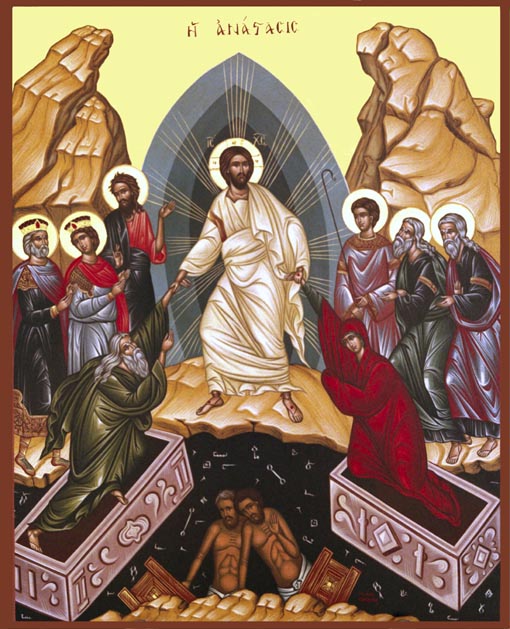
After the sabbath, as the first day of the week was dawning, Mary Magdalene and the other Mary went to see the tomb. And suddenly there was a great earthquake; for an angel of the Lord, descending from heaven, came and rolled back the stone and sat on it. His appearance was like lightning, and his clothing white as snow. For fear of him the guards shook and became like dead men. But the angel said to the women, “Do not be afraid; I know that you are looking for Jesus who was crucified. He is not here; for he has been raised, as he said. Come, see the place where he lay. Then go quickly and tell his disciples, `He has been raised from the dead, and indeed he is going ahead of you to Galilee; there you will see him.’ This is my message for you.” So they left the tomb quickly with fear and great joy, and ran to tell his disciples. Suddenly Jesus met them and said, “Greetings!” And they came to him, took hold of his feet, and worshiped him. Then Jesus said to them, “Do not be afraid; go and tell my brothers to go to Galilee; there they will see me.” Matthew 28:1-10

It is Easter at last and Christians around the world sing the triumphant message “alleluia Christ is risen, he is risen indeed!”  Just as the first disciples walked with Jesus we too have walked with Jesus through the penitential season of Lent beginning on Ash Wednesday where we remembered that “we are but dust and to dust we shall return.” With each thing that we abstained from or added to our spiritual discipline we in a small way were reminded that we are to “deny ourselves, take up our Cross and follow.”  In Holy week we experienced the nearly schizophrenic emotions of triumph and tragedy of Palm or Passion Sunday, the solemnity that comes on Holy or Maundy Thursday as we recall the institution of the Eucharist or the Lord’s Supper and the humility of Jesus as he takes on the mantle of a lowly servant and washes the feet of his disciples.  Leaving that we enter into the suffering of Jesus on Good Friday and see how even his friends betrayed or abandoned him with only a thief on an adjacent cross and the officer in charge of the crucifixion realizing just who was on that middle cross.  We wait overnight Friday and through Saturday in the uncomfortable middle between the crucifixion and resurrection that so often mirrors events in our own life where we sometimes experience what we feel to be forsaken by family, friends, church and sometimes even God.  Yet in the pre-dawn darkness of that first Easter morning we like the disciples awake to find that something has happened, that the stone is rolled away, the tomb is empty and Jesus is raised from the dead crushing sin death and hell.  We are greeted by Jesus who tells us not to be afraid but to go and tell others what has happened.  He greets us on the road to Emmaus and breaks bread with us even as we tell him about the tragedy of his death and then our eyes are opened.  Jesus is the victor and in his death burial and resurrection we have the forgiveness of sins.  The event is also eschatological in that it opens the door for him to return in glory and for him to be revealed in his people For the creation waits with eager longing for the revealing of the children of God;  “for the creation was subjected to futility, not of its own will but by the will of the one who subjected it, in hope that the creation itself will be set free from its bondage to decay and will obtain the freedom of the glory of the children of God.” Romans 8:20-21

Likewise it is in this series of inseparable events that Christ establishes our redemption by the forgiveness of sins “For while we were still weak, at the right time Christ died for the ungodly. Indeed, rarely will anyone die for a righteous person—though perhaps for a good person someone might actually dare to die. But God proves his love for us in that while we still were sinners Christ died for us.” Romans 5:6-8.

It is a universe changing event whereby Christ sets his people free and destroys the power of his enemies. Karl Barth wrote: “Look once again to Jesus Christ in his death upon the cross.  Look and try to understand that what he did and suffered he did and suffered for you, for me, for us all.  He carried our sin, our captivity and our suffering, and did not carry it in vain.  He carried it away.  He acted as the captain of us all.  He broke through the ranks of our enemies.  He has already won the battle, our battle.  All we have to do is to follow him, to be victorious with him.  Through him, in him we are saved.  Our sin no longer has any power over us.  Our prison door is open…when he, the Son of God, sets us free, we are truly free.” This is the redemption that the world awaits, not a redemption that is to be hoarded by believers but a redemption that extends beyond the present redemption for all people, especially those who believe and the people of God are to toil and struggle for this “For to this end we toil and struggle, because we have our hope set on the living God, who is the Savior of all people, especially of those who believe.” 1 Timothy 4:10

The Cross and Resurrection are to be a new and purifying wind in the world and the people of God are to be the vehicle for this wind empowered by the Holy Spirit of God.  It is not simply about mastering the art of dying as Socrates did but experiencing resurrection.  Christ did not merely die but he overcame the last enemy which is death itself. (1 Corinthians 15:26)  The power of this is not to be taken lightly in its possibilities for real change for as Dietrich Bonhoeffer wrote “If a few people really believed that and acted on it in their daily lives, a great deal would be changed. To live in the light of the Resurrection—that is what Easter means.”

While we live in the reality of the light of the Resurrection we simultaneously live under the shadow of the Cross of Christ as well as the cross that we are obliged by God to carry in our own lives. In the duality and unity of the Cross and Resurrection we have hope and in that hope we are not to be overwhelmed by events in the world that we cannot control.  Nor are we to be consumed by false “gospels” presented by various ideologues of the right and the left who may identify themselves as “Christian” but place their ideologies, social, political, national and economic over the Gospel itself.  Ideologues who quote scripture to buttress their arguments so that their ideology and the “Gospel” are one in the same much as Satan did during the temptation of Jesus to provide a veneer of Christianity to ideologies that are often opposed to the message of the Gospel. Such an idea is much like the message on German soldier’s belt buckles in the Second World War proclaimed “Gott Mit Uns” even as their nation made war on the world and executed an evil ideology of death upon the Jews and others unfortunate enough to be considered the enemies of the Nazi Party.

It is the ideologues who now endanger the Church and Gospel itself for many choose to remain inside the walls of the church and attempt to turn it into a tool of their ideology and in doing so these ideologues measure and evaluate “others only from the standpoint of whether they are supporters of this ideology, or whether they might become such, or whether they might at least be useful to it even without their consent, or whether they must be fought as its enemies. Its glory has already become for him the solution not only to the personal problem of his own life but to each and all of the problems of the world.” But the Cross and resurrection cry out “NO!” to such ideas even when they are drenched with so called “Biblical” support.

The Cross and the Resurrection bring us to life and promise that Christ who died and was raised will come again and in doing so will complete the redemption of the world for which he suffered and died. It is the real world for which God cares for enough to live suffer and die to save, as Dietrich Bonhoeffer so eloquently wrote “God loves human beings. God loves the world. Not an ideal human, but human beings as they are; not an ideal world, but the real world. What we find repulsive in their opposition to God, what we shrink back from with pain and hostility, namely, real human beings, the real world, this is for God the ground of unfathomable love.”

It is God’s unfathomable love that Easter proclaims as victorious and allows us will all people to cry out “Alleluia Christ is Risen! The Lord is Risen indeed!”

Peace and Happy Easter

Padre Steve+

1 Comment

Filed under christian life, faith, Religion

Holy Saturday….Living in the Uncomfortable Middle

“Man no longer lives in the beginning–he has lost the beginning. Now he finds he is in the middle, knowing neither the end nor the beginning, and yet knowing that he is in the middle, coming from the beginning and going towards the end. He sees that his life is determined by these two facets, of which he knows only that he does not know them” Dietrich Bonhoeffer

Holy Saturday reminds us of the fact that we live as Bonhoeffer so eloquently put it “in the middle, knowing neither the end nor the beginning. The Gospel accounts are silent as to what was happening during this interregnum between the crucifixion and the resurrection except that the women prepared the body of Jesus for burial and that the tomb was sealed and a Roman guard detachment detailed to ensure that the tomb remained secure.

One has to use their imagination as to what was occurring in the lives of the characters in this story. We know that on the day of the crucifixion that after Jesus’ death that Joseph of Arimathea provided a tomb where Jesus’ body was prepared and in which he was laid.  We know that the tomb was sealed and that Roman guards were at it as ordered by Pilate.  We know that the disciples with the exception of John had abandoned Jesus and that following the crucifixion that they had scattered and went underground with the exception of Judas who was last seen hanging around.  Most of Jerusalem was observing Passover between Friday evening and Saturday evening.  Life for many went on without a second thought as Jesus was now yesterday’s news.  The disciples wondered if they would be next, a mother mourned, members of the Sanhedrin likely were relaxing for the first time since Jesus entered Jerusalem as potential Messiah the previous Sunday while Roman soldiers far from home wondered just why they were guarding the tomb of a criminal.

We know from the reactions of the disciples the next day that they really believed that Jesus was not only dead but not coming back. There was a finality that they lived a grief that they bore. Their teacher the one that they had given up all to follow was dead executed as a criminal between common criminals and buried in a borrowed tomb.  One of their friends that they had shared the previous three years had betrayed Jesus.  Their world was upended; the one that they assumed to be the Messiah was mortal.  Their faith was crushed.

The life of faith that we live in the interregnum between life and death creation and consummation is often similar to that the disciples experienced.  We experience situations where faith is hard to come by and since we are in the uncomfortable middle nothing seems certain.  Much of this comes when like the disciples we expect something from God or expect God to do something only to find that our expectations were perhaps just a bit different from those of the Deity.  Disappointment with God I think one has called it and if we are honest it is a part of life because none of really know the will of God or even what will transpire tomorrow something that scripture is rather clear about.

We live in the middle every time we walk with Jesus and his followers through Holy Week just as we walk through life and Holy Saturday is in a sense a metaphor for life when we don’t understand it when we are in the middle wondering what transpired before and not knowing the future.  It is a time to again seek out our faith and with our friends who share this life to maintain hope that things will work out, that in fact resurrection will come.

Until tomorrow we leave the disciples in hiding, the city sleeping and the Roman soldiers cold and bored at a tomb which in reality they care less about.

Peace,

Padre Steve+

Leave a comment

Filed under christian life, faith, Religion