Tag Archives: faith

I Belong Here With Those in Pain and Who Have Lost Their Faith

iraqchristmas

Christmas Eve at COP South 2007, the Most Important Mass of My Life

“I belong with those who are in pain, and who have lost their faith, I belong here.” Father Palmer, the Chaplain in Joyeux Noel (Merry Christmas)

In the next day or two, certainly by Christmas I will again watch the film classic Joyeux Noel (Merry Christmas) which is the story of the amazing and exceptional Christmas Truce of 1914. It is a film that each time I see it that I discover something new, more powerful than the last time I viewed it. I will also be writing about Christmas from my perspective as a combat veteran and giving voice to those who serve now, as well as those who served God’s people in hellish places before me.

As a Chaplain I am drawn to the actions of the British Padre in the film, who during the truce conducts a Mass for all the soldiers, British, French and German in no-man’s land, who goes about caring for the soldiers both the living and the dead.  His actions are contrasted with his Bishop who comes to relieve him of his duties and to urge on the replacement soldiers to better kill the Germans.

palmer

Father Palmer Tending the Wounded

As the Chaplain begins to provide the last Rites to a dying soldier the Bishop walks in, in full purple cassock frock coat and hat and the chaplain looks up and kisses his ring.

As the chaplain looks at his clerical superior there is a silence and the Bishop looks sternly at the priest and addresses him:

“You’re being sent back to your parish in Scotland. I’ve brought you your marching orders.”

Stunned the Priest replies: “I belong with those who are in pain, and who have lost their faith, I belong here.”

The Bishop then sternly lectures the Priest: “I am very disappointed you know. When you requested permission to accompany the recruits from your parish I personally vouched for you. But then when I heard what happened I prayed for you.”

The Priest humbly and respectfully yet with conviction responds to his superior: “I sincerely believe that our Lord Jesus Christ guided me in what was the most important Mass of my life. I tried to be true to his trust and carry his message to all, whoever they may be.”

The Bishop seems a bit taken aback but then blames the Chaplain for what will next happen to the Soldiers that he has served with in the trenches: “Those men who listened to you on Christmas Eve will very soon bitterly regret it; because in a few days time their regiment is to be disbanded by the order of His Majesty the King. Where will those poor boys end up on the front line now? And what will their families think?”

They are interrupted when a soldier walks in to let the Bishop know that the new soldiers are ready for his sermon. After acknowledging the messenger the Bishop continues: “They’re waiting for me to preach a sermon to those who are replacing those who went astray with you.” He gets ready to depart and continues: “May our Lord Jesus Christ guide your steps back to the straight and narrow path.”

The Priest looks at him and asks: “Is that truly the path of our Lord?”

The Bishop looks at the Priest and asks what I think is the most troubling question: “You’re not asking the right question. Think on this: are you really suitable to remain with us in the house of Our Lord?”

With that the Bishop leaves and goes on to preach. The words of the sermon are from a 1915 sermon preached by an Anglican Bishop in Westminster Abbey. They reflect the poisonous aspects of many religious leaders on all sides of the Great War, but also many religious leaders of various faiths even today, sadly I have to say Christian leaders are among the worst when it comes to inciting violence against those that they perceive as enemies of the Church, their nation or in some cases their political faction within a country.
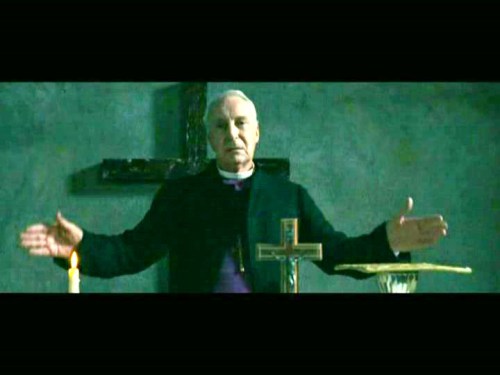
bishop

The Bishop Leads His “Service” 

http://www.youtube.com/watch?v=fMPxjUE40iw

“Christ our Lord said, “Think not that I come to bring peace on earth. I come not to bring peace, but a sword.” The Gospel according to St. Matthew. Well, my brethren, the sword of the Lord is in your hands. You are the very defenders of civilization itself. The forces of good against the forces of evil. For this war is indeed a crusade! A holy war to save the freedom of the world. In truth I tell you: the Germans do not act like us, neither do they think like us, for they are not, like us, children of God. Are those who shell cities populated only by civilians the children of God? Are those who advanced armed hiding behind women and children the children of God? With God’s help, you must kill the Germans, good or bad, young or old. Kill every one of them so that it won’t have to be done again.”

The sermon is chilling and had it not been edited by the director would have contained the remark actually said by the real Bishop that the Germans “crucified babies on Christmas.”  Of course that was typical of the propaganda of the time and similar to things that religious leaders of all faiths use to demonize their opponents and stir up violence in the name of their God.

When the Bishop leaves the Priest finishes his ministration to the wounded while listening to the words of the Bishop who is preaching not far away in the trenches. He meditates upon his simple cross, takes it off, kisses it hand hangs it upon a tripod where a container of water hangs.

The scene is chilling for a number of reasons. First is the obvious, the actions of a religious leader to denigrate the efforts of some to bring the Gospel of Peace into the abyss of Hell of earth and then to incite others to violence dehumanizing the enemy forces. The second and possibly even more troubling is to suggest that those who do not support dehumanizing and exterminating the enemy are not suitable to remain in the house of the Lord. Since I have had people, some in person and others on social media say similar things to what the Bishop asks Palmer the scene hits close to home.
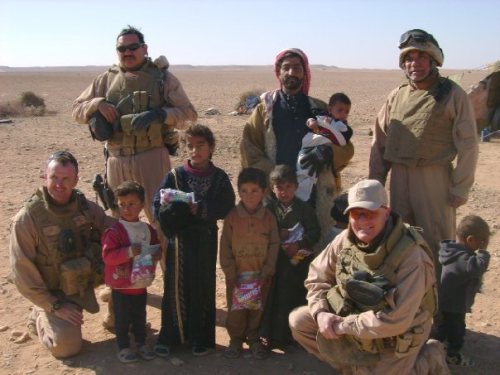
iraq-bedouin1

Christmas Eve 2007 with the Bedouin 

When I left Iraq in February 2008 I felt that I was abandoning those committed to my spiritual care, but my time was up. Because of it I missed going with some of my advisors to Basra with the 1st Iraqi Division to retake that city from insurgents. It was only a bit over a month after I had celebrated what I consider to be my most important Masses of my life at COP South and COP North on December 23rd as well as Christmas Eve and Christmas Day. In fact they were really the last masses that I felt the mystery and awe of the love of God that I used to so much feel.

When I left the new incoming senior Chaplain refused to take my replacement leaving our advisors without dedicated support. He then slandered me behind my back because what I was doing was not how he would do things and because I and my relief were under someone else’s operational control. It is funny how word gets back to you when people talk behind your back. Thankfully he is now retired from the Navy and I feel for any ministers of his denomination under his “spiritual” care.  So I cannot forget those days and every time I think about them, especially around Christmas I am somewhat melancholy and why I can relate so much to Father Palmer in the movie.

It has been seven years since those Christmas Masses and they still feel like yesterday. In the intervening years my life has been different. Just a year later I was walking home from church where my wife was to sing in the choir during the Christmas vigil mass. I couldn’t handle the crowds, the noise, and I felt so far away from God. That night I walked home in the dark looking up into the sky asking God if he still was there. If there had been a bar on the way home I would have stopped by and poured myself in.

Since Iraq I have dealt with Severe and Chronic PTSD, depression, anxiety and insomnia were coupled with a two year period where due to my struggles I lost faith, was for all practical purposes an agnostic. I felt abandoned by God, but even more so and maybe more importantly by my former church and most other Chaplains. It was like being radioactive, there was and is a stigma for Chaplains that admits to PTSD and go through a faith crisis, especially from other Chaplains and Clergy.  It was just before Christmas in late 2009 that faith began to return in what I call my Christmas Miracle. But be sure, let no one tell you differently, no Soldier, Sailor, Marine or Airman who has suffered the trauma of war and admitted to PTSD does not feel the stigma that goes with it, and sadly, despite the best efforts of many there is a stigma.

Now that faith is different and I have become much more skeptical of the motivations of religious leaders, especially those that demonize and dehumanize those that do not believe like them or fully support their cause or agenda. Unfortunately there are far too many men and women who will use religion to do that, far too many.

As for me, I thought that I was in a better place a year ago. I had the floor kicked from out from under me this summer and it has been a hard fight and while I am beginning to get back to some sense of normal it is a day to day thing. I still suffer the effects of the PTSD, especially the insomnia, nightmares and the nightmares which came back with a vengeance this summer. I also still have the anxiety in crowded places and bad traffic, but working with my new therapist I am coming up with some effective coping mechanisms. As for faith, I do believe again, though at the same time I doubt. I would have to consider myself a Christian Agnostic who echoes the cry of the man who cried out to Jesus, “Lord I believe, help my unbelief!” 

Like the Priest in Joyeux Noel I know that my place is with those who are “in pain, and who have lost their faith.” For me this may no longer be on the battlefield as I will retire from the Navy out of my current billet teaching at the Joint Forces Staff College in a couple of years. However, that being said I will strive to be there for those that struggle with faith and believe, especially those who struggle because of what they saw and experienced during war and when they returned home.
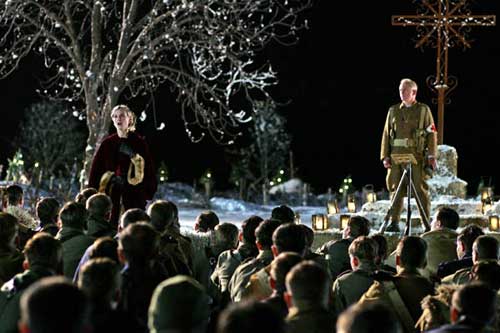
3670064wxkyb

Joyeux Noel Christmas Eve

Likewise I expect that I will do my best to speak truth to those in power and those whose faithfulness is more a product of their comfort with the God that they create in their own mind rather than the Crucified God wise death on the Cross s a scandal. For many Christians the scandal of the cross is too easy to avoid by surrounding ourselves with pet theologies that appeal to our pride, prejudice and power. The kind of malevolent power represented by the bishop in Joyeux Noel. Thus I take a measure of comfort in the words of Simone Weil who said “He who has not God in himself cannot feel His absence.” 

Thus, like Paul Tillich I have come to believe that “Sometimes I think it is my mission to bring faith to the faithless, and doubt to the faithful.”  In other words to become a complete pain in the ass until the day that I die.

Praying for Peace this Christmas,

Padre Steve+
1 Comment

Filed under christian life, faith, film, History, Military, PTSD, Tour in Iraq, world war one

An Advent of Doubt, Faith and Struggles

Lord I believe, help me in my unbelief.

A new liturgical year is upon us and with the season of Advent Christians look forward to the “Advent” of Christ both in looking forward to the consummation of all things in him as well as inviting him back into our lives as we remember his Incarnation, as the Creed says “For us and for our salvation he came down from heaven: by the power of the Holy Spirit he became incarnate from the Virgin Mary, and was made man.”

At the same time for a lot of people the season of Advent and Christmas are incredibly difficult and times where faith, already difficult becomes nearly impossible.  For many the season is not a time of joy but depression, sadness and despair. I know feeling well, for it has been the reality that I have lived with since returning from Iraq.

Before Iraq,  Advent and Christmas were times of wonder and mystery and I really found it difficult to understand how anyone could be depressed during the season.  Until I came home from Iraq. Now while I have faith again I struggle to find the same wonder and mystery of the season that I once experienced. I think that the last time I was truly joyful at Christmas and during Advent was in Iraq, celebrating the message of hope among our advisors up and down the Iraqi-Syrian border. I think the most special moment was serving Eucharist to an Iraqi Christian interpreter who had not received the Eucharist in years that Christmas Eve of 2007 at COP South. Somehow in that God forsaken land God seemed closer than any place I have been since.

Since I returned from Iraq my life has been a series of ups and major downs. In dealing with PTSD, anxiety, depression and chronic insomnia as well as my dad’s painfully slow death from Alzheimer’s Disease, I have struggled with faith.  Prayer became difficult at best and as I dealt with different things in life I knew that I didn’t have any easy answers.  Going to church was painful. Chaplain conferences even more so, except being with others who struggled like me.  About the only place that I could find solace was at a baseball park.  For some reason the lush green diamond comforts me.

I find that the issue of doubt is not uncommon for a lot of people, including ministers of all faiths. For those of us who are ordained and view our ministry or our Priesthood as a sacred vocation this is difficult to deal with.  Ministers and others who suffer a crisis in faith, depression or despair endure a hell because it is not supposed to happen to us. I do believe that for many people a religious leader who has doubts and struggles with his or her faith is disconcerting.  I can remember a myriad of situations where pastors due to a myriad of reasons experienced a crisis in faith many of which involved great personal loss such as the loss of a child, a failed marriage, being let go or fired by a church, or experiencing a major traumatic event.  These were good people and quite often instead of being enfolded by a caring community of faith they were treated as faithless, failed and worthless, often abandoned or excluded from their faith community as if they were criminals.

When I was younger I used to look askance at pastors who had given up, lost their faith, or abandoned the ministry for whatever reason.  As a young seminary student and later young chaplain I had a hard time with this, it made no sense to me and I was somewhat judgmental until I started to get to know a decent number of “broken” ministers from various faith traditions that a lot more went into their decision than simply not being tough enough to hang in there until things got better.  At the same time I never thought it would happen to me. I thought I was “bulletproof,” that it could never happen to me. And it did and I was stunned.

When I came back from Iraq I came home to find that my office had been packed up and many mementos lost, it took months to find most and there are still important documents that have never been recovered. My accomplishments went unrecognized on my return home.  As I crashed no one asked about my faith until Elmer the shrink did when he met me.  Later my Commodores, first Frank Morneau when he found out about my condition and Tom Sitsch when he took command of EOD Group 2 both asked me about my faith.  I told them that I was struggling. Commodore Sitsch asked me “Where does a Chaplain go for help?”  Sadly I had no idea how much Commodore Sitsch was going through as he ended his life on January 6th of this year, suffering the effects of untreated PTSD and TBI.

On the professional side I felt isolated from much of the clergy of my former church and many chaplains, something that I still feel to some extent today. I was angry then because I felt that I deserved better, because I had done all that was asked of me and more for both church and chaplain corps.  The Chaplains that I knew cared all worked in different commands and were not immediately available and I was ashamed to go ask them for help.

I appreciated simple questions like “How are you doing with the Big Guy?” or “Where does a Chaplain go to for help?” It showed me that people cared.  When I went to the medical center I dealt with many difficult situations and was haunted by my dad’s deterioration, the latter which I still deal with today.  To have a close family member mock my vocation, service and person and provoke me into rages was equally taxing.  Likewise the absolute hatred and divsion in the American political debate tore my heart out.  I felt like, and in some ways still feel like we are heading down a path to being “Weimar America.”

There were many times that I knew that I had no faith.  People would ask me to pray and it was all that I could do to do to pray and hoped that God would hear me.  Even the things that I found comforting, the Mass, the Liturgy and the Daily Office were painful, and they often still are.

That being said, I am still a Christian, or maybe as I noted last week a Follower of Jesus, since the Christian “brand” is so badly tarnished by the politically minded, hateful, power seeking, media whores that populate the airwaves and cyber-space.

Why I am is  sometimes hard to figure.  I am not a Christian because of the Church, though I love the Church, church bodies have often has been for me a sourse of pain and rejection.  I am not a Christian because of what is called “Christian.” Nor can I ignore the injustice, violence and oppression wrought by those who called themsleves Christian throughout history, including that wrought by current Christian leaders.  Slavery, the subjectation and conquest of who peoples to take their land and resources and wars of agression blessed by “Christian” leaders are all part of history.

At the same time much progress has come through the work, faith and actions of Christians and the Church. Despite all of the warts and the many sins and crimes committed by Christians, even genocide, I can like Hans Kung “I can feel fundamentally positive about a tradition that is significant for me; a tradition in which I live side by side with so many others, past and present.” (Kung, Hans Why I am Still a Christian Abingdon Press, Nashville 1987 p. 36)

Neither am I a Christian because I think that the Christian faith has “all” of the answers.

In fact after coming through Iraq and returning home I know that it is not so.

I have to be painfully honest and say that neither the Church nor Christians have all the answers, and those who think that they do, and claim that in the name of God or Jesus, are fundamentally deceived, and that I would not follow them across the street.

I now understand what my Church History Professor, Dr Doyle Young said in class that “all of people’s deepest needs are not religious.”  Likewise I certainly not a Christian because I think that Christians are somehow better or more spiritual than others.  In fact I find the crass materialism and self centered “What can God to for me?” theology and way of life to be deeply offensive.

People get sick, young children die, innocents are subjected to trauma even from their parents or siblings.  Good people endure unspeakable trials while sometimes it seems that evil people get away with murder.  I can’t chealk it all up to a naive “it’s God’s will” kind of theology.  I don’t presume to know God’s will and I can’t be satisfied with pat answers like I see given in so many allegedly Christian publications, sermons and media outlets.  Praying doesn’t always make things better. I remain a Christian in spite of these things.  I still believe that God cares in spite of everything else, in spite of my own doubts, fears and failures.

I still believe, Lord help me in my unbelief.

One of the verses of the Advent hymn O’ Come O’ Come Emmanuel is a prayer for me this year.

O come, Thou Day-Spring, come and cheer
Our spirits by Thine advent here
Disperse the gloomy clouds of night
And death’s dark shadows put to flight.
Rejoice! Rejoice! Emmanuel
Shall come to thee, O Israel.

So now, for those that like me struggle with faith, feel abandoned by God, family and friends.  For those who have experienced the crisis of faith or even a loss of faith I pray that all of us will experience joy this season.

I’m sure that I will have some ups and downs, I certainly don’t think that I am over all that I am still going through.  However I know that I am not alone to face my demons and pray that by opening up that others who are going through similar experiences will find hope.  O come, Thou Day-Spring, come and cheer, our spirits by Thine advent here. Disperse the gloomy clouds of night, and death’s dark shadows put to flight.

Peace,

Padre Steve+

2 Comments

Filed under christian life, faith, Religion, Tour in Iraq

AIDS, Death, Cold Religion and Simple Christian Love

IMG_1915

Friends of Padre Steve’s World

I have to admit I never know what will get me going and what will trigger memories of different events in the past. The situation with the Ebola outbreak flooded me with memories, memories of my experiences as a hospital chaplain and as a medical personnel officer dealing with those afflicted with HIV/AIDS. I have shared those over the last two nights. So tonight I will finish that story line with two very different experiences with dying AIDS patients from my Clinical residency at Parkland Memorial Hospital in Dallas. Tomorrow I will be posting a newly written except from a chapter of my Gettysburg text dealing with emancipation and the contributions of African American soldiers in the Civil War.

Peace

Padre Steve+

For me it is still hard to comprehend, a young chaplain; two relatively young men dying of AIDS, two partners, two families and two radically different experiences of humanity, faith, religion and authentic loving relationships.

I was still a relatively inexperienced minister and chaplain back when I was doing my Pastoral Care residency at Parkland Memorial Hospital in Dallas Texas back in 1993 and 1994. Yes I had graduated from seminary. Yes I had a bit of chaplain experience as an Army National Guard chaplain and as a counselor at a major evangelical Christian ministry, and yes I had experience in dealing with AIDS as a Medical Service Corps officer in the Army.

Despite that, I was so ill prepared to deal with the massively different treatment of people dying from AIDS from their families. Families that in some cases shared the same Christian faith as me. I think that is one of the things that young ministers struggle with when they enter the nether world between life and death, mortality and immortality, faith and unbelief in the real world. When I was in seminary the senior pastor of the mega-church that I attended told a story about being approached by a family member of someone who was very sick and in hospital. The person wanted him to visit them while they were a patient. He had been their pastor for years. When they ask him if he would come, he refused. He recounted that the “parishioner asked just how sick he would have to be to get a hospital visit?” The pastor told us his response. He laughed and said “you don’t want to be that sick.” The congregation laughed and I was devastated.

The pastor was a leader in the New Apostolic Reformation, a friend of John Wimber, Rick Joyner and others who helped to pave the way to the heartless, unfeeling, political “Christianity” and “Dominion theology” that is in vogue with the Tea Party and Religious Right today. When I questioned him about his comments later he told me that thought that pastoral care of those in his congregation, especially in regard to hospital visits was “below his office as an apostle, that others had that responsibility.” The thing that disturbed me the most was that he had ordained me as an Evangelical minister in that church to be a chaplain barely two years before this. I had respected him and now I felt a tremendous sense of emptiness when I left his office.

So when I began my pastoral care residency at Parkland I found that I had a lot to learn about the real world of religious faith, religious hypocrisy and religious hatred and intolerance.

Early in my residency I dealt with a number of AIDS cases. I wrote about one of those cases last night, although that was not really early in my residency, it was closer to the end of it. There were two cases besides that one that made such deep impressions on me that I can never forget them. Both involved young, white, homosexual men dying of the complications from full blown AIDS. Both came from very “Evangelical Christian” families (both were Southern Baptist) and both were being grieved by what we called then, their “significant others” as well as their biological families. But that was where the similarities ended.

The first case was in the second month of my residency, when I was the chaplain for the Medical ICU, before the Pastoral Care Director wisely moved me to the Trauma and Surgery department. A patient came to us, a man, about my age, a successful architect with many friends who was experiencing pneumonia brought about by his immunodeficiency brought about by HIV.

When he arrived he was still able to communicate and he had many of his friends as well as his significant other visiting him. They loved him and he loved them. There was a sense of community and if I dare say real family as they visited. In those first few days I got to know him and these people, most of who were homosexual but not all. There were a number of women there, who I am sure had the patient, who was a remarkably handsome man, been a heterosexual, would have loved to have been his wife.

My encounter with him, before his condition worsened to the point that he had to go on a ventilator and was sedated was transforming. He grew up in the church, knew that he was homosexual, attempted to live with it and finally came out as gay, and was disowned by his family. Despite this he became a highly successful architect, had many friends, was active in charitable works, and still maintained his faith in Jesus. I came to appreciate him, the man who for was for all purposes his spouse and his friends.

However, when his condition deteriorated his estranged family, the people who had disowned him, rushed to his “rescue.” In good Christian form they brought their pastor who though their son was unconscious proceeded to preach at him regarding his need to “repent” and “to come back to Jesus.” The family also took advantage of the law. They were his biological family and next of kin. They banned the man’s partner and friends from his room as he lay dying.

The family’s  pastor preached at the dying man and glared at the people closest to him while he was present.  I was appalled by his, and their behavior. While they isolated their son from those closest to him and allowed their pastor to condemn him as he died, I remained with his partner and friends. I prayed with them, I cried with them, I embraced them. When the family left I went with them to be with this young man’s mortal body. We prayed and after the nurses prepared his body and the doctors completed their final notes, I walked with them as we took his body on that long trip from the ninth floor to basement, where the morgue awaited. I still cry when I think of this encounter, of how supposedly Christian people would not only keep their son, who they had rejected and condemned from those who loved him the most as he lay dying.

A couple of months later I was in my element as the Trauma and Surgery Department Chaplain, but I still had on call duty where I was responsible for crisis situations anywhere in the house. One of those wild nights I got a call from the nursing staff of Nine South, the Medical Step Down unit where the lady that I wrote about last night had passed away, but that was still in the future.

This time there was another young white man, another partner, another family. This young man was not in the ICU fighting for his life, he was passing away in the quiet solitude of his room with his mother and father, his partner and his friends at his side. Like the other young man he was a man of faith. He loved Jesus, he loved his family and he loved his partner.

He was from the area west of Dallas, the area between Fort Worth and Abilene. His mom and dad were ranchers, dad was wearing his cowboy hat, a plaid shirt, classic western Levi’s jeans and cowboy boots. His mom was wearing a simple dress. Both were thing, tanned and their faces lined by the sun and weather and from being out on the range with their cattle. The young man who was with them, the dying man’s partner was casually dressed but though he was from the same area was not a rancher.

I spent time with all of them. The contrast between the “Christian” parents and pastor of the first young ma could have not been more profound. Like the architect’s parents, they were Christians. In fact they were Southern Baptists who attended a small country church in the town that they lived. By any sense of the word they could be described as “Fundamentalist” Christians, but unlike so many fundamentalists they focused on loving God and loving people, even people that so many Christians reject out of hand.

I arrived as the patient was breathing his last. I remained with him, his parents, partner and friends as he passed away, and when his parents asked I offered a prayer commending his soul to God. As I did this his partner was in a state of near collapse, exclaiming “I have no one now, I am alone!” His grief was overwhelming, he had no legal status, in the eyes of the law he meant nothing, though the man that he loved had just died. My heart was rent, and I held on to him.

As I did, the patient’s father came alongside of us. The father said to the young man “You are not alone, you are our son now, we love you.” When this dear man said this we all were in tears, as I am right now. I stayed with all of these dear people as the nursing staff prepared the young man’s body to go to the morgue. At some point the parents escorted their son’s now widowed partner out of the hospital. Mom and dad walked on either side of him as they left the ward. If there was anyone couple on this either who were true Christians, it was this dear couple. As we parted I could not hold back the tears, and the father of the deceased gave me a hug and thanked me for being with them and honoring his son.

I remained with the nursing staff and the internal medicine resident as they complete their duties and took the young man’s body to the morgue. After that I went back to the emergency room where some of the nursing staff, including a RN who at one time had been an Assemblies of God pastor, but was now an avowed atheist who loved to torment chaplains, except me, comforted me in my grief. It is funny that an atheist would be comforting the chaplain after such an event, but then if I do believe in God, why can’t I believe that anyone cannot share in the grief of others and of comfort and care.

It was a story that I could only share with my pastoral care residency supervisor, in our residency group and with my wife Judy, as I knew if I shared my experience at church that at best I would only be humored, and most probably be ostracized.

But, in a way it was a step to freedom because I realized that what I had been taught for so long was so horribly at odds with the message of Jesus.

Two deaths, two men, two partners, two families, two experiences of God’s grace, two experiences of a common humanity and the experience of one very flawed, but no longer confused chaplain…

Peace

Padre Steve+

Leave a comment

Filed under christian life, faith, healthcare, Pastoral Care

The Enduring Mystery of an Encounter with an AIDS Patient

lent

Last night I wrote about my early experience dealing with AIDS while serving as an Army Medical Service Corps personnel officer in 1987. In the 1990s that experience changed as I began to deal with men and women who were dying of the effects of full blown AIDS while serving as a hospital chaplain. The experiences of being with those men and women, and in some cases with their families, or loved ones was another chapter in my acceptance of Gays as well as other people marginalized and abandoned by my fellow Christians.

This is an account of one of those encounters at Parkland Hospital in Dallas where I was doing my Clinical Pastoral Education residency, it is not about the politics of AIDS, instead it is about humanity, connection, faith, mystery and things that I cannot explain. Those who know me or have followed my writings on this site know my struggles with faith and God, belief and unbelief.

Even today thinking about this encounter brings tears to my eyes and makes me wonder about faith, life, reason and mystery. Frankly, it is something that I cannot explain, nor do I care to. I am content to live with the mystery of something that I cannot explain, but then at the same time, I am not.

As Anais Nin wrote: “The possession of knowledge does not kill the sense of wonder and mystery. There is always more mystery.”

Peace

Padre Steve+

Sometimes death comes unannounced but other times it sounds a warning.  Most of the time we think of such warnings as what our body is saying to us, maybe someone is having chest pains or that we know of a terminal condition which is getting worse and the doctors say that there is nothing else that they can do.  Other times it appears that some people almost have a sixth sense about their impending death and leave notes or say “goodbye” to loved ones in a different way than they would normally do.

When I see or hear about the sixth sense kind of incident I find that I am intrigued.  As a student of history I have read countless accounts where soldiers know that they will not survive a particular battle and leave things or messages for their friends to give to loved ones.

There have been times when I have had a sixth sense about what was going to happen to someone and the feeling is like you are watching something unfold in slow motion but can do nothing to stop it.

This story is a bit different and took place during an overnight as the “on call” chaplain at Parkland Memorial Hospital in Dallas during my Clinical Pastoral Education Residency. Parkland is a rather large, at the time of my residency a 940 bed county hospital and Level One Trauma center.  The “on call” chaplain after normal hours was the only chaplain in the hospital to cover all emergencies in the house.  Usually I stationed myself in the ER area as that was the “hottest” place for ministry at any given time.  I would always take a spin around our 9 ICUs sometime in the evening to make sure that nothing was brewing; but unless something was going bad on one of them would always end up back in the ER.

One night I had just finished with a situation involving a violent death in the ER when about Nine PM I got a page from “9 South” our General Medicine Step-Down ward. This was a ward that not much usually happened on, in fact as a critical care and trauma type I considered it and other wards like it as a bit boring as nothing much usually happened there.

The nurse that I talked to when I returned the page told me that I needed to come up right away. She said that she had a patient who was convinced that she was going to die that night.  Intrigued, I told the nurse, that I would be right up and made my way up to the ward.

I got to the ward about 9:15 PM and met the nurse who further explained the situation to me while I reviewed the chart.  The nurse was an RN who had come to the United States from India and she was obviously unnerved by what was going on. She told me about the patient, I reviewed the chart as is my normal procedure and then went in to visit the lady. There was nothing in the chart to indicate any problems, in fact she was listed as improving enough to go home the next day, discharge orders were already in the chart.

The lady was in her mid-30s and she was HIV positive. She was married, and her husband who was also HIV positive and in a more advanced stage of the disease had been discharged from the hospital the day before. She had come in for a few day stay as she had been spiking a fever but that was under control, and she had no other medical issues. She was not at the point of having any of the major opportunistic infections or diseases associated with full blown AIDS, her T-Cell count was good.  Clinically she was stable and expected to do well for a number of years to come.

But despite all the good numbers, stable condition and good prognosis the woman was convinced that she was going to die, this very evening.

Just after the evening shift change the patient had told the nurse that “the Lord was going to take her home tonight.”  This troubled the nurse as it would any normal rational person, so she called the duty Internal Medicine resident physician to come and speak with the lady. The resident could not convince here that she was going to be okay and that she told both of them that she was going to die that evening and “go home and be with Jesus.”

Now for those who have never lived in the south “going home” is not like leaving the office at the end of the day.  Elvis “went home” wherever that was (see “Men in Black”) and if you are talking with someone raised in the South and they start talking about “going home” you better stop and clarify to make sure that they are going home to watch the Braves on television and drink a beer, or if they are planning on dying.

I had a grandmother who told me from the time that I was 5 years old that she was either “going home” or “wasn’t going to be around much longer.” Of course she was convinced that she was going to die, and once I stirred up a hornet’s nest when after she told me that “she wast going to be around much longer  So I asked her “where are you moving to?” Granny was not impressed and gave me an earful. Granny lived to be almost 90 years old when she finally “went home”  when I was 40 after giving me 35 years worth of warning, but I digress…

Now patently I am of the mind that if the numbers say that you will live I believe the numbers.  I’m a baseball guy, God speaks to me through baseball and I play the percentages. It is the rational thing to do, which means that while I believe that God can intervene in situations I don’t bet on that happening. I read the chart. I talk to the nursing staff, and I talk with the physicians.

After talking with the resident and nurse I was convinced that this lady would walk out of the hospital in the morning and probably outlive her husband. Then I met the lady.

I walked into her room. She was sitting up in bed with her Bible open beside her on her mattress. She appeared to be very calm and there was a peaceful sense about her.  She was from Jamaica and very polite and when I introduced myself to her she greeted me warmly with the accent characteristic of that island nation.

“So you are the pastor?” she asked.

I replied that I was the Chaplain and that the nurse and doctor had asked me to spend some time with her.

She then said “Ah yes, they do not believe me because I told them that Jesus told me that he will take me home tonight.”

So I asked her what she believed was going on with her. She then described to me what had occurred that evening to make her think that she was going to die. “You see pastor, the doctors say that I will go to my house tomorrow but I will not.”

She paused and even more curious I nodded for her to go on and said “really? Tell me more.”

She continued “Pastor you see this evening Jesus came to me, he visit me and tell me that I will go and be with him tonight.”

Now I have to admit that I was skeptical. However, she was not acting emotional or even bothered about what she just said. Normally I might ask for a psychiatric consult, but she seemed to be completely rational, and her chart made no mention of any mental illness or psychological issues.

I was fascinated and asked her to tell me more. She then went on a fairly long recitation of her faith journey from the time that she was a young girl. She told me how she frequently would sense God’s presence and hear his voice at different points in her life. She told me how she had gotten HIV from her husband, who had been a drug abuser and how much it meant for her to be right with others and God.

So I asked her about the specifics of “why she thought that she would die tonight?”

Calmly she explained. “The doctors tell me that I will be well and go home tomorrow. They tell me that I am in good condition and that I will live a long time, but that does not matter to me because Jesus told me today that he will take me home to be with him….tonight.” 

The word tonight was said with a confidence that stunned me. She talked as if this was a regular every day occurrence and her face was radiant.  She continued “I love Jesus and know that he will not lie to me so I know that I will be with him tonight.”

Her faith was touching and powerful in its simplicity and the amount of trust that she showed even to a message that she believed to be from Jesus that was completely different than the news of the doctors. After our conversation, which lasted about 30 minutes involved me probing her faith, asking what she understood about her condition and talking about her family. It seemed to me that our visit was a time for her to tie up the loose ends of her life and that I was the person that she was taking the time to share them with.

As we closed she asked me if I would pray with her and give her a blessing which I did.  She thanked me, reached out and asked for a hug. She embraced me weakly and then let go, and she thanked me again.  I was moved by this, still not convinced that Jesus would take her home. I didn’t she was going to die but there was a certain finality in her words and actions that gave me a bit of doubt about the facts and numbers that I trusted in.

When I left her room, I charted my visit, wrapped things up with the resident and the nurse and went back down to ER where more carnage was waiting, shootings, motor vehicle accidents and drug overdoses.

About 2:30 AM my pager went off. It was the nurse’s station on Nine South. I returned the call and the nurse that I had talked with earlier was on the line.

She was nearly frantic and said: “Chaplain, please come quick, I went in to check her vitals and she is dead!”  I put on my best calm voice and said “Who is dead?” 

The nurse nearly in a panic said “The lady that said that God was going to take her home, she died!”  I looked up from the Trauma ER nurses’ station and realized that there was nothing immediate and told the nurse  “Okay I’ll be right up” and went up to the ward as quickly as I could.

When I got to the ward to find the nurse pacing anxiously outside the door of the patient’s room.  I asked if the nurse if she was okay, meaning her and not the now deceased patient. The poor nurse replied that she was upset by the death because the lady should not be dead. She was frightened and that she didn’t understand how the patient could calmly know that she was going to die.  Now the nurse was not a southerner unless it was the south part of the Indian subcontinent.  She was relatively new to Texas and the American South she was not as attuned to some of the religious and cultural aspects of either the South or some of the Caribbean islands, where the lady had come.

After helping the nurse calm down I met the resident who was in the room looking perplexed, when I walked in he said “This women shouldn’t be dead.” 

I couldn’t think of much else to say so I just said to him “sometimes it’s just someone’s time even if the numbers don’t say so.” 

He said: “Yeah, I know, but this was really freaky because she told me that she was going to die tonight and she did.”

I did concur with this young doctor that what had happened was a bit on the unusual side but that we couldn’t discount what she believed especially since she had been correct. As the resident went to finish up paperwork I looked at the woman. It looked like she had simply fallen asleep. Her Bible was on her lap and opened to the book of Revelation, the 21st chapter. Although I cannot be sure exactly what she was reading can only imagine that it was this verse “See, the home of God is among mortals. He will dwell with them as their God; they will be his peoples, and God himself will be with them; he will wipe every tear from their eyes. Death will be no more; mourning and crying and pain will be no more, for the first things have passed away.” (Revelation 21:3b-5 NRSV)

This dear woman had passed away, gone home looking forward to a place where whatever tears or sorrows she had experienced would be wiped away. I closed her Bible, gently placed her hands together over it and prayed a prayer of commendation before pulling the bed sheet over her face and body.

On leaving the room I spent a bit more time with the nurse who was beginning to gather herself after this unusual death.  A couple of hours later I would escort the body of this woman to our morgue accompanied by the nurse and a LVN.

If you have never made the walk to a morgue it is always the longest walk you will ever make. At Parkland it seemed that no matter where you were coming from the walk took forever as it is a massive facility, and in the wee hours of the morning while most of the world sleeps, that walk is an eternity.

As we rode the elevator down to the basement where the morgue was located we continued to talk a bit more. When we got to the basement and commenced the walk down the long and empty corridor to the morgue we did so in silence. I unlocked the door and then the door to the walk in refrigerator, which could hold up to eight adult bodies on cold stainless steel gurneys at any given time. Dimly lit and damp the morgue has a truly macabre ambiance which is magnified by the sight of bodies of the deceased wrapped in body bags and covered by white sheets.

Once I had admitted the body and locked the door to the morgue the two nurses left to head back to the 9th floor. I took the chart and other paperwork up to our office where our decedent affairs clerk would complete the death certificate. The daytime duty chaplain would have the responsibility of discharging the woman’s body after an autopsy was conducted and a funeral home came to take her body to her final resting place.

I thought how unusual this case was as I sat for a while in the office. I had heard of similar things but had never seen something like this before where the person in question made such a claim and was right defying the numbers that said she would walk out of the hospital. After a the rest of the evening, or rather the early morning was relatively uneventful and my shift came to an end as the rest of the staff came in for the day. I briefed the chaplain who was taking the pager, did my debriefing with my fellow Pastoral Care residents and went home, wondering what had happened.

Physicist Max Planck who originated Quantum Theory said: “Science cannot solve the ultimate mystery of nature. And that is because, in the last analysis, we ourselves are a part of the mystery that we are trying to solve.”

It is a mystery, so I guess I should leave it there…

Peace

Padre Steve+

Leave a comment

Filed under christian life, faith, healthcare, ministry, Pastoral Care, philosophy, Religion

Is it Really God or do I Make You Uncomfortable? PTSD, Mental Illness and Christians

IMG_1915

Christians can be among the most clueless people regarding how their language and theological prejudices negatively impact others and harm their own witness regarding their professed devotion and love of Jesus the Christ. Sadly much of what they spout is neither scriptural or has any roots in reason or church tradition. Instead it is a product of their own prejudice and uncomfortableness with those who express doubt that they have learned from very popular, yet extremely ignorant and often hateful political ideologues who masquerade as preachers in mega-churches, on television, radio or the internet.

There are many Christians, particularly conservative Evangelicals and Charismatics who are fine people, men and women of integrity who I can honestly say love God and try serve God and also to care for his people. That being said many of these same people in their attempts to help others; especially those dealing with PTSD, depression, anxiety, suicidal thoughts, substance abuse and faith crisis’s do more far damage and harm than good. This is because they are unaware of their prejudices that they learn in church and how wrong their preachers are about such subjects, but still presume that what they have learned trumps other people’s experience. Yes this is a generalization, but there is much truth in it.

Those who read this site regularly and know something about me know that I am a Navy Chaplain, a Priest in an Old Catholic denomination and have been in the military over 30 years including a tour in Iraq and one at sea for Operation Enduring Freedom. You also know that I am very transparent about my struggle with PTSD as well as faith following my return from Iraq in 2008. According to many I am now a “liberal” which for some is even worse than being an “unbeliever.”

Being transparent about this difficult because it involves risk and as a person who is extremely introverted to begin with I am a very private person and eschew risk. I can understand why people who struggle with different parts of themselves that are unpopular or stigmatized by people in “normal” society feel, especially in the church. However in 2009 in consultation with my first therapist I decided to in a sense “come out of the closet” in regards to PTSD, moral injury, depression, anxiety, suicidal thoughts and mental illness in general; as well as my struggle to dealing with faith and God. All of those things are fraught with danger in a military society where the stigma regarding all of these things is all too real and all to prevalent in the military. But I digress…

Stigma is difficult and I deal with it all the time. What I represent by being so transparent, especially to Christians who have an absolute need for certitude in their lives is a topic that they don’t want to face. PTSD and other mental illness is a subject that scares many people. For some religious people, not just Christians, it forces them to retreat into the certitude of a Fundamentalist theology that blames the victim rather than to face reality of the issue, and the uncomfortable truth that it could happen to them.

Of course when your theology is that of “Job’s comforters” the only way to deal with such subjects is to retreat to that certitude. Admitting the truth would be something that would shred their faith and maybe even destroy their belief structure, thus to keep that certitude the experiences and faith of others which are different must be dismissed, confronted or shown to be wrong so the offending individual can repent and turn back to God.

Last week I had an officer come up to me after a ceremony and begin to tell me that “God sent him to our school” and he was there “not to learn what we teach” regarding what he as a relatively senior and up and coming officer is there to learn, but “to do the Father’s business.” For those that don’t understand this him that business meant that he had to tell me that God didn’t send him here to learn what he was sent to learn but to bring me back to the right way of thinking and belief.

I have no doubt of the man’s sincerity, but sometimes sincere people scare the hell out of me. I understand why Eric Hoffer wrote these words about “true believers”:

“The impression somehow prevails that the true believer, particularly the religious individual, is a humble person. The truth is the surrendering and humbling of the self breed pride and arrogance. The true believer is apt to see himself as one of the chosen, the salt of the earth, the light of the world, a prince disguised in meekness, who is destined to inherit the earth and the kingdom of heaven too. He who is not of his faith is evil; he who will not listen will perish.”

It has been my experience that such people are more inclined to want to tell you what to do rather than listening. This man began to tell me about his “testimony” that though he “didn’t have PTSD that he had a right to have it” and that “God wanted to take my “garbage” from me…but I kept taking it back.”

It took me the night to sleep on it before I realized the full implications of this man’s words.

Though I have heard this kind of talk for decades growing up in evangelical and charismatic Christian circles what this man said to me stunned me. I don’t expect educated professionals to make those kind of comments. However, religious fundamentalism, be it Christian, Jewish, Moslem or whatever can make educated professionals as fanatical and even as bloodthirsty as unlearned oafs. Please note that many of the top leaders of the Islamic State are educated professionals with highly technical backgrounds. Being educated does not mean that you cannot allow your religion to turn you into a sociopathic killer.

Let me just share my thoughts on his words. First there was the comment that he “was not at our Staff College to learn what we taught” but rather “to do his Father’s will.” I am sorry, I cannot accept such logic from either a Christian or a military professional perspective. First from the Christian perspective we have multiple responsibilities in our lives, faith should inform us. At the same time if a person is a Christian but also an officer, he or she is also an agent of the state who has sworn an oath to the Constitution.

The more that I thought about this man’s words, that he wasn’t at our college to learn, but to “do his Father’s will” I got more angry. He said that he wants to talk to me about my stuff next week but I think that I will have to tell him that if he is not here to learn that he should resign his commission. If he is not learning and does not care to learn then it is a waste of the taxpayer money and an abuse of his office and I am going to tell him that, and I may even inform the senior officer of his service on our faculty of his comments. Of course I cannot divulge his name or anything about him, but maybe the senior officer of that service can fire “warning shot” across the bow of all of the students from his service. But that comment angered me, it was arrogant and if I have any Christian concept of our responsibilities to God as well as our responsibilities to the citizens of our country who employ us.

The second thing that bothered me was that he insinuated that “though he did not have PTSD that he had a right to have it.” First, if he does not have it he is lucky and should be thanking God and not judging others. Second, if he does not have it he doesn’t have any right to have it. That statement is arrogant and presumptive and it totally devalues and dehumanizes the suffering of the person who would rather not be dealing with it. It would like someone telling a person with cancer that “though they don’t have cancer that they have a right to it.” I’m sorry, that would be reprehensible, just as this man’s words were to me. No one who does not have a disease or illness does not have a right to it.

But that’s the difference for the fanatic. Mental illness is not the same as physical illness. I cannot imagine this man telling me what he said if I had an illness like cancer, but I could be wrong because I have heard Christians, especially charismatics and Pentecostals say similar things to those with cancer or other terminal illnesses. The attitude is hateful, arrogant and so against what Jesus would do in a similar situation based on the words of scripture.

The last thing was that the man told me that “I kept taking my garbage back from God.” That devalued my experience, my suffering and my struggle to still believe even when I couldn’t believe. The fact is that I have heard this metaphor so many times that it is not even funny. What the illustration says in so many words is that if we suffer and God does not grant relief or healing that it is our fault, and we are guilty of keeping our garbage, even though God wants it.

Sorry that is bullshit of the worst degree. That metaphor is not even in scripture and I cannot even recall any of the Church Fathers who made such a statement. If we believe in God at all, and have faith to believe that in spite of trails, tribulations and suffering that God still loves and cares for us, that God has not abandoned us even when we feel that he has abandoned us that to say what this man said is outright blaspheme.

As you can understand from what I have said here, I am angry about this on a number of levels. I hope that this officer comes to see me this week because while I will be pastoral to him and care for him, I will not mince words. Unless he cares about his commission and duties as an officer then he better be at the Staff College to learn If he is not he should resign his commission and become a missionary. He is wasting taxpayer money and pissing on his oath of office and I am going to tell him that.

Second, I am going to tell him that if he doesn’t have PTSD that he doesn’t know what the hell he is talking about and he has no “rights to it.” I am going to tell him that if he says those words to the people who serve under him who do have it that he is misusing his office. I know far too many soldiers, sailors, marines and airmen who suffer the very real effects of PTSD, who suffer the discrimination and stigma that comes with it to have some “Christian” senior officer tell them that their suffering is “their problem” because they “took their garbage back from God.”

The whole thing was offensive, and last night I had a terrible time sleeping and this morning woke up suffering a lot of anxiety. On the way home from a visit to the local Navy Exchange I told Judy that I felt anxious and couldn’t put my finger on the reason why. Now I know, I was really bothered by what this officer said and it was much more disturbing than I had initially thought, because it is more than about me.

Now here is the bigger issue for me. It is a societal and policy issue. Chaplains are in the military to facilitate the free exercise of religion for all those in the military. We are not to proselytize and are to either perform or provide for the religious rights of all assigned to the units that we serve. I do that, and have done it for over 22 years as a chaplain in the Army and the Navy, honoring and caring for the religious needs of people across the spectrum.

But here’s the deal, thanks to the Christian right there are a host of fanatical Christians, mostly lay people who serve as officers and NCOs who have no concern for the rights of others, even the Chaplains who are there to make sure that they get what they need. Instead they are there not to serve the country but on their own religious mission paid for by tax payers and this is being promoted by many leaders of the American Religious Right, including James Dobson, Franklin Graham, Mike Huckabee, Pat Robertson, Phyllis Schafly, the leaders of American Family Association and Family Research Council including Jerry Boykin, Tony Perkins and Bryan Fischer, not to mention the corporate leaders of the big and politically mega-churches.

Can you imagine if Moslems in the military were to say that they in the military to serve “Allah” first what the same Christians who say that they are in the military to “do the Father’s will” would say? They would be apoplectic and protest how Moslems were trying to use the military to take over the government. But isn’t that what they are trying to do? As retired Army Lieutenant General and religious right activist Jerry Boykin said: “The military is the most respected institution in America. So if you want to change the rest of society, you have to target the military.”

As the late Dr. D. James Kennedy said before his death: “As the vice-regents of God, we are to bring His truth and His will to bear on every sphere of our world and our society. We are to exercise godly dominion and influence over our neighborhoods, our schools, our government… our entertainment media, our news media, our scientific endeavors—in short, over every aspect and institution of human society.”

Personally I cannot see how this is different from the the statements and actions of those of militant Islamic leaders of Al Qaida and the Islamic State. But then my presence and my transparency must be a threat. I’m pretty sure that this officer when he comes to share his “testimony” will further attempt to devalue my faith and experience. In fact I believe that this man is not so much driven by God but rather by his own doubts, fears and uncertainty about his own faith which is threatened by my words. Truthfully I have seen this far too often. People who must have absolute certitude in their own life who are threatened by those that express doubts. I felt that almost immediately when this man told me these things.

The stage is set, but I don’t plan on becoming a notch in his Bible and I am going to tell him straight up I believe that his theology is flawed and that I believe him telling things like this to me, or anyone else suffering PTSD is an abuse of his office. I also will ask him if he is sure that this is God, or if it is not his own fears hat he is expressing; and finally I will tell him that if his purpose at this highly selective level of military education is not to learn what we are teaching in order to serve as an officer, that he should immediately submit his resignation and retire from the military.

Why will I do this? Because simply I care about my country and my faith more than I do my career. I’ve been in the military a long time, well over half of my life, and frankly encounters like this are getting old.

Pray for me a sinner, because I will need it.

Peace

Padre Steve+

5 Comments

Filed under christian life, faith, leadership, mental health, Military, PTSD

A Thank you to All of My Readers and Welcome to My World

163017_10150113444907059_3944470_n

I want to welcome all of the new subscribers to the site and do hope that you tell your friends. As you probably figured out I write about a lot of subjects, some of which may be of great interest to you and others not so much. Don’t worry I’m not offended if you don’t like or read everything that I write. In a way this site is like a buffet and you can chose what you like and what you don’t. By the way, just a fair warning since I am getting ready to lead my students to Gettysburg at the end of the month you are going to get a bunch of Civil War and Gettysburg articles over the next few weeks as I update my text for the class.

As a Priest, a historian and career military officer, who suffers from PTSD, chronic insomnia, a major crisis in faith with continued doubts about God and a bunch of other stuff from my time in Iraq I sometimes use what I write to work through my own stuff as well as offer support to others who might be walking down a similar path.  I am a pretty flawed person, but I am okay with that as it keeps me humble and allows me to be a bit more gracious to most people. Like I said, I’m pretty flawed so I can’t say more gracious to everyone. Some people drive me absolutely crazy and to keep my sanity I pretty much try to shut them out.  There are times that like the legendary Don Quixote I joust at windmills as well

church relics

I happen to love baseball and I am a big fan of the Baltimore Orioles and San Francisco Giants and I keep season tickets with the Norfolk Tides who are the Orioles Triple-A farm team. Baseball is probably as important to my faith, after all I like Jesus very much, but he no help with curveball, and baseball is probably as important to my spirituality, mental health and resiliency as anything but my wife Judy who you can follow at the Abbey Normal Abbess,  my dogs Molly and Minnie and my friends at the Gordon Biersch Brewery Restaurant in Virginia Beach. I love music, especially classic rock, pop, R&B, country-rock and soul from the late 1960s, 1970s and 1980s.

I find meaning in a lot of things, faith, history, baseball, music, literature, the lives of complicated and often contradictory people, as well as nature. History, military theory, foreign policy and the relationships of nations and peoples are a passion for me. So I write a lot about them, as I do some social, religious, and political issues.

Politically I am more progressive than I ever was before, and I definitely fall on the liberal-progressive side of the tracks on almost every issue. Though I am a career military officer, since I have seen it, I view war as an evil; a last resort and I am a critic of the chicken-hawks who can’t get enough of war even though they have no skin in the game. I spent most of my life as a pretty conservative Republican until I came back changed from my time in Iraq. That being said I don’t hold politics against anyone and I have close friends who we may disagree with in terms of politics, religion, social issues or if they happen to be Yankee’s or Dodgers fans; but we still are friends, we get along and enrich each others lives. That is important to me because relationships matter and unfortunately our society is so divided right now that a lot of people seem incapable of seeing past their own views to keep friends.

orange-BloomCounty-morals

I am a Christian but even so I struggle with faith. When I returned from Iraq I went through a faith crisis that left me pretty much as an agnostic for about two years. I try to be honest about my struggle with faith and as transparent as I can in dealing with my own issues, the stigma associated with PTSD, depression and other mental health issues.

So anyway welcome to the new folks, thank you to the faithful and I hope that you have a great night.

Peace

Padre Steve+


Leave a comment

Filed under Loose thoughts and musings

Thursday Thoughts on Life, Faith, Doubt and Beer

1622612_10152232336042059_727365308_n

“There are moments, sure, where you think ‘Is there a God? Where is God?” Archbishop Justin Welby

Friends of Padre Steve’s World. Yesterday I promised you part two of the revised article on the American Civil War as the first modern war. I tried to get it done but since I am so unhappy with the previous edition of it I am tearing it apart and get it logically sorted out. I have been doing this for a while and finally got the first part of it done yesterday. I thought that I could get the rest done today but between a very busy day with multiple meetings and presentations at work as well as securing help for a sailor in a difficult crisis couldn’t get it done. Not only that I am busy getting ready to travel to Munich and the real Oktoberfest tomorrow. That will be fun, we have lived there before and travelled there many times, but never to Oktoberfest. In the week there my wife and plan on going to Salzburg and possibly Nuremberg or Wurzburg. We’ll get back next weekend and then I will get back to work on it.

But anyway, we are so looking forward to this trip, which we are making with a good number of friends from the Gordon Biersch Brewery Restaurant Stein Club. The trip is paid for by the Gordon Biersch Passport rewards program. Trust me it is the best rewards program of any restaurant anywhere, not only do they have great craft beer and food, but they reward you well, but I digress.

Just a few thoughts on the words of the Archbishop of Canterbury, Justin Welby who in an interview at the Bristol Cathedral. You can watch that interview here:

https://www.youtube.com/watch?v=exmHYXNEt9A&feature=youtu.be&t=11m52s 

The remarks shocked some because he quite honestly noted how: “There are moments, sure, where you think ‘Is there a God? Where is God?”

Of course clergy are no supposed to doubt but as I have noted before that I went through almost two years following my tour in Iraq suffering a complete emotional, spiritual and physical collapse from PTSD where I was for all intents and purposes an agnostic just praying that God still existed. So Archbishop Welby’s comments were absolutely refreshing to hear, because for a church leader to do so upsets the apple cart of blind certitude in doctrines that because they deal with God we cannot prove. As Dietrich Bonhoeffer said: “a God who would let us prove his existence is an idol.”

Archbishop Welby did note something that I also, at least, most of the time agree: “It is not about feelings, it is about the fact that God is faithful and the extraordinary thing about being a Christian is that God is faithful when we are not.”  Honestly I still doubt every day, but I also believe. Andrew Greeley’s fiction Bishop Blackie Ryan noted: “Most priests, if they have any sense or any imagination, wonder if they truly believe all the things they preach. Like Jean-Claude they both believe and not believe at the same time.”

But since I am going to Oktoberfest one last thought on faith and beer.

church relics

So, since I am still busy and unlike my wife have done nothing to pack for the trip, I wish you a good night.

Peace

Padre Steve+

2 Comments

Filed under christian life, faith

The Dangers of the Reductionist Religion of Fundamentalism

IMG_1915.JPG

My friends, today will be a busy day so I wanted to share a few thoughts about religious fundamentalism in it’s various forms. Now I want to say up front this is not an attack on God or people that believe it God, or in what God they choose to believe in for either their eternal salvation or just getting through life. Instead it is some observations about fundamentalist, or absolutist belief systems that allow no room for doubt or that any other view of God might have some measure of truth and how some groups use political, police and military power, even terror to impose those views on others.

It occurred to me a few years back that many Christians, among them Evangelicals, certain Reformed types, Fundamentalists, and even some conservative Roman Catholics practice a reductionist form of the Christian faith. It is a form that woefully short changes those that embrace it. Now I am speaking very general terms right now and the subject probably needs to be fleshed out some for each particular form. I probably will do that sometime soon, but let me continue.

What I have observed is that the richness, the history, the intellectual achievements, and the diverseness of the Christian experience, whether it that of the mystics like Hildegarde of Bingen, the patristic theologians such as Basil, Origen or Gregory of Nyssia, the scholastics such as Anselm of Canterbury who penned a philosophy that I much admire, “faith seeking understanding” the reformers such as Martin Luther, those of the awakenings such as John and Charles Wesley, the humanists such as Erasmus of Rotterdam, those of the enlightenment such as Schleiermacher, and Kierkegaard, the Neo-Orthodox of the early part of the Twentieth Century like Karl Barth, Dietrich Bonhoeffer, Emil Brunner and Paul Tillich, or the Catholic reformers leading up to and following Vatican II like Pierre Teilhard de Chardin, Hans Kung, Yves Congar, Bernhard Haring, and Andrew Greeley, and the Theologians of Hope led by Jurgen Moltmann.

This list is certainly not exclusive by any means. However, the one common thing about these men was that they understood their faith in the context of the society, history, culture and learning of their day. They used reason informed by faith and wrestled with subjects that are for the most part denied to the reductionists of Christian Fundamentalism. The fact is that most fundamentalists of any stripe tend to disregard history, science, philosophy and other disciplines that seek to interpret the world and instead place their own understanding of God, their scriptures or creeds above all others. Various groups of Christians, Jews, Moslems, Buddhists, Hindus and other religions all do this, even some Atheists and other Secularists are not immune. It is a reality of many people’s need for certitude in a world that is full of too many troubles and contradictions.

Christian fundamentalism in its various forms reduces the faith to a small set of absolute principles from which no deviation is allowed. As I mentioned there are different forms of this, but in a sense adherents to any version of Christian Fundamentalism treat the Bible, their Statement of Faith, catechism or Creed as a sort of “tech manual” that provides quick solutions to those that “know the truth.”

By this I mean is that when there is a really difficult question that requires critical thinking, reasoning and nuance, instead of wrestling with it they throw out a Bible verse or a credal type statement to shut down the person asking the question. I think I remember the classic line that I heard when I was in high school: “Jesus is the answer, what was the question?” The sad thing was this was not a joke, the person who said it meant it.

Now I admit for some people a simple faith works well, that is human nature, but when religious leaders present the faith in such reductionist and absolute terms they impoverish their followers and end up driving off those who ask the hard questions. These are questions which cannot be answered by the shibboleths thrown out by these leaders because they are not easy, and defy attempts to simplify them. This is because they often deal with existential matters and the mysteries of human life and nature.

The fundamentalism in all it’s forms reduces life to a dualism in which one is either on God’s side (that is whoever’s God) or not in which all life’s questions are resolved by faith or religion. I would dare say that most of people’s most difficult questions, issues and needs are not religious at all and that is why so many people reject fundamentalism, either because they see the fallacies inherent in such inflexible systems of belief, or because they experience disappointment in those groups when the ideal of God presented, either as individuals or the community does not match reality.

As for as what people believe as individuals or within their religious communities that does not bother me one bit, even if I disagree with them. I fact I think the discussion of religion should be allowed in the public square. However, I believe that to discussion should include everyone, not just which religious group has the most power in government or influence in society.

The problem that I see is when such groups, regardless of what God they believe in decide to impose their beliefs on others through the power of the government, and for that matter even use their beliefs to silence others in the public square. The danger is when any such group decides it is superior, that it’s leaders have a lock on the truth, are “anointed” or whatever term they call it, hear directly from God, authoritatively speak for God and then use that to suppress dissenters or control unbelievers through the power of the state, of in the case of the new Islamic State, the power of military conquest and terror.

In fact the leaders and followers of such groups almost practice a form of Gnosticism, where if you have the right understanding of “the truth” you are superior to those that do not. Since God is the ultimate trump card in any argument those who believe they have the direct line are the most dangerous.

In spirit, this reductionist understanding of faith is ultimately destructive and when people take it to its logical end use it to justify the most heinous crimes against their fellow human beings. What we see with the Islamic State is really no different than other fundamentalist religions with absolute control of their society do to unbelievers. The ultimate choice for those under their rule, is to “convert or die.”

Christians have done this numerous times since Christianity became the state religion of the Empire under Constantine, and Catholics, Orthodox and Protestants have all exercised that option. One only has to look at the persecution of various Protestants by Roman Catholics, the persecution of the Anabaptists by Catholic and Protestant State Churches, the burning of heretics and witches, even in Colonial America, and the persecution of Catholic immigrants from Europe by American Protestants in the 1800s, not to mention the pogroms conducted against the Jews in Europe, the Holocaust, or the extermination of Native Americans in the name of the Christian God.

Moslems have done this too throughout history and in the present,where the Islamic State and other groups like it, Boko Haram, Al Shabab, and Hezbollah among them practice it in its worst form.

It is also part of the earliest forms of Judaism in the conquest of Canaan where God’s command, to put it in the modern vernacular was “kill them all and let God sort them out later.” In fact I remember scandalizing my Old Testament class in seminary by blurting that out. But when I read supposedly Christian apologists defending the legitimacy of what even they refer to as genocide it sickens me.

Likewise it was fascinating thing for me this week was to hear the star of the Duck Dynasty Phil Robertson, a Christian fundamentalist explain that “convert or die” was the choice that the people in the Islamic State should be offered. Others have said similar things and not just in regard to Islamic radicals.

Again, I have no problem who need to believe in a God of absolutes, some people need that and it is a free country. But I think that such beliefs shortchange and deprive them of the richness of faith, life and the mystery of God and faith, even the great mystery of the Christian faith that we proclaim in the celebration of the Eucharist “Christ has died, Christ is risen, Christ will come again.” The mystery of God who became man, or as Anselm of Canterbury wrote “cur Deus homo” “Why God Man?” or what Christians call the Incarnation, is central to the the Christian faith.  Like creation and the eschaton is a mystery, as Bonhoeffer wrote and we would be so wise to remember:

“Man no longer lives in the beginning–he has lost the beginning. Now he finds he is in the middle, knowing neither the end nor the beginning, and yet knowing that he is in the middle, coming from the beginning and going towards the end. He sees that his life is determined by these two facets, of which he knows only that he does not know them.”

The fact is that no matter what we say, we do not know and when we make absolutist claims based on our scriptures we have to remember that they as well are shrouded in mystery, but then Eric Hoffer noted “We can be absolutely certain only about things we do not understand.”

The mystery associated with the Canon of Scripture, includes the authorship as well as the contents of scripture. Since we don’t have the original autographs of any book of the Bible, or for that matter any major religions scriptures there is a certain mystery associated with the scriptures. We believe them by faith, just as we do in the existence of God. The reality is that in many cases we don’t know who the actual authors were and even as to when some of them were written.

This might make the Christian Canon of scriptures as well as those of other major religions sources of inspiration, spirituality, sources of good advice, lessons and ethics; but not absolute truth and fact in matters of history, science or anything else we might want them to be. The fact is we believe in God by faith, and we trust scriptural accounts by faith.

However, for those who must claim the Bible as absolute there is a need to prove it, and that need brings about the controversies of “inerrancy” that are part and parcel of Protestant fundamentalism as well as the absolutist claims of others in regards to their scriptures. Sadly, for many, their absolutist understandings of scripture or creedal claims are dogma to be defended to the death and to force upon others, rather than mysteries by which we experience the love and grace of God.

The problem is that such beliefs, even if they are from antagonistic or competing groups are all variations on a theme. They are all variations of the same species of religion, religion that must control or suppress dissenters at all costs, and if given the chance to use the police and military power of the state to succeed when dialogue fails. The only differences these religions have, besides the God that they believe is right, is the matter of degree with which they apply those beliefs. For some they are quite happy with keeping such matters in house and leave outsiders alone. But there are others in every major religion who have a need to impose their beliefs on others using any means necessary, including special privileges for themselves that no other groups get as well as to use the state to persecute, terrorize against or conquer by brute military force those who do not believe.

That is why the Islamic State must be defeated and why we must be ever vigilant at home to such beliefs, no matter what religious group utters them. Sadly the reality is that there are Americans as well as those in Western Europe and other countries

Now I am sure that I have offended some today, but that was not the intention. I believe in a person’s right to believe in anything they chose to believe or not to believe and to defend those rights, while at the same time defending others from anyone that wants to use the state to impose those beliefs on others.

Have a great night,

Peace.

Padre Steve+

1 Comment

Filed under faith, History, Loose thoughts and musings, philosophy, Political Commentary, Religion

Faith and Doubt on a Sunday Afternoon

shakethefinger


“Most priests, if they have any sense or any imagination, wonder if they truly believe all the things they preach. Like Jean-Claude they both believe and not believe at the same time.” Andrew Greeley “The Bishop and the Beggar Girl of St Germain”

Many off my readers as well as people I deal with on a regular basis struggle with faith and doubt. Today I was reading a column in the New York Times that brought up a very interesting article called Where Reason Ends and Faith Begins  by T.M. Luhrmann, http://www.nytimes.com/2014/07/27/opinion/sunday/t-m-luhrmann-where-reason-ends-and-faith-begins.html?hp&action=click&pgtype=Homepage&module=c-column-top-span-region&region=c-column-top-span-region&WT.nav=c-column-top-span-region a professor at Stanford. It talked about the point in different where individuals make a decision of what they chose to believe because it is reasonable and what they chose to believe by faith. I also read an article by Bishop Gene Robinson called Hope When the World’s Gone off the Rails  http://www.thedailybeast.com/articles/2014/07/27/hope-when-the-world-s-gone-off-the-rails.html Both were excellent articles because they deal with a reality that many religious people don’t want to deal with. Something that I have struggled with most of my life, but especially after I returned from Iraq in 2008.

When I returned from Iraq in 2008 I was a mess. I had gone to Iraq thinking that I had the answers to about anything and that I was invincible. I felt that with years of experience in the military and in trauma departments of major trauma centers that I was immune to the effects of war and trauma. Likewise I had spent years studying theology, pastoral care and ethics as well as military history, theory and practice. I had studied PTSD and Combat Stress and had worked with Marines that were dealing with it. If there was anyone who could go to Iraq and come back “normal” it had to be me.

Of course as anyone who knows me or reads this website regularly knows I came back from Iraq different. I collapsed in the midst of PTSD induced depression, anxiety and a loss of faith. For nearly two years I was a practical agnostic.
During those dark days, particularly the times where I was working in the ICU and Pediatric ICU at Naval Medical Center Portsmouth attempting to have enough faith to help others in crisis, be they patients at the brink of death or families walking through that dark valley even though I did not have any faith to even believe that God existed.

It was during those dark days that the writings of Father Andrew Greeley, mainly his Bishop Blackie Ryan mysteries that provided me with one of the few places of spiritual solace and hope that I found. Baseball happened to be the other.
During those dark times when prayer seemed futile and the scriptures seemed dry and dead I found some measure of life and hope in the remarkable lives of the people that inhabited the pages of the Bishop Blackie Ryan novels. Through them I learned that doubt and faith could co-exist and that there was a mystery to faith in Jesus that defied doctrinal suppositions as well as cultural, political and sociological prejudices.

I did learn something else, something that makes many people uncomfortable and that took me a long time to accept. That was that doubt and faith could co-exist and as I read Greeley’s stories I began to see scripture in a new light, especially the stories of men and women that we venerate for their faith who doubted and even when they believed often disputed God. The Old Testament is full of their stories and there are even some in the New Testament. Greeley wrote that is was possible for a priest to lose their faith “no more often than a couple of times a day.”

Thus I find it hard to deal with preachers and others who are so full of certitude that they are full of shit, no matter what their faith tradition. God is too big for that.

I rediscovered faith and life as I anointed that man in our emergency room in December 2009. To my surprise faith returned. I believe again but I also doubt, at least a couple of times a day, it keeps me humble. And for that I’m grateful.

Peace and have a wonderful rest of your weekend,

Padre Steve+

1 Comment

Filed under christian life, faith, Pastoral Care, PTSD

The Journey of a Christian Agnostic: Remembering 18 Years of Priestly Ministry

“Do you exist? I think not. I have never seen you or touched you or felt you. Well, sometimes I think you’re presen163017_10150113444907059_3944470_nt but that may be wish fulfillment. Intellectually, I have no reason to believe. Yet much of the time I act like I do believe …. Only when I have time to reflect do I feel doubts, and then after the doubts certainty that the universe is cold and lonely. I know that I am a hypocrite and a fool. Then I preside over the Eucharist in my unsteady bumbling way and I know that you are. I don’t believe but I know.” Andrew Greeley in The Beggar Girl of St Germain

Eighteen years ago, on a warm and sultry night in Libertytown Maryland I was ordained as a Priest. I had been graduated from seminary in 1992 and been ordained as a minister in an Evangelical Protestant church in 1991 and served as a chaplain in the Army National Guard and Reserve as well as civilian hospital ministry, but in the course of my studies and subsequent study I came to a more Anglican and Catholic understanding of life and ministry.

Since that time the world has changed and I have changed. Back then I lived my life with a fair amount of certitude, hubris and arrogance, a trait that many, maybe even most young ministers regardless of their denomination or religion often fall into, and unfortunately many who seek to climb the ecclesiastical ladder to power, influence and sometimes fortune never forsake. At one time I believed that church and church leaders should not be questioned, until I found that they like many others were just as prone to cruelty, injustice and desire for power and authority as anyone I knew in the secular world.

After encountering this lack of care, cruelty and and injustice, both in the church and among some senior military chaplains my eyes were opened. I should have known better because just before I left the active duty Army to go to seminary I was told by my brigade executive officer “Steve, you think that the Medical department is too political, cutthroat and vicious, we can’t hold a candle to the Chaplain Corps.”

Unfortunately he was right, not only the Chaplain Corps, but many churches and denominations. I know far too many ministers and other ordained clergy who have been crushed by the burdens placed on them by their faith groups as well as various chaplain ministries, military and civilian. When I was in seminary I was shocked by the number of “former ministers” that I encountered, many who had real, earned academic theological degrees, as well as a wealth of pastoral experience, but the common thing that must shared was being abused, abandoned and sometimes even persecuted by their faith communities, often for the most trivial of reasons.

While I do not have any regrets about following the call to ministry and the priestly vocation, and would do it again, I do not recommend it to most people, it is an incredibly difficult life .

Since that night in 1996 my life has experienced twists and turns that I could never have imagined. Like Jerry Garcia of the Grateful Dead wrote in his song “Truckin’” 
“what a long strange trip it’s been.” That being said most of my time as a priest has been spent serving in some capacity on active duty as a military chaplain, first in the Army, but since 1999 in the Navy.

After Iraq, my life changed, afflicted with severe PTSD and what also might be considered “moral injury” I collapsed, psychologically, physically and spiritually. For all practical purposes I was an agnostic, praying that God just might still exist. When faith, seemingly miraculously returned it ended the hubris and certitude. I became much more willing to ask questions, express my doubts and publicly disagree with the church that I was first ordained as a priest. That got me thrown out of that church, as my bishop accused me of being “too liberal,” and thankfully I am now in a faith community where I am a good fit.

Faith has returned, at least part of the time and to be honest I still doubt, and that is not a bad thing. Andrew Greeley, speaking as Bishop Blackie Ryan in the novel The Bishop and the Beggar Girl of St Germain wrote: “Most priests, if they have any sense or any imagination, wonder if they truly believe all the things they preach. Like Jean-Claude they both believe and not believe at the same time.”

I still serve as a priest and Navy Chaplain. I am happy and like Father Jean-Claude in Andrew Greeley’s novel I believe and do not believe at the same time. I have the honor of serving a small chapel for our students at the Joint Forces Staff College as well as teaching ethics, military history and leading the Gettysburg Staff Ride. I also find a great deal of meaning in writing on this website, something that was begun out of the anguish of what I was going through after Iraq. In this website I serve people that I may never meet, and when they write, share their own stories and seek and encourage me it renews my faith and hope. As Andrew Greeley said: “I wouldn’t say the world is my parish, but my readers are my parish. And especially the readers that write to me. They’re my parish. And it’s a responsibility that I enjoy.”

My politics and views on many social issues have changed significantly since I was ordained, they are significantly more liberal and I think better grounded in the grace and love of God than they were before. As far as the people I encounter, both in the chapel setting, at the Staff College and among people I meet in town I find that I am much more comfortable listening to and being there for others, especially struggling clergy and others who find church not a place of solace, but a place of fear where they are neither cared for or accepted, the outcasts. Thus I feel strongly that eery encounter, especially sacramental ones are times to show care for others. As Andrew Greeley wrote in his final Bishop Blackie novel The Archbishop Goes to Andalusia:

“Every sacramental encounter is an evangelical occasion. A smile warm and happy is sufficient. If people return to the pews with a smile, it’s been a good day for them. If the priest smiles after the exchanges of grace, it may be the only good experience of the week.” 

That was something that I experienced this weekend with a visitor to my chapel. That makes it all worth it, despite that I believe and do not believe at the same time and I will live with this tension and trust that the Jesus the Christ, God who took on the fullness of humanity for the life of the world will somehow understand.

Peace

Padre Steve+

4 Comments

Filed under christian life, faith, ministry