Tag Archives: Field Marshal Von Rundstedt

D-Day: Omaha Beach

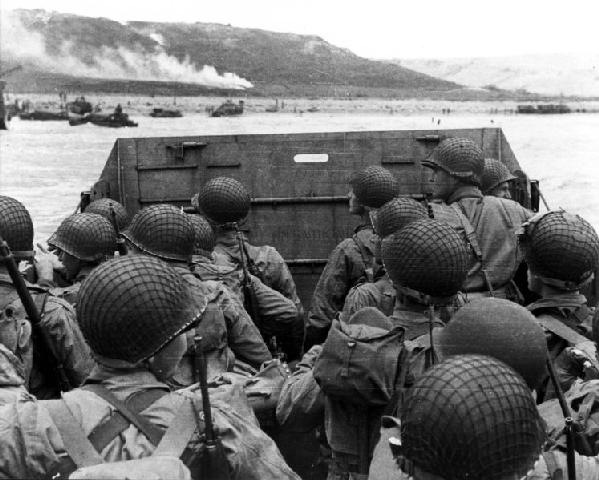
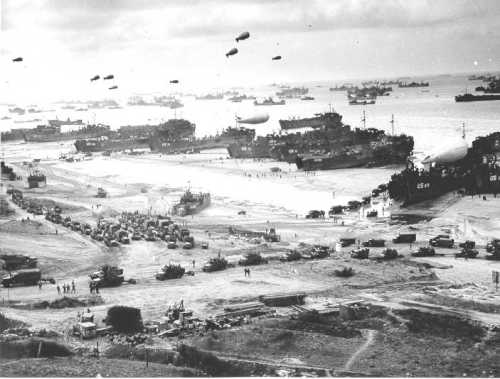
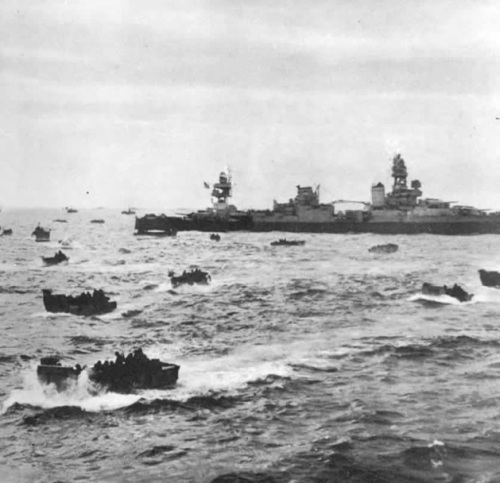
LCVP’s pass USS Augusta

Like the rest of the Allied invasion forces the 1st and 29th Divisions set sail from their embarkation ports with the intent of landing on June 5th.  General Bradley, commanding the First Army until the American Army Group would be activated accompanied the invasion force.  The OMAHA landing was placed under General Gerow and his V Corps while VII Corps landed the 4th Infantry Division landed at Utah supported by airdrops of the 82nd and 101st Airborne Divisions inland.  American command and control was exercised from sea although General Officers went ashore with each of the American divisions.  A severe channel storm disrupted the plan to land on the 5th and Eisenhower delayed the invasion one day catching a break in the weather and electing to go on the 6th.[i] This delay while uncomfortable for the embarked troops caused the Germans to believe that no invasion would take place until the next favorable tide and moon cycle later in the month[ii] a break which caused a number of senior German leaders, including Rommel to be absent from the invasion front when the Allies landed.[iii]

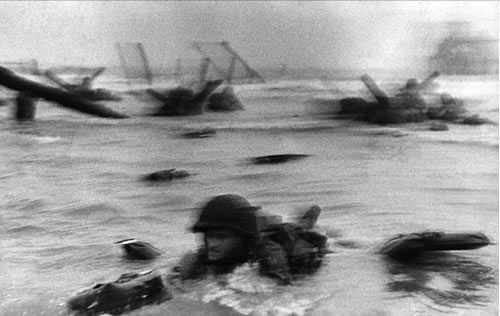
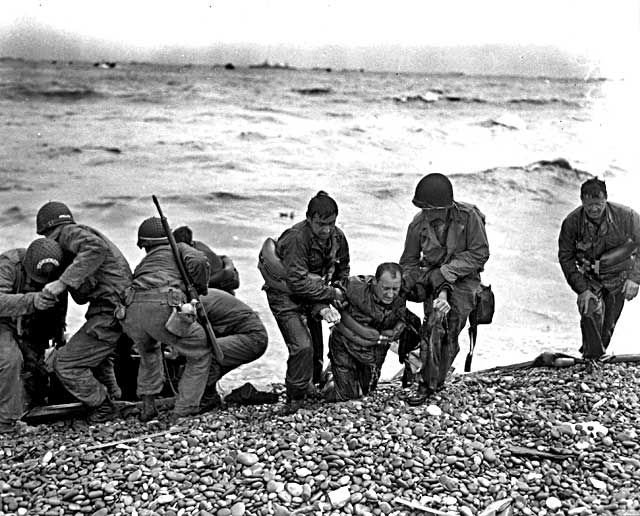
US Soldier struggling in surf at Omaha Beach

The landing beaches at OMAHA stretched about 6500 meters from Colleville-Sur-Mer to Vierville-Sur-Mere in the west.  A further objective to the west of Vierville; Pont du Hoc, was believed to house a 150mm battery sighted where it could enfilade OMAHA and was assigned to the 2nd Ranger Battalion.  Companies from this battalion made a heroic landing and scaled the cliffs to capture the strongpoint only to discover that the guns had not been emplaced and held their isolated beachhead until relieved by the 29th Division on the morning of June 8th.[iv]

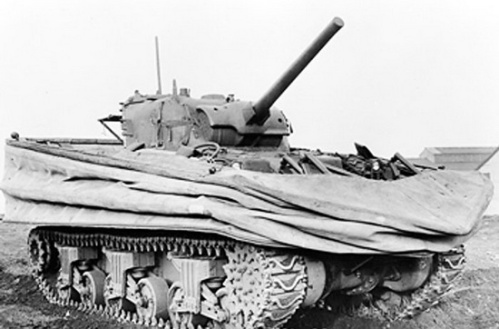
H-Hour for OMAHA was 0630.  Unfortunately the assault troops were transferred to their LCVPs 16-20 kilometers from the beach resulting in a long and dangerous ride in the small craft for the infantry.  Most of the infantry were completely soaked in sea spay and seasick before going ashore carrying loads far above what they normally would carry into battle.[v] One battalion of DD tanks, the 741st Armored Battalion, supporting the 16th Infantry of 1st Infantry Division was launched too far out and nearly all of its tanks were swamped and lost before firing a shot in anger.[vi] Weigley notes that at OMAHA “at least 10 of the LCVPs sank” as did “the craft carrying almost all of the 105mm howitzers that were to be the first artillery ashore after the tanks.”[vii] The losses would cripple the assault on OMAHA and nearly cause its abandonment.

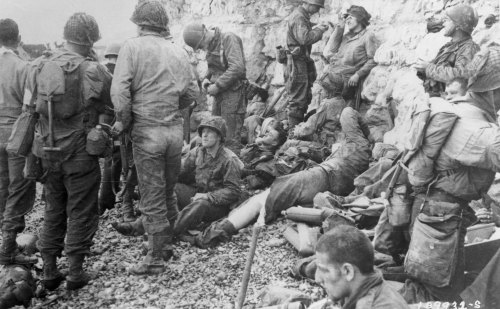
As the soldiers of the American divisions on OMAHA came ashore they faced German defenders of the 352nd, 716th and a regiment of the 709th Infantry Division, the latter under the tactical command of the 352nd.   Without the bulk of their tanks artillery and lacking close air support the Americans struggled across the beaches and were cut down in large numbers before being pinned down behind the sea wall.[viii] As the Americans pinned down on the beach failed to advance the time tables for the reinforcing waves became snarled amid the German beach obstacles which had not been cleared due to 40% casualties among the Combat Engineers and the loss of all but five bulldozers.[ix] Naval officers were frustrated in their attempts to provide support by the lack of identifiable targets on the beaches but strongpoints were “knocked out by either by superbly directed vigorous gunfire from destroyers steaming as close as 800 yards offshore, or by determined action from Rangers or infantry.[x]

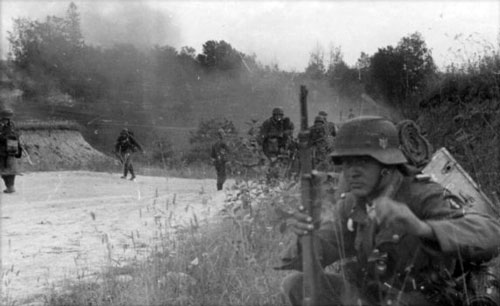
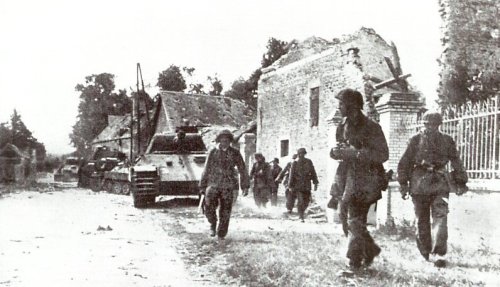
Grenadiers of 352nd Infantry Division move to counter-attack

Soldiers ashore discovered the truth that they were not facing the static 716th Division but the 352nd Division as well.[xi] But for the leadership of Brigadier General Norman Cota, assistant division commander of 29th Infantry Division and Colonel Charles Canham of the 116th Infantry who were able to rally their troops and just enough leaders and small units from the 116th which had its linage back to the “Stonewall Brigade” as well as units of the 1st Divisions’ 16th and 18th Regiments  who kept their heads and began to lead survivors through the dunes and up the bluffs to attack German defenders of the roads leading up from the beach from the flank and rear as well as a mid-day break in the weather which allowed some close tactical air support General Bradley may have ordered the evacuation of OMAHA.

Omaha Beach rescue of wounded from surf

At sea events were as confused as Bradley and his staff attempted to make sense of what was going on.  Even later in the evening there was discussion of diverting all further reinforcements from OMAHA to the British beaches.[xii]At 1330 hours “Gerow signaled Bradley: “Troops formerly pinned down on beaches…advancing up heights behind beaches.”[xiii] By the end of the day Bradley’s aid Major Hansen noted Bradley’s comments to Collins: “They are digging in on Omaha beach with their fingernails. I hope they can push in and get some stuff ashore.”  And Montgomery: “Someday I’ll tell Gen[eral] Eisenhower just how close it was for a few hours.”[xiv]

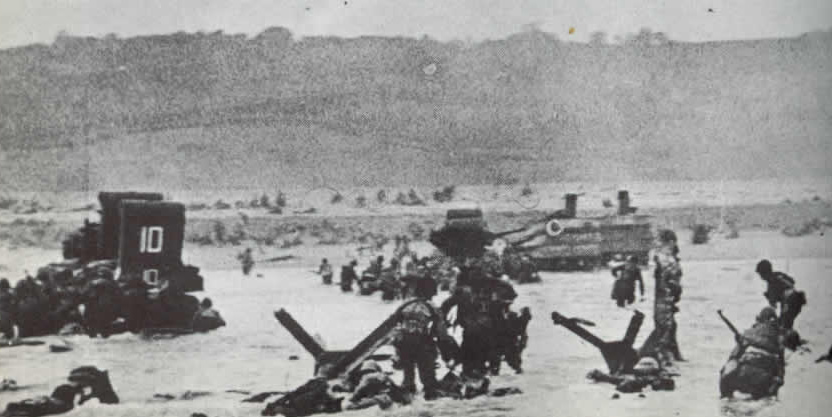
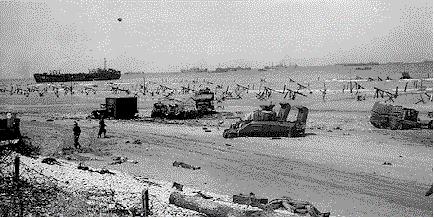
Omaha Beach Wreckage

The landings at OMAHA did succeed at a cost of over 2000 casualties, critical to their success were the German inability to reinforce their defending troops on the beach and the weakness of the units available to mount the standard counterattack that was critical to German defensive plans on D-Day itself. The 352nd Division fought superbly under the full weight of V Corps and the British XXX Corps on its right suffering heavy casualties as they contested every inch of ground.  The 716th Division units melted under the onslaught.  Allied air supremacy played a key role as sorties by the 8th and 9th Air Forces helped keep German reinforcements from arriving and interdicted counter attacks inland.  Weigley credits the Allied air superiority with the success of the landings and with limiting the cost of allied lives.[xv] Von Rundstedt and other German commanders in France were limited by the delay and refusal of Hitler and OKW to release Panzer reserves when needed most early on June 6th.  By the close of D-Day allied forces had secured the five invasion beaches but not achieved their objectives of taking Caen and Bayuex and forces had not linked up leaving the beaches extremely vulnerable had the Germans been able to mount a rapid counterattack by Panzers and strong infantry formations.

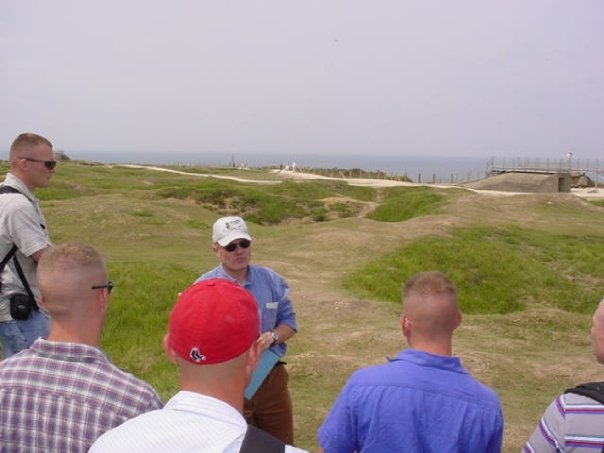
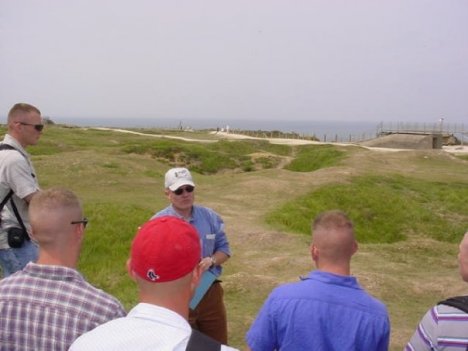
The author lecturing at Pont du Hoc Omaha Beach 2004


[i] Ibid. p.74-75

[ii] Von Luck, Hans.  “Panzer Commander“ Dell Publishing, New York, 1989 pp. 169-170.  Von Luck a regiment commander in 21st Panzer noted that General Marcks of 84th Corps had predicted a 5 June invasion at a conference May 30th.

[iii] Almost every D-Day historian talks about the weather factor and its effect on the German high command’s reaction to the invasion.  Rommel was visiting his wife for her birthday and planned to make a call on Hitler. Others including commanders of key divisions such as the 91st Airlanding Division were off to a war game in Rennes and the 21st Panzer Division to Paris.

[iv] Ibid. Weigley p. 96

[v] See Cornelius Ryan, “The Longest Day” Popular Library Edition, New York 1959. pp. 189-193 for a vivid description of the challenges faced by soldiers going from ship to landing craft and their ride in to the beaches.

[vi] Ibid. Weigley. p.78 Weigley talks about the order for the tanks to be carried ashore on their LCTs that did not get transmitted to the 741st.

[vii] Ibid.

[viii] Ibid. Weigley  p. 87 The weather prevented the aerial bombardment from being effective. Because the bombers could not see their targets they dropped their bomb loads further inland, depriving the infantry of support that they were expecting.  Naval gunfire support had some effect but had to be lifted as the troops hit the beach leaving much of that support to come from Destroyers and specially equipped landing craft which mounted rockets and guns.

[ix] Ibid. Hastings. pp. 90-91.

[x] Ibid. p.99

[xi] Ibid. Weigley p.80

[xii] Ibid. p.101  Also see Weigley p.80

[xiii] Ibid. p.99

[xiv] Ibid. Weigley. p.95

[xv] Ibid. p.94

2 Comments

Filed under History, Military, world war two in europe

Wacht am Rhein: The Battle of the Bulge

The Decision 


            Adolf Hitler gathered with the Chiefs of Oberkommando des Wehrmacht on September 16th 1944 at his “Wolf’s Lair” headquarters in East Prussia.  The situation was critical; he had recently survived an assassination attempt by Army officers led by Colonel Klaus Von Staufenberg at his Wolf’s Lair headquarters in East Prussia.  When the assassination attempt took place the German situation in Normandy was critical. The Americans broke out of the Bocage at St. Lo and spread out across Brittany and the interior of France with Patton’s 3rd Army leading the way.  Even as his commanders in the West pleaded for permission to withdraw to the Seine Hitler forbade withdraw and ordered a counter attack at Mortain to try to close the gap in the German line and isolate American forces. When the German offensive failed the German front collapsed. 40,000 troops, hundreds of tanks and thousands of vehicles were eliminated when the Americans and Canadians closed the Falaise pocket. Despite this cadres of decimated divisions including SS Panzer, Army Panzer and elite Paratroops made their way out of Normandy.  With the Germans in full retreat the Allies advanced to the border of the Reich itself. On the Eastern Front as well disaster threatened when the Red Army launched an offensive which annihilated Army Group Center and advanced to the border of Poland before outrunning supply lines and stalling on the Vistula.

Tiger II Advancing in the Ardennes

            Since Normandy Hitler had wanted to counter attack but had neither the forces nor the opportunity to strike the Allied armies. As the Allied offensive ground to a halt due to combat losses, lack of supplies and stiffening German resistance Hitler maintained a close eye on the situation in the West.  He believed that despite their success that the Americans and British alliance was weak and that a decisive blow could cause one or both to drop out of the war. During a briefing an officer noted the events of the day on the Western Front including a minor counterattack by kampfgrüppen of the 2nd SS Panzer and the 2nd Panzer Divisions which had made minor gains in the Ardennes, Hitler rose from his seat ““Stop!” He exclaimed. “I have come to a momentous decision. I shall go over to the counterattack….Out of the Ardennes, with the objective Antwerp.””[i]

            Thus began the planning for the last great German offensive of WWII.  Hitler “believed that sufficient damage could be inflicted to fracture the Anglo-American alliance, buy time to strike anew against the Soviets, and allow his swelling arsenal of V-weapons to change the course of the war.”[ii]  It was a course of born of desperation, even admitted by Hitler in his briefings to assembled commanders in the week prior to the offensive, one officer noted his remarks: “Gentlemen, if our breakthrough via Liege to Antwerp is not successful, we will be approaching an end to the war which will be extremely bloody. Time is not working for us, but against us. This is really the last opportunity to turn the war in our favor.”[iii]

US Soldiers manhandling a 57mm Anti-Tank Gun into Position

            Despite shortages of men and equipment, continuous Allied assaults and over the objections of General Guderian who argued to reinforce the Eastern Front[iv], the OKW staff secretly developed detailed plans. The planning was so secretive that the “Commander in Chief West and the other senior commanders destined to carry out the attack were not informed.”[v] The plans were submitted to Hitler on October 9th [vi] and presented to Field Marshalls Von Rundstedt and Model at the End of October. General Hasso Von Manteuffel, commander of 5th Panzer Army commented that: “The plan for the Ardennes offensive…drawn up completely by O.K.W. and sent to us as a cut and dried “Führer order.”[vii]  Likewise Model and Von Rundstedt objected to the scope of the attack. Von Rundstedt stated: “I was staggered…It was obvious to me that the available forces were way too small for such an extremely ambitious plan. Model took the same view of it as I did….”[viii]  Model reportedly said to General Hans Krebs: “This plan hasn’t got a damned leg to stand on.”[ix] And “you can tell your Führer from me, that Model won’t have any part of it.”[x] Sepp Dietrich, the old SS fighter and commander of 6th Panzer Army expressed similar sentiments.[xi]  Despite the objections by so many senior commanders Hitler scorned Model’s attempt to float a less ambitious plan to reduce the Allied salient at Aachen. Likewise Von Rundstedt’s desire to remain of the defense and wait for the Allies to attack using the armored forces to launch against any breakthrough was rejected.[xii] Hitler’s mind was set and the preparations moved forward.  The plan was complete down to the timing of the artillery bombardment and axes of advance, and “endorsed in the Führer’s own handwriting “not to be altered.””[xiii] Such a plan flew in the face of the well established doctrine of the Auftragstaktik which gave commanders at all levels the freedom of action to develop the battle as the situation allowed and opportunities arose.

SS General Sepp Dietrich Commander of the 6th SS Panzer Army

          The Germans who the Allies presumed to be at the brink of collapse made a miraculous  recovery following their ghastly losses in Normandy. Kampfgrüppen and remnants of divisions bled the Americans White at the Huertgen Forrest and blunted the British attempt to leapfrog the Northern Rhine at Arnhem decimating the British First Airborne division and causing heavy casualties among other British and American units. The German 15th Army avoided disaster when the British failed to close their escape route from Walchern island allowing 60,000 troops and much equipment to escape.   The Germans re-formed and reorganized the front.  They pulled back many units of the 5th and 6th Panzer Armies for re-fitting and diverted nearly all tank, armored fighting vehicle and artillery production to the West at the expense of the Eastern Front.  The Germans called up 17 year olds and transferred young fit personnel from the Navy and Luftwaffe to the Army and Waffen SS.  Here they were trained by experienced NCOs and officers and brought into veteran units alongside hardened veterans who showed taught them the lessons of 5 years of war.[xiv]  However the rapid influx of new personnel meant that they could not be assimilated as quickly as needed and thus many were not as well trained as they might have been with more time.[xv] Many infantry and Parachute units had received inexperienced officers, taken from garrison duty to fill key positions a problem that would show up during the offensive.[xvi]

Panzer IV Ausf H of an SS Panzer Divsion in the Bulge

            The Germans were aided by the caution displayed by the Allies throughout the campaign in France which allowed the Germans to reconstitute formations around veteran headquarters staffs.[xvii]  The Germans built up the 5th and 6th Panzer Armies as the Schwerpunkt of the offensive giving them the lion’s share of reinforcements and pulling them out of the line during the fall battles along the Seigfried line and in the Alsace and Lorraine.  The plan was for the two Panzer armies and 7th Army to punch through the Ardennes, cross the Meuse, drive across Belgium, capture Antwerp and severe the link between the British and the Americans.

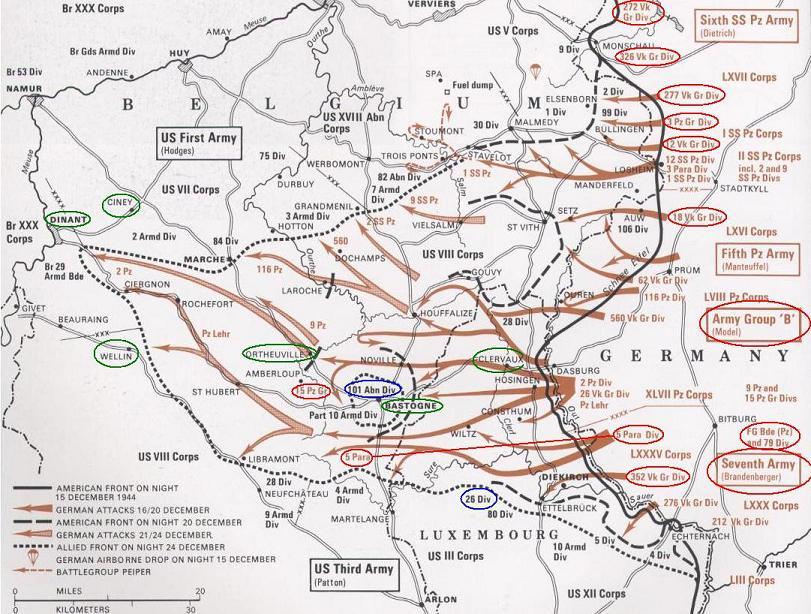
The spearhead of the assault was 6th Panzer Army Commanded by SS General Sepp Dietrich. It was composed of 1st and 2nd SS Panzer Corps and Army’s LXVII Corps.  The 6th SS Panzer Army included some of the best formations available to the German Army at this late stage of the war including the 1st  SS Panzer Division, the Leibstandarte Adolf Hitler, the 2nd  SS Panzer Division Das Reich, the 9th SS Panzer Division Hohenstaufen and the12th  SS Panzer Division Hitler Jügend. It’s ranks were filled out by the 3rd Parachute Division, the 501st SS Heavy Tank Battalion (attached to 1st SS), the 3rd Panzer Grenadier Division and the 12th, 246th, 272nd, 277th and 326th Volksgrenadier or Infantry divisions. The 6th Panzer Army would be the northern thrust of the offensive and its ultimate objective was Antwerp.  The 6th Panzer Army would be aided by a hastily organized parachute battalion under Colonel Von Der Heydte[xviii] and the 150th Panzer Brigade under SS Colonel Otto Skorzeny which included teams of American dialect speaking soldiers in American uniforms and equipment that were to spread confusion and panic in American rear areas.[xix]

Bradley, Eisenhower and Patton at Bastogne

       To the south was the 5th Panzer Army commanded by General Hasso Von Manteuffel.  The 5th Panzer Army was to advance alongside of the 6th Panzer Army with Brussels as its objective.  Composed of the XLVII and LVIII Panzer Corps and LXVI Corps the major subordinate commands included the best of the Army Panzer divisions including the 2nd Panzer, Panzer Lehr, 9th and the16th Panzer division. It also had the elite Führer Begleit Brigade composed of troops from Panzer Corps Grossdeutschland and commanded by Otto Remer who had help crush the coup against Hitler in July.  The 5th Panzer Army also included the 18th, 26th, 62nd, 560th and later the 167th Volksgrenadier divisions.

The south flank was guarded by 7th Army commanded by General Erich Brandenburger composed of LIII, LXXX and LXXXV Corps.  It included the Führer Grenadier Brigade and later the 15th Panzergrenadier division.  It was the weakest of the three armies but eventually included 6Volksgrenadier divisions of varying quality and strength[xx] and the veteran 5th Parachute division.[xxi]  However with only 4 divisions at the start of the offensive the 7th Army was the equivalent of a reinforced corps.

             While this force seemed formidable it had a number of weaknesses beginning with tank strength.  The 1st and 12th SS Panzer divisions were only at approximately half their established tank strengths and faced severe shortages in other vehicles.[xxii]  2nd SS and 9th SS of II SS Panzer Corps reported similar shortages.[xxiii]The shortage of other motorized vehicles, even in Panzer divisions was acute.  “Even the best equipped divisions had no more than 80 percent of the vehicles called for under their tables of equipment, and one Panzergrenadier division had sixty different types of motor vehicles, a logistician’s nightmare.[xxiv] Panzer Lehr was so short in armored half tracks that only one battalion of its Panzer Grenadiers could be transported in them while others had to use “trucks or bicycles.”[xxv]

Limitations on equipment as well as fuel were not the only challenges that the Germans faced. The US V Corps launched an attack on the Roer River Dams just before the offensive making it necessary for the Germans to divert 6th SS Panzer Army infantry divisions and Jagdpanzer units to be used by 6th SS Panzer Army.  One regiment of 3rd Parachute Division and over half of a second division could not take part in the initial 6th Panzer Army attack. Likewise some Jagdpanzer and Sturmgeschutzen units did not arrive until three days after the offensive began.[xxvi]

Allied Response: Before the Battle

            While the German commanders sought to implement Hitler’s plan Allied commanders looked only to completing the destruction of Germany not believing the Germans capable of any major operation.  The Allied commanders with the exception of Patton did not believe the Germans capable of any more than local counter attacks.  Patton’s 3rd Army G-2 Colonel Koch was the only intelligence officer to credit the Germans with the ability to attack.[xxvii]  Most allied commanders and intelligence officers discounted the German ability to recover from disastrous losses, something that they should have learned in Holland or learned from the Soviet experiences on the Eastern front.  Bradley noted in his memoirs hat “I had greatly underestimated the enemy’s offensive capabilities.”[xxviii]  Carlo D’Este noted that “there was another basic reason why the Allies were about to be caught with their pants down: “Everyone at SHAEF was thinking offensively, about what they could do to the enemy, and never about what the enemy might do to them.””[xxix]   This mindset was amazing due to the amount of intelligence from Ultra and reports from frontline units that major German forces were no longer in the line.[xxx] Additionally nearly all commentators note that American units in the Ardennes did not conduct aggressive patrols to keep the enemy off balance and obtain intelligence.[xxxi]  One describes the efforts of 106th Division as “lackadaisical” and notes that enemy before the offensive was not the Germans but the cold.[xxxii] Max Hastings noted that: “the Allies’ failure to anticipate Hitler’s assault was the most notorious intelligence disaster of the war.”[xxxiii]

The Allies also were in the midst of a manpower crisis. Eisenhower did not have enough divisions to establish a clear manpower advantage as “there were not enough Anglo-American divisions, or enough replacements for casualties in the existing divisions.”[xxxiv]  No more American Infantry divisions were available as the Army had been capped at 90 divisions and infantry replacements were in short supply.  This shortage meant that Eisenhower could not pull divisions out of line to rest and refit. He could only transfer divisions such as the 4th and 28th Infantry divisions to the relative quiet of the Ardennes. He had no ability to “create a strategic reserve unless he abandoned the broad front strategy.”[xxxv] The Germans knew of the allied weakness and believed that they could achieve local superiority even if they did not believe they could reach Antwerp. Model believed that “he was sure that he would reach the Meuse in strength before the Americans could move sufficient reserves to halt his armies or even head them off.”[xxxvi]

American Response: The Breakthrough

            The German assault began on December 16th. Some breakthroughs were made especially in the vicinity of the Losheim Gap and the Schnee Eifel by the southern elements of 6th Panzer Army and Manteuffel’s 5th Panzer Army. However the Germans could not break through around Monschau and Elsenborn Ridge held by the inexperienced but well trained 99th Infantry division and elements of the veteran 2nd “Indianhead” Division.  In the far south near Diekirch the 4th Infantry Division held stubbornly against the attacks of 7th Army’s Volksgrenadiers. The Germans achieved their greatest success at Losheim where SS Colonel Josef Peiper and his 1st SS Panzer Regiment had driven off the US 14th Cavalry Group and penetrated 6 miles into the American front.  5th Panzer Army made several breakthroughs and isolated two regiments of newly arrived 106th Infantry Division in the Schnee Eifel. Manteufel also pressed the 28th Division hard along the Clerf River, Skyline Ridge and Clairvaux.  Yet at ‘no point on that first day did the Germans gain all of their objectives.”[xxxvii]  The credit goes to US units that stubbornly held on, but also to the poor performance of many German infantry units.  German commanders were frustrated by their infantry’s failure even as the panzers broke through the American lines.  Manteuffel noted his infantry was “incapable of carrying out the attack with the necessary violence.”[xxxviii]

US Airborne Commanders James Gavin (R) and Matthew Ridgeway (L)

            The initial Allied command response to the attack by senior commanders varied.  Bradley believed it was a spoiling attack “to try and force a shift of Patton’s troops from the Saar offensive back to the Ardennes.”[xxxix] Courtney Hodges of 1st Army agreed with Bradley and refused to allow General Gerow, commander of V Corps to call off 2nd Infantry Division’s attack against the Roer dams on the 16th in order to face the German offensive.[xl]  Gerow was one of the first American commanders to recognize the scope of the German attack but Hodges, perhaps the least competent senior American commander in Europe failed to heed Gerow’s advice. Soon after making this decision Hodges “panicked” and evacuated his headquarters at Spa fearing that it would be overrun by the advancing Germans.[xli] Eisenhower when informed of the news realized that something major was occurring and ordered the 7th Armored Division from the 9th Army and 10th Armored Division from 3rd Army into the Ardennes. On the 17th he made other dispositions and released the 82nd and 101st Airborne Divisions from SHAEF reserve at Rheims to the Ardennes under the command of XVIII Airborne Corps.[xlii]  However during this short amount of time Mantueffel’s panzers had advanced 20 miles.

SS Panzer Troops of Kampfgruppe Knittel on the advance.  Photo has often been identified for decades in books and other publications as Waffen-SS Colonel Joachim Peiper the commanding officer of the 1st SS Panzer Regiment and Kampfgruppe Peiper. This has been refuted by recent study.  Peiper is pictured below.

            At the command level Eisenhower made a controversial, but correct decsion to divide the command of the Bulge placing on a temporary basis all forces in the northern sector under Montgomery and leaving those to the south under Bradley.  Montgomery according to one commentary initially “had been astonishingly tactful in handing his American subordinates.”[xliii] However he quickly made himself obnoxious to many American commanders.[xliv] Following the battle Montgomery made the situation worse by claiming to have saved the Americans and giving credit to British units which scarcely engaged during the battle.[xlv]  Eisenhower also ordered Patton to launch a counter-attack along the southern flank of the German advance.  However Patton was already working on such an eventuality and promised to be able to launch a counterattack with three divisions by the 22nd.[xlvi]  Bradley praised Patton highly in his memoirs noting: “Patton’s brilliant shift of 3rd Army from its bridgehead in the Saar to the snow-covered Ardennes front became one of the most astonishing feats of generalship of our campaign in the West.”[xlvii]

American Response: the Shoulder’s Hold

                The 99th Division’s position was precarious, its right flank was subject to being turned and it was suffering severely at the hands of 12 SS Panzer and several Volksgrenadier divisions.  Gerow reinforced the 99th with elements of the 2nd Infantry division even before he had the final authorization to end its attack.  The two divisions stubbornly held Elsenborn Ridge and the villages of Rockerath, Krinkelt and Büllingen. By the 20th the 9th and 1st Infantry divisions arrived to strengthen the defense and lengthen the line to prevent it from being rolled up by the Germans.  The stubborn resistance of the Americans and arrival of reinforcements meant line was proof “against anything Sepp Dietrich might hurl against it”[xlviii]  By the 23rd Dietrich and 6th SS Panzer Army conceded defeat at Elsenborn and “turned its offensive attentions to other sectors.”[xlix]  German commanders like General Priess the commander of 1st SS Panzer Corps believed that terrain and road network in this sector was unfavorable to the German offensive and had proposed moving the attack further south.[l]  The Panzers could not deploy properly and the German infantry was not up to the task of driving the Americans out of their positions before the reinforcements arrived.

In the south the 4th Infantry Division held the line though heavily pressed by Brandenburger’s 7th Army.  The division was reinforced by elements of both 9th and 10th Armored divisions on the 17th and generally held its line along the Sauer River around Echternach “largely because the left flank of the enemy assault lacked the power-and particularly the armor-of the thrust farther north.”[li]

Turning Point: The Destruction of Kampfgruppe Peiper

            While V Corps fought the 6th Panzer Army to a standstill, to the south 1st SS Panzer Division led by Kampfgrüppe Peiper split the seam between V Corps and VIII Corps. The Kampfgrüppe moved west leaving a brutal path of destruction in its wake, including massacres of American POWs and Belgian civilians.[lii]  However its advance was marked with difficulty. On the night of the 17th it failed to take Stavelot. After clearing the American defenders from the town after a hard fight on the 19th it failed to capture a major American fuel dump a few miles beyond the town.  When the Germans approached the American commander ordered his troops to pour 124,000 gallons down the road leading to the dump and set it on fire, depriving the Germans of badly needed fuel.[liii]  Combat Engineers from the 291st Engineer Battalion blew a key bridge across the Ambleve at Trois Ponts and another bridge across the Lienne Creek which left the Germans bottled up in the Ambleve River valley.  This bought time for the 30th Infantry Division to set up positions barring Peiper from the Meuse.  The 30th would be joined by Combat Command B of 3rd Armored Division and elements of 82nd Airborne. These units eventually forced Peiper to abandon his equipment and extricate some 800 troops by foot by the 23rd after a hard fight with the Americans who had barred his every effort to break through to the Meuse.

Turning Point: The Crossroads: St Vith & Bastogne

            The battle rapidly became focused on key roads and junctions, in particular St. Vith in the north and Bastogne in the south.  At St. Vith the 7th Armored Division under General Hasbrouck, who Chester Wilmont calls one of the “great men of the Ardennes”[liv] completed a fifty mile road march from Aachen to St. Vith.  On his arrival he deployed his combat commands around the town which was the key to the road network in the north and also to the only rail line running west through the Ardennes.[lv]  Hasbrouck gathered in Colonel Hoge’s Combat Command B of 9th Armored Division and the 424th Infantry Regiment of the 106th Division into his defensive scheme as well as the survivors of the 112th Infantry Regiment of the 28th Infantry Division which had escaped the German onslaught after holding as long as possible along the Clerf River and Skyline Drive.[lvi]  With these units Hasbrouck conducted “an eight-day stand that was as critical and courageous, as the defense of Bastogne.”[lvii]  After holding the Germans at St. Vith the units were withdrawn to another defensive position along the Salm and Ourthe Rivers and the village of Viesalm.  This was done at the behest of Montgomery and General Ridgeway of XVII Airborne Corps whose 82nd Airborne had moved into that area on the 19th.  The arrival of the 82nd greatly assisted Hasbrouck’s force holding St. Vith whose defenders had lost an estimated 5000 casualties.[lviii]

The stand at St. Vith confined the “confined the Sixth Panzer Army’s penetration to a chokingly narrow corridor.”[lix]  It also posed a problem for German command and control which because it was out of the 6th Panzer Army’s area of operations Dietrich was unable to lend his weight into the fight.  “Hitler himself had strictly prohibited deviations from the zonal boundaries”[lx] which left the fight for St. Vith in the hands of 5th Panzer Army who felt the impact of the stand as the Americans “also choked off one of the Fifth Panzer Army’s best routes to Bastogne, almost nullifying the significance of the captured road junction at Houffalize.”[lxi]

To the south of St. Vith lay Bastogne, another key road junction needed by 5th Panzer Army for its advance.  On the night of the18th Panzer Lehr division came within two miles of the town before being checked by resistance by units of the 10th Armored division, remnants of 28th Division and misdirection by “friendly” Belgian guides onto a muddy path that helped halt their advance.[lxii]  This gave the 101st Airborne just enough time to get to the town and prevent its capture. The siege of Bastogne and its defense by the 101st elements of 9th and 10th Armored Divisions and 28th Division became an epic stand against Manteuffel’s Panzers which had surged around the town.  Wilmont comments that “had the Germans won the race for Bastogne, Manteuffel’s armor would have had a clear run to Dinant and Namur on December 19th and 20th[lxiii] when there were only scattered American units between them and the Meuse. Manteuffel b bypassed Bastonge after the failure to capture it and masked it with 26th Volksgrenadier Division and a regiment of Panzer Lehr.  The remainder of Panzer Lehr and the 2nd Panzer Division moved to the west. [lxiv]  The garrison endured numerous attacks and on the 22nd one of the most celebrated incidents of the war took place when Brigadier General Anthony McAuliffe responded to a demand for the surrender of the town with the reply; “Nuts.”  The town would continue to hold until relieved by 3rd Army on the afternoon of December 26th.[lxv]

Allied Response: The Counterattack


            The Allied counterattack began with 3rd Army in the south on 21 December.  Patton’s initially proposed to attack toward the base of the Bulge in order to cut off the largest number of Germans possible.  Eisenhower dictated an attack further west with the goal of relieving Bastogne.  Eisenhower wanted to delay the attack to concentrate combat power while Patton wanted to attack sooner in order to ensure surprise. Patton got his way but attacked on a wide front.  The attack lost its impetus and bogged down into a slugging match with 7th Army’s infantry and paratroops along the southern flank. [lxvi]  Patton’s failure to concentrate his forc forces for the advance to the north diminished his combat power.[lxvii] While Patton attacked from the south the 1st Army dealt with the advanced spearhead of 2nd Panzer Division which had reached the town of Celles and ran out of gas just four miles from Dinant and the Meuse. The 84th Infantry Division stopped the 116th Panzer division from being able to effect a relief of the 2nd Panzer the US 2nd Armored Division and allied fighter bombers chopped up the virtually immobile 2nd Panzer division completing that task by the 26th.[lxviii]

To the north Montgomery launched a cautious counterattack which slowly and methodically took back lost ground but allowed many Germans to escape. While Montgomery moved south Patton faced heavy German resistance from elements of 5th Panzer Army, reinforced by 1st SS Panzer Corps and 7th Army.  The rupture in the American front was not repaired until 17 January when the American forces met at Houffalize.[lxix] Bradley took over for Montgomery and the Americans pushed the Germans slowly back across the Clerf River by the 23rd.  The advance was hampered by tough German resistance and terrible weather which forced much of the attack to be made by dismounted troops as the roads had completely frozen over.[lxx]

The Allied counter attack has been criticized for allowing too many Germans to escape what could have been a major encirclement.  Patton recognized the incompleteness of the victory in the Ardennes stating: ““We want to catch as many Germans as possible, but he is pulling out.” The “but” clause, the note of regret, the awareness of the imperfection of his victories typified Patton.””[lxxi]  Patton in his memoirs notes: “In making the attack we were wholly ignorant of what was ahead of us, but we were determined to strike through to Bastogne.”[lxxii] Max Hastings simply said: “the Allies were content with success.”[lxxiii]  Murray and Millett place blame on Bradley and Hodges for choosing “merely to drive the enemy out of the Ardennes rather than destroy him.”[lxxiv]

Analysis: Could Wacht Am Rhein Have Worked?

          Could Wacht am Rhein worked?  If much was different, yes.  If the German had been stronger in tanks and vehicles and had adequate stocks of fuel; if their infantry was better trained, and had the Americans not resisted so stubbornly it might have at least got to the Meuse.  Perhaps if the the bad weather held keeping Allied air forces away from the Germans, or had St. Vith and Bastogne been taken by the 18th or 19th, they might have reached the Meuse.  Had the Germans executed their plan and coordinated their assault better[lxxv] in the 6th Panzer Army sector and had the 7th Army enough strength to conduct offensive operations in depth and secure the left flank the attack might have succeeded.  Because the Americans held the shoulders and road junctions, Manteuffel’s 5th Panzer Army, the only force besides the regimental sized Kampfgrüppe Peiper to actually threaten the Meuse was forced to advance while attempting to take Bastogne and defeat 3rd Army’s counterattack. Whether they could have made Antwerp is another matter.  Nearly all German commanders felt the offensive could not take Antwerp but did believe that they could inflict a defeat on the Allies and destroy a significant amount of allied combat power.

The German offense was a desperate gamble.  Too few divisions, scant supplies of petrol, formations that had recently been rebuilt and not given enough time to train to the standard needed for offensive operations coupled with Hitler’s insistence on an unalterable plan kept them from success.  At the same time the Allies were weak in troops as Eisenhower had no strategic reserve save the two American Airborne Divisions.  All reinforcements to the threatened sector had to come from the flanks and by the middle of the battle the 9th Army was drawn down to two divisions. Russell Weigley notes the constraints imposed by the 90 division Army, and of the limited stocks of artillery ammunition.[lxxvi] If the Germans had more forces they might have inflicted a significant defeat on the Allies had they been able to reinforce their success in depth.  Despite this they still inflicted punishing losses on the Americans though suffering greatly themselves.  Hastings notes that the real beneficiaries of the Ardennes offensive were the Russians.[lxxvii]  It is unlikely that the offensive could have ever achieved Hitler’s goals of taking Antwerp and fracturing the British-American alliance.

A Note About other Parts of the Campaign in France

The Riviera and Rhone

            The campaign in south France was strategically wise although opposed by the British to the last minute because they felt it would take away from Overlord.[lxxviii] Though delayed the campaign was well executed by 7th Army, particularly Lt. General Lucian Truscott’s VI Corps of 3 American divisions. Truscott believed “destroying the enemy army was the goal”[lxxix] managed the battle well and skillfully maneuvered his small forces against Blaskowitz’s 19th Army inflicting heavy losses, though some German commanders noted the caution of American infantry in the attack.[lxxx]  Only Blaskowitz’s tactical skills and the weakness of the American force prevented the Germans from disaster. The seizure of Marseilles and Toulon provided the allies with sorely needed ports that were invaluable to sustain the campaign.[lxxxi]

The Lorraine Campaign

            Patton attacked in the Lorraine with the goal of crossing the Moselle and attempting to break into Germany. He doing so he ran into some of the strongest German forces on the front and bogged down in the poor terrain and mud of the region.[lxxxii]  Patton was delayed in making his assault due to his place “at the far end of the logistics queue.”[lxxxiii] German forces skillfully defended the ancient fortress of city Metz forcing the Americans into a protracted campaign to clear the area with the last strongpoint surrendering on 13 December.  Patton is criticized for his failure to concentrate his forces[lxxxiv] but American tactics were less to blame than the weather, German resistance and shortages of infantry.[lxxxv] In some cases American infantry units performed admirably, particularly 80th Division’s assault on the Falkenburg Stellung.[lxxxvi]Liddell Hart criticized the Allies for failing to attack through the then weakly defended Ardennes, commenting: “By taking what appeared to be the easier paths into Germany the Allies met greater difficulties.”[lxxxvii]

The Huertgen Forrest

            The Huertgen Forrest was the worst managed American fight Western European campaign. [lxxxviii] General Courtney Hodges leadership was poor.[lxxxix] In the Huertgen he fed division after division into a battle that made no strategic sense.  American infantry performed poorly and took extremely heavy casualties leaving four divisions shattered.[xc]  Poor American tactics demonstrated by attacking into a forest in poor weather without concentration negated all of Hodges’ advantages in tanks, artillery and airpower. The forest contained no significant German forces capable of threatening any American advance[xci] and its gain offered little advantage.[xcii] Hastings noted that the gains the only saving grace was that it made it easier for the northern shoulder of the Bulge to hold[xciii]   General Model and his subordinates expertly handled their handful of excellent but weary divisions in this battle using terrain, weather and prepared defensive positions to contest nearly every yard of the Forrest.[xciv]

Conclusions

            The lessons of the Bulge and the other campaigns on the German-French border are many and can be gleaned from Allied and German mistakes. On the Allied side the most glaring mistakes were assumptions prior to the German attack that the Germans were incapable of any serious offensive and ignoring the fact that the Germans had attacked through the Ardennes in 1940.  Likewise the self limitation of the American Army to 90 divisions for world-wide service meant that there were no more divisions in the pipeline and that worn out divisions would have to be reinforced with inexperienced troops while in the front line which ensured a lack of cohesiveness in many divisions, especially the infantry.  Allied intelligence failures as well as their reliance of forces much smaller than they should have had for such a campaign ensured that they would suffer heavy losses in the Bulge while poor planning and execution by Hodges wasted many good troops in a senseless battle.  The Germans were hamstrung by Hitler’s fantasy that the Western Allies could be forced out of the war or the Alliance split by a defeat in the Ardennes.  Likewise German forces, even those so quickly reconstituted were often short troops, tanks and vehicles.  German commanders were forced by Hitler’s rigid insistence on not altering the plan to not be as flexible as they might have been in earlier offensives to adjust according to the situation on the ground.


[i] Dupay, Trevor N.  Hitler’s Last Gamble: The Battle of the Bulge December 1944-January 1945Harper Collins Publishers, New York NY 1994 p.2.

[ii] Hastings, Max. Armageddon:  The Battle for Germany 1944-1945 Alfred A Knopf, New York NY 2004 p.197.

[iii] Reynolds, Michael. Sons of the Reich: II SS Panzer Corps; Normandy, Arnhem, Ardennes, and on the Eastern Front.  Casemate Publishing, Havertown PA 2002 p.186

[iv] Ibid. p.198

[v] Warlimont, Walter. Inside Hitler’s Headquarters 1939-1945 translated by R.H. Barry. Presidio Press, San Francisco, CA 1964. p. 480

[vi] Ibid.

[vii] Liddell Hart, B.H. The German Generals Talk. Originally published 1948, Quill Publishers Edition, New York 1979 p.274.

[viii] Liddell Hart, B.H. The History of the Second World War G.P. Putnam’s Sons, New York NY 1970. p.646.

[ix] MacDonald, Charles B. A Time for Trumpets: The Untold Story of the Battle of the Bulge William Morrow and Company, New York, NY 1985 p.35.

[x] [x] Newton, Steven H. Hitler’s Commander: Field Marshal Walter Model, Hitler’s Favorite General.DeCapo Press, Cambridge MA 2005. p.329

[xi] Ibid. Hastings p.198.  Hastings quotes Dietrich: “All Hitler wants me to do is cross a river, capture Brussels, then go on and take Antwerp. And all this at the worst time of year through the Ardennes when the snow is waist-deep and there isn’t enough room to deploy four tanks abreast let alone armored divisions. When it doesn’t get light until eight and it’s dark again by four and with re-formed divisions made up chiefly of kids and sick old men-and at Christmas.”

[xii] Ibid. Liddell-Hart The German Generals Talk p.276

[xiii] Wilmont, Chester. The Struggle for Europe Harper and Brothers Publishers, New York, NY 1952 p.576

[xiv] Ibid. p.557.

[xv] Ibid. Hastings. p.199. Hastings notes that Manteuffel said: “It was not that his soldiers now lacked determination of drive; what they lacked were weapons and equipment of every sort. Von Manteuffel also considered the German infantry ill trained.”

[xvi] Ibid. Dupay.p.47  Dupay notes that in 3rd Parachute Division that most of the regimental commanders had no combat experience.

[xvii] Weigley, Russell  F. Eisenhower’s Lieutenants: The Campaign in France and Germany 1944-1945. Indiana University Press, Bloomington IN 1981 p.432.  Weigley speaks of Allied caution and predictable strategy, caution in logistical planning which did not allow the Allies to provide the fuel needs for a rapid drive into Germany and caution of operational commanders.

[xviii] Liddell Hart discusses the issue of paratroops at length in discussions with Manteuffel and General Kurt Student. At the time of the operation there were very few jump trained paratroops available for the operation as most of the 6 organized Parachute Divisions were committed to battle as infantry during the 1944 battles in the East, Italy and in the West. German Generals Talk pp.282-285.  Although Liddell Hart makes note of the employment of these troops and talked with Model and student about why they were not used to seize bridges and other critical terrain featured ahead of the Panzers instead of the use as a blocking force, I have found no one who questioned why the Germans did not use small glider detachments for the same purpose.  The Germans had demonstrated with Skorzeny when they rescued Mussolini from his mountain prison that they still retained this capability.  The use of the SS Paratroop battalion which could have been assigned to Skorzeny as a glider borne force could have been decisive in capturing the key bridges and terrain ahead of 6th Panzer Army.

[xix] Skorzeny’s operation was Operation Greif designed to sow confusion in the Allied Ranks.  His brigade numbered about 3500 men and had a good number of captured US vehicles including some tanks and tank-destroyers on hand to confuse American units that they came in contact with.

[xx] Ibid. Hastings.  p. 199.  Hastings quotes the Adjutant of 18th Volksgrenadier Division who “felt confident of his unit’s officers, but not of the men “some were very inexperienced and paid the price.”  MacDonald notes that the division had many Navy and Air Force replacements but was at full strength. p.646.

[xxi] See MacDonland pp. 644-655 for a detailed commentary on the German Order of Battle.

[xxii] Reynolds, Michael. Men of Steel: 1st SS Panzer Corps;  The Ardennes and Eastern Front 1944-1945 Sarpendon Publishers, Rockville Center NY, 1999. pp.36-37.  Reynolds notes that the 1st SS Panzer Regiment only had 36 Panthers and 34 Mark IV Panzers to begin the operation (excluding the attached 501st SS Heavy Tank Battalion).  He also notes that many of the tank crew replacements had no more than 6 weeks of military training and some of the tank crews had never been in a tank.  Similar problems were found in all the Panzer Divisions.  Severe shortages of armored half tracks, reconnaissance vehicles and other vehicles meant that Panzer Grenadier and Motorized battalions lacked the lift needed and some went on foot or on bicycles.

[xxiii] Ibid. Reynolds. Sons of the Reich. P.183

[xxiv] Ibid. MacDonald. p.44.

[xxv] Ibid.

[xxvi] Ibid. Dupay pp. 27-28.

[xxvii] Ibid. MacDonald. p.52.  MacDonald notes that Koch warned that the Germans were not finished, that “his withdraw, though continuing has not been a rout or mass collapse.” He calls Koch a “lone voice” in the Allied intelligence world.

[xxviii] Bradley, Omar  N. A Soldier’s Story Henry Holt and Company, New York NY 1951. p.459.  Weigley makes some poignant calling Bradley’s comments  “contradictory” and states that: “his apologia is hardly a model of coherence. (p.461)

[xxix]  D’Este, Carlo. Eisenhower: A Soldier’s Life Owl Books, Henry Holt and Company, New York NY 2002. p.638

[xxx] Dupay and others talk about this in detail. See Dupay pp. 35-44.

[xxxi] Ibid. p.38.

[xxxii] Ibid. Hastings. p.201

[xxxiii] Ibid. Hastings. p.199

[xxxiv] Ibid. Weigley. p.464

[xxxv] Ibid.

[xxxvi] Ibid. Wilmont. P.581.

[xxxvii] Ibid. p.583

[xxxviii] Ibid. Hastings. p.223

[xxxix] Ibid. Weigley. P.457

[xl] Ibid. p.471

[xli] Ibid. Hastings. pp.205-206

[xlii] Ibid. Wilmont. pp.583-584

[xliii] Murray, Williamson and Millett, Allan R. A War to Be Won: Fighting the Second World War The Belknap Press of Harvard University Press, Cambridge Massachusetts and London England, 2000 p.470 The authors must base their conclusion on the fact that Montgomery who mentioned to Eisenhower that Hodges might have to be relieved, did not do so and by the next day told Eisenhower that the action was not needed.  A  few other American commanders in the north were favorable to Montgomery but this appears to be a minority view.

[xliv] Ibid. Weigley. pp.504-506.  Weigley and Wilmont both note the comment of a British Staff Officer the Montgomery “strode into Hodges HQ like Christ come to cleanse the temple.” (Wilmont p.592)

[xlv] Ibid. Hastings. pp.230-232.  Hastings is especially critical of Montgomery.  Weigley, equally critical notes regarding  the January 7th press conference, Montgomery’s “inability to be self critical at any point.” p.566.

[xlvi] Ibid. Weigley. p.500.

[xlvii] Ibid. Bradley. p.472  Other commentators differ in their view of Patton’s movement.  Wilmont notes that Patton had no “equal in the on the Allied side in the rapid deployment of troops. (p.589) Weigley urges readers that “it should be kept in appropriate perspective; it was not a unique stroke of genius.” And he compares it to Guderians disengagement with Panzer Group 4 and 90 degree change of direction and assault against the Kiev pocket in the 1941 Russian campaign (p.500)  Hastings notes that “Patton had shown himself skilled in driving his forces into action and gaining credit for their successes. But he proved less effective in managing a tough, tight battle on the southern flank.” (p.230)  Regardless of the perspective and criticism Patton’s movement was unequaled by any Allied commander in the war and had he not moved so quickly the 101st Airborne might not have held Bastogne. Admittedly his attack north was dispersed along a wide front but part of the blame for this must be assigned to Eisenhower who dictated the attack toward the west vice the base of the Bulge where Patton desired to make it.  A note I would make is that being a cavalryman Patton thought like one and when faced with the tight battles in close quarters was not at his best.  Similar comparisons could be made to J.E.B. Stuart at Chancellorsville when he had to take command of Jackson’s Corps.

[xlviii] Ibid. Weigley. p.475

[xlix] Ibid. p.474

[l] Ibid. Reynolds Men of Steel pp.51-52.

[li] Ibid. Weigley. p.470

[lii] The worst of these took place at the village of Malmedy where Battery B 285th Field Artillery Observation Battalion of 7th Armored Division was captured and about 150 soldiers were rounded up and machined gunned in a field with survivors killed with pistol shots in the head.

[liii] Ibid. Weigley. pp.478-479.

[liv] Ibid. Wilmont. p.584

[lv] Ibid. Weigley. p.487

[lvi] Ibid. Weigley. pp.486-487

[lvii] Ibid. Hastings. p.215. Hastings gives most of the credit to Brigadier General Bruce Clarke of CCB 7th Armored Division for the stand.

[lviii] Ibid. MacDonald. 481-487.  MacDonald notes that following the war that the commanders of the units involved “would be grateful to Field Marshal Montgomery for getting them out of what they saw as a deathtrap for their commands. (p.487)

[lix] Ibid. Weigley. p.487

[lx] Ibid.

[lxi] Ibid.

[lxii] Ibid. Hastings. p.217 Also  MacDonald. p.289 who talks of the confused situation east of Bastogne both for the Americans and Germans.

[lxiii] Ibid. Wilmont. p.598

[lxiv] Ibid. Liddel Hart. The German Generals Talk. p.288

[lxv] The defense of Bastogne would continue until after the 1st of January as Hitler renewed the attempts to secure the town in order to push on to the Meuse. Other German formations including units of 1st SS Panzer Corps shifted south from their original attack would make determined efforts to dislodge the stubborn American defenders.

[lxvi] Ibid. Weigley. pp.500-501.  Bradley gives Patton more credit than later commentators. Wilmont notes that the Germans though “amazed at the speed with which Patton had disengaged from the Saar and wheeled them northward…they received due warning of his movement by monitoring the radio net which controlled American traffic, and they were braced to meet his assault. (p.599).

[lxvii] Ibid. Weigely. Pp.520-521

[lxviii] Ibid.  pp.535-537

[lxix] Ibid. pp. 558-561

[lxx] Ibid. pp.563-564

[lxxi] Ibid. p.566.

[lxxii] Patton, George S. War as I Knew It  Originally published by Houghton Mifflin Company NY 1947, Bantam Paperback Edition,  Bantam Books, New York, NY 1980 p.364

[lxxiii] Ibid. Hastings. p.230

[lxxiv] Ibid. Murray and Millett p.471.

[lxxv] Hastings notes that “Tactically, the Ardennes was one of the worst-conducted German battles of the war, perhaps reflecting that none of the generals giving the orders saw any prospect of success. (p.236)

[lxxvi] Ibid. Weigley. pp.567-572

[lxxvii] Ibid. Hastings. p.236-237.  Hastings believes that the employment of the 5th and 6th Panzer Armies in the East “made the task of Zhukov and his colleagues much harder.”

[lxxviii] Ibid. Weigley. p.236. I find it interesting that neither Hastings nor Liddell Hart mention the Riviera and Rhone campaign.

[lxxix] Ibid. Weigley. p.236

[lxxx] Giziowski, Richard. The Enigma of General Blaskowitz  Hippocrene Books Inc. New York NY, 1997. p.328

[lxxxi] Ibid.  Weigley comments on how much the overall supply situation was aided by the operation and capture of the ports and notes that the pace of the Cobra breakout had created a crisis in supply and “without the southern French ports the crisis would have been insurmountable.” (p.237)

[lxxxii] Ibid. p.397.  Weigley notes: “The immobilizing mud and the enemy’s recalcitrant resistance had fragmented the battle into affairs of squads, platoons, companies and battalions….and Patton’s juniors more than he controlled the course of action, to the extent that control was possible.”

[lxxxiii] Ibid. p.384

[lxxxiv] Ibid. p.390 Weigley states: “The American disinclination to concentrate power was rarely more apparent.” comparing the frontages of 1st, 9th and 3rd Armies and notes that Patton attacked along his entire front.”

[lxxxv] Ibid. Weigley. pp.400-401.  Weigley spends a fair amount of time on American infantry shortages in 3rd Army.

[lxxxvi] Ibid. Weigly. P.400.  Weigley notes a German General Wellm attributed part of that victory to the “prowess of the American infantry.”

[lxxxvii] Ibid. Liddell Hart. The History of the Second World War p.560

[lxxxviii] Hastings and Weigley both note how many American division and regimental commanders were relieved of command for their failures in the Huertgen.

[lxxxix] Ibid. Hastings. p.179.  Hastings notes that “instead of recognizing the folly of attacking on terrain that suited the Germans so well, Courtney Hodges reinforced failure.”

[xc] Ibid. Weigley. p.420.  Weigley notes the high numbers of ballet and non battle casualties in the 4th, 8th, 9th and 28th Divisions as well as CCR of 5th Armored and 2nd Ranger Battalion.

[xci] Ibid. Hastings. p.275.  Hastings notes that defending 275th Division “were poor grade troops who-like the garrison of Aachen posed no plausible threat to the flanks of an American advance to the Roer.”

[xcii] Weigley compares the battle in its effect on the American army to Grants “destruction of the Confederate army in the Wilderness-Spotsylvania-Cold Harbor campaign expended many proud old Union army formations…” (p.438)

[xciii] Ibid. Hastings. p.215

[xciv] Ibid. Newton. p.324

7 Comments

Filed under History, Military, world war two in europe

The American Campaign in Normandy

Note: This is the first of a series of four articles dealing with the campaign in France and Germany in 1944-1945.  The second installment “Mortain to Market-Garden” was posted a couple of months back. The link to that article is here: https://padresteve.wordpress.com/2009/09/17/mortain-to-market-garden-a-study-in-how-armies-improvise-in-rapidly-changing-situations/

The others should be posted in the coming weeks.


Introduction

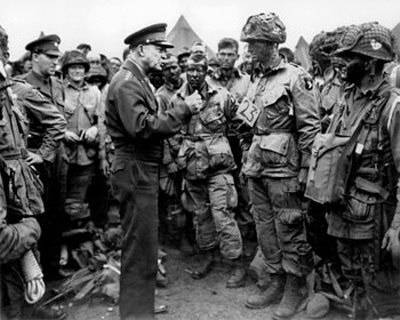
eienhower and 101stEisenhower and 101st Airborne

The American landings on Omaha Beach were critical to the success of the Allied invasion northwestern Europe in the overall Overlord plan.  Without success at Omaha there would have been a strong chance that the German 7th Army and Panzer Group West could have isolated the remaining beachheads, and even if unsuccessful at throwing the Allies into the sea could have produced a stalemate that would have bled the Allies white.  This quite possibly could have led to a political and military debacle for the western allies which would have certainly changed the course of World War II and maybe the course of history.[i] This is not to say the Germans would have won the war, but merely to state that a defeat on Omaha could have changed the outcomes of the war significantly.   Subsequent to the successful landing there were opportunities both for the Allies and the Germans to change the way that the campaign unfolded, thus the battles leading up to the breakout at Avranches are critical to its development and the subsequent campaign in France.

OVERLORD: The Preparations

The planning for the Normandy invasion began in earnest after the QUADRANT conference in Quebec in August 1943.  The timetable for the operation was established at the Tehran conference where Stalin sided with the Americans on the need for an invasion of France in the spring of 1944.[ii] Prior to this there had been some planning by both the British and Americans for the eventual invasion initially named ROUNDUP.  These preparations and plans included a large scale raid at Dieppe in 1942 which ended in disaster but which provided needed experience in what not to do in an amphibious assault on a heavily defended beach.        The failure at Dieppe also darkened the mood of the Allies, the British in particular to the success of such operations, bringing to mind the failed Gallipoli campaign of 1915 as well as the opposed landings at Salerno and the USMC experience at Tarawa.[iii] Despite this the Americans led by General Marshall pushed for an early invasion of northwest Europe. Churchill and the British due to their weakness in land power pushed for land operations in the Mediterranean, and even in Norway as an option to the assault in France. The conflicted mindset of the Allies left them in the position of planning almost exclusively for the success of the initial landings and build up to the near exclusion of planning for the subsequent campaign once they landed. This especially included what one writer described as “the maze of troubles awaiting behind the French shore.”[iv]

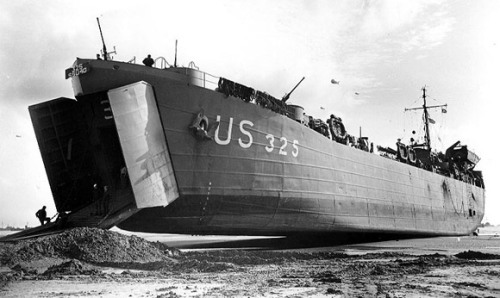
lst-325 at normandyLST-325 at Normandy, Specialized Landing Ships and Craft were in High Demand and Short Supply in June 1944

Despite conflicts between the Americans and British political and military leadership the planning for the Normandy landings detailed in NEPTUNE and OVERLORD moved ahead.  General Dwight Eisenhower was appointed as the commander of SHAEF with his major subordinates for Land, Air and Sea which caused consternation on both sides of the Atlantic.[v] [vi] The planned operation was expanded from the initial 3 division assault on a narrow front to a minimum 5 division assault on a broad front across Normandy[vii] supplemented by a strong airborne force.[viii] Overall the plan as it developed reflected a distinctly “American willingness to confront the enemy head-on in a collision which Britain’s leaders had sought for so long to defer.”[ix] It is ironic in a sense that the British avoidance of the head on attack was based on their known lack of manpower.  Britain had few infantry reserves to sustain the war effort and the Americans only late recognized their own deficiency in both quantity and quality of infantry forces on which their strategy depended.  That the western allies, so rich in material and natural resources would be so deficient in infantry manpower was a key constraint on the subsequent campaign in France and Germany.  The shortage of infantry forces would cause great consternation among the Allies as the campaign in France wore on. The Germans too faced manpower shortages due to the immense losses sustained on the Eastern front, those lost in Africa and those tied down in Italy, the Balkans and Norway as well as the drain caused by Luftwaffe Field Divisions and troops diverted into the Waffen-SS.   The German Army resorted to smaller divisions and the created many “static” divisions manned by elderly or invalid Germans to plug the gaps along the Atlantic wall. The Germans were also forced to recruit “Volksdeutsch” and foreign “volunteers” to fill out both Wehrmacht and Waffen-SS formations.

omaha_beach_low_tideOmaha Beach

Prior to the final decision to mount an invasion the Allied planners had contended with the location of the assault in northwestern France.  The Pas de Calais provided a direct route was rejected because it was where the Germans would expect the strike to occur and because it was where the German defenses were strongest.  The fiasco at Dieppe had provided ample proof of what could happen when making an assault into a heavily fortified port.  Likewise the mouth of the Seine near Le Harve was rejected because of the few beaches suitable for landing and because the forces would be split on both sides of the river.  Brittany was excluded due to its distance from the campaigns objectives in Germany.[x] This left Normandy which offered access to a sufficient number of ports and offered some protection from the weather. Normandy offered options to advance the campaign toward the “Breton ports or Le Harve as might be convenient.”[xi] Omaha beach, situated on the center right of the strike would be crucial to the success of the assault situated to the left of UTAH and the right of the British beaches.

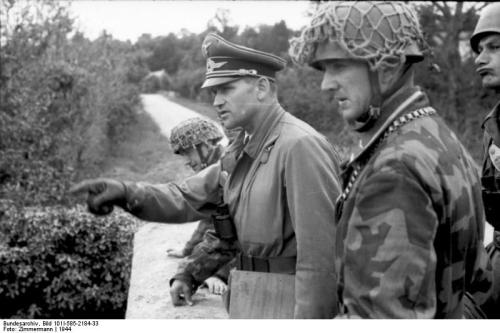
Bild 101I-585-2184-33Outnumbered Paratroops of II Fallschirmjaeger Corps Delayed US Forces Considerably in Normandy

Once Normandy was selected as the location for the strike by the Allies, the planning sessions remained contentious.  This was especially true when the Allies debated the amount and type of amphibious lift that could be provided for the landings, particularly the larger types of landing ships and craft to support the Normandy invasion and the planned invasion of southern France, Operation ANVIL.  The increase in OVERLORD requirements for landing craft had an impact in the Mediterranean and resulted in ANVIL being postponed until later in the summer.

As part of their preparations the Allies launched a massive deception campaign, Operation FORTITUDE.  This operation utilized the fictitious First Army Group under the “command” of General George Patton. Patton was still smarting from his relief of command of 7th Army following slapping commanded an “Army Group” which incorporated the use of dummy camp sites, dummy tanks, aircraft and vehicles, falsified orders of battle and communications to deceive German intelligence.[xii] The success of this effort was heightened by the fact that all German intelligence agents in the U.K. had been neutralized or turned by the British secret service.  Additionally the Luftwaffe’s limited air reconnaissance could only confirm the pre-invasion build ups throughout England without determining the target of the invasion.[xiii] The German intelligence chief in the west, Colonel Baron von Roenne “was deceived by FORTITUDE’s fantasy invasion force for the Pas de Calais.”[xiv] Despite this Commander of the 7th Army recognized by 1943 that Normandy was a likely Allied target and efforts were made to shift 7th Army’s center of gravity from Brittany to Normandy.  The one potential German success in getting wind of when the Allied landings would occur was lost when German intelligence discovered two lines of Verlaine’s “Chason d’ Automme” in June 1944 which were to alert the French Resistance of the invasion.  The security section of 15th Army heard them transmitted on the afternoon of 5 June and notified General Jodl at OKW, but no action was taken to alert forces on the coast.[xv] Allied intelligence was aided by ULTRA intercepts of coded German wireless transmissions. However this was less of a factor than during the African and Italian campaigns as more German communications were sent via secure telephone and telegraph lines vice wireless.[xvi] Allied deception efforts were for the most part successful in identifying German forces deployed in Normandy. However they were uncertain about the location of the 352nd Infantry Division which had been deployed along OMAHA and taken units of the 709th Infantry Division under its command when it moved to the coast.[xvii]

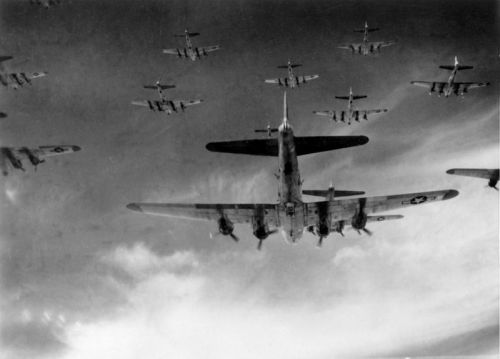
b-17_group_in_formation8th Air Force Bombers Helped Hit German Oil Production Facilities and caused the Luftwaffe to spend its fighter squadrons over Germany than France

The Allied air campaign leading up to the invasion was based on attempting to isolate the invasion site from German reinforcements. Leigh-Mallory the Air Chief developed the “TRANSPORTATION PLAN” which focused efforts on destroying the French railroad infrastructure.[xviii] A more effective effort was led by General Brereton and his Ninth Air Force which was composed of medium bombers and fighters.  Brereton’s aircraft attacked bridges and rapidly achieved success in crippling German efforts to reinforce Normandy.[xix] Max Hastings gives more credit to the American bombing campaign in Germany to crippling the German defense in the west. General Spaatz and the 8th Air Force destroyed German production capacity in oil and petroleum as well as the degraded the German fighter force.  The American daylight raids so seriously degraded the German fighter force that it could not mount effective resistance to the invasion.[xx] Russell Weigley also notes that Albert Speer the Reich Armaments Minister said that “it was the oil raids of 1944 that decided the war.”[xxi]

omaha_beach_uss_augusta1944Landing craft passing USS Augusta

Planning and preparations for OMAHA were based around getting the 1st and 29th Infantry Divisions ashore and them securing a beachhead “twenty-five kilometers wide and eight or nine kilometers deep.”[xxii] American preparations were thorough and ambitious, but the American assault would go through the most heavily defended sector of German defenses in Normandy.  The landing beaches were wide and bordered by dunes which were nearly impassable to vehicles and “scrub covered bluffs thirty to fifty meters high…rough and impassable to vehicles even to tracked vehicles except at a few places.  The exits were unimproved roads running through four or five draws that cut the bluffs.”[xxiii] Dug in along those bluffs was the better part of the 352nd Division. The Americans compounded their selection of a difficult and heavily defended landing zone the Americans failed to take advantage of many of the “gadgets” that were offered by the British which in hindsight could have aided the Americans greatly.  The Americans made use of two battalions of DD (Dual Drive) tanks but turned down the offer of flail tanks, flamethrower tanks, and engineer tanks, the “funnies” developed by General Hobart and the British 79th Armored Division.[xxiv] Weigley believes that the American view of “tanks as instruments of mobility rather than of breakthrough power.” Likewise the Americans victories in the First World War were won by infantry with little tank support.[xxv] In this aspect the Americans were less receptive to utilizing all available technology to support their landings, something that when considering the fact that Americans were great lovers of gadgets and technology. The British use of the Armor, including the “Funnies” on the beaches to provide direct fire into German strong points lessened their infantry casualties on D-Day. Due to this lack of armor support on the beach American forces on OMAHA had little opportunity to exercise true combined arms operations during the initial landings.[xxvi]

dd-tankDual Drive or DD Tanks took heavy Losses at Omaha

German preparations for an Allied landing in Normandy were less advanced than the Pas de Calais.  However they had made great strides since late 1943. Field Marshal Rommel greatly increased defensive preparations along the front, including the Normandy beaches.  One of Rommel’s initiatives was to deploy Panzer Divisions near the coast where they could rapidly respond to an invasion.  However Rommel did not get everything that he wanted.  The OKW only allotted him two Panzer Divisions to be deployed near the Normandy beaches.  Only one of these the 21st Panzer Division was deployed near Caen in the British sector.  One wonders the result had the 12th SS Panzer Division been deployed behind OMAHA. [xxvii]

OMAHA: The Landings

Like the rest of the Allied invasion forces the 1st and 29th U.S. Infantry Divisions set sail from their embarkation ports with the intent of landing on June 5th.  General Bradley, commanding the First Army until the American XII Army Group would be activated accompanied the invasion force.  The OMAHA landing was under the command of General Gerow and his V Corps while VII Corps led by the 4th Infantry Division landed at Utah supported by airdrops of the 82nd and 101st Airborne Divisions inland.  American command and control during the invasion was exercised from sea as in the Pacific, although General Officers were to go ashore with each of the American divisions.  A severe channel storm disrupted the plan to land on the 5th and Eisenhower delayed the invasion one day catching a break in the weather and electing to go on the 6th.[xxviii] This delay while uncomfortable for the embarked troops caused the Germans to believe that no invasion would take place until the next favorable tide and moon cycle later in the month.[xxix] The assumption that no invasion was possible ensured that a number of key senior German leaders, including Rommel were absent from the invasion front when the Allies landed.[xxx]

1st id normandy1st Infantry Divison Troops at the Omaha Beach Sea Wall

The landing beaches at OMAHA stretched about 6500 meters from Colleville-Sur-Mer to Vierville-Sur-Mere in the west.  The beaches are wide with bluffs overlooking them and a seawall between the beaches and the bluffs.  Additionally several small towns dot the beach. To the west of the town of Vierville, a prominent height overlooked the entire beachhead.  Named Pont du Hoc, it was believed to house a 150mm battery sighted where it could enfilade the OMAHA landing zones.  The Americans assigned to the 2nd Ranger Battalion to make a seaborne assault to land, scale the cliffs and take the battery.  Companies from this battalion made a heroic landing and scaled the cliffs to capture the strongpoint only to discover that the guns had not been emplaced.  The Rangers took heavy casualties and held their isolated beachhead against German counterattacks until relieved by the 29th Division on the morning of June 8th.[xxxi]

H-Hour for OMAHA was 0630.  Unfortunately the assault troops were transferred to their LCVP landing craft 16-20 kilometers from the beach.  The result was a long and dangerous ride in the small craft for the infantry.  Most of the infantry were completely soaked in sea spay and seasick before going ashore and they carried loads far above what they normally would carry into battle.[xxxii] The Armor support was one battalion of DD tanks, the 741st Armored Battalion, supporting the 16th Infantry Refiment of 1st Infantry Division. These were also launched too far out and nearly all of the tanks were swamped and lost before firing a shot in anger.[xxxiii] Other American support units needed to provide firepower on the beach were equally unfortunate. Weigley notes that at OMAHA “at least 10 of the LCVPs sank” as did “the craft carrying almost all of the 105mm howitzers that were to be the first artillery ashore after the tanks.”[xxxiv] The losses would cripple the assault on OMAHA and nearly cause its abandonment.

panzer111Panzers and Grenadiers in Normandy

As the soldiers of the American divisions on OMAHA came ashore they faced German defenders of the 352nd, 716th and a regiment of the 709th Infantry Division, the latter under the tactical command of the 352nd.   Without the bulk of their tanks artillery and lacking close air support the Americans struggled across the beaches and were cut down in large numbers before being pinned down behind the sea wall.[xxxv] With the Americans pinned down on the beach unable to advance, the time tables for the reinforcing waves became snarled amid the German beach obstacles which had not been cleared.  This was in large part due to 40% casualties among the Combat Engineers and the loss of all but five bulldozers.[xxxvi] Naval officers were frustrated in their attempts to provide naval gunfire support by the lack of identifiable targets on the beaches.  Yet German strongpoint’s were “knocked out by either by superbly directed vigorous gunfire from destroyers steaming as close as 800 yards offshore, or by determined action from Rangers or infantry.[xxxvii]

Soldiers ashore discovered that they were not facing the static 716th Division but the veteran 352nd Division as well.[xxxviii] Only the leadership and actions of Brigadier General Norman Cota the 29th Division’s Deputy Commander and Colonel Charles Canham of the 116th Infantry kept the situation from complete collapse.  They were able to rally their troops. Under their leadership small units from the 116th which had its linage back to the “Stonewall Brigade” as well as elements of the 16th and 18th Infantry Regiments began to move forward.  Surviving junior leaders began to lead survivors through the dunes and up the bluffs to attack German defenders of the roads leading up from the beach from the flank and rear.  A mid-day break in the weather allowed some close tactical air support giving the troops badly needed support.

With the situation desperate General Bradley considered the evacuation of OMAHA.  At sea events were as confused as Bradley and his staff attempted to make sense of what was going on.  Even later in the evening there was discussion of diverting all further reinforcements from OMAHA to the British beaches.[xxxix]At 1330 hours “Gerow signaled Bradley: “Troops formerly pinned down on beaches…advancing up heights behind beaches.”[xl] By the end of the day Bradley’s aid Major Hansen noted Bradley’s comments to Collins: “They are digging in on Omaha beach with their fingernails. I hope they can push in and get some stuff ashore.”  And Montgomery: “Someday I’ll tell Gen[eral] Eisenhower just how close it was for a few hours.”[xli]

me-at-normandy

The Author Teaching at Point du Hoc in 2004

The landings at OMAHA succeeded at a cost of over 2000 casualties.  Critical to the success of the landings were the German inability to reinforce their defending troops on the beach.  Likewise the weakness of the units available to mount the standard counterattack that was critical to German defensive plans on D-Day itself kept the Germans from driving the Americans back into the Channel. The 352nd Division fought superbly under the full weight of V Corps and the British XXX Corps on its right suffering heavy casualties as they contested every inch of ground.  The 716th Division composed of second rate troops melted under the onslaught.  Allied air supremacy played a key role as sorties by the 8th and 9th Air Forces helped keep German reinforcements from arriving and interdicted counter attacks inland.  Weigley credits the Allied air superiority with the success of the landings and with limiting casualties.[xlii] Von Rundstedt and other German commanders in France were limited by the delay and refusal of Hitler and OKW to release Panzer reserves when needed most early on June 6th.  By the close of D-Day allied forces had secured the five invasion beaches but not achieved their objectives of taking Caen and Bayuex.  Since the forces on the various beachheads had not linked up the beaches would have been extremely vulnerable had the Germans been able to mount a rapid counterattack by Panzers and strong infantry formations as they had at Salerno.

Major Battles to the Breakout at Avranches


Securing the Beachheads:

It took the V and VII Corps nearly a week to secure the beachheads. German forces including the stalwart 352nd Division resisted stubbornly and mounted sharp local counterattacks which kept the Americans off balance.  Elements of the 29th Division and the 90th Division began to push inland and to expand the beachhead toward UTAH. Opposed by the 352nd Division and elements of the 91st Airlanding Division and other non-divisional units the fighting revealed the inexperience of the American infantry formations and the uneven quality of their leadership.  As the Americans tackled the Germans in the labyrinth of the Bocage country the defensive skill of the Germans cost many American lives and delayed the joining of the beachheads. On the 13th the link up was solid enough to enabling the Americans to conduct the follow up operations needed to expand the beachhead, secure Cherbourg and clear the Cotentin.

tiger-tank normandyTiger Tank and Crew in Normandy

In some American divisions the hard fighting triggered a leadership crisis.  The lack of success of the 90th Division led General “Lightening Joe” Collins of VII Corps relieve the division commander and two regimental commanders of command, a portent of things to come with other American units.[xliii] As the V and VII corps pushed into the “Bocage” they were followed by a massive build up of troops and equipment delivered to the beaches and to the artificial “Mulberry” harbors.  Despite their numeric superiority, air supremacy and massive Naval gunfire support and facing the weakened 352nd, 91st and the 6th Parachute Regiment and other less than quality formations, survivors of the static divisions, the Americans made painfully slow progress as they moved off the beachhead and into the Bocage.[xliv]

The Capture of Cherbourg

Once the beachheads had been consolidated the Americans turned their attention toward Cherbourg. Cherbourg was the major naval port at the far northwest tip of the Cotentin.  D-Day planners counted on its swift capture and rehabilitation to serve as a supply port for the Allied forces. The 9th Division drove south to the coast near Barneville on the 18th of June cutting off the German forces covering the approaches to Cherbourg.[xlv] This put the Germans in a bind as the 7th Army “had to split its forces in the peninsula in order to hold the fortress a little longer and thus to gain time for the establishment of the southern front on the Cotentin peninsula.[xlvi] The German forces arrayed before Cherbourg waged a desperate defense centered around the 243rd Infantry Division and other assorted battle groups of LXXXIV Corps, whose commander General Marcks one of the best German Generals was killed in action on 12 June.[xlvii] The U.S. VII Corps under Collins with the 9th, 4th and 79th Divisions pushed up the peninsula capturing Cherbourg on June 29th.  Bradley pushed hard for the capture of the port as the Mulberries had been ravaged by a severe Channel storm the week prior. The port of Cherbourg was thoroughly demolished by German engineers and would not be fully operational for months. The loss of the Mulberries and delay in Cherbourg’s availability meant that few supplies were landed on the beaches would “hinder the escape from the constricting land of the hedgerows into which the Americans had come in search of a port.[xlviii]

The Battle of Caumont Gap

V Corps under Gerow made a cautious advance by phase lines toward Caumont, St Lo and Carentan.  The deliberate advance by the Corps toward a line weakly held by the Reconnaissance battalion of the 17th SS Panzer Grenadier Division was directed by Bradley who did not want to divert attention from the effort against Cherbourg.   After capturing Caumont V Corps halted and continued aggressive patrolling to deceive the Germans while digging in.[xlix] The possibility existed that a strong push against the weak German line could have led to an opportunity to envelope the German line west of Caen. This was a missed opportunity that in part led to the bloody and controversial campaign to capture Caen.[l]

British efforts around Caen

Montgomery had ambitious plans to break out of Normandy by capturing Caen on D-Day and driving toward Falaise and Argentan.  The British plans for this were frustrated by the rapid reinforcement of the sector by the Germans and the activities of 21st Panzer, Panzer Lehr, and the 12th SS Panzer Divisions.  A flanking maneuver at Villers-Bocage was frustrated by a few Tiger tanks led by the legendary Waffen SS Panzer commander Captain Michael Wittman whose tanks devastated a British Armored battalion.[li] A series of disastrous attacks toward Caen (EPSOM, CHARNWOOD and GOODWOOD) strongly supported by air strikes and Naval gunfire finally succeeded in taking that unfortunate city on July 18th but failed to take the heights beyond the town.[lii] Against crack well dug in German forces the British took heavy casualties in tanks and infantry seriously straining their ability to conduct high intensity combat operations in the future.[liii] The one benefit, which Montgomery would claim after the war as his original plan was that German forces were fixed before Caen and ground down so they could not be used against Bradley’s breakout in the west at St Lo.[liv]

Holding the line Michael_Wittmann_auf_Panzer_VI_(Tiger_I)Panzer Ace Captain Michael Wittmann on His Tiger Tank

Clearing the Bocage: The Battle of the Cotentin Plain

Other German forces arrived, and reinforced the Caumont gap which no longer “yawned invitingly in front of V Corps.” [lv] Bradley wished to push forward rapidly to achieve a breakthrough in the American sector.[lvi] Facing the most difficult terrain in France amid the Bocage and swamps that limited avenues of approach to the American divisions committed to the offensive.  The Americans now faced their old foe the 352nd division as well various elements of II Parachute Corps, the 17th SS Panzer Grenadier and Panzer Lehr Divisions.  American tanks and infantry made slow progress and incurred high losses as they dueled the Germans at close range.  In the VIII Corps sector alone the attack “consumed twelve days and 10,000 casualties to cross eleven kilometers of the Bocage…the achievements of the VII and XIX Corps were no better than comparable.[lvii]

St. Lo

St. Lo was a key to Bradley’s breakout efforts.  His Army had to capture it and the roads leading out of it to launch Operation COBRA along the coast.  The task of capturing St. Lo was assigned to GEROW’S V Corps and Corlett’s XIX Corps.  They faced opposition from the tough paratroops of the German 3rd Parachute Division of II Parachute Corps.  The 2nd, 29th, 30th and 83rd Divisions fought a tough battle advancing eleven kilometers again with high numbers of casualties especially among the infantry to secure St. Lo on 18 July.[lviii] They finally had cleared the hedgerows.  St Lo epitomized the struggle that the American Army had to overcome in the Bocage.  Hard fighting but outnumbered German troops in excellent defensive country exacted a terrible price in American blood despite the Allied control of the skies.[lix]

st-loUS Tanks and German Prisoners at St Lo

Operation COBRA

With the Bocage behind him Bradley desired to push the Germans hard.  COBRA was his plan to break out of Normandy.  Bradley ably assisted by Collins they realized that the better terrain, road networks favored a breakout.  American preparations included a technical advance that allowed tanks to plow through hedgerows. This was the “Rhino” device fashioned by American troops which was installed on 3 of every 5 First Army Tanks for the operation.[lx] VII Corps was to lead the attack which was to begin on July 24th. American planning was more advanced than in past operations.  Collins and Bradley planned for exploitation operations once the breakthrough had been made. A massive air bombardment would precede the attack along with an artillery barrage by Collins corps artillery which was reinforced by additional battalions.   A mistake by the heavy bombers in the 24th resulted in the American troops being hit with heavy casualties and a postponement of the attack until the 25th.[lxi] The following day the attack commenced.  Another mistake by the bombers led to more American casualties[lxii] but VII Corps units pressed forward against the determined resistance of the survivors of Panzer Lehr and the remnants of units that had fought the Americans since the invasion began.  Although it was a “slow go” on the 25th Bradley and his commanders were already planning for and beginning to execute the breakout before the Germans could move up reinforcements.  The 26th of June brought renewed attacks accompanied by massive air strikes.  While not much progress was made on the 26th, the Americans discovered on the 27th that the German forces were retreating.  The capture of Marigny allowed VIII Corps to begin exploitation down the coastal highway to Coutances.  On the 27th General Patton was authorized to take immediate command of VIII Corps a precursor to the activation of his 3rd Army.  COBRA ripped a hole in the German line and inflicted such heavy casualties on the German 7th Army that it could do little to stop the American push.[lxiii] As the American forces pushed forward they reinforced their left flank absorbing the local German counterattacks which were hampered by the Allied close air support.

Avranches and Beyond

As the breakthrough was exploited the command of the forces leading it shifted to Patton and the newly activated 3rd Army. By the 28th VIII Corps led by the 4th and 6th Armored Divisions had reached Avranches and established bridgeheads over the See River with additional bridges being captured intact on the 30th.[lxiv] The capture of Avranches allowed the Americans to begin exploitation operations into Brittany and east toward the Seine. Weigley notes that for the first time in the campaign that in Patton the Americans finally had a commander who understood strategic maneuver and would use it to great effect.[lxv]

Conclusion

The American campaign in Normandy cost the U.S. Army a great deal. It revealed weaknesses in the infantry, the inferiority of the M4 Sherman tank to most German types, problems in tank-infantry cooperation and also deficiencies in leadership at senior, mid-grade and junior levels. Heavy casualties among infantry formations would lead to problems later in the campaign. Numerous officers were relieved including Division and Regimental commanders.  Nonetheless during the campaign the Americans grew in their ability to coordinate air and ground forces and adapt to the conditions imposed on them by their placement in the Cotentin.  The deficiencies would show up in later battles but the American Army learned its trade even impressing some German commanders on the ground in Normandy.[lxvi]


[i] See the alternative history of by Peter Tsouras Disaster at D-Day: The Germans Defeat the Allies, June 1944, Greenhill Books, London 1994. Tsouras describes the defeat of the Omaha landings and the effect on the course of the campaign leading to the overthrow of Hitler and a negotiated armistice in the west.  While this outcome could be rigorously debated other outcomes could have led to the fall of the Roosevelt and Churchill governments and their replacement by those not committed to unconditional surrender or a continuation of the war that brought about more German missile attacks on the U.K. and the introduction of other advanced German weapons that could have forced such a settlement. Another option could have led to the dropping of the Atomic Bomb on a German city vice Hiroshima.

[ii] Weigley, Russell F. Eisenhower’s Lieutenants: The Campaign of France and Germany, 1944-1945, Indiana University Press, Bloomington IN, 1981 p.33

[iii] Ibid pp. 34-35

[iv] Ibid p.35

[v] General Montgomery 21st Army group and Land Forces, Admiral Sir Bertram Ramsey as Allied Naval Expeditionary Force and Air Marshall Sir Trafford Leigh-Mallory as Commander in Chief Allied Expeditionary Air Force. Weigley p.43

[vi] Max Hastings in Overlord: D-Day and the Battle for Normandy Vintage Books, New York, 1984, comments that many in Britain wondered if Eisenhower with the lack of actual battle experience could be a effective commander and that Eisenhower was disappointed in the appointment of Leigh-Mallory and Ramsey, and had preferred Alexander over Montgomery, pp. 28-29.

[vii] Ibid. Weigley p.40.  Montgomery was the first to object to the 3 division narrow front invasion rightly recognizing that seizing Caen with its road junctions could provide a springboard for the campaign into open country.

[viii] Ibid. p.37

[ix] Hastings, Max. Overlord: D-Day and the Battle for Normandy Vintage Books, New York, 1984 p.29  Hastings finds the irony in the selection of the British officers to execute the plan that reflected the American way of thinking.

[x] The Germans agreed with this in their planning leaving Brittany very lightly defended.  See  Isby, David C. Ed. “The German Army at D-Day: Fighting the Invasion.” p.27 The report of General Blumentritt, Chief of Staff OB West noted that only 3 divisions were assigned to Brittany.

[xi] Ibid. Weigley, pp. 39-40

[xii] Ibid. p.73

[xiii] See Isby p. 69.  General Max Pemsel of 7th Army noted that “During  the spring of 1944, Seventh Army received only tow good photographs of British southern ports, which showed large concentrations of landing craft.”

[xiv] Ibid. Hastings p.63.  Hastings comments also about the success of using the turned Abwehr agents.

[xv] Warlimont, Walter. “Inside Hitler’s Headquarters: 1939-1945.” Translated from theGerman by R.H. Barry. Presidio Press, Novao CA, English Edition Copyright 1964 Wiedenfeld and Nicholson Ltd. Pp.422-423

[xvi] Ibid. Weigley pp. 53-54

[xvii] Ibid. p. 67

[xviii] Ibid. pp.57-64  Weigley spends a great deal of time on the wrangling between Eisenhower, Leigh Mallory and Spaatz on the nature of the plan, the allocation of forces both strategic and tactical assigned to carry it out and its success, or in the light of postwar analysis the lack of effect that it had on German operations.

[xix] Ibid. p.67-68.

[xx] Ibid. Hastings pp. 43-44 In large part due to the long range P-51 Mustang which accompanied the American bombing raids beginning in 1943.  Another comment is that the campaign drew the German fighters home to defend Germany proper and prevented their use in any appreciable numbers over the invasion beaches.

[xxi] Ibid. Weigley p.69

[xxii] Ibid. p.89

[xxiii] Ibid. pp. 88-89

[xxiv] Ibid. p.87

[xxv] Ibid. Weigley also talks about the rejection of General Corlett’s ideas to use Amtracks used by the Marines in the Pacific to land on less desirable, but less defended beaches to lessen casualties on the beaches and the need for additional support equipment even on smooth beaches.  One of Corlett’s criticisms was that too little ammunition was allotted to supporting the landings and not enough supporting equipment was provided. pp. 46-47

[xxvi] Hastings notes that with the strength and firepower of the German forces on OMAHA that many of these vehicles had they been employed would like have ended up destroyed further cluttering the beachhead. “Overlord” p.102

[xxvii] The battle over the deployment of the Panzer Divisions is covered by numerous historians.  The source of the conflict was between Rommel who desired to place the Panzer Divisions on the Coast under his command due to the fear that Allied air superiority would prevent the traditional Panzer counterthrust, General Gyer von Schweppenburg commander of Panzer Group West (Later the 5th Panzer Army) and Field Marshal Von Rundstedt who desired to deploy the divisions order the command of Rundstedt for a counter attack once the invasion had been launched, a strategy which was standard on the Eastern Front, and Hitler who held most of the Panzer reserve including the SS Panzer Divisions under his control at OKW.  Hitler would negotiate a compromise that gave Rommel the satisfaction of having three Panzer Divisions deployed behind coast areas in the Army Group B area of responsibility.  21st Panzer had those duties in Normandy.

[xxviii] Ibid. p.74-75

[xxix] Von Luck, Hans.  “Panzer Commander“ Dell Publishing, New York, 1989 pp. 169-170.  Von Luck a regiment commander in 21st Panzer noted that General Marcks of 84th Corps had predicted a 5 June invasion at a conference May 30th.

[xxx] Almost every D-Day historian talks about the weather factor and its effect on the German high command’s reaction to the invasion.  Rommel was visiting his wife for her birthday and planned to make a call on Hitler. Others including commanders of key divisions such as the 91st Airlanding Division were off to a war game in Rennes and the 21st Panzer Division to Paris.

[xxxi] Ibid. Weigley p. 96

[xxxii] See Cornelius Ryan, “The Longest Day” Popular Library Edition, New York 1959. pp. 189-193 for a vivid description of the challenges faced by soldiers going from ship to landing craft and their ride in to the beaches.

[xxxiii] Ibid. Weigley. p.78 Weigley talks about the order for the tanks to be carried ashore on their LCTs that did not get transmitted to the 741st.

[xxxiv] Ibid.

[xxxv] Ibid. Weigley  p. 87 The weather prevented the aerial bombardment from being effective. Because the bombers could not see their targets they dropped their bomb loads further inland, depriving the infantry of support that they were expecting.  Naval gunfire support had some effect but had to be lifted as the troops hit the beach leaving much of that support to come from Destroyers and specially equipped landing craft which mounted rockets and guns.

[xxxvi] Ibid. Hastings. pp. 90-91.

[xxxvii] Ibid. p.99

[xxxviii] Ibid. Weigley p.80

[xxxix] Ibid. p.101  Also see Weigley p.80

[xl] Ibid. p.99

[xli] Ibid. Weigley. p.95

[xlii] Ibid. p.94

[xliii] Ibid. p.99 Both Weigley and Hastings make note of the failure of both the Americans and British to train their troops to fight in the bocage once they had left the beaches.

[xliv] Ibid. Hastings. pp.152-153

[xlv] Ibid. Weigley p.101

[xlvi] Isby, David C., Ed. “Fighting in Normandy: The German Army from D-Day to Villers-Bocage.” Greenhill Books, London,  2001.  p.143

[xlvii] Ibid. Hastings p.173 Allied fighter bombers exacted a fearful toll among German commanders. The Commanders of the 243rd and 77th Divisions fighting in the Cotentin were also killed by air attacks on the 17th and 18th.   Further east facing the British the commander of the 12th SS Panzer Division, Fritz Witt on the 17th.

[xlviii] Ibid. Weigley. p.108

[xlix] Ibid. p.111-112.

[l] Ibid.

[li] The efforts of the 51st Highland Division and 7th Armored Division were turned aside by the Germans in the area and were dramatized by the destruction of  a British armored battalion by SS Captain Michael Wittman and his platoon of Tiger tanks.  See Hastings pp.131-135.

[lii] The British 8th Corps under General O’Connor lost 270 tanks and 1,500 men on 18 July attempting to crack the German gun line on the ridge beyond Caen. Weigley, pp.145-146.

[liii] Hastings comments about the critical British manpower shortage and the pressures on Montgomery to not take heavy casualties that could not be replaced. Overlord. pp.241-242.

[liv] Ibid. Weigley pp.116-120

[lv] Ibid. p.122

[lvi] Ibid. p121 Bradley told Eisenhower “when we hit the enemy this time we will hit him with such power that we can keep going and cause a major disaster.”

[lvii] Ibid. 134

[lviii] Ibid. Weigley. pp. 138-143.  Weigley notes of 40,000 U.S. casualties in Normandy up to the capture of St. Lo that 90% were concentrated among the infantry.

[lix] Weigley quotes the 329th Regiment, 83rd Division historian “We won the battle of Normandy, [but] considering the high price in American lives we lost. P.143. This is actually a provocative statement that reflects America’s aversion to massive casualties in any war.

[lx] Ibid. p.149

[lxi] Ibid. p. 152

[lxii] Ibid. pp. 152-153.  Among the casualties were the command group of the 9th Division’s 3rd Battalion 47th Infantry and General Leslie McNair who had come to observe the assault.

[lxiii] Ibid. pp.161-169. Weigley notes the advances in U.S. tactical air support, the employment of massive numbers of U.S. divisions against the depleted German LXXXIV Corps, and the advantage that the “Rhino” device gave to American tanks by giving them the ability to maneuver off the roads for the first time.

[lxiv] Ibid. pp.172-173.

[lxv] Ibid. p.172

[lxvi] Ibid. Isby, David C. “Fighting in Normandy,” p.184, an officer of the 352nd Division referred to the American soldier “was to prove himself a in this terrain an agile and superior fighter.”

Bibliography

Carell, Paul. “Invasion: They’re Coming!” Translated from the German by E. Osers, Bantam, New York 1964.

Hastings, Max. Overlord: D-Day and the Battle for Normandy Vintage Books, New York, 1984

Isby, David C. Ed. “The German Army at D-Day: Fighting the Invasion.” Greenhill Books, London 2004

Isby, David C., Ed. “Fighting in Normandy: The German Army from D-Day to Villers-Bocage.” Greenhill Books, London, 2001.

Ryan, Cornelius, “The Longest Day” Popular Library Edition, New York 1959

Tsouras, Peter. “Disaster at D-Day: The Germans Defeat the Allies, June 1944,” Greenhill Books, London 1994.

Von Luck, Hans.  “Panzer Commander“ Dell Publishing, New York, 1989

Warlimont, Walter. “Inside Hitler’s Headquarters: 1939-1945.” Translated from theGerman by R.H. Barry. Presidio Press, Novao CA, English Edition Copyright 1964 Wiedenfeld and Nicholson Ltd. Warlimont, Walter. “Inside Hitler’s Headquarters: 1939-1945.” Translated from theGerman by R.H. Barry. Presidio Press, Novao CA, English Edition Copyright 1964 Wiedenfeld and Nicholson Ltd.

Weigley, Russell F. Eisenhower’s Lieutenants: The Campaign of France and Germany, 1944-1945, Indiana University Press, Bloomington IN, 1981

5 Comments

Filed under Loose thoughts and musings

Operation “Dachs” My First Foray into the Genre “Alternative History”

For a change of pace I have pulled up something that one of my professors allowed me to do in my Military History Masters Program.  This was my first foray into historical fiction, or as it is known sometimes as “Alternate History.”  This is actually a growing genre among military writers and others who have vivid imaginations as to what might have happened if….

I hope you enjoy.  Peace, Steve+

This is an alternative history of how the Germans might have avoided the disaster at Kursk. It looks at what might have happened if an actual assassination attempt on Hitler had succeeded in March 1943 and how Manstein might have been able to execute the “backhand” strategy that he favored using a mobile defense.  This is predicated by Hitler’s death, based on Hitler’s actions and control of operational decisions Manstein would never have been allowed the freedom to conduct operations in this manner.  In eliminating Hitler I have also included personnel changes and the overall strategy for the German High Command, and the probable response of Stalin to Hitler’s death had it occurred in the spring of 1943. I have tried to be faithful to known historical opinions and actions of the participants and likely reactions to such a situation although one cannot predict precisely what people would have done.  Thus I have documented the article with footnotes as if it were an actual history. It would have been interesting to be able to lengthen this and included sections on tactical actions based on memoirs of German and Russian soldiers.

hitlers fw-200Hitler’s FW-200 Prior to his Ill-fated vist to Army Group Center

Background: The Strategic Situation Spring 1943

In April 1943 the German High Command faced a decision on which the fate of Nazi Germany would hinge, but for the first time in the war it was not under the thumb of Adolf Hitler. Following Manstein’s counter-stroke following the Stalingrad disaster there was considerable pressure to follow up with that success with a continued offensive. Manstein himself had proposed this but Field Marshal Von Kluge refused to agree to an immediate offensive because he felt his troops needed rest and refitting. On March 13th Hitler flew out to meet with Von Kluge at Army Group Center HQ at Smolensk.  On the flight back Hitler’s FW-200 was racked by an explosion crash landing near Minsk, taken down by a bomb planted on the plane by Colonel Henning Von Trescow of Kluge’s staff.[i] While Hitler survived, he remained in critical condition, barely alive at a SS hospital until his death on 20 April 1943, his 54th birthday. The crash landing was reported by the escorting ME-109s of JG-53, and a Alarm Company from a Security Division at Minsk rescued Hitler but were driven off the crash site by a large force of Soviet Partisans who destroyed the aircraft and any evidence to the cause which the escorting fighters attributed to mechanical problems.  There were no other survivors. Von Kluge, expecting to be implicated the Fuhrer’s death committed suicide after visiting troops on the front line, and was succeeded at Army Group Center by Field Marshal Model the commander of 9th Army. The other conspirators were frozen into inaction when Hitler survived the crash and made no attempt to take over the government, realizing that “our plans for seizing power in Berlin and other large cities were still not adequate to the task.”[ii] In the absence of Hitler Reichsmarschall Goering, Hitler’s designated successor, took action to secure his power and using contacts in the GESTAPO accused Himmler of treason for making contact with Neutral intermediaries in Sweden[iii] and replaced him with SS General Kurt Wolfe, and reappointed Rudolf Diels, the former head of the GESTAPO when it was still under his control[iv], to head it again.  Himmler attempted to flee and was caught near Luneburg when he committed suicide with a cyanide capsule before he could be interrogated. Other potential rivals were eliminated; Martin Bormann, who Goering hated, was arrested on charges of exceeding his authority, embezzlement, and harming the war effort and was executed.[v] Joseph Goebbels swore his loyalty to Goering even before Hitler’s death.  He and Albert Speer were directed to arrange the state funeral for the late Fuhrer. Berlin Radio announced the Fuhrer’s death on the 21 April, Hitler’s body was prepared and lay in state at the Chancellery.   A period of mourning was declared 21 April to 1 May on which the State Funeral took place. On 2 May Goering announced that Field Marshal Von Rundstedt was the new Chief of OKW and would coordinate strategy on all fronts. The next day Goering called together a meeting of the heads of OKH, OKW, the Inspector General of Panzer Troops, and the commanders of the Eastern Front Army Groups, Western Europe and Africa as well as Reichsfuhrer Karl Wolff, Admiral Donitz and Field Marshal Von Richthofen[vi] representing the Luftwaffe to decide on a course of action for the summer. It was the first time that all had been called together to discuss the overall situation since Barbarossa began in 1941, and the first true attempt to formulate a grand strategy during the war.

Options and Decision: The Zossen Conference 3 May 1943[vii]
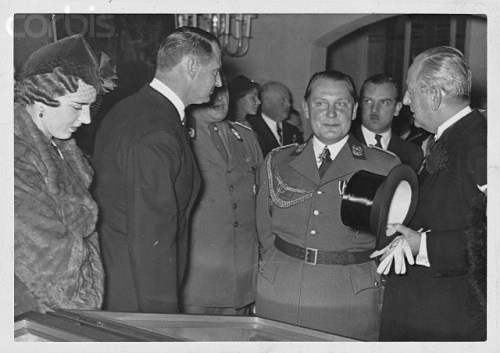
HU010919Goering meeting Diplomats following Hitler’s State Funeral

Herman Goering looked up from the maps spread out on the conference table.  He looked surprisingly fit, somehow between the crash of Hitler’s aircraft and his death he had pulled himself together and out of his drug induced malaise.  It was as if he again had a purpose. Field Marshal Von Rundstedt now Chief of OKW following Goering’s relief of Field Marshal Keitel, and General Jodl had just finished briefing the situation in western and southern Europe, following briefings by Colonel General Zeitzler of OKH, the Inspector General of Armored Troops, General Guderian and Field Marshal Von Manstein of Army Group South.  Albert Speer briefed tank and aircraft production numbers while the Chief of the Army personnel office noted the requirement for 800,000 replacements “but even the most ruthless call-up was able to produce only 400,000.”[viii] Looking from the table he spoke: “Gentlemen, the situation is critical and I have to admit that I have thought so for a number of months but have been unable to speak out.   Our political situation is perilous, the Italians are ready to abandon our cause. Our forces in North Africa will soon be unable to hold out as our Italian friends have let us down again.[ix] I expect that if Jodl and Kesselring are right about Allied intentions that we will have our hands full in the west shortly.  Kesselring and Arnim, you need to evacuate as many German soldiers from Africa as possible,[x] use all air and naval forces that you can, I know it will be difficult, especially with the heavy losses we have taken in transport aircraft and the pathetic Italian Navy.”  Goering paused, his gaze passing around the room.  “In the west we need to assume that the Allies will invade and the ‘very real danger that the enemy may turn against Brittany and Normandy,’ Field Marshal Rommel will take command of OB West to build up the Atlantic Wall in these sectors.”[xi] “Zeitzler, Manstein, we need to shore up the eastern front.”

“Herr Reichsmarschall, the Fuhrer had approved the plan called ZITADELLE, to attack the Russians here in the Kursk salient.” responded Zeitzler.[xii] “We should be ready to begin the offensive this month.”  Goering raised his hand stopping Zeitzler.  “I know, but I have considered that plan and I cannot support it. Richthofen briefed me on it prior to the Fuhrer’s death and general, we must have another plan, and an attack on Kursk is so obvious the Russians will be ready to meet it.  I have considered what the General Guderian and Minister Speer said regarding tank production and the state of the Panzer arm.  I cannot approve Zitadelle, but we must find a way to deal the Russians a defeat without squandering our strength attacking such an obvious target. Model too is dubious of the prospects; he believes that the Russians know our intentions and has requested a delay to strengthen his forces.”[xiii] “Reichsmarshall.” chimed in Jodl. “You are correct, the premature commitment of central reserves in such an offensive will not help our cause, in fact only local success is what can be expected from Zitadelle.”[xiv]

“But Reichsmarshall, we must recapture the initiative in the east, we must take the offensive!” retorted Zeitzler. “Our new units of Panthers and Tigers will give us a decisive technical advantage.”[xv] Guderian now joined in. “But the Panthers still have many technical problems, it would be better to wait until they are worked out before we commit them to a major offensive, and besides, how many people do you think even know where Kursk is?”[xvi]

“Zeitzler, I appreciate your zeal.” Interrupted Goering, “But Jodl and Guderian are correct, even a successful attack at Kursk will not alter the strategic situation. We must work to stave off defeat.  Manstein has a plan that may help, there is some risk, but I see no other way. An offensive at Kursk would require tanks and aircraft that must be used to combat the Allied bombing of the Reich and to safeguard withdraw of our units from Africa, it would force us to commit everything with little gain.” Goering paused and said to Manstein, “Go ahead Manstein.”

“Reichsmarshall, Gentlemen.  Our situation in the east is not hopeless, in March I felt that an immediate offensive would succeed in pinching off the Kursk bulge, but I think now that the moment of opportunity has passed for such an attack.  Instead we should fight a defensive battle of maneuver as called for by Truppenführung that we have developed from the days of the Reichswehr.  We should build up our forces; give ground where we can, and when we have the chance strike the enemy on the backhand, as we did at Kharkov.”[xvii]

Zeitzler jumped in. “But how can we do that? If we don’t strike now while we have the opportunity the Russians will grow stronger, and how can we know where they will strike?”[xviii]

“General Zeitzler, the Russians are already building up heavy armored forces in the area of Kursk, and diverting forces from other sectors of the front to that area.  The south offers them the best opportunity to finish what they started in the winter.  They will come and it will be in the south, they will want Kharkov and they will again attempt to envelop our forces in the south. If they succeed they will follow up and rapidly move into the Balkans, Romania and Hungary will turn on us and it will be a disaster, we cannot afford that.”  Manstein looked up, Jodl nodded and Model said “Once that is done they will push to Kiev and Poland.” Goering interjected “Thank you Model, you are right, Field Marshal Manstein; please go on with your plan.”
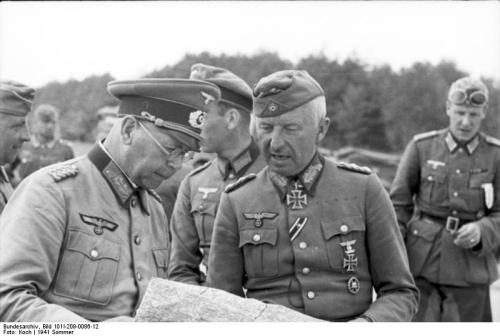
Bild 101I-209-0086-12Erich Von Manstein at the Front

Motioning to the map Manstein continued. “We will concentrate the majority of our Panzer forces here, just west of Kharkov and another group here west of Orel.  We will also build fall back positions for our infantry forces here along the Dnieper.  We should be ready to withdraw from the Crimea should the need arise, we cannot afford another encirclement.  When the Russians attack we will give ground, even Kharkov if needed. Our infantry divisions will fight a delaying action supported by Jagdpanzer and Sturmgeschutzen, the Luftwaffe will need to give us good close air support from Stukas and as the Russians outrun their supply depots and their offensive loses momentum we will attack, like a badger defending itself.  Our Panzers will cut off their spearheads west of Kharkov while we bleed them dry in the north; we will then roll them up, stabilize the line and prepare for the winter.”  Manstein sounded confident; those in the room began to sense that his plan could work.  Rundstedt spoke up: “That will give us the chance to transfer forces to other fronts and, maybe, since Hitler is dead there might be a chance for Reichsmarschall to negotiate a settlement,[xix] otherwise gentlemen the Allies will destroy our cities from the air and grind our armies down until we have no recourse but surrender.”

“Right” added Goering, making eye contact with each man in the room. “We must have success in the defense, we must buy time and we must work to end this war before Germany is destroyed. ‘We will have reason to be glad if Germany can keep the boundaries of 1933 after the war.”[xx] He paused and said “General Zeitzler, you are relieved of your duties at OKH, General Guderian, you are now the Chief of OKH.[xxi] Manstein, you will command the East, General Hoth will take your Army Group. You will work with Guderian and Model to flesh out this plan.  We must get the Panther, Tiger and Ferdinand units operational as soon as possible.  I believe that the Russians will attack by June. Richthofen, I need you to look to the Luftwaffe. We have not had a good year and we have to succeed in defending the Reich from Allied bombers and provide support to the ground forces. Of course flak needs to be built up. The Luftwaffe Field Divisions with the exception of the Fallschirmjaeger and Herman Goering Panzer Division need to be transferred to Army control.”  He looked at Speer: “Herr Speer, the Fuhrer entrusted you with our war production program, you must increase production of tanks and aircraft. Speed the production of the ME-262 and cancel all programs that take away from the panzers, fighters and ground support aircraft that we need now.” He put his hands on his hips and took a deep breathe. He looked at Wolfe, Himmler’s successor.  Wolff, the Reich needs the Waffen SS, the Panzer troops are exceptional, but I want all Waffen SS Formations, with including the Panzers turned over to Army control, we cannot keep dividing our resources. With the personnel from the Luftwaffe Field Divisions we should be able to provide the Army with excellent troops to rebuild experienced formations.”  Goering looked around the room; “Are there any questions Gentlemen?” Putting his arm across Manstein’s soldier and said: “I think that Badger is a fitting name for your plan. Our little Dachs will tear them to pieces.”   Later, Goering met with Foreign Ministry officials emphasizing the need to strengthen German Allies and seek peace with the west. He “admitted that he was worried about the future. ‘It’s not quite clear to me how we are going to end this war.’”[xxii] Those present could not believe how Goering had conducted himself, and all left the meeting thinking that it might be possible to stave off defeat.  It was an incredible performance. After Hitler’s crash he had secretly undergone a “systematic withdraw cure which had ended his drug addiction.”[xxiii] The change was marked.

STAVKA Headquarters Moscow: 7 May 1943

Josef Stalin was ecstatic.  His agents reported that Hitler was dead even before the announcement from Berlin.  Partisans had confirmed that it was Hitler’s aircraft that they found and recovered some of Hitler’s personal belongings, including his cap, which they presented to Stalin.  Intelligence reported that Goering had taken power, and Stalin was sure that his position was weak and many believed that Goering, was not up to the task, and that a renewed offensive could bring down the Nazi regime.  Now was the time to bring the Nazi terror to an end and Stalin called his key leaders together.  While Stalin wanted an immediate offensive his generals wanted to wait just in case the Germans attacked Kursk.  “Zhukov, Vasilevsky, and various General Staff officers urged caution and recommended that the Red Army remain on the defensive until the Germans expended their offensive strength.”[xxiv] Stalin supported by commanders, like Vatutin, “argued for a resumption of offensive action in early summer to preempt German action and regain the momentum lost in March 1943.”[xxv] In the end a compromise was reached and despite the temporary defensive stand “Russian strategic planning in the summer of 1943 was inherently offensive in nature.”[xxvi] The new offensive would be launched on 15 June if the Germans had not attacked before.  It would be named Operation Kutuzov[xxvii] and be aimed at the Orel salient and Kharkov.  The northern prong under Rokossovsky’s Central Front would destroy the Germans around Orel and drive west while Vatutin’s Voronezh and Konev’s Steppe Front would take Kharkov and drive toward the Dnieper.[xxviii] The Southwest Front and South Fronts would attack and destroy the German forces along the Mius, the goal: “collapse of the German defenses and an advance to the line of the Dnieper River from Smolensk in the north southward to the Black Sea.”[xxix]

German Preparations
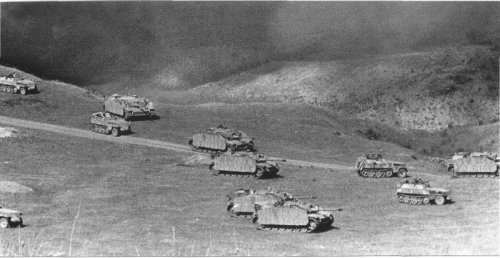
sturmgeschutzSturmgechuten and SdKfw 251 APCs moving into position

Manstein met with Model, Hoth and Guderian to develop DACHS. They had  to play for time and deceive the Russians as to their true intent so they could build up their forces.  Deception operations were mounted on both sides of the Kursk bulge to give the impression of attack preparations.  1st Panzer Army and Army Detachment Kempf  were to launch a diversion called Operations HABICHT and PANTHER southeast of Kursk  “designed to push the Soviets back from the industrial area of the Donets River.”[xxx] The defensive plan called for the infantry supported by tank destroyers, assault guns the heavy Ferdinands as well as mobile Pioneer units to conduct a withdraw to delay and disrupt the Russian attack.  Bridges were prepared for demolition, defensive positions constructed at choke points which would be defended and then abandoned when no longer defensible, and minefields laid to slow the Russian advance.  This was critical for 9th Army now commanded by General Henrici in the Orel salient north of Kursk.  Henrici, a defensive master constructed a series of defensive belts to allow his army to withdraw from the bulge without being cut off and inflict heavy casualties on the Russians through skillful deployment of anti-tank weapons, especially self propelled guns.[xxxi] In the south 4th Panzer Army, now commanded by SS General Paul Hausser[xxxii] and Army detachment Kempf made preparations to allow the Russians to advance past Kharkov using the same defend and delay tactics and then counterattack. As the armies prepared, Speer and Guderian’s efforts to rebuild the Panzer force were bearing fruit.  By 15 May the first brigade of Panther tanks was activated and began training west of Kharkov.[xxxiii] Two battalions of Ferdinands, one for 9th Army and one for 4th Panzer Army were activated.[xxxiv] Sturmgeschutz battalions were assigned to each infantry corps. Panzer divisions built up so that all had an average of 130 tanks, with the SS Divisions and Gross Deutschland receiving more.  Tiger battalions were assigned to each Panzer Corps.

The Summer Campaign

On 1 June Operations PANTHER and HABICHT hit the unfortunate Soviet 6th Army, which had been victimized by Manstein’s counter-stroke in March.  III Panzer Corps of Army Detachment Kempf supported by Corps Raus (IX Corps) linked up with 1st Panzer Army at Kupiansk on 3 June.  The Russian counterattacked with 8th Guards Army and the 2nd and 23rd Tank Corps. The battle of Kupiansk resulted in the destruction of 6th Army and the 23rd Tank Corps which was surprised by the 503rd Panzer Detachment’s Tigers. 2nd Tank Corps received a similar mauling at the hands of the 6th Panzer Division.  On 9 June the Germans returned to their start positions.
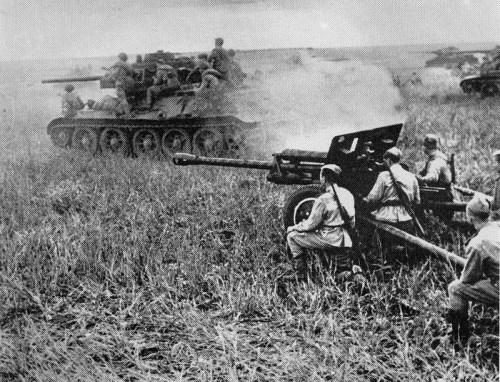
Kursk_T34_and_Fieldgun-px800Soviet Tanks and AT Guns at Kupiansk

The attack at Kupiansk surprised STAVKA which had been deceived by the build up of Panzers around the Kursk salient.  Stalin continued to hound his generals to begin Kutuzov on time, but the generals were “chastened” by the defeat at Kupiansk and “earlier experiences”[xxxv] and wanted to delay. Stalin forced them to begin Kutuzov on 22 June, the 2nd Anniversary of Barbarossa.  Manstein and his Eastern Front commanders held their breath.  Teams of Brandenburger commandos operating in the Soviet rear and Luftwaffe reconnaissance aircraft reported Russian units moving to advanced positions to the north and south of Kursk.  Vatutin commanding the Voronezh Front was ambushed and killed by a Brandenburger detachment supporting Ukrainian irregulars[xxxvi] as he returned from visiting 69th Army near Prokhorovka station on 19 June and was replaced by Lieutenant General Katukov of 1st Tank Army.  Katukov “was one of the Red Army’s most accomplished and experienced armor officers.”[xxxvii]
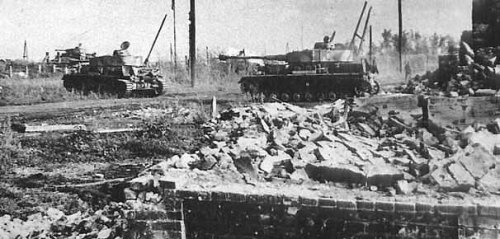
kursk_tanksMk IV Panzers

In the north Rokossovsky’s Central Front and Popov’s Bryansk Front supported by 11th Guards Army[xxxviii] began concentric attacks on the German 9th and 2nd Panzer Armies and ran into Henrici’s labyrinth on 22 June.  They hit the first line they found it empty, the Germans having repaired to secondary positions,[xxxix] German 88’s and self propelled guns took a heavy toll on the tanks of 2nd Tank Army.  The 3rd Tank Army under General Rybalko’s army committed after the initial assault “attempted a fresh penetration instead of exploiting the earlier efforts of the 3rd and 63rd Armies… Rybalko’s force included 698 serviceable tanks…but lacked the artillery and engineers for such a deliberate assault.”[xl] Popov telephoned Stalin at noon on 25 June “to report that Rybalko was practically stalled and suffering heavy losses in tanks.”[xli] The Germans committed the 5th and 8th Panzer divisions[xlii] against 3rd Tank Army. The fresh Panzers inflicted painful losses on Rybalko.  On 27 June Stalin called to complain about the handling of the army, demanding a direct assault.[xliii] The battle turned into a “grinding battle of armored attrition.”[xliv] After “a few bloody days bereft of any success, Rybalko’s tank formations had to be pulled out of the line into reserve.”[xlv] The “battle for the Orel salient ended three weeks later with a German defensive victory, as Army Group Center extricated its two armies from the box prepared for them while inflicting heavy casualties on three Soviet Fronts.”[xlvi] The Soviets lost over 629,000 men and 3,500 tanks.[xlvii] In comparison German losses were light and by falling back they shortened their line freeing units for other operations.  Stalin had Orel but failed to destroy the Germans and lost heavily in the attempt.

In the south Konev’s Steppe and Katukov’s Voronezh Fronts prepared their assault on Kharkov.  They attempted to deceive the Germans by simulating the massing of a “notional tank and combined-arms army” in the western side of the Kursk bulge.[xlviii] The deception was unsuccessful as reconnaissance by Luftwaffe aircraft and Brandenburgers failed to uncover any troop concentrations and Russian deserters, talked of a strike at Kharkov. The offensive “Rumiantsev” was opened by the 5th and 6th Guards armies supported by 53rd and 69th Armies on 21 June; a day later 7th Guards Army jumped off, two additional armies supported the west flank of the offensive.[xlix] The Russians in the two fronts began the operation with 980,000 men and 2,500 tanks.[l] Opposing them were 4th Panzer Army and Army Detachment Kempf’s 350,000 men and 1,750 tanks and assault guns including 100 Tigers and 192 Panthers.[li]
Sovietic_T34_battle_of_kurskT-34 towing disabled T-34 near Orel

STAVKA “chose to strike the strongest portion of Hoth’s defense head-on, to engage and defeat the German force and avoid the problems of flank threats.”[lii] Unfortunately they complicated the attack by focusing it at “precisely the boundary between the Voronezh and Steppe Fronts, causing increased coordination problems from the start of the operation.”[liii] The Germans used Ferdinands, Jagdpanzers and Sturmgeschutz in a mobile defensive role, as infantry fought delaying actions as they withdrew to successive defensive lines, inflicting brutal losses on the Russians.  Aided by massive artillery preparation the Russians broke through the weakened Army Detachment Kempf near Belgorad[liv] taking the city on 24 June.  Corps Raus’ 167th Infantry Division was taken on its exposed left flank forcing Raus to “fight a delaying action…until the withdraw reached Kharkov.” [lv] The Germans reacted to the threat by committing the “veteran 5th SS Panzer Grenadier Division Wiking” to reinforce Army Detachment Kempf.[lvi] Despite the success “the German defenses proved so tenacious that the leading brigades of the two tank armies had to enter the fray.”[lvii]

As the Russians advanced the German fell back.  Hoth directed Hausser to wait before counterattacking with XLVIII Panzer Corps and II SS Panzer Corps.  Katukov pushed the 1st and 5th Tank Armies into the hole in the German lines and moved toward Kharkov which was liberated by the 89th and 183rd Guards Divisions[lviii] on 2 July.  The liberation of Kharkov and Belgorad while exhilarating had cost Katukov over 250,000 casualties.  Skillful employment of mobile defense and local counterattacks by mixed Panzer battlegroups, such as one by Grossdeutschland on the flank of 5th Tank Army caused panic and some units withdrew “leaving behind masses of equipment of every description.”[lix] The tank armies had lost upwards of 50 percent of their tanks, infantry divisions were now down to half strength, some down to 3000 men.[lx] Yet the Soviets attempted to drive south to trap the Germans.  They were hit by XLVIII Panzer Corps and II SS Panzer Corps, both of which had seen little action thanks to Hoth’s conservation of strength. XLVIII Panzer Corps hit the 1st Tank Army at the “key road junction of Bogodukhov, 30 kilometers northwest” of Kharkov “severely mauling the leading three brigades”[lxi] forcing 1st Tank Army to withdraw towards Kursk. 5th Tank army moved to support but was taken in the flank by II SS Panzer Corps.  The SS Corps encircled the remainder of 5th Tank Army. Hunted by the SS on the open steppe the survivors slipped through gaps in the encirclement but both armies were ravaged.  By 15 June 1st Tank Army was down to 120 tanks and 5th Tank Army had “50 of its original 503 tanks and self-propelled guns serviceable.”[lxii] XLVII Panzer Corps took Kharkov on 18 July.

Totenkopf-Kursk-01SS Panzer Troops and Tigers prepping for battle

The victory paid dividends for the Germans. The Front held and the Russians had taken nearly a million casualties and lost almost 6000 tanks and self-propelled guns.  Three Tank Armies had been smashed, 5th Tank Army would not be fit for field duty for two months.[lxiii] 3rd Tank Army earned a Guards designation but was withdrawn from combat.[lxiv] 6th Army, victimized by PANTHER was destroyed while the 5th, 6th and 7th Guards Armies were shattered. Additionally, the Germans decimated two independent tank corps.  Stalin reacted by halting operations, cancelling follow on offensives and rebuilding the Red Army’s tank armies and mechanized forces.  He realized that his Generals had been right in not wanting to undertake offensive operations until the Germans had been weakened, but the German insistence on not going on the offensive caused him to ignore their arguments. He decided to wait until winter to launch his next offensive, but that offensive would never be launched as by the time he was ready the war was over.

Bild 101III-Zschaeckel-206-34German Tank Commader as Panzers mop up

The elimination of the Russian threat enabled Italy to be reinforced as well as the reinforcement of the Atlantic Wall.  The Salerno landings were a disaster, the Allies driven into the sea by Panzer Divisions released from the Eastern Front.  The disasters at Salerno and the Russian debacle brought overwhelming domestic political pressure on Roosevelt and Churchill to end the war. Clandestine talks began in Switzerland between Avery Dulles and Karl Wolff[lxv] while Walter Schellenberg met with Count Bernadotte.[lxvi] Despite the previous demand for unconditional surrender the Allies decided to negotiate with the new German leadership might end the war in Europe.  Goering surrendered power to General Beck and gave himself and other accused war criminals up to the Allies. Beck took power, withdrew to 1939 borders, dismantled the death camps and disbanded the Nazi Party, and its police apparatus.[lxvii] Peace came to Europe on 9 November 1943, 25 years after Kaiser Wilhelm’s abdicated his throne.
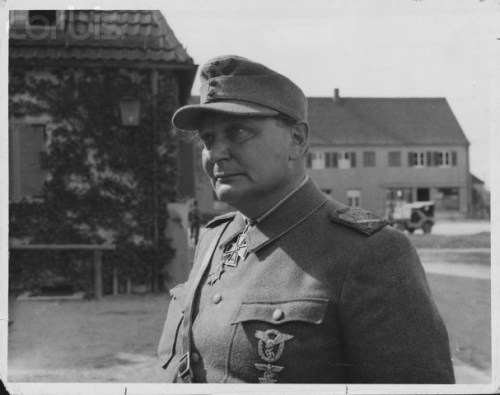
HU048801Goering Surrenders himself


[i] Clark, Alan. Barbarossa: The Russian German Conflict, 1941-45. Harper Collins Publishers, New York, NY 1965. Pp.307-311. There was an attempt on Hitler’s life on his return from Kluge’s headquarters.  Only the bomb did not go off, all components had worked but the detonator did not fire.  Clark notes that “the Devil’s hand had protected Hitler.” (p.311)

[ii] Galante, Pierre. Operation Valkyrie: The German Generals’ Plot Against Hitler. Translated by Mark Howson and Cary Ryan. Harper and Row Publishers, New York, NY 1981. Originally published as Hitler est il Mort? Librairie Plon-Paris-Match, France. 1981. p.167 

[iii] Padfield, Peter. Himmler. MJF Books, New York. 1990. p.474.  Himmler had a number of contacts and intermediaries who he used to attempt contact with the Allies as early as 1943.

[iv] Höhne, Heinze. The Order of the Death’s Head: The Story of Hitler’s SS. Translated by Richard Barry. Penguin Books, New York and London, 2000. First English edition published by Martin Secker and Warburg Ltd. London 1969. Originally published as Der Orden unter dem Totenkopf, Verlag Der Spiegel, Hamburg 1966.  Diels remained an ally of Goering even marrying his sister in 1943.

[v] Von Lang, Jochen. The Secretary: Martin Bormann: The Man Who Manipulated Hitler. Translated by Christa Armstrong and Peter White. Random House Inc. 1979. Originally published as Der Secretär. Deutsche-Verlags-Anstalt, Stuttgart. 1977 p.9.  At his trial Goering remarked to other defendants. “If Hitler had died sooner, I as his successor would not have had to worry about Bormann. He would have been killed by his own staff even before I could have given the order to bump him off.”

[vi] Irving, David. Göring: A Biography. William Morrow and Company, New York, NY 1989. Richthofen had succeeded Jeschonnek in March when Goering relieved him. Goering believed that Jeschonnek “was too pliable at the Wolf’s Lair.” Goering had actually considered this a number of times but postponed it several times. p.388

[vii] Guderian, Heinz. Panzer Leader. (abridged) Translated from the German by Constantine Fitzgibbon, Ballantine Books, New York 1957. pp.244  Hitler conducted a similar conference involving many of the same people in Munich.

[viii] Carell, Paul. Scorched Earth: The Russian German War 1943-1944. Translated by Ewald Osers, Ballantine Books, New York, NY 1971, published in arrangement with Little-Brown and Company. p. 336

[ix] Ibid. Irving. pp. 377-379.

[x] Ibid. Guderian. p.243

[xi] Ibid. Irving. p.378

[xii] Glantz, David M and House, Jonathan. The Battle of Kursk.  University Press of Kansas, Lawrence, KS. 1999. pp.21-25.  Operations order 5 had been approved by Hitler on and issued by OKH on 13 March. It was followed by Operations Order 6 on 15 April.

[xiii] Ibid. Clark. p.324.

[xiv] Warlimont, Walter. Inside Hitler’s Headquarters 1939-45. Translated by R.H. Berry, Presido Press, Novato CA, 1964. p.334 These objections of Jodl were from June, but indicate the feeling of Jodl for the Zitadelle as planned and when would have likely been his response in such a situation.

[xv]Glantz, David M. and House, Jonathan. When Titans Clashed: How the Red Army Stopped Hitler. University Press of Kansas, Lawrence, KS. 1995. p.157 Zeitzler had been a consistent advocate for Zitadelle since he heard Manstein’s initial proposal in March.

[xvi]Macksey, Kenneth. Guderian: Creator of the Blitzkrieg. Stein and Day Publishing, New York, NY 1975 p.206

[xvii] Ibid. Clark. p.322

[xviii] Ibid. Clark. p.323.  Zeitzler made this argument with Jodl during a briefing in April 1943.

[xix] Shirer, William L. The Rise and Fall of the Third Reich. A Touchstone Book published by Simon and Schuster, 1981, Copyright 1959 and 1960. p.1115.  Hitler had told Keitel and Jodl that “When it comes to negotiating [for peace]…Goering can do much better than I. Goering is much better at those things.”

[xx] Speer, Albert. Inside the Third Reich. Collier Books, a Division of MacMillan Publishers, Inc. New York, NY 1970. p.245.  From a conversation with Speer in late 1942.

[xxi] Ibid. Glantz and House. Clash of Titans. pp. 216-217. Hitler would replace Zeitzler with Guderian in June 1944.

[xxii] Ibid. Irving. p.379 From a conversation with State Secretary Ernst von Weizäcker 11 February 1943.

[xxiii] Ibid. Speer.  p.512. The ending of the addiction took place at Nurnberg and Goering surprised many of his co-defendants with his “remarkable energy.”

[xxiv] Ibid. Glantz and House. Kursk. p.28

[xxv] Ibid. Glantz and House. Kursk. p.28.

[xxvi] Ibid. Glantz and House. Kursk. p.264

[xxvii] Overy, Richard. Russia’s War: A History of the Soviet War Effort: 1941-1945. Penguin Books, New York NY and London, 1997. pp.211

[xxviii] Erickson, John. The Road to Berlin. Cassel Military Paperbacks, London, 2003. First Published by Weidenfeld and Nicholson, 1983. p.76

[xxix] Ibid. Glantz and House. Kursk. p.265

[xxx] Ibid. Glantz and House. Kursk. p.23.

[xxxi] Liddell-Hart, B.H. The German Generals Talk. Quill Publishing, New York, NY. 1979. Copyright 1948 by B.H. Liddell-Hart. p.215  Henrici describes the methods that he used in 1944 as Commander of 1st Panzer Army and as Commander of Army Group Vistula during the defense of Berlin.

[xxxii] Hausser would actually command 7th Army in Normandy in 1944.

[xxxiii] Ibid. Glantz and House Kursk. p.53 This was the 10th Panzer Brigade assigned to XLVIII Panzer Corps.  Additionally Clark notes production figures for Panthers from Speer that indicate that 324 Panthers would be available by 31 May. (Clark. p.325)

[xxxiv] Ibid. Glantz and House. Kursk. p.52.  At Kursk the two Ferdinand detachments were both assigned to 9th Army.

[xxxv] Ibid. Glantz and House. Kursk. p.28.

[xxxvi] Ibid. Carell. p.510.  Vatutin was killed by Ukrainian irregulars in April 1944.

[xxxvii] Ibid. Glantz and House. Kursk. p.62

[xxxviii] Newton, Steven H. Hitler’s Commander: Field Marshal Walter Model, Hitler’s Favorite General. DeCapo Press, Cambridge MA 2005. p. 256

[xxxix] Ibid. Liddell-Hart. p.215.

[xl] Ibid. Glantz and House. Kursk. p.236

[xli] Ibid. Erickson. p.113. At Kursk the call took place on 20 July when Rybalko was in this situation.

[xlii] Ibid. Newton. p.256

[xliii] Ibid. Erickson. p.114

[xliv] Ibid. Glantz and House. Kursk. p.236

[xlv] Ibid. Erickson. p.114

[xlvi] Ibid. Newton. p.256

[xlvii] Ibid. Glantz and House. p.345. The actual losses were 429,000 men and 2,500 tanks against a German force significantly weakened by Zitadelle.  Had the Russians attacked the Germans rather than receiving the German attack first their losses in men and machines would have been far higher.  I have reflected that in the alternative numbers.

[xlviii] Ibid. Glantz and House. When Titans Clashed. p.168  The Soviets did try this in their counter offensive following Zitadelle.

[xlix] Ibid. Glantz and House. When Titans Clashed. p.169

[l] Ibid. Glantz and House. Kursk. p.344. Actual figures for beginning of offensive.

[li] Ibid. Glantz and House. Kursk. p.338.  Figures from beginning of Zitadelle.

[lii] Ibid. Glantz and House. Kursk. p.244 The actual text reads “Manstein’s defense” not Hoth’s.

[liii] Ibid. Glantz and House. Kursk. p.244

[liv] Von Mellenthin, F.W. Panzer Battles: A Study of the Employment of Armor in the Second World War. Translated by H. Betzler, Ballantine Books, New York, NY, 1971. Originally Published University of Oklahoma Press, 1956. p.286

[lv] Raus, Erhard. Panzer Operations: The Eastern Front Memoir of General Raus, 1941-1945. Compiled and Translated by Steven H Newton. Da Capo Press a member of the Perseus Book Group, Cambridge, MA 2003. p.214

[lvi] Ibid. Glantz and House. Kursk. p.247

[lvii] Ibid. Glantz and House. When Titans Clashed. p.169

[lviii] Ibid. Erickson. p.121  These were the actual divisions that liberated Kharkov.

[lix] Ibid.  Von Mellenthin . p.287

[lx] Ibid. Glantz and House. p.252

[lxi] Ibid. Glantz and House. When Titans Clashed. p.170

[lxii] Ibid. Glantz and House. Kursk. p.252

[lxiii] Ibid. Glantz and House. Kursk. p.252

[lxiv] Ibid. Glantz and House. Kursk. p.237

[lxv] Ibid. Hohne. p.572

[lxvi] Ibid.  Hohne. p.570

[lxvii] Ibid. Galante. pp 69 and 207

Bibliography

Carell, Paul. Scorched Earth: The Russian German War 1943-1944. Translated by Ewald Osers, Ballantine Books, New York, NY 1971, published in arrangement with Little-Brown and Company

Clark, Alan. Barbarossa: The Russian German Conflict, 1941-45. Harper Collins Publishers, New York, NY 1965

Erickson, John. The Road to Berlin. Cassel Military Paperbacks, London, 2003. First Published by Weidenfeld and Nicholson, 1983

Galante, Pierre. Operation Valkyrie: The German Generals’ Plot Against Hitler. Translated by Mark Howson and Cary Ryan. Harper and Row Publishers, New York, NY 1981. Originally published as Hitler est il Mort? Librairie Plon-Paris-Match, France. 1981.

Glantz, David M and House, Jonathan. The Battle of Kursk.  University Press of Kansas, Lawrence, KS. 1999.

Glantz, David M. and House, Jonathan. When Titans Clashed: How the Red Army Stopped Hitler. University Press of Kansas, Lawrence, KS. 1995

Guderian, Heinz. Panzer Leader. (abridged) Translated from the German by Constantine Fitzgibbon, Ballantine Books, New York 1957

Höhne, Heinze. The Order of the Death’s Head: The Story of Hitler’s SS. Translated by Richard Barry. Penguin Books, New York and London, 2000. First English edition published by Martin Secker and Warburg Ltd. London 1969. Originally published as Der Orden unter dem Totenkopf, Verlag Der Spiegel, Hamburg 1966.

Irving, David. Göring: A Biography. William Morrow and Company, New York, NY 1989

Liddell-Hart, B.H. The German Generals Talk. Quill Publishing, New York, NY. 1979. Copyright 1948 by B.H. Liddell-Hart

Macksey, Kenneth. Guderian: Creator of the Blitzkrieg. Stein and Day Publishing, New York, NY

Newton, Steven H. Hitler’s Commander: Field Marshal Walter Model, Hitler’s Favorite General. DeCapo Press, Cambridge MA 2005

Overy, Richard. Russia’s War: A History of the Soviet War Effort: 1941-1945. Penguin Books, New York NY and London, 1997

Padfield, Peter. Himmler. MJF Books, New York. 1990

Raus, Erhard. Panzer Operations: The Eastern Front Memoir of General Raus, 1941-1945. Compiled and Translated by Steven H Newton. Da Capo Press a member of the Perseus Book Group, Cambridge, MA 2003

Shirer, William L. The Rise and Fall of the Third Reich. A Touchstone Book published by Simon and Schuster, 1981, Copyright 1959 and 1960.

Speer, Albert. Inside the Third Reich. Collier Books, a Division of MacMillan Publishers, Inc. New York, NY 1970.

Von Lang, Jochen. The Secretary: Martin Bormann: The Man Who Manipulated Hitler. Translated by Christa Armstrong and Peter White. Random House Inc. 1979. Originally published as Der Secretär. Deutsche-Verlags-Anstalt, Stuttgart. 1977

Von Mellenthin, F.W. Panzer Battles: A Study of the Employment of Armor in the Second World War. Translated by H. Betzler, Ballantine Books, New York, NY, 1971. Originally Published University of Oklahoma Press, 1956.

Warlimont, Walter. Inside Hitler’s Headquarters 1939-45. Translated by R.H. Berry, Presido Press, Novato CA, 1964.

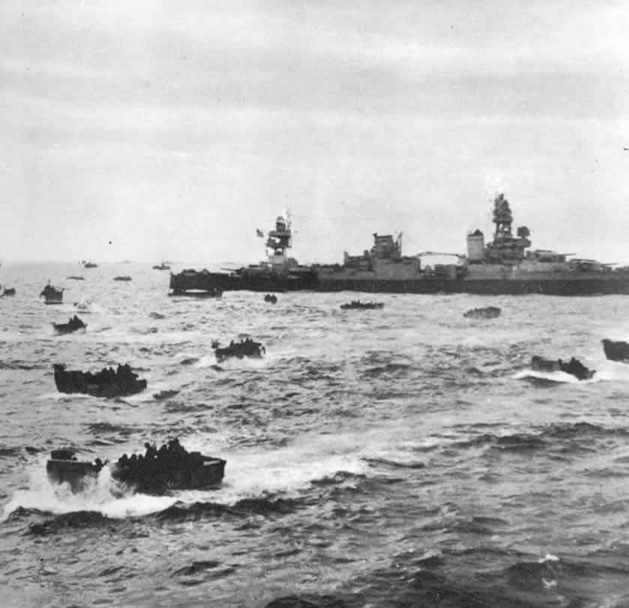
2 Comments

Filed under alternative history, History, Military, world war two in europe