Tag Archives: franklin d roosevelt

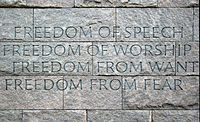
The Four Freedoms

FDR_Memorial_wall

Friends of Padre Steve’s World,

On January 6th 1941 President Franklin Delano Roosevelt delivered his State of the Union Message to Congress and the nation. I spent the time to both both read it and listen to it the other day. It is a profoundly moving speech, not without controversy of course, but one which we need to hear again. It is a speech that like the Declaration of Independence, Lincoln’s  Gettysburg Address, and Dr. Martin Luther King Jr.’s I have a Dream speech calls us to higher ideals, ideals that we often come up short in living up to, but ideals worth living for.

https://www.youtube.com/watch?v=VQU6bFbjIC8

When Roosevelt spoke the nation was in the midst of crisis. It was still recovering from the Great Depression, war threatened as Hitler’s Nazi German legions had overrun all of Western Europe, much of North Africa, and German U-Boats and surface ships were prowling the North Atlantic. Britain stood alone between Germany’s complete domination of Europe. Even the Soviet Union, a mortal enemy of Fascism had concluded a concordat with Hitler to divide Eastern Europe. Though no one yet knew it, Hitler was already planning to break his accord with Stalin and invade the Soviet Union.

In the speech, which was largely focus on the threat of Nazi Germany, support of Britain and the exiled governments of nations conquered by Hitler, and preparations to defend the United States, Roosevelt called on Congress to pass Lend Lease to help those fighting the dictators, as well as increased opportunity at home. In response to the emerging threats and the unwillingness of some, including big business to face up to them. He noted:

“As a nation we may take pride in the fact that we are soft-hearted; but we cannot afford to be soft-headed.  We must always be wary of those who with sounding brass and a tinkling cymbal preach the “ism” of appeasement.  We must especially beware of that small group of selfish men who would clip the wings of the American eagle in order to feather their own nests.”

On the domestic front Roosevelt reiterated the message of the New Deal, for even with war looming he did not want to see Americans lost in the exchange and he linked freedom abroad to the same at home. He noted:

“As men do not live by bread alone, they do not fight by armaments alone. Those who man our defenses and those behind them who build our defenses must have the stamina and the courage which come from unshakable belief in the manner of life which they are defending. The mighty action that we are calling for cannot be based on a disregard of all the things worth fighting for.”

He continued:

“Certainly this is no time for any of us to stop thinking about the social and economic problems which are the root cause of the social revolution which is today a supreme factor in the world. For there is nothing mysterious about the foundations of a healthy and strong democracy.

The basic things expected by our people of their political and economic systems are simple. They are:

Equality of opportunity for youth and for others.

Jobs for those who can work.

Security for those who need it.

The ending of special privilege for the few.

The preservation of civil liberties for all.

The enjoyment — The enjoyment of the fruits of scientific progress in a wider and constantly rising standard of living.

These are the simple, the basic things that must never be lost sight of in the turmoil and unbelievable complexity of our modern world. The inner and abiding strength of our economic and political systems is dependent upon the degree to which they fulfill these expectations.”

But the real heart of the message, applicable to all people everywhere Roosevelt enunciated a number of principles that are a beacon to all people. Firmly grounded in words of the Declaration of Independence and the Gettysburg Address they are called the Four Freedoms. Those freedoms are an ideal, in fact they certainly were not practiced well then by Americans, nor now, but they are worth working to: Roosevelt said:

“In the future days, which we seek to make secure, we look forward to a world founded upon four essential human freedoms.

The first is freedom of speech and expression—everywhere in the world.

The second is freedom of every person to worship God in his own way—everywhere in the world.

The third is freedom from want—which, translated into world terms, means economic understandings which will secure to every nation a healthy peacetime life for its inhabitants—everywhere in the world.

The fourth is freedom from fear—which, translated into world terms, means a world-wide reduction of armaments to such a point and in such a thorough fashion that no nation will be in a position to commit an act of physical aggression against any neighbor—anywhere in the world.

That is no vision of a distant millennium. It is a definite basis for a kind of world attainable in our own time and generation. That kind of world is the very antithesis of the so-called new order of tyranny which the dictators seek to create with the crash of a bomb.”

The speech was important, and now as it did then it calls Americans to higher purposes, to higher ideals, and it recognizes that we have never fully measured up to our own words. At the time it was spoken, Jim Crow was still the law of the land, Mexican Americans were often treated as poorly as blacks, Native Americans had few rights; and barely a year later Japanese Americans would be taken from the homes, lose their business and be sent to detention camps for the duration of the war after Pearl Harbor, simply because they were of Japanese descent. But those abiding principles are things that we should never lose sight of, and always strive to realize.

In an age of uncertainty, turbulence, division, inequity, and deeply ingrained cynicism like ours, it is time to reflect on them, to strive for a higher purpose, and not to lose hope or give in to fear.

Peace,

Padre Steve+
3 Comments

Filed under History, philosophy, Political Commentary

Greetings from Shangri-La: The Doolittle Raid

hornet1941-4-18-020807

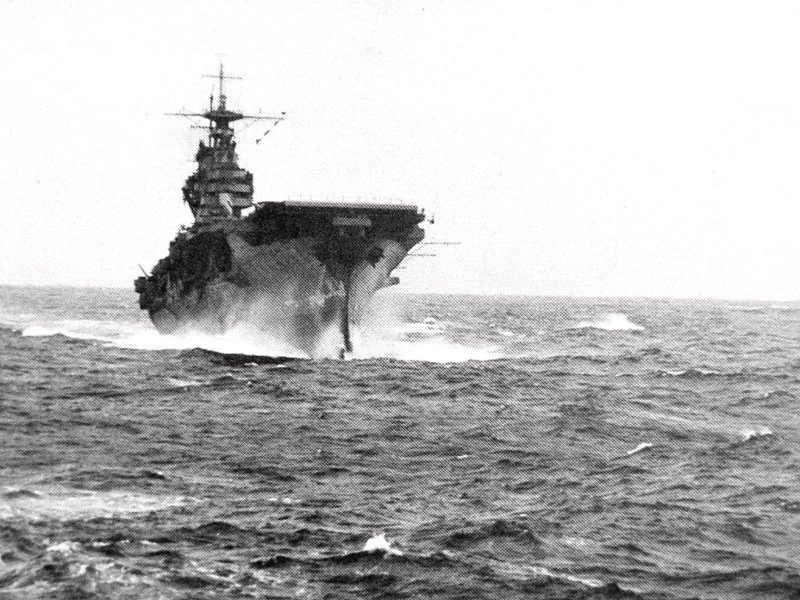
This week marks the 73rd anniversary of the Doolittle Raid on Tokyo. 80 US Army Air Corps flyers manning 16 B-25 Mitchell bombers conducted a mission from the deck of the USS Hornet CV-8 which though it caused little damage changed the course of World War Two in the Pacific.

Marc_A._Mitscher_and_James_Doolittle

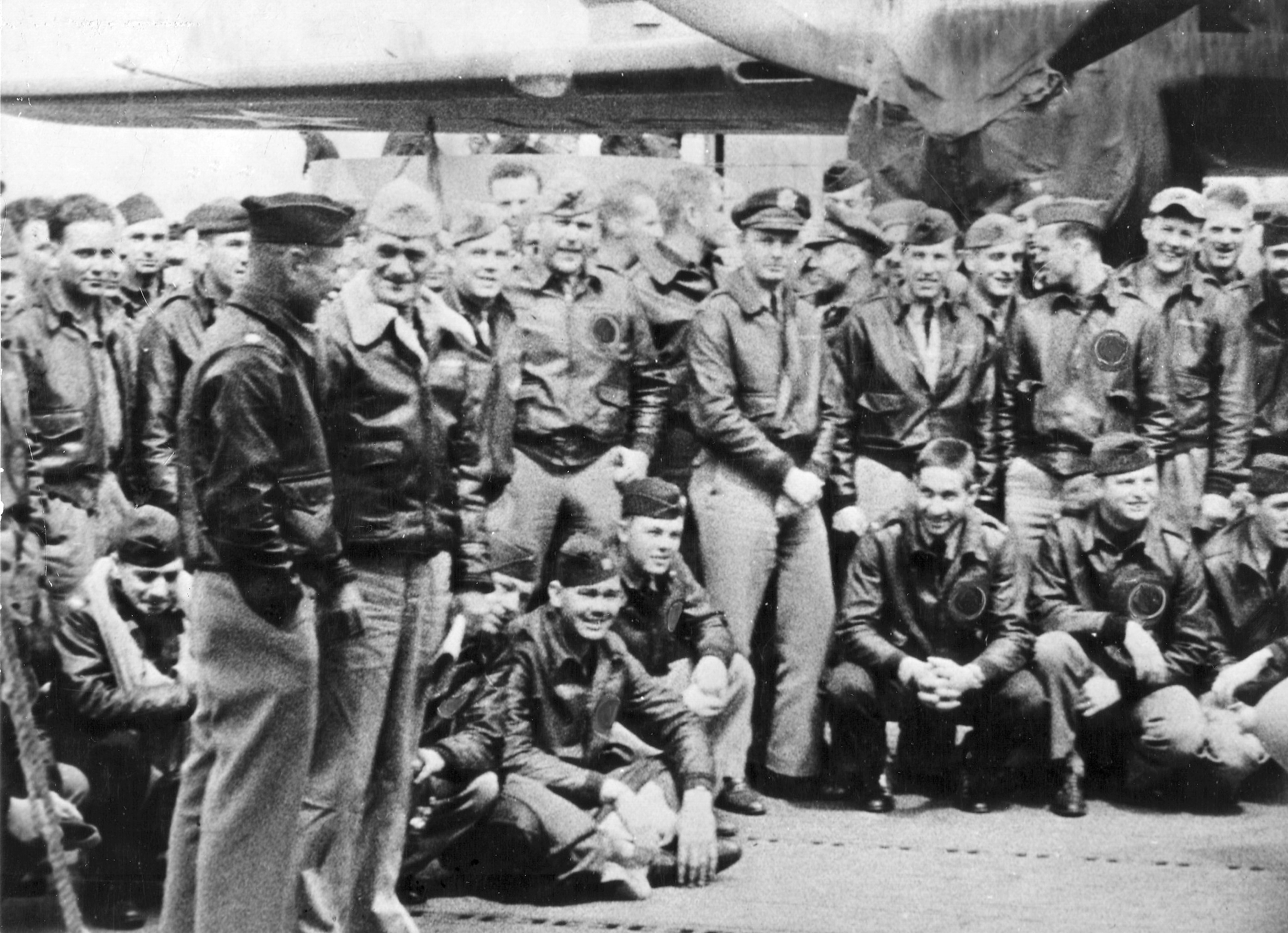
Doolittle and his Airmen with Hornet’s C.O. Captain Marc Mitscher 

The genus of the strike came from the desire of President Franklin Roosevelt to bomb Japan as soon as possible during a meeting just prior to Christmas 1941. Various aircraft types were considered and in the end the military chose the B-25 because it had the requisite range and had the best characteristics. Aircraft and their crews from the 17th Bomb Group which had the most experience with the aircraft were modified to meet the mission requirements. Lieutenant Colonel Jimmy Doolittle was selected to lead the mission.

Once the aircraft were ready they and their crews reported to Eglin Field for an intensive three week period of training. Supervised by a Navy pilot the crews practiced simulated carrier take offs, low level flying and bombing, night flying and over water navigation. When the training was complete the aircraft and crews and support personnel flew to McClellan Field for final modifications and then to NAS Alameda California where they were embarked on the Hornet Hornet’s air group had to be stowed on the ships hanger deck since the 16 B-25s had to remain of the flight deck. Each bomber was loaded with 4 specially modified 500 lb. bombs, three high explosive and one incendiary.

Departing Alameda on April 2nd the Hornet and her escorts, Hornet’s Task Force 18 rendezvoused with the Admiral William “Bull” Halsey’s Task Force 16 built around the USS Enterprise CV-6. task Force 16 provided escort and air cover during the mission. The carriers, escorted by 4 cruisers, 8 destroyers and accompanied by two oilers hoped to get close enough to the Japanese home islands so that the raiders could reach bases in allied China.

hornet-rough-seas1

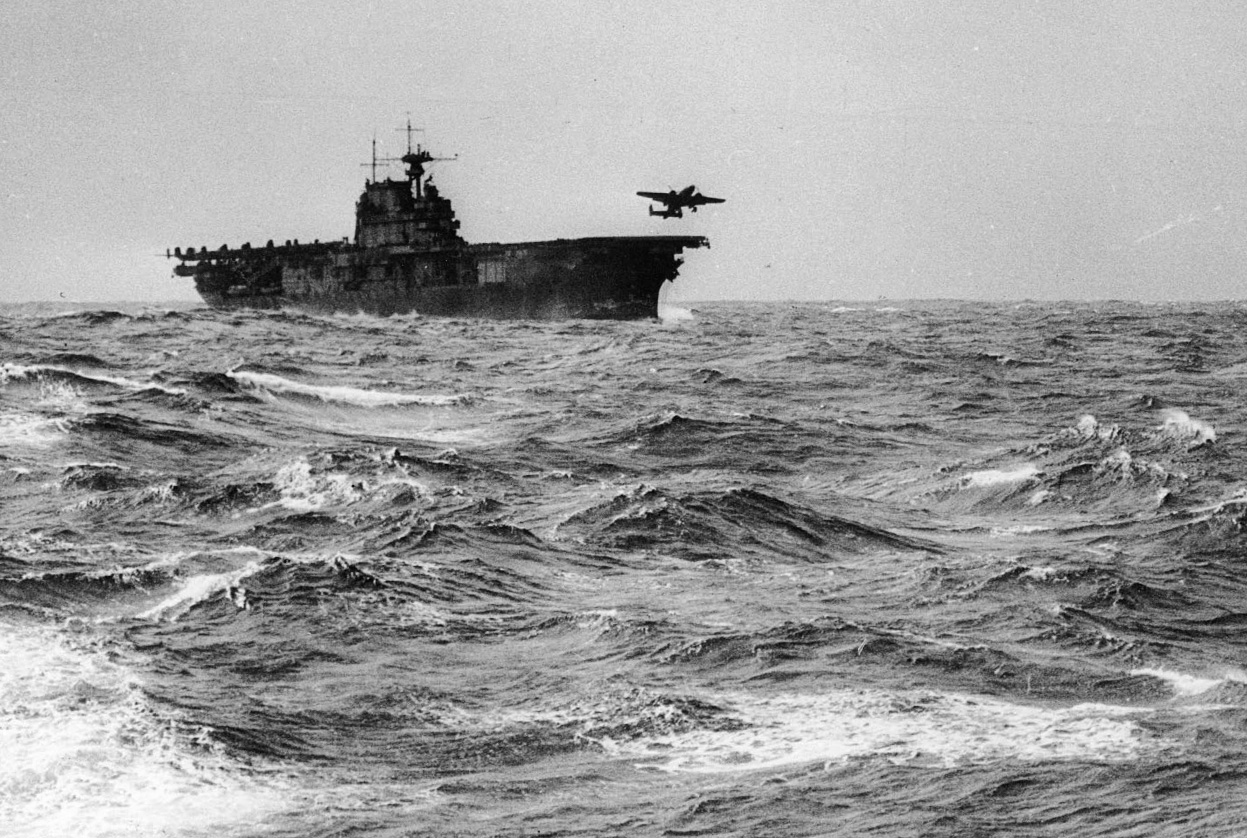
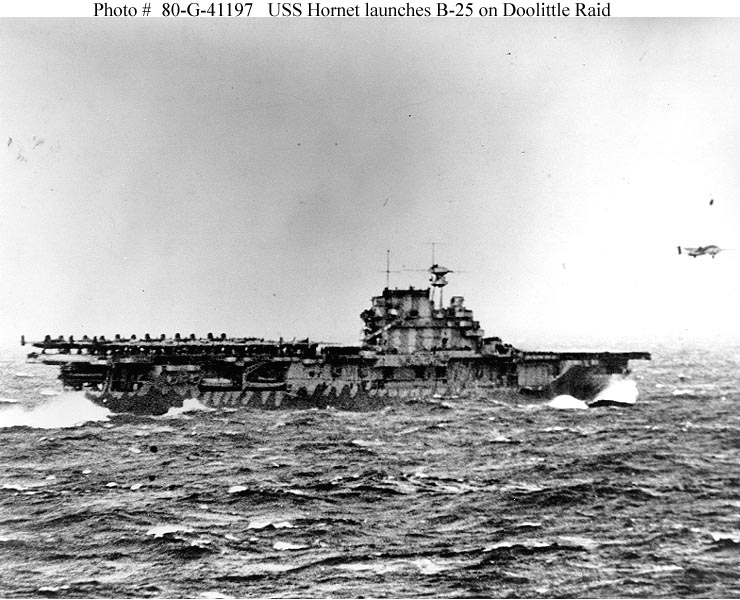
Hornet in Heavy Seas while launching the Raiders

The destroyers and slow oilers broke off on the evening of the 17th after refueling the carriers and cruisers. The two carriers and the cruisers then commenced a high speed run to get into range. However early in the morning of April 18th the ships were sited by a Japanese patrol boat, the #23 Nitto Maru which was sunk by the USS Nashville but not before it got off a radio message alerting the Japanese command. However the Japanese knowing that carrier aircraft had a relatively short range did not expect an attack. However, realizing the danger that the sighting brought, Captain Marc Mitscher elected to launch immediately, even though it meant that bombers would have to ditch their aircraft or attempt to land well short of the friendly Chinese airfields. The launch was 10 hours earlier and about 170 miles farther out from the Chinese bases than planned.

538x362xNorth-American-Aviation-B-25B-Mitchell-launches-from-USS-Hornet-CV-8-18-April-1942-21.jpg.pagespeed.ic.fjuaPl49hb

B-25 Launching from Hornet

Flying in groups of two to four aircraft the raiders struck the Japanese cities of Tokyo, Yokohama, Yokosuka, Nagoya, Kobe and Osaka. Minimal damage was done and only one aircraft was damaged. However they needed to fly nearly 1500 more miles to get to areas of China unoccupied by Japanese forces. Miraculously most of the aircraft and crews managed to find refuge in China. 69 of the 80 pilots and crew members avoided death or capture. Two flyers drowned, one died when parachuting from his aircraft. Eight men were captured. Of those captured by the Japanese three, Lieutenants William Farrow, Dean Hallmark and Corporal Harold Spatz were tried and executed for “war crimes” on October 15th 1942.

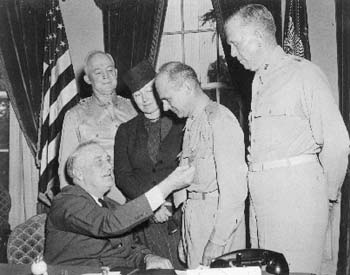
Many of the surviving flyers continued to serve in China while others continued to serve in North Africa and Europe, another 11 died in action following the raid. Doolittle felt that with the loss of all aircraft and no appreciable damage that he would be tried by courts-martial. Instead since the raid had so bolstered American morale he was awarded the Medal of Honor, promoted to Brigadier General and would go on to command the 12th Air Force, the 15th Air Force and finally the 8th Air Force.

The raid shook the Japanese, especially the leadership of the Imperial Navy who had allowed American aircraft to strike the Japanese homeland. The attack helped convince Admiral Isoroku Yamamoto that an attack on Midway was needed in order to destroy the American Carriers and the threat to the home islands.

When asked by a reporter about where the attack was launched from, President Roosevelt quipped “Shangri-La” the fictional location of perpetual youth in the Himalayas’ made famous in the popular book and movie Lost Horizon.

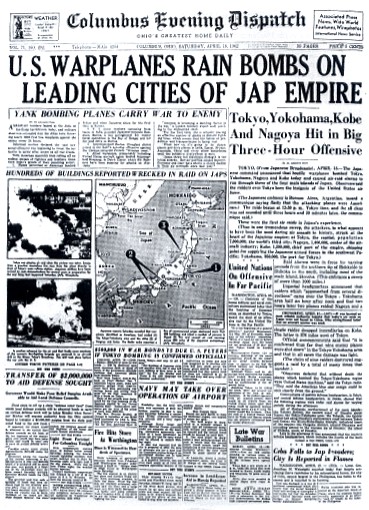
01_raid_newspaper

The raid in terms of actual damage and losses to the attacking forces was a failure, but in terms of its impact a major victory of the United States. The attack was psychologically devastating to Japanese leaders, including Prime Minister Hideki Tojo, whose personal aircraft was nearly hit by one of the raiders and Admiral Isoroku Yamamoto, who felt personally humiliated and dishonored by the fact that bombers launched from American carriers.

Likewise the raid gave the people of the United States a huge morale boost at a time when very little was going right. It forced the Japanese Navy to launch the attack on Midway that turned out to be a disaster, decimating the best of the Japanese Naval Air Forces and the loss of four aircraft carriers and enable the US Navy to take the offensive two months later at Guadalcanal.

President-Franklin-Delano-Roosevelt-pins-the-Congressional-Medal-of-Honor-on-Brig.-Gen.-James-Doolittle.

Franklin Roosevelt Awards Medal of Honor to Jimmy Doolittle 

In the years after the war the survivors would meet. Today only two survivors of the raid remain alive. The two men presented the Congressional Gold Medal awarded to the group to the National Museum of the U.S. Air Force on Saturday, 73 years to the day after their bombing attack on Japan rallied Americans in World War II. Ninety-nine year old Lt.Col. Richard “Dick” Cole and ninety-three year old Staff Sergeant David Thatcher presented the medal which was carried to the museum in  a ceremonial flight of B-25 bombers. Cole was Doolittle’s co-pilot and Thatcher the tail gunner in the bomber nicknamed the “Ruptured Duck.”

It will not be long before these last two survivors will be gone and it is up to us to never forget their heroism, sacrifice and service in a mission the likes of which had never before been attempted, and which would in its own way help change the course of the Second World War.

Peace

Padre Steve+

9 Comments

Filed under History, Military, world war two in the pacific

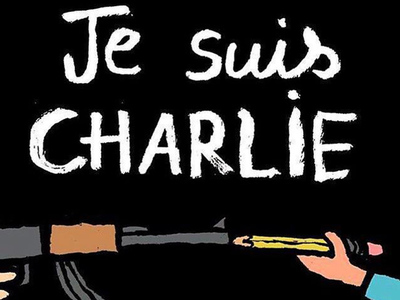
Do Not Give in to Fear: #Je Suis Charlie

je-suis-charlie

In his First Inaugural Address Franklin D. Roosevelt spoke these immortal words:

“This is preeminently the time to speak the truth, the whole truth, frankly and boldly. Nor need we shrink from honestly facing conditions in our country today. This great Nation will endure as it has endured, will revive and will prosper. So, first of all, let me assert my firm belief that the only thing we have to fear is fear itself—nameless, unreasoning, unjustified terror which paralyzes needed efforts to convert retreat into advance.”

The threat today is different than Roosevelt faced in 1932 when he was addressing widespread economic, social and political chaos that was striking fear at the heart of America and radicalizing some segments of the population. It is more closely related to the threat that he would later face in 1941 when he recognized Nazi threat and signed the Atlantic Charter and then responded to the Japanese attack on Pearl Harbor. But even then there are differences, between that and the threat today.

That being said, in this address Roosevelt was absolutely correct in several things which are timeless and that we as Americans and others in the West, as well as those who aspire to our values in other parts of the world, include Moslem nations must address.

What happened in Paris, the brazen attack of Al Qaeda linked terror striking at cartoonists and other satirists who they claimed to be committing blasphemy against the Prophet Mohammed. That attack has raised legitimate security concerns that other radicalized Moslems will commit similar attacks, not just in France but in other Western democracies. In fact as a career military officer, historian and theologian I can say that this threat is not overblown. We are probably just seeing the tip of the iceberg.

However, the problem is during such times that people, including government leaders, religious leaders, academics and journalists give in to fear by responding in one of two counterproductive ways. Some, give in to the fear by remaining silent, playing it safe and hoping the threat just goes away and even condemning those that they believe brought on the crisis, rather than those actually committing the violent acts. Others go to the opposite extreme and create a climate of fear, suspicion and encourage the creation of a police state, the surrender of civil liberties and the persecution of anyone remotely resembling the perpetrators of the attacks.

In fact the Roosevelt administration itself was guilty of the latter when in 1941 and early 1942 it rounded up Japanese Americans on the West Coast and sent them to internment camps, simply for the crime of being Japanese. But they didn’t do that to Americans of German or Italian descent. Why? Well it was easy, the Japanese were easy to identify, they were not white. It gave into the climate of fear, and imprisoned patriotic American citizens because of their race, while ignoring those of German descent who in the late 1930s and even in 1941 were members of the a group called the Bund, which was made of of ethic Germans who supported the Nazis.

But Roosevelt’s words are applicable today. The attacks in Paris were an attack on Western Civilization and democracy, done in the name of Islam. They were aimed at the heart of being able to speak freely, even insensitively and offensively about people in power, using satire to do so. While satirist were the target this time, there have been those who have been threatened, attacked or killed for writing truthful history, political commentary or even fictional works which some Moslems cannot abide, including author Salman Rushdie.

The vast majority of these types of attacks over the past several decades have been done in the name of Islam. However, Christians, Jews, Hindus and others cannot claim that leaders of their religions have not engaged in similar behaviors, dating to antiquity. All have committed similar acts throughout history in the name of their Gods, acts that have encompassed everything from harassment and persecution, programs, banishment from society, forced conversions, military conquest and even genocide.

Now is the time for leaders to boldly speak the truth, with honesty and candor. They cannot mince words in the hopes of not offending those who strike at our freedoms, even freedoms which some find offensive.

Likewise, all of us, not just leaders have to honestly face the conditions in our countries, and we cannot give in to fear. We should not be silent, or even self-censor when it comes to difficult and controversial ideas simply because we fear a backlash of some kind. That being said, when we do so we have to ensure that our words do not add to that climate of fear, intolerance and loathsome behavior that characterizes a nation seeking scapegoats, as did the Germans to the Jews after the First World War and during the Nazi regime.

Fear is the driving factor in both of these reactions, and both are counter-productive because they encourage more extremism. As Roosevelt said “the only thing we have to fear is fear itself—nameless, unreasoning, unjustified terror which paralyzes needed efforts to convert retreat into advance.” 

Sadly there will be those, especially some politicians, pundits and political preachers who seek to convert that fear to their advantage. Already in response to these heinous attacks we are seeing it. Calls for the full militarization of police forces, placing police spies in houses of worship, and treating all Moslems if they were guilty for the acts of some of their brothers and suggest imprisoning, expelling or killing Moslems  because of their religion.

While I would agree that Islam has much reforming to do, persecuting Moslems is no way to bring it about. However, after the Charlie Hebdo massacre there are signs that some Moslems, journalists, some religious leaders and even the President of Egypt are calling for a Reformation of Islam.  That will take time, that Reformation in Christianity needed to be helped along by the more secular Enlightenment before Christians began to abandon some of the same kind of punitive beliefs and measures against heretics, critics and unbelievers so common in Islam today.

Likewise there are some religious leaders, particularly conservative Christian leaders in this country who are blaming the victims of the massacre for committing blasphemy. Bryan Fischer of the American Family Association even called it God’s judgment on them for blasphemy, not of Islam, but of Christianity. Randall Terry, a founder of Operation Rescue urged Christians in 1993:

“Let a wave of intolerance wash over you. I want you to let a wave of hatred wash over you. Yes, hate is good…. If a Christian voted for Clinton, he sinned against God. It’s that simple…. Our goal is a Christian Nation… we have a biblical duty, we are called by God to conquer this country. We don’t want equal time. We don’t want Pluralism. We want theocracy. Theocracy means God rules. I’ve got a hot flash. God rules.” 

Honestly, is that any different from the Islamic preachers of hate today?


But then what is blasphemy? Every religion has beliefs which if contradicted or criticized could be considered blasphemy, which in some cases throughout history has merited death. Protestants who abandoned Catholicism during the Reformation were marked as heretics and unless they had a Prince of King powerful enough to protect them were tried and executed. Anabaptists killed under under Calvin and Zwingli because they were re-baptized. Catholics in England became criminals after the Anglican Church became the state church. Sunni and Shia Moslems kill each other because of where they believe legitimate religious authority lies, the bloodline of the Prophet or learned teachers.

Since the list of blasphemous acts goes on and on depending on what religion, or sect within a religion decides, who is to judge in a pluralistic society? The church? The state? Even better the theocratic state that many “conservative Christians” want to re-establish and use fear of progressives, non-believers, homosexuals, outsiders, and non-Christian religious groups, especially Moslems.

Thus we cannot give in to fear, be it fear of all Moslems, or those who make satire of what others hold dear. We do have nothing to fear, but fear itself, and those who stoke that fear to attain their goal of holding power over others. As Captain Lean Luc Picard, played by Patrick Stewart said in the Star Trek the Next Generation episode The Drumhead:“We think we’ve come so far. Torture of heretics, burning of witches it’s all ancient history. Then – before you can blink an eye – suddenly it threatens to start all over again.”

Peace

Padre Steve+

2 Comments

Filed under civil rights, faith, History, News and current events, Political Commentary

The Doolittle Raid: 30 Seconds that Changed the Course of the Pacific War

20130417-235602.jpg

This week marks the 71st anniversary of the Doolittle Raid on Tokyo. 80 US Army Air Corps flyers manning 16 B-25 Mitchell bombers conducted a mission from the deck of the USS Hornet CV-8which though it caused little damage changed the course of World War Two in the Pacific.

The genus of the strike came from the desire of President Franklin Roosevelt to bomb Japan as soon as possible during a meeting just prior to Christmas 1941. Various aircraft types were considered and in the end the military chose the B-25 because it had the requisite range and had the best characteristics. Aircraft and their crews from the 17th Bomb Group which had the most experience with the aircraft were modified to meet the mission requirements. Lieutenant Colonel Jimmy Doolittle was selected to lead the mission.

Once the aircraft were ready they and their crews reported to Eglin Field for an intensive three week period of training. Supervised by a Navy pilot the crews practiced simulated carrier take offs, low level flying and bombing, night flying and over water navigation. When the training was complete the aircraft and crews and support personnel flew to McClellan Field for final modifications and then to NAS Alameda California where they were embarked on the Hornet Hornet’s air group had to be stowed on the ships hanger deck since the 16 B-25s had to remain of the flight deck. Each bomber was loaded with 4 specially modified 500 lb. bombs, three high explosive and one incendiary.

Departing Alameda on April 2nd the Hornet and her escorts, Hornet’s Task Force 18 rendezvoused with the Admiral William “Bull” Halsey’s Task Force 16 built around the USS EnterpriseCV-6. task Force 16 provided escort and air cover during the mission. The carriers, escorted by 4 cruisers, 8 destroyers and accompanied by two oilers hoped to get close enough to the Japanese home islands so that the raiders could reach bases in allied China.

The destroyers and slow oilers broke off on the evening of the 17th after refueling the carriers and cruisers. The two carriers and the cruisers then commenced a high speed run to get into range. However early in the morning of April 18th the ships were sited by a Japanese patrol boat, the #23 Nitto Maru which was sunk by the USS Nashvillebut not before it got off a radio message alerting the Japanese command. However the Japanese knowing that carrier aircraft had a relatively short range did not expect an attack. However, realizing the danger that the sighting brought, Captain Marc Mitscher elected to launch immediately, even though it meant that bombers would have to ditch their aircraft or attempt to land well short of the friendly Chinese airfields. The launch was 10 hours earlier and about 170 miles farther out from the Chinese bases than planned.

Flying in groups of two to four aircraft the raiders struck the Japanese cities of Tokyo, Yokohama, Yokosuka, Nagoya, Kobe and Osaka. Minimal damage was done and only one aircraft was damaged. However they needed to fly nearly 1500 more miles to get to areas of China unoccupied by Japanese forces. Miraculously most of the aircraft and crews managed to find refuge in China. 69 of the 80 pilots and crew members avoided death or capture. Two flyers drowned, one died when parachuting from his aircraft. Eight men were captured. Of those captured by the Japanese three, Lieutenants William Farrow, Dean Hallmark and Corporal Harold Spatz were tried and executed for “war crimes” on October 15th 1942.

Many of the surviving flyers continued to serve in China while others continued to serve in North Africa and Europe, another 11 died in action following the raid. Doolittle felt that with the loss of all aircraft and no appreciable damage that he would be tried by courts-martial. Instead since the raid had so bolstered American morale he was awarded the Congressional Medal of Honor, promoted to Brigadier General and would go on to command the 12th Air Force, the 15th Air Force and finally the 8th Air Force.

The raid shook the Japanese, especially the leadership of the Imperial Navy who had allowed American aircraft to strike the Japanese homeland. The attack helped convince Admiral Isoroku Yamamoto that an attack on Midway was needed in order to destroy the American Carriers and the threat to the home islands.

When asked by a reporter about where the attack was launched from, President Roosevelt quipped “Shangri-La” the fictional location of perpetual youth in the Himalayas’ made famous in the popular book and movie Lost Horizon.

The raid in terms of actual damage and losses to the attacking forces was a failure, but in terms of its impact a major victory of the United States. It gave the people of the United States a huge morale boost at a time when very little was going right. It forced the Japanese Navy to launch an attack on Midway that turned out to be a disaster, decimating the best of the Japanese Naval Air Forces and the loss of four aircraft carriers and enable the US Navy to take the offensive two month later at Guadalcanal.

In the years after the war the survivors would meet. Today four survivors of the raid remain alive. Three of them will meet in Fort Walton Beach Florida this week for their final public reunion. At some time the remaining men will meet privately and drink a bottle of 1896 Hennessy Cognac from silver goblets each inscribed with their names.

It will not be long before the final survivors will be gone and it is up to us to never forget their heroism, sacrifice and service in a mission the likes of which had never before been attempted, and which would in its own way help change the course of the Second World War.

Peace

Padre Steve+

3 Comments

Filed under History, Military, US Navy, world war two in the pacific

A Matter of Honor

“Confidence… thrives on honesty, on honor, on the sacredness of obligations, on faithful protection and on unselfish performance. Without them it cannot live.”  Franklin D. Roosevelt

“For though we love both the truth and our friends, piety requires us to honor the truth first.” Aristotle

Today I write concerning honor. Honor is a precious commodity in today’s world.  It has disappeared from much of public life in the actions of politicians, business leaders and even in various churches and religious organizations which often act in ways no different than people and organizations which make no claims on the Deity and which do not fall back on their relationship with God to justify unjust actions of their own.

Honor is something that I have tried to live my life by, to be honest even when it could be dangerous, to admit my faults even though it might be detrimental and to value the sacredness of friendship, loyalty and perseverance. I have not always succeeded but I do my best and if I am wrong I usually feel the sting of violating my own code and more often than not attempt to make amends or reconcile. As a military officer as well as Priest I have always looked to the words of General Douglas MacArthur in his farewell speech to the Cadets at West Point in my understanding of honor. Macarthur put it well in this immortal paragraph:

“Duty, Honor, Country: Those three hallowed words reverently dictate what you ought to be, what you can be, what you will be. They are your rallying points: to build courage when courage seems to fail; to regain faith when there seems to be little cause for faith; to create hope when hope becomes forlorn.”

As readers of this site as well as my friends know last September I was forced to leave the church that I had served for over 14 years by my Bishop. It was something that I knew that I would have to do at some point but when the time came I was unprepared for it; it was an emotional body blow but at the same time a relief. It was quite perplexing actually. Thankfully I found a new Church home that is in reality a much better fit for me.  I wrote about the reasons for my departure without any malice and preferred to leave the matter behind as I exited with honor and dignity without casting dispersions on anyone in the current leadership of the Charismatic Episcopal Church. I expected that my intent and action would be reciprocated and in large part it has been with the exception of one person that I know of and possibly one other.

If I was a better man I might be able to shrug off some of the things that have been written about me since I left. But I guess my skin is not as thick as I thought it was. Since leaving I have had my honor, integrity and motivation for my actions questioned or condemned. I have been called a “heretic” and “Apostate.” I have had those that call me such refer to the Church that has graciously cared for me and brought me in as an “apostate Church.” I have even had my faith disparaged.

Some other things happened in the last two days that I will not go into here except to say that my trust and in a person that despite leaving the CEC I viewed as a friend made comments that disparaged me on another website a month ago that I just saw and did something that could cause problems for my military chaplain friends in my former church. I communicated my thoughts to the appropriate people in my former church and pray that they will be able to handle the situation in such a way that my friends to not get dragged down and hurt by this man’s hubris.

One good thing to come out of this was a comment by a bishop that I contacted via e-mail. This bishop had actually by his kindness shown to me in 2000-2001 and again in 2004 allowed me to give the CEC another chance after I had been silenced, demeaned and abused by several former CEC bishops.  That bishop replied to my e-mail with this note which means a lot to me and moved me to tears.

Thanks Fr. Steve,

It was my privilege knowing you during your time with us.  You were a courageous man who well represented your country and church.  I’m sure you will do well and God will bless you where you are.

Blessings,

Since he wrote this in confidence I will not reveal his name but he is one of the best representatives of the CEC that I know.  Thank God for people like him.

I have elected not to include things which would inflame the situation or hurt the CEC national leadership from minimizing the damage from this man’s selfish, deceptive and dishonorable actions and words. While I am no longer in the CEC my heart goes out to my friends in that church.

I do appreciate your prayers because I have had some of my old yet unhealed wounds reopened by this incident and for my friends who are now caught in the middle of a problem created by a man that knows no honor.

Since the subject is painful I hope this will be the last time that it raises its ugly head. Thank you for your prayers and support as always.

Peace

Padre Steve+

7 Comments

Filed under Loose thoughts and musings

British Bulwarks: The King George V Class Battleships

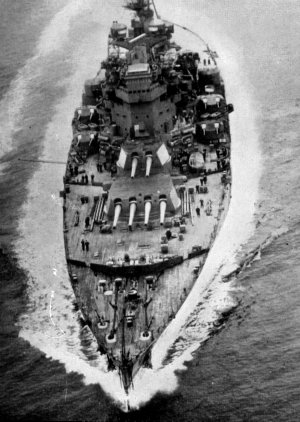
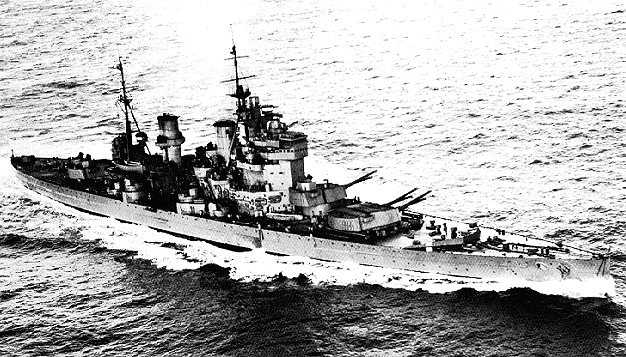
HMS King George V

This is the third in a series of five articles on the battleships built under the provision of the Washington and London Naval Treaty limitations in the 1930s. I am not including the ships which were completed in the immediate aftermath of the Washington Treaty limitations. This series looks at the modern battleships that the World War II combatants would produce in the 1930s which saw service in the war. This article covers the British Royal Navy King George V Class battleships. Part one covered the Italian Vittorio Veneto class entitled The Pride of the Regina Marina: The Vittorio Veneto Class Battleships. Part two French Firepower Forward: The unrealized potential of the Dunkerque and Richelieu Class Battleships covered the French Dunkerque class and Richelieu class Battleships. Part Four the American North Carolina and South Dakota Classes. I have already published the final part which covers the German Scharnhorst Class entitled Power and Beauty the Battle Cruisers Scharnhorst and Gneisenau . The German Bismarck, Japanese Yamato, British Vanguard and American Iowa Classes will be covered in a subsequent series.

HMS King George V in 1941

In the wake of the First World War the major naval powers entered into an agreement restricting the construction of capital ships and limiting the numbers that treaty signatories were allowed to keep. As a result numerous ships were scrapped or disposed of and the majority of planned ships were either cancelled while building or never laid down. In some cases to comply with treaty restrictions ships such as the Royal Navy’s Nelson Class which was a compromise design which sacrificed speed for protection and firepower.  By the late 1920s the Royal Navy’s battle force was comprised of the Nelson’s, the fast Battlecruisers Hood, Renown and Repulse and 10 ships of the Queen Elizabeth and Revenge classes all designed before the First World War.

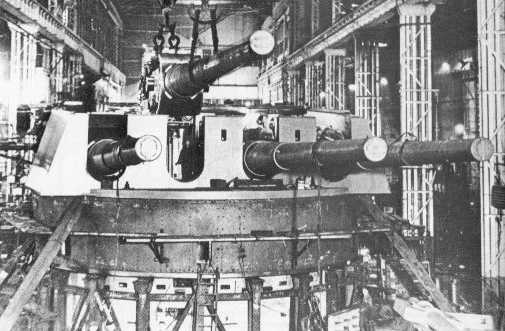
King George V Class Quad Turret being built

The Royal Navy began planning for a new class of battleships in 1928 but the plans were shelved with the signing of the London Naval Treaty which continued the “building holiday” on capital ship construction as well as size and armaments until 1937.  With the realization that its battle force was becoming dated as other nations laid down new classes of battleships the Royal Navy recommenced planning in 1935.  The Navy planned to build to the maximum of the 35,000 displacement limitation and placed a great measure of emphasis on armor and protection. The ships were designed to achieve a 28 knot speed which made them faster than all British battleships although slower than the Battlecruisers. The planners had alternative designs to use 14”, 15” or 16” guns with the Navy favoring the 15” models which had equipped all of their other ships with the exception of the Nelson’s. However the Admiralty to use 14” as the government was endeavoring to negotiate with other powers to impose a 14” limitation on armament for new battleships.  While the Americans and French agreed to the limit neither the Japanese nor Italians followed suit and as a result all new battleships of other powers had larger guns than the King George V Class ships with the French and Italians opting for 15”on the Vittorio Veneto Class, the Americans 16” on the North Carolina, South Dakota and Iowa Classes and the Japanese 18” guns for their Yamato Class. The Germans who were not a signatory built their Scharnhorst Class with 11” although they were planned as 15” ships and would equip the Bismarck Class with 15” guns.  The Royal Navy attempted to rectify this by placing more guns on the ships than those of other navies but the planned armament of twelve 14” guns mounted in quadruple turrets but this was impossible on the 35,000 platform without compromising protection or speed.  Thus the Admiralty compromised on 10 guns mounted in 2 quadruple and 1 twin turret.

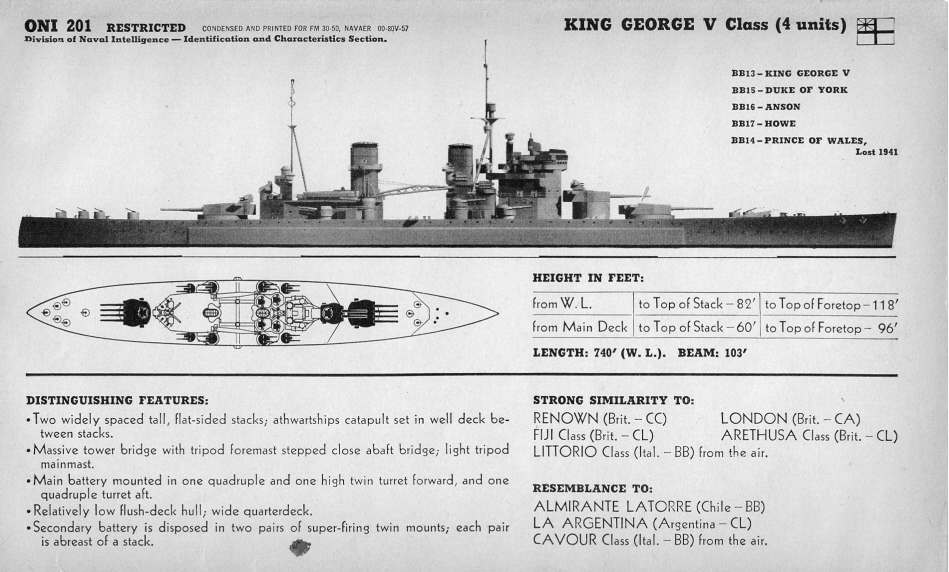
ONI Drawing of King George Class

The ships displaced a full load displacement of 42,237 tons in 1942 which had increased to 44,460 tons in  1944. The were 745 feet long had a beam of 103 feet, a top speed of 28 knots with a cruising range of 5,400 nautical miles at 18 knots. Their relatively poor endurance limited their operations in the Pacific and even nearly caused King George V to have to abandon the chase of the Bismarck in May 1941.

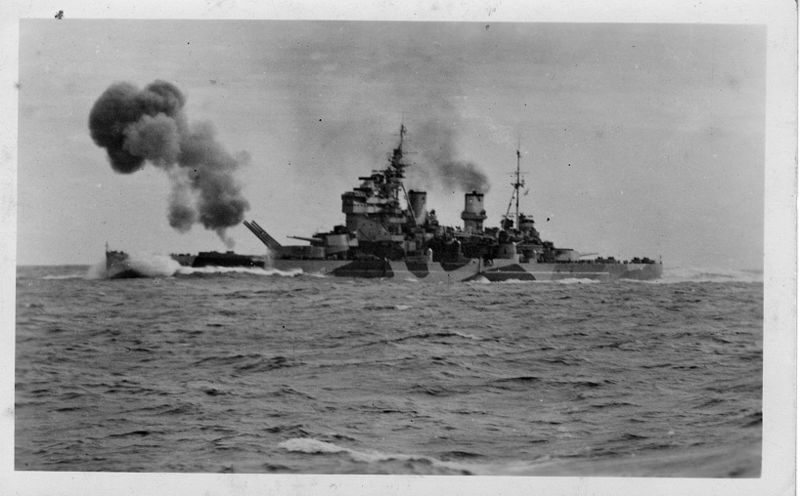
The main batteries of the ships proved problematic in combat with the quadruple turret design causing all the ships problems. This was demonstrated in the engagement of the Prince of Wales against the Bismarck as well as the King George V in its duel with the German behemoth when A turret became disabled and completely out of action for 30 minutes and half of the main battery being out of action for most of the engagement for mechanical reasons.  The Duke of York achieved excellent results against the Scharnhorst but even in that engagement the main battery was only able to be in action 70% of the time.  One of the other drawbacks of the design was that in order to replace a gun due to wear that the turret itself had to be dismantled in order to remove and replace the guns.

The main secondary armament of 5.25” dual purpose guns in twin mounts suffered from poor rate of fire and slow traverse well below their designed standards.

The mounting of the armament was designed to provide protection against turret explosions which could potentially detonate the ship’s magazines.  The main side and underwater protection scheme was sound and protected the ships well in combat.  The vertical protection was also sound as was the protection afforded to the turret barbets and placement of the magazines to shield them from plunging fire.  Only the Prince of Wales was lost due to enemy action had later examination of her wreck revealed that the culprit was a torpedo which detonated in a propeller shaft outside of the armored belt which caused uncontrolled flooding when she was attacked by Japanese aircraft on 8 December 1941.

HMS Anson conducting gunnery exercises

The propulsion systems developed problems after 1942 when fuel oil quality was decreased because of the need for aviation gas.  The new mixtures which were higher viscosity and contained more water than the boilers could effectively burn increased maintenance costs and decreased efficiency. To compensate the Admiralty designed new higher pressure fuel sprayers and burners which returned the boilers to full efficiency.

The lead ship of the class the King George V was laid down on 1 January 1937, launched on 21 February 1939 and commissioned on 11 December 1940.  As the flagship of the Home Fleet she took part in the unsuccessful search for the Scharnhorst and Gneisenau and in the hunt for the Bismarck in which she earned lasting fame in helping to sink that ship.  She took part in the Murmansk convoy protection as well as Operation Husky, the invasion of Sicily before sailing to the Far East for operations against the Japanese. She finished the war with the British Pacific Fleet and was present at the Japanese surrender in Tokyo Bay.  She returned as flagship of Home Fleet until she was decommissioned in 1949. She was subsequently sold for scrap in 1957.

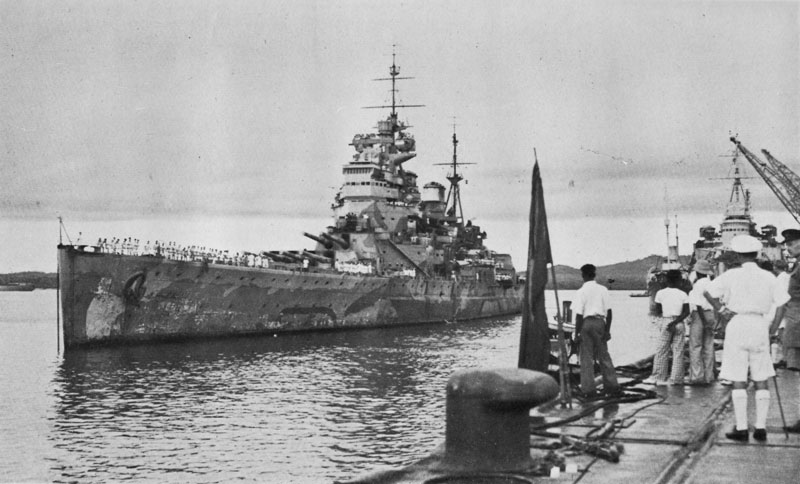
Prince of Wales pulling into Singapore

The second ship the Prince of Wales laid down on 1 January 1937, launched on 3 May 1939 and commissioned 19 January 1941 although she was not officially completed until March 1941. Her initial operation came in May 1941 when she sailed with the HMS Hood to intercept the Bismarck. When she sailed she still had shipyard technicians aboard.  Damaged in the action she did score an important hit on Bismarck which cut a fuel line making her forward tanks inaccessible and causing her to make her run for Brest which she did not complete. Another hit damaged her aircraft catapult and a third an electric dynamo.

Church Service on Prince of Wales at Argentia Bay with Churchill and Roosevelt in attendance

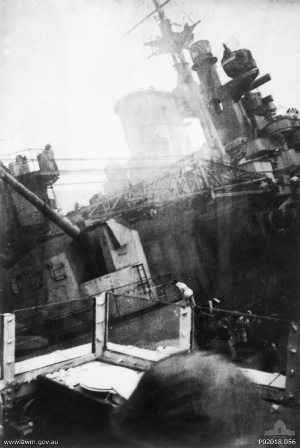
Following repairs she carried Winston Churchill to the Argentia Bay Newfoundland where he met with Franklin D. Roosevelt and together drafted the Atlantic Charter. She accompanied the HMS Repulse to Singapore to bolster the British presence in the Far East but without air cover was sunk by Japanese aircraft which struck her with 4 torpedoes and a bomb, the key hit being a lucky hit on her propeller shaft which caused flooding that caused a loss of power to pumps and anti-aircraft defenses.

Prince of Wales sinking and being abandoned

The third ship the Duke of York was laid down 5 May 1937, launched on 28 February 1940 and commissioned 4 November 1941. She provided convoy escort for the Lend Lease convoys to the Soviet Union as well the sinking of the Scharnhorst on 26 December 1943 during the Battle of North Cape. She was transferred to the Pacific in 1944 and served at Okinawa.  She was decommissioned in 1949 and scrapped in 1957.

Duke of York

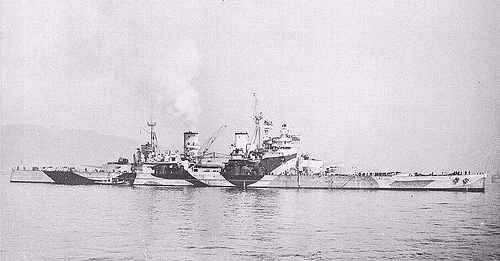
The fourth ship of the class the Howe was laid down on 1 June 1937, launched 9 April 1940 and commissioned on 29 August 1942.  She served with the Home Fleet and in the Mediterranean until she was transferred to the Pacific in August 1944. She was stuck by a Kamikaze in May 1945 and Howe was sent for refit at Durban South Africa. She was still in refit when the war ended. She returned home and was placed in reserve in 1950 and scrapped in 1958.

HMS Howe

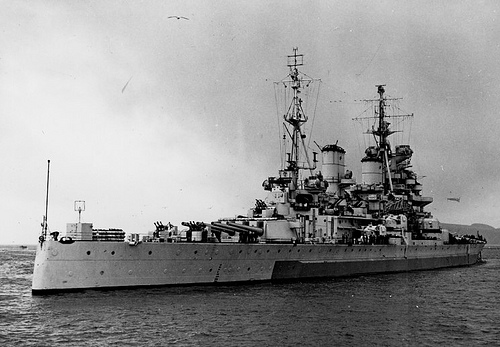
The last of the class the Anson was laid down 20 July 1937, launched 24 February 1940 and commissioned on 22 June 1942. She operated in the Mediterranean and the North Atlantic and was sent to the Pacific in 1945 where she accepted the surrender of the Japanese Forces at Hong Kong. She returned to Britain and was decommissioned in 1941 and scrapped in 1957.

HMS Anson

The ships had rather unremarkable careers for the most part with the exception of the Prince of Wales and King George V in the hunt for the Bismarck and the Duke of York sinking the Scharnhorst. They had a number of technical problems which limited their operations in the war. However they and their brave crews deserve to be remembered as helping to hold the line against the Axis in the early years of the war and sank two of the four German Battleships lost during the war.  This alone was as remarkable achievement as of their contemporaries only the USS Washington sank an enemy battleship in combat.


12 Comments

Filed under History, Military, Navy Ships, world war two in europe, world war two in the pacific