
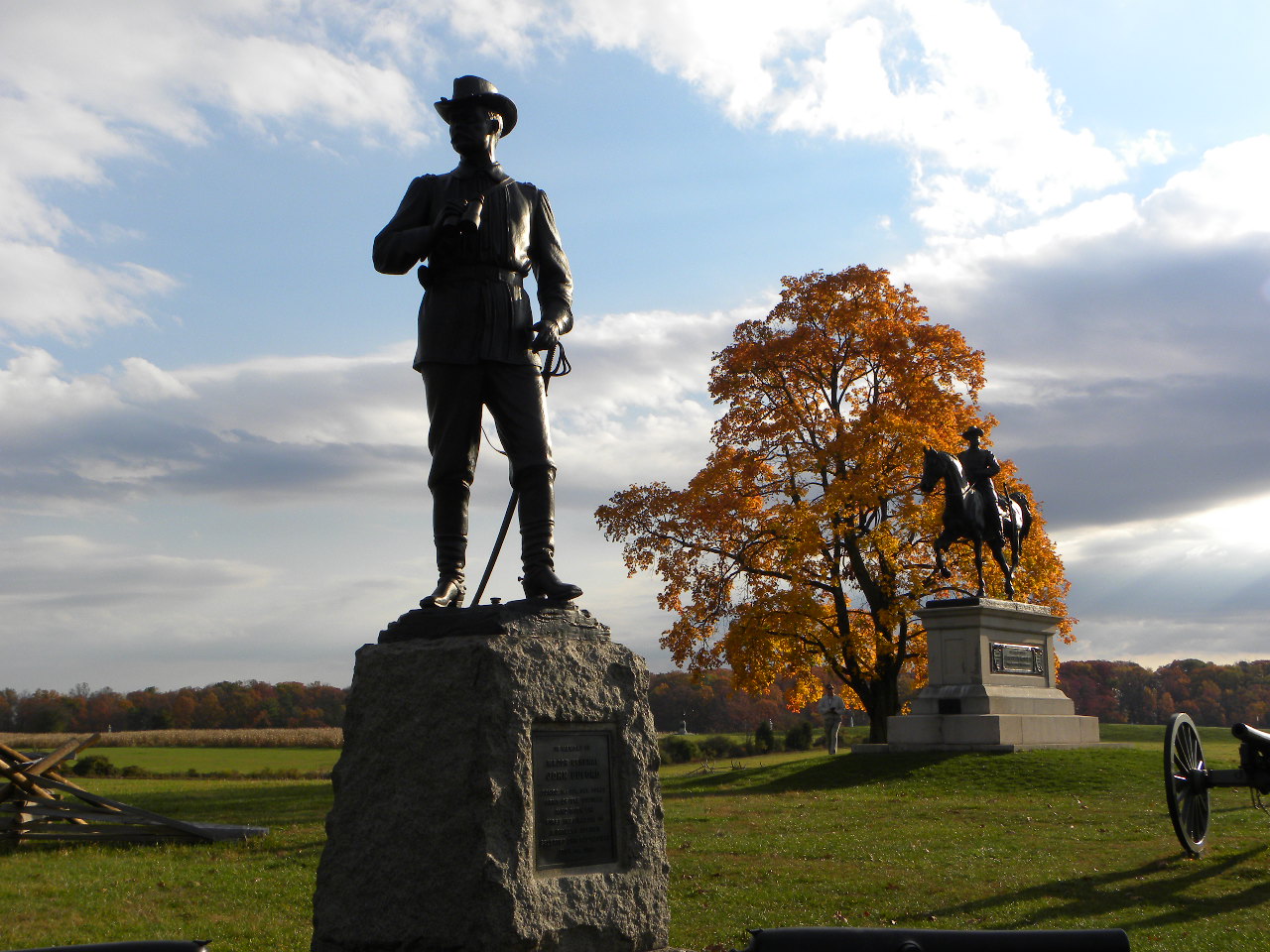
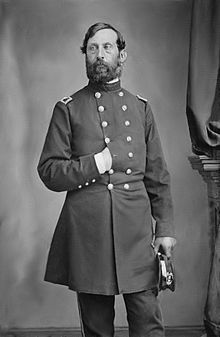
Major General Henry Hunt
“Fires are defined as the use of weapon systems to create specific lethal or nonlethal effects on a target. All fires are normally synchronized and integrated to achieve synergistic results.”Joint Publication 3-09 “Joint Fire Support”30 June 2010 p.I-1
Major General Henry Hunt the Chief of Union artillery was the admitted expert of all the artillerymen present at Gettysburg. Prior to the war he had taught artillery theory and tactics at West Point and written the Army’s artillery doctrine. However, he was no mere theoretician. He was an excellent battlefield leader who had a keen eye to assess the tactical situation and effectively employ his batteries. Hunt also understood the change in warfare brought about by small arms, particularly the rifled musket and that artillery had become a support weapon instead of an assault weapon, something that Lee had not yet fully appreciated as we have seen from his use of artillery.
The employment of fires is an important part of military art and to be effective it must be understood and used in concert with maneuver. As George Patton wrote in War as I Knew It “Battles are won by fire and by movement. The purpose of the movement is to get the fire in a more advantageous place to play on the enemy.” In contrast to Lee and his employment of artillery at Gettysburg which was ineffective in large part because he declined to use maneuver to his advantage, Meade, Hancock, Hunt and the various Union Corps commanders used their artillery to maximum effect taking advantage of their interior lines.
After Hooker’s disastrous experiment at Chancellorsville to decentralize the command and organization of the artillery Hunt was give a free hand to reorganize the artillery of the Army of the Potomac. The changes were sweeping. Batteries were removed from divisions and consolidated into brigades for each corps. Additionally Hunt created an Artillery Reserve of five Brigades totaling 21 batteries which could be employed to support the army at any given point and provided both him and the army commander a flexible and powerful source of firepower. “Hunt put his best veteran artillerymen in charge of these brigades, and their deployment was in the hands of Hunt and the corps commanders.”[1] At Gettysburg the changes would be of decisive importance.
Hunt had been very active on July 2nd in working with Meade, Hancock and vital in ensuring that Sickles beleaguered command received batteries from the artillery reserve. He was not present at the council of war held that night but was informed of the decision to remain upon his return from his last inspection of his lines and supervision of artillery at Culp’s Hill. In his inspection of the Federal artillery positions he took charge and moved units as needed and coordinated his work with the brigade commanders of each corps ensuring that they understood their part in the next day’s action.
Unlike his Confederate counterpart William Pendleton, Hunt went into battle on July 3rd with very definite ideas of how he was going to employ his artillery and developed a detailed plan of fire support. Hunt’s artillery regulations dictated that “in the attack…the artillery is employed to silence the batteries that protect the [enemy] position. In the defense it is better to direct its fire on the advancing troops.”[2]
One of his most critical decisions was in relation to the Artillery Reserve to address Meade’s concerns about an attack on the Union center. About 11 A.M. Hunt went to Cemetery Hill where he was able to gain a good view of Confederate preparations. He wrote that “Here a magnificent display greeted my eyes. Our whole front for two miles was covered by batteries in line or going into position…. Never before had such a sight been witnessed on this continent, and rarely if ever abroad…”[3]Hunt placed twenty batteries of his artillery reserve along Cemetery Ridge and “laid out a deadly latticework of crossfire lanes designed to scourge the fields in front of every living thing.”[4] Hunt was aided in his efforts by the commander of the Artillery Reserve Brigadier General Robert O. Tyler who was able to increase the number of guns available “through repairs and reconditioning.”[5]
As Hunt examined the situation before him he had to discern what the Confederate intentions were. He thought there was the possibility that Lee might use them to cover a move of infantry to support Ewell but he dismissed that as he did the possibility of Lee withdrawing his army. Despite the fact that he could not see the deployment of the Confederate infantry massing for the assault Hunt was convinced that the attack would hit the center. In light of his understanding of the how artillery should be employed in the defense he “grasped the essence of the situation-that the duty of the artillery was not to combat the opposing ones, but to reserve themselves to smash the infantry assault.”[6]

As such his guns, both of the artillery reserve as well as II Corps deployed on Cemetery Ridge was confronted with an artilleryman’s dream. “He was posted on the high ground…with clear fields of fire. He had 119 guns of high quality massed in battery, with plentiful reserves and sufficient ammunition. He was positioned to catch an infantry attack in a deadly crossfire. His brigade commanders were chosen by him and trained by him….”[1] This total included the guns on Cemetery Hill as well as Cemetery Ridge.
Hunt knew that any Confederate infantry assault on Cemetery Ridge would be preceded by an artillery bombardment and once he was sure that this was the Confederate intent Hunt “immediately set out to ride his lines once again”[2]and went to each of his artillery commanders and instructed them. Another insightful Union officer, Gouverneur Warren felt counter battery fire was “doing little good” and “from his observation post on Little Round Top, sent a message to Meade, suggesting that the Union batteries cease firing.” [3] The message was unnecessary as Hunt was working to ensure this but it showed that insightful officers on the Union side were not adverse to recommending changes in deployments or tactics to meet the conditions of the battlefield.
“I gave instructions to the batteries and to the chiefs of artillery not to fire at small bodies! nor to allow their fire to be drawn without promise of adequate results; to watch the enemy closely, and when he opened to concentrate the fire of their guns on one battery at a time until it was silenced; under all circumstances to fire deliberately, and to husband their ammunition as much as possible.” [4]
Until the Confederate bombardment began at 1:07 P.M. Hunt continued to “check on the condition of his batteries” [5] and was with Hazlett’s former battery of 10 pounder Parrotts on Little Round Top, now commanded by Rittenhouse. When the cannonade began reiterated his orders to Rittenhouse to ensure that he “would not tolerate any yielding to the usual artilleryman’s temptation to fire back and turn things into a useless artillery duel.” [6]and then rode down to Freeman McGilvery’s guns on the south end of Cemetery Ridge.
In the process he observed the performance of his former students commanding the Confederate artillery. He was not impressed by their performance. At Appomattox Hunt, the consummate instructor recounted to Colonel Armistead Lindsey Long of Lee’s staff been his student:
“I was not satisfied with the conduct of this cannonade which I heard was under his direction, inasmuch as he had not done justice to his instruction; that his fire, instead of being concentrated on the point of attack, as it ought to have been, or as I expected it would be, was scattered, over the whole field.” [7]
Though Long was not in charge of the Confederate barrage Hunt remembered that his former student’s was amused and replied “I remembered my lessons at the time, and when the fire became so scattered I wondered what you would think about it!” [8]
As a Hunt moved back up the Union gun line he was pleased that his artillerymen were doing as he had told, except for guns of Hancock’s II Corps Artillery commanded by Captain John Hazard. Hancock, confused as to why his guns were not replying to the Confederate barrage berated his artillery Chief and ordered him to open fire. He believed that “the moral of an infantryman under an artillery barrage is best maintained by a heavy and vigorous counterbarrage by one’s own artillery.” [9] It was a classic clash between the points of view of an infantryman and an artillery expert.
Hancock seeing McGilvery’s guns silent rode to that officer to demand that he open fire. McGilvery refused as he was not under Hancock’s command which “brought a red-hot stream of language…profane and blasphemous such as a drunken Ruffian would use.” McGilvery was the wrong officer to attempt such a tactic. The former sea captain told Hancock straight up that “he was not under General Hancock’s orders, and….his orders would result in a most dangerous and irreplaceable waste of ammunition.” [10]
During the barrage Hunt supervised the rotation of batteries off of Cemetery Ridge from the reserve and from the VI Corps artillery brigade. Hunt’s persistence paid off with fresh batteries ready for the Confederate infantry assault.
Many Confederates later assumed that their massive barrage had severely damaged the union batteries and caused significant casualties. There were some areas around Cemetery Hill that the early part of the cannonade had an effect, causing heavy damage to a few batteries. However the damage caused much less than the effort and ammunition expended. The Prussian observer to the Army of Northern Virginia referred to the barrage as a “Pulververschwendung” which can be translated as “a waste of powder.” [11]
As Pickett’s men prepared to advance the essential batteries capable of the crossfire that would slaughter them were unaffected, and the morale of the Union infantry awaiting the assault still high. The infantry brigade at the center of the Confederate maelstrom commanded by brigadier General A. S. Webb only suffered about 50 casualties. The Union counter battery fire caused about 350 casualties among the waiting Confederate infantry, especially among Kemper’s brigade of Pickett’s division. [12]
As Pickett’s, Pettigrew’s and Trimble’s divisions advanced across the mile separating Cemetery and Seminary Ridge the came under fire from the concentrated enfilade and cross fire from batteries of Osborne’s on Cemetery Hill, Rittenhouse on Little Round Top and McGilvery’s powerful brigade of 8 batteries poured a merciless fire into them. “The gun crews manned their pieces and directed them on the advancing gray line in-that most cold blooded of military phrases- “anti-personnel fire.” They were firing bursting shells, some solid shots, and much canister.” [13]
The barrage from the well protected Union artillery was devastating. “The storm of hot metal shredded the attacking column, which suffered 50 percent casualties.” [14] Fifty percent is a good round number but the Confederate casualties were likely higher. Stewart whose micro-history of focuses solely on Pickett’s Charge in relation to the rest of the battle notes and who examined numerous sources, discounting many “official” reports as inaccurate believes that Pickett’s division suffered 67 percent casualties, Pettigrew 60 percent and Trimble 52 percent. [15]
McGilvery and Hunt had skillfully deployed his brigade behind a rise of high ground that shielded them from view of the Confederates. Pickett’s division was advancing oblique angle past McGivery’s brigade. McGilvery explained “the Rebel battle lines “presented an oblique front to the guns under my command, and by training the whole line of guns obliquely to the right, we had a raking fire through all three of these lines.” [16]As a Florida regiment of Wilcox’s brigade which had come up in support of Pickett passed in front of McGilvery’s brigade an officer found “himself in a bewildering storm of “men falling all around me with brains blown out, arms off, and wounded in every direction.” [17]One of McGilvery’s captains later testified “We had a splendid chance at them…and we made the most of it.” [18]
It was almost all that Hunt had hoped for. [19] But because Hancock had ordered his guns to fire throughout the Confederate cannonade Hazlett’s guns kept silence until the enemy was within canister range. Hunt believed that has his “instructions been followed here, as they were by McGilvery, I do not believe that Pickett’s division would have reached our line. We lost not only the fire of one third of our guns, but the resulting cross fire, which would have doubled its value.” [20]
A few hundred Confederates led by Brigadier General Lewis Armistead survived the blistering fire and broke into the Federal lines at the angle. The subsequent minutes of fierce hand to hand fighting caused heavy casualties in the artillery batteries posted there from Hazlett’s brigade. Hunt noted that of the five II Corps battery commanders there that four were killed or mortally wounded a fifth severely wounded and that four batteries had to be combined in order to form two complete batteries after the battle. [21]
Fresh batteries arrived and opened fired even as masses of Confederates attempted to surrender. One rebel soldier approached Captain Gulian Weir of Battery C, 5th United States Light Artillery out of the maelstrom and asked “Where can I go to get out of this Hellish fire?” [22]But the attack was spent and Pickett’s charge was history, soon “Confederates on both sides of the wall three down their arms and were taken prisoners of war. All those who could do so streamed back to their own lines” [23]
The devastation that Hunt’s well planned artillery defense and it’s execution by most of his commanders sealed the doom of the Robert E Lee’s plan to break the Army of the Potomac. Like Malvern Hill, Fredericksburg and Cold Harbor it showed that “a frontal assault on an unshaken enemy led to a costly failure.” [24] Hunt’s command of the artillery was an excellent example of mission command applied to fires and the value of well executed planning of fires in the defense.
[1] Sears, Stephen W. Gettysburg Houghton Mifflin Co. Boston and New York 2003 p.376
[2] Ibid
[3] Jordan, David M. Happiness is Not My Companion: The Life of G.K. Warren Indiana University Press, Bloomington Indiana 2001 p.97
[4] Hunt Henry Report of Brigadier General Henry Hunt, USA, chief of Artillery, Army of the Potomac in Guide to the Battle of Gettysburg edited by Luvaas, Jay and Nelson, Harold W. University Press of Kansas, Lawrence Kansas 1994 p.175
[5] Coddington, Edwin B. The Gettysburg Campaign, A Study in Command A Touchstone Book, Simon and Schuster New York 1968 p.496
[6] Guelzo, Allen C. Gettysburg: The Last Invasion Vintage Books a Division of Random House, New York 2013 p.402
[7] Ibid. Hunt, The Third Day at Gettysburg p.386
[8] Ibid.
[9] Jordan, David M. Winfield Scott Hancock: A Soldier’s LifeIndian University Press, Bloomington and Indianapolis 1988 p.96
[10] Ibid. Guelzo p.404
[11] Ibid. Stewart p.160
[12] Ibid. pp.160-161
[13] Downey, Clifford Lee and his Men at Gettysburg: The Death of a Nation Skyhorse Publishing New York 1958 p.309
[14] Millet, Allan R. and Maslowski, Peter, For the Common Defense: A Military History of the United StatesThe Free Press a Division of Macmillan Inc. New York, 1984 p.206
[15] Ibid. Stewart p.263
[16] Ibid. Sears p.425
[17] Ibid. Guelzo p.415
[18] Ibid. Foote p.555
[19] Ibid. Sears p.424
[20] Ibid, Hunt The Third Day at Gettysburg p.387
[21] Ibid.
[22] Ibid. Trudeau p.510
[23] Ibid. Coddington p.519
[24] Fuller, J.F.C. The Conduct of War 1789-1961 Da Capo Press New York 1992, originally published by Rutgers University Press, Brunswick NJ 1961 p.104
[1] Sears, Stephen W. Gettysburg. Houghton Mifflin Co. Boston and New York 2003 p.32
[2] Foote, Shelby, The Civil War, A Narrative. Volume Two Fredericksburg to Meridian Random House, New York 1963 p.545
[3] Hunt, Henry The Third Day at Gettysburg in Battles and Leaders of the Civil War edited by Bradford, Neil Meridian Press, New York 1989 p.385
[4] Trudeau, Noah Andre. Gettysburg: A Testing of Courage, Harper Collins Publishers, New York 2002 p.486
[5] Ibid. Sears p.375
[6] Stewart, George R. Pickett’s Charge: A Micro-History of the Final Attack at Gettysburg, July 3rd 1863 Houghton Mifflin Company Boston 1959 p.131





 The Inglorius Padre Steve's World