Tag Archives: grover cleveland

The Importance of Labor and Labor Day

Friends of Padre Steve’s World,

Today is Labor Day and sadly many people don’t really understand its significance. For decades organized labor has been demonized by the descendants of people who died to secure decent working conditions, wages, and benefits for regular hard working people. The attacks on labor and workers have become much more pronounced under the Trump Administration than any prior administration since that of Herbert Hoover.

But most of the people lucky enough not to have to work on Labor Day really don’t know why it it matters, and whips in spite of those who despise labor and care not a whit about working people, who simply to use business terminology are simply human capital or resources. I actually despise those terms because they dehumanize people by turning them into impersonal economic units of measure.

So today I am digging into the vault to explore why Labor Day and what it represents matters to us now. This article is one that I have taken the time to edit and update.

Until tomorrow,

Peace,

Padre Steve+

Abraham Lincoln, who was perhaps our only President who was a real working man once said, “If any man tells you he loves America, yet hates labor, he is a liar. If any man tells you he trusts America, yet fears labor, he is a fool.” 

It seems that nothing about humanity ever changes, even so it is hard to believe that at one time American workers had no rights and I am not talking about African American slaves who as slaves didn’t even count as human beings. No I’m talking about the people Mel Brooks called in Blazing Saddles: “the white God fearing citizens of Rock Ridge” and for that matter every place and every race in America.

It was not until the mid-1800s in the United States and Europe that workers began to organize and protest for the right to decent wages and working conditions. But this came at a cost; the loss of jobs, homes, property, prison, deportation, deportation, and death.

There were many instances when this cost workers and labor organizers their lives. Employers, often backed by heavily armed private security contractors like the Pinkerton Agency, used deadly force to break up peaceful strikes. In the days of the Robber Barons, when business ran the government at almost every level, employers frequently called in local and state law enforcement, as well as the National Guard, and occasionally Federal troops to break strikes. They played various ethnic and racial groups off of each in order to divide the labor movement. There are hundreds of instances of such violence being used against workers, in some strikes the dead numbered in the hundreds.

Troops Putting Down the Pullman Strike 

Some of these attacks on workers occurred in major cities, others at isolated work sites and factories. Some are famous, the Haymarket Massacre of May 4th 1886 in Chicago, the Pullman Strike Massacre of 1894, the Homestead Strike and Massacre of 1892, the Latimer Massacre of 1897, the Ludlow Massacre of 1914, and the Columbine Mine Massacre of 1927.

Others less so, but there was more. In the Bisbee Deportation of 1917 1300 striking miners and their families were deported from their homes in Bisbee Arizona by 2000 armed deputies, put in box cars and transported 200 miles to the New Mexico desert, where without food, water or money they were left. There was the Triangle Shirtwaist Factory Fire where managers locked the doors in order to ensure that the fleeing women workers did not put anything unauthorized in their purses. One hundred forty-four workers, mostly young women died, many jumping from the burning building to their death.

Police and other Onlookers Looking up at the burning Triangle Shirt Factory with the bodies of Women Workers who jumped from it at Their Feet

Early labor organizations such as the Knights of Labor led the effort to bring about better conditions. For doing so they were labeled subversive and even called communists. Their meetings were often attacked and the leaders jailed and some lynched.

Eugene Debs

The sacrifices of those early workers, and organizers are why we have Labor Day. One of the early American labor leaders was a man named Eugene Debs. Debs eventually became a Socialist, but he said something remarkable which still is as timely as when he uttered the words:

“I am opposing a social order in which it is possible for one man who does absolutely nothing that is useful to amass a fortune of hundreds of millions of dollars, while millions of men and women who work all the days of their lives secure barely enough for a wretched existence.”

I wish that wasn’t true but it is. The Social Darwinists who follow Ayn Rand as if she were the Prophet and who populate Wall Street boardrooms and every major school of business ensure that it is. The disparity between wage laborers and CEOs is higher than it has ever been. But I digress…

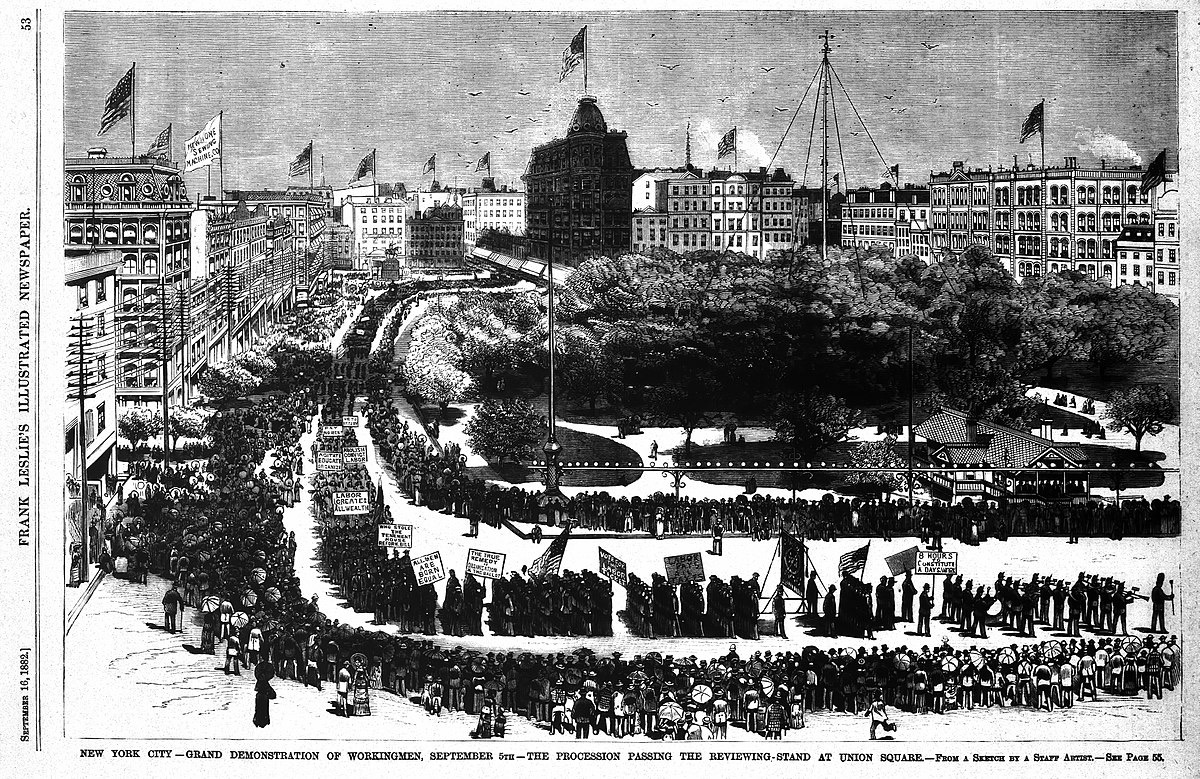
On September 5th 1882 the first Labor Day was observed when members of several Unions in New York City organized the first Labor Day parade. The police came armed and ready to intervene if the workers got out of hand, but the parade was peaceful. It ended and the marchers moved over to Wendell’s Elm Park where they had a party. Twenty-five thousand Union men and their families celebrated, with hundreds of kegs of lager beer.

Within a few years many states began to institute Labor days of their own. In 1894, just days after the violent end of the Pullman strike in which Federal troops and Marshalls killed 30 workers and wounded 57 more, Congress and President Grover Cleveland rushed through legislation to establish a Federal Labor Day.

My Great Aunt Goldie Dundas was a labor organizer for the International Ladies Garment Worker’s Union in West Virginia in the 1920s – 1950s. I wish I had gotten to really know her, but she died when I was about 8 or 9 years old. Sadly the workers represented by that Union have had almost all of their jobs in the textile industry outsourced to China, India, Pakistan, the Caribbean, and Bangladesh where cheaply made garments are produced, and workers abused. The examples of mass deaths due to safety issues and fires in Bangladeshi factories are too numerous to list. But then who cares? The fact is you can drive through many parts of the South and see the poverty created by the exodus of these Union employers, the textile industry, which was part of the fabric of the South is gone. Empty factories and poverty stricken towns dot the countryside. I saw a lot of them living in Eastern North Carolina, towns that once thrived are ghost towns, riddled with crime, unemployment and no hope, unless Wal-Mart opens a store in town. Ironically it sells the clothing made overseas that used to be manufactured by the parents, grandparents and great-grandparents of the people who live there today.

Adam Smith, the father of Capitalism understood it in a very different manner than those who claim to be Capitalists today. He wrote in his magnum opus, The Wealth of All Nations:

“In regards to the price of commodities, the rise of wages operates as simple interest does, the rise of profit operates like compound interest. Our merchants and masters complain much of the bad effects of high wages in raising the price and lessening the sale of goods. They say nothing concerning the bad effects of high profits. They are silent with regard to the pernicious effects of their own gains. They complain only of those of other people.”

The fact is that today, labor is under threat. Unions have been demonized by politicians and pundits and their power and influence much reduced. Some of this was due to their own success in improving conditions from workers, and not just Union workers. When my dad retired from the Navy in 1974, he went to work at one of the few non-Union warehouses of the John Deere Company in Stockton, California. While they were not union, the workers received every benefit won by the majority of the workers in the company who were members of the United Auto Workers Union. Due to that my dad had high wages, excellent working conditions and benefits. The company had a program for the children of workers, which allowed them to work in the summer in the warehouse and receive incredibly high pay and benefits while in college. I did that for two years, and it helped pay for much of my college. I was not a union member but I benefited because Union men and leaders did the hard work to make that job happen.

However, in many places, Unions and labor are under attack, sometimes not just by corporations, but also by state governments. Job security and stability for most American workers is a thing of the past. Federal and State agencies charged with protecting those rights, including safety in the workplace are being cut in the mad rush to reduce government power. Corporations are offshoring and outsourcing jobs without regard to American workers or the country itself. Part of that is due to globalization and I understand that, but these companies frequently relocate jobs to places where they can exploit workers, deny them benefits, pay them less, and suffer no penalty for ignoring safety procedures or harming the environment. It seems to me that we are returning to the days of the Robber Barons. I wonder when violence against workers and those who support them will be condoned or simply ignored.

Pope Leo XIII wrote in his encyclical Renum Novarum:

“The following duties . . . concern rich men and employers: Workers are not to be treated as slaves; justice demands that the dignity of human personality be respected in them, … gainful occupations are not a mark of shame to man, but rather of respect, as they provide him with an honorable means of supporting life. It is shameful and inhuman, however, to use men as things for gain and to put no more value on them than what they are worth in muscle and energy.”

He also wrote:

“Equity therefore commands that public authority show proper concern for the worker so that from what he contributes to the common good he may receive what will enable him, housed, clothed, and secure, to live his life without hardship. Whence, it follows that all those measures ought to be favored which seem in any way capable of benefiting the condition of workers. Such solicitude is so far from injuring anyone, that it is destined rather to benefit all, because it is of absolute interest to the State that those citizens should not be miserable in every respect from whom such necessary goods proceed.”

But sadly there are far too few church leaders of any denomination who will take the side of workers or the poor, and when they do they are either condemned by the disciples of Ayn Rand or politely thanked and ignored by politicians and corporate leaders.

So please, when you celebrate Labor Day, do not forget that it is important, and that we should not forget why we celebrate it. If we forget that, it will become a meaningless holiday and our children may have to make the same sacrifices of our ancestors.

Labor Day is a day to remember the men and women, some of them former soldiers, workers, labor organizers, and leaders; some of whom were killed by National Guard and Federal troops for their effort, who paved the way for workers today. We cannot forget that. So when you see a politician attacking Labor and seeking to diminish workers rights or benefits ask them what Abraham Lincoln or Adam Smith would think. If they can’t answer, turn your backs on them and start fighting for what is right.

WASHINGTON, : US civil rights leader Martin Luther King,Jr. (3rd from L) walks with supporters during the “March on Washington” 28 August, 1963 after which, King delivered the “I Have a Dream” speech from the steps of the LIncoln Memorial. 28 August, 2003 marks the 40th anniversary of the famous speech, which is credited with mobilizing supporters of desegregation and prompted the 1964 Civil Rights Act. King was assassinated on 04 April 1968 in Memphis, Tennessee. James Earl Ray confessed to shooting King and was sentenced to 99 years in prison. AFP PHOTO/FILES (Photo credit should read AFP/AFP/Getty Images)

Dr. Martin Luther King Jr., who always stood for the rights of workers no-matter what their race, creed, or color, said:

“We must rapidly begin the shift from a “thing-oriented” society to a “person-oriented” society. When machines and computers, profit motives and property rights are considered more important than people, the giant triplets of racism, materialism, and militarism are incapable of being conquered.” 

Likewise, one cannot forget that Dr. King was assassinated when he went to Memphis to support the Memphis Sanitation Worker strike.

This my friends is why Labor and the protection of working people from those who abase them, mistreat them, and exploit them is so important.

3 Comments

Filed under civil rights, ethics, faith, History, labor, laws and legislation, News and current events, Political Commentary

Thoughts on Labor Day

Friends of Padre Steve’s World,

Yesterday was Labor Day and sadly many people don’t really understand its significance. For decades organized labor has been demonized by the descendants of people who died to secure decent working conditions, wages, and benefits for regular hard working people. But most of the people lucky enough not to have to work on Labor Day really don’t know why it it matters, and whips in spite of those who despise labor and care not a whit about working people, who simply to use business terminology are simply human capital or resources.

So today I am digging into the vault to explore why Labor Day and what it represents matters to us now. This article is one that I have taken the time to edit and update.

Until tomorrow,

Peace,

Padre Steve+

Abraham Lincoln, who was perhaps our only President who was a real working man once said, “If any man tells you he loves America, yet hates labor, he is a liar. If any man tells you he trusts America, yet fears labor, he is a fool.” Likewise, Adam Smith wrote:

“In regards to the price of commodities, the rise of wages operates as simple interest does, the rise of profit operates like compound interest. Our merchants and masters complain much of the bad effects of high wages in raising the price and lessening the sale of goods. They say nothing concerning the bad effects of high profits. They are silent with regard to the pernicious effects of their own gains. They complain only of those of other people.”

It seems that nothing about humanity ever changes, even so it is hard to believe that at one time American workers had no rights and I am not talking about African American slaves who as slaves didn’t even count as human beings. No I’m talking about the people Mel Brooks called in Blazing Saddles: “the white God fearing citizens of Rock Ridge” and for that matter every place and every race in America.

It was not until the mid-1800s in the United States and Europe that workers began to organize and protest for the right to decent wages and working conditions. But this came at a cost; the loss of jobs, homes, property, prison, deportation, deportation, and death.

There were many instances when this cost workers and labor organizers their lives. Employers, often backed by heavily armed private security contractors like the Pinkerton Agency, used deadly force to break up peaceful strikes. In the days of the Robber Barons, when business ran the government at almost every level, employers frequently called in local and state law enforcement, as well as the National Guard, and occasionally Federal troops to break strikes. They played various ethnic and racial groups off of each in order to divide the labor movement. There are hundreds of instances of such violence being used against workers, in some strikes the dead numbered in the hundreds.

Some of these attacks on workers occurred in major cities, others at isolated work sites and factories. Some are famous, the Haymarket Massacre of May 4th 1886 in Chicago, the Pullman Strike Massacre of 1894, the Homestead Strike and Massacre of 1892, the Lattimer Massacre of 1897, the Ludlow Massacre of 1914, and the Columbine Mine Massacre of 1927.

Others less so, but there was more. In the Bisbee Deportation of 1917 1300 striking miners and their families were deported from their homes in Bisbee Arizona by 2000 armed deputies, put in box cars and transported 200 miles to the New Mexico desert, where without food, water or money they were left. There was the Triangle Shirtwaist Factory Fire where managers locked the doors in order to ensure that the fleeing women workers did not put anything unauthorized in their purses. One hundred forty-four workers, mostly young women died, many jumping from the burning building to their death.

Early labor organizations such as the Knights of Labor led the effort to bring about better conditions. For doing so they were labeled subversive and even called communists. Their meetings were often attacked and the leaders jailed and some lynched.

The sacrifices of those early workers, and organizers are why we have Labor Day. One of the early American labor leaders was a man named Eugene Debs. Debs eventually became a Socialist, but he said something remarkable which still is as timely as when he uttered the words:

“I am opposing a social order in which it is possible for one man who does absolutely nothing that is useful to amass a fortune of hundreds of millions of dollars, while millions of men and women who work all the days of their lives secure barely enough for a wretched existence.”

I wish that wasn’t true but it is. The Social Darwinists who follow Ayn Rand as if she were the Prophet and who populate Wall Street boardrooms and every major school of business ensure that it is. The disparity between wage laborers and CEOs is higher than it has ever been. But I digress…

On September 5th 1882 the first Labor Day was observed when members of several Unions in New York City organized the first Labor Day parade. The police came armed and ready to intervene if the workers got out of hand, but the parade was peaceful. It ended and the marchers moved over to Wendell’s Elm Park where they had a party. Twenty-five thousand Union men and their families celebrated, with hundreds of kegs of lager beer.

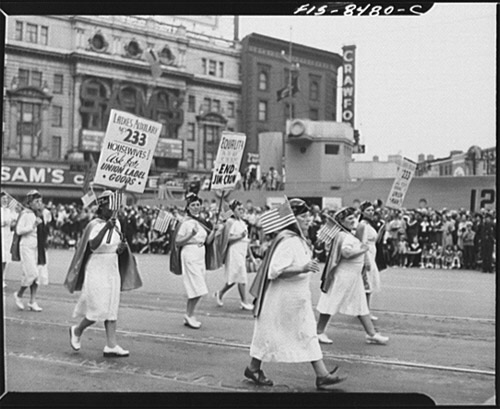
Within a few years many states began to institute Labor days of their own. In 1894, just days after the violent end of the Pullman strike in which Federal troops and Marshalls killed 30 workers and wounded 57 more, Congress and President Grover Cleveland rushed through legislation to establish a Federal Labor Day.

My Great Aunt Goldie Dundas was a labor organizer for the International Ladies Garment Worker’s Union in West Virginia in the 1920s – 1950s. I wish I had gotten to really know her, but she died when I was about 8 or 9 years old. Sadly the workers represented by that Union have had almost all of their jobs in the textile industry outsourced to China, India, Pakistan, the Caribbean, and Bangladesh where cheaply made garments are produced, and workers abused. The examples of mass deaths due to safety issues and fires in Bangladeshi factories are too numerous to list. But then who cares? The fact is you can drive through many parts of the South and see the poverty created by the exodus of these Union employers, the textile industry, which was part of the fabric of the South is gone. Empty factories and poverty stricken towns dot the countryside. I saw a lot of them living in Eastern North Carolina, towns that once thrived are ghost towns, riddled with crime, unemployment and no hope, unless Wal-Mart opens a store in town. Ironically it sells the clothing made overseas that used to be manufactured by the parents, grandparents and great-grandparents of the people who live there today.

Adam Smith, the father of Capitalism understood it in a very different manner than those who claim to be Capitalists today. He wrote in his magnum opus, The Wealth of All Nations:

“In regards to the price of commodities, the rise of wages operates as simple interest does, the rise of profit operates like compound interest. Our merchants and masters complain much of the bad effects of high wages in raising the price and lessening the sale of goods. They say nothing concerning the bad effects of high profits. They are silent with regard to the pernicious effects of their own gains. They complain only of those of other people.”

The fact is that today, labor is under threat. Unions have been demonized by politicians and pundits and their power and influence much reduced. Some of this was due to their own success in improving conditions from workers, and not just Union workers. When my dad retired from the Navy in 1974, he went to work at one of the few non-Union warehouses of the John Deere Company in Stockton, California. While they were not union, the workers received every benefit won by the majority of the workers in the company who were members of the United Auto Workers Union. Due to that my dad had high wages, excellent working conditions and benefits. The company had a program for the children of workers, which allowed them to work in the summer in the warehouse and receive incredibly high pay and benefits while in college. I did that for two years, and it helped pay for much of my college. I was not a union member but I benefited because Union men and leaders did the hard work to make that job happen.

However, in many places, Unions and labor are under attack, sometimes not just by corporations, but also by state governments. Job security and stability for most American workers is a thing of the past. Federal and State agencies charged with protecting those rights, including safety in the workplace are being cut in the mad rush to reduce government power. Corporations are offshoring and outsourcing jobs without regard to American workers or the country itself. Part of that is due to globalization and I understand that, but these companies frequently relocate jobs to places where they can exploit workers, deny them benefits, pay them less, and suffer no penalty for ignoring safety procedures or harming the environment. It seems to me that we are returning to the days of the Robber Barons. I wonder when violence against workers and those who support them will be condoned or simply ignored.

Pope Leo XIII wrote in his encyclical Renum Novarum:

“The following duties . . . concern rich men and employers: Workers are not to be treated as slaves; justice demands that the dignity of human personality be respected in them, … gainful occupations are not a mark of shame to man, but rather of respect, as they provide him with an honorable means of supporting life. It is shameful and inhuman, however, to use men as things for gain and to put no more value on them than what they are worth in muscle and energy.”

He also wrote:

“Equity therefore commands that public authority show proper concern for the worker so that from what he contributes to the common good he may receive what will enable him, housed, clothed, and secure, to live his life without hardship. Whence, it follows that all those measures ought to be favored which seem in any way capable of benefiting the condition of workers. Such solicitude is so far from injuring anyone, that it is destined rather to benefit all, because it is of absolute interest to the State that those citizens should not be miserable in every respect from whom such necessary goods proceed.”

But sadly there are far too few church leaders of any denomination who will take the side of workers or the poor, and when they do they are either condemned by the disciples of Ayn Rand or politely thanked and ignored by politicians and corporate leaders.

So please, when you celebrate Labor Day, do not forget that it is important, and that we should not forget why we celebrate it. If we forget that, it will become a meaningless holiday and our children may have to make the same sacrifices of our ancestors.

Labor Day is a day to remember the men and women, some of them former soldiers, workers, labor organizers, and leaders; some of whom were killed by National Guard and Federal troops for their effort, who paved the way for workers today. We cannot forget that. So when you see a politician attacking Labor and seeking to diminish workers rights or benefits ask them what Abraham Lincoln or Adam Smith would think. If they can’t answer, turn your backs on them and start fighting for what is right.

Dr. Martin Luther King Jr., who always stood for the rights of workers no-matter what their race, creed, or color, said: “We must rapidly begin the shift from a “thing-oriented” society to a “person-oriented” society. When machines and computers, profit motives and property rights are considered more important than people, the giant triplets of racism, materialism, and militarism are incapable of being conquered.”

This my friends is why Labor and the protection of working people from those who abase them, mistreat them, and exploit them is so important.

7 Comments

Filed under ethics, faith, History, labor, laws and legislation, News and current events, Political Commentary

The Most Scientific and Resourceful of All: General Edward Porter Alexander

alexander

Friends of Padre Steve’s World

I am getting ready to conclude my latest Gettysburg Staff Ride with my students from the Staff College. It has been a fantastic experience again. Right now I am getting ready to turn in for the night after having dinner and drinks with my students. In the morning we will be walking the ground of Pickett’s Charge before heading to General Meade’s headquarters and the Soldier’s Cemetary where President Abraham Lincoln delivered the Gettysburg Address.

As part of what I have been doing on the site I have been periodically interspersing and publishing short articles about various commanders at Gettysburg. I did one on The Union cavalry commander, John Buford yesterday. 

These articles are all are drawn from my student text and will likely become a book in their own right when I finish the chapter on the Union commanders.  The reason is I am going to do this is because I have found that readers are often more drawn to the lives of people than they are events. As I have noted before that people matter, even deeply flawed people, and we can learn from them. Sometimes good and even honorable people serve malignant causes, while bad or even wicked people support good causes, usually for selfish reasons, but that is the constant quandary that human beings find themselves.

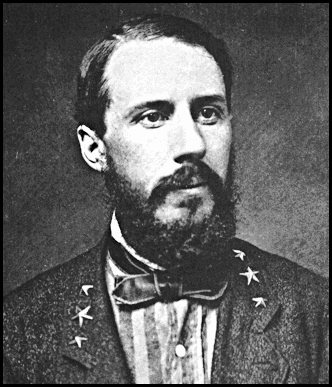
Today’s article is about Confederate General Edward Porter Alexander. Alexander directed the Confederate artillery during Pickett’s Charge and because he was not a terribly high ranking officer is comparatively little known.

However, Alexander is another interesting character. He was one of the most gifted and brilliant artillery commanders of the war and after the war went on to serve the country with distinction after following his re-integration back into the ranks of American citizens.

Alexander wrote a narrative of the war that is considered by historians to be one of the best and most objective accounts written by any Confederate. However, he was very much a military man and never fully grasped the political and ideological nature of the war, not the profound social effects of the Union victory. I hope you enjoy. Until tomorrow. 

Peace

Padre Steve+ 

Though he was only a Colonel commanding an artillery battalion in Longstreet’s First Corps at Gettysburg, Edward Porter Alexander needs to be mentioned in this text because during the battle he assumed tactical command of the largest concentration of Confederate artillery during the entire war. Likewise his contributions to the writing history of the war are incredibly important and provide some of the most balanced views of the war written by any participant on the Confederate side.

Alexander was born in Washington Georgia in 1835. He attended West Point and graduated third in his class in 1857. One of his classmates was Marcus Reno who was second in command of the ill-fated fight of Custer’s 7th Cavalry at Little Big Horn.

Alexander was commissioned in the Corps of Engineers and served as an instructor at West Point. He realized after the John Brown raid that if war came he would fight for the Confederacy. He was married to Bettie Mason in April 1860 and was thereafter assigned to duty at Fort Steilacoom, Washington. He wrestled with his the decision to leave the army, his father was one of the Georgia legislators who voted for secession and like many Southern officers he decided to resign. He wrote about Lincoln, “If he is elected I believe that in the interests of humanity, civilization, and self-preservation call on the South to secede, I’ll go my arm, leg, or death on it.” [1]

His commander Major James McPherson who later had a prominent part in Sherman’s campaigns attempted to talk Alexander into remaining in the army on the west coast, but Alexander refused. McPherson graciously allowed Alexander and his bride to return to the East in a leave status. Bettie too was “upset by this decision and seriously questioned whether other alternatives were possible.” [2] But Alexander saw no other option. McPherson graciously allowed Alexander and his bride to return to the East in a leave status. When he got back to the South he resigned his commission after the election of Lincoln and on July 2nd 1861 Captain Alexander reported for duty at Manassas as an artillery officer. The professional artillerymen believed that Alexander “was the most scientific and resourceful of all.” [3]

Promotion came at regular intervals for Alexander. Initially he served as Beauregard’s Signals officer, and was appointed as the Chief of Ordnance for the Army of Northern Virginia, with the rank of Lieutenant Colonel. He was made an artillery battalion commander after Antietam, and at Fredericksburg his battalion was in the thick of the fighting along Marye’s Heights. With each new battle Lee and Longstreet “had come to rely increasingly on Alexander’s eager intelligence, regularly assigning him duties more properly those of Col. James Walton, Longstreet’s nominal chief of artillery, or even Brig. Gen, William N. Pendleton, the artillery chief of the Army of Northern Virginia.” [4] So trusted was he that he “had nearly a free hand in organizing the Fredericksburg defenses” [5] and his work was instrumental in turning back the Army of the Potomac in its bloody repulse.

During the winter of 1862-63 Alexander worked with Pendleton and Colonel Stapleton Crutchfield to reorganize the artillery in February 1863. He and his battalion were in the thick of the fighting at Chancellorsville where he also assumed command of Second Corps artillery when Crutchfield was wounded. [6] He was promoted to Colonel prior to Gettysburg and then Brigadier General of Artillery in February 1864. He was in the action in the Wilderness campaign and at Petersburg where he was badly wounded.

After recovering he rejoined the army and was present at the surrender at Appomattox where in the hours before the surrender he advocated beginning a guerrilla campaign in order to continue the war. This Lee was unwilling to do and Lee reminded Alexander and the other officers present that such was not an honorable course of action. Lee told Alexander:

“We have simply now to face the fact that the Confederacy has failed. And as Christian men, Gen. Alexander, you & I have no right to think for one moment of our personal feelings or affairs. We must consider only the effect which our action will have upon the country at large.” [7]

After Lee’s monologue Alexander later wrote “I was so ashamed of having proposed such a foolish and wild cat scheme that I felt like begging him to forget he had ever heard it.” [8] When Alexander saw the gracious terms of the surrender he was particularly impressed with how non-vindictive the terms were, especially in terms of parole and amnesty for the surrendered soldiers.

Sadly, Alexander really did not have any political vision or understanding of the meaning of the war. When asked about his “Confederate allegiance, Alexander had a straightforward explanation. “We didn’t go into our cause,” he said; “we were born into it.” [9] This is something that men like Virginian George Thomas who remained loyal to the Union would have certainly contested. Thomas’s loyalty resulted in him being rejected and disowned by his family during and after the war.

Alexander adjusted to peace and went into railroads, becoming highly successful railroad president as well as one of the more circumspect of the Confederate officers who wrote histories of the Civil War. His book Military Memoirs of a Confederate published in 1907 infuriated many associated with the myth of the lost cause for he dared to criticize the generalship of both Lee and Jackson. However, the book gained the praise of many reviewers for Alexander’s objectivity. The Nation wrote of it “No preceding book by a Southern officer surpasses this in good temper wise discrimination and graphic portrayal.” But the review also noted that Alexander “all but ignored social issues and barely touched on the merits and questions in dispute.” [10] A reviewer in the American Historical Review wrote: “He criticizes alike Confederate friend and Federal foe, the justice for which, in some cases, may be disputed, but the good temper showed must be conceded.” [11]

Alexander became a close friend of President Grover Cleveland and the President, recognizing Alexander’s talent sent him to “be the U.S. boundary arbitrator between Nicaragua and Costa Rica; a job that needed to be done prior to going ahead with plans for building the Panama Canal.” [12] As in nearly everything he did he was successful, but the cost was great. Bettie was experiencing severe health problems and died a month after he returned in 1899. He remarried in 1901 but his health continued to decline. He suffered a series of strokes, and he died in 1910 in Savannah.

Notes

[1] Golay, Michael To Gettysburg and Beyond: The Parallel Lives of Joshua Lawrence Chamberlain and Edward Porter Alexander Crown Publishers, New York 1994 p.74

[2] Ibid. Wilson and Clair They Also Served p.116

[3] Ibid. Freeman Lee p.44

[4] Ibid. Golay To Gettysburg and Beyond p.109

[5] Ibid. Golay To Gettysburg and Beyond p.109

[6] Ibid. Freeman Lee p.486

[7] Alexander, Edward Porter. Fighting for the Confederacy: The Personal Recollections of General Edward Porter Alexander edited by Gary Gallagher University of North Carolina Press, Chapel Hill 1989 p.532

[8] Ibid. Golay To Gettysburg and Beyond p.262

[9] Ibid. Golay To Gettysburg and Beyond p.vii

[10] Ibid. Golay To Gettysburg and Beyond p.329

[11] Ibid. Golay To Gettysburg and Beyond p.329

[12] Ibid. Wilson and Clair They Also Served p.117

Leave a comment

Filed under civil war, Gettysburg, History, leadership, Military