Tag Archives: henri nouwen

Success, Depression & Empathy

chicken of depression

Friends of Padre Steve’s World,

I just finished reading a biography of the late Iris Chang, who wrote the book The Rape of Nanking and A History of the Chinese in America. She was a brilliant, caring, and passionate women who had a major depressive crash and ended up committing suicide. She wrote her mother about her feelings when Charles Schulz, the creator of Peanuts died, the night before the final Sunday comic came out. She wrote her mom:

Dear Mom,

I think it was Charles Schulz’s pessimism – as well as his ability to understand human failure, insecurity, heartbreak – that made millions love Peanuts.

You’re absolutely right, Schulz had no reason whatsoever to be depressed, after achieving wealth and fame at such an early age. But depression is not rational. Perhaps he did have a mental problem, or some chemically induced condition. But whatever it was, it prevented him from losing touch with the underdogs of the world.

It’s strange, but I still feel a void in my heart after Schulz’s death – even though I never knew him and didn’t particularly like him after meeting him in person, It made me wonder, what is the secret to Schulz’s magical appeal?

The answer, I believe, is simple. Schulz understands the heart of a loser. He captures those moments in life when we fell utterly unloved, unwanted, and alone. And all of us – no matter how successful- have felt like losers at some point in life.

Love, Iris

(From The Woman Who Could Not Forget: Iris Chang Before and After The Rape of Nanking, a memoir by Ying-Ying Chang, Pegasus Books, New York, 2013)

The book intrigued me and I was drawn to Iris’s story, and was so impressed with her as a person, and having suffered major depression myself, felt a certain kinship with her as I read the book, especially the chapters dealing with her success, and her collapse.

Those of you who have followed me for a while know that I have struggled a lot with major depression, anxiety, and even have occasionally been suicidal since returning from Iraq in 2008 with one hell of a case of PTSD. Thankfully over the past couple of months I have been doing pretty well. While I still suffer chronic insomnia, really weird dreams, nightmares, and night terrors, as well as anxiety in crowed places and flashbacks; but I have not been chronically depressed. I have had a few down days, but nothing like the past number of years. So all in all I think that is a good thing, I am starting to get back in better physical shape, eating better, and losing weight, so all in all I count that in the win column.

That being said, since Iraq I have developed a tremendous amount of empathy for those that suffer from depression, because it is not a rational disease. It affects millions of people in our country, and I am not referring to people who once in a while get the blues or feel a bit down, but people who live their lives in a state of clinical depression. I have known a lot of people who suffer from depression. Most are tremendously talented, witty, charming, intelligent, and caring. I have known very successful people who suffer from such depression that they cannot appreciate their own achievements and feel like failures. I have known some who have committed suicide because they saw no hope for themselves and believed that the world would be better off without them. I have friends who walk this path today, people who are battling to stay alive.

Likewise, many of my heroes, my role models, have suffered from depression, even lifelong depression. These include Joshua Lawrence Chamberlain, the hero of Little Round Top at Gettysburg, Abraham Lincoln, and T.E. Lawrence, better known as Lawrence of Arabia.

Sadly, most people, especially religious people have little long term tolerance for depressed people. If the depressed person does not get better, they abandon them, sometimes in very cruel ways.

In a Peanuts strip Charlie Brown goes to Lucy and says, “I have deep feelings of depression… What can I do about this?” Lucy does what is so common in our culture and says “Snap out of it! Five cents, please.” The fact is that if you are chronically depressed or suffer from clinical depression, you don’t simply snap out of it and I think that depression and mental pain is harder to bear than physical pain. C.S. Lewis wrote in his book The Problem of Pain:

“Mental pain is less dramatic than physical pain, but it is more common and also more hard to bear. The frequent attempt to conceal mental pain increases the burden: it is easier to say “My tooth is aching” than to say “My heart is broken.”

The reality is that depression is not rational, nor is it logical, and thus it defies the attempts of well-meaning people to help those who suffer from it. You can tell a depressed person to get involved in activities, to stay busy, work harder, to read their Bible or pray more, but most of the time this only makes things worse. The depressed person tries them and does not get better which makes the depression and feeling of failure even worse. I know this because I lived it, I did all those things. I worked harder, prayed more, and the rest of that, and I only got worse. Then I began to lose hope. It was terribly frightening and very few people understood, and even fewer stood by me. Those who did were mainly my drinking buddies and friends from the Norfolk Tides and Kinston Indians ballparks, not clergy, or chaplains. 

This makes it terribly frustrating for all concerned. The depressed person ends up feeling alone, lost, isolated, and rejected when the friends, family, and caregivers give up.

I think to me the hardest thing is that for those of us who serve in caring professions, the clergy, mental health care, medicine, and nursing; is that when we struggle there is often no-one to go to. When I was absolutely falling apart after Iraq, my new commanding officer asked me “where does a chaplain go to get help?” and I said “I don’t know, but not to other chaplains.” I know that I said that in the abyss of total despair, and that there are a couple of chaplains that I can go to and pour out my heart without fear of rejection, but they are the minority. The fact is that many caregivers, especially clergy, have no empathy for those most like them. I know this because I have known and seen so many clergy, across the denominational and theological spectrum who have been broken by the cares of life, and been abandoned by their churches and their peers.

But like, Iris Chang, I do think that some, people like Charles Schulz, the depression they live enables them not to lose touch with those who suffer, that in a sense that their suffering engenders a great empathy for others that many lack. I have been told by some that I have that kind of empathy and if I do it is not because I am such a great person, but rather because I have suffered and still suffer from the pain, and despite my own accomplishments, and achievements, that I still occasionally feel like a loser or failure. But as far as my condition goes, I am oddly comforted by the words of Raymond “Red Reddington (James Spader) in The Blacklist:

“There is nothing that can take the pain away. But eventually, you will find a way to live with it. There will be nightmares. And everyday when you wake up, it will be the first thing you think about. Until one day, it’s the second.”

I know my ongoing battle will continue, but I have determined to try to be there for others that struggle with pain that does not want to go away, and nightmares that never seem to end. As the late Henri Nouwen wrote: “Ministry means the ongoing attempt to put one’s own search for God, with all the moments of pain and joy, despair and hope, at the disposal of those who want to join this search but do not know how.”

Until tomorrow,

Peace

Padre Steve+

2 Comments

Filed under faith, History, mental health, ministry

It’s Not You It’s Me: Firing Your Military Therapist

IMG_1931

Friends of Padre Steve’s World

Another week, another therapist… At least that is what it seems like to me. Those who have been following my writings for any length of time know of my struggles with PTSD and its associated maladies, as well as my struggles dealing with the military mental health system. This week is no different.

Last week I got a new “bungee-therapist” who I would have had less than three months before his rotation at the clinic is done. He is a nice young man, only 32 years old, I have been in the military longer than he he has been alive. He still in his residency; well trained, but not very experienced and it shows. Truthfully, though I don’t have as much specific education in psychology as the provider, I do have more clinical experience working with trauma and PTSD than the young man.

So on the second appointment I fired him. I think the biggest issue was what I saw as a lack of continuity in care and the mismatch in age and experience.

I was really anxious about the visit. This was based on an experience with another young provider last year. That experience caused me to crash and have some troubling thoughts about offing myself. Since I love life and am not a fan of taking the eternal celestial dirt nap; which some readers assure me will have me taking the eternal vacation on the Lake of Fire, but I digress….

6a82edf42d1de0ca5695dbc8cbf9bbcf

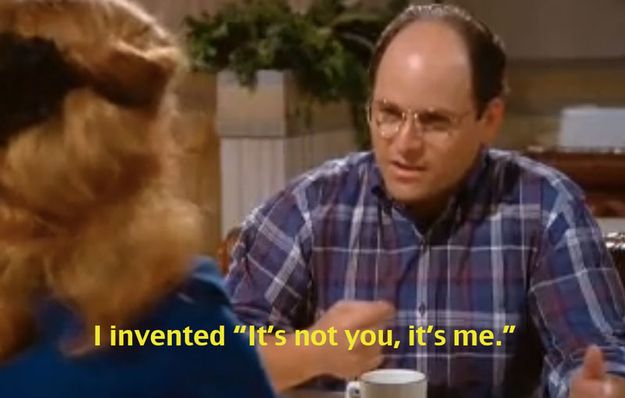
Like I said I was anxious due to the previous experience. But, the two of us handled it very well and it was an amicable parting, a clean breakup if you will. I even used the George Costanza tested “it’s not you it’s me” breakup line. But hey, Ces’t l’apres-guerre… (such is life after war)

My plan now is to get with a senior shrink that I know and have worked with to help get me someone more compatible for what I need at this point in life. I just hope that by “breaking-up” with my therapist that I won’t get shafted by the institution.

But I have learned to live with this; I realize that the military mental health system is not in the business of trying to get you better, it is in the business of trying to return young men and women to be able to go back to war. If you actually get better in the process that is kind of a twofer. Honestly I could have gone back to war with  a year of coming home. Going to war is easy, coming home intact is not.

Do not get me wrong, it is not that there are not providers willing to help; there are plenty of them. But the system , crowded with people who need more help than it can provide and without with ever shrinking budgets; almost makes it impossible to get help. If you can be patched up and sent back out, they have done their job, if you crash after you leave the service not their problem. Sadly, I have lost too many friends, some to suicide after they left the military, including men whose credentials as real American heroes were unmatched. This is not a new issue, ask any vet who has dealt with getting post-service care at the VA or anywhere.

Likewise, if you remain in service and have a chronic-long-term condition, of any kind, physical or mental the attitude seems to be “fuck you.” If you get the label as a “broke” Marine, Sailor, Soldier, or Airman your career is pretty much over, unless you are one of the lucky few like me who had some superiors who looked beyond that and protected you. I know that because it is not just my experience but the experience of hundreds of combat vets that I have dealt with.

I can live with this as long as I am on my meds, and have friends and beer, but then I am an old guy looking at retirement at the end of this tour. If I were a young guy, with my whole career ahead of me I would be fucked. So when I retire I will be a pain in the ass to the system to ensure that the young guys who will be fighting our wars in the future as well as those who are out of the military gets the care that they need.

But as far as my condition goes, I am oddly comforted by the words of Raymond “Red Reddington (James Spader) in The Blacklist:

“There is nothing that can take the pain away. But eventually, you will find a way to live with it. There will be nightmares. And everyday when you wake up, it will be the first thing you think about. Until one day, it’s the second.”

Many things haunt me; but unlike many people who have little self-awareness I might have just a bit too much. I have talked about the nightmares, night terrors and insomnia that I have many times following my return from Iraq. I used to believe, at least back in the first year or so after I returned that I thought that eventually I would get over it. I don’t believe that anymore, now I just believe that I will find a way to live with them.

I guess that is the secret to life. Instead of wishing that something would miraculously take way the pain, I guess that it is better to find a way to live with it because one day something else will replace it.

Is that an ideal way to deal with life? Probably not, but I know that I am an idealist anymore. I used to be, but that was a while back. It took time, but war and the lies of men that I voted for, men who I trusted because they professed my faith, my love of country, and some who even shared my vocation as a priest and chaplain took that from me.

Some experts call this “moral injury.” For me it is connected with my tour in Iraq, PTSD and what I experience when I came home from colleagues, and people in my former church. Betrayal and abandonment is a terrible thing, but I am learning to live with it. It is not pretty but I am learning with every passing night and morning. Alexander Dumas wrote in The Count of Monte Cristo:

“Moral wounds have this peculiarity – they may be hidden, but they never close; always painful, always ready to bleed when touched, they remain fresh and open in the heart.”

My life is full again, there is meaning and purpose, but it is tempered by realism and the expectation that every day I will wake up and still think about those painful memories until finally something else takes their place.

I guess that the secret to living with darkness and pain is simply to live with it because the saying that “time heals all wounds” is a lie, it is the fabrication of people that don’t want to deal with the real world. God might heal, but then God may not. I have learned to be okay with that. I know that there are some Christians who might disagree and even say that I do not have enough “faith,” whatever that means, but I can live with this.

So I will live with it and in doing so I will continue on and in the process hopefully be there for others that also struggle with pain that does not want to go away and nightmares that never seem to end. As the late Henri Nouwen wrote: “Ministry means the ongoing attempt to put one’s own search for God, with all the moments of pain and joy, despair and hope, at the disposal of those who want to join this search but do not know how.” Not exactly perfection, but it will work.

This now is my goal and my prayer: God grant me the courage to change the things I cannot accept; Serenity to accept the things I have changed; And the wisdom to know I’m different. Amen.

Peace

Padre Steve+

1 Comment

Filed under faith, healthcare, mental health, PTSD

There Will be Nightmares: PTSD & Memories of War

Friends of Padre Steve’s World

I’m really very tired today so another short post. I haven’t slept well in several weeks, part of this of course was the worry I had regarding my wife Judy and her cancer diagnosis, surgery and recovery. As she has gotten better I have been dealing with stuff from my own closet of anxieties. Those who have been reading my articles here know that I deal with PTSD, Traumatic Brain Injury and moral injury from my time in Iraq, and my return home.

ramadi

Last year I went through a very difficult time dealing with the military mental health system that I never want to repeat again. I hope I don’t have to, but I may. My therapist who I have had since last summer took a new job thousands of miles away and now I am going to have to find another therapist. I am hoping the man I see for my medication management can get me referred to someone good, because I do not want to be thrust back into the system and take the luck of the draw. That scares me to death, and since I found out my therapist was leaving and that I will not see her again I have been trying to keep my anxiety under control and not to panic. Awake I do pretty well with this, but when I try to sleep, all my Iraq stuff, plus all the very real and bad experiences that I had with the military mental health system last year flood my psyche. The night terrors are back, the terrible dreams and fears. It is not fun waking up in the middle of the night in a state of terror. Last year, after dealing with a number of providers and administrators I was nearly suicidal. It took the intervention of a former commanding officer who had been recently selected for promotion to Admiral in the Medical Corps to get me listened to and to get me the help that I sought.

295_26912092058_3949_n

But I know that I am not alone, I will get the professional help that I still need and I do have some friends I can talk to about these issues. Likewise I know many combat who veterans deal with similar issues related to their service, as well what happened to them when they returned home from Iraq or Afghanistan. The return from war is often worse than actually being over there, few people really understand, unless they too have been there.

Guy Sajer wrote in his book The Forgotten Soldier, “Only happy people have nightmares, from overeating. For those who live a nightmare reality, sleep is a black hole, lost in time, like death.” General Gouverneur Warren, a hero of many Civil War battles including Gettysburg wrote to his wife after the war “I wish I did not dream so much. They make me sometimes to dread to go to sleep. Scenes from the war, are so constantly recalled, with bitter feelings I wish never to experience again. Lies, vanity, treachery, and carnage.”

n671902058_1153794_4301

I am a realist about this. I know that there is no magic wand which will make it all go away and I don’t expect any therapist, or even God to cure me. I can understand why Alexander Dumas in the Count of Monte Cristo wrote, “Moral wounds have this peculiarity – they may be hidden, but they never close; always painful, always ready to bleed when touched, they remain fresh and open in the heart.”

That is true and I know to some people that may sound like I have given up, especially because it runs counter to the snake oil salesmen who write self-help books which promise to heal you in whatever number of steps or exercises; especially the ones written by preachers. But that is not the case, despite everything I still have a love of life and lust for learning. Except that now I just have moved to a new level of understanding concerning my own dark places, and that pain that manifests at night as I try to sleep. Since nothing will take it away I need to live with it and realize that it won’t always be the first thing that I think about when I wake up in the morning. That my friends is the essence of hope. 

n671902058_1219154_8844

One of my favorite actors, James Spader, plays a character named Raymond Reddington on the television show The Blacklist. During one episode he told another character something quite profound, something that if we actually embrace it can be somewhat comforting. “There is nothing that can take the pain away. But eventually, you will find a way to live with it. There will be nightmares. And every day when you wake up, it will be the first thing you think about. Until one day, it’s the second.”

I think that is why I can continue and at the same time seek to be available to those who suffer similar afflictions, and thankfully, I do still have those opportunities and as the late Henri Nouwen wrote, “Ministry means the ongoing attempt to put one’s own search for God, with all the moments of pain and joy, despair and hope, at the disposal of those who want to join this search but do not know how.”

Anyway, have a nice night.

Peace

Padre Steve+

4 Comments

Filed under Loose thoughts and musings

My Faith: A Journey and Mission

IMG_0230

Friends of Padre Steve’s World

Today I am writing because a couple of days ago I celebrated the nineteenth anniversary of my ordination to the Priesthood. Likewise, I have a lot of new readers and subscribers to the site, as well as a lot of Twitter followers who maybe see the title of the page and wonder want I am about. So this is kind of an introduction to me and my faith journey, kind of how I view life. Paul Tillich once said, “Sometimes I think it is my mission to bring faith to the faithless, and doubt to the faithful.” Truthfully I have in large part adopted that as a model for life and faith as a rather miscreant priest, in large part because so many Christians, especially clergy seem too busy prattling on about programs, policies, politics and seem not to understand that most people, just want a listening ear, as Dietrich Bonhoeffer wrote:

“Many people are looking for an ear that will listen. They do not find it among Christians, because these Christians are talking where they should be listening. But he who can no longer listen to his brother will soon be no longer listening to God, either; he will be doing nothing but prattle in the presence of God, too. This is the beginning of the death of the spiritual life, and in the end there will be nothing left but spiritual chatter and clerical condescension arrayed in pious words… never really speaking to others.”

My experience of the Church is profoundly influenced by my life in the nether world of the military culture. My world view is shaped by a blending of various Christian traditions, mutual support and collaboration among believers of often radically different points of view. Because of the love, care and mentoring of people from a blend of different traditions I came to know God and survived a tumultuous childhood with many moves.

As a historian I have been blessed to study church history from the early Church Fathers to the present. As I look to church history I find inspiration in many parts of the Christian tradition. In fact rather being threatened by them I have become appreciative of their distinctiveness. I think that there is a beauty in liturgy and stability in the councils and creeds of the Church. At the same time the prophetic voice of evangelical preaching shapes me, especially the message of freedom and tolerance embodied in the lives and sacrifice of men like John Leland, the American Baptist who helped pioneer the concept of Freedom of Religion established in the Constitution of the United States, of William Wilberforce who labored to end slavery in England and, Martin Luther King Jr. who led the Civil Rights movement.

Likewise that prophetic message of the faith is demonstrated in the ministry, writing and martyrdom of Dietrich Bonhoeffer and his contemporaries Martin Niemoller and Jesuit priest Father Rupert Meyer. All three resisted and preached against the evils of Nazism. In a more contemporary setting I am inspired by Bishop Desmond Tutu who helped topple apartheid in South Africa.

Women like Teresa of Avila and St Catherine show me that women have a legitimate place of ministry and leadership in the Church. I am convinced through my study of Church history, theology and a deep belief in the power of the Holy Spirit that women can and should serve as Priests and Bishops in the church.

My theology has shaped by the writings of Hans Kung, Yves Congar, Jurgen Moltmann, Andrew Greeley, and Henry Nouwen. I’ve been challenged by St Francis of Assissi, John Wesley and Martin Luther. I am especially inspired by Pope John XXIII whose vision brought about the Second Vatican Council and I am inspired by Pope Francis.

I pray that Christians can live in peace with one another and those who do not share our faith. I pray that we can find ways to overcome the often very legitimate hurts, grievances and divisions of our 2000 year history. At the same time I pray that we can repent from our own wrongs and work to heal the many wounds created by Christians who abused power, privilege and even those who oppressed others, waged war and killed in the name of Jesus.

I do not believe that neither triumphalism nor authoritarianism has a place in in a healthy understanding of the church and how we live. I am suspicious of any clergy who seek power in a church or political setting. I profoundly reject any argument that requires the subjection of one Church with its tradition to any other Church. In fact I think that the arrogance and intolerance of Christians to others is a large part of why people are leaving the church in droves and that the fastest growing “religious group” is the “nones” or those with no religious preference. Andrew Greeley said something that we should take to heart:

“People came into the Church in the Roman Empire because the Church was so good — Catholics were so good to one another, and they were so good to pagans, too. High-pressure evangelization strikes me as an attempt to deprive people of their freedom of choice.”

I grew up in and have lived my life in a very open and ecumenical environment. I have lost any trace denominational parochialism and competition that I might have had if I had become a pastor of a civilian parish instead of a chaplain. It is interesting that the pastor that first ordained me in the evangelical tradition and the bishop that ordained me as a priest both did so with the intent that I serve as a chaplain. Whether it was the recognition of a gifting for the work or the fact that they didn’t want me messing up their civilian operations by asking hard questions I will never know.

I believe that my environment and the men and women who have helped shape my life have been a stronger influence in the way I think about ecumenical relations and ministry than my actual theology or ecclesiology. Whether they were Catholics, Anglicans, Lutherans, Methodists, Presbyterians, Evangelicals or even those considered by many to be outside the faith including Jews, Moslems, Buddhists, Mormons and even complete non-believers all have contributed to my life and faith.

I have grown weary of refighting theological debates that have divided the church for a thousand years. Since what we know of theology including our Scriptures and Creeds are based on faith and not science I see no reason to continue to battle.

That doesn’t mean that I think we should put our brains in neutral but rather we must wrestle with how to integrate our faith with science, philosophy and reason, otherwise we will become irrelevant. In that sense I identify with Saint Anselm of Canterbury who wrote about a faith seeking understanding and Erasmus of Rotterdam who very well understood the importance of both faith and reason. In that sense I am very much at home with the Anglican triad of Scripture, Reason and Tradition when it comes to approaching faith.

I struggle with faith and belief. After Iraq I spent two years as a practical agnostic. As Andrew Greeley wrote: “Most priests, if they have any sense or any imagination, wonder if they truly believe all the things they preach. Like Jean-Claude they both believe and not believe at the same time.” Andrew Greeley “The Bishop and the Beggar Girl of St Germain”

I am an Old Catholic and believe that inter-communion does not require from either communion the acceptance of all doctrinal opinion, sacramental devotion, or liturgical practice characteristic of the other, but implies that each believes the other to hold all the essentials of the Christian faith. I like to think that I embody what the early Anglicans referred to as the via media and that somehow my life and ministry has been about building bridges at the intersections of faith with a wide diversity of people.

When I have tried to embrace traditionalism or choose to fight theological battles I have ended up tired, bitter and at enmity with other Christians. In a sense when I tried those paths I found that they didn’t work for me. I discovered that I was not being true to who God had created and guided my life, education and experience. I feel like T. E. Lawrence who wrote:

“The rare man who attains wisdom is, by the very clearness of his sight, a better guide in solving practical problems than those, more commonly the leaders of men, whose eyes are misted and minds warped by ambition for success….”

My favorite theological debates have been with other chaplains over pints of good beer in German Gasthausen or Irish pubs. Those were good times, we argued but we also laughed and always left as friends and brothers. I believe since we are human that none of us will ever fully comprehend all of God or his or her truth. I believe that the Holy Spirit, God’s gracious gift to her people will guide us into all Truth. For me my faith has become more about relationships and reconciliation than in being right.

As far as those who disagree with me that is their right, or your right, if that is the case. I don’t expect agreement and I am okay with differences and even if I disagree with an individual or how another religious denominations polity, theology, beliefs or practices those are their rights. In fact I am sure that those that believe things that I don’t are at least as sincere as me and that those beliefs are important to them. I just ask that people don’t try to use them to force their faith or belief on others, be it in churches or by attempting to use the power of government to coerce others into their belief systems.

Have a great night,

Peace

Padre Steve+

3 Comments

Filed under christian life, ethics, faith, Religion

The Duggars & the Danger of Absolutism

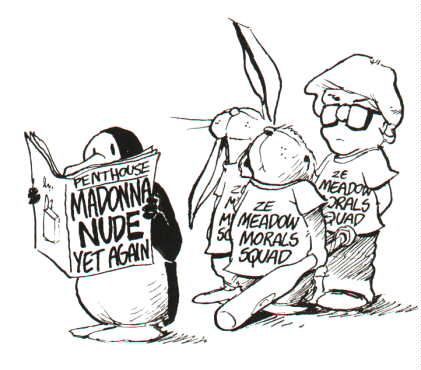
orange-BloomCounty-morals

“Religion carries two sorts of people in two entirely opposite directions: the mild and gentle people it carries towards mercy and justice; the persecuting people it carries into fiendish sadistic cruelty…” Alfred North Whitehead 

Friends of Padre Steve’s World,

Yesterday I wrote about my thoughts on the situation regarding the Duggar family and how I saw the incident as demonstrating the moral implosion of the Christian Right. As I wrote about it I began to think about the religious world of the Christian Right that I spent much of my life in before I returned shattered from my experiences serving in Iraq. For me the war was a watershed in my life and in my faith.

Those who follow my writings know how much I struggle with faith and doubt on a daily basis. I believe, but as the man told Jesus when he asked Jesus to heal his child “I believe, help my unbelief.” I no longer believe in the “absolute truths” that I once believed. Of course to some this makes me a heretic or worse. That being said, I have faith in a God I cannot see. I have faith in a God who clothes himself in human weakness and allows himself to be killed as a state criminal.

That being said I see many of my fellow Christians, not to mention those of other faiths who attempt to use their interpretation of what they believe are absolute truths and attempt to impose them on others. Using their houses of worship they indoctrinate believers into believing the “truth” including the judgment on non-believers. The Duggars and their stalwart supporters are prime examples of this. As I said yesterday, if the Duggars were simply minding their own business and raising their family according to their beliefs the story, while revolting and disgusting in its moral tenor would not have become a political issue. However, because the Duggars have used their fame to insert themselves and their ideology into the political arena where they routinely appear at the side of presidential candidates, influential congressmen and senators, governors and as keynote speakers at quasi-religious political events where they rail against liberals, gays, Moslems and others it has become precisely that.

But then I kind of understand the amount of indoctrination that it takes for people like the Duggars and their supporters to get where they are. I went to churches for much of my adult life where right wing politics was part and parcel of everything that these churches taught. The “voters guides” put out by the Christiian Coalition were not only distributed before, during and after worship services, but they were required reading. Pseudo-historians came and sold their wares about America’s Christian Heritage to people who devoured them. I remember going through mandatory classes for clergy in my previous denomination which were entitled “The Government of God” and utilized Robert Bork’s book Slouching Towards Gomorrah: Modern Liberalism and American Decline as its primary text. Obviously the class had little to do with faith, but was a tool by which we were indoctrinated to believe by the political-religious ideology of our church leaders. There were several more texts, which basically echoed Bork’s thought, but they were taught in a manner is if they were as important as the often contradictory Biblical tests or the writings of the church Fathers, the great saints, Scholastics or Protestant Reformers. It was an exercise in political indoctrination based on religious ideology. At the time I had no idea that what the church leaders were appealing to was nothing more than a variation on the Christian Dominionism ideology. 

Such ideology is incredibly dangerous because when people in power take it to heart and act upon it, all pretense of fairness, justice and integrity is lost. Those who are simply different are persecuted, those who do not tow a particular party or religious line are suspect, and the innocent are presumed guilty. It has happened throughout human history in every corner of the world, and it still goes on today especially in the religious and cultural world that the Duggars are a part. Their “faith” if you can call it that is built on the absolute certitude that they are right and thus even if they do wrong it is not as bad because they are standing for God.

This type of religious and moral absolutism is terrifying when it reaches its fruition, and so I ended up rejecting that view of faith and life after coming home from Iraq. For publicly voicing my disagreement on a number of issues retaliated to those matters I was asked to leave that denomination in 2010.

I believe again, but my doubts are real. But even more I have a belief in justice, and I believe that that justice itself cannot be built on absolutes. As Captain Jean Luc Picard (Patrick Stewart) noted in the Star Trek the Next Generation episode Justice: 

“I don’t know how to communicate this, or even if it is possible. But the question of justice has concerned me greatly of late. And I say to any creature who may be listening, there can be no justice so long as laws are absolute. Even life itself is an exercise in exceptions.”

I have found that as Picard said, “that life itself is an exercise in exceptions.”  We all make them, and the Bible and the history of the church is full of them. So I have a hard time with those who claim an absolute certitude in beliefs that are built on faith and treat them as fact, despite the fact that they are not provable. Dietrich Bonhoeffer noted the problem well when he talked of this problem and described the dilemma of so many believers:

“Man no longer lives in the beginning–he has lost the beginning. Now he finds he is in the middle, knowing neither the end nor the beginning, and yet knowing that he is in the middle, coming from the beginning and going towards the end. He sees that his life is determined by these two facets, of which he knows only that he does not know them”

Even so the Duggars and their supporters, like many believers of all faiths wrap themselves in the certitude of their faith. They espouse doctrines that at best are humanity’s best attempts to describe a God that is infinitely bigger and more complex than they believe. The contest then becomes not about God himself, but the manner that the human being who interprets God espouses as incontrovertible doctrine. Eric Hoffer wrote:

“A doctrine insulates the devout not only against the realities around them but also against their own selves. The fanatical believer is not conscious of his envy, malice, pettiness and dishonesty. There is a wall of words between his consciousness and his real self.”

That certitude and the belief that we absolutely know the mind of a God who claims that we cannot know is the height of arrogance and it ensures that when we speak in terms of absolutes that we do not understand God, nor do we believe in justice, because as Captain Picard so wisely noted “life itself is an exercise in exceptions.” Even the most devout of believers make exceptions, simply because they are human and can’t avoid it, unless they are sociopaths.

Henri Nouwen wrote something very profound that all who claim to know God’s absolute will or truth need to consider. Nouwen wrote: “Theological formation is the gradual and often painful discovery of God’s incomprehensibility. You can be competent in many things, but you cannot be competent in God.”

The fact is that no one can be competent in God, and that those who claim to are either hopelessly deluded by their ignorance, or worse, are evil men masquerading as good. Those who pro port to know absolutes and want to use the Bible or any other religious text as some sort of rule book that they alone can interpret need to ask themselves this question, posed by Commander Riker to Captain Picard when he talked about absolutes and life: “When has justice ever been as simple as a rulebook?” 

Sadly too many people the Duggars apply their own misconceptions and prejudices to their scriptures and use them as a weapon of temporal and divine judgement on all who they oppose. However, as history, life and even our scriptures testify, that none of us can absolutely claim to know the absolutes of God. As Captain Picard noted “life itself is an exercise in exceptions.” 

Thus our human justice, as feeble as it often is must take this into account: It takes true wisdom to know when and how to make these exceptions, wisdom based on reason, grace and mercy. Justice, is to apply the law in fairness and equity, knowing that even our best attempts can be misguided and if based on emotion, hatred, racism or vengeance all clothed in the language of righteousness can be more evil than any evil it is supposed to correct.

Does it matter if we are doing it the sake of law and order, or for love of country, or to defend the faith; if at the heart of it what we call justice, or moral absolutes is nothing more than the implementation of an agenda to crush the powerless under our heel and promote even more injustice? If we lean toward the view that we are implementing the absolute law and will of God then we had better be sure, as Nouwen so well noted we can be competent in many things, but we cannot, as much as we deceive ourselves, be competent in God.

But we see it all too often, religious people and others misusing faith to condemn those they do not understand or with whom they disagree. This is why the Duggar controversy is important. As Patrick Stewart playing Captain Jean Luc Picard noted in the Start Trek Next Generation episode The Drumhead:

“We think we’ve come so far. Torture of heretics, burning of witches it’s all ancient history. Then – before you can blink an eye – suddenly it threatens to start all over again.”

Peace

Padre Steve+

8 Comments

Filed under christian life, faith, News and current events, Political Commentary

Doubt, Faith and Realism: Doubting Thomas

jesusthomas

Yesterday I celebrated Eucharist on the Second Sunday of Easter its a number of m students and their families at our Staff College Chapel. I have to say that I love what do, I never will regret following the call that I first felt aboard the USS Frederick (LST-1184) back in 1978 to become a Navy Chaplain.

Of course was with everything in my life it has not been easy, and to quote Jerry Garcia I have to admit “what a long strange trip it’s been.” Bug my friends I digress…

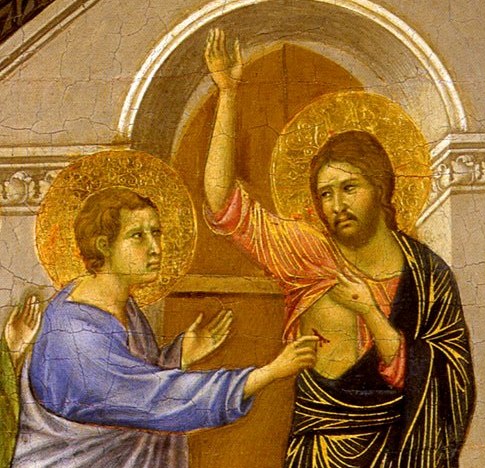
That being said, today was a specially day. I was able to celebrate Eucharist with some very nice people and today the Gospel lesson, from the final chapter of John centered on the story of St. Thomas, or he is better know among most people today, “Doubting Thomas.”

The interesting thing is that unlike most “true believers” today Thomas was not rejected by the other disciples as they testified to the resurrection, nor by Jesus himself. Thomas you see was a realist who wanted proof. Thomas wanted to put his hand in the wounds of Jesus, the same Jesus who he knew was crucified and dead. As a realist, Thomas know that dead is dead and unless as he told the other disciples, unless he could put his hand in the wounds of Jesus he would not believe.

Personally, I admire that, more than most people could imagine. Faith is faith, it is not about having to absolutely know, but is about trust, about belief even when you cannot prove it, otherwise it would not be faith. That is why when I see those who have to prove that the absolute certitude that they call “faith” is “absolute truth” I realize that they have totally missed the point of the Gospel.

Having gone through a period of almost two years where as a priest and chaplain I was for all practical purposes an agnostic hoping that God existed I understand this. In fact I have to admit that even today I doubt as much as I believe. I totally understand Thomas, and in fact not only understand, but feel a special kinship with this much maligned follower of Jesus.

Truthfully I think that doubt is a very good thing, it keeps us honest, it keeps us from becoming pious, arrogant, religious assholes who think that they know it all.

Truthfully, I don’t know it all. In fact, as the late Earl Weaver said, “it’s what you learn after you know it all that counts.” At least that seems to be the case for Thomas and the other disciples because what happened with Jesus and the resurrection blew their minds, it was not anything that they could fathom.

Perhaps Thomas, having not been one of the first witnesses to the resurrection was actually more circumspect and a bit more like us than the disciples who first saw Jesus following his crucifixion and resurrection. I would actually saw more honest, for in fact Thomas was a realist who refused to believe unless he had some kind of physical evidence. That my friends I appreciate more than I ever did, because even though Thomas saw Jesus, talked with him and had Jesus show him his wounds, Thomas only believed when he saw and touched those wounds. I cannot condemn nor can I question the faith of the man who is most identified with doubt.

Doubt is not bad. As the late Father Andrew Greeley wrote in his novel The Bishop and the Beggar Girl of St. Germain: 

“Most priests, if they have any sense or any imagination, wonder if they truly believe all the things they preach. Like Jean-Claude they both believe and not believe at the same time.” 

That my friends is faith. That is Easter, if we knew it absolutely it would not be faith and that would be against everything proclaimed by those that first followed Jesus. In fact if we claim with absolute certitude that we know everything needed to be right with God and that we know exactly what God desires, we are probably liars, or at the minimum sadly deluded. As the late Father Henri Nouwen wrote:

“Theological formation is the gradual and often painful discovery of God’s incomprehensibility. You can be competent in many things, but you cannot be competent in God.”

I think this is something that Thomas and the other disciples came to understand. All of them had their moments of faith, and certainly their times of unbelief, even after the resurrection. Maybe that is why Jesus told Thomas “Have you believed because you have seen me? Blessed are those who have not seen and yet have come to believe.”  

Thomas was a realist. Even though the other disciples testified to Jesus being alive, Thomas knew that dead, was dead. He knew that Jesus had died on that cross and that it would take more than words to make him believe that Jesus was alive.

Faith is not about certitude as much as the apologists and propagandists of any faith may say, faith always has to have an element of doubt, otherwise it cannot legitimately be called faith. In fact sincere faith admits that it could be wrong, and as the Paul the Apostle said “If Christ has not been raised, your faith is futile….”

Personally, I find nothing wrong with that. For me that is honest faith, that is Easter faith.

So, have a great day.

Peace

Padre Steve+


1 Comment

Filed under christian life, faith, Religion

I Want to Believe this Easter

themiddle

“Religion carries two sorts of people in two entirely opposite directions: the mild and gentle people it carries towards mercy and justice; the persecuting people it carries into fiendish sadistic cruelty…” Alfred North Whitehead 

Sometimes Holy Week can be a downer and I can understand why people who doubt, or who have been abused by Christians, either in the church or as outsiders find this to be so. I am a Christian, a priest, a Navy Chaplain. By all estimates I should be on the “inside” so to speak, but in the current religious and political climate I am an outsider. My crime to the “true believers” is that I question their certitude, and I reject the hateful ideas of an American Christian theocracy preached by the politicians, pundits and preachers of the Christian Right.

As for me, this year, Holy Week has been a bit of a downer. I believe, but I don’t. For a while I wondered if it was my post-Iraq agnosticism returning, but after spending some time meditating and thinking on it I realized that was not the case. I do still believe, or at least I want to, but my doubt and unbelief now mainly comes from of my experience with Christians, not so much God.

Truthfully I wonder. I wonder if God is the God whose Son reconciled the world to himself, how those that claim to be his most devout followers seem more intent preaching a message of alienation and rejection rather than reconciliation. I wonder how people who claim to be the disciples of the Prince of Peace seem far more intent on conducting a jihad like culture war than the message of peace and reconciliation. I wonder how such people who claim to be God’s elect and anointed can so maltreat the very people who Jesus would have gone out of his way to care for, and in fact died and rose again in order to save. But I am not alone in this.

Rachel Held Evans wrote in a CNN religion blog yesterday:

“This is the tragic irony of the culture wars: The casualties tend to be the very people Jesus went out of his way to serve: the poor, the sick, the marginalized, the outcasts, the people ostracized and deemed “sinners” by the religious elite. And when the world sees Christians hurting rather than helping such people in the name of political gain, our testimony is profoundly diminished.” 

I fully understand what she is saying. Personally I am tired of the abuse of people who in the name of their culture warrior political Christian elite must resort to the most loathsome methods to demonize people who do not agree with them, including me. Sadly, in addition to people who don’t know me from Adam who do this I have experienced it from so called “Christian” friends. If it wan’t for people, including conservative Christians who have stood by me through thick and thin, even when they disagree with me, I probably would just chuck Christianity and the church.

But I cannot do that if I believe in the message of Jesus. I cannot do that if I actually even somewhat believe message of Jesus. A message that reaches out even to the same people who seem to loath me and others like me with a hate stronger than life itself.

When when a person like me struggles to believe in the first place, and at the same time is rejected by those who loudly proclaim to be the disciples of Jesus it does get old. Way too old.

Since it is Holy Week and I am struggling I have decided to not get involved with any discussions this week with the supposed followers of Jesus on any social media that denigrate those who Jesus died to save. If I am to preserve any sort of faith I have to do this.

Sadly, that can and does include things not even connected with the actual Christian faith, mostly the politics of the supposedly “Christian Right.”  A couple of days ago I dared to state the truth that a certain Republican Presidential candidate espoused the same theocratic views as his Christian Dominionist preacher father. That got me attacked by a number of so called Christians including one whose Facebook avatar picture was a soldier wearing a death’s head mask with a pistol pointed directly at me. That man called me a “wolf in sheep’s clothing.” I told that man that I had a feeling that I knew what he would do if he actually met me. I picture is worth a thousand words, especially when it comes to revealing attitudes of the heart.

Personally, between the rejection and abuse I have experienced from Christians that I thought were friends, as well as those who are no better than hateful trolls on social media I am pretty much done with all things remotely considered Christian by most Americans today. I find it no wonder that people are fleeing the church, and have no doubts as to why why every poll and trend shows that people increasingly want nothing to do with the those that call themselves Christian or the church.

But I stay, and the the only reason I remain now I think is that I believe in the Jesus of Good Friday, the Jesus who is rejected by all the theologians of glory and Christian Dominionists, the crucified God. I believe in the Jesus whose death was considered a scandal to the Jews and foolishness to the Greeks. If I am to believe this is the Jesus that I have to believe in, not the God of the “theologians of glory” or the Dominionists who seek to establish their kingdom on earth with a thin veneer of faith. It as as Jurgen Moltmann wrote:

“The God of freedom, the true God, is… not recognized by his power and glory in the history of the world, but through his helplessness and his death on the scandal of the cross of Jesus”

Theologian Paul Tillich, who served as a U.S. Army Chaplain wrote “Sometimes I think it is my mission to bring faith to the faithless, and doubt to the faithful.”  

In light of my belief in the scandal of the Cross, something that certainly is offensive to those that seek the power and glory of God even if it means trampling those that Jesus most identified, is a mission that I can subscribe.  Most of the people I deal with are those marginalized and rejected by the Christian pharisees, or what I call the “Christian Taliban.”  Personally I am tired of being associated with people who treat the poor, the alien, the different, the sinful and the afflicted as less than human, or less than worthy of God’s love and grace.  I am tired of being associated with people who claim to be pro-life so long as it only applies to life in the womb, who have no problem blessing war without end and the merciless killing of innocents abroad. I am tired of people who scream “let them die” at Presidential debates referring of course to the the poor and uninsured being the voice of Christianity in this county. People who have so discredited themselves and the faith as to make no one want to have anything to do with Jesus.

In the movie Joyeux Noel a priest and chaplain serving with a Scottish regiment during the Christmas truce of 1914 tells the Bishop who is sending him home: “I belong with those who are in pain, and who have lost their faith, I belong here.” Of course the bishop is a man who heartily subscribes to a war without mercy, just as so  many who call themselves Christians do today. When the priest questioned the bishop about being relieved of his duties, the bishop, in a manner similar to what I have experienced tells the priest: “You’re not asking the right question. Think on this: are you really suitable to remain with us in the house of Our Lord?”

I have experienced such comments too much. So regardless of the cost, even the cost to myself I will chose to believe and serve the Crucified God, the God who is not the God of the theocrats of the “Christian” right, but the Crucified God who stands against them. The God who in humility and weakness  proclaimed that his kingdom was not of this world and who stands against those who fraudulent attempt to establish their kingdoms in his name. People that often do so upon the bodies of those that they kill, and the lives of those that they despise. If this means that I am not suitable to “remain in the house of the Lord” than I would rather be an outcast on my own Golgotha this Holy Week than in that house.

Frankly, I don’t know what this Holy Week will bring for me. I am struggling. I want to believe, but sometimes I get so discouraged as one of those wounded by such people that I need to create some safe space if I am to find some solace.

I am opposed to the conservative Christian “Culture Wars” that so many of my friends and others have, and sadly still embrace. I see the “”Culture Wars” as antithetical to the Gospel. I see them as vain attempts to establish a state religion, an American Theocracy that would crush and destroy any that dare oppose it.

That being said I want to remain open to any who seek God. Henri Nouwen wrote:

“Ministry means the ongoing attempt to put one’s own search for God, with all the moments of pain and joy, despair and hope, at the disposal of those who want to join this search but do not know how.”

My journey this Holy Week is one of hope. I do want to believe. Jurgen Moltmann wrote:

“Totally without hope one cannot live. To live without hope is to cease to live. Hell is hopelessness. It is no accident that above the entrance to Dante’s hell is the inscription: “Leave behind all hope, you who enter here.”

That is my journey this week, a journey from my own Golgotha to the Easter Alleluia. To do so I cannot give up hope. I probably won’t do very well at it,this week or any other, but that is my journey.

I don’t know if that makes any sense, but somehow, it does make sense to me.

Peace

Padre Steve+


5 Comments

Filed under christian life, faith, Religion

The Wannabe Inquisitors: Christian Trolls

dyer-hanging1

Friends of Padre Steve’s World

Just a short post today, I have spent most of the day over at the Naval Medical Center, getting my initial evaluation for Traumatic Brain Injury and Concussive Syndrome and new hearing aids to help with Tinnitus and speech processing disorder.

But, another day, another religious troll. This one not the typical Evangelical, or even more traditionalist Roman or conservative Catholic type. This one claimed to be Eastern Orthodox and had to bluntly confront me on my heresy. Of course that had to do with women clergy and homosexuals, which seem to be for many of these guys, and for that matter all of my trolls have been guys, the big issue is that they always focus on these things when calling me a heretic. They never call me a heretic for the things that the Church Fathers all condemned as heretical, like my very orthodox doctrine of God, Christ, and the Holy Spirit. Nor can they say that any of my beliefs conflict with the Creeds or Councils, or are not enunciated by at least some of the Church Fathers. Instead they jump on women in ministry and gays.

My personal feeling is that thought they cloak their reasons in their theology is the fact that they cannot handle women in any kind of authority position and that, and the issue of homosexuality makes them question their own manhood, or possibly lack thereof. I love what Barbara Tuchman wrote about male theologians. “Theology being the work of males, original sin was traced to the female.” That really is why male dominated, and often mysoginistic religions reject women as priests, bishops, ministers, Imams, or Rabbis.

After a couple of exchanges this gentleman referred to the statement that the “Orthodox Church IS the Church, is true and correct in EVERYTHING it teaches….” (His emphasis)

Such appeals to absolute truth being contained in any one religion or denomination neither impress or frighten me. I went through that stage of faith, and frankly it’s a free country. I know lots of other people  that would disagree with the man, including the official teaching of the Roman Catholic Church which still holds its 1054 excommunication of the Orthodox as binding, despite the good intentions of Pope John Paul II and Pope Francis. But if such certitude comforts this man, good on him.

What I don’t understand though is how this man and others like him have a compulsive need to troll the internet, find someone that they find lacking, call them a heretic and get upset when the person that they assaulted takes umbrage. I don’t get that. I have no need to go to anyone’s site just to tell them how wrong I think that are. But then maybe such people do this because they lack the official backing of the government to enforce their religious beliefs on others.

I have a live and let live attitude. I don’t think that anyone or any church, denomination, sect or religion has a monopoly on truth. I quite agree with the late Father Henri Nouwen who said:

“Theological formation is the gradual and often painful discovery of God’s incomprehensibility. You can be competent in many things, but you cannot be competent in God.”

I no longer make absolute truth claims. I believe, but I doubt and question, some days more the latter than the former. So when people like this come at me I try not to waste much time on them, though I did defend myself. This man proved again Eric Hoffer’s magnificent thoughts:

“A doctrine insulates the devout not only against the realities around them but also against their own selves. The fanatical believer is not conscious of his envy, malice, pettiness and dishonesty. There is a wall of words between his consciousness and his real self.”

The good thing is that in this country, men like this are unable to enforce their doctrine on other citizens through the police power of the government. Such as the case in Russia where Vladimir Putin’s crusades against women, the LGBT community as well as other smaller Christian denominations and Jews are rooted in the state religion of Russian Orthodoxy. This is a fact and it is a reminder that such people and such systems do exist, and if they ever, in whatever form gained control of the government in this country they would do the same. We see this at the state level where a number of states are attempting to establish Christianity as the State religion, or at the minimum give Christianity precedence over any other religion.

These Wannabe American inquisitors love Putin, and many actually go to Russia to cheer on his actions.

Hopefully things never come to that here. But you never know. As Captain Jean Luc Picard (Patrick Stewart) said in the Star Trek the Next Generation episode The Drumhead:

“We think we’ve come so far. Torture of heretics, burning of witches it’s all ancient history. Then – before you can blink an eye – suddenly it threatens to start all over again.”

Have a great night,

Peace

Padre Steve+


2 Comments

Filed under christian life, faith, Military, News and current events, Religion

An Exercise in Exceptions: “Absolute” Truth, Faith and Justice

dyer-hanging1

“Religion carries two sorts of people in two entirely opposite directions: the mild and gentle people it carries towards mercy and justice; the persecuting people it carries into fiendish sadistic cruelty…” Alfred North Whitehead 

Those who follow my writings know how much I struggle with faith and doubt on a daily basis. I believe, but as the man told Jesus when he asked Jesus to heal his child “I believe, help my unbelief.” I no longer believe in the “absolute truths” that I once believed. Of course to some this makes me a heretic or worse. That being said, I have faith in a God I cannot see. I have faith in a God who clothes himself in human weakness and allows himself to be killed as a state criminal.

That being said I see many of my fellow Christians, not to mention those of other faiths who attempt to use their interpretation of what they believe are absolute truths and attempt to impose them on others. Using their houses of worship they indoctrinate believers into believing the “truth” including the judgment on non-believers.

I remember going through classes in my previous denomination which were entitled “The Government of God” and utilized Robert Bork’s book Slouching Towards Gomorrah: Modern Liberalism and American Decline as its primary text. Obviously the class had little to do with faith, but was a tool by which we were indoctrinated to believe the political-religious ideology of our church leaders. There were several more texts, which basically echoed Bork’s thought, but they were taught in a manner is if they were as important as the often contradictory Biblical tests or the writings of the church Fathers, the great saints, scholastics or Protestant Reformers. It was an exercise in political indoctrination based on religious ideology. At the time I had no idea that what the church leaders were appealing to was nothing more than a variation on Christian Dominionism. 

Such ideology is incredibly dangerous because when people in power take it to heart and act upon it, all pretense of fairness, justice and integrity is lost. Those who are simply different are persecuted, those who do not tow a particular party or religious line are suspect, and the innocent are presumed guilty. It has happened throughout human history in every corner of the world, and it still goes on today.

I ended up rejecting that view of faith and life after coming home from Iraq, and for voicing my disagreement on a number of issues was asked to leave that denomination in 2010.

I believe again, but my doubts are real. But even more I have a belief in justice, and I believe that that justice itself cannot be built on absolutes. As Captain Jean Luc Picard (Patrick Stewart) noted in the Star Trek the Next Generation episode Justice: 

“I don’t know how to communicate this, or even if it is possible. But the question of justice has concerned me greatly of late. And I say to any creature who may be listening, there can be no justice so long as laws are absolute. Even life itself is an exercise in exceptions.”

I have found that as Picard said, “that life itself is an exercise in exceptions.”  We all make them, and the Bible and the history of the church is full of them. So I have a hard time with those who claim an absolute certitude in beliefs that are built on faith and treat them as fact, despite the fact that they are not provable. Dietrich Bonhoeffer noted the problem well when he talked of this problem and described the dilemma of so many believers:

“Man no longer lives in the beginning–he has lost the beginning. Now he finds he is in the middle, knowing neither the end nor the beginning, and yet knowing that he is in the middle, coming from the beginning and going towards the end. He sees that his life is determined by these two facets, of which he knows only that he does not know them”

Even so believers of all faiths wrap themselves in the certitude of their faith. They espouse doctrines that at best are humanity’s best attempts to describe a God that is infinitely bigger and more complex than they believe. The contest then becomes not about God himself, but the manner that the human being who interprets God espouses as incontrovertible doctrine. Eric Hoffer wrote:

“A doctrine insulates the devout not only against the realities around them but also against their own selves. The fanatical believer is not conscious of his envy, malice, pettiness and dishonesty. There is a wall of words between his consciousness and his real self.”

That certitude and the belief that we absolutely know the mind of a God who claims that we cannot know is the height of arrogance and it ensures that when we speak in terms of absolutes that we do not understand God, nor do we believe in justice, because as Captain Picard so wisely noted “life itself is an exercise in exceptions.” Even the most devout of believers make exceptions, simply because they are human and can’t avoid it, unless they are sociopaths.

Henri Nouwen wrote something very profound that all who claim to know God’s absolute will or truth need to consider. Nouwen wrote: “Theological formation is the gradual and often painful discovery of God’s incomprehensibility. You can be competent in many things, but you cannot be competent in God.”

The fact is that no one can be competent in God, and that those who claim to are either hopelessly deluded b their ignorance, or worse, are evil men masquerading as good. Those who pro port to know absolutes and want to use the Bible or any other religious text as some sort of rule book that they alone can interpret need to ask themselves this question, posed by Commander Riker to Captain Picard when he talked about absolutes and life: “When has justice ever been as simple as a rulebook?” 

Sadly too many people, Christians, Moslems, Jews, Hindus, and others apply their own misconceptions and prejudices to their scriptures and use them as a weapon of temporal and divine judgement on all who they oppose. However, as history, life and even our scriptures testify, that none of us can absolutely claim to know the absolutes of God. As Captain Picard noted “life itself is an exercise in exceptions.” 

Thus our human justice, as feeble as it often is must take this into account: It takes true wisdom to know when and how to make these exceptions, wisdom based on reason, grace and mercy. Justice, is to apply the law in fairness and equity, knowing that even our best attempts can be misguided and if based on emotion, hatred, racism or vengeance all clothed in the language of righteousness can be more evil than any evil it is supposed to correct.

Does it matter if we are doing it the sake of law and order, or for love of country, or to defend the faith; if at the heart of it what we call justice, or moral absolutes is nothing more than the implementation of an agenda to crush the powerless under our heel and promote even more injustice? If we lean toward the view that we are implementing the absolute law and will of God then we had better be sure, as Nouwen so well noted we can be competent in many things, but we cannot, as much as we deceive ourselves, be competent in God.

But we see it all too often, religious people and others misusing faith to condemn those they do not understand or with whom they disagree. As Patrick Stewart playing Captain Jean Luc Picard noted in the Start Trek Next Generation episode The Drumhead:

“We think we’ve come so far. Torture of heretics, burning of witches it’s all ancient history. Then – before you can blink an eye – suddenly it threatens to start all over again.”

Peace

Padre Steve+

2 Comments

Filed under civil rights, ethics, faith, laws and legislation, philosophy, Religion

Living with Dark Places and Pain

947188_10151670056587059_1172426886_n

“There is nothing that can take the pain away. But eventually, you will find a way to live with it. There will be nightmares. And everyday when you wake up, it will be the first thing you think about. Until one day, it’s the second.” Raymond “Red Reddington (James Spader) The Blacklist

I am haunted by many things, unlike many people who have little self-awareness I might have just a bit too much. I have talked about the nightmares, night terrors and insomnia that I have many times following my return from Iraq. I used to believe, at least back in the first year or so after I returned that I thought that eventually I would get over it. I don’t believe that anymore, now I just believe that I will find a way to live with them.

I guess that is the secret to life. Instead of wishing that something would miraculously take way the pain, I guess that it is better to find a way to live with it because one day something  else will replace it.

Is that an ideal way to deal with life? Probably not, but I know that I am an idealist anymore. I used to be, but that was a while back. It took time, but war and the lies of men that I voted for, men who I trusted because they professed my faith, my love of country, and some who even shared my vocation as a priest and chaplain took that from me.

Experts call this “moral injury.” For me it is connected with my tour in Iraq, PTSD and what I experience when I came home from colleagues, and people in my former church. Betrayal and abandonment is a terrible thing, but I am learning to live with it. It is not pretty but I am learning with every passing night and morning. Alexander Dumas wrote in The Count of Monte Cristo:

“Moral wounds have this peculiarity – they may be hidden, but they never close; always painful, always ready to bleed when touched, they remain fresh and open in the heart.”

My life is full again, there is meaning and purpose, but it is tempered by realism and the expectation that every day I will wake up and still think about those painful memories until finally something else takes their place. 

I guess that the secret to living with darkness and pain is simply to live with it because the saying that “time heals all wounds” is a lie, it is the fabrication of people that don’t want to deal with the real world. God might heal, but then God may not. So I will live with it and in doing so I will continue on and in the process hopefully be there for others that also struggle with pain that does not want to go away and nightmares that never seem to end. As Henri Nouwen wrote:

“Ministry means the ongoing attempt to put one’s own search for God, with all the moments of pain and joy, despair and hope, at the disposal of those who want to join this search but do not know how.”

Peace

Padre Steve+

1 Comment

Filed under christian life, faith, ministry, PTSD