Tag Archives: hms repulse

Four of a Kind: The Illustrious Class Aircraft Carriers

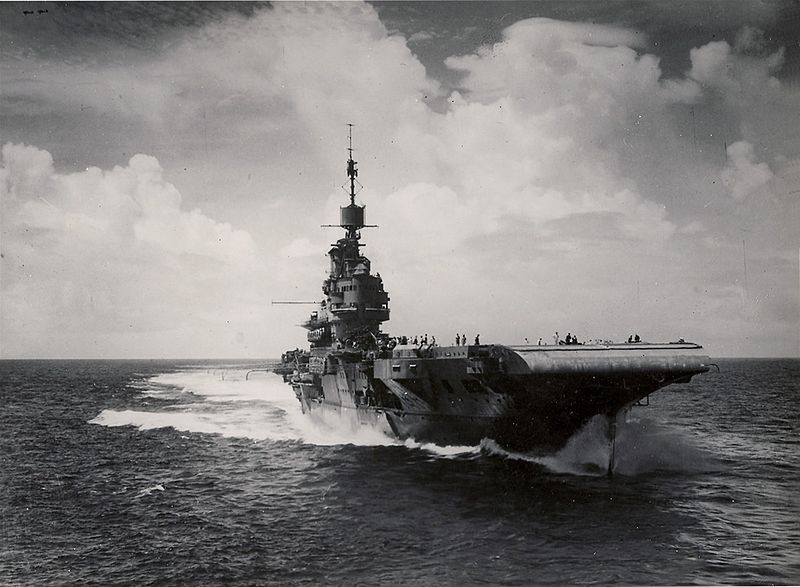
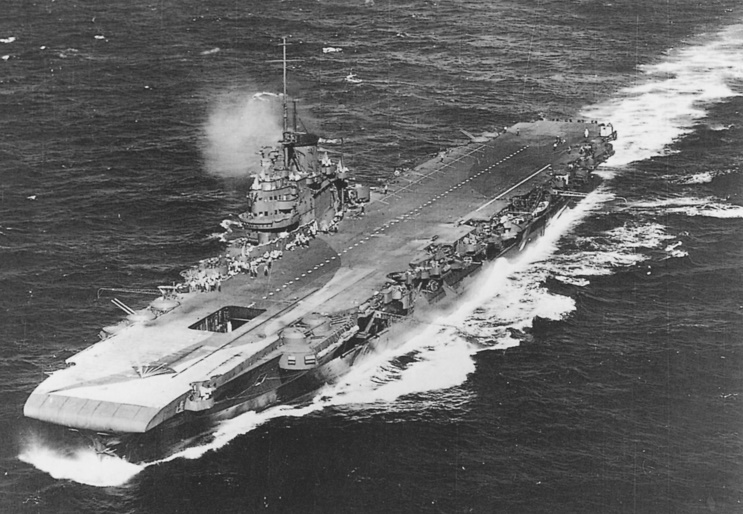
HMS Illustrious in 1944

In the mid-1930s the Royal Navy recognized the need to develop and built new Fleet Carriers. The Illustrious Class of four ships was ordered as part of the 1936 Naval Program.  The four ships of the class HMS Illustrious, HMS Formidable, HMS Victorious and HMS Indomitable were some of the most important ships to see service in the Royal Navy in the Second World War and would see action in the Atlantic, Arctic, Mediterranean, Indian Ocean and Pacific.  They were tough ships and all sustained serious damage at least once in their careers that might have sunk other ships.  Different in concept than the Royal Navy’s only modern carrier the Ark Royal they displaced more than the U.S. Navy Yorktown Class and just somewhat less than the following Essex Class ships although they were over 100 feet shorter in length as compared to the American ships.

The class was built with an armored flight deck which covered the hangar deck with both as an integral part of the ship’s structure and defense.  The American ships hanger and flight deck were part of the superstructure with the armored deck being that of the hangar deck itself.  This provided advantages in protection against bombs and later Kamikazes but there was a trade off in both aircraft capacity and the ability for the ships to handle the larger aircraft that came into service following the Second World War.  As designed the ships carried just 36 aircraft as compared with the 80-100 aircraft of the American ships and the 72 that the Ark Royal was rated at.  Later in the war the Royal Navy adopted the American practice of an air park on the flight deck which increased their capacity to up to 70 aircraft. The last ship of the class, the Indomitable was built to a modified deign with an expanded two deck hangar with increased aircraft capacity similar to that of the Ark Royal.  An additional drawback to the design was that any bomb which penetrated the armored flight deck exploded inside the hangar causing deformation to the actual ship’s structure.

British defensive doctrine for these carriers was focused on the passive protection provided by the armored flight deck and by a far heavier anti-aircraft battery than the Yorktown Class and comparable to the Essex Class. This was a different doctrine than that of the Americans and the Imperial Japanese Navy which embarked large air groups believing that the aircraft were integral to the defense of the ship.

The ships displaced 28,919 tons full load and were capable of steaming at 30.5 knots with an operational range of 11,000 nautical miles at 14 knots, far more than any previous Royal Navy carrier but far less than the Essex class which could steam 20,000 nautical miles at 15 knots. The Essex Class ships were had a greater displacement as well as a higher top speed of 33 knots.  The Illustrious class was best suited for operations in the Atlantic and Mediterranean and less suited to the vast expanse of the Pacific where they would spend the last year of the war.
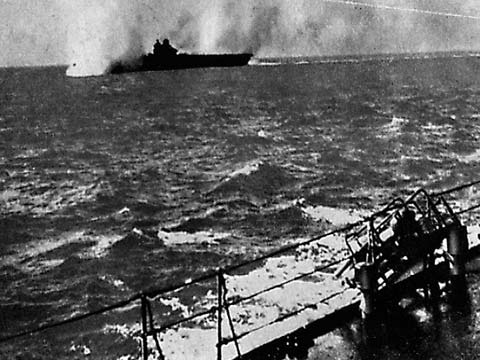
Illustrious under attack by German Bombers

HMS Illustrious: Illustrious was laid down in April 1937, launched in April 1939 and commissioned in May 1940. Upon commissioning she and her air group deployed to the Mediterranean where in the dark days following the fall of France they escorted vital convoys, supported the Royal Army in the war in North Africa and conducted strikes against Italian shore installations and fleet units.  Illustrious launched the first major raid against an enemy shore base by carrier aircraft on 11 November 1940. Her aircraft from number 813, 815, 819 and 823 Squadrons made a night attack on the Naval Base at Taranto sinking the battleship Conte di Cavour and heavily damaging the battleships Andrea Doria and the new battleship Littorio and moderate damage to the Caio Dulio This strike helped cripple Italian naval power and helped give the Japanese inspiration for the Pearl Harbor attack.    On 10 January she suffered severe damage from 6 bomb hits while escorting a convoy near Malta. She was attacked again at Malta causing more damage and she was withdrawn from action and sent to Norfolk Naval Shipyard for repairs. The damage was severe enough to keep her out of the war until May of 1942.  One of her shafts was so badly damaged that it had to be cut away and could not be replaced which reduced her speed to 23 knots. On her return to action she covered the landings against the Vichy French island of Madagascar and the Sicily landings. In 1944 she was in action with the Far East Fleet conducting raids against Japanese held islands in Indonesia and in 1945 was in action as part of the British Pacific Fleet where she saw action at Okinawa where she was hit by two Kamikazes and Formosa where a near miss close aboard by a Kamikaze caused severe damage below her waterline.  She sailed home where she underwent repair until 1946 when she was returned to duty as a training carrier in which capacity she served until she was decommissioned and scrapped in 1954.

Grumman Marlett (F4F Wildcat) on flight deck of HMS Formidable

HMS Formidable: Formidable was laid down in June 1937, launched in August 1939 and commissioned in November 1940.  She actually “launched herself” a half hour before her Christening ceremony which gave her the nickname “The ship that launched herself.”  Formidable saw action in the Mediterranean in 1941 and was heavily damaged by two 1000 kg bombs while escorting a Malta Convoy. This put her out of action for 6 months as she was repaired at Norfolk Naval Shipyard.  On her return she saw service first in the Indian Ocean and then in the invasions of North Africa, Sicily and the Italian Campaign. She also saw service in the Arctic sinking U-331 and in raids against the German Battleship Tirpitz.  She was in action in 1945 against the Japanese with the British Pacific Fleet where she relieved Illustrious after that ship was withdrawn from action. On 4 May 1945 while supporting operations off Okinawa she suffered massive damage from a Kamikaze, temporary repairs kept her in action until hit by another Kamikaze on 9 May. She was withdrawn from action and a fleet review determined that she was not economically repairable in the austere post war years. She was placed in reserve in 1947 and sold for scrap in 1953 with the scrapping taking place in 1956.
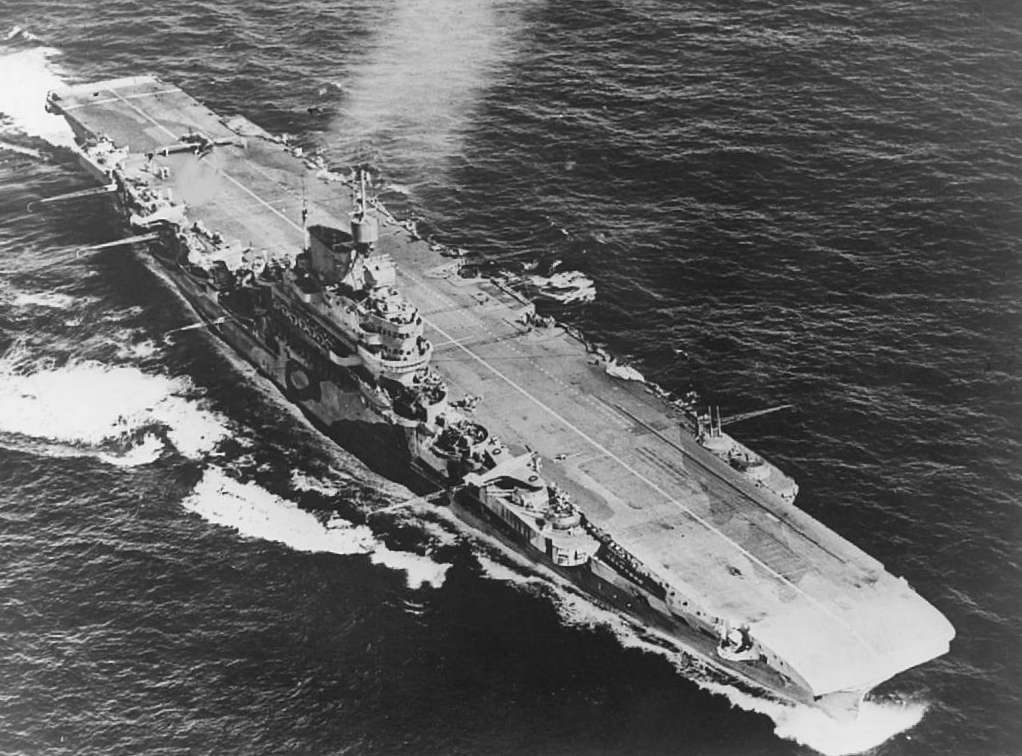
HMS Indomitable

HMS Indomitable: Indomitable was built to a modified design which allowed her to operate far more aircraft than her sisters. She was laid down in November 1937, launched in March 1940 and commissioned in October 1941. She was slated to accompany the HMS Prince of Wales and HMS Repulse to the Far East and the defense of Singapore but ran aground on a coral reef during her shakedown cruise in the Jamaica which prevented that deployment.  After repairs she operated with the Far East Fleet in the Indian Ocean and took part in the invasion of Madagascar in November 1942.  In July of 1942 she took part in the Malta resupply mission Operation Pedestal where she was heavily damaged by two 500 kg bombs which penetrated her flight deck. She was withdrawn to the United States for repairs which lasted until February 1943 when she returned to the Mediterranean.  She took a torpedo hit from a German Ju-88 bomber on 15 June 1943 during the build up to the invasion of Sicily and again returned to the United States for repairs which were completed in February 1944. She then took part in operations with the Far East Fleet in the Indian Ocean before joining the British Pacific Fleet in 1945. She received minor damage from a Kamikaze hit on 4 May 1945 while operating near Okinawa. She finished the war in good shape compared to Illustrious and Formidable but was damaged by an internal fire and explosion in 1947 the damage from which was never repaired. She remained in service until she was placed in unmaintained reserve in 1953 and scrapped in 1955.
HMS Victorious

HMS Victorious: The Victorious was probably the most celebrated aircraft carrier in the history of the Royal Navy. Her World War Two service was remarkable by any standard and she was the only ship of her class to be modernized to carry jet aircraft following the war being refitted in much the same way as the American Essex Class ships were in the 1950s with an angled flight deck.  She was laid down in May 1937, launched in September 1939 and commissioned on 14 May 1941. Within 10 days of her commissioning she was taking part in the Hunt for the Bismarck and her Swordfish torpedo bombers scored one torpedo hit on that ship.  She saw much action in the North Atlantic and Arctic escorting convoys and deterring forays of German raiders into the Atlantic. She served in the Mediterranean during some Malta operations including Operation Pedestal and the Operation Torch landings in North Africa.  Due to the shortage of U.S. Carriers from heavy combat in the South Pacific in 1942 Victorious was “loaned” to the U.S. Navy deployed to operate with the U.S. Pacific Fleet following refits to operate U.S. built aircraft. She operated in the South Pacific from March to September of 1943 with the USS Saratoga in operations against the Japanese to include the New Georgia landings. She returned home and took part in raids against the Tirpitz which put that ship out of action for several months. She deployed to the Far East in 1944 and support operations in the Indian Ocean before being transferred to the British Pacific Fleet.
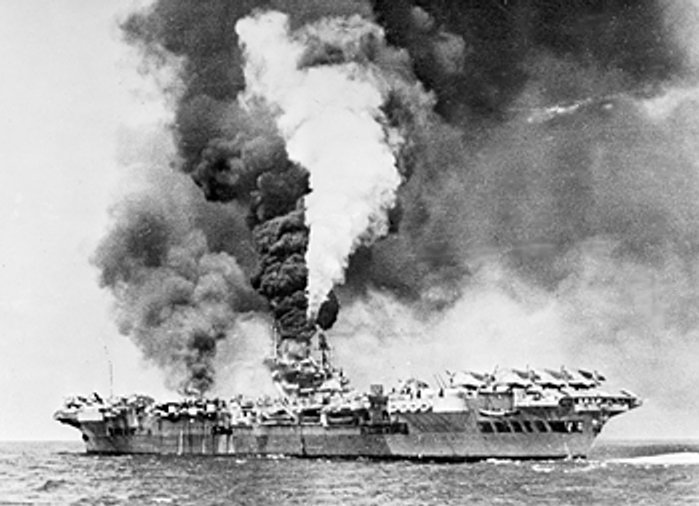
Victorious on Fire off Okinawa

She was involved in extensive Pacific operations including Okinawa and the raids on mainland Japan. She was stuck on a number of occasions by Kamikazes but remained in action.  After the war she was modernized and remained in service until 1969 when the Royal Navy decided that it was going to end its fixed wing operations and decommission its remaining attack aircraft carriers. She was broken up at Faslane beginning in 1969.
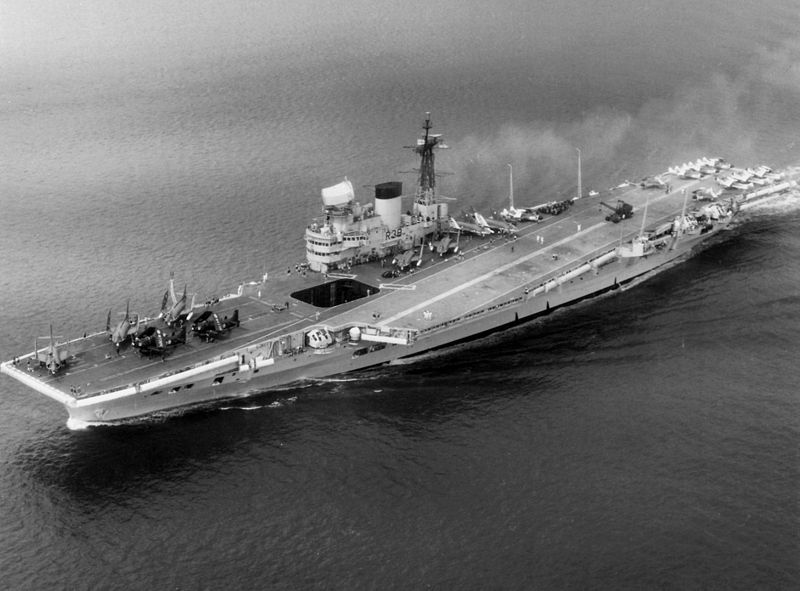
The modernized HMS Victorious

The Illustrious Class ships were great ships which performed admirable work in the Second World War. They and their brave crews continued the proud tradition of the Royal Navy. It is my hope that at least the new Queen Elizabeth Class carriers will be renamed for a ship of this class, preferably Victorious.

Peace

Padre Steve+


9 Comments

Filed under History, Military, Navy Ships, world war two in europe, world war two in the pacific

Five Minutes that Changed History: The Battle of Midway 1022-1027 hours June 4th 1942

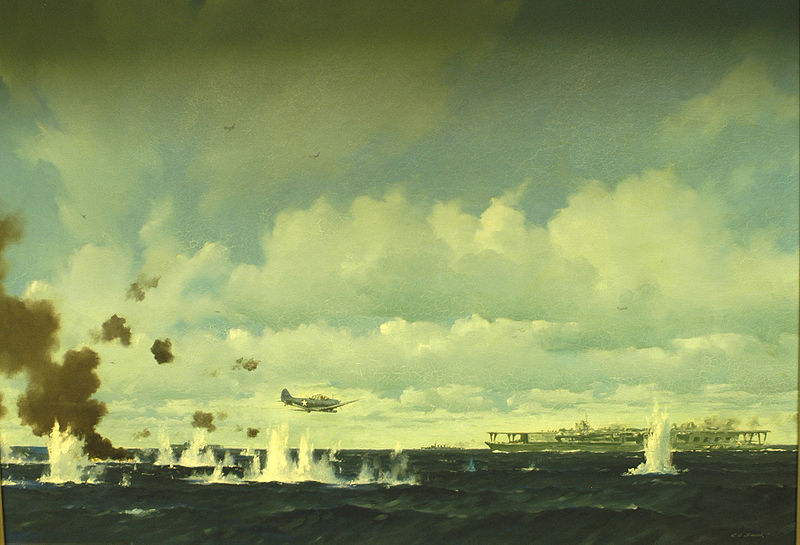
Instruments of Death SBD Dauntless Dive Bombers at Midway

Six months after Pearl Harbor the United States Navy met the Imperial Japanese Navy in battle on the seas and in the airspace around Midway Island. It was a battle between a fleet that had known nothing but victory in the months after Pearl Harbor, sweeping across the Pacific and the Indian Oceans and decimating Allied Naval forces that stood in their way, the HMS Prince of Wales and HMS Repulse off of Singapore, a force of Royal Navy cruisers and the Aircraft Carrier HMS Hermes in the Indian Ocean, the bulk of the US Asiatic Fleet in the waters around the Philippines and the Dutch East Indies culminating in the Battle of the Java Sea where the bulk of the American, British, Dutch and Australian naval forces engaged were annihilated.  In only one place had a Japanese Naval task force been prevented from its goal and that was at the Battle of the Coral Sea where Task Force 11 and Task Force 17 centered on the Carriers USS Lexington and USS Yorktown prevented a Japanese invasion force from taking Port Moresby sinking the light carrier Shoho, damaging the modern carrier Shokaku and decimating the air groups of the Japanese task force.

In May US Navy code breakers discovered the next move of the Imperial Navy an attack on Midway Island and the Aleutian islands.   Since the occupation of Midway by Japanese forces would give them an operational base less than 1000 miles from Pearl Harbor Admiral Chester Nimitz committed the bulk of his naval power, the carriers USS Enterprise CV-6, USS Yorktown CV-5 and USS Hornet CV-8 and their 8 escorting cruisers and 15 destroyers, a total of 26 ships with 233 aircraft embarked to defend Midway along with a force of 5 cruisers and 4 destroyers to cover the Aleutians.  Midway had a mixed Marine, Navy and Army air group of 115 aircraft which included many obsolete aircraft, 32 PBY Catalina Flying Boats, of which the 83 fighters, dive bombers, torpedo planes and Army Air Force bombers piloted by a host of inexperienced pilots.

The Japanese Flagship Akagi

The Japanese sent a force of 7 battleships, 7 carriers including the elite First Carrier Striking Group composed of the Pearl Harbor attackers Akagi, Kaga, Soryu and Hiryu and their highly trained and combat experienced air groups composed of 273 aircraft along with 14 cruisers and 39 destroyers assigned to take Midway and destroy the US Navy when it came out to fight as well as a force of 4 battleships, 12 destroyers assigned screen to the Aleutian invasion force which was accompanied by 2 carriers 6 cruisers and 10 destroyers.   The other carriers embarked a further 114 aircraft.  A factor which aided the Americans was the distance between the Japanese Task forces which were scattered over thousands of square miles of the Northern Pacific Ocean from which they could not rapidly come to the assistance of any other group.

With the foreknowledge provided by the code breakers the US forces hurried to an intercept position northeast of Midway eluding the Japanese submarine scout line which the Japanese Commander Admiral Yamamoto presumed would find them when they sailed to respond to the Japanese attack on Midway.  Task Force 16 with the Enterprise and Hornet sailed first under the command of Rear Admiral Raymond A Spruance and Task Force 17 under Rear Admiral Frank “Jack” Fletcher with the Yorktown which had been miraculously brought into fighting condition after suffering heavy damage at Coral Sea. Fletcher assumed overall command by virtue of seniority and Admiral Nimitz instructed his commanders to apply the principle of calculated risk when engaging the Japanese as the loss of the US carriers would place the entire Pacific at the mercy of the Japanese Navy.

On June 3rd a PBY Catalina discovered the Japanese invasion force and US long range bombers launched attacks against it causing no damage.  The morning of the 4th the Americans adjusted their search patterns in and the Japanese came into range of Midway and commenced their first strike against the island.  In response land based aircraft from Midway attacked the Japanese carrier force taking heavy casualties and failing to damage the Japanese task force.  The American Carrier task forces launched their strike groups at the Japanese fleet leaving enough aircraft behind of the Combat Air Patrol and Anti-submarine patrol.  As the Americans winged toward the Japanese fleet the Japanese were in confused.  A scouting report by an aircraft that had been delayed at launch discovered US ships but did not identify a carrier until later into the patrol.  This was the Yorktown and TF 17. The Japanese attempted to recover their strike aircraft and prepare for a second strike on the island and then on discovery of the carrier embarked on the task of unloading ground attack ordnance in favor of aerial torpedoes and armor piercing bombs.  The hard working Japanese aircrew did not have time to stow the ordnance removed from the aircraft but by 1020 they had the Japanese strike group ready to launch against the US carriers.

AM6-2 Zeros Mauled the US Torpedo Bombers

As the Japanese crews worked the Japanese carriers were engaged in fending off attacks by the US torpedo bomber squadrons, VT-6 from Enterprise, VT-8 from Hornet and VT-3 from Yorktown.  The Japanese Combat Air Patrol ripped into the slow, cumbersome and under armed TBD Devastators as they came in low to launch their torpedoes.  Torpedo Eight from Hornet under the command of LCDR John C Waldron pressed the attack hard but all 15 of the Devastators were shot down.  Only Ensign George Gay’s aircraft was able to launch its torpedo before being shot down and Gay would be the sole survivor of the squadron.

Hopelessly obsolete 40 of 44  TBD Devastators were lost in action

Torpedo 6 under the command of LCDR Eugene Lindsey suffered heavy casualties losing 10 of 14 aircraft with Lindsey being one of the casualties.  The last group of Devastators to attack was Torpedo 3 under the command of LCDR Lem Massey from the Yorktown.  These aircraft were also decimated and Massey killed but they had drawn the Japanese Combat Air Patrol down to the deck leaving the task force exposed to the Dive Bombers of the Enterprise and Yorktown.

TBD Devastator attacking Akagi

There had been confusion among the Americans as to the exact location of the Japanese Carriers, the Bombing 8 and Scouting 8 of Hornet did not find the carriers and had to return for lack of fuel with a number of bombers and their fighter escort having to ditch inn the ocean and wait for rescue.  The Enterprise group under LCDR Wade McClusky was perilously low on fuel when the wake of a Japanese destroyer was spotted.  McClusky followed it to the Japanese Task Force.  The Yorktown’s group under LCDR Max Leslie arrived about the same time.  The found the skies empty of Japanese aircraft. Aboard the Japanese ships there was a sense of exhilaration as each succeeding group of attackers was brought down and with their own aircraft ready to launch and deal a fatal blow to the American carrier wondered how big their victory would be.

At 1020 the first Zero of the Japanese attack group began rolling down the flight deck of the flagship Akagi, aboard Kaga aircraft were warming up as they were on the Soryu.  The unsuspecting Japanese were finally alerted when lookouts screamed “helldivers.” Wade McClusky’s aircraft lined up over the Akagi and Kaga pushing into their dives at 1022. There was a bit of confusion when the bulk of Scouting 6 joined the attack of Bombing 6 on the Kaga.  The unprepared carrier was struck by four 1000 pound bombs which exploded on her flight deck and hangar deck igniting the fully fueled and armed aircraft of her strike group and the ordnance littered about the hangar deck.  Massive fires and explosions wracked the ship and in minutes the proud ship was reduced to an infernal hell with fires burning uncontrollably. She was abandoned and would sink at 1925 taking 800 of her crew with her.     LT Dick Best of Scouting 6 peeled off from the attack on Kaga and shifted to the Japanese flagship Akagi. On board Akagi were two of Japans legendary pilots CDR Mitsuo Fuchida leader of and CDR Minoru Genda the architect of the Pearl Harbor attack and subsequent string of Japanese victories.  Both officers were on the sick list and had come up from sick bay to watch as the fleet was attacked.  Seeing Kaga burst into flames they stood mesmerized until Akagi’s lookouts screamed out the warning “helldivers” at 1026.  Best’s aircraft hit with deadly precision landing tow of their bombs on Akagi’s flight deck creating havoc among the loaded aircraft and starting fires and igniting secondary explosions which turned the ship into a witch’s cauldron.  By 1046 Admiral Nagumo and his staff were forced to transfer the flag to the cruiser Nagara as Akagi’s crew tried to bring the flames under control. They would do so into the night until nothing more could be done and abandoned ship at 2000.  Admiral Yamamoto ordered her scuttled and at 0500 on June 5th the pride of the Japanese carrier force was scuttled.

Scouting 6 gets the Akagi

VB-3 under LCDR Max Leslie from the Yorktown stuck the Soryu with 17 aircraft, only 13 of which had bombs due to an electronic arming device malfunction on 4 of the aircraft including the squadron leader Leslie.  Despite this they dove on the Soryu at 1025 hitting that ship with 3 and maybe as many as 5 bombs. Soryu like her companions burst into flames as the ready aircraft and ordnance exploded about her deck. She was ordered abandoned at 1055 and would sink at 1915 taking 718 of her crew with her.

The remaining Japanese flattop the Hiryu attained the same fate later in the day after engaging in an epic duel with the Yorktown which her aircraft heavily damaged.

It was quite miraculous what happened at Midway in those five pivotal minutes.  Authors have entitled books about Midway Incredible Victory and Miracle at Midway and the titles reflect the essence of the battle.  A distinctly smaller force defeated a vastly superior fleet in terms of experience, training and equipment and when it appeared that the Japanese Fleet would advance to victory in a span of less than 5 minutes turn what looked like certain defeat into one of the most incredible and even miraculous victories in the history of Naval warfare.  In those 5 minutes history was changed in a breathtaking way.  While the war would drag on and the Japanese still inflict painful losses and defeats on the US Navy in the waters around Guadalcanal the tide had turned and the Japanese lost the initiative in the Pacific never to regain it.   The Japanese government hid the defeat from the Japanese people instead proclaiming a great victory while the American government could not fully publicize the information that led to the ability of the US Navy to be at the right place at the right time and defeat the Imperial Navy.

When one looks at implications of the victory it did a number of things. First it changed the course of the war in the Pacific probably shortening it by a great deal.  Secondly it established the aircraft carrier and the fast carrier task force as the dominant force in naval warfare which some would argue it still remains.  Finally those five minutes ushered in an era of US Navy dominance of the high seas which at least as of yet has not ended as the successors to the Enterprise, Hornet and Yorktown ply the oceans of the world and the descendants of those valiant carrier air groups ensure air superiority over battlefields around the world.

Peace

Padre Steve+

7 Comments

Filed under History, Military, US Navy, world war two in the pacific