Tag Archives: jesus christ

Faith’s Journey: A Progressive Christian Navy Chaplain Looks at the Journey to Wholeness

400236_10151328400862059_541742014_n

June 27th 2013: After the events of this week including the Supreme Court decision declaring the Defense of Marriage Act unconstitutional I decided to re-publish an article that was one of the most important that I ever published. Not so much because of the what I think was so earth shattering regarding the content but because of what happened after its publication. At the point in time that I wrote it I was pushing the envelope with my former denomination, but figured that in light of all the controversies and schisms in that church at the time that whatever I wrote would not result in any problems. But I was wrong. I received a call the next day from my bishop telling me that I needed to find a new home because I was “too liberal.”

It was actually quite fascinating, I was able to gain a new church home which was much more progressive, welcoming and catholic, being of the Old Catholic tradition. For me that phone call was just a few months later deposed for attempting to create yet another schism in the church. I think it is even more interesting because some of my friends still in that church think that he used this article as a reason to get rid of me in order to keep me from exposing his scheme. I don’t know if that it the case or not, but my friends believe it to be a distinct possibility. That being said one of my long time priest friends revealed his plot to the other bishops and the bishop who forced me  was deposed. Irony is fascinating. Since that time my former church is regaining its footing and doing better and for my friends in it I am glad for even if I have differences in theology, faith or beliefs with people who I consider to be friends, they are still friends and I wish them well.  

So anyway, for those that are fairly new followers on this site here is the article that in a sense served as a declaration of independence and station on the road to wholeness and integrity. 

Peace, Padre Steve+

Faith Journeys: Why I am Still a Christian (Originally published 22 September 2010)

There are many times that I totally empathize with author Anne Rice in saying that she has left Christianity yet still has faith in Christ.  For Rice it was the lack of love shown by the institutional church for people that are marginalized and treated as if they were unredeemable by often well meaning Christians.

I know what it feels like to be marginalized after I came back from Iraq because many of my Christian friends seemed, at least in my view to be tied to the absolute hogwash that spews from talk radio hosts and allegedly “Christian” politicians.  I remember having some Christians question my patriotism and even my faith because I disagreed with them regarding certain aspects of the war, despite the fact that I had been on the ground in harm’s way serving with our advisors and Iraqis in Al Anbar province.  The fact that not a clergyman, civilian or military, took time to care for me when I was in a major PTSD meltdown and crisis of faith before I went to Naval Medical Center Portsmouth didn’t seem to matter because a political agenda was given primacy over the simple truths and hard demands of the Gospel.

Yesterday I wrote about Chaplains that experience a crisis of faith after coming home from a combat deployment.  For me there is nothing more symbolic of the lack of soul left in many Christians and Christian Churches in how they treat those that have served faithfully. Those Chaplains that have served  God, Church and Country and come back spiritually wondering what happened, not knowing what to believe and feeling abandoned by God and cast off by the Church and the military simply because we have a hard time with the so called “orthodoxy” of some Christians.

I went through a period after Iraq where feeling abandoned and isolated from those of a like faith that I was for all practical purposes an agnostic.  That was a really difficult time in my life and if you think that anything sucks try to be a Chaplain when you no longer know if God exists and the only person asking how you are doing with “the Big Guy” is your therapist. I can say without a doubt that it sucks like a Hoover and I know that I am not alone in my feelings.  I have met others whose experience is similar to mine but those that are struggling right now, caught between our faith and the feeling of being abandoned by God and his people because our experience of seeing the human suffering caused by war has shaken us.

Let’s talk about spiritual despair. Did you know that in the past couple of years that two Army Chaplains and one Navy Chaplain have committed suicide? These were men of faith who had served in peace and war at least one that had served at the Battle of Hue City as a Marine before becoming a Priest and Chaplain.  Another Army Chaplain that had served in Iraq as a minister of a conservative Charismatic and Evangelical Christian denomination became a Wiccan and was excoriated by Christians.  I don’t know his faith journey but I have to believe that part was his experience in Iraq and experience on his return. I don’t know about you but those are all signs of spiritual despair and feeling cut off from their faith community and even God, his or her self.

I am still a Christian. I believe in the God of Scripture, the Creeds and the Councils. At the same time that belief is not as rigid as it once was. I used to consider those that didn’t believe like I did in relation to Scripture, the Creeds and Councils not to be Christians.  I cannot say that now. I am much more to have the Grace and Mercy of God be my default position and let other things fall out where they may.  My practice of my faith has changed. When I came back from Iraq I attempted, as it were without success to keep my faith structure and practice the same as it was before I deployed to Iraq.  Within six months of Iraq I could no longer pray the Daily Office with any kind of faithfulness and by Lent 2009 give up the practice for Lent hoping to recover some authenticity to my faith. The authenticity has returned and after about a hear and a half I am seeking a way to reincorporate what had been a very important part of my daily practice of faith into my life without feeling like I am a phony in doing so.

I went through a period of absolute spiritual despair even leaving a Christmas Eve Mass in 2008 to walk home in the dark, alone, looking at the sky and asking God if he even existed.  A year later after my life had completely fallen apart I experienced what I call my “Christmas miracle” where I was called to our Emergency Room to provide the “last rites” to a retired Navy doctor and active Episcopalian when I was the duty Chaplain.  As I prayed the last prayer of commendation and removed my oil covered fingers from the man’s forehead he breathed his last. His wife told me that he was waiting to be anointed before he died.  The young doctor, a Psychology Resident doing his ER rotation who called me to the ER would die a couple of months later of natural causes in his living room not long after we had taken the “fat boy” program PT test together.

From that moment the paradigm shifted.  Faith began to return and I began to experience the presence of God again, not is the same was as before Iraq but one that was more relational, grace filled and informal.  I will likely begin praying the Daily Office again in the near future but I will approach it from a different point of view.  I will no longer use it simply to fulfill my priestly vows and obligations but rather as a way to re-experience and if need be re-imagine God.  Now before the heresy hunters think that I am re-imagining God is some unbiblical manner they are wrong. I want to re-imagine God as he has been revealed to his people both in Scripture, Tradition and in the life of his, or her people today.

moralssquad

How have I changed? I believe again. I am no longer an agnostic hoping and praying that God just might be there. My faith has become much more deeply rooted and grounded in the “Crucified God” and my faith in the “theology of the Cross.”  It is no longer connected to my politics and I refute any political ideology that attempts to use the Christian faith and the faith of well meaning Christians for purposes that Jesus himself would have condemned.  I don’t think Jesus was a big fan of his followers attempting to be the favorites of any political party or ideological system. In fact if I recall he really had pretty harsh words for his fellow Jews who were all wrapped around the axels with that kind of stuff. Jesus seems to befriend and hang around with those that are not connected to the religious, political or economic elites. In fact he seemed to reserve his harshest words for such people.  Jesus seemed to have a pretty good relationship with those marginalized and rejected by the religious folks of his day. He welcome sinners and tax collectors to his table and praised the faith of gentile Roman officers and stopped the super-religious folks from stoning an adulterous woman.

This is the Jesus that I follow and the Jesus that I believe is present in body, soul and spirit in the Eucharist.  I believe like Hans Kung and others that this table belongs to the baptized community of faith and not to an exclusive Priestly class who dictate who can come to the table.  It is not the exclusive property of any denomination or Church organization especially those that most loudly state this to be the case.

Now if saying this makes me a heretic then a heretic I will be. It is better to be a heretic in the eyes of Pharisees than to be one that denies justice to the persecuted people of God.  I guess that makes this moderate a liberal and to some an unbeliever.  Yet I believe in the God of Abraham, Isaac and Jacob. I believe in the Jesus that defied religious systems to offer the grace of God to the people that those systems rejected and the Jesus that was far more critical of “believers’ than those rejected as unbelievers.  I guess that is why I can accept women as ministers or even Priests, accept homosexuals as Christian brothers and sisters, and see Christ and the grace and love of God in people that are not “Christians” even the Muslims in Iraq that treated me with respect and even if they had an “Aryan” view of Jesus still showed a greater reverence for Jesus and the Blessed Virgin Mary than many that claim Jesus for themselves.

Why? You ask. Very simply I once was lost but now am found.  I thought that I knew it all before, now I know that I don’t know it all and that God is the God of surprises, just look in Scripture.  I doubt at times. I know that there are many answers that elude me and I cannot answer just by citing or using Scripture out of its historic, cultural and linguistic context.  I believe in the God that did not reject me when I didn’t know if he even existed.

Why am I still a Christian when I have so many problems with how many Christians practice the faith? Because I believe and not because will not I tow anyone’s party line be they liberals or conservatives. I believe in spite of my unbelief in a fellowship of those who as a result of war and trauma have trouble believing those that won’t race the cold realities of this life. I believe because many times it was those marginalized by others, especially those marginalized by the “faithful” showed me the love of God when the “faithful” for pure or impure motives, or even because they didn’t know what to do allowed me to sink into despair and isolation. So in the words of my favorite heretic Martin Luther I say “Here I stand, I can do no other. So help me God. Amen.”

Peace,

Padre Steve+

1 Comment

Filed under christian life, faith, Pastoral Care, philosophy, Religion

Bringing Faith to the Faithless and Doubt to the Faithful

400236_10151328400862059_541742014_n

I like hard questions and hard cases. My life has been quite interesting and that includes my faith journey as a Christian and human being. It is funny that in my life I have as I have grown older begun to appreciate those that do not believe and to rather distrust those who proclaim their religious faith with absolute certitude, especially when hard questions are asked.  Paul Tillich once said “Sometimes I think it is my mission to bring faith to the faithless, and doubt to the faithful.” 

I think that the quote by the late theologian is quite appropriate to me and the ministry that I find myself. I think it is a ministry pattern quite similar to Jesus in his dealings with the people during his earthly incarnate ministry. He was always hanging out with the outcasts, whether they be Jewish tax collectors collaborating with the Romans, lepers and other “unclean” types, Gentiles including the hated Roman occupiers, Samaritans and most dangerously and scandalously women. He seemed to reach out to these outcasts while often going out of his way to upset the religious establishment and the “true believers” of his day. He was actually quite successful at this, so successful that his enemies made sure that they had him killed.

I think that what has brought me to this point is a combination of things but most importantly what happened to me in and after my tour in Iraq. Before I went to Iraq I was certain of about everything that I believed and was quite good at what we theologians and pastors call “apologetics.” My old Chaplain Assistant in the Army, who now recently serves as a Chaplain and was recently selected for promotion to Lieutenant Colonel called me a “Catholic Rush Limbaugh” back in 1997 and he meant it quite affectionately.  I was so good at it that I was silenced by a former Archbishop in my former church and banned from publishing for about 7 years. The funny thing is that he, and a number of my closest friends from that denomination are either Roman Catholic priests or priests in the Anglican Ordinariate which came into communion with Rome a couple of years back. Ironically while being “too Catholic” was the reason I was forbidden to write it was because I questioned certain traditions and beliefs of the Church including that I believed that there was a role for women in the ordained ministry, that gays and lesbians could be “saved” and that not all Moslems were bad that got me thrown out in 2010.

However when I returned from Iraq in the midst of a full blown emotional, spiritual and physical collapse from PTSD that certitude disappeared. It took a while before I was able to rediscover faith and life and when I did it wasn’t the same. There was much more mystery to faith as well as reason. I came out of that period with much more empathy for those that either struggle with or reject faith. Thus I tend to hang out at bars and ball games more than church activities or socials, which I find absolutely tedious. I also have little use for clergy than in dysfunctional and broken systems that are rapidly being left behind. I am not speaking about belief here, but rather structure and methodology.

I think that if there is anything that God will judge the American versions of the Christian church is our absolute need for temporal power in the political, economic and social realms and the propagation of religious empires that only enrich the clergy which doing nothing for the least, the lost and the lonely. The fact that the fastest growing religious identification in the United States is is “none” or “no preference” is proof of that and that the vast amounts of money needed to sustain these narcissistic religious empires, the mega-churches and “Christian” television industry will be their undoing.  That along with their lack of care for anyone but themselves. Jesus said that his disciples would be known by their love for one another, not the size of their religious empire or temporal power.

The interesting thing is that today I have friends and colleagues that span the theological spectrum. Many of these men even if they do not agree with what I believe trust me to love and care for them, even when those most like them in terms of belief or doctrine, both religious and political treat them like crap. Likewise I attract a lot of people who at one time were either in ministry or preparing for it who were wounded in the process and gave up, even to the point of doubting God’s love and even existence. It is kind of a nice feeling to be there for people because they do not have to agree with me for me to be there for them.

In my darkest times my only spiritual readings were Father Andrew Greeley’s Bishop Blackie Ryan mysteries which I began reading in Iraq to help me get through the nights in between missions in Iraq and through the nights when I returned from them.  In one of those books, the last of the series entitled “The Archbishop goes to Andalusia” the miscreant Auxiliary Bishop to the Cardinal Archbishop of Chicago goes to Seville Spain.  In the novel Bishop Blackie makes a comment after celebrating Mass in the cathedral at Seville. He said “Every sacramental encounter is an evangelical occasion. A smile warm and happy is sufficient. If people return to the pews with a smile, it’s been a good day for them. If the priest smiles after the exchanges of grace, it may be the only good experience of the week.”  (The Archbishop in Andalusia p.77)

That is something that I try to do now on a regular basis. Sure most of my sacramental encounters as a hospital chaplain do not occur during the liturgy, but often in the life and death moments and times of deep discouragement felt by the wounded, ill and injured. In that ministry I have found that there are many hurting people, people who like me question their faith and even long held beliefs.

On my way home from taking my little dog Molly home from a visit to the vet this afternoon I heard the old song by Nazareth called Love Hurts. The song always gets me. It is one of those “real” songs from the 1960s and 1970s that nails how life can be sometimes.

Love hurts, love scars
Love wounds and mars
In any heart not tough
Nor strong enough
To take a lot of pain
And love is like a cloud
Holds a lot of rain
Love hurts

I’m young and I know
But even so, I know a thing or two
I have learned from you
I’ve really learned a lot
And love is like a stove
Burns you when it’s hot
Love hurts

Some fools rave of happiness
Of blissfulness, togetherness
Some fools fool themselves, I guess
But they’re not fooling me
I know it isn’t true
Love is just a lie
Made to make you blue
Love hurts

In 1977 a Christian singer, Erick Nelson included that song on an album called The Misfit and used it to lead into another song of his called He Gave Me Love. The album which he did as a duet with a lady named Michelle Pillar was always and still is one of my favorite albums. It was and still is one of the few works of “contemporary Christian music” to really deal with the hard questions of faith, including hurt, doubt and betrayal and the cost of following Jesus with any measure of authenticity. The song, the lyrics of which I include here are quite remarkable, because they talk about those themes.

When I was down, they wouldn’t stay
When I was hurt, they turned away
But Jesus called me and I must obey
He gave me love

You see, His friends all let Him down
And when He healed everyone around
All He got was a thorny crown
Because of love

Because of love for you
Because of life and truth
Because of love for you
Come take his love

Sometimes they laugh and are unkind
And others smile and say I’ve lost my mind
But all I know is what I find
And I find, He gave me love…

Love does hurt, and well deciding to love can bring a lot of pain, but I do think that it is worth it. Well, that is all for tonight. Until tomorrow.

Blessings and Peace

Padre Steve+

Love Hurts lyrics © Kobalt Music Publishing Ltd., Warner/Chappell Music, Inc., EMI Music Publishing, Sony/ATV Music Publishing LLC, HOUSE OF BRYANT PUBLICATIONS

HE GAVE ME LOVE Words and Music by Erick Nelson 1977 Maranatha! Music All rights reserved.

3 Comments

Filed under christian life, faith, Pastoral Care, philosophy, PTSD, Religion

The Long Good Friday of Longinus the Centurion

600px-Gustave_Doré_-_Crucifixion_of_Jesus

This is a re-do of my original “Long Good Friday of Longinus the Centurion., Since I first wrote that piece two years ago I have written a prequel, and like George Lucas feel the need to change and improve the original. Unlike Lucas who simply tweeked Star Wars I have chosen to spend my time completely re-writing the original in light of the prequel series dealing with the events leading up to Good Friday that I did this week. I don’t know about you but I like to imagine events as they might have actually happened. As an Iraq veteran who served with our advisors to the Iraqis I do understand the plight of soldiers from an occupying power serving far away from home where their presence is barely tolerated, much less welcomed. Since I have always felt a special affinity for the soldiers that have interactions with Jesus, who are treated very sympathetically by the writers of the Gospels as well as Luke in the Book of Acts.

The links to the first four chapters of this story are linked in below. I have not linked the three original articles in order to provide a better continuity and personal narrative for the characters in light of the Gospel accounts, non-Biblical accounts, church tradition and my own imagination.

Peace

Padre Steve+

A Centurion’s Sunday in Jerusalem: The Story of Longinus

The Story of Longinus the Centurion: A Meeting of Friends

The Story of Longinus the Centurion: A Visit to Death Row

Duplicity in Jerusalem: An Official Visit and 30 Pieces of Silver


Longinus had finally decided to try to get a bit of rest. After his rather morose meeting with Flavius and Decius he and Decius went back to check on the preparations for the executions scheduled for the next day. Quentin his Tesserarius had been working with the squad chosen to to conduct the actual crucifixions of the prisoners, Bar-Abbas the insurgent as well as the common criminals and murderers Dismas and Gestas who he had met in the hell hole of a jail in the dungeon of Fortress Antonia after Pilate had assigned him the task of conducting the executions.

Longinus was certain of his unit’s ability to carry out the mission, though he would have rather had a unit from Italy than his unit of Syrian and Samaritan troops. There was one positive aspect, his Samaritans and Syrians had no love for the Jews and would have no qualms whatsoever in disposing of the criminals.

He thought for a moment about the prisoners. That Bar-Abbas fellow, he would be glad that he or any other Roman would have to deal with him again once the crucifixion was over. As for the common criminals he felt that everyone would be better off with Gestus dead although he hoped that Pilate might take pity on the repentant thief named Dismas. However, despite his feelings he also knew that the law was the law and repentant or not that Dismas was guilty of the crimes and the sentence was just. As he had realized earlier in the day while talking with Flavius it was important not to become emotionally involved with the locals, especially prisoners. Maintaining an emotional distance ensured that he would not flinch in times when ice rather than blood needed to flow through one’s veins. He was proud that he could do this but envied the humanity that his comrade and friend Flavius still maintained in spite of everything.

He was just about to prepare for bed when a messenger from Pilate knocked on his door. It was late, too late and Longinus wondered just what was going on.

“Come.” He said, the weariness in his voice obvious in the way he answered.

The messenger, a relatively young Italian soldier assigned to Pilate’s bodyguard entered, came to attention and saluted.

Longinus looked at the young man, like him far from home and asked “what am I needed for now?”

“Centurion, the Governor has requested your presence” the soldier replied.

“May I ask what for?” A now increasingly irritated Longinus asked.

“Sir, I do not have the details but it is a pressing matter regarding the Jews and that Galilean preacher.” The young man was obviously uncomfortable in having to request a career officer like Longinus, a veteran of real battles and campaigns appear before Pilate for what was not much more than a religious dispute among an occupied people.

“Pressing matter?” Asked Longinus.

“Yes Centurion. I was told that it was urgent that you come to Governor Pilate now and alert your unit as at least some of your men may be needed if things get out of hand.”

“Can you please tell me just what is going on?” Longinus asked as he pulled his armored breastplate over his shoulders.

“I’m sorry Centurion, I have no more information. You are to report to the Governor within the half hour. The Governor wants your unit ready within the hour.” When he finished he came to attention, saluted and exited the room.

Longinus hated how leaders sent young men to be their messengers and would not give them all of the relevant information.

Longinus sat back down in his chair where he had been sitting and discussing the situation with Flavius and Decius. He wondered to himself what could be so pressing that Pilate needed him now.

After briefing Decius and Quentin, instructing them to wake the men and be ready for action Longinus took a squad and went to Pilate’s headquarters. When he arrived Pilate greeted him.

“Centurion, I hate to have bothered you at this hour in light of how busy you and your men will be in the morning but a situation has arisen.” Longinus looked around the room and then heard some commotion on the area called “the Pavement.”

“What is happening my Lord?”

“Longinus, these Jews have brought that Jesus fellow here and are accusing him of fomenting a rebellion against the Emperor.”

“A rebellion sir?”

“That is what they say Centurion. They claim that one of his closest associates had turned him in and after a trial of their own that they found him guilty of claiming to be a king and God that will overthrow the Emperor.” Pilate could not hide his discomfort.

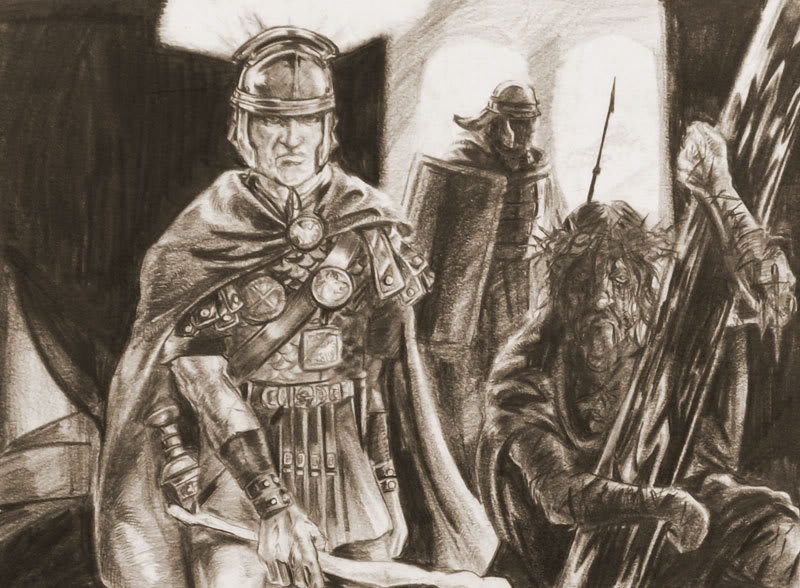
carrycross

“Do you actually believe them sir? After all we had heard this morning that this Judas Iscariot fellow had betrayed him for 30 pieces of silver.”

“I know Centurion, I know.” Pilate looked at Longinus then back out at the crowd gathered outside in the dark. He was afraid and Longinus could sense that fear, fear that if he made the wrong move that a real rebellion could break out and that Pilate as the Governor would take the blame and bear the punishment and wrath of Caesar.

“Centurion, I tried to placate these people be questioning this Jesus fellow myself.” Pilate paused. “I must say that he is a rather unusual man and truthfully I could not find anything that under Roman law that I could find him guilty of doing. Not a thing Centurion, nothing but their leaders kept pressing me.” Pilate’s gaze seemed to be almost pleading with Longinus to help him escape this decision. Longinus knew at that moment that his day was about to get worse. Pilate continued “It seems to be a religious squabble of some kind so in order to deal with it and to try to keep us out of it I sent Jesus to Herod since Herod is the ruler of Galilee.”

“So Herod will certainly deal with the situation, will he not Governor?”

“Centurion, I thought that that corpulent bastard Herod would deal with it but I just got word that Herod too could find no crime. The Jewish leaders and of their Temple Police are supposedly bringing him back to me to render judgement. They are leaving it to me.”

“Judgement for what?”

“Sedition, treason, blasphemy, proclaiming himself a king.” Pilate paused, his face flushed. “My God I’m surprised that they haven’t accused the man of fathering the High Priest’s daughter.” The sarcasm and bitterness was evident in his voice.

“So what do you intend to do.”

“I intend to try to get us out of this with as little trouble or guilt as possible. When they return him to me I will ask a few more questions and set him free as is my prerogative, certainly they wouldn’t want to release a real murderer like Bar-Abbas back into society, I do give them more credit than to stoop that low.”

“I do hope that you are right governor, but from what I understand it seems that they are intent on ridding themselves of the fellow once and for all. I think that their leaders see the Galilean as more of a threat than a man like Bar-Abbas.”

Pilate said nothing and during the silence Longinus’s troops under the direction of Decius entered the perimeter of the court adding an additional security cordon as the crowd grew and got more boisterous. As they took up position the Temple Police and members of the High Priest’s entourage approached the court with the Galilean in custody. Quentin with four soldiers met them and took custody of the obviously tired and already abused man. They delivered Jesus to Pilate and stood back. Longinus watched as it happened. As he did so Flavius entered the room with his servant. The servant appeared unsteady and full of emotion when he saw the man who had healed him two years before. Flavius stood by his face not betraying any feelings except deep seated rage that was boiling as he saw this travesty of justice take place.

Pilate attempted every trick in the book to garner a way to save the life of the man standing before him. He asked him questions and Jesus clothed in a purple robe that Herod had mockingly placed upon him said nothing. Finally in desperation Pilate asked Jesus if he was a king. The answer both fascinated and terrified Pilate and caused him to wish that he had never come to the city. As he deliberated earlier and debated the members of the Sanhedrin his wife again urged him to “have nothing to do with that innocent man.”

But the answer of Jesus to the question of his kingship troubled Pilate. Had he thought the man insane he would have scourged him, declared him mad and been done with the affair. “My kingdom is not of this world, if it were my followers would be fighting to ensue that you did not hand me over to the Jewish leaders.” Jesus looked into Pilate’s eyes, the look sent a chill through Pilate’s soul and Pilate restated the question “so you are a king?”

Jesus replied solemnly “You say I am a king. I was born for this and it is why I came to this world, to testify to the truth. Everyone who belongs to the truth listens to me.”

Pilate appeared stunned and both Longinus and Flavius knew that he was beaten. They listened as Pilate asked “what is truth?” The question was one of a man who had long ago sold his soul to gain the world, it was the question of a deeply cynical man who had long determined that truth was only in the eye of the beholder and to be used as needed to acquire power. At the same time they could see a touch of genuineness in the question as Pilate, desperate for an answer that would enable him to please everyone and spare the life of the man before him wrestled with the question of truth for the first time in years.

They watched as Pilate attempted to bargain for the life of Jesus only to be shouted down by the increasingly riotous crowd who demanded that Bar-Abbas be released. Again attempting to assuage the mob he had Jesus scourged with a barbed whip. The soldier who did that brutal work was a Syrian, big and burley without a trace of feeling in his eyes or face. The servant of Flavius begged him to intervene but Flavius now knew that the things happening to Jesus could no longer be influenced by sentimentality and stories of the goodness of Jesus. He had seen this type of Justice before, and though he despised it, he earnestly hoped that it would be enough to deliver Jesus.

After the scourging, soldiers assigned to Longinus jammed a crown of thorns down on the blood covered Jesus and placed the purple cloak over him. Jesus’s body trembled. Pilate again approached the mob and tried to decline the odious responsibility thrust into his hands. The mob led by the Chief Priests and joined by man of their rivals, the Pharisees cried out for Jesus to be crucified.

They heard Pilate plead with Jesus, again noting that he had power over the life and death of Jesus to which Jesus replied that Pilate “had no power over him that had not been given by God.” Finally he pleaded with the Jews one more time to take Bar-Abbas for execution and to spare the Galilean. The leaders shouted him down again and cried out that Pilate would be a traitor to Caesar if he let a man who claimed to be a king live.

Defeated By the mob and by his own weakness of character Pilate asked for a ceremonial washing basin full of water. When it came in the hands of a court member he placed his hands in it and proclaimed “I am innocent of this man’s blood.” He then ordered the soldiers to take Jesus to be crucified even as the prisoners Dismas and Gestus were led from the dungeon for execution and a profoundly perplexed Bar-Abbas was released by the jailer.

Longinus looked at Flavius and whispered to him “wash my hands of his blood? My God, he knows that he is as guilty at them.” Flavius looked on and simply said “I know my friend, we all are.”

The detail of soldiers assigned to the crucifixion detail was commanded by Quentin, a man who had fought many battles and like Longinus and Flavius felt that these executions of helpless prisoners were unworthy of soldiers like himself. The soldiers of Flavius’s unit had responsibility for helping to clear a way down the narrow street called by the Romans Via Delarosa. The street of suffering. It was the street that all the condemned travelled to the hill of execution so fittingly called the place of the Skull. Longinus had seen others walk this path but in the past he had been able to shield his person from their suffering, but today was different.

Longinus’s own execution squad led by Quentin led Jesus and the others along, forcing them to carry their crosses. About halfway down the street Jesus collapsed under the weight if his cross and grabbed a bystander, a man from Cyrene to carry the cross while the soldiers prodded the bloody body of Jesus down the street and out of the city to the place of execution. People jeered at the condemned as they did at very execution as for most this was no different than any other crucifixion and most of those present knew little about any of the condemned men and even those that were familiar with Jesus probably did not recognize the bloody man stumbling down the street. Of course there were others present who did know Jesus and watched in horror as their friend, teacher and for one woman her son struggled to the execution site. Longinus wondered about his own elderly mother and thought of her as he saw the mother of Jesus. He quickly tried to chase her image from his mind, he needed to be strong and hard if he was to keep his objectivity and conduct the mission as distasteful as he found it.

When the macabre parade arrived at the hill, the prisoners were stripped, placed on the crosses and nailed to them. Their screams as Quentin hammered the large iron nails home through their already abused flesh echoed for all to hear. Thankfully Quentin knew what he was doing and this part of the execution process happened quickly. Then the crosses were raised, but just before this a messenger from Pilate arrived with the placards that denoted the charges. He handed them to Longinus who noted what was written on the one for Jesus. It said “The King of the Jews.”

The placards were placed and with a thud the crosses were placed in the holes on the hill. The suffering of the prisoners was great, the crowds jeered and mocked them while those that loved them stood at a distance. Soldiers stood guard to ensure that no one interfered with them in any way. There was a bit of banter between the real criminals one of whom, the unpleasant one named Gestus joined in the mocking of Jesus only to be put in his place by the other one named Dismas.

Longinus, Flavius, Decius and a few other officers watched as their soldiers from the crucifixion detail divided the paltry worldly possession of the men between themselves. The men argued over a one piece tunic worn by Jesus, Not wanting to destroy it they cast lots for it. A trooper from Tyre won the tunic. Longinus and Flavius looked at each other and realized how little most of their men earned and neither begrudged the men the few items that they gathered from the men being executed.

The skies which had began the day with bright sunshine now became dark and foreboding. Lightening appeared in the distance and occasionally Jesus would address his mother or one man, Flavius believed him to be a disciple who stood by the cross. Jesus even promised the Dismas character that “he would be with him in paradise” and told others, Longinus thought the soldiers but he wasn’t sure “forgive them they know not what they do.” As it approached the ninth hour Jesus cried out in Aramaic “my God, my God, why have you forsaken me!”

A cold rain began to fall.

Quentin approached him with a sponge on a pole which was soaked in a sour wine. It touched Jesus’s lips and Jesus said “Father into your hands I commit my spirit” and then “it is finished.”

With that last dying remark the head of Jesus fell to his chest and his body, bloody and mangled hung limp. As the men looked on the ground began to tremble and as the ground shook and the officers looked about amid the gloom and confusion as the onlookers took flight Longinus exclaimed “surely this man was the son of God.” Flavius looked at his fellow Centurion in astonishment. Longinus, the man who had closed his heart in a fortress was echoing what he had believed since Jesus had healed his servant, the young man who was more than a servant to him.

As the crowds dispersed Longinus received the message that the executions had to be concluded before the Jews began their Passover. With that he sent Quentin to break the legs of the prisoners to hasten their deaths. When Quentin reached Jesus he called for Longinus.

IMG_0643-726257

“Centurion, I believe that this man is already dead. Do you still want me to break his legs?”

Longinus looked at his subordinate and said “no I must do this myself.” He had a soldier bring him his lance, a ceremonial lance that denoted his seniority as the senior Centurion in the Legion. He looked at the lance and plunged it into the side of Jesus into his heart. Jesus did not move but from the wound blood mixed with what looked like water poured out of the wound and down his side.

“Quentin, he is dead, you may take him down.” Other soldiers pulled down the dead bodies of the thieves. As they did this a man approached Longinus and Flavius.

“Gentlemen. I am Joseph, I am a member of the Sanhedrin. I have come to take responsibility for the body of Jesus of Nazareth.”

Longinus replied in a businesslike manner “by whose authority?” He had a hard time believing that a member of the Sanhedrin would claim this body.

With that Joseph produced a letter from Pilate. Longinus looked the letter over and handed it back to Joseph without comment. Joseph then motioned to several men with him to take the body as Longinus, Flavius and the others looked on. Longinus thought to himself that it was good that a man of some means and influence would at least take the time to give this innocent man a decent burial.

As Quentin took charge of the clean up Longinus instructed Decius to prepare the troops to return to Fortress Antonia. Flavius instructed his optimo to do the same. The last thing that any of them wanted to be was on the streets when the Jews began their Passover, as always they decided that it was unwise to stir up any more animosity than was needed. Today w a near run thing with e demonstration outside Pilate’s headquarters and none of them wanted any more excitement this evening.

When the clean up was completed and the bodies removed Longinus and Flavius ordered their soldiers back to Fortress Antonia. When they arrived the Centurions went to Pilate to inform him that the mission was complete. Pilate was glad the ordeal was over but was obviously still disturbed by the events of the day. Longinus, now exhausted was glad to leave Pilate’s presence. He still loathed politicians and wondered if had Pilate been a soldier if he would have had the courage to tell the leaders of the Sanhedrin to “pound sand” and keep Jesus alive. But then he knew that had Pilate done something that only a diplomat could do, he kept the peace. Had he been in charge the man named Jesus might have lived but hundreds maybe even thousands of others might have died.

After he dismissed his soldiers he went to his room, doffed his gear and went to the tavern in the fortress. Flavius joined him about 15 minutes later. They sat at the table as the barkeeper brought them each an ale. They looked at each other and Flavius asked “What did you mean by surely this man was the son of God?”

Longinus shook his head. “My friend I do not really know.” He paused and took a drink from his cup. “Until today I simply figured that he was a good man, but after today, after what I witnessed I just don’t know.”

“If you ask me my friend I think that he must be a God, if not somehow connected to the greatest of Gods, the God of the Jews.”

“Perhaps Flavius you are right. All I know is that I can no longer see the world, the Empire or my life in the same light as I did just a week ago.”

Flavius nodded his understanding as Decius entered the tavern. The younger officer reported to his seniors. They acknowledged his entrance and Longinus asked the younger officer to sit with them.

“What do you know Decius?”

The younger officer spoke. “Sir, I do not know if you heard the latest about the man that betrayed Jesus.”

Longinus said sarcastically “did they elect him High Priest?”

The younger man caught the sarcasm and replied “if only that we’re the case. He was found dead, hanging from a tree in the Potter’s Field.”

Flavius answered “so the traitor couldn’t handle his own act of duplicity?”

Longinus replied, “evidently not.” He took a drink from his cup and motioned for the barkeep to get Decius an ale. The three men continued to drink silently and wondered what else could happen…

1 Comment

Filed under faith, History, Religion

Duplicity in Jerusalem: An Official Visit and 30 Pieces of Silver

images-35

This is the final section of the prequel to my historical fiction series on Longinus the Centurion. The other chapters of the series can be found at the following links. Have a blessed Easter Triduum.

A Centurion’s Sunday in Jerusalem: The Story of Longinus

The Story of Longinus the Centurion: A Meeting of Friends

The Story of Longinus the Centurion: A Visit to Death Row 

Good Friday Special: The Long Good Friday of Longinus the Centurion

Holy Saturday Special: A Centurion Reflects on a Days Work

Easter Special: Trouble in River City the Centurion’s Easter: An Empty Tomb, Duplicitous Politicians and a Lingering Question

Peace,

Padre Steve+

Longinus continued to think about the various intrigues that he saw in Jerusalem but he could not imagine what he was soon to learn about. The morning had started normally until the corpulent and corrupt Herod Antipas, the appointed “Jewish” ruler of Galilee and son of Herod the Great arrived in Jerusalem with his entourage.

Longinus knew that there was no love lost between Pilate and Herod, nor between the Pharisees and Herod. Herod chafed knowing that he only ruled a portion of the land his father had ruled especially that he did not rule in Jerusalem. His father had rebuilt and restored the Temple after it was desecrated by the Seleucids, something that the Pharisees and the Priestly class in the city seemed to not give his father enough credit for doing. The fact that Herod was coming to observe the Passover in the city could only add to the tensions that were simmering.

Pilate called Longinus and the other senior officers, including the Centurion Flavius to his headquarters to be part of his official greeting party. Pilate may have despised Herod, but he was the representative of the Empire and Herod, like any proxy ruler needed Pilate’s support.

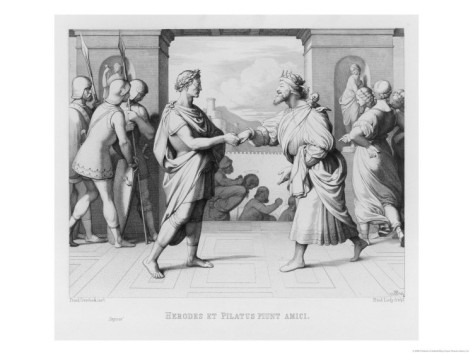
friedrich-overbeck-pilate-and-herod-resolve-their-differences-and-pilate-hands-jesus-over-to-herod-s-jurisdiction

The meeting at the court referred to as “the Pavement” was filled with ceremonial pleasantries as Pilate, Herod and their staff members and court followers conducted the business of the day. Nothing of much importance was discussed, Pilate decided not to bring up anything about the Galilean preacher despite the uproar of Sunday that accompanied his arrival. Pilate thought it amusing that a poor preach from Herod’s own province would be greeted as a king while the population hardly acknowledged Herod, apart from the rathe sullen looks that greeted his arrival.

After Herod departed Longinus, Flavius and the other officers were dismissed, yet another morning that they would never get back. But again that was part of life as an officer in a Godforsaken backwater like Judea. Such meetings of course were a necessary evil for them to attend and sometimes one could find out information that could be useful. Though nothing important was shared in the meeting Longinus noted that no Jewish religious leaders were in attendance. He thought that odd until he arrived back in his quarters where he was doffing his more ceremonial dress uniform items for the more practical daily kit.

After Herod departed Longinus, Flavius and the other officers were dismissed, yet another morning that they would never get back. But again that was part of life as an officer in a Godforsaken backwater like Judea. Such meetings of course were a necessary evil for them to attend and sometimes one could find out information that could be useful. Though nothing important was shared in the meeting Longinus noted that no Jewish religious leaders were in attendance. He thought that odd until he arrived back in his quarters where he was doffing his more ceremonial dress uniform items for the more practical daily kit.

As he changed his second in command, Decius knocked on the door.

“Come.” Longinus said and his subordinate entered. Decius came to attention and saluted.

“Be at ease my friend, what news do you bring?”

“Centurion. I have some rather interesting news from our Jewish spy regarding this Jesus fellow.”

“Is that so?” Longinus inquired.

“Yes sir. He said that one of Jesus’s own men, one of his 12 closest followers went to the ruling elders this morning and offered to betray him.” The words coming from his subordinate were stunning.

“Tell me more.” Longinus said, his voice now full of curiosity.

“Sir, our man said that a man named Judas Iscariot, who is trusted by Jesus enough that he carries the money bag and pays whatever expenses that Jesus and his men incur.” Decius paused while Longinus pondered this unexpected turn of events.

After a few moments of silence Longinus asked his Tesserarius, Quentin to fetch Flavius and asked Decius to sit at his desk. Flavius arrived within a couple of minutes and joined Longinus and Decius at the desk.”

Longinus began the discussion.

Judas' 30 pieces of silver

“Flavius, we have news about your friend the Galilean preacher, it seems that one of his merry band is a traitor.”

If Longinus’s reaction to the news was surprise and maybe even amusement with the duplicity of these Jews the reaction of Flavius was one of stunned disbelief and horror.

“You can’t be serious?” He stammered.

“Well that is what Decius says my Jewish insider at the Sanhedrin has reported just a little while ago.” He looked at Flavius as Flavius asked “do you know which one of his men has done this.”

“A certain Judas Iscariot. That is the correct name isn’t it Decius.”

“Yes Centurion, Judas Iscariot.”

Flavius looked at Decius and Longinus and said “Iscariot.”

“You know of him.” Inquired Longinus.

“Yes I do know of him. Before he joined with Jesus he was reported to be linked to a group of assassins called the sicarii.”

“The sicarii?” Longinus asked , hardly believing what Flavius said. The sicarii were a particularly violent group, known to kill Romans and people that they suspected of being collaborators. They armed themselves with a particularly nasty dagger that they carried beneath their tunics. If this was true it could be a particularly disturbing turn of events.

“Yes my friend. You see many people followed this Jesus not because of his goodness or any thought of benevolence, but because they believed that he would overthrow the Jewish regime and drive us out of this land.”

“I had no idea. I thought they were all a bunch of do gooders. In fact until Jesus took a whip to all the merchants in the Temple the other day I didn’t think that he had a violent bone in his body.”

He looked at Decius and asked “What does our spy say about this Judas fellows motive?”

The younger officer replied “our man said that He overheard Judas talking before he went into the chambers of the Sanhedrin with some Priests sympathetic with the Zealot party of the Jews.”

“Continue.”

“What he said is that evidently Judas told these men that he was disappointed by the fact that Jesus did not appear to be seeking to overthrow us.”

“That would not be surprising for a member of the sicarii.” Added Flavius, his expression changing from disbelief to anger and after a moment’s reflection he slammed his fist down on the table and added “I could kill that miserable bugger myself…the man Jesus has done nothing wrong.” As Flavius spoke his voice rose in intensity. Longinus knew his friend was upset.

“Flavius, I can understand, this seems a vile thing but there are even larger issues than your friendship with this man and what he did for your servant.” Longinus hoped that his outward calm and acknowledgment of his friend’s feelings would help calm the anger.

“Longinus my friend, I know how you feel about these people and I hoped for better, I wanted to believe that they were a cut above us with their One God, but I see that even a people as devout as the Jews are as capable of evil as the worst Greek, Egyptian, Cretin or Arab.” He paused. “Do you have wine? I could use a drink about now.”

“Of course, my friend. Decius pour us each a cup of wine.”

As the younger officer got the wine Longinus looked at his angry and downcast friend. He felt a certain amount of sympathy for Flavius, but he had long ago learned not to let the sufferings of occupied people touch him deeply. He had built a fortress at impregnable as Fortress Antonia around his own heart years ago. It was the only way to survive. The being said he recognized a certain amount of humanity in his friend that was absent from so many of his comrades. In a way he envied Flavius. As he thought these things he realized that he needed to move the subject from Flavius’s emotional response to this situation to the practical consequences of this development. About that time Decius brought the wine and placing three cups on the table poured the wine.

“Thank you my friend.” Flavius said as he lifted the cup to his lips.

Both men raised their cups and took a drink. As he set his cup down Longinus continued. “I know that you hoped for better from these people, but you know I have found that some of the most religious people are also the most violent and intolerant.”

Flavius looked at his friend who continued “it seems to me that when someone, you know true believers, know that they have any deity at their disposal they are inclined to be less tolerant of others.” He paused and took a sip of wine. “I think that it is a testament to the Empire that we have so many religions and that in the name of law and order that violent ones are suppressed. That is why throughout most of the Empire we have peace.”

Flavius interrupted his friend. “But we enforce the religion of Caesar, a man, who we claim as God on our citizens.”

“True, but none of us really believe he is a real God anyway, it is a way to keep order. The state makes a religion of itself, it keeps the really dangerous types at bay. So long as people put Caesar first, even if it means burning a bit of incense to a man that they do not believe is God it serves a purpose doesn’t it?”

Flavius looked at his friend and quietly replied “I guess until I met this Jesus fellow I would have agreed completely, but now I don’t know.”

Longinus listened to his friend and could see the sincerity in his face. He continued saying softly  “I really believe my friend that the second that any religion that proclaims something different arises and gains control of the Empire you can be assured that the peace that we know will be gone.”

“But that is no substitute for belief in a real God.” Answered Flavius.

“That may be so my friend but it helps keep the peace and is why we don’t have problems throughout the Empire like those that beset us here.”

A curious silence descended in the room as the two friends pondered the situation. Finally Flavius broke the silence. “I just hope that what this man has done stays a Jewish problem for their leaders. I would hate for us Romans to have to become involved in it.”

“As do I my friend, I can drink to that.”

The three men sat silently continuing to drink their wine as they pondered the position that they found themselves…. It was nearly sunset.

2 Comments

Filed under faith, History, Religion

If I Wasn’t Already a Christian I Wouldn’t Be

blm121011

In the movie Major League, the Cuban ballplayer Pedro Cerrano commented to a Christian teammate “I like Jesus very much, but he no help with curve ball.”

I like Jesus a lot. In fact I believe in Jesus and am completely orthodox in the basics of the historic Christian faith. Now I did go through a crisis of faith when I returned from Iraq that left me for all intents and purposes an agnostic struggling to believe. When faith returned in the Emergency Room at Portsmouth Naval Medical Center to this day I believe that it was a miracle.

However, since that evening in December 2009 I have found that despite Jesus, that some American Christians can be among the most hateful, intolerant, narrow minded and vicious people on the planet. In light of the very real fact that people are fleeing the Church in ever increasing number and that the fastest growing segment of the religious population in the United States is “the Nones” or those that have no religious preference you would think that Church leaders and for that matter those that call themselves Christian would take a bit of time to reflect on what is going on.

The great evangelist Dwight L Moody once said “Out of 100 men, one will read the Bible, the other 99 will read the Christian.” I do believe that is true. The earliest Christians, men and women that followed Jesus when there was no earthly benefit to doing so attracted people to their faith and their Savior because their lives exemplified love, care and humanity quite unlike many of their persecutors. William Blake, the 18th Century English poet would say “The glory of Christianity is to conquer by forgiveness.”

However I have to say that if I was to be looking for Jesus by the recent experiences that I have had with people that call themselves “Christians” I would never consider becoming a Christian. Now I am a Christian and I do not plan on leaving the faith but I have to agree with Mahatma Gandhi that “I like your Christ, I do not like your Christians. Your Christians are so unlike your Christ.”

This yesterday I received an e-mail from a woman upset with an article I wrote about the death of the Reverend David Wilkerson a couple of years ago. I was polite and even apologetic but in two subsequent e-mails she persisted and finally sent me an e-mail stating: “You are an arrogant pompous hypocrite a classic wolf in sheep’s clothing. Call yourself Padre tells it all. Now get thee behind me Satan. In Jesus name.”

I have for the most part stopped taking such attacks personally. Yes there are some times that they hurt or anger me, but in light of them I can understand why so many people hold Christianity, the Church and Christians in such low esteem. This particular person was so ignorant about what she was talking about and me that I could hardly take her comments seriously or be hurt by them. What scares me is how widespread this type of attitude is in some church communities and the effects that it has on so many people and our society as a whole. In light of this and so many other interactions I have had with “Christians” that I am tempted to agree with Mark Twain who said: “If Christ were here there is one thing he would not be—a Christian.” Since I have written about these encounters many times I will not go into detail here other than to say that they make me tired and simply restate that if I wasn’t already a Christian I wouldn’t be.

The late Oscar Romero, the martyred Archbishop of El Salvador wrote: “I don’t want to be an anti, against anybody. I simply want to be the builder of a great affirmation: the affirmation of God,who loves us and who wants to save us.”

That is the kind of Christian that I want to be. I will strive to love people and tell the truth, and if need be confront injustice against any of God’s people. Hopefully in doing so I will be a witness that helps call people back to the love of God shown in Christ.

Peace

Padre Steve+

4 Comments

Filed under christian life, faith

Ash Wednesday and the Beginning of a Radical and Happy Lent

barmherzigkeit

“Accustom yourself continually to make many acts of love, for they enkindle and melt the soul.”  Teresa of Avila 

Well my friends today is Ash Wednesday and the beginning of the season of Lent. Lent is, for those unfamiliar with the custom is a penitential season in the days leading up to Easter in which Christians, through prayer, fasting and abstinence seek to prepare themselves for Holy Week and Easter. It really is a time of great value if its observance is not done simply out of legalism or even the need to show ones personal holiness as somehow more important than the relationships that one has with both God and one’s neighbor.

If you have read my articles on this site dealing with Ash Wednesday and Lent you will note that Lent is a season that I have struggled with throughout my life, even my life as a Priest. I did not grow up in the catholic tradition, Roman, Orthodox or Anglican. I came to a catholic understanding of faith in a Southern Baptist Seminary and my journey took years and when I finally came over to the “catholic” side of the line in 1995 and 1996 I attempted for a number of years to be more individualistically pious in my observance of the Lenten season and tradition than others.

That did not work well. Instead of finding a depth of meaning and transformation Lent became a burden. I observed it and did my best but without much joy. When I returned from Iraq in 2008, my faith shaken, and emotionally broken my Lenten observance was so painful that mid-way through it I abandoned it. The following year I declared that I was not going to do Lent in the way that I had done in the past, but even in this I struggled. That was not unexpected because by then I was for all intents and purposes an agnostic struggling to believe and praying that God might be real. The only thing that kept me going at times was the belief that my vocation as a Priest mattered, no matter how I felt.

The past few years Lent has been a struggle. I have worked to make it both meaningful and joyful. When I think of the irony that I was attempting to work to experience God’s grace I can now laugh.

This year Lent started out differently. Over the past number of months my life, including my spirituality has been coming back into focus and much more free and integrated than it was in the past.

Today I was part of our hospital Chapel ecumenical Ash Wednesday service. Our small chapel was full, with more people standing than sitting. Working with my two colleagues, a Southern Baptist Pastoral Counselor and an American Baptist Chaplain we served those who came, Catholics and various expressions of Protestants. My colleagues did most of the work for the service. I simply approved their work and though about what I was going to say and do as the primary celebrant during the service.

Our Old Testament reading out of Isaiah Chapter 58 actually set the tone for me because it has been something that has been zinging my spirit ever since my seminary days and early days as a Priest. In the passage Isaiah was speaking to a very religious people who seemed to take great pride in their external demonstrations of righteousness but whose hearts were far from God and the people that God had placed around them. Isaiah wrote:

Is not this the fast that I choose: to loose the bonds of injustice, to undo the thongs of the yoke, to let the oppressed go free, and to break every yoke?
Is it not to share your bread with the hungry, and bring the homeless poor into your house; when you see the naked, to cover them, and not to hide yourself from your own kin?
Then your light shall break forth like the dawn, and your healing shall spring up quickly;
your vindicator shall go before you, the glory of the LORD shall be your rear guard.
Then you shall call, and the LORD will answer; you shall cry for help, and he will say, Here I am.

Likewise Jesus warned his disciples about the dangers of religious hypocrisy in the Gospel reading which was from Matthew Chapter Six. “Beware of practicing your piety before others in order to be seen by them; for then you have no reward from your Father in heaven.” He then went on to warn them about how to pray and how to fast. In each case he was very much against public displays that would serve to show off an individual’s religious superiority. Instead he talked about prayer being in secret and fasting that did not attract the attention of others. That is actually quite a revolutionary idea if you take a look at the practices of many who call themselves Christian, or for that matter religious people of any religion.

Jesus seemed to “get off” so to speak in confounding the severely religious people of his day. He hung out with, care for, fed, healed and loved people that the people who were more concerned with outward religious displays actually despised. I think that Jesus actually understood the real meaning of Lent than we do. Yes, Jesus prayed, he fasted, actually for 40 days in the wilderness once and was tempted by the Devil who offered food, protection from harm if he jumped off the pinnacle of the Temple and even the whole world, if Jesus would only worship him. Of course Jesus withstood the temptation, but it was real and if we actually take the humanity of Jesus seriously it was a real temptation that actually threatened to destroy the eternal relationship that Jesus had with the Father and the Holy Spirit.

So there is a value in spiritual disciplines of prayer and fasting, but they are not the be all and end all of the Christian faith. Instead, they are important but unless they actually are part of a change in our hearts that turns them from us to God and maybe even more importantly the real people that we meet, especially the least, the lost and the lonely.

However according to the Barna Group, which surveys Christians and their attitudes it seems that American Christians don’t seem to get the message. Barna commented:

“The vast majority of (secularists) don’t need to hear the Good News. They have been exposed to Christianity in an astonishing number of ways, and that’s exactly why they’re rejecting it. They react negatively to our ‘swagger’, how we go about things, and the sense of self-importance we project.” They quote one outsider as saying: “Most people I meet assume that Christian means very conservative, entrenched in their thinking, antigay, antichoice, angry, violent, illogical, empire builders; they want to convert everyone, and they generally cannot live peacefully with anyone who doesn’t believe what they believe.”

Over the past few years I have gotten to the point that I have a hard time simply giving money to causes, ministries and churches but really have a hard time passing up the homeless, the hurting and the despondent people that I see every day.

I just wonder what it would be if people that call themselves Christians would during Lent, instead of giving up chocolate or going meatless on certain days would instead do something kind for a person that can do nothing for them, especially people who may or may not be Christians. I’m sorry but that seemed to be what Jesus did more often than not.

Can you imagine what the practical result of over one billion Christians doing one act of kindness a day to someone that can’t pay them back, that they don’t know, that may even to them seem to be of a class, religion or lifestyle that they do not approve? What if instead of giving billions of dollars to the money pits of self indulgent Christian ministries and churches they simply paid someone’s rent, bought a meal, or a tank of gas for someone in need, took someone to the doctor, or helped someone find a job?  What if instead of giving up something that for practical purposes is meaningless for 40 days, like our favorite food or drink seek out opportunities to do something as simple as walking up to the homeless person on the side of the road who has the “please help” sign and look them in the eye, ask them what they need and then do something to help them?

And let me preach. When we were down and out and losing almost every earthly possession we had when I was in seminary there were regular people who did those practical acts of kindness and mercy that helped us through terrible times. People bought us gas, let us borrow or gave us cars, paid for doctors visits, food and even tuition.  Of course I was working my ass off in two or more jobs at any given time, going to school full time and serving in the National Guard as we attempted to recover from the debacle we had experienced while still moving forward. Thus I approach this with a great deal of gratitude and empathy.

I think that this is a radical idea. Not original by any means, but certainly radical.

normal_LaughingJesus

And then there is one other thing, what we do should be done with a happy heart, not with a gloomy one. Saint Teresa of Avila once said “God save us from gloomy saints!”

Have a happy Lent.

Peace

Padre Steve+

Leave a comment

Filed under christian life, faith, Religion

Advent and Life: God Loves the Real World

2004weihnachtsbrief

O come, thou Dayspring, come and cheer
our spirits by thine advent here;
disperse the gloomy clouds of night,
and death’s dark shadows put to flight.

(From O Come O Come Emmanuel) 

Today is the fist Sunday of what we in the liturgical Christian world know as the season of Advent.

Advent is the beginning of the liturgical year, in a sense the opening day of a new season of faith, as much as the Opening Day is in Baseball. It is a season of new beginnings, of hope looking forward and looking back. It is a season of intense realism. It is a season where the people of God look forward to their deliverance even as they remember the time when God entered into humanity.  It was not simply entering the human condition as a divine and powerful being inflicting his will upon people but deciding to become subject to the same conditions know by humanity. As Paul the Apostle, wrote about him: “though he was in the form of God, did not regard equality with God as something to be exploited,  but emptied himself, taking the form of a slave, being born in human likeness. And being found in human form, he humbled himself and became obedient to the point of death– even death on a cross.” (Philippians 2:5b-8) 

In the incarnation Jesus Christ shows his love and solidarity with people, humanity, the creation, reality. Dietrich Bonhoeffer wrote:

“God loves human beings. God loves the world. Not an ideal human, but human beings as they are; not an ideal world, but the real world. What we find repulsive in their opposition to God, what we shrink back from with pain and hostility, namely, real human beings, the real world, this is for God the ground of unfathomable love.” 

That simple fact is why Christ came.

He didn’t come to found a government. He did not come to exemplify “Christian” virtues or to condemn people that religious people condemned as sinners.

The meaning of the incarnation, and the hope of the season of Advent is that God loves people, even those that some that presume to be his spokesmen and women despise.

In the next few week there will be much written and said about Jesus. Much of it will not actually deal with Jesus or the people that he came to save but instead about the worldly power and influence of those who seek the profits of being “prophets.” Some of them will talk fervently about the “war on Christmas” as if somehow God and Christ are so small that they need government sponsored displays in the public square in order to be real, relevant or or for that matter important. What a small God they must have.

Somehow the message of Advent, the coming of Jesus is contradictory to the message of the for profit prophets. Certainly the early Christians had no government backing of any kind. They simply lived the life and showed God’s love to their neighbors, often at the cost of their lives and paradoxically the message was not crushed, but spread and overcame an empire. It was only when they became co-executors of government power that the message of reconciliation became a bludgeon to be used against those who did not agree with the theology of the clerics beholden to the Empire.

The Christ of the Season of Advent, the one who came and who promises to come again is not captive to the capricious message of the for profit prophets and their political and media allies. I would dare say that God is much bigger than them or those that they believe will somehow end the Christian faith as we know it. But then maybe the Christian faith “as we know it” is more a reflection of us and our need for temporal physical power over others than it is of Jesus.

All I know is that the simplicity of the message that “for God so loved the world that he gave his only begotten Son” is more powerful than any political-religious alliance. Likewise the two things that Jesus said to do in order to “inherit the Kingdom of God” were to “Love God with all your heart and love our neighbors as ourselves,” and similarly the words of the old Testament minor prophet Micah, who asked “what does the Lord require of thee? To love show justice, to love mercy and to walk humbly with thy God.” But then there is not much money or political power in that is there?

But despite the inconvenience of a direct temporal profit or power which is so central to most churches, I do think that the message that God loves the real world is worth repeating. In fact I think that because the message of God’s great love for those deemed “repulsive” is so distasteful to the “for profit prophets” of our time that it is not only worth repeating, but actually believing.

It is a good reason for me to during this season of Advent to look forward to our celebration of the mystery of the Incarnation, the coming of the God who “emptied himself” and took “the form of a slave” in order to save his people.

Peace

Padre Steve+

2 Comments

Filed under christian life, faith, Pastoral Care, Religion

Rejecting the “God” of Black Friday

Yes my friends it is that most holy of occasions in American life, the annual celebration of Black Friday where others sane an rational people allow themselves to unleash their animal passions on the floors of our greatest retailers and on the internet.  We have observed the high holy day of Black Friday where Americans of all races and religious persuasions observe a day of sacrifice to the God of consumerism often spending days in preparation carefully hoarding their treasures in hopes of scoring the best deals at the nation’s leading retailers.

Today I can say that I have not even spent a penny on this Black Friday, not even online. I just can’t get into the whole mass psychology marketed by the retailers.  The thought of waiting hours just beat other people to buy some gadget made by salve laborers in China or some other despotic country is frightening. When one realizes that the retailers that cater to our greed not only profit off of slave labor, but also pay their workers low wages, offer few if any benefits for working obscene and often unpredictable hours to maximize their profits one has to wonder about the morality of it all.

In the good news of the day, our local news reports that no one has yet been shot, knifed or trampled to death in any of our local retailers. However I can imagine that customer number 201 in line for the 200 available the $199 HDTVs Wal-Mart or other retailers with a limited numbers of Black Friday “door buster” specials is feeling homicidal or suicidal or possibly both about now.

But I hear that in some places the holiday has been celebrated with much more aplomb than our sleepy city.  I have read about shootings inside and outside of different retailers, incidents where shoppers had to be tasered by police, pepper sprayed by store security officers or even better pepper strayed each other. In one location a lady ran someone down in a mall parking lot, distracted driving appears to be the case. I guess she got a text from another retailer with an unannounced special across town. There is a case where a man kept people in line by pulling out a gun, at least someone is keeping order. I can only image how fun that was for them as they wrestled for all of those really “hot” deals.

I do think that this celebration says something about us now, while many people around the world would be willing to die for a decent meal or freedom of speech we are willing to harm our neighbors because they might be the fist to get the latest gadget for a few dollars less than us.  It seems perverted don’t you think? I can’t imagine Jesus or Thomas Jefferson approving such behavior but it is part and parcel of the culture that we are very much a part of and participate in and that means Tea Party and Occupy Wall Street types and everyone in between because whether we like to admit it we like our stuff and we want it for the best possible price, not that there is anything wrong with that…especially if you are a follower of Ayn Rand’s banal philosophy.

But when we let the urges for stuff overcome our common sense and any sense of decency, decorum or love of our neighbor then maybe we have lost our way.

I guess the fact that after Iraq I am claustrophobic and get panicky in big crowds in enclosed areas now makes me less inclined even to try to go to a major retailer today.  Maybe that makes it easy for me to say these things with relative impunity since the thought of going out in such crowds petrifies me. I certainly am not trying to be judgmental but when I see people doing harm to each other to obtain things that are more than luxuries for most of the world I think that we need to just step back and look at ourselves.

I mean really….We have massive long term unemployment, our country is financially and politically broken, we are facing a “Fiscal Cliff,”  we have troops at war in Afghanistan while the rest of the Middle East is about to go up in flames and bring us even more heartache. So with all that going on we have people fighting each other and some people actually doing physical harm to others for gadgets made in China or Third World countries by what amounts to slave labor.

Even worse we have people in all levels of corporate America that promote this culture and make their living off of the people that are committing crimes to get a deal.  I think that says something about us and that troubles me.  But then I guess I don’t have enough faith in the God of Black Friday.

But why should I have faith in that God? The “God” of Black Friday caters to the darkest nature of self-centered greed and mocks the God who on the real Black Friday, offered himself for the life of the world. The “God” of this Black Friday is the no-God of Ayn Rand and her disciples who despise the crucified God in thought, word and deed.

I wonder what Jesus would do if he stumbled into a Christian book store on Black Friday and found people fighting over a special on WWJD junk or the latest greatest “study Bible” featuring the notes of some prosperity preacher. I don’t think that he would be very happy.

Peace

Padre Steve+

1 Comment

Filed under economics and financial policy, faith, News and current events, philosophy, Religion

I Like Jesus Very much, but He no Help with Militant Angry Christians

Did you ever have one of those days where a militantly religious person attacks you ceaselessly because they are offended at something you said and continues to attack no matter how many times you try to let it go? It has been one of those days for me. On days like this I get weary of militant, angry and all too often ignorant Christians.  They make me tired but even still I will serve to ensure that they have their religious liberty.

There is a scene in the movie Major League where the Cuban defector Pedro Cerrano played by Dennis Haysbert, who has an altar to his God Jobu in his locker to help him hit the curveball. One of the other players ask him about Jesus and Cerrano says “Jesus, I like him very much, but he no help with curveball.” Well for me Jesus is no help with militantly angry Christians.

I have written over 1200 articles on this site some of which attract criticism and so long as the critic is polite and sticks to facts I deal with it pretty well. However I find that the nastiest of my critics are supposedly Christian. I cannot believe the hateful, rude and uncivil manner displayed by these people and on rare occasion I have responded with blunt criticism of their behavior. In fact in posts where I have been critical of any faith it is Christians who are the most vicious in their attacks. Even Moslems that have written when I have criticized either the actions of Moslem extremists or aspects of their religion are more decent than these Christians.

The funny thing is that I never get attacked for big stuff, but rather having the nerve to criticize their favorite preacher or suggest that Christian leaders that they idolize may have feet of clay. Even people that disagree with me on doctrine or divisive social and political topics, including those espoused by Christians generally try to stick to some kind of ground rules when they comment. They stick to the issues and don’t for the most part make it personal.

However, there is a type of religious personality that cannot abide any criticism of their leaders. You name the religion and you will find people that are militantly aggressive and even violent to those that criticize their current earthly leader or some previous leader. It as if you criticize them you are criticizing God even when it is well deserved criticism completely backed up with facts. But then to such people facts don’t matter.

Likewise the viciousness levied by such Christians against “sinners” is appalling, especially homosexuals and people of non-Christian religions. Jeremy Affeldt, an Evangelical Christian and pitcher for the San Francisco Giants commented on his blog recently:

“It’s getting harder all the time to say, “I’m a Christian.” I’m not afraid to say I’m a Christian. Sometimes I’m embarrassed to say it! I’m embarrassed by how people view Christianity, as a judging faith. The way people view Christianity is not the way that sinners viewed Jesus. Sinners loved Jesus! They knew He loved them! And as much as it is possible, I want to be viewed like Jesus was viewed, as someone who loves people.”

I stand in total agreement with him. I deal with a lot of people who have been for a large number of diverse reasons been treated badly by the church as an institution or by some of the people who act as if they are the final arbiter of truth or God’s judgement.

I find it little wonder that people are leaving Christian churches of all denominations in droves. For most of these people it is not about God or Jesus, or even the Bible. It is due to the lack of love, care, compassion exhibited by Christians and the institutional corruption, lack of transparency, double standards and political machinations of churches over people that are not of their faith or under their institutional control. The surveys conducted by Christian pollsters like George Barna bear this out. When asked what words or phrases “best describe Christianity” the top response of 16-29 years olds was “anti-homosexual” while 91% of all non-Christians surveyed said this was the first word as it was for 80% of Christians in the survey. Here are those words that describe Christians. Personally I don’t like them but it is what it is.

Hypocritical: Christians live lives that don’t match their stated beliefs;
Antihomosexual: Christians show contempt for gays and lesbians – “hating the sin and the sinner” as one respondent put it
Insincere: Christians are concerned only with collecting converts
Sheltered: Christians are anti-intellectual, boring, and out of touch with reality.
Too political: Christians are primarily motivated by a right-wing political agenda

The sad thing is that we are not simply alienating non-Christians we are losing young Christians in this cesspool of Christless Christianity. I wrote about this about a year ago in an article entitled Reaching the Lost Christian Generation.I wrote another article when novelist Anne Rice announced that she was leaving the Catholic Church called Anne Rice and the Exodus. Both articles deal with reality that many conservative Christian leaders refuse to recognize. The fact is that in many western countries Christians and the institutional church behave as if they are both entitled to being at the top of the heap and play the victim when they don’t get their way or when someone dares to criticize them or their leaders.

Jesus told his disciples that people would know they were his disciples by their love for one another. It was a sentiment that even the Roman persecutors of the early Church echoed.

I just hope that despite my own faults that people who come to me in person, or on this site see me as someone that loves people hopefully as Jesus would. What grieves me about some of those that attack and attack and attack is that they try every nerve that I have, and the sad thing as most of them don’t take the time to actually find out anything about me or what I believe before they launch their attacks. I can in a small way understand Jesus’ frustration with the religious leaders of his time.

Here is to hoping that things will get better.

Peace

Padre Steve+

1 Comment

Filed under christian life, faith, Religion