
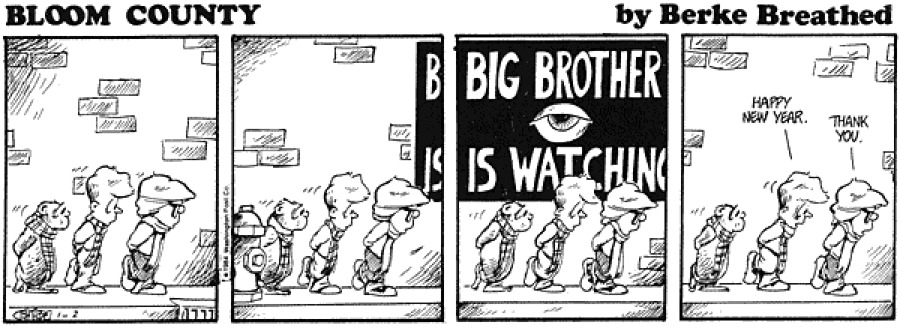
Thoughts are free, who can guess them?
They fly by like nocturnal shadows.
No man can know them, no hunter can shoot them
with powder and lead: Thoughts are free!
Die Gedanken Sind Frei (The Thoughts are Free)
Welcome to 1984.
Okay, I know it’s 2014 but bear with me, I figured that the first post of the New Year should be about the reality that has been with us for years but most people didn’t recognize until 2013. The NSA revelations though shocking to many shouldn’t have been because almost every countries intelligence services are attempting to do similar things. Likewise the private sector both aids and abets the government intelligence and security services and do similar things themselves to their customers.
Technology is a great thing and we love it. We depend on it. Smart phones, internet, text messaging, blogs, electronic banking, finance and commerce, e-books, and even gaming technology has revolutionized the way that we live.
Technology itself is neutral, it can be used for good or evil and every point on the morality spectrum in between. Thus it can be used for good, for convenience and holds much promise for most people, even as a minority uses it to commit acts of terrorism as well as all sorts of criminal activity against otherwise honest and law abiding people.
The tension that exists between the good and evil uses of technology, especially after the attacks of September 11th 2001 has prompted different reactions from both civil libertarians and people trusted with security of nations, businesses and infrastructure networks.
The fact is I can understand and argue for a strong civil libertarian response as well as the security response. Honesty I wrestle with the tension between civil liberty, including the right to privacy and the need for security. I want both but the reality is that the world has changed since I grew up. It is not that people, governments and businesses didn’t seek to impinge on personal freedom or privacy and that others did not seek to kill or disrupt the lives of others in times past. The difference is the vast advances in technology which enable all of them to have ever more influence over our lives.
Technology has made possible what George Orwell only imagined when he wrote 1984. Governments, business, the banking industry, private security firms, internet service providers and search engines, as well as criminals gather information for good and for bad purposes. For our security we use Passwords and Pins which others seek to crack, while those delicious Cookies that are planted on our computers when we visit different websites contribute to our convenience while enabling others to collect incredibly detailed information about us.
It really is amazing and unfortunately I don’t have any answers because I am a realist. I am not a fan of the National Security State, nor am I a fan of the way business and other organizations collect information. That being said I also know that there are those in the world who desire to use the technology that we are so dependent on to kill or harm people or disrupt society.
Back in the day when terrorism was simply a matter of relatively small bombs, assassinations, hijackings, kidnappings and postal or wire fraud it was a nuisance. It was bad if you were in the path of it but for most people it was not a real threat. I lived with it in the 1980s in Germany with the Red Army Faction, the Baader-Meinhoff gang and Libyan agents blowing up American and West German facilities and kidnapping and killing soldiers. We lived with it, daily searches of our vehicles at the front gate and extra guard duties, my wife and I almost were at the Frankfurt PX when it was bombed in 1985.
But with the advent of technology even small and seemingly insignificant groups have unprecedented power to kill and destroy. The attacks on the Twin Towers, the Tokyo subway system, the Madrid commuter trains, London transit system, the Moscow Subway system and theaters, hotels, restaurants and train stations in Mumbai India and the recent attacks on the Russian city of Volgagrad show our vulnerability to groups that use technology, old and new. Likewise the ability of criminal organizations or individual criminals to use technology to gain access to massive amounts of financial data as was demonstrated in the breaking of Target’s retail system demonstrates our vulnerability.
We want absolute freedom, privacy and security. However absolutes are no longer possible. Absolute freedom has never been possible, though we like to imagine it, yet absolute security can only be achieved by sacrificing all freedom. Now days security usually trumps freedom especially when the potential losses in lives, property and treasure are so great.
My inclination is toward civil liberties and privacy but such in the modern world may be on way to extinction and not all because of technology. Yes the technological part is big, and as a realist I do not think as long as the capabilities that technology provides us exist and advance that we can go back to a point that they cannot be used against individual liberty, life or property. Again, they technology itself is neutral, but how it is used makes all the difference.
The more worrisome issue for me is the way that the freedom of thought is being extinguished not in the name of security or freedom but for efficiency. Various parties including government, political, religious, scientific and business interests all seek to control thought for their own purposes.
Thus even history is twisted, as Orwell wrote: “He who controls the past controls the future. He who controls the present controls the past.” It used to be that conservatives complained about liberals doing revisionist history, but as a historian I find what I see coming out of some conservative circles much more frightening as history is twisted for the most gross political, religious and social ends. We allow half witted poorly educated loudmouths like Rush Limbaugh, Sean Hannity and Glenn Beck to think for us, promote fake history and conspiracy theories while giving credence to fake historians like David Barton. If there is a danger to any real freedom of thought it is because we as a people have allowed ourselves to taken in by such charlatans. Likewise the corporate state uses academics and intellectuals to prop itself up but once it has them it refuses to let them function independently.
Chris Hedges wrote of the corporate state:
“It is one of the great ironies of corporate control that the corporate state needs the abilities of intellectuals to maintain power, yet outside of this role it refuses to permit intellectuals to think or function independently.”
While Ray Bradbury wrote in Fahrenheit 451:
“Cram them full of non-combustible data, chock them so damned full of ‘facts’ they feel stuffed, but absolutely ‘brilliant’ with information. Then they’ll feel they’re thinking, they’ll get a sense of motion without moving. And they’ll be happy, because facts of that sort don’t change. Don’t give them any slippery stuff like philosophy or sociology to tie things up with. That way lies melancholy.”
I believe that in such an age that freedom of thought is the most important thing, even more than freedom of speech. Soren Kierkegaard wrote: “People demand freedom of speech as a compensation for the freedom of thought which they seldom use.”
In college I learned the words of the old German song Die Gedanken Sind Frei (The Thoughts are Free). It is an ancient song that during the days of Metternich was popular among student fraternities in Austria and the various German states. After the 1848 revolutions it was banned by many governments in their crackdown against democratic movements. It was a song close to many of the anti-Nazi resistance groups including the White Rose movement led in part by Sophie Scholl. In light of the terrifying possibilities of repression that exist with the technology of today and what will certainly come into being in the coming years it is important to realize that our liberty must always come from within. The third verse of the song goes like this:
And if I am thrown into the darkest dungeon,
all these are futile works,
because my thoughts tear all gates
and walls apart: Thoughts are free!
Bertram Russell wrote of the freedom of thought:
“Men fear thought as they fear nothing else on earth — more than ruin, more even than death. Thought is subversive and revolutionary, destructive and terrible, thought is merciless to privilege, established institutions, and comfortable habits; thought is anarchic and lawless, indifferent to authority, careless of the well-tried wisdom of the ages. Thought looks into the pit of hell and is not afraid … Thought is great and swift and free, the light of the world, and the chief glory of man.”
It took some time but 1984 is finally really here. That is the new reality, but do not lose hope so long as your thoughts remain free.
Happy New Year!
Peace
Padre Steve+


 The Inglorius Padre Steve's World