
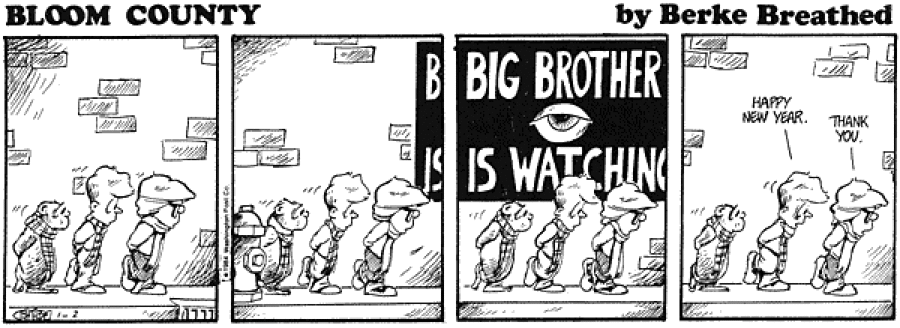
Thoughts are free, who can guess them?
They fly by like nocturnal shadows.
No man can know them, no hunter can shoot them
with powder and lead: Thoughts are free!
Die Gedanken Sind Frei (The Thoughts are Free)
Welcome to 1984 yet again, only now it is thirty-one years later and Orwell’s 1984 almost seems quaint by comparison.
Okay, I know it’s now New Year’s Eve for 2015, but who really cares? so but bear with me.
I figured that the first post of the New Year should be about the reality that has been with us for years but most people didn’t recognize until the past few years. The NSA revelations of 2013, though shocking to many shouldn’t have been so shocking because almost every countries intelligence services are attempting to does similar things. Likewise the private sector both aids and abets the government intelligence and security services and do similar things themselves to their customers.
Technology is a great thing and we love it. We depend on it. Smart phones, internet, text messaging, blogs, electronic banking, finance and commerce, e-books, and even gaming technology has revolutionized the way that we live. Hell, I’ll a technophile I admit it, I love technology and I use it.
While technology itself is neutral, it can be used for good or evil and every point on the morality spectrum in between. Thus it can be used for good, for convenience and holds much promise for most people, even as a minority uses it to commit acts of terrorism as well as all sorts of criminal activity against otherwise honest and law abiding people.
The tension that exists between the good and evil uses of technology, especially after the attacks of September 11th 2001 has prompted different reactions from both civil libertarians and people trusted with security of nations, businesses and infrastructure networks.
The fact is I can understand and argue for a strong civil libertarian response as well as the security response. Honesty I wrestle with the tension between civil liberty, including the right to privacy and the need for security. I want both but the reality is that the world has changed since I grew up. It is not that people, governments and businesses didn’t seek to impinge on personal freedom or privacy and that others did not seek to kill or disrupt the lives of others in times past. The difference is the vast advances in technology which enable all of them to have ever more influence over our lives.
Technology has made possible what George Orwell only imagined when he wrote 1984. Governments, business, the banking industry, private security firms, internet service providers and search engines, as well as criminals gather information for good and for bad purposes. For our security we use passwords and pins which others seek to crack, while those delicious cookies that are planted on our computers when we visit different websites contribute to our convenience while enabling others to collect incredibly detailed information about us.
It really is amazing and unfortunately I don’t have any answers because I am a realist. I am not a fan of the National Security State, nor am I a fan of the way business and other organizations collect information. That being said I also know that there are those in the world who desire to use the technology that we are so dependent on to kill or harm people or disrupt society.
Back in the day when terrorism was simply a matter of relatively small bombs, assassinations, hijackings, kidnappings and postal or wire fraud it was a nuisance. It was bad if you were in the path of it but for most people it was not a real threat. I lived with it in the 1980s in Germany with the Red Army Faction, the Baader-Meinhoff gang and Libyan agents blowing up American and West German facilities and kidnapping and killing soldiers. We lived with it, daily searches of our vehicles at the front gate and extra guard duties, my wife and I almost were at the Frankfurt PX when it was bombed in 1985. But that was different…
Today with the advent of technology, even small and seemingly insignificant groups have unprecedented power to kill and destroy. The attacks on the Twin Towers, the Tokyo subway system, the Madrid commuter trains, London transit system, the Moscow Subway system and theaters, hotels, restaurants and train stations in Mumbai India and the recent attacks on the Russian city of Volgagrad show our vulnerability to groups that use technology, old and new. The ability of other groups to use chemical weapons, to shoot down large commercial airliners with surface to air missiles and to hack the information systems of banks, businesses and governments threatens the stability of nations. The ability of criminal organizations or individual criminals to use technology to gain access to massive amounts of financial and personal data as was demonstrated in the breaking of Target and several other major retailers show just how vulnerable we are. Just imagine instead of money they decided to hack power systems, the electronic distribution grid or water works?
We want absolute freedom, privacy and security. However absolutes are no longer possible. Absolute freedom has never been possible, though we like to imagine it, yet absolute security can only be achieved by sacrificing all freedom. Now days security usually trumps freedom especially when the potential losses in lives, property and treasure are so great.
My inclination is toward civil liberties and privacy but such in the modern world may be on way to extinction and not all because of technology. Yes the technological part is big, and as a realist I do not think as long as the capabilities that technology provides us exist and advance that we can go back to a point that they cannot be used against individual liberty, life or property. Again, they technology itself is neutral, but how it is used makes all the difference.
The more worrisome issue for me is the way that the freedom of thought is being extinguished not in the name of security or freedom but for efficiency. Various parties including government, political, religious, scientific and business interests all seek to control thought for their own purposes.
Thus even history is twisted, as Orwell wrote: “He who controls the past controls the future. He who controls the present controls the past.” It used to be that conservatives complained about liberals doing revisionist history, but as a historian I find what I see coming out of some conservative circles much more frightening as history is twisted for the most gross political, religious and social ends. We allow half-witted poorly educated loudmouths like Rush Limbaugh, Sean Hannity and Glenn Beck to think for us, promote fake history and conspiracy theories as they give credibility to fake historians like David Barton. If there is a danger to any real freedom of thought it is because we as a people have allowed ourselves to taken in by such charlatans. Likewise the corporate state uses academics and intellectuals to prop itself up but once it has them it refuses to let them function independently.
Chris Hedges wrote of the corporate state:
“It is one of the great ironies of corporate control that the corporate state needs the abilities of intellectuals to maintain power, yet outside of this role it refuses to permit intellectuals to think or function independently.”
While Ray Bradbury wrote in Fahrenheit 451:
“Cram them full of non-combustible data, chock them so damned full of ‘facts’ they feel stuffed, but absolutely ‘brilliant’ with information. Then they’ll feel they’re thinking, they’ll get a sense of motion without moving. And they’ll be happy, because facts of that sort don’t change. Don’t give them any slippery stuff like philosophy or sociology to tie things up with. That way lies melancholy.”
I believe that in such an age that freedom of thought is the most important thing, even more than freedom of speech. Soren Kierkegaard wrote: “People demand freedom of speech as a compensation for the freedom of thought which they seldom use.”
In college I learned the words of the old German song Die Gedanken Sind Frei (The Thoughts are Free). It is an ancient song that during the days of Metternich was popular among student fraternities in Austria and the various German states. After the 1848 revolutions it was banned by many governments in their crackdown against democratic movements. It was a song close to many of the anti-Nazi resistance groups including the White Rose movement led in part by Sophie Scholl. In light of the terrifying possibilities of repression that exist with the technology of today and what will certainly come into being in the coming years it is important to realize that our liberty must always come from within. The third verse of the song goes like this:
And if I am thrown into the darkest dungeon,
all these are futile works,
because my thoughts tear all gates
and walls apart: Thoughts are free!
Bertram Russell wrote of the freedom of thought:
“Men fear thought as they fear nothing else on earth — more than ruin, more even than death. Thought is subversive and revolutionary, destructive and terrible, thought is merciless to privilege, established institutions, and comfortable habits; thought is anarchic and lawless, indifferent to authority, careless of the well-tried wisdom of the ages. Thought looks into the pit of hell and is not afraid … Thought is great and swift and free, the light of the world, and the chief glory of man.”
It took some time but 1984 is finally really here. That is the new reality, but do not lose hope so long as our thoughts still remain free.
So Happy New Year my friends!
Peace
Padre Steve+






 The Inglorius Padre Steve's World
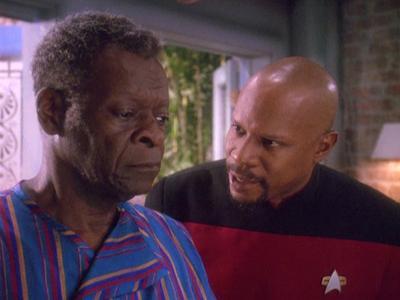
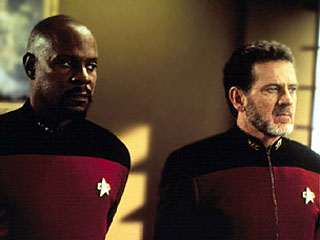
The Dangers of the Expanding National Security State: The Drumhead
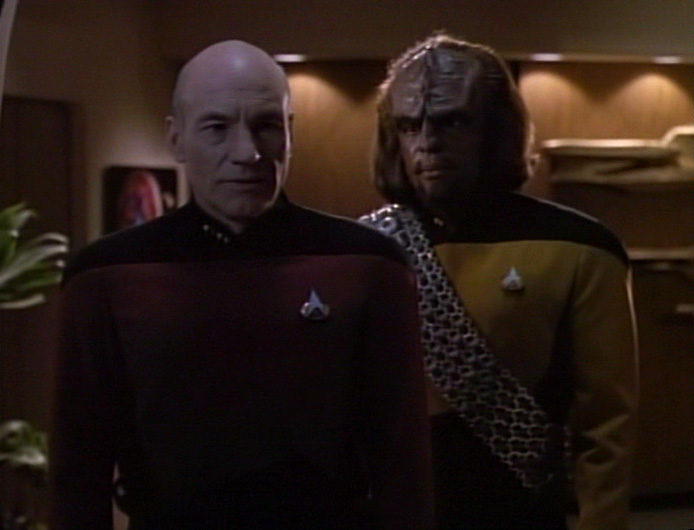
Lieutenant Worf: “Sir, the Federation does have enemies. We must seek them out.”
Captain Jean-Luc Picard: “Oh, yes. That’s how it starts. But the road from legitimate suspicion to rampant paranoia is very much shorter than we think. Something is wrong here, Mister Worf. I don’t like what we have become.”
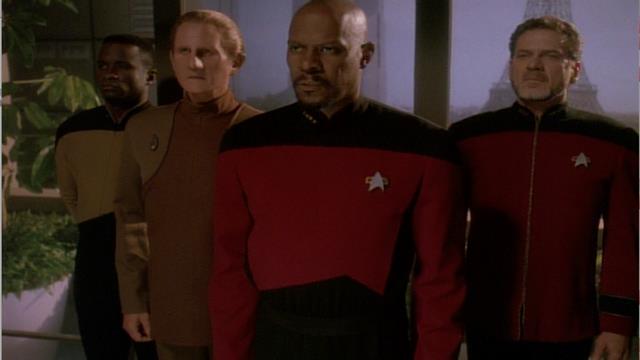
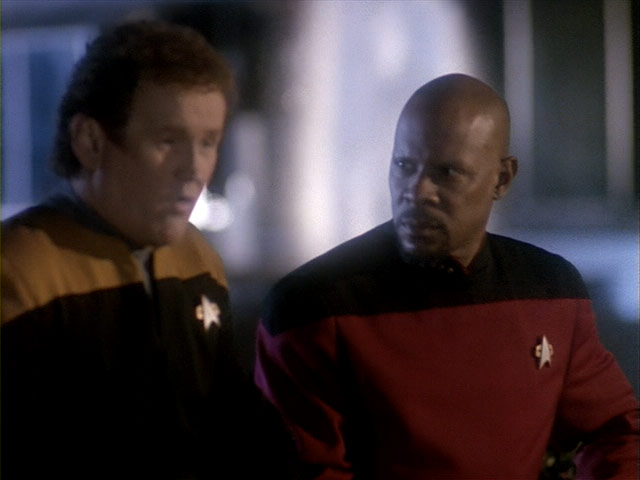
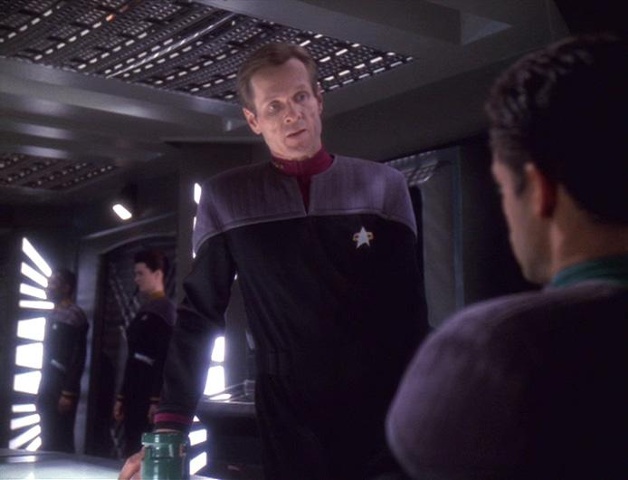
Back in 1991 when I was still in seminary I spent every Saturday evening glued to my television set to watch Star Trek the Next Generation. Even today I enjoy watching the human drama that Gene Roddenberry and his cohorts created on the small screen. Of all the Star Trek series my favorites are TNG and Deep Space Nine. Those series often touched on very pertinent social, political, medical, and technological and dare I say national security issues. In fact I have used some Deep Space Nine episodes in my previous posts about the NSA leak situation and the War on Terrorism.
One of the most chilling episodes regarding national security and potential terrorism or sabotage is called “The Drumhead.” In light of the the ever expanding National Security State and the ability of governments, private industry and even individuals to use technology to gather information on almost anyone and to abuse that power, The Drumhead is an episode that remains as relevant today, perhaps even more so, than when it first aired in 1991.
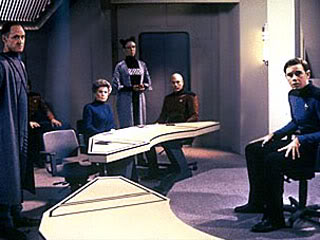
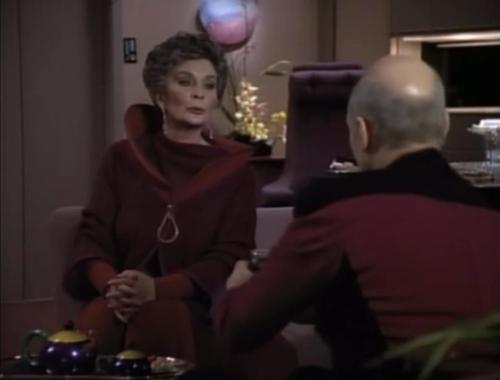
The episode is about an investigation that takes place on the Enterprise following an explosion in its engineering spaces. Suspicion centers on a Klingon exchange officer. However, the investigator, the retired Starfleet Judge Advocate General, Nora Satie and her Betazed assistant soon casts a wide net which eventually brings charges against a crew member and eventually Captain Picard.
At first Admiral Satie’s investigation seems reasonable. After all the Federation faced danger from the Romulans, who were always trying to use Klingons unhappy with the Federsation-Klingon peace treaty, to further their interests. The initial situation raised the possibility that the Enterprise, was sabotaged and that the Klingons or others might be involved. Thus as Sati began her investigation she was welcomed by the Captain as well as the Security Chief, Lieutenant Worf, the only Klingon serving as a Starfleet officer. Satie, assisted by Enterprise security officers then discovered how the Klingon scientist smuggled classified information off the Enterprise.
The Chief Engineer of the Enterprise, Lieutenant Commander LeForge determined in his investigation that the explosion thought to be “sabotage” was caused by a flaw in a recently replaced dilithium chamber. Although she was convinced that the Klingon was not the saboteur Satie believed that another saboteur was aboard the Enterprise. Satie and her assistant uncovered a piece of information that a crewman lied about his family background on his enlistment contract. They then used it to connect the crewman to to the Klingon spy by supplying false information about the explosion in an attempt to get the crewman to admit guilt.
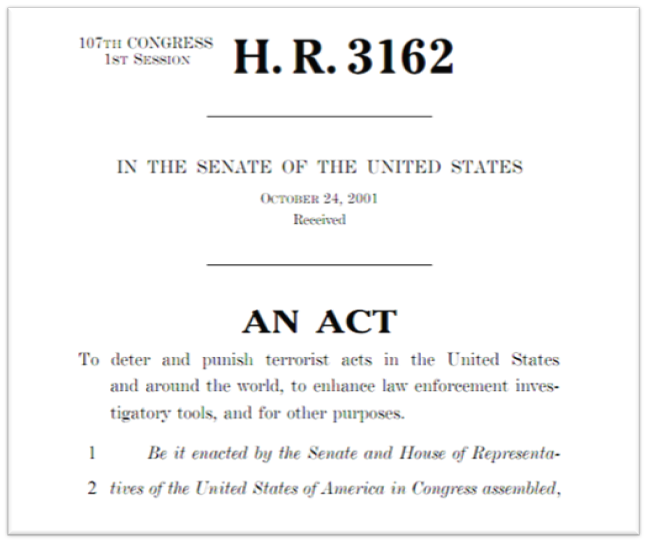
As the investigation widened Picard discussed it with Lieutenant Worf. I find this dialogue to be quite relevant to today thirteen years into the war on terror and about the same amount of time since the Patriot Act was passed.
Lieutenant Worf: “Sir, the Federation does have enemies. We must seek them out.”
Captain Jean-Luc Picard: “Oh, yes. That’s how it starts. But the road from legitimate suspicion to rampant paranoia is very much shorter than we think. Something is wrong here, Mister Worf. I don’t like what we have become.”
When Picard objected to the grilling of the crewman, Admiral Satie and her chief assistant began an investigation of Picard. As she informed him that he was now a subject of the investigation, the normally calm Picard erupted, telling Sati; “Admiral! What you’re doing here is unethical; it’s immoral. I’ll fight it.” Admiral Sati then laid down the gauntlet, and told Picard, “Do what you must, Captain. And so will I.”
Admiral Satie called on the Director of Starfleet Security, Admiral Henry, to watch her interrogate Picard who she had by now labeled a traitor.
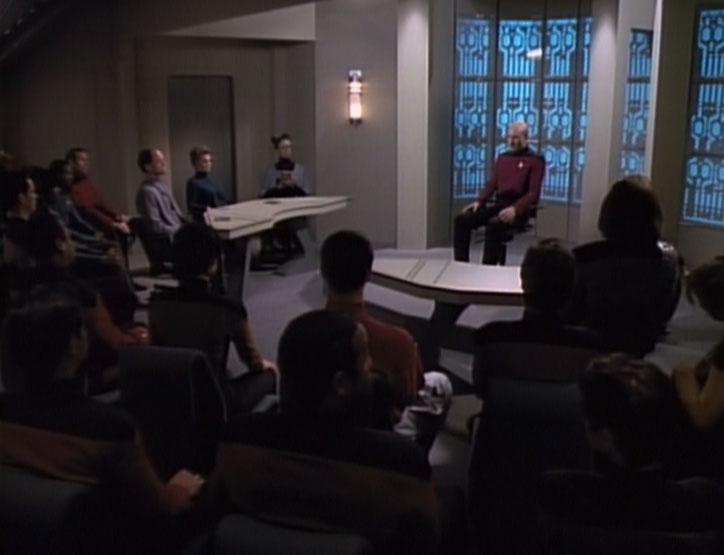
Picard forced to testify at an open hearing where Sati began to attack him. However, the tables are turned during Picard’s testimony. The dialogue is riveting as Sati attempts to use anything that she can to prove Picard a traitor the the Federation.
Admiral Satie: Tell me, Captain, have you completely recovered from your experience with the Borg?
Captain Jean-Luc Picard: Yes, I have completely recovered.
Admiral Satie: It must have been awful for you… actually becoming one of them. Being forced to use your vast knowledge of Starfleet operations to aid the Borg. Just how many of our ships were lost? Thirty-nine? And a loss of life, I believe, measured at nearly 11,000. One wonders how you can sleep at night, having caused so much destruction. I question your actions, Captain; I question your choices, I question your loyalty!
Capt. Picard: You know there are some words I’ve known since I was a schoolboy: “With the first link, the chain is forged. The first speech censured, the first thought forbidden, the first freedom denied, chains us all irrevocably.” Those words were uttered by Judge Aaron Satie, as wisdom and warning. The first time any man’s freedom is trodden on, we’re all damaged. I fear that today…
Admiral Satie: [stands up in anger and interrupts Picard] How dare you! You who consort with Romulans, invoke my father’s name to support your traitorous arguments! It is an offense to everything I hold dear! And to hear those words used to subvert the United Federation of Planets. My father was a great man! His name stands for integrity and principle. You dirty his name when you speak it! He loved the Federation. But you, Captain, corrupt it. You undermine our very way of life. I will expose you for what you are. I’ve brought down bigger men than you, Picard! [Admiral Henry gets up and leaves the room]
With Sati obviously unhinged, Admiral Henry ends the investigation and sends Admiral Satie home.
Of course this is fiction but the mindset and attitude of Admiral Satie seems to have been embraced by some in our government and security agencies, including the TSA and the NSA. But the talk is out there, former Senator and Secretary of Defense William J. Cohen said: “Terrorism is escalating to the point that Americans soon may have to choose between civil liberties and more intrusive means of protection.”
Well the choice has been made and I don’t think that there is any going back despite the posturing of politicians on both sides of the political divide. The fact is that polls show that the majority of Americans are willing to sacrifice freedoms for security.
Sati had become so consumed with “defending liberty” that she was willing to trample the rights of anyone that she suspected of disloyalty to the Federation.
Sati’s questioning of Picard by is fascinating and thought provoking, because there are people that think and act just her fictional character. People who believe, that they too are defending “freedom.”
Frederick Douglass once said: “Find out just what the people will submit to and you have found out the exact amount of injustice and wrong which will be imposed upon them; and these will continue until they are resisted with either words or blows, or with both. The limits of tyrants are prescribed by the endurance of those whom they oppress.”
The balance has to be found in this effort; right now the pendulum is so far to the security side that it seems freedom is no longer even a concern at least for the vast majority of the population and our political leadership, and not just the Executive Branch, the Congress seems to love making new laws that further limit freedom, local governments have militarized their police forces and the courts don’t seem to mind. Unless we undertake a real debate in the issue it is very likely that it will fade away and the national security state that we have become will grow even stronger with the inevitable loss of even more civil liberties.
One only has to look at what politicians on both sides of the political chasm have said about “protecting the homeland” to realize that this is only the beginning and that if we do not have a spirited public debate that we risk our Constitutional liberties under the 4th Amendment as well as potentially the 1st Amendment. Prosecuting actual wrongdoers is one thing, but prominent legislators on important committees dealing with national security suggest prosecuting reporters for doing their job, something that would be a crushing blow to freedom of speech and freedom of the press. The fact that some suggest this shows how just how close we are to surrendering even more freedom in the name of security.
The last scene of The Drumhead is enlightening. Lieutenant Worf, who had so eagerly embraced the investigation, goes to Picard to let him know that Admiral Satie and Admiral Henry have left the Enterprise. Worf is apologetic about his rather overzealous role in the investigation. He tells Picard about Sati: “after yesterday, people will not be so ready to trust her.” Picard replies “Maybe. But she, or someone like her, will always be with us, waiting for the right climate in which to flourish, spreading fear in the name of righteousness. Vigilance, Mister Worf – that is the price we have to continually pay.”
Eternal vigilance in the face of both terrors from abroad and self imposed tyranny designed to protect us from the terrorists. Yes James Madison, was absolutely right when he said “The means of defense against foreign danger historically have become the instruments of tyranny at home.” However I fear that those that warn of such dangers will themselves be labeled the enemy.
Henry Steele Commager said “Men in authority will always think that criticism of their policies is dangerous. They will always equate their policies with patriotism, and find criticism subversive.” This, my friends is the reality that we live in and the danger that we face.
Peace
Padre Steve+
Share this:
Leave a comment
Filed under civil rights, ethics, laws and legislation, national security, political commentary
Tagged as 1st ammendment, 4th amendment, 9-11 2001, admiral satie, attack on benghazi us consulate, Boston marathon bombing, captain jean luc picard, civil liberties, frederick douglass, global war on terrorism, henry steele commager, james madison, lcdr leforge, lieutenant worf, national security state, nsa leaks, Patriot Act of 2001, representativ peter king, star trek the next generation, the drumhead, tsa