Tag Archives: propaganda

A Break from Hate

It is all too easy in a divided country and a world in crisis to succumb to hate. Hate is easily stirred up by what I call the Unholy Trinity of Pundits, Politicians and Preachers. This Unholy Trinity uses the tools of the 24 hour cable news cycle and internet “news” services that are little more than the mouthpieces for foul ideologues to promote lies and propaganda across the political and religious spectrum. This is not limited to the United States but is now a world wide industry. The cycle of hate seems to be unending.

I wrote last night about those that pour gasoline on an already blazing fire. It was actually my second attempt to write the piece. I had started on Tuesday night was the news of the attacks on the American Embassy and Consulate began to unfold. I became very angry at both the attackers as well as the producers of the film that at least sparked the violence in Egypt. I actually began to feel hate toward the extremists of all kinds that thrive on this, the media that uses it for market share and certain politicians that try to gain a cheap political advantage of an unfolding crisis where American lives are at stake.

I find that those that trigger my anger the most are religious zealots or all types, but mostly those of my own faith that promote hate and fear in the name of Jesus. Religious hatred is perhaps the most evil hatred because those that spew it actually believe that God agrees with them. God is the ultimate trump card for such ideologues.

I am not going to go back into the embassy and consulate story now, but I began to write about it on Tuesday night. As I wrote I became more and more angry. I felt what Darth Vader so well described as “the power of the Dark Side.” My words were becoming venomous and I was becoming livid. Then I stopped writing realizing that something wasn’t right in me, I was being consumed by hatred of those that promote hate and so I just stopped and pondered what was going on with me.

I did a complete re-write of that article last night after I had spent some time getting more information about the attacks and then talking about the issue with someone that I trust. He told me something that I already knew, that unbridled hatred is poisonous and not only toward those that it is directed, but to those consumed by it. Since coming back from Iraq and dealing with PTSD I have had to deal with a lot of anger and many times I have felt hate rise up in me. It is a frightening thing to feel “the power of the Dark Side.”

Hatred is the fruit of fear. Buck O’Neal the legendary Negro League Baseball player and manager said “It makes no sense, Hate. It’s just fear. All it is. Fear something different. Something’s gonna get taken from you, Stolen from you. Find yourself lost.”

So today I have tried to unplug from the news cycle. I got a good workout in. I listened to music rather than talk radio in the car. I went to a local restaurant’s bar for a salad and a couple of beers with the old timer locals that hang out there. I spent time reading, watching baseball and walking the dog to the beach and back rather than surfing news sites or watching cable news pundits.

I needed it and since I will be traveling tomorrow I will get another chance to stay mostly unplugged for another day, and probably most of the weekend as Molly my dog and I go home to see Judy and Minnie our puppy. Maybe if we all took a day off once in a while from the propaganda mills of all forms that masquerade as news outlets we could step away from the abyss that our individual and collective is driving us over.

Peace

Padre Steve+


1 Comment

Filed under christian life, faith, News and current events, Political Commentary, PTSD, Religion

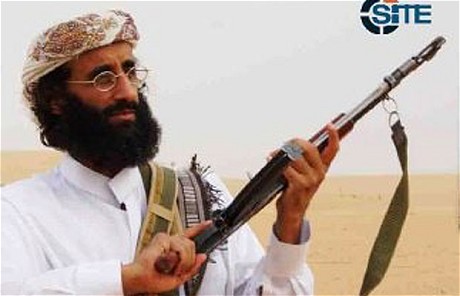
Fighting a World Wide Insurgency Part Two: The changing nature of War and the Justified Killing of Anwar al-Awlaki

This is a belated follow up to my article Fighting a World Wide Insurgency: The Problem Fighting Revolutionary Terrorists and Insurgents- Part One . It deals with the killing of American born Al Qaeda cleric and propagandists Anwar al-Awlaki and Samir Khan by U.S. Forces in Yemen.  There is controversy in the American media, body politic and among U.S. based civil rights groups such as the ACLU.  My premise is that the killing of Awlaki and Khan was justified because of their actions and because the nature of warfare itself has changed radically since the current “Law of War” contained in the Geneva and Hague conventions the U.N. Charter and other international law standards were laid down.  The were all written with the nation state in mind, not apocalyptic terrorists that recognize no borders do not differentiate between civilians and military targets and have not regard for citizenship either their own or that of others.  Alan Dershowitz the noted jurist, legal scholar and civil libertarian wrote “The great American justice Oliver Wendell Holmes Jr once remarked that “it is revolting to have no better reason for a rule of law than that it was laid down in the time of Henry IV. It is still more revolting if the grounds upon which it was laid down have vanished long since, and the rule simply persists from blind imitation of the past.”

Awlaki and Khan were not mere criminals they were enemy combatants and the fact that they were not on a recognizable battlefield when targeted is irrelevant.  They played games with their citizenship, never officially renouncing it even as they did everything that they could from a propaganda point of view to wage war against their country and incite others including members of the U.S. Military to kill Americans. Yes, they were combatants waging war and not “victims” of an “assassination” ordered by the President.  They knew they were at war and said so quite openly.  The provided aid and encouragement to those that killed American soldiers at FortHoodand attempted to bring down a Delta Air Lines jet on Christmas Day 2009.  Derschowitz commented on the kind of strike used to kill Awlaki and contrasted it with terrorism saying “A targeted assassination is exactly the opposite of terrorism. Terrorism is untargeted assassination — you just throw a bomb in a cafeteria and you get everybody. Targeted assassination is designed to be very precise and very specific.”

Awlaki, Khan and their fellow Al Qaeda travelers fight a different kind of war than we in the West are comfortable waging. They fight a war where they make no distinction between soldiers and civilians and do not recognize the borders of sovereign nations.  Al Qaeda has defined the battlefield and it is not confined to Iraq or Afghanistan.  Using secure bases of operations in nations that are officially our “allies,” they have been able to place themselves safely out of harm’s way until the past year while planning, training and propagandizing new recruits into their terrorist cause.

Awlaki stated his opinion succinctly about the kind of war he was waging in an interview in early 2010:

“Yes. With regard to the issue of ‘civilians,’ this term has become prevalent these days, but I prefer to use the terms employed by our jurisprudents. They classify people as either combatants or non-combatants. A combatant is someone who bears arms – even if this is a woman. Non-combatants are people who do not take part in the war. The American people in its entirety takes part in the war, because they elected this administration, and they finance this war. In the recent elections, and in the previous ones, the American people had other options, and could have elected people who did not want war. Nevertheless, these candidates got nothing but a handful of votes. We should examine this issue from the perspective of Islamic law, and this settles the issue – is it permitted or forbidden? If the heroic mujahid brother Umar Farouk could have targeted hundreds of soldiers, that would have been wonderful. But we are talking about the realities of war.” Anwar a-Awlaki comments in interview supporting attempted downing of Delta Air Lines flight on Christmas Day 2009 http://www.memri.org/report/en/0/0/0/0/0/0/4202.htm

The United States killed two men who though technically a “citizens” were declared enemies of theUnited States. By his own words and actions Awlaki declared war against the land of his birth and the land that blessed him with an education that he used for years to encourage other Muslims, especially American Muslims to kill Americans wherever they are found.

The method of his killing appears to be by a targeted drone strike on his hide out in Yemen.  His killing has been condemned and it’s legality questioned by a good number of people including Republican Presidential candidate Ron Paul.  On the surface I can see their concerns.  Any reader of this site knows that I am on the whole with very few exceptions very much a civil libertarian and some will call me a hypocrite but I am okay with that.  The fact is that I do not want our government to be engaged in activities that violate the constitutional rights of Americans anywhere in the world.  Nor do I want to see Awlaki’s killing used as precedent in killing American citizens not engaged in acts of war against the United States. Critics have contended that Awlaki had not broken the law and that his killing in a country that we are not at war with made the act an illegal assassination under the 5th Amendment while ignoring his goal of mobilizing Muslims worldwide, but especially American Muslims to kill Americans at home and abroad. However even criminal courts in the United States recognize that a person that encourages murder can be charged as an accomplice or even co-conspirator as Awlaki was to the mass murderer of Fort Hood Major Nidal Hussein.

However those that decry Awlaki’s killing ignore his words that “we have to establish an important principle: Jihad is global. It is not a local phenomenon. Jihad is not stopped by borders or barriers; they cannot stand in the way of Jihad. Jihad does not recognize the colonial borders that were made in the countries in the past that were drawn by a ruler on the map; Jihad doesn’t recognize those superficial borders.” (Chapter 3: Constants on the Path of Jihad)  The critics of Awlaki’s killing as well as that of Osama Bin Laden and other men that describe themselves as combatants in a war against the United States all encourage the killing of every American because “all Americans are guilty.”   Awlaki’s fellow “American” terrorist companion Samir Khan who was killed with him in the attack wrote “I am a traitor to America because my religion requires me to be. We pledge to wage jihad for the rest of our lives until either we implant Islam all over the world or meet our Lord as bearers of Islam.”

Dershowitz noted that weapons of mass destruction in the hands of suicide terrorists with no fear of death and no home address have rendered useless the deterrent threat of massive retaliation. This threat has been the staple of military policy since the days of the Bible. Because suicide terrorists cannot be deterred, they must be pre-empted and prevented from carrying out their threats against civilians before they occur. This change in tactics requires significant changes in the laws of war – laws that have long been premised on the deterrent model.”

Yes by law Awlaki was still an American citizen at the time of his death. Despite his many calls for the destruction of this country and the killing of its citizens he never went to an Embassy or Consulate to officially renounce his citizenship and thus was still a citizen.  The fact that Awlaki was a leader and propagandist for Al Qaeda on the order of what Josef Goebbels was to the Nazis is lost in the debate.  The uncomfortable truth is that an “American” citizen Awlaki had for all recognizable purposes renounced his citizenship, and under most historical and legal precedents in the United Statesand Europe Awlaki forfeited his rights as such.

This country has revoked the citizenship of citizens for taking up arms against this country to include all officers who left the U.S. military and former government officials that took up prominent positions in the Confederate armed services and government.  They lost their citizenship rights and all had to reaffirm their allegiance to the Union to receive pardons.  Some did not and some such as the commandant of the Andersonville prisoner of war camp were executed for their crimes against other U.S. citizens.

The fact that he hid among his family’s tribal homeland inYemenis also held out as a reason that Awliki’s killing was illegal.  However Awlaki did not recognize the borders that some say should offer him protection and in my view it is unreasonable for theUnited Statesto be bound by conditions that our adversaries do not acknowledge.

The fact is that Al Qaeda and other terror groups have redefined warfare and that many of our long held notions about the nature of war are obsolete.  Al Qaeda and other militant groups understand the concept of revolutionary warfare in ways that are distinctly uncomfortable for us in the West. We talk about counterinsurgency in Afghanistanand Iraq without realizing that the actual insurgency is worldwide and not bound by our constraints.  One of the key components of revolutionary warfare is propaganda which is exactly what Awlaki and Khan were doing.  They betrayed their country, inspired who knows how many radicals to kill Americans around the world including the infamous Major Nidal Hasan who Awlaki described as a hero. He is a man of conscience who could not bear living the contradiction of being a Muslim and serving in an army that is fighting against his own people…My support to the operation was because the operation brother Nidal carried out was a courageous one.”

Roger Trinquier a French officer who served in both Indo-China and Algeria recognized this method of operation in his book Modern Warfare: http://www.cgsc.edu/carl/resources/csi/trinquier/trinquier.asp:

“Warfare is now an interlocking system of actions political, economic, psychological; military that aims at the overthrow of the established authority in a country and its replacement by another regime.  To achieve this end, the aggressor tries to exploit the internal tensions of the country attacked ideological, social, religious, economic, any conflict liable to have a profound influence on the population to be conquered.”

Unfortunately many in political and media elite as well as some civil libertarians like the ACLU are still acting if it was 1944 and there are clear lines that divide nations as well as military personal from civilians.  But for the terrorist this is not the case, Trinquier states the matter very well:

“But the case of the terrorist is quite otherwise. Not only does he carry on warfare without uniform, but he attacks, far from a field of battle, only unarmed civilians who are incapable of defending themselves and who are normally protected under the rules of warfare. Surrounded by a vast organization, which prepares his task and assists him in its execution, which assures his withdrawal and his protection, he runs practically no risks-neither that of retaliation by his victims nor that of having to appear before a court of justice. When it has been decided to kill someone sometime somewhere, with the sole purpose of terrorizing the populace and strewing a certain number of bodies along the streets of a city or on country roads, it is quite easy under existing laws to escape the police.”

Likewise the critics seem to assume that the people plotting and waging war against the United Statesand the West are poor conscripts that do not have a choice in what they are doing but they are not. Most of the leaders including Awlaki, Khan and Osama Bin Laden were the educated children of privilege as is Adam Yahiye Gadahn an American convert to Islam who like Awlaki and Khan has devoted himself to jihad against his native land. Gadahn who has been indicted on the charge of treason makes no bones about his hatred for the United Statesin a 2004 video saying “Fighting and defeating America is our first priority….” In 2009 he praised Nidal Hassan as “a pioneer, a trailblazer and a role-model who has opened a door, lit a path and shown the way forward for every Muslim who finds himself among the unbelievers.”

Yes this is an ugly conflict and it is far different than any war we have every faced. It will mean having to come to terms with methods and tactics that are effective in carrying the war to the enemy, even enemies that we have allowed to retain their citizenship even as they wage war against us.  Critics that think this war will be won or lost on the battlefields of Iraqor Afghanistanand those who condemn the killing of Awalki and Khan misunderstand the shape of warfare in the 21st century.

Trinquier and others understood this and we have to adapt if we are to defeat this world wide insurgency.  On so vast a field of action, traditional armed forces no longer enjoy their accustomed decisive role. Victory no longer depends on one battle over a given terrain. Military operations, as combat actions carried out against opposing armed forces, are of only limited importance and are never the total conflict.”

Awlaki and Khan understood what they were doing and were prepared to die to achieve their goals which they did.  I suppose that we could have risked the lives of more American troops on the ground to track them down and attempt to capture or kill them deep inside hostile territory as we did with Bin Laden.  However, such operations are so risky that they cannot be allowed to become commonplace.

Likewise even as we step up the use of drones and special operations forces and scale back in the manpower intensive theaters of Iraq and Afghanistan we must embrace the role of the media propagandizing the truth. We must define the message and not allow future Awlaki’s and Khan’s to set the narrative of the war. We must use all available media and communications technology to our advantage and not surrender that realm of operations to whomever Al Qaeda appoints to replace Alwaki and Kahn in their propaganda minister role.

It is clear that  Geneva and Hague conventions, the U.N. Charter and aspects of the U.S. Code including citizenship provisions need to be revised in light of the changing nature of war.  If they are not we will always be constrained by those rules even as terrorists use those protections as part of their overall strategy.  To counter such actions we cannot be bound by common law written at the time of Henry IV or laws that never envisioned the kind of war being waged by our enemies.  Dershowitz wrote:

“Laws must change with the times. They must adapt to new challenges. That has been the genius of the common law. Ironically, it is generally the left that seeks change in the laws, while the right is satisfied with Henry IV. Today it is many on the left who resist any changes in the law of war or human rights. They deny the reality that the war against terrorism is any way different from conventional wars of the past, or that the old laws must be adapted to the new threats. The result is often an unreasonable debate of extremes: the hard left insists that the old laws should not be tampered with in the least; the hard right insists that the old laws are entirely inapplicable to the new threats, and that democratic governments should be entirely free to do whatever it takes to combat terrorism, without regard to anachronistic laws. Both extremes are dangerous. What is needed is a new set of laws, based on the principles of the old laws of war and human rights – the protection of civilians – but adapted to the new threats against civilian victims of terrorism.” Article in “The Independent” 3 May 2006

From a more military standpoint Trinquier noted:

“In seeking a solution, it is essential to realize that in modern warfare we are not up against just a few armed bands spread across a given territory, but rather against an armed clandestine organization whose essential role is to impose its will upon the population. Victory will be obtained only through the complete destruction of that organization.

That complete destruction of such an organization begins with its leaders including its propagandists, even those that are American citizens.  Some will disagree with me on this but this war has been going on over 10 years and will not end when we withdraw from Iraq and Afghanistan. The killing of Osama Bin Laden and the intelligence garnered in the raid on his Pakistani compound was a watershed moment and has shifted momentum to the United States and its allies.  Al Qaeda’s senior leaders are being killed in ever increasing numbers with substantially fewer civilian casualties.  But we can lose it all if we fail recognize that the very nature of war has changed and that if we remain tied to law and policy written when the world in no way resembled what it is today.

Padre Steve+

P.S.  For those wondering what a Priest knows about this I hold a Masters degree in Military History and a graduate of the U.S. Marine Corps Command and Staff College. I have also studied revolutionary war and insurgency extensively since 2001.  I served with our advisers to the Iraqi Army, Police and Border and Port of Entry Police in 2007-2008. 

2 Comments

Filed under laws and legislation, middle east, Military, national security

Fighting a World Wide Insurgency: The Problem Fighting Revolutionary Terrorists and Insurgents- Part One

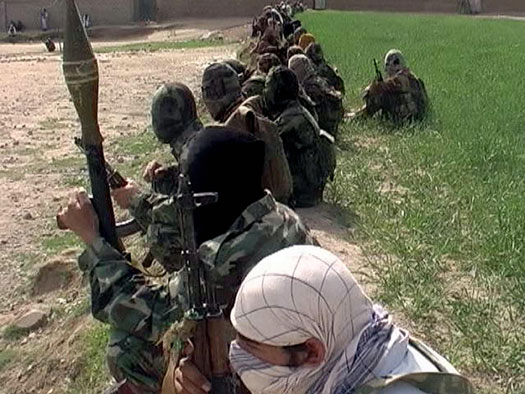
Taliban Insurgents

“Warfare is now an interlocking system of actions political, economic, psychological; military that aims at the overthrow of the established authority in a country and its replacement by another regime.  To achieve this end, the aggressor tries to exploit the internal tensions of the country attacked ideological, social, religious, economic, any conflict liable to have a profound influence on the population to be conquered.” Roger Trinquier Modern Warfare

The United State and our allies have been at war with Islamic terrorists as well as nationally based insurgencies for over nine years.  The war that we are fighting is not like the Second World War where we fought a conventional war against enemies that were defined by national, political and geographic boundaries.  That war as well as the First World War and most recently the 1991 Gulf War but rather is a global insurgency in which we are pitted against a number of sometimes disparate groups One of the things that seems to be misunderstood by much of the media as well as the public

Muslim terrorist groups they use some tenants of Islam, mostly from the Wahabi school that emerged on the Arabian Peninsula in the late 1700s to justify what they do. Hezbollah and the Iranian Revolutionary Guard use the Islam taught by the school of the Ayatollah to do the same.

However that being said there are a sizable number of Muslims worldwide that oppose the terrorists and their brands of Islam but still can be offended and driven to the other side by Americans doing just what pastor Jones got started. The radicals take this and use it as propaganda against us.

The fact is that it is all about using propaganda effectively and not giving the terrorists the grist they need to use against us. The terrorist or the insurgent has no need to tell the truth and usually will not and will twist any “truth” to his own end. This is true in every revolutionary war, which is what all of these groups are waging. They are fighting to turn all of Islam and anyone else they can against us. This is the case since the beginning of time and not limited to Muslims.

We as Americans have been pretty lousy at this except when we were the revolutionaries. It is a fact, not just with the Muslims but all revolutionaries that since they are on the weak side of the military equation that they use propaganda, especially what any of our people do to radicalize people on the fence against us. Jones and others played into their hands and by doing so jeopardize the mission and endanger our troops. The fact is that we neither have the resources or people to allow this to become a war against all of Islam. Thus we have to exploit natural divisions and cultural divides in the Moslem world to isolate and neutralize the radicals of Al Qaeda, Hamas, the Taliban, Hezbollah and the Iranian Revolutionary Guard.

It may seem on the surface to be politically correct appeasement but a true strategic purpose is served. The counter-insurgent cannot do what the insurgent can as they will lose the propaganda war and with it the broader war. We are fighting a world-wide revolutionary war against Moslem fundamentalist extremists that want us to make it a war against all of Islam. If that were to be the case we would have to go to a total war footing, ignore our own economy renew the draft and prepare for a war that in the long run we cannot win and will leave us as broken as Germany after WWII.

The problem with Islam as that for the most part much of Islam especially in the Middle East still lives in the 14th century with fancy technology. They did not have the Renaissance, Reformation or the enlightenment thus the appeal of the fundamentalist sects and radical Islam. That makes our job hard and that of Bin Laden easy as their world-view  promotes a black and white understanding of the world which makes recruitment of youthful idealists easy especially when the conflict is framed as against “Crusaders” or “Imperialists” opposed to Islam.

The war that we are engaged in is not conventional and we do not have a good record in recent times of fighting this kind of war. We lost in Vietnam because we ignored this. We won all the battles and lost the war. Despite what some pundits believe this is not like WWII and no new incarnation of George Patton will win it.

As I said we are engaged in a revolutionary war which is different than other types of war. In revolutionary wars the revolutionary no matter what his cause is able to use propaganda to influence opinion, usually of people that they are trying to bring to their side. Our founders were very good in portraying the British as violent and brutal occupiers. We used British excess especially in Boston and in the South against them very well. The Jihadists are promoting a revolutionary cause, that cause being the overthrow of established governments in the Middle East and bringing about a radical and fundamental brand of Islamic rule. This happened in Iran and after 30 years the young people are beginning to revolt against the Ayatollahs. It is also revolutionary because they are actively promoting the overthrow of established states and have a goal of establishing their brand of Islam over the entire world. The use revolutionary techniques and strategies used successfully by other revolutionaries attempting to control the populations where they operate through both terror and by discrediting unpopular or corrupt governments.

One of the problems that we in the United States have in understanding Al Qaida and other Islamic groups that rely on terrorism as their primary means of conducting warfare is the nature of the terrorist himself.  Roger Trinquier who observed and fought against such groups in the 1940s and 1950s wrote one of the fundamental books on this type of warfare.  Trinquier said something that will undoubtedly be taken wrong by some readers of this essay but if one understands the nature of Revolutionary war has been true going back for centuries and is not confined to militant Islamic Fundamentalism.   Trinquier observed that “the terrorist should not be considered an ordinary criminal.  Actually he fights within the framework of his organization, without personal interest, for a cause he considers noble and for a respectable ideal, the same as soldiers in the armies confronting him.”

One can see how this is demonstrated in history in such disparate groups as the Israeli Irgun fighters who used terrorist tactics from 1931 until the founding of the state of Israel in 1948 against the British occupiers, the Irish Republican Army.  This is even part of the American experience in the post Civil War South of the Reconstruction era.  Then many Southern whites organized into guerrilla terrorist units such as the Klan in Tennessee, the Red Shirts in South Carolina, the Knights of the White Camellia in Louisiana, the Young Men’s Democratic Club in Florida in order to attack anyone associated with Reconstruction. Their targets included newly free blacks, carpetbaggers, Scalawags, teachers from the North, Freedmen Bureau officials, northern troops, and Republicans.  If you read their writings or even query their current day descendants you will find that none believed that they were criminals and their actions, while unacceptable to many were justified.  One does not have to agree that the terrorists cause is right to acknowledge that terrorists believe this to be true.  Thus in fighting the terrorist organizations one has to employ a wide variety of tactics to protect the populations targeted by terrorists to include police, limited military involvement, the use of propaganda, and “soft” methods to provide aid to these populations and isolate the terrorists from them.

The current batch of Jihadists are actually fairly disparate and not necessarily allies as we found out in Iraq where Al Qaeda and the foreign fighters turned the population of Al Anbar Province against them and brought that Sunni population to our side. They also have sometimes conflicting goals or limit their cause to local areas. The Sunni and the Shi’a have a hard time working together so while this is a global revolution it is not monolithic. Thus if we are smart we can exploit natural divisions in these groups. To do so we have to play smart in how we fight them recognizing that the “soft” approach often is better as the French found out too late in Vietnam but did well with in Algeria. See books by David Galula “Counterinsurgency in Algeria 1956-1954” “Counterinsurgency Warfare”, Roger Trinquier’s “Modern Warfare” as well as the book by Alister Horne “A Savage War of Peace” all are excellent reads. Bernard Fall’s book “Street Without Joy” is a good study of how this happened in French Indochina. The US Counterinsurgency Manual is available online or in bookstores as is “Learning to Eat Soup with a Knife” by John Nagl, a major writer of US Counterinsurgency doctrine.

US Advisors with Afghan Army Officers

In a world-wide insurgency even actions which seem logical to Americans at home can be detrimental to US Forces and political goals in Afghanistan, Pakistan, and Iraq and throughout the Muslim world. I’m not a fan of the Mosque near the World Trade Center even though it is the equivalent of 6 normal city blocks away and not visible from the site. Many Americans if not an outright majority oppose this building project yet the builders don’t seem to understand the raw wounds that the project has opened for many Americans. I’m sure for them that much of it is a business, they are developers in New York City and the land was available. Yet the project can quite rightly be seen as insensitive because of what it means to the victims.

At the same time politicians and protesters by naming it the “Ground Zero Mosque” has raised its propaganda value exponentially, that is why Hamas and Hezbollah have also raised the ante in their talk about it. Thus what was an annoyance and hurtful to the victims has become a propaganda victory for the terrorists. In a sense we have let our collective outrage play into the terrorist’s hands. When he pastor of a small church in Florida threatened to burn a large number of copies of the Koran he helped ignite a firestorm of protest in many parts of the Islamic world especially in the epicenter of our current struggle in Afghanistan and neighboring Pakistan.

We are at war with the warlike highly militant strains of Islam and trying to keep the more Western leaning peaceful variants on the sidelines or enlist them to our side. This is a hard path for our leaders to walk as President Bush found out and President Obama is finding out is that most Americans don’t see it that way.  To many Americans all of Islam is the enemy and nothing can change that and the heated passion of our population often plays into the hands of our enemies.  Thus both Presidents’ comments about Islam have usually fallen on deaf ears and both have been excoriated for straddling this fence.

Anyway as you gather I have spent a considerable amount of time studying this type of warfare. I admit that this is pretty unusual for a chaplain, but I also have a Masters degree in Military History as well as the Marine Corps Command and Staff College. When I was in Iraq I knew more than many Marine and Army officers about fighting this type of war. Kind of weird I know but what can I say?

One of the most famous and successful practitioners of Counterinsurgency Warfare was French Colonel David Galula.  Galula in a sense is the “voice crying in the wilderness” of counterinsurgency doctrine and his methods have been used with some measure of success during the “Surge” in Iraq and the “Anbar Awakening” which turned the tide of the Iraqi insurgency.  Galula commented about terrorist tactics, tactics that have not changed in either Iraq or Afghanistan:

“The rebels realized that they could achieve the greatest psychological effect on the French and on world opinion at the cheapest price by stepping up terrorism in the main cities, notably in Algiers, which served as headquarters to most French and foreign correspondents and thus acted as a natural amplifier. A grenade or a bomb in a café there would produce far more noise than an obscure ambush against French soldiers in the Ouarsenis Mountains.” Galula “Counterinsurgency in Algeria”

One of the most frustrating aspects for military and police personnel fighting insurgencies that employ terrorist tactics is that quite often superior forces cannot finish off the insurgents. Galula provides an answer to this question.

“Our forces were vastly superior to the rebels. Then why couldn’t we finish with them quickly? Because they managed to mobilize the population through terror and persuasion . . . It was therefore imperative that we isolate the rebels from the population and that we gain the support of the population.  This implied that under no circumstances could we afford to antagonize the population even if we had to take risks for ourselves in sparing it.”

This is a lesson that we have not always learned as incidents such as the Abu Ghraib torture and most recently a series of targeted killings of Afghan civilians by a squad of Army Soldiers in Afghanistan in which they allegedly planned the killings in advance and kept body parts of their victims.  Unfortunately atrocities like this as was demonstrated at Mei Lai in Vietnam do little to the enemy and everything to turn the populations that we are trying to protect and world opinion against us. It also provides grist for the terrorist propaganda purposes and aids him in recruiting more insurgents to his cause.

Galula recognized the quandary that commanders of police and military units involved in counterinsurgency operations face when dealing with populations where terrorists operate. Galula was a realist about this and noted “If we distinguish between people and rebels, then we have a chance. One cannot catch a fly with vinegar. My rules are this: outwardly treat every civilian as a friend; inwardly you must consider him as a rebel ally until you have positive proof to the contrary.” This may seem contradictory but the concept was used by Ronald Reagan during the Cold War using the term “trust but verify” in relationship to the Soviet Union and arms control.

David Kilcullen an Australian Army Lieutenant Colonel and counterinsurgency expert and advisor to General David Petreus noted

Colonel Dennis Drew writing in 1988 understood the linkage of all parts of insurgency and how well an insurgency represents the essence of the thought of Prussian theorist Carl von Clausewitz: “Although theorists consider insurgent warfare to be anti-Clausewitzian, such warfare is the very embodiment of the Prussian master’s most famous dictum. Insurgency represents the total integration of political and military factors, but with political factors always in complete domination.” (INSURGENCY AND COUNTERINSURGENCY American Military Dilemmas and Doctrinal Proposals- Air University Press Maxwell Air Force Base, Alabama 1988)

Thus attempting to fight an insurgency and terrorist groups thinking that one can defeat them in the style of world War Two, as is so often espoused by pundits and amateur military theorists that crowd the airwaves and cyber space is foolish and only leads to the defeat of the counter-insurgent and the loss of the population targeted by the insurgent. The wars in Afghanistan and Iraq are not conventional wars and the political outweighs the military in every respect.  As Drew noted:

“Although the military aspect of the struggle may ebb and flow, the source of insurgent strength–a covert political infrastructure–remains constant. This infrastructure, the bitter fruit resulting from the perceived political and economic inequities sown much earlier, is the most important ingredient in the insurgent recipe for success. The political infrastructure performs at least six major functions vital to the survival, growth, and eventual success of the insurgency: (1) intelligence gathering and transmission; (2) provision of supplies and financial resources; (13) recruitment; (4) political expansion and penetration; (5) sabotage, terrorism, and intimidation; and (6) establishment of a shadow government.”

This is exactly what has happened in Afghanistan and why we have such difficulty in fighting the insurgency.

One of the most common tactics that the United States has attempted in attacking the insurgents is the strategy of decapitation. In this the U.S. has attempted to kill the leaders at the top echelons of the insurgency with limited success. Even when we kill off a senior Al Qaida or Taliban leader others rapidly take their place with little affect in their operations against us. Galula recognized the fallacy of this approach in Algeria when the French government succeeded in capturing five top leaders of the Algerian rebellion. “Then, five top leaders of the rebellion, including Ben Bella, had been neatly caught during a flight from Rabat to Tunis. Their capture, I admit, had little effect on the direction of the rebellion, because the movement was too loosely organized to crumble under such a blow.” The lesson here is that should we ever succeed in capturing or killing Osama Bin Laden or Mullah Omar that this will not lead to victory unless we are able to protect the population of Afghanistan.

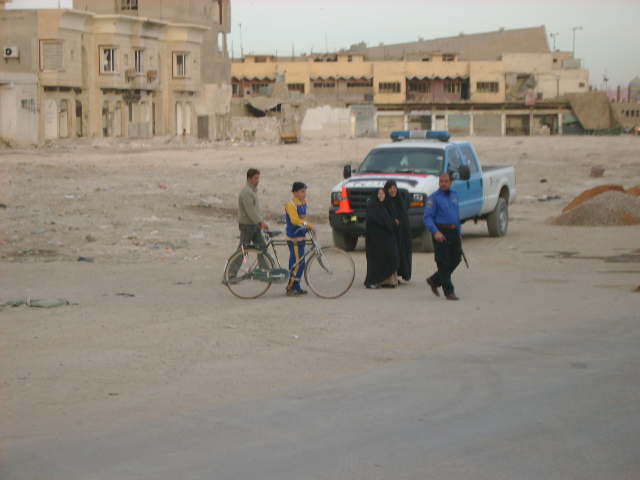
Protecting the population Iraqi Police and Civilians in Ramadi

To do this the population must come to our side because they know that we will stay the course and that we can be counted on to help them.  This cannot just be the military aspect of protecting them against the terrorists as well as economic and political reforms that is consistent with their traditional way of life which is not necessarily consistent with Western political and social traditions or practices. In fact the difficulty for the United States and NATO in Afghanistan is the political struggle on the home front where as Drew states:

“American military dilemma concerns time, public support, and image. Time is the ally of the insurgent; the longer an insurgent survives, the stronger its chances of growing. Meanwhile, as time drags on, the American military position is weakened by declining support, impatience, and war weariness at home, particularly if there is no perceived progress in the struggle. Maintaining public support is clearly a responsibility of the political side of the equation and involves factors far beyond the battlefield–although military progress is a key ingredient. The connection between the duration of the struggle and public support is the image of the insurgency presented to the American body politic.”

To be continued….

Peace

Padre Steve+

1 Comment

Filed under counterinsurency in afghanistan, History, iraq,afghanistan, Military, national security, Political Commentary

How to Make an Incredibly Difficult War Unwinnable: The Crass Hatred of “Pastor” Terry Jones for Moslems Endangers Americans

“Pastor” Terry Jones

“Warfare is now an interlocking system of actions-political, economic, psychological, military-that aims at the overthrow of the established authority in a country and its replacement by another regime. To achieve this end, the aggressor tries to exploit the internal tensions of the country attacked-ideological, social, religious, economic -any conflict liable to have a profound influence on the population to be conquered. Moreover, in view of the present-day interdependence of nations, any residual grievance within a population, no matter how localized and lacking in scope, will surely be brought by determined adversaries into the framework of the great world conflict. From a localized conflict of secondary origin and importance, they will always attempt sooner or later to bring about a generalized conflict.” Roger Trinquier

“Pastor” Terry Jones of the Gainesville Florida “Dove World Outreach Center” has crossed a boundary in regard to the abuse of freedom of speech and freedom of religion.  While many may vehemently disagree with this religious zealot’s (I cannot honor him with the title of Christian) hatred and bigotry he has a Constitutional right the express his beliefs under the First Amendment.  Unfortunately while the Reverend Jones may believe his beliefs to be the absolute truth and has the Constitutional right both to hold and express those views in any medium that he wishes it does not mean that those expressed views represent the entirety of the Christian faith much less the body politic of the American nation.  Likewise it does not mean that his views while protected free speech cannot be harmful to the interests of the nation and the people that at least in an earthly state are the guarantors of that liberty.  In fact it has become apparent that some individuals and groups can be so convinced of their own “correctness” that in spite of every warning to the contrary that they do all that they can to inflame tensions and undercut the efforts of the military that seeks to preserve those rights.

There are a couple of major issues that I see here and I will not address the Constitutional issues which regardless of how hateful and devoid of reason one’s beliefs may be they are still protected under the First Amendment.  This is settled law and has been applied to a variety of hateful and actually harmful ideologies on both the right and the left.  Thus as idiotic, ignorant, hateful and strategically harmful an argument be, be it religious, philosophical or political as long as it does not impinge of the physical right to life, liberty and property as it might be it is still protected speech.  What bothers me as well as most of the people I know believe about the stated in intentions of the “Reverend” Jones and his flock to be is that not that he has the right to express them, but that he chooses to do so in the knowledge that his actions will very well cost the American military lives in an ongoing war.

We live in the United States and political or religious thought, even hateful and potentially damaging is protected speech.  At the same time there are times that such speech can harm the interests of the county and cost lives.

The “Reverend” Jones is planning to conduct a protest against Islam, a religion that he believes to be “of the Devil.”  Okay, whatever, he has a right to those beliefs.  However, he insists on pursuing a plan to burn hundreds of copies of the Koran, the most sacred book in the Islamic religion despite the fact that the commander of US and NATO Forces in Afghanistan has asked him not to do so, and against the warnings of other US government officials and even over the protestations of other Christian denominations including the Roman Catholic Church, the National Association of Evangelicals and others.  The plan which he has announced on the internet has unfortunately gained the attention and air time of major television news networks has been reported worldwide and has sparked outrage in moderate Islamic nations that have a history of standing alongside the United States against Islamic radicals. In places where U.S. Forces battle Islamic extremists the statements and planned actions of the “Reverend” Jones and his little apostate “church” place American Solders, Marines, Sailors and Airmen in even more danger because his actions turn those that might be for us against us.

The war against Islamic extremists occurs on numerous fronts and is much larger than military operations. In fact military operations will not will the war of themselves. We do not simple face an insurgency in Iraq and Afghanistan but a world-wide insurgency where as Trinquier recognized everything is connected, political, religious, economic, military and ideological. In fact since the advent of the internet and cheap digital video technology the potential for radicals such as Jones to adversely impact U.S. military operations and broader political goals in the war against Islamic extremists has grown exponentially. Who could believe that a “pastor” of a 50 member church who has what best can be described as a “Braveheart” fantasy and fetish that was kicked out of a church that he founded in Germany in 2008 would be able to cause such a stir?” Unfortunately that is the power of the new media.  The internet has provided muckrakers of hate like Terry Jones unlimited potential to get their message out and into the sights of mainline media that survive and thrive on the controversy of such stories which feed the 24 hour news cycle for days on end. Yes, the mainstream media are prostitutes when it comes to stories like this and hopefully when Jones actually conducts his burning of the Koran will ignore him as Secretary of State Hillary Clinton has asked.  Jones may have the Constitutional right and freedom to do this but he does not need to be given any more attention by the media which would work against U.S. policy and endanger Americans, especially the military in harm’s way.

I find Jones’ actions to be treasonous. He may have the “rights” to do this but his actions endanger Americans, not just the military but all Americans by his actions. He quickly redirects the blame for this against Moslems but the fact is that his actions help stir a witch’s cauldron of hate against his own country. He advocates actions against American Moslems which if they were recommended by others against Christians would be enough to provoke outrage that might result in violence in the current poisonous political climate.  Likewise in burning the Koran he stoops to a level that Moslems will not go to against Christians or Jews, that is burning books that they consider holy, even if they do not believe that they contain the full revelation of the Koran. Islamists may burn effigies of our leaders and our flag and even persecute Christians and Jews, but they will not burn or desecrate our either the Bible or the Torah.  In doing what he is doing Jones sinks to a low that even the most insane Islamic extremist will not do.  The sad thing is that despite the murderous terrorism practiced by Al Qaeda and other Islamic extremists, including the attack on the World Trade Center and Pentagon on September 11th 2001and around the world since then, that the most brutal and murderous Moslem terrorist will not burn or desecrate our holy books.  I am sure that given Jones’ theology that if he even had a chance to do more than issue vile statements about Moslems and condemn all Moslems and their religion for the actions of some that he would do so. A man that would willingly conduct an act that most certainly will inflame the Moslem world against the United States, endanger our people as well as his own Christian brethren worldwide would not hesitate to conduct terrorist actions against Moslems if he had the money, organization and backing to do so.

Despite what he claims “Reverend” Jones embodies everything that is unseemly and even un-Christian. He has no sense of civic responsibility and he twists the Christian message so vilely that it is unrecognizable as Christian in any way shape or form. In his ignorant hatred he endangers U.S. Forces and works to make an already difficult war unwinnable as he further inflames Moslems against us. Unfortunately no amount of denunciations by the U.S. Government, military leaders or Churches will undo what will happen if he conducts this action as he has stated that he will on September 11th.  His actions like those of others that have couched the Christian message in hate to fulfill their political agendas stands in opposition to what Jesus himself would do and against the message proclaimed by the early church. His actions hearken to the times that so called “Christians” conducted their own “terrorism” against other Christians, Moslems, Jews and Pagans throughout history and even in recent times.

There are some in this country that espouse similar views to Jones even if they will not burn the Koran. Some of this I know is because of ignorance and some simply because they are reacting to world events on a totally emotional level. I get that. The vast majority of these people, be they Christians or not do not advocate or support the actions of Terry Jones.  At the same time their ignorance about the Moslem and Arab world, portraying it as a monolithic “Islamofacist” threat works against their own country and our attempts to win this war against terrorists. We can fight a campaign against a limited number of terrorists and other enemies in Iraq and Afghanistan so long as we have the majority of the populations of those nations on our side supporting us. However we cannot win those wars if people like Jones through their actions turn those that support us against us.  This is an interconnected war, and like Trinquier said it is all connected. Even little groups like the Dove World Outreach Center and their hate filled delusional pastor can cause us great problems.  We cannot fight the entire Moslem world. Our military as it is stretched to the limit, the protected wars in Iraq and Afghanistan have spent much of our national treasure as well as cost thousands of the lives of our service men and women, those killed, wounded, maimed and those that have the unseen wounds of PTSD, TBI and moral injury.

I do pray that Jones will turn away from this insanity but based on his words and past actions I believe that he has no regard for American treetops or the security of this country. Jones is a menace. He has the right to do what he is doing but in doing so he endangers American lives and makes the job of winning this war that much harder if not impossible. He is an apostate from the Christian faith and a traitor to his own country. I say this as a Christian and a career military officer that remembers 9-11 well and who has deployed twice in support of Operation Iraqi Freedom or Enduring Freedom. I have seen the sacrifice of our Marines, Sailors, Soldier and Airmen, been with the wounded and worked with Iraqi security forces and know their sacrifices.  Jones should be condemned by Americans of all faiths, especially Christians.

Our enemies will use Jones’ actions against us as we would if the situation were reversed. They will use their propaganda networks to use this to poison others against us. Whenever American “Christians” do such idiotic things it makes our job in the military that much harder. Personally I cannot see how anyone that advocates such actions can believe that they are “supporting the troops.”  I see many e-mails forwarded by family friends and others that attack the loyalty of American citizens that disagree with them and especially question the loyalty of American Moslems.  Somehow I recall back in the early years of the Christian Church that the Roman Empire questioned the loyalty of Christians in the empire because they would not acknowledge Caesar as Lord.  I wonder if we truly were Christians and paid Christ more allegiance than our political parties or ideologies rather than use him to buttress our own political parties or allies if we would be considered to be “loyal” citizens. In our country Catholics were considered suspect until at least the 1960s because of their “allegiance” to Rome. Now we do this to Americans citizens who are Moslems and we wonder why these citizens do not speak out more loudly against Islamic extremists. Many have family in Moslem countries that would be in danger if they spoke out and many feel threatened as relatively new immigrants by people like Terry Jones.  They are damned if they do and damned if they don’t.

Jones has stated that he will go ahead with his Koran burning despite the please of General David Petreus in Afghanistan, the U.S. Government and other Christians.  The blood of Americans will be on his hands.

Peace

Padre Steve+

1 Comment

Filed under faith, Foreign Policy, History, iraq,afghanistan, national security, Religion

Tom Hanks on the Pacific War and the Impact of Race in the Pacific War

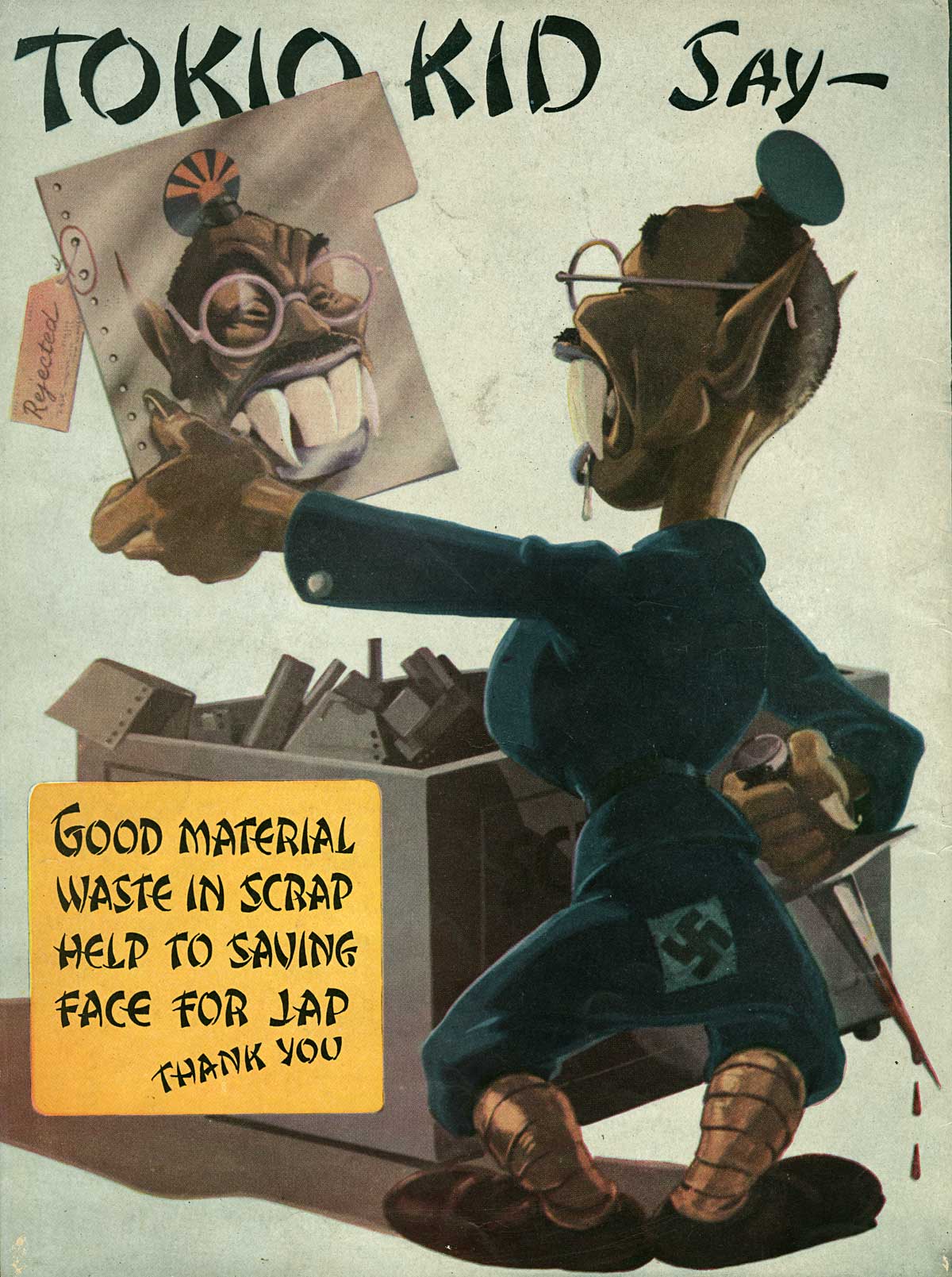
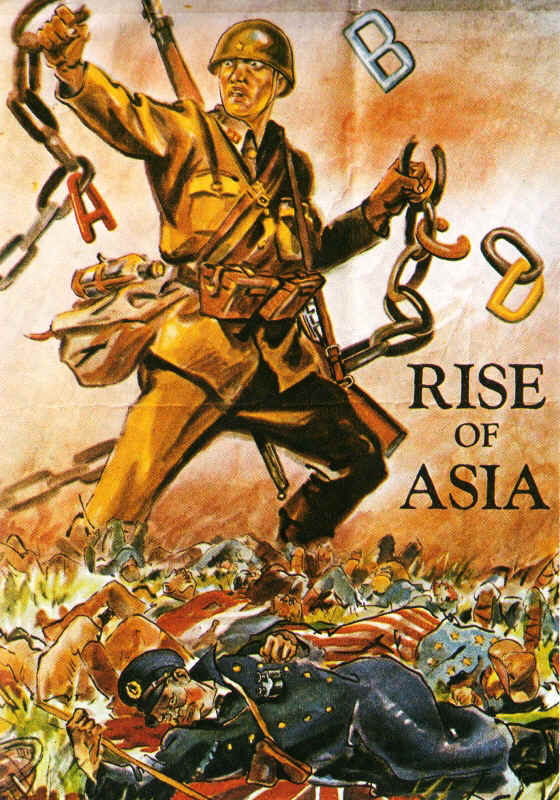
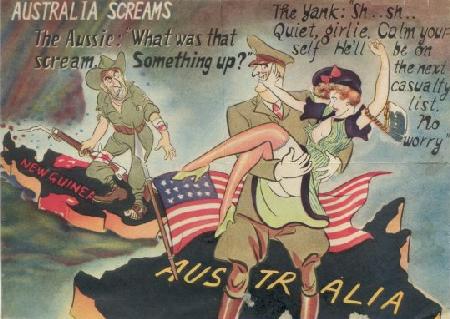
Anti US Japanese Propaganda

This is my third installment of my series background for the new HBO series “The Pacific.” The producer of this series is actor and producer Tom Hanks. Hanks has also acted in “Saving Private Ryan” and produced “Band of Brothers” both of which have been critically acclaimed. Hanks recently ran afoul of his most loyal audience for these productions when he made a very inaccurate comment about the role of racism in the American-Japanese war in the Pacific which he repeated.  Hanks is a great film maker and his work on “Saving Private Ryan” and “Band of Brothers” helped show a new generation the courage and sacrifice of the generation that fought World War Two.

Hanks comments had a bit of truth in them, as racism did play a role in the propaganda of both sides during the war and the manner in which some leaders and soldiers fought it.  However Hanks demonstrated a true lack of objective historical balance as he skewed this into an overall condemnation of the way that the United States prosecuted the War against Japan. Hanks ignored Japanese conduct and responsibility in the conduct of the war and drew a straw man analogy to the current wars in Iraq and Afghanistan. Yes there was racism at work in the Pacific war; it did influence the conduct of the war and the actions of individual leaders and soldiers, but both the American and Japanese were both part of it, this was not a one way street as Hanks seems to indicate.

But what did Hanks say?  Hanks first comment came in an interview with Time magazine:

“Back in World War II, we viewed the Japanese as ‘yellow, slant-eyed dogs’ that believed in different gods,” he told the magazine. “They were out to kill us because our way of living was different. We, in turn, wanted to annihilate them because they were different. Does that sound familiar, by any chance, to what’s going on today?”

Hanks then followed this on MSNBC’s “Moring Joe” with Joe Scarborough where he said:

“‘The Pacific’ is coming out now, where it represents a war that was of racism and terror. And where it seemed as though the only way to complete one of these battles on one of these small specks of rock in the middle of nowhere was to – I’m sorry – kill them all. And, um, does that sound familiar to what we might be going through today? So it’s– is there anything new under the sun? It seems as if history keeps repeating itself.”

To be fair there was a significant amount of racism but involved but it was rampant on both sides and Japan’s racism not only included American and British but most of the rest of Asia and in many places they waged a war of extermination against the Chinese and others who resisted them.  Much of the American attitude was based upon the widespread publicity of Japan’s brutal campaign against the Chinese, a people that many Americans harbored an affinity for at that time.  Likewise the attack on Pearl Harbor influenced the way that Americans thought of Japan. The Japanese frequently appealed to anti-colonial feelings of territories that the conquered ignoring their own subjugation of local populations.

Since the subject of race has been broached I have re-posted a review of John Dower’s book “War without Mercy: Race and Power in the Pacific War.” The book shows how much racism played a role in the conduct of the war on both sides. However it was not in the manner in which Hanks portrayed it in his interviews as it was a two way street. The war in the Pacific was one of the most brutal “no-quarter” conflicts ever fought and much of this was directly related to the Japanese concept of honor which considered personal surrender cowardly and a loss of face, or believing that showing mercy or treating defeated enemies who surrendered with honor was undeserved.

The comparison of this war by Hanks to the current wars in undeserved. With few exceptions the American military has conducted itself with tremendous restraint often risking its own to ensure that non-combatants are not killed even during firefights and battles.  There are some in the United States who advocate the type of war that we had with the Japanese against Moslems extremist or otherwise and they are among the loudest critics of the military’s prosecution of these wars. Depending on what happens racism has the potential to reemerge as a major factor in this conflict, but at the present Hanks remark can only be called ill-informed and prejudiced in its own right. By doing this Hanks sullies his reputation among the surviving veterans of the “Great Generation” who had to battle a tenacious and proud foe on the “little specks of sand and rock” in the Pacific.
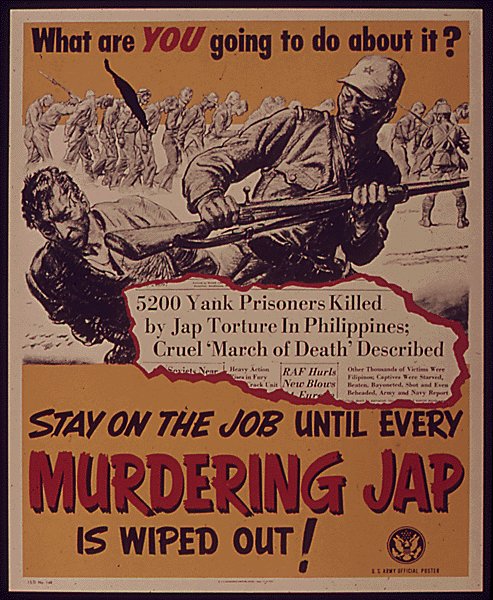
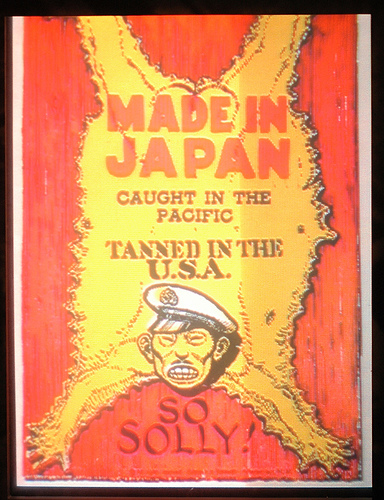
Anti-Japanese propaganda sometimes encouraged “wiping out” every “murdering Jap”

This is a review of John Dower’s “War without Mercy” which I published on this site last year.  It is a book that raises troubling questions about the Pacific war but one that is not one sided.

Peace,

Padre Steve+

Dower, John W. War without Mercy: Race and Power in the Pacific War.” Pantheon Books, a Division of Random House, New York, NY 1986.
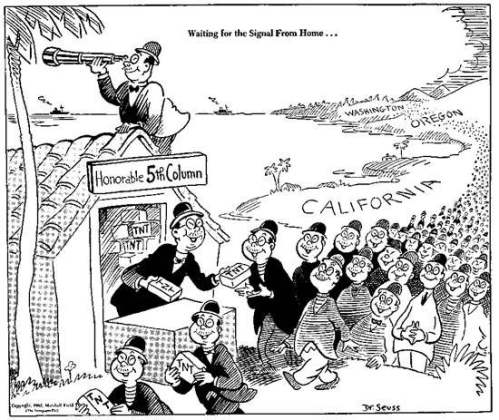
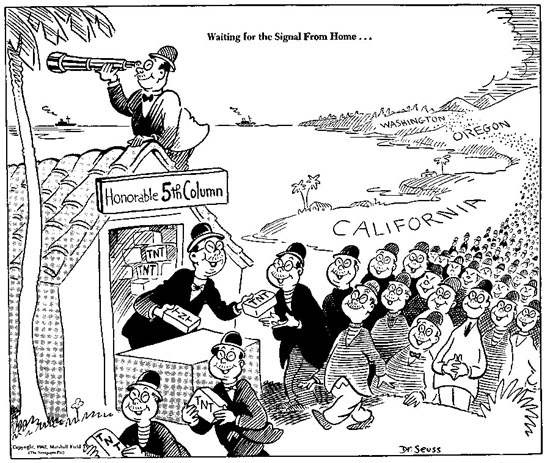
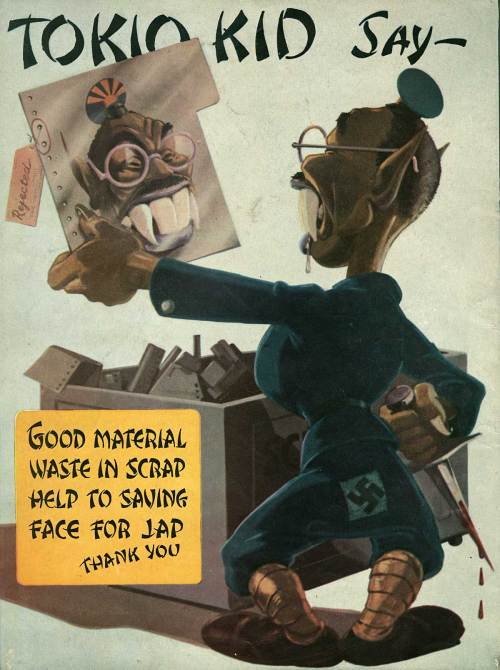
Even Dr Seuss was used to paint the picture of Japanese Americans as traitors

The study of war cannot simply be confined to the study of battles, weapons and leaders. While all of these are important one must as Clausewitz understood examine the human element of policy, ideology and the motivations of nations as they wage war. Clausewitz understood that war could not be reduced to formulas and templates but involved what he called the “remarkable trinity” which he described in on war as (1) primordial violence, hatred, and enmity; (2) the play of chance and probability; and (3) war’s element of subordination to rational policy. Clausewitz connects this with the people being connected to the primordial forces of war, the military with the non-rational elements of friction, chance and probability and the government.
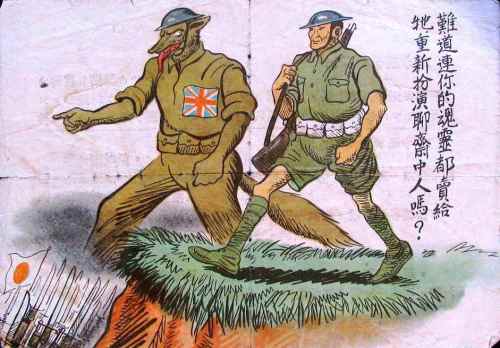
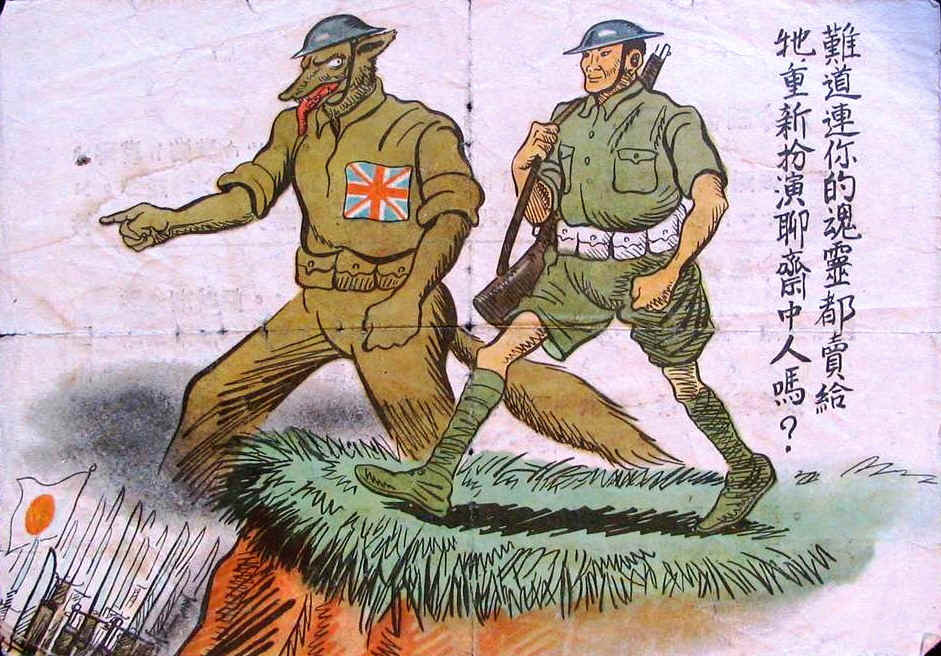
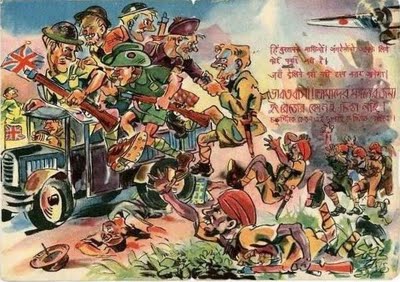
Anti-British Japanese Propaganda leaflet

The Clausewitzian understanding of war is rooted in the Enlightenment and classic German Liberalism, born out of his experience in the Napoleonic Wars, which forever changed the face of warfare.  From the defeat of Prussia and its liberation from Napoleonic rule under Scharnhorst and Gneisenau Clausewitz developed the understanding that war was more than simply tactics and weapons.  Thus when we examine war today we deprive ourselves of properly understanding the dynamic of war if we fail to appreciate the human factor which is frequently not rational.  Such is especially the case when one fights an enemy who wages war on religious, racial or ideological grounds as is the case in the current war against Al Qaida and other extremist Moslem groups. Such groups would like to turn this war into such a conflict as do certain figures in the American political milieu who repeatedly label all of Islam as the enemy.  In such a climate it is imperative to look at history to show us the results of such primal passions.
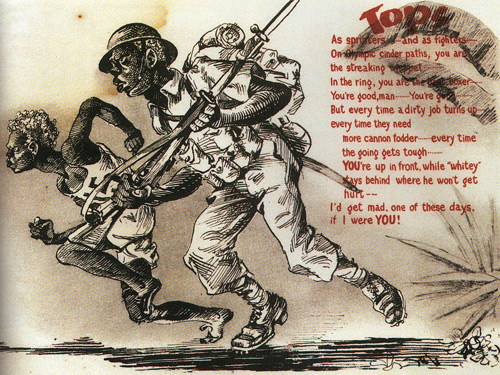

The Japanese made a conscious but unsuccessful attempt to incite African Americans to rise against white America

It is in such conflict as we are engaged in today it is good to look at previous wars from the human experiential component and not simply military operations.  If one wants to look at how inflamed passion driven by racial prejudice and hatred took war to a level of barbarity and totality that defy our comprehension we only need to look back to the Pacific war between Japan and the United States.  In another post I dealt with the how racial ideology influenced Nazi Germany’s conduct of the war against Poland and the Soviet Union.  https://padresteve.wordpress.com/2009/09/14/the-ideological-war-how-hitlers-racial-theories-influenced-german-operations-in-poland-and-russia/

To do this I will look at John Dower’s “War Without Mercy.” In this book Dower examines World War Two in the Pacific from the cultural and ideological viewpoints of the opposing sides.  He looks at the war as a race war, which he says “remains one of the great neglected subjects of World War Two.”[i] Dower examines race hated and its influence on both the Japanese and the Allies, particularly in the way that each side viewed one another and conducted the war.  He examines the nature of racial prejudice and hate in each society, including its religious, psychological, ideological, scientific and mythological components.  He also examines the use of media and propaganda, and how racial attitudes not only influenced national and individual attitudes, but also the military and intelligence operations of both sides.  This book is not about military campaigns, thus it is much more like “In the Name of War” by Jill Lepore[ii] than any history of the Pacific war.
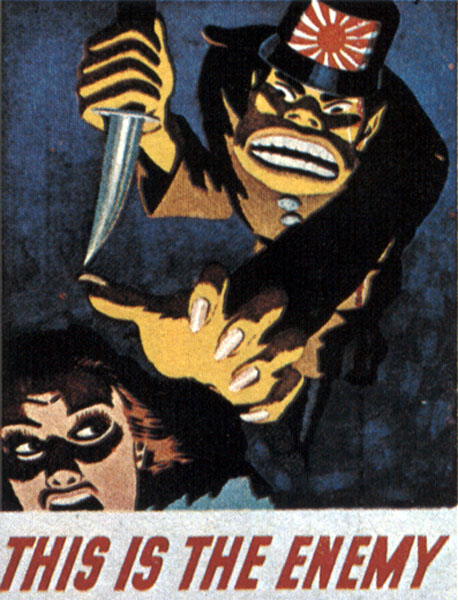
Dower uses sources such as songs, movies, cartoons and various writings of the times to demonstrate the totality of the war.  Dower admits many of these are difficult to handle and “not respectable sources in some academic sources.”[iii] Despite this he puts together a work that is sometimes chilling, especially when one looks at the current war that our country is engaged in. He also endeavors to explain how after a war where “extraordinarily fierce and Manichean”[iv] race hate predominated, it could “have dissipated so easily”[v] after the war was over.
Dower divides his work into three major sections.  The first which examines how the aspect of race effected the fighting of the war, the second, the war through Western eyes and the third the war through Japanese eyes.  The first section begins with how racial attitudes in Western and Japanese societies helped fuel the war and compares similar attitudes and concepts in Western and Japanese thought, including how “prejudice and racial stereotypes frequently distorted both Japanese and Allied evaluations of the enemy’s intentions and capabilities.”[vi] He looks at the language of the conflict; at how war words and race words came together “in a manner which did not reflect the savagery of the war, but truly contributed to it….”[vii] the result being “an obsession with extermination on both sides.”[viii] He comes back to this theme throughout the book comparing the two sides and occasionally contrasting these attitudes with corresponding attitudes of the Allies to their German and Italian foes in Europe.[ix]
In the first chapter Dower examines the role played by the propaganda used by both sides.  In particular he explains how the “Know Your Enemy: Japan” movies commissioned by the War Department and directed by Frank Capra, and the Japanese works “Read this and the War is Won” and “The Way of the Subject” helped shape the view of each side. Propaganda developed the idea of the war in terms of good versus evil and the mortal threat posed to their respective cultures by the enemy.
From this he looks at the visceral emotions that the war engendered and how those emotions spilled over into the conduct of the war especially in regard to its ferocity and the war crimes that were spawned by the unbridled hatred of both sides.  He notes the targeted terror bombings of civilians by both sides and how those actions were portrayed as “barbaric” by the other side when they were the victim.[x] He notes the viciousness of the war and how for the Americans the war brought forth “emotions forgotten since our most savage Indian wars.”[xi] He contrasts this with European war in particular how the Japanese and their actions were portrayed in Western media, and how similar actions by the Germans, such as the Holocaust, were ignored by Western media until the war was over.[xii] He traces some of this to the understanding of the psychological effects of the defeats and humiliations of the Allies at the hands of the Japanese, and the corresponding brutality toward Allied prisoners by the Japanese as compared to that of the Germans.[xiii] He uses this section to also examine the prevailing attitudes of the Japanese toward the Allies as being weak and “psychologically incapable of recovery” from blows such as the Pearl Harbor attack, and the Allied view of the Japanese as “treacherous.”[xiv]
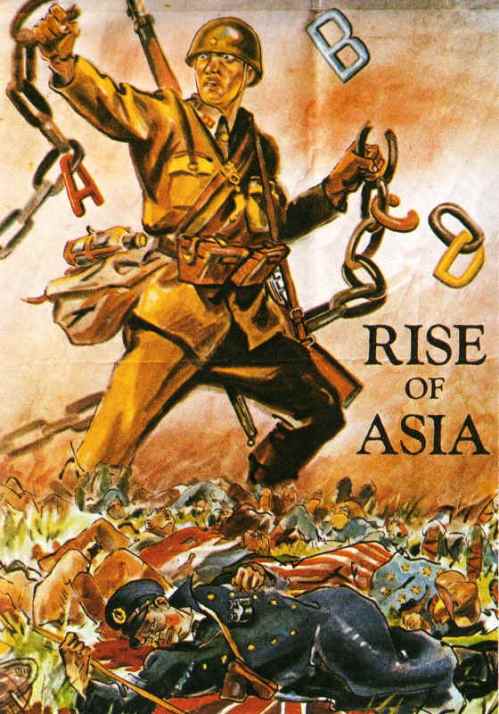
Dower’s second major section describes the attitudes and actions of the Americans and British toward their Japanese enemy.  He looks at the view that the Japanese were less than human and often portrayed as apes or other primates such as monkeys.  To do this he examines cartoons and illustrations in popular magazines and military publications, and includes those cartoons in the book.   The sheer vulgarity of these cartoons is easily contrasted with those promoted and published by Nazis such as Julius Streicher in Der Stürmer, something often overlooked or ignored in other histories.[xv] The early Western views of Japan as sub-human continued throughout the war, while at the same time, especially after the rapid series of Allied defeats and Japanese victories they were viewed as almost “super-human.”  Paradoxically some allied leaders turned the Japanese from “the one time “little man” into a Goliath.”[xvi] They were now “tough, disciplined and well equipped.”[xvii] Ambassador Joseph Grew, reported on his return from Japan, that the Japanese were; “”sturdy,” “Spartan,” “clever and dangerous,” and that “his will to conquer was “utterly ruthless, utterly cruel and utterly blind to the values that make up our civilization….””[xviii] The juxtaposition of such conflicting attitudes is curious, although understandable, especially in light of other Western wars against Asians or Arabs.[xix]
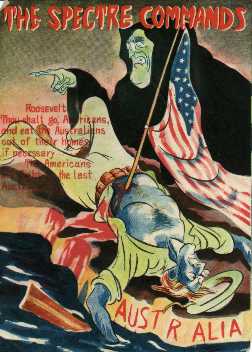
Dower then examines how some Americans and British explained the Japanese “National Character,” their approach to war, and actions during the war from Freudian psychiatry as well as Anthropology and other social and behavioral sciences.   Beginning with the widespread Allied understanding that the Japanese were “dressed-up primitives-or “savages” in modern garb…”[xx] he notes that these interpretations of the Japanese national character stemmed from “child-rearing practices and early childhood experiences,”[xxi] including toilet training and Freudian interpretations that saw an arrested psychic development at the “infantile (anal or genital) stage of development.”[xxii] Dower deduces that it was not hard to see how “Japanese overseas aggression became explicable in terms of penis envy or a castration complex….”[xxiii] The views were widespread and emphasized  that the “Japanese were collectively unstable.”[xxiv] Dower notes that the “very notion of “national character”-was the application to whole nations and cultures of an analytical language that had been developed through personal case studies…”[xxv] which he is rightly critical in suggesting that this premise “was itself questionable.”[xxvi] In addition to this was the understanding of Margaret Mead and others of the Japanese as “adolescents” and “bullies,”[xxvii] and notes that from “the diagnosis of the Japanese as problem children and juvenile delinquents, it was but a small step to see them as emotionally maladjusted adolescents and, finally as a deranged race in general.”[xxviii] Dower cites numerous other “experts” of the time and their interpretations of the Japanese national character, but the overwhelming message is that the application of these theories, regardless of their validity had a major impact on the Allied war against Japan.
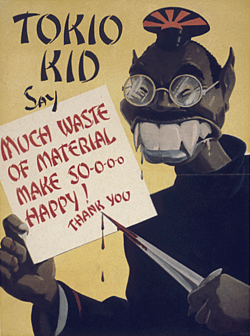
He follows this chapter with one with much importance in explaining the similarities in how Americans and Westerners in general viewed the Japanese in relationship to other races that they had dealt with including Blacks, Chinese, Filipinos, and American Indians.  Common themes include the views of each as primitives, children and madmen and the view of the Japanese as part of the “Yellow Peril.”  Of particular note is his analysis of the work of Homer Lea’s 1909 book The Valor of Ignorance and the vision of Japanese supermen which enjoyed a revival after Pearl Harbor.[xxix] Dower examines depictions of Asians in general in the Fu Manchu and Charlie Chan series of films and other racial aspects hearkening back to the “specter of Genghis Khan and the prospect that the white races “may be liquidated.”[xxx] He notes how Japanese propagandists attempted to use Allied prejudice to influence the Chinese and other Asians against the Allies[xxxi] and American blacks against whites,[xxxii] while attempting to maintain their own racial superiority which is the subject of the next section.

The chapters dealing with the Japanese view of themselves and their opponents tie together neatly.  These deal with the Japanese view of themselves as the leading race in Asia and the world.  Dower talks about symbols and the understanding of racial purity that motivated the Japanese from the 1800s to the rejection of Japan’s request for a declaration of “racial equity” at the League of Nations.[xxxiii] He notes the “propagation of an elaborate mythohistory in Japan and the time spent “wrestling with the question of what it really meant to be “Japanese” and how the “Yamato race” was unique among races….”[xxxiv] He notes the relationship of Shinto with whiteness and purity and connotations of how the Japanese indulged in “Caucasianization” of themselves vis-à-vis other Asians during World War Two,”[xxxv] and their emphasis on a Japanese racial worldview.[xxxvi] He also tackles the way in which the Japanese wrestled with evolution and its relationship to other racial theories contrasting books such as A History of Changing Theories about the Japanese Race and Evolution of Life with Cardinal Principles of the National Polity published by the Thought Bureau of the Ministry of Education in1937.  These declared that the Japanese were “intrinsically different from the so-called citizens of Occidental countries.”[xxxvii] He also deals with the Kyoto school and the Taiwa concept.[xxxviii] In Chapter Nine Dower looks at how the Japanese viewed themselves and outsiders, in particular the characterization of Westerners as nanbanjin or  barbarians and how this eventually train of thought carried through the war led to the “Anglo-American foe emerged full blown as the demonic other.”[xxxix] Dowers final chapter deals with how quickly the race hatred dissipated and genuine goodwill that developed between the Japanese and Americans after the war.[xl]

This book holds a unique place in the literature of the Pacific war.  It is not a comfortable book, it is challenging. No other deals with these matters in any systemic way.  If there is a weakness in Dower is that he does not, like Lepore in “In the Name of War” deal with the attitudes of soldiers and those who actually fought the war.  His examples are good and go a long way in explaining the savagery with which the war was conducted, but could have been enhanced with reflections and accounts of those who fought the war and survived as well as the writings of those who did not, and the way those attitudes were reflected in different services, times and theaters during the war, including adjustments that commanders made during the war.[xli] His description of how Japanese “reluctance to surrender had meshed horrifically with Allied disinterest …in contemplating anything short of Japan’s “thoroughgoing defeat.”[xlii]

The lessons of the book are also contemporary in light of the cultural and religious differences between the West and its Moslem opponents in the current war. Possibly even more so than the war between the United States and Japan which was fought by nation states that still were signatories to international conventions, not nation states against terrorists unbound by any Western code or law or indigenous forces engaged in revolutionary war against the west such as the Taliban.[xliii] The temptation is for both sides to demonize one’s opponent while exalting one’s own way of life through official propaganda and popular media, with a result of increased viciousness and inhumanity in pursuit of ultimate victory.   In today’s world with the exponential rise in the radicalization of whole people groups and the availability of weapons of mass destruction, it is possibility that the war could develop into one that is a racial as well as religious and ideological war that would make the War in the Pacific look like a schoolyard brawl.

Bibliography

Alexander, Joseph H. Utmost Savagery: The Three Days of Tarawa. Ivy Books, Published by Ballantine Books, New York, NY 1995

Dower, John W. War without Mercy: Race and Power in the Pacific War.” Pantheon Books, A Division  of Random House, New York, NY 1986.

Leckie, Robert. Okinawa. Penguin Books USA, New York NY, 1996

Lepore, Jill  The Name of War Vintage Books a Division of Random House, New York, NY 1998

Tregaskis, Richard Guadalcanal Diary Random House, New York NY 1943, Modern Library Edition, 2000.

Notes


[i] Dower, John W. War without Mercy: Race and Power in the Pacific War.” Pantheon Books, A Division  of Random House, New York, NY 1986. p.4

[ii] Lepore, Jill  The Name of War Vintage Books a Division of Random House, New York, NY 1998.  Lepore’s book deals with King Phillip’s War and how that war shaped the future of American war and how it shaped the views of Indians and the English Colonists and their later American descendants both in the language used to describe it, the histories written of it and the viciousness of the war.

[iii] Ibid. p.x

[iv] Ibid. p.ix

[v] Ibid. p.x

[vi] Ibid. p.11

[vii] Ibid.

[viii] Ibid.   Also see Alexander, Joseph H. Utmost Savagery: The Three Days of Tarawa. Ivy Books, Published by Ballantine Books, New York, NY 1995 Alexander notes an incident that shows a practical application of the Japanese views and the ruthlessness inflicted on their enemies, in this case prisoners in response to an American bombing raid. In 1942 the commander of the Japanese Garrison of Makin Island ordered 22 prisoners beheaded after one cheered following a bombing raid. (p.32)

[ix] An interesting point which Dower does not mention but is interesting for this study is how the Germans referred to the British and Americans as “Die gegener” (opponents) and the Soviets as “Die Feinde” (the enemy), the implication being that one die gegener was a common foe, much like an opposing team in a sport, and the other a mortal enemy, the implication of Feinde being evil, or demonic.

[x] In particular he makes note of the Japanese actions during the “Rape of Nanking,” and the 1945 sack of Manila, as well as the fire bombing of Japanese cities by the US Army Air Corps in 1945.

[xi] Ibid. Dower. p.33

[xii] Ibid. p.35

[xiii] Ibid.  This is important in the fact that the Allies tended not to make much of German brutality to the Jews, Russians and other Eastern Europeans.

[xiv] Ibid. p.36.

[xv] Dower does not make this implicit comparison, but having seen both and studied the Nazi propaganda directed toward the Jews, Russians and other Slavic peoples considered to be Untermenschen (sub-humans) by the Nazis the similarities are striking.

[xvi] Ibid. pp.112-113.

[xvii] Ibid. p.113

[xviii] Ibid.

[xix] In the 2006 Israeli invasion of Lebanon, Israeli soldiers who previously showed no respect to any Arab fighter described their Hezbollah opponents as “soldiers and warriors.”  Similar attitudes were voiced by American soldiers in Vietnam when they fought NVA regulars.

[xx] Ibid. p.123

[xxi] Ibid.

[xxii] Ibid.

[xxiii] Ibid.

[xxiv] Ibid. p.124

[xxv] Ibid.

[xxvi] Ibid.

[xxvii] Ibid. p.129

[xxviii] Ibid. p.143

[xxix] Ibid. P.157.  Lea is interesting because he predicts a decline in the stature of the British Empire and softness of both the Americans and British as peoples.  Also see John Costello in The Pacific War 1941-1945 Quill Books, New York, NY 1982 pp.31-32 notes Lea’s concerns and how they drove the American Pacific strategy until the outbreak of World War Two.

[xxx] Ibid. p.161

[xxxi] Ibid. p.169

[xxxii] Ibid. pp.174-180.  This is an interesting section.  One of the most interesting topics being the reaction of the NAACP’s Walter White’s book A Rising Wind published which “suggested a sense of kinship with other colored-and also oppressed-peoples of the world….he senses that the struggle of the Negro in the United States is part and parcel of the struggle against imperialism and exploitation in India, China, Burma….” (p.177-178)

[xxxiii] Ibid. p.204

[xxxiv] Ibid. p.205

[xxxv] Ibid. p.209  This is interesting when one compares the Japanese emphasis on “Pan-Asianism” and the inherent contradiction between the two.

[xxxvi] Ibid. p.211  Dower notes that the article Establishing a Japanese Racial Worldview in the monthly Bungei Shunju “clarified the Japanese character, whose basic traits were brightness, strength and uprightness.  These qualities made the Japanese “the most superior race in the world.”

[xxxvii] Ibid. p.221

[xxxviii] Ibid. p.227 This was the theory of Zen Buddhism’s Suzuki Daisetsu (D.T. Suzuki) in his teaching of the struggle for the Great Harmony “Taiwa” which attempted to identify “an intuitive sense of harmony and oneness that he declared to be characteristic of Oriental thought.”

[xxxix] Ibid. p.247.  Descriptions of the Allies as Barbarians, Gangsters and Demons permeated Japanese propaganda.

[xl] Ibid. Dower makes a number of observations relating to how the Japanese were able to use their own self concept to adapt to their defeat.  He also notes that the Japanese were able to transfer their self concept to a peaceful orientation.

[xli] See Leckie, Robert. Okinawa. Penguin Books USA, New York NY, 1996 p.35.  Leckie quotes General Ushijima “You cannot regard the enemy as on par with you,” he told his men. “You must realize that material power usually overcomes spiritual power in the present war. The enemy is clearly our superior in machines. Do not depend on your spirits overcoming this enemy. Devise combat method [sic] based on mathematical precision-then think about displaying your spiritual power.”  Leckie comments: “Ushijima’s order was perhaps the most honest issued by a Japanese commander during the war. It was Bushido revised, turned upside down and inside out-but the revision had been made too late.”

[xlii] Ibid. Dower. p.37

[xliii] See Tregaskis, Richard Guadalcanal Diary Random House, New York NY 1943, Modern Library Edition, 2000. p.95.  Tregaskis notes when commenting on Japanese POWs on Guadalcanal “We stared at them and they stared back at us. There was no doubt what we or they would have liked to do at that moment-if we had not remembered our code of civilization or if they had not been unarmed.”

2 Comments

Filed under History, world war two in the pacific