Tag Archives: raymond reddington

Ideological Opinion: The Enemy of Knowledge

Friends of Padre Steve’s World,

Salman Rushdie one wrote: “The moment you say that any idea system is sacred, whether it’s a religious belief system or a secular ideology, the moment you declare a set of ideas to be immune from criticism, satire, derision, or contempt, freedom of thought becomes impossible.”

We seem to be at another crossroads in Western civilization, a crossroads where the classic liberalism that was the basis for democratic societies is being stampeded by zealots of various persuasions who guided by the supposed infallibility of their ideological belief systems, deliberately and without remorse seek to destroy the institutions that are the guardians of liberty.

We have seen the results of such movements in history before and each time they succeed in gaining power they have brought disaster to nations, and sometimes the world.

Proponents of ideological purity assume that their ideological bias is equivalent to sacred truth, be it a religious or secular truth. The promoters of such systems promote something more than their opinion, as Hannah Arendt noted: “For an ideology differs from a simple opinion in that it claims to possess either the key to history, or the solution for all the “riddles of the universe,” or the intimate knowledge of the hidden universal laws which are supposed to rule nature and man.”  As such, ideology is not based on knowledge, but is distinct from it and the enemy of knowledge for it binds the mind in a straitjacket in which all thought must be submitted to the truth of the ideology. As Arendt noted such ideologies must be handled with caution as theypretend to be keys to history but are actually nothing but desperate efforts to escape responsibility.”  An ideology protects the believer from having to think for himself, it allows the insecure to grasp at the protection that it allegedly provides, and allows the believer to deny reality, and to by definition declare everything that contradicts the ideology to be heretical, and opponents to be aligned with the devil himself, allowing the believer to hate the opponent. As Eric Hoffer noted, “Hatred is the most accessible and comprehensive of all the unifying agents. Mass movements can rise and spread without belief in a god, but never without a belief in a devil.” 

My favorite television character, Raymond Reddington, played by James Spader in The Blacklist once said “I know so many zealots, men and women, who chose a side, an ideology by which to interpret the world. But, to get up every single day and to do the hard work of deciding what to believe. What’s right, today? When to stand up or stand down. That’s courage.” The fact is, no matter how stridently they espouse their beliefs, ideologues are by definition not courageous, because courage takes critical thinking, something that ideologues of any persuasion are incapable of doing.

It takes no courage to be an ideologue, and once a person surrenders to an ideology as his or her reason for existence, they sacrifice the ability to reason, the ability to think critically, and the capacity to acquire knowledge. That is the danger of the blind ideologies that are consuming our world today.

Until tomorrow,

Peace

padre Steve+

1 Comment

Filed under philosophy

The Courageous vs. the Ideologues 


Friends of Padre Steve’s World,

Being an ideologue of any kind is easy, you adopt an ideology and then use it to interpret the world. That is why there are so many of them of so many different varieties: right wing, left wing, religious and so many more. In fact if you take a look at the most strident supporters of any ideology, politician, or religious leader you can see that they are little different from one another. 

The fact is that there is a difference between people who lean a certain way politically or religiously, and the people Eric Hoffer called, the “true believers,” the people who chose a side and never wrestle with the hard choices of life. They simply declare all who oppose their ideology or theology to be unworthy of life. 

It’s funny, I am a liberal and a progressive, but I often find left-wing ideologues to be as off putting as militant right wingers. I guess that is because despite everything I am a realist. I wake up every day to try to do the hard thing of deciding what is right and what to believe. 

My favorite television character, Raymond Reddington, played by James Spader in The Blacklist once said “I know so many zealots, men and women, who chose a side, an ideology by which to interpret the world. But, to get up every single day and to do the hard work of deciding what to believe. What’s right, today? When to stand up or stand down. That’s courage.” The fact is, no matter how stridently they espouse their beliefs, ideologues are by definition not courageous, because courage takes critical thinking, something that ideologues of any persuasion are incapable of doing. I see examples of this every day, especially in my Twitter feed. While I’m sure that many, if not most of these people are good and well meaning people, they seldom display any originality of thought or true character. I had one left wing Twitter follower attack repeatedly me because to her I was supposedly a sellout. I have had right wing religious friends and followers on social media do the same, but the intellectual commonality they share is the fact that they are ideologues and zealots, and while they espouse different beliefs they are almost indistinguishable in their inability to think critically. 

I guess that is one of the things that bothers me the most about so much of what I see going on in the United States today. Too many ideologues, not enough critical thinkers. Too many people who value absolute consistently of thought without asking if what they preach is still true today, or if it might be tomorrow. 

One thing that I have learned over the past eight years or so is that I have to ask what is right today, and make a choice of when to stand up, or to stand down. Sometimes, I don’t like those choices, but I make them. 

I guess that is why I like reading about the lives of complicated and often conflicted people; men like T.E. Lawrence, William Tecumseh Sherman, and the fictional Raymond Reddington. I find much to admire and to criticize in all of them even as I empathize and understand each one of them. Interestingly, each of my heroes all have feet of clay. As Reddington said, “We become who we are. We can’t judge a book by its cover… But you can by its first few chapters, and most certainly by its last.” 

Have a great day and weekend.

Peace,

Padre Steve+ 

3 Comments

Filed under philosophy, televsion

Finding my Way Home: Nine Years After Iraq


Friends of Padre Steve’s World,

I was thinking last night  as I watched an episode of the television show The Blacklist, where the lead character, Raymond Reddington, played by James Spader made a comment about Homer’s classic Greek myth The Oddesy where he said, “Odysseus spent a decade at war. But his biggest battle was finding his way home.” I can understand that. Nine years ago I was on my first long distance mission out to the Syrian border in Iraq’s Al Anbar Province. It was the first of many missions in the badlands of that war ravaged province, and seven months later I returned home, but I didn’t. Too much of me was still in Iraq, and in some ways still is, but that being said I think I can finally say that I am home. 

Now let me say, there is still a lot of Iraq in me and if I got the chance to go back I would probably jump at it. I still have issues from my tour in Iraq, the dreams, nightmares, and night terrors have caused more physical injuries than my actual time in country. Frankly, I expect that will never change, so I simply adapt to minimize risk, and to enjoy life to the utmost. That is my reality. I can dwell on the bad and hate life, or I can make the adjustments and enjoy life. 

After a major emotional crash in the spring I decided that the latter was the better choice and I have not looked back since. 

My experiences in Iraq have helped make me the man I am today, and for that I am grateful. I can admit that I am damaged and at the same time realize that I am in the process of becoming whole, maybe for the first time in my life. I have really come to appreciate life and the blessings that I have, especially my wife Judy, my two little dogs, and my friends. Things are not perfect, nor will they ever be, but I am happy and for the first time since I deployed to Iraq in July 2007 can say that I am home. Like the journey of Odysseus, mine has been a long, and for that matter, a strange trip.

Once I get at least one of my three texts dealing with the Civil War era and Gettysburg published, I’ll write my story. 

So until tomorrow I wish you peace, and the joy of making it home.

Peace,

Padre Steve+ 

1 Comment

Filed under faith, iraq, Tour in Iraq

The Second Thing: Living and Thriving with PTSD


Friends of Padre Steve’s World,

I wanted to take some time to reflect on the struggle I have had with chronic PTSD following my tour in Iraq.

For years, PTSD dominated my life, in fact it almost defined who I was. The nightmares, night terrors, anxiety, depression, occasional thoughts of suicide, and so many other effects of it were often almost more than I could bear. But over the past few months, beginning with an existential crisis around Easter, I think I have turned a corner. 

I have quoted James Spader’s character Raymond Reddington from the television series The Blacklist. Reddington told an FBI agent who had seen his fiancée murdered: “There is nothing that can take the pain away. But eventually, you will find a way to live with it. There will be nightmares. And every day when you wake up, it will be the first thing that you think about. Until one day, it’s the second.” 

For me, my time in Iraq haunted me. It was the first thing that I thought of when I got up, when I went to bed, and so many times during the days, and through the sleepless nights. It still is there, I left part of me in Al Anbar Province and brought part of it back with me. That will not change, but it is no longer the first thing that I think about. 


That my friends is a turning point. I still suffer in many ways from the effects of PTSD and mild Traumatic Brain Injury, or TBI, but while they are a big part of me, they do no longer define who I am. Iraq is no longer the first thing that I think about, and that my friends is important. It has taken over eight years, and yes, I still deal with the effects, but they don’t define who I am. I am a priest, a chaplain, a historian, a theologian, a husband, and a career military officer; not to mention daddy to two very sweet and smart Papillons. 

Indeed, there is nothing that can take the pain away, but for me, it is now the second thing. For me, that is a victory. 

Peace,

Padre Steve+ 

3 Comments

Filed under mental health, Military, PTSD

Zealots and Ideologues

raymond-reddington-sunglasses

“In this world, there are no sides. Only players.”

Friends of Padre Steve’s World,

I think my favorite character on television is Raymond “Red” Reddington, played by James Spader on the shoe The Blacklist. He is a very complex and troubling character, and the thing is I can understand him. His is a world of gray where he does the right thing for wrong reasons and the wrong thing for right reasons. His loyalties are personal and not ideological, he is a man of contradictions, as am I. Raymond Reddington one said, “Cultural peculiarities notwithstanding, I find cock fighting to be abominable. However, truth be told, I do love fried chicken.” I totally agree with that, sorry Vegan friends.

My regular readers know that I am a complex person as well. I am a Christian, a priest at that, who often doubts; a career military officer who hates war, but also realizes that as much of an evil as war is, that there are worse evils than war itself.  Likewise I am very liberal and progressive in my political and social beliefs, but I serve in a profoundly conservative institution that is not always welcoming to my beliefs. But that being said, even though I am a liberal and progressive at heart, my education as a historian and my life experience mitigates against me becoming an ideologue or zealot, and I am not a revolutionary.

I tend to be able to see and appreciate arguments of multiple points of view on almost every issue, and I wrestle with them, doing the best I can to do the right thing. Whether it is for the right reason or not, I don’t pretend to know. Maybe that is one reason I have friends on all sides of the political, religious, and ideological debates that rage about this country and in the world. But as always I digress…

In the last episode of season three of The Blacklist, Reddington tells an assistant FBI director who he has been helping solve crimes, “I know so many zealots, men and women, who choose a side, an ideology by which to interpret the world. But, to get up every single day and do the hard work of deciding what to believe. What’s right, today? When to stand up or stand down. That’s courage.” From my experience I believe that to be the truth, and truthfully, I would rather deal with people that wrestle with this difficult world than rather than those whose beliefs are shaped by their ideology first, regardless of facts, divergence of opinions, history, science, reality, and experience.

But what bothers me in what I see going on in this country and around the world is that mass movements of ideologues and zealots of every persuasion, political and religious, those that have seized or are trying to seize power in many nations, and foment revolution. Captivated by ideological purity, they are unwilling to compromise and frequently label anyone that disagrees with them or the leader of their movement, even in the slightest manner as traitors or evil. Many times the zealots take no time to evaluate the quality of the merits of their movement or those that oppose them, their cause is right, their opponents are evil and need to be destroyed. I think the most distressing case is where the Nazis and German Communists worked together to destroy the Weimar Republic in the late 1920s and early 1930s.

Eric Hoffer wrote,  “The quality of ideas seems to play a minor role in mass movement leadership. What counts is the arrogant gesture, the complete disregard of the opinion of others, the singlehanded defiance of the world.” Likewise, Hoffer noted something that I observe almost every day, that the zeolots and ideologues of mass movements use anger and hatred to unify their followers. Hoffer noted, “Hatred is the most accessible and comprehensive of all the unifying agents. Mass movements can rise and spread without belief in a god, but never without a belief in a devil.” Believe, me, ask any ideologue of any type, and he or she will tell you who their devil is. But sadly history demonstrates that a mass movements of any type, political, ideological, or religious has achieved powe, all opponents, especially those closest to them ideologically or religiously are the enemy, or to use Hoffer’s words “a devil.” The opponents closest to the ideologues ideology have to be destroyed or discredited first, before they can move on to battle their real opposites. Just look at history.

The ideologue cannot lose because he already knows his answer, the classic fundamentalist Christian quote, “God said it, I believe it, that settles it”  is very much descriptive of other ideologically driven mass movements be they conservative or liberal. The ideologue’s attitudes are derived from their ideology and are often not subject to facts. I see it every day, especially on social media where partisans of evil persuasion fire broadside after broadside at all opponents, regardless of the facts, or even the fact that there may be more than one equally valid viewpoint on a subject. But then I tend to see everything in various shades of gray and not in black and white absolutes, and ideologues of all types frighten me, even those whose unbending beliefs are sugarcoated with millennial or utopian sentiments of the perfect world that will follow their victory. I know from history that such is not the case, in far too many instances first thing that radical, or self-proclaimed revolutionaries do after achieving absolute power is to kill.

Maybe that is why I like Raymond Reddington. I really do think that real courage is to wrestle with reality every day and do the hard work of deciding what to believe; and today that may be different then tomorrow, but it will be based on reality and tempered by my often contradictory beliefs. Of course a true political ideologue or religious fundamentalist will condemn me to their version of hell of being that honest, but it is true. That is my uncomfortable reality, it may not be right, and my vision may be skewed and distorted, but it is what it is, and as Reddington said, “In the kingdom of the blind, the one-eyed man is king.”

So until tomorrow,

Peace

Padre Steve+

2 Comments

Filed under ethics, faith, History, philosophy, Political Commentary, Religion

Finding Ways to Live With It: 8 Years After Returning from Iraq

IMG_0222

Friends of Padre Steve’s World

Just a short thought on this Friday morning. It has been eight years to the day that I stepped back in country and returned from my tour in Iraq. I have written much about that tour so I won’t spend any time recounting those experiences and just share a couple of observations that come from my struggle with PTSD and other maladies associated with that tour. In fact the night before last I fell out of bed as during a nightmare I rolled to escape attacking enemy soldiers. Sadly, this is nothing new, at least this time I escaped unhurt. 

It has been a terribly difficult eight years as in addition to my own struggles I have watched friends who also served in Iraq and Afghanistan, struggle as they have tried to readjust to life out of the sandbox. Of course there are those who never came home, friends and comrades killed in action, as well as those that either died of illness or wounds incurred during their tours, and others who sadly took their lives after their return. Likewise, there is the cost born by spouses, the broken marriages, substance abuse, and so many other issues.

No wonder two-time Medal of Honor winner, Marine Corps Major General Smedley Butler noted, “What is the cost of war? what is the bill? “This bill renders a horrible accounting. Newly placed gravestones. Mangled bodies. Shattered minds. Broken hearts and homes. Economic instability. Depression and all of its attendant miseries. Back -breaking taxation for generations and generations. For a great many years as a soldier I had a suspicion that war was a racket; not only until I retired to civilian life did I fully realize it….”

I have spent years trying to make heads or tails out of my own struggles and I finally have come to the realization that I am probably about as good as I will get. I do not trust the military mental health system, even though there are some very good doctors, therapists and other providers in it. While I have had some very good therapists, all were civilians, I cannot see any of them here and to try to get back into the system is often dehumanizing. I have someone managing my medicines, for PTSD and my chronic insomnia and the combinations are working better than other attempts so I am not going to complain.

I have a wonderful wife who has neither divorced nor killed me, though she probably would have been justified a number of times. I have two wonderful little dogs who incredibly comforting. Likewise I have friends, some in the military, some at my work at the Staff College, and others at the Gordon Biersch Brewery Restaurant, my version of Cheers. I don’t know what I would have done without these wonderful people. So I am grateful, and as I said, things are about as good as they will get.

One of my favorite actors, James Spader, plays a character named Raymond Reddington on the television show The Blacklist. During one episode he told another character something quite profound, something that I began to embrace last year, and though some might find it odd, I find it comforting.

“There is nothing that can take the pain away. But eventually, you will find a way to live with it. There will be nightmares. And every day when you wake up, it will be the first thing you think about. Until one day, it’s the second.”

Have a great weekend,

Peace,

Padre Steve+

1 Comment

Filed under Loose thoughts and musings, mental health, Military, Tour in Iraq

Success, Depression & Empathy

chicken of depression

Friends of Padre Steve’s World,

I just finished reading a biography of the late Iris Chang, who wrote the book The Rape of Nanking and A History of the Chinese in America. She was a brilliant, caring, and passionate women who had a major depressive crash and ended up committing suicide. She wrote her mother about her feelings when Charles Schulz, the creator of Peanuts died, the night before the final Sunday comic came out. She wrote her mom:

Dear Mom,

I think it was Charles Schulz’s pessimism – as well as his ability to understand human failure, insecurity, heartbreak – that made millions love Peanuts.

You’re absolutely right, Schulz had no reason whatsoever to be depressed, after achieving wealth and fame at such an early age. But depression is not rational. Perhaps he did have a mental problem, or some chemically induced condition. But whatever it was, it prevented him from losing touch with the underdogs of the world.

It’s strange, but I still feel a void in my heart after Schulz’s death – even though I never knew him and didn’t particularly like him after meeting him in person, It made me wonder, what is the secret to Schulz’s magical appeal?

The answer, I believe, is simple. Schulz understands the heart of a loser. He captures those moments in life when we fell utterly unloved, unwanted, and alone. And all of us – no matter how successful- have felt like losers at some point in life.

Love, Iris

(From The Woman Who Could Not Forget: Iris Chang Before and After The Rape of Nanking, a memoir by Ying-Ying Chang, Pegasus Books, New York, 2013)

The book intrigued me and I was drawn to Iris’s story, and was so impressed with her as a person, and having suffered major depression myself, felt a certain kinship with her as I read the book, especially the chapters dealing with her success, and her collapse.

Those of you who have followed me for a while know that I have struggled a lot with major depression, anxiety, and even have occasionally been suicidal since returning from Iraq in 2008 with one hell of a case of PTSD. Thankfully over the past couple of months I have been doing pretty well. While I still suffer chronic insomnia, really weird dreams, nightmares, and night terrors, as well as anxiety in crowed places and flashbacks; but I have not been chronically depressed. I have had a few down days, but nothing like the past number of years. So all in all I think that is a good thing, I am starting to get back in better physical shape, eating better, and losing weight, so all in all I count that in the win column.

That being said, since Iraq I have developed a tremendous amount of empathy for those that suffer from depression, because it is not a rational disease. It affects millions of people in our country, and I am not referring to people who once in a while get the blues or feel a bit down, but people who live their lives in a state of clinical depression. I have known a lot of people who suffer from depression. Most are tremendously talented, witty, charming, intelligent, and caring. I have known very successful people who suffer from such depression that they cannot appreciate their own achievements and feel like failures. I have known some who have committed suicide because they saw no hope for themselves and believed that the world would be better off without them. I have friends who walk this path today, people who are battling to stay alive.

Likewise, many of my heroes, my role models, have suffered from depression, even lifelong depression. These include Joshua Lawrence Chamberlain, the hero of Little Round Top at Gettysburg, Abraham Lincoln, and T.E. Lawrence, better known as Lawrence of Arabia.

Sadly, most people, especially religious people have little long term tolerance for depressed people. If the depressed person does not get better, they abandon them, sometimes in very cruel ways.

In a Peanuts strip Charlie Brown goes to Lucy and says, “I have deep feelings of depression… What can I do about this?” Lucy does what is so common in our culture and says “Snap out of it! Five cents, please.” The fact is that if you are chronically depressed or suffer from clinical depression, you don’t simply snap out of it and I think that depression and mental pain is harder to bear than physical pain. C.S. Lewis wrote in his book The Problem of Pain:

“Mental pain is less dramatic than physical pain, but it is more common and also more hard to bear. The frequent attempt to conceal mental pain increases the burden: it is easier to say “My tooth is aching” than to say “My heart is broken.”

The reality is that depression is not rational, nor is it logical, and thus it defies the attempts of well-meaning people to help those who suffer from it. You can tell a depressed person to get involved in activities, to stay busy, work harder, to read their Bible or pray more, but most of the time this only makes things worse. The depressed person tries them and does not get better which makes the depression and feeling of failure even worse. I know this because I lived it, I did all those things. I worked harder, prayed more, and the rest of that, and I only got worse. Then I began to lose hope. It was terribly frightening and very few people understood, and even fewer stood by me. Those who did were mainly my drinking buddies and friends from the Norfolk Tides and Kinston Indians ballparks, not clergy, or chaplains. 

This makes it terribly frustrating for all concerned. The depressed person ends up feeling alone, lost, isolated, and rejected when the friends, family, and caregivers give up.

I think to me the hardest thing is that for those of us who serve in caring professions, the clergy, mental health care, medicine, and nursing; is that when we struggle there is often no-one to go to. When I was absolutely falling apart after Iraq, my new commanding officer asked me “where does a chaplain go to get help?” and I said “I don’t know, but not to other chaplains.” I know that I said that in the abyss of total despair, and that there are a couple of chaplains that I can go to and pour out my heart without fear of rejection, but they are the minority. The fact is that many caregivers, especially clergy, have no empathy for those most like them. I know this because I have known and seen so many clergy, across the denominational and theological spectrum who have been broken by the cares of life, and been abandoned by their churches and their peers.

But like, Iris Chang, I do think that some, people like Charles Schulz, the depression they live enables them not to lose touch with those who suffer, that in a sense that their suffering engenders a great empathy for others that many lack. I have been told by some that I have that kind of empathy and if I do it is not because I am such a great person, but rather because I have suffered and still suffer from the pain, and despite my own accomplishments, and achievements, that I still occasionally feel like a loser or failure. But as far as my condition goes, I am oddly comforted by the words of Raymond “Red Reddington (James Spader) in The Blacklist:

“There is nothing that can take the pain away. But eventually, you will find a way to live with it. There will be nightmares. And everyday when you wake up, it will be the first thing you think about. Until one day, it’s the second.”

I know my ongoing battle will continue, but I have determined to try to be there for others that struggle with pain that does not want to go away, and nightmares that never seem to end. As the late Henri Nouwen wrote: “Ministry means the ongoing attempt to put one’s own search for God, with all the moments of pain and joy, despair and hope, at the disposal of those who want to join this search but do not know how.”

Until tomorrow,

Peace

Padre Steve+

2 Comments

Filed under faith, History, mental health, ministry

It’s Not You It’s Me: Firing Your Military Therapist

IMG_1931

Friends of Padre Steve’s World

Another week, another therapist… At least that is what it seems like to me. Those who have been following my writings for any length of time know of my struggles with PTSD and its associated maladies, as well as my struggles dealing with the military mental health system. This week is no different.

Last week I got a new “bungee-therapist” who I would have had less than three months before his rotation at the clinic is done. He is a nice young man, only 32 years old, I have been in the military longer than he he has been alive. He still in his residency; well trained, but not very experienced and it shows. Truthfully, though I don’t have as much specific education in psychology as the provider, I do have more clinical experience working with trauma and PTSD than the young man.

So on the second appointment I fired him. I think the biggest issue was what I saw as a lack of continuity in care and the mismatch in age and experience.

I was really anxious about the visit. This was based on an experience with another young provider last year. That experience caused me to crash and have some troubling thoughts about offing myself. Since I love life and am not a fan of taking the eternal celestial dirt nap; which some readers assure me will have me taking the eternal vacation on the Lake of Fire, but I digress….

6a82edf42d1de0ca5695dbc8cbf9bbcf

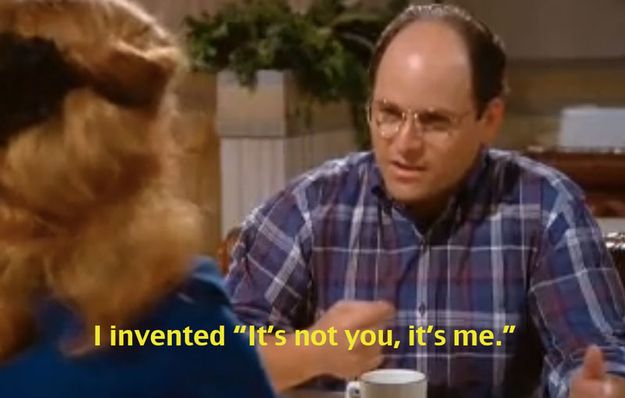
Like I said I was anxious due to the previous experience. But, the two of us handled it very well and it was an amicable parting, a clean breakup if you will. I even used the George Costanza tested “it’s not you it’s me” breakup line. But hey, Ces’t l’apres-guerre… (such is life after war)

My plan now is to get with a senior shrink that I know and have worked with to help get me someone more compatible for what I need at this point in life. I just hope that by “breaking-up” with my therapist that I won’t get shafted by the institution.

But I have learned to live with this; I realize that the military mental health system is not in the business of trying to get you better, it is in the business of trying to return young men and women to be able to go back to war. If you actually get better in the process that is kind of a twofer. Honestly I could have gone back to war with  a year of coming home. Going to war is easy, coming home intact is not.

Do not get me wrong, it is not that there are not providers willing to help; there are plenty of them. But the system , crowded with people who need more help than it can provide and without with ever shrinking budgets; almost makes it impossible to get help. If you can be patched up and sent back out, they have done their job, if you crash after you leave the service not their problem. Sadly, I have lost too many friends, some to suicide after they left the military, including men whose credentials as real American heroes were unmatched. This is not a new issue, ask any vet who has dealt with getting post-service care at the VA or anywhere.

Likewise, if you remain in service and have a chronic-long-term condition, of any kind, physical or mental the attitude seems to be “fuck you.” If you get the label as a “broke” Marine, Sailor, Soldier, or Airman your career is pretty much over, unless you are one of the lucky few like me who had some superiors who looked beyond that and protected you. I know that because it is not just my experience but the experience of hundreds of combat vets that I have dealt with.

I can live with this as long as I am on my meds, and have friends and beer, but then I am an old guy looking at retirement at the end of this tour. If I were a young guy, with my whole career ahead of me I would be fucked. So when I retire I will be a pain in the ass to the system to ensure that the young guys who will be fighting our wars in the future as well as those who are out of the military gets the care that they need.

But as far as my condition goes, I am oddly comforted by the words of Raymond “Red Reddington (James Spader) in The Blacklist:

“There is nothing that can take the pain away. But eventually, you will find a way to live with it. There will be nightmares. And everyday when you wake up, it will be the first thing you think about. Until one day, it’s the second.”

Many things haunt me; but unlike many people who have little self-awareness I might have just a bit too much. I have talked about the nightmares, night terrors and insomnia that I have many times following my return from Iraq. I used to believe, at least back in the first year or so after I returned that I thought that eventually I would get over it. I don’t believe that anymore, now I just believe that I will find a way to live with them.

I guess that is the secret to life. Instead of wishing that something would miraculously take way the pain, I guess that it is better to find a way to live with it because one day something else will replace it.

Is that an ideal way to deal with life? Probably not, but I know that I am an idealist anymore. I used to be, but that was a while back. It took time, but war and the lies of men that I voted for, men who I trusted because they professed my faith, my love of country, and some who even shared my vocation as a priest and chaplain took that from me.

Some experts call this “moral injury.” For me it is connected with my tour in Iraq, PTSD and what I experience when I came home from colleagues, and people in my former church. Betrayal and abandonment is a terrible thing, but I am learning to live with it. It is not pretty but I am learning with every passing night and morning. Alexander Dumas wrote in The Count of Monte Cristo:

“Moral wounds have this peculiarity – they may be hidden, but they never close; always painful, always ready to bleed when touched, they remain fresh and open in the heart.”

My life is full again, there is meaning and purpose, but it is tempered by realism and the expectation that every day I will wake up and still think about those painful memories until finally something else takes their place.

I guess that the secret to living with darkness and pain is simply to live with it because the saying that “time heals all wounds” is a lie, it is the fabrication of people that don’t want to deal with the real world. God might heal, but then God may not. I have learned to be okay with that. I know that there are some Christians who might disagree and even say that I do not have enough “faith,” whatever that means, but I can live with this.

So I will live with it and in doing so I will continue on and in the process hopefully be there for others that also struggle with pain that does not want to go away and nightmares that never seem to end. As the late Henri Nouwen wrote: “Ministry means the ongoing attempt to put one’s own search for God, with all the moments of pain and joy, despair and hope, at the disposal of those who want to join this search but do not know how.” Not exactly perfection, but it will work.

This now is my goal and my prayer: God grant me the courage to change the things I cannot accept; Serenity to accept the things I have changed; And the wisdom to know I’m different. Amen.

Peace

Padre Steve+

1 Comment

Filed under faith, healthcare, mental health, PTSD

There Will be Nightmares: PTSD & Memories of War

Friends of Padre Steve’s World

I’m really very tired today so another short post. I haven’t slept well in several weeks, part of this of course was the worry I had regarding my wife Judy and her cancer diagnosis, surgery and recovery. As she has gotten better I have been dealing with stuff from my own closet of anxieties. Those who have been reading my articles here know that I deal with PTSD, Traumatic Brain Injury and moral injury from my time in Iraq, and my return home.

ramadi

Last year I went through a very difficult time dealing with the military mental health system that I never want to repeat again. I hope I don’t have to, but I may. My therapist who I have had since last summer took a new job thousands of miles away and now I am going to have to find another therapist. I am hoping the man I see for my medication management can get me referred to someone good, because I do not want to be thrust back into the system and take the luck of the draw. That scares me to death, and since I found out my therapist was leaving and that I will not see her again I have been trying to keep my anxiety under control and not to panic. Awake I do pretty well with this, but when I try to sleep, all my Iraq stuff, plus all the very real and bad experiences that I had with the military mental health system last year flood my psyche. The night terrors are back, the terrible dreams and fears. It is not fun waking up in the middle of the night in a state of terror. Last year, after dealing with a number of providers and administrators I was nearly suicidal. It took the intervention of a former commanding officer who had been recently selected for promotion to Admiral in the Medical Corps to get me listened to and to get me the help that I sought.

295_26912092058_3949_n

But I know that I am not alone, I will get the professional help that I still need and I do have some friends I can talk to about these issues. Likewise I know many combat who veterans deal with similar issues related to their service, as well what happened to them when they returned home from Iraq or Afghanistan. The return from war is often worse than actually being over there, few people really understand, unless they too have been there.

Guy Sajer wrote in his book The Forgotten Soldier, “Only happy people have nightmares, from overeating. For those who live a nightmare reality, sleep is a black hole, lost in time, like death.” General Gouverneur Warren, a hero of many Civil War battles including Gettysburg wrote to his wife after the war “I wish I did not dream so much. They make me sometimes to dread to go to sleep. Scenes from the war, are so constantly recalled, with bitter feelings I wish never to experience again. Lies, vanity, treachery, and carnage.”

n671902058_1153794_4301

I am a realist about this. I know that there is no magic wand which will make it all go away and I don’t expect any therapist, or even God to cure me. I can understand why Alexander Dumas in the Count of Monte Cristo wrote, “Moral wounds have this peculiarity – they may be hidden, but they never close; always painful, always ready to bleed when touched, they remain fresh and open in the heart.”

That is true and I know to some people that may sound like I have given up, especially because it runs counter to the snake oil salesmen who write self-help books which promise to heal you in whatever number of steps or exercises; especially the ones written by preachers. But that is not the case, despite everything I still have a love of life and lust for learning. Except that now I just have moved to a new level of understanding concerning my own dark places, and that pain that manifests at night as I try to sleep. Since nothing will take it away I need to live with it and realize that it won’t always be the first thing that I think about when I wake up in the morning. That my friends is the essence of hope. 

n671902058_1219154_8844

One of my favorite actors, James Spader, plays a character named Raymond Reddington on the television show The Blacklist. During one episode he told another character something quite profound, something that if we actually embrace it can be somewhat comforting. “There is nothing that can take the pain away. But eventually, you will find a way to live with it. There will be nightmares. And every day when you wake up, it will be the first thing you think about. Until one day, it’s the second.”

I think that is why I can continue and at the same time seek to be available to those who suffer similar afflictions, and thankfully, I do still have those opportunities and as the late Henri Nouwen wrote, “Ministry means the ongoing attempt to put one’s own search for God, with all the moments of pain and joy, despair and hope, at the disposal of those who want to join this search but do not know how.”

Anyway, have a nice night.

Peace

Padre Steve+

4 Comments

Filed under Loose thoughts and musings

Living with Dark Places and Pain

947188_10151670056587059_1172426886_n

“There is nothing that can take the pain away. But eventually, you will find a way to live with it. There will be nightmares. And everyday when you wake up, it will be the first thing you think about. Until one day, it’s the second.” Raymond “Red Reddington (James Spader) The Blacklist

I am haunted by many things, unlike many people who have little self-awareness I might have just a bit too much. I have talked about the nightmares, night terrors and insomnia that I have many times following my return from Iraq. I used to believe, at least back in the first year or so after I returned that I thought that eventually I would get over it. I don’t believe that anymore, now I just believe that I will find a way to live with them.

I guess that is the secret to life. Instead of wishing that something would miraculously take way the pain, I guess that it is better to find a way to live with it because one day something  else will replace it.

Is that an ideal way to deal with life? Probably not, but I know that I am an idealist anymore. I used to be, but that was a while back. It took time, but war and the lies of men that I voted for, men who I trusted because they professed my faith, my love of country, and some who even shared my vocation as a priest and chaplain took that from me.

Experts call this “moral injury.” For me it is connected with my tour in Iraq, PTSD and what I experience when I came home from colleagues, and people in my former church. Betrayal and abandonment is a terrible thing, but I am learning to live with it. It is not pretty but I am learning with every passing night and morning. Alexander Dumas wrote in The Count of Monte Cristo:

“Moral wounds have this peculiarity – they may be hidden, but they never close; always painful, always ready to bleed when touched, they remain fresh and open in the heart.”

My life is full again, there is meaning and purpose, but it is tempered by realism and the expectation that every day I will wake up and still think about those painful memories until finally something else takes their place. 

I guess that the secret to living with darkness and pain is simply to live with it because the saying that “time heals all wounds” is a lie, it is the fabrication of people that don’t want to deal with the real world. God might heal, but then God may not. So I will live with it and in doing so I will continue on and in the process hopefully be there for others that also struggle with pain that does not want to go away and nightmares that never seem to end. As Henri Nouwen wrote:

“Ministry means the ongoing attempt to put one’s own search for God, with all the moments of pain and joy, despair and hope, at the disposal of those who want to join this search but do not know how.”

Peace

Padre Steve+

1 Comment

Filed under christian life, faith, ministry, PTSD