Tag Archives: realism

A Name Change to Reflect Reality: Musings of a Progressive Realist in Wonderland


Friends of Padre Steve’s World,

The World is a bit different today than it was when I first began to blog here in 2009, and my world is also different. When I started writing here I named the site Padre Steve’s World: Musings of a Passionate Moderate. After the 2012 elections I decided that the title needed a change to reflect my still moderate, but ever growing liberal and progressive philosophy. Over the past year as I have watched friends as well as the country as a whole drift towards more ideological polarity, I realized that even as a progressive, and a passionate one at that that I was not an ideologue, nor have I ever been. 

A few weeks ago I was reading B.H. Liddell-Hart’s biography of General William Tecumseh Sherman and I was struck by the title of the chapter describing Sherman’s warnings to people in the South and the North of what secession and civil war would bring to the country. His predictions turned out to be more correct than almost anyone of his time, others such as Abraham Lincoln and Ulysses S. Grant would within the year begin to come to Sherman’s point of view, but many people and leaders in both the North and South were much too slow to comprehend his warning. The chapter was titled “A Realist in Wonderland.” As I reflected in it, and then looked back to the articles I have been writing about the rapidly changing political climate and polarization in the country that my views are much like Sherman, I am much more pragmatic than many people in the country. I do have my passionate beliefs, and yes though I am a liberal and progressive, I am still moderate. But my moderatation is better described as realism. I have a hard time being arguments from either side of the political and ideological spectrum that are not grounded in political, economic, social, technological, diplomatic, cultural, or military reality, as well as human nature. Likewise, I do not jump on the bandwagon of any movement without looking at it in context of what it will mean for all of us. 

Since I am a historian, a theologian with a fair amount of training in psychology and sociology, coupled with the fact  and I am a man who has spent over 90% of my adult life in the military and 86% of that time as an officer I am a consummate realist. 

Sadly, in today’s world, realism is not often practiced. Ideologues on all sides of the political spectrum fan passionate hatred of all that oppose them, even in minor details. Politicians of all stripes promise things that cannot be delivered because they are not based in political or economic realities, compromise and cooperation is shunned in favor of extreme positions than when examined seldom pass the muster of reality and their proponents seldom thing of the second, third, and fourth order effects of their policies if enacted. I think the recent Brexit is an example of that and what happens now will change the world. In some cases those changes may be good, in other realms bad, and some potentially disastrous. How those changes unfold, and what the consequences  will be, is dependent on all of us and who the political leaders that we elect deal with the issues, as well as the leaders of commerce and industry. 

In fact I would dare say that the United States today is as divided as it was in the mid to late 1850s and that our political parties are undergoing the same kind of disintegration as occurred to the Whigs and Democrats of that era, with new movements; some based on economics, some on the idea of emancipation and freedom, and some based on anti-immigrant racial and religious xenophobia arising. But I digress…

We can look to history to try to understand the nature of our situation, but what we become will be based on our human nature, and how we rise to the occasion. It will be a challenging time, and to get back to what I started with, I think that the change in the blog title is better descriptive of me and my views. 

Have a great day and I hope that you continue to enjoy what I post, learn from it, be challenged, and spread the word that there is a realist in wonderland.

Peace

Padre Steve+
1 Comment

Filed under leadership, philosophy, Political Commentary

ISIL: A Generational Problem in Which the Enemy Gets a Vote

295_26912117058_5652_n

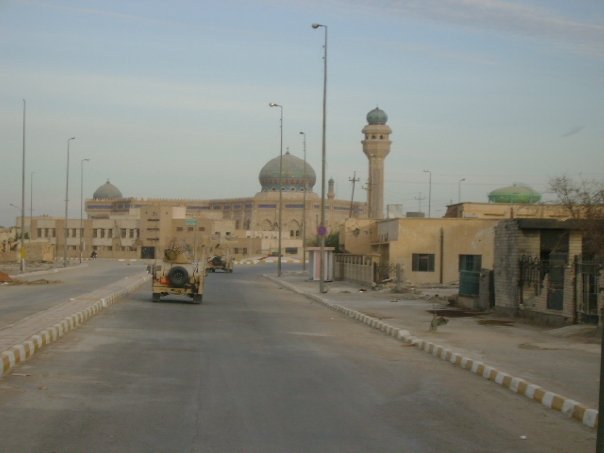
I have been writing much in recent days about the war that we are now in against the Islamic State, or ISIL.  Today Secretary of defense Hegel and Chairman of the Joint Chiefs of Staff General Martin Dempsey briefed the Senate Armed Services Committee about the developing strategy to defeat ISIL. They both echoed what I have been writing, that this is not going to be a short and easy war. It was the kind of briefing that Secretary Rumsfeld, Paul Wolfowitz and others should have given Congress before launching the Iraq war in 2003.

Unlike Rumsfeld and others who plainly concocted a fairy tale about the character, length and cost of the war which they and their propagandists in the media deceived the American public into supporting that war, this was a briefing conducted by realists who did not paint beautiful picture of just how easy it will be to win this war, and how it really won’t be over until it’s over. Retired Marine Corps General James Mattis very wisely said: “No war is over until the enemy says it’s over. We may think it over, we may declare it over, but in fact, the enemy gets a vote.”

In fact the aftermath of that 2003 invasion opened a Pandora’s box of chaos, and opened the door to what T.E. Lawrence warned about in 1919: “A Wahabi-like Moslem edition of Bolshevism is possible, and would harm us almost as much in Mesopotamia as in Persia…” ISIL is exactly that, a fulfillment of Lawrence’s warning.

Unfortunately no one really likes realists, they rain on people’s ideological parades and no one likes to have their parade rained on. Both men recognize that after the past thirteen years of war, as well as the massive upheaval spawned in the region in large part because of it, and the many other crises  that the American military and our NATO allies are having to confront, that American military and diplomatic options are less than optimal and as General Mattis said the enemy gets a vote. As Winston Churchill said:

“Never, never, never believe any war will be smooth and easy, or that anyone who embarks on the strange voyage can measure the tides and hurricanes he will encounter. The statesman who yields to war fever must realize that once the signal is given, he is no longer the master of policy but the slave of unforeseeable and uncontrollable events…. Always remember, however sure you are that you could easily win, that there would not be a war if the other man did not think he also had a chance.”

General Dempsey cautioned the Senators that this was not going to be a short or easy effort. He noted as any realist would : “It’s a generational problem, and we should expect that our enemies will adapt their tactics as we adjust our approach.” 

They outlined a number of elements of the strategy to include the continued air campaign, coordination with the Iraqis, the advisory mission and the diplomatic efforts being made to build an alliance, as well as to build up “moderate” Syrian rebel forces that are functioning under some kind of “moderate” authority, whatever that is, and if there is such a thing in Syria I hope we find it.

The fact is there is nothing easy about any of these options, even the advisory piece is fraught with danger and the potential of being expanded into a ground combat operation. President Obama has promised not to enter into a ground war, but remember the enemy, as well as the other participants in war get a vote. General Dempsey acknowledged this when he told the committee: “If we reach the point where I believe our advisors should accompany Iraqi troops on attacks against specific ISIL targets, I’ll recommend that to the president.” Yes, the decision to commit troops in a ground combat role is ultimately that of the President as Commander in Chief, but the Congress and the American people need to be part of the decision making process and get a vote. If Congress fails to weigh in on this, and either vote for committing troops, or putting limitations on military action, they will have failed in one of their chief constitutional duties.

General Dempsey also noted the nature of the air campaign that is being conducted and which will be conducted in Syria, saying: “we will be prepared to strike ISIL targets in Syria that degrade ISIL’s capabilities. This won’t look like a ‘shock and awe’ campaign because that is simply not how ISIL is organized, but it will be a persistent and a sustainable campaign.” Part of this is due to ISIL as General Dempsey said, but also as he later noted the growing mismatch between policy ends and the means available to deal with them including the will of Congress to provide those means. Dempsey warned of the danger if the “will to provide means does not match the will to pursue ends,”  a time bomb that the austerity minded Congress foisted on the nation through sequestration in 2012. 

Dempsey was cautiously optimistic in his assessment:

“Given a coalition of capable, willing regional and international partners, I believe we can destroy ISIL in Iraq, restore the Iraq-Syria border and disrupt ISIL in Syria…ISIL will ultimately be defeated when their cloak of religious legitimacy is stripped away and the populations on which they have imposed themselves reject them. Our actions are intended to move in that direction.”

General Dempsey recognized that American military power alone cannot solve this situation and that ultimately if ISIL is to be defeated and destroyed, those people that they have conquered need to rise up and reject them. I think that is possible, but it may take years of suffering and oppression at the hands of ISIL for those people to rise up against them. The Sunni did it in Anbar in 2006-2009 to help turn around the Iraq campaign, but they did so on the basis that their rights would be respected and that they would have a real voice in the Shi’ite dominated Iraqi government. Instead they were tossed aside by the Maliki government making them far more apprehensive and unwilling to go all in on defeating ISIL as they did its predecessor.  The Sunni attitude is much like that of the Arabs who rebelled against the Turks, of whom T. E. Lawrence wrote:

“The Arabs rebelled against the Turks during the war not because the Turk Government was notably bad, but because they wanted independence. They did not risk their lives in battle to change masters, to become British subjects or French citizens, but to win a show of their own.”

This is the reality and it is not pretty. Reality sucks, but as Mark Twain said

“Reality can be beaten with enough imagination.”

Peace

Padre Steve+

1 Comment

Filed under Foreign Policy, History, iraq,afghanistan, middle east, Military, national security, Political Commentary, War on Terrorism
