Tag Archives: scharnhorst class

The Post Treaty Super Dreadnought Battleships: Introduction

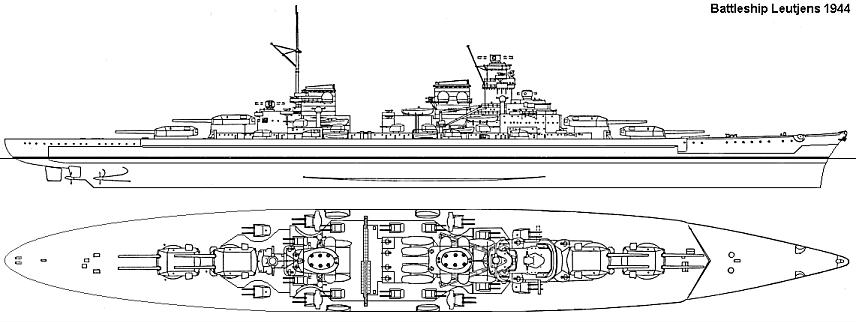
Line Drawing of the German H-39 Class Battleship

Note: This is the introductory article for a series of 8 articles on the classes of battleships built or planned by the major powers following the expiration of the Second London Naval Treaty. A previous series of articles dealt with the battleships constructed in compliance or close compliance with the treaty. This series will cover the Japanese Yamato Class, the British Lion Class and the Vanguard, the German Bismarck Class and H39 Class, the Soviet Sovyetskiy Soyuz Class and the American Iowa and Montana classes.
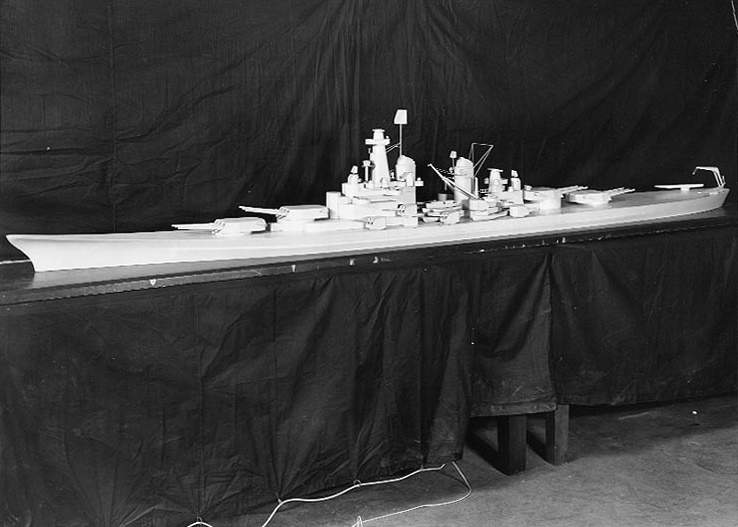
Model of the Montana Class

All of these ships were designed and built or designed in the late 1930s and early 1940s and with the exception of the Sovietetskiy Soyuz Class built on each navy’s experience. The Japanese had constructed no treaty battleships in the 1930s so the Yamato’s were the first battleships constructed by Japan since the Nagato Class which had been completed in the 1920s and the incomplete Tosa Class.

The Bismarck

The Second London Naval Treaty of 25 March 1936 was signed by France, Britain and the United States. Japan walked out on the conference and the Italians did not sign because of the outcry that their invasion of Abyssinia had evoked.  The treaty called for ships to have a standard displacement of no more than 35,000 tons and main armament of 14” guns, a reduction in size of armament from the previous London and Washington treaties. When the Japanese pulled out and the Italians refused to sign the United States invoked the escalator clause which permitted them to disregard treaty limitations.

USS Iowa lead ship of the Iowa class

The Americans who invoked only the armament part of the clause on the North Carolina and South Dakota classes but took full advantage of it to construct the 45,000 ton Iowa class. The Montana Class of 65,000 tons mounting twelve 16” guns and protection proof against that type of shell. Those ships were never laid down but will be covered in this series of articles.

Line Drawing of the Lion Class

The British Royal Navy planned the Lion Class which was in essence an enlargement of the King George V Class armed with nine 16” guns.  The Lion class of which 4 ships were to built was cancelled early in the war and only one further battleship the 44.500 ton HMS Vanguard would be completed by the Royal Navy but not until 1946.

HMS Vanguard

The Germans, who were not a signatory to the treaty but had an agreement with Britain to limit their total naval tonnage to 35% of Britain’s had build the Scharnhorst Class Battlecruisers in the mid 1930s and began the Bismarck Class the largest capital ships completed in Europe. These were to be followed by the H39, H41, H42, H43 and H44 classes ranging in displacement from 56,444 tons to 131,000 tons with armament ranging from eight 16” to eight 20” guns. Only two of the H39’s were laid down and cancelled while in the early stages of construction and I will only discuss the H39 class in this series.

Sovyetskiy Soyuz Class

The Soviet Union which was never a signatory to any of the naval treaties and had not built a battleship since the First World War planned the massive Sovyetskiy Soyuz Class which would have displaced 58,220 tons and mounted nine 16” guns. The four initial ships of the class but were never completed.

Yamato

The Japanese Yamato Class, the largest battleships ever constructed of 69,998 tons standard displacement armed with nine 18” guns, the largest main battery ever installed on battleships were the largest capital ships built before the second generation of U.S. Navy super carriers.

The first article I write will be about the Bismarck Class and that will appear later this week.
 

10 Comments

Filed under History, Military, Navy Ships

French Firepower Forward: The unrealized potential of the Dunkerque and Richelieu Class Battleships

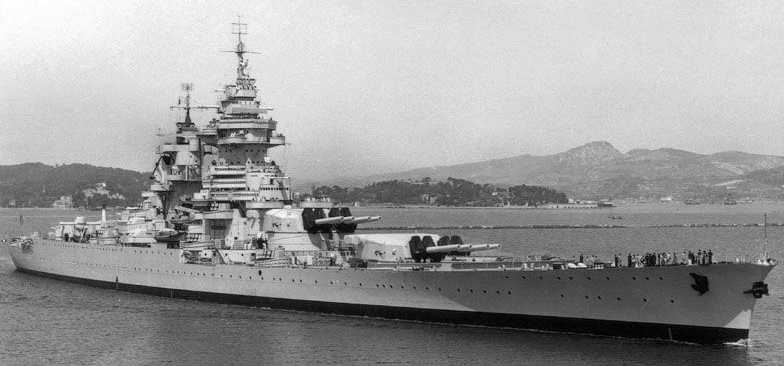
Richelieu in the 1950s © Photo Marius BAR – Toulon (France) site internet : http://www.mariusbarnumerique.fr  

This is the second in a series of five articles on the battleships built under the provision of the Washington and London Naval Treaty limitations in the 1930s. I am not including the ships which were completed in the immediate aftermath of the Washington Treaty limitations. This series looks at the modern battleships that the World War II combatants would produce in the 1930s which saw service in the war. Part one covered the Italian Vittorio Veneto class entitled The Pride of the Regina Marina: The Vittorio Veneto Class Battleships. This article covers the French Dunkerque class and Richelieu class Battleships. Part Three will deal with the British King George V Class and Part Four the American North Carolina and South Dakota Classes. I have already published the final part which covers the German Scharnhorst Class entitled Power and Beauty the Battle Cruisers Scharnhorst and Gneisenau . The German Bismarck, Japanese Yamato, British Vanguard and American Iowa Classes will be covered in a subsequent series.

Dunkerque 1937

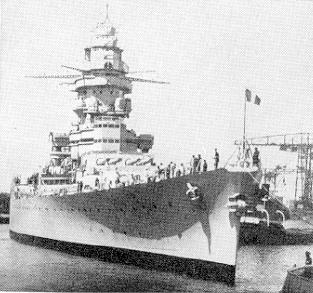
In the late 1920s the French Navy having concentrated on cruiser construction following the war realized the need to develop a class of Fast Battleships to counter the German Deutschland class Pocket Battleships but was limited by the Washington Treaty to just 70,000 tons which meant that in order to have a number of battleships that they would have to be smaller but still mount a significant armament. The new class of ship which the French termed a Fast Battleship was more like a battle cruiser being less heavily armed or armored than current battleships and less so than the new classes of ships being developed by other navies in the mid-1930s.  The Dunkerque class had a designed displacement of 26,500 tons and a top speed of 31 knots the ships mounted 8 13” guns in two quadruple turrets both mounted forward. This allowed all guns to fire forward during engagements to present the smallest possible silhouette to the enemy.  They employed all or nothing armor protection ensuring the strongest protection over vital spaces with their armor designed to protect the ships against German 11” gunfire from the Pocket Battleships or the Scharnhorst Class Battlecruisers. They also mounted a powerful dual purpose armament recognizing the need for defense against aircraft as well as surface ships.

Dunkerque Class:


Dunkerque was laid down on 24 December 1932, launched on 2 October 1935 and commissioned on 1 May 1937. Her sister Strasbourg followed and was laid down in 1934 and launched on 12 December 1936 and commissioned in 1939. When war was declared the two ships spent their time operating with the Royal Navy searching for German raiders and to escort convoys.

Strasbourg

When the Germans overran France in June 1940 the ships took refuge at Mers-el-Kibir where with other French Fleet units they were the target of the Royal Navy to keep them from being taken over by the Germans on 3 July 1940. Dunkerque was heavily damaged in the attack and sank with the loss of 210 sailors after being hit by 4 15” shells from the Battlecruiser HMS Hood and Battleships HMS Resolution and HMS Valiant a testament to their light armor protection.  Strasbourg escaped to Toulon with 5 destroyers where she joined the bulk of the French Fleet in the so called “Free Zone” of Vichy France. She was joined by Dunkerque following the completion of temporary repairs in February 1942.

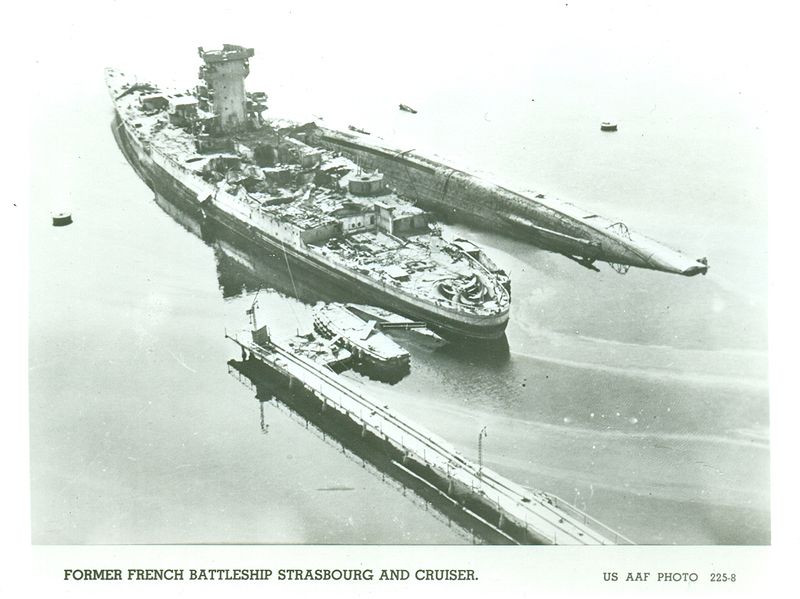
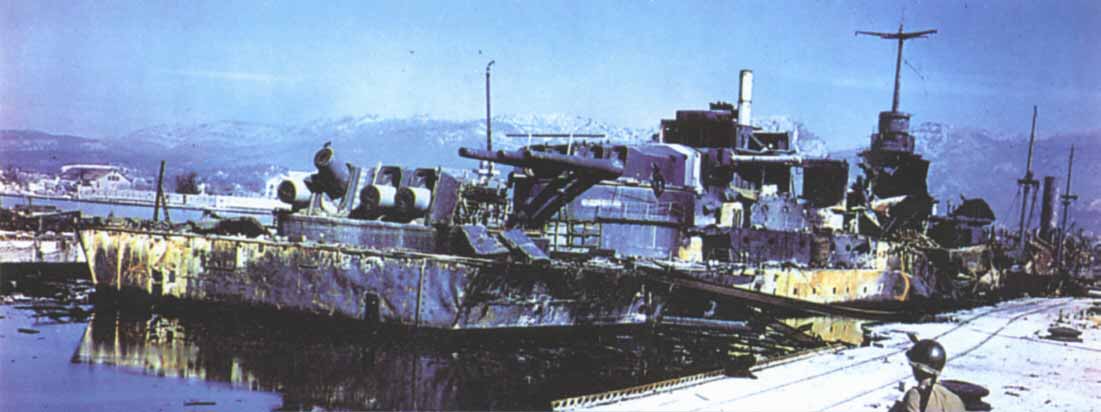
Dunkerque entered drydock for permanent repairs and was there when the Germans occupied Vichy. Under threat of capture the Fleet was scuttled. Dunkerque was destroyed in drydock and declared a total loss. Both the Germans and Italians attempted scrapping operations and the wreck was further damaged by Allied bomber attacks.

The Hulk of the Dunkerque in1944

What was left of the hulk was refloated and finally scrapped in 1958. Strasbourg was scuttled but refloated by the Italian Navy in July 1943 and after the Italian surrender taken over by the Germans. Sunk again in an American air attack in August 1944 she was refloated and used as a test bed for underwater explosions until she was condemned.  She was sold for scrapping in 1955.

Richelieu Class


The Richelieu class was derived from the Dunkerque class in response to the Italian Vittorio Veneto Class.  With a standard displacement of 35,000 tons and a full load displacement of 48,950 tons the ships were the largest build for the French Navy until the commissioning of the Nuclear Aircraft Carrier Charles DeGaulle.  The ships shared the layout of the Dunkerque Class with their main battery of 8 15” guns mounted in quadruple turrets forward which like the Dunkerque’s allowed them to present the smallest silhouette possible to an opposing ship while being able to employ their entire main battery.   Their speed, protection and design were state of the art and comparable to their contemporaries in other navies.  They were capable of 32 knots at full speed and had a cruising range of 7671 miles at 20 knots.  The main battery was spaced far enough apart to ensure that a single hit could not put both turrets out of action and each turret was internally subdivided to prevent a single hit from knocking out all four guns. The mounted 9 6” dual purpose guns in three triple turrets aft and 24 4” AA guns in 12 twin-mounts located amidships.  During the war Richelieu was repaired and refitted in the US receiving 56 40mm Bofors AA guns in quadruple mounts and 48 20mm Oerlikon AA guns in place of her original 37mm cannons and 13.2 inch machine guns.

Richelieu arrives in New York in 1943

Richelieu was laid down in October 1935, launched in January 1939 and began sea trials in January 1940. When the Germans broke through the French defenses and threatened Brest Richelieu put to sea to French North Africa and was commissioned in June at Dakar. She was damaged by an aerial torpedo launched by a Swordfish Torpedo bomber from the HMS Hermes and received emergency repairs in Dakar. On 24 September she fought an engagement against the Royal Navy at the Battle of Dakar and was damaged by two 15” shells fired by the HMS Barham and was further damaged by a misfire in one of her turrets. Following the French return to the Allied camp she was sailed to New York for major repairs and modernization from January to November of 1943. Following this she operated with the British Home Fleet until March of 1944 when she was sent to the India Ocean to serve with the British Far East Fleet in operations against the Japanese until the end of the war. Following the war she took part in the initial stages of the campaign in French Indochina. She was placed in reserve in 1956 and struck from the Navy list and scrapped in 1968.

The Damaged Jean Bart at Casablanca

Her sister Jean Bart was laid down in December 1936 and launched on 6 March 1940.  Only 75% complete with untested engines and only one of her main battery turrets and no secondary armament installed Jean Bart put to sea to escape the German advance and sailed to Casablanca.  The navy attempted to ship her second main battery turret on a freighter but that ship was sunk by a U-boat enroute to Casablanca. She was at Casablanca when the Allies invaded North Africa and was attacked by the U.S. Navy when the Vichy government refused to surrender on 8 November 1942.  She was engaged by the Battleship USS Massachusetts and aircraft from the carrier USS Ranger and was damaged by several bombs and shells from the 16” guns of Massachusetts. She engaged Massachusetts with her one working turret but scored no hits. On the 10th she opened fire on the USS Augusta and was attacked again by aircraft from the Ranger which damaged her so that she had to be run aground to prevent her from sinking.  She remained in Dakar for the duration of the war as it was not feasible to sail her to the United States for completion. Following the war it was suggested that she be converted to an aircraft carrier but that was rejected and she was completed as a battleship and commissioned in 1949.  She took part in the Suez crisis of 1956, was decommissioned in 1957 and finally sold for struck in 1969 and sold for scrap in 1970.

Jean Bart in the 1950s

Both the Dunkerque and Richelieu class were ships of unrealized potential due to the French surrender and the deep divisions between the Vichy and Free French governments.  Had circumstances been different they might have played an important role in the Battle of the Atlantic or in the Mediterranean during the war. Once wonders how they might have done in open combat with their Italian contemporaries or even the German Bismarck and Tirpitz. Instead they and their brave crews had to battle the Axis powers as well as former allies in circumstances in which all the cards were against them. One of Richelieu’s 15” guns is mounted on the waterfront at Brest as a memorial to these brave ships and the men that sailed them.

20 Comments

Filed under History, Navy Ships, world war two in europe

The Pride of the Regina Marina: The Vittorio Veneto Class Battleships

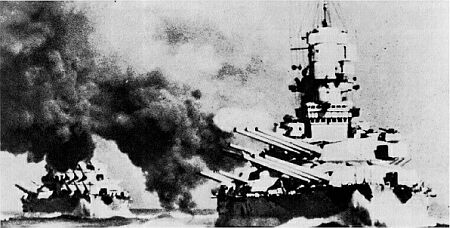
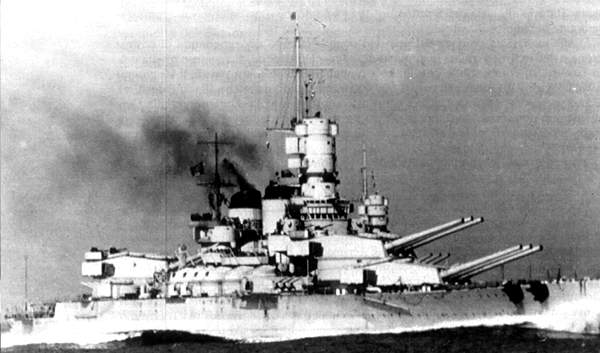
Vittorio Veneto and Littorio

This is the first in a series of five articles on the battleships built under the provision of the Washington and London Naval Treaty limitations in the 1930s. I am not including the ships which were completed in the immediate aftermath of the Washington Treaty limitations. This series looks at the modern battleships that the World War II combatants would produce in the 1930s which saw service in the war. Part one covers the Italian Vittorio Veneto class, Part Two the French Dunkerque and Richelieu Classes, Part Three the British King George V Class and Part Four the American North Carolina and South Dakota Classes. I have already published the final part which covers the German Scharnhorst Class entitled Power and Beauty the Battle Cruisers Scharnhorst and Gneisenau The German Bismarck, Japanese Yamato, British Vanguard and American Iowa Classes will be covered in a subsequent series.

Technically many of these ships were constructed after the expiration of the treaties but since most of the navies at least attempted to maintain a façade of compliance with them most were officially listed as complying with the treaty restrictions.

The Washington Treaty placed a limit on the displacement and armament of battleships. The London Treaty continued them which limited the displacement of new ships to 35,000 tons with the main battery being limited to 16” guns. Each of the treaty signatories as well as the Germans who had been bound by the much more stringent Treaty of Versailles restrictions endeavored to build to the limit of the treaty and if possible skirt the limitations in terms of displacement which allowed them to increase protection as well as more powerful engineering plants.

The Royal Italian Navy had not completed a battleship design since the Andria Doria Class which were constructed between 1912 and 1915 and modernized given an extensive modernization between 1937 and 1940.  A subsequent class the Francesco Caracciolo class was started during the First World War but no ships of the class were completed.

In the 1930s a new naval arms race was underway in the Mediterranean as the French Navy had begun a new class of Fast Battleships, the Dunkerque class which were designed to defeat the German Deutschland class “pocket battleships” and the follow on Richelieu Class. Mussolini saw the new French ships as a threat to the control of the Mediterranean and ordered the construction of a new class of battleships to help Italy achieve naval dominance in the Mediterranean.

The new ships were of a breathtaking design, large, fast and heavily armed officially listed as meeting the prescribed treaty limit of 35,000 tons they actually would displace 41,177 tons standard displacement and 45,963 tons full load. Armed with a main battery of 9 15” guns in triple turrets and a secondary armament of 12 6” and 12 3.5” guns along with 20 37mm and 30 20mm anti-aircraft guns and capable of 29 knots in service and with a relatively short range of 3900 miles at 20 knots they were formidable ships for operations in the Mediterranean. They were well protected although their Pugliese torpedo defense system proved inferior to traditional designs.

Their main armament though formidable was not without its flaws. The 15” guns had a very long range of 42 km or 26.6 miles and high muzzle velocity of 2900 fps. The high muzzle velocity led to a barrel life of only about half that of their counterparts and inconsistent shell fall patterns.  The guns also suffered from a slow rate of fire of only 1.3 rounds per gun a minute.

The Ships:

Vittorio Veneto in 1943

Vittorio Veneto: The Vittorio Veneto was laid down 1934 along with her sister the Littorio and was launched on 25 July 1937 and commissioned on 28 April 1940. She would see action numerous times and give a good account of herself against the British taking part in 56 war missions. She fought at the Battle of Cape Spartivento (Teulada) where she fired 19 salvos to drive off a 7 ship British cruiser squadron in a pitched battle that also included the battleship HMS Ramillies and battle cruiser HMS Renown. In 1941 she took part in the Battle of Cape Matapan where she was damaged by an aerial torpedo after driving off a British cruiser squadron. After repairs she was back in action and on 15 June 1942 participated in the Battle of Mid-June, where she and her sister ship Littorio successfully fenced off a large British convoy from Alexandria by their mere presence at sea.  She was also the first Italian battleship equipped with radar. She surrendered with the Italian fleet to the Allies on 8 September 1943 surviving furious German air attacks. She was interred at the Great Bitter Lakes in the Suez Canal. After the war she taken as war compensation and was returned to Italy and scrapped beginning in 1948.

Littorio

Littorio (later Italia): Littorio was laid down in 1934 and launched on 22 August 1937 and commissioned on 6 May 1940.  She participated in 43 operations including the Battle of Sirte and several actions against British convoys.  Following the Battle of Mid-June she was struck by an aerial torpedo dropped by a Wellington bomber. She was repaired and upon the removal of Mussolini from power was renamed Italia and surrendered with the Italian Fleet on 8 September 1943 being damaged by a Fritz-X radio controlled bomb. With her sister Vittorio Veneto she was interred in the Great Bitter Lake and was returned to Italy where she was decommissioned and scrapped beginning in 1948.

Roma

Roma: Roma was laid down 18 September 1938, launched on 9 June 1940 and commissioned 14 June 1942.  Despite her addition to the fleet she was not deployed due to a fuel shortage. She sailed with the Italian Fleet to surrender on 8 June under the guise of the fleet sailing to attack the Allied invasion fleet off Salerno. The Germans discovering the ruse launched air attacks by Dornier Do-217s armed with Fritz-X radio controlled bombs attacked the fleet as it transited the Strait of Bonafacio.

Roma exploding after being hit by Fritz-X radio guided bomb

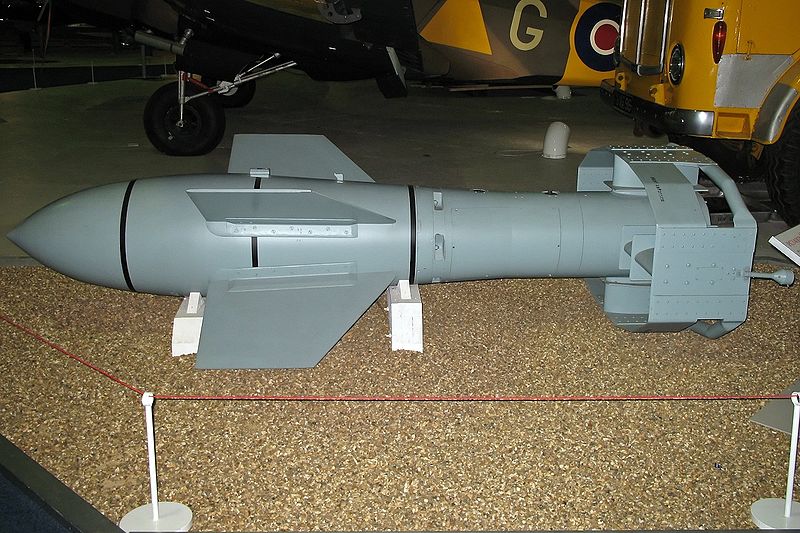
Roma was hit by two of the missiles the first which flooded two boiler rooms and the aft engine room.  She was hit soon after by a second Fritz-X which hit in the forward engine room causing catastrophic damage and igniting the number two turret magazine blowing the turret off the ship and causing the ship to capsize and break in two as she sank carrying 1255 of her crew including Admiral Carlo Bergamini to their death. Roma was the first ship sunk by a radio controlled bomb, the forerunner of our current air launched anti-ship missiles.

The Fritz-X Radio Guided Bomb

Impero: Impero was laid down but never completed and scrapped after the war.

The Vittorio Veneto class was a sound design and operationally successful against the Royal Navy and the brave sailors of the Regina Marina who manned these fine ships should not be forgotten.

10 Comments

Filed under History, Military, Navy Ships, world war two in europe