Tag Archives: sicily invasion

Arthritis, a Cane, and a Pistol: The Son of the Rough Rider, Theodore Roosevelt III and D-Day

Theodore Roosevelt Jr4

Friends of Padre Steve’s World,

Today I am remembering an American hero who the older and more broken down I get I admire more. Brigadier Theodore Roosevelt III, known affectionately as “Ted” was beloved by his troops, and less that appreciated by senior commanders, mainly because he cared for his troops and he tended to dress down, and often wore non-uniform gear. He also had bad arthritis and needed to walk with a cane. I had to do that for a year when my knees when bad, and without the aid of gel injections in both knees every 3-4 months I would need today. He went ashore in the first wave of the 4th Infantry Division in Normandy. So this adds to my D-Day collection for this year. I hope that you can enjoy and appreciate. 

The Prussian military theorist Carl von Clausewitz wrote: “Courage, above all things, is the first quality of a warrior.”

By the standards of military service on the front line the man was ancient. He was 56 years old, four years younger than I am now. He had arthritis and a history of heart problems, but he was his father’s son and he put himself in harm’s way in the greatest invasion in history.

The oldest man to land on the beaches of Normandy was the son of a President. His father was Theodore “Teddy” Roosevelt who had taken leave of his office as Assistant Secretary of the Navy at the outset of the Spanish-American War to go into harm’s way. With the help of his friend Colonel Leonard Wood, Roosevelt formed the legendary First U.S. Volunteer Cavalry Regiment, the “Rough Riders” and led them in the fight at the Battle of San Juan Hill.

The son of the President entered the business world and then served as a Reserve officer. When the United States entered the First World War he was commissioned as a Major.  He volunteered for overseas service and served as a battalion commander and later as commander of the 26th Infantry Regiment of the 1st Infantry Division. Leading from the front he was wounded and gassed at Soissons in 1918. For his service he was awarded the Distinguished Service Cross and the French Chevalier Légion d’honneur.

After the war he helped found the American Legion and entered politics and was elected to the New York State Assembly. However while serving as Assistant Secretary of the Navy in the Harding Administration he was linked to the Teapot Dome Scandal and though he was cleared of any wrongdoing his name was tarnished. He was opposed by his cousin Franklin Delano Roosevelt and his political fortunes in elections plummeted. However, he was appointed as Governor of Puerto Rico and later Governor-General of the Philippines a post that he served at until 1935.  He returned to the United States and went back into business world with American Express.

Between the wars he continued his Army Reserve service. Like most reservists he attended his annual training periods, but he also took it upon himself to attend the Infantry Officer Basic and Officer Advanced Courses as well as the Command and General Staff College. When war broke out in Europe and the United States began to mobilize for war he again volunteered for active service. He attended a refresher course and was promoted to Colonel in the Army Reserve. He was mobilized in April 1940 and was given command of his old 26th Infantry Regiment assigned to the First Infantry Division. He was promoted to Brigadier General in late 1941 and became the the Assistant Division Commander.

Ted_Cane_France

He served well in that role in North Africa and Sicily and earned citations for bravery being constantly on the front lines with his soldiers. However his association with the Division Commander, the unorthodox Terry Allen earned the enmity of George Patton and Omar Bradley. Patton disliked Allen and hated the way both Allen and Roosevelt eschewed “spit and polish” and “dressed down,” often wearing unauthorized uniform items. After Bradley assumed command of 7th Army he relieved both officers, believing that they were guilty of “loving their division too much.” Bradley later admitted was one of the hardest decisions that he made in the war. Roosevelt then served as a liaison officer with the Free French Forces in Italy before returning to England to assume duties as Assistant Division Commander of the 4th Infantry Division. His superior, Terry Allen would go on to command the 104th Infantry Division in an exemplary manner in France and Germany in 1944-45. Bradley praised him and his new division as one of the best in Europe.

TeddyJr5-530x414

Roosevelt constantly trained with the troops and asked his commander, Major General Raymond “Tubby” Barton for permission to land with the first wave in the invasion. After being denied twice Roosevelt put his request to Barton in writing:

“The force and skill with which the first elements hit the beach and proceed may determine the ultimate success of the operation…. With troops engaged for the first time, the behavior pattern of all is apt to be set by those first engagements. [It is] considered that accurate information of the existing situation should be available for each succeeding element as it lands. You should have when you get to shore an overall picture in which you can place confidence. I believe I can contribute materially on all of the above by going in with the assault companies. Furthermore I personally know both officers and men of these advance units and believe that it will steady them to know that I am with them.”

Barton reluctantly approved the request not expecting Roosevelt to survive the landings. Roosevelt was in the first wave of assault troops at Utah Beach. On landing he discovered that the first wave was about a mile off course and in an area where the German defenses were not strong.

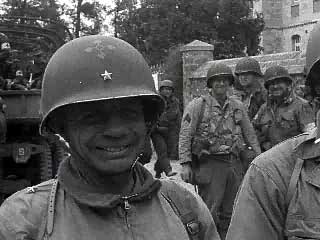
Armed with a pistol and supported by a cane Roosevelt led a reconnaissance patrol  to find the causeways off the beach. He briefed the battalion commanders and then ordered an attack from where the troops had landed telling his officers “We’ll start the war from right here!” It was a moment immortalized in the film The Longest Day in which Henry Fonda played Roosevelt.

fon2

Henry Fonda Portrays Brigadier General Theodore “Ted” Roosevelt III in “The Longest Day”

His actions were key in the success of the Utah Beach landings and he was recommended for the Distinguished Service Cross by General Barton. Just over a month after the invasion after continuously leading his troops in Normandy Roosevelt died of a heart attack on July 12th 1944, the very day he had been selected for his second star and promotion to Major General with orders to take command of the 90th Infantry Division. His award was upgraded to the Congressional Medal of Honor which was posthumously awarded on September 28th 1944. He was buried in the American Cemetery in Normandy. The remains of his younger brother Quentin who had been killed in the First World War were exhumed and interred next to his in 1955.

The Medal of Honor citation reads:

For gallantry and intrepidity at the risk of his life above and beyond the call of duty on 6 June 1944, in France. After 2 verbal requests to accompany the leading assault elements in the Normandy invasion had been denied, Brig. Gen. Roosevelt’s written request for this mission was approved and he landed with the first wave of the forces assaulting the enemy-held beaches. He repeatedly led groups from the beach, over the seawall and established them inland. His valor, courage, and presence in the very front of the attack and his complete unconcern at being under heavy fire inspired the troops to heights of enthusiasm and self-sacrifice. Although the enemy had the beach under constant direct fire, Brig. Gen. Roosevelt moved from one locality to another, rallying men around him, directed and personally led them against the enemy. Under his seasoned, precise, calm, and unfaltering leadership, assault troops reduced beach strong points and rapidly moved inland with minimum casualties. He thus contributed substantially to the successful establishment of the beachhead in France.

Roosevelt’s story is quite amazing. In the modern wars of the late 20th and early 21st Centuries few commanders as senior as Roosevelt would ever be in the first wave of an invasion or offensive operation. The personal courage and example set by Roosevelt in both World Wars, leading from the front and maintaining relationships with the troops that he commanded in combat is something that is unusual today. We in the military talk about a lot in various military leadership classes but often seems to be smothered by business models promoted by think tanks and others with money to be made.

Likewise, a commander suffering from Roosevelt’s infirmities would not be allowed to command troops in combat today. But in the Second World War when many other American Generals failed miserably and often could not be found near the front and were relieved of command for incompetence and cowardice the old, crippled and infirm Roosevelt led from the front. He made decisions on Utah Beach on D-Day that helped ensure that the landings were a success. Bradley, who had fired Roosevelt after the Sicilian Campaign with Allen said that the most heroic act that he had seen in combat was “Ted Roosevelt on Utah Beach.”

Roosevelt was an exception to Clausewitz’s axiom that “boldness becomes rarer, the higher the rank.” I think that even if a General wanted to lead in the manner of Roosevelt today that he would be punished by the institution for risking himself regardless of his success, because I t would make others look bad.

Peace

Padre Steve+
1 Comment

Filed under History, leadership, Military, us army, world war two in europe

Four of a Kind: The Illustrious Class Aircraft Carriers

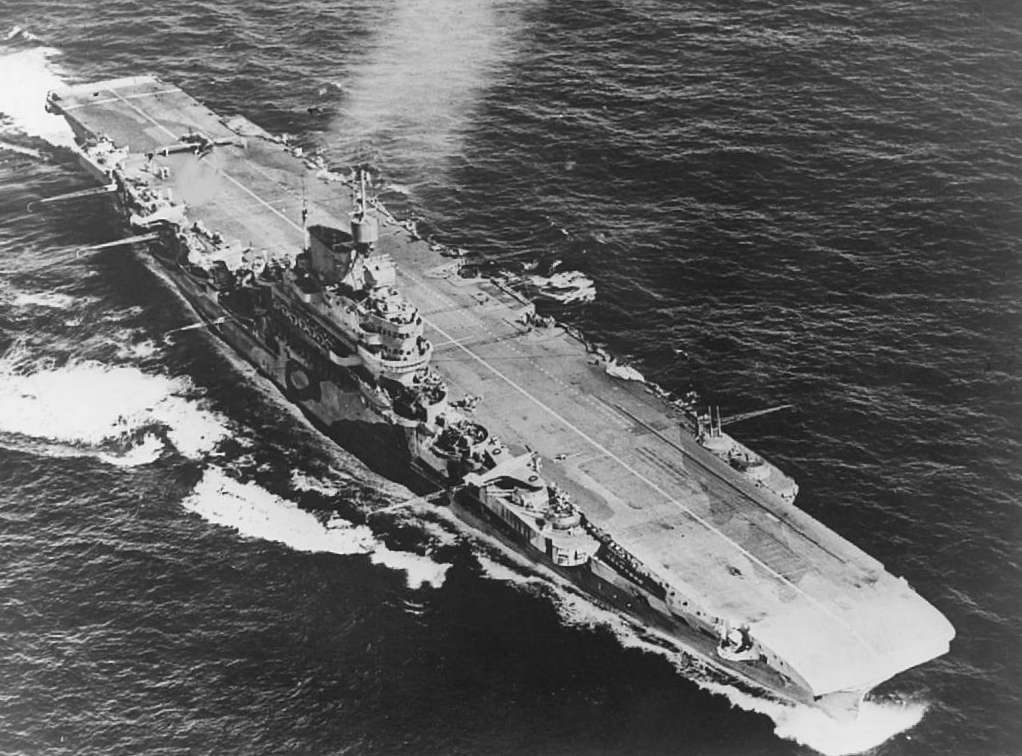
HMS Illustrious in 1944

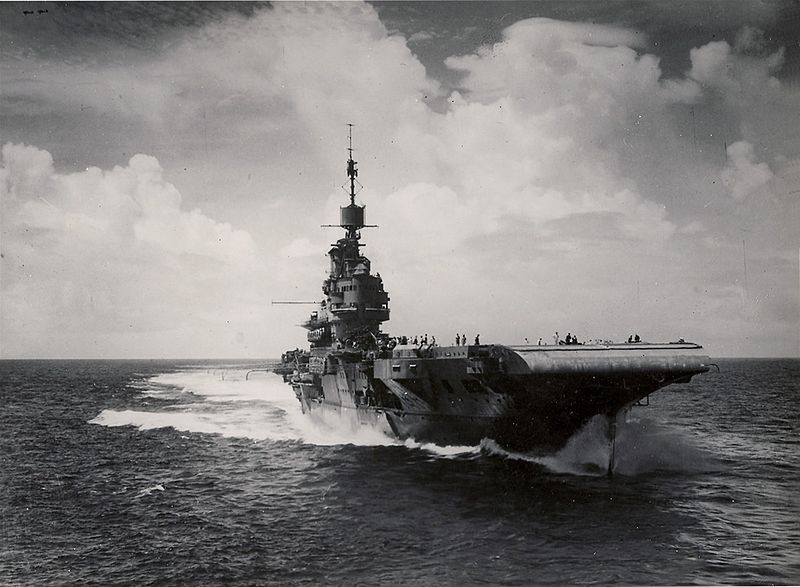
In the mid-1930s the Royal Navy recognized the need to develop and built new Fleet Carriers. The Illustrious Class of four ships was ordered as part of the 1936 Naval Program.  The four ships of the class HMS Illustrious, HMS Formidable, HMS Victorious and HMS Indomitable were some of the most important ships to see service in the Royal Navy in the Second World War and would see action in the Atlantic, Arctic, Mediterranean, Indian Ocean and Pacific.  They were tough ships and all sustained serious damage at least once in their careers that might have sunk other ships.  Different in concept than the Royal Navy’s only modern carrier the Ark Royal they displaced more than the U.S. Navy Yorktown Class and just somewhat less than the following Essex Class ships although they were over 100 feet shorter in length as compared to the American ships.

The class was built with an armored flight deck which covered the hangar deck with both as an integral part of the ship’s structure and defense.  The American ships hanger and flight deck were part of the superstructure with the armored deck being that of the hangar deck itself.  This provided advantages in protection against bombs and later Kamikazes but there was a trade off in both aircraft capacity and the ability for the ships to handle the larger aircraft that came into service following the Second World War.  As designed the ships carried just 36 aircraft as compared with the 80-100 aircraft of the American ships and the 72 that the Ark Royal was rated at.  Later in the war the Royal Navy adopted the American practice of an air park on the flight deck which increased their capacity to up to 70 aircraft. The last ship of the class, the Indomitable was built to a modified deign with an expanded two deck hangar with increased aircraft capacity similar to that of the Ark Royal.  An additional drawback to the design was that any bomb which penetrated the armored flight deck exploded inside the hangar causing deformation to the actual ship’s structure.

British defensive doctrine for these carriers was focused on the passive protection provided by the armored flight deck and by a far heavier anti-aircraft battery than the Yorktown Class and comparable to the Essex Class. This was a different doctrine than that of the Americans and the Imperial Japanese Navy which embarked large air groups believing that the aircraft were integral to the defense of the ship.

The ships displaced 28,919 tons full load and were capable of steaming at 30.5 knots with an operational range of 11,000 nautical miles at 14 knots, far more than any previous Royal Navy carrier but far less than the Essex class which could steam 20,000 nautical miles at 15 knots. The Essex Class ships were had a greater displacement as well as a higher top speed of 33 knots.  The Illustrious class was best suited for operations in the Atlantic and Mediterranean and less suited to the vast expanse of the Pacific where they would spend the last year of the war.

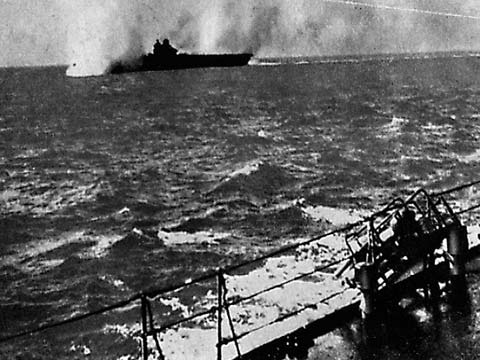
Illustrious under attack by German Bombers

HMS Illustrious: Illustrious was laid down in April 1937, launched in April 1939 and commissioned in May 1940. Upon commissioning she and her air group deployed to the Mediterranean where in the dark days following the fall of France they escorted vital convoys, supported the Royal Army in the war in North Africa and conducted strikes against Italian shore installations and fleet units.  Illustrious launched the first major raid against an enemy shore base by carrier aircraft on 11 November 1940. Her aircraft from number 813, 815, 819 and 823 Squadrons made a night attack on the Naval Base at Taranto sinking the battleship Conte di Cavour and heavily damaging the battleships Andrea Doria and the new battleship Littorio and moderate damage to the Caio Dulio This strike helped cripple Italian naval power and helped give the Japanese inspiration for the Pearl Harbor attack.    On 10 January she suffered severe damage from 6 bomb hits while escorting a convoy near Malta. She was attacked again at Malta causing more damage and she was withdrawn from action and sent to Norfolk Naval Shipyard for repairs. The damage was severe enough to keep her out of the war until May of 1942.  One of her shafts was so badly damaged that it had to be cut away and could not be replaced which reduced her speed to 23 knots. On her return to action she covered the landings against the Vichy French island of Madagascar and the Sicily landings. In 1944 she was in action with the Far East Fleet conducting raids against Japanese held islands in Indonesia and in 1945 was in action as part of the British Pacific Fleet where she saw action at Okinawa where she was hit by two Kamikazes and Formosa where a near miss close aboard by a Kamikaze caused severe damage below her waterline.  She sailed home where she underwent repair until 1946 when she was returned to duty as a training carrier in which capacity she served until she was decommissioned and scrapped in 1954.

Grumman Marlett (F4F Wildcat) on flight deck of HMS Formidable

HMS Formidable: Formidable was laid down in June 1937, launched in August 1939 and commissioned in November 1940.  She actually “launched herself” a half hour before her Christening ceremony which gave her the nickname “The ship that launched herself.”  Formidable saw action in the Mediterranean in 1941 and was heavily damaged by two 1000 kg bombs while escorting a Malta Convoy. This put her out of action for 6 months as she was repaired at Norfolk Naval Shipyard.  On her return she saw service first in the Indian Ocean and then in the invasions of North Africa, Sicily and the Italian Campaign. She also saw service in the Arctic sinking U-331 and in raids against the German Battleship Tirpitz.  She was in action in 1945 against the Japanese with the British Pacific Fleet where she relieved Illustrious after that ship was withdrawn from action. On 4 May 1945 while supporting operations off Okinawa she suffered massive damage from a Kamikaze, temporary repairs kept her in action until hit by another Kamikaze on 9 May. She was withdrawn from action and a fleet review determined that she was not economically repairable in the austere post war years. She was placed in reserve in 1947 and sold for scrap in 1953 with the scrapping taking place in 1956.

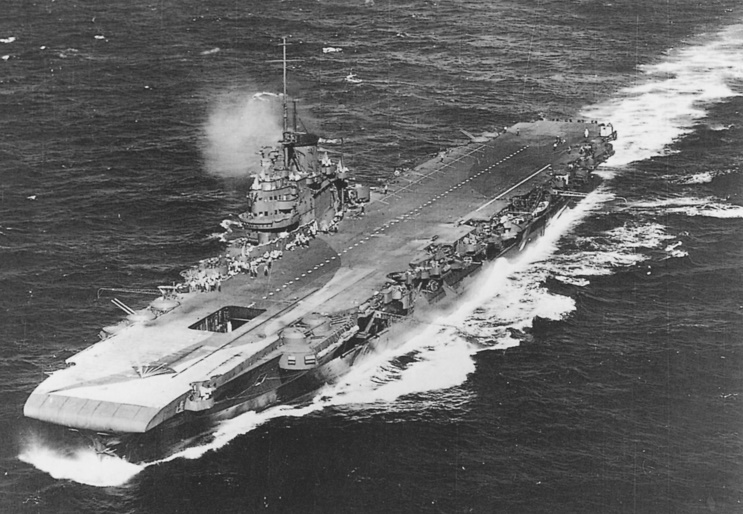
HMS Indomitable

HMS Indomitable: Indomitable was built to a modified design which allowed her to operate far more aircraft than her sisters. She was laid down in November 1937, launched in March 1940 and commissioned in October 1941. She was slated to accompany the HMS Prince of Wales and HMS Repulse to the Far East and the defense of Singapore but ran aground on a coral reef during her shakedown cruise in the Jamaica which prevented that deployment.  After repairs she operated with the Far East Fleet in the Indian Ocean and took part in the invasion of Madagascar in November 1942.  In July of 1942 she took part in the Malta resupply mission Operation Pedestal where she was heavily damaged by two 500 kg bombs which penetrated her flight deck. She was withdrawn to the United States for repairs which lasted until February 1943 when she returned to the Mediterranean.  She took a torpedo hit from a German Ju-88 bomber on 15 June 1943 during the build up to the invasion of Sicily and again returned to the United States for repairs which were completed in February 1944. She then took part in operations with the Far East Fleet in the Indian Ocean before joining the British Pacific Fleet in 1945. She received minor damage from a Kamikaze hit on 4 May 1945 while operating near Okinawa. She finished the war in good shape compared to Illustrious and Formidable but was damaged by an internal fire and explosion in 1947 the damage from which was never repaired. She remained in service until she was placed in unmaintained reserve in 1953 and scrapped in 1955.

HMS Victorious

HMS Victorious: The Victorious was probably the most celebrated aircraft carrier in the history of the Royal Navy. Her World War Two service was remarkable by any standard and she was the only ship of her class to be modernized to carry jet aircraft following the war being refitted in much the same way as the American Essex Class ships were in the 1950s with an angled flight deck.  She was laid down in May 1937, launched in September 1939 and commissioned on 14 May 1941. Within 10 days of her commissioning she was taking part in the Hunt for the Bismarck and her Swordfish torpedo bombers scored one torpedo hit on that ship.  She saw much action in the North Atlantic and Arctic escorting convoys and deterring forays of German raiders into the Atlantic. She served in the Mediterranean during some Malta operations including Operation Pedestal and the Operation Torch landings in North Africa.  Due to the shortage of U.S. Carriers from heavy combat in the South Pacific in 1942 Victorious was “loaned” to the U.S. Navy deployed to operate with the U.S. Pacific Fleet following refits to operate U.S. built aircraft. She operated in the South Pacific from March to September of 1943 with the USS Saratoga in operations against the Japanese to include the New Georgia landings. She returned home and took part in raids against the Tirpitz which put that ship out of action for several months. She deployed to the Far East in 1944 and support operations in the Indian Ocean before being transferred to the British Pacific Fleet.

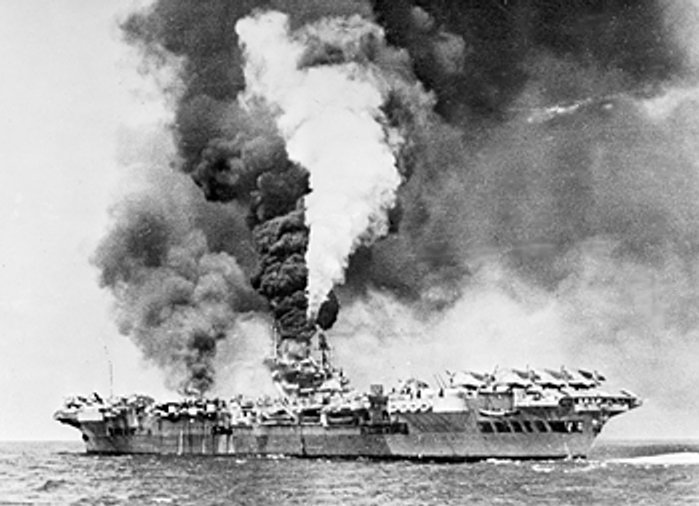
Victorious on Fire off Okinawa

She was involved in extensive Pacific operations including Okinawa and the raids on mainland Japan. She was stuck on a number of occasions by Kamikazes but remained in action.  After the war she was modernized and remained in service until 1969 when the Royal Navy decided that it was going to end its fixed wing operations and decommission its remaining attack aircraft carriers. She was broken up at Faslane beginning in 1969.

The modernized HMS Victorious

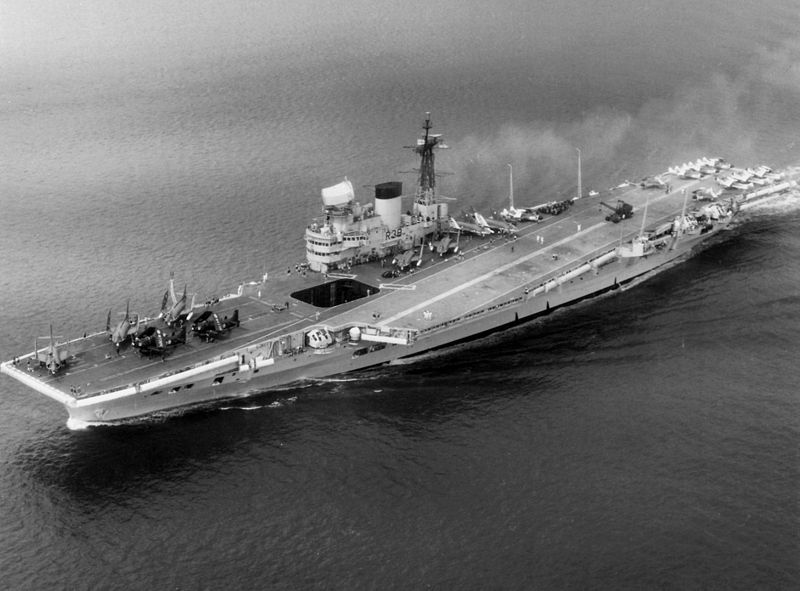
The Illustrious Class ships were great ships which performed admirable work in the Second World War. They and their brave crews continued the proud tradition of the Royal Navy. It is my hope that at least the new Queen Elizabeth Class carriers will be renamed for a ship of this class, preferably Victorious.

Peace

Padre Steve+


9 Comments

Filed under History, Military, Navy Ships, world war two in europe, world war two in the pacific