Tag Archives: stephen douglas

Incredible Scoundrel Pt.2: A Murder in Washington

philip-barton-key-granger

Friends of Padre Steve’s World

I am a historian as well as a chaplain and priest. I do a lot of work with the Battle of Gettysburg and much of my work involves biography as I believe that the one constant in history is people. Technology and many other things may change, but people and human nature are constant, for good and for bad, and frankly I find people fascinating.

One of the most fascinating people of the Battle of Gettysburg is Union Major General Daniel E. Sickles, a man who was one of the most fascinating, salacious, scandalous, and incredible figures ever to grace and disgrace American history.

This is the second of a three part series taken from my Gettysburg and Civil War text. I hope that you enjoy.

Peace,

Padre Steve+

Within a year of his assignment Sickles returned to the United States to help prepare the Democratic nomination for his friend Buchanan who had long desired the office, and return to his lucrative post in New York. In the spring of 1856 Sickles began to work on Buchanan’s nomination for the Presidency and while doing so began his own campaign for New York’s Third District’s Congressional seat. Buchanan won the election of 1856 against an opposition divided between the Know Nothing candidacy of former President Millard Fillmore and the candidate of the new Republican Party, John C. Fremont.

In the election of 1856, Sickles carried the district easily. For Sickles it was a triumph, he was “riding a flood tide of political fortune that might carry him far,” [1] and like any wife Teresa too was delighted with the result. Even so, Teresa must have wondered if her husband would mend his ways now that he was on the national spotlight, or if he would continue his extramarital romps around the nation’s capital. Following the election Dan and Teresa moved to Washington D.C. where they took up a fashionable residence, the Stockton Mansion, on Lafayette Square, not far from the White House and Sickles friend, James Buchanan.

Once he was established in Washington Sickles was in his element, politics at its grandest. It was a different style than of politics than Tammany, where brass knuckled force often ruled, but it suited Sickles, who was “a fixer who knew all the tricks of Tammany at its crookedest but who seems not to have taken graft himself. He had his sights fixed on the presidency, and he was making about as much progress in that direction as a Tammany man can,” [2]   until a strange combination of unrequited love, infidelity, the personal betrayal of a friend, and a murder intervened.
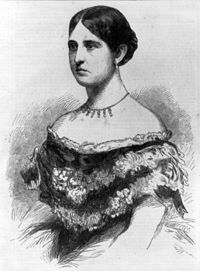
HarpersMagazineMrs.Sickles

Teresa Sickles

While her husband politicked along the Potomac, the new congressman’s wife was adapting to her life in Washington D.C. The wives were expected to entertain and host parties on a regular basis at their residences, but they also knew their share of loneliness and neglect. Since legislators routinely were “busy with night sessions, committee meetings, and plain nocturnal politicking over whiskey punch, that their wives either accepted other escorts or spent lonely evenings at home with fancywork or a book.” thus it was not surprising that Teresa, “should seek the gayety of the capital in her first year there.” [3] In the absence of their husbands it “was not uncommon for available bachelors to act as escorts for married women when their husbands were unavailable.” [4] Since Dan Sickles was frequently unavailable and since Teresa probably still suspected that Dan was still engaged in extramarital affairs, it is not surprising that the young Mediterranean beauty found comfort in another man.

The years of 1857 and 1858 would be a tumultuous time for the nation as well as the Sickles. Buchanan had been elected because of his stability and moderation in an age of pro and anti-slavery radicalism. However, over the next year his presidency, and his would be overwhelmed by events and Buchanan’s decisions supporting the expansion of slavery. While Sickles was neither a slave owner, nor himself fond of the institution, it was part of life, and many of his friends in Washington D.C. and in Congress were slave holders. Buchanan had schemed before his inauguration with Chief Justice of the Supreme Court Roger Taney in the Dred Scott decision, which was handed down in the days following Buchanan’s inauguration, followed by the fiasco over the Lecompton constitution and the attempted admission of Kansas as a Slave State, an event which split the Democratic party in the 1860 election, ensuring Abraham Lincoln’s defeat of Buchanan’s Lecompton foe in the Senate, Senator Stephen A. Douglas who would have been the prohibitive favorite in the election had the split not occurred.

Likewise, Sickles and his beautiful young wife would become part of one of the most sensational trials of American history, rivaling the Lindbergh kidnapping trial, the trial of O.J. Simpson, the Scopes Monkey Trial, and the Impeachment of President Bill Clinton in its captivation of America. As in London, Teresa became popular and she and Dan were much sought after and their home “became the scene of a gradual number of and entertainments,” [5] and even as Sickles continued his robust politicking and philandering Teresa became the object of another’s affection, the District of Attorney for the District of Columbia, Philip Barton Key, the son Francis Scott key, the writer of the Star Spangled Banner. Interestingly enough it was Sickles who had helped Key the troubled man to be reappointed to his office in early 1857 after Key had helped Sickles overcome legal and financial difficulties to secure Sickles in the Stockton Mansion and the two men developed a warm friendship.

Philip Key was extraordinarily handsome, especially when outfitted in his green and gold militia uniform of the Montgomery Guards, and was considered one of the most desirable men in Washington. An accomplished horsemen he rode about town on his “horse Lucifer – a nobly bred, dapple gray hunter.” [6] When he gained Sickles’ friendship many of his well to do political and society friends became frequent visitors to the Sickles household. After Sickles had helped Key to be reappointed to his office, Key was instrumental in helping make the arrangements for Sickles to rent the Stockton Mansion.

During his first term in office Key was not known for being a particularly good District Attorney and spent much time away from the office complaining about his allegedly poor health. But his health did not keep him away from Washington’s party scene and “One hostess called him “the handsomest man in all Washington… he was a prominent figure at all the principle functions; a graceful dancer, her was a favorite of every hostess of the day.” [7] When he met Teresa, the dashing bachelor took an intense interest in the wife of the man who had helped him retain his job. The two were soon attending many functions together that Sickles, due to his work schedule could seldom attend.

Within weeks Key became a frequent guest at the Sickles home and few were surprised at this, as most observers knew that Sickles was responsible for Key’s reappointment. With Sickles now fully engaged in the dramatic political battles of late 1857, Teresa and Key began to spend much more time together. The two were seen together at the “theater, at teas, at hops. But most of all they went riding together.” [8] The frequency of these visits was noted and became the source of much gossip but Sickles was unaware of it and entertained no suspicions that his new friend was becoming deeply involved with his wife, and that Key had rented a room where the two could intimate.

That was until a young man equally smitten by Teresa had a few drinks with a colleague and the colleague shared the information with a loyal Sickles ally who then told Sickles. Sickles was shocked and called for a meeting with Key, however, after a brief conversation, Key convinced Sickles that there was nothing to the rumors, and Sickles was satisfied.

Though Sickles had been satisfied by the explanation, “despite his own well-publicized moral lapses, Daniel Sickles was a man of intense personal pride who would not countenance the breath of scandal attaching to his wife.” [9] He took the time to warn her to make sure that she was not involved in any other indiscretions, and left the subject. However, Key and Teresa continued to see each other, and “she and Barton thought that they were taking more care, and being less observed by people than they were.” [10] Yet as they pursued one another their affair became increasingly public, and seen by too many people not to go unnoticed. The two were seen together in at the Congressional Cemetery, and frequently at a house at “385 15th Street where he would enter the by the front door – and she the back.” [11] When a mutual friend expressed his concerns, Key shrugged off the warning, and “with the bravado of a proud weakling, he still held his course. And Teresa, ductile, enamored, blindly followed his lead.” [12] Another friend of Key suggested to him that he could be in danger, but Key “bridled and patted the breast of his coat. “I am prepared for any emergency,” he snapped. Key was a crack pistol shot and his friend believed that Key was preparing for a possible confrontation. [13]

Like so many people young spouses who find their needs unfulfilled at home, and who suspect their spouse of infidelity, , “Teresa did not see this love affair as tragic and dangerous. She lived within it as a secret fantasy, as in a virtual and time-consuming experience that lacked any power to inflict damage on other areas of her life.” [14] She became less discreet, Key would signal to her from across the street to confirm their dalliances and despite their insipidly inept attempt to hide the affair it became clear to Sickles’ coachman and household maids that the two were engaged in sexual encounters in the Sickles carriage and in the Stockton Mansion itself.

The situation finally came to a head in February 1859 following Sickles reelection and return to Washington. “Made more reckless than ever by their recent separation, Barton and Teresa now again were seen everywhere together.” [15] The couple were now making clandestine liaisons on a nearly daily basis, and eventually, one of the observers decided to tell Sickles. The anonymous source, using the initials of R.P.G. sent Sickles a letter detailing the affair. Sickles received the letter from a butler on the night of Thursday February 24th as he was leaving the usual dinner party at his house for the traditional hop that followed at the Willard Hotel.

Sickles did not read the letter until after the couple returned home and Teresa had gone to bed. Sickles was stunned and at first did not believe the contents as he placed little stock in anonymous messages. So he had George Wooldridge, a longtime friend and congressional clerk investigate, and on Saturday February 26th Wooldridge confirmed Sickles worst fears. That evening at their home Sickles confronted Teresa about the letter and as he stormed about angrily in their bedroom she confessed, after which Sickles had her write out her confession detailing everything. He may have been desolate and angry, but he was a lawyer, and he got his written proof.

But scandal was the last thing that Sickles wanted, as he had higher aspirations in politics, so he immediately called his friends for counsel and by Sunday morning several, including Wooldridge and Samuel Butterworth were at the Stockton Mansion with Sickles. As always, Sickles’ “first thoughts were for himself, and he melodramatically”[16] exclaimed to Butterworth, “I am a dishonored and ruined man…I cannot look you in the face.” [17]
4P8V9475

Murder

His friends “were profoundly touched by the depth of his feeling, and were convinced that he needed to be saved from a severe derangement of his senses; from lunacy, that is.” [18] his friends attempts to calm him, Sickles was beside himself with anger, and his anger now swirled around his marriage and what he believed was the scandal that would cost hi his career. That afternoon, Key again tempted fate, this time, for the last time. He had been tipped off by an anonymous letter that the affair was public, but he was determined to see Teresa. He made several passes by the house, each time signaling with a handkerchief, until Sickles observed him. Sickles called out to Butterworth “That villain has just passed my house! My God, this is horrible!” [19]

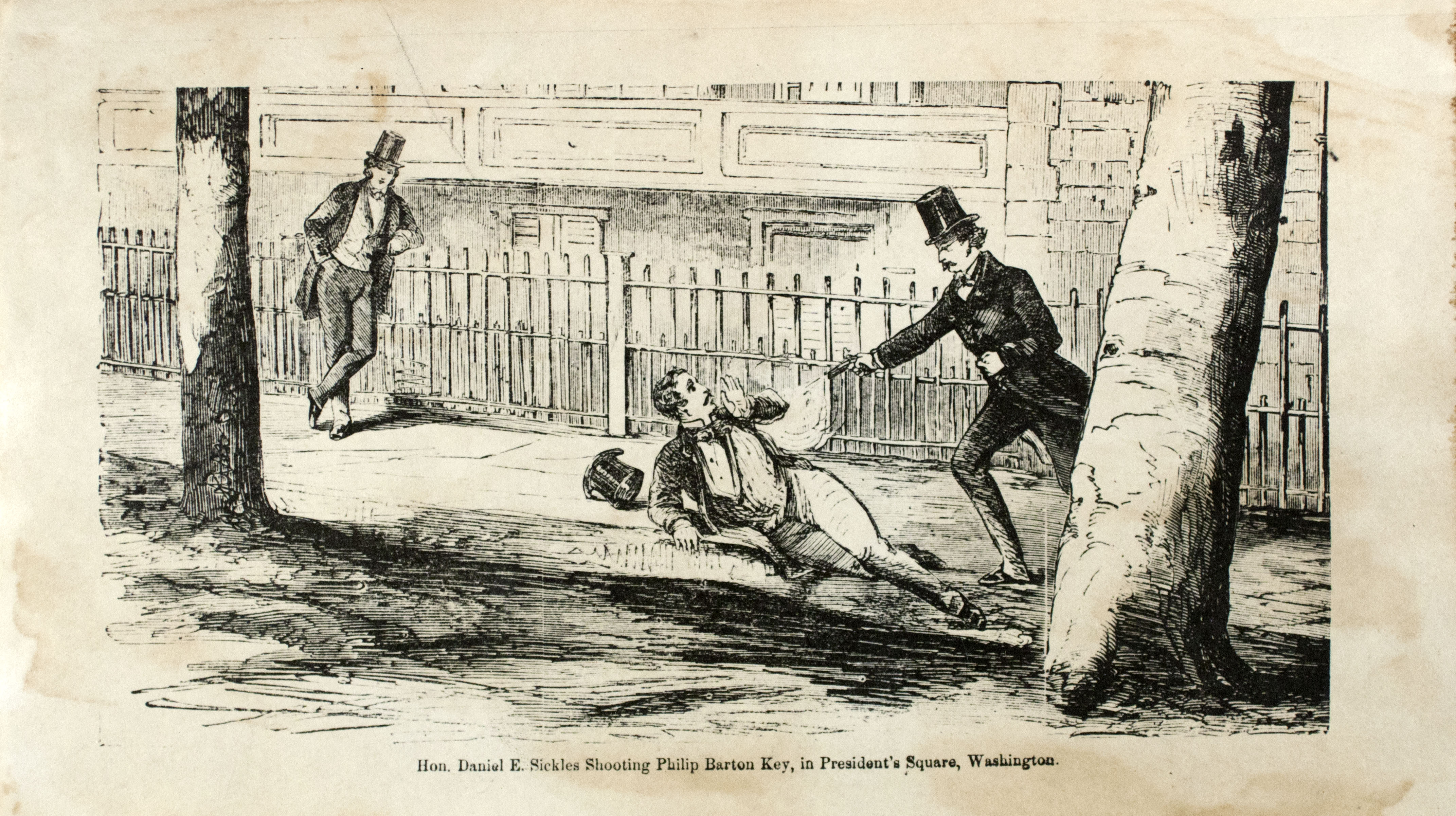
Butterworth left the house first and met Key at the southeast corner of Lafayette Square across from the White House. Allegedly not knowing Sickles intended any harm, Butterworth walked with Key to for a few minutes and then left. The exchange delayed Key and gave Sickles, who had armed himself with a single shot large caliber Derringer, and a muzzle-loading Colt revolver, enough time to catch up with Key near the Club House on Madison on the east side of the square. Sickles was raving but Dan’s fury transcended reality,” [20] as at least a dozen witnesses were nearby as he screamed, “Key, you scoundrel, … you have dishonored my bed – and you must die!” [21] Sickles pulled out the revolver, the first shot from which grazed Key, and the second which misfired. A brief scuffle ensued as Key lunged at his assailant, but Sickles flung him to the ground, and drew the Derringer as Key threw the opera glasses that he viewed Teresa at Dan. A third shot hit Key in the groin and he slumped to the ground screaming “Murder! Murder!… Don’t shoot!” [22]

If there was a chance for Sickles to prove that he acted in self-defense it was now, but he could not control himself. He fired the revolver yet again and it misfired. He placed the weapon in his pocket and drew the Derringer, and fired a shot which hit Key in the Liver. As Key writhed on the ground Sickles tossed the Derringer to the ground and he again drew the Colt. As the stunned witnesses to the attack looked on, Sickles advanced toward the fallen Key and placed the gun at his head and pulled the trigger, but again the weapon misfired. As Sickles attempted to place another cap in the pistol, a number of witnesses began to intervene. One man, “a member of the club, running up, stopped him. Mr. sickles – for God’s sake!” And Butterworth, coming forward, took Dan by the arm. Without a word, they walked away together.” [23] Witnesses took the mortally wounded Key away to the Club, where he expired.

President Buchanan was almost immediately told of the murder by a White House page boy, was aware of the implications of the scandal, Sickles was a friend and political ally with much promise. Buchanan told the boy leave town and gave him a sum of money to facilitate his departure. Soon after Sickles and Butterworth went by carriage “to the home of Attorney General Black, where the Congressman formally surrenders himself to the silver-haired Cabinet member who had regarded him as a protégé.” [24] He declined bail in favor of a speedy trial, was allowed to go home where he told Teresa that he had killed her lover, retrieved some personal items and then went to the District jail, “a foul hole, swarming with vermin, destitute of sewage, bath, water, ventilation, and so inadequate to its purpose that often a dozen or more prisoners were herded into a single narrow cell.” [25] When he arrived he reportedly asked the jailer if they were the best accommodations available, to which the jailer responded “this is the best place you members of Congress have afforded us.” [26] Dejected, but undeterred Sickles sent a message to the public, “In doing what I had to do I have broken the law. Therefore I place myself behind bars. It is for you to set me free.” [27] The stage was now set for the one of the most unbelievable and storied trials in American history.

Notes

[1] Ibid. Swanberg Sickles the Incredible p.4

[2] Ibid. Catton The Army of the Potomac: Glory Road p.151

[3] Ibid. Swanberg Sickles the Incredible p.15

[4] Ibid. Hessler Sickles at Gettysburg p.8

[5] Ibid. Swanberg Sickles the Incredible p.16

[6] Ibid. Pinchon Dan Sickles p.74

[7] Ibid. Hessler Sickles at Gettysburg p.9

[8] ibid. Swanberg Sickles the Incredible p.20

[9] Ibid. Swanberg Sickles the Incredible p.25

[10] Ibid. Keneally American Scoundrel p.92

[11] Ibid. Wilson and Clair They Also Served p.99

[12] Ibid. Pinchon Dan Sickles p.94

[13] Ibid. Swanberg Sickles the Incredible p.44

[14] Ibid. Keneally American Scoundrel p.92

[15] Ibid. Pinchon Dan Sickles p.93

[16] Ibid. Hessler Sickles at Gettysburg p.10

[17] Ibid. Swanberg Sickles the Incredible p.53

[18] Ibid Keneally American Scoundrel p.121

[19] Ibid. Hessler Sickles at Gettysburg p.10

[20] Ibid. Keneally American Scoundrel p.127

[21] Ibid. Swanberg Sickles the Incredible p.54

[22] Ibid. Hessler Sickles at Gettysburg p.11

[23] Ibid. Pinchon Dan Sickles p.112

[24] Ibid. Swanberg Sickles the Incredible p.55

[25] Ibid. Pinchon Dan Sickles p.114

[26] Ibid. Keneally American Scoundrel p.135

[27] Ibid. Swanberg Sickles the Incredible p.114

3 Comments

Filed under civil war, crime, Gettysburg, History, laws and legislation, Political Commentary

When Political Parties Implode: The Battle over the Lecompton Constitution and its Relevance Today

Friends of Padre Steve’s World

I have been watching the implosion of the Republican Party with some concern, not because I am a Republican or support that party, but because I am a historian and understand that the effects of these kinds of crack ups are not just bad for the party concerned, but often for the country, because they reveal deeper social and political issues. As I watch this I am reminded of the crisis and battle regarding the Lecompton Constitution in 1858. Since the article deals with this in some detail I will cut to the bottom line. In 1858 the Democratic Party held majorities in both houses of Congress and the Presidency. It had been aided by the collapse of the Whig Party and the new republican Party was still in its infancy. But extremists Democrats sought to push through a measure to bring Kansas into the Union as a Slave State, though the measure was rife with fraud. It split the Democratic Party and for a time destroyed it as a national party and helped bring about the Civil War. The battle over the Lecompton constitution is an epic event in our history. 

The issues today are not the same by any means, but the rhetoric and the intransigence of the most zealous ideologues is destroying the Republican Party in much the same way other ideologues destroyed the Democratic Party in 1858.  I admit that I could be wrong, but everything that I see happening is pointing to the implosion and possible breakup of the Republican Party. This may be good for Democrats in the short term, but seldom is it good for the country. But whatever your political views are, I do hope that you read this article and think about the implications of it, and of what is happening in our country today.

Peace

Padre Steve+

Stephen-Douglas-in-1858

Senator Stephen Douglas in 1858

Kansas was politically divided between two competing legislatures, each which claimed to be the voice of the people. The population of Kansas was heavily anti-slavery and many citizens felt disenfranchised by the official legislature, which was “a pro-slavery body elected by fraud in 1855.” [1] This body met in the city of Lecompton. In 1857 the Lecompton legislature sensed the opportunity to have Kansas admitted to the Union as a Slave State. It elected slavery supporters as members of a constitutional convention to draft a constitution which would be submitted to Congress for admission to the Union as a Slave State.

Free State partisans feared that that if they participated in the election that they would be “gerrymandered, and simply counted out by stuffed ballots,” and sat out the election. As a result it was “a quiet election, with many proslavery candidates unopposed and only 2,200 out of 9,000 registered voters going to the polls, a large majority of extreme proslavery men won election as delegates to the constitutional convention in September.” [2] But the result of the election was untenable, for “Two thousand voters in a territory with 24,000 eligible for the franchise had elected a body of delegates whom no one seriously regarded as representative of the majority opinion in Kansas.” [3]

The Lecompton legislature passed the proslavery constitution, but it was vetoed by the outgoing governor, John W. Geary. Geary accused “the pro-slavery legislature of attempting to stampede a rush to statehood on pro-slavery terms,” but his veto was overridden. The constitution had several provisions that most of the population found unacceptable. It protected owners of “the 200 slaves in Kansas, banned free blacks from the state, and prohibited any amendments to the constitution for seven years.” [4] The newly appointed governor of the territory, Robert J. Walker opposed the measure and denounced it “as a vile fraud, a bare counterfeit.” [5] Walker demanded a new, fair, referendum, which the newly elected president James Buchanan, also backed. In response many Southerners in Congress “threatened to secede unless the administration fired Walker and backed down on the referendum issue.” [6] The threat of secession by Southerners in support of the radical minority in Lecompton led to chaos in the Democratic Party which controlled the House, the Senate and held the Presidency.

james-buchanan

President James Buchanan

James Buchanan, who had rode into office on the votes of the South was now pressured by Southern legislators to change his position on the Lecompton Constitution. Buchannan’s cabinet, which was heavily Southern, and pro-slavery expansion also used its influence to pressure the president. In response to the pressure, Buchanan reversed his previous stance in regard to Kansas and endorsed the bill. This provoked a new outcry, this time from members of the Democratic Party. Many Northern Democrats were outraged by the reversal and the threats of secession. Most of the Northern Democrats were willing to accept and even defend slavery where it existed, but they were opposed to the expansion of slavery. They felt betrayed by their president’s actions and rose in opposition to the bill that would admit Kansas as a Slave State.

The formidable Stephen A. Douglas, the Little Giant who had so skillfully crafted the Compromise of 1850 using the principle of popular sovereignty, led these Democrats in their fight against Buchanan’s acceptance and endorsement of Lecompton. Douglas’s previous actions to support the rights of Slave States had made him a hero in much of the South and his stature in both the North and the South made him the front runner to win the Democratic nomination for the presidency in 1860.

But Douglas, who had worked so hard to build compromises that would hold the Union together could not countenance the actions and tactics of the Southern members of his party. Douglas was a political realist and not an ideologue. He was very sympathetic to slave holders and no supporter of emancipation, in fact Douglas was a racist, and was convinced “of the inferiority of the Negro, and he had a habit of stating it with brutal bluntness, “I do not believe that the Negro is any kin of mine at all…. I believe that this government of ours was founded, and wisely founded upon white basis. It was made by white men, for the benefit of white men and their posterity, to be executed and managed by white men.” [7] But despite his own beliefs Douglas understood the danger that the pro-slavery extremists supporting Lecompton were to the party, and he knew that if the bill was passed that it would destroy the unity of the Democratic Party and possibly the Union itself.

Douglas was outraged and when he saw the news that in the Washington Union that Buchanan had decided to support Lecompton he wrote:

“This left no doubt were the old bastard stood. “Can you believe his Goddamned arrogance?” I told a friend. “I run the Committee on Territories. He should have consulted me before approving the Lecompton fraud. He’ll pay for that. By God, sir, I made Mr. James Buchanan, and by God, sir, I’ll unmake him.” [8]

As such, the Little Giant threw caution to the wind and stormed to the White House “to confront Buchanan on the “trickery and juggling of the Lecompton constitution.” He warned the president of that his actions in support of the Lecompton party would “destroy the Democratic party in the North,” and we warned that “if Buchanan insisted on going through with it, Douglas swore to oppose him in Congress.” [9]

It was an epic confrontation. Douglas recalled, “The Lecompton constitution, I told Buchanan bluntly, was a blatant fraud on the people of Kansas and the process of democracy, I warned him not to recommend acceptance of it. With his head titled forward in that bizarre habit of his, he said that he intended to endorse the constitution and send it to Congress. “If you do,” I thundered, “I’ll denounce it the moment that it is read.” His face turned red with anger. “I’ll make Lecompton a party test,” he said. “I expect every democratic Senator to support it.” I will not, sir![10] Buchanan then cut Douglas off.

Angry and offended by Douglas Buchanan issued his own threat to Douglas saying, “I desire you to remember that no Democrat ever yet differed from an administration of his own choice without being crushed….Beware of the fate of Tallmadge and Rives,” two senators who had gone into political oblivion after crossing Andrew Jackson.” Douglas was undeterred and fought back, Douglas riposted: “Mr. President, I wish to remind you that General Jackson is dead, sir.” [11] It was an unprecedented action by a sitting Senator, to confront a President of one’s own party and threaten to oppose him in Congress was not done.

Following the confrontation with Buchanan Douglas was even more determined to defeat the Lecompton party. In righteous anger Douglas “took his political life into his own hands and assailed the Lecompton Constitution on the floor of the Senate as a mockery of the popular sovereignty principle.” [12] Buchanan’s allies in Congress fought back, and the two sides sometimes came into physical confrontation with each other in the chambers of Congress. When Buchanan’s supporters pushed for Lecompton’s approval and the admission of Kansas as a Slave State, Douglas fired back, warning “You do,” I said, “and it will lead directly to civil war!” I warned the anti-Lecompton Democrats of the North that the President intended to put the knife to the throat of every man who dared to think for himself on this question and carry out principles in good faith. “God forbid,” I said “that I ever surrender my right to differ from a President of the United States for my own choice. I am not a tool of any President!” [13]

Under Douglas the Northern Democrats joined with Republicans for the first time to defeat the admission of Kansas as a Slave State. Douglas recalled the battle:

“After the Christmas recess, the Administration unleashed its heavy horsemen: Davis, Slidell, Hunter, Toombs, and Hammond, all southerners. They damned me as a traitor and demanded that I be stripped of my chairmanship of the Committee on Territories and read out of the Democratic party. Let the fucking bastards threaten, proscribe, and do their worst, I told my followers; it would not cause any honest man to falter. If my course divided the Democratic party, it would not be my fault. We were engaged in a great struggle for principle, I said, and we would defy the Administration to the bitter end.” [14]

Southern members of Congress fought back and as the battle continued their acrimony towards Douglas grew and their rhetoric against the Little Giant became more heated. He was “at the head of the Black column…stained with the dishonor of treachery without parallel…patent double dealing…detestable heresies…filth of his defiant recreancy…a Dead Cock in the Pit…away with him to the tomb which he is digging for his political corpse.” [15]

But Douglas was undeterred by the threats to his career, he saw that he was in the right, and though he was in agreement with the philosophy of his opponents regarding slavery as an institution he realized that appeasing the South was not an option in regard to Lecompton. He wrote:

“My forces in the House fought a brilliant delaying action while I worked to win over wavering Democrats. When we introduced a substitute bill, Buchanan called a dozen congressmen to the White House and exhorted them not to forsake the administration. He was cursing and in tears. He had reason to be: on April first, a coalition of ninety-two Republicans, twenty-two anti-Lecompton Democrats, and six Know-Nothings sent Lecompton down to defeat by passing the substitute bill. This bill provided for a popular vote on the Lecompton constitution and for a new convention if the people rejected that document, as they surely would.” [16]

The substitute bill was passed by the Senate as well and sent back to Kansas for a popular vote. When the Lecompton Constitution was resubmitted to the people of Kansas, “to the hideous embarrassment of Buchanan, the voters of Kansas turned on August 30th and rejected Lecompton by a vote of 11,812 to 1,926.” [17] Douglas wroteThe agony is over,” cried one of my aides, “and thank God that the right has triumphed. Poor old Buck! Poor old Buck had just had his face rubbed in shit. By our “indomitable courage, “ as another aide put it, we’d whipped this “powerful and proscriptive” Administration and forced the Black Republicans to support a substitute measure which fully embodied the great principles of the Kansas-Nebraska Act.” [18]

Pro-slavery Southerners were outraged and Buchanan used every measure that he could to crush the anti-Lecompton Democrats, but he had lost “one of the most vicious struggles in the history of Congress, Southern Democrats had seriously damaged the patience of their Northern counterparts, and Buchannan loyalists in the North were unseated wholesale by upstart Republicans in the 1858 congressional elections.” [19] Buchanan’s Presidency was discredited, his party divided, its majority in congress lost, and the South moving closer to secession. Southerners considered Douglas a traitor and accused him of betraying them. “A South Carolinian lamented that “this defection of Douglas has done more than all else to shake my confidence in Northern men on the slavery issue, for I have long regarded him as one of our safest and most reliable friends.” [20]

The fight over Lecompton was a watershed. It served to illuminate how “minuscule minorities’ initial concerns ballooned into unmanageable majoritarian crises. The tiny fraction of Missouri slaveholders who lived near the Kansas border, comprising a tinier fraction of the South and a still tinier fraction of the Union, had demanded their chance to protect the southern hinterlands.” [21] The crisis that they provoked drew in the majority of Southern Democrats who came to their aid in Congress and provoked Northerners to condemn the Southern minority, which they believed was disenfranchising the majority in order to expand slavery to new territories.

The issue of Lecompton galvanized the political parties of the North and split the Democratic Party into Northern and Southern factions, dooming it as a national party for the foreseeable future. It was also the first time that a coalition Northern Democrats sided with anti-slavery forces. Through the efforts of “Republicans and anti-Lecompton Douglas Democrats, Congress had barely turned back a gigantic Slave Power Conspiracy to bend white men’s majoritarianism to slavemaster’s dictatorial needs, first in Kansas, then in Congress.” [22]

The political impact of the Lecompton crisis on the Democratic Party was an unmitigated disaster. The party suffered a major election defeat in the 1858 mid-term elections and lost its majorities, and in a sense fulfilling Lincoln’s words “became increasingly a house divided against itself.” [23] Douglas’s courageous opposition to Lecompton would be chief among the 1860 split in the Democratic Party, Southern Democrats turned with a vengeance on the man who had been their favorite in the 1856 democratic primary. This doomed his candidacy for President and ensured the election of Abraham Lincoln and the Republicans, a man that he had defeated for Senate in that critical summer of 1858.

Notes

[1] Ibid. Guelzo Fateful Lightening p.81

[2] Ibid. Potter The Impending Crisis p.300

[3] Ibid. Potter The Impending Crisis p.314

[4] Ibid. Guelzo Fateful Lightening p.115

[5] Ibid. McPherson The Battle Cry of Freedom p.165

[6] Ibid. McPherson The Battle Cry of Freedom p.164

[7] Ibid. Potter The Impending Crisis p.340

[8] Ibid, Oates The Approaching Fury p.208

[9] Ibid. McPherson The Battle Cry of Freedom p.166

[10] Ibid, Oates The Approaching Fury p.208

[11] Ibid. McPherson The Battle Cry of Freedom p.166

[12] Ibid. Guelzo Fateful Lightening p.115

[13] Ibid, Oates The Approaching Fury p.210

[14] Ibid, Oates The Approaching Fury pp.212-213

[15] Ibid. McPherson The Battle Cry of Freedom p.168

[16] Ibid, Oates The Approaching Fury pp.215-216

[17] Ibid. Guelzo Fateful Lightening p.116

[18] Ibid, Oates The Approaching Fury p.216

[19] Ibid. Guelzo Fateful Lightening p.116

[20] Ibid. McPherson The Battle Cry of Freedom p.167

[21] Ibid. Freehling, The Road to Disunion Volume II: Secessionists Triumphant 1854-1861 p.140

[22] Ibid. Freehling, The Road to Disunion Volume II: Secessionists Triumphant 1854-1861 p.142

[23] Fehrenbacher, Don E. Kansas, Republicanism, and the Crisis of the Union in The Civil War and Reconstruction Documents and Essays Third Edition edited by Michael Perman and Amy Murrell Taylor Wadsworth Cengage Learning Boston MA 2011 p.94

7 Comments

Filed under civil rights, civil war, History, laws and legislation, leadership, Political Commentary
