Tag Archives: the crucified god

Good Friday…Ecce Homo! Behold the Man

“God is nowhere greater than in his humiliation. God is nowhere more glorious than in his impotence. God is nowhere more divine than when he becomes man” Jürgen Moltmann Trinity and Kingdom


“So they took Jesus; 17and carrying the cross by himself, he went out to what is called The Place of the Skull, which in Hebrew* is called Golgotha. 18There they crucified him, and with him two others, one on either side, with Jesus between them.” John 19: 16b-18

4Surely he has borne our infirmities
and carried our diseases;
yet we accounted him stricken,
struck down by God, and afflicted.
5But he was wounded for our transgressions,
crushed for our iniquities;
upon him was the punishment that made us whole,
and by his bruises we are healed.
6All we like sheep have gone astray;
we have all turned to our own way,
and the Lord has laid on him
the iniquity of us all. Isaiah 53:4-6

“My God my God why have you forsaken me?”

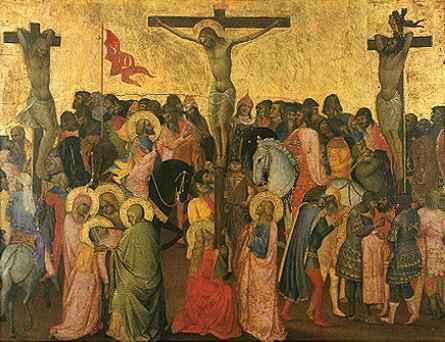
Today is Good Friday, the Altars are bare and we simply “Behold the Man.” The picture that we have today is paradoxical, it is the picture of a suffering man betrayed by a friend, abandoned by his closest followers and executed in a barbaric fashion under the orders of a man who washes his hands of his own responsibility.  It is a picture that is troubling because of its unpleasantness it is not the kind of picture of God that we want.  While we gladly acknowledge God’s grace and God forgiving our sins through Jesus we want to stay on this side of the resurrection. But like it or not we are confronted with questions about why do the innocent suffer and how could God do this to me or the one that I love.  Much of the problem is that we often buy in to a God untouched by human suffering a God who is arbitrary, unfeeling and cold no matter how much we try to convince ourselves that he cares.  A God incapable of suffering is a cold comfort when we or a loved one suffers. This is not the Christian God even if we try to baptize this “god” in our theology.  “In Christianity the cross is the test of everything that deserves to be called Christian” so writes Jürgen Moltmann in “The Crucified God.”

The Cross and the Passion of Christ is the center of how Christians come to understand God and if we attempt to regulate it to the background we do the message of the Gospel violence.  This is very apparent in the number of churches that do nothing to acknowledge the event on Good Friday even as they adorn their churches for the Easter celebration. It is as if the central event in God’s revelation to humanity and means by which he reconciles humanity to himself is a stepchild to the resurrection, but without the Cross there is no resurrection. It is also seen by some who find the symbol of the Crucifix offensive often derisively saying “Jesus isn’t on the Cross anymore, I worship the Risen Jesus.” While we worship the Risen Christ he also remains the Crucified God who in his human flesh bore the sins of the world. It is as Dietrich Bonhoeffer writes:

“The figure of the reconciler, of the God-man Jesus Christ, steps into the middle between God and the world, into the center of all that happens.  In this figure is disclosed the mystery of the world, just as the mystery of God is revealed in it.  No abyss of evil can remain hidden from him through whom the world is reconciled to God.  But the abyss of the love of God embraces even the most abysmal godlessness of the world.  In an incomprehensible reversal of all righteous and pious thought, God declares himself as guilty toward the world and thereby extinguishes the guilt of the world.  God treads the way of humble reconciliation and thereby sets the world free.  God wills to be guilty of our guilt; God takes on the punishment and suffering that guilt has brought on us.  God takes responsibility for godlessness, love for hate, the holy one for the sinner.  Now there is no more godlessness, hate, or sin that God has not taken upon himself, suffered, and atoned.  Now there is not longer any reality, any world, that is not reconciled with God and at peace.  God has done this in the beloved son, Jesus Christ.  Ecce homo!” –Dietrich Bonhoeffer, Ethics: Dietrich Bonhoeffer Works, Volume 6, edited by Clifford J. Green and translated by Reinhard Krauss, Charles C. West, and Douglas W. Scott (Minneapolis: Fortress, 2005), 83.

In addition to its salvific value the Cross of Christ is also relevant to all who suffer as “the deep meaning of the cross of Christ is that there is no suffering on earth that is not borne by God.” In the Cross God identifies himself with all of humanity especially those afflicted or persecuted.

Today we take the time to reflect and remember this event. Many people will have a day of fasting and accompany it with prayer or service.  My prayer is that in the midst of the various crises that we face in the country and the world that we will take the time as Christians to ponder the depth of God’s love and identification with his all people and the ramifications for how we treat others, even those that we view as our opponents or even enemies.  If God can condescend to love us while we were at enmity with him, just how can we fail to treat others with the same love? To again quote Bonhoeffer with whom I have walked this Lenten season:

“God loves human beings. God loves the world. Not an ideal human, but human beings as they are; not an ideal world, but the real world. What we find repulsive in their opposition to God, what we shrink back from with pain and hostility, namely, real human beings, the real world, this is for God the ground of unfathomable love.”

Ecce Homo! Behold the Man!

Peace

Padre Steve+

Leave a comment

Filed under christian life, faith, Religion

Palm or Passion Sunday…the Paradox of the Triumphant Entry and the Cross

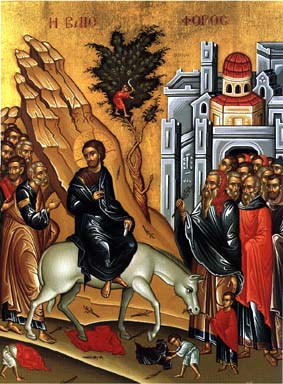
The Triumphant Entry

“Although we praise our common Lord for all kinds of reasons, we praise and glorify him above all for the cross. Paul passes over everything else that Christ did for our advantage and consolation and dwells incessantly on the cross. The proof of God’s love for us, he says, is that Christ died for us while we were yet sinners. Then in the following sentence he gives us the highest ground for hope: If, when we were alienated from God, we were reconciled to him by the death of his Son, how much more, now that we are reconciled, shall we be saved by his life!” John Chrysostom (AD 347-407)

God speaking to Luther: “Discipleship is not limited to what you can comprehend—it must transcend all comprehension. … Not to know where you are going is the true knowledge. My comprehension transcends yours. Thus Abraham went forth from His father… not knowing whither he went. … Behold, that is the way of the cross. You cannot find it yourself, so you must let me lead you as though you were a blind man. Wherefore it is not you, no man… but I myself, who instruct you by my Word and Spirit in the way you should go. Not the work which you choose, not the suffering you devise, but the road which is clean contrary to all you choose or contrive or desire—that is the road you must take. To that I call you and in that you must be my disciple.” Dietrich Bonhoeffer the Cost of Discipleship

Palm or Passion Sunday always is a day that invokes mixed emotions in me. It is the last Sunday of the Lenten Season and in modern times has become a juxtaposition of two events, the Triumphant Entry of Jesus into Jerusalem where he according to all four Gospels was greeted by crowds of people who lined the street with palms as Jesus riding on a donkey processed from Bethany and Bethphage where he had been staying with Lazarus into Jerusalem and the narrative of the Passion.  As such it is a roller coaster ride in our experience of walking with Jesus in the most difficult times.

This particular occasion is the Sunday where the disciples of Jesus are confronted with the reality that our earthy expectations of him do not meet the reality of his condensation to walk among us fully Divine yet fully Human but one too well acquainted with suffering, rejection and shame.  He shatters our expectations that he will bless any particular political or social ideology that we allow to take pre-eminence over him, even those that invoke his name. Thus our liturgy brings us to this strange day where in a sense we are confronted with celebrating the entrance of the King and in the next breath cursing him and betraying him to those who torture and crucify him.

In the Roman Catholic and Anglican liturgy the observance is divided between the Liturgy of the Palms which takes place outside the Church Nave either outside the church building or in the Narthex in cold or inclement weather.  After an opening collect and reading of the Gospel passage from one of the synoptic Gospels, which one depends on which of the three year liturgical readings that the church is in. Following the reading of the Gospel the congregation led by choir, acolytes and clergy process into the church reciting the words of Psalm 118: 18-29 or singing a hymn such as “All Glory Laud and Honor.”  Once the congregation is in the church the Liturgy of the Word continues and when the Passion Gospel is read and specific roles may be assigned to members of the congregation, while the congregation remains seated through the first part of the Passion the congregation stands at the verse where “Golgotha” is mentioned and remains standing.

The liturgy takes the congregation on an emotional and spiritual roller coaster.  As the congregation begins outside the following is read:

When Jesus had come near Bethphage and Bethany, at the place called the Mount of Olives, he sent two of the disciples, saying, “Go into the village ahead of you, and as you enter it you will find tied there a colt that has never been ridden. Untie it and bring it here. If anyone asks you, ‘Why are you untying it?’ just say this, ‘The Lord needs it.'” So those who were sent departed and found it as he had told them. As they were untying the colt, its owners asked them, “Why are you untying the colt?” They said, “The Lord needs it.” Then they brought it to Jesus; and after throwing their cloaks on the colt, they set Jesus on it. As he rode along, people kept spreading their cloaks on the road. As he was now approaching the path down from the Mount of Olives, the whole multitude of the disciples began to praise God joyfully with a loud voice for all the deeds of power that they had seen, saying,

“Blessed is the king who comes in the name of the Lord!

Peace in heaven, and glory in the highest heaven!”

Some of the Pharisees in the crowd said to him, “Teacher, order your disciples to stop.” He answered, “I tell you, if these were silent, the stones would shout out.” Luke 19:29-40

It is hard when you read this passage and be caught in the reenactment of this procession not to feel the excitement that must have accompanied that procession.  It has the feeling of a victory parade but this road ends in a manner that those present, those seeking an earthly king and Messiah who would drive our the Roman oppressor and restore the kingdom to Israel would not expect with some of them perhaps playing a role in the drama that would take place later in the week.  I particularly like the hymn “All Glory Laud and Honor.”

All glory, laud and honor,
To Thee, Redeemer, King,
To Whom the lips of children
Made sweet hosannas ring.

Thou art the King of Israel,
Thou David’s royal Son,
Who in the Lord’s Name comest,
The King and Blessèd One.
Refrain

The company of angels
Are praising Thee on High,
And mortal men and all things
Created make reply.
Refrain

The people of the Hebrews
With palms before Thee went;
Our prayer and praise and anthems
Before Thee we present.
Refrain

To Thee, before Thy passion,
They sang their hymns of praise;
To Thee, now high exalted,
Our melody we raise.
Refrain

Thou didst accept their praises;
Accept the prayers we bring,
Who in all good delightest,
Thou good and gracious King.

During the Liturgy of the Word one of the following is read, either Isaiah 45:21-25 or Isaiah 52:13-53:12, the second being the Song of the Suffering Servant.  The Psalm is Psalm 22 where the Psalmist foretells Jesus’ anguished cry from the Cross; “My God, my God, why have you forsaken me? and are so far from my cry and from the words of my distress?”And then we have the New Testament reading Philippians 2: 5-11, the hymn to Christ is read:

“Let the same mind be in you that was in Christ Jesus, who, though he was in the form of God, did not regard equality with God as something to be exploited, but emptied himself, taking the form of a slave, being born in human likeness. And being found in human form, he humbled himself and became obedient to the point of death– even death on a cross. Therefore God also highly exalted him and gave him the name that is above every name, so that at the name of Jesus every knee should bend, in heaven and on earth and under the earth, and every tongue should confess that Jesus Christ is Lord, to the glory of God the Father.”
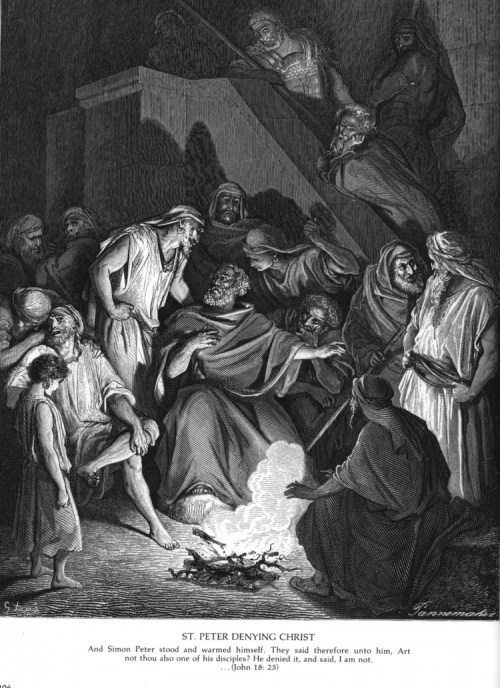
Peter Denies Christ

This year the Passion Narrative is that of Luke (22:39-71) 23:1-49 (50-56).  The three parts that stand out in this narrative for me are Peter’s denial of Jesus:

“Then they seized him and led him away, bringing him into the high priest’s house. But Peter was following at a distance. When they had kindled a fire in the middle of the courtyard and sat down together, Peter sat among them. Then a servant-girl, seeing him in the firelight, stared at him and said, “This man also was with him.” But he denied it, saying, “Woman, I do not know him.” A little later someone else, on seeing him, said, “You also are one of them.” But Peter said, “Man, I am not!” Then about an hour later still another kept insisting, “Surely this man also was with him; for he is a Galilean.” But Peter said, “Man, I do not know what you are talking about!” At that moment, while he was still speaking, the cock crowed. The Lord turned and looked at Peter. Then Peter remembered the word of the Lord, how he had said to him, “Before the cock crows today, you will deny me three times.” And he went out and wept bitterly.”

Peter’s denial is in large part because he has had his illusions about Jesus shattered and the fact that he had not understood the message up to that point.  As Bonhoeffer says “Jesus is a rejected Messiah. His rejection robs the passion of its halo of glory. It must be a passion without honor. Suffering and rejection sum up the whole cross of Jesus. To die on the cross means to die despised and rejected of men. Suffering and rejection are laid upon Jesus as a divine necessity, and every attempt to prevent it is the work of the devil, especially when it comes from his own disciples; for it is in fact an attempt to prevent Christ from being Christ.”

Likewise Jesus interaction with the condemned thieves that were crucified with him:

“One of the criminals who were hanged there kept deriding him and saying, “Are you not the Messiah? Save yourself and us!” But the other rebuked him, saying, “Do you not fear God, since you are under the same sentence of condemnation? And we indeed have been condemned justly, for we are getting what we deserve for our deeds, but this man has done nothing wrong.” Then he said, “Jesus, remember me when you come into your kingdom.” He replied, “Truly I tell you, today you will be with me in Paradise.”
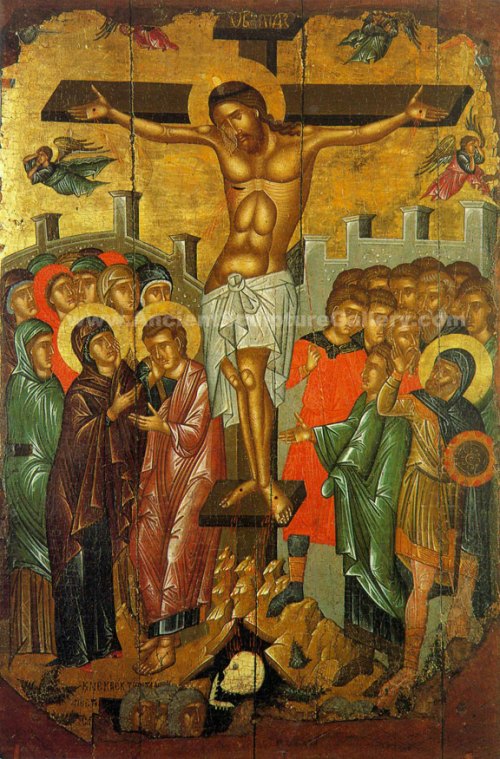
The Crucifixion

The final passage from this narrative that strikes me is the moment of Jesus’ death on the Cross:

“It was now about noon, and darkness came over the whole land until three in the afternoon, while the sun’s light failed; and the curtain of the temple was torn in two. Then Jesus, crying with a loud voice, said, “Father, into your hands I commend my spirit.” Having said this, he breathed his last. When the centurion saw what had taken place, he praised God and said, “Certainly this man was innocent.” And when all the crowds who had gathered there for this spectacle saw what had taken place, they returned home, beating their breasts. But all his acquaintances, including the women who had followed him from Galilee, stood at a distance, watching these things.”

The darkness of this is event is perplexing to those who want to find God in some place where he is untouched by human suffering to them the Cross is folly for what kind of God would submit himself to such ignominy but as Martin Luther wrote “He who does not know Christ does not know God hidden in suffering. Therefore, he prefers works to suffering, glory to the cross, strength to weakness, wisdom to folly. For they hate the cross and suffering and love works and the glory of works. Thus they call the good of the cross, evil and the evil of a deed, good. God can only be found in suffering and the cross.” It is in the contradiction of this week that we come to know God, not a God who seeks not the righteous or the powerful, those who seek the power of an earthy kingdom backed by an ideology of power which tramples the weak, but rather those who will simply walk in the footsteps of Jesus the Christ who rules by serving the least, the lost and the lonely.

The liturgy of this day takes us to the heart of the Gospel as we led by the writers through the triumph of the entrance into Jerusalem, to the betrayal of Jesus by Judas, the abandonment of him by the disciples and the denial of Peter.  As the writers lead us through his trial, conviction, scourging and trek to Golgotha we see the gamut of human emotions and reactions to Jesus and we know that we can be there as well in any of the characters simply because we are human and capable of compassion or betrayal.  As Jesus is on the Cross it is not the religious or upstanding that remain with him.  He is left with his mother, the other Mary and John the beloved.  He is shown compassion by a thief and recognized as the Son of God by the Roman Centurion, a gentile serving an empire oppressing the people of Israel and whose governor had pronounced the sentence of death upon him.  In this liturgy we have been taken from the heights of exhilaration in the triumphant entry to the depths of despair felt by his disciples that Friday afternoon. It is in this time that we realize how right Dietrich Bonhoeffer is when he writes “God loves human beings. God loves the world. Not an ideal human, but human beings as they are; not an ideal world, but the real world. What we find repulsive in their opposition to God, what we shrink back from with pain and hostility, namely, real human beings, the real world, this is for God the ground of unfathomable love.”
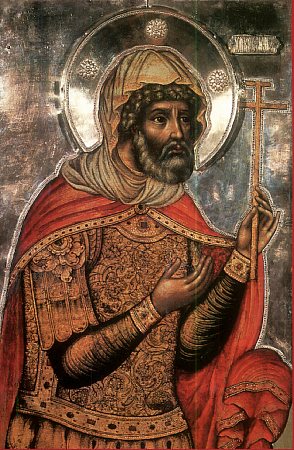
St Longinus, Centurion at the Cross and Martyr

It is the Centurion for which I have the greatest affinity in this story. He is a soldier and in the words of so many soldiers who have obey orders carried out the sentence upon Christ by crucifying him and then as the life ebbs out of Christ’s crucified body exclaims “surely this was a good man” or in other accounts “surely this was the Son of God.” That is the cry of a man who knows that he has executed an unjust sentence, the reaction of a true penitent, the reaction of a man who comes to realize even before many of Jesus’ closest followers understood.  According to tradition the Centurion was named Longinus who left the service of the Imperial Legion, was baptized by the Apostles and was martyred under the orders of Pontius Pilate by soldiers of the unit that he had once commanded.

It is important for the Church not to lose this identification.  The Church is not to become enmeshed and co-opted by those who attempt to use the Gospel to promote ideologies foreign to it as is the temptation in times of crisis.  As Jürgen Moltmann notes:

“In Christianity the cross is the test of everything which deserves to be called Christian… The Christian life of theologians, churches and human beings is faced more than ever today with a double crisis: the crisis of relevance and the crisis of identity. These two crises are complementary. The more theology and the church attempt to become relevant to the problems of the present day, the more deeply they are drawn into the crisis of their own Christian identity….

Christian identity can be understood only as an act of identification with the crucified Christ, to the extent to which one has accepted that in him God has identified himself with the godless and those abandoned by God, to whom one belongs oneself.” The Crucified God [pgs. 7, 19]

Nor is our task is not to attempt to invent “crosses” for ourselves in acts of pseudo-martyrdom but simply to be faithful in loving Jesus and our neighbor as Bonhoeffer noted “Must the Christian go around looking for a cross to bear, seeking to suffer? Opportunities for bearing crosses will occur along life’s way and all that is required is the willingness to act when the time comes. The needs of the neighbor, especially those of the weak and downtrodden, the victimized and the persecuted, the ill and the lonely, will become abundantly evident.” The mark of the Christian is not to blindly give his life for a cause or be consumed by the false “messiah’s” promoted by politicians, pundits and even preachers captivated by the lust for power and glory.

As we walk through the mystery of Holy Week together let us renew our faith in the Crucified One and not be conformed to those things that seek to turn us from the way of discipleship and the way of the Cross.

Peace

Padre Steve+

2 Comments

Filed under christian life, faith, philosophy, Religion

Reformation Day: How Martin Luther and Hans Kung Brought Me to an Anglo-Catholic Perspective, a Book and Bible Burning Reaches Ludicrous Speed and Yankees take Game Three 8-5

Today is Reformation Day that is right sports fans, Reformation Day.  Now most people, unless they are Lutheran or a really “reformed” Presbyterian or Reformed Church kind of Christian have no clue about this. However when a young Priest and Theology Professor at the University of Wittenberg named Martin Luther posted the 95 Theses on the door of the Schlosskirche in Wittenberg it changed the course of Western as well as Church history.

martin-lutherMartin Luther

Luther posted his “theses” which was basically points of theological debate on the door of the Schlosskirche it broke the hold of the Roman Catholic Church of Europe, brought about what would become an increasingly fractured and diverse church in the west and established the primacy of the State over the Church in Western nations.  Luther intended nothing more than reforming and curtailing abuses in the Catholic Church and how the Church saw grace, faith and scripture.  His act and subsequent actions when put under the “ban” by the Pope drew to him the support of German nobility who desired to be free of the Holy Roman Empire and rapidly engulfed Europe in religious, political and military conflict.

The theology that Luther developed based upon the Three Solas; Sola fides by faith alone, Sola Gratia by grace alone and Sola Scriptura by scripture alone became the hallmarks of the Reformation and without getting into the weeds to dissect all the ramifications for the Church and the world impact the way that many Christians practice and express their faith to the current day.

For me Martin Luther was along with Fr Hans Kung, Jurgen Moltmann, and Alistair McGrath a key figure in the development of my faith.  At some point I will probably get deeper into this on this blog, but right now it suffices to say that it was Martin Luther who confirmed to my the essential nature of the Eucharist to the Christian faith and which helping bring me to a catholic understanding of the faith versus a truly reformed Protestant understanding of it.  I do not agree with all of Luther’s points or ideas but his Theology of the Cross brought me to a much more incarnational understanding of the Christian faith especially in regards to understanding that it is only through the Cross that we come to know God in a truly Christian sense of understanding.  For Luther the Cross was central to understanding the humanity’s relationship to the Trinity, not as Calvin would enunciate God’s will and predestination from before time began.  Kung from the Catholic side is a big Luther supporter (see On Being a Christian) and Moltmann has brought Luther’s thought to the 21st Century in Theology of Hope and The Crucified God as has Anglican Theologian and Luther scholar Alistair McGrath (The Mystery of the Cross.) All of these men helped me in my transition following seminary to a moderate Anglo-Catholic expression of faith that places a high place to Scripture, Apostolic Tradition and Reason in interpreting and living out the faith.

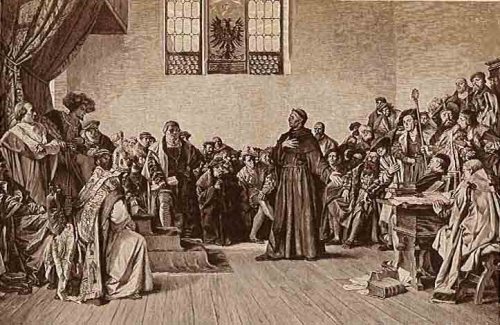
luther_at_wormsLuther at the Diet of Worms

I did a lot of study on the Lutheran Reformation in and after seminary and in 1996 while stationed in Germany as a mobilized Army Reserve Chaplain had the privilege of organizing a series of Reformation tours to Wittenberg on Reformation day where we attended the Reformationstag service at the Schlosskirche and I led a walking tour of the town.  One of the parishioners from the chapel asked me if I had been to Wittenberg before because I seemed like I knew every place in the town.  I had to tell her that I had not been there in person but because of my study felt like I had from the time we stepped off of our tour bus.  I also directed a tour to Worms where Luther on trial before Charles V was told to recant his writings and made his timeless statement:

“Unless I am convicted by scripture and plain reason – I do not accept the authority of the popes and councils, for they have contradicted each other – my conscience is captive to the Word of God. I cannot and I will not recant anything for to go against conscience is neither right nor safe. God help me. Amen.” It is legend that Luther said the words “Here I stand. I cannot do otherwise. God help me, Amen!” These words were probably only added later by someone else to make the story more interesting as they do not appear in the council notes.  Not that Luther would have objected.  The film version is linked here:

http://www.youtube.com/watch?v=U0tk_EvWXQQ&feature=player_embedded

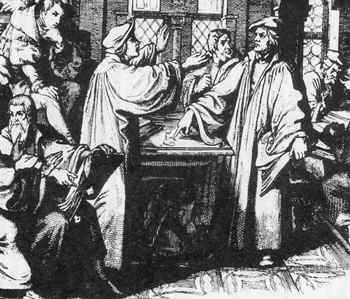
marburgZwingli and Luther at Marburg

Likewise his debate with Swiss Reformer Ulrich Zwingli at the Marburg colloquy regarding points of doctrine was significant for me. It was held that they might unify their movements. They agreed on all points except the Eucharist where Luther enunciated a very catholic understanding of the “Real Presence” and Zwingli held to be a symbolic memorial though might have some spiritual component.   Luther would not budge and to each of Zwingli’s arguments pulled back the tablecloth to reveal the words “This is my body, this is my blood” which he had carved on the table.  They departed without achieving unity, something that has plagued Protestants to this day and when Zwingli was killed in battle when leading the militia from Zurich to fight the approaching Catholic Army.  When Luther heard about the Zwingli’s death he commented Zwingli drew his sword. Therefore he has received the reward that Christ spoke of, ‘All who take the sword will perish by the sword’ [Matt. 26:52]. If God has saved him, he has done so above and beyond the rule.” (Table Talk #1451)

I have always had a special place in my heart for Luther even with all of his flaws which were many; he was earthy, spoke his mind, and had no problem with having fun or good beer.  Additionally he had a bit of an anger problem, suffered from clinical depression and had issues with his father.  Luther could be an ass, but then I can be an ass too.

Well the “unhappy few” at the Amazing Grace Baptist Church in Canton North Carolina are moving right along in their book and Bible burning crusade led by their Grand Master Pastor Marc Grizzard. In the past few days he has gotten into a pissing contest with a very conservative and should I even say “Fundamentalist” theologian named James White.  Evidently Mr. White is on the opposite end of the Fundamental spectrum according to Grand Master Pastor Marc along with “the agnostics, liberals, New Evangelicals, and Bible doubters.”  I did find it fascinating to see how Grand Master Pastor Marc’s little brain works in the text of their terrible translation tiff which is linked here: http://amazinggracebaptistchurchkjv.com/subpage570.html

I especially enjoyed this comment from his most recent webpage update where he castigates Mr. White:

“I had rather be uneducated and irrational and know that I have God’s preserved, inspired, infallible, inerrant Word of God, than to be a scholar who doesn’t know where God’s Word is. One person said, “I’d rather be an fool on fire, than a scholar on ice.” Don’t get me wrong, I am not saying a person should not better themselves or study. They should! But if study and education is going to rob you of your unwavering faith in the KJB, than leave the education to the Bible doubters. I will never be open to anything but the KJV, call me what you want. I don’t care!” Pastor Marc Grizzard

MARC KNEELING2Profiles in Stupidity Pastor Marc Grizzard

Since he has invited people to call him anything they want I think idiot works well. Have no fear he is already talking about next year’s event:

God has showed me why this years event went around the world. Check back in a couple of weeks as we begin to “Turn this world upside down.” Acts 17:6 “…These that have turned the world upside down” “Coming to a town near you!!!!” Please not my town.

Make arrangements now, if it gets popular you might have to book through Ticketmaster or the Amazing Grace Baptist Church Box Office.  By the way the start time is 7PM and Marc has said if you are not a member or have an invitation from him you are not welcome, and that includes law enforcement who promise to be there, kind of reminds me of the concert in the Blues Brothers. Of course he will have to compete with the folks at the fictional Landover Baptist Church to have the world’s greatest book and Bible burning. http://www.landoverbaptist.org/news1002/bookburning.html

Of course I wonder about a group of separatist Baptists staking their faith not on Jesus but the King James Version. It seems absurd for a group that descends from people who valued religious liberty to be burning book or Bibles of any kind.  The fact that they have set an Anglican translation, authorized by a flaming homosexual who hated, persecuted and killed the early English Baptists and which is actually a later version than the 1611 that has multiple versions, the Oxford and the Cambridge and is based on a text that was not the most common text used by the early or “ante-Nicene” church is beyond me.  The fact that King James onlyism is only about 100 years old and comes from a unusual 7th Day Adventist preacher and was advanced by the founder of the Pensacola Bible Institute who experimented with Zen Buddhism, thought about becoming a Jesuit and believed in a bunch of stuff including UFO;s that most Fundamentalists would deride only adds to my mystification.  But then to quote Forrest Gump “stupid is as stupid does.”  Congratulations Pastor Marc you win the Gump award for 2009. Congratulations, your 1973 orange Ford Pinto is waiting in the A-1 Auto Salvage in Fayetteville.

Tonight the Abbess and I will go to a Halloween party at our favorite restaurant the Gordon Biersch Brewery Restaurant in Virginia Beach.  I went as a baseball player from a scary team, the Orioles and the Abbess is going as a Hippy Chick.  It was fun, nice people, good music and 70’s and 80’s music videos and great beer.

Mariners Yankees BaseballAlex Rodriguez Broke out of His Slump

Now I sit watching game three of the World Series. For once replay was used to overturn a bad call, Alex Rodriguez getting his first hit, a 2 run home run that hit the lens of the right field television camera that was initially ruled a double.  Cole Hammels was hit hard as I predicted giving up five runs before he was pulled in the 5th, one of the runs coning off the bat of Andy Pettitte who drove in Nick Swisher and then later scored.  The Yankees bats began to come alive, Nick Swisher who had had a miserable post season hit a home run and a double, and Alex Rodriguez broke out of his slump with his 2 run homer. Hideki Matsui hit his second home run of the series with 2 outs in the 8th as a pinch hitter against Brett Myers.  For the Phillies the hot hitting Ryan Howard has continued to slump striking out 3 more times tonight to make him 2 for 13 with 9 strike outs in the first three games.  On the other hand Jayson Wirth continues to hammer the ball hitting two solo shots tonight.

Tomorrow should be nice, Church in the morning after an extra hour sleep, followed by some study for my exams and game four of the series tomorrow with C.C. Sabathia coming back against Joel Blanton.  Advantage has to go to the Yankees with Sabathia on the hill and thier bats starting to come to life. Should be another great game.

Peace,

Padre Steve+

3 Comments

Filed under Baseball, History, Religion

Alleluia! Memories of Easter…Past and Present

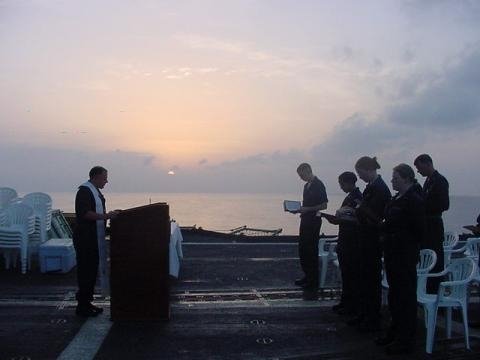
easter-2002-on-hue-cityEaster aboard USS Hue City CG-66 off the Horn of Africa 2002

I find Easter to be an interesting time.  I tend to get reflective and while I do joyfully say “Alleluia! Christ is Risen!” I also tend to be somewhat subdued.  By nature I am reflective person, I like to watch, observe and think.  I am not into big Easter productions and extravaganzas. I prefer much more simple expressions of the Risen Lord.  I think that Jesus would go along with me on this as he spent that first Easter walking with friends, who failed to recognize him, and then breaking bread, he celebrated the first Eucharist after the Resurrection at Emmaus.

For me my most memorable Easters have been connected with my life in the military.  They have almost always been simple affairs, and most involving the liturgy somehow.  I think the first Easter that I remember was at Cubi Point Naval Air Station in the Philippines, it was seeing the Chaplains in their Summer White uniforms that still stands out to me today.  I remember a Easter Sunrise service at Naval Station Long Beach and looking in wonder at two “mothballed” carriers of World War II vintage, the USS Boxer and USS Princeton moored near the site of the service on the waterfront.  When my dad was in Vietnam and we had been made unwelcome in a civilian church, we attended Mass at the Quonset hut that served as the Chapel on the little Naval Communications station.  In my senior year of high school I made a cruise on Navy ships to and from Pearl Harbor Hawaii.  During the week at Pearl I made the trip to the Arizona Memorial on Easter Sunday.  For some reason that experience reverberated as loud as any church service I have ever attended.  When I was a young Army Officer running from God and hiding in the Chapel, the Deity Herself patently used the events of Holy Week to “rend my heart” so to speak.  I left the Good Friday Tenebrea service praying that Easter would come.  Our good Lutheran Chaplain, Lee Rittenbach had driven home the reality of Jesus’ death so well that I really started to understand what the disciples went through.  When Easter came I learned to say “Alleluia! Christ is Risen!”

After that I went through kind of a spiritual desert as far as Easter was concerned.  In seminary I was attending mega-churches which did nothing with Holy week, and made a big evangelical production of Easter, complete with overly loud and insipidly shallow “worship” music and laborious preaching.  I have to say that these big productions were more of an ordeal than a celebration for me.  During seminary we were going through sickness, financial disaster, loss of our home, cars and struggling to survive working multiple jobs while being a full time student.  How we got through seminary I will never understand, other than that the Deity herself provided for us through a lot of wonderful people.  The “happy talk” at church, the prosperity Gospel, focus on signs and wonders seemed to reflect almost a gnostic other worldly view of life that I did not see in the Scriptures.

Academically and from a theological point of view Easter began to rally take shape for me.  Reading the Church Fathers as well reading Dietrich Bonhoeffer’s The Cost of Discipleship, Emil Brunner’s The Scandal of Christianity, Alister McGrath’s The Mystery of the Cross, Hans Kung’s On Being a Christian and Jurgen Moltman’s The Crucified God brought me to greater understanding of the connectedness of Easter to the Incarnation and the Passion.  One of my professors, a kindly gentleman named Yandall Woodfin, made a comment in his Philosophy of Religion class:  “We do not do Christian Theology without coming to grips with the reality of suffering and death.”  That comment was at first offensive to me because my mega-church pastors all focused on the Resurrection.  Death to them seemed to be a bother. One pastor said in a sermon how he did not do visits to the sick.  When asked by someone how sick they had to be for him to see them, he stated “You don’t want to be that sick.”

However, what Dr. Woodfin said planted a seed in me.  This went from an academic question, to daily reality during my Clinical Pastoral Education Residency at Parkland hospital.  Doing various Holy Week services there, in the midst of the amazing amount of pain, suffering and death in that gargantuan Medical Center brought into focus and made real what Dr. Woodfin said.  At Parkland there was no avoiding death or suffering, and what Dr. Woodfin said was right.  We don’t begin to do Christian theology until we we deal with suffering and death.  Easter and the Resurrection don’t happen without the Incarnation and Passion of Jesus.  Easter disconnected from the reality of suffering and death is nothing more than a “happy thought” or escape that avoids the the great Mystery of Faith: Christ has died. Christ is Risen. Christ will come again.

After Parkland my understanding of Easter grew as I was immersed in the liturgy, began to observe the liturgical year, and occasionally “clandestinely” attend Anglican churches during Christmas and Easter. During this time Judy became Roman Catholic, something that accelerated what was already going on in me.  During my formation process and following my ordination to first the Deaconate and then the Priesthood, the understanding deepened as I saw how the Gospel in Word and Sacrament. As an Army Reserve chaplain serving on active duty I experienced the life of a parish pastor at a small base in central Pennsylvania.  There I saw how the how the liturgical year and life are so intimately connect.  In life and death, in sorrow and joy, in good times and bad, the Holy Spirit touched people.

Easter became even more part of my life when I became a Navy Chaplain and left the Army in the “rear view mirror.”  Here I began to see how wonderful Easter is when you do not have all the “smells and bells” “praise teams” or great music or facilities.  It goes back to simplicity.  On Easter Sunday 2001, I was on the USS Frederick, LST 1184 with my Marines going from Korea back to Okinawa.  It was on Frederick 23 years before that I had first felt the call to be a Navy Chaplain during the trip to Pearl Harbor.  In 2002 I was deployed on USS Hue City CG-66 at the beginning of Operation Enduring Freedom. Off the Horn of Africa we had both sunrise services as well as a morning Eucharist on our flight deck. While with the Marine Security Forces I spent an Easter celebrating Eucharist on the fence-line adjoining Communist Cuba.  I now have come back to critical care hospital ministry in my ICUs.  Here we live Good Friday every day.  For me Easter is not just a nice thing to observe, but a necessity in life.

This morning I attended the early Mass with Judy at Ascension Catholic Church.  I love the church, though it is a bit big and busy for me now after Iraq.  So I found me a corner near the choir where I could sit with my back against the wall, an emergency exit to my left, and where I could observe what was going on.  Yes I was having a PTSD moment, but I got through it with the help of the Deity herself and a little ant-anxiety medication.  But the really cool thing was seeing a man who was one of our patients on the ICU a couple of months back.  A man who almost died on us several times, and his wife.  We had grown close during that 2 1/2 weeks and he made it through.  He looked great this morning.  We all hugged and talked of how good God is before Mass, exchanged the Peace and then spent some time together after Mass. That was really cool.  What a way to celebrate Easter.

Life and death, pain and suffering, healing and resurrection.  Alleluia, Christ is Risen. The Lord is Risen indeed. Alleluia!

Peace, Steve+

Leave a comment

Filed under Loose thoughts and musings, Military, Religion