Tag Archives: the killer angels

The Things that We Do: Killer Angels and Hew-Mons : The Part of Humanity we Don’t Like to Talk About

images-47

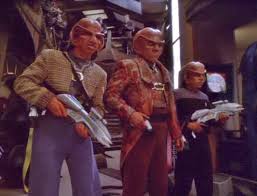
“Let me tell you something about Hew-mons, Nephew. They’re a wonderful, friendly people, as long as their bellies are full and their holosuites are working. But take away their creature comforts, deprive them of food, sleep, sonic showers, put their lives in jeopardy over an extended period of time and those same friendly, intelligent, wonderful people… will become as nasty and as violent as the most bloodthirsty Klingon. You don’t believe me? Look at those faces. Look in their eyes.” Quark to Nog Deep Space Nine- The Siege of AR-558 

We human beings, regardless of our race, religion or political ideology are a complex lot.

On one hand we can exhibit the utmost kindness, compassion, care and charity and on the other hand we can bless, endorse, encourage. condone and execute the most cruel,  hateful, violent and “inhuman” acts against our fellow human beings. We are quite a contradictory lot if you ask me.

It really is a most interesting and at times contradictory phenomena when you look at it. Of course, I like to believe, as to most of us I am quite sure like to think that we have either been created by God or evolved into a species that rises above the baser parts of life, the things that we like to say were done in years past but are no longer a part of who we are as human beings.

The same can be said for those of us that consider ourselves to be Christians. We look back on nearly 2000 years of Christendom and well, it is not a pretty sight. But like every other generation of Christians we like to think that we are better, perhaps more spiritual, better educated, better interpreters of the Bible or even perhaps better in tune with the Holy Spirit of God than were those before us.

Of course those of us that think that we are so advanced that we have evolved past violence, cruelty, hatred and avarice, be we Christians or not tend to gloss over the fact that we are human, or as Quark calls us “Hew-mons.” As such we are capable of the most extreme acts of kindness, love and benevolence as well as the utmost in cruelty.

0919071823

Of course when I say “we” I do include “me” because I am like about everyone else, I have my good days and bad and as much as I would like to think that I am better than my baser instincts something happens and I find that I am not. That much is evident any time I get out into traffic or go to Wal-Mart. It is a good thing that I do not display any Christian symbols on either of my cars, I don’t want God getting blamed for my lack of Christian behavior, and frankly I wish more Christians would do the same. I have lost count of the number of vehicles adorned with Christian symbols, bumper stickers and personalized plates that have ignored all the basic courtesies, rules of the road and polite behavior and who are frankly rude assholes that probably shouldn’t be allowed to drive that make me wish that they would keep their faith in Jesus to themselves, it makes Jesus look bad. But I digress… but just a moment, why do so many of these people drive mini-vans? At least I seem to end up behind them or get cut off by them. Maybe the mini-van is an invention of the Devil? You won’t get me behind the wheel of one.

No wonder that Paul the Apostle laments in the 7th Chapter of the Epistle to the Romans “I can will what is right, but I cannot do it. For I do not do the good I want, but the evil I do not want is what I do.”  Martin Luther, the great leader of the Reformation commented on this passage “This tension lasts in us as long as we live; though in one person it is greater, in another less, according as the spirit or the flesh, and he fights with himself until he becomes wholly spiritual.” It is one of the most honest commentaries on scripture even written no wonder we don’t like it.

I don’t know about you but this does make me think, take inventory of my own strengths, weaknesses, virtues and vices. The fact is that in any given situation Quark’s description of Hew-mons in general is very applicable to me.
480908_655507297796895_1863071676_n

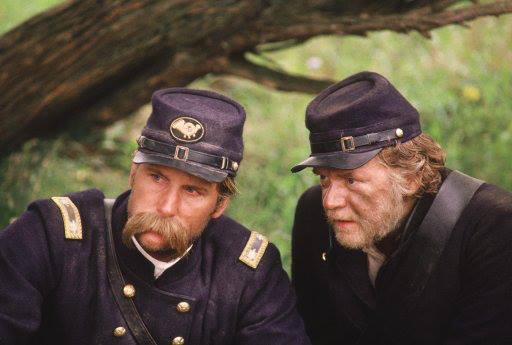
In Michael Shaara’s novel The Killer Angels and the film Gettysburg there is a remarkable exchange between Colonel Joshua Chamberlain, Colonel of he 20th Maine and Professor of Natural and Revealed Religions at Bowdin College and Sergeant Buster Kilrain, an exile from Ireland fighting for the Union.

Colonel Joshua Lawrence Chamberlain: [quoting Hamlet] “What a piece of work is man, in form and movement how express and admirable. In action how like an angel.”

Sergeant ‘Buster’ Kilrain: “Well, if he’s an angel, all right then. But he damn well must be a killer angel.” 

In light of all that we see every day as human beings we must find it in our hearts to agree with Kilrain. We are such a contradictory species. As Spock would say “fascinating.”

Peace

Padre Steve+

3 Comments

Filed under christian life, civil war, faith, star trek

Shoeless Joe and the Healing of the Soul

“Success is getting what you want, but happiness is wanting what you get.” Eddie Scissions in Shoeless Jo

I don’t read much non-fiction. However I do appreciate writers that can tell a story and make it feel real and bring the wood pulp that becomes the pages of a book to life.  I appreciate the writers who are able to blend fantasy and reality, history, religion, faith and mystery and in doing so bring me into the world that they create. It is quite amazing when I think about it.

Before Iraq the fiction I read was historical fiction or the genre of “alternative history.” I gravitated toward military fiction like Anton Meyrer’s Once an Eagle or W.E.B. Griffin’s The Brotherhood of War series and Michael Shaara’s The Killer Angels. All dealt with a military culture that was part of me and that I could relate to because of that shared culture.

But took going to Iraq for me to start reading the occasional work of fiction that was not related to the military. When I was in Iraq I started reading Father Andrew Greeley’s Bishop Blackie Ryan mysteries. I was beginning a crisis in faith and couldn’t sleep at night I found that somehow the stories touched me with the grace of God.  But I also read a little book called The Perfect Game by Michael Shaara which was a novel about a baseball player, a pitcher named Billy Chapel in the final game of his career. The book  later became the basis of the movie For the Love of the Game. It also resonated in me because it dealt with a man looking back at his life, his successes and failures and how they all flowed through his mind in that final game.

I finished reading W. P. Kinsella’s masterpiece Shoeless Joe last night. It is not the first time that I have read it The book is the novel that the film Field of Dreams is adapted from. Kinsella is a wonderful writer who manages to write in such a way that if you pause for a moment and close your eyes that you can enter into the vividness of the story. Sights, sounds, scents and even touch are imaginable in what he writes.

I saw the movie before I ever read the book. I drove Judy a couple of hundred miles out of our way back in 2004 to visit the actual Field of Dreams in Dyersville Iowa. But the book touches me in a very deep way. I read it the first time during the summer of 2008 when I returned from Iraq. I remember hunting through the shelves of the local bookstore until I found a copy. Every page that I read came to life and there were times that I had to stop reading because tears filled my eyes.

This time I read it on my I-Phone courtesy of the Amazon Kindle App. I have been doing a lot of my reading on my Kindle or I-Phone lately and despite the lack of pages to turn and spill coke or beer on as I read, the ability to have a lot of books at my fingertips instead of weighing down my trusty Blackhawk “Three Day Pack” that has been with me since I went to Iraq with more books that I should reasonably carry. People have always been amazed with the number of books that I have lugged around ever since I was a kid going to the public library or the school library.  Believe me the trade off is worth it, but I digress….

Once again Kinsella transported me to the world of Ray Kinsella, J.D. Salinger, Moonlight Graham and Shoeless Joe Jackson and the “Unlucky Eight” of the Black Sox scandal that rocked baseball in 1919.  I feel like I know them. But then in a way I do. I know so many ballplayers and baseball has been such a big part of my life that there is something that transcends the pages.  Like the characters in the book whose lives are tied to certain teams, in particular the 1919 White Sox and 1908 Cubs I have that sense of connection with the 1970 California  Angels and players like the late Jim Spencer and Third Base Coach Rocky Bridges. Spencer was a Gold Glove First Baseman and I met him at an autograph signing session at a local Von’s supermarket in Long Beach. that year. I wrote an essay for a contest on why he was my favorite Angel. I was one of the runners up and ended up as a runner up and got tickets to a game, my name in the newspaper and announced by Dick Enberg. I met Coach Bridges that same year and have a picture of him with my brother Jeff and me. That year at Anaheim Stadium and those fleeting encounters with the ball players and coaching staff of the 1970-71 Angels made me a believer in the game of baseball.

So whenever I read the book Shoeless Joe or see the movie Field of Dreams I end up crying. I do that a lot more of that than I used to and as always by the last few pages of the book I was wiping away my tears in order to read.

I think this is because it is a story that really is about the healing power of that lush green field, that perfect diamond that the game of baseball is played. It is a story of reconciliation of fathers and sons, brothers and even strangers. It really is a story of life touched by grace, of infinite possibilities. As Ray Kinsella, the teller of the story in the novel said:

“Baseball is the most perfect of games, solid, true, pure and precious as diamonds. If only life were so simple. Within the baselines anything can happen. Tides can reverse; oceans can open. That’s why they say, “the game is never over until the last man is out.” Colors can change, lives can alter, anything is possible in this gentle, flawless, loving game.”

It is a healing balm to my soul.

Peace

Padre Steve+

3 Comments

Filed under Baseball, faith, movies, philosophy

Gettysburg Day Three: The Tragedy of Friends at War; Lewis Armistead and Winfield Scott Hancock

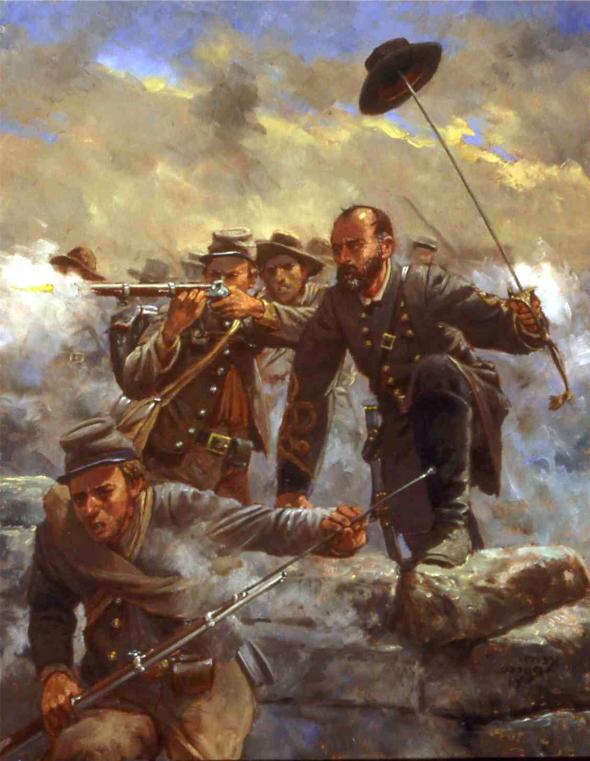
“Armistead at Gettysburg” by Keith Rocco

The bonds of friendship forged by soldiers are some of deepest and long lasting that are formed anywhere.  Those bonds are formed by military professionals in the small rather closed society that is the regular United States military over years of deployments, isolated duty, combat and a culture that is often quite different than that of civilian society.

When the people of a nation goes to war against each other the military is often the last to split and when it does men that were friends and comrades turn their weapons against each other and seldom with pleasure. Mass levies of civilian volunteers motivated by ideological, sectional or religious hatred tend to take up such causes with great aplomb. But those that serve together, even those that may believe in their cause are often torn between oaths that they swore to defend their country and their family and home. When their decisions are made they often part with great sadness knowing that they could one day meet each other on a battlefield.

The American Civil War has many such tales. One of the most remembered due to it being a key story line in Michael Shaara’s Pulitzer Prize winning novel The Killer Angels is that of Union General Winfield Scott Hancock and Confederate General Lewis Armistead. This friendship was immortalized in the movie Gettysburg which is based on Shaara’s novel.

Major General Winfield Scott Hancock USA

Hancock was from Pennsylvania was a career soldier and Infantry officer, a graduate of West Point Class of 1844. He served in Mexico and held numerous positions and in 1861 he was stationed in California as a Quartermaster under the command of Colonel (Brevet Brigadier General) Albert Sidney Johnston. One of his fellow officers, who he and his wife Almira became fast friends with was Captain Lewis Armistead, a twice widowed Virginian who also served as a commander of the New San Diego Garrison under Johnston’s command. Armistead was a nephew of the officer who defended Fort McHenry from the British in the War of 1812, a battle which occasioned Francis Scott Key to pen the Star Spangled Banner.  Armistead had academic difficulties at West Point and also had an altercation with Jubal Early in which he broke a plate over Early’s head.  His father helped him obtain a commission as an Infantry officer and his career was similar to many other officers of his day, Mexico, the Great Plains, Kansas, Utah and California.

As the war clouds built and various southern states seceded from the Union numerous officers were torn between their oath, their friendships with their fellow officers and their deep loyalty to their home state and families even if they personally opposed secession. In the end it was a decided minority of of Southern born officers that remained loyal to the Union, the most prominent of these men were General Winfield Scott and Major General George Thomas, the Rock of Chickamauga. Thomas’s action cost him his relationship with his immediate family who deemed him to be a traitor. Both men were pilloried and demonized in the most base ways by many in the South, during and after the war. Some Southerners who served the Union were executed when captured, George Pickett, who called for Thomas’ death ordered 22 North Carolinians captured fighting for the Union in Kinston North Carolina and he was not alone.

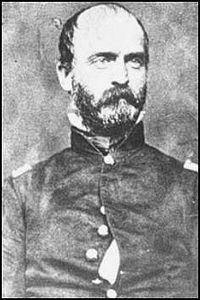
Brigadier General Lewis Armistead CSA

Armistead and other officers asked Hancock, who was a Democrat advice on what he would do if war came. Hancock’s reply was simple. I shall not fight upon the principle of state-rights, but for the Union, whole and undivided” 

The Hancock’s hosted a going away party for their friends departing from the service to join the Confederacy. Almira Hancock wrote that “Hearts were filled with sadness over the surrendering of life-long ties.”with the Johnston’s wife Eliza singing the popular Irish song Kathleen Mavourneen:

“Mavourneen, mavourneen, my sad tears are falling, To think that from Erin and thee I must part!

It may be for years, and it may be forever, Then why art thou silent, thou voice of my heart?…”

Armistead was tearful and said “Hancock, good-by; you can never know what this has cost me, and I hope God will strike me dead if I am ever induced to leave my native soil, should worse come to worse.”

At Gettysburg Armistead spoke his fears to his comrades, including Brigadier General Dick Garnett, another of his comrades from the California days as they met the night before the fateful charge of July 3rd. The next afternoon Armistead and Garnett led their brigades of Pickett’s Division against Hancock’s II Corps which was defending Cemetery Ridge.

During the engagement Garnett was killed just before reaching the Union lines and Hancock gravely wounded. Armistead, leading his brigade breached the Union line with his black hat atop his sword was wounded in the right arm and shoulder and fell near one of the Union artillery pieces, a point now known as “The High Water Mark” of the Confederacy.  As Armistead lay wounded he was approached by Major Bingham of Hancock’s staff who was responding to Armistead’s making a Masonic sign of distress. When Bingham told Armistead of Hancock’s injury Armistead was grieved and told Bingham to “Tell General Hancock for me that I have done him and you all an injury which I shall regret the longest day I live.” He gave Bignham a wrapped Bible and Prayer book to give to Almira Hancock, inscribed were the words “Trust in God and fear nothing.” 

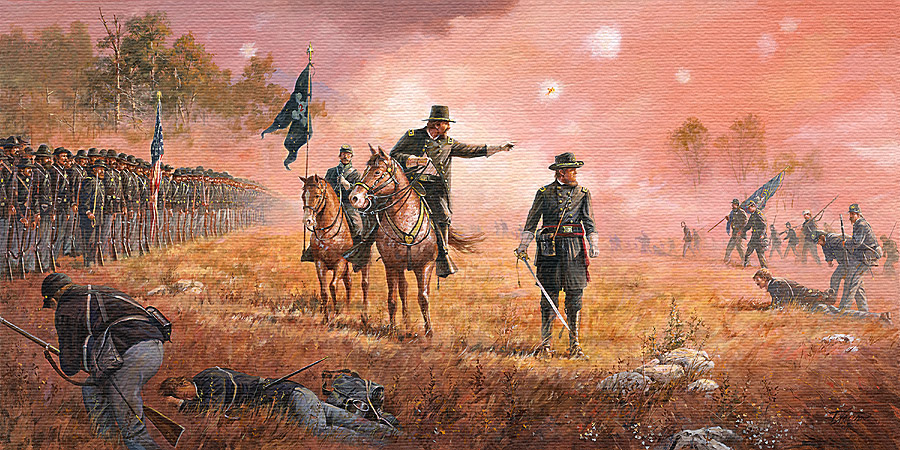
“Minnesota Forward” Hancock directing the Defense by Dale Gallon

Armistead would die from infections caused by his wounds which were initially not thought to be life threatening. Hancock would go on to continued fame and be one of the most admired and respected leaders of the Army during and after the war. He was gracious as a victor and spoke out against reprisals committed against Southerners after the war. He was the Democratic nominee for President losing a close election to James Garfield, losing the popular vote by under 40,000 votes.  It was an era of great political corruption and Hancock was one of the few major public figures Even his political opponents respected him for his integrity and honesty. Former President Rutherford B Hayes said “[i]f, when we make up our estimate of a public man, conspicuous both as a soldier and in civil life, we are to think first and chiefly of his manhood, his integrity, his purity, his singleness of purpose, and his unselfish devotion to duty, we can truthfully say of Hancock that he was through and through pure gold.” 

A few years after his death Republican General Francis A Walker, lamenting the great corruption of the time said:

“Although I did not vote for General Hancock, I am strongly disposed to believe that one of the best things the nation has lost in recent years has been the example and the influence of that chivalric, stately, and splendid gentleman in the White House. Perhaps much which both parties now recognize as having been unfortunate and mischievous during the past thirteen years would have been avoided had General Hancock been elected.”

The story of Hancock and Armistead is one that reminds us of how hardened ideologues can divide a nation to the point of civil war. It is a story that should give pause to any political or spiritual leader that incites people to war against their neighbor and use their ideology to enslave or brutalize their political opponents.

The blood of the approximately 50,000 soldiers that were killed or wounded during the three days of the Battle of Gettysburg is ample reminder of the human suffering brought about by unrestrained ideologues.

Peace

Padre Steve+

8 Comments

Filed under civil war, History

The “Comfortable” Experts and the Real Soldiers

“Too many people learn about war with no inconvenience to themselves. They read about Verdun or Stalingrad without comprehension, sitting in a comfortable armchair, with their feet beside the fire, preparing to go about their business the next day, as usual…One should read about war standing up, late at night, when one is tired, as I am writing about it now, at dawn, while my asthma attack wears off. And even now, in my sleepless exhaustion, how gentle and easy peace seems!” 

Guy Sajer “The Forgotten Soldier”

Currently well under one percent of Americans are serving in any branch of the military and of these not all have served with boots on the ground.  There is no shame for those that have not as land war is the prevue of the Army and Marines though a significant number of Sailors and some Air Force personnel have served alongside their Soldier and Marine comrades in arms.

Of those that serve there is not one who has not enlisted, reenlisted or renewed their Officer Oath of Office at least once since September 11th 2001.  There are those of us who have been in far longer but even we have made the commitment to continue in the service of our country knowing that anyone can be sent into harm’s way at any time.

Those that serve especially those that have served at the point of the spear in the remote badlands, or dangerous cities of Iraq and Afghanistan are a true minority group. We are a minority group composed of the best our nation has to offer. We represent every state and territory; we are citizens or in the case of many immigrants’ men and women seeking citizenship by risking their lives for a country that often despises their relatives based on their race, nationality or religion.  In fact this is not new; men have come to this country since our revolution from far countries because of the ideals that this nation represents.

This is a minority group composed of all races and whose families helped colonize this nation, came here in the following centuries and those that were here before the Europeans landed on this continent. We represent almost every religion and creed known to human kind. We come from cities, small towns, rural areas and island territories.  We are Democrats, Republicans, Libertarians and Independents.  We are Americans and we know war not from books, though many of us study military history, strategy and the lives of those great Soldiers, Sailors, Marines and Airmen that have gone before us. We know war because we have seen it. We have lost friends and seen others maimed or injured in mind, body or spirit. We have seen the wounded and the destruction which war inflicts on often innocent people who have the misfortune of living in a combat zone.

We do not make policy we carry out the orders of our national leaders and obey the laws passed by Congress. We are professionals.  We are not perfect but we serve.  In a sense we embody what the character of Colonel Joshua Chamberlain of the 20th Maine said at Gettysburg in Michael Shaara’s novel The Killer Angels and its film adaptation Gettysburg.

“This is a different kind of army. If you look at history you’ll see men fight for pay, or women, or some other kind of loot. They fight for land, or because a king makes them, or just because they like killing. But we’re here for something new. This has not happened much, in the history of the world: We are an army out to set other men free. America should be free ground, all of it, from here to the Pacific Ocean. No man has to bow, no man born to royalty. Here we judge you by what you do, not by who your father was. Here you can be something. Here is the place to build a home. But it’s not the land. There’s always more land. It’s the idea that we all have value, you and me. What we’re fighting for, in the end… we’re fighting for each other. Sorry. Didn’t mean to preach.” 

We serve at a time that our nation has been engaged in two very costly wars in terms of lives and treasure. We never thought that they would last as long as they have after all we were promised that and even told that the mission was “completed.” But the wars didn’t end and now our nation is involved in one, maybe two more in Libya and possibly Yemen.

We are told in spite of what we know from experience that the wars are going well and that we have turned a corner in Afghanistan even as the situation on the ground tells us otherwise.  We have the professional military experts in the think tanks telling us that the wars have to continue. Of course these men have never served in combat and what they know is gleaned from their interpretation of history and often dictated by their ideology and sometimes even worse by their connections to the defense industry, that which President and General of the Army Dwight D. Eisenhower so charmingly called “the military industrial complex.” Of course now we can and the media and elected officials who promote war to sustain their political power and enrich the powerful in their home districts.

Then there are those, especially the young that grow up with war as a series of video games and since very few meet the standards to serve in the military for a wide variety of reasons think that war is cool.  Look at the top selling games, almost all deal with virtual close combat, without any cost to those that play them.

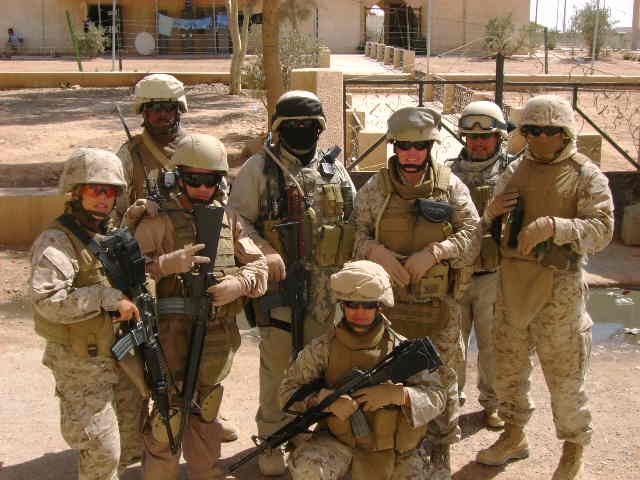
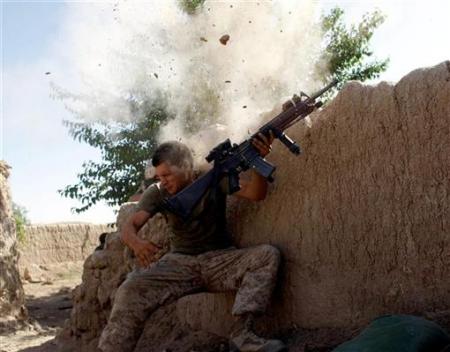
Marines in Afghanistan under attack

Such men and in some cases women need to learn about war in the uncomfortable manner described by Sajer, a Frenchman that served in the German Army on the Eastern Front because one of his parents was German.  The problem is that those that promote war as a business and those that sell war to kids via the entertainment industry really don’t care about the real human beings, the men and women who serve knowing that these wars are unlikely to end anytime soon.  Even more frightening are people of strong religious convictions who promote war in order to see their views, especially about the Middle East vindicated.

Such are the comfortable experts who debate in comfort and write with a detached certitude that they alone have the correct view of the world.  There is a good case to be made that such people be held accountable for the wars that they advocate and the lives lost because of their hubris.

Peace

Padre Steve+

4 Comments

Filed under Foreign Policy, History, iraq,afghanistan, middle east, Military, Political Commentary