Tag Archives: the longest day

D-Day: Brigadier General Theodore “Ted” Roosevelt III Lands at Utah Beach

Theodore Roosevelt Jr4

“Courage, above all things, is the first quality of a warrior.” Carl Von Clausewitz

By the standards of military service on the front line the man was ancient. He was 56 years old, had arthritis and a history of heart problems, but he was his father’s son.

The oldest man to land on the beaches of Normandy was the son of a President, Theodore “Teddy” Roosevelt who had taken leave of his office as Assistant Secretary of the Navy at the outset of the Spanish-American War. With the help of his friend Colonel Leonard Wood, Roosevelt formed the legendary First U.S. Volunteer Cavalry Regiment, the “Rough Riders” and led them in the fight at the Battle of San Juan Hill.

The son of the President entered the business world and then served as a Reserve officer and since he had received prior military training was commissioned as a Major when the United States entered World War One. He volunteered for overseas service and served as a battalion commander and later as commander of the 26th Infantry Regiment of the 1st Infantry Division. Leading from the front he was wounded and gassed at Soissons in 1918. For his service he was awarded the Distinguished Service Cross and the French Chevalier Légion d’honneur.

After the war he helped found the American Legion and entered politics and was elected to the New York State Assembly. However while serving as Assistant Secretary of the Navy in the Harding Administration he was linked to the Teapot Dome Scandal and though cleared of any wrongdoing his name was tarnished. Opposed by his cousin Franklin Delano Roosevelt his political fortunes in elected offices floundered. However he was appointed as Governor of Puerto Rico and later Governor-General of the Philippines a post that he served until 1935 when he returned to the United States and the business world serving as an executive with American Express.

Between the wars “Ted” continued his Army Reserve service attending his annual training periods as well as attending the Infantry Officer Basic and Officer Advanced Courses as well as the Command and General Staff College. When war came to Europe he again volunteered for active service, attended a refresher course and was promoted to Colonel in the Army Reserve. Mobilized in April 1940 he was given command of his old 26th Infantry Regiment assigned to the First Infantry Division and was promoted to Brigadier General in late 1941 becoming the Assistant Division Commander.

Ted_Cane_France

He served well in that role in North Africa and Sicily and earned citations for bravery being constantly on the front lines with his soldiers. However his association with the Division Commander, the unorthodox Terry Allen earned the enmity of George Patton and Omar Bradley. Patton disliked Allen and hated the way both Allen and Roosevelt eschewed “spit and polish” and “dressed down,” often wearing unauthorized uniform items. After Bradley assumed command of 7th Army he relieved both officers, believing that they were guilty of “loving their division too much” something that he admitted was one of the hardest decisions that he made in the war. Roosevelt served as a liaison officer with the Free French Forces in Italy before returning to England to assume duties as Assistant Division Commander of the 4th Infantry Division. Allen would go on to command the 104th Infantry Division in an exemplary manner during the command’s in France and Germany in 1944-45 with even Bradley praising him and his new division as one of the best in Europe.

TeddyJr5-530x414

Roosevelt constantly trained with the troops and asked his commander, Major General Raymond “Tubby” Barton for permission to land with the first wave in the invasion. After being denied twice Roosevelt put his request to Barton in writing:

“The force and skill with which the first elements hit the beach and proceed may determine the ultimate success of the operation…. With troops engaged for the first time, the behavior pattern of all is apt to be set by those first engagements. [It is] considered that accurate information of the existing situation should be available for each succeeding element as it lands. You should have when you get to shore an overall picture in which you can place confidence. I believe I can contribute materially on all of the above by going in with the assault companies. Furthermore I personally know both officers and men of these advance units and believe that it will steady them to know that I am with them.”

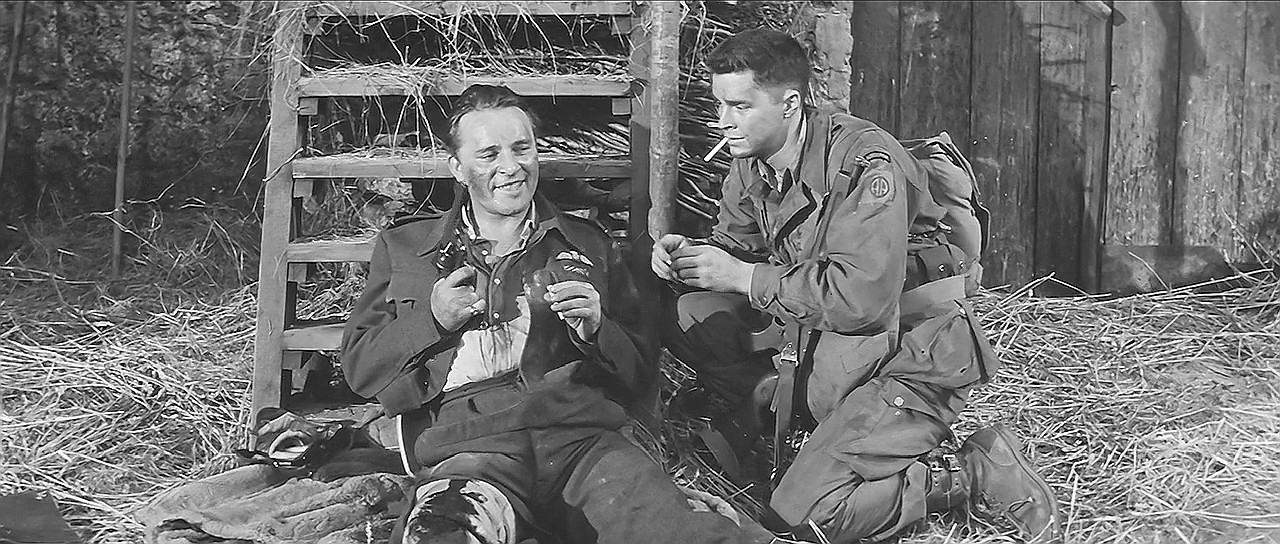
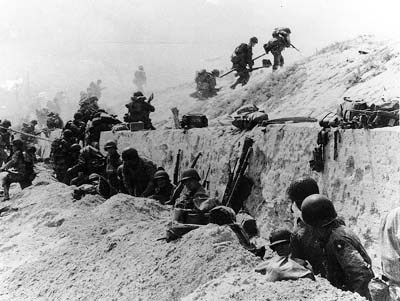
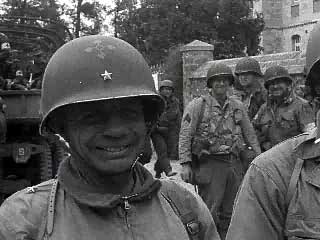
Barton reluctantly approved the request not expecting Roosevelt to survive the landings. Roosevelt was in the first wave of assault troops at Utah Beach. On landing he discovered that the first wave was about a mile off course. Armed with a pistol and supported by a cane Roosevelt led a reconnaissance to find the causeways off the beach. He briefed the battalion commanders and then ordered an attack from where the troops had landed telling his officers “We’ll start the war from right here!” a moment immortalized in the film The Longest Day in which Henry Fonda played Roosevelt.

fon2

Henry Fonda Portrays Brigadier General Theodore “Ted” Roosevelt III in “The Longest Day”

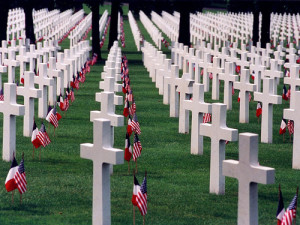
His actions were key in the success of the Utah Beach landings and he was recommended for the Distinguished Service Cross by General Barton. Just over a month after the invasion after continuously leading his troops in Normandy Roosevelt died of a heart attack on July 12th 1944, the very day he had been selected for his second star and promotion to Major General and had orders to take command of the 90th Infantry Division. His award was upgraded to the Congressional Medal of Honor which was posthumously awarded on September 28th 1944. He was buried in the American Cemetery in Normandy, the remains of his younger brother Quentin who had been killed in the First World War were exhumed and interred next to his in 1955.

The Medal of Honor citation reads:

For gallantry and intrepidity at the risk of his life above and beyond the call of duty on 6 June 1944, in France. After 2 verbal requests to accompany the leading assault elements in the Normandy invasion had been denied, Brig. Gen. Roosevelt’s written request for this mission was approved and he landed with the first wave of the forces assaulting the enemy-held beaches. He repeatedly led groups from the beach, over the seawall and established them inland. His valor, courage, and presence in the very front of the attack and his complete unconcern at being under heavy fire inspired the troops to heights of enthusiasm and self-sacrifice. Although the enemy had the beach under constant direct fire, Brig. Gen. Roosevelt moved from one locality to another, rallying men around him, directed and personally led them against the enemy. Under his seasoned, precise, calm, and unfaltering leadership, assault troops reduced beach strong points and rapidly moved inland with minimum casualties. He thus contributed substantially to the successful establishment of the beachhead in France.

Roosevelt’s story is quite amazing. In the modern wars of the late 20th and early 21st Centuries few commanders as senior as Roosevelt would ever be in the first wave of an invasion or offensive operation. The personal courage and example set by Roosevelt in both World Wars, leading from the front and maintaining relationships with the troops that he commanded in combat is something that we talk about a lot in various military leadership classes but often seems to be smothered by business models promoted by think tanks and others with money to be made.

Likewise, a commander suffering from Roosevelt’s infirmities would not be allowed to command troops in combat today. But in the Second World War when many other American Generals failed miserably and often could not be found near the front and were relieved of command for incompetence and cowardice the old, crippled and infirm Roosevelt led from the front. He made decisions on Utah Beach on D-Day that helped ensure that the landings were a success. Bradley, who had fired Roosevelt after the Sicilian Campaign with Allen said that the most heroic act that he had seen in combat was “Ted Roosevelt on Utah Beach.”

Roosevelt was an exception to Clausewitz’s axiom that “boldness becomes rarer, the higher the rank.” I think that even if a General wanted to lead in the manner of Roosevelt today that he would be punished by the institution for risking himself.

Peace

Padre Steve+
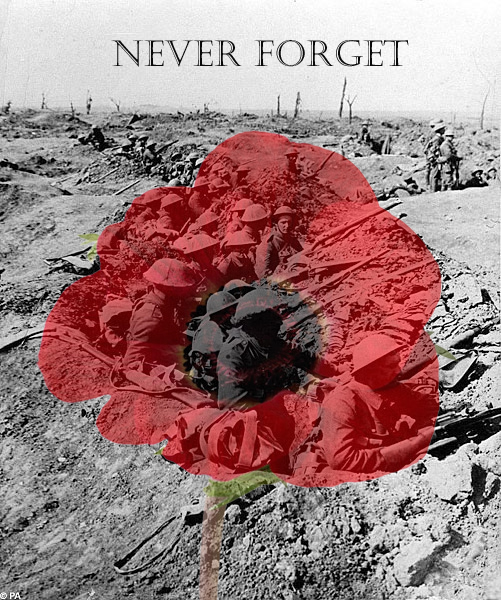
Leave a comment

Filed under History, Military, movies, world war two in europe

My Melancholy Memorial Day Thoughts

Remembrance_Day___Poppy_Day_by_daliscar

“It’s funny isn’t it. He’s dead, I’m crippled, you’re lost. Suppose it’s always like that. I mean war.” Flying Officer David Campbell played by Richard Burton in “The Longest Day” 

LD20

I came back a different man from Iraq. It seems that for me with every passing year Memorial Day becomes more of a melancholy observance. It is a weekend and observance that I feel deeply having lost friends in war and served in Iraq as well as Operation Enduring Freedom. It is also a day in which I feel more and more disconnected from the vast majority of my fellow Americans. I don’t know, but just from my observation it seems that for most Americans the weekend serves as not much more than the end of the school year and the beginning of the summer holiday and vacation season.

I could be wrong, but it seems to me that for most Americans, the vast majority who have themselves never served a day in uniform and who have no more than a passing relationship with anyone who is either serving in our current wars or has served in any war that war is at best a spectator sport. It is an attitude that has been nurtured by our politicians of all parties, political pundits and preachers for decades. As a result there is a grave disconnect between the society at large and the men and women who serve in the military and in our wars.

To be fair I don’t think it is a matter of ordinary people not caring, not that at all, just that no one has really called the nation to war, as such we have been at war but only a small amount of the population is called on to serve. The real fact of the matter is that the wars that we have fought since World War II have not been national affairs. If they were we would not be continually fighting wars that most people neither understand and which in many if not most cases we would be better off staying out of completely.  That being said I am appreciative of those who do things to care for and honor our veterans, honor our fallen and do practical things for the survivors. There are some really wonderful people, many who have never served who do what they can for those who fight and die in or come back forever changed from these misbegotten and unpopular wars.

What I do find offensive are the war mongers and profiteers who have never served. I feel this way about those who did all that they could to avoid serving in the military and those who did the very minimum to satisfy outward appearances of service while avoiding anything difficult, especially deployment to combat zones. Of the latter I can think of five to six currently serving and very outspoken conservative members of the House of Representatives and the Senate that fit the description. I shan’t mention the members of the previous Presidential administration who through their willing lies caused the deaths of nearly 4500 American military personnel in Iraq. I speak about men who in their writings, their appearances on news networks and their think tanks and corporations that do nothing but profit off of war. Some are current or former politicians, others supposedly “academics” and others men who smell a profit in war.

memorial-day1-300x225

I find such people to be loathsome and wonder how on Memorial Day weekend they can show their faces. But then they are rather shameless. Sometimes their actions make me wonder if the sacrifices made by those who serve are in vain. However, I strive to resist that and pray that our sacrifices will not be in vain. While they profit from war others pay the bill and it has always been this way. Marine Corps Major General Smedley Butler, a two time winner of the Congressional Medal of Honor wrote after World War One in his book War is a Racket:

“This bill renders a horrible accounting. Newly placed gravestones. Mangled bodies. Shattered minds. Broken hearts and homes. Economic instability. Depression and all of its attendant miseries. Back -breaking taxation for generations and generations. For a great many years as a soldier I had a suspicion that war was a racket; not only until I retired to civilian life did I fully realize it….”

Maybe I feel this way because I grew up in a military family where my dad was frequently deployed and served in Vietnam, a place where some of my friends fathers died, and because I have been in the military 32 years between the Army and the Navy. Maybe it is partly because I am a military historian, theologian, priest and chaplain who has seen the horrors of war and the wounds that remain for life in the bodies, minds and spirits of those that fight in them.  I cannot speak of how my heart feels when I see young men and women, wounded in war, their lives forever changed bravely struggling to go on even as the war mongers, war profiteers and chicken-hawks profit off of their suffering.

481801_10151367001287059_1003164983_n-1.jpg

So for me this is a rather melancholy time. A time where I struggle. I honor the fallen, my brothers and sisters who have given the last full measure of devotion in serving this country, those that I know personally or have served with and those who did so before I was every born.

Until tomorrow.

Peace

Padre Steve+

3 Comments

Filed under History, iraq,afghanistan, Military, News and current events, shipmates and veterans

D-Day- Courage, Sacrifice and Luck, the Costs of War and Reconciliation

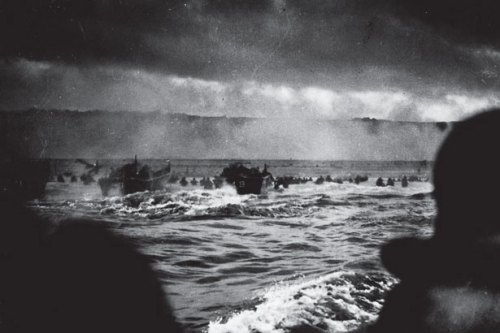
d-day-openerOmaha Beach from a Landing Craft

“Long after our time on this Earth has passed, one word will still bring forth the pride and awe of men and women who will never meet the heroes who sit before us: D-Day.” President Barack Obama at Normandy 2009

“Friends and veterans, what we cannot forget — what we must not forget — is that D-Day was a time and a place where the bravery and selflessness of a few was able to change the course of an entire century,” President Barack Obama at Normandy 2009

“The men of Normandy had faith that what they were doing was right, faith that they fought for all humanity, faith that a just God would grant them mercy on this beachhead, or on the next. It was the deep knowledge — and pray God we have not lost it — that there is a profound moral difference between the use of force for liberation and the use of force for conquest.” President Ronald Reagan at Normandy 1982

Here, in this place where the West held together, let us make a vow to our dead. Let us show them by our actions that we understand what they died for. Let our actions say to them the words for which Matthew Ridgway listened: “I will not fail thee nor forsake thee.” President Ronald Reagan at Normandy 1982

Sixty-five years ago today the liberation of France began on the beaches of Normandy.  Soldiers from 6 Allied Infantry and 3 Airborne Divisions supported by an Armada of over 5000 ships and landing craft and several thousand aircraft braved weather, heavy seas and in places fierce German resistance to gain the foothold on beaches named Omaha, Utah, Gold, Sword and Juno.  Over the next seven weeks the Allied soldiers advanced yard by yard through the hedgerows and villages of Normandy against ferocious German resistance before they were able to break out of the lodgment area and begin the drive across France.  The fighting was bloody, most American, British and Canadian infantry battalions and regiments suffered nearly 100% casualty rates in Normandy.  Replacements were fed in at a cyclic rate to make up the losses even as fresh divisions flowed ashore, but the losses were terrible.  By the time the landings took place, the British having been at war for nearly five years were bled out.  They had little left to replace their losses.  From Normandy on the British were losing combat power at a rate that they could not make up.  For the Americans there was another problem.  The US High command decided to limit the Army to 90 Divisions.  Many of these were committed to the Pacific and Mediterranean theaters.   Likewise, American Infantry units were generally made up of the lowest caliber of recruits, led often by the poorest officers.  Now this is not to criticize veterans, but it is a factor in the campaign.  US Infantry Divisions with the exceptions of those previously blooded in North Africa and Sicily often performed badly in action.  Some, after being manhandled by the Germans had leadership replaced and became excellent combat units.  However, every new division that arrived in France after D-Day always got the worst of their initial engagement against German forces.  While performance suffered there was another problem for the Americans.  With the limitation in number of divisions, they stopped building infantry divisions, upon whom the bulk of the campaign depended and had little in the way of trained infantry replacements to make up heavy losses in Normandy.  By late 1944 during the Battle of the Bulge the American infantry crisis was so bad that 30,000 Air Corps candidates were trained as infantry and soldiers support units such as Ant-Aircraft battalions were used to bolster infantry units.  Had the Germans been able to hold out it is conceivable that the British and Americans would have ground to a halt for lank of infantry in 1945.  In spite of this there was no lack of individual courage among the troops engaged; the courage and sacrifice of all who fought there should not be forgotten.

dday37Soldiers Moving off of Utah

The human toll among the combatants both Allied and German, as well as the local populace was especially traumatic.  While the American, Canadian and British people are keen to remember the sacrifices made by our soldiers we often forget the toll among the French civilian population of Normandy as well as the German soldiers, mostly conscripts, sacrificed by the Nazi regime.  Normandy suffered more than any part of France during the liberation.  In the months leading up to D-Day Allied Air Forces unleashed hell on Normandy to attempt to lessen potential German resistance.  The Allied Naval bombardment added to the carnage ashore and once the campaign began the combined fires of both Allied and German forces devastated the region.  Whole cites such as Caen were destroyed by Allied Air forces and an estimated 30,000 French civilians were killed, 3000 on D-Day alone.  I think it can be said that the blood of the civilians of Normandy was shed for the freedom of all of France.

caen_ruinsThe Ruins of Caen-July 1944

The campaign in Normandy was one of the most viciously contested in western military history.  German forces, especially Paratroops of the 2nd, 3rd, 5th and 6th Fallschirmjager Divisions, German Army Panzer Divisions such as the 2nd, 21st, 116th and Panzer Lehr and those of the Waffen-SS, especially the 1st, 2nd and 12th SS Panzer Divisions held the line against ever increasing Allied forces.  As they sacrificed themselves Hitler refused to commit more forces to Normandy and insisted that his Army contest every meter of ground.  He forbade his commanders to withdraw to more defensible positions along the Seine.   His decisions actually shortened the campaign.  Whatever the crimes of the Hitler Regime and Nazism, which were among the most heinous in history, one can never question the valor, courage and sacrifice of ordinary German soldiers.  For those Americans who lump all Germans who fought in World War II with the evil of the Nazi regime, please do not forget this on fact.  There are those today, even in this country that makes the same charge against Americans who have fought in Iraq and those at home and abroad who have labeled the US as an aggressor nation.  When you judge others, know that the same standard will be applied to you someday.

tiger2falaise16hhGerman Tiger Tank at Falaise

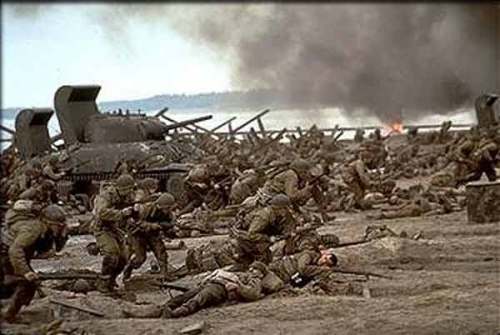
Normandy was a near run thing for the Allies.  First the weather almost delayed it by 2 to 4 weeks.  Had that happened the Germans might have been even better prepared to meet the invasion.  Likewise, the Red Army’s devastating offensive which annihilated Army Group Center in June kept the Germans from transferring additional forces from the Russian Front to Normandy.  On D-Day itself there were a number of times where Lady Luck, or maybe the Deity Herself, saved the Allies from disaster.  Any person who has seen Saving Private Ryan, The Longest Day or Band of Brothers knows a little bit about how close Overlord came to failure.  Allied Airborne units were dispersed throughout the region after they drooped.  Many units were not fully operational for more than a day as they sought to organize themselves and gather their troops.  At Omaha Beach the Americans had not counted on the presence of the first rate German 352nd Infantry Division.  This division, despite being pounded by naval and air forces almost cause General Bradley to withdraw from Omaha.  At Utah the soldiers of the 4th Infantry division escaped a similar mauling by landing on the wrong beach.  Had they landed at the planned beaches they would have ran into the same kind of resistance from well dug in German forces.  At Gold Juno and Sword British forces benefitted from confusion in the German command which kept the 21st Panzer Division from descending on the British forces and quite possibly splitting the British zones.  The Allies benefitted from the absence of Field Marshall Erwin Rommel, Commander of Army Group B who because of the ad weather assumed no invasion was possible and travelled to German to celebrate his wife’s birthday.  Finally, and perhaps most important they benefitted by Hitler’s refusal to immediately commit forces, including his Panzer reserve to defeat the invasion at the beach head.

Bild 101I-587-2253-15German Paratroops or Falsschirmjaeger in Normandy
For those who fought in Normandy and those civilians who lived through it the memories are still vivid. Many suffer the effects of PTSD, grief and other wounds, physical, emotional and spiritual.  When one is exposed to the danger and destruction of war, the smell of death, the sight of burned out cities, vehicles and the suffering of the wounded and dying, it makes for a lifetime of often painful memories.

For some of the German, British and American veterans, the struggle in Normandy has given way to long lasting friendships.  Those who fought against each other were soon allies as part of NATO and soldiers of nations which were once bitter enemies serve together in harm’s way in Afghanistan.  The generation that fought at Normandy is rapidly passing away, their numbers ever dwindling they remain a witness to courage, sacrifice and reconciliation.

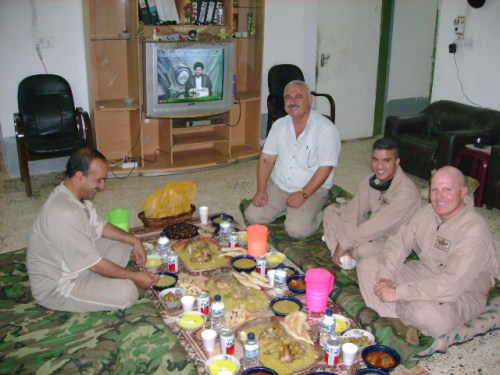
In the end it is reconciliation and healing that matters. Some scars of war never pass away; some memories are far too painful to release.  Yet we strive to reconcile.  In 2002 while deployed at sea for Operation Enduring Freedom I was an advisor to a boarding team from my ship.  It was our job to make sure that impounded ships which were breaking the UN embargo on Iraq were not in danger of sinking, and that their crews had food, water and medical care.  Since many of these ships remained at anchor for 2- weeks in the heat of the Arabian Gulf, this was important.  The delays imposed by UN rules sometimes meant that the sailors of these ships grew resentful.  It was my job to spend time with the Master’s of these ships to keep things calm and work out any issues that arose.  On one of these ships I met an Iraqi merchant skipper.  The man was well travelled, educated in the U.K. in the 1960s and in his career a frequent visitor to the US. In 1990 he was the senior captain of the Kuwaiti shipping line.  Then Saddam Hussein invaded Kuwait.  As a result of this when Kuwait was liberated he lost his job.  His nation was an international pariah.  Since his life was the sea he took up the only job possible to support his family, what he knew best, captaining ships.  He was most apologetic for the trouble that he and others like him caused us.  We shared much during those visits.   One of his daughters was in medical school and other children in university.  He longed for the day when Iraq would be free.  On our last talk before his ship was released he remarked to me “I hope one day we will meet again.  Maybe someday like the American, British and German soldiers after the war, we can meet in a pub, share a drink and be friends.”  I too pray for that.  Maybe someday we will.  I only hope that he and his family have survived the war and are doing well.

Dinner w BG SabahBeginnings of Reconciliation: Old Enemies, New Friends General Sabah and Me, Ramadi 2007
God bless all those who fought at Normandy and give your peace to all who have served since then. Be with our troops as they serve in Iraq and Afghanistan. Heal the wounds of war and bring your peace to the nations. Amen

Peace, Steve+

3 Comments

Filed under Foreign Policy, History, iraq,afghanistan, Military, PTSD, world war two in europe

Hollywood and Recruiting Since Vietnam

I have been thinking about how Hollywood occasionally helps military recruiting in the post-Vietnam and all-volunteer era.

Back in World War II Hollywood Moguls signed on to further the war effort with films which were entertaining but also inspiring to those on the home front.  Films like Wake Island, they Were Expendable, Destination Tokyo, The Fighting Sullivans, the Flying Tigers, The Memphis Belle (1943), and Thirty Seconds over Tokyo all helped bolster the war effort.  Stars like Jimmy Stewart served in combat.  These were the high tide of patriotic war films.  In the post war era more films about the war were made until Vietnam made war films a riskier proposition for studios.  With the exception of The Green Berets and a few Second World War themed films such as The Longest Day, In Harms Way, The Battle of the Bulge and Patton war films became much more anti-war and often anti-military.  Such films as Catch 22, M*A*S*H, Go Tell the Spartans, Kelly’s Heroes showed this while films like Platoon, The Deer Hunter and Coming Home showed the dark side of Vietnam.

In the 1970s some films like Midway began the return of film makers to more positive looks at the military. After the election of Ronald Reagan Hollywood began to produce more military themed films.  Some were fully endoresed by the Department of Defense and others not.  Some were designed to make the miltary look good and well, some which were not intended to do so had the opposite effect.

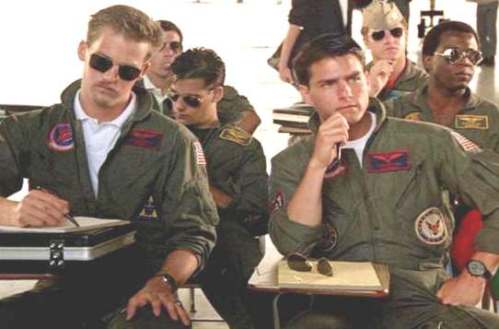
top_gun_goose_and_maverick

The most successful of these films dealt with the Navy and Marine Corps, those dealing with the Army and Air Force were not as successful, though the Iron Eagle series with Louis Gossett Jr. had a pretty good run.  Films like Top Gun thrilled young audiences with both the story of Naval Aviators, a great musical score and some really hot and sensual scenes.  The Hunt for Red October was another thriller in which Tom Clancy made the Navy look great.  An Officer and a Gentleman had some of the most memorable Drill Sergeant scenes of any film, with Louis Gossett Jr. in the role of Gunnery Sergeant Foley destroying and rebuilding a class of OCS candidates led by Richard Gere.

an-officer-and-a-gentleman01

Once again a good story well acted and some great love scenes and musical score made this appeal to the younger generation.  I was across the Puget Sound when this was being filmed having my own ass ripped by an Army Special Forces, Ranger and Vietnam veteran Drill Sergeant.  I could relate to Richard Gere crying “I’m not going to DOR, I’ve got nowhere else to go.” Thank you Sergeant First Class Harry Ball for making me a better person by destroying all preconceptions that I had about myself and rebuilding me.  Judy when she first saw the movie asked if I had a Puget Sound Deb but alas, I did not.  I was too busy cleaning latrines with a toothbrush for any extra-curricular activities even if I was so inclined. Clint Eastwood’s Heartbreak Ridge was a positive portrayal of a Marine taking over a Recon Platoon before going into Grenada.

jessup

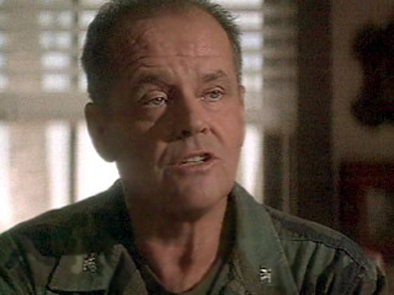
A Few Good Men was not supposed to be a film that made the Marines look good.  Director Rob Reiner attempted to get permission of the Marines to film at Guantanamo Bay but was unable to do so because of the script.  The film turned out to be a cult classic among many Marines.  Jack Nicholson’s portrayal of Colonel Nathan Jessup became a hit.  The line You ant the Truth, you can’t handle the truth!” followed by the rest of the speech is classic.  The character that Nicholson was based on was a real CO of Gitmo.  He was relieved after about a year into his two year tour.  A former CO of mine who served under that man at another duty station said that officers and enlisted alike lived in fear of him. More recent films such as Saving Private Ryan and the Band of Brothers HBO mini-series brought positive attention to the men of the greatest generation.  Films about Iraq have varied.  Perhaps the best is Taking Chance with Kevin Bacon playing a Marine LtCol. escorting the body of a young Marine killed in action home.

So it is interesting to see how Hollywood sometimes helps and sometimes hurts recruiting.  We’ll have to see what the next batch of war films turn out to be like.

Peace, Steve+

private-ryan-beach

Leave a comment

Filed under Military