Tag Archives: tommy lasorda

Managing the “AAA” Franchise: A View from 102

“Baseball is a simple game. If you have good players and if you keep them in the right frame of mind then the manager is a success.” Sparky Anderson

“I believe managing is like holding a dove in your hand. If you hold it too tightly you kill it, but if you hold it too loosely, you lose it.”  Tommy Lasorda

This has been an interesting year for the Norfolk Tides.  For me the year has been the first where I have had the opportunity to observe the game on nearly a daily basis from field level behind the plate. The proximity of where I sit to the playing field in Section 102, Row B Seat 2 at the Church of Baseball, Harbor Park Parish has given me the chance to sharpen my eye for the nuances of the game.  Part of this has been lessons on life, leadership, strategy, player development and the psychology of winning and organizations that win.  In fact if you are a regular reader of this website you will likely note that baseball is pervasive in my writings.  Likewise the subject of baseball is usually entwined with my local team the Norfolk Tides who inhabit the parish church with me.  Thus my closest observations of the game come from watching the Tides.  Over the course of the season I have become familiar with the players met a decent number of the starting pitchers on more than one occasion each as well as talked with scouts and former players.  Additionally one of the best baseball men round who really needs to be hired as a color man for the Tides radio show is Elliott the Usher. Elliott and I have had numerous discussions regarding strategy, player development and baseball philosophy throughout the season, not always agreeing, but each hearing what the other had to say.  Elliott knows the game, knows the players and despite being a Red Sox fan, not that there’s anything wrong with that is a great human being.  Thank the Deity Herself that he is not a Dodgers fan, yeech!

So anyway, here are a couple of Padre Steve’s observations about the Tides this year that I think hurt player development and kept them out of the playoffs.   Now I don’t think being in the playoff as a minor league team is the end all of life, but it does not hurt the organization.  My thesis is that although the Tides suffered an end of July and August collapse that need not have happened and may have hurt a number of player’s chances of making the majors.   The collapse was like the old “June Swoon” days of the San Francisco Giants only worse.  Yet despite the swoon the Tides continued to maintain one of the highest batting averages in the league and their pitching, though not as reliable as earlier in the season was constantly around the middle of the league.  I think that there is a reason for what happened to the reliability of the pitching and it is not because the pitchers suddenly went bad. I’ll explain this further on in this article.

Fielding, in regard to the number of errors committed by the infield was not that much different than their International League South rivals.  However it seemed that the errors committed by Tides players tended to come at the worst possible time and often scuttled solid performances by pitchers.  My thesis is that this was not a case of the talent available to the team despite mid-season call ups and injuries. Nor is it just because the players did not play as well as they could thus I would take issue with those who would who want to simply blame the collapse on these factors.  Did they play a part? Yes, were they the over-riding factor? I don’t think so.

The most important person on a Triple “A” team is the Manager.  The manager sets the tone for the team and is the face of the team.  The manager is not simply a teacher, but someone who has to have a feel, almost a 6th sense for how players are doing at given points in the game or season, what their strengths and weaknesses are and what makes them tick…in other words the way that a manager deals with his players is as important to their development and success as is the talent and ability that the players bring to the team when they show up.  A minor league manager cannot allow himself to just be a cog in the big league club’s system.  The manager needs to be able to make the hard calls of telling the big club what he thinks of where players can fit and when and where they should play. A manager should never be a slave to arbitrary pitch counts, especially if he sees a pitcher is really doing badly early, or if he sees a pitcher doing well enough to complete a game.   Psychology is as important as numbers.  There are times players need to be handled with great care and other times that they might need a dressing down or boot up their ass, but this must be well thought out and not an arbitrary process.  Likewise, there is the emotional tone that a player sets in the clubhouse.  There is no right or wrong as to style, but the manager needs to be able to make his style work. If he cannot the cohesion of the club will suffer as will the hardiness of the players, individually and as a team to weather difficult times during the season.   All this said it is my belief that Tides manager Gary Allenson was not effective in this, especially during July and August.  This is certainly not to be interpreted as a sour grapes kind of accusation.  As someone who has had the responsibility for over a hundred personnel, and a couple of million dollars worth of equipment and property as well as regularly dealing with people in life and death circumstances I am sensitive to the weight on a manager’s shoulders and I have taken my share of criticism.  The job is not easy and Allenson has had a lot of success during his managing career.  So I am not saying that he is a bad manager, but that this year his management of the team was a causal factor in the collapse.

To go into specifics the biggest places that this was apparent was with the pitching staff.  When a starter of reliever got in trouble it seemed that Allenson was often disengaged.  Maybe he was trying to reach a pitch count with them or maybe trying to teach them how to pitch through difficult situations. Patently these are important in grooming pitchers but cannot be seen as the goal itself.  They are rather measurement tool to assess the pitcher’s development and readiness to play at the current level or move up in the organization.  However, the tools cannot be allowed to dictate the manager’s decision making process.  Observing this close hand watching the pitchers at various points during the game and season and watching Allenson’s body language in the dugout as well as how long it would take to have  a reliever ready makes me believe that these were overriding factors in the decision making process.

I do not know if Allenson’s intent was to let pitchers try to work through rough outings without relief every time that they pitch, or if it is something that the Orioles have instructed him to do.  Regardless of what it is that plan did not work.  The pitching staff became demoralized it was evident in their body language and by what was heard around the park.  It is fine to occasionally let a pitcher work through a difficult patch and even get roughed up a bit.  That builds character and perseverance, in fact not to do it promotes a false sense of confidence that hurts the pitcher later on.  However it is not a good policy to do this in every game as it becomes counterproductive as the pitcher loses confidence because they are not winning.  This appeared to be what was happening with Tides pitchers.  The psychology of pitchers depends a lot on winning. To take a pitcher out before he gets in trouble while he is ahead is not a bad thing. Winning helps promote a winning attitude that carries over from game to game.  Pulling a pitcher before he gets in trouble can be used to the benefit of the pitcher and the team.  This is the way of great major league managers including Earl Weaver.  Allowing pitchers to be roughed up and have no relief waiting in the bullpen on a regular basis is detrimental to their development and serves no purpose.  Thus if a pitcher is beaten and the manager knows it leaving him in the game serves no purpose unless it is simply to preserve the bullpen.  If a manager senses that a pitcher is in trouble he should be more like Earl Weaver and get the guy out of the game for his good as well as that of the team.  Losing is contagious.  Lose a lot, especially when the losses could have been avoided and a team loses its fire and often its heart.  Take a look at perennial winning and losing teams and you will find that it is not just the talent that makes a team, it is the management and manner in which they work with the talent available that make them the organizations that they are.  Winning organizations promote winning at all levels.

Another aspect of the management of Tides pitchers has been the lack of consistency in developing relief pitchers.  It is important to work to individual pitcher’s strengths in how they are employed.  If a reliever finds his particular niche then it is incumbent on management to build on this.  Relievers are a quirky breed and by the time that they are in Triple “A” ball the management should have a relatively good idea of where they fit in the organization and start preparing them for that role on the big league club.  Thus at Triple “A” it is not the best policy to give players shots at all the different relief situations, especially if it takes someone who has the potential to be a great closer out of his game.  Case in point for the Tides was the use of Jim Miller.  Miller became the Tides closer early in the season and by the All-Star break had 15 saves.  When Miller went in during the first half of the season it was almost automatic that he would close the game successfully.  After the All-Star break Miller was bounced to middle relief and occasional set up roles as the Orioles according to Gary Allenson “wanted to turn him into a two-inning pitcher, because he’s probably not going to close games in the big leagues.”  Miller said recently that he would rather finish games. “That’s what I’ve done my whole career. They wanted to stretch me out, have me throwing 30-35 pitches. If that’s what they want, of course, that’s what I’ll do. But I like closing games.” It was noticeable how uncomfortable Miller was and how his effectiveness went down when moved out of the closer role.  I’m a firm believer that if someone does something better than others that you play to strength and build on it. Guys who can close a game and have a closers mindset are rare; those guys need to be coached to be even better and not bounced around.  Miller has come into the game in the 9th in close situations since the 31st and has been his old self, even games where he had no chance at a save he shut the opponent down.  It may be the case that the Orioles do not need Miller as a closer, however he could be the 8th inning set up man, not the 5th to 7th inning middle reliever and still keep a closer mindset.

Winning organizations know when a player is in his element and from thereon work hard to make him the best at that position and to put complementary players around him. To win an organization needs no only to produce a lot of middle of the road jack of all trades utility players but guys who can become All-Stars.  Utility players do not end up on the All-Star team and while important to an organization are not the building blocks of it.  I have heard it said that giving infielders experience at a lot of different positions helps them get to the majors.  While I believe this has some validity,  I think if an infielder is gifted at a certain position, say 2nd, 3rd or shortstop and has the potential to be a starter in that position on the major league club then it imperative that the organization focus on making him the best possible player at that position.  Can the player be used at other positions occasionally?  Of course, they need to be somewhat versatile but to use a military expression, I think it is best to “train as you fight.”  In other words of the player is being groomed for a certain position don’t waste too much time trying him at other positions, or moving him to allow someone who is a utility player to play in his spot.  A Triple “A” team might have one of these players on their team at any given time; they should be the linchpin around which utility players are utilized.   I think that 2nd Baseman Justin Turner was this player on the 2009 Tides and should be used in this manner in 2010 as the Orioles prepare to bring him up. Can he play other positions? Certainly, but watching him the further he was moved from 2nd base the less effective and sure of himself he became.

Next year should be interesting.  Several of the late season call ups from Bowie should be good additions to the club, notably outfielders Jonathan Tucker and Dave Krynzel.  Guillermo Rodriguez should remain at catcher as he has the potential to develop pitchers and be available on short notice to play in Baltimore as a backup for Matt Wieters.  Injured Scott Moore, Donnie Murphy and Justin Christian should be back as should Rhyne Hughes, Brandon Snyder and Brandon Pinckney.  Pitchers Chris Waters if not taken up to Baltimore or traded should be back, as should Jake Arrieta, Chris Lambert and Chris George.  Andy Mitchell would be an ideal middle to long reliever to follow hard throwing starters with his submarine style delivery. Jim Miller needs to be kept if not brought up to the Orioles or traded, as should Josh Perrault and Troy Patton.  Other pitchers on the current staff could still be of use; Bob McCrory seemed to be doing well at the end of the season and as did Ross Wolf.  I believe that starter David Pauley is a free agent after this season so I do not know if he will be back.  Of the other position players I think it unlikely that 37 year old Jolbert Cabrera comes back and wonder if Melvin Dorta and Blake Davis need to be at Norfolk as both had significant numbers of errors.

If I was the Orioles organization I would re-look to see if Gary Allenson is the man to continue to lead the team.  The last half of the season the team has not performed to the level that it could have. Some of this maybe a lot has to do with management.  It is possible that Allenson’s superiors in Baltimore are calling the shots at Norfolk and that he wants to manage differently.  However my assumption has to be that Allenson was unable to get the team to gel after the loss of players to mid-year injuries and call-ups and did not adjust well to losing so much hitting at that time.  Again my take is not that of a disgruntled fan, but an observer trying to make sense of what happened from the end of July until the end of August.  My assessment is that it is largely a managerial problem, likely at the field level, though possibly higher in the Orioles organization as well.

It is too easy to criticize a manager and I have tried to be as fair as possible, however a team’s success is always to a great degree dictated by the manager and at the end of the year every organization has to ask itself if it has the right man for the manager’s job.  It is incumbent to the organization to do so.

Peace, Steve+
1 Comment

Filed under Baseball, leadership, philosophy

Padre Steve’s Highs and Lows of 28 Years Service

Ooops, this should have posted the 25th…all references in the post though it posted today are for the 25th.  The meltdown was the 24th, not my duty night.

Note: I think that I have pretty much recovered from last night’s mini-meltdown, though tired have has a good day working some stuff that is pretty cool that could be a positive thing for Navy and VA Chaplains.  I think success does help mitigate some of the effects of a meltdown.  If today had been crappy and I hadn’t had a good talk with Elmer the Shrink it might have continued.  Now with some sleep I could be cooking with gas even though my house is all electric.

On to the Post:

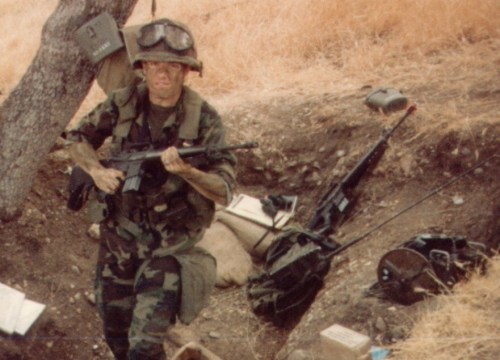
Soldier Once and YoungEnlisted in National Guard 1982

“So we’re all dogfaces, we’re all very, very different, but there is one thing that we all have in common: we were all stupid enough to enlist in the Army. We’re mutants. There’s something wrong with us, something very, very wrong with us. Something seriously wrong with us – we’re soldiers. But we’re American soldiers! We’ve been kicking ass for 200 years!” Bill Murray as John Winger in “Stripes” 1981

Well sports fans I am at the hospital tonight celebrating 28 years of service in the military. It really doesn’t seem like any more than 27 ½ but who’s counting right? And when I look back at the Army I joined I am reminded of Stripes.

I think that I have pretty much recovered from last night’s mini-meltdown, though tired have has a good day working some stuff that is pretty cool that could be a positive thing for Navy and VA Chaplains.  I think success does help mitigate some of the effects of a meltdown.  If today had been crappy and I hadn’t had a good talk with Elmer the Shrink it might have continued.  Now with some sleep I could be cooking with gas even though my house is all electric.

So 28 years ago today I went down and signed my name on the dotted line.  It was August 25th 1981 two months after the release of the movie Stripes and two months before I saw it with Judy at the $1 movie theater.  On that end of summer day I went down and signed my contract with the Army ROTC program at UCLA with the Chief Lord of Discipline himself, the Captain Bruce Lawson swearing me in.  He had just finished PT and though still in his PT clothes administered the Oath of Enlistment.  It was not much on ceremony but it was a start.  In fact most of my promotions in either the Army of the Navy have not come with much fanfare and I’m actually pretty okay with that so long as I get paid and get to do what I love doing which is being a Priest and getting to serve now as a Navy Chaplain.  So I followed with a trip down to the National Guard Armory on Victory Blvd in Van Nuys to enlist in the National Guard. Since I was not a scholarship student I was allowed to simultaneously enter the Guard.  So the 25th was kind of like a double header for me, I did the oath for the Guard later in the afternoon. It’s like Tommy Lasorda once said: “I love doubleheaders. That way I get to keep my uniform on longer.”

So I went in to Headquarters and Headquarters Battery and met the Company Commander, Captain J.J. Kramer, now a retired Colonel I believe and Major Charles Armagost, the Full Time Unit Administrator and Adjutant.  Wearing his green fatigues the good Major administered the Oath for the California National Guard, which differed from the Federal Oath in that it also included words about obeying the Governor of the State and the Laws of California etc…Following that I was walked down to the supply room where a rather rotund Sergeant began issuing me uniforms and field gear.  I got my first gift of US Military designer clothing and was told to report the Thursday after Labor Day for a “Battery Dark Night.”  So began my rather auspicious career.

I remember being in uniform in those early days without a single ribbon or medal to my name.  I’d look around and see all the guys who had served in Vietnam and some in Korea as well with all kinds of ribbons, medals, unit citations and qualification badges.  I would look at them and once I remarked to Judy that I wish that I would have a lot someday.  She accused me of whining, something that I feel is a mischaracterization of my attitude about not having anything and something that now with a full chest of ribbons, medals and qualification pins that she is not hesitant to remind me of and tell others about.

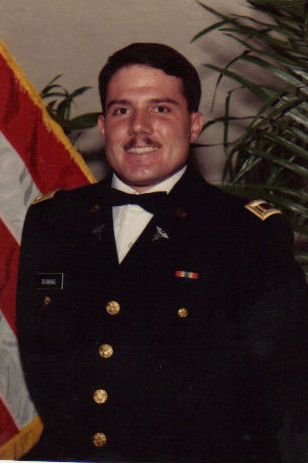
2LT Dundas 1983Look Mom One Ribbon

So what has transpired in 28 years?  Here are some of the highlights and a few lowlights of the of this adventure.

In 1981 it all began and things happened fast, within two weeks of enlisting I was driving an M-151A1 Jeep to Ft Irwin CA as part of battalion advance party and then spending the weekend learning to call in artillery fire. After going through hell and being destroyed and rebuilt by SFC Harry Ball, Drill Sergeant US Army like Richard Gere was in An Officer and a Gentleman I somehow got commissioned in part due to the forbearance of Major Lawson, the former Captain Lawson who has sworn me in.  Judy asks if I had my own “Puget Sound Deb” when she sees the movie with me that winter. However just prior to getting commissioned during my last annual training period at Camp Roberts I led team of Ersatz East German Kommando’s on raids against battalion rear area as the opposing forces.  I was almost run over in may M-151A1 by an M-548 Ammo Carrier during a strafing run coming down hills firing blanks from machine guns like the Rat Patrol and dropping Smoke and CS grenades in the vehicle’s path.  Later we captured the battery Operations Center during a firing mission. None of this made them happy but the Forward Observers and I had a blast.

After I got commissioned I attended the Medical Department Officer Basic Course at Ft Sam Houston TX and suffered for Jesus for 9 weeks in the Riverwalk Marriott hotel in downtown San Antonio. After this I spent 11 glorious weeks at Ft Knox Kentucky which by the way is in a “dry county” or at least it was back then  going through a 6 week course after being bumped by Saudi Arabian exchange officers.

557th comany command 1985Company Commander

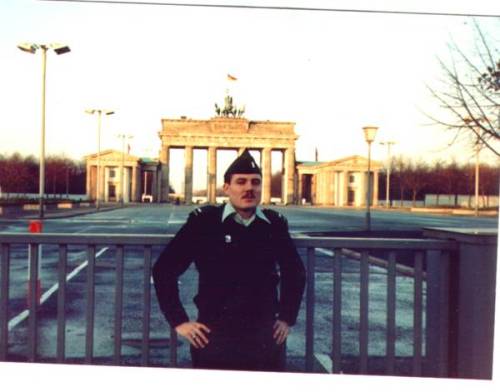
From January 1984 through late December 1986 we were stationed with the 557th Medical Company Neubrucke and later Wiesbaden. Was a platoon leader and became company XO when our XO checked into a psych ward before Winter REFORGER. While in the field was promoted but o one realized that fact until we came out of the field in mid- February. In a late night hastily arranged ceremony which I had to drag Judy in from bed to see I was promoted and got my first real medal. In September I became a “relief pitcher” Company Commander when my new CO got fired. I was told “Lieutenant; clean up that Company.” After 7 months, and having to adjudicate close to 50 Article 15’s, and kicking a bunch of drug users out of the Army I was relieved by a Captain and I had my first and last Change of Command ceremony. Became a personnel officer at our group, pissed off the boss and had a miserable last couple months in Germany. However I completed my first row of ribbons made some really good lifelong German friends and learned to drive really fast and really good and developed a fine appreciation of good beer.

In 1987 I attended the Military Personnel Officer Course at Ft Benjamin Harrison which is in Indianapolis and continued on to Fort Sam Houston where I was assigned as the Adjutant for the Academy Brigade, Academy of Health Sciences.  I got promoted right after I got there and since Judy had not arrived I had the world’s best platoon sergeant, SFC Cynthia Carter help pin on my new Captain bars. Judy was quite happy that Cindy got to do this as she really liked her.  My Brigade Commander wondered what was up with that, but it was an honor to have her do the pinning. While there I worked on AIDS/HIV personnel policy and became “CINC AIDS” at the Academy. While there I collected my second Army Achievement Medal and an Army Commendation Medal.

Berlin WallBerlin Wall 1986

In 1988 I left Active Army to attend Seminary and was appointed as an Armor officer in Texas Army National Guard.  I was told by my boss LTC Jim Wigger that I was moving from the “frying pan into the fire as the chaplains were a cutthroat bunch” and that the “Medical Department was not even in the same league as the Chaplains.” When the Division Chaplain found out that a seminarian was getting ready to drive tanks he pitched a fit and had me enter the Chaplain Candidate program.  In seminary I attended  the Chaplain Officer Basic Course at Fort Monmouth NJ. As Deputy Course leader and Company “First Sergeant” pissed off lots of chaplains and seminarians. Thankfully I was backed up by LTC Rich Whaley who saved my ass for the first time and not the last time.  I met my friend Fr Jim Bowman who kept me from doing anything really stupid. In 1992 I graduated from seminary was ordained and become a chaplain and assigned to 111th Engineer Battalion in Abilene. That year I got thrown out of the Chaplain Officer Advanced Course when school changed a policy on Chaplain Candidates awaiting final approval to be chaplains to enter course. After Billy Martin style tantrum Rich Whaley saves my ass a second time.

In 1993 I went back to Chaplain Officer Advanced Course, made amends and did the appropriate penance.  Meet up with Fr Jim Bowman again. In the fall of 1994 finished the final phase of the Chaplain Officer Advance Course.  Happiness is Ft Monmouth in your rear view mirror. In the summer of 1984 I viewed the O.J. Chase live on miniature TV in M-577 Command Track with Lakers playoff game in split screen while at Fort Hood.

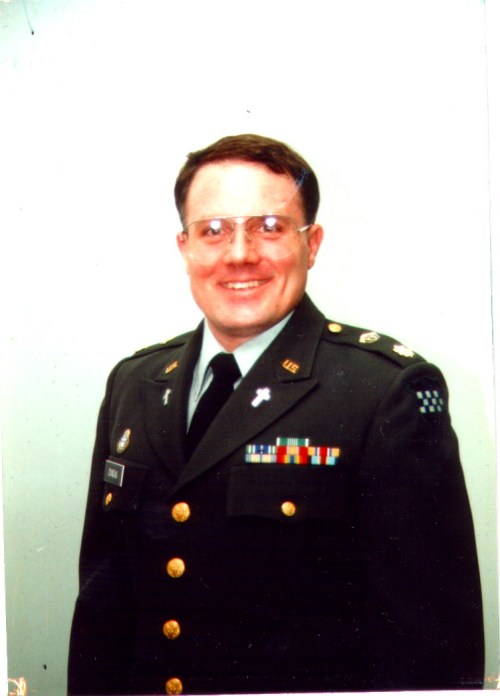
In January 1995 I moved to Huntington WV to take a job as a contract ER Chaplain.  I transferred from one former Confederate Unit to another going from the Texas to the Virginia Army National Guard.  In December I was promoted to Major and transferred to the Army Reserve and got rid of the 410 mile one way trip for a drill.

New MajorNew Major December 1995

In July of 1996 I got mobilized and sent to Germany to support Bosnia mission, lose job. While in Germany get to do a lot of cool stuff, got a bunch of medals and though the Chaplains there wanted me to be brought on regular active duty get told I am too senior to transfer to Regular Army. I actually think that the guy who made the decision remembered me from Chaplain School and did not want someone like me in “his” Chaplain Corps. Upon my return from Bosnia support the Reserves assigned to Ft Indiantown Gap PA as Installation Command Chaplain where in September 1998 I got to close down help close down the Federal side of things and transfer chapel and congregation to National Guard care. In October I returned to the reserves like a journeyman ball-player being sent back to AAA from the Majors. In December the Navy offered me a deal to play “in the show” on active duty and I took it, went from being an Army Reserve Major to Navy Lieutenant. My friend Father Fred Elkin was my first detailer and offered me a choice of East Coast or West Coast Marines when I asked for a ship.  We now serve together and get a good laugh about that now. It did turn out to be a good thing for me. One of the cool things about my time in the Navy has been since I have blown myself up enough in the Army and seen others do likewise that I know where the career “land mines” are and how not to step on them. This has been a great benefit to me.  It was like changing from one league to another in the middle of a baseball season.  The old stats don’t count for or against you when you start playing in the new league.

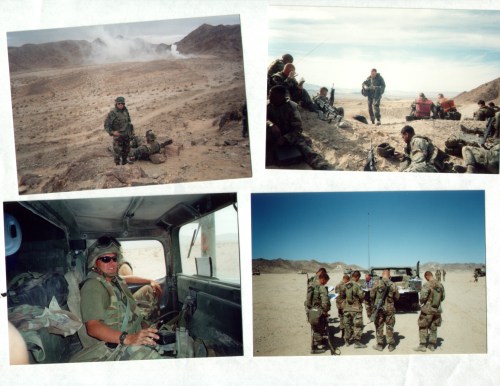
After Navy Chaplain School I was assigned to the 2nd Marine Division at Camp LeJuene NC. From then on my life has been going non-stop.  I was chaplain for 4 different battalions in the Division where Father John Kaul used me as a “relief pitcher” in situations where chaplains had either been fired for doing illegal or immoral things or replacing people who had to move on short notice orders. Did CAX at 29 Palms on multiple occasions and did a deployment to the Far East, Okinawa, Japan and Korea.  Collected more medals got my “old” version Fleet Marine Force Qualification. I was assigned to HQ BN 2nd MARDIV. 9-11 -01 attack happened. A couple of months later I reported to USS HUE CITY CG-66 in Mayport.

Dundas of the DesertDundas of the Desert 29 Palms 2000-2001

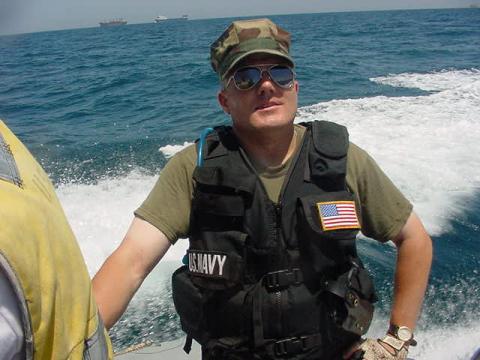
Not long after reporting went on the final work up exercises prior to deployment, deployed to the Horn of Africa, Northern Arabian Gulf, Gulf of Oman and Mediterranean.  Was an advisor for a boarding team in Northern Arabian Gulf and made 75 boardings of detained smugglers.  We almost got to see the Indians and Pakistanis get in a nuclear war, that was a bit sporty and we supported air operations in Afghanistan. After a period in the yards during following deployment as well as work with the great Marines who served in the Battle of Hue City I checked off the ship in October 2003, again collecting more medals and ribbons.

Boarding partyBoarding Party 2002

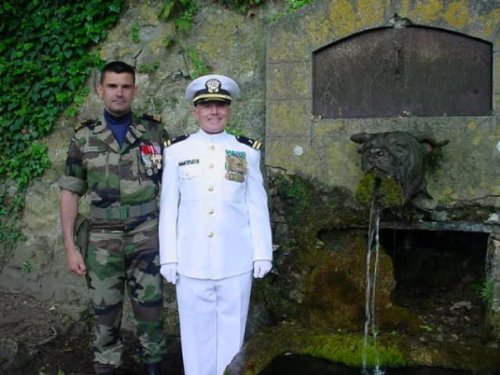
I went to Norfolk where I was assigned to the Marine Corps Security Force Battalion and my Commanding Officers, Colonel Mike Paulovich and Colonel Donald Rogers sent me about the world to care for our Marines.  Over that time I probably averaged 2 trips a month out of the area, many overseas to Japan, Hawaii, Spain, France, the United Kingdom and Bahrain, others to places far and wide in the Continental United States.  Colonel Paulovich and I probably worked more closely together than any commander that I have ever worked with and we went through many difficult times in that assignment. We are still friends to this day.  One of the cool things is the people that we work with. I was promoted to Lieutenant Commander in April 2006.  This meant that I had spent almost 16 years of my career wearing Captain or Lieutenant bars.  I again collected more ribbons and medals for the time with the Marines and was one of the first Navy Officers to get the Fleet Marine Force Officer Qualification pin while completing Marine Command and Staff College.

Belleau woodBelleau Wood France 2004

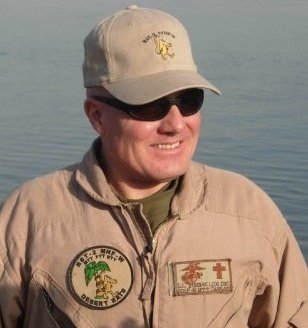
I then went to Navy EOD Group Two in Little Creek where I was the first chaplain assigned to EOD.  While there I got to go to Jordan to the Jordanian Army/UN Peace Operations Training Center and to Sicily.  I was snatched up to go to Iraq in July 2007 and served the most meaningful operational deployment of my career serving our Marine, Army, Navy, Air Force and Department of Justice and Homeland Security advisors to the Iraqi Army, Police and Border Forces in Al Anbar Province.  I came back from Iraq with a great case of PTSD, a gift that keeps on giving.  I checked out of EOD in September 2007 again with more medals and ribbons to my current assignment at Naval Medical Center Portsmouth where I get to do what I am passionate about as a Priest and Navy Chaplain serving in a teaching hospital.

My Tom Clancy lookIraq 2008

Looking back it has been a long and strange trip and it is still an ongoing journey.  People ask me how I keep going even with the PTSD and it’s like Tommy Lasorda says “Guys ask me, don’t I get burned out? How can you get burned out doing something you love? I ask you, have you ever got tired of kissing a pretty girl?” Speaking of which now that I am on the way home after 31 or so hours at work I probably need to do with Judy when I see her.

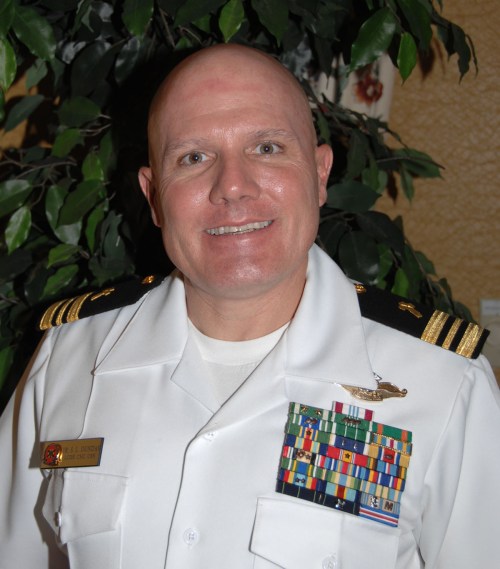
Steve Summer Whites 2008July 2008, Grand Admiral of the Ottoman Navy?

Peace,  Steve+

1 Comment

Filed under Baseball, History, iraq,afghanistan, Loose thoughts and musings, Military, PTSD

Class Acts in Baseball: Tommy Lasorda

“Listen, if you start worrying about the people in the stands, before too long you’re up in the stands with them.” Tommy Lasorda

I have had the privilege of meeting some great baseball players and managers over my lifetime beginning back in 1970 when my dad would take us to see the Angels at Anaheim Stadium.  One manager who I think is a class act is Dodger’s great and hall of fame manager Tommy Lasorda.  Despite the fact that he “bleeds Dodger Blue” and is forever associated with mortal rival of my Giants, I have always liked him.  It really began when the Abbess of the Abby Normal and I moved to the San Fernando Valley to attend California State University at Northridge in 1980.

Money was tight so we did not get to see many games while in school.  Television for us was the old 13 inch black and white TV’s, until Judy’s dad had her come home to pick up a new 13 inch color TV that he had bought for her dorm room.  Neither of us had cable but the Dodgers and Angels were frequently on either local or national stations so I did get my baseball fix.  In doing so I got to watch a great manager in action.  He always seemed to have some nugget of practical down to earth wisdom that made sense, especially in leadership and dealing with people.   He still has a knack for it and he is gracious when you meet him.   He is a very real person who has despite his “Dodgerism” managed to find a soft spot in my heart.  I can relate to him, he speaks in my kind of language and a lot of his leadership and managerial philosophy and approach to people are similar to mine.  Of course this is something that has taken me a long time to figure out having played around with various approaches throughout my life.  Lasorda is simply himself; he is a regular guy who is comfortable with himself.  I think that is one of the big things that has made a difference in my life.  I am finally comfortable with whom I am and want to be the best at being me and doing what I do, whatever that may be.  One of the keys for me is to I just have to good at being me and who I am within my calling and vocation as a Priest, chaplain and writer.

I remember back in 2003 as I was waiting for a Jacksonville Suns game to begin, the Suns at the time being the Southern League AA affiliate of the Dodgers.  Mr. Lasorda walked right in front of me as he came off of the field.  I looked up from whatever I was doing and realized that I had seen a legend.  I was awestruck, a man who I held in such esteem walks right by me. I had always wanted his autograph but even now I am hesitant to just walk up to someone and ask as I try to respect their space.  At Harbor Park I have gotten to meet some of the players charting the games and some of the scouts and collect some autographs always being respectful of them and letting them know if it is for the Baseball Shrine in my kitchen and dining room or if I am having signed for someone else, usually sick kids in the hospital that I work at.  So I sat and kind of brooded, according to the Abbess I am quite good at brooding even before I came back from Iraq.  I guess I brood well so I sat in my seat wanting to go up and ask him to sign the baseball that I had, but not feeling like I should.  About that time an usher that I knew came up, tapped me on the shoulder and said, “Mr. Lasorda will sign your ball for you.”  I looked at him funny and said “Really?”  He said yes and with that I went over to where Mr. Lasorda was sitting and said “Mr. Lasorda I was going to college in Los Angeles when you managed the Dodgers to the Worlds Series win over the Yankees.  I would be honored if you would sign this ball.  He looked up at me, took the ball, signed it and then shook my hand.  I felt like a kid again, but then when don’t I feel like a kid at a ball game?

The ball is now in a case displayed with other signed baseballs and memorabilia in my dining room.  It is a connection to a classy man who always managed to inspire me.  He was also true to his word: “ALWAYS give an autograph when somebody asks you.”

Tonight at Harbor Park I saw the Tides win a vital game against the Gwinnett Braves and in the process paid off the 1967 signed Willie Mays baseball card that Marty the Card Dealer had for me and had the baseball that I carry every day at work signed by Tides pitcher Chris Waters who was charting the game.  Elliott the Usher and his lovely bride Robin celebrated their 42nd wedding anniversary tonight, neither look old enough to have that much time in service in their marriage.  If they were not from Massachusetts but Appalachia I might think that their parents had married them off when they were 10.  Congratulations to these wonderful folks and many more.

Peace,  Steve+

Leave a comment

Filed under Baseball, philosophy

Minor League Road Trips

grainger stadiumGrainger Stadium Kinston NC

“The one constant through all the years has been baseball. America has rolled by like an army of steamrollers. It’s been erased like a blackboard, rebuilt, and erased again. But baseball has marked the time. This field, this game, is a part of our past. It reminds us of all that once was good, and what could be again.” – James Earl Jones in Field of Dreams (1989)

There is something about baseball that is healing.  It is part of the fabric of our American culture something that somehow overcomes the political and religious divisions that so divide our country right now.  We were at Gordon Biersch watching the last couple of innings of a qualification game for the Little League World series between a team from Peabody Massachusetts and one from Rhode Island.  It was one of those magical games that ended with a walk-off Grand-Slam home run in the bottom of the 6th.  It triggered a flood of memories for me and ait got Judy, the Abby Normal Abbess and I talking about some of our own expereinces travelling the country and watching baseball.

I love the game of baseball especially going to a ballpark and seeing a game.  The experience of this for me has been life-long though difficult to continue from about 1983-1999 due to a tour in Germany with the Army a very difficult four years of seminary followed by residency, my first hospital job where I worked the second shift, a mobilized tour in Germany prior to coming in the Navy in early 1999.  During those years getting to games was a rare event, either due to time or money.  Despite this we as a couple got to a few games and I got in a couple on my own when traveling.  Thankfully, Judy, the Abby Normal Abbess tolerates and even joins me in my own baseball journey.

When I went into the Navy and moved to North Carolina that began to change.  North Carolina of course is the setting of the classic baseball movie Bull Durham and once can visit some of the same ballparks as are shown in the movie. The adventure of going to the ballpark again became a regular part of our lives.  It began in a little town in Eastern North Carolina called Kinston, the home of the Kinston Indians.  Kinston is a town that has seen better times, but the Indians, or the K-Tribe as they are known is part of the lifeblood of the community.  They play in Grainger Stadium, which though an older ballpark is still a great place to watch a game.  The Indians Carolina League which is advanced “A” ball and for a number of years dominated that League. When were stationed in Camp LeJeune we would make the trip to Kinston on a regular basis when I was in town. At the time the Indians farm system was producing a lot of great prospects, many who now are major leaguers, including Grady Sizemore, Jhonny Peralta Shane Victorino and Victor Martinez.  When we left LeJeune we were stationed a brief time in Jacksonville Florida, where we lived very close to the Baseball Grounds of Jacksonville, home of the Jacksonville Suns then the Los Angeles Dodgers AA affiliate in the Southern League.  The ballpark is a great venue to see a game and the Suns management led by Peter Bragan and Peter Bragan Jr. who are part of a great baseball family run a great show, and the Dodgers staff was a class organization.  I got to meet Tommy Lasorda in Jacksonville as well as Steve Yeager.  I have 2 game worn special issue jerseys from the Suns.  When we moved to Norfolk in 2003 the season was already over but beginning on opening day of 2004 I began to worship at the Church of Baseball, Harbor Park Parish.  This if you follow this site is the home of the Norfolk Tides.  Ever since then I have had the opportunity to see the game close up on a very regular basis.

In addition to attending the games near us we would travel and see other games. We would make trips down to Kinston from Virginia.  Once we went to a reunion of a singing group, the Continental Singers and Orchestra that I ran spotlight for back in 1979 which was being held in Kansas City.  On the way we saw a game in Louisville with the Louisville Bats, followed by a game in Cedar Rapids Iowa where we saw the Cedar Rapids Kernels play the Battle Creek Yankees and followed it with a trip to the “Field of Dreams” outside Dyersville, where that film was made.  Judy indulged me by playing catch with me on the field and taking my picture coming out of the cornfield.  It was almost; well it was a spiritual experience.  Occasionally when we visit Huntington West Virginia we try to see the West Virginia Power in Charleston.

Until I went to Iraq Judy and I used to take trips to Minor League ballparks around our Wedding anniversary.  We would take about four or five days and travel city to city to see some of the most fascinating baseball venues around.  We haven’t made a trip like that, even outside the wedding anniversary in a while mainly due to time as my much leave time has been spent going home to assist with my parents, especially the past 18 months where my dad’s Alzheimer’s Disease has progressed to the point of him being in a nursing home on palliative care.  Despite that I would always try to find time to see a game when in Stockton.  Before Iraq we would see the Stockton Ports in Billy Herbert Field.  The Ports now play in Banner Island Ballpark which is a great place to see a game.  If the Ports have not been in town we have occasionally been able to see the Giants, the A’s or the Sacramento River Cats, the AAA affiliate of the A’s.

The anniversary trips took us to some of the most interesting places to see games.  I have already mentioned Kinston where on one of our anniversaries we got to throw out the first pitch.  We have also travelled to Winston-Salem, when they were the Warthogs and Charlotte home of the Knights, the AAA affiliate of the White Sox.  Actually, Charlotte’s stadium is just down the road a way in Round Rock South Carolina.  We got rained out in Winston-Salem as a major storm hit at game time.  To our north we have been up to Frederick Maryland, home of the Frederick Keys, the Carolina League affiliate of the Orioles and Harrisburg Pennsylvania to see the Harrisburg Senators, the Montreal Expos-Washington Senators AA Eastern League affiliate at Metro-Bank Park on City Island.  This park was used in the movie Major League II as the Spring Training facility. There were two really cool things that happened at Harrisburg which was on our anniversary.  First we saw Phillies Slugger Ryan Howard about tear the cover off a ball hitting a double down the right field line and the General Manager had a ball autographed for us by the team.  That was really cool.  Likewise when Atlanta still had its Richmond affiliate, the Richmond Braves, we made a number of trips to “The Diamond” in Richmond.  This was the worst stadium I had ever watched a game in, though the team was always good.  We saw a playoff game there in 2004 between the Braves and the Columbus Clippers, who were then the Yankees AAA affiliate.  Sitting behind home plate I saw Jason Giambi play for the Clippers on a rehab assignment.

I have done some parks on my own when travelling.  Any time I have been on the road in baseball season and have the chance I try to see the local team if circumstances permit.  I have seen a number of games in the Pacific Northwest seeing two Seattle Mariners short season single A Northwest League affiliate the Everett Aquasox and AAA Pacific Coast League affiliate the Tacoma Rainiers.  Everett is an especially interesting place to see a game.  The games are well attended and the team management has some great promotions including “Frogfest” where the team wears tie-dyed jerseys and there is a kind of 1960s hippy theme.  The Rainiers play in Cheney Stadium in Tacoma.  In Tacoma I saw Mariners pitcher Felix Hernandez pitch his first AAA game. Both Everett and Tacoma are nice places to see a game.  While on the USS Hue City at the Maine Lobster Festival I worked a deal with festival organizers to get tickets for our sailors for two games watching the Portland Seadogs the AA affiliate of the Boston Red Sox.  When the Seadogs hit a home run a lighthouse rises up from behind the fence and a foghorn sounds.

However the two most interesting place that we have seen games together are Ashville North Carolina, the home of the Ashville Tourists and Zebulon North Carolina home of the Carolina Mudcats.  Ashville has quite a history with McCormack Field dating back until 1919.  The grandstand was rebuilt a number of years back, but the playing field is the same.  The outfield wall backs up into a tree covered hillside into which home runs hit at night almost seem to dissolve.   Zebulon is another matter.  The stadium is about a mile out of town surrounded by farm fields.  When you drive to it down US 64 from Raleigh the stadium almost seems to emerge from nowhere as if it were beamed down from a orbiting starship.  It is a fairly new stadium and very modern a great place to see a game.  We went there to see the Mudcats, who were then the Marlins AA Southern League affiliate play the Mississippi Braves.  We got to the stadium and found that somehow I had left our tickets at home.  Since the game was in an hour and home was bout a 6-8 hour round trip I knew that going home to get them was not an option.  So I went to the ticket manager and explained the situation.  He had remembered taking my ticket order by phone as we had talked about shared military experiences.  He was able to print us duplicates for the seats that we had previously purchased and we saw the game, as always from down behind home plate.  In this game we saw Braves All Star catcher Brian McCann play the week before he was called up to Atlanta.

I hope that we have some time next year to make at least one trip out to see some other Minor League venues.  They are a lot of fun and part of the fabric of our country and somehow I believe if we reconnect in these locations, watching this timeless game that maybe just maybe we can overcome the emnity of all that divides our country and learn to be Americans again.  We will never all agree on politics, religion, domestic, foreign or economic policy.  No Americans ever have, but we can discover what it means again, through this wonderful game called baseball.  I do think that the Deity Herself approves of all of these local parishes of the Church of Baseball scattered about our land.  At the same time I always have my place in Section 102, Row B Seat 2 at Harbor Park.

Peace, Steve+

Leave a comment

Filed under Baseball, Loose thoughts and musings, marriage and relationships, travel

Crossing the Mendoza Line: It’s not All about the Lifetime Batting Average

Hammock Grand SlamRobby Hammock Crossing the Plate after his Grand Slam in the Bottom of the 6th against Charlotte

When I was playing baseball I hit somewhere around the Mendoza line.  I was never much of a hitter but I made up for my lack of hitting by being pretty solid defensively, a pretty versatile utility player and hustling on every play.  Likewise I would be the guy encouraging other players.   On two different teams in two different sports I was named the “Most Inspirational Player” by my teammates.  Being the most inspirational player does not mean that you are a particularly good ballplayer but rather that you add something else to the team dynamic.  In fact you may not be admired for how well you play, but rather how hard you try and how you get along with your team mates.  I was talking to my dad who is now in a nursing home with end stage Alzheimer’s disease on my last visit.  In a rare moment I had him back talking baseball I thanked him for how he helped me learn to love the game, pitch and field, especially fielding.  I said to him, the only thing that you didn’t do was teach me to hit.  He looked up at me and said “Son, there are a lot of people who can’t hit, it’s a gift.”  So I guess I was doomed to be a Mendoza Line player.

Mario Mendoza played for the Pirates and Mariners.  To be kind he was an amazing defensive shortstop but he as my dad would have said” Couldn’t hit his way out of a wet paper bag.”  His career average was .215 although he often flitted and flirted with the .180 – .200 level. He never played in an All Star game or World Series.  He never hit more than two home runs in a season, in fact one was an inside the park job playing for the Mariners and he hit below .200 in five of his nine major league seasons.   However, despite that Mario Mendoza lives on in baseball, his name forever associated with a low batting average.  In modern baseball parlance the Mendoza line is considered a batting average of .200.  Credit for who coined the term goes depending on your source to either George Brett, the All-Star Third Baseman of the Kansas City Royals or fellow Seattle Mariners Tom Paciorek or Bruce Bochte from whom Brett may have heard the term.  Either way the term stuck after ESPN commentator Chris Berman who used the term in 1988 to describe the hitting struggles of a star power hitter.  Once Berman made the comment it became a pretty standard way of denoting guys who struggle at the plate.  Mexican sportscaster Oscar Soria corroborates the Paciorek and Bochte version referencing a conversation with Mario Mendoza while Mendoza was managing the Obregon Yaquis in the Mexican Pacific League who stated that Mendoza said “that Tom Paciorek was the first to mention the phrase “Mendoza Line” when he read the Sunday paper” and that “then George Brett heard about that.”  Soria then discussed how Mendoza was initially angered by Berman’s use of the term but now “he enjoys the fame of the phrase Mendoza line.”  For a really good discussion of the Mendoza Line see the article in the Baseball Almanac at: http://www.baseball-almanac.com/books/mendozas_heroes_book.shtml, from which the information above is gleaned.

Now my buddy Elliott the Usher and I have frequent discussions about the game discussing pitching, hitting, fielding, base running, prospects, scouting and strategy.  Elloitt is one of those gems of Baseball knowledge, his love and knowledge of the game shows in the way he deals with people including Major League Scouts, players from the Tides and visiting team who are charting the game and others.  I really think that he should be hired as a commentator or color man on some baseball broadcast.  This season we have enjoyed a lot of laughs as well as had a lot great talks amid the joys and sorrows of the season.  One of our frequent subjects of discussion is players on our team as well as the visiting teams who are hitting near or below the Mendoza Line.  We have a few on the Tides who are hovering at or below the Mendoza line.  A couple of these players are former Major Leaguers and a couple career minor league guys.  Last night I decided to venture out for the first time in two days since I was now getting a case of “cabin fever” and my cocktail of Vicodin, Motrin and Amoxicillin seemed to have my pain and swelling a bit more under control.  Judy said my cheek still looks “like a squirrel’s” but at least I wasn’t in too bad of pain, though when I got up in the morning and until 2 or 3 PM I was still pretty sore and tired.  At least for the majority of the game the pain was manageable and of course as soon as I got home I dumped a butt load of meds down me and went to sleep.

Last night the Tides swept a double header from the Charlotte Knights who are the AAA affiliate of the Chicago White Sox.  Since the game was rain delayed after a series of severe storms raked the area in the two hours prior to the first pitch it was not well attended.  Because of this I was able to flit between my buddies Barry down in section 102 and Elliott.   It was good to be able in a fairly relaxed atmosphere to talk about the game.  The Tides had lost the last game prior to the All Star Break in Durham and then the first game back from the break.  In those two games their hitting died and they were outscored 16-3.  Last night Chris Tillman was throwing an outstanding game having given up just one run in the first inning.  It wasn’t until the 6th inning until the Tides scored their first run with one out when Michael Aubry doubled to score Justin Turner to tie the game 1-1.  The Tides then loaded the bases and Brandon Pinkney struck out for the second out.  At this point with the bases loaded, Elliott and I gave a mutual groan.  One of our “below the Mendoza Line” batters, catcher Robby Hammock was coming to the plate.  Robby is a good defensive catcher and while playing for the Arizona Diamondbacks caught Randy Johnson’s perfect game in 2003.  However this year has seen Robby really struggle at the plate.  The count went to two and from the way Robby had been swinging the bat tonight Elliott turned to me and said “I can’t look.”  Robby then fouled off the next pitch.  I said “Elliott he’s dragging this out.” Then I yelled “Hey Mendoza! Get a hit!”   At this point Robby who is currently hitting .190 stood back into the batter’s box.  The pitch from Knight’s reliever John Link was a slider that didn’t cut and Robby planted it in the picnic area in Left Center for a Grand Slam home run.  Elliott and I rejoiced, Robby had maybe gotten the hit that would re-ignite the team for the second half of the season.  This blew the game open and the Tides went on to win 5-1.  Robby was quoted in the Virginia Pilot today about the hit “I closed my eyes and put my bat in the spot” and “I felt decent today, I just got lucky and that’s all there was to it.”  Tides fans are not complaining even if it was lucky, I’m happy for you Robby, you helped get us back on track enjoy the moment and keep hanging in there.

The hitting surge continued in the second game.  Jeff Fiorentino and Michael Aubrey, who are .300 hitters, Fiorentino about .325 right now and way above the Mendoza Line each had 2 hits and drove in two runs while our other way below the Mendoza Line players had a good night. Infielder Carlos Rojas was in at Third due to injuries that forced Manager Gary Allenson to reshuffle the line up.  Carlos is a pretty good defensive player with pretty good range.  However he was only hitting .156 going into the game but went 2-3 with two singles in what I think was his first multi-hit game of the season.  Catcher Chad Moeller who has struggled at the plate since coming down from Baltimore when Matt Wieters was called up also doubled and scored a run as the Tides took the second game 5-1 with Chris Waters getting the win.

All in all it was not a bad night for our guys living below the Mendoza line; hopefully they will all get themselves up above it.  As a member of the Mendoza Line club myself I hope that they all do well and that last night is a harbinger of things to come.  Today my mouth feels a bit better than yesterday though I woke up in some pain.  I plan on seeing tonight’s game with Judy as the Tides hopefully will extend their International League South Division lead over the Durham Bulls by defeating the Knights here again.

Coming back to the Mendoza Line itself the way that guys like Mendoza make their mark is by the intangibles that they bring to the game.  Some of the “Mendoza’s” went on in other ways to make a difference in the game through coaching, managing, scouting at the Major or Minor League level, as well as in sports media, announcing or writing.  Some would include guys like Tony LaRussa career .199 average in 10 seasons, Charlie Manuel .198 in 6 seasons, Bob Uecker career .200 in 6 Major League seasons, Sparky Anderson who hit .218 in one season in the Majors and once said “I led the league in “Go get ’em next time.” Tommy Lasorda was a pitcher and had a 0-4 record and 6.48 ERA in three major league seasons as well as Earl Weaver who never made it to the Majors.  All made lasting marks on the game and all were way below the Mendoza line.

The application to baseball players and non-ball players alike when you find yourself at the Mendoza Line is to make the most out of what you have.  Play to your strengths and know that if you do this you will make a mark, even if it is not at the plate.  I figure as a somewhat well trained and experienced theologian, historian, military officer and Priest that the Deity Herself understands bad days, and lackluster careers and still helps us get through life.  So anyway, as a Mendoza Line alumnus I say to all those hovering around the line, find a way to make your mark and do well, I’m cheering for you as are all the other Mendoza’s among the Saints in Heaven.

Peace, Steve+

1 Comment

Filed under Baseball, philosophy