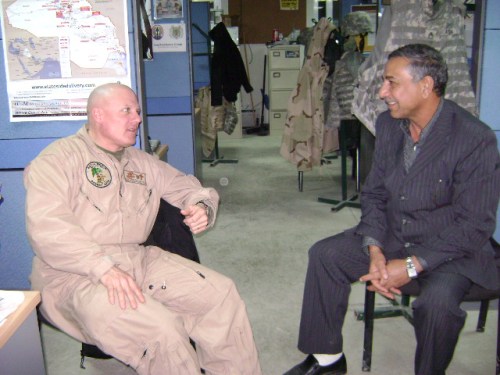
Tag Archives: usmc

Going to War: Flying in Al Anbar on C-130s

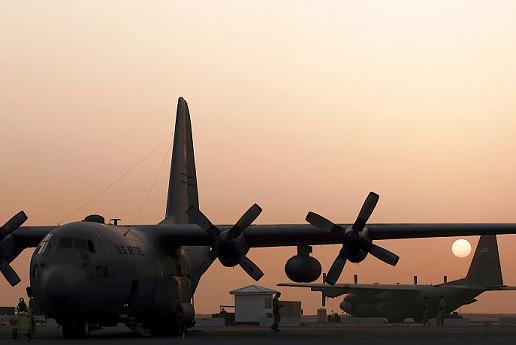
C-130’s in Iraq

This is another installment of my “Going to War” Series that I began last year.  In the Fall I had to take a break from posting anything more on the story of my deployment to Iraq in 2007 and 2008 due to issues that I was having dealing with the effects of PTSD. I have reached the point that I can again write about this so on occasion I will post these articles which now deal with our actual operations and experiences supporting our Marine Corps, Army and Joint Service advisor teams in the province. The previous posts as well as others dealing with Iraq are filed in the “Tour in Iraq” link on the home page. The direct link to these articles is here: https://padresteve.wordpress.com/category/tour-in-iraq/

Nelson and I continued to prepare in the days leading up to our first mission to the Border Port of Entry at Waleed on the Syrian border with a planned follow on to the teams of the 3rd Brigade, 7th Iraqi Division at Al Qaim about a hundred miles to the north .  Waleed is about 350 miles west of TQ and 70 miles from the nearest FOB with any substantial American presence. We were in constant communication with the team that we to visit via VOIP and SVOIP telephone and secure and non-secure e-mail. The commander of the Border teams, which included Border and Port of Entry adviser teams was Lieutenant Colonel Bien.  Our mission in getting out to the furthest point west was to meet up with an incoming and an outgoing Port of Entry team and see what we could do to get out to other posts along the border.
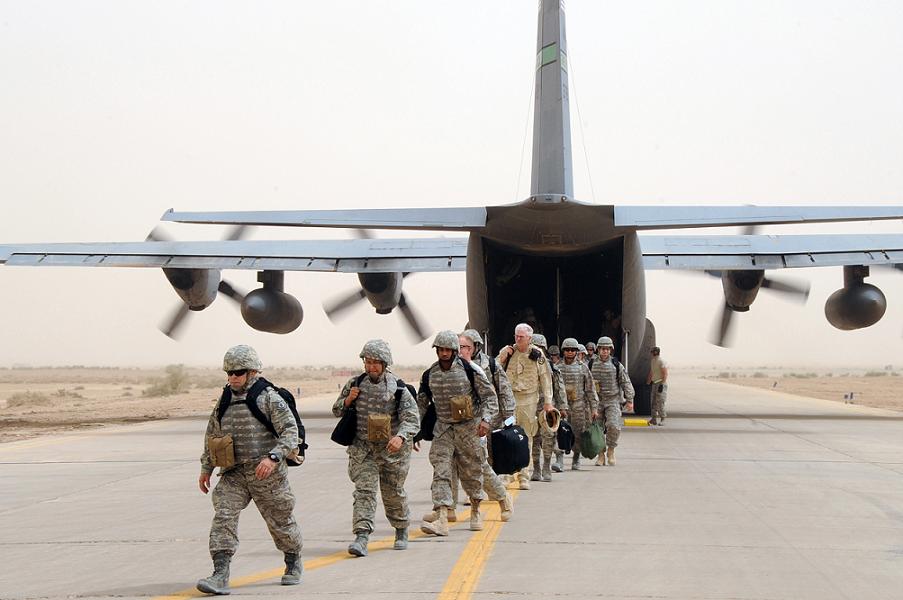
C-130 unloading its passengers

Nothing in Iraq is easy.  The get out to Waleed we had to make a two day trip from TQ, through Al Asad out to Waleed.  Our flight out was a day flight on an Air Force C-130 to Al Asad.  Our contacts in the G3-Air at 2nd MLG were good in helping me figure out the Air Force flight request which was different than the normal Marine Air Support Request.  For this mission I had to submit 2 Air Force and 3 Marine Air Support requests.    Simply submitting a request does not guarantee a flight. Flights are based on precedence dictated by the overall mission.  Religious support was pretty high on the list but there was no telling that your flight would go until you had your approval message and even then things could change.  The actual missions were not known until about midnight the night prior to the flight. So if you were a frequent flyer it meant no sleep the night before a mission as you waited to see if you were approved.  This was my first time actually having to do this for real so I sat at my secure laptop in my office in the back of the TQ plywood Cathedral waiting for the flight list to be posted on the MLG G3 Air Secure Website.  Finally about 0100 the list popped and our first flight was on in.  It was a mid day flight which meant that we needed to be at the passenger terminal about 0930.  This entailed getting our ride from the Chapel to the terminal by 0900.

I told Nelson who was checking his e-mail on a computer in the RP office that it was a go and then headed off to my can to prepare.  Since most of my gear for the 10 day trip was already packed I tried to actually get ready to sleep.  I quickly found that simply being tired because I was up late was not enough to help me go to sleep.  I was really tired but the adrenaline was coursing through my body making it impossible to sleep.  I prayed the office of Compline and then played computer Ma-Jong until at least 0300 before I could finally pass out.  I was up early to shower and get breakfast before lugging my gear over to the chapel.  The weather as usual was about 100 degrees by the time I got back from the chow hall; I gathered my gear and went to the chapel.  I took my back pack, my laptop and a flight bag. I would learn on this mission that I would need to pack lighter the next time around, but live and learn.

The first leg of our trip was on an Air Force C-130 from TQ to Al Asad which we shared with a large number of previously unknown friends from every branch of service in the US military as well as various civilians and contractors.  All of us had our personal protective equipment as well as our bags. The bags that we did not want to lug were placed on pallets and transported with a large fork lift to the aircraft.  When you make one of these trips you are accounted for a good number of times before ever getting on the aircraft.  This first mission was still in the heat of the Iraqi summer and thus the temperature inside and outside of the aircraft was stifling.  We staged off the tarmac in the sun for a final role call and then in two lines who guided out to our aircraft which had just landed.  As we were trudging out to the aircraft two lines of assorted passengers primarily Soldiers and Marines passed us mid way to the aircraft.  As we neared the aircraft the propeller blast blew the hot air into our faces and I thanked God for the high speed ballistic sunglasses that I had been issued by EOD.  Entering into the aircraft we had to step up onto the cargo ramp and then took our seat in the narrow canvas mesh jump seats that lined both the side of the aircraft and the center.  The rear of the aircraft including the cargo ramp was used for several pallets of cargo including the bags that we elected not to carry.  Sitting in the aircraft and waiting for the pallets to be loaded I thought back to my early career as an Army Officer where I became an air-load planner and embarked my soldiers on six C-130s during Winter REFORGER 1985.  Back then instead of the 130 degree heat of Iraq we faced the coldest winter in 40 years in Europe in which the Rhine froze over.  Although the use of computers has become routine in load plans the principles are the same as they were 25 years ago and everything on the aircraft needs to be properly balanced to ensure the stability and safety of the aircraft and that weight limits are not exceeded.  As the sweat poured off of me I took off my helmet and downed part of the one liter bottle of water that I carried onto the aircraft and threw some on my face, though warm it was refreshing and I reattached my helmet as the aircrew came through the cabin giving a final safety brief.
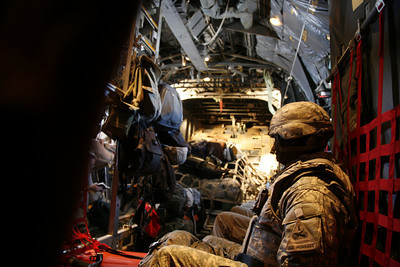
Interior shot of a C-130

As the last of the cargo pallets were loaded about the aircraft the cargo ramp was raised, the entire time that the aircraft was on the ground was under 15 minutes, it is amazing what the Marine and Air Force ground crews and cargo handlers can accomplish.  With the ramp raised the aircraft’s air conditioning began to take effect and though not the coolest air conditioning it was better than what we had up to that point. The aircraft began to roll and move down the taxiway and when it reached the end of the taxiway it made a fast turn and began its take off.  Since there was a real and present danger of possible missile or gun attacks on low flying aircraft the C-130 made a steep lift off and banked right over Lake Habbinyah and continued its ascent until it reached its cruise altitude.  The C-130, like any cargo aircraft is extremely loud and because of this hearing protection is worn by passengers and crew and conversation is nearly impossible.

The flight from TQ to Al Asad is only about 30 to 45 minutes depending on the route taken so most of the passengers took the opportunity to grab a bit of sleep or read.  Nelson and I sat together on the starboard side of the aircraft not far from the palletized cargo.  Nelson who can sleep almost anywhere on a moment’s notice was out quickly; and although I was tired I could do little more than close my eyes and try to clear my mind.  When we neared Al Asad the aircraft banking nearly perpendicular to the ground made a steep and fast approach.  As we landed I could see other aircraft on the ground including F-18’s, various transports and rotor wing aircraft.  The C-130 taxied to a spot on the tarmac where the ramp was dropped and we were instructed to exit the aircraft and led to the rear of the aircraft about 50 yards and then led between it and another aircraft to a group of tiny Japanese made Nissan and Mitsubishi buses in which we were loaded until every seat was full including the in aisle jump seats.  Packed into the bus like sardines and smelling almost as bad we sucked in the stench, which was somewhat like a European elevator in the 1980s.
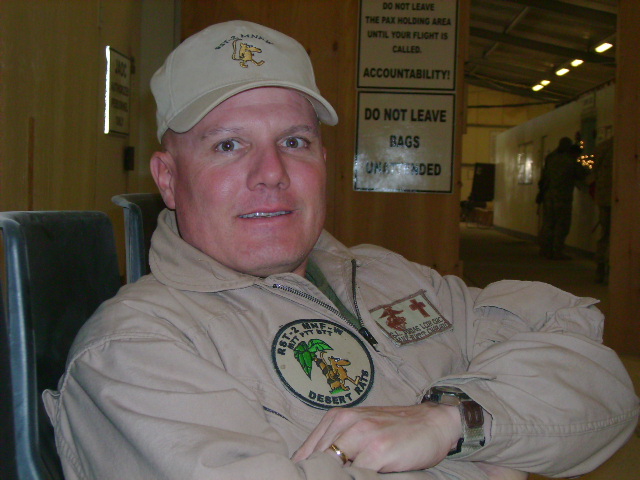
Padre Steve Chillin’ at Al Asad Terminal

After a short ride to the terminal we picked up our gear which had been delivered on the pallets by forklifts.  Another muster was taken and after all personnel were accounted for those of us waiting on follow on flights checked in at the terminal and got our temporary billeting in large tents about a hundred yards from the terminal where we each found a bunk grounded our gear and settled in for a bit to clean up before trying to go get some chow.

Next: Air Travel In Al Anbar the California Line.
Leave a comment

Filed under History, iraq,afghanistan, Military, Tour in Iraq

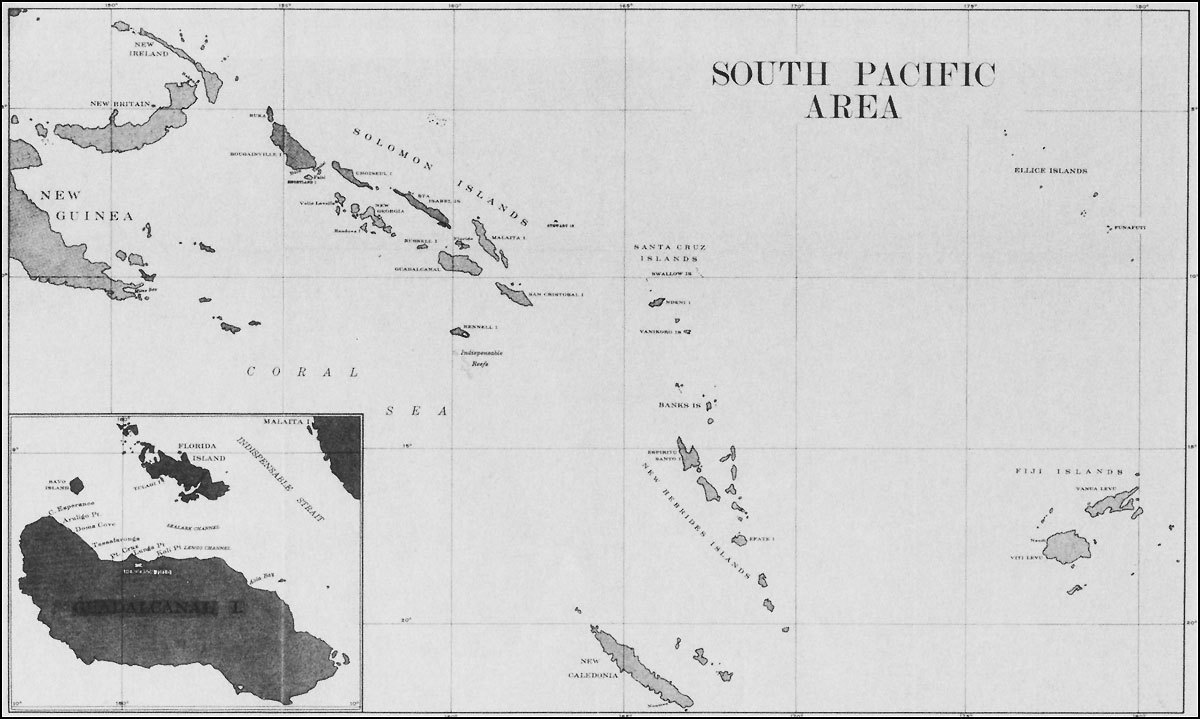
Background to “The Pacific” Part One: The Guadalcanal Campaign and the Beginning of Joint Operations

The Battle of Bloody Ridge

Note: This is the first of a series that I will post on the campaign in the Pacific.  Some are older articles that I wrote for my Masters Degree program and others will be new material dealing with specific topics in this long neglected campaign.  I was watching the second episode this evening and found it quite powerful…so much that I was in tears as the Marines of 1st Marine Division and John Basilone came aboard the troop transport and went to the Mess Deck.  I have served with the Marines for around six years including with Marine advisers in Iraq and been the Chaplain for the USS HUE CITY which is named after the Battle of Hue City.  I love the Marines and this series has touched me already.  I hope everyone watches it on HBO.

The Guadalcanal Campaign and the Beginning of Joint Operations

Marines on Guadalcanal

The Guadalcanal campaign was the first experiment by the United States of conducting a “joint” campaign in modern warfare involving Naval and Naval Air, Ground combat units, Army air assets and amphibious operations. The campaign involved numerous land, sea and air battles. It was under the command of Admiral Nimitz as CINCPACFLT and included commanders for ground, air and sea forces engaged.  For brevity and simplicity sake I will discuss the campaign and sea even though they are interconnected with the sea and air campaigns directly affecting the outcome of the land campaign.

Designated OPERATION WATCHTOWER and aptly called OPERATION SHOESTRING the campaign was launched on short notice, approved on 2 July the commanders of the operation first learned of it on 7 July. Utilizing the 1st Marine Division, which would later be reinforced by the Americal Division, landed on Guadalcanal and the neighboring island of Tulagi on 7 August.  The Marines took Tulagi after a brief but bloody fight and the few Japanese troops on Guadalcanal fled inland allowing the Marines to seize the airfield.  Unfortunately, the commander of the supporting US carrier task force, Admiral Frank Fletcher fearing danger to his carriers and withdrew following the landings. The forces in direct support were surprised by a Japanese cruiser force under Admiral Mikawa losing 3 American and 1 Australian heavy cruiser in one of the worst American naval defeats in history at the Battle of Savo Island. The next morning the transports, many still full of supplies left the Marines.  Admiral Fletcher’s action, which left the Marines without air cover and carrier support gave the Marines a new term, still in use today, for being left high and dry: “to be Fletchered.”

Japanese dead of the Ichiki Detachment after the Battle of the Tenaru (Ilu) River

The Land Battles: The Japanese quickly responded sending in Naval Landing forces which went in light without all their troops or equipment. The Ichiki detachment was wiped out in the battle of the Tenaru (Ilu) river on 20 August.  The Kawaguchi detachment of 3,500 men landed in two groups, again short of men, material and equipment landed in the closing days of August and attempted to seize the now operational “Henderson” field on September 13 to 14th after one of its supporting units had been destroyed by the 1st Raider Battalion in a small amphibious assault.  Kawaguchi’s attack was disjointed and his units dispersed.  He was defeated in detail by the Marines in the Battle of “Edson’s ridge” or “Bloody Ridge.”

Chesty Puller

The Marines attacked and destroyed another Japanese force at the Mataniko river on 9 October.  The Marines were further reinforced by the 7th Marine Regiment while Kawaguchi was reinforced by the HQ of 17th Army under General Hyakutake who brought the 2nd Division onto the Island under the command of General Maruyama.  Kawaguchi would then be relieved and sent home following disagreements with Maruyama and his chief of staff prior to the next major Japanese attack which took place 23-25 October along the same ridgeline that Kawaguchi had assaulted. Though the Japanese now had 15,000 troops with good artillery support, the attacks were fierce but uncoordinated. Defended by 7th Marines under Chesty Puller as well as troops from the recently arrived Americal, the Marines again effectively destroyed the attacking Japanese force.

Sergeant John Basilone USMC with Medal of Honor

Despite additional reinforcements of the 38th Division, the Japanese, due to severe food, supply and ammunition shortages would not make any more major attempts to take the airfield.  The Americans would shift to the offensive with the Army XIV Corps composed of the 25th Division, Americal Division and Second Marine Division under Major General Lawton J “Lightening Joe” Collins commanding in December.

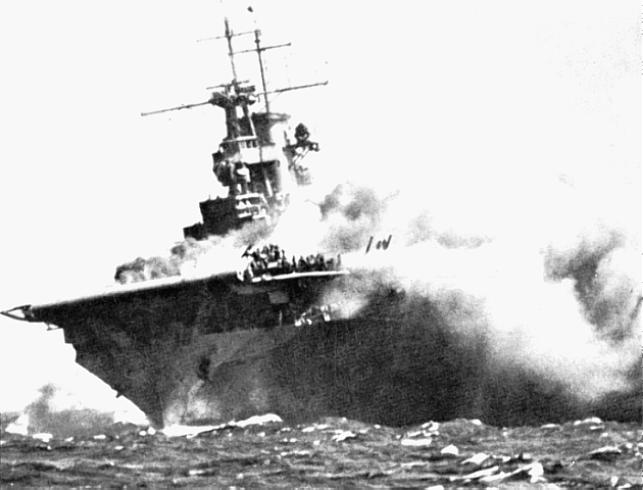
The US Navy paid a heavy price for the victory at Guadalcanal. Here the USS Wasp sinks after being hit by Japanese torpedoes

The Sea Battles: The sea campaign in the waters surrounding Guadalcanal would be marked by some of the bloodiest sea battles in the history of the US Navy.  So many ships from both navies would be sunk offshore that the waters would become known as “Ironbottom Sound.” Following the previously mentioned “Battle of Savo Island” the Americans lost the carrier Saratoga to torpedo damage and the Wasp was sunk while escorting a convoy. In the Battle of Eastern Solomon’s of 24 August the Americans have the Enterprise knocked out of action for 2 months and while sinking a Japanese light carrier and inflicting heavy aircraft losses on the Japanese. The Americans surprised a Japanese force on 11 October off Cape Esperance sinking a heavy cruiser and destroyer and heavily damaging a second heavy cruiser. The Japanese effort, now directed by Yamamoto brought battleships to support operations around Guadalcanal, including bombardments of the airfield on 13-14October in support of Maruyama. The attacks damaged but did not close Henderson field which was able to continue air support to the Marines and soldiers.  On 26 October a carrier engagement would be fought, the Battle of Santa Cruz Islands would be a tactical Japanese victory sinking the Hornet and damaging Enterprise, while losing no ships. Two Japanese carriers were damaged but they lost a large number of pilots and aircrews who could not be readily replaced. They also not succeed in their amphibious efforts to retake the island or Henderson field, gaining the Americans badly needed time.  On 13 November the Japanese attempted to repeat the bombardment of Henderson field but would be stopped from doing so by a task force under Admiral Daniel Callaghan.  The First Naval Battle of Guadalcanal cost the Japanese the battleship Hiei and two destroyers, additionally many of the transports bringing Japanese reinforcements would be sunk by aircraft from Henderson field and Enterprise.  The Americans lost 2 cruisers and 4 destroyers sunk and every other ship save the destroyer Fletcher damaged. Admiral Callaghan and Admiral Norman Scott, the victor of Cape Esperance were both killed.  The following night the Japanese would lose the battleship Kirishima to the USS Washington task group under the command of Admiral Willis Lee.  Further Japanese naval activity would be limited to attempts to reinforce the island with destroyers; during one of these operations on 29 November they would clash with a force of American cruisers and destroyers at Cape Tassafaronga, sinking 1 cruiser and badly damaging three more at the cost of one destroyer, but was unable to complete his supply run.  Though the Americans lost more total warships, the Japanese could not replace what they lost.

USAAF B-17E over the Solomons

Air Operations: The air operations would be decisive to the effort, land based aircraft of the Japanese played a key role in destroying some US shipping and sinking warships in waters off Guadalcanal however they could not maintain air superiority over the island which was maintained and increased by the Americans as Henderson field’s capacity grew and additional Army, navy and Marine aircraft were stationed there.  Naval air was extremely important in the sea battles around the island.

Beached and destroyed Japanese transport ship at Guadalcanal

Japanese Reaction: The Japanese reaction was one of dismay; they could not fulfill their promise to the emperor to retake the island.  They had lost many ships and aircraft as well as ground troops. From this time on the Japanese would go over to a strategic defensive in the Pacific.  Japanese losses were devastating as they could not be made up.

Importance for the Americans: This was important in a number of ways. For the navy it showed that they could defeat Japanese surface ships in night engagements and gave the navy great experience as it moved forward in the South and Central Pacific. American carrier air crews had become experienced and gained superiority over the Japanese.  On the ground the myth of the Japanese “superman” was destroyed, yet American commanders also began to appreciate the skill, endurance and tenacity of the Japanese soldier in future operations.

Importance for Joint Operations: The campaign also was a triumph for the Americans in the fact that they were able to overcome inter-service rivalries undertake a difficult operation against a stronger opponent far from major fleet logistics and support basis.  To be sure this was Joint Operations in its infancy and until the arrival of significant Army forces on the island to relieve the Marines was for the most part a Navy, Marine Corps and Army Air Corps operation.  When Major General Lawton “Lightning Joe” Collins assumed command of the island from Marine Major General Alexander Vandergrift it became a true-inter service operation and the beginning of Joint Operations.

12 Comments

Filed under History, world war two in the pacific

The Impact of Technology on the Organization, Strategy and Tactics in the Second World War

Introduction

World War II saw some of most rapid technological advances impacting military forces in history. The advances in technology impacted the organization and tactics of major power military forces, especially those of the United States, Germany, the Soviet Union and Great Britain.  These advances combined to revolutionize the way wars were fought and military forces have been organized to the current day.

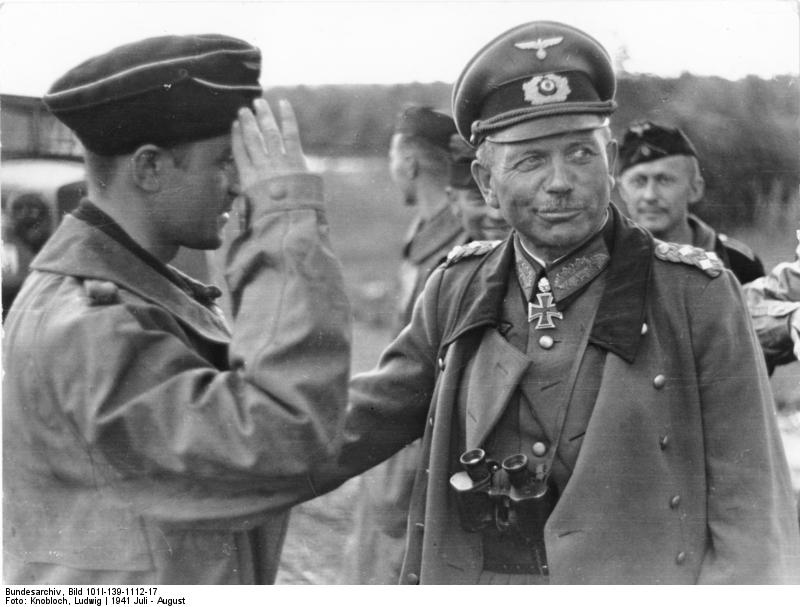
Heinz Guderian’s Theories of Mechanized and Combined Arms Warfare and His Organizational Genius Revolutionized  Land Warfare

The technical developments and their relationship to military organization and tactical applications began in the years following World War I as various writers began to analyze that war and formulate ways not to repeat the grist mill of trench warfare that dominated it.  The writers looked at tactical innovations, new technology and enunciated ways that technology and tactics could be combined with organizational changes to revolutionize the ways that wars were fought.  Chief among these writers were General Fuller and Captain B.H. Liddell Hart in Britain, Colonel Heinz Guderian and Erwin Rommel in Germany.  Airpower theories were dominated by the strategic bombing theories of Italy’s Guido Douhet and tactical air theories of American Marine General Roy Geiger as well as the pioneers of tactical air support in the Luftwaffe.   In the United States General George C. Marshall helped initiate doctrinal changes that would change the way that the U.S. Army would fight.

Among the common elements found in the works of these men was the necessity to apply technology to overcome the pitfalls that all of the armies which fought in the First World War found themselves.

The Mechanization of Ground Forces

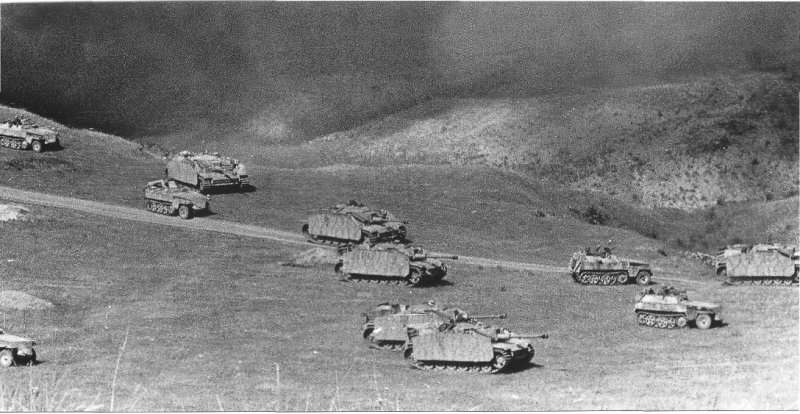
Mass Speed and Firepower: The Germans Would Pioneer the New Style of Warfare

There were a number of major technological advances between the wars and during the war that helped change the nature of warfare.  One of the earliest was the mechanization of armies which began toward the end of the First World War and continued between the wars to varying degrees in each country.  All the major armies experimented with mechanized forces to one degree or another. In Britain these got the earliest start with some formations being 100% mechanized by the early 1930s.  France was more circumspect about mechanization only slowly converting forces as they were focused on a defensive strategy based on the Maginot Line.  Many in the German high command resisted Guderian and other innovators regarding the mechanization of the Wehrmacht as well as the development of the Panzerwaffe.

The Soviet Union Would Turn the Tables on the Germans using their own Tactics

The Soviet Union had a large number of mechanized and armored formations prior to the war though they were not proficient in their use and had not developed doctrine to match the forces that they controlled.  The Untied States also resisted efforts to mechanize its Army but seeing the results of the German Blitzkrieg quickly overcame years of resistance to become an Army that save for 2 Cavalry Divisions was 100% mechanized.  The development of Airborne formations added the possibility of vertical envelopment to ground operations. These developments impacted nearly every campaign in Europe and North Africa and to a much lesser degree the Pacific theater. German performance in the early Polish, French, North African and Balkan Campaigns as well as the initial foray into the Soviet Union were all successful due to the proficiency of their combined mechanized, Panzer and tactical air forces.  The Soviets would develop and become very effective at this type of warfare on a much large scale than the Germans could have imagined beginning with the Stalingrad counteroffensive and especially in the destruction  of the German Army Group Center in the summer of 1944.

Though Using Lighter Armored Forces the Americans Would become Proficient in the New Type of Warfare by the Summer of 1944

The Americans became proficient at mobile operations during the war, especially during the “dash across France” and the breakout in the Saar-Palatine campaign in 1945,  but many times uninventive commanders squandered the advantage and allowed themselves to be sucked into battles of attrition that their forces were not made for.

Communications

A key development that accompanied and accentuated the mechanization of ground forces were advances in tactical wireless communications which made it possible for commanders to keep up with fast moving formations and react in near real time to changing tactical situations.  The Germans were the first to become very proficient in this as they not only developed communications for ground forces but also for coordination between tactical air forces and ground forces.  This made the German Blitzkrieg the first example of modern air-ground combat cooperation.  The Americans, British and Soviets would follow suit but it was the German Wehrmacht and Luftwaffe that pioneered the communications revolution.  As the war went on communications capabilities increased and armies became more dependent on tactical and long range wireless communications.  The dependency of military forces on communications networks became a major factor in operational planning and the success of the Allies in breaking Japanese and German codes gave them an advantage in anticipating German or Japanese moves.

Armor, Firepower and Mobility: The Tank Comes into its Own

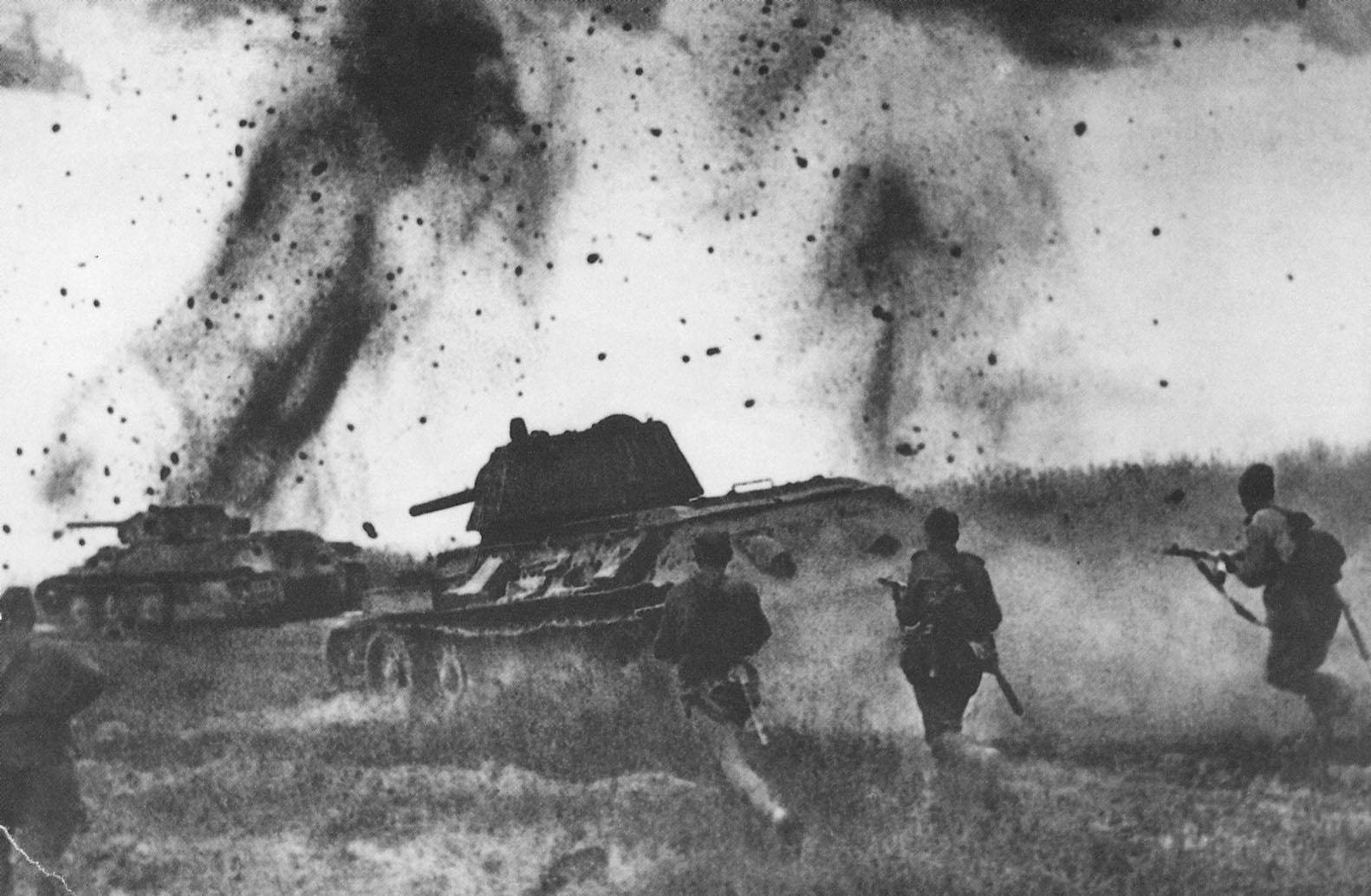
World War Two Saw Tanks become Deadly Instruments of Modern Warfare

Mechanization was a major factor in the war and the most decisive component of the mechanization of ground forces was the development of the tank as well as specialized formations which employed tanks in close cooperation with other arms, such as mechanized infantry and artillery.  The development of such forces really began with the British but the best example of this was the German Panzer Division.  The Panzer Division was a totally mechanized and integrated force of all arms which was employed in mass and capable like all German units to be task organized into Kampfgruppen to optimize tactical flexibility.  British Armored Divisions were tank heavy and infantry light which made them far less flexible organizations.  Soviet Armored forces were slow to develop but they became masters of large level operational maneuver using mechanized and tactical air forces to a deadly effect against the Wehrmacht.  The Americans delivered a light and flexible armored formation and became very proficient in combined arms warfare though the divisional structure often proved too light and not as resilient as German formations.  It was in this environment that the tank truly came into its own to dominate the battlefield in a way that many could not have imagined prior to the war. Firepower, protection and mobility advantages gained through technological advances increased the lethality and survivability of the tank and forced each side to develop better ways of neutralizing tanks through more powerful anti-tank guns, sabot rounds and shaped charges.

Tactical and Strategic Air developments

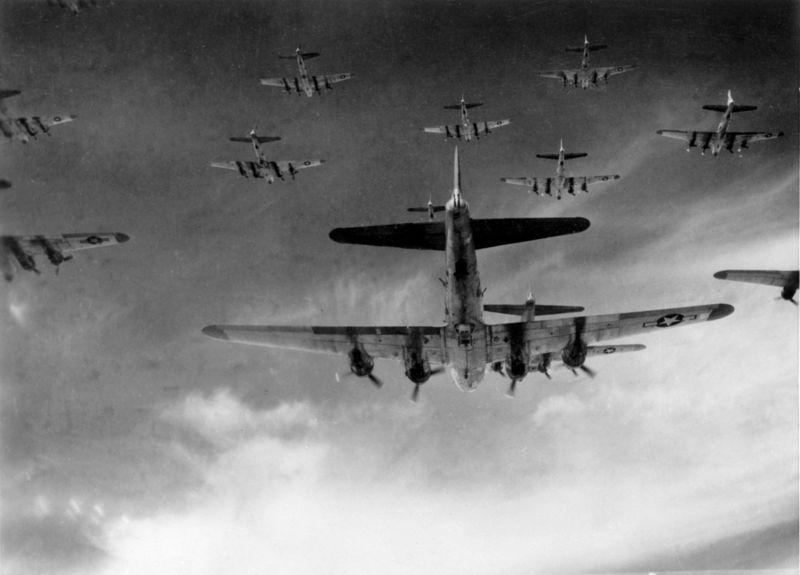
The Americans and the British Would Develop the Concept of Strategic Bombing against Germany

With the technical revolution came revolution in the skies both at the strategic and tactical levels.  Modern bombers with good navigational gear guided by radar and assisted by modern bombsites such as the Norden developed by the United States would wreak havoc on industrial and civilian centers. Advances in aircraft technology saw fast and more lethal aircraft being fielded by all powers as the war progressed and while Jet propulsion developed during the war would doom piston powered aircraft as first line assets.

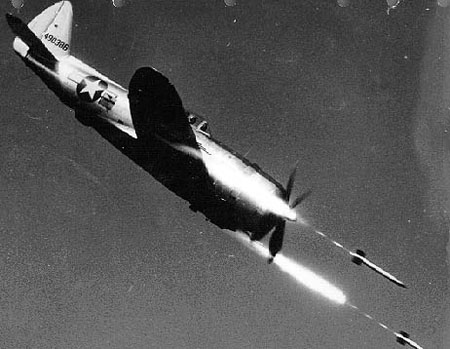
The P-47 Thunderbolt Would Serve as both a Long Range Bomber Escort and as Seen Here as an Excellent Ground Attack Aircraft

Tactical air developments would be led by the Germans but as the war went on the Allies developed sophisticate tactical air forces that dominated battlefields when the weather permitted. The Germans pioneered the use of ballistic missiles as well as the cruise missile while the United States and Britain developed the Atomic Bomb.  Specialized types of tactics and organizations were developed for strategic, tactical and naval air forces. At the strategic level there were the dueling schools of precision versus area bombing while at the tactical level the developments were as much predicated on air-ground communications as they were the aircraft flown.  Specialized aircraft were developed or modified as tank-killers while fighter forces became more specialized to into interceptors, bomber escorts and night fighters.

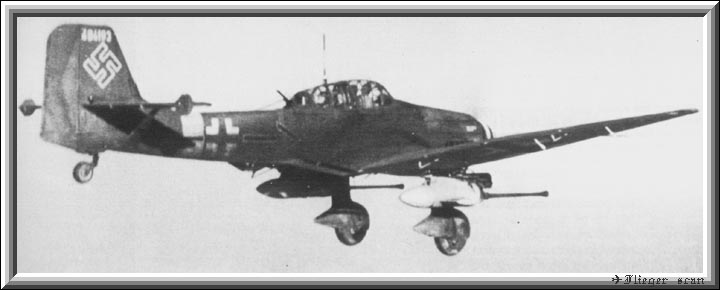
The Obselecent Junkers JU-87 found New Life on the Eastern Front as a Tank Killer armed with 2 37mm FLAK cannon

The influence of air assets, especially at the tactical level would become more pronounced as the war went on.  Allied air superiority ensured that the landings in France and the breakout in Normandy succeeded and tactical air dominance by US Navy and Marine air forces in the Pacific aided ground operations as well as sea battles.

Amphibious Warfare developments

The US Navy and Marine Corps Would Perfect Amphibious Operations in the Pacific

Technology came to the fore in amphibious operations with the development of specialized landing craft, beach clearing equipment and naval gunfire support.  This effort was led by the United States with the most advanced force being the Marines.   The combined use of air, land, sea and naval air forces to include the use of Aircraft Carriers revolutionized how the campaign in the Pacific would be fought to a conclusion long before anyone thought that it could be.

General Naval Developments

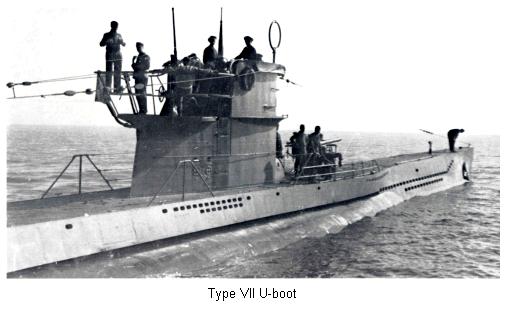
At sea ship design advanced new and better classes of warships as technologic advances in radar, sonar, gunnery systems, torpedo and ant-aircraft technology made warships far more formidable than those built only years before the war.  This was nowhere more apparent than in submarine development especially that of Germany’s U-boat arm with the development of streamlined hulls and “schnorkel” technology.  The use of U-Boats and later American submarines in the Pacific into “Wolf Packs” increased the lethality of submarine forces to a near decisive state in the war.  Naval tactics were influenced by the use of air and surface search radar as well as sonar.

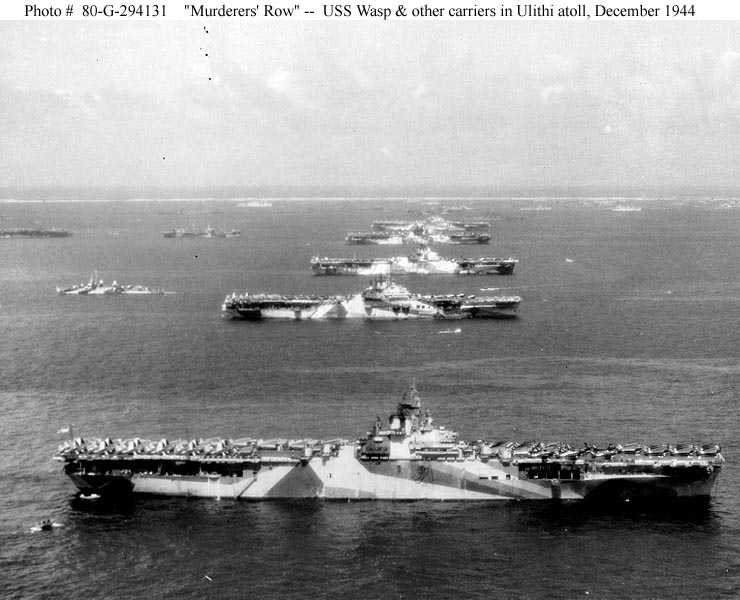
US Fast Carrier Task Forces Would Dominate the Pacific War and Naval Warfare to the Present Day

The development of the US Navy into the dominant Naval Power of the next 65 years was built upon the success of the Navy in the Second World War.  The largest and some of the bloodiest sea battles in history were fought in the Pacific with decisive results in that theater of operations.  Operationally the major Navies all were influenced to one degree or another by the theories of Alfred Thayer Mahan.

Summary and Conclusion

The course of World War Two was determined by the strategic and operational theories developed in the inter-war years. These were applied correctly by some powers and not by others.   The use technological advances and more effective organizational structure developed in the inter-war years and refined by the experience of war impacted the war on land, at sea and in the air in every theater of war.  The use of combined arms and joint operations revolutionized the manner in which wars would be fought.  If the technology, theory and force structure had not come together when it did the war might have been fought much as the First World War.  Instead warfare became faster and more lethal than ever and would lead to even more advances in the years to come.

3 Comments

Filed under History, Military, world war two in europe, world war two in the pacific

Going to War: Baghdad, Briefings, Coordination and Connections

This is the 10th installment of my “Going to War” series which Chronicles my deployment with RP2 Nelson Lebron to Iraq in 2007-2008.  This installment deals with our time at Camp Victory in Baghdad as were prepared to go west. For other segments go to the “Tour in Iraq” link on the sidebar.

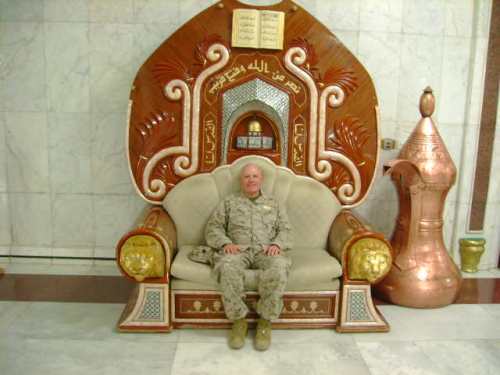
051Sitting on Saddam’s Throne

Following our arrival at Camp Victory Nelson and I continued to get our bearings. We went to the Iraq assistance Group where we checked in and began to meet the people who were going to be assisting us as we got ready to do our mission where we met with the Chaplain, Major Peter Dissmore, the Chief of staff, Colonel David Abramowitz and the Commanding General.  We received briefing and coordinating assistance from a number of the G-Shops in the IAG, the Chaplain and the Multi-National Corps Iraq Chaplain Office.

The visits with all were cordial and my long Army career as a Medical Service Corps Officer and Chaplain allowed me to have a edge in working with the Army because I knew the system, the language and the culture.  Now the IAG was run by the Army but was a joint command with Navy, Air Force and Marine staff in addition to the Army.  The IAG at least then was the coordinating office for the teams of Advisors and trainers working with the Iraqi Army, Border Forces and National Police.  Another command worked with the Provincial Police and other security forces throughout the country.

While we had an idea where we would be working before we deployed that we would work with the Marine and Army advisors in Multi-National Force West, we received the word that we would be going there.  MNF-West operates in Al Anbar Province which at that time was still a very dangerous place, although there were signs that things might be beginning to turn around.  It was funny as during our pre-deployment preparation and training took place almost everyone who heard that Nelson and I were going to Anbar expressed concern as the battle there had been very difficult since the U.S. led invasion.

The actual briefings and preparations did not take long, but the important part was building relationships that would assist us in our mission as it developed.  The two key people at IAG for our mission were Chaplain Dissmore and Colonel Abramowitz.  Chaplain Dissmore a chaplain of the Assemblies of God denomination, graduate of Princeton and ethics instructor at the Army Engineer school had been deployed like us as an individual augment as had Colonel Abramowitz.  We got along with both very well as we got details of the mission.  Colonel Abramowitz took a liking to us, especially Nelson, a fellow New Yorker.  Abramowitz is an Army Aviator and the son of an Army Infantry Colonel.  He is a big man, about 6′ 6′ or maybe taller and reminds me of a Jewish version of Patton.  When he found out that Nelson was a fighter and had multiple championship belts he had to “Google” him.  Nelson told him to “Google Nelson Lebron, kick boxer.”  When Colonel Abramowitz did he was amazed that Nelson was the real deal.  He became one of our strongest advocates in Baghdad.  We talked baseball of course the good Colonel being a Yankees fan. Another group of men who were invaluable to us were two former Iraqi Army and Air Force Generals who had fled the country during the reign of Saddaam after the the Gulf war.  Both helped us considerably as we gt to know more about the make up of the new Iraqi Army which after a couple of years had been purged of many of the opportunists and political hacks who had come in after it was re-established.  Many of the officers replacing the problem children were career military men, secular in outlook who had served since the Iran-Iraq war of the 1980s are well as in the First Gulf War.  These men wanted the chance to get the Iraqi Army back in shape as a fighting force, but faced opposition from certain political and religious groups in the country not to mention the insurgents who desired to undermine the effectiveness of this force from the beginning.

Almost immediately after meeting with the IAG staff we were on the phone with Navy Captain Mike Langston the Chaplain for MNF-W and II Marine Expeditionary Force Forward and his deputy Commander J. Hedges.  They were excited to have us coming to their area.  When Chaplain Dissmore informed them that they had the choice of a Navy team or an Army team they of course picked us.  This was also the intent of the IAG who realized that a Navy team would understand the more Marine oriented advisors and chain of command out west.  When Chaplain Langston heard that the team was composed of Nelson and me he expressed great pleasure as Nelson had served with him in Afghanistan and I had served with him at Second Marine Division.  As a result we had a great amount of trust placed in us because of prior service together as we were both known quantities.  Relationships matter in the military and this time they were a great help to us.

Dundas and FallahMeeting with General Falah

One of the things pointed out to us was that we were the first Navy team assigned to doing this type of mission since Vietnam.  Most of the Army teams doing the mission were reservists and according to the information that we were given were struggling.  A team that had been dispatched out west prior to us had been sent back early because of their ineffectiveness.  I had already known that we were the first Navy team to do this mission since Vietnam and had taken the time to read the histories of the chaplains who served in this “niche” role in that war.  Likewise being a history major and working on a second Masters in Military History I had been doing a lot of study on counter-insurgency and revolutionary warfare.  Not long prior to our deployment the Army and Marine Corps had issued a new manual on the subject.  When I read it I was surprised to find that I had already read many of the primary sources used in its compilation.  These are things that while not directly related o being a chaplain are things that help give a chaplain “street cred” and an ability to adapt to the culture and understand the language of the men that he serves with.  I did not stop being a Priest in this, but I knew where we fit and understood what the advisers on the MiTT  Military Transition teams, mission was and challenges that they faced.  This again put us ahead of the power curve going into the mission.  I do not think that any Religious Ministry or Army Unit Ministry Team has been as well prepared for this kind of mission than we were.

While at Camp Victory I met several old friends and acquaintances from Army and Navy service, as well as a Marine Corps Officer with who I had attended Command and Staff College.  One, LCDR Andy Wade who I had served with at 2nd MARDIV was completing a tour with the MNC-I Chaplain Office. Two of the Army Chaplains had been in my officer basic course and one, an Orthodox Priest was a friend from the Army Chaplain Officer basic course at Fort Monmouth NJ in 1990.  Peter Batkis was a newly commissioned 1LT when I went to the basic course and was the room mate of my good friend Fr Jim Bowman.  He was  now a Lieutenant Colonel and Chaplain for the 18th MP Brigade.  The other former classmate had been with an advisory team elsewhere in country and not had a good experience.  I was shocked to see how he had aged and how badly he wanted to get out of country.

While at Camp Victory we continued to get ourselves ready to go.  Our flight to Fallujah was arranged by the IAG staff and we began the process of waiting.  While waiting we were able to get some PT in and on the morning of the 8th of August (7 August in the States) while at breakfast I saw Barry Bonds hit home run #756 to break the record of Hank Aaron.  What I saw at Camp Victory amazed me.  The place was a veritable “little America” complete with the largest military exchange in country, about the size of a small Wal-Mart with a separate market for Iraqi vendors and, American fast food outlets housed in white trailers outside the exchange and a host of other exchange services found anywhere in the world, except to much of Al Anbar where we were heading.  It was kind of surreal, all of this Americana plunked down in there heart of Iraq, surrounded by blast walls and guarded with multiple check points. Parking lots were filled with a  mixture of tactical and non-tactical vehicles and every military person was armed. Helicopters overflew the area regularly, both transport aircraft and gunships, the gunships which flew what would have at one time been called a “Combat Air Patrol.” Additionally there was the ever present noise of small arms fire, distant explosions and sirens of various emergency and police vehicles.  The weather while 6-8 degrees cooler than Kuwait was still very hot and we were constantly picking up liter bottles of fresh water to stay hydrated.

Additionally we received the tour of the Al Faw Palace which was one of Saddaam Hussein’s major residences which had been taken over as the headquarters of Multi-National Force Iraq.  The palace was abuzz with the activity of the MNF-I staff.  In the lobby of the palace there is a throne given to Saddaam by Yasser Arafat in which almost everyone going through Camp Victory gets their photo taken in.

On our 4th day in country we got word that we would fly that night.  Nelson and I got ourselves packed, made final preparations and coordination with the IAG staff and waited.

Leave a comment

Filed under iraq,afghanistan, Military, Tour in Iraq