

Iron Brigade Forward! Battle of Gettysburg, PA – July 1, 1863 by Mark Maritato
“…by his promptitude and gallantry he had determined the decisive field of the war, and he opened brilliantly a battle which required three days of hard fighting to close with a victory.” Major General Harry Hunt, Chief of Artillery, Army of the Potomac on the actions of Major General John F Reynolds at Gettysburg
Major General John Reynolds was on his home soil. A native of Lancaster Pennsylvania Reynolds was the senior Corps commander in the Army of the Potomac. Considered by his peers and superiors to be the best commander in the Army he had been given command of a wing of the Army, his own I Corps, Oliver Howard’s XI Corps and John Sedgewick’s III Corps. He also had John Buford’s 1st Cavalry Division under his command.
Early in June Abraham Lincoln had offered command of the Army of the Potomac to Reynolds, however Reynolds’ set a condition which Lincoln in the political climate of the time could not grant, that he would be free from the political interference which had beset previous Army commanders. Both Reynolds’ request and Lincoln’s response are understandable. Lincoln respected Reynolds and when Major General Joseph Hooker was relieved of command of the Army by Lincoln Major General George Meade, commander of V Corps another Pennsylvanian took his place with Reynolds keeping his position.
As the Army of the Potomac reacted to the advance of Robert E Lee’s Confederate Army of Northern Virginia Hooker pursued and Meade continued the pursuit into Pennsylvania once he took command.
Reynolds’ wing of three Infantry corps and Buford’s Cavalry division acted as the advance elements of the Army. Late in the afternoon of June 30th Buford’s troops observed Johnston Pettigrew’s brigade of Harry Heth’s division near Gettysburg. Pettigrew on detecting Buford’s cavalry refused to engage and Buford made the choice to take the good high ground west of Gettysburg and hold it in order to give Reynolds followed by the rest of the Army time to arrive.
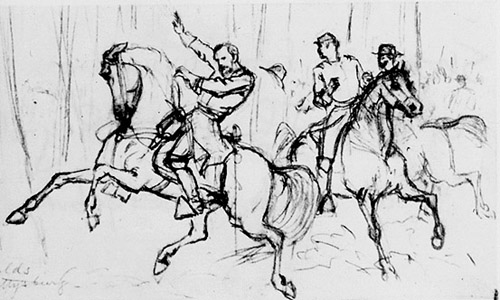
The Death of Reynolds (Waud)
Reynolds sent messages late in the evening to both Reynolds and the Union Calvary Corps commander, Major General Alfred Pleasanton describing the situation. Reynolds’ units were south of Emmitsburg moving north and on the morning of the 1st of July he brought his troops up as Buford and his cavalry troopers engaged Heth’s division in a delaying action in order to give Reynolds’ units time to get to the good high ground around Gettysburg.
Reynolds rode ahead and briefly met Buford at the Lutheran Seminary where Buford ensured Reynolds that his troopers could hold. With that Reynolds ordered his leading corps, the lead division under the command of Abner Doubleday to advance to the action at the double-quick. He then sent a message to Meade through a staff officer stating “Tell the General that we will hold the heights to the south of the town, and that I will barricade the streets of the town if necessary.”
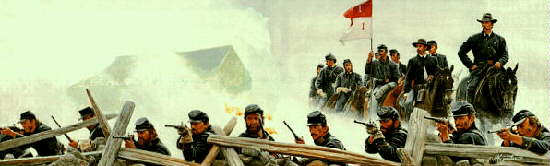
As his units arrived into an already raging battle Reynolds directed them to key areas of the battlefield. As he directed the “Iron Brigade” into position in Herr’s (McPherson’s) Woods Reynolds exhorted the men forward.“Forward! men, forward! for God’s sake, and drive those fellows out of the woods!” As he said these words he was struck by a bullet in the head and died instantly.
In the immediate confusion following Reynolds’ death the I and XI Corps confusion reigned. It seemed that the Union corps now fighting two Confederate Corps, Hill’s 3rd Corps which they had been fighting since the morning and Ewell’s 2nd Corps which arrived in a flanking position to their north during the afternoon might be routed. The Federal troops, I Corps now under the command of Doubleday and XI under Major General Oliver Howard withdrew through Gettysburg to Cemetery Hill where they were rallied by Reynolds’ old friend Major General Winfield Scott Hancock of II Corps.
Hill’s troops entered the town but did not attempt to take the hill while Ewell passed on an opportunity to take nearby Culp’s Hill which would have dislodged the Federal right flank.
The first day ended with the Army of the Potomac holding the high ground in an easily defensible position on interior lines. Lee’s Army was spread out and the defense mounted by Buford and Reynolds had disrupted Hill’s Corps, causing significant casualties.
Buford is to be given much of the credit for choosing the ground of the battle and fighting a stellar delaying action against superior forces. But had Reynolds not brought his units up in the expeditious manner in which he did and then all of Buford’s efforts might have been in vain. The two men, bound by their professionalism and commitment to duty and their oath helped save the Union on that first day of July 1863.
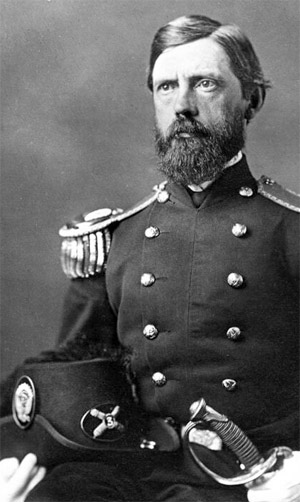
Charles Veil who served as a staff officer under Reynolds wrote the following epitaph stating that Reynolds “was a man who knew not fear or danger was, in a word (he was) one of our very best Generals. Wherever the fight raged the fiercest, there the General was sure to be found, his undaunted courage always inspired men with energy & courage.”
Peace
Padre Steve+


 The Inglorius Padre Steve's World