
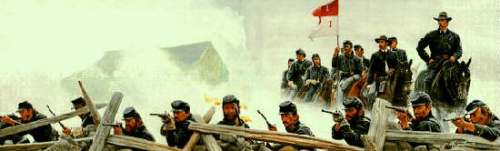
On June 30th 1863 Robert E. Lee’s Army of Northern Virginia was still spread out over wide parts of south central Pennsylvania and Maryland. He had issued orders to concentrate his forces near Cashtown but his orders to his subordinate commanders still lacked clarity. As such his corps commanders still acted in a nearly independent manner.
Lee was operating blind. Due to his own operational decisions he was without any significant cavalry forces to screen his army and conduct reconnaissance as it operated deep in enemy territory. He had only found out about the location and proximity to his forces of the Army of the Potomac from the report of Longstreet’s spy Harrison.
On June 30th Major General Harry Heth sent a brigade of his division to conduct a reconnaissance in the direction of Gettysburg. The brigade commander Brigadier General Johnston Pettigrew was instructed to avoid being drawn into battle. Pettigrew observed Federal cavalry of John Buford taking up positions west of the town and chose not to engage. He retired from the field and reported the presence of well drilled Federal cavalry to General Heth. As he was doing so A.P. Hill arrived and rejected Pettigrew’s report insisting that the Army of the Potomac was still over 20 miles away in Maryland. Neither Hill or Heth trusted Pettigrew’s report as Pettigrew’s was not a professional soldier.
The following morning Heth with Hill’s permission decided to send a force to Gettysburg to see what was there and to obtain a large number of shoes that he heard were in the town.
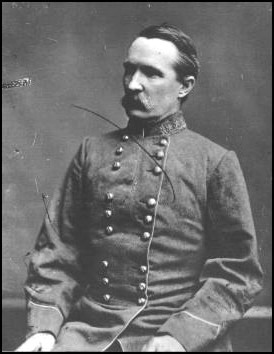 Major General Henry (Harry) Heth
Heth was an 1847 graduate of West Point. He graduated at the bottom of his class. Heth was commissioned as an Infantry Officer in the United States Army. Heth did not serve in Mexico but on the frontier. He had commanded a company in battle against the Lakota Sioux in 1855 and wrote the first marksmanship manual for use in the U.S. Army.
Heth was a Virginian and a close friend of A.P. Hill. He spent the early part of the war as Lee’s Quartermaster where he became one of Lee’s favorite officers. This was the beginning of a close relationship where Lee looked after Heth’s career. Heth served as regimental commander in the actions in the Kanawha Valley of Western Virginia being assigned to Kirby Smith’s Department of Tennessee. There he commanded a division but took part no any major actions.
Lee brought him back to the Army of Northern Virginia in 1863 to command a brigade in Hill’s Division. He took commanded that brigade at Chancellorsville in which he made an ill advised unsupported attack against Union forces in which his brigade sustained heavy casualties. Despite this, during the reorganization of the army Heth was promoted to command of the Division when Hill assumed command of Third Corps when it was created following the death of Stonewall Jackson.
Lee had given his commanders orders not to provoke a major engagement until the Army was fully concentrated. However neither Heth nor Hill believed that the troops that Pettigrew observed were a threat, believing them to be nothing more than local militia.
Hill was sick and decided to conduct a reconnaissance despite his lack of cavalry. Hill decided to conduct an infantry reconnaissance, However instead of sending a small force he dispatched two of his divisions, those of Heth and Dorsey Pender and remained in his quarters. Heth, the most inexperienced division commander took the lead and advanced his division in a column not deployed for battle or reconnaissance.
Lee’s intent seemed to be clear at this point clear. He desired to have a tired and weary Union force under a new commander under political pressure attack him on ground of his choosing. He hoped to defeat the Union forces piecemeal as they came into the battle. By initiating the action Hill and Heth set in motion events that would lead to the climactic battle of the Civil War. Hill’s decision to use such a large force and Heth’s inexperience in leading such a mission put Lee in a position where he began to make more mistakes.
The Federal Cavalry that Heth’s troops encountered was the First Cavalry Division under the Command of Brigadier General John Buford. Buford’s division arrived in Gettysburg ahead of the Army of the Potomac on the 30th. Buford and his brigade commanders immediately recognized the importance of the ground when they saw Pettigrew’s troops. Buford order his troops to deploy on the ridges west of Gettysburg, Herr Ridge, McPherson Ridge and Seminary Ridge. It was the perfect place for a delaying action against superior forces.
 Brigadier General John Buford
Buford was also a graduate of West Point and served as a Cavalry officer in the Army before the war. He was from Kentucky and his father was a Democrat who had opposed Abraham Lincoln. Much of his family chose to fight for the Confederacy but Buford remained loyal to his oath and remained in the Army.
Prior to the war Buford had served against the Sioux and on peacekeeping duty in the bitterly divided State if Kansas. Later he served in the Utah War in 1858. He was a modern soldier who recognized that the tactics of the Army had to change due to improvements in weapons and technology. He was promoted to Brigadier General in 1862 and served in numerous engagements as a Cavalry Brigade commander before being given command of the 1st Cavalry Division after Chancellorsville.
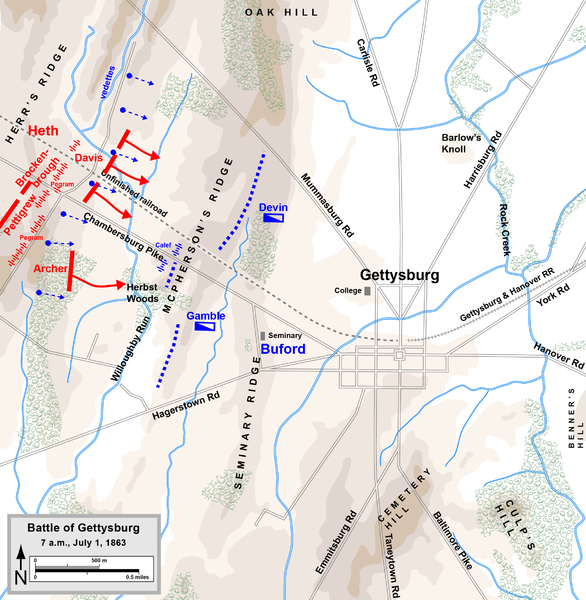
The Delaying Action, July 1st 1863 Map by Hal Jespersen, http://www.posix.com/CW
Buford was a keen student of war and a commander who was able to control his forces. When Heth’s division attacked he fought a masterful action. This allowed the Infantry Corps of the Army of the Potomac to arrive on the field of battle. Buford’s action to select the ground upon which the battle was fought was instrumental to the Union victory at Gettysburg. Even though Federal forces were pushed back on the first day they were able to maintain control of the high ground east of the city with interior lines of communication which they fortified.
After Heth engaged the Federal army Lee decided that he had to force the battle and continue the attack. Lee brushed aside the objections of General Longstreet and ignored the fact that he did not fully know the numbers and disposition of the troops arrayed against him.
Lee’s decision to engage the enemy was disastrous. Lee decided to attack after the ill conceived decision of Hill and Heth to get involved in a big fight and the correspondingly excellent command decisions of Buford to choose good ground and then to fight a skilled engagement.
While Lee and Hill’s decisions shaped the battle the tactical decisions of Heth and Buford in their conduct of the battle and their advice to their superiors had a dramatic effect on how the Battle of Gettysburg unfolded. Heth’s lack of experience in the east against the Army of the Potomac and limited battle experience as a senior commander certainly was a factor. Likewise, Buford’s experience played a major role. Buford had spent the war in action against Lee’s Army. He knew the capabilities of his enemies and knew what had to be done to give his side a chance to win.

Like many battles success is often due to such factors. Had Heth been more experienced and been more prudent in conducting his mission Lee might not have made his fateful decision to commit his army at a Gettysburg. Had Buford not seen the importance of the ground that he selected and deployed himself accordingly the rest of the Army may not have gotten to Gettysburg before Lee had gained the critical ground east and south of the town.
On such decisions battles are decided and wars won. Heth was a good soldier, but his relative inexperience and inability to control his command was a decisive factor in the battle. On the other hand Buford’s experience and poise under pressure enabled the rest of the army to come up on that first day of battle. Had he not done so it is possible that despite the bad decisions made by Lee, Hill and Heth that the Army of northern Virginia might have seized the critical ground east of Gettysburg before the bulk of the Federal Army arrived.
Had that happened it would have been interesting to see how the rest of the campaign unfolded. But such is speculation and that is a subject for novelists, writers of historical fiction or alternate history. Instead we are left with the real decisions of people that to this day influence us. Experience versus inexperience, accident versus design and the decisions of men long dead are things that we must ponder as we look at this battle and seek to learn lessons that will benefit us today.
Peace
Padre Steve+

 The Inglorius Padre Steve's World