Yearly Archives: 2016

The Creepiest: Bates Motel


Friends of Padre Steve’s World,

Just a short post today. Monday night Judy and I watched the season finale of Bates Motel on A&E. Now for people that follow the show and missed the latest episodes I promise not to give away any spoilers, at the same time I cannot stay silent about what a well written and acted show this is. In fact, I think the writers and actors are absolutely brilliant. 

For those that have never seen the show you need to take yourself back to Alfred Hitchcock’s classic film Psycho. If you have never seen Psycho I pity you, it was one of the most brilliant films of all time, but I digress…

Bates Motel is an incredible prequel to Psycho which starred the late Anthony Perkins as Norman Bates. In the past four season we have gotten to see the relationship that Norman who is played by the fantastic young English actor Freddie Highmore, and his mother, Norma Bates, played by Vera Farmiga. The combination of superb actors who are believable in the roles that they play and the excellent writing that keeps views on edge week after week. Watching the young Norman devolve from an innocent yet disturbed teen to a psychopath over the last four season was amazing. To watch his mother ignore and deny Norman’s descent into the abyss of acute and murderous psychosis is equally amazing. 

Let me be truthful, I did not see the first season until I got the series on Blu-Ray. It was my wife Judy who started watching the show when I was stationed at Camp LeJeune. When I came home for my birthday in 2013 I found our bathroom decorated in Psycho-Bates Motel motif. When she showed me I about died laughing. 


That being said, and without giving any spoilers away, Bates Motel is a masterful prequel to the original Hitchcock masterpiece. Unfortunately those of us that follow the show will have to wait between six to eight months for season five. But then sometimes good things have to wait. 

Oh well, what can I say? 

Peace

Padre Steve+ 

Leave a comment

Filed under televsion

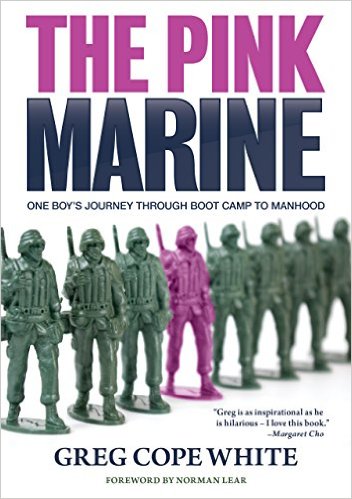
Overcoming: A Review of and Reflection on “The Pink Marine”

Pink Marine Cover

Friends of Padre Steve’s World,

I sometimes have the opportunity to review various books, but it has been a while since I have done one. That being said I read a lot and probably do more book reviews, however, much of my reading is comprised of histories that a lot of other people just are not that interested in, and since I am not doing these reviews for an historical or political science journal, I see no point in writing reviews of them here.

But once in a while I read a book that jumps out at me as something that I really feel the need to review. One of those is Greg Cope White’s The Pink Marine.

Greg served as a closeted Gay man for six years in the Marine Corps, leaving with the rank of Sergeant before the era of don’t ask don’t tell, but the book is not so much about that, although the threat of being found out and being court-martialed or discharged with a less than honorable discharge was always present.

But as I said, the book is about far more than that. This is not a story of a man talking about being persecuted, it is a book about overcoming obstacles and self-doubts to accomplish something worthwhile. For Greg this was becoming a United States Marine, something that he is still very much proud of being.

You do not have to be Gay to enjoy, appreciate, and be inspired by this book. It an outstanding read for anyone who wants to understand the importance of learning to overcome and succeed.

The book deals with life, and how Greg’s life, upbringing, a lifelong friendship, all came together during the crucible of Marine Boot Camp. This is a story of triumph in the face of self-doubt and adversity, a story of friendship, loyalty, and bonding that those who have not gone through Boot Camp, or other forms of rigorous initial entry training in the military, training which challenges you to reach beyond your limits and overcome all of the obstacles thrown in your path.

Greg’s story is a common story for many men and women, straight and gay alike who have volunteered to serve in the military, not knowing quite what to expect, and then be broken down, and built back up, not just as individuals but as a group. When Greg tells the stories of Boot Camp, the work of the Drill Instructors, and his story of conquering his own doubts and weaknesses I could relate.

While I am not Gay, I have served in the military some 35 years, 17 1/2 years in the Army, and about the same in the Navy, with about six of my Navy years serving with the Fleet Marine Force. I still remember the breaking process of my Army ROTC Advanced Camp at Fort Lewis Washington in the summer of 1982 when an Army Special Forces and Ranger, Vietnam combat veteran by the name of Sergeant First Class Harry Ball broke me down and built me back up. I have written about that before, and it has stayed with me. Greg’s very vivid description of his Marine Corps Drill Instructors, also Vietnam vets, made me feel like I was there again. Such training can be both traumatic and humorous and Greg tells it better than most.

Likewise, Greg’s retelling of his work to master the Marine Physical Fitness Test, (PFT) made me recall my transition from the Army to the Navy, serving with the Second Marine Division at Camp LeJeune North Carolina. Though I was about to turn forty, the Marines made me want to do more than settle for Navy standards or my former Army standards, I wanted to meet theirs. When I read his account of nearly maxing that test, it brought me back to when I passed the Marine PFT with a Class One score on my 40th birthday in March 2000, and completing a timed forced march in full combat gear at the end of a grueling field exercise. Though I am a Navy officer I proudly wear the Fleet Marine Force Qualification pin, it establishes a link with Marines that cannot be broken.

I heartily recommend Greg’s book to anyone, especially those that need some inspiration to begin to believe in themselves, and that they can accomplish things that they thought were unattainable. It is a story of what it takes to become a Marine, total commitment and the qualities of courage, honor, loyalty, and professionalism. That is what you get in this book.

Greg’s book should also be read by those who oppose Gays serving in the military. I would hope that reading it would help lessen their prejudice and enlighten them that Gays and Lesbians, like anyone else can serve our Nation honorably, with the highest distinction.

I found Greg’s story tremendously inspiring, even at the age of 56 and now passed over for Captain, happily getting ready for my final tour of duty before I retire.

The Pink Marine can be found in most bookstores as well as on Amazon.com which has it on their Kindle format. Greg is an author, television writer, and is the host of the Cooking Channel’s food and travel show Unique Sweets, writes for the Huffington Post, and has his own blog over called EAT.GREG.EAT at www.eatgregeat.com

Have a great day.

Peace,

Padre Steve+

4 Comments

Filed under History, leadership, LGBT issues, Military

Women in the Civil War: Spies, Nurses and Transgender Soldiers

women-civil-war-sarah-edmonds-frank-thompson-631

Friends of Padre Steve’s World,

This is the follow-up to yesterday’s article on the early women’s rights movement. It deals with how women served in the Civil War. While women were not allowed to be soldiers, many disguised themselves and lived as men in order to do so, in effect living as transgender men. Others served as spies or nurses. All were pioneers, and though women are now beginning to reach the highest ranks of the U.S. Military, and being allowed to serve in military specialties previously limited to men, there is still much political and cultural opposition to them doing so. 

As before this is a section from my Civil War and Gettysburg text. I do hope that you find it interesting. 

Peace

Padre Steve+

Of course when the Civil War broke out the logical end of this train of though was that should women be allowed to serve in the military. Legally and socially it was not possible for women to serve in the military in 1861, but this did not stop women in the Union or the Confederacy from doing so. Quite a few women on both sides of the conflict chaffed about not being allowed to fight for their countries, their families and their causes, and despite official prohibitions that kept women from serving in any capacity but nursing, a good number of women found their way to go to war. While men in the North and South “were expected to enlist, any woman actively participating in the Civil War was an oddity if not a renegade.” [1] In some cases this involved hundreds of women taking male identities in order to fulfill their desires to serve their countries.

The motives of these women varied. In some cases women wanted gain the economic privileges of full citizenship, and for others the glory reserved to only to men. In our modern parlance those that took male identities would be considered transvestites or possibly transgender, but for them “transvestitism was a private rebellion against public conventions. By taking a male social identity, they secured for themselves male power and independence, as well as full status as citizens of their nation. In essence the Civil War was an opportunity for hundreds of women to escape the confines of their sex.” [2]

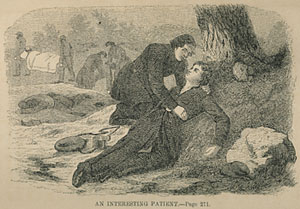
civilwar-07-patient1

During the war hundreds of women went to war, taking on the identity of men. They enlisted under male names and pretended to be men. Unless they were discovered to be women, or unless they confessed to their wartime service either during or after the war, most women managed to serve without being caught. Sadly, most of their service records were lost. In 1861 Private Franklin Thompson “enlisted in Company F of the 2nd Michigan Infantry…unknown to comrades, Thompson actually was Sarah Emma Edmonds.” [3] Edmonds served in the illustrious Iron Brigade until the disaster at Fredericksburg. Well known for her courage as Franklin Thompson, Edmonds participated in some of the bloodiest combats of the war. At Antietam she was caring for the wounded when she came upon a soldier who had been wounded in the neck. That soldier informed Edmonds that she was dying and after a surgeon came by and confirmed what the soldier said the dying soldier told Edmonds:

“I am not what I seem, but I am female. I enlisted from the purest motives, and I have remained undiscovered and unsuspected. I have neither father, mother nor sister. My only brother was killed today. I closed his eyes about an hour before I was wounded….I am Christian, and have maintained the Christian character ever since I entered the army. I have performed the duties of a soldier faithfully, and am willing to die for the cause of truth and freedom….I wish you to bury me with your own hands, that none may know after my death that I am other than my appearance indicates.” [4]

That unknown woman was not alone, at least nine women, eight Union and one Confederate, fought at Antietam and of those five were casualties. Five women, two Federal and three Confederate took part at Gettysburg. All three Confederate women at Gettysburg were either killed or wounded, or captured, including two women who took part in Pickett’s Charge. [5]

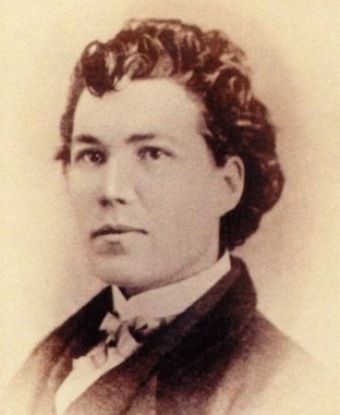
Edmonds_inline

Sarah Edmonds aka Franklin Thompson

Sarah Edmonds published a book Nurse and Spy in the Union Army while recovering from malaria in 1863. The book, which was published the following year, sold 175,000 copies, the proceeds that she donated to care for sick and wounded Union veterans. After the war, Edmonds attended Oberlin College, married, had three of her own children and adopted two more. She “became a member of the Grand Army of the Potomac, the organization for Union veterans of the Civil War. She applied for, and received, a military pension, and upon her death in 1898 was buried with full military honors.” [6] She was the only women admitted to the Grand Army of the Republic.

Clayton-Francis-L

Frances Clayton

Another of the women to serve was Frances Louisa Clayton. Fighting for the Union as a member of the Minnesota State Militia Cavalry and 2nd Minnesota Battery, serving under the command of Ulysses S. Grant she was wounded at Fort Donelson. Like many other women soldiers, Clayton mastered the art of behaving as a man. She “became “a capital swordsman,” but also commanded attention with her “masculine stride in walking” and “her erect and soldierly carriage.” [7] After the war she promoted her service in a book.

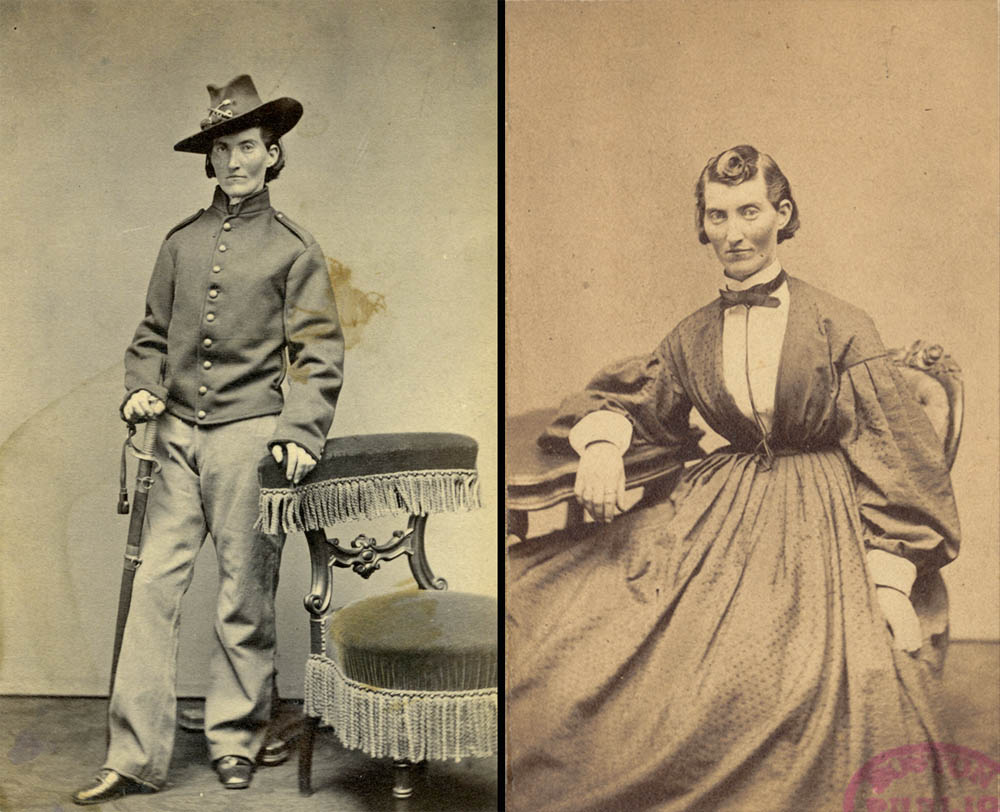
Albert-Cashier

However, most women were more discreet during and after the war regarding their true sexuality. Private Albert Cashier hid his sexuality identity for his entire term of service. He enlisted in August 1862 as a member of the 95th Illinois. Cashier was born in Ireland as a woman, Jennie Hodgers. He fought in forty battles and was discharged with the regiment in August 1865. At Vicksburg he was briefly captured by the Confederates while conducting a reconnaissance “but managed to escape by seizing a gun from one of her guards, knocking him down, and outrunning others. Comrades recalled Private Cashier climbing to the top of their fieldworks to taut the enemy into showing themselves.” [8]

After the war “Albert” returned home and lived as a “farmer and handyman and served as a caretaker in his church. He never married.” In 1890 he applied for and received a military pension and in 1911 the now elderly “man” was struck by a car and suffered a broken leg. The doctor threating him discovered that Albert was not a man, but a woman. But the doctor kept his confidentiality and without revealing “Albert’s” secret had the Union veteran admitted to the local Soldier’s and Sailors’ Home at Quincy, Illinois.” [9] A few years later the elderly “man” began to exhibit erratic behavior and was “committed to a public mental hospital and the word was out.” [10] With her story now sensational front page news and “old comrades in arms came to her defense.” [11] Her comrades had never known that “Albert” was a man during or after the war, while the news was a surprise to them they came to her defense. To combat some of the sensationalism in the media Albert’s fellow soldiers testified “to Albert’s bravery in combat and public good works in later life. Albert/Jennie died at Watertown State Hospital in 1915 at age seventy-one. The local post of the Grand Army of the Republic arranged for her burial. Her headstone reads: “Albert D.J. Cashier, Company G, 95th Illinois Infantry.” [12]

Wartime records are sketchy but as a minimum it is believed that “between 250 and 400 women disguised as men found their way into either the Federal or Confederate armies.” [13] Women known to have served had a “combined casualty rate of 44 percent” including the fact that “eleven percent of women soldiers died in the military.” [14] Some of those women are now well known but many others are lost to history. Most women tried to keep their sexual identities secret, even to the point of their death on the battlefield. Most of the women who served in the armies returned home to resume relatively normal lives after the war.

Other women would serve as spies for both sides, often rendering valuable assistance to their countries. The women who served as spies often took their lives into their hands; however, they often provided vital information to the Union or Confederate officers that they served. Pauline Cushman “parlayed her acting talents into a series of elaborate ruses that allowed her to pry information out of admiring and complaisant Confederate officers; Belle Boyd used an equal measure of talent in as a northern Virginia coquette to elide the same kind of information out of Federal officers.[15]

Even those women who were successful often suffered for their service during and after the war as they learned “that few people completely trusted or respected a spy, not even a “friend.” [16] Many, especially Southern women who spied for the Union were ostracized and persecuted in their communities after the war, and found little support from Northern politicians. Rebecca Wright, a young Quaker schoolteacher in Winchester, Virginia provided information that “enabled him to defeat General Early’s forces” in the Valley of 1864. She lost her job, and her former friends and neighbors boycotted her family’s businesses. Rejected for a pension, Sheridan helped Wright obtain “an appointment in a government office, remaining there for the rest of her days.” [17] Elizabeth Van Lew was a lifelong resident of Richmond and daughter of a wealthy businessman. She helped Union prisoners escape from Richmond’s notorious Libby prison and when Grant besieged Petersburg, Miss Van Lew “supplied him with a steady stream of information” [18]

01302012_harriet-tubman2-library-of-congress-600

Harriet Tubman

“African American women were generally dismissed as militarily harmless, a miscalculation that Harriet Tubman…used to immense advantage. Tubman, who had escaped from slavery in Maryland twenty years before the war and who had amassed considerable experience venturing into the south to guide runaways to the North undertook spying expeditions for the Federal troops on the South Carolina Sea Islands.” [19] The incredibly brave woman served throughout the war accompanying Union forces and securing vital information even as she worked to set other slaves free. Tubman’s “spying activities included convincing slaves to trust the Union invaders,” [20] many of whom would join the ranks of the newly raised regiments of U.S. Colored Troops.

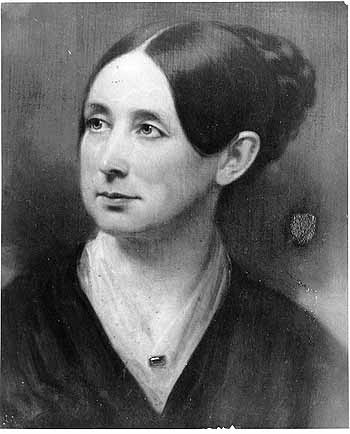
dix

Dorothea Dix

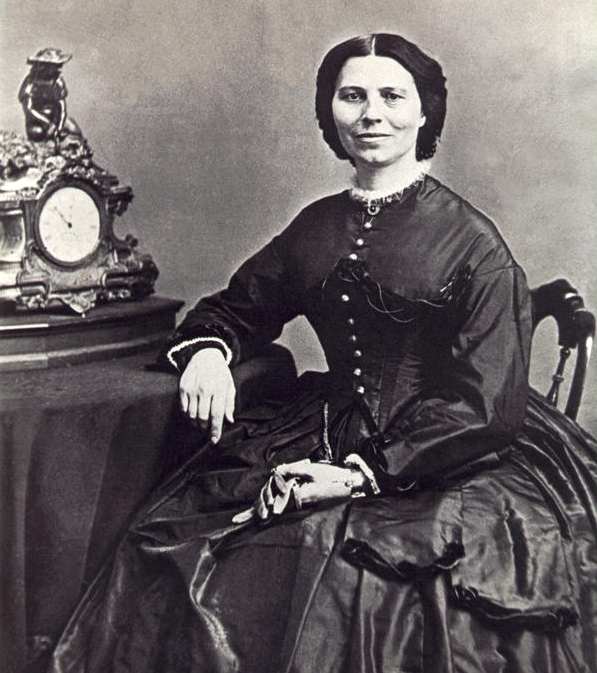
Other women served in various roles caring for the wounded. In the North, “Dorothea Dix organized the Union’s army nurses for four years without pay; Mary Livermore headed the Union’s Sanitary Commission, inspecting army camps and hospitals….Scores of others like Clara Barton, volunteered to be nurses.” [21] All of these women did remarkable service, mostly as volunteers, and many witnessed the carnage of battle close up as the cared for the wounded and the dying which often created ethic concerns for the women nurses:

“Clara Barton described her crisis of conscience when a young man on the verge of death mistook her for his sister May. Unable to bring herself actually to address him as “brother,” she nonetheless kissed his forehead so that, as she explained, “the act had done the falsehood the lips refused to speak.” [22]

Clarabartonwcbbrady

Clara Barton

Of the women that served in the ranks, some were discovered, and many remained protected by their fellow soldiers. Quite a few received promotions and even served as NCOs or junior officers. With women now serving in combat or combat support roles in the U.S. Military since Operation Desert Storm in 1991, the stigma and scandal that these cross-dressing women soldiers of the Civil War has faded and as scholars and the public both “continue probing cultural notions of gender and identity, the reemerging evidence that women historically and successfully engaged in combat has met with less intellectual resistance and has taken on new cultural significance.” [23] As the United States military services examine the issues surrounding further moves to integrate the combat arms we also should attempt to more closely examine the service of the brave and often forgotten women who served on both sides of the Civil War.

Notes

[1] Silvey, Anita I’ll Pass for Your Comrade Clarion Books, New York 2008 p.9

[2] Ibid. Blanton and Cook They Fought Like Demons p.5

[3] Ibid. Lowry The Stories the Soldiers Wouldn’t Tell p.119

[4] Ibid. Silvey I’ll Pass for Your Comrade p.68

[5] Ibid. Blanton and Cook They Fought Like Demons pp. 15-16

[6] Ibid. Silvey I’ll Pass for Your Comrade p.90

[7] Ibid. Blanton and Cook They Fought Like Demons p.58

[8] Ibid. Blanton and Cook They Fought Like Demons pp. 16-17

[9] Ibid. Lowry The Stories the Soldiers Wouldn’t Tell p.121

[10] Ibid. Lowry The Stories the Soldiers Wouldn’t Tell p.121

[11] Ibid. Silvey I’ll Pass for Your Comrade p.90

[12] Ibid. Lowry The Stories the Soldiers Wouldn’t Tell p.121

[13] Ibid. Guelzo Fateful Lightening p.394

[14] Ibid. Blanton and Cook They Fought Like Demons pp.206-207

[15] ibid. Guelzo Fateful Lightening p.395

[16] Ibid. Massey Women in the Civil War p.87

[17] Ibid. Massey Women in the Civil War pp. 103-104

[18] Ibid. Massey Women in the Civil War p.102

[19] Ibid. Guelzo Fateful Lightening p.394

[20] Sizer, Lyde Cullen Acting Her Part: Narratives of Union Women Spies in Divided Houses: Gender and the Civil War Oxford University Press, New York and Oxford 1992 p.130

[21] Ibid. Silvey I’ll Pass for Your Comrade p.10

[22] Faust, Drew Gilpin, This Republic of Suffering: Death and the American Civil War Vintage Books, a division of Random House, New York 2008 p.12

[23] Ibid. Blanton and Cook They Fought Like Demons p.204

Leave a comment

Filed under civil rights, civil war, History, Military, Political Commentary

Equality: The Early Women’s Rights Movement

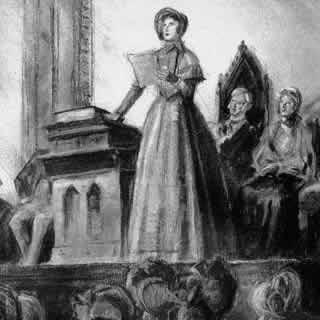
senecafalls-womanspeaking

The Seneca Convention

Friends of Padre Steve’s World,

The issue of Women’s Rights is still in the forefront of political debate in the United States. Women’s rights have been slow to progress despite the passage of the 19th Amendment which gave women the right to vote in 1920. The defeat of the Equal Rights Amendment in 1982 gave added ammunition to conservative opponents of Women’s rights to fight them.

Though women have long been in the workplace in many cases there is a large gap in pay for men and women doing the same jobs and having the same qualifications, likewise, the number of women in senior positions in the private sector and in government is still dwarfed by the numbers of men. The are numerous disparities in how men and women are treated in society, and in many cases and in many parts of conservative society, especially churches, women are still considered less than equal to men. In light of the fact that we will likely have a woman running as the Democratic Party nominee for President the issue is even more pronounced, and Hilary Clinton, whether one likes her or not, and regardless of her policies, or previous record as a Senator or Secretary of State, is held to a higher standard of scrutiny than men in those position.

But this is nothing new, and in light of this I have decided to re-post a sightly edited portion of the chapter in my Civil War and Gettysburg text that deals with the early Women’s Rights movement. I hope that you find it insightful.

Peace

Padre Steve+

Another development, which in large part is related to the abolition movement, was the campaign for women’s rights. The Civil War was also revolutionary because it was instrumental in propelling women into positions in American society that they had never before been allowed. The war Some of this was because many women decided to like those who campaigned for the end of slavery and the rights of African Americans to turn the world upside down. The war allowed the women who served, “in uniform or not, war permitted these women to experiment with a series of role reversals in gender,” [1] and in some cases gender and race. These experiments are the beginning of women’s’ equality and to women serving in the military.

In much of the country and in particular the South, women’s rights were the same as granted in English Common Law. Common law held to the more archaic understanding of the Christian Church that women were the property of their husbands, especially in cases of infidelity including during the trial of Dan Sickles for killing Barton Key.

Southern culture and law ensured that women had even few rights than the women in the North who were making some gains in the workplace and in various professions such as teaching and nursing. This was in large part due to the understanding that the “household was a spatial unit, defined by the property to which the owner not only held legal title over, but over which he exercised exclusive rights.” [2] As such Southern men had nearly unlimited rights and power over what occurred on his property, for “in societies in which landed property comprised the chief means of subsistence…legal title to the land had historically incorporated claims over the persons and labor of those who were dependents on it.” [3]

Thus for Southern men the stakes of ensuring slavery’s continuation and expansion were high, the culture of the South ante-bellum South was deeply patriarchal and “The possibility that the black man might be empowered like any other was such a threat to the southern social hierarchy that some white southerners were inclined to fear not only for their position as slaveowners but for the entire basis of their claim to patriarchal power. They feared for their power not only over their slaves but over their women as well.[4]

William Lloyd Garrison and the leaders of the abolitionist movement came into contact with two southern women who had converted to the abolitionist cause; South Carolina cotton heiresses, Sarah and Angelina Grimke. The two women were passionate as well as eloquent and became popular lecturers on the abolitionist speaking circuit. Angelina Grimke was a powerful speaker and linked abolition and women’s rights:

“We cannot push Abolitionism forward with all our might until we take up the stumbling block out of the road…. If we surrender the right to speak in public this year, we must surrender the right to petition next year, and the right to write the year after, and so on. What then can the woman do for the slave, when she herself is under the feet of man and shamed into silence?” [5]

The Grimke sisters and other women like them brought Garrison and others in the abolitionist movement into contact with the early leaders of the new women’s rights movement. The leaders of the movement, Elizabeth Cady Stanton, Abby Kelley, and Lydia Maria Child were outspoken in their belief that “a campaign to emancipate slaves could not avert its eyes from the need to emancipate American women from social conventions and legal restraints that prevented them, like the slave, from owning property and voting, and kept them altogether subservient to the interests of white males.” [6]

The principals involved in the abolitionist and the women’s movements, those of freedom, emancipation and equality eventually forged a bond between them, and have provided inspiration to others in their quest for political and social equality. For William Lloyd Garrison “the woman question clearly demonstrated how the logic of reform united all good causes and carried them to new ground. If in their endeavors to break the chains of slavery women discovered, as Abby Kelley put it, that “we were manacled ourselves,” the abolitionist principle required a defense of equal rights without regard to race or sex.” [7]

However, women found that their rights were not considered as important by the political leadership fighting for the rights of black men. Few in Congress “responded sympathetically to feminists’ demands. Reconstruction they insisted, was the “Negro’s hour.” [8] Though the economic situation of women began to improve, especially through women being admitted to the Civil Service. Likewise women began to have more educational opportunities in the post-war years. Women’s suffrage was not included in the Fifteenth Amendment, which caused a split between women’s groups and their long-time abolitionist allies who told them “If put on the same level and urged in the same connection, neither will soon be accomplished.” [9]  Even so in some territories women were granted the right to vote in territorial elections, “women were given the vote in Wyoming Territory in 1869. However, Wyoming’s admission as a state twenty years later came only after a heated debate on the women’s suffrage article in the state constitution.” [10]

Elizabeth Cady Stanton

In the 1800s women in the United States were bound by English common law. Women had no claim to property, wages, or even their children. Single women had few rights while married women had even fewer as:

“marriage very nearly meant the legal annihilation of a woman…once a woman was married all property and property rights were transferred to her husband, and she was permitted to own nothing in her own name. Married women could not make contracts, could not sue, could not buy or sell, except over their husband’s signatures.” [11]

A married woman’s position was as close to being a slave as could be, and only the plight of black female slaves was worse, for they were simply chattel. The few free black women mainly stayed unmarried “in order to maintain what few property rights they were entitled to.” [12] As they also did over blacks, white men ruled over women in all spheres of life. While the eventual emancipation of blacks provided more rights for black men, those did not help many black women as Sojourner Truth, a pioneering African-American abolitionist who spent forty-years as a slave said toward the end of her long life:

“There is a great stir about colored men getting their rights, but not one word about colored women; and if colored men get their rights, and not colored women theirs, you see colored men will be master over the women, and it will be just as bad as it was before. So I am for keeping the thing going while things are still stirring because if we wait till it is still, it will take a great while to get it going again….I suppose I am the only colored woman that goes on to speak for the rights of the colored women. I want to keep the thing stirring, now that the ice is cracked…” [13]

Elizabeth Cady Stanton was among the most vocal of women’s rights advocates. She believed that a woman’s place in the home was ultimately destructive and “reflected her subordinate position in society and confined her to domestic duties that served to “destroy her confidence in her own powers, lessen her self respect, and to make her willing to lead a dependent and abject life.” [14] Stanton noted how the condition of women of her day was “more fully identified with the slave than man possibly can be… For while the man is born to do whatever he can, for the woman and the negro the is no such privilege.” [15] It was a key observation and something even today, a state that some politicians, pundits and preachers would like to return women.

Since nearly all of the most “outspoken feminists had been schooled in abolitionist movement” they were “suspect in the South, where society was conservative, patriarchal, and insistence that ladies live in a kind of earthly limbo.” [16] Such women posed a threat to the pillars of Southern society. Since the South was now fighting tooth and nail against the abolitionist movement, anything closely connected with that movement, including the women who advocated abolition and women’s rights were shunned and their message rejected and inflammatory and revolutionary. It was not until the crisis caused by the Civil war that Southern women began to seize “the opportunity to lay claim to an increased reciprocity in gender relations.” [17]

But even with the abolition movement there was opposition the women’s rights, the 1839 meeting of the American Anti-Slavery Society witnessed a debate over including women in the membership. Conservative Evangelicals recoiled in disgust, and when the convention voted to allow women into the membership Lewis Tappan “got up a starchy “protest” which condemned the “repugnant” admission of women as an ‘expression of local and sectarian feelings…well suited to the unnecessary reproach and embarrassment to the cause of the enslaved as [it] is at variance with the general usage and sentiments of this and other nations.” [18] In May of 1840 the American Anti-Slavery Society split among religious lines when leading evangelicals led by the Tappan brothers withdrew from it.

But that neither stopped Garrison from working with women, nor kept Frederick Douglass from embracing them as part of the abolitionist movement. From this rather inauspicious beginning, the women’s rights movement began to infiltrate society, especially in the field of education. In 1848 at Seneca New York there was a convention that launched the modern women’s rights movement. Led by Stanton and Elizabeth Mott the delegates published a “Declaration of Sentiments, modeled on the Declaration of Independence, proclaimed “that all men and women are created equal” and deserved their “inalienable rights” include the right to elective franchise.” [19] The declaration was bold and its denunciation of the place of women in society to be considered revolutionary in character. Part read:

“He has never permitted her to exercise her inalienable right to elective franchise. He has compelled her to submit to laws, in the formation of which she had no voice. He has withheld from her rights which are given to the most ignorant and degraded men – both natives and foreigners… He has made her, if married, in the eye of the law, civilly dead. He has taken from her all right to property, even to the wages that she earns…. After depriving her of all her rights as a married woman, if single, and the owner of property, he has taxed her to support a government which recognizes her only when her property can be made profitable to it. He has monopolized nearly all the profitable employments, and from those she is permitted to follow she receives but a scanty remuneration. He closes against her all the avenues to wealth and distinction which he considers honorable to himself. As a teacher of theology, medicine of the law, she is not known… He has created a false public sentiment by giving the world a different code of morals for men and women, by which moral delinquencies which exclude women from society, are not only tolerated, but deemed of little account in man. He has usurped the prerogative of Jehovah alone, claiming his right to assign for her a sphere of action, when that belongs to her conscience and to her God. He has endeavored, in every way that he could, to destroy her confidence in her own powers, lessen her self-respect, and to make her willing to lead an abject and dependent life.” [20]

The declaration also stated, in words which inflamed many men that: “the history of mankind is a history of repeated injuries and usurpations on the part of man toward woman, having in direct object of an absolute tyranny over her.” [21] In the years following this meeting women took up an even more important place in the abolitionist movement, Abby Kelly Foster returned to head the work and recruited many talented women agents including Sallie Holley, Lucy Stone and Susan B. Anthony who “often made five or six appearances a week” in various abolitionist meetings and in 1850-1851 they were joined by the “black evangelist Sojourner Truth, whom Garrison had met and the Northampton colony in 1843 and for whom he had printed an autobiographical narrative.” [22] These women contributed greatly to the abolitionist cause and would in the years to come be among those who continued to fight not only for the rights of blacks, but the rights of women.

The new women’s rights groups continued to work hand in hand with the abolitionist groups but also began a campaign for the rights of women. In the mid-1850s primarily focused on “obtaining state laws guaranteeing women’s right to control their property and wages, to be legal guardians of their children, and to be paid salaries commensurate with their labors, while a few women advocated for more liberal divorce laws so that they could rid themselves of alcoholic, insane, criminal, or brutal husbands.” [23] These efforts secured some modest gains and by 1861 most states had granted women some type of property rights or had changed their laws to follow the community property principle.

While the movement made modest progress regarding property rights for women in some states, they made little progress in terms of elective franchise and better wages and working conditions. During the ante-bellum period, women who lobbied for such rights were met with open opposition and scorn. The press “frequently denounced and ridiculed the “strong-minded women…” [24] Despite such attitudes women did make some significant advancements, particularly in lay aspects of the church, such as Bible societies, moral reform organizations, as well as the abolition and temperance movements, which had gained prominence during the Second Great Awakening.

During the ante-bellum period women made great progress in education. By 1850 the United States was the only country where “girls went to elementary school and achieved literacy in virtually the same proportion as boys.” [25] Likewise a few women entered higher education, particularly at women’s seminaries, which were for all practical purposes boarding schools that produced teachers and writers, as well as the Oberlin College, which was founded by Christian abolitionists and welcomed students of both genders as well as of any racial minority. During the three decades prior to the war women made some specific gains, but more important “was the development to their talents for organization, cooperation, leadership, and self expression. It was a time of beginnings and not fulfillment, a time when most women realized and accepted the fact that they lived in a man’s world, a time when a few dedicated but belligerent visionaries were frustrated in their attempt to remake the social order “overnight.” [26]

However, the war would help bring about many more opportunities for women. In 1850 a follow on conference to the Seneca conference, the National Women’s Rights Convention denied the right of anyone to dictate what women could do with their lives:

“The right of any portion of the species to decide for another portion, of any individual to decide for another Individual what is not their “proper sphere”; that the proper sphere for all human beings is the largest and highest to which they are able to attain; what this is, can not be ascertained without complete Liberty of choice; women therefore, ought to choose for herself what sphere she will fill, what education she will seek, and what employment she will follow, and will not be bound to accept, in submission, the rights, the education, and the place which man thinks proper to allow her.” [27]

Notes

[1] Ibid. Guelzo Fateful Lightening p.395

[2] McCurry, Stephanie The Politics of Yeoman Households in South Carolina in Divided Houses: Gender and the Civil War Oxford University Press, Oxford and New York 1992 p.23

[3] Ibid. McCurry The Politics of Yeoman Households in South Carolina p.23

[4] Whites, Leeann The Civil War as a Crisis in Gender in Major Problems in the Civil War and Reconstruction, 3rd Edition Edited by Michael Perlman and Murrell Taylor Wadsworth Centage Learning, Boston 2011 p.16

[5] Ibid. Zinn The Other Civil War p.121

[6] Ibid. Guelzo Fateful Lightening pp.49-50

[7] Mayer, Henry All on Fire: William Lloyd Garrison and the Abolition of Slavery W.W. Norton and Company, New York and London 1998 p.265

[8] Ibid. Foner Forever Free p.124

[9] Ibid. Foner Forever Free p.125

[10] Massey, Mary Elizabeth, Women in the Civil War University of Nebraska Press, Lincoln NE 1966 p. 358

[11] Ibid. Guelzo Fateful Lightening p.391

[12] Ibid. Guelzo Fateful Lightening p.391

[13] Ibid. Zinn The Other Civil War pp.53-54

[14] Ibid. Goldfield America Aflame p.74

[15] Ibid. Guelzo Fateful Lightening p.50

[16] Ibid. Massey Women in the Civil War p. 19

[17] Ibid. Whites The Civil War as a Crisis in Gender p.21

[18] Ibid. Mayer All on Fire p.267

[19] Ibid. McPherson Battle Cry of Freedom p.36

[20] Blanton, DeAnne and Cook, Lauren M. They Fought Like Demons: Women Soldiers in the Civil War Vintage a books, a Division of Random House New York 2002 pp.3-4

[21] Ibid. Guelzo Fateful Lightening p.392

[22] Ibid. Mayer All on Fire p.424

[23] Ibid. Massey Women in the Civil War p.21

[24] Ibid. Massey Women in the Civil War pp.21-22

[25] Ibid. McPherson The Battle Cry of Freedom p.36

[26] Ibid. Massey Women in the Civil War p.23

[27] Ibid. Guelzo Fateful Lightening p.392.

1 Comment

Filed under civil rights, History, laws and legislation, leadership, News and current events, Political Commentary

Freedom’s Pilot: Robert Smalls Fight for Freedom


Friends of Padre Steve’s World,

There are some people and events that are important but get swept up in broader historic events. One such story is that of Robert Smalls, a slave in Charleston South Carolina. Smalls was hired out to work with the money going to his master. He worked in a number of jobs, but as a teenager fell in love with the sea. He went to work as a slave worker on the city’s waterfront where he started as a common dockworker, became a rigger, a sailmaker, and finally a wheelman, which basically was a ship’s pilot, since slaves were not permitted that title. Even so his abilities and knowledge of Charleston harbor well well known and respected by ship owners. 


When South Carolina seceded and the Confederacy went to war, Smalls was assigned as wheelman of the CSS Planter, a small and lightly armed transport. On the night of May 12th and 13th of 1862, Smalls took advantage of all three white officer’s absence ashore, by putting into effect an escape plan he had worked out with the other slave crew members of Planter. Smalls and seven other slaves got the ship underway, with Smalls donning the captain’s uniform and a straw hat similar to the captain’s. In the darkness the ruse was perfect, no Confederades ashore suspected anything as Planter stopped to pick up the escaped slaves family members at another wharf before Smalls sailed out past the range of the Confederate shore battery guns to surrender to the USS Onward. Smalls present the U.S. Navy with the ship, her cargo, which included four artillery pieces intended for a Confederate fort in the harbor, but more importantly a Confederate code book and charts showing the location of deadly undersea mines and torpedoes that had been laid in the harbor. 

Smalls quickly became a hero. Congress voted him and his crew the prize money for the ship, and he met with Secretary of War Stanton to argue the case that blacks should be allowed to serve. Smalls’ story helped convince Lincoln of allowing African Americans to serve in the United Staes forces. Smalls served as a civilian pilot working for the Navy and and the Army, serving in numerous battles. He was the pilot for the experimental ironclad USS Keokuk when that ship was heavily damaged by over 90 hits at Charleston. He was responsible for getting the ship safely out of range of the  Confederate batteries before she sank, thus saving many crew members. 

He then was reassigned to the USS Planter, now assigned to the Army. The ship got caught in a crossfire between the Union and Confederate forces and Planter’s captain ordered the ship to surrender. Smalls objected, knowing that any African American caught serving Union forces would not be treated as prisoners of war, but either returned to slavery or executed by order of the Confederate Congress. Smalls took command of the vessel and steered her out of harm’s way. He was appointed Captain of the ship and was present for the ceremonial raising of the American flag over Fort Sumter in April 1865. Smalls was the first African American to command a ship in the service of the U.S. Military.

After the war Smalls got an education and when the 14th Amendment was passed ran for office, serving in the South Carolina legislature and as a member of Congress. He fought against changes to the 1895 South Carolina Constituion that disenfhchised African Americans and codified the Jim Crow laws which had be upheld by the Supreme Court in Plessy v. Ferguson. 

In 1889 Smalls was appointed U.S. Collector of Customs in Beaufort and served in that office until 1911. He also was director of a black owner railroad, and helped publish the black owners Beaufort Standard newspaper. He died in 1915 at the age of 75. 

Small’s courage and his fight for freedom, as well as others who did so should not be forgotten. 

Peace,

Padre Steve+ 

Leave a comment

Filed under civil rights, civil war, History, leadership, Military

War What is it Good For? Sometimes Something: The Context of War

cropped-the_storming_of_ft_wagner-lithograph_by_kurz_and_allison_1890a.jpg

Friends of Padre Steve’s World,

Today something different. Yesterday I did a post about the Gettysburg Address and the importance of the proposition that of democracy that all men are created equal. It is a radical proposition that since the writing of the Declaration of Independence, the Emancipation Proclamation, the Gettysburg Address, the Thirteenth, Fourteenth, Fifteenth and Nineteenth Amendments, the Voting Rights Act of 1964 and Civil Rights Act of 1965, as well as Supreme Court decisions in Brown v. Board of Education and Obergfell v. Hodges, has grown in or country to encompass civil rights for African Americans and other racial minorities, Women, and Gays. But those liberties had to be fought for, and would most likely never happened had not Abraham Lincoln and others in the North understood that neither liberty or Union could survive if the South succeeded. In fact, all of us owe our continued freedom to that understanding and the necessity of total war to achieve it.

However, yesterday I had a Twitter troll snipe at me, this time a left-wing troll who claimed to be a “liberal progressive.” However, his remarks were so ignorant of history and reality that I am sure the the had no clue how his words betrayed his alleged beliefs. So in a few words I told him that he was basically ignorant and blocked him. Most of the time when this happens to me it comes from supposed “conservatives,” or “white nationalists” of various flavors, to include the KKK and Neo-Nazi types. But the fact that this came from a self-proclaimed “liberal and progressive” proves that ignorance is not confined to any ideology. That is a sad commentary on our time.

So what I am posting today is an updated and slightly edited portion of the first chapter of my Civil War and Gettysburg text. The entire chapter is close to 150 pages and is probably going to become a book in its own right, but I think it is important for my readers to understand, that sometimes liberty only comes with great sacrifice and the complete defeat of those who want to deny it. That does not matter if it was the Confederacy, Nazi Germany, or even the so-called Islamic State.

As a man who came back changed by war I can only say that I hate it. That being said, though I am a progressive and liberal, I am a realist and understand that as evil as war is, that surrendering liberty to those who believe in “liberty for the few, and slavery for all others.” 

The section of the book may seem a bit wonkish, but it is important. I understand that some of my readers will disagree, but one cannot escape reality.

So anyway, that being said I wish you a good day.

Peace,

Padre Steve+

Richard Evans wrote something in the preface to his book The Third Reich in History and Memory that those who study military history often forget. He noted: “Military history, as this volume shows, can be illuminating in itself, but also needs to be situated in a larger economic and cultural context. Wherever we look, at decision making at the top, or at the inventiveness and enterprise of second rank figures, wider contextual factors remained vital.” [1] Thus while this work is an examination of the Gettysburg campaign it is important to understand the various issues that were formative for the men who directed and fought the battle. One cannot understand the determination the determination of Robert E. Lee to maintain the offensive, the dogged persistence of Joshua Chamberlain or Strong Vincent to hold Little Round Top, what brought John Buford to McPherson’s Ridge, what motivated Daniel Sickles to move Third Corps to the Peach Orchard, and what motivated the men of Pickett’s division to advance to their death on Cemetery Ridge, without understanding the broader perspective of culture, politics, economics, religion, sociology, and ideology that shaped these men.

The American Civil War was the first modern war. It was a watershed event in an era, which introduced changes in new types of weapons, more lethal versions of older weapons, tactics, army organization, logistics, intelligence and communications. Though the war did not change the essential nature of war, which Clausewitz says is “is an act of violence to compel our opponent to fulfill our will” [2] it expanded the parameters of war and re-introduced the concept of “total war” to the world and “because its aim was all embracing, the war was to be absolute in character.” [3] In a sense it was a true revolution in military affairs.

The Civil War was truly a revolution in military affairs. The war changed the character of war, as it had been known for centuries, since the Peace of Westphalia and the end of the Thirty Years War. In the American Civil War, the character of war changed from a limited war waged between opposing armies into a war that at times bordered on Clausewitz’s understanding of absolute or total war. This conflict was waged between two people who shared much in common but were divided by an ideology which encompassed politics, economics, society, law, and even religion.

The war was revolutionary in other ways, and brought about a host of social, philosophical, economic, and political changes which continue to impact the lives of people in the United States and around the world even today. Some of these, especially those regarding the abolition of slavery and emancipation, as well as the beginnings of the Women’s Rights movement have had a ripple effect in matters of political and social equality for other previously disenfranchised groups of citizens. One writer noted in regard to the social impacts that “The Civil War uprooted institutions, transformed our politics, influenced social relationships of half a continent, and wrought changes that echo down the generations.” [4] Mark Twain wrote in 1873 that the war “uprooted institutions that were centuries old, changed the politics of a people …and wrought so profoundly upon the national character that cannot be measured short of two or three generations.” [5]

In a sense, when Abraham Lincoln proclaimed “a new birth of freedom” in his Gettysburg address it served as a watershed moment in American history because it brought to the forefront the understanding of Jefferson and the other signers of the Declaration of Independence that all men are created equal. That statement, flowing from the Declaration was key to Lincoln’s understanding of human rights and dignity, and from it came the Emancipation Proclamation and the Thirteenth Amendment, which abolished slavery. Those would be followed by the Republican Congresses’ passage of the Fourteenth Amendment, which overturned the Dred Scott Decision, which denied all citizenship to blacks across the country, and by Ulysses S. Grant’s Fifteenth Amendment, which gave African American men to right to vote. That is the human and political context by which we have to understand the American Civil War.

Thus it is important to study the Gettysburg campaign in the context of the Civil War because the campaign of 1863 in the east cannot be divorced from what was happening in the west at Vicksburg, nor the Union blockade, nor the diplomatic, economic and informational aspects of the war. Likewise the Gettysburg campaign cannot be separated from its relationship to the broader understanding of the nature and character of war. To do this one must examine the connection between them and policies made by political leaders; to include the relationship of political to military leaders, diplomats, the leaders of business and industry and not to be forgotten, the press and the people. Likewise we must understand the various contexts of war, to include the social, political, ideological and even the religious components of war, how they impacted Civil War leaders and why civilian policy makers and military leaders must understand them today.

While the essential nature of war remains constant, wars and the manner in which they are fought have changed in their character throughout history, and this distinction matters not only for military professionals, but also policy makers. The changing character of war was something that military leaders as well as policy makers struggled with during the American Civil War much as today’s military leaders and policy makers seek to understand the character of warfare today. British military theorist Colin Gray writes “Since the character of every war is unique in the details of its contexts (political, social-cultural, economic, technological, military strategic, geographical, and historical), the policymaker most probably will struggle of the warfare that is unleashed.” [6] That was not just an issue for Abraham Lincoln and Jefferson Davis, both of whom struggled with the nature of the war which had been unleashed, but it is one for our present political leaders, who as civilian politicians are “likely to be challenged by a deficient grasp of both the nature of war as well as its contemporary context-specific character.” [7]

In addition to being the first modern war, or maybe I should say, the first war of the Industrial Age, the Civil War prefigured the idea of total war written about by Clausewitz that occurred in the World Wars of the Twentieth Century. The war combined a massive number of technological advances, which both preceded and occurred during it, in which the philosophical nature of the Industrial Revolution came to the fore.

Likewise, the enmity of the two sides for one another had been fostered by a half century of relentless and violent propaganda that ushered from the mouths of politicians, the press and even from the pulpit brought the element of hatred to the fore of the conflict. A Confederate Captain wrote his wife to teach his children “a bitter and unrelenting hatred of the Yankee race” that had “invaded our country and devastated it…[and] murdered our best citizens…. If any luckless Yank should unfortunately come my way he need not petition for mercy. If he does I will give him lead.” A soldier from a Wisconsin regiment wrote to his fiancée after the assault on Resaca, Georgia that his unit had captured twenty-three Confederates and “or boys asked if they remembered Fort Pillow and killed them all. Where there is no officer with us, we take no prisoners…. We want revenge for our brother soldiers and will have it…. Some of the [rebels] say they will fight as long as there is one of them left. We tell them that is what we want. We want to kill them all off and cleanse the country.” [8]

As such there were many times the American Civil War came close to Clausewitz’s understanding of absolute war in its in character, and it prefigured the great ideological wars of the twentieth century. J.F.C. Fuller noted “for the first time in modern history the aim of war became not only the destruction of the enemy’s armed forces, but also of their foundations- his entire political, social and economic order.” [9] It was the first war where at least some of the commanders, especially Ulysses S. Grant and William Tecumseh Sherman were men of the Industrial Age, in their thought and in the way that they waged war, in strategy, tactics even more importantly, psychologically. Fuller wrote:

“Spiritually and morally they belonged to the age of the Industrial Revolution. Their guiding principle was that of the machine which was fashioning them, namely, efficiency. And as efficiency is governed by a single end- that every means is justified- no moral or spiritual conceptions of traditional behavior must stand in its way.” [10]

Both men realized in early 1864 that “the South was indeed a nation in arms and that the common European practice of having standing armies engaged each other in set-piece battles to determine the outcome of a war was not enough to win this struggle.” [11] Though neither man was a student of Clausewitz, their method of waging war was in agreement with the Prussian who wrote that “the fighting forces must be destroyed; that is, they must be put in such a position that they can no longer carry on the fight” but also that “the animosity and the reciprocal effects of hostile elements, cannot be considered to have ended so long as the enemy’s will has not been broken.” [12]

William Tecumseh Sherman told the mayor of Atlanta after ordering the civilian population expelled that “we are not only fighting hostile armies, but a hostile people, and must make the old and young, the rich and poor, feel the hard hand of war.” [13] Sherman was one of the first American military leaders to understand that a civil war could not be waged according to the limited war doctrines most American officers had been taught. He not only “carried on war against the enemy’s resources more extensively and systematically than anyone else had done, but he developed also a deliberate strategy of terror directed against the enemy’s minds.” [14] While some might find this troubling, the fact remains that it was Sherman’s Southern sweep of all that lay before him that broke the back of the Confederacy.

vincent

Strong Vincent

But Sherman and Grant were not alone in understanding the problem of fighting a limited war against the Confederacy. In the fall of 1862 a twenty-five year volunteer Colonel serving with McClellan’s army in Virginia who would be instrumental in throwing back Hood’s assault on Little Round Top, and die leading the defense of that edifice, by the name of Strong Vincent, understood what had to happen if the Union were to overcome the rebellion of the Confederacy.

“We must fight them more vindictively, or we shall be foiled at every step.  We must desolate the country as we pass through it, and not leave a trace of a doubtful friend or foe behind us; make them believe that we are in earnest, terribly in earnest; that to break this band in twain is monstrous and impossible; that the life of every man, yea, of every weak woman or child in the entire South, is of no value whatever compared with the integrity of the Union.” [15]

To most modern Americans who have no experience of war other than seeing it as a video spectator, the words of Vincent and Sherman seem monstrous and even inhuman. However, those who persist in such thinking fail to understand the nature and context of war. While some wars may be fought in a limited manner, others, especially ones driven by militant and uncompromising ideologies, often backed by fanatical religious beliefs cannot be limited, and those that fight such wars must, to paraphrase the words of Strong Vincent, “must fight them more vindictively, or be foiled at every step.” It would have been interesting to see what Vincent might have achieved had he not been cut down by Confederate bullets on Little Round Top.

Abraham Lincoln came to embrace the eternal nature of war as well as the change in the character of the war over time. Lincoln had gone to war for the preservation of the Union, and initially pursued the war in a limited way, seeking to defeat Confederate armies in the field while sparing the people of the Confederacy from total destruction.

But in his quest to preserve the Union, something that for him was almost spiritual in nature, as is evidenced by the language he used in both of his inaugural addresses and the Gettysburg Address, he found that Confederacy would only return to the Union if conquered, and he became convinced that the South’s peculiar institution, that of slavery, must be destroyed in the process. Thus, instead of a war to simply re-unite the Union and let bygones be bygones, Lincoln changed the narrative of the war when he signed the Emancipation Proclamation. When this happened the war not only became a war to restore the Union, but the a war for the liberation of enslaved African Americans, After January 1st 1863 when the Emancipation Proclamation went into effect, Lincoln “told an official of the Interior Department, “the character of the war will be changed. It will be one of subjugation…The [old] South is to be destroyed and replaced by new propositions and ideas.” [16] That too was a modern understanding of war.

Of course, the revolution in military affairs that characterized the Civil War took time, but it was the political and military leaders of the North who better adapted themselves and their nation to the kind of war that was being fought. “Lincoln’s remarkable abilities gave him a wide edge over Davis as a war leader, while in Grant and Sherman the North acquired commanders with a concept of total war and the determination to make it succeed.” [17]

At the beginning of the war the leaders and populace of both sides still held a misguided and unrealistic romantic idea of war. Most people in the North and the South held on to the belief that the war would be over in a few months and that would be settled by a few decisive battles and that casualties would be comparatively light. This included most politicians as well as many military officers on both sides. There were some naysayers who believed that the war would be long and costly, like the venerable and rather corpulent General Winfield Scott, but politicians and the press mocked Scott and other doubters who even suggested that the war would be long, hard, and bloody. Of course those who predicted a short, easy, and relatively bloodless war were the ones proven wrong, though it would take the leaders and the people of both sides over a year to understand. When it was done the American Civil War became the bloodiest war ever waged by Americans, and it was against other Americans.

Notes

[1] Evans, Richard J. The Third Reich in History and Memory Oxford University Press, Oxford and New York 2015 p.ix

[2] Clausewitz, Carl von. On War Indexed edition, edited and translated by Michael Howard and Peter Paret, Princeton University Press, Princeton NJ 1976 p.75

[3] Fuller, J.F.C. The Conduct of War 1789-1961 Da Capo Press, New York 1992. Originally published by Rutgers University Press, New Brunswick N.J p.99

[4] Lowry, Thomas P. The Stories the Soldiers Wouldn’t Tell: Sex in the Civil War Stackpole Books, Mechanicsburg PA 1994 p.176

[5] McPherson, James The War that Forged a Nation: Why the Civil War Still Matters Oxford University Press, Oxford and New York 2015 p.48

[6] Gray, Colin S. Fighting Talk: Forty Maxims on War, Peace, and Strategy Potomac Book, Dulles VA 2009 p.36

[7] Ibid. Gray Fighting Talk p.36

[8] Ibid. McPherson The War that Forged a Nation pp.49-50

[9] Fuller, J.F.C. A Military History of the Modern World, Volume Three: From the Seven Days Battle, 1862, to the Battle of Leyte Gulf, 1944 Minerva Press 1956 p.88

[10] Ibid. Fuller A Military History of the Modern World, Volume Three p.88

[11] Flood, Charles Bracelen, Grant and Sherman: The Friendship that Won the War, Harper Perennial, New York 2005 p.238

[12] Ibid. Clausewitz p.90

[13] McPherson, James. The Battle Cry of Freedom: The Civil War Era Oxford University Press, Oxford and New York 1988 p.809

[14] Weigley, Russell F. The American Way of War: A History of United States Military History and Policy University of Indiana Press, Bloomington IN, 1973 p.149

[15] Nevins, James H. and Styple, William B. What Death More Glorious: A Biography of General Strong Vincent Belle Grove Publishing Company, Kearney NJ 1997 p.57

[16] Ibid. McPherson The Battle Cry of Freedom p.558

[17] Ibid. McPherson The Battle Cry of Freedom p.857

Leave a comment

Filed under civil rights, civil war, ethics, History, Military, Political Commentary

Gettysburg and the Importance of Democracy

gburg address

Friends of Padre Steve’s World,

If you followed my writings over the past week you knew that I was again in Gettysburg leading my students on our Gettysburg Staff Ride.

This event was interesting as I was accompanied by five South Korean officers, all of whom were outstanding students, interested in learning, who also were able to glean the material and make application to today, not only in a military setting, but socially and politically. It was a joy to spend time with them each night over dinner and continue to discuss elements of the Civil War and the Battle of Gettysburg and hear them discuss social, political, diplomatic, and military connections between then and now, as well as the tensions that exist in their own country.

I wish that more Americans were able to do that, instead all too often we, no matter what our political or ideological position, choose to believe myth presented as history and biography.

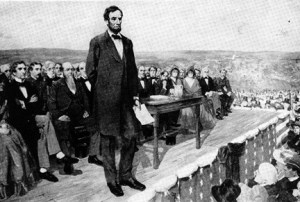
Today I am not going to explore the issue of myth being presented and believed as history, as I have written about it relatively recently. Instead I want to remind my readers of the continued importance of Lincoln’s Gettysburg Address.

As always I end the Staff Ride at the Soldier’s Cemetery on Cemetery Hill and close with a talk about the human cost of war, and the importance of the Gettysburg Address today. I actually think that this event, which commemorated the soldiers who fought an died for a proposition, magnifies the importance of that victory, even as it marked the beginning of a universalizing the concept of liberty, a concept at the time which was still pretty much limited to White men.

In a time where many are wearied by the foibles and follies of our politicians, even wondering about our form of government can survive Lincoln’s words matter. Dr. Allen Guelzo, Professor of Civil War Studies at Gettysburg College wrote in the New York Times:

“The genius of the address thus lay not in its language or in its brevity (virtues though these were), but in the new birth it gave to those who had become discouraged and wearied by democracy’s follies, and in the reminder that democracy’s survival rested ultimately in the hands of citizens who saw something in democracy worth dying for. We could use that reminder again today.” [1]

Dr. Guelzo is quite correct. With the rise of Donald Trump and the frustration of so many people, on both the political right and left, many people in this country and around the world are having grave doubts about our democracy. I wonder myself, but I am an optimist. I do believe that we will recover because for the life of me I see no nation anywhere else with our resiliency and ability to overcome the stupidity of politicians, pundits and preachers.

Lincoln was sick when he delivered the address having what was mostly likely a mild form of Smallpox when he gave the address. Thus the tenor, simplicity and philosophical depth of the address are even more remarkable. It is a speech given in the manner of Winston Churchill’s “Blood sweat toil and tears” address to Parliament upon being appoint Prime Minister in 1940. Likewise it echoes the Transcendentalist understanding of the Declaration of Independence as a “test for all other things.”

Many in the United States and Europe did not agree and argued that no nation found on such principles could long survive. The more reactionary European subscribers of Romanticism ridiculed the “idea that a nation could be founded on a proposition….and they were not reluctant to point to the Civil War as proof that attempting to build a government around something as bloodless and logical as a proposition was futile.” [2]

But Lincoln disagreed. He believed that the “sacrifices of Gettysburg, Shiloh, Murfreesboro, Chancellorsville, and a hundred other places demonstrated otherwise, that men would die rather than to lose hold of that proposition. Reflecting on that dedication, the living should themselves experience a new birth of freedom, a determination – and he drove his point home with a deliberate evocation of the great Whig orator Daniel Webster – “that government of the people, by the people, for the people, shall not perish from the earth.” [3]

The Unitarian pastor and leading Transcendentalist Theodore Parker wrote:

“Our national ideal out-travels our experience, and all experience. We began our national career by setting all history at defiance – for that said, “A republic on a large scale cannot exist.” Our progress since that has shown that we were right in refusing to be limited by the past. The practical ideas of the nation are transcendent, not empirical. Human history could not justify the Declaration of Independence and its large statements of the new idea: the nation went beyond human history and appealed to human nature.” [4]

Likewise Lincoln’s address echoes the thought of George Bancroft who wrote of the Declaration:

“The bill of rights which it promulgates is of rights that are older than human institutions, and spring from the eternal justice…. The heart of Jefferson in writing the Declaration, and of Congress in adopting it, beat for all humanity; the assertion of right was made for the entire world of mankind and all coming generations, without any exceptions whatsoever.” [5]

Parker’s words also prefigured an idea that Lincoln used in his address, that being: The American Revolution, with American history since, is an attempt to prove by experience this transcendental proposition, to organize the transcendental idea of politics. The ideal demands for its organization a democracy – a government of all, for all, and by all…” [6]

So I ask that you take the time to reflect on the words of this remarkable speech, and in spite of all the cynicism take the time to read it again and imagine why it is still so important.

Four score and seven years ago our fathers brought forth on this continent, a new nation, conceived in Liberty, and dedicated to the proposition that all men are created equal.

Now we are engaged in a great civil war, testing whether that nation, or any nation so conceived and so dedicated, can long endure. We are met on a great battle-field of that war. We have come to dedicate a portion of that field, as a final resting place for those who here gave their lives that that nation might live. It is altogether fitting and proper that we should do this.

But, in a larger sense, we cannot dedicate — we can not consecrate — we can not hallow — this ground. The brave men, living and dead, who struggled here, have consecrated it, far above our poor power to add or detract. The world will little note, nor long remember what we say here, but it can never forget what they did here. It is for us the living, rather, to be dedicated here to the unfinished work which they who fought here have thus far so nobly advanced. It is rather for us to be here dedicated to the great task remaining before us — that from these honored dead we take increased devotion to that cause for which they gave the last full measure of devotion — that we here highly resolve that these dead shall not have died in vain — that this nation, under God, shall have a new birth of freedom — and that government of the people, by the people, for the people, shall not perish from the earth.[7]

Peace,

Padre Steve+

Notes

[1] Guelzo, Allen C. Lincoln’s Sound Bite: Have Faith in Democracy New York Time Opinionator, November 17th 2013 retrieved from http://opinionator.blogs.nytimes.com/2013/11/17/lincolns-sound-bite-have-faith-in-democracy/?_php=true&_type=blogs&_r=0 July 18th 2014

[2] Ibid. Guelzo. Fateful Lightening p.409

[3] Ibid. Guelzo. Fateful Lightening p.408

[4] Ibid. Wills. Lincoln at Gettysburg p.110

[5] Ibid. Wills. Lincoln at Gettysburg p.105

[6] Ibid. Wills. Lincoln at Gettysburg p.105

[7] Lincoln, Abraham The Gettysburg Address the Bliss Copy retrieved from http://www.abrahamlincolnonline.org/lincoln/speeches/gettysburg.htm

Leave a comment

Filed under civil rights, civil war, History, Political Commentary

Coffee, Eminent Domain & Remembering Molly


Friends of Padre Steve’s World,

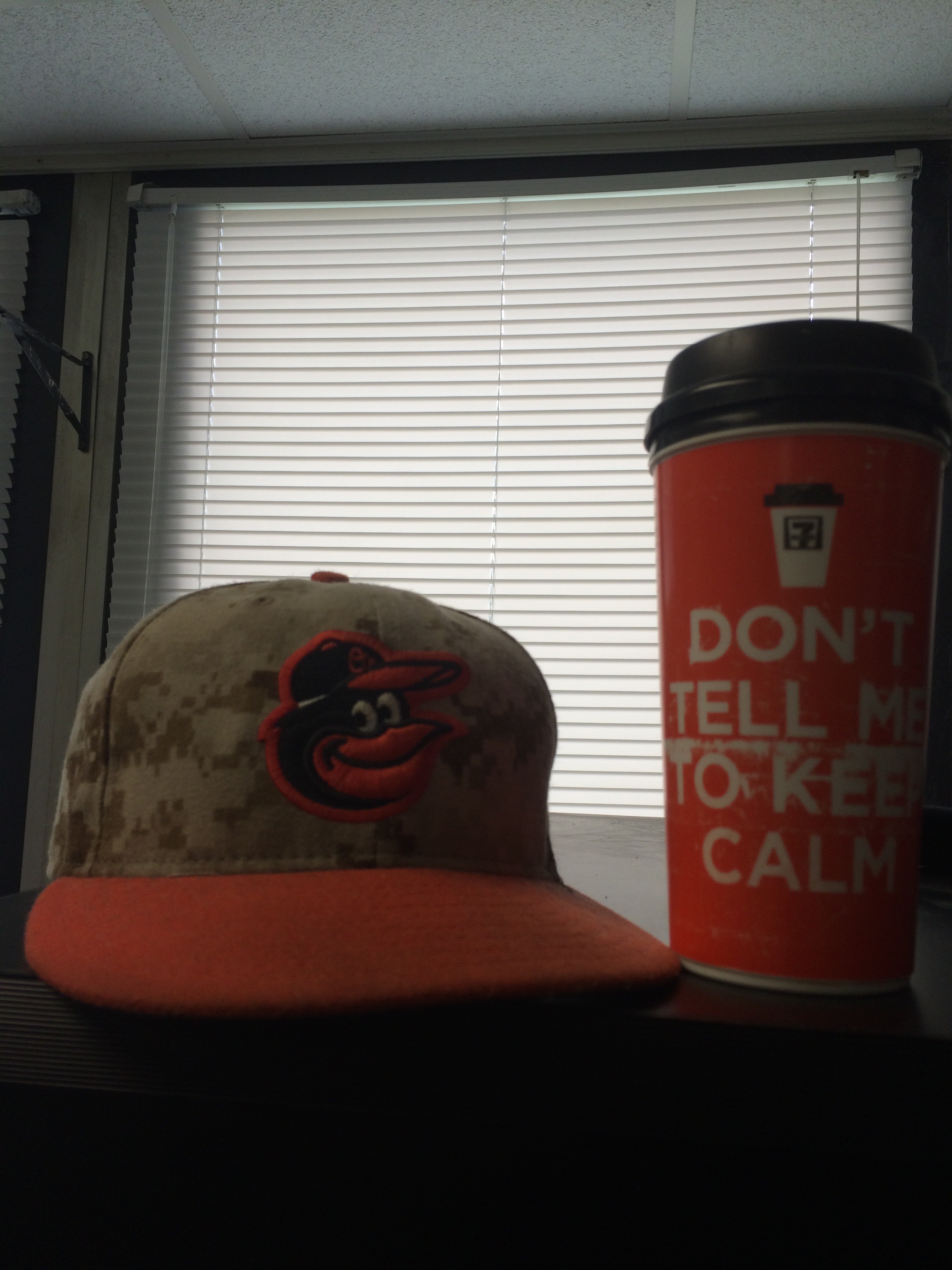
Today was kind of a sad day as I got my last cup of coffee at the 7-11 store that I visit most mornings on my way to work, and it is the anniversary of us losing our wonderful Papillon-Dachshund mix Molly a year ago. Molly was a great dog, a dog who helped me through the some of my worst times after Iraq, and whenever Judy was sick became “Nurse Molly.” We both miss that girl. Thankfully we have Minnie and Izzy, and Izzy especially is beginning to fill in the role of comforter that Molly filled so well.

I am kind of a “blue collar” guy when it comes to morning coffee, not a real big fan of the fancy coffee shops. I like the mixture of working class people who are the clientele more than I do fancy places. Likewise I just like a nice up of coffee with a little French Vanilla creamer and a packet of brown sugar, and a stick of string cheese as my breakfast, instead of some fancy beverage.

This store happens to be on my way to work, just before I get on the freeway. But, sadly, today was the last day for that. The store was a victim of a badly needed expansion of the road and freeway on and off ramps, but it is kind of sad as I have gotten to know the folks that work there as well as the regulars who like me make it their morning coffee stop, and as a creature of habit I hate change. The manager and his wife will go to another store, but not close to me. They are good people, and I will miss them.

mollybag

Molly

Since the construction may make a mess of that route, I may have to find an alternate anyway, but as for now I have to figure it out, but in the meantime I will take some time with Judy this afternoon, and remember Molly while enjoying Minnie and Izzy.

Have a great day,

Peace

Padre Steve+

1 Comment

Filed under Loose thoughts and musings

Cemetery & Culp’s Hill Pt 5

Friends of Padre Steve’s World

I am catching up from  from another trip with my students to Gettysburg, and happen to be posting my newest additions to my text, these dealing with the battles for Culp’s Hill and Cemetery Hill which occurred on the night of July 2nd and early morning of July 3rd 1863. I hope you enjoy.

Peace,

Padre Steve+

greene monument

When the divisions Alpheus Williams and John Geary marched away to meet the threat to Cemetery Ridge, only George Greene’s brigade remained to defend Culp’s Hill. In addition to his own position, Greene found his brigade “guarding nearly half a mile of Twelfth Corps works.” [1] Much like Joshua Chamberlain on the extreme left of the Union line, “Greene ended up with a much-thinned single-rank battle line without reserves.” [2] Greene only had between 1,300 and 1,400 men and one battery of artillery, but he made the most of them taking advantage of the natural terrain features as well as the entrenchments which his men and the other Twelfth Corps units had prepared. He “formed his brigade in a single line, with spaces between the men, regiments moving to the right as the line lengthened.” [3] In addition he sent out his smallest regiment, the 78th New York “The Cameron Highlanders” down the hillside to act as skirmishers where they joined with men of the 60th New York.

culp's hill

Allegheny Johnson and his division drew the toughest assignment on this warm summer evening. Since it arrived on the battlefield the previous night it was sheltered to the rear of Brenner’s Hill about a mile east of Gettysburg north of the Hannover Road, where with the exception of sending some skirmishers to Rock Creek, “Johnson kept his infantry concealed and quiet throughout the day.” [4] His four brigades, one of Louisianans under the Colonel Jesse Williams, and the brigades of Brigadier Generals John M. Jones, George “Maryland” Steuart, and James Walker, were primarily Virginians. His four brigades had sat inactive the entire day and impatiently awaited orders to attack, with one staff officer “prudently “conducting religious services…the men gladly joining the solemn exercises.” [5]

When Latimer’s battered artillery battalion withdrew from Brenner’s Hill, Ewell gave orders for the attack to begin. At about seven o’clock Johnson ordered his troops forward, but unlike Early’s troops who were well deployed in a position where they could immediately attack Cemetery Hill, John’s brigades had to make a march over bad, obstacle strewn ground in order to get to their attack positions, and the advance did not go according to plan. James Walker’s “Stonewall” Brigade had to be left behind “to settle accounts with aggressive skirmishers from General Gregg’s cavalry division who had persisted in harassing his left flank and rear.” [6] This stubborn fight of the Union Cavalry troopers prevented “the entire Stonewall Brigade from taking its place in Ewell’s assault column” as Walker “was so flustered by the resistance that he encountered that he deferred his movement to Culp’s Hill, fearing to uncover Ewell’s left to Union observers.” [7] This deprived the Confederates of a quarter of their strength before the attack even began.

ewells-attack-on-culps-hill

As the remaining brigades of the division, “Jones, Williams, and Steuart, in that order, reached Rock Creek, they discovered waist-deep water that would take time to negotiate.” [8] In addition to the high water the far back was very steep and “infested with Yankee soldiers ready to contest any passage.” The officer commanding the skirmishers wrote, “We held this point with the briskest fire we could concentrate…. I decided to…sweep them as the crossed the brook.” [9] The delay cost the Confederates another half hour and the Union troops slowly withdrew up the slope continuing to maintain fire as they withdrew “using “the heavy timber” to make “every tree and rock a veritable battlefield.” [10] As the New Yorkers withdrew, the brigades of Jones and Williams had to make the assault up the steep and rugged slope of Culp’s Hill, and by now it was dark. The main part of Culp’s Hill, where these brigades attack “with its steep, rock strew slopes broken here and there by cliffs fifteen to twenty feet high, afforded great protection to its defenders,” [11] who as previously noted had worked hard to fortify the already imposing ground. Johnson himself was concerned about the effect of the terrain on the advance as “the Confederate infantry halted from time to time, waiting for its advance to clear the way.” [12]

Johnson sent some 4,700 men up Culp’s Hill to attack Greene’s 1,300 dug in veterans. “That kind of manpower edge would have likely been decisive elsewhere on the field that day, but against Pop Greene’s providential and well-constructed breastworks the odds leveled out.” [13] The Confederate troops continued to move up the slope battling the persistent skirmishers the entire way when they discovered another unpleasant surprise. Greene had concealed his men, even hiding the colors below the barricades to disguise his positions and he waited until the Confederates were almost upon his positions and had stopped to dress the line, before opening “a general open fire “like chain lightening” from his brigade.” [14] The fire had a devastating effect on the Confederate’s, whose line wavered. A captain of the 44th Virginia remembered that “all was confusion and disorder.” Private Benjamin Jones of the 44th remembered the enemy’s works as “a ditch filled with men firing down on their heads.” [15] The volleys of Greene’s men from “in front and the abattis behind trapped John Marshall Jones’ Virginia brigade “scarcely thirty yards from the enemy’s breastworks,” [16] forcing them to take cover for nearly fifteen minutes while their officers figured out what to do. Finally they rose up and stormed the works. They charged four times, and General Jones was wounded in the leg, forcing him to turn over command of his brigade. The attacks of Jones and William’s brigades “were bloody disasters. The steep pitch of the hill and the darkness of the hour, compounded by the rocks and brush that everywhere hindered movement, rendered any sort of coherent assault an impossibility.” [17] Finally, the Confederates withdrew to the base of the hill where they established a foothold and tried to regroup.

Greene’s men fought hard but Greene was not ready to rest on his laurels. He requested reinforcements from First and Eleventh Corps on his left. Despite being under attack himself, James Wadsworth, who had fought his division so well at McPherson’s and seminary Ridge the previous day, “promptly sent two regiments, the 6th Wisconsin and the 84th New York. Howard, in response to Greene’s call had Schurz hurry over the 82nd Illinois, the 45th New York, the 157th New York, and the 61st Ohio.” [18] However, the six regiments that arrived had been reduced to fractions of their former strength by the first day’s battle “increased Greene’s force only by about 755 men.” [19]Additionally, Hancock who heard the battle raging “sent two regiments to the relief of Slocum as well.”[20] Greene’s after action report noted:

“we were attacked on the whole of our front by a large force few minutes before 7 p.m. The enemy made four distinct charges between 7 and 9.30 p.m., which were effectually resisted. No more than 1,300 were in our lines at any one time. The loss of the enemy greatly exceeds ours.”[21]

Further south, “Maryland” Steuart’s brigade entered the area of the Federal line which had been vacated by Geary and Williams’s divisions where it posed a brief threat. However, Steuart’s brigade fared no better as it hit the Federal line. Two of his regiments “got ahead of the rest of their command and hooked onto the right flank of the Louisiana troops. This had the unpleasant effect of funneling them into a deadly cul de sac, with unfriendly fire in their front and on both flanks” [22] His left regiments faced little resistance and began to look for a way around Green’s flank in the darkness.

As the night wore on Confederate attacks continued and in the darkness other Federal units arrived, including those from XII Corps which had gone earlier in the day. By mid-morning Johnson’s assault was done. His units had suffered severe casualties and his division had been drained of all attacking power by the time Lee needed it on the morning of July 3rd to support Pickett’s attack. “This division, formed by Stonewall Jackson was never the same again. Its glories were in the past.”[23] In the end the Army of the Potomac still held both Cemetery and Culp’s Hill, in large part due to the actions of the old soldier, George Greene who’s foresight to fortify the hill and superb handling of his troops and those who reinforced him kept Johnson’s division from rolling up the Federal right. However, Greene had refused his right and had occupied the traverse trench line that he had constructed earlier as a fallback position. From here, Colonel David Ireland’s 137th New York conducted a private war with them. Ireland’s men were joined by three companies of the 149th New York, and the 14th Brooklyn, recently arrived from First Corps as well as Rufus Dawes 6th Wisconsin of the Iron Brigade. Steuart wrote “The left of the brigade was the most exposed at first, and did not maintain its position in line of battle. The right, thus in advance, suffered very severely, and, being unsupported, waved, and the whole line fell back in good order. The enemy’s position was impregnable, attacked by our small force, and any further effort to storm it would have been futile, and attended with great disaster, if not total annihilation.” [24] Late in the night the leading elements of the Twelfth Corps units which had went to Cemetery Ridge fought a brisk fight the rest of the night and into the morning with Steuart’s men to regain their trench lines. The fight of the 137th New York until it could be reinforced was instrumental to Union success, but “the cost was high; that night Colonel Ireland lost a third of his men.” [25] As the night wore on across the hill scattered musketry attended the night and the Confederate attacks ceased.

Eventually, Johnson had to settle for the lodgment that he made at the base of the hill and with Steuart’s occupation of the Union trenches. He hoped that the following day, reinforced he might take the hill. Reinforced by troops from Rodes’s division, Allegheny Johnson made a maximum effort in the morning despite the objections of various brigade and regimental commanders, including George Doles and Maryland Steuart. The commanding officer of the 1st Maryland Battalion exclaimed “it was nothing less than murder to send men into that slaughter pen.” [26] The attack was a disaster, Johnson’s division suffered over 2,000 casualties, the supporting units suffered over 1,000 more.

Ewell’s troops would play no further role in the battle. In the end his presence around Cemetery and Culp’s Hill diminished the resources that Lee needed to support his other assaults on the second and third day of battle. In effect it left Lee without one third of his forces. The result was the sacrifice of many troops with nothing to show for it. Ultimately Lee is to blame for not bringing Ewell’s forces back to Seminary Ridge where they and their artillery may have had a greater effect on the battle.

Ewell’s attack was a costly mistake marked by the constant inability of the Confederate commanders to coordinate their attacks. Of the Confederate commanders, only Johnson led his troops into the fight, Ewell remained well behind the lines, Early gave tactical command of the cemetery Hill assault to Hays, and Rodes demurred to the caution of Ramseur and Doles. On the Union side, the splendid work by George Greene helped undo what could have been a disaster when Williams and Geary’s divisions were sent to Cemetery Ridge. Hancock and Howard responded quickly to all danger sending in reinforcement when and where they were needed the most. The stand of the artillery on Cemetery Hill and the counter-attack of Carroll’s Gibraltar Brigade to drive off Hays’s men also were decisive.

The real hero of Culp’s Hill was Greene. But Greene in many ways is a forgotten hero, he was not given much credit in Meade’s after action report though Slocum attempted to rectify this and Meade made some minor changes to his report. But it was in later years that Greene was began to receive recognition for his actions. James Longstreet gave Greene credit for saving the Union line on the night of July 2nd and said that “there was no better officer in either army” at the dedication of the 3rd Brigade monument on Culp’s Hill in 1888. Greene died in 1899 having been officially retired from the Army in 1893 as a First Lieutenant, his highest rank in the Regular Army. A monument to Greene stands on Culp’s Hill looking east in the direction of Johnson’s assault.

Notes

[1] Ibid. Pfanz Gettysburg: Cemetery Hill and Culp’s Hill p. 204

[2] Ibid. Sears Gettysburg  p.326

[3] Ibid. Guelzo Gettysburg: The Last Invasion p.347

[4] Ibid. Greene “A Step All-Important and Essential Element of Victory” p.121

[5] Ibid. Guelzo Gettysburg: The Last Invasion p.347

[6] Ibid. Coddington The Gettysburg Campaign: A Study in Command  p.430

[7] Longacre, Edward G. The Cavalry at Gettysburg: A Tactical Study of Mounted Operations during the Civil War’s Pivotal Campaign, 9 June-14 July 1863 University of Nebraska Press, Lincoln and London 1986 p.212

[8] Ibid. Greene “A Step All-Important and Essential Element of Victory” p.123

[9] Ibid. Trudeau Gettysburg: A Testing of Courage p.400

[10] Ibid. Guelzo Gettysburg: The Last Invasion p.348

[11] Ibid. Coddington The Gettysburg Campaign: A Study in Command  p.431

[12] Ibid. Guelzo Gettysburg: The Last Invasion p.348

[13] Ibid. Sears  Gettysburg p.326

[14] Ibid. Guelzo Gettysburg: The Last Invasion p.348

[15] Ibid. Pfanz Gettysburg: Cemetery Hill and Culp’s Hill p. 216

[16] Ibid. Guelzo Gettysburg: The Last Invasion p.348

[17] Ibid. Trudeau Gettysburg: A Testing of Courage p.400

[18] Ibid. Coddington The Gettysburg Campaign: A Study in Command  p.431

[19] Ibid. Coddington The Gettysburg Campaign: A Study in Command  p.431

[20] Jordan, David M. Winfield Scott Hancock: A Soldier’s Life Indian University Press, Bloomington and Indianapolis 1988 p.94

[21] Ibid. Luvaas and Nelson The U.S. Army War College Guide to the Battle of Gettysburg pp. 159-160

[22] Ibid. Trudeau Gettysburg: A Testing of Courage p.400

[23] Ibid. Dowdy Lee and His Men at Gettysburg: The Death of a Nation p.262

[24] Ibid. Luvaas and Nelson The U.S. Army War College Guide to the Battle of Gettysburg p.155

[25] Ibid. Sears  Gettysburg p.328

[26] Ibid. Trudeau Gettysburg: A Testing of Courage p.447

Leave a comment

Filed under Loose thoughts and musings

Cemetery & Culp’s Hill Pt 4

Friends of Padre Steve’s World

I have just gotten back from another trip with my students to Gettysburg, and happen to be posting my newest additions to my text, these dealing with the battles for Culp’s Hill and Cemetery Hill which occurred on the night of July 2nd and early morning of July 3rd 1863. I hope you enjoy.

Peace,

Padre Steve+

robert-rodes

Major General Robert Rodes, C.S.A.

It would not be until the evening of the 2nd that Ewell’s troops went into action against the now very well entrenched, but depleted, Federal Forces on Cemetery and Culp’s Hill. The assaults began on Cemetery Hill where Jubal Early’s division attacked forces along the north and east section of the hill. This attack was to have been supported by Robert Rodes’ division on the west.

However as with most of the Confederate offensive actions of the battle this too fell apart as Rodes division provided no support to Early’s attack. Edwin Coddington explained that Rodes “did not give himself enough time to get his big division into formation for the attack. By the time he had completed the complicated maneuver of wheeling his brigades forty-five degrees to the left and advancing them half a mile to a good place from which to charge up Cemetery Hill the battle was over.” [1] However, this explanation gives Rodes too much of a pass, although he indeed failed to properly prepare for the attack, he decided not to attack based on the discretion given to him in Ewell’s orders.

Rodes’s division had lost about forty percent of its strength in the disastrous attack on Oak Ridge on July 1st. “Perhaps still shaken from the near disaster the day before, Rodes displayed a lack of diligence and energy which was untypical of his career, civilian or as a soldier.” [2] Robert Rodes was under general instructions from Ewell to support the attacks, which gave him some latitude in decided when and where to do so. As a result he “had been very careful and cautious in marching his men out of Gettysburg and into line across from the northwest corner of Cemetery Hill.” [3] Likewise, he “seems to have greatly underestimated how long it would take to move his five brigades out of Gettysburg and deploy them to the west of the town for an assault.” [4] His two leading brigades, those of Stephen Ramseur and George Doles which had distinguished themselves the previous day, “had covered about half an mile toward the enemy’s line when, in dusk, the two young brigadiers got a good and very sobering look at the Federal position.” [5] Rodes had given tactical command of the advance, and the final say in deciding on the attack, to Ramseur, an aggressive officer “who nonetheless paled when he saw the strength of the enemy defenses.” [6] When his brigade “came within six hundred feet of the Union line, the moonlight was apparently strong enough for Ramseur to observe the great strength of the position: batteries ready to pour “direct, cross, and enfilade fires” upon his lines, and two supporting rows of infantry well protected by stone walls and breastworks.” [7] Alfred Iverson, who had contributed to the disaster the day before claimed “we were advancing to our destruction.” [8]

This was enough for Ramseur who consulted with George Doles and Iverson, and told Rodes of their findings. “When Doles concurred with Ramseur in this report, Rodes cancelled the attack,” [9] and “deferring the attack until daylight.” [10] As the time was past when he could support Early, whose brigades had now ceased their attack, Rodes decided “it would be useless sacrifice of life to go on.” [11]

Despite the failure of Latimer’s barrage, and Rodes’s decision not to attack, “Johnson and Early rushed their men into action as if relieved that the tension of the long wait was over,” [12] and both would meet with bloody failure.

Storm on Cemetery Hill: Early’s Attack

Like the rest of Second Corps, Jubal Early’s division had waited throughout the day for the word to advance. Early had placed the brigades of Colonel Isaac Avery, who was commanding Hoke’s brigade, and Brigadier General Harry Hay’s Louisiana brigade, “in a protected position north of the town, from which they could easily storm cemetery Hill.” [13] He also moved John Gordon’s brigade into a supporting position while leaving “Extra Billy” Smith’s brigade to cover the Confederate rear along the York Road.

350px-Gettysburg_Cemetery_Hill

Assault on Cemetery Hill

It was Early’s division which came the closest to breaking the Union line and seizing the all-important position on Cemetery Hill. His line, with Avery left and Hays on the right, “some 3,500 men in all, stretched east from the town across the fields to within a short distance from Rock Creek. As Johnson closed in on Culp’s Hill around eight o’clock. Early began to whip his men into motion.” [14] Early put Hays in tactical command of the two brigades Hays exhorted his men, including the famed Louisiana Tigers, with the challenge that Early had ordered “the Louisianans and …North Carolinians to take the guns on the hill.” [15] But some of his officers, including Lieutenant Warren Jackson, “who had been on the skirmish line most of the day was not assured; he felt as though his fate had been sealed.” [16]

But some Union troops along the line had become complacent, assuming that the defeat of Latimer’s artillery at Brenner’s Hill meant that the threat had passed. One Union soldier wrote, “We did not expect any assault,” and “could not have been more surprised if the moving column had raised up out of the ground amid the waving timothy grass of the meadow.” [17]

From their starting positions outside Gettysburg, Early’s forces had to make a giant wheel to their right to strike the Federal line on East Cemetery Hill. Hays’s Louisiana regiments “extended out from the pivot of the wheel. Isaac Avery’s three North Carolina regiments, on the outer edge of the wheel had longer to march.” [18] The two brigades began their advance and were immediately assailed by the massed Federal artillery batteries on Cemetery Hill. Charles Wainwright wrote that the Hays’s Confederates “marched straight out of the town, and then facing to their right rushed for the hill.” [19] A Federal artilleryman described the advance, “When they came into full view in Culp’s meadow our artillery…opened on them with all the guns that could be brought to bear. But on, still on, they came, moving steadily to the assault, soon the infantry opened fire, but they never faltered.” [20]

The Confederates faced a fusillade of artillery fire from the guns of First and Eleventh Corps. Captain Michael Wiedrich’s Battery I, 1st New York, “closest to the Louisianans, went to canister almost immediately. Before long all the batteries were firing canister, then double canister. When they ran out of canister they fired case shot without fuzes, the missiles exploding as they left the muzzles.” [21]  However, much of the fire had little effect as the guns could not be depressed enough and many rounds went over the heads of the Confederates, protecting them from an even greater slaughter. Avery’s North Carolina troops suffered worse as they had more open ground to cover and Avery himself was killed early in the advance.

The hill “was ascended through the wide ravine between Cemetery and Culp’s hills,” and “a line of infantry on the slopes was broken,” [22] and “Hays’s men moved straight up the hill, taking three successive positions.” [23] The Union troops in this section of the line were the survivors of Barlow’s division now commanded by Adelbert Ames who manned a thin line along a stone wall near the base of the hill. Numbering just over 1,000 men the division held a line along the base of the hill along the Brickyard lane. The thin line was quickly overwhelmed in many places after a brief fight, while many accused the Germans of fleeing at the first sight of the enemy, some units gave a good account, the 17th Connecticut and 75th Ohio on the right of Harris’s Brigade occupied a spot of high ground from which they were not moved by the Confederates. However, the 107th and 25th Ohio occupying a salient at the extreme north of the Union line were overwhelmed after a brief but fierce fight. Soon “Ames’s brigades were dissolving into an uncontrollable spray of fugitives or inconsequential knots of resistance in the lane, as the rebel tide flowed beyond them.” [24]

cemetery hill

Soon the Louisiana Tigers were among the Federal artillery batteries and fierce hand to fighting raged among the guns and the Union gunners refused to withdraw. The Germans of Wiedrich’s and Rickett’s batteries went toe to toe with the Louisianans and North Carolinians who had gain the summit, and “Wiedrich’s men defended their guns with courage.” [25] As one of “Hay’s Louisiana Tigers confidently threw himself onto the muzzle of a Napoleon, he shouted, I take command of this gun! A German gunner with the piece’s lanyard in his hand replied, Du sollst sie haben (it was a line from a German birthday song – you can have it) and blew the rebel to smoking bits.”  [26] The German gunners fought with such tenacity that Charles Wainwright, a frequent critic of the German units wrote, “the men of “I” Battery, also Germans, fought splendidly, sticking to their guns and finally driving the rebs out with their hand spikes and fence rails.” [27] So it went along the gun line as the Union gunners fought the Confederate infantry matching pikes, rammers, pistols and sabers against the Confederate riflemen, but soon the guns were silent and it appeared “for one incredible moment, as Hays reported, “every piece of artillery which had been firing on us was silenced,” and two Confederate brigades possessed the enemy stronghold.” [28] But the apparent triumph would not last long.

“In the crisis the performance of Howard and Schurz showed up well.” [29] Seeing the chaos on Cemetery Hill, Oliver Howard and Carl Schurz reacted to this with alacrity and ordered Colonel Wladimir Krzyzanowski to take the 119th and 58th New York regiments “at double quick the short distance across the Baltimore Pike to Wiedrich’s battery…. The 119th New York, less than 200 strong…made a “vigorous rush” against the Louisiana interlopers and swept them down the hill. When they reached the base, Krzyzanowski’s men flopped down and Wiedrich’s guns belched canister at the fleeing Confederates.” [30] Howard also had the foresight to ask “for supporting troops from the Second Corps,” a request “Hancock had anticipated by sending out Carroll with most of his brigade, but with “no precise orders” about where he was to go.” [31] Hancock had heard the sound of heavy firing Hancock reacted, he recalled “I heard the crack of musketry on Howard’s front…. Recognizing the importance to the whole army of holding the threatened positions, I directed General Gibbon to send a brigade instantly to Gen’l Howard’s assistance.” [32] The sense of both Generals to order this movement as a precaution proved to be a decision that ensured that Cemetery Hill would remain in Union hands.

220px-Samuel_S_Carroll

Colonel Samuel Carroll

The brigade was commanded by Colonel Samuel Carroll, it was a crack unit, known as the Gibraltar Brigade, aside from the Iron Brigade, the only “Western” brigade in the Army of the Potomac. Carroll was one of the best brigade commanders in the Army of the Potomac. Carroll graduated near the bottom of the West Point class of 1856 and spent four years on the frontier before being assigned as a quartermaster at West Point and took command of the 8th Ohio in the fall of 1861. He soon was a brigade commander but at Gettysburg was still a Colonel, despite this he was a man of action and rapidly moved the brigade exactly where with was needed the most. Carrol had a full head of brick-red hair, which garnered him the name Old Brick Top. His personality and leadership style was such that it “often reminded people of his manic-aggressive division commander, Alex Hays, and this occasion was no exception.” [33]

Coming over from the west side of Cemetery Ridge the brigade appeared in the moonlight to Hays as a shadowy indistinguishable mass. Since Hays expect that Rodes’s troops might be moving in from the west, or Longstreet’s from the south. He was unsure of who the advancing troops were, and how many were advancing towards him. He wrote in his after action report, “I reserved my fire, from the uncertainty of this being a force of the enemy or of our own men, as I had been cautioned to expect friends both in front, to the right and to the left.” [34]

With little direction form either Hancock or Howard, “Carroll trotted him men in column…. He skillfully positioned his men in the dark for the attack, facing obliquely to the left and uphill. The debris of early fighting made it difficult to advance on a wide front, so Carroll placed the 14th Indiana in the advance and stacked up the other two regiments (the 7th West Virginia and 4th Ohio) behind it.” [35] Carroll had a booming voice and he called out to his troops “in a voice that was heard all over East Cemetery Hill: “Halt! Front Face! Charge bayonets! Forward, double-quick! March! Give them Hell!” [36]

The brigade charged the Confederates and “struck Hoke’s brigade and pushed it back. At the same moment some men from Hays’s brigade opened a brisk fire on his left flank from behind a stone wall. Carroll quickly had the 7th West Virginia change from and drive the Louisianans away.” [37] Even so the fight was fierce, “there was a confused sound of pounding feet and colliding human bodies, grunts, yells and curses and a crackling of rifle fire – and the last of the Confederates were driven out.” [38]

Though Early achieved some success his division was repulsed and the threat to the Union gun-line on Cemetery Hill was ending. “Hays, already staggered by three unanswered volleys – the third was especially destructive, delivered at such close range – gave the order at last for his men to return the fire.” [39] His troops fought back but he realized that no help was coming either from Rodes, or Gordon, whose brigade was withheld by Early when he realized that Rodes was not attacking, believing that it “would been a useless sacrifice.” [40] Without support and threatened by more Federal troops, Hays gave the order to withdraw. As one author noted, “Courage and determination could not offset superior numbers and fresh troops. With no help coming and enemy units swarming around them, all those Rebels who were still under some command and control began to fall back.” [41]

img_0578

Early’s attack which had been so promising ended in failure and would be the subject of controversy after the battle and after the war. Rodes’s failure to support his attack on Cemetery Hill, “angered Jubal Early, and he did not mince words about it. In his report, Early complained: “No attack was made on the immediate right, and not meeting with support from that quarter, these brigades could not hold the position that they had attained.” [42]

Whether the Confederates could have taken the position had Rodes delivered his attack is another matter which can only be speculative in nature. Had Rodes and Gordon supported the attack, had Ewell better coordinated with A.P. Hill in order to have Pender’s division support the attack, it might have succeeded Like the earlier Confederate failures of the past two days the issue came down to command and control, coordination, and vague orders. “Ewell had no control over his corps. Three division commanders were coordinating without a central control – and one failed.” [43] Likewise, there is no question that “if Rodes had been able to mount an attack in conjunction with Early, which under the circumstances would have been a miracle of generalship, the defenders of Cemetery Hill would have had a hard time of it.” [44] But the failure of Ewell and his division commanders to coordinate the attack speaks volumes about “the uncoordinated command style that had become Robert E. Lee’s habit, and for the paralyzing evaporation of initiative that crept over the senior generals of the Army of Northern Virginia the longer and deeper they remained in the unfamiliar environment of Pennsylvania.” [45]

Notes

[1] Ibid. Coddington The Gettysburg Campaign: A Study in Command pp.429-430

[2] Ibid. Dowdy Lee and His Men at Gettysburg: The Death of a Nation p.237

[3] Ibid. Trudeau Gettysburg: A Testing of Courage p.407

[4] Ibid. Sears Gettysburg  p.341

[5] Ibid. Dowdy Lee and His Men at Gettysburg: The Death of a Nation p.238

[6] Ibid. Trudeau Gettysburg: A Testing of Courage p.407

[7] Ibid. Coddington The Gettysburg Campaign: A Study in Command p.439

[8] Ibid. Guelzo Gettysburg: The Last Invasion p.344

[9] Ibid. Sears Gettysburg  p.341

[10] Ibid. Coddington The Gettysburg Campaign: A Study in Command p.439

[11] Ibid. Dowdy Lee and His Men at Gettysburg: The Death of a Nation p.238

[12] Ibid. Dowdy Lee and His Men at Gettysburg: The Death of a Nation p.233

[13] Ibid. Coddington The Gettysburg Campaign: A Study in Command p.430

[14] Ibid. Coddington The Gettysburg Campaign: A Study in Command p.435

[15] Ibid. Guelzo Gettysburg: The Last Invasion p.339

[16] Ibid. Pfanz Gettysburg: Cemetery Hill and Culp’s Hill p.236

[17] Ibid. Guelzo Gettysburg: The Last Invasion p.339

[18] Ibid. Sears Gettysburg  p.334

[19] Ibid. Wainwright A Diary of Battle p.245

[20] Ibid. Gottfried  The Artillery of Gettysburg p.169

[21] Ibid. Sears Gettysburg  p.334

[22] Hunt, Henry. The Second Day at Gettysburg in Battles and Leaders of the Civil War Volume III, The Tide Shifts. Edited by Robert Underwood Johnson and Clarence Clough Buel Castle, Secaucus NJ p.312

[23] Ibid. Dowdy Lee and His Men at Gettysburg: The Death of a Nation p.235

[24] Ibid. Guelzo Gettysburg: The Last Invasion p.340

[25] Ibid. Pfanz Gettysburg: Cemetery Hill and Culp’s Hill p.269

[26] Ibid. Guelzo Gettysburg: The Last Invasion p.342

[27] Ibid. Wainwright A Diary of Battle pp.246-246

[28] Ibid. Dowdy Lee and His Men at Gettysburg: The Death of a Nation p.236

[29] Ibid. Coddington The Gettysburg Campaign: A Study in Command p.437

[30] Ibid. Pfanz Gettysburg: Cemetery Hill and Culp’s Hill p.272

[31] Ibid. Coddington The Gettysburg Campaign: A Study in Command p.437

[32] Ibid. Sears Gettysburg  p.339

[33] Ibid. Guelzo Gettysburg: The Last Invasion p.343

[34] Luvaas, Jay and Nelson Harold W. editors. The U.S. Army War College Guide to the Battle of Gettysburg South Mountain Press, Carlisle PA 1986 p.163

[35] Ibid. Tagg The Generals of Gettysburg p.56

[36] Ibid. Sears Gettysburg  p.339

[37] Ibid. Coddington The Gettysburg Campaign: A Study in Command p.437

[38] Catton, Bruce The Army of the Potomac: Glory Road Doubleday and Company, Garden City New York, 1952 p.303

[39] Ibid. Foote The Civil War, A Narrative. Volume Two Fredericksburg to Meridian p.519

[40] Ibid. Sears Gettysburg  p.340

[41] Ibid. Trudeau Gettysburg: A Testing of Courage p.409

[42] Ibid. Pfanz Gettysburg: Cemetery Hill and Culp’s Hill p.281

[43] Ibid. Dowdy Lee and His Men at Gettysburg: The Death of a Nation p.239

[44] Ibid. Coddington The Gettysburg Campaign: A Study in Command p.440

[45] Ibid. Guelzo Gettysburg: The Last Invasion p.344

Leave a comment

Filed under Loose thoughts and musings