Author Archives: padresteve

padresteve's avatar

About padresteve

I'm a Navy Chaplain and Old Catholic Priest

When Political Parties Implode, Pt 2: The 1860 Democratic Convention

democratic convnetion

Friends of Padre Steve’s World

Over the past six months or so I have alluded to events in the Republican Party that make it appear that it is about to implode. I am a historian, and there is precedent in American history for the collapse of a national political party. This happened before in the 1854 collapse of the Whig Party, the 1912 division in the republican Party, but more importantly during the 1858 through 1860 collapse of the Democratic Party. Now I am not a person to say that history repeats itself. there are similarities and trends, but nothing is ever exactly the same as to why different parties collapse.  

While the issues of each day may be different there are common threads of humanity, hubris and hatred that unite to destroy political parties. I think that this is happening now in the Republican Party, and that it is possible that something similar may occur with the Democratic Party in the coming years. So it is important to look at history whenever possible to see how different political leaders responded in times of intense ideological, economic, social, national, and sectional division.

This is a three part series on the disaster that the Democratic Party made for itself and the country between 1858 and 1860. This second part deals with the after effects of the Lecompton Constitution fiasco during the 1860 Democratic Party Conventions in Charleston and Baltimore.

This is a section of one of the chapters of my Civil War and Gettysburg text and I hope that you will find it interesting and thought provoking.

Peace,

Padre Steve+

The fight over Lecompton was a watershed in American politics that those who wrote the Constitution of the United States could not have imagined. The deeply partisan fight served to illuminate how easily “minuscule minorities’ initial concerns ballooned into unmanageable majoritarian crises. The tiny fraction of Missouri slaveholders who lived near the Kansas border, comprising a tinier fraction of the South and a still tinier fraction of the Union, had demanded their chance to protect the southern hinterlands.” [1] The crisis that Kansas Democrats provoked drew in the majority of Southern Democrats who came to their aid in Congress and President Buchanan. This provoked Northerner, including Democrats to condemn the Southern minority, which they believed was disenfranchising the majority of people in the territory in order to expand slavery there and to other territories in the west.

The issue of Lecompton crisis galvanized the political parties of the North and demolished any sense of national unity among the Democrats. The split in the Democratic Party mirrored the national divide and the party split into hostile Northern and Southern factions, which doomed it as a national party for the foreseeable future.

Following Lecompton the intra-party Democrat divide widened as “Pro-Douglas and pro-Buchanan Democrats openly warred on one another for the next two years; an unacknowledged but real split had taken place.” [2]

The battle over the Lecompton Constitution also marked the first time that a coalition Northern Democrats sided with anti-slavery forces to defeat pro-slavery legislation in congress. Though the measure to admit Kansas as a slave state was defeated it was a narrow victory; the “Republicans and anti-Lecompton Douglas Democrats, Congress had barely turned back a gigantic Slave Power Conspiracy to bend white men’s majoritarianism to slavemaster’s dictatorial needs, first in Kansas, then in Congress.” [3]

The political impact of the Lecompton crisis on the Democratic Party was an unmitigated disaster. The party suffered a major election defeat in the 1858 mid-term elections and lost its majority in the House of Representatives even though it barely maintained a slim majority in the Senate. While the victorious Republicans had won the election, they made little legislative headway since the Democrats still controlled the Senate and James Buchanan remained President. In a sense “there were two Democratic parties: one northern, on southern (but with patronage allies in the north); one having its center of power in the northern electorate and in the quadrennial party convention… the other with its center of power in Congress; one intent on broadening the basis of support to attract moderate Republicans, the other more concerned to preserve a doctrinal defense of slavery even if it meant driving heretics out of the party.” [4] Democratic Party divide fulfilled what Lincoln had said about the country, as the Democratic Party had “became increasingly a house divided against itself.” [5]

democrat condenders

Douglas’s courageous opposition to the fraud of Lecompton would be the chief reason for the 1860 split in the Democratic Party as Southern Democrats turned with a vengeance on the man who had been their standard bearer during the 1856 Democratic primary. “Most southern Democrats went to Charleston with one overriding goal: to destroy Douglas.” [6] The party decided to meet in the Charleston to decide on their platform and the man who would be their standard bearer in the election of 1860. When the convention met in April 1860 it rapidly descended into a nightmare for the Democrats as “Southern delegates were much more intent on making a point than on nominating a presidential candidate.” [7] The “Southern delegates demanded a promise of federal protection of slavery in all the territories and a de facto veto in the selection of the party’s presidential candidate” [8] in order to block the nomination of Douglas. Southern radicals “led by William Lowndes Yancey of Alabama stood for seven days agitating for a pro-slavery platform.” [9]

Ohio Democrat George A. Pugh responded to the Southern fire-eaters and said that “Northern Democrats had worn themselves out defending Southern interests – and he declared that the Northern Democrats like himself were now being ordered to hide their faces and eat dirt.” [10] Georgia Senator Alexander Stephens who had moderated his position and was supporting Douglas wrote that the radicals “strategy was to “rule or ruin.” [11] When their attempts to place the pro-slavery measures into the party platform were defeated by Northern delegates, it prompted “a walkout by delegates from Alabama, South Carolina, Georgia, Florida, Mississippi, Louisiana, and Texas.” [12] This deprived Douglass of the necessary two thirds majority needed for the nomination and “the shattered convention adjourned, to reconvene in Baltimore on June 18,” [13] the “incendiary rhetoric left the Democratic Party in ashes.” [14] A friend of Alexander Stephens suggested that the party might patch things up in Baltimore, but Stephens dismissed the suggestion and told his friend, “The party is split forever. The only hope was in Charleston.” [15]

Old line former Whigs who feared the disintegration of the country led by Kentucky Senator John J. Crittenden formed their own convention, the Constitutional Union Party and declared a pox on both the Buchanan and Douglas factions of the Democratic Party. They nominated a rather cold and uninspiring moderate slave owner, the sixty-four year old John Bell of Tennessee as their candidate for President and “then chose a man who overshadowed him, Edward Everett of Massachusetts, aged sixty-seven, as the vice-presidential nominee.” [16] But this ticket had no chance of success, as Bell “stood for moderation and the middle road in a country that just now was not listening to moderates, and the professional operators were not with him.” [17]

When the Democratic Party convention reconvened the results were as Stephens predicted. Another walk out by Southern delegates resulted in another and this time a final split. “Rival delegations from the Lower South States arrived in Baltimore, one side pledged to Douglas and the other to obstruction. When the convention voted for the Douglas delegations, the spurned delegates walked out, this time joined by colleagues from the Upper South.” [18] Though Douglas did not have the two-thirds majority, the convention “adopted a resolution declaring Douglas unanimously nominated.” [19] A day later the radicalized Southern delegates nominated their own candidate, the current Vice President, John C. Breckinridge of Kentucky as their candidate “for president on a slave-code platform.” [20]

There were now four presidential tickets, three composed of Democrats and former Whigs, “each supported by men who felt that they were following the only possible path to salvation. A Republican victory was almost certain, and the Democrats, who had the most to lose from such a victory, were blindly and with a fated stubbornness doing everything they could to bring that victory to pass.” [21]

The Democratic Party had imploded and doomed the candidacies of Douglas and Breckinridge. The Augusta Daily Chronic and Sentinel editorialized, “It is an utterly futile and hopeless task to re-organize, re-unite and harmonize the disintegrated Democratic party unless this is to be done by a total abandonment of principle… No, sensible people might as well make up their minds to the fact that the Democratic party is dissolved forever, that new organizations must take its place.” [22]    

Notes

[1] Ibid. Freehling, The Road to Disunion Volume II: Secessionists Triumphant 1854-1861 p.140

[2] Ibid. Levine Half Slave and Half Free p.213

[3] Ibid. Freehling, The Road to Disunion Volume II: Secessionists Triumphant 1854-1861 p.142

[4] Ibid. Potter The Impending Crisis p.394

[5] Fehrenbacher, Don E. Kansas, Republicanism, and the Crisis of the Union in The Civil War and Reconstruction Documents and Essays Third Edition edited by Michael Perman and Amy Murrell Taylor Wadsworth Cengage Learning Boston MA 2011 p.94

[6] Ibid. McPherson The Battle Cry of Freedom p.213

[7] Ibid. Goldfield America Aflame p.167

[8] Ibid. Levine Half Slave and Half Free p.216

[9] Ibid. Guelzo Fateful Lightening p.121

[10] Catton, Bruce The Coming Fury Phoenix Press, London 1961 p.32

[11] Ibid. McPherson The Battle Cry of Freedom p.215

[12] Ibid. Goldfield America Aflame p.167

[13] Ibid. Guelzo Fateful Lightening p.121

[14] Ibid. Goldfield America Aflame p.167

[15] Ibid. Catton The Coming Fury p.46

[16] Ibid. Potter The Impending Crisis p.417

[17] Ibid. Catton The Coming Fury p.46

[18] Ibid. Goldfield America Aflame p.168

[19] Ibid. Potter The Impending Crisis p.413

[20] Ibid. McPherson The Battle Cry of Freedom p.216

[21] Ibid. Catton The Coming Fury p.69

[22] Ibid. Guelzo Fateful Lightening p.121

3 Comments

Filed under civil war, History, News and current events, Political Commentary

When Political Parties Implode, Pt 1: The Fraud of the Lecompton Constitution

Friends of Padre Steve’s World

Over the past six months or so I have alluded to events in the Republican Party that make it appear that it is about to implode. I am a historian, and there is precedent in American history for the collapse of a national political party. This happened before in the 1854 collapse of the Whig Party, the 1912 division in the republican Party, but more importantly during the 1858 through 1860 collapse of the Democratic Party. Now I am not a person to say that history repeats itself. there are similarities and trends, but nothing is ever exactly the same as to why different parties collapse.  

While the issues of each day may be different there are common threads of humanity, hubris and hatred that unite to destroy political parties. I think that this is happening now in the Republican Party, and that it is possible that something similar may occur with the Democratic Party in the coming years. So it is important to look at history whenever possible to see how different political leaders responded in times of intense ideological, economic, social, national, and sectional division.

This is a three part series on the disaster that the Democratic Party made for itself and the country between 1858 and 1860. The first part deals with the background of the issue, a time when Democratic leaders allowed themselves to be captivated by an extreme minority of slaveholders in eastern Kansas to force that territory’s admission into the Union as a Slave State.

This is a section of one of the chapters of my Civil War and Gettysburg text and I hope that you will find it interesting and thought provoking.

Peace,

Padre Steve+

Stephen-Douglas-in-1858

Senator Stephen A. Douglas

Kansas was politically divided between two competing legislatures, each which claimed to be the voice of the people. The population of Kansas was heavily anti-slavery, in fact slaveholders and their supporters were a minuscule minority in the territory, but they were both load, and often used violence and intimidation to achieve power. As such many citizens felt disenfranchised by the official legislature, which was “a pro-slavery body elected by fraud in 1855.” [1] This body met in the city of Lecompton. In 1857 the Lecompton legislature sensed the opportunity to have Kansas admitted to the Union as a Slave State. To ease the way for this to happen over the will of the majority this legislature elected slavery supporters to be members of a constitutional convention, the goal of which was to draft a constitution which would be submitted to Congress for the admission of the Kansas Territory to the Union as a Slave State.

Free State partisans in Kansas feared that that if they participated in the election that they would be “gerrymandered, and simply counted out by stuffed ballots,” and most decided to sit out of the election. As a result it was “a quiet election, with many proslavery candidates unopposed and only 2,200 out of 9,000 registered voters going to the polls, a large majority of extreme proslavery men won election as delegates to the constitutional convention in September.” [2] But the result of the election was untenable, for “Two thousand voters in a territory with 24,000 eligible for the franchise had elected a body of delegates whom no one seriously regarded as representative of the majority opinion in Kansas.” [3]

The Lecompton legislature passed the proslavery constitution, but it was vetoed by the outgoing governor, John W. Geary. Geary accused “the pro-slavery legislature of attempting to stampede a rush to statehood on pro-slavery terms,” but his veto was overridden. The constitution had several provisions that most of the population found unacceptable. It protected owners of “the 200 slaves in Kansas, banned free blacks from the state, and prohibited any amendments to the constitution for seven years.” [4] In response the pro-Free State legislature in Topeka issued a referendum in which people voted “10,226 votes to 162 votes” [5] against the pro-slavery measures contained in the Lecompton Constitution. The newly appointed governor of the territory, Robert J. Walker opposed the measure and denounced it “as a vile fraud, a bare counterfeit.” [6] Walker demanded a new, fair, referendum, which the newly elected president James Buchanan, also backed. In response many Southerners in Congress “threatened to secede unless the administration fired Walker and backed down on the referendum issue.” [7] The threat of secession by Southerners in support of the radical minority in Lecompton led to chaos in the Democratic Party which controlled the House, the Senate and held the Presidency.

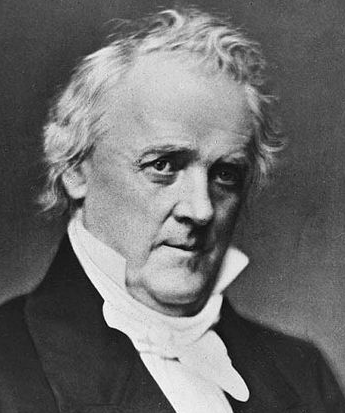
James Buchanan was a pro-slavery Pennsylvania Democrat who had rode into office on the votes of the South. He was now pressured by Southern legislators to change his position on the Lecompton Constitution. Buchanan’s cabinet, which was heavily Southern, and pro-slavery expansion also used its influence to pressure the president into supporting the plan to admit Kansas as a Slave State. In response to the pressure, Buchanan reversed his previous stance in regard to Kansas and endorsed the bill, and he “called on Congress admit Kansas as a slave state with a constitution (drafted by the proslavery territorial government at Lecompton) that was never approved by Kansas voters and obviously opposed by a majority of them.” [8] The decision by Buchanan tossed aside the doctrine of popular sovereignty which had been key to engineering earlier compromises and in response some Northern Democrats opposed Buchanan.

Buchanan’s patently obvious move to placate the slave states and overturn the restrictions on the expansion of slavery contained in the Missouri Compromise, the Compromise of 1850, and the Kansas-Nebraska Act, provoked a new outcry, this time from Northern members of the Democratic Party. Many Northern Democrats were outraged by Buchanan’s flip-flop and the threats of secession emanating from the South if the measure was not approved. Most of the Northern Democrats were willing to accept and even defend slavery where it existed, but they were opposed to the expansion of slavery. His announcement to the House of Representatives “touched off a twelve-hour donnybrook in February 1858” and “about 50 congressmen in various states of inebriation tangled with each other on the House floor… The rumble subsided only when Mississippi congressman William Barksdale tackled an unidentified assailant as the latter snatched his toupee and waved it about like a captured flag. Barksdale finally retrieved his scalp and plopped it on his head wrong side out, the absurdity of the scene giving the combatant’s pause.” [9] Many Northern Democrats felt betrayed by their president’s actions and rose in opposition to the bill that would admit Kansas as a Slave State. Even so Buchanan was a “skilled political infighter swung a remarkable percentage of Northern Democratic members of the House of Representatives, fully 60 percent, behind the Lecompton Constitution,” [10] but he did not contend with the charismatic power of Stephen Douglas in the Senate.

These Democrats were led by the formidable Senator Stephen A. Douglas. Known as the Little Giant Douglas had skillfully crafted the Compromise of 1850 using the principle of popular sovereignty, led these Democrats in their fight against Buchanan’s acceptance and endorsement of Lecompton. Douglas’s previous actions to support the rights of Slave States had made him a hero in much of the South and his stature in both the North and the South made him the frontrunner to win the Democratic nomination for the presidency in 1860.

But Douglas, who had worked so hard to build compromises that would hold the Union together could not countenance the actions and tactics of the Southern members of his party. Douglas was a political realist and not an ideologue. He was very sympathetic to slave holders and was certainly no supporter of emancipation, in fact the Little Giant was an avowed racist. He was completely convinced “of the inferiority of the Negro, and he had a habit of stating it with brutal bluntness, “I do not believe that the Negro is any kin of mine at all…. I believe that this government of ours was founded, and wisely founded upon white basis. It was made by white men, for the benefit of white men and their posterity, to be executed and managed by white men.” [11] But despite his own racist beliefs Douglas understood the danger that the pro-slavery extremists supporting Lecompton were to the Democratic Party and the nation. Douglas understood that if the bill to admit Kansas as a slave state was passed that it would destroy the unity of the Democratic Party and quite possibly the Union itself.

The Illinois Senator found out about the President Buchanan’s new support of the measure when he read the newspaper. He was outraged when he saw the news in the Washington Union that Buchanan had decided to support Lecompton. He was infuriated and the fury showed when he wrote with characteristic honesty:

“This left no doubt were the old bastard stood. “Can you believe his Goddamned arrogance?” I told a friend. “I run the Committee on Territories. He should have consulted me before approving the Lecompton fraud. He’ll pay for that. By God, sir, I made Mr. James Buchanan, and by God, sir, I’ll unmake him.” [12]

As such, the Little Giant threw caution to the wind and stormed to the White House “to confront Buchanan on the “trickery and juggling of the Lecompton constitution.” He warned the president of that his actions in support of the Lecompton party would “destroy the Democratic party in the North,” and we warned that “if Buchanan insisted on going through with it, Douglas swore to oppose him in Congress.” [13]

It was an epic confrontation. Douglas recalled, “The Lecompton constitution, I told Buchannan bluntly, was a blatant fraud on the people of Kansas and the process of democracy, I warned him not to recommend acceptance of it. With his head titled forward in that bizarre habit of his, he said that he intended to endorse the constitution and send it to Congress. “If you do,” I thundered, “I’ll denounce it the moment that it is read.” His face turned red with anger. “I’ll make Lecompton a party test,” he said. “I expect every democratic Senator to support it.” I will not, sir![14]

james-buchanan

President James Buchanan

Angry and offended by the confrontation of Douglas, Buchanan cut the senator off and issued his own threat to Douglas and his political career saying, “I desire you to remember that no Democrat ever yet differed from an administration of his own choice without being crushed….Beware of the fate of Tallmadge and Rives,” two senators who had gone into political oblivion after crossing Andrew Jackson.” The redoubtable Senator from Illinois was undeterred by the President’s threat and fought back, “Douglas riposted: “Mr. President, I wish to remind you that General Jackson is dead, sir.” [15] It was an unprecedented action by a sitting Senator, to confront a President of one’s own party and threaten to oppose him in Congress was simply not done, but now Douglas was doing it, but doing so to his President’s face, and the consequences for him, his party, and the country would be immense.

Following his confrontation with Buchanan, Douglas was even more determined to defeat the Lecompton party and their brazen attempt to admit Kansas as a slave state over the will of the non-slave majority. In a display of righteous anger Douglas did what few politicians would consider doing in our day and age and “took his political life into his own hands and assailed the Lecompton Constitution on the floor of the Senate as a mockery of the popular sovereignty principle.” [16] President Buchanan and his allies in Congress fought back viciously, so much so that the two sides sometimes came into physical confrontation with each other in the chambers of Congress.

When Buchanan’s supporters pushed for Lecompton’s approval and the admission of Kansas as a Slave State, Douglas fired back, warning “You do,” I said, “and it will lead directly to civil war!” I warned the anti-Lecompton Democrats of the North that the President intended to put the knife to the throat of every man who dared to think for himself on this question and carry out principles in good faith. “God forbid,” I said “that I ever surrender my right to differ from a President of the United States for my own choice. I am not a tool of any President!” [17]

Under Douglas the Northern Democrats joined with Republicans for the first time to defeat the admission of Kansas as a Slave State. Douglas recalled the battle:

“After the Christmas recess, the Administration unleashed its heavy horsemen: Davis, Slidell, Hunter, Toombs, and Hammond, all southerners. They damned me as a traitor and demanded that I be stripped of my chairmanship of the Committee on Territories and read out of the Democratic party. Let the fucking bastards threaten, proscribe, and do their worst, I told my followers; it would not cause any honest man to falter. If my course divided the Democratic party, it would not be my fault. We were engaged in a great struggle for principle, I said, and we would defy the Administration to the bitter end.” [18]

Southern Democrats in Congress fought back furiously. As the battle continued their acrimony towards Douglas grew into apocalyptic proportions and their rhetoric against the Little Giant became more heated. According to his opponents Douglas was “at the head of the Black column…stained with the dishonor of treachery without parallel…patent double dealing…detestable heresies…filth of his defiant recreancy…a Dead Cock in the Pit…away with him to the tomb which he is digging for his political corpse.” [19]

But Douglas was undeterred by the threats to his career made by Buchanan, his congressional opponents and the press. He believed that he was in the right, and though he was in agreement with the philosophy of his opponents regarding slavery as an institution to be protected in the South, he realized that appeasing the South was not an option in regard to Lecompton, since that measure undermined the entire concept of popular sovereignty. He wrote:

“My forces in the House fought a brilliant delaying action while I worked to win over wavering Democrats. When we introduced a substitute bill, Buchannan called a dozen congressmen to the White House and exhorted them not to forsake the administration. He was cursing and in tears. He had reason to be: on April first, a coalition of ninety-two Republicans, twenty-two anti-Lecompton Democrats, and six Know-Nothings sent Lecompton down to defeat by passing the substitute bill. This bill provided for a popular vote on the Lecompton constitution and for a new convention if the people rejected that document, as they surely would.” [20]

The substitute bill was passed by the Senate as well and sent back to Kansas for a popular vote. When the Lecompton Constitution was resubmitted to the people of Kansas for a vote, the results of the referendum were devastating to the pro-slave faction, and “to the hideous embarrassment of Buchanan, the voters of Kansas turned on August 30th and rejected Lecompton by a vote of 11,812 to 1,926.” [21] The ever colorful and blunt Little Giant wroteThe agony is over,” cried one of my aides, “and thank God that the right has triumphed. Poor old Buck! Poor old Buck had just had his face rubbed in shit. By our “indomitable courage, “ as another aide put it, we’d whipped this “powerful and proscriptive” Administration and forced the Black Republicans to support a substitute measure which fully embodied the great principles of the Kansas-Nebraska Act.” [22] The victory of Douglas and his faction over the Buchanan faction in the Lecompton fight “ended a political battle which had convulsed the country and virtually destroyed two administrations, but the full consequences of the prolonged struggle had yet to become evident.” [23]

Pro-slavery Southerners were outraged and Buchanan used every measure that he could to crush the anti-Lecompton Democrats, but he had lost “one of the most vicious struggles in the history of Congress, Southern Democrats had seriously damaged the patience of their Northern counterparts, and Buchanan loyalists in the North were unseated wholesale by upstart Republicans in the 1858 congressional elections.” [24] Buchanan’s Presidency was discredited, his party divided, its majority in congress lost, and the South moving closer to secession. Southerners considered Douglas a traitor and accused him of betraying them. “A South Carolinian lamented that “this defection of Douglas has done more than all else to shake my confidence in Northern men on the slavery issue, for I have long regarded him as one of our safest and most reliable friends.” [25]

To be continued…

Notes

[1] Ibid. Guelzo Fateful Lightening p.81

[2] Ibid. Potter The Impending Crisis p.300

[3] Ibid. Potter The Impending Crisis p.314

[4] Ibid. Guelzo Fateful Lightening p.115

[5] Ibid. Freehling, The Road to Disunion Volume II: Secessionists Triumphant 1854-1861 p.138

[6] Ibid. McPherson The Battle Cry of Freedom p.165

[7] Ibid. McPherson The Battle Cry of Freedom p.164

[8] Ibid. Levine Half Slave and Half Free p.211

[9] Ibid. Goldfield America Aflame p.144

[10] Ibid. Freehling, The Road to Disunion Volume II: Secessionists Triumphant 1854-1861 p.138

[11] Ibid. Potter The Impending Crisis p.340

[12] Ibid, Oates The Approaching Fury p.208

[13] Ibid. McPherson The Battle Cry of Freedom p.166

[14] Ibid, Oates The Approaching Fury p.208

[15] Ibid. McPherson The Battle Cry of Freedom p.166

[16] Ibid. Guelzo Fateful Lightening p.115

[17] Ibid, Oates The Approaching Fury p.210

[18] Ibid, Oates The Approaching Fury pp.212-213

[19] Ibid. McPherson The Battle Cry of Freedom p.168

[20] Ibid, Oates The Approaching Fury pp.215-216

[21] Ibid. Guelzo Fateful Lightening p.116

[22] Ibid, Oates The Approaching Fury p.216

[23] Ibid. Potter The Impending Crisis p.325

[24] Ibid. Guelzo Fateful Lightening p.116

[25] Ibid. McPherson The Battle Cry of Freedom p.167


4 Comments

Filed under civil war, History, News and current events, Political Commentary

Controversy & Redemption: Dan Sickles and July 2nd at Gettysburg

Daniel_Edgar_Sickles

Friends of Padre Steve’s World

For those that have followed my writing for some time you know that I teach military history and ethics at the Joint Forces Staff College. One of the great joys that I have is leading the Gettysburg Staff Ride, which is an optional event for students that want to participate. When I took the position here I took some of my older writings on Gettysburg and put them into a student study guide and text. That was two years ago. Then the text was about 70 pages long. It is now about 925 pages long and eventually I hope to get it published. When and if that happens I expect it to become two, and possibly three books.

This is the sixth of a series of articles that I will be posting potions of a chapter that I have rewritten about the critical battles on the south side of the battlefield on July 2nd 1863, the battle for Devil’s Den, the Wheatfield, the Peach Orchard, and the final repulse on Cemetery Ridge.

As you read this don’t just look at the events, but look at the people, and their reaction to the what they encountered on the battlefield, for that understanding of people is where we come to understand history.

So even if you are not a Civil War buff, or even a history buff, take the time to look at the people, their actions, and the things that made them who they were, and influenced what they did. History is about people.

So please enjoy,

Peace

Padre Steve+

LongstreetJ_main

Lieutenant General James Longstreet C.S.A.

President John F. Kennedy paraphrased the words of the Roman Emperor Tacitus after the failed Bay of Pigs invasion, Kennedy told a journalist, “victory has 100 fathers and defeat is an orphan.” The problem in doing a proper analysis of Longstreet’s assault is the fact that many of the men involved on both sides made the battle personal, issuing scathing denunciations of one another, fudging the facts to their advantage, and by making the fight political a political football in the South and in the North.

The Confederate attacks had been badly directed and uncoordinated. In the end though McLaws’ and Hood’s divisions had succeeded in thrashing Sickles’ Third Corps in the exposed salient they were unsuccessful at breaking the Federal line. The disjointed nature of their attacks and the lack of active command and control by Lee and Longstreet had much to do with the outcome. Lee’s presence was needed on the south end of the Confederate line, but he left Longstreet to his own devices.

There was much blame to go around on the Confederate side, Longstreet placed much of the blame for the defeat on Lee, which earned him the everlasting enmity of many Confederates. But Lee’s Warhorse also met with criticism, especially for his performance on July 2nd 1863. Some of the most withering came not years later, but in the days following the battle. The harshest came from Lafayette McLaws, his old friend, who had been a favorite of Longstreet. McLaws blamed his corps commander for the defeat, writing his wife, “I think that the attack was unnecessary and the whole plan of battle a very bad one. Genl Longstreet is to blame for not reconnoitering the ground and for persisting in ordering the assault when his errors were discovered. During the engagement he was very excited [,] giving contrary orders to every one, and exceedingly overbearing. I consider him a humbug – a man of small capacity, very obstinate, not at all chivalrous, exceedingly conceited, and totally selfish….” [1]

One of Longstreet’s biographers wrote “Longstreet’s performance during the morning deserves criticism…. Had he attended to the details that were his responsibility and not allowed his disagreement with Lee to affect his judgment and effort, the afternoon assault would have begun sooner, but not several hours earlier.” [2] That historian believes that had Sickles not moved forward that Longstreet’s attack, even if made earlier would have met success, something echoed by Porter Alexander who wrote, “There seems no doubt that Longstreet’s attack on the 2nd been materially sooner, we would have gained a decided victory.” [3]

Casualties were heavy on both sides but the attack had failed and it had failed because of senior leadership of Lee and his corps commanders. Had Lee “duplicated the active role taken by his counterpart, George Meade, the outcome might have been different.” [4] But this too is speculation born of perfect 20/20 hindsight. One of Lee’s biographer’s wrote “Longstreet was disgruntled, Ewell was inept and Hill was unwell.” [5] To make matters worse, throughout the day, Robert E. Lee did not assert himself and even his most devoted biographer Douglas Southall Freeman would write that on July 2nd 1863 “the Army of Northern Virginia was without a commander.” [6]

general-george-meade

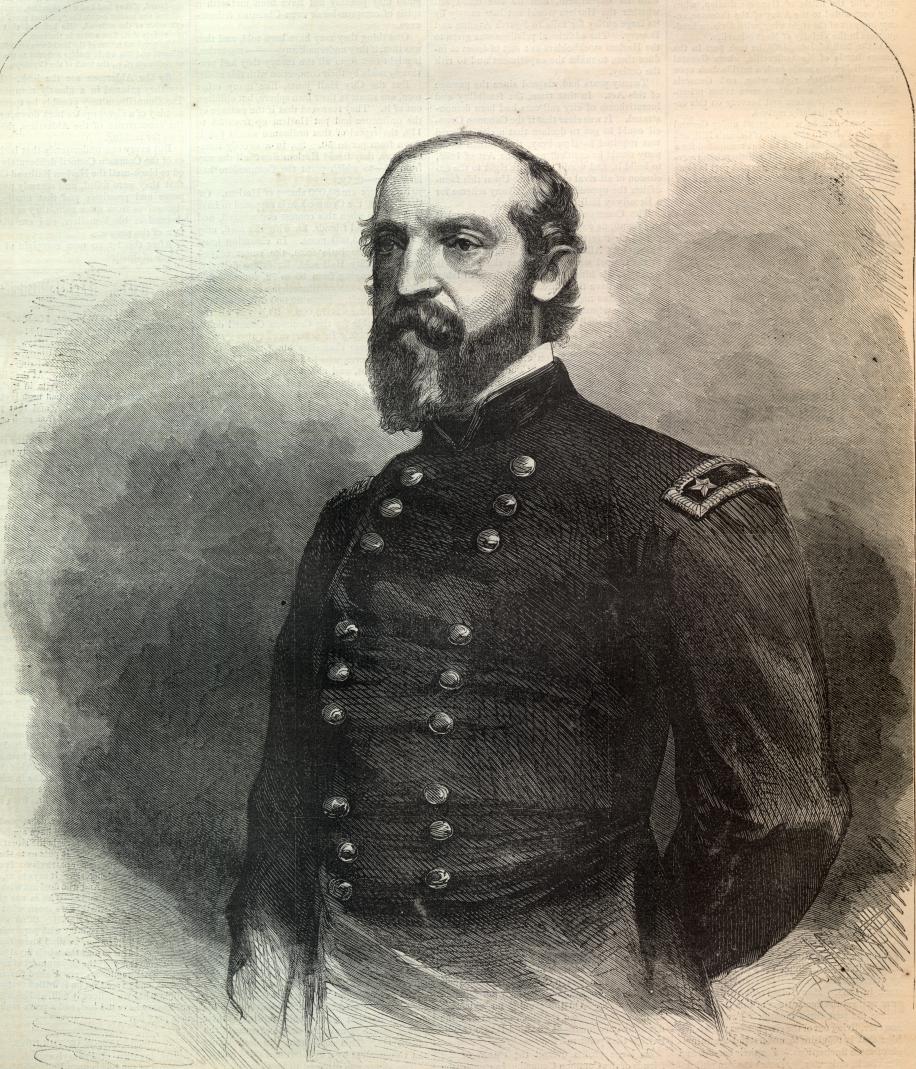
Major General George Meade U.S. Army

On the Federal side most of the controversy has to do with Sickles’ decision to move the Third Corps forward from Cemetery Hill to the Peach Orchard and so it is appropriate to close this chapter discussing Dan Sickles. The matter has been a long subject of controversy, especially because of the way that Sickles politicized his actions in the press and in the Congressional hearings that followed. Many generals on both sides blundered at Gettysburg.

One can speculate that had Sickles remained in the position dictated by Meade that the Confederate assault might have gone down to an even more disastrous defeat. That being said the line that Sickles would have occupied with his 10,600 troops was long and he could not have held it in great strength, even Little Round Top would have been lightly occupied, and Meade might not have been forced to reexamine his line. It is fully possible that “had Longstreet attacked there with the same headlong fury, it is possible that the Confederates would have broken through not merely into Sickles’ rear, but into the entire Union rear and that disaster would have been the result.” [7] However, Sickles, even though he thought he was justified, was wrong in not informing Meade of the move, and leaving his army commander ignorant of the position of his left.

Sickles action, though an error, was something that could have been rationally addressed by him and Meade long before the Confederate attack began. Had the two men “worked in tandem – that is had the line taken by the Third Corps been shared by the Fifth, and had command matters been resolved and fallback plans established – Longstreet’s troops would have been hard pressed to achieve any of their goals.” [8] One historian put the matter of Sickles’s decision and the subsequent controversies into perspective:

“The entire episode has been clouded since 1863 by issues of politics and personality that hinder unbiased analysis. It is time to put aside such extraneous issues. When Sickles’s scandalous prewar behavior, postwar bombast, and special pleading are discounted and the case is considered solely on its merits, the results of the Third Corps advance speak for themselves. Dan Sickles was not perfect on July 2, 1862, but neither was he the military buffoon so often portray.” [9]

In his after action report Meade criticized Sickles and did so again before the Congressional Committee on the Conduct of the War, that latter in regard to comments made by Sickles and his supporters both to the committee and in the press. Meade not only had to deal with the diversions created by Sickles, he also had the real problem of Abraham Lincoln’s disappointment with his failure to catch and destroy the Army of Northern Virginia before it escaped across the Potomac. Dan Sickles did not have to worry about that, and “he could play the role that politicians play best: critic and second guesser.” [10] With the press on his side the former disgraced Congressman was now a one legged war hero, and Sickles attempted to use his redemption and status of a hero “to have Meade removed from command in disgrace.” [11] Many generals on both sides blundered at Gettysburg. Had Sickles taken the high road after the battle rather than attempting to torpedo the name and reputation of George Meade, his action might have provoked less controversy, and “Dan Sickles the historical figure has paid a permanent price for this, overshadowing the laudable work he did as an early force in establishing the Gettysburg National Memorial Park.” [12]

That was most unfortunate, for it has poisoned the discussion of the battle for over 150 years. Unlike Lee, Meade was constantly leading from the front on this long and brutal afternoon. Meade fought a magnificent defensive battle and recovered from the surprise of Sickles movement even as Sickles and his soldiers fought hard greatly impeded the Confederate plan. Sickles was praised in the press and even by long term enemies such as George Templeton Strong, who wrote, “I suppose Sickles… with his one leg, among our best volunteer officers. His recuperative powers are certainly wonderful. Four years ago he was a ruined man in every sense, a pariah whom to know was discreditable.” [13]

“The whole damned field is my memorial”

But the continuing controversy which always seemed to swirl around him prevented him from being honored on the battlefield where he lost his leg. Alone of all the Union Corps commanders at Gettysburg Sickles has no memorial on the battlefield. When asked about the lack of a monument, Sickles, in his typical manner is reported to have said that “The whole damned field is my memorial.” [14]

Despite the controversy surrounding his life, and those that swirled in the fighting and refighting of the Battle of Gettysburg, in true fashion Dan Sickles went on to further glory and scandal. Ulysses Grant never allowed him to command troops in the field, Sickles commanded the Military Department of South Carolina, the Department of the Carolinas, and the Department of the South, where was a strong proponent of Reconstruction. He was retired as a Major General in the Regular Army in 1869 and went on to serve as Minister to Spain where he carried on an affair with the deposed Queen Isabella, a nymphomaniac who long before she ever Sickles had conducted a myriad of high profile affairs. The affair with the former queen was open and offensive to many people, but neither seemed to mind. In a sense they were kindred spirits. A Paris newspaper dubbed the one-legged General “the Yankee King of Spain.” [15] The affair with Isabella eventually burned itself out and Sickles married Senorita Caroline de Creagh, the daughter of a Spanish Minister, who bore him two children. To do this he converted to Roman Catholicism, something that he had never done when Teresa was alive. After his service in Spain was ended Sickles remained in Paris for four years, where he was widely admired and “received the office of Commander of the Legion of Honor.” [16]

Though a Democrat he supported Republican Presidential candidates Ulysses S. Grant and Rutherford Hayes, the latter against a long time Democratic rival from New York. As he got older Gettysburg became an increasing part of his life and in 1892 he ran for Congress in order to spearhead efforts to preserve the battlefield. He was elected and it was in large part due to his efforts that what we now know as the Gettysburg National Military Park exists. In 1893, Sickles met James Longstreet at a Gathering in Gettysburg, and the two men became lifelong friends. Since the war both men had been refighting the battle and the controversies that hung over their decisions that July 2nd like a pall. Longstreet, for his actions on the battlefield, and his decision to become a Republican and serve in the post-war Reconstruction efforts was a pariah in much of the South. That “unpopularity was painful to him, and he was glad to find a sympathetic ally in Sickles. Each of the two generals agreed that the other had moved with blameless skill that day,” [17] and both would defend the other in the succeeding years. As the continuing battle of Gettysburg was fought in the press and in histories written by various participants, Longstreet wrote of Sickles, “I believe it is now conceded that the advanced position at the peach orchard, taken by your Corps and under your orders, saved that battlefield for the Union cause.” [18]

Sickles was awarded the Medal of Honor in 1897, the citation stating, “Displayed most conspicuous gallantry on the field vigorously contesting the advance of the enemy and continuing to encourage his troops after being himself severely wounded.”

Sickles long to outlived George Meade who died in 1872 and all of the other Corps commanders of the Army of the Potomac, not to mention most of his friends and enemies. His father George Sickles died in 1887 leaving Dan an estate of nearly five million dollars. His daughter by Teresa, Laura, whose life had been so scarred by the events of 1859 died alone and estranged from her father. In 1896, disgusted by the nomination of William Jennings Bryant as the Democratic Presidential nominee, the one-legged Sickles went to work with his old Gettysburg comrade, the one-armed Oliver Otis Howard to campaign for the Republican William McKinley. They were quite a pair, the religious Howard, and the libertine Sickles, but they helped McKinley defeat Bryant, and McKinley remained grateful to them until his death by an assassin’s bullet.

In 1913 he attended the fiftieth anniversary ceremonies at Gettysburg where he watched the white haired survivors of Pickett’s Charge hobble across the wide battlefield into the arms of their former opponents on Cemetery Ridge. Helen Longstreet, James Longstreet’s second wife and widow quoted the words of a poet named Horatio King, for the event for a southern newspaper.

I see him on that famous field,

The bravest of the brave,

Where Longstreet’s legions strove to drive

The Third Corps to its grave

The fight was bloody, fierce and long,

And Sickles’ name shall stay

Forever in the hall of fame

As he who saved the day [19]

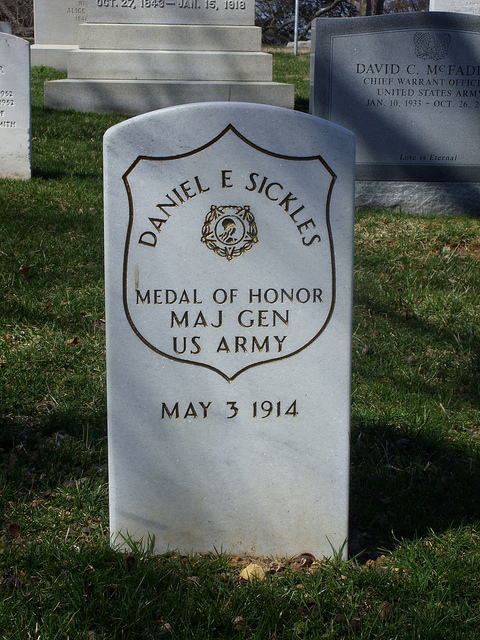
While Helen Longstreet’s claim that Sickles was “forever in the hall of fame” is a tad farfetched, there is no doubt that scoundrel had found redemption. When Sickles died in 1914 at the age of 94, his funeral was held at Saint Patrick’s Cathedral in New York and he was buried at Arlington National Cemetery, with full military honors, his flag-draped casket carried on an artillery caisson accompanied by a rider-less horse and artillery salutes. His funeral, in a military cemetery among other soldiers was “proof that he was no longer an attorney, politician, or even the murderer of Barton Key,” [20] he was a soldier. His tombstone simply reads:

Daniel E. Sickles

Medal of Honor

Maj. Gen. U.S. Army

May 3 1914

sickles grave

The New York Times made a comment that no one, be they an admirer or enemy could deny. “He was a truly adventurous spirit.” [21]

Notes

[1] Ibid. Oeffinger A Soldier’s General p.197

[2] Ibid. Wert General James Longstreet p.279

[3] Ibid. Alexander Fighting for the Confederacy p.278

[4] Ibid. Wert General James Longstreet p.279

[5] Taylor, John M. Duty Faithfully Performed: Robert E Lee and His Critics Brassey’s, Dulles VA 1999 p.149

[6] Freeman, Douglas S. R.E. Lee volume 3 Charles Scribner’s Sons, New York 1935 p.150

[7] Ibid. Swanberg Sickles the Incredible p.235

[8] Ibid. Trudeau Gettysburg, the Testing of Courage p.421

[9] Robertson, William Glenn The Peach Orchard Revisited: Daniel E. Sickles and the Third Corps on July 2, 1863 in The Second Day at Gettysburg: Essays on Confederate and Union Leadership edited by Gary W. Gallagher, The Kent State University Press, Kent Ohio and London, 1993 p.56

[10] Ibid. Hessler Sickles at Gettysburg p. 244

[11] Ibid. Swanberg Sickles the Incredible p.235

[12] Ibid. Hessler Sickles at Gettysburg p. 401

[13] Ibid. Hessler Sickles at Gettysburg pp.244-245

[14] Ibid. Swanberg Sickles the Incredible p.390

[15] Ibid. Swanberg Sickles the Incredible p.321

[16] Ibid. Keneally American Scoundrel p.339

[17] Ibid. Swanberg Sickles the Incredible p.367

[18] Ibid. Keneally American Scoundrel p.341

[19] Ibid. Keneally American Scoundrel p.353

[20] Ibid. Hessler Sickles at Gettysburg p. 385

[21] Ibid. Swanberg Sickles the Incredible p.390

5 Comments

Filed under civil war, Gettysburg, History, leadership, Military

Embarrassed to Call Myself a Christian

  
Friends of Padre Steve’s World,

I have to get something off of my chest. I saw something on a fellow clergyman’s political comments that were so ignorant and over the top in the hatred that seethed from them that I chastised him and told him that I was embarrassed by his comments. Honestly I do not care who someone votes for or against, what political party they belong to, what ideology they affirm, so long as they remain civil, and if they are a member of the clergy to at least not stoop to personal assaults on their opponents that would turn the stomach of Jesus while at the same time turning a blind eye to the faults and anti-Christian behavior and policies of the political leaders that they support. 

A few days ago I read a very provocative article by Russell Moore, the head of the Southern Baptist Ethics and Religious Liberty Commission. In the article Dr. Moore wrote that he could no longer call himself an Evangelical Christian because the term in in the United States no longer has any real meaning. In fact he went out of his way to blast the crass manner in which leading so called  “evangelical” leaders have perverted the Gospel, especially in their politization of it. I was in his Amen corner  throughout the article. 

In the past I have written a number of articles about being afraid of Christians, well at least the kind of people who call themselves by the name of Christ that Dr. Moore referred to in his article. But I am more than afraid, I am terrified of them. I have n doubt that if they were given the chance that they would ruthlessly exterminate every political enemy that they have in the name of God. 

So I will do Dr. Moore one better. I am embarrassed to call myself a Christian, because that term has been so maligned by these people that it is meaningless. Dr. Moore said that he now refers to himself as a Gospel Christian. I can understand that and even on issues where I fail to see eye to eye with him I can respect him. But I cannot even call myself that, the term Gospel itself has been perverted by many of the people that Dr. Land rightly criticizes into an insipid morass of bad ahistorical theology, the blessing of greed, avarice, and violence to get the blessing of God and gain earthly power without any sacrifice, humility, repentance, not to mention the forgiveness of sin that the term Gospel has lost its power. 

Though I have been a Christian for most of my life, and have been an ordained minister an priest for over twenty-five years, I have a hard time calling myself a Christian. I struggle with faith, with belief, and the actions of so many Christians, including people that I once thought of as friends has been so corrosive that I have a hard time believing. A well meaning person asked me a couple of weeks ago if I believed. I told them that about half the time I do, about forty percent of the time I don’t know, and about ten percent of the time that I don’t. At least I am honest. There are times that I sense the wonder, grace, mystery and love of God, and there are many times that I don’t. 

But when I corresponded with my friend I realized that my issue with what he wrote had far less to do with his politics than what he said about people, especially in regards to words that they had not spoken and speeches they have not given. Dietrich Bonhoeffer wrote, “In judging others we blind ourselves to our own evil and to the grace that others are just entitled to as we are.” Is it any wonder that more and more people are fleeing Christ and the Church and that the fastest growing religious demographic in the United States is the Nones, or people who have no specific religious faith? I don’t find it surprising at all, and when I see people who call themselves Christians make hateful, ill-informed comments and then say that they are tired of being politically correct I shake my head in bewilderment. That is the same kind of “Christian Faith”  that Bonhoeffer fought against in the Nazi era. But then Bonhoeffer noted that “if you board the wrong train, it is no use in running down the corridor in the other direction.”  Far too many people who call themselves by the name of Christ have boarded that train, and it has left the station. 

So I guess that I will call myself a follower of Jesus like the man who told Christ, “I believe, help me in my unbelief.” 

Until the next time,

Peace

Padre Steve+ 

12 Comments

Filed under christian life, ethics, faith, Political Commentary

Super Tuesday Analysis

election

Friends of Padre Steve’s World,

I am a little bit late posting today as I wanted to see how the Super Tuesday primaries turned out and I was not surprised.

Last night I watched results from the Super Tuesday primary states with great interest. Mind you I did not turn on my television to do so. The maddening number of politicians, pundits, and propagandists masquerading as spokespeople, consultants, and experts on every cable news outlet wears me out. Instead I simply pulled up a website that simply let me watch the election returns come up in real time.

I didn’t listen to a single “victory speech” by Cruz, Clinton, Sanders, Trump, or Rubio because such speeches are basically propaganda and spin, though I did read some of the excerpts from each candidate’s speech, carefully parsing them for truth in light of the actual data from the primaries, not just the total votes or delegates won, but where each candidate did well, or fell on their ass.

So here is my bottom line and what I think will probably happen next.

One the Democratic side Clinton won seven states and Sanders four states. But the states that Hillary one were big delegate rich states which are more reflective of the Democratic Party as a whole than the four states that Sanders won she now has 1034 of the 2383 that she needs for the nomination while Sanders lags over 600 delegates behind with just 408. The polling data from big delegate laden state primaries coming up show that she will further extend her lead over Bernie and it appears that Hillary will continue her march to become the Democratic nominee. The good thing for the Democrats is that Sanders challenge has forced Hillary to recognize progressives and move her campaign more to embrace policies enunciated by Sanders, this will in effect serve to unify the Democrats in the lead up to November.

The Republican race is more complicated than that of the Democrats. The campaign of Donald Trump has blown away the influence of what had been known as Republican Establishment. His opposition is fragmented and that fragmentation will not end anytime soon. Trump currently has 316 of the 1230 delegates needed to clinch the nomination. Cruz has 226 and Rubio 106. But the apparent closeness of those numbers is deceptive. Trump benefits from the completion between Cruz and Rubio and neither is likely to drop out of the race, Cruz because he honestly believes that God has chosen him for the job and Rubio because despite his poor showing in most primaries is the face that the GOP wants to project, and as a result he will retain the support of realists and moderates in the party.

The split between Cruz and Rubio will ensure that Trump continues to rack up primary victories in big states. Complicating the situation for Rubio is fact that John Kasich has gained some traction and in Vermont and Virginia played spoiler, probably keeping Rubio from winning those states. Rubio won in Minnesota but has lost thirteen of fourteen times.

On Super Tuesday Cruz won in three states Texas, Oklahoma, and Alaska. But even in Texas he needed to do better than he did and he was blasted by Trump in the Deep South, which he has to win to get the nomination. To put Cruz’s Texas win in perspective, it is the lowest percentage that any Republican Presidential candidate has received since 1912. He is under performing even when wins, his polling numbers in many states are abysmal and no amount of spin will change that fact. 

Cruz has a different problem, if Trump is seen to be a bully, Cruz is seen to be a completely dishonest and slimy bully that most people in his party cannot stand to be around. One of those people is Ben Carson, who Cruz went out of the way to cheat in Iowa by having his staff call potential Carson voters to switch their vote to him as Carson had dropped out of the race. It probably gave Cruz his narrow victory over Trump in the Iowa caucus and in the process made Carson his mortal enemy. Carson has no chance at winning and he knows it, but he is not formally dropping out. My guess is he will do this simply to draw voters away from Cruz since they cater to the same base of conservative Evangelical Christian voters. Since he is skipping the next debate this may have less impact than if he participated in it.

My prediction is that Clinton and Trump will clinch their party nominations by the beginning of April unless something really strange happens.

Now a minor editorial note. I am a Democrat and would have to call myself a pragmatic progressive and possibly a Democratic Socialist based on what I believe. That being said I spent thirty-two years of my life as a Republican beginning in 1976 when I worked for the Gerald Ford campaign as a high school student, but I was a “big tent Republican.” I became disillusioned with the party based on my experiences in Iraq, when I realized that the rational for going in was lies, and I was repelled by the stridently militant demands of right-wing Christians who seemed to be attempting to turn the party into their religious party. As a result I left the GOP in 2008.

While some democrats rejoice in what is happening to the GOP today, but I do not. As a historian I honestly believe that the GOP will implode. Senate Mitch McConnell is trying to limit losses by distancing himself from Trump hoping that if he and others do so they might retain control of the House and Senate.  The coming GOP implosion may benefit the Democrats in November, but such implosions of major political parties are generally not good for the country. One only has to look at the implosion of the Whigs in 1854 and the Democrats between 1858 and 1860 to see how badly such events can turn out for the country.

I will be writing something about that in a day or two.

Have a great day,

Peace

Padre Steve+

3 Comments

Filed under News and current events, Political Commentary

Dedicated to a Proposition: Super Tuesday & the New Birth of Freedom 


Friends of Padre Steve’s World

I have returned from my time teaching at Gettysburgt and today is Super Tuesday, a day that will most likely establish who will be the Democratic and Republican nominees for President. Thus it is an important day and like any Election Day one that we should approach with a matter of solemn responsibility.

When I go to Gettysburg I always learn more than I teach. Part of this is because I am always reading, researching, writing, and exploring the subject so when I get there I look for things that I might have missed in previous visits. I enjoy the time with my students, not just on the battlefield staff ride, but in our table talk at ouch, dinner, and at the bar. But I think most importantly I am touched with the sense that what happened on that hallowed ground still matters today. At least I think that it should matter today if we honestly believe the words spoken by Abraham Lincoln in his Gettysburg Address:

“Four score and seven years ago our fathers brought forth on this continent, a new nation, conceived in Liberty, and dedicated to the proposition that all men are created equal.” 

Those words, spoken on the site were Federal soldiers turned back the invading Confederate Army just a few months before were as revolutionary as when Thomas Jefferson penned the words “We hold these truths to be self-evident, that all men are created equal, that they are endowed with certain unalienable rights, that among these are Life, Liberty, and the pursuit of happiness. – That to secure these rights governments are instituted among men….” 

Of course when Jefferson wrote them they were revolutionary, but they only guaranteed the rights of white men, primarily those who owned property, which in many cases in those early days included the human property of African American slaves. But just a year prior to speaking at Gettysburg, Lincoln issued the provisional Emancipation Proclamation, giving the Confederacy a last chance to end the war and free their slaves. This was followed by the issuance of the proclamation on January 1st 1863. Lincoln’s action was even more revolutionary than that of Jefferson, for he began the process of univerasalizing the understanding that “all men are created equal.” He followed this with the passage of the 13th Amendment. His allies in Congress passed the 14th Amendment after his assassination over the strident objections of President Andrew Johnson, and Ulysses Grant followed this by ensuring that the 15th Amendment was passed.

  
Of course it took many years of struggle to see the “proposition that all men are created equal” was extended to Native Americans, Women, and most recently Gays and Lesbians. Even so many people according to one recent survey said that they thought that some 13% of Americans disagreed with the Emanicaption Proclamation while 17% weren’t sure. Many others despise the 14th Amendment that provided citizenship rights to African Americans, the 15th Amendment which gave Blacks the right to vote, as well as the 19th Amendment which gave women the right to vote, and most recently the Oberfell v. Hodges decision which gave Gays the right to marry. Of course the precedent for most of the after decisions was found in the 14th Amendment.

emancipation

Today our country is nearly as divided as it was before and during the Civil War, Lincoln said, “Now we are engaged in a great civil war, testing whether that nation, or any nation so conceived and so dedicated, can long endure.” There are politicians, pundits and preachers who are intent on rolling back or eliminating the rights of others in order to preserve their privilege, and to crush the rights of others in doing so for the flimsiest of reasons. That my friends frightens me, but I do believe that the wrong will fail. Even so I do get concerned, but then I remember Lincoln’s words:

“It is for us the living, rather, to be dedicated here to the unfinished work which they who fought here have thus far so nobly advanced. It is rather for us to be here dedicated to the great task remaining before us — that from these honored dead we take increased devotion to that cause for which they gave the last full measure of devotion — that we here highly resolve that these dead shall not have died in vain — that this nation, under God, shall have a new birth of freedom — and that government of the people, by the people, for the people, shall not perish from the earth.”


When I walked among the graves the men men who fought and died to ensure those rights over the weekend I again felt that call, the call to embrace and fight for the new birth of freedom that Abraham Lincoln so eloquently spoke. Yes my friends, it is for us the living to be dedicated to the proposition that all men are created equal. If we do not do so what good are we?

Peace,

Padre Steve+


Leave a comment

Filed under civil rights, civil war, History, leadership, News and current events, Political Commentary

The Peach Orchard: July 2nd at Gettysburg Pt.6

1497705_10152329726382059_1343167358_n

Friends of Padre Steve’s World

For those that have followed my writing for some time you know that I teach military history and ethics at the Joint Forces Staff College. One of the great joys that I have is leading the Gettysburg Staff Ride, which is an optional event for students that want to participate. When I took the position here I took some of my older writings on Gettysburg and put them into a student study guide and text. That was two years ago. Then the text was about 70 pages long. It is now about 925 pages long and eventually I hope to get it published. When and if that happens I expect it to become two, and possibly three books.

This is the sixth of a series of articles that I will be posting potions of a chapter that I have rewritten about the critical battles on the south side of the battlefield on July 2nd 1863, the battle for Devil’s Den, the Wheatfield, the Peach Orchard, and the final repulse on Cemetery Ridge.

As you read this don’t just look at the events, but look at the people, and their reaction to the what they encountered on the battlefield, for that understanding of people is where we come to understand history.

So even if you are not a Civil War buff, or even a history buff, take the time to look at the people, their actions, and the things that made them who they were, and influenced what they did. History is about people.

So please enjoy,

Peace

Padre Steve+

It was now time for Longstreet to commit the last brigades of McLaws’ division, the Georgians of William Wofford, and the Mississippians of William Barksdale. These units had been waiting west of the Peach Orchard, and the delay of Barksdale’s brigade getting into the fight had greatly chagrinned Joseph Kershaw when his South Carolinians made their attack without the Mississippi brigade supporting their left. “Longstreet never fully explained how he timed his order for Barksdale’s advance, nor did he specify why he allowed Kershaw to attack without Barksdale’s support.” [1] However, the delay was not easy on McLaws, or his brigade commanders, “particularly William Barksdale, whose thirst for glory was as sharp in Pennsylvania as it had been on his great day at Fredericksburg, where Lee to his delight had let him challenge the entire Yankee army.” [2]During the seemingly endless wait, the aggressive Barksdale plead with both McLaws and Longstreet to be allowed to attack, telling Longstreet, “I wish you would let me go in General!” “Wait a little,” answered Longstreet, “we are all going in presently.” [3] In the acrimonious post-war feud between the Confederate generals, Longstreet blamed McLaws for the delay, and Lafayette McLaws blamed Alexander’s slowness in bringing up his artillery for it, and while Alexander complained of “four partial attacks of two brigades each [in Hood and McLaw’s divisions], requiring each an hour and a half to be gotten into action; where one advance by the eight brigades would have won a quicker victory with far less loss.” [4]

However, McLaws was now ready, and Longstreet gave the order to attack. Porter Alexander’s massed artillery opened the battle for the Peach Orchard opening fire on the Federal troops with fifty-four guns which were drawn up to within five hundred yards of the Federal position. Henry Hunt saw the Confederate build-up and brought up more artillery and by four o’clock and they went “into battery not a minute too soon, the Rebel artillery that Hunt had spied moving into position let loose with a converging fire” [5] against Sickles’ troops. The Confederate artilleryman “hoped, with my 54 guns & close range, to make it short, sharp, and decisive. At close ranges there was less inequality in our guns, & especially in our ammunition, & I thought if I could ever overwhelm & crush them I would do it now.” [6]

The effect the barrage was dramatic as the Confederate guns blasted away at the men of Graham’s brigade of Birney’s division who held the angle of the Federal salient. Even so, Henry Hunt had managed to get “an impressive array of ordnance totaling thirty-two guns ready to take on the looming Confederate attack.” [7] By the time McLaws’s infantry attacked, “the three batteries in the Peach Orchard area had been increased to seven. A virtual solid line of forty Federal guns extended south from the Sherfy house to the Peach Orchard and east from there along the Wheatfield Road to Trostle’s Woods and the stony hill.” [8] Exposed to the massed fire of Alexander’s batteries the Federal artillery replied furiously and with more effects than Alexander or the other Confederate commanders expected. Alexander recalled that “they really surprised me, both in the number of guns that they developed, & the way they stuck to them. I don’t think that there ever in our war a hotter, harder, sharper artillery afternoon than this.” [9] In the artillery slugfest Alexander reported losing 144 men and 116 horses to the Federal batteries, He wrote, “So accurate was the enemy’s fire, that two of my guns were fairly dismounted, and the loss of men so great that I had to ask General Barksdale, whose brigade was lying down close to the wood, for help to handle the heavy 24-pounder howitzers of Moody’s battery.” [10] He noted that it was a higher toll than the artillery had suffered at Antietam during the entire battle. Henry Hunt’s gunners tenaciously held on to their exposed positions and with “waves of gray rolling all around them, some of the batteries in the forefront of the line went under, sucked into the vortex of death and devastation. Yet despite the opposition and the ninety-two-degree heat…other batteries held one stubbornly, hurling single and double charges of canister at their opponents, determined to seal up the holes in Meade’s line created by Dan Sickles’s impetuosity.” [11]
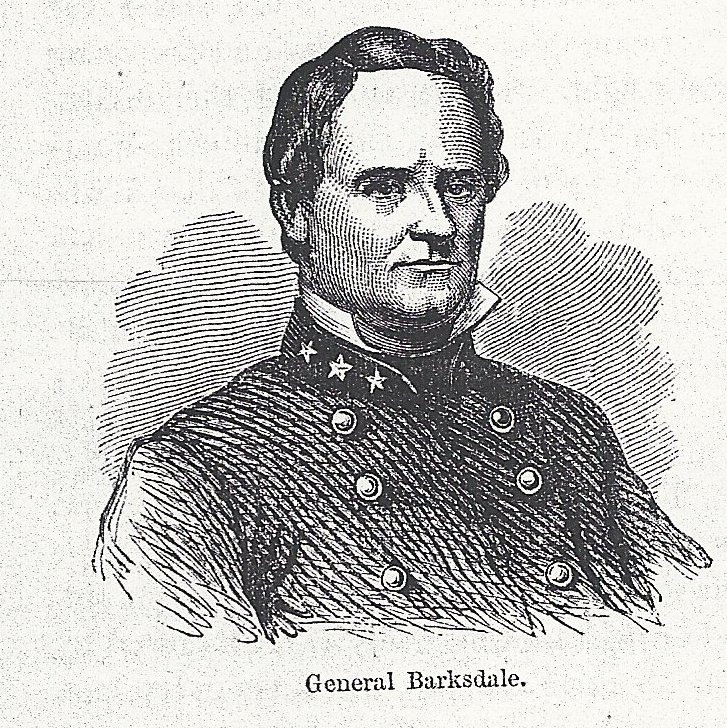
general-barksdale

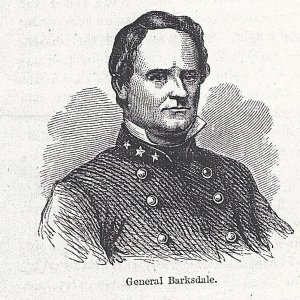
Leading the assault now was the battle-hardened Mississippi brigade of Brigadier General William Barksdale, a former congressional colleague of Sickles whose time in Congress was not without a journey or two into infamy. Barksdale was born in Smyrna Tennessee in 1822. He was a Mississippi lawyer, newspaper editor and politician. Barksdale served in Mexico as a quartermaster officer of a militia unit, but though he was an administrator he did not shy away from battle. He “frequently appeared at the front during heavy fighting, often coatless and carrying a large sword.” [12]

While most of the former Regular Army Confederate officers supported and defended the institution of slavery and secession, many were less than passionate about either and would have preferred that the Union had been preserved. However, Barksdale was one of the few generals serving in Lee’s Army who in the decade leading up to the war had become “violently pro-slavery and secessionist.” [13] But his views regarding secession had evolved since he had first entered politics. When Barksdale entered Mississippi politics he was not a proponent of secession. In fact he was solidly against it and in one debate remarked that “no occasion for the right of [secession] existed.” [14] However, over time he became a reluctant supporter of secession and eventually “came to passionately embrace the Southern dream of an independent nation.” [15]

Barksdale was a passionate and sometimes violent man. As a state legislator and Congressman Barksdale was involved in a number of violent altercations with political opponents. In an 1853 incident at Vicksburg he was attacked and stabbed a number of times before knocking his assailant, his former commander during the War with Mexico out with one punch.

However, the incident for which Barksdale became most famous was an altercation which occurred when Representative Preston Brooks nearly killed Massachusetts Senator Charles Sumner in the Senate chamber. During that brawl Representative Elihu Washburne of Illinois landed a blow on Barksdale that sent Barksdale and his previously unsuspected wig flying. Someone snatched the wig from the floor and “waved it about like a captured flag.” When Barksdale finally recaptured the hairpiece he “and plopped it on his head wrong side out, the absurdity of the scene giving the combatants pause.” [16] As the scrum broke up Barksdale was left “sputtering about his shame.” [17]

At the outbreak of the war Barksdale volunteered for service and enlisted as a private. Shortly thereafter he was elected Colonel of the 13th Mississippi Infantry Regiment. Barksdale took command of the Mississippi Brigade during the Seven Days Battles at Malvern Hill and he was promoted to Brigadier General in August 1862.

At Antietam, Fredericksburg and Chancellorsville he and his Mississippi brigade were always in the thick of the fight. “He possessed a “thirst for battle glory” wrote one Mississippian….Inspiring by example, Barksdale was a leader who dared to go where many other high-ranking officers would not go in a crisis situation.” [18] He had a strong bond with his soldiers which made them willing to follow him anywhere, one soldier wrote “of the comfort of his men he was most considerate, would tolerate no neglect of denial of their rights, or imposition of anyone.” [19]

The other brigade commander of McLaws’s division final strike was Brigadier General William Wofford. Wofford was the newest of McLaws’ brigade commanders, and in many respects was Barksdale’s opposite in temperament and politics, particularly in regard to secession. Wofford was born in Habersham County, Georgia in 1824. Educated a local schools “he studied law, was elected to the bar, and began a practice in Cassville, Georgia.” [20] In addition to his law practice Wofford served as the editor for the Cassville Standard newspaper, and was a respected leader in his community. Though he had no military education Wofford volunteered to serve during the Mexican War, as a Captain of “a battalion of Georgia mounted volunteers” [21] where he experienced a great deal of fighting.

Wofford was considered a man of “high moral bearing…of the strictest sobriety, and, indeed of irreproachable moral character.” [22] Demonstrating the political tensions of the day Wofford was a “staunch Unionist Democrat” who “opposed secession and voted against it at the Georgia secession convention.” [23]

Despite his opposition to secession, Wofford, like others, considered loyalty to his state a higher ideal than to the Union, and when Georgia seceded he volunteered for service and was “elected colonel of the first Georgia regiment to volunteer for the war.” [24] Despite the contradiction of volunteering to serve his home state, Wofford “was a decided Union man from first to last during the whole war” and saw “with exceptional prescience…the certain fatality” of secession, but once the deed was done, he closed ranks…” [25] This may seem hard to comprehend in our present day, to to men like Wofford it was not. When he went to war Wofford served well as the regimental commander of the 18th Georgia regiment, and served as an acting brigade commander during the Seven Days, Second Manassas, Antietam and Fredericksburg. Now the able and experienced the Georgia Unionist was promoted to the rank of brigadier general in January 1863 and given command of the brigade of Thomas Cobb who had been mortally wounded at Fredericksburg.

These two men would lead Longstreet’s final attack of July 2nd 1863. The fiery Mississippian and the pragmatic Georgian would lead their devoted soldiers in one of the fiercest charges of the war, one which pushed their Federal opponents to the limit before it was repulsed on the southern end of Cemetery Ridge.

When the order to attack was relayed to Barksdale by McLaws’ aide-de-camp, Captain G.B. Lamar reported, when I carried him [Barksdale] the order to advance, his face was radiant with joy. He was in front of his brigade, his hat off, and his long white hair reminded me of ‘the white plume of Navarre.’” [26] Barksdale told his regimental commanders “The line before you must be broken – to do so let every office and man animate his comrades by his personal presence in the front line.” [27]

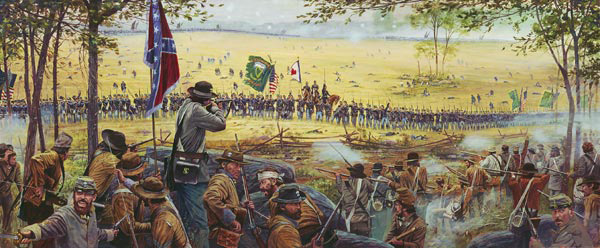
As McLaws division attacked, Barksdale’s Mississippians broke through Federal salient, “charged straight through a picket fence, knocking it down by sheer impact, and they shot and stabbed a Pennsylvania regiment that was dug in behind it, and after a flurry of hand-to-hand fighting under the shattered peach trees the Union defenders turned and ran and the peach orchard was gone.” [28] Porter Alexander wrote, “McLaws’s division charged past our guns, and the enemy deserted their line in confusion. Then I believed that Providence was indeed “taking the proper view,” and that the war was very nearly over.” [29] But like many that day Alexander’s instinct was wrong.

Barksdale’s Mississippians drove forward through the Peach Orchard, through the men of Graham’s brigade, cheering and making the rebel yell, continuing to Plum Run, driving broken Federal regiments and batteries before them. “The Mississippi brigade drove forward at the double-quick and “literally rushed the goal,” tipping the rebel yell “with the savage courage of baited bulls” [30] Barksdale continued to lead his brigade forward though it had suffered significant casualties and was losing cohesion. Barksdale insisted on continuing to advance and would not stop to take time to reform his lines shouting at one of his regimental commanders “No! Crowd them – we have them on the run. Move your regiments.” [31] General Graham, attempted to rally his men and rode forward where he had his mount shoot out from under him. He then encountered Barksdale’s Mississippians who called on him to surrender. Graham, who had taken his adjutant’s mount replied “I won’t surrender. I’m a Brigadier General, and I won’t surrender.” [32] Undeterred the Mississippians shot his second mount out from under him and took him prisoner. “Graham had followed Sickles from their old days together in New York all the way to the Peach Orchard, and now would spend the next several months in captivity as his reward.” [33] As the Mississippians drove the remnants of Graham’s brigade to the rear, “the shattered line was retreating in separate streams[,] artillerists heroically clinging to their still smoking guns, and brave little infantry squads assisting their endangered cannon over soft ground…” [34]

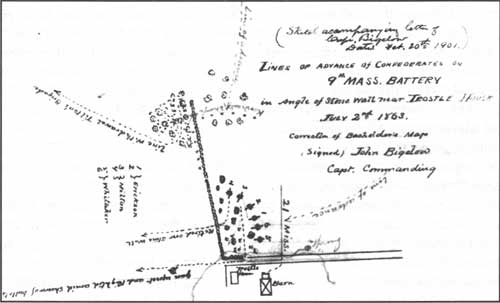
As the Third Corps line collapsed the Trostle farm where Sickles had made his headquarters became hot to remain in. At about six-thirty P.M. Sickles was riding up to a hill just above the Trostle barn which would allow him a better view of his troops, the General was stuck by a Confederate round shot which stuck him in his right leg while leaving his mount unharmed. Sickles wrote:

“I never knew I was hit. I was riding the lines and was tremendously interested in the terrific fighting which was going on along my front. Suddenly I was conscious of dampness along the lower part of my right leg, and I ran my hand down the leg of my high-top boots and pulling it out I was surprised to see it dripping with blood. Soon I noticed the leg would not perform its usual functions. I lifted it carefully over my horse’s neck and slid to the ground. Then I was conscious of approaching weakness, and the last thing I remembered was designating the surgeons of my staff who should examine the wound and treat it. They found that the knee had been smashed, probably by a piece of shell, and that the leg had been broken above and also below the knee; but while all this damage had been done I had not been unhorsed, and never knew exactly what hurt had been received.” [35]
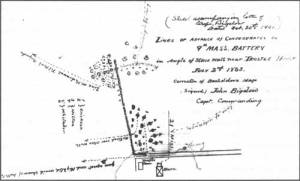
fig23

Sickles ordered Major Tremain to find General Birney and said “Tell General Birney he must take command.” [36] as a tourniquet was placed on his leg and his soldiers prepared to evacuate him to the rear, thinking that his wound might well be mortal. When the stretcher bearers arrived the wounded general, never missing a chance to build upon his legacy, “had an NCO light his cigar, and that was how he was carried away, cap over his eyes, cigar in mouth, hands folded on chest.” [37] Sickles was taken to the rear by ambulance where his leg was amputated in a field hospital that night. A soldier of the 17th Maine wrote, “Our last sight of him in the field ambulance is one we shall long remember….He was sitting in an ambulance smoking and holding his shattered limb and appeared as cool as though nothing had happened.” [38] His surgeon was using a new method of amputation and he had read that “the Army Medical Museum in Washington was advertising for samples, and so, instead of throwing the limb into a heap, he had it wrapped in a wet blanket and placed in a small coffin for shipment to Washington.” [39] In the years following Sickles paid his leg many visits and it can still be viewed along with a round shot similar to the one that wounded him at National Museum of Health and Medicine in Washington D.C.

The disaster that engulfed Sickles’ Third Corps now threatened the Federal center. Meade and Hancock rushed reinforcements in the form of Fifth Corps and much of Second Corps. The tip of the Sickle’s salient at Sherfy’s Peach Orchard manned by Graham’s brigade of David Birney’s division was overwhelmed and retreated in disorder. Once “the angle had been breached, the lines connecting to it on the east and north were doomed.” [40] This exposed the left of Humphrey’s division and it too was forced to retreat under heavy pressure sustaining heavy casualties. The final collapse of Humphrey’s division a large gap opened in the Federal lines between the elements of Fifth Corps fighting along Devil’s Den and Little Round Top and Second Corps along the central portion of Cemetery Ridge.

The Battle on the Plum Run Line July 2nd

When Meade realized the seriousness of the situation he gave Sickles’ free reign to call for reinforcements from Harry Hunt’s Artillery Reserve as III Corps had only batteries organic to it. Those five batteries were in the thick of the fighting providing invaluable support to Sickles’ hard pressed and outnumbered corps. Firing canister and grapeshot they cut swaths of death and destruction through the massed ranks of wildly cheering Confederates of Kershaw and Semmes and Barksdale’s brigades of McLaws’ division. Kershaw recalled:

“The Federals…opened on these doomed regiments a raking fire of grape and canister, at short distance, which proved most disastrous, and for a time destroyed their usefulness. Hundreds of the bravest and best men of Carolina fell….” [41]

mcgilvery

Lieutenant Colonel Freeman McGilveryThis Fiery Line

The Confederates believed that they had cut the Union line in half and advanced through the Peach Orchard and across the Wheat Field toward Cemetery Ridge. But they were to befall another furiously conducted defense, this by artillery hastily collected along what is known as the Plum Run Line.

Among the artillery called into action was the First Volunteer Brigade under the command of Lieutenant Colonel Freeman McGilvery. McGilvery was a Maine native and a former sea captain who had left the high seas to volunteer to serve the Union cause, and it was fortunate for the Union that this officer, knew how to inspire his artillerymen feats many thought unattainable in combat. On obtaining his commission as a Captain of Maine Volunteers, McGilvery organized and commanded the 6th Battery of the 1st Maine Volunteer artillery in January 1862.

McGilvery commanded that unit with distinction in a number of engagements. At the Battle of Cedar Mountain on August 9th 1863, “During the battery’s baptismal fire, McGilvery and his Maine cannoneers, in one general’s opinion, had “saved the division from being destroyed or taken prisoners.” [42] A few days later, operating without infantry support yet again, “The battery performed spectacularly during the Second Manassas campaign, bringing recognition to its salty commander.” [43] He was promoted to Major in early 1863 and assumed command of the brigade during the Chancellorsville campaign. Following Chancellorsville McGilvery was given command of the newly formed First Volunteer Brigade of the Artillery Reserve. Barley a month later as the Army of the Potomac pursued Lee’s Army through Virginia and into Maryland he was promoted to Lieutenant Colonel.

McGilvery’s battalion was directed by Brigadier general Tyler of the Artillery Reserve to assist Sickles, and Henry Hunt met them on the road and directed them into position. McGilvery’s batteries arrived in the sector between 3:30 and 4:00 p.m. and “he was told by Sickles to examine the ground and pace the guns where he saw fit.” [44] He placed his four batters, some twenty-two guns in the Peach Orchard to support the artillery of Third Corps. Three batteries were placed in the Orchard itself near the Emmitsburg Road, and the fourth, the 9th Massachusetts under the command of Captain John Bigelow was deployed near the Trostle Farm. Without infantry support “It would be their job to hold the road down to the stony ridge by themselves.” [45] “Though hurt by enfilading fire from some of Alexander’s batteries, McGilvery’s guns in company with others from the reserve and the Third Corps had exchanged blow for blow with Confederate artillerymen for about two hours and had broken up the movements of some enemy infantry columns.” [46] These batteries were key in the first repulse of Kershaw and Semmes’ brigades at the stony ridge and which mortally wounded Semmes. McGilvery wrote:

“At about 5 o’clock a heavy column of rebel infantry made its appearance in a grain field, about 850 yards in front, moving at quick time toward the woods on our left, where infantry fighting was going on (front of the Round Tops). A well directed fire from all the batteries was brought to bear on them, which destroyed their order of march and drove many back into the woods on the right… In a few minutes another and larger column appeared, at about 750 yards, presenting a slight left flank to our position. I immediately trained the entire line of guns upon them and opened fire with various kinds of ammunition. The column continued to move on at double quick until it reached a barn and farm house immediately in front of my left battery (Bigelow’s) about n450 years distant. When it came to a halt (a shot had killed its commanding officer) I gave them canister and solid shot with such good effect, that, I am sure that several hundred were put hors du combat in a short time….” [47]

The Union batteries continued a destructive fire against various Confederate regiments and brigades but suffered from Confederate artillery fire and close in infantry assaults. Finally, “the pressure of the rebels became too great, and all of McGilvery’s batteries except Bigelow’s retired from this part of the field.” [48] Bigelow wrote, “No friendly supports of any kind were in sight…but Johnnie Rebs in great numbers. Bullets were coming in to our midst from many directions and a Confederate battery added to our difficulties.” [49]

McGilvery rode into the maelstrom of the retreating Third Corps soldiers and guns broken by Alexander’s withering fire. As he rode to and from each battery his horse was hit four times by enemy fire, but the salty artilleryman remained unwounded despite “exposing himself to enemy missiles on all parts of the field from Cemetery Ridge to the Peach Orchard.” [50] As he surveyed the scene he realized that there was no infantry in the immediate area that could plug the gap in the line. Taking the initiative, McGilvery acted instantly on his own authority to make a decision that in all likelihood saved the Union line.

In the confusion of the Third Corps disintegration, with soldiers fighting their way back to Cemetery Ridge and small groups and batteries attempting to keep their guns from being captured, McGilvery rode up to Bigelow and his 9th Massachusetts battery, which now stood alone at the Trostle farm. McGilvery told Bigelow, who was starting to make preparations to withdraw back to Cemetery Ridge, that he and his battery must “hold at all hazards.” [51]

Bigelow later explained that McGilvery told him that “for 4 or 500 yards in my rear there were no Union troops.” He was then instructed by McGilvery “For heavens [sic] sake hold that line…until he could get some other batteries in position…” [52] In another account Bigelow recorded “Captain Bigelow…there is not an infantryman back of you along the whole line which Sickles moved out; you must remain where you are and hold your position at all hazards, and sacrifice your battery if need be, until at least I can find some batteries to put in position and cover you.” [53]

The order could have been considered suicidal, the 21st Mississippi was nearly upon them and they were but one battery and barely one hundred troops. Bigelow did not hesitate to obey; he brought his guns into line at the Trostle house “facing one section slightly to the southwest and the other two sections directly into the path of the oncoming Confederates.” [54]

Henry Hunt described the action, “Bigelow’s 9th Massachusetts made a stand close by the Trostle house in the corner of the through which he had withdrawn with prolonges fixed. Although already much cut up he was directed by McGilvery to hold that point until a line of artillery could be formed in front of the wood beyond Plum Run; that is, on what we now call the “Plum Run line.” [55]
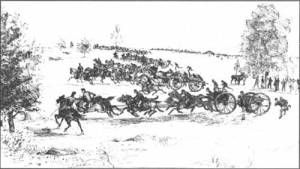
fig20

Bigelow’s Drawing of the action at Trostle Farm

Bigelow’s artillerymen fought like demons he described the effect of his fire on Kershaw’s South Carolinians “the Battery immediately enfiladed them with a rapid fire of canister, which tore through their ranks and sprinkled the field with their dead and wound, until they disappeared in the woods on our left, apparently a mob.” [56] They poured a merciless stream of fire into the advancing Confederates until “they had exhausted their supply of canister and the enemy began to close in on his flanks.” [57] A German born gunner noted “we mowed them down like grass, but they were thick and rushed up.” [58] A hand to hand fight ensued among the guns but the Massachusetts men escaped losing 28 of its 104 men engaged,[59] their brave commander Bigelow was wounded and nearly captured but one of his men helped him to the rear.

Their sacrifice was not in vain. They bought McGilvery an additional half an hour to set up a new line of guns along Plum Run, it was a masterful exercise of improvisation under incredible pressure. “This line was formed by collecting the serviceable batteries, that were brought off, with which, and with Dow’s Maine battery fresh from the reserve, the pursuit was checked. Finally some twenty-five guns formed a solid mass, which unsupported by infantry held this part of the line, aided General Humprheys’s movements, and covered by its fire the abandoned guns until the could be brought off, as all were, except perhaps one. When, after accomplishing its purpose, all that was left of Bigelow’s battery was withdrawn.” [60] Hunt praised the effort of Bigelow’s men to give McGilvery the necessary time to form his new gun line. “As the battery had sacrificed itself for the safety of the line, its work is specially noticed as typical of the service that artillery is not infrequently called to render, and did render in other instances at Gettysburg besides this one.”[61]

Barksdale’s brigade did not pause and continued in their relentless advance towards Cemetery Ridge, sweeping Union stragglers up as they moved forward led by their irrepressible Colonel. Before them was McGilvery’s new line, hastily cobbled together from any batteries and guns that he could find. Initially the line was composed of about fifteen guns of four different batteries and McGilvery was he was joined by two more batteries. This gave him a total of about twenty-five guns on the new line. Subjected to intense Confederate artillery fire and infantry attacks McGilvery’s batteries held on even as their numbers were reduced until only six guns remained operational. “Expertly directed by McGilvery a few stouthearted artillerymen continued to blaze away and keep the low bushes in front of them clear of lurking sharpshooters. Although they had no infantry supports, they somehow managed to create the illusion that the woods to their rear were filled with them, and they closed the breach until the Union high command could bring up reinforcements.” [62]

However, it was McGilvery who recognized the emergency confronting the line and on his own took responsibility to rectify the situation. He courageously risked “his career in assuming authority beyond his rank” [63] and without his quick action, courage under fire and expert direction of his guns Barksdale’s men might have completed the breakthrough that could have won the battle for General Lee despite all of the mistakes committed by his senior leaders that day.

It was another example of an officer who had the trust of his superiors who did the right thing at the right time. It is an example of an officer used the principles of what we today call Mission Command to decisively impact a battle. McGilvery rose higher in the Federal service and was promoted to Colonel and command of the artillery of Tenth Corps. He was slightly wounded in a finger at the battle of Deep Bottom in August 1864. The wound did not heal properly so surgeons decided to amputate the finger. However, during the operation they administered a lethal dose of chloroform anesthesia to the brave colonel and he died on September 9th 1864. When he died the Union lost one its finest artillerymen. His body was returned to his native Maine and buried. However, he was not forgotten. In 2001 Maine legislature designated the first Saturday in September as Colonel Freeman McGilvery Day.

As Barksdale’s Mississippians advanced, Wofford’s Georgians moved forward on their right. It was the advance of Wofford’s men that caused Crawford’s men to pull back from the stony hill and the Wheatfield. That brigade “drove into the gap between the Peach Orchard and de Trobriand’s old position on Stony Hill. The Georgians were an especially welcome sight to Kershaw’s weary South Carolinians, trying to sort themselves out on Rose’s farm.” [64] The remnants of Kershaw’s brigade joined in the advance to the right of Wofford and forced the survivors of Zook, Kelly, and Sweitzer’s brigades from the stony hill. The Confederates advanced driving the Union troops before them and plunged into the valley at the base of Little Round Top. Here that were met by the fresh division of the Pennsylvania Reserves which launched a counterattack, “driving the Southerners back across the ridge and into the Wheatfield…and the fighting on that section of the battlefield on that section abated into deadly sharpshooting.” [65] Longstreet, knowing that nothing more could be done in the sector ordered his troops back.

Barksdale’s advance also affected the Humphrey’s division which up to this point had not been severely engaged and had acquitted itself well against elements of Richard Anderson’s division of A.P. Hill’s corps. When Sickles was wounded he turned command of the Third Corps over to Birney. In spite of being flanked by Barksdale and pressed by Anderson, Humphreys planned to counter attack, but Birney order him back to Cemetery Ridge. One of Humphreys’ aides recalled the scene, “The crash of artillery and the tearing rattle of our musketry was staggering, and added to the noise on our side, the advancing roar & cheer of the enemy’s masses, coming on like devils incarnate.” [66] Pressed hard, Humphreys pulled his troops back in a delaying action and the division suffered about 1,200 casualties, “but it came out intact with morale sound and still full of fight.” [67]
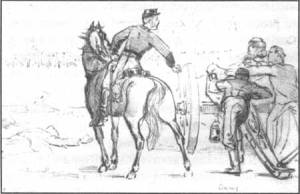
fig22

The High Water Mark

Led by their exuberant commander the brigade pushed past the Trostle farm and into the Plum Run Valley, continuing to take casualties from the stubborn survivors of Third Corps. Now unsupported Barksdale continued to press forward toward cemetery Ridge, a soldier of the 13th Mississippi “recalled the sight of the mounted Barksdale encouraging the boys onward, yelling, “Forward through the brushes.” [68] Barksdale believed that he and his Mississippians could still wrest victory from defeat and he kept urging his decimated brigade forward in spite of the odds.

However, the tide was about to shift for the last time, as Barksdale’s survivors reached the lower portion of Cemetery Ridge a fresh Federal brigade arrived. Commanded by Colonel George Willard this brigade, struck the Mississippians. Willard’s brigade was seeking redemption having been one of the units forced to surrender at Harpers Ferry the previous September. His troops were fresh and full of fight fell upon the Mississippians. “Taking advantage of the downhill grade, they charged headlong into the right flank of Barksdale’s brigade.” [69] As they did so the New Yorkers shouted, “Remember Harper’s Ferry! Remember Harpers Ferry!” “A short but terrible contest ensured in the bushes in the swale” and the Mississippians; “fire slackened and they began to give back.” As they did, “large numbers of them, staring at “the very points of our bayonets,” surrendered and “lay down in ranks.” [70]

The attack by Willard’s brigade broke the Mississippians who had swept so many others before them, but now Barksdale’s troops were spent and disorganized having reached their culminating point of their attack. When the two sides collided in the swale, “the New Yorkers were at the peak of their frenzy, while the Mississippians had spent theirs.” [71] Barksdale “in his gold-braided roundabout jacket, was “almost frantic with rage” at the repulse of his brigade, and “was riding at the front of his troops” and trying to make his men stand.” [72] He was now a conspicuous target and the men of 125th and 126th New York opened fire on him, hitting him “in the chest, puncturing a lung, and in his left leg fracturing a bone.” [73] The gallant officer fell from his horse, mortally wounded as his troops driven back by the New Yorkers. A party of Union soldiers recovered him and took him to a Federal field hospital where he “told his minders “tell my wife I fought like a man and I will die like one.” [74] The former Congressman died the next “morning, his thirst for glory slaked at last.” [75] His final opponent, Colonel George Willard did not live long to savor the redemption that he and his brigade won that afternoon as he was hit “full in the face by a fragment of a shell and died instantly.” [76]

To the north of the salient Anderson’s division of Hill’s corps made a disjointed and uncoordinated attack at toward Cemetery Ridge. Due to apparently garbled orders from Anderson, neither Carnot Posey’s or “Little Billy” Mahone’s brigades advanced. Ambrose Wright’s troops went forward, but his claims to have breached the Federal line are romantic fiction at best, and David Lang’s tiny Florida brigade made only a desultory advance before retiring. Cadmus Wilcox’s brigade advanced unsupported up to Cemetery Ridge which due to the dispatch of troops to the Peach Orchard was only lightly defended.

When Hancock saw the threat he ordered the 1st Minnesota commanded by Colonel William Covill, all of 262 men to charge the advancing Confederates. Hancock told Covill: “Colonel, do you see those colors?…Then take them.” [77] Second Lieutenant Lochran of the regiment remembered the moment “Every man realized in an instant what that order meant, – death or wounds to us all; the sacrifice of the regiment to gain a few minutes time to save the position, and probably the battlefield…” [78] Covill’s tiny force “of a little over three hundred men tore into Wilcox’s right and stopped it cold.” [79] But the cost to the regiment was high, “Covill and all but three of his officers were killed or wounded, together with 215 of his men.” [80] Covill’s gallant troops bought time for Hancock to bring up Gibbon’s division which forth a heavy fire of musketry and were joined by the artillery which just minutes before had ravaged Barksdale’s Mississippians Wilcox, now staggered Wilcox’s regiments. Having taken a fair number of casualties he saw that he had no help or support from the rest of Anderson’s division, and reluctantly he withdrew his brigade from Cemetery Ridge .He later reported, “With a second supporting line the heights could have been carried. Without support on either my right or my left, my men were withdrawn to prevent their entire destruction or capture.” [81]

By the evening fresh Federal troops directed by Meade, Hancock and Hunt poured into the sector. Dan Sickles’ impetuous gamble was a near disaster for the Army of the Potomac, but the cool determination of his soldiers, the outstanding work of the Federal artillery, and the active leadership provided by Meade, Hancock, Warren, and Hunt enabled the army to repulse the Confederate assault. But it had been “another close call, staving off another Chancellorsville through unscripted decisions and split second timing.” [82] By the end of the day despite sustaining massive casualties the Federal Army held its ground and the Confederates, with the exception of their lodgment at Devil’s Den returned to their start positions.

The fighting around the Peach Orchard, the Wheatfield and Devil’s Den was confusing as units of both sides became mixed up and cohesion was lost. Both sides sustained heavy casualties but Lee’s Army could ill afford to sustain such heavy losses. By the end of the evening both McLaws and Hood’s divisions were spent having lost almost half of their troops as casualties. Hood was severely wounded early in the fight, and many other Confederate commanders were killed or mortally wounded including the irrepressible Barksdale and Paul Semmes of McLaws’ division.

Amid the carnage there were acts of kindness shown towards one another by men who not long before had been mortal enemies. Private John Coxe of the 2nd South Carolina wrote:

“I felt sorry for the wounded enemy, but we could do little to help them. Just before dark I passed a Federal officer sitting on the ground with his back resting against a large oak tree. He called me to him, and when I went he politely asked me to give him some water. There was precious little in my canteen, but I let him empty it. His left leg was crushed just above the ankle, the foot lying on the ground sidewise. He asked me to straighten it up, and as I did so I asked him if the movement hurt him. “There isn’t much feeling in it now,” he replied quietly. Then before leaving him I said, “Isn’t this war awful?” “Yes, yes,” said he, “and all of us should be in a better business….” [83]

That evening the exhausted Confederate troops consolidated their positions on the few places where they had made lodgments in near the Federal line, tending to their wounded and seeking shelter among the rocks, trees and the dead. The Federal troops tended to the wounded around their lines while Henry Hunt’s artillerymen repaired their batteries as the night fell and their generals took counsel.

Notes

[1] Ibid. Hessler Sickles at Gettysburg p.193

[2] Ibid. Foote The Stars in Their Courses p.136

[3] Freeman, Douglas Southall, Lee’s Lieutenant’s a Study in Command, One volume abridgment by Stephen W Sears, Scribner, New York 1998 p.580

[4] Ibid. Hessler Sickles at Gettysburg p.193

[5] Ibid. Longacre The Man Behind the Guns p.165

[6] Ibid. Alexander Fighting for the Confederacy p.239

[7] Ibid. Gottfried The Artillery at Gettysburg p.119

[8] Ibid. Pfanz Gettysburg, the Second Day p. 312

[9] Ibid. Alexander Fighting for the Confederacy p.239

[10] Alexander, Edward Porter. The Great Charge and the Artillery Fighting at Gettysburg, in Battles and Leaders of the Civil War Volume III The Tide Shifts Edited by Robert Underwood Johnson and Clarence Clough Buel Castle, Secaucus NJ p.360

[11] Ibid. Longacre The Man Behind the Guns p.167

[12] Ibid. Tagg The Generals of Gettysburg pp.217-218

[13] Ibid. Dowdy. Lee and His Men at Gettysburg p.217

[14] Tucker, Phillip Thomas. Barksdale’s Charge: The True High Tide of the Confederacy at Gettysburg, July 2nd, 1863 Casemate Publishers, Philadelphia and Oxford 2013 p.14

[15] Ibid. Tucker Barksdale’s Charge p.15

[16] Ibid. Goldfield America Aflame p.144

[17] Freehling, William. The Road to Disunion Volume II: Secessionists Triumphant 1854-1861 Oxford University Press, Oxford and New York 2007 p.140

[18] Ibid. Tucker Barksdale’s Charge p.18

[19] Ibid. Tucker Barksdale’s Charge p.17

[20] Warner, Ezra J. Generals in Gray: Lives of Confederate Commanders Louisiana State University Press, Baton Rouge 1959, 1987 p.343

[21] Ibid. Warner. Generals in Gray p.343

[22] Ibid. Guelzo, Gettysburg: The Last Invasion p.296

[23] Ibid. Tagg The Generals of Gettysburg p.221

[24] Ibid. Guelzo, Gettysburg: The Last Invasion p.297

[25] Ibid. Guelzo, Gettysburg: The Last Invasion pp.296-297

[26] Ibid. Dowdy Lee and His Army at Gettysburg p.221

[27] Ibid. Hessler Sickles at Gettysburg p. 193

[28] Ibid. Catton Glory Road p.295

[29] Ibid. Alexander The Great Charge and the Artillery Fighting at Gettysburg p.360

[30] Ibid. Guelzo Gettysburg, the Last Invasion p.308

[31] Ibid. Trudeau Gettysburg a Testing of Courage p.368

[32] Ibid. Guelzo Gettysburg, the Last Invasion p.310

[33] Ibid. Hessler Sickles at Gettysburg p. 202

[34] Ibid. Trudeau Gettysburg, the Testing of Courage p.368

[35] Ibid. Hessler Sickles at Gettysburg p. 202

[36] Ibid. Swanberg Sickles the Incredible p.217

[37] Ibid. Keneally American Scoundrel p.288

[38] Ibid. Hessler Sickles at Gettysburg p. 207

[39] Ibid. Keneally American Scoundrel p.289

[40] Trudeau, Noah Andre Gettysburg: A Testing of Courage Harper Collins, New York 2002 p.368

[41] Ibid. Kershaw Kershaw’s Brigade at Gettysburg p.335

[42] Ibid. Tucker Barksdale’s Charge p.188

[43] Ibid. Gottfried The Artillery at Gettysburg p.97

[44] Ibid. Gottfried The Artillery at Gettysburg p.97

[45] Ibid. Guelzo Gettysburg p.307

[46] Ibid. Coddington The Gettysburg Campaign a Study in Command p.415

[47] Bigelow, John The Peach Orchard Gettysburg, July 2nd 1863, Explained by Official Reports and Maps. Primary Source edition., Originally published by Kimball-Storer Co. Minneapolis 1910 p.20

[48] Ibid. Coddington The Gettysburg Campaign a Study in Command p.416

[49] Ibid. Trudeau Gettysburg a Testing of Courage p.384

[50] Coco, Gregory A. A Concise Guide to the Artillery at Gettysburg Colecraft Industries, Orrtanna PA 1998 p.31

[51] Hunt, Henry Proceeded to Cemetery Hill in Battles and Leaders of the Civil War Bradford, Ned editor, Meridian Books, New York 1956 p.378

[52] Ibid. Guelzo Gettysburg p.314

[53] Ibid. Trudeau Gettysburg a Testing of Courage p.385

[54] Ibid. Trudeau Gettysburg a Testing of Courage p.385

[55] Hunt, Henry. The Second Day at Gettysburg in Battles and Leaders of the Civil War Volume III, The Tide Shifts. Edited by Robert Underwood Johnson and Clarence Clough Buel Castle, Secaucus NJ p.310

[56] Bigelow, The Peach Orchard, 54; History of the Fifth, 638 retrieved from WE SAVED THE LINE FROM BEING BROKEN: Freeman McGilvery, John Bigelow, Charles Reed and the Battle of Gettysburg by Eric Campbell http://www.nps.gov/history/history/online_books/gett/gettysburg_seminars/5/essay4.htm#52

[57] Ibid. Coddington The Gettysburg Campaign p.416

[58] Ibid. Guelzo Gettysburg the Last Invasion pp.314-315

[59] Ibid. Hunt Proceeded to Cemetery Hill p.379

[60] Ibid. Hunt The Second Day at Gettysburg p.310

[61] Ibid. Hunt Proceeded to Cemetery Hill p.379

[62] Ibid. Coddington The Gettysburg Campaign p.417

[63] Ibid. Coddington The Gettysburg Campaign p.417

[64] Ibid. Sears Gettysburg p.302

[65] Ibid. Wert A Glorious Army p.262

[66] Ibid. Trudeau Gettysburg, the Testing of Courage p.379

[67] Nofi, Albert A. The Gettysburg Campaign June – July 1863 Third Edition Combined Publishing, Conshohocken, PA 1986 p.128

[68] Ibid. Tucker Barksdale’s Charge p.221

[69] Ibid. Coddington The Gettysburg Campaign a Study in Command p.417

[70] Ibid. Guelzo Gettysburg, the Last Invasion p.325

[71] Ibid. Trudeau Gettysburg, the Testing of Courage p.388

[72] Ibid. Guelzo Gettysburg, the Last Invasion p.325

[73] Ibid. Wert A Glorious Army p.262

[74] Ibid. Guelzo Gettysburg, the Last Invasion p.325

[75] Ibid. Foote The Civil War, A Narrative: Fredericksburg to Meridian p.509

[76] Ibid. Tucker Barksdale’s Charge p.231

[77] Ibid. Trudeau Gettysburg, the Testing of Courage p.393

[78] Ibid. Gragg The Illustrated Gettysburg Reader p.222

[79] Ibid. Coddington The Gettysburg Campaign a Study in Command p.423

[80] Ibid. Foote The Civil War, A Narrative: Fredericksburg to Meridian p.509

[81] Ibid. Luvaas and Nelson Guide to the Battle of Gettysburg p.128

[82] Ibid. Guelzo Gettysburg, the Last Invasion p.334

[83] Ibid. Gragg The Illustrated Gettysburg Reader p.205


Leave a comment

Filed under civil war, Gettysburg, History, leadership, Military

July 2nd at Gettysburg Pt. 5: The Wheatfield

gettysburg-1

Friends of Padre Steve’s World

For those that have followed my writing for some time you know that I teach military history and ethics at the Joint Forces Staff College. One of the great joys that I have is leading the Gettysburg Staff Ride, which is an optional event for students that want to participate. When I took the position here I took some of my older writings on Gettysburg and put them into a student study guide and text. That was two years ago. Then the text was about 70 pages long. It is now about 925 pages long and eventually I hope to get it published. When and if that happens I expect it to become two, and possibly three books.

This is the fifth of a series of articles that I will be posting potions of a chapter that I have rewritten about the critical battles on the south side of the battlefield on July 2nd 1863, the battle for Devil’s Den, the Wheatfield, the Peach Orchard, and the final repulse on Cemetery Ridge.

As you read this don’t just look at the events, but look at the people, and their reaction to the what they encountered on the battlefield, for that understanding of people is where we come to understand history.

So even if you are not a Civil War buff, or even a history buff, take the time to look at the people, their actions, and the things that made them who they were, and influenced what they did. History is about people.

So please enjoy,

Peace

Padre Steve+

To the left of Benning, “Tige” Anderson’s brigade and two of Robertson’s orphaned regiments assaulted the remaining elements of Hobart Ward’s brigade along the western section of Houck’s Ridge and Rose’s Woods. Ward had been assigned by his division commander, David Birney to defend the left flank of Sickles over-extended line. To do so he had already placed the men of the 124th New York and the 4th Maine on his left, while those remaining took position on Houck’s Ridge and in Rose’s Woods. Like the other units of Third Corps, these troops were all veterans led by veteran officers and they would not give ground without a fight. However, Ward’s troops had not taken the time to erecting any hasty fortifications or breastworks, as one “veteran remembered it, “we had not yet learned the inestimable value of breastworks, and instead of spending time rolling the loose stones into a bullet-proof line, we lounged about on the grass and rocks.” [1] But when the Confederate assault began, these men took advantage of the nature terrain features which made it formidable even without such efforts.

As the Confederates moved against Ward’s troops on the ridge and in Rose’s Woods their left flank made contact with the adjoining brigade of Regis de Trobriand, the leftmost regiment of which, the 17th Maine was posted at the southwest corner of the Wheatfield. As the Union infantry regiments braced for the attack, the Confederate formations were shredded by the shells of the Federal artillery which crashed upon them. “I could hear bones crash like glass in a hail storm,” asserted a Georgian. Colonel Dudley M. DuBose of the 15th Georgia avowed, “I never saw troops move on more steadily & in better order than these did on that occasion.” [2] Despite the carnage the Georgians continued on, and when they got within seventy-five yards of the 17th Maine opened a blistering fire which “slowed Anderson’s brigade’s assault but certainly did not stop it.” [3] Lieutenant Colonel Charles Merrill of the 17th Maine wrote:

“We opened fire on the enemy, then within 100 yards of us. The contest became very severe, the enemy at times being driven back by our line, then by superior numbers compelling us in turn to give way. The ground was hotly contested, but we held our position till, finding the right of my regiment outflanked and exposed to murderous fire from the enemy’s reinforcements, I was obliged to form a new line, changing the right wing of the regiment into position at a right angle to the left. This movement was executed in good order, under a heavy fire from the advancing foe. In this position we continued to fight, checking the enemy till, receiving orders to retire, we fell back across a wheat-field in our rear to the edge of the woods.” [4]

Anderson’s Confederates continued their attack and as they advanced Anderson was wounded and Colonel W.W. White took command, and while the Georgians had succeeded in taking some ground and inflicted heavy casualties on the Federal troops, the brigade was spent. Attesting to the severity of the fight Colonel White wrote, “From the exhausted condition of the men, together with the fact that the enemy were pouring in large re-enforcements on the right, it was deemed impractical to follow him further… The brigade retired in good order across the ravine, and went into bivouac for the night…. The loss of the brigade was heavy…. 105 killed, 512 wounded, and 146 missing.” [5]

The fight in Rose’s Woods and the Wheatfield between Birney’s division and the men of Benning and Anderson’s brigades drew in other units and McLaws’ division entered the fight and the men of Caldwell’s division of the Federal Fifth Corps entered the battle. Initially, the Union infantry was outnumbered but it had the support of the artillery that Henry Hunt had rushed into the fight. The brigades to the right of the woods on the rocky hill commanded by Tilton and Sweitzer were rapidly becoming isolated as the Confederates advanced to their rear and Kershaw’s South Carolina brigade “appeared through the smoke” like a malevolent fury, “moving with shout, shriek, curse, and yell…loading and firing with deliberation as they advanced, begrimed and dirty-looking fellows in all sorts of garb, some without hats, some without coats, none apparently in the real dress or uniform of a soldier.” [6]

Joseph Kershaw was one of the few Confederate commanders without a legacy to protect to write in detail about the battle in the Wheatfield. Kershaw was a lawyer and politician who had served in the Mexican-American War with the Palmetto Regiment. After the war he went back to civilian life and served as a member of the South Carolina State Senate. When South Carolina seceded from the Union, Kershaw volunteered for service and was made Colonel of the 2nd South Carolina Volunteer Infantry which he commanded at Fort Sumter, Bull Run, and on the Peninsula. “Natural leadership and applied intelligence had advanced him to brigades command, and he was tabbed for future material for division command.” [7] As a brigade commander he distinguished himself during the Seven days, Second Bull, Run, Antietam, and Fredericksburg. Kershaw was an natural leader and displayed an ability for “quick and rational decisions, and he never endangered his men rashly” [8] His division commander, Lafayette McLaws had a tremendous amount of trust and respect for his subordinate. “Pious, intelligent, a clear blond of high bred, clean-cut features, he had the bearing of command and a clear voice that seemed to inspire courage when it was raised in battle.” [9] Kershaw was “probably the most popular brigade commander in the entire Army of Northern Virginia. His South Carolinians – the 2,100 men of the 2nd, 3rd, 7th, 8th, and 15th South Carolina, along with the seven companies that made up the 3rd South Carolina Battalion – adored him as “a very fine man and good officer” who is liked by everyone.” Actually, this forty-one-year-old lawyer from Camden…was a chronic depressive, unhappily married, and “intensely lonely” [10] That did not diminish the love of his men for him, and His brigade had been the lead unit of the First Corps’ disastrous movement to contact that afternoon, and he had watched the contra-temps between Longstreet’s and McLaws during the march and counter-march that morning and afternoon, and upon the discovery of Sickles’ troops in the Peach Orchard. His brigade, a unit of battle-hardened veterans may not have looked like soldiers due to the wear and tear of constant campaigning and the lack of new uniforms or equipment but they were among the toughest and most disciplined brigades on either side.

Kershaw’s brigade as well as the Georgia brigade of Brigadier General Paul Semmes, the brother of Rafael Semmes, the Captain of the raider CSS Alabama, formed the right flank of Lafayette McLaws’ attack on the Peach Orchard and the Wheatfield. Kershaw understood from his discussions with McLaws and Longstreet that his attack was supposed to be coordinated with that of Hood’s division on his right, which was “sweep down the Federal line in a direction perpendicular to our line of battle.” [11] and with Barksdale’s brigade on his left. However, as his troops prepared to jump off to start their attack Kershaw “got his first unpleasant surprise when he observed Hood’s brigades moving “independently against Round Top,” a departure from the plan that meant they would not “directly participate in the joint attack.” [12] Without Hood’s support on his right Kershaw was now completely dependent on Barksdale’s brigade on his left to hit the Peach Orchard to protect his left flank from the massed Federal artillery on that height.

When Kershaw received word to advance his troops moved off followed by Semmes’ brigade while Longstreet accompanied the brigade until it reached the Emmitsburg Road. Kershaw made a tactical decision which made sense but which had a major impact on his attack. “All field and staff officers were dismounted on account of the many obstacles in the way.” [13] Kershaw chose to move with his right regiments and being dismounted this diminished his ability to see what was going on with his left, and limited his ability to provide command and control. This was not a mistake, it was a sound tactical move due to the terrain and the exposure of mounted officers to sharpshooters and artillery directed specifically at them.

As Kershaw’s men advanced he looked for Barksdale’s brigade, and only then “heard Barksdale’s drums beat the assembly, and I knew then that I should have no immediate support on my left, about to be squarely presented to the heavy force of infantry and artillery at and in the rear of the Peach Orchard.[14] Without Barksdale on his flank Kershaw was forced to improvise, he divided his regiments with “two going straight toward the stony hill, he sent two to their left to take the Union batteries in the back of the peach orchard.” [15] Porter Alexander, commanding Longstreet’s artillery noted that “Barksdale’s delay “ was especially unfortunate in this case, because advancing Kershaw without advancing Barksdale would expose Kershaw to enfilade by troops who Barksdale would easily drive off. Few battlefields can furnish examples of worse tactics.” [16]

Up to the point of crossing the Emmitsburg Road, Kershaw’s regiments had a relatively easy advance, but as Kershaw feared, they were hit from the front and flank by rifle fire, and by artillery fire. “We saw plainly that their artillerists were loading their guns to meet our assault, while their mounted officers went dashing wildly from gun to gun, to be sure that all were ready,” recalled one soldier of the 2nd South Carolina, and when they opened fire, “every Federal cannon let fly at us” with solid shot and canister.” [17] The effect on Kershaw’s troops was devastating. Scores of his troops were cut down as they advanced, even so they continued to move forward. Private William Shumate of the 2nd South Carolina described the effect of the massed Union artillery fire on Kershaw’s troops. “Kershaw’s brigade moved…in perfect order and with the precision of brigade drill, while upon my right and left comrades were stricken down by grape and canister which went crashing through our ranks. It did not seem to me that none could escape.” [18] Kershaw’s left regiments were now approaching the Federal artillery and Kershaw had lost contact with them. As they approached the Union guns, those batteries ceased fire and prepared to withdraw.

Victory seemed assured and then the unthinkable happened, as it so often does in the confusion of battle and the fog of war; an order was issued by an unknown officer to change the direction of the attack. Evidently someone misunderstood “Kershaw’s orders or his intent and with this false order aborted the attack.” [19] The change of direction resulted in those regiments making a right flank and presenting their exposed left to the Federal artillery men, who now remained their guns and opened a devastating and merciless fire into the flank of the South Carolinians. Kershaw was livid and later wrote:

“The Federals returned to their guns and opened on these doomed regiments a raking fire of grape and canister, at short distance, which proved most disastrous, and for a time destroyed their usefulness. Hundreds of the bravest and best men of Carolina fell, victims of this fatal blunder.” [20]

A Massachusetts infantryman walked the field after the charge and noted, “Masses of Kershaw’s and Wofford’s brigades had been swept from the muzzles of the guns, which had been loaded either with double-shotted, or spherical case, with fuses being cut to one second, to explode near the muzzles. They were literally blown to atoms. Corpses strewed the ground at every step. Arms, heads, legs and parts of dismembered bodies were scattered all about, and sticking among the rocks and against the trunks of trees, hair, brains, entrails, and shreds of human flesh still hung, a disgusting, sickening, heart-rending spectacle to our young minds.” [21]

While his left regiments were being manhandled by the Federal artillery due to the errant order, Kershaw’s right regiments continued their attack on troops of De Trobriand, Sweitzer, and Tilton, on the stony hill. This landmark was in the process of being cut off from the rest of the Federal army as Anderson’s troops gained control of the Wheatfield.

On the surface it seems that the three brigades should have been enough to hold the stony hill, although this is not entirely clear from contemporary accounts or from the histories published since. But, there is one overriding opinion that comes through in most of the accounts, which is that there was a problem with Federal command and control on this section of the battlefield. When the Fifth Corps units of Barnes’ division began arriving in the Third Corps section, Sickles and Birney assumed that these troops were subordinated to their command, but Meade had given contrary orders to Sykes who assumed that the changed orders “relieved his troops from “any call from the commander of the Third Corps.” [22] Whether this was Meade’s plan, Sykes’ interpretation of his orders, or Sickles’ seeking to shift some of the blame for the near disaster to someone else depends on which account one reads.

Thus when pressure began to build on the stony hill as Kershaw’s troops advanced from the front and Anderson’s worked their way to the rear, Barnes or Tilton apparently gave orders to Tilton and Sweitzer, whose “brigades had put up a brief but determined fight along their end of the stony ridge” [23] to withdraw from their position. Like the other controversies of this day this too played out in the media long after the battle was over, however, Sweitzer “clearly reported that he did not retreat until after Tilton’s brigade had fallen back, and then fell back by Barnes’ order.” [24] What appeared to have happened was that the renewed advance of Kershaw’s troops had intimidated Barnes and Tilton, and Barnes, watching the advance with anxiety “issued a precautionary order for withdraw. It seems in retrospect that caution had gone beyond prudence to pessimism.” [25] De Trobriand, who had been encouraged by the arrival of the two brigades was stunned when he saw them withdraw and wrote, “I saw these troops rise up and fall back hurriedly at the command of their officers.” [26] He realized that his position was now untenable noting, “I found myself in danger of being surrounded, and fell back out of the woods” and reforming his lines kept “the enemy at bay until the arrival of sufficient reinforcements from the Second Corps allowed us to be relieved when our ammunition was just exhausted.” [27] The end result was that Kershaw’s troops, despite the heavy casualties that they had suffered now gained the summit of the stony hill and joined forces with Anderson’s brigade. “This success, coupled with the eviction of Ward’s brigade from its position at Devil’s Den, meant that the whole left wing of Sickles’s line had been smashed and that its right wing along the Emmitsburg Road was in jeopardy.” [28]

gettysburg-blog-photo-1

The arrival of the four brigades of John Caldwell’s division of Winfield Scott Hancock’s Second Corps occurred in a nick of time for the men along Sickles’ beleaguered line along the Wheatfield. One of these brigades was the Irish Brigade formerly commanded by Dan Sickles’ friend, and former defense attorney, Thomas Meagher, and now commanded by Colonel Patrick Kelly of the 88th New York. The Irish Brigade had been decimated in fight after fight, “now numbering only about five hundred men. Indeed, as one Irish Brigade officer noted, they “were a brigade in name only.” [29] When it became clear that the brigade was about to go into action, the brigade’s chaplain and after the war, the President of Notre Dame University, Father William Corby, realized that his duties “included the lifting the burden of sin from his flock through the act of conditional absolution.” [30] What followed was one of the most remembered events of the battle. Colonel Kelly:

“called the brigade to attention and commanded it to “Order Arms.” Father Corby stepped up on a boulder about three feet high, explained what he was about to do, and ended his remarks with the observation that the “Catholic church refuses Christian burial to the soldier who turns his back on the foe or deserts his flag.” The men of the brigade knelt, each man on his right knee, head uncovered, hat in left hand, rifle in right, and head bowed, while Chaplain Corby, raised his right hand and pronounced the Latin words of absolution.” [31]

When Father Corby pronounced the words “Dominus nos Jesus Christus vos absolvat” they were made more poignant by the sound of the guns and echoing explosions to their south. The commander of the 116th Pennsylvania noted that even General Hancock, a Protestant noted for his frequent blasphemy, was “watching from his horse, removed his hat and bowed his head. It was, as Corby later declared, an absolution for them all – Catholics and Protestants, northerners and southerners, all “who were susceptible of it who were about to appear before their judge.” [32] An observer wrote “The service was more than impressive, it was awe-inspiring.” [33]

Upon receiving his orders Caldwell moved his division forward crossing Plum Run and moving toward the Wheatfield at the double-quick. Colonel Edward Cross’s brigade was on the right. When Hancock saw him he remarked “Colonel Cross, this day will bring you a star.” Colonel Cross, looking up at Hancock, shook his head and replied gravely, “No General, this is my last battle.” [34] Cross normally wore a red bandana to allow his troops to recognize him in battle, but today he wore a black scarf on his head. As his troops advanced he called out to them, “Boys, you know what’s before you…give ’em hell.” [35] His brigade was followed by Kelly’s Irish Brigade and Brigadier General Samuel Zook’s brigade and that John Brooke. When Caldwell’s division struck it struck with fury, but was met with terrific resistance by Anderson’s men in the Wheatfield and Kershaw’s on the stony hill. Cross’s brigade was stopped before it could break through the Confederate line, with their commander being mortally wounded in the attack. Cross was hit in the abdomen and realizing his wound was mortal said “I hope that peace will be restored to our distressed country. I think that the boys will miss me. Say goodbye to all.” [36]

Wheatfield-irish

Zook’s brigade came next, taking its direction from Dan Sickles. The brigade “deployed near the Trostle farm, and advanced against Kershaw’s men on the stony hill.” [37] There they were met by withering fire, and Zook leading his men from the front was mortally wounded, his brigade suffering massive casualties even as they continued to advance and many “of the companies…came out commanded by sergeants.” [38] A survivor of the brigade remembered it, “the firing became terrific and the slaughter frightful. We were enveloped in smoke and fire, not only in our front, but on our left, and even at times on our right….Our men fired promiscuously, steadily pressing forward, but the fighting was so mixed, rebel and union lines so close together, and in some places intermingled, that a clear idea of what was going on was not readily obtainable.” [39] These stalwart men were followed by Kelly’s Irish Brigade and Brooke’s brigade, Caldwell’s last available unit, which moved through the Wheatfield and up the slope of the stony hill.

These brigades, as well as Sweitzer’s, which had been commandeered by Caldwell finally wrested control of the Wheatfield from Anderson and the stony hill from Kershaw. As the Irish advanced a South Carolina officer remarked “Isn’t that a magnificent sight.” [40] Kershaw later wrote that “the fighting was general and desperate all along the time and so continued for some time….I feared the brave men around me would be surrounded by the large force of enemy constantly increasing in numbers and all the while enveloping us. In order to avoid such a catastrophe, I ordered a retreat to the buildings at Rose’s.” [41] Major St. Clair Mulholland, commanding the 116th Pennsylvania of the Irish Brigade recalled the fight for the hill:

“Having entered a dense woods, we began to ascend a hill, where large bowlders of rocks impeded our progress, notwithstanding which we advanced in good order. We soon came within sight of the enemy, who occupied the crest of the hill, and who immediately opened fire at our approach. Our brigade returned the fire with good effect. After firing for about ten minutes, the order was given to advance, which the brigade did in excellent style, driving the enemy from their position, which we at once occupied….We found the position which our enemy had occupied but a few moments before thickly strewn with the dead and wounded.” [42]

For a time the mixed units that the Federals had committed to the fight for the Wheatfield and the stony hill, along with Sykes’s division of Regulars which had moved up to their left flank stabilized the Federal line. For a time it “appeared that the Rebel effort to overwhelm the Federal flank had failed, save for Devil’s Den. But the situation was changing quickly…”[43]. But the conduct of the battle, “in large part to Sickles, and with help from Longstreet’s execution of the attack, the situation was proving to be a bloody mess on both sides.” [44] The Federal occupation of the stony hill lasted barely twenty minutes when a new threat arose from the direction of the Peach Orchard, Caldwell’s success had placed the division in an exposed position and he had no reserves left to counter any Confederate move on his right flank.

To be continued…

Notes

[1] Ibid. Hessler Sickles at Gettysburg p.164

[2] Ibid. Wert A Glorious Army p.259

[3] Ibid. Pfanz Gettysburg, the Second Day p.247

[4] Ibid. Luvaas and Nelson Guide to the Battle of Gettysburg p.105

[5] Ibid. Luvaas and Nelson Guide to the Battle of Gettysburg p.108

[6] Ibid. Guelzo Gettysburg, the Last Invasion p.286

[7] Ibid. Dowdy Lee and His Men at Gettysburg p.197

[8] Ibid. Tagg The Generals of Gettysburg p.214

[9] Ibid. Pfanz Gettysburg, The Second Day p.151

[10] Ibid Guelzo Gettysburg, The Last Invasion p.282

[11] Ibid. Kershaw Kershaw’s Brigade at Gettysburg p.333

[12] Ibid. Trudeau Gettysburg, a Testing of Courage p.351

[13] Ibid. Kershaw Kershaw’s Brigade at Gettysburg p.334

[14] Ibid. Kershaw Kershaw’s Brigade at Gettysburg pp.334-335

[15] Ibid. Dowdy Lee and His Men at Gettysburg p.222

[16] Ibid. Hessler Sickles at Gettysburg p.181

[17] Ibid. Guelzo Gettysburg, the Last Invasion p.287

[18] Gottfried, Bradley The Artillery of Gettysburg Cumberland House Publishing, Nashville TN 2008 p.125

[19] Ibid. Sears Gettysburg p.285

[20] Ibid. Kershaw Kershaw’s Brigade at Gettysburg p.335

[21] Ibid. Gottfried The Artillery of Gettysburg p.126

[22] Ibid. Coddington The Gettysburg Campaign a Study in Command p.399

[23] Ibid. Guelzo Gettysburg, the Last Invasion p.286

[24] Ibid. Hessler Sickles at Gettysburg p.187

[25] Ibid. Pfanz Gettysburg, The Second Day p.259

[26] Ibid. Sears Gettysburg p.286

[27] Ibid. Luvaas and Nelson Guide to the Battle of Gettysburg p.114

[28] Ibid. Pfanz Gettysburg, The Second Day pp.264-265

[29] Bruce, Susannah Ural The Harp and the Flag: Irish American Volunteers and the Union Army, 1861-1865 New York University Press, New York and London 2006 p.160

[30] Ibid. Trudeau Gettysburg, a Testing of Courage p.303

[31] Ibid. Pfanz Gettysburg, The Second Day p.268

[32] Ibid. Bruce The Harp and the Flag p.165

[33] Ibid. Trudeau Gettysburg, a Testing of Courage p.303

[34] Ibid. Pfanz Gettysburg, The Second Day p.269

[35] Ibid. Guelzo Gettysburg, the Last Invasion p.291

[36] Ibid. Pfanz Gettysburg, The Second Day p.273

[37] Ibid. Trudeau Gettysburg, a Testing of Courage p.363

[38] Ibid. Guelzo Gettysburg, the Last Invasion p.295

[39] Ibid. Sears Gettysburg p.290

[40] Ibid. Trudeau Gettysburg, a Testing of Courage p.363

[41] Ibid. Kershaw Kershaw’s Brigade at Gettysburg pp.336-337

[42] Ibid. Luvaas and Nelson Guide to the Battle of Gettysburg p.117

[43] Ibid. Trudeau Gettysburg, a Testing of Courage p.367

[44] Ibid. Hessler Sickles at Gettysburg p.192

Leave a comment

Filed under civil war, Gettysburg, History, Military

July 2nd at Gettysburg Pt. 4: The Confederate Storm at Devil’s Den

Friends of Padre Steve’s World

For those that have followed my writing for some time you know that I teach military history and ethics at the Joint Forces Staff College. One of the great joys that I have is leading the Gettysburg Staff Ride, which is an optional event for students that want to participate. When I took the position here I took some of my older writings on Gettysburg and put them into a student study guide and text. That was two years ago. Then the text was about 70 pages long. It is now about 925 pages long and eventually I hope to get it published. When and if that happens I expect it to become two, and possibly three books.

This is the fourth of a series of articles that I will be posting potions of a chapter that I have rewritten about the critical battles on the south side of the battlefield on July 2nd 1863, the battle for Devil’s Den, the Wheatfield, the Peach Orchard, and the final repulse on Cemetery Ridge.

As you read this don’t just look at the events, but look at the people, and their reaction to the what they encountered on the battlefield, for that understanding of people is where we come to understand history.

So even if you are not a Civil War buff, or even a history buff, take the time to look at the people, their actions, and the things that made them who they were, and influenced what they did. History is about people.

So please enjoy,

Peace

Padre Steve+

Men_of_Granite

Fix bayonets my brave Texans

The delays had taken a toll on the Confederate plan. By the time Hood and McLaws divisions were in place along with Anderson’s division from Hill’s Third Corps it was nearly four o’clock. Throughout the day the senior commanders of the Army of Northern Virginia had made a thorough mess of their chances for success, but when the attack began it blew into the Federal forces like a violent storm as the Confederate troops fell upon the soldiers of Sickles Third Corps.

However, the Confederate assault was marred by still more command and control issues, the most important which happened in Hood’s division.. “Contrary to orders Hood had moved his division away from the Emmitsburg road for the purpose of taking Little Round Top and outflanking the Union position on the heights of Devil’s Den.” [1] Riding in front of his old Texas brigade, Hood called out “Fix bayonets my brave Texans…forward and take those heights.” His loyal troops responded to their former commander, and cheered his words in response: “Follow the Lone Star Flag to the Top of the mountain!” Cried the lieutenant colonel of the 1st Texas, and there “arose such a wild indescribable battle yell that no one having heard ever forgot.” [2]

McLaws had waited until Hood’s troops advanced across the rough ground that separated his division from “Smith recalled that his guns “tore gap after gap in the ranks of the Confederate foe.” Robertson agreed, reporting that as his brigade advanced through the intervening fields, “for half a mile we were exposed a heavy and destructive fire of canister, grape, and shell” [3] Little Round Top and Devil’s Den. As Hood’s division moved forward it came under artillery fire from the four 10 pound Parrot Rifles of Captain James Smith’s 4th New York Independent Battery on Houck’s Ridge above Devil’s Den and it began to sustain casualties. . Among the earliest to fall was John Bell Hood who was badly wounded when a shell “exploded above his head, and one of the fragments tore into his left arm.” The arm would have to be amputated and as he was taken away by stretcher-bearers recalled that he experienced “deep distress of mind and heart at the inevitable fate of my brave fellow-soldiers, who formed one of the greatest divisions of that world-renown army….” [4]

The absence of Hood would create a leadership void in his division as it made its attack on Devil’s Den and Little Round Top as his successor Evander Law was deeply engaged in leading his brigade in its epic fight at Little Round Top, and not able to influence or coordinate the attacks of the remaining brigades of the division. Coordination “between the brigades soon dissolved. Regiments in Law’s Alabama brigade veered apart, and a gap formed in the center of Jerome Robertson’s Texas Brigade. While these units angled toward the Round Tops, behind them, moving towards Rose’s Woods and Devil’s Den came the pair of Georgia brigades under Henry Benning and George T. Anderson.” [5] Order broke down, and soon control was at the company commander level or lower, “Every fellow was his own general,” a Texan later wrote. “Private soldiers give commands as loud as officers, nobody paying attention to either. [6] In the absence of Hood, Brigadier, and feeling the pressure of the situation, General J.B. Robertson commanding the Texas Brigade on Law’s left, took the initiative and sent couriers to Henry Benning and George Anderson “urging them to hurry their brigades to his support.” [7]

As Law’s brigade and two of Robertson’s regiments assaulted Little Round Top, the remainder of Robertson’s brigade as well as those of Benning and Anderson attacked the Federal position on Devil’s Den. There a fierce fight ensued as the badly outnumbered troops of the 124th New York under the command of Colonel Augustus Van Horn Ellis, and the four guns of Smith’s 4th New York Independent Battery refused to yield the hill to Robertson and Benning’s troops.

Men_Must_See_Us_Today_Gettysburg

The 124th New York was raised in Orange County New York, and a veteran unit, but it had taken many casualties and during the afternoon of July 2nd 1863 it went into action with just 18 officers and 220 men, in a position just to the left rear of Smith’s battery. The left flank of the 124th was protected by the tiny 4th Maine Infantry and the two remaining guns of Smith’s battery. Captain Smith whose battery had already expended its supply of case shot called out, “Give them she’ll! Give them solid shot! Damn them, give them anything!” [8]

Led by their gallant commander, who against the advice of a number of officers, mounted his horse and further exposed himself to enemy fire, the New Yorkers of the 124th were aware of their critical place on the battlefield. Looking at his Major Cromwell, Ellis remarked “the men must see us today.” [9] Cromwell cried out the order to charge the advancing Texans, and “the New Yorkers rushed down the west face of Houck’s Ridge at the double-quick. The 1st Texas reeled back some 200 yards under the surprise onslaught. “The conflict at this point defied description,” wrote an officer of e 124th. “Roaring cannon, crashing rifles, screeching shots, bursting shells, hissing bullets, cheers, shouts, shrieks and groans….” [10] A Confederate soldier wrote that the battle “was more like Indian fighting…than anything I experienced in the war.” [11] A reporter from the Savannah Republican accompanying Benning’s brigade wrote, “Down the plunging shot came…bursting before and around and everywhere tearing up the ground in a terrific rain of death….[As Benning’s brigade] approached the [Yankee] guns, the rain of grape and canister began! Mingling their sharp cries with the shrill whistle of the mad minnie balls which seemed to come in showers.” [12] The gallant regiment held off several attacks by Robertson’s Texans, and Ellis was killed by a bullet, as was Major Cromwell, and many of their gallant soldiers. “In the savage hand-to-hand fighting among the rocks, men shot at one another from the opposite side of the same Boulder, sometimes so close that clothing caught fire from the blaze of an enemy’s rifle. The high-pitched Rebel yell and the full-throated Federal huzzahs echoed through the rocks as first one side and then the other gave way…” [13]

In his after action report, Henry Benning wrote:

“When my first line reached the foot of the peak, I found there a part of the First Texas, struggling to make the ascent… The part of the First Texas…falling in with my brigade, the whole line commenced ascending the rugged…steep [incline] and, on the right, crossing the gorge. The ground was difficult – rocks in many places presenting, by their precipitous sides, insurmountable obstacles, while the fire of the was very heavy and very deadly. The progress was, therefore, not very rapid, but it was regular and uninterrupted….” [14]

With their supporting infantry considerably weakened, Smith’s guns were in danger. Some of Robertson’s troops had reached the base of the hill and taken cover behind a stone wall where they could take Smith’s artillery men under fire. Smith “could no longer depress his guns sufficiently to hit the Rebels. Occupying the low ground and using boulders for cover, the Confederates began to pick off Smith’s gunners. Smith “saw it would be impossible…to hold my position without assistance” and fell back…but the loss of artillery support was the beginning of the collapse of Sickles left flank.” [15] To the left in the Plum Run Valley, which later became known as the Valley of Death, the 4th Maine and Smith’s remaining guns fought off attacks by Robertson and Benning’s brigades before being forced to retreat. With his left now threatened Brigadier General Hobart Ward dispatched the 99th Pennsylvania to protect it, thinning his lines to do so. The Pennsylvanians of the 99th as well as men from the 124th New York, and the 4th Maine launched a counter-attack which succeeded in regaining the lower section of Houck’s Ridge. A soldier of the 99th recalled the moment his unit entered the fight, “Above the crack of the rifle, the scream of shells and the cries of the wounded, could be heard the shout of for “Pennsylvania and our homes…” [16] The cost had been great, but the ridge had been retaken from it the Union men rained fire down on the Alabamians below them in the Valley of Death. Hood’s men occupied Devil’s Den and secured a small lodgment on Houck’s Ridge which enabled the assault on Little Round Top to continue.

In a sense the fight at Devil’s Den was a victory for the Confederates as they had forced Ward’s troops from the position, but the human cost had been high among the men of the assaulting regiments. Robertson was wounded and had to be carried from the field, and most of the field officers of the Texas brigade were either killed or wounded leading their troops in the fight. Historian Harry Pfanz wrote, “The hard fighting at Devil’s Den, together with the sinister character of the spot, gave it a hallowed place in American history that might actually exceed its actual significance.” [17]

Robertson’s Texans and some of Law’s Alabamians surged up the slope of Little Round Top. But the sacrifice of the New Yorkers and Maine men was not in vain, they had helped buy the needed minutes for the soldiers of Colonel Strong Vincent’s brigade to arrive at the summit of Little Round Top, and Confederate casualties had been very heavy even before they attempted to scale the heights of Little Round Top.

To be continued…

Notes

[1] Ibid. Coddington The Gettysburg Campaign p.402

[2] Ibid. Guelzo Gettysburg, the Last Invasion p.256

[3] Ibid. Hessler Sickles at Gettysburg p.166

[4] Ibid. Pfanz The Second Day at Gettysburg pp.172-173

[5] Ibid. Wert A Glorious Army p.259

[6] Ibid. Foote The Stars in Their Courses p.128

[7] Ibid. Coddington The Gettysburg Campaign a Study in Command p.402

[8] Ibid. Sears Gettysburg p.273

[9] Ibid. Pfanz The Second Day at Gettysburg p.293

[10] Ibid. Sears Gettysburg pp.273-274

[11] Ibid. Foote The Stars in Their Courses p.128

[12] Ibid. Trudeau Gettysburg, A Testing of Courage p.342

[13] Ibid. Dowdy Lee and His Men at Gettysburg p.211

[14] Luvaas, Jay and Nelson, Harold W. Editors The U.S. army War College Guide to the Battle of Gettysburg, South Mountain Press Incorporated, Carlisle PA 1986 p.99

[15] Ibid. Hessler Sickles at Gettysburg p.166

[16] Ibid. Trudeau Gettysburg, A Testing of Courage p.345

[17] Ibid. Pfanz Gettysburg, the Second Day

Leave a comment

Filed under civil war, Gettysburg, History, Military

Hallowed Ground: A Weekend at Gettysburg


Friends of Padre Steve’s World,

Once again I am leading a group of my students on a Staff Ride at Gettysburg. We left the Staff College later than I like to but even so we made much better time getting up here than we usually do, only a little traffic to slow us down on I-495 on the way out of Washington D.C. This got us into Gettysburg earlier than I expected so after getting my stuff in my hotel room I took a walk around Cemetery Hill and through the Soldiers Cemetery.

As always I was astounded and humbled as I walked the ground. This really is hallowed ground. I think that Abraham Lincoln, who spoke “a few words” at the dedication of the Soldiers Cemetery said it the best:

“But, in a larger sense, we can not dedicate — we can not consecrate — we can not hallow — this ground. The brave men, living and dead, who struggled here, have consecrated it, far above our poor power to add or detract. The world will little note, nor long remember what we say here, but it can never forget what they did here. It is for us the living, rather, to be dedicated here to the unfinished work which they who fought here have thus far so nobly advanced. It is rather for us to be here dedicated to the great task remaining before us — that from these honored dead we take increased devotion to that cause for which they gave the last full measure of devotion…”


As I walked around Cemetery Hill and through the Soldiers Cemetery I felt the presence of the men that fought and died to preserve this remarkable Union. But when I got to the Masonic Memorial on the western slope of the hill was touched by an image of one of the more human things that happened on the battlefield. That image is a statue of a Union officer, a Captain Bingham rendering aid to Confederate General Lewis Armistead as the latter lay mortally wounded after leading his troops to the High Water Mark of the Confederacy. The story of Armistead is tragic, I have written about it before and it was movingly portrayed by Richard Jordan in the movie Gettysburg.

But when I come up here it is always Lincoln’s words, as well as the gallantry of the soldiers of the Army of the Potomac that inspire me more than anything. Please don’t get me wrong, while I admire the bravery and many of the cities of the Conferate soldiers, I despise the cause that they died for, and no, it is not the myth of states rights. It is the reality that Confederate leaders seceded because they had failed in Congress and at the ballot box to expand slavery outside of where it was legal.

I guess that is why Lincoln’s conclusion of the address resonates with me so much, “that from these honored dead we take increased devotion to that cause for which they gave the last full measure of devotion — that we here highly resolve that these dead shall not have died in vain — that this nation, under God, shall have a new birth of freedom — and that government of the people, by the people, for the people, shall not perish from the earth.”

So anyway, I hope that you are enjoying my latest Gettysburg posts.

Peace

Padre Steve+q

Leave a comment

Filed under civil war, Gettysburg, Military